




Introduction
Organic farming aims to reduce the footprint on water pollution by fertilisers and pesticides, greenhouse effect gas emissions, animal welfare, soil quality and energy expenditure(1).
Organic farming implies cultivation and breeding practices that respect the natural balance, limiting inputs and excluding genetically modified organisms and synthetic chemicals. An organic product must comply with specific regulation at all stages of production, collection, transformation, preparation, preservation and distribution. New technologies emerge to confirm the organic origin of food, for instance the natural isotopic abundance in 15N and 13C(Reference Mantha, Laxmi Patel and Hankard2). Organic labelling is supposed to guarantee sustainable production practices, respecting biodiversity, natural resources and animal welfare. However, current specifications in organic farming concern only the mode of production, not the end-product composition.
In the European Union, a processed product is considered organic if at least 95% of its ingredients are obtained from organic farming(3). Organic food refers to a specific definition given by former European regulation n°834/2007 of the Council of 28 June 2007 and of 5 September 2008 with implementation of regulation relating to the production, labelling and controls of organic product processes(3,4) . Since January 2022, the European Union (EU) Regulation 2018/848 of the European Parliament and of the Council of 30 May 2018 is the applicable legislative act(1). In the United States, the US Department of Agriculture has overseen rules and regulations through the National Organic Program since 2022(5).
Organic food consumption is on the rise worldwide, with differences in progression between countries, across all age groups, including childhood, which raises the issue of its effects on children’s nutritional intake and its potential impact on the child’s nutritional status(Reference Carrasco Cabrera and Medina Pastor6,Reference Willer, Trávníček and Schlatter7) . Because many children eat the same food as their parents early on, some authors assumed parallel consumption between children and their parents, yet the arrival of a child may alter parental practices(Reference Chouraqui, Dupont and Briend8). In the Eurobarometer 2020 survey, 26% of respondents associated the consumption of organic food with a healthy/sustainable diet, even if these are close but different entities(9). This driver, that is, the dietary profile of consumption of organic food (more ‘green’ than ‘hedonist’ eater), was also reported in the NutriNetSanté observational cohort(Reference Baudry, Péneau and Allès10). In Denmark, nutritional quality was the sixth driver for buying organic food (40% of responses) after avoidance of spray residues in fruits/vegetables, better animal welfare, better for environment/drinking-water and higher sustainability(Reference Pedersen11). In the 2022 French survey by Agence bio/CSA Institute, organic products were consumed by 76% of French people at least once a month, including 52% who did so at least once a week and 15% every day(12). In that survey, the main reason for consuming organic food was to reduce the intake of contaminants. Sixty-six percent of organic consumers chose organic products for the sake of their children or their own health, compared with 54% in 2003. Nowadays, only 9% of French people assume never to consume any organic product. The birth of a child or having a child was mentioned as a motivation for switching to the consumption of organic products in 15% of organic consumers, and was the top motivation in 4% of cases, both answers with increased prevalence compared with 2019. In a 2022 Polish study, reasons stated for organic food consumption by mothers of children under 6 years old were its presumed higher vitamin and mineral contents (19%, fourth driver)(Reference Woś, Dobrowolski and Gajewska13).
Organic food consumption is guided mainly by the evidence for a lower contaminant content in organic food, but also by ecological concerns(Reference Carrasco Cabrera and Medina Pastor6). Information on organic versus conventional food has focused largely on environmental and toxicologic information. In 2022, a report from the European Food Safety Authority confirmed that pesticide residues were generally lower in organic food than in conventional food(Reference Carrasco Cabrera and Medina Pastor6). Among organic food samples, over 80% contained no detectable pesticide residues, compared with 55% in all (organic and conventional) food samples. Dietary interventions based on the introduction of organic diet in US families of adults and children found significant reductions in urinary levels of thirteen pesticide metabolites and parent compounds, also found by other authors(Reference Hyland, Bradman and Gerona14,Reference Rempelos, Wang and Barański15) .
Despite the increasing consumption of organic food in the general population, there is a clear lack of information on their nutritional value (macronutrient and micronutrient composition), which may be different from conventional food, especially with regard to the particularities of nutritional needs of infants and young children (fatty acids, proteins, etc.)(Reference Fewtrell, Bronsky and Campoy16). This narrative review first focuses on the nutritional value of organic food compared with conventional products with clinical relevance from a paediatric perspective. In this regard, its geographic focus concerns Western countries (where organic standards exist and most studies were conducted). A second part addresses the health impact of these nutritional differences and of other potential contaminants which interact with metabolism based on studies beyond the paediatric population. Other important differences between organic and conventional food, such as direct or indirect exposure to contaminants, exposure of farmers’ children and environmental impact are not addressed as they are covered in detail elsewhere and are beyond the scope of this review(Reference Mielech, Puścion-Jakubik and Socha17,Reference Arcury, Chen and Quandt18) .
In summary, the objectives of this review were to compare the macronutrients and micronutrients composition between organic and conventional food, to assess their impact on diet requirements of children from birth to the end of childhood, to describe the characteristics of organic consuming families and to summarise data from epidemiologic studies in children, adolescents and adults. Our hypothesis was that nutrient composition in organic versus conventional food would present some differences and that they may have potential health effects in children, to an extent that remains to be documented.
Methods
In this narrative review, original peer-reviewed articles and peer-reviewed reviews in humans were selected from the PubMed, ScienceDirect and Google Scholar databases until 30 October 2023; official reports and websites in this topic were visited. Studies written in the French and English languages were selected.
The first literature search focused on studies of organic food nutritional composition for children formula and specific food for infants and young children under 3 years of age, and main food products: dairy products, meat, fish and eggs, fruits and vegetables, and starchy food. The search terms combined to the term ‘organic food’ were: milk, dairy products, meat, beef, pork, poultry, chicken, lamb, goat, fish, egg, vegetables, carrot, beetroot, spinach, zucchini, eggplant, cabbage, cauliflower, salad, broccoli, cucumber, fruits, tomato, apple, pear, plum, peach, apricot, kiwifruit, banana, grapefruit, grapes, orange, tangerine, clementine, berry, legumes, crops, starch, wheat, corn, potato, oat, pasta, rice, rye, bread, breakfast cereals, oil, olive oil sunflower oil. All articles and reviews that compared organic versus conventional food by food type or by food were included.
The second literature search focused on the characteristics of organic food consumers (especially children and families), the nutritional impact of their diet composition and the potential health impact based on cohorts and systematic reviews. Relevant keywords included terms related to organic diet in children or families in combination with terms relevant to health outcomes: obesity, type 2 diabetes, metabolic syndrome, cancer, asthma, eczema, allergy. All articles, reviews and cohort studies describing organic food consumption of children or families, or articles focusing on health outcomes, were included. Another part was to explore the effect of contaminants which may impact metabolism, cancer risk and allergy, to better interpret the other findings.
Additional relevant publications were retrieved from similar articles or articles citations of the first wave of articles and were included in the review.
Nutritional characteristics among organic food groups
Formula and specific food for infants and young children under 3 years of age
The proportion of organic baby food consumption is very different in European countries, from 4·8% in Italy to 59·6% in the United Kingdom, and 24–26·9% in Finland, Sweden and France(Reference Willer and Schlatter19). These differences are difficult to explain and might be linked to health representations of organic food in those countries as well as differences in costs and availability between conventional and organic baby food.
Contrary to the regulation regarding organic products designed for the general population, the European regulation for formula and specific food for young children guarantees not only the production process but also its end results. Regulation for formula (infant, follow-on and young child formula) and specific baby food describes contents and requires a near absence of contaminants (Table 1)(20–25). Requirements include: (1) a total ban on artificial flavours, colourings, hormones, preservatives and sweeteners, (2) a limited number of authorised additives (53 versus 400 for common food)(26), (3) a maximal quantity of contaminants: pesticides (500 times less than in common food), nitrates (10 times less), heavy metals, etc., and (4) monitoring microbiological contaminants after sterilisation or pasteurisation (10 times more than other food).
Maximum residue levels in EU regulation of main contaminants in specific foods for infants and children under 3 years of age and older children and adults

PCB, polychlorinated biphenyls.
a Whether organic or conventional.
We found no studies comparing the nutritional qualities of organic and conventional origin in these specific foods for infants and children under 3. Food intended for children under 3 years of age (infant formulas, small jars contents, specific dairy products, etc.) abide by very strict regulations for their nutrient composition, applicable for both conventional and organic food. Because of the specific regulation, it can safely be assumed that the differences of concentrations in contaminants between organic and conventional baby food may be smaller than in generic food products. In the European market, a label on packaging guarantees these standards for specific infant food but also for raw food (fruits and vegetables)(20,21,Reference Bocquet27) .
Dairy products
Consumption of organic food of animal origin has overall been low but is rising sharply, mainly for milk and dairy products(28). Published nutrient contents of that food category are summarised in Table 2 and in the Fig. 1(Reference Ormston, Qin and Faludi29–Reference Breza-Boruta, Ligocka and Bauza-Kaszewska33). In a meta-analysis of 170 studies comparing organic with conventional milk and dairy products, fat content was similar, but n-3 fatty acids and vitamin E were higher in organic milk and dairy products(Reference Średnicka-Tober, Barański and Seal30). The difference in long-chain n-3 polyunsaturated fatty acids (PUFA) resulted in +7 mg for ¼ litre of whole milk, that is, 3–7% of dietary reference values for children under 4 in Europe (100–250 mg according to age)(34). Potential differences in protein content between organic and conventional milk are conflicting(Reference Średnicka-Tober, Barański and Seal30–Reference Dall’Asta, Angelino and Pellegrini32).
Nutritional content of organic dairy food, eggs, meat and fish compared with their conventional counterpart

↑, higher content; ↓, lower content; =, non-different content; α−ΛΑ, α−linolenic acid; DHA, docosahexaenoic acid; DPA, docosapentaenoic acid; EPA, eicosapentaenoic acid; LA, linoleic acid; LC, long-chain; MUFA, monounsaturated fatty acids; PUFA, polyunsaturated fatty acids; SFA, saturated fatty acid.
* A literature review may report controversial results, with opposite symbols for the same reference.
Summary of nutritional content differences of organic food compared to their conventional counterpart.
Legend: bold: most important differences.

These discrepancies may arise from differences in cow feed, with more fibre and less starch in organic farming, and production processes, with a lesser milk yield from cow breeds used in organic farming. The differences in composition between organic and conventional farming may be lower in an extensive grassland conventional farming system, particularly for long-chain n-3 PUFA(Reference Schwendel, Wester and Morel35,Reference Hasanaliyeva, Sufar and Wang36) . Furthermore, extensive grassland could be the main explanation of the differences, beyond organic farming per se. Other determinants of n-3 PUFA composition are season, production mode, process and home preparation which are rarely, if ever, documented in observational studies(Reference Ormston, Qin and Faludi29).
Finally, considering the observed insufficient intake of these compounds, organic dairy products have an interesting higher long-chain n-3 PUFA content and a lower n-6:n-3 PUFA ratio but less selenium and iodine. Cow’s milk, organic or conventional, is almost iron free.
Meat and fish, eggs
Results for animal products and eggs are summarised in Table 2 and in Fig. 1 (28,Reference Średnicka-Tober, Barański and Seal37–Reference Küçükyılmaz, Bozkurt and Yamaner42) . Neither the protein content nor the saturated fatty acids (SFA), monounsaturated fatty acids (MFA), α-tocopherol, iron or zinc differed between organic and conventional meat. Some differences were found in PUFA. PUFA and n-3 PUFA may be higher in organic meat compared with conventional meat (all meat, beef, lamb/goat, pork, poultry, all fishes, Atlantic salmon and eggs), although myristic and palmitic acids and the n-6:n-3 ratio may be lower (all meat, lamb/goat, pork, poultry, Atlantic salmon and eggs).
In brief, the source of the animal feed may mostly account for these differences, with soy, palm kernel cake and cereals (low n-3 content) in conventional farming, versus pasture-based diet (grazed grass, high-forage diets and legume consumption) used in organic farming but also in extensive conventional farming(Reference Davis, Magistrali and Butler43). Organic feed consists of high-forage diets and limited use of concentrate feeds for animals, which could explain most of the differences in n-3 fatty acid concentrations(Reference Hasanaliyeva, Sufar and Wang36). For example, in bulls produced on an indoor concentrate system compared with bulls produced on a grass-based system (summer pasture feeding and winter indoor period on grass silage and a concentrate containing linseed), n-3 fatty acids in muscle were lower and the n-6:n-3 ratio was three to four times higher(Reference Nuernberg, Dannenberger and Nuernberg44). Similar results were found in lamb (with differences between breeds) and pork (with additional effect of storage (freezing) and the effect of sex and castration for males)(Reference Fisher, Enser and Richardson45,Reference Nilzén, Babol and Dutta46) . Differences in trace elements were also found between organs (muscle, liver) from organic and conventional pork(Reference Parinet, Royer and Saint-Hilaire47). Some interesting evidence is emerging that the interconversion of α-linolenic acid (found in milk and meat) may be sufficient as a source of long-chain n-3 PUFA in humans, which may be considered for EPA and DHA needs(Reference Burdge48).
These small differences in PUFA content of meat may vary depending on animal strain, slaughter age and muscle types and came from a limited number of studies. European recommendations suggest to increase n-3 fatty acid intake, which may be partly achieved by eating organic meat or meat from extensive conventional farming. Regarding proteins, organic egg consumption may have a small impact because eggs are not a major source of protein in a healthy diet for children. Other reported differences are small and inconsistent.
Crops
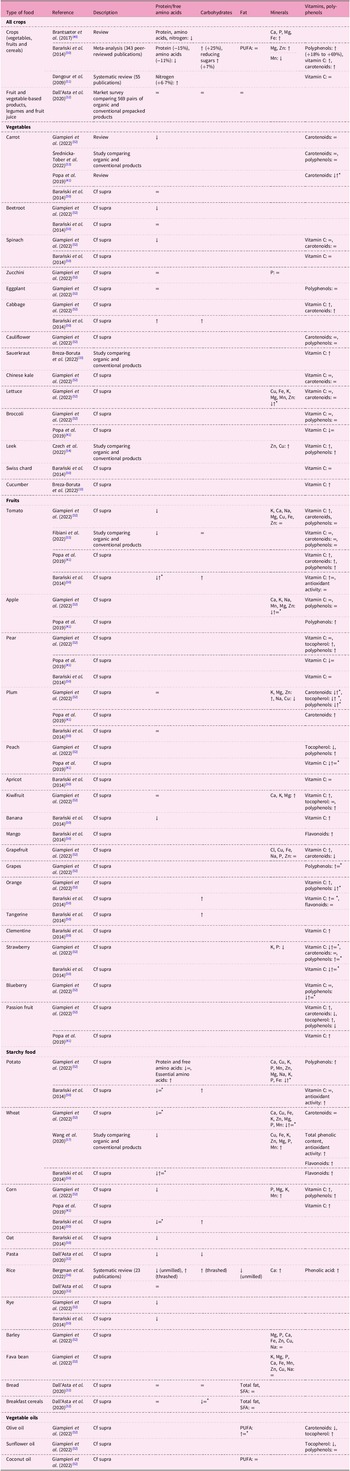
Reviews found some differences in nutritional composition of fruits and vegetables between organic and conventional food, as detailed in Table 3 and in Fig. 1 (Reference Dall’Asta, Angelino and Pellegrini32,Reference Breza-Boruta, Ligocka and Bauza-Kaszewska33,Reference Popa, Mitelut and Popa41,Reference Brantsæter, Ydersbond and Hoppin49–Reference Fibiani, Paolo and Leteo55) , as well as starchy food(Reference Dall’Asta, Angelino and Pellegrini32,Reference Popa, Mitelut and Popa41,Reference Barański, Srednicka-Tober and Volakakis50,Reference Giampieri, Mazzoni and Cianciosi52,Reference Bergman and Pandhi56,Reference Wang, Chatzidimitriou and Wood57) .
Nutritional content of organic food for main fruits, vegetables and starchy food compared with their conventional counterpart

↑, higher content. ↓, lower content. =, non-different content. PUFA, polyunsaturated fatty acids. SFA, saturated fatty acid.
* A literature review may report controversial results, with opposite symbols for the same reference.
In a meta-analysis of 343 peer-reviewed publications, organic vegetables, fruits and cereals were found to have an overall lower protein content compared with conventional crops (mean percentage difference −3·01 (95% confidence interval (CI) −5·18, −0·84)%), due mainly to cereals but not to vegetables and fruits, and a higher total carbohydrate content (mean percentage difference 1·54 (95% CI 0·10, 2·99)%) but other meta-analysis did not show any differences(Reference Barański, Srednicka-Tober and Volakakis50). Protein content in organic wheat flour was found to be 14–17% lower than in conventional wheat flour, but the better protein digestibility of organic wheat compensates for this difference(Reference Vrček, Čepo and Rašić58). Carbohydrate content in organic wheat flour was 81 versus 102 g protein/kg dry matter in conventional wheat flour(Reference Mazzoncini, Antichi and Silvestri59). PUFA did not differ. Phenolic compounds, carotenoids and vitamin C were higher or similar in organic crops compared with conventional crops.
In wheat, organic production methods may result in significantly higher antioxidants, polyphenols and Zn(Reference Barański, Srednicka-Tober and Volakakis50,Reference Rempelos, Almuayrifi and Baranski60) . Phenolic/antioxidant concentrations and activity (+10% to +33%), Phosphorus (P) (+42%), potassium (K) (+27%), magnesium (Mg) (+49%), manganese (Mn) (+51%), zinc (Zn) (+45%), copper (Cu) (+43%) and iron (+Fe) (16%) were higher in organic compared with conventional flour, but the influence of whole-grain compared with white flour was significantly more important, respectively +200–430%, +144%, +125%, +209%, +216%, +111%, +49% and +63% for these compounds(Reference Wang, Chatzidimitriou and Wood57). In the same study, Al and Ni concentrations were significantly higher (12% and 81%, respectively) in organic compared with conventional flour, but the concentrations remained low.
Recent reviews highlighted that the intensification of farming led to lower concentrations in phenols/antioxidants, Se and Zn in cereals, and phenols/antioxidants and minerals in fruits and vegetables(Reference Hasanaliyeva, Sufar and Wang36,Reference Rempelos, Almuayrifi and Baranski60) .
As mentioned for dairy products, the processes from culture in the field to home preparation are also important for crops, especially for polyphenols (particularly fertilisation management, soil biology and environmental pressure)(Reference Giampieri, Mazzoni and Cianciosi52). Comparing starchy food is difficult. Important differences in mineral content (Fe, Na, K, Mg, P, Zn and Cu) were seen according to organic wheat genotypes(Reference Hussain, Larsson and Kuktaite61,Reference Hussain, Larsson and Kuktaite62) . Wheat phenolic and mineral composition and quantity were more affected by milling fraction, with higher concentrations in the bran, than by farming system(Reference Wang, Chatzidimitriou and Wood57,Reference Mazzoncini, Antichi and Silvestri59) . Whole corn flour contained more crude protein (95 ± 3 g/kg dry matter) than starch (6·9 ± 0·1 g/kg dry matter), as well as crude fat (52·3 ± 1 g/kg dry matter and 2·3 ± 0 g/kg dry matter, respectively)(Reference Malumba, Boudry and Roiseux63). Wheat refining (removing most of the bran and germ) lowered mineral, vitamin and fibre content by 60–80%(Reference Aune, Keum and Giovannucci64). Another issue is that the nutritional content may widely fluctuate year on year (mainly due to weather variations and soil alteration), as for example for tomatoes regarding protein, carotenoids and ascorbic acid(Reference Fibiani, Paolo and Leteo55). Also, the time elapsed between harvesting and consumption leads to a rapid loss of nutritional quality, particularly in terms of vitamins. Vitamin C is used in both organic and conventional processed food as an additive for preservation, reducing the difference when products reach the market.
In conclusion, vitamin C, carotenoids and, to a lesser extent, Mg (4%) and Zn (5%) content is generally higher in raw organic than in conventional fruits and vegetables, whereas nitrate and protein content are generally lower in organic cereals (3%) than from conventional farming, which may have a little clinical relevance, even in the context of a limited animal protein diet, due to the likely better digestibility of organic crops(Reference Vrček, Čepo and Rašić58). The selection of traditional, older, longer-straw varieties in organic farming tends to produce higher grain protein concentrations(Reference Rempelos, Wang and Sufar65,Reference Murphy, Reeves and Jones66) . Another recent example exploiting favourable properties is the selection of wheat varieties (taller spelt) which contain higher concentrations of Se(Reference Daud, Rempelos and Cakmak67). The conclusion of Dall’Asta et al.(Reference Dall’Asta, Angelino and Pellegrini32) was a global non-superiority of organic food compared with conventional food concerning starch. In wheat, phenolic/antioxidant concentrations and minerals were higher in organic compared with conventional flour, but eating whole grain could be of greater interest.
Epidemiological studies and health outcomes
Most information in this field comes from observational studies, in the absence of long-term randomised controlled trials which would be extremely challenging to conduct. In children, none is available in the literature. Since the main driver to change diet for most consumers is health concern, the population who prefers organic food also tends towards a healthier or a Mediterranean diet and a healthier lifestyle (consuming less meat from animals raised in sustainable farming, more wholegrain, fruit and vegetables (containing antioxidants, etc.), practising more physical activity, etc.)(Reference Baudry, Péneau and Allès10,Reference Baudry, Méjean and Péneau68,Reference Eisinger-Watzl, Wittig and Heuer69) . Thus, many confounding factors interfere with the impact of organic food per se when comparing health outcomes in people consuming organic diet versus conventional diet. Another issue is the potential impact of pesticide exposure on metabolic and health disorders(Reference Barański, Srednicka-Tober and Volakakis50), beyond the specific nutritional effect (see Chapter 4·2).
Characteristics of the population consuming organic food and impact on their diet composition (Table 4)
In the longitudinal French birth cohort ‘Étude Longitudinale Française depuis l’Enfance’ (ELFE), with a follow-up of 9764 children, organic food was never consumed in 51% of infants and children under age 2, sometimes in 24%, often in 15% and always (or mostly) in only 9%(Reference de Lauzon-Guillain, Gaudfernau and Camier70). Higher organic food consumers among infants and children had an older mother, a lower pre-gravid maternal body mass index (BMI), a longer duration of breastfeeding, a later introduction to complementary feeding, a higher maternal education level and a higher household income(Reference de Lauzon-Guillain, Gaudfernau and Camier70). In the same cohort, the frequencies of organic and conventional food categories offered as complementary food were different for desserts (32% versus 25% respectively), meat-free dishes (35% versus 22%), meat dishes (26% versus 35%) and cereals (5% versus 14%)(Reference Payet, Adjibade and Baudry71). Within each dish category, the only difference between both categories was the total protein content, which was lower in organic meat dishes (2·9 versus 3·1 g/100 g)(Reference Payet, Adjibade and Baudry71). The overall nutritional composition showed lower total fat (1·7 versus 1·9 g/100 g) and protein content (1·9 versus 2·2 g/100 g). The higher fibre content (1·6 versus 1·3 g/100 g) observed in organic versus conventional food consumers may be related to the consumed categories of complementary food.
In the ‘Étude individuelle nationale des consommations alimentaires’ (INCA3) survey, studying a representative lifespan French sample of 1 775 children and adolescents (4–17 years), frequency of consumption of organic food was associated with higher parental educational level and higher family income and also with more frequent home-made processed food, dietary supplement consumption and a Mediterranean diet(Reference Gosling, Goncalves and Ehrminger72). Analyses were based on a questionnaire covering the past 12 months and may not be representative of the entire childhood dietary history, exposing to an inaccuracy due to recall bias, and should be interpreted with caution.
In the NutriNet-Santé web-based observational prospective survey launched in 2009, following 28 245 adults, higher organic food consumption was associated with a better adherence to the French nutritional guidelines(Reference Baudry, Allès and Péneau73). Higher proportion of organic food consumption was associated with a lower meat and a higher plant-food consumption. This resulted in lower intakes of SFA, added sugars and protein and in higher intake of PUFA and vitamins C and E(Reference Baudry, Pointereau and Seconda74).
Some differences without clinical relevance were found between organic and conventional food consumers for plasma concentration of Mg (0·84 (0·83, 0·85) versus 0·83 (0·82, 0·84) mmol/l, p = 0·01), β-carotene (1·09 (1·00, 1·19) versus 0·96 (0·86, 1·06) µmol/l, p = 0·04), linoleic acid (25·65 (25·12, 26·18) versus 24·73 (24·20, 25·26)% total fatty acids, p = 0·02), palmitoleic acid (1·84 (1·74, 1·95) versus 2·01 (1·91, 2·11)% total, p = 0·04, and docosapentaenoic acid (0·68 (0·66, 0·71) versus 0·73 (0·71, 0·79)% total, p = 0·02)(Reference Baudry, Ducros and Druesne-Pecollo75). Intakes of MUFA and α-linoleic acid were higher in organic compared with conventional food consumers, respectively 37·6 ± 14·5 versus 33·5±15·6 g/d (p = 0·004) and 1·67 ± 1·09 versus 1·46 ± 1·19 (p = 0·01). The authors concluded that such differences were likely to be more related to the dietary pattern rather than to the origin of food (organic or conventional).
Putative impact on health outcomes
Obesity/metabolic diseases (Table 4)
Epidemiological studies and health outcomes

BMI, body mass index. ELFE, étude longitudinale française depuis l’enfance; INCA3, étude individuelle nationale des consommations alimentaires; NHANES, National Health and Nutrition Examination Survey.
In the cross-sectional INCA3 study, in children and adolescents, taking into account confounding factors (socio-economic status, quality of the diet and physical activity), a high consumption of organic food was associated with a lower BMI (17·7 versus 18·7 kg/m2, p = 10−3), a lower prevalence of obesity (3 versus 5%, p = 10−2) and a trend towards a lower energy intake (1781 versus 1884 kcal/d, p = 0·054)(Reference Gosling, Goncalves and Ehrminger72).
In the ELFE cohort, organic food consumption frequency between 3 and 10 months was negatively associated with BMI z-score at 1 year and 5 years(Reference Ghozal, Camier and Heude76). After accounting for breastfeeding duration or infant feeding practices, a lower risk of overweight at 5 years was observed in children consuming almost always organic food versus those never consuming organic food (odds ratio 0·60, 95% CI 0·40, 0·90).
In the NutriNet-Santé cohort, a lower BMI was observed in higher organic adult consumers, and the risk of becoming overweight and obese was reduced in consumers of greater amounts of organic food (−23% and −31%, respectively)(Reference Baudry, Pointereau and Seconda74,Reference Kesse-Guyot, Baudry and Assmann77) . After adjustment for confounding variables, an association was shown only in women between a higher organic food consumption and a type 2 diabetes risk reduction (−35%). A reduction of 3% in type 2 diabetes risk was observed for each 5% increase in organic food proportion(Reference Kesse-Guyot, Rebouillat and Payrastre78). An independent association was found between lower dietary pesticide exposure and body weight gain in women, as well as a decrease in type 2 diabetes risk(Reference Berlivet, Payrastre and Rebouillat79,Reference Rebouillat, Vidal and Cravedi80) . Organic diet was associated with a 31% decrease in metabolic syndrome risk(Reference Baudry, Lelong and Adriouch81). In the National Health and Nutrition Examination Survey (NHANES) cohort, enrolling 8199 adults, after adjustment for age, gender, race/ethnicity, education, ratio of family income to poverty, family history of diabetes, smoking status, alcohol intake, physical activity, total energy intake, Healthy Eating Index-2010 and BMI, a lower prevalence of diabetes (−20%) was associated with purchase of organic food (a proxy for consumption)(Reference Sun, Liu and Du82). In a systematic review and meta-analysis of four studies (enrolling 104 488 adults), comprising the studies from Kesse-Guyot et al.(Reference Kesse-Guyot, Baudry and Assmann77) and Gosling et al.(Reference Gosling, Goncalves and Ehrminger72), consuming organic food was associated with a significantly lower risk of obesity (odds ratio 0·89, 95% CI 0·80, 0·97, p < 10−3)(Reference Bhagavathula, Vidyasagar and Khubchandani83). In another recent systematic review of longitudinal studies in adults, a higher organic food consumption was associated with a lower risk of metabolic syndrome and a lower risk of high BMI(Reference Vigar, Myers and Oliver84). Conclusions must be cautious due to highly probable unmeasured residual confounding factors, to the observational nature of the studies and to lifestyle factors of organic consumers.
Dietary pattern in high-organic-food consumers, with a higher proportion of plant-based food and a lower proportion of animal food, may underlie the protective association against metabolic diseases, obesity, cardiovascular disease and type 2 diabetes, leading to cautious interpretation of the observed relationship between organic diet and metabolic diseases(Reference Derbyshire85–Reference Kesse-Guyot, Lairon and Allès88). People from higher socio-economic categories (most organic consumers) better comply with nutritional guidelines, resulting in lower risks of obesity, cardiovascular diseases and type 2 diabetes. Moreover, mothers belonging to more privileged socio-economic categories breastfeed more often and longer, and the link between breastfeeding and lower risk of obesity is well known. Unmeasured residual confusion is highly probable.
In adults, the review from Vigar et al.(Reference Vigar, Myers and Oliver84) concluded that clinical trials with single or whole organic food (short time, from 2 to 4 weeks of supplementation) show no difference in blood/urine parameters (antioxidant activity, vitamin C, vitamin E, carotenoids) and in body composition.
Some contaminants may play a role in these observations. In the US observational Nurses’ Health Study, the NHS-II and the Health Professionals Follow-up Studies (170 142 US adults followed for up to 14 years), intake of low-pesticide-residue fruits and vegetables was inversely associated with risk of coronary heart diseases (0·92 to 0·81 from one to four or more servings per day), but intake of high-pesticide-residue fruits and vegetables was not associated with this risk(Reference Chiu, Sandoval-Insausti and Ley89). Several pesticides induce a disruption in the endocrine system, such as increased levels of glucose, increased insulin secretion and resistance, decreased levels of HDL-cholesterol and high levels of triacylglycerol, which may favour the development of obesity(Reference Skonieski, Silva and Fagundes90). The altered absorption of nutrients in the intestine and the altered energy storage may also contribute to the imbalance in weight regulation favoured by pesticides, mainly from the class of organochlorines(Reference Skonieski, Silva and Fagundes90). It may increase fat deposition and adipogenesis in adipocytes at different steps of lipid homoeostasis (gut, liver, adipocytes)(Reference Jiang, Peng and Sun91). Some authors consider that these endocrine-disrupting chemicals are an important factor in increasing obesity prevalence(Reference Skonieski, Silva and Fagundes90).
Nitrate has a special interplay with human metabolism. It is contained in both organic (in lower amounts) and conventional food, mostly in cold meats, but also naturally in vegetables. Nitrate content seems not to be influenced by the type of farming(Reference Vasco and Alvito92). It is used as additives in food for conservation, against microbial contamination and chemical changes(Reference Karwowska and Kononiuk93). Nitrate may have a positive role in energy metabolism homoeostasis by contributing to nitric oxide formation (regulating arterial blood pressure, inflammation and immune response) and microbiota equilibrium (used as a substrate)(Reference Bedale, Sindelar and Milkowski94).
Cancer (Table 4)
Literature is scarce in adults, and no study has been published in children or adolescents. In the NutriNet-Santé cohort (68 946 adults with 7 years follow-up), a higher frequency of organic food consumption was inversely associated with the overall cancer risk, with a 25% reduction in regular consumers of organic food compared with less regular consumers, and was inversely associated with postmenopausal breast cancer (high correlation with dietary pesticide exposure: components with chlorpyriphos, imazalil, malathion, profenofos and thiabendazole), non-Hodgkin’s lymphoma and all lymphomas(Reference Baudry, Assmann and Touvier95,Reference Rebouillat, Vidal and Cravedi96) . In a large prospective study of women in the United Kingdom, the overall cancer risk was not associated with the frequency of organic food consumption except a slightly higher risk of breast cancer, but a significant 21% reduction in the risk of non-Hodgkin’s lymphoma was observed(Reference Bradbury, Balkwill and Spencer97). A conflicting conclusion was found in the Danish Diet, Cancer and Health cohort, which followed 41 928 adults for a median of 15 years. Consuming organic food was associated with a lower incidence of stomach cancer but higher incidence of non-Hodgkin’s lymphoma, compared with people who never consumed organic food(Reference Andersen, Frederiksen and Hansen98). In the US observational Nurses’ Health Study, the NHS-II and the Health Professionals Follow-up Studies (150 830 women and 29 486 men adults followed for up to 14 years), intake of fruits and vegetables with low or high pesticide residue was not associated with cancer risk(Reference Sandoval-Insausti, Chiu and Lee99). Pesticide exposure could be different between countries affecting various mechanisms of carcinogenesis (DNA damage, functional damage through epigenetic mechanisms, etc.) or genetic characteristics of the two populations may be different(Reference Hernández-Verdin, Labreche and Benazra100). Further longitudinal studies are needed to clarify these conflicting results.
Nitrate, contained in both organic and conventional food, plays a role in carcinogenesis and may increase the incidence of gastric, colorectal, oesophageal, thyroid, renal cell and breast cancers. The mechanism involves endogenous nitrosation (nitrosamines) causing alkylation damage, which may cause DNA damage, DNA synthesis inhibition, cancer mutagenesis, cytotoxicity and genotoxicity(Reference Karwowska and Kononiuk93,Reference Bedale, Sindelar and Milkowski94) .
Mycotoxins, found mainly in vegetables and cereal products, are associated with cancer risk but also impaired growth and hepatic dysfunction(Reference Açar and Akbulut101). These compounds are in higher concentration in organic food since fungicides are not allowed in organic farming(Reference Trewavas102). Organic cereal baby food have a higher content of deoxynivalenol than conventional ones(Reference Herrera, Bervis and Carramiñana103). Children have proportionally a high part of their diet from these sources, which may expose to contamination, but no data are available on their impact. Infant formula contamination is very limited(Reference Mielech, Puścion-Jakubik and Socha17).
Allergy (Table 4)
In the ELFE cohort, in infants without cow’s milk protein allergy before 2 months of age, organic complementary food was associated with a higher risk of food allergy at 5·5 years of age, after adjustment for family and infant characteristics, and variables related to study design(Reference Payet, Adjibade and Baudry71). However, the existence of cow’s milk protein allergy or a family history of allergy was positively associated with organic food choice during the complementary feeding period, probably in relation to the healthier image of organic food compared with conventional food. This association might reflect ‘reverse causality’: a family history of allergy may prompt mothers to feed their children with organic food. No association was found for eczema and allergic respiratory diseases(Reference Payet, Adjibade and Baudry71).
The KOALA birth cohort in the Netherlands followed 815 children in the first 2 years of life. At 2 years of age, 27% of children were sensitised against at least one allergen. Consumption of >90% organic dairy products was associated with a 36% decrease in the risk of eczema in infants, but not organic egg consumption(Reference Kummeling, Thijs and Huber104). No other association between organic/conventional food and atopic disease was found. However, a recent review of longitudinal studies in adults found that higher organic food consumption was associated with reduced incidence of allergic sensitisation(Reference Vigar, Myers and Oliver84). The age of exposure could play a major role on the impact of these allergic sensitisation.
Eating organic diet for 5 d reduced urinary excretion of thirteen pesticides metabolites, including neonicotinoid, organophosphate, pyrethroid and 2,4-dichlorophenoxyacetic acid exposure, in US families in four locations, which, if organic diet is regularly consumed, may reduce asthma, allergic rhinitis and atopic dermatitis(Reference Hyland, Bradman and Gerona14).
Cross-sectional and prospective studies from population with anthroposophical lifestyle, which includes biodynamic food and regular consumption of fermented vegetables but also breastfeeding, home delivery, rural area living and limitation of medications (antibiotics and vaccinations), showed less atopy in children, fewer allergies in families and lower immunoglobulin-E sensitisation(Reference Alm, Swartz and Lilja105–Reference Stenius, Swartz and Lilja107). The specific diet and farm living of such a population are confounding factors for allergy risk, so the observed effects may not be associated with organic food consumption alone.
Lasty, pesticides authorised in the production of organic fruits and vegetables could contribute to allergy since plants are more stressed, which is a source of oxidation(Reference Smith-Spangler, Brandeau and Hunter108). In conclusion, the effect of organic food on allergy is controversial.
In brief, in epidemiologic observational studies, the evidence for a health benefit of organic food is still debated, but organic food consumption is associated with lower incidence of obesity, type 2 diabetes and metabolic syndrome. Results for cancer and allergy risk are still controversial. Some contaminants in organic food may be harmful. Further studies are needed to improve our knowledge in this area.
Discussion
Parents (and their children) consuming organic food have, on average, a higher education level and a higher income; organic food usually costs at least 15% more than conventional food(Reference de Lauzon-Guillain, Gaudfernau and Camier70,Reference Gosling, Goncalves and Ehrminger72) . Their choice is guided by a desire to consume a healthier diet, often enhanced by having a child in the family and the ability to afford the higher cost of organic food(12). Furthermore, organic consumers tend to adhere more to dietary guidelines and to have a healthier lifestyle. Such concerns are strong confounding factors when analysing the link between organic food intake and health.
Some differences in nutritional composition between organic and conventional food may be highlighted. Organic milk and dairy products may contain more PUFA, long-chain (LC) n-3 PUFA and vitamin E, whereas the n-6:n-3 PUFA ratio may be lower, which may be beneficial for children for brain development(Reference Hadders-Algra109). Organic meat, fish and eggs may contain less myristic and palmitic acids, less protein only in eggs, more PUFA and LC n-3 PUFA and a lower n-6:n-3 PUFA ratio. Consuming organic milk, dairy products and meat (∼50% higher n-3 PUFA concentrations) may aid in meeting the European recommendations to increase n-3 fatty acid intake, which is interesting to consider. However, an extensive grassland conventional farming system, particularly for long-chain n-3 PUFA could be the main explanation of the differences, more than organic farming(Reference Schwendel, Wester and Morel35,Reference Hasanaliyeva, Sufar and Wang36) . Organic farming does not increase cow’s milk iron content. Lower selenium in organic milk and dairy products (−20%) is probably without clinical relevance in most people, but because cereals are a major dietary source for Se; the culture of specific organic wheat varieties (taller spelt) with high concentrations of Se may help to increase Se intake, particularly in population from Northern Europe with low-Se soils(Reference Daud, Rempelos and Cakmak67). This may also be an interesting option for vegans who neither drink milk nor eat dairy products. The significantly lower iodine content in organic milk and dairy products (−74%) may be an issue in the populations who cannot obtain the main sources of dietary iodine, which are iodine-fortified table salt and sea food. In this situation, milk and dairy products are the main source of iodine and their lower amount in organic products may lead to iodine deficiency causing thyroid dysfunction and developmental delay early in life. Lower protein content may be beneficial for children, since European diets often provide amounts of proteins higher than recommended, with, in young children, a possible risk of obesity and alteration of renal function(Reference Chouraqui, Darmaun and Salmon-Legagneur110,Reference Patro-Gołąb, Zalewski and Kołodziej111) . Since recommendations for egg consumption by children are low, the lower protein content in organic eggs may have a limited impact. Organic fruits and vegetables may contain more carbohydrate, phenolic antioxidant compounds, vitamin C and carotenoids. In fruits and vegetables, using vitamin C for preservation in processed food reduces the difference in the final product. Slightly higher magnesium and zinc content in fruits and vegetables are likely clinically irrelevant, since the main sources of Mg and Zn in Western diets are of animal origin. In children with limited intake of animal food (Mediterranean diet, flexitarians, vegetarians or vegans), it might be interesting to consume more organic whole-grain cereals, containing more minerals(Reference Wang, Chatzidimitriou and Wood57). Last, organic cereals may contain less protein (but with increased digestibility) and energy as well as more minerals and phenolic compounds; only minor differences are reported and may have no impact in children.
In epidemiological surveys from countries with different dietary patterns, organic food consumption is associated with a lower prevalence of obesity in children, and lower prevalence of type 2 diabetes and metabolic syndrome in adults(Reference Gosling, Goncalves and Ehrminger72,Reference Baudry, Pointereau and Seconda74,Reference Kesse-Guyot, Baudry and Assmann77,Reference Baudry, Lelong and Adriouch81–Reference Vigar, Myers and Oliver84) . All studies presented are observational, leading to some limitations in interpretation due to the possibility of numerous confounding factors, such as differences in lifestyle, exercise level, meat intake and socio-economic status, which were adjusted by statistical methods. Considering that these results were observed in different countries, this may suggest an effect of organic diet on the incidence of obesity, type 2 diabetes and metabolic syndrome. Since these diseases are a public health problem, mainly in high-income countries, with major morbidities, mortality and substantial public costs, if these results confirmed that organic food intake may reduce their incidence and prevalence, national policies and health promotion programmes could consider increasing their promotion of organic food consumption. Finally, the effects on cancer and allergy are controversial.
A limitation to the nutritional interpretation of the consequences of organic food consumption is that pesticides and other contaminants interfere in the metabolic homoeostasis and cancer mechanisms, which makes it difficult to determine the specific role of the dietary profile. Further studies linking suspected contaminants or a combination of contaminants to the development of metabolic diseases, cancer and allergy are needed to better understand the underlying mechanisms and causality, which would be confirmed in epidemiologic studies.
Since the organic label implies a control only of the processes and not of the final composition, some contaminants from conventional agriculture with human health impact (for example, carcinogenesis) may be found and have higher concentrations in organic products: nitrates, mycotoxins, persistent organic pollutants, heavy metals, organochlorine pesticides, cyclodienes, hexachlorocyclohexanes, hexabromocyclododecane, hexachlorobenzene and non-brominated flame retardants(Reference Ramakrishnan, Maddela and Venkateswarlu112). A microbial hazard was also reported(Reference Harvey, Zakhour and Gould113–Reference Dervilly-Pinel, Guérin and Minvielle115). This probably implies a human health risk even when consuming mostly organic food. Hence, in this regard, food aimed at infants and children below the age of 3 years according to the EU regulation, may present a specific interest for this population.
This review shows that the conclusions about the nutritional value of organic food are limited because of many factors. The regulatory principles of organic farming show national and even regional differences and peculiarities in their implementation. Unfortunately, no organisation has listed the national or regional implementing decrees of European organic farming. When studying/comparing the nutritional value of these organic products, every step of processing is influential, making comparison between studies difficult, because these aspects are generally not documented. These steps include climate and soil variability, agricultural practices, strain and animal and plant genotype, type of fertilisation, extensive or intensive type of animal husbandry, animal diet and home preparation of food, all of which can affect the nutritional value of food(28).
It is of great interest to focus research on children, to study the effects on growth and later health status. More surveys in various countries with different lifestyles and cultural settings may be interesting, but international prospective cohort studies lasting for several years, which take into account diet profile but also lifestyle (smoking, physical activity, etc.), people’s characteristics (children and adults, gender, etc.), socio-economic status and exposure to contaminants could be of greater interest, although difficult to conduct.
Summary and recommendations from the Nutrition Committee of the French Pediatric Society (CN-SFP)
-
Current EU regulations on the composition of food intended for infants and young children under 3 years of age are more stringent than those for organic food. Therefore, the CN-SFP considers that organic food specific for this age group is equivalent to conventional infant and young child food from a nutritional standpoint.
-
For children beyond 3 years, the nutrient content in organic food is overall similar to that of conventional food. A specific point can be made in Western countries on the lower protein content of organic eggs and cereals, and in any country on the higher vitamin C and polyphenol content in fruits and vegetables with their antioxidant properties and a higher n-3 and lower n-6:n-3 PUFA ratio in organic dairy products and meat/fish. Under specific conditions (when iodine-supplemented salt is not available and/or soils are poor in Se), reduced iodine and Se concentrations in organic milk and dairy products could be an issue.
-
From epidemiologic studies, organic diet may lower the risk of obesity, type 2 diabetes and metabolic syndrome. The effects of organic food on allergy and cancer are controversial.
-
Despite preliminary evidence for an overall health benefit of organic food in children, organic certification cannot currently ensure a better nutritional value regarding macro- and micronutrient content.
-
Beyond nutritional aspects, organic food consumption may be important in terms of sustainability and level of food contaminants, recommending its consumption seems legitimate, provided such food is affordable.
Conclusion
There is evidence that some organic foods have a better nutritional value than conventional food for children. More evidence is required on the positive effects on health, but in observational studies, obesity and metabolic disorder prevalence was lower in populations consuming organic diet. Organic dairy products and meat/fish, likely due to extensive grassland conventional farming system, may be preferable for children, especially due to their higher content in long-chain n-3 PUFA, which are involved in neurodevelopment, and their lower n-6:n-3 PUFA ratio. Reduced iodine and Se concentrations in organic milk and dairy products could be an issue in populations excluded from sufficient natural or supplemented intake. The lower protein content in organic eggs and cereals could be beneficial for Western children, as the European diets often provide higher-than-recommended amounts of protein, which may be harmful in young children, but its putative beneficial effect on health is probably limited, given the small differences observed. Vitamin C, carotenoids and some minerals (Mg, Zn, Ca, P, Fe) contents are often higher in organic crops, which may help to cover children’s needs, as may whole-grain crops.
The dietary pattern is of great importance for a healthy diet in children and in adults, and consideration should be given to favouring a diet richer in fruit, vegetables, legumes and whole-grain cereals, and lower in meat and highly processed foods. Considering that most children do not exclusively consume organic food and that most differences observed so far are of limited importance, the aim of consuming organic food to improve the nutritional value of the diet may be difficult to achieve. It should be noted that, for food intended for infants and children under 3 years of age, the existing EU regulations regarding nutrient composition and levels of contaminants are so strict that the choice of organic baby food beyond this certification may provide no advantages.
Overall, organic food offers enormous advantages in terms of sustainable development, and the limitation of contaminants has a direct impact on health, although an indirect influence through ecological benefits can also be discussed. Even if the difference is greater for meat (the consumption of which should be reduced) than for fruits and vegetables, organic food remains more expensive than conventional food and the economic costs are an issue that needs to be considered in public health nutrition guidelines.
The CN-SFP has no nutritional argument against organic food. Our review suggests that organic food is safe for children. In fact, it would recommend organic food for children because of the lower contaminant content and their possible beneficial effect on health, taking into account economic aspects. Standardised protocols for comparative studies on food composition are needed.
Authorship
A.D.L. and J.-P.C. contributed to the study conception and design. A.D.L., A.Bo, M.C., C.D. and J.-P.C. contributed to the data collection and analysis., A.D.L. wrote the original draft of the manuscript and all authors contributed to critical revisions of the article. All authors contributed to the final reading and approval of the manuscript.
Financial support
This research received no specific grant from any funding agency, commercial or not-for-profit sectors.
Competing interests
The authors declare none.




 Open access

