





Dietary interventions aiming at increasing the availability of healthy or sustainable meals, for example, plant-based or vegetarian meals, were found to be effective in various settings, such as workplaces, schools and supermarkets(Reference van der Put and Ellwardt1–Reference Garnett, Balmford and Sandbrook3). For instance, a year-long large-scale series of observational and experimental field studies has shown that doubling the proportion of vegetarian meals offered increases vegetarian sales by between 41 % and 79 %(Reference Garnett, Balmford and Sandbrook3). Another natural experiment conducted in supermarkets found that average weekly unit sales of plant-based products increased significantly with 52 % (95 % CI 51 %, 55 %) during the 1-month intervention with increased availability of plant-based products(Reference Trewern, Chenoweth and Christie2).
Among those interventions that successfully increased the consumption of plant-based products, there was no evidence for any sustained change beyond the intervention period and context(Reference Pechey, Bateman and Cook4). On the other hand, changes beyond the intervention period and context were often not evaluated(Reference Verfuerth, Jones and Gregory-Smith5–Reference Verfuerth, Gregory-Smith and Oates7). The change beyond the intervention period and context is often referred to as the spillover effect of the intervention, while the change during the intervention period and context is the direct effect of the intervention. To our knowledge, it is still not well-understood to what extent and how targeted behaviour changes directly related to interventions can be sustained outside intervention contexts(Reference de Boer and Aiking8). Despite the importance of sustained change beyond the intervention period and context, evaluation of the spillover effects is challenging because of the restricted timeframe, human resources and methodological limitations(Reference Michie, West and Sheals9).
The assessment of dietary behaviour change beyond the intervention period and context remains complex as daily dietary behaviour happens across several locations and network settings (e.g. home and restaurant, with family and friends) and is related to factors at individual, interpersonal and contextual levels(Reference Bruner and Chad10). The majority of research on factors related to any behaviour change has relied on more simplistic statistical directed acyclic graph (DAG)-based association studies applied to observational data(Reference Arnold, Harrison and Heppenstall11). More importantly, such methodological limitation fails to capture the dynamic interactions between individuals (e.g. the effects of one’s social networks) or the dynamic interactions between individual and contextual factors (e.g. feedback loops between dietary behaviour of individuals and the type of eating location and eating episode).
Agent-based modelling (ABM) is a promising tool to help with the methodological limitation because it can model the interaction between heterogeneous individuals embedded in a given social structure, where macro-level outcomes are studied as dynamic consequences of individual interaction and individual–environment interaction. Unlike DAG-informed regression modelling that considers the linear relationships, ABM focuses on largely unpredictable, unforeseen, unplanned aggregate outcomes due to non-linear causal relationships between interacting agents(Reference Badham, Chattoe-Brown and Gilbert12). ABM can also integrate both qualitative and quantitative data into one model and provide insight into how a system would behave according to different policy scenarios or behaviour rules. To our knowledge, applications of ABM to the study of dietary behaviour are limited(Reference Davis, Dermody and Koetse13–Reference Blok, de Vlas and Bakker16). Moreover, the spillover effects beyond the intervention period have not yet been studied.
We developed an ABM to simulate an individual’s dietary behaviour within hypothetical interventions at workplace canteens and beyond intervention settings. The model was calibrated to existing data and theories. We illustrate the utility of this approach by applying the model with the aim to understand whether and how the spillover effects beyond intervention settings can occur.
Methods
The ABM was developed following the Overview, Design Concepts and Details, plus Decision (ODD + D) protocol, a standardised framework that enhances transparency and reproducibility in ABM documentation(Reference Müller, Bohn and Dreßler17). A detailed ODD + D model description is provided in the Supplementary Materials (see online supplementary material, Supplemental Model).
Agent-based model
We turned to a large body of extant qualitative and quantitative descriptive literature to design an ABM that meaningfully represents the dynamic system of factors that drive adults’ dietary practices. While a formal systematic review was not conducted, the literature informing model development was selected based on relevance to adult dietary behaviour and the quality of evidence. The ABM simulated the complexity of dietary practice that is influenced by intrapersonal (e.g. dietary identity, habituation), interpersonal (eating network) and contextual (dietary intervention, eating location) factors.
The qualitative concepts were inspired by the theory of practices and identity process theory(Reference Frezza, Whitmarsh and Schäfer6). According to the theory of practice, spillover in the context of dietary practice depends on the practice bundle, which is indicated mainly by the habituation parameter in this ABM(Reference Frezza, Whitmarsh and Schäfer6). It was shown that consumers with lower levels of meat attachment are more inclined to change their meat dietary pattern away from meat-rich habits, whereas consumers higher in meat attachment appear to eat meat more often, have stronger preferences for meat and are less likely to restrict meat eating and to change towards a more flexitarian diet(Reference Graça, Calheiros and Oliveira18,Reference Possidónio, Prada and Graça19) . Spillover in the identity process suggests that engaging in a practice can shape one’s identity, which is dynamic and may sometimes conflict with existing practices in different settings. This process often involves negotiation with others in one’s social network(Reference Frezza, Whitmarsh and Schäfer6). We assume that individuals have a dynamic dietary identity that can change under certain circumstances (see online supplementary material, Supplemental Figure S2). The higher the habituation to a dietary identity, the less likely an individual is to be influenced by other factors when choosing a meal (see online supplementary material, Supplemental Table S8).
Quantitative observational studies have shown that repetitive exposure to a dietary intervention would often yield effects on the motivation, intention or actual behaviour change of the participants; however, heterogeneity exists in the degree of change and direction of changes(Reference Craig20). Dietary consumption beyond intervention settings (‘e.g. consumption at home, with an intervention at work settings’) is related to, among other factors, one’s own motivation to consume certain types of meals, the motivation of one’s social network, the eating location and the eating episode and time (weekends and weekdays)(Reference Horgan, Scalco and Craig21). Overall, when one is eating alone, one’s dietary choice would mostly be in line with one’s current dietary identity, for example, vegetarian, pescatarian, flexitarian and omnivore(Reference Horgan, Scalco and Craig21,Reference Einhorn22) . Dietary identity corresponds to the percentage of plant-based protein intake relative to the total protein intake of a meal: ≥ 90 % is classified as a ‘vegetarian meal’; 60–90 % as a ‘pescatarian meal’; 30–60 % as a ‘flexitarian meal’; and < 30 % as an ‘omnivore meal’. When dining with family members or friends, one tends to assess the average opinion of the eating network of the day, and the majority of the individuals would follow the preference of the majority. Vegetarians, by definition, only eat plants and can often not adapt to the choice of the eating social network(Reference Einhorn22–Reference Ge, Scalco and Craig24). Moreover, for non-vegetarians, individuals would be more inclined to consume meat-based meals when dining at a restaurant or using meal delivery services, compared with cooking at home(Reference Verfuerth, Gregory-Smith and Oates7,Reference Biermann and Rau25) . When not eating at home, the influence of the eating social network would also be less(Reference Horgan, Scalco and Craig21). In this ABM, vegetarians always choose a vegetarian meal, while non-vegetarians generally follow the dominant dietary identity of their eating network but are less likely to do so when not dining at home (online Supplementary Materials, Supplementary Methods, Behaviour rules and decision-making).
The conceptual model (Figure 1) was developed based on the literature search of qualitative theories and quantitative studies described above, together with input from in-house experts. The model design was reviewed by a public health nutritionist, dietary behaviour expert and computational modelling expert and subsequently informed the model process overview (see online supplementary material, Supplemental Figure S3).
Conceptual figure of the agent-based modelling design.
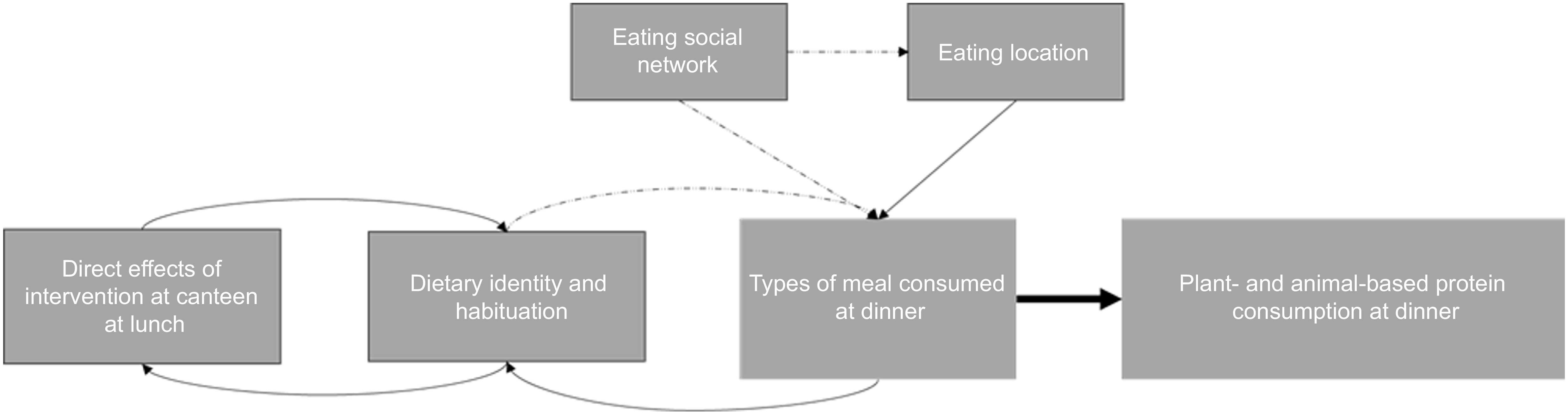
The ABM starts to simulate the direct effect of an intervention (intervention effect size) at workplace canteens during lunch time. The output of the intervention effect is indicated by a randomly selected number of non-vegetarian employed adults consuming a vegetarian meal. The spillover effect is indicated by the plant- and animal-based protein consumed outside the intervention setting, that is, at dinner time and a dining place, for all adults.
Dutch National Food Consumption Survey and agent-based modelling
We drew data from the Dutch National Food Consumption Survey (DNFCS) 2012–2016 to parameterise and test our ABM. The DNFCS monitors the food consumption and intake of energy and nutrients of the general representative Dutch population. Between 2012 and 2016, 1368 adult participants aged 18–65 years were recruited for a food consumption survey. The consumption data were collected by means of general questionnaires and through two non-consecutive 24-h dietary recalls (using the computer-directed interview programme GloboDiet, previously called EPIC-Soft)(Reference van Rossum, Buurma-Rethans and Dinnissen26). These data contain participant characteristics, consumption data on food, beverages, supplements and nutrients by participant, food(sub)groups, food consumption occasion and location. The initial dietary habit at the time of the survey was also recorded. Subsequently, the animal- and plant-based consumption across eating locations and eating episodes can also be drawn from the survey. A relevant participant flowchart and how the data inputs were retrieved from DNFCS 2012–2016 are included in the Supplementary Materials (see online supplementary material, Supplemental Model parameterisation and initialisation).
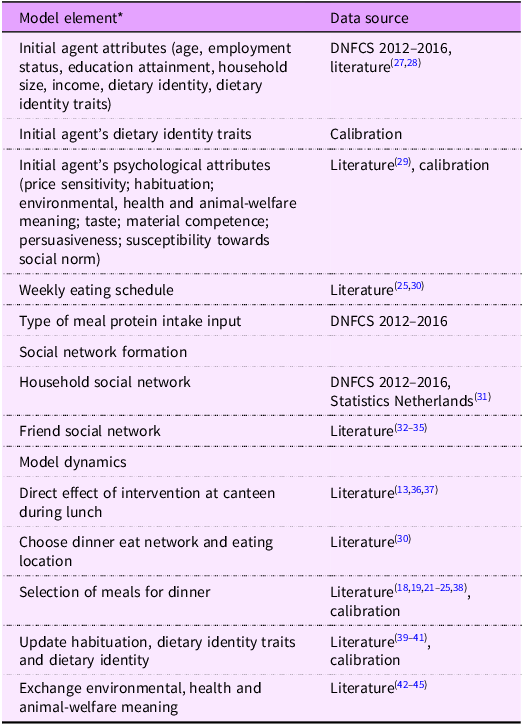
We built a model that characterised consumption for a simulated population based on participants from the DNFCS 2012–2016 aged 18–65 years. Simulated meal consumption during dinner time was a dynamic function of the direct effect of intervention at the workplace, habituation of current dietary behaviour, eating social network, eating location and eating episode (lunch and dinner). Wherever possible, we parameterised the model elements using DNFCS data either directly or through calibration. As necessary and appropriate, we supplemented the DNFCS data with additional data and previous literature (Table 1). Our model was implemented in NetLogo 6.4.0, and we summarise the model in the following and describe it in full detail in Supplementary Materials (see online supplementary material, Supplemental Model parameterisation and initialisation).
Summary of model parameterisation in the dietary intervention spillover effects agent-based modelling

DNFCS, Dutch National Food Consumption Survey.
* Detailed descriptions of data sources and literature supporting each model element are provided in the online supplementary material, Supplemental Behaviour rules and decision-making.
Model initialisation
Agents in our models were all individual adult participants aged 18–65 from the DNFCS 2012–2016 (n 1368). At the baseline setup, every agent had a dietary identity either self-reported from the survey (vegetarian and pescatarian) or probabilistically assigned according to literature (flexitarian and omnivore). We begin the simulation on intervention day 1 on Monday (a working day). We probabilistically assigned agent attributes if not reported in the DNFCS and set associations based on parameters summarised in Table 1 and detailed in Supplementary Materials (see online supplementary material, Supplemental Model parameterisation and initialisation).
Model dynamics and individual behaviour
Throughout each simulation, we simulated the model up to 3 years, which is equivalent to 1095 timesteps in the model. We intended to model beyond the typical dietary intervention duration that rarely goes beyond 24 months(Reference Ashton, Sharkey and Whatnall46). The 3-year timeframe was chosen based on stability tests and in consultation with in-house modelling experts to ensure that it captures key dynamics of the intervention effects (see online supplementary material, Supplemental Stability test). Each time step represents 1 d, and the intervention takes place on all weekdays. During the day, agents’ meal choices will be recorded for lunch and dinner. On weekdays during lunch, employed non-vegetarians are exposed to workplace canteen interventions designed to promote plant-based protein consumption. These interventions, which restructure the food environment to encourage vegetarian choices, are modelled by assigning a percentage of randomly selected non-vegetarians to consume a vegetarian meal based on the intervention’s effect size. The spillover effects were modelled as the influence from the lunch choice to the dinner meal selection. The following additional dynamics were also incorporated besides the individual-level dietary identity and habituation being influenced by the intervention:
-
1. Social influence from household or friend network: We characterised the eating social network influence on an individual’s meal selection as a ‘follow-the-average’ mechanism based on the dietary identity of the current eating social network. Except for those who were already vegetarian, the rest of the agents are inclined to choose according to the dominant dietary identity in the current eating network.
-
2. Situational influence: Together with the eating network, the eating location/situation is defined as eating at home, restaurant or using meal delivery services. At home, individuals with a non-vegetarian default diet follow the dominant dietary identity trait of their current eating network. When eating out, their probability of following the dominant dietary identity trait depends on the degree of habituation of their current default diet.
-
3. Temporal influence: To mimic the real-life setting, the direct influence from the intervention would be paused on weekends, and the dinner meal selection process would be repeated twice.
The rationale and specific characterisation of these dynamics were based on data sources summarised in Table 1 and detailed in Supplementary Materials (see online supplementary material, Supplemental Behaviour rules and decision-making).
Output measure
The outcome of the ABM is the percentage of plant-based protein intake in the total protein intake from the last month (last thirty timesteps) of the intervention period for all agents in the model, which is considered a proxy of habitual dietary behaviour often measured in real-life dietary instruments.
Model usage and intervention effects
The aim of the model is to investigate if and to what extent the spillover effects would occur after the direct effect of any form of interventions that target non-vegetarians. The effect size of the interventions is abstracted as the percentage of non-vegetarian employees who consumed a vegetarian lunch on a weekday. First, we identified a ‘baseline’ (i.e. no intervention or effect size of intervention = 0) condition with parameter values taken from the DNFCS, literature and calibration (Table 1); parameter selection processes and specific parameter values are detailed in Supplementary Materials (see online supplementary material, Supplemental Methods and Results). We compared simulated baseline consumption to that observed in the DNFCS to assess whether and to what extent our model reproduced real-world patterns. Second, we applied the model experimentally, varying the direct effect size of the intervention, that is, the percentage of non-vegetarian employees being influenced by the intervention by consuming a vegetarian meal on each weekday. Each condition was defined by changes of effect size per 10 % increment until 100 %, and the outcome measured after 1095 timesteps was compared. We also checked at which point the percentage of plant-based protein consumed during dinner starts to be significantly different from the equivalent timepoint of the scenario without intervention.
To reflect variability in the stochastic parts of the ABM, we conducted ten simulation runs under each increment of intervention effect size based on the results of the stability test (see online supplementary material, Supplemental Methods: Stability test). To aid in interpretation, we calculated the intervention impact in terms of distributions of average monthly consumption of relative plant-based protein to total protein consumption across repeated simulation runs. In other words, for each simulation run, we output the average per-agent percentage of plant-based protein consumption in the last thirty timesteps and then take the average of the total population. We then conducted Welch’s two-sample t test comparisons of distributions of average monthly percentage of plant-based protein consumed across fifty repeated runs under each intervention increment to fifty repeated runs of the baseline condition to derive estimates of intervention impact means and 95 % CI.
Results
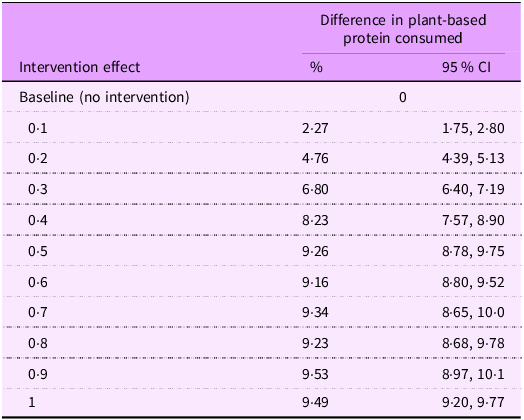
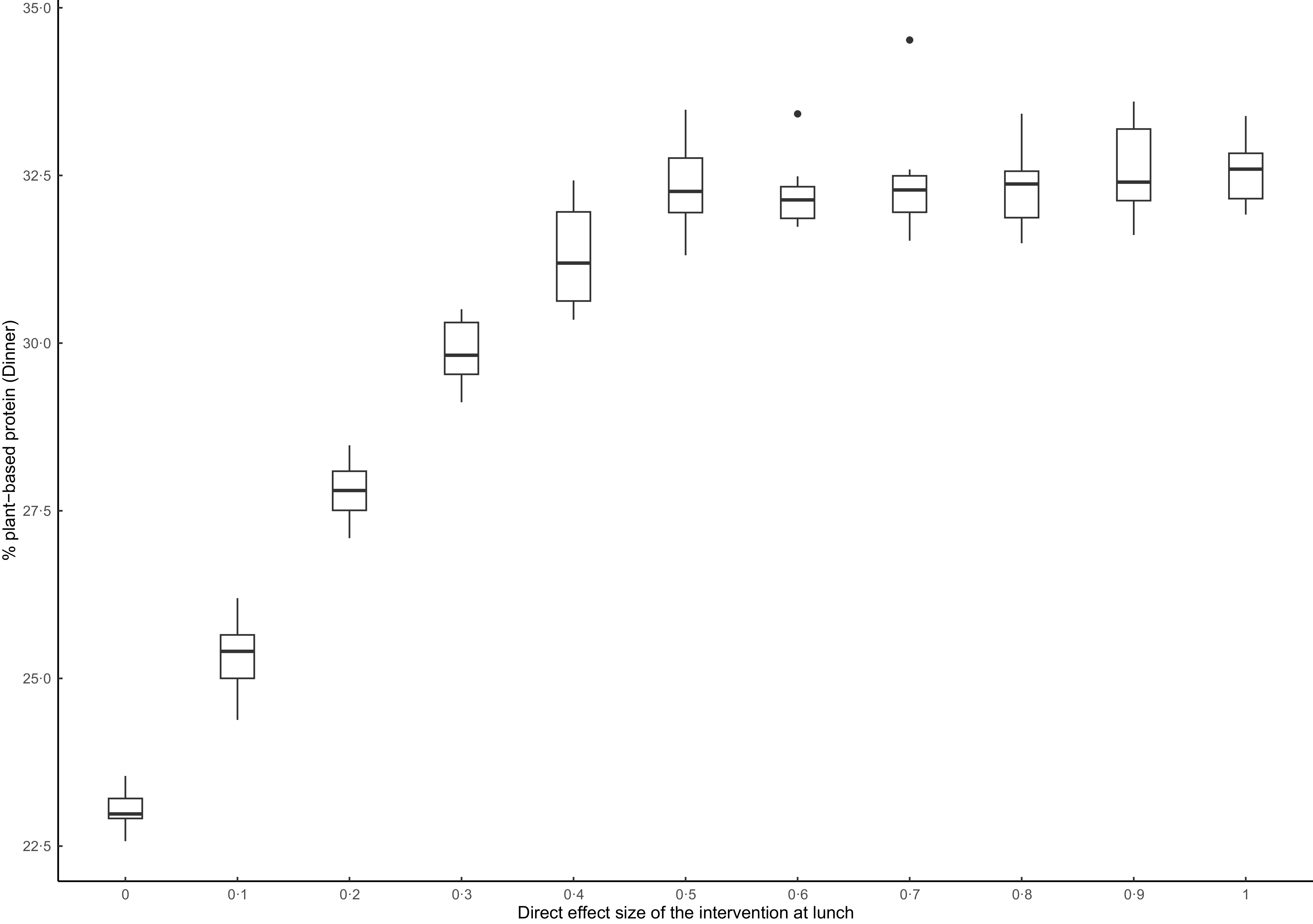
Overall, we found that interventions at workplace canteens during lunch had positive spillover effects on the plant-based protein consumed during dinner. If every workday, every employed non-vegetarian person consumed a vegetarian lunch at the workplace canteen, the percentage of plant-based protein consumed at dinner time increased 9·49 % (95 % CI 9·20, 9·77) compared with a baseline condition where only vegetarians, either employed or not employed, would consume a vegetarian lunch (Table 2). When only half of the employed non-vegetarians consumed a vegetarian lunch at the workplace canteen, this would yield an increase of 9·26 % (95 % 8·78, 9·75) of plant-based protein consumed during dinner. Model estimates suggested that the spillover effect of an intervention from the workplace to home settings was non-linear in nature. Figure 2 shows a spectrum of direct intervention effect sizes from interventions that increased vegetarian lunch consumption from the workplace setting, ranging from 0·1 to 1, meaning 10–100 % of the employed non-vegetarians consumed a vegetarian lunch every day. At baseline, the percentage of plant-based protein consumed at dinner at home was 23·0 % (95 % CI 22·9, 23·2). With the increase of the direct effect of the intervention at the workplace canteen from 0·1 to 0·5, the percentage plant-based protein consumed at dinner increased linearly to 32·3 % (95 % CI 31·8, 32·8). From the direct effect size of 0·5–1, there was no significant increase, and the percentage of plant-based protein consumed seemed to reach a plateau (Figure 2).
Differences in percentage plant-based protein consumption of baseline condition and across varying workplace interventions effect sizes generated from the dietary intervention spillover effects agent-based modelling

Boxplots denote the mean and sd of the percentage of plant-based protein consumed during dinner time across repeated runs under different intervention effect sizes (generated from the dietary intervention spillover effects agent-based modelling) during lunch at workplaces. A direct effect size of 0 % corresponds to the baseline condition.

Additional results, including those from sensitivity analyses, are included in Supplementary Materials (see online supplementary material, Supplemental Results Figs. S5–S13). Sensitivity analyses indicated that the initial number of flexitarians, frequency of self-reflection on intervention exposure, frequency of exchanging information within social networks and the value of the habit formation plateau influenced model outcomes. A higher baseline number of flexitarians led to a stronger cross-contextual spillover effect (Figure S5), while less frequent self-reflection on intervention exposure reduced this effect (Figure S9). The frequency of social network interactions had only a minor impact compared with other factors, with less frequent exchanges leading to a smaller increase in plant-based protein consumption at dinner (Figure S10). Additionally, while habit formation plateaus between 54 and 126 d showed no significant differences, shorter plateaus (< 54 d) were associated with a weaker increase in plant-based protein consumption (Figure S11).
Discussion
Using the ABM to simulate how individuals with different dietary identities respond to dietary interventions, we investigated how and to what extent spillover effects beyond direct dietary interventions can occur. More specifically, this ABM helps to understand how the spillover effect can occur with increased plant-based protein consumption beyond the dietary intervention settings (i.e. at work, at lunch). The ABM drew from nationally representative consumption survey data, existing literature and open source databases. Model parameterisation and theoretical grounding ensured that the model has a high explanatory power(Reference Verfuerth, Jones and Gregory-Smith5). Given that spillover effects in dietary behaviour change have received very limited empirical attention and can be rather challenging and impractical to observe from existing interventions(Reference Verfuerth, Jones and Gregory-Smith5,Reference Verfuerth, Gregory-Smith and Oates7,Reference Juhl, Fenger and Thøgersen36) , we believe that our model can be a useful tool for prospectively providing guidance to policymakers and intervention designers.
Using the ABM, we experimented with how an intervention at the workplace canteen during lunch can lead to a change at home during dinner, meaning the spillover effect. We simulated a multitude of direct intervention effect sizes for workplace intervention during 3 years. The results showed that spillover does occur from workplace lunch to dinner at home. Moreover, the magnitude of the spillover effect was positively correlated with the magnitude of the intervention effect size. However, the nature of the correlation was not linear; it reached a plateau after the direct effect size reached 0·5, meaning 50 % of the non-vegetarian employed individuals consume a vegetarian lunch at work on a daily basis.
Our results showed that an intervention that targets a specific setting, that is, the workplace canteen during lunch, can have sustained effects outside the intervention setting. However, the magnitude of these effects appears limited, likely due to the social, situational and temporal influences(Reference Horgan, Scalco and Craig21,Reference Ge, Scalco and Craig24) . To our knowledge, interventions that target dietary behaviour are mostly implemented in a setting outside the home, such as the workplace and school(Reference Kwasny, Dobernig and Riefler47,Reference van der Put48) . This is probably because such interventions are easier to implement or study. Our research suggests that a context-specific approach, in which we target the food environment in a specific setting and evaluate a larger eating environment, may show more effect due to positive spillover effects, even though the influence of social interactions appears to be limited. Thus, investment of resources into identifying such strategies is merited. Additionally, there seems to be a tipping point where the positive spillover effects reaches its plateau; thus, allocating resources and ensuring the direct effect of interventions around the tipping point might help effectively and efficiently maximise the desired positive spillover effects. Interestingly, the initial amount of flexitarians in the population might exacerbate the magnitude of positive spillover effects. Hence, promoting a flexitarian diet could be an intermediate indicator and step towards plant-based diet transition (see online supplementary material, Supplemental Results Figure S5).
The outputs stemming from the experiments using this ABM might provide directions for future intervention design. First, one can use this model to estimate the extent of the potential spillover effect given the measured and observed direct effects from a dietary intervention at a setting similar to a workplace canteen lunch meal. Second, the spillover effect may have a limit, so maximising the intervention’s effect size may not be the most cost-effective approach. Nevertheless, the results derived from ABM experiments are not intended to make decisions for policymakers directly; rather, they provide an additional piece of evidence to complement other forms of evidence. It remains essential to integrate insights from other relevant studies to support comprehensive decision-making.
Limitations and future research
The designed ABM tried to capture the complexity of the real-life behavioural changes as much as possible, but it is still a simplified model as we were not able to capture every single possible factor influencing dietary behaviours. For example, we simulated the intervention for 3 years, and the duration might not be feasible in real-life settings. It is also assumed that every employed individual agent would go to work and eat at the workplace canteen on weekdays, while in the Netherlands, not every company or institution has a workplace canteen. Meanwhile, while the option to work from home existed prior to the COVID-19 pandemic, it has become significantly more common and widely accepted since the pandemic. Therefore, one would expect even smaller positive spillover effects. Next, the input data of the designed ABM were not from a single population dataset but from a combination of open source data and literature. The results may not be generalisable to populations with different demographics, sociocultural contexts or geographic environments. Moreover, based on the sensitivity analyses, the output of the model (spillover effects) is sensitive to the input parameters, notably the initial amount of flexitarians in the population, the formation of habituation and the frequency of self-evaluation of the intervention (see online supplementary material, Supplemental Results Figs. S5–S13). Lastly, the innovative purpose of the ABM and research questions makes it hard to validate with existing scarce empirical evidence.
Recommended future research includes conducting real-life experiments to study spillover in dietary behavioural changes and to measure as many variables as possible to better estimate model parameters. The current ABM can also be updated with new input data from real-world empirical studies, with the added benefit that the model provides an opportunity to iteratively increase its sophistication. Additionally, the ABM can be extended to incorporate more factors to better capture the complexity and dynamics of dietary behavioural change after interventions, including work-from-home dynamics and the role of children in dietary decision-making. Alternatively, a supplementary, similar ABM could be developed focusing on a specific aspect of the dynamics that influences dietary behaviour, for example, how friend networks impact an individual’s dietary identity after exposure to a dietary intervention.
Beyond the current ABM, the successful application of this technique demonstrates its significant potential as a versatile tool in public health nutrition research to model interactive individual changes to aggregated and emerging population-level changes. The ABM offers a unique lens and can be used by researchers for prospective policy testing as a low-cost, low-risk virtual laboratory to evaluate a wide array of hypothetical dietary interventions before deploying them in the real world(Reference Colasanti, MacLachlan and Silverman49). In addition, ABM can be used to identify key drivers of change; in other words, researchers can use their models to pinpoint which parameters have the largest impact on population outcomes, helping policymakers optimise resource allocation by focusing on the most influential factors.
Conclusion
With a specific focus on the dietary intervention, which targets the increased consumption of plant-based protein, we observed in our simulation that the plant-based protein consumption (%) at dinner also increases, with the increase of the direct effect size at lunch time. However, the marginal increase eventually levels off, reaching a plateau. In other words, the positive spillover effects do occur, but the magnitude of the spillover effects does not increase linearly with the increase of the direct effect; instead, it levels off. The application of the ABM offers an innovative computational lens to understand complex dietary behaviour changes. Together with other empirical evidence, it has the potential to guide the design and implementation of future interventions to tackle public health nutrition challenges(Reference Tracy, Cerdá and Keyes50). The use of ABM allows us to build upon various types of data and mechanistic insights to understand complex systems in a structured way. Based on the successful application of the ABM in the present study, we suggest that researchers, intervention experts, policymakers and other stakeholders acknowledge the complexity of dietary behaviour change and consider the tipping point at which the maximum spillover effects of dietary behaviour change can be achieved across contexts.
Supplementary material
For supplementary material accompanying this paper, visit https://doi.org/10.1017/S1368980026102018
Availability of data and materials
The agent-based model code and the corresponding ODD + D model protocol documentation have already been peer-reviewed and are available on the Network for Computational Modeling in the Social and Ecological Sciences (CoMSES Net) platform with an open access GPL-3·0 licence: https://www.comses.net/codebase-release/587eae0b-fbf5-4c39-8289-aca07c91e4a7/ (see online supplementary material, Supplemental Model). The DNFCS data are available upon request for some research purposes.
Acknowledgements
The authors wish to acknowledge all the study participants of the DNFCS. They would also like to acknowledge the feedback provided by Jeljer Hoekstra in the ABM design process.
Authorship
Y.Z. Conceptualisation, Methodology, Software, Validation, Formal analysis, Investigation, Data curation, Writing – original draft, Visualisation, Project administration. M.C.O. Conceptualisation, Methodology, Resources, Writing – review & editing, Supervision. E.V. Conceptualisation, Resources, Supervision, Writing – review & editing, Funding acquisition.
Financial support
The present study was funded by the Dutch Research Council (NWO) (grant number 40319235).
Competing interests
There are no conflicts of interest.
Ethics of human subject participation
Not applicable.


 Open access

