



A safe and balanced food intake, a basic human right, can contribute to a sustained physical and mental health. Adequate energy and nutrient intakes are essential for preventing hunger and malnutrition and are also important for the maintenance of good health(Reference Webb, Stordalen and Singh1). Dietary habituation is an important factor underlying energy and nutrient intakes (that can affect various health problems and nutritional deficiencies)(Reference Kabir, Miah and Islam2). Balanced eating by workers is fundamental to ensuring productivity, a healthy workforce, good working conditions and disease prevention(Reference LeCheminant, Merrill and Masterson3,Reference Jensen4) .
The health status, represented by energy and nutrient intakes among workers who spend at least one-third of their day at work, is closely related to their working conditions. For example, working conditions with long working hours, workplace stress and shift work have been identified recently as risk factors for obesity(Reference Cook and Gazmararian5,Reference Sun, Feng and Wang6) . A key aspect of obesity is an excessive energy intake. However, few studies have focused on energy or nutrient intakes among workers and their associated working conditions. The risk of obesity among workers is related to their working conditions, which ultimately influences their energy and nutrient intakes. Although previous research has reported that shift work schedules influence workers’ eating habits(Reference Lowden, Moreno and Holmback7), few studies have examined energy and nutrient intake statuses among workers. Adequate energy and nutrient statuses are key components of occupational safety and workplace health for both employers and workers; but these have rarely been investigated, even by occupational professionals.
The current study investigated the association between nutrient intake status among a working population and their working conditions. Understanding the link between nutrient intake and occupational characteristics while also considering sex and age differences will help improve occupational health and safety issues. First, this paper provides an overview of the nutrient intake statuses among Korean workers with sex and age stratification. Then, we demonstrated the association between working conditions (occupational classification, long working hours, shift work and non-standard work) and nutrient intake status with sex stratification.
Methods
Study population
The current study used the Korean National Health and Nutritional Examination Survey (KNHANES), which is a nationally representative and population-based survey conducted by the Korea Centres for Disease Control and Prevention (KCDC). We merged KNHANES data from 2007 to 2016, including food intake information. Figure 1 provides a schematic diagram depicting the study population. Of the 81 503 KNHANES participants from 2007 to 2016, we excluded those with non-paid work (n 60 889), without energy and nutrient intake survey results (n 3222), aged <20 or >65 years (n 1732) and those with any missing data (n 4515). Finally, a total of 11 145 participants (5401 males; 5744 females) were included.
Schematic diagram depicting study population

Energy and nutrient intake variables
Energy and nutrient intake data were collected from the 1-d 24-h recall KNHANES survey. The nutritional survey included a face-to-face interview conducted in the participants’ homes by trained dietitians 1 week after a basic health interview. The recall data included all foods and beverages consumed within a 24-h period on all weekdays except for national holidays(Reference Kweon, Kim and Jang8–Reference Yu, Song and Park10).
Macronutrients were calculated as percentages of the total energy intake. The energy intake was calculated using standard conversion factors to convert grams to kilojoules (17 kJ/g for protein and carbohydrate and 37 kJ/g for fat). The age- and sex-specific estimated energy requirement (EER), estimated average requirement (EAR), acceptable macronutrient distribution ranges (AMDRs), recommended nutrient intake (RNI), adequate intake (AI) and tolerable upper intake level (UL) of the dietary reference intakes for Koreans (KDRIs) according to the Dietary Reference Intakes for Korean citizens(Reference Yun, Kim and Oh11–Reference Kweon13) were used to estimate the energy and nutrient intake statuses (Supplementary Table 1).
The energy and nutrient intake statuses were categorised into the following four classes: total energy from primary sources (carbohydrate, fat and protein); water; vitamins (Vits) (A, C, B1, B2 and niacin) and minerals (Ca, phosphate, Na, K and Fe). Some of the energy and nutrient over-intake values are controversial. Therefore, the current study could only demonstrate an inadequate nutrient intake status based on the nutritional academic consensus for each nutrient. Thus, under-nutrition could only be estimated for protein, water, Vit C, Vit B1, Vit B2, niacin and K.
Total energy and nutrient ‘under-intake’ were defined as consumption ≤75 % of the EER (EAR for Ca, Fe, Vit A and Vit B2). ‘Over-intake’ was defined as consumption ≥125 % of the EER (AMDR for fat intake). Both the under- and over-intake rates for total energy and nutrients were included in the KNHANES by the KCDC as indexes to monitor Korean citizens’ nutritional-related health.
Carbohydrate and fat intakes were categorised into two classes (under and over) according to the percentage of total AMDR energy intake. Protein under-intake was defined as an amount below the EAR. Water under-intake was defined as fluid (ml) per day below the AI. Vit or mineral under-intake was defined as an intake below the EAR, whereas over-intake was defined as an intake greater than the UL.
Socioeconomic variables
For educational status and household income, we examined socioeconomic variables. The educational level was classified as less than high school, college or higher. Household income was categorised according to the total monthly household income (US dollars ($): <1400, <1900, <2500 and ≥2500).
Occupational characteristics
The occupational characteristics examined were occupational classification, long working hours, shift work and non-standard workers. As reported in a previous study(Reference Lee, Yeom and Yoon14), occupational classification was categorised into four groups based on the International Standard Classifications of Occupations by skill and duty levels as follows: white-collar workers (legislators, senior officials, managers, professionals, technicians and associated professionals); pink-collar workers (clerk, sales and customer service); green-collar workers (agriculture, fishery and forestry) and blue-collar workers (craft, plant and machine operators, assemblers and elementary workers). Long working hours were defined as >60 h/week. Shift work included night duty, evening duty, regular day and night shifts, 24-h shifts, separated shifts and irregular shift work schedules. Non-standard workers were employed temporarily or daily.
Statistical analysis
Energy and nutrient intakes according to sex, age and occupational characteristics were analysed using the χ 2 test. We also estimated the P values for trends to demonstrate the association between inappropriate energy and nutrient intakes and age. The risk of inappropriate energy and nutrient intakes was calculated using logistic regression analysis with both crude and fully adjusted models according to the occupational classification after sex stratification. The fully adjusted model was adjusted for age, education and household income. We calculated each of the inappropriate energy and nutrient status item as a count variable, and differences in the mean total number of inappropriate energy and nutrient statuses were analysed using Student’s t-test according to sex and occupational characteristics.
Results
Participants
Table 1 shows the characteristics of the study participants. Overall, 48·5 % of the workers were male. The largest age group was 30–49 years (n 5970; 53·6 %). The largest proportion of the participants had a monthly household income greater than $2500 (35·8 %), followed by an income between $1900 and $2500 (33·8 %). Green-collar workers made up the least of the occupational classifications (n 48; 0·4 %). Among participants, 92·5 %, 82·1 % and 67·3 % had long working hours, shift work and non-standard working conditions, respectively.
Baseline characteristics of study participants

Energy and nutrient intake statuses according to sex and age
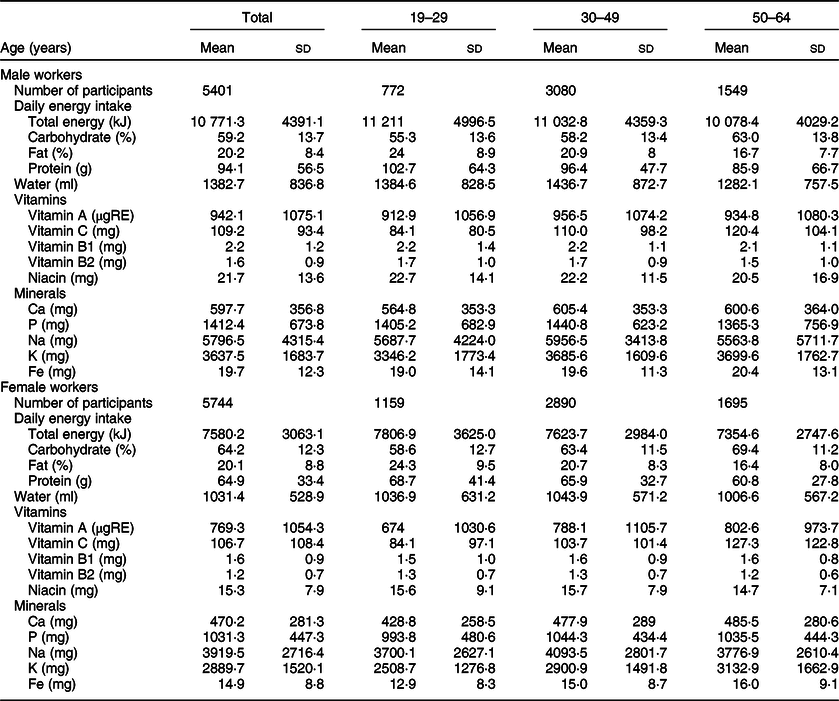
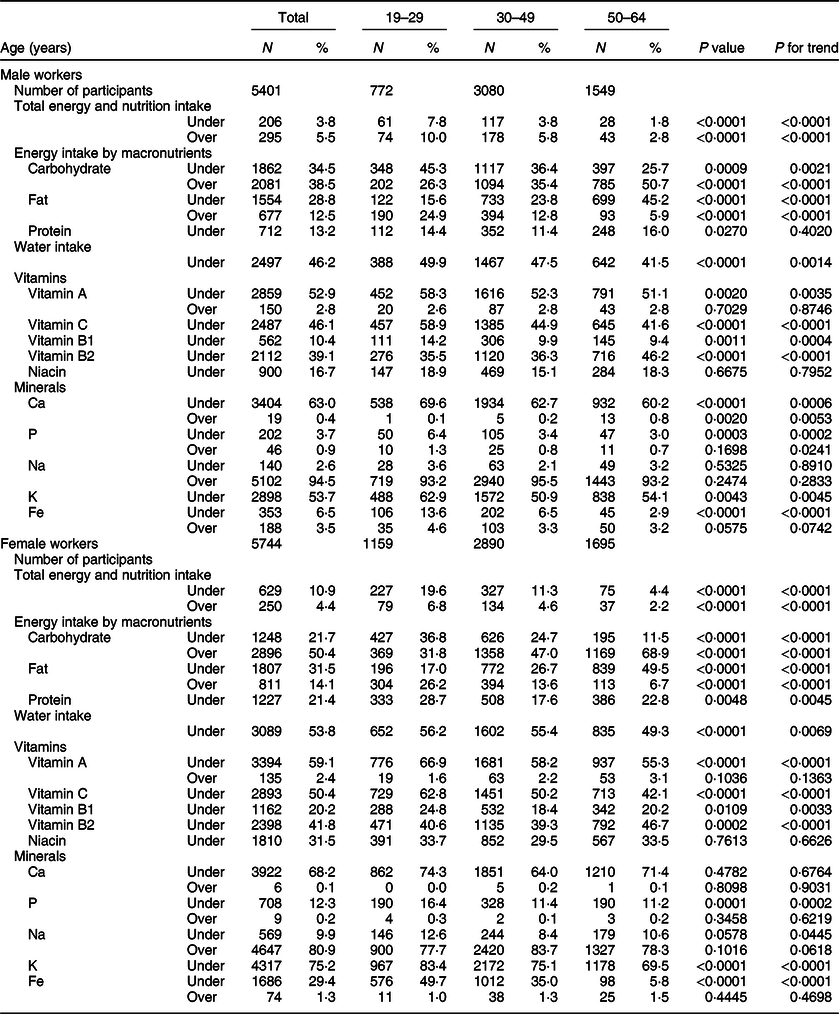
The energy and nutrient intake statuses of the participants classified by sex and age are shown in Table 2. Table 3 shows the inappropriate energy and nutrient intake statuses for each nutrient according to sex and age. For both sexes, a significant difference was found in the prevalence of imbalanced daily energy, carbohydrate, fat, protein, water, Vit A, Vit C, Vit B1, Vit B2, phosphate, K and Fe intakes among the age groups. In males, a significant difference was also found in the prevalence of an inappropriate Ca intake.
Energy and micronutrient intake status according to gender and age group
The inappropriate energy and micronutrient intake of each energy and nutrient according to gender and age group
Energy and nutrient intake statuses according to occupational characteristics
Tables 4 (males) and 5 (females) show inappropriate energy and nutrient intake statuses according to occupational characteristics. A significant difference was noted in inappropriate carbohydrate, protein, water, Vit C, Vit B1, Vit B2, niacin, phosphate and K intakes according to the male workers’ occupational classifications. In females, a significant difference was found in the percentages of inappropriate total energy and nutrient, carbohydrate, protein, water, Vit B1, Vit B2, niacin, Ca and Fe intakes by occupational classification.
The inappropriate energy and micronutrient intake of each nutrient according to occupational characteristics in male workers (n 5401)

The inappropriate energy and micronutrient intake of each nutrient according to occupational characteristics in female workers (n 5744)
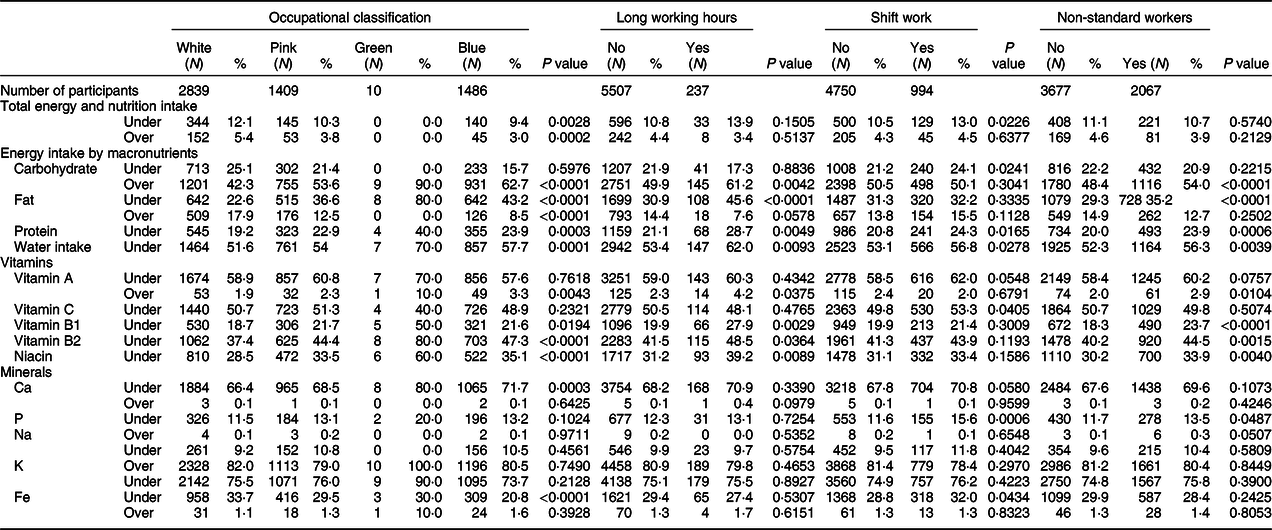
Males who worked >60 h/week showed higher inappropriate carbohydrate (74·9 % v. 72·7 %, P = 0·0032); protein (18·0 % v. 12·6 %, P = 0·0002); water (53·3 % v. 45·4 %, P = 0·0003); Vit B2 (44·7 % v. 38·4 %, P = 0·003) and phosphate (6·9 % v. 4·4 %, P = 0·0238) intakes than those who worked ≤60 h/week. Also females who worked >60 h/week showed higher inappropriate carbohydrate (78·5 % v. 71·8 %, P = 0·0017); protein (28·7 % v. 21·1 %, P = 0·0049); water (62·0 % v. 53·4 %, P = 0·0093); Vit B1 (27·9 % v. 19·9 %, P = 0·0029); Vit B2 (48·5 % v. 41·5 %, P = 0·0364) and niacin (39·2 % v. 31·2 %, P = 0·0089) intakes.
Considering the work schedule, male shift workers were more likely to show inappropriate carbohydrate (74·5 % v. 72·7 %, P = 0·0065); protein (16·4 % v. 12·5 %, P = 0·001); water (55·4 % v. 45·2 %, P < 0·0001); Vit C (50·2 % v. 45·1 %, P = 0·0036); Vit B1 (13·3 % v. 9·8 %, P = 0·0011); Vit B2 (42·6 % v. 38·3 %, P = 0·0131); niacin (20·4 % v. 15·8 %, P = 0·0005); Ca (67·3 % v. 62·2 %, P = 0·0048); phosphate (6·8 % v. 4·1 %, P = 0·0023) and K (58·9 % v. 52·5 %, P = 0·0002) intakes than regular workers. For the female shift workers, inappropriate protein (24·3 % v. 20·8 %, P = 0·0165); water (56·8 % v. 53·1 %, P = 0·0278); Vit C (53·3 % v. 49·8 %, P = 0·0405) and phosphate (15·7 % v. 11·8 %, P = 0·0012) intakes were significantly higher than those of the regular workers.
Male non-standard workers showed higher inappropriate carbohydrate (74·7 % v. 72·1 %, P = 0·0349); protein (15·6 % v. 12·2 %, P = 0·0009); water (50·4 % v. 44·5 %, P < 0·0001); Vit B1 (13·0 % v. 9·4 %, P < 0·0001); Vit B2 (42·1 % v. 37·9 %, P = 0·0036); niacin (18·7 % v. 15·8 %, P = 0·0108) and K (56·5 % v. 52·5 %, P = 0·0076) intakes than standard workers. Female non-standard workers showed significantly higher inappropriate carbohydrate (74·9 % v. 70·6 %, P < 0·0001); protein (23·9 % v. 20·0 %, P = 0·0006); water (56·3 % v. 52·3 %, P = 0·0039); Vit A (63·1 % v. 60·4 %, P = 0·0115); Vit B1 (23·7 % v. 18·3 %, P < 0·0001); Vit B2 (44·5 % v. 40·2 %, P = 0·0015); niacin (33·9 % v. 30·2 %, P = 0·004) and phosphate (13·5 % v. 11·7 %, P = 0·0190) intakes.
Risk of inappropriate energy and micronutrients intakes according to occupational characteristics
Supplementary Tables 2 and 3 and Figs. 2 and 3 show the risk analysis for inappropriate energy and nutrient intakes according to the occupational classification or characteristics based on the multivariate logistic regression model for each sex. When each occupational group was compared with those of the white-collar workers, male pink-collar workers had a significantly higher risk of water, Vit A, Vit C, Vit B1 and niacin under-intake. Green-collar workers had a higher risk of protein under-intake, whereas male blue-collar workers had a higher risk of niacin under-intake. In contrast, the risk of inappropriate intake by female pink- and green-collar workers was not significantly different from that of the white-collar workers. Only female blue-collar workers had a higher risk of carbohydrate and Vit A over-intake.
Risk for inappropriate energy and nutrition intake according to occupational characteristics in male workers (OR and 95 % CIs)

Risk for inappropriate energy and nutrition intake according to occupational characteristics in female workers (OR and 95 % CIs)

As shown in Fig. 2, males with long working hours had a higher risk of total energy and nutrient, fat, protein, water and phosphate under-intake than those who did not work long hours. In contrast, long working hours were associated with a lower risk of Fe under-intake. Long working hours were significantly associated with under-intake of total energy and nutrients, protein and Vit B1 in females (Fig. 3). Male shift workers had a higher risk of carbohydrate over-intake and protein, water, Vit B1, Vit B2, niacin, Ca, phosphate and K under-intake than day workers. Female shift workers only had a significantly higher risk of phosphate under-intake compared with that of day workers. Non-standard male workers were at a higher risk of carbohydrate over-intake and Vit B1 under-intake than standard workers. On the other hand, female non-standard workers had a higher risk of carbohydrate and Vit A over-intake than standard workers.
Discussion
The current study demonstrated differences in energy and nutrient intakes among Korean workers according to age, sex and occupational characteristics.
We found that younger workers of both sexes had an increased prevalence of inappropriate energy and nutrient intake statuses (total energy and nutrient intakes and the intakes of each macronutrient, Vit A, Vit C, Vit B1, Ca, phosphate, K and Fe). This finding is contrary to those of previous studies, which suggested that elderly populations may have a greater risk of inappropriate energy and nutritional statuses due to medical, lifestyle, psychological and social factors(Reference Hickson15). This result may be explained by the fact that younger workers may experience greater workloads and stress than older workers(Reference Lundberg, Mårdberg and Frankenhaeuser16). As a result, younger workers may skip meals or have insufficient time to eat at work. Therefore, in the working population, younger workers may be at risk of inappropriate energy and nutrient intakes.
We found sex differences between workers with inappropriate energy and nutrient intakes. This result can be explained in part by not only behavioural and sociocultural factors but also by chromosomal factors. Energy intake habituation in women is linked to menstrual cycle-related hormones(Reference Davidsen, Vistisen and Astrup17). Hypothalamic regulators, which impact both energy homeostasis and the reproductive axis, are closely related to sex-specific energy and nutrient intakes(Reference Lovejoy and Sainsbury18). Therefore, the findings of the current study further support sex differences in energy and nutrient intakes.
The current study also demonstrated that occupational characteristics were related to inappropriate energy and nutrient intakes. First, we can infer that long working hours may result in inappropriate energy and nutrient intakes. Males and females working long hours had inadequate daily energy intakes, with a tendency to consume less fat and protein than recommended. This finding is contrary to those of a previous study, which found that these workers had a tendency to overeat and had high BMIs(Reference Suzuki, Sakurazawa and Fujita19). In that study, stress was suggested as the main contributing factor for the high BMI in Japanese male workers with long hours, with the additional contribution from later dinner time and irregular intake. Another study also found that long working hours influenced negative emotions and led to binge eating behaviour(Reference Wardle, Steptoe and Oliver20). One explanation for our finding may be that long working hours might have contributed to irregular food intake and meal skipping, resulting in poor daily energy intake. Inadequate energy intake is known to increase the risk of psychiatric symptoms, such as dizziness, dyspepsia and depression(Reference Klein and Walsh21–Reference Ulrich-Lai, Fulton and Wilson23). Thus, interventions should be designed to improve energy intake for workers with long hours.
Second, shift work schedules could be a risk factor for inappropriate energy and nutrient intakes. Shift workers may have altered dietary patterns and food choices(Reference Lowden, Moreno and Holmback7,Reference Lennernäs, Hambraeus and Åkerstedt24) , and increased consumption of unhealthy foods related to chronic diseases has been reported(Reference Esquirol, Bongard and Mabile25). Our study demonstrated that male shift workers had excessive carbohydrate intake. This finding was consistent with those of previous studies, which showed that shift workers’ eating habits included less regular meal patterns with multiple snacks and higher energy intake at night(Reference Lowden, Moreno and Holmback7). Moreover, our study further supported the expended scope of the risk of unhealthy food intake among shift workers, especially for Vits and minerals. Male shift workers reported under-intake of Vit B1, Vit B2, niacin, phosphate and K. These findings have important implications for developing nutritional interventions. This is because niacin is the most widely used medication for raising HDL-cholesterol levels. Indeed, niacin has been shown to increase HDL-cholesterol by 16–25 %(Reference Birjmohun, Hutten and Kastelein26,Reference Kelley, Kelley and Tran27) , which leads to a decreased CVD risk. Shift work is a well-known risk factor of CVD(Reference Boggild and Knutsson28,Reference Jeong, Rhie and Kim29) . Phosphate deficiency was also noted in males working long hours and female shift workers. Phosphate plays a key role in energy production and is a component of ATP, DNA and RNA(Reference Aisbett, Condo and Zacharewicz30).
One unanticipated finding was that non-standard workers were a vulnerable population for inappropriate energy and nutrient intakes. Non-standard work cannot be an occupational hazard, because this work is a type of contract employment. Surprisingly, vulnerable points of the food intake status was found in non-standard workers; significantly increased risks for carbohydrate over-intake and Vit B1 under-intake were found for both male and female workers. Further research should focus on determining the process underlying the inappropriate energy and nutrient intakes among non-standard workers.
Another important finding of the current study was the risk of inadequate water intake among the working population. An increased risk of inadequate water intake was observed among male pink-collar workers and those with long hours or shift work. Providing employees with safe drinking water is the responsibility of every employer, as specified by the Occupational Safety and Health Administration regulations. However, previous studies have focused on the importance of hydration for outdoor workers but have neglected its impact on service or sales businesses. Inadequate water supply reduces the plasma volume and influences the circulatory system, which controls blood flow to the skin and working muscles. This phenomenon leads to muscle fatigue and an increased body temperature. Thus, subclinical dehydration affects physical performance and cognitive function and may precede workplace injuries(Reference Miller and Bates31). In addition, since long working hours and shift work are known cardiovascular(Reference Birjmohun, Hutten and Kastelein26,Reference Jeong, Rhie and Kim29) and musculoskeletal risk factors(Reference Aisbett, Condo and Zacharewicz30), water intake interventions should be considered.
The current study has several strengths and limitations. First, the study revealed associations between inappropriate energy and nutrient intakes and occupational characteristics. This topic has received relatively little attention, and very few studies have focused on the working population. In addition, the current study also investigated Vit and mineral intakes. Second, statistical significance was achieved mainly due to the large sample size of nationally representative data. Limitations include the use of 24-h recall for investigating food intake. This method has several weaknesses because it relies on memory, and food intake may be underestimated due to recall bias, the interviewee’s capacity could have affected the precision of the report. Individual variation can occur according to the day when the survey was administered, and excessive or deficient nutrients might have been under-/over-estimated using the 1-d 24-h recall survey(Reference Beaton, Milner and Corey32). However, the 24-h recall design has several benefits because the burden on the interviewee is relatively small, and the survey is easy to complete with low research expenses. Moreover, the KNHANES data contain information on micronutrients (Vits, minerals, fatty acids, etc.) and are suitable for estimating the average intakes of the group. Another limitation of the study is the ecological model design on which the current study was based. Therefore, these findings must be interpreted with caution before application to individuals. Lastly, although the cross-sectional nature of the current study makes establishing the direction of influence difficult, the energy and nutrient intakes are unlikely to lead to different occupational characteristics.
Conclusion
The current study assessed inappropriate energy and nutrient intake statuses according to age, sex and occupational characteristics and revealed some important findings. Younger workers with long hours and shift work schedule were at risk of having inappropriate energy and nutrient intakes. In addition, non-standard workers were a vulnerable population for dietary intake, and water intake was inappropriate among pink-collar workers and workers with long hours or shift work. Workers spend at least one-third of their day in the workplace; thus, further research into eating habits in the workplace is an essential step in investigating inappropriate energy and nutrient intakes among the working population.
Acknowledgements
Acknowledgements: The authors thank the KNHANES respondents for their contribution to the current research. Financial support: Not applicable. Conflict of interest: The authors declare no conflict of interest. Authorship: W.L. and H.-R.K. conceptualised the study, analysed the data and drafted and revised the manuscript. J.J. conducted the analysis and drafted the manuscript. J.A. contributed to developing the study design and revised the manuscript. H.-R.K. is the corresponding author of this work and, as such, takes responsibility for the integrity of the data and the accuracy of the data analysis. All authors read and approved the final version of the manuscript. Ethics of human subject participation and consent to participate: The current study was conducted according to the guidelines laid down in the Declaration of Helsinki, and all procedures involving research study participants were approved by the Institutional Review Board (IRB) of the KCDC (IRB No. 2007–02-CON-04-P 2008–04EXP-01-C, 2009–01CON-03–2C, 2010–02CON-21-C, 2011–02CON-06-C, 2012–01EXP-01–2C, 2013–07CON-03–4C, 2013–12EXP-03–5C and 2015–01–02–6C). Written informed consent was obtained from all subjects/patients.
Supplementary material
For supplementary material accompanying this paper visit https://doi.org/10.1017/S1368980019004075.



