





Non-technical Summary
Extreme environmental changes have pushed global biodiversity past its breaking point just a handful of times, now referred to as the “Big Five” mass extinctions. These events probably represent “perfect storms,” where individual pressures, often severe in themselves, combine to catastrophic effect, driving sweeping changes to the biota. Better constraints on the timing of biotic and environmental changes and on the spatial locations and biologies of victims and survivors have improved analyses aiming to identify the roles of traits and other factors in promoting survival. These new data also help to identify hitchhiking effects, where certain evolutionary lineages or biological traits were lost or survived not because of the direct action of the extinction drivers, but because they were carried along by other traits, such as geographic-range size. Adding other dimensions or currencies of biodiversity, such as biological form or function, gives further insights into the evolutionary roles of mass extinctions: modes of life are surprisingly extinction-resistant, even in the face of extensive species loss. However, the extinction filter is just one major factor in reshaping biodiversity at these events. Longer-term impacts also flow partly from their ensuing rebounds, and more work is needed to uncover the circumstances that spur some groups and modes of life to re-diversify while others are relegated to marginal roles in the post-extinction world. Analyses of past extinction events and their rebounds bring macroevolutionary insights to the present-day biodiversity crisis—approaching a “perfect storm” in the intensity and scale of its pressures—and help to pinpoint the lineages, modes of life, and organismal forms most vulnerable to extinction and failed rebounds.
Introduction
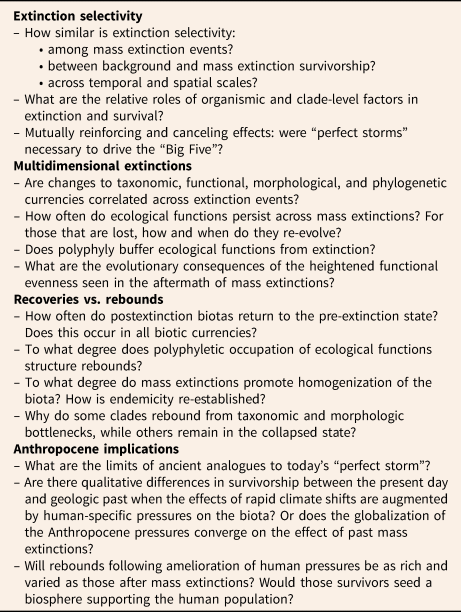
Even before Darwin, extinction was seen as a striking, albeit problematic, aspect of the history of life (Rudwick Reference Rudwick1972; Sepkoski Reference Sepkoski2020). With the publication of the Origin, extinction became a fundamental term in the Darwinian equation, but the emphasis was on its role in constructive improvement of the global biota or its components via natural selection (e.g., Raup Reference Raup1994; Sepkoski Reference Sepkoski2020)—even with Phillips's (Reference Phillips1860) iconic diagram showing the great turnovers at the end of the Paleozoic and Mesozoic Eras. Views on how extinction shapes the tree of life have changed dramatically over the past half-century. After a brief overview of Paleobiology's role in our increased understanding of mass extinction in the history of life, we discuss two active and promising research directions: the relationship among different currencies or dimensions of biodiversity (e.g., taxa, morphology, function, phylogeny) during and after these events, and the nature of postextinction rebounds. We close with some implications of this macroevolutionary approach for understanding the biodiversity crisis in the Anthropocene. Throughout, we highlight some of the active questions and potential research directions (Table 1).
Some key open issues in mass extinctions.
Fifty Years of Biological Upheaval
Paleobiology was founded just 5 years before Alvarez et al. (Reference Alvarez, Alvarez, Asaro and Michel1980) transformed the study of mass extinctions from a cottage industry into a multidisciplinary research powerhouse. Documentation of great temporal variation in extinction intensities had begun well before that, thanks to pioneers like Newell (Reference Newell1967) and Valentine (Reference Valentine1969, Reference Valentine1973). This early work was crucial, not just for injecting much-needed quantitative approaches into large-scale diversity questions, but for something more fundamental: demonstrating that a handful of severe extinction episodes were global in scope and cut across higher taxa and biomes. The search for drivers was still in a fairly primitive and speculative state when the Alvarez hypothesis for an impact at the Cretaceous/Paleogene (K/Pg) boundary initiated a new phase of more explicit hypothesis testing and analysis.
Mass extinctions first came into Paleobiology largely through conference reports (“Current Happenings”; e.g., Fischer Reference Fischer1980; Thierstein Reference Thierstein1980; Clemens et al. Reference Clemens, Archibald and Hickey1981), and we count only three research papers in Paleobiology focused on mass extinctions over the journal's first decade. However, the field was moving quickly in other venues, and by Paleobiology's 10th anniversary issue, Gould (Reference Gould1985) argued that mass extinctions were an important evolutionary force that could decouple macroevolutionary change not only from short-term, microevolutionary processes, but from species sorting driven by “normal” species-level origination and extinction dynamics. Gould was writing in the first flush of enthusiasm for a relatively short-term (~26 Myr) periodicity, a finding that remains stubbornly controversial (e.g., Melott and Bambach Reference Melott and Bambach2014; Erlykin et al. Reference Erlykin, Harper, Sloan and Wolfendale2018), but his general hierarchical approach to the evolutionary process has been corroborated in a number of contexts, including for mass extinctions (for recent reviews, see Sepkoski Reference Sepkoski2012; Foote et al. Reference Foote, Ritterbush and Miller2016; Jablonski Reference Jablonski2017, Reference Jablonski2022; Congreve et al. Reference Congreve, Falk and Lamsdell2018; Hautmann Reference Hautmann2020). Overall, the great bulk of the mass extinction literature research has been on potential drivers, particularly the marshaling of physical and chemical evidence around the major events. In Paleobiology, papers have mainly addressed analytical approaches to the imperfections of the paleobiological record, such as confidence limits on stratigraphic ranges (e.g., Marshall Reference Marshall1997; Wang et al. Reference Wang, Everson, Zhou, Park and Chudzicki2016; Zimmt et al. Reference Zimmt, Holland, Finnegan and Marshall2021), and the perpetual issue of extinction selectivity.
Confidence intervals and other analytical approaches to sampling, and to the fabric of the stratigraphic record more generally, brought statistical power to the interpretation of stratigraphic ranges as recorded near mass extinction boundaries, raising a host of interesting new questions. For example, confidence intervals around the end-Permian extinction of ostracods and brachiopods in the classic Meishan section place the main extinction pulses of the two groups at that locality up to 1.2 Myr apart at 95% confidence (Wang and Everson Reference Wang and Everson2007; Wang et al. Reference Wang, Sadler, Shen, Erwin, Zhang, Wang, Wang, Crowley and Henderson2014). Whether the extinction involved two distinct pulses or a protracted interval packaged into pulses by sedimentary hiatuses, this unexpected separation in time and taxonomy should inform models for the extinction and its consequences (Holland and Patzkowsky Reference Holland and Patzkowsky2015). At larger scales, a model optimizing origination, extinction, and sampling sharpens extinction events to the point that the end-Guadalupian and mid-Miocene extinction pulses fade to statistical insignificance as backward-smearing of larger events or perhaps regional episodes (Foote Reference Foote2007; Wang et al. Reference Wang, Sadler, Shen, Erwin, Zhang, Wang, Wang, Crowley and Henderson2014; Fan et al. Reference Fan, Shen, Erwin, Sadler, MacLeod, Cheng and Hou2020; Marshall Reference Marshall2023). Sharpening of taxon stratigraphic ranges necessarily feeds back on the interpretation of extinction drivers and their selectivity, which can in turn prompt further examination of stratigraphic ranges (see Holland [Reference Holland2020] for an overview of new approaches to the stratigraphy of mass extinctions). This feedback loop improves inferences of extinction dynamics, perhaps enabling the eventual conversion of absence of evidence into evidence of absence.
Selectivity, that is, the role of abundance, trophic level, body size, inferred physiology, geographic-range size, and other organismal or higher-level factors in promoting survival during extinction events, has been a steady focus of paleobiological analysis (see Orzechowski et al. [Reference Orzechowski, Lockwood, Byrnes, Anderson, Finnegan, Finkel and Harnik2015] and Payne et al. [Reference Payne, Al Aswad, Deutsch, Monarrez, Penn and Singh2023] for overviews with quite different perspectives and conclusions). Comparisons between “background” and mass extinction have often revealed contrasts in survivorship, although results on specific traits, clades, and events have varied widely (Congreve et al. [Reference Congreve, Falk and Lamsdell2018: p. 820] provide ~25 references; see also Reddin et al. [Reference Reddin, Kocsis, Aberhan and Kiessling2021]; Payne et al. [Reference Payne, Al Aswad, Deutsch, Monarrez, Penn and Singh2023]; and Trubovitz et al. [Reference Trubovitz, Renaudie, Lazarus and Noble2023 and references therein] on the failure of abundance or biomass as a predictor of extinction risk in general, nicely consistent with Gould's Reference Gould1985 multilevel argument). Selectivity contrasts between background and mass extinctions are likely a matter of spatial and temporal scale of drivers, with the buffering role of some organismal traits overwhelmed as perturbations enlarge in scale and intensity, leaving relatively few survivorship-enhancing factors to be effective. For example, clade-level (e.g., genus) geographic-range size can enhance survivorship during both background and at least some mass extinctions, while some organismal traits ordinarily related to background rates show no effect at extinction boundaries (Jablonski Reference Jablonski2005b; Orzechowski et al. Reference Orzechowski, Lockwood, Byrnes, Anderson, Finnegan, Finkel and Harnik2015; Payne et al. Reference Payne, Al Aswad, Deutsch, Monarrez, Penn and Singh2023; Yan et al. Reference Yan, Song and Dai2023; but see Echevarría and Ros-Franch [Reference Echevarría and Ros-Franch2024], who find geographic range to promote bivalve survivorship during the end-Permian extinction but not during the ensuing rebound). If scaling effects combine with specific drivers to impose mass extinction selectivities (and their absence, for some traits), they may set clade-specific thresholds, with volatile groups such as ammonoids pushed into a mass extinction regime even as more stolid groups such as bivalves remained relatively unfazed. If so, then smaller extinction events, such as the Toarcian in the Early Jurassic, or the Eocene–Oligocene in the early Cenozoic, may prove to be a predictable, quantitative mix of background and mass extinction selectivity patterns.
Much of the large-scale extinction work over the past few decades is founded on the huge volume of data collected and synthesized over the geologic history of life, as in the Paleobiology Database, the online community resource that has grown prodigiously since its start in 1998. This occurrence-based database is a spectacular resource that was not originally intended to capture complete stratigraphic or geographic ranges, and ongoing work has explored some of the biases inherent in any literature-based database, nearly inevitable for global analyses over long time spans (e.g., on geographic coverage, see Allison and Briggs [Reference Allison and Briggs1993]; Valentine et al. [Reference Valentine, Jablonski, Kidwell and Roy2006, Reference Valentine, Jablonski, Krug and Berke2013]; Vilhena and Smith [Reference Vilhena and Smith2013]; Close et al. [Reference Close, Benson, Alroy, Carrano, Cleary, Dunne, Mannion, Uhen and Butler2020]; Jones et al. [Reference Jones, Dean, Mannion, Farnsworth and Allison2021]; Dillon et al. [Reference Dillon, Dunne, Womack, Kouvari, Larina, Claytor and Ivkić2023]). For example, geographic-range sizes and their extinction consequences tend to be more accurately recovered in large-scale analyses of “background” intervals than those tightly focused around mass extinctions. The probability of capturing the overall spatial extent of genera or higher taxa increases when summing over the longer time spans of background intervals, where scattered records can collectively capture much of the provincial extent of taxa. Of course, geographic-range estimates and their consequences for taxon survivorship can be strongly affected by variations in the spatial distribution of fossiliferous deposits (Darroch et al. Reference Darroch, Casey, Antell, Sweeney and Saupe2020; these simulations assume that fossiliferous deposits are sampled at roughly equal intensity, perhaps reasonable for studies within certain regions but problematic at the scale required for global studies of genera across mass extinction events). Such issues apply to all paleobiological analyses, but the effects can be reduced in taxonomically focused datasets that provide more comprehensive temporal, spatial, and phylogenetic coverage of the target clades (for examples of such databases and their applications, see Foote et al. [Reference Foote, Crampton, Beu and Cooper2008, Reference Foote, Crampton, Beu and Nelson2015], Crampton et al. [Reference Crampton, Cooper, Beu, Foote and Marshall2010, Reference Crampton, Cooper, Sadler and Foote2016], Harnik [Reference Harnik2011], Valentine et al. [Reference Valentine, Jablonski, Krug and Berke2013], Mondal and Harries [Reference Mondal and Harries2016], Edie et al. [Reference Edie, Jablonski and Valentine2018], Cole and Hopkins [Reference Cole and Hopkins2021], and Guinot and Condamine [Reference Guinot and Condamine2023]; and Foote et al. [Reference Foote, Edie and Jablonski2024], analyzing a dataset estimated as 90% complete following the approach in Foote et al. [Reference Foote, Sadler, Cooper and Crampton2019]).
The next step in comparative analysis of mass extinctions and their aftermath involves confronting the possibility that the most dramatic events in the history of life are driven by the alignment of mutually reinforcing drivers (Jablonski et al. Reference Jablonski, Huang, Roy and Valentine2017; Jablonski and Edie Reference Jablonski and Edie2023). The “Big Five” mass extinctions are embedded in larger abiotic perturbations that could have amplified shorter-term shocks to the global biota. The end-Cretaceous extinction might have been less severe if the bolide impact had not occurred during Deccan volcanism (and, for that matter, not struck sulfate-rich marine evaporites); the end-Permian if Siberian volcanism not been at a time of continental amalgamation and low sea levels (and, for that matter, not intruded into coal-rich sediments); the end-Ordovician if Hirnantian glaciation not been at a time of increased arc volcanism and changes in ocean circulation (references in Jablonski and Edie [Reference Jablonski and Edie2023]; see also Rasmussen et al. [Reference Rasmussen, Vandenbroucke, Nogues-Bravo and Finnegan2023]). (Conversely, the largest igneous province of all, the Ontong-Java Plateau, and the extensive Kergeulen Plateau, might have had milder biotic effects because they erupted through coal- and sulfate-poor oceanic crust, although increased post-Jurassic resilience to such perturbations is also possible; see Bond and Wignall [Reference Bond and Wignall2014]; Wignall [Reference Wignall2015].) These mutually reinforcing drivers make it difficult to isolate the effect of any one from the others on extinction, but expanding analyses to include aspects of biodiversity beyond taxonomic identity will likely help in ranking them for different events. This approach becomes particularly important when we consider that the multifactorial nature of the biggest extinction events resembles the anthropogenic “perfect storm” that is buffeting present-day biota (e.g., Halpern et al. Reference Halpern, Frazier, Potapenko, Casey, Koenig, Longo and Lowndes2015; Bowler et al. Reference Bowler, Bjorkman, Dornelas, Myers-Smith, Navarro, Niamir and Supp2020; Price Reference Price2022), and invites a larger analytical role for the smaller extinction events, which may involve fewer juxtaposed drivers (and see Algeo and Shen Reference Algeo and Shen2024 for the valuable distinction between proximate and ultimate causes, and between carbon-burial and carbon-release events).
Multidimensional Extinctions
Biodiversity is multidimensional, and any single axis is unlikely to exactly mirror the dynamics of the others. Paleobiology led the way in expanding the analyses of mass extinctions to fresh macroevolutionary currencies via multivariate morphospaces (Foote Reference Foote1992, Reference Foote1999; Ciampaglio et al. Reference Ciampaglio, Kemp and McShea2001; McGowan Reference McGowan2004; Saunders et al. Reference Saunders, Work and Nikolaeva2004; see also Wagner Reference Wagner, Bell, Futuyma, Eanes and Levinton2010; Polly Reference Polly2023). However, the journal and the field have seen far less work on other currencies, such as functional variety and phylogenetic diversity, and even less analysis of linkages (or lack thereof) among the currencies. For example, the polyphyletic occupation of most functional categories may underlie the ecological resilience of the biosphere, at least in part. Thus, comparative analyses among these dimensions are likely to provide deeper insights into the macroevolutionary and macroecological roles of mass extinctions and the ensuing rebounds.
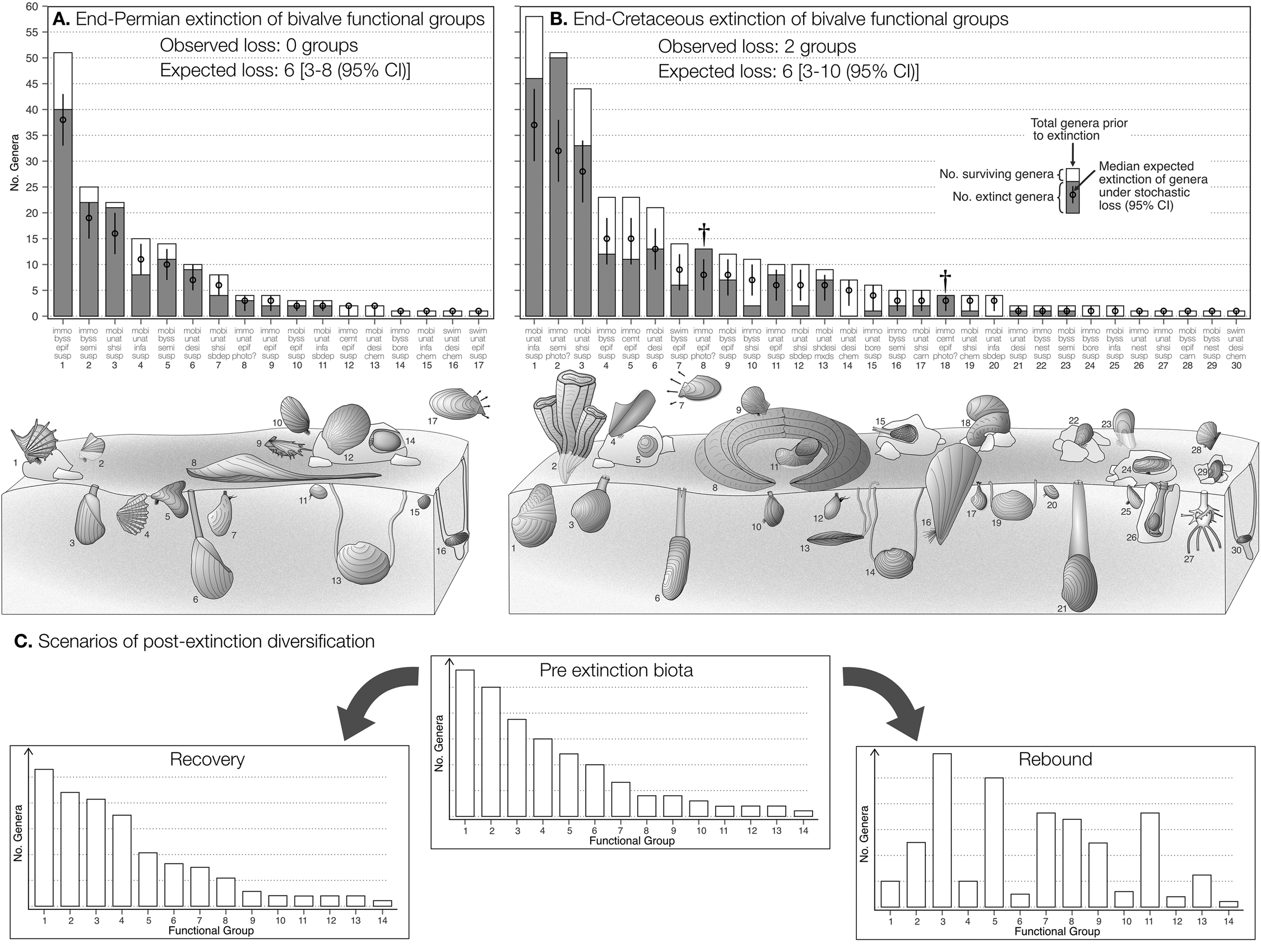
Functional variety is remarkably persistent through the “Big Five” extinctions for several major animal groups (Erwin et al. Reference Erwin, Valentine and Sepkoski1987; Foster and Twitchett Reference Foster and Twitchett2014; Dunhill et al. Reference Dunhill, Foster, Sciberras and Twitchett2018; Edie et al. Reference Edie, Jablonski and Valentine2018; Vellekoop et al. Reference Vellekoop, Van Tilborgh, Van Knippenberg, Jagt, Stassen, Goolaerts and Speijer2020; Guinot and Condamine Reference Guinot and Condamine2023; but not for diplobathrid crinoids in Cole and Hopkins [Reference Cole and Hopkins2021], which may indicate that taxic and functional losses are more concordant within smaller clades and more finely resolved functions). Bivalves lose more than half of their genera across the both end-Permian and end-Cretaceous extinctions, but their functional richness is virtually unchanged in each case (Foster and Twitchett Reference Foster and Twitchett2014; Dunhill et al. Reference Dunhill, Foster, Sciberras and Twitchett2018; Edie et al. Reference Edie, Jablonski and Valentine2018; Wang et al. Reference Wang, Huang, Song, Tian, Chu and Tong2024), a result incompatible with stochastic extinction (Edie et al. Reference Edie, Jablonski and Valentine2018) (see Fig. 1A,B). The survival of functional groups is even more striking in light of present-day biogeographic patterns, with functional variety declining from tropics to poles in rough proportion to taxonomic richness in marine and terrestrial systems (Schumm et al. Reference Schumm, Edie, Collins, Gómez-Bahamón, Supriya, White, Price and Jablonski2019). The contrast with biogeographic data is conceptually important for at least two reasons: First, it shows that functional schemes founded on discrete categories can have sufficient resolution to detect real-world gradients in functional richness. Second, it highlights our poor understanding of the response of functional variety to dramatic drops in taxonomic richness. Both the tropics-to-poles latitudinal trends and the mass extinctions defining the Paleozoic, Mesozoic, and Cenozoic Eras result in increased evenness in the distribution of genera among functional groups, another intriguing commonality that may or may not derive from a common mechanism, but will surely repay further dissection.
Extinction and persistence of marine bivalve functional groups across the (A) end-Permian and (B) end-Cretaceous mass extinctions. Expected loss of functional groups in A and B was estimated via stochastic extinction of genera at the observed intensity for each event (end-Permian: 74%; end-Cretaceous: 64%). Data and approach from Edie et al. (Reference Edie, Jablonski and Valentine2018). (C) Potential diversification trajectories of genera within functional groups relative to the configuration of the ecological landscape before the extinction event. A recovery reflects a return to the prior state, either meeting or exceeding the previous level of taxonomic diversity, whereas a rebound shows a reconfigured taxonomic structure among functional groups. Abbreviations for functional states: mobility: immo, immobile; mobi, mobile; swim, swimming; attachment: byss, byssate; cemt, cemented; unat, unattached; substratum use: bore, borer; desi, deep infaunal siphonate; epif, epifaunal; infa, infaunal asiphonate; nest, nestler; semi, semi-infaunal; shdesi, shallow/deep infaunal siphonate; shsi, shallow infaunal siphonate; feeding mode: carn, carnivore; chem, chemosymbiotic; mxds, mixed deposit/suspension; photo?, photosymbiotic?; sbdep, subsurface deposit; susp, suspension.
The persistence of virtually all functional variety during mass extinctions and the associated rise in functional evenness require a concentrated loss of taxa in the most diverse functional groups (Edie et al. Reference Edie, Jablonski and Valentine2018; also Pimiento et al. Reference Pimiento, Bacon, Silvestro, Hendy, Jaramillo, Zizka, Meyer and Antonelli2020). This pattern could emerge from one or more scenarios, including indirect persistence via taxa with broad geographic-range sizes, a patchwork of geographic refugia, physiologies buffering against extinction drivers, and/or a destabilization of resources that favors the more generalized taxa within broad functional categories (Valentine [Reference Valentine1971], in typically pathfinding fashion; Edie et al. [Reference Edie, Jablonski and Valentine2018], who find some support for the indirect, hitchhiking hypothesis; Pimiento et al. [Reference Pimiento, Bacon, Silvestro, Hendy, Jaramillo, Zizka, Meyer and Antonelli2020]). On the other hand, as many as 17 functional groups are evidently lost from terrestrial systems in the end-Triassic extinction (not surprising, given that Cribb et al. Reference Cribb, Formoso, Woolley, Beech, Brophy, Byrne and Cassady2023 report 96% genus-level extinction, perhaps raising sampling questions), but most of those losses are immediately recovered by evolution in new or surviving groups (Cribb et al. Reference Cribb, Formoso, Woolley, Beech, Brophy, Byrne and Cassady2023; see also Donovan et al. [Reference Donovan, Iglesias, Wilf, Labandeira and Cúneo2016] on the loss and re-occupation of plant insect-damage syndromes after the K/Pg extinction). In both temporal and biogeographic patterns, it is important to separate the persistence of ecological functions via the survival of constituent taxa from the re-evolution of extinct functions following the event. Those very different macroevolutionary scenarios should be used to refine hypotheses of drivers and motivate new tests to understand dynamics, for example, the potential role of evolutionary convergence in form or function in buffering the survival of functional diversity when extinction is phylogenetically concentrated.
Morphological disparity shows more complex patterns across extinctions are compared to functions, perhaps in part because morphologies reflect a mix of phylogenetic and ecological signals. Different disparity metrics in morphospaces built using different methods can capture non-overlapping aspects of extinction and survival, but an overall understanding has emerged that some clades persist with a thinned but full range of body forms, while others vacate entire regions of morphospace (Foote Reference Foote1991, Reference Foote1993 Reference Foote1997; Ciampaglio et al. Reference Ciampaglio, Kemp and McShea2001; Korn et al. Reference Korn, Hopkins and Walton2013; Guillerme et al. Reference Guillerme, Puttick, Marcy and Weisbecker2020; Puttick et al. Reference Puttick, Guillerme and Wills2020; Polly Reference Polly2023). Tying these morphological dynamics to those of other biodiversity dimensions will better constrain potential drivers of extinction. For example, high disparity within functional groups before an extinction may promote persistence of that function via one or more specialized morphologies—a consequence of the many-to-one relationship between form and function. Alternatively, some functions persist despite narrow morphological disparity, which would guide the next level of investigation into the phylogenetic diversities or the biogeographies of those taxa: were they overdispersed and thus potentially buffered via diverse physiologies or via widespread distributions encountering refugia? Direct comparisons of global and regional dynamics are starting to show multiple pathways to the emergent global pattern, with some regions mirroring the global signal while others form a mosaic of survival patterns (Flannery-Sutherland et al. Reference Flannery-Sutherland, Silvestro and Benton2022; Serra et al. Reference Serra, Balseiro and Waisfeld2023; Bault et al. Reference Bault, Crônier and Monnet2024). More work is needed on the determinants of these differences.
Analyses of morphospace across extinctions have been based both on continuously varying aspects of shape and on discrete morphological traits. For the latter, it has been difficult to determine direct links between traits and taxon survivorship, despite some phylogenetic signal to both trait distributions and extinction intensity (Puttick et al. Reference Puttick, Guillerme and Wills2020). In combination, these patterns suggest indirect selection, a macroevolutionary hitchhiking effect whereby organismal traits are carried by differential survival or extinction of taxa owing to other traits manifest at the organismal level or above, such as geographic-range size (Vrba and Gould Reference Vrba and Gould1986; Jablonski Reference Jablonski2007, Reference Jablonski2017; Harnik Reference Harnik2011; Huang et al. Reference Huang, Roy and Jablonski2015; Saupe et al. Reference Saupe, Qiao, Hendricks, Portell, Hunter, Soberón and Lieberman2015; Polly Reference Polly2023). Extinction drivers probably did not select directly against selenizones in snails, sigmoid thecae in graptolites, and pentagonal lumens in crinoids during the end-Ordovician event (Wagner Reference Wagner1996; Bapst et al. Reference Bapst, Bullock, Melchin, Sheets and Mitchell2012; Cole Reference Cole2019); complex sutures in cephalopods during the Late Devonian and end-Cretaceous (Seilacher Reference Seilacher1988; Peterman et al. Reference Peterman, Ritterbush, Ciampaglio, Johnson, Inoue, Mikami and Linn2021; Tajika et al. Reference Tajika, Landman, Cochran, Nishida, Shirai, Ishimura, Murakami-Sugihara and Sato2023; Ward et al. Reference Ward, Barord, Schauer and Veloso2023); and schizodont (trigonioid) and dysodont (hippuritoid) hinges in bivalves and elongate rostra in echinoids at the end-Cretaceous (Huang et al. [Reference Huang, Roy and Jablonski2015], Jablonski [Reference Jablonski2020], and Smith [Reference Smith2004], respectively). Selectivity may have been indirect, but it still permanently changed the morphological range and/or taxonomic breadth of these clades. Performance spaces, in which measures of shape or trait values are regressed against independent measures of biological capabilities (Polly et al. Reference Polly, Stayton, Dumont, Pierce, Rayfield and Angielczyk2016), would be a valuable step toward testing such macroevolutionary hitchhiking effects against direct links between morphospace losses and extinction selectivity and may challenge current understanding of form–function relationships. For example, hydrodynamic measures of performance did not explain the shift in ammonite morphospace occupation from the Middle Triassic to the Early Jurassic (Hebdon et al. Reference Hebdon, Polly, Peterman and Ritterbush2022).
Far less has been done on the loss of phylogenetic diversity in mass extinctions, at least in those terms, and surprisingly few analyses address how deeply (or directly) mass extinctions prune phylogenies relative to background times. Phylogenies of extinct taxa lag behind those for their modern relatives, but some information is gained from taxonomic analyses across levels, for example, comparisons of genus- versus order-level extinctions in brachiopods, where ordinal extinctions (and therefore marked loss of phylogenetic diversity) occurred not only at mass extinction events, but in the late Cambrian and Early Jurassic (Vörös et al. Reference Vörös, Kocsis and Palfy2019). Similarly, entire orders of bivalves such as the rudists have been lost across mass extinctions, and with them tens to hundreds of millions of years in evolutionary history. In contrast, angiosperms suffered up to 75% species extinction, regionally at the end-Cretaceous, but may have lost few higher taxa (Thompson and Ramírez-Barahona Reference Thompson and Ramírez-Barahona2023; Wilf et al. Reference Wilf, Carvalho and Stiles2023; and see Hagen Reference Hagen2024). If these estimates are both correct, despite being derived from very different datasets, then angiosperms lost less phylogenetic diversity than might be expected from the magnitude of species loss, perhaps because major clades, and thus higher taxa, are tied to reproductive structures rather than ecomorphic characters and therefore are spread across a wide array of growth habits and ecological roles.
Congruence between phylogeny and ecology can result in the extinction of large clades, but as noted for morphology, the traits that disappear with the clades need not have been the basis of the selection (Green et al. Reference Green, Hunt, Wing and DiMichele2011; Korn et al. Reference Korn, Hopkins and Walton2013; Jablonski Reference Jablonski2017; Puttick et al. Reference Puttick, Guillerme and Wills2020). Beyond these hitchhiking effects, clade extinction can create misleading trait patterns in a number of other situations. For example, intense extinction events can mimic selective extinction when sample sizes are small (Foote Reference Foote, Jablonski, Erwin and Lipps1996). Simulations further show that selective mass extinction can have deceptive long-term effects on trait distributions: when analyzed on phylogenies of extant taxa, disruptive selectivity (i.e., against the modal trait values) followed by a Brownian rebound can mimic an early burst in the branch tips of a molecular phylogeny, and an event selective against extremes can mimic Ornstein-Uhlenbeck evolution (Puttick et al. Reference Puttick, Guillerme and Wills2020). Still, phylogenetic data can give insights into combined survivorship and sampling bottlenecks, which are sometimes so narrow that surviving clades outnumber the genera known to cross the extinction boundary, as in end-Permian ammonoids, brachiopods, and echinoids (McGowan and Smith Reference McGowan and Smith2007; Leighton and Schneider Reference Leighton and Schneider2008; Thompson et al. Reference Thompson, Hu, Zhang, Petsios, Cotton, Huang, Zhou, Wen and Bottjer2018; also end-Triassic terrestrial vertebrates [Cribb et al. Reference Cribb, Formoso, Woolley, Beech, Brophy, Byrne and Cassady2023]). Clearly, there are good opportunities to understand the general, univariate dynamics of phylogenetic diversity through mass extinctions, but deeper insight into causes and consequences of these events will come from comparing changes to phylogenetic diversity in taxonomic, ecological, and morphological contexts.
Although the classic view that mass extinctions open opportunities does accord with the observed evolutionary dynamics of many clades, the “Big Five” are not the sole instigators of diversification and disparification. For example, the possibility that the Cambrian explosion of metazoan body plans was mediated by, or perhaps drove, an abrupt mass extinction of the Ediacaran biota seems increasingly unlikely (Hoyal Cuthill Reference Hoyal Cuthill2022; Kolesnikov et al. Reference Kolesnikov, Marusin, Rud'ko and Pokrovsky2023). The approximate terrestrial equivalent, the successive invasion of land by plants, arthropods, and vertebrates, is another major event probably mediated by “key opportunities” in the absence of mass extinctions. The Mesozoic–Cenozoic diversification of marine life was likely a composite, involving more than, though not entirely independent of, the end-Paleozoic, end-Triassic, and end-Mesozoic mass extinctions. Intensifying biotic interactions, upticks in nutrient inputs, and the effects and feedbacks between climate change and continental configurations, among other factors, probably also contributed to this dramatically polyphyletic post-Paleozoic diversity pattern (see references in Jablonski and Edie [Reference Jablonski and Edie2023]). The question remains as to how the mass extinctions that punctuate larger-scale evolutionary patterns damp, promote, or are simply noise imposed on, the truly long-term biotic trends. But when we add both the extinction filter and the evolutionary dynamics of the rebounds, mass extinctions and their aftermaths are a significant force in the large-scale evolution of biotas, even if they are not the only ones.
Rebounds, Not Recoveries
It is often said that 99% of all species that ever lived are extinct, but only ~5% of that extinction is associated with the “Big Five” events (Raup Reference Raup1994). The disproportionate role of mass extinctions in shaping the global biota derives in part from shifts in extinction selectivity (including hitchhiking of traits) and the intensity of the diversity bottleneck, but evidence is growing that the long-term, that is, evolutionary, response to mass extinctions can be as important as the extinction filter itself in shaping biodiversity (Erwin Reference Erwin2001; Jablonski Reference Jablonski2005b, Reference Jablonski2008; Bush et al. Reference Bush, Wang, Payne and Heim2020). “Recovery” is the term usually applied to postextinction intervals, but this is a misnomer. It was used when the aim was strictly to count taxa, without reference to the morphologies, ecologies, or identities and phylogenetic relationships of those taxa, and implies a return to the prior state (see Fig. 1C). The aftermath of a mass extinction is better viewed as a set of macroevolutionary responses to a major, often compound perturbation (Jablonski and Edie Reference Jablonski and Edie2023). Thus, although mass extinctions can level the playing field, biotas rebound in heterogeneous ways, so that the postextinction biotas never replicate the pre-extinction one (references in Hull [Reference Hull2015]). This point is important not just for understanding the past but for anticipating the future.
Such postextinction reconfigurations are evident after all of the “Big Five” events when viewed through a phylogenetic or functional-variety lens. For example, although most or all bivalve functional groups survived both the end-Permian and end-Cretaceous extinctions, the rank orders of genus numbers within functional groups were scrambled during or after the immediate rebounds (i.e., the “rebound” pattern in Fig. 1C and in Edie et al. [Reference Edie, Collins and Jablonski2023]). Even the end-Ordovician extinction, which reportedly imposed minimal ecological reorganization (Droser et al. Reference Droser, Bottjer, Sheehan and McGhee2000), selectively diminished or eliminated certain clades and allowed others to flourish for the first time (Chen et al. Reference Chen, Melchin, Sheets, Mitchell and Fan2005; Finnegan et al. Reference Finnegan, Rasmussen and Harper2017; Sclafani et al. Reference Sclafani, Congreve, Krug and Patzkowsky2018; Rasmussen et al. Reference Rasmussen, Kröger, Nielsen and Colmenar2019; B. Huang et al. Reference Huang, Chen, Harper and Rong2023). Thus, although biodiversity as a whole shows a remarkable resilience through mass extinctions, where taxonomic diversity has always rebounded to or beyond pre-extinction levels, clades need not re-diversify exclusively into their prior roles. The latter finding, along with expansions of clade morphospaces, has been classically attributed to opportunities opened by the breaking of ecological incumbency (Valentine Reference Valentine1980; Knoll and Bambach Reference Knoll and Bambach2000; Jablonski Reference Jablonski2001). For example, nautiloid disparity increased following the end-Cretaceous demise of ammonites, but the cephalopod “recovery” was incomplete, as nautiloids failed to fully occupy the pre-extinction ammonite morphospace—a pattern attributed to intrinsic constraints imposed by the nautiloid's simpler, septal geometries (Ward Reference Ward1980). In fact, the full range of potential postextinction trajectories can be seen in the fossil record:
1. continuity, with or without a setback—for example, the waxing and waning of Sepkoski's (Reference Sepkoski1984) evolutionary faunas (see also Miller Reference Miller2000) and evolutionary escalation (as in Vermeij Reference Vermeij1987 and later publications);
2. survival without recovery —for example, “dead clade walking” (Jablonski Reference Jablonski2002; Barnes et al. Reference Barnes, Sclafani and Zaffos2021), a survivorship pattern akin to some versions of the “living fossil” concept (Lidgard and Love Reference Lidgard and Love2018; Hopkins et al. Reference Hopkins, Wagner and Jordan2023); and
3. new, or newly enhanced, diversification —for example, the classic Cenozoic mammal case, which is proving to be more complex than previously thought (Grossnickle et al. Reference Grossnickle, Smith and Wilson2019): (a) post-K/Pg mammals significantly expand their disparity of body sizes and morphologies during the Paleocene, but more by a shift from a constrained evolutionary mode to Brownian Motion than by accelerated divergence (Slater Reference Slater2013; Halliday and Goswami Reference Halliday and Goswami2016); (b) the carnivore functional group expands rapidly in morphospace but the clade Carnivora does not (Wesley-Hunt Reference Wesley-Hunt2005); and (c) and mammals as a whole do not begin to explore new functional spaces (as measured by jaw ecomorphological traits) until the Eocene, >10 Myr after the extinction (Benevento et al. Reference Benevento, Benson and Friedman2019).
The processes underlying these varied trajectories are not well understood, as they do not appear to be a simple consequence of a clade's extinction intensity. Perhaps most pressing from both theoretical and Anthropocene standpoints is uncertainty on why some clades rebound from taxonomic and morphological bottlenecks while others remain in the collapsed state (e.g., Huang et al. Reference Huang, Roy and Jablonski2015). In other words, how many dead clades walking were pushed into an evolutionary corner by a mass extinction? A mix of the three dynamics is presumably responsible for the contrast between pre- and postextinction biotas; for example, the shuffling of taxonomic dominance in global and regional biotas, of taxon richness within functional groups, and of clade-level morphospace occupation. In some instances, more rapid phenotypic rebounds may occur in clades with higher intrinsic taxonomic rates, and thus fit a probabilistic expectation (e.g., the concordant diversification in taxonomic richness and body size in ammonoids in the Early Triassic, see Brayard et al. [Reference Brayard, Escarguel, Bucher, Monnet, Brühwiler, Goudemand, Galfetti and Guex2009] and Schaal et al. [Reference Schaal, Clapham, Rego, Wang and Payne2016]; but see McGowan [Reference McGowan2005] on a lag for shape disparity).
Expanding the comparative library of clades and extinction events will be necessary to dissect why some clades show contrasting rebound trajectories, helping to tease apart the many factors potentially in play.
Biotic Factors
Differences in rebounds can reflect altered ecological landscapes rather than something intrinsic to clades. For example, durophagous sharks and rays survive the K/Pg extinction but rebound more slowly than sharks in other trophic groups (Guinot and Condamine Reference Guinot and Condamine2023), a contrast that might be viewed in terms of the large, short-term losses and then long-term decline of their presumably important prey, the immobile soft-substratum bivalves (Thayer Reference Thayer, Tevesz and McCall1983). Thus, care is needed in separating clade-specific effects such as inherited intrinsic diversification rates, as in the rapid rebound of Early Triassic ammonoids versus the slower one for bivalves, from those imposed by postextinction conditions.
Spatial Structure
Rebounds are complicated by a spatial component (Jablonski Reference Jablonski1998; Erwin Reference Erwin2001). For example, the evolutionary imprint of the most recent mass extinction (the K/Pg) has spatial structure, and given the general lack of evidence for regional refugia, this appears to derive from the post-Cretaceous rebound. Present-day marine bivalves show a global genus age–frequency distribution with a pronounced break corresponding to the diversification following the K/Pg boundary, reflecting a permanent shift in origination rate, intermediate between the Mesozoic rate and the transient pulse of the immediate rebound interval (Krug et al. Reference Krug, Jablonski and Valentine2009; Krug and Jablonski Reference Krug and Jablonski2012). However, the shift in the age–frequency distributions diminishes in higher-latitude provinces, suggesting that the rebound and its resulting ecological changes was fueled mainly in warm waters (including the contraction of young genera toward lower latitudes with polar cooling) (Krug et al. Reference Krug, Jablonski and Valentine2009; Whittle et al. Reference Whittle, Witts, Bowman, Crame, Francis and Ineson2019). Similar spatial analyses of taxon ages downstream of the other mass extinctions and across a variety of clades and ecologies could test for spatially inhomogeneous rebound patterns.
Several analyses have documented biogeographic mixing of biotas after mass extinctions, often accompanied by a marked decrease in endemicity (Button et al. Reference Button, Lloyd, Ezcurra and Butler2017; Huang et al. Reference Huang, Jin and Rong2018; Yan et al. Reference Yan, Song and Dai2023; Echevarria and Ros-Franch Reference Echevarría and Ros-Franch2024). Such a shift might have derived simply through the preferential loss of endemics; the erasure of biogeographic barriers, climatic or otherwise; or the invasion of opportunities opened by the extinction itself (Dai and Song Reference Dai and Song2020; Yan et al. Reference Yan, Song and Dai2023). In at least some instances, survivors do not increase ecological breadth, indicating that “ecological release” at the species level need not be a key factor in this biogeographic dynamic (Brisson et al. Reference Brisson, Pier, Beard, Fernandes and Bush2023).
Extinction bottlenecks do not require one of these “Big Five” events to leave their stamp on diversification trajectories, particularly when they are spatially uneven. The lesser but still significant extinctions around the Eocene/Oligocene boundary (~34 Ma)—and for some clades, the Plio-Pleistocene transition to high-amplitude climate fluctuations—drove regional biotic changes with effects still evident today (e.g., corals: Johnson et al. Reference Johnson, Budd and Stemann1995; Jackson and O'Dea Reference Jackson and O'Dea2023; bivalves: Krug et al. Reference Krug, Jablonski, Roy and Beu2010; Jablonski et al. Reference Jablonski, Huang, Roy and Valentine2017).
Climate State
The climatic context of rebounds may also be important. Four of the “Big Five” extinctions seem to be followed by greenhouse conditions, presumably accompanied by a broad tropics, although icehouse conditions came relatively soon after the Late Devonian extinction (e.g., Lakin et al. Reference Lakin, Marshall, Troth, Harding, Becker, Königshof and Brett2016). Many have attributed the apparently slow Early Triassic rebound to prolonged adverse conditions rather than limitations specific to particular clades, but the extreme view that near-equator regions were uninhabitably hot for a substantial block of Early Triassic time (e.g., Sun et al. Reference Sun, Joachimski, Wignall, Yan, Chen, Jiang, Wang and Lai2012) is seeming less plausible, and sampling may still be an issue: (1) ectothermic vertebrates are increasingly described from the Early Triassic tropics (e.g., Romano et al. Reference Romano, Koot, Kogan, Brayard, Minikh, Brinkmann, Bucher and Kriwet2016, Reference Romano, Bernardi, Petti, Rubidge, Hancox and Benton2020; Dai et al. Reference Dai, Davies, Yuan, Brayard, Ovtcharova, Xu and Liu2023; Jiang et al. Reference Jiang, Zhou, Motani, Tintori, Fraser, Huang and Rieppel2023); (2) analyses using simulations and a variety of extinction-intensity metrics to evaluate potential sampling effects in the Permo-Triassic interval find no robust evidence for latitudinal variation in extinction intensity in the mass extinction or its (disputed) Guadalupian precursor (Allen et al. Reference Allen, Clapham, Saupe, Wignall, Hill and Dunhill2023); and (3) the rebound lag may be spatially more heterogeneous than generally thought (e.g., Smith et al. Reference Smith, Laville, Fara, Escarguel, Olivier, Vennin and Goudemand2021; Foster et al. Reference Foster, Godbold, Brayard, Frank, Grasby, Twitchett and Oji2022). Unstable Early Triassic climates seem to be more likely than prolonged superheating (e.g., Romano et al. Reference Romano, Goudemand, Vennemann, Ware, Schneebeli-Hermann, Hochuli, Brühwiler, Brinkmann and Bucher2013; Goudemand et al. Reference Goudemand, Romano, Leu, Bucher, Trotter and Williams2019); early views that abiotic instability may play a major, direct or indirect, role in diversity trends (Valentine Reference Valentine1971, Reference Valentine1973) should probably be revisited. If the tropics are the engine of biodiversity in terms of species and higher taxa/body plans (Jablonski Reference Jablonski1993, Reference Jablonski2005a; Martin et al. Reference Martin, Bonier and Tewksbury2007; Vermeij Reference Vermeij2012), then warm climates might actually supercharge rebounds and could place novelty origins outside conventional tropical latitudes. If so, then perhaps the lack of a Silurian greenhouse accounts for an apparently subdued rebound from the end-Ordovician extinction, and the relatively brief latest Devonian greenhouse and the narrowness of the Carboniferous tropics account for the sluggish dynamics at that time (Stanley and Powell Reference Stanley and Powell2003; Shi et al. Reference Shi, Wang, Fan, Huang, Xu, Zhao and Shen2021).
Testing these hypotheses might entail determining the evolutionary productivity of greenhouse intervals not associated with mass extinctions (Huang et al. Reference Huang, Roy and Jablonski2014). On the other hand, if tropical reefs in particular—that is, extensive, complex three-dimensional biogenic habitats—are the locus of marine origination (Kiessling et al. Reference Kiessling, Simpson and Foote2010), then the collapse of reef communities in each of the “Big Five” Extinctions should damp evolutionary productivity relative to reef-rich time intervals. In that context, macroevolutionary quiescence remains a neglected problem that requires careful analysis relative to sampling and other confounding factors, not least being the intrinsic rate differences among clades (see Patzkowsky [Reference Patzkowsky1995] and Foote [Reference Foote2007] for important early steps). For example, the brief evolutionary pause at the start of the Paleogene evidently spanned thousands rather than millions of years, detectable mainly in high-resolution microfossil records (e.g., Hull Reference Hull2015), and is probably within expectations from pre-extinction diversification rates for most macrofossil groups.
Macroevolutionary Feedbacks
Postextinction evolutionary bursts do slow down, which may be some of the most convincing evidence for large-scale negative feedbacks in biodiversity dynamics. However, the fact that major groups slow their net diversification but rarely go into prolonged diversity plateaus drives home the point that such feedbacks can occur well below any strict diversity ceiling (Miller and Sepkoski Reference Miller and Sepkoski1988; Jablonski Reference Jablonski2008; Foote Reference Foote, Bell, Futuyma, Eanes and Levinton2010, Reference Foote2023). The chief explanation for such negative feedbacks has been within-clade diversity dependence, but many clades comprise a wide range of adaptive types that make across-the-board origination or extinction effects unlikely. Interactions within polyphyletic functional groups may drive apparent diversity-dependence within, and in principle among, clades (e.g., Foote et al. Reference Foote, Edie and Jablonski2024), but other interactions might be involved, such as the increases in the diversity, density, or effectiveness of predators downstream of extinction events (Vermeij Reference Vermeij1987; see Harper [Reference Harper2022] for a recent review). However, little is known on how taxonomic pulses play out in the other currencies. Early counts of higher taxa (e.g., orders) as proxies for functional or morphological disparity hinted at pulses in those dimensions as well, and ecological opportunity was often invoked for such diversification (e.g., Valentine Reference Valentine1969; Sepkoski Reference Sepkoski and Eldredge1992), but more direct, phylogenetically informed analyses are needed.
Although most research on the macroevolutionary role of biotic interactions has emphasized negative effects, interactions can also enhance evolutionary rates and may be both a part of the rebound process and an explanation for lag phases. Predation and other biotic disturbances might, in principle, promote rather than damp diversification if they fragment prey or competitor populations, so that an evolutionary rise in such enemies as communities reassemble drives heightened speciation and rising disparity (see Vermeij Reference Vermeij1987, Reference Vermeij2019; Jablonski Reference Jablonski2008). Especially intriguing is the possibility that ecosystem engineers, constructing niches for themselves and other taxa, might take time to regain footing or evolve anew, and then promote diversification by positive feedbacks (Erwin Reference Erwin2008; Jablonski Reference Jablonski2008), a scenario repeatedly invoked for the Early Triassic lag and mid-Triassic pulse in marine benthic diversification (Erwin Reference Erwin2007; Friesenbichler et al. Reference Friesenbichler, Hautmann and Bucher2021).
Macroevolutionary Ratchets
The extinction resistance of most functional groups, above stochastic loss, suggests the operation of a macroevolutionary ratchet, whereby functional groups tend to accumulate over a major clade's history despite waves of taxonomic extinction. A (very) few bivalve functional groups are lost and then regained, sometimes repeatedly, sometimes with long lags (endolithic borers: see Collins et al. Reference Collins, Edie and Jablonski2023; photosymbioses: see Edie et al. Reference Edie, Jablonski and Valentine2018), and sometimes with short ones (byssate epifaunal swimmers among scallops after the end-Cretaceous extinction), with the lag possibly being a function of the phylogenetic distance between successive occupants of that functional group. It is not clear why some functional groups acquired or reacquired in the wake of a mass extinction accumulate large numbers of taxa while others, such as bivalve borers, have remained at low diversities despite the apparent opening of new ecospace. Planktic forams re-acquired carnivory immediately after the end-Cretaceous extinction (judging by the return of spines inferred to promote prey capture), whereas photosymbiotic forams reappeared ~4 Myr after extinction (see Lowery and Fraass [Reference Lowery and Fraass2019], who argue that morphospace expansion occurred before the recapture of these functions). Molecular data suggest that the early Cenozoic surface ocean was recolonized by transitions from benthic forams, rather than by re-diversification from the few planktic foram survivors (Morard et al. Reference Morard, Hassenrück, Greco, Fernandez-Guerra, Rigaud, Douady and Kucera2022), so the rapid recapture of functional groups is even more dramatic, and arguably more deterministic, than previously thought.
Fatal Attractors
The repeated loss and regain of certain functional groups or other traits suggest the existence of “fatal attractors,” adaptive peaks that are repeatedly occupied, presumably under short-term advantage, but that render their occupants more extinction prone under certain stresses, or, perhaps owing to conflicts between processes at the organismic and species level. Photosymbiosis may be an example of such a fatal attractor, and large body size in vertebrates may be another (e.g., Van Valkenburgh Reference Van Valkenburgh2007; Clauset and Erwin Reference Clauset and Erwin2008; see also Jablonski Reference Jablonski2017:453). Photosymbiosis might not be the vulnerability factor in itself, but might co-occur with, or impose, other attributes that elevate extinction risk, such as narrow geographic and bathymetric ranges (Jablonski [Reference Jablonski2008] on rudists; Vermeij [Reference Vermeij2013] on other molluscan lineages); for corals, perhaps coloniality (Kiessling and Kocsis Reference Kiessling and Kocsis2015; Dishon et al. Reference Dishon, Grossowicz, Krom, Guy, Gruber and Tchernov2020); for forams, perhaps large size as impediment to diffusion under suboxic conditions (Feng et al. Reference Feng, Song, Song, Wu, Li, Tian, Dong, Lei and Clapham2024). Large body size is associated with many other attributes in vertebrates, such as diet, population size and growth rate, and requirements for home-range extent, although effects may differ for carnivores and herbivores (Van Valkenburgh Reference Van Valkenburgh2007; Huang et al. Reference Huang, Eronen, Janis, Saarinen, Silvestro and Fritz2017), and the consistency between “background” and mass extinction selectivity is still uncertain. Even on macroevolutionary scales, short-term advantage can evidently lead to long-term extinction risk.
Back to the Future
The mounting anthropogenic pressures on biodiversity—a “perfect storm” if ever there was one—is in many ways geologically unprecedented. Nonetheless, the fossil record is important for predicting how extinction filters might operate and how the biota might rebound, especially as today's pressures transition from local and regional effects of pollution, habitat conversion, and overexploitation to pervasive effects driven by climate change and ocean acidification. Major advances in understanding the formation of the young fossil record and its biases (reviewed by Kidwell Reference Kidwell2015) have supported a booming literature on recent, previously undocumented biotic change and its implications (e.g., Tomašových and Kidwell Reference Tomašových and Kidwell2017; Kowalewski et al. Reference Kowalewski, Nawrot, Scarponi, Tomašových and Zuschin2023; Finnegan et al. Reference Finnegan, Harnik, Lockwood, Lotze, McClenachan and Kahanamoku2024). Steady comparative work on the paleontological library of extinction in deeper time, discussed earlier, provide much-needed natural experiments on the consequences of pushing biotas past the breaking point. Thus, both the shallow and deep fossil records bring insights that can help to guide future conservation and management efforts.
The shallow fossil record can establish baselines for the composition and dynamics of today's ecosystems before human impacts, which were manifest long before industrialization (Kidwell Reference Kidwell2015; Zalasiewicz et al. Reference Zalasiewicz, Waters, Ellis, Head, Vidas, Steffen and Adeney Thomas2021; and reviews cited earlier). But a richer understanding of how the present pressures are likely to reshape the biota through extinction filters and the ensuing, painfully slow rebound will come from deeper time, even non-analogue, extinction events. Matching past drivers of mass extinctions to present-day pressures can assess the vulnerability of particular traits or trait combinations to, for example, warming, ocean acidification, and anoxia (see Kiessling et al Reference Kiessling, Smith and Raja2023; Payne et al. Reference Payne, Al Aswad, Deutsch, Monarrez, Penn and Singh2023; Rasmussen et al. Reference Rasmussen, Vandenbroucke, Nogues-Bravo and Finnegan2023; Finnegan et al. Reference Finnegan, Harnik, Lockwood, Lotze, McClenachan and Kahanamoku2024), although translating these dynamics into predictions for today's biodiversity must account for the differences in temporal and spatial scales and take a more explicit approach to the interaction of driving factors. For example, we have a special situation with climate change today, where the biota is largely blocked by human population and infrastructure from spatially tracking suitable conditions, in powerful contrast to the past half-billion years of Earth history. Even where those shifts can occur, they may often involve species harmful to human enterprises, for example, pests and pathogens (Lehmann et al. Reference Lehmann, Ammunét, Barton, Battisti, Eigenbrode, Jepsen and Kalinkat2020; Byers Reference Byers2021; McDermott Reference McDermott2022). Diminished local abundance is also an important part of current biodiversity decline, and may have been for past extinction events (Hull et al. Reference Hull, Darroch and Erwin2015). This suggests that Lazarus taxa, that is, lineages that apparently go extinct but later reappear in the fossil record, may be more than an indicator of spatiotemporal variation in sampling but can also reflect biology (as suggested by Jablonski [Reference Jablonski and Elliott1986]), potentially indicating taxa that can withstand bottlenecks in abundance or geographic range in the past and today. More generally, evolution during and immediately following severe pressures must occur, and present-day observations (e.g., Otto Reference Otto2018) can be integrated with the fossil record for a better picture of transient versus lasting effects. The fossil record provides a window into the limits of such evolutionary responses, not only to the extinction drivers (the plethora and variety of victims speak to the pace and severity of the perturbation and to evolutionary failure across much of the biota), but to opportunities opened in the aftermath (as in apparent stasis of certain niche dimensions among Late Devonian survivors; Brisson et al. Reference Brisson, Pier, Beard, Fernandes and Bush2023).
Rebounds from past extinctions can also provide insights into the potential behavior of the remaining biota on longer timescales after the amelioration of pressures, in what is certain to be a profoundly changed world. As in the geologic past, restoration to prior states may be a less accessible goal than the promotion of new but functional ones (Pyron and Pennell Reference Pyron and Pennell2022). Perhaps most pressing is the need for a richer understanding of why some clades fail to participate in rebounds while others suffer similar bottlenecks but expand in one or more macroevolutionary currencies. Several analyses, including a recent analysis of time-calibrated phylogenies of fossil taxa, indicate that that long-lived lineages—that is, the most extinction-resistant ones—are not necessarily the richest or quickest source of re-diversification (Cantalapiedra et al. [Reference Cantalapiedra, Aze, Cadotte, Dalla Riva, Huang, Mazel, M, Pennell, Ríos and Mooers2019], as also seen in the macroevolutionary trade-off discussed by Jablonski [Reference Jablonski2017], and anticipated in the increaser–survivor distinction in Gould and Eldredge [Reference Gould and Eldredge1977]). As with spatial shifts, shuffling of functional groups, morphologies, and the balance of clade diversities need not tend to human advantage, and so understanding that shuffling may help to set conservation and management priorities during the unfolding extinction bottleneck.
The shifting fortunes of co-occurring clades can have far-reaching consequences that have not been systematically addressed. For example, the diversity of stony corals—key ecosystem engineers in today's tropical oceans—rebounds from mass extinctions much more slowly than their less skeletonized relatives, the octocorals (Quattrini et al. Reference Quattrini, Rodríguez, Faircloth, Cowman, Brugler, Farfan and Hellberg2020). If this pattern plays out again in today's oceans, through a combination of climate change, ocean acidification, and more localized factors, then we should ask how to replace the ecosystem services provided by stony corals that are not fulfilled by octocorals or by the fleshy algae that are also moving into former coral-reef settings. The apparently precarious status of many ecosystem engineers should receive greater attention in the fossil record as a source of large-scale experiments, as in the finding that reef structures have sometimes become scarce even in the absence of taxonomic losses (Johnson et al. Reference Johnson, Jackson and Budd2008; Harrison et al. Reference Harrison, Santodomingo, Johnson and Renema2023). Increasing pressure on exploited species is also likely to shape future food sources as humans fish down the food web and the abundance structure, and the fossil record can be informative about extinction resistance of the relevant lineages (Collins et al. Reference Collins, Edie, Hunt, Roy and Jablonski2018; S. Huang et al. Reference Huang, Edie, Collins, Crouch, Roy and Jablonski2023). As noted earlier, terrestrial systems may lose considerable functional diversity across extinction events, although attention must be paid to different degrees of functional-group subdivision relative to marine systems (Bambach et al. Reference Bambach, Bush and Erwin2007; Cribb et al. Reference Cribb, Formoso, Woolley, Beech, Brophy, Byrne and Cassady2023). It is sobering that birds appear to be at risk of greater losses in morphological and functional diversity today than expected from random extinction (Hughes et al. Reference Hughes, Edwards and Thomas2022; Ali et al. Reference Ali, Blonder, Pigot and Tobias2023), a striking contrast to past marine extinctions that needs exploration to separate contrasting methodologies from contrasting drivers or, more generally, genuine differences between marine and terrestrial systems.
Conclusions
The fossil record offers a series of natural experiments on the short- and long-term consequences of pushing biotas past breaking points, with lasting effects on the structure and function of biodiversity. Mass extinctions in particular are often the result of mutually reinforcing negative impacts, making it difficult to attribute losses in any of the major currencies—taxonomic, functional, morphologic—to single drivers. Nevertheless, comparative analyses of selectivity for events with partially overlapping drivers and clades can start to shift inference from correlative models to mechanistic ones, and help separate hitchhiking effects from direct selectivity. Continuing to build out and standardize fossil datasets and integrating them with molecular phylogenies will be important, especially as analyses push to capture events at finer temporal and spatial scales. The search for general consequences of mass extinctions must involve understanding the persistence of some biodiversity dimensions despite the loss of others, for example, the unexpected survival of ecological functions even when extinction of taxa and morphology is severe. In terms of the present pressures on biodiversity, comparative extinction analyses in the fossil record can provide rich insights into extinction filters and, by identifying vulnerabilities, can help guide efforts to ameliorate them. This comparative multidimensional framework should also be used to test how biotas are rebuilt—we need to understand why some lineages rebound rapidly, others are slow, and some never do. Such macroevolutionary insights from deep time, on both losses and rebounds, can be put into immediate use for projections of biodiversity response to today's crisis and for setting conservation agendas in the Anthropocene.
Acknowledgments
We thank M. Foote and J. Todes for discussions, the editors for the invitation to assemble our thoughts, W. Kiessling and two anonymous reviewers for valuable comments, J. Morrison for illustration advice, and the National Science Foundation (grant no. EAR-1633535, DEB 2049627), National Aeronautics and Space Administration (grant no. NNX16AJ34G), Guggenheim Foundation, and Smithsonian Institution for funding.
Competing Interests
The authors declare no competing interests.


 Open access

