The argali Ovis ammon is categorized as Near Threatened on the IUCN Red List (Harris & Reading, Reference Harris and Reading2008) but the Marco Polo argali (or Marco Polo sheep) Ovis ammon polii has not been assessed separately as a subspecies. However, a national assessment categorized the Marco Polo argali as Critically Endangered in Pakistan (Sheikh & Molur, Reference Sheikh and Molur2004). The historical distribution of the subspecies includes Pakistan and other countries that share the Pamir Mountains (Russia, Afghanistan, China, Tajikistan and Kyrgyzstan; Heptner et al., Reference Heptner, Nasimovic and Bannikov1966; Schaller, Reference Schaller1976, Reference Schaller1977; Petocz et al., Reference Petocz, Habibi, Jamil and Wassey1978; Schaller et al., Reference Schaller, Talipu, Hua, Junrang, Mingjiang and Haibin1987; Fedosenko, Reference Fedosenko2000; Habib, Reference Habib2006; Schaller & Kang, Reference Schaller and Kang2008). Throughout its range it is restricted to sparsely vegetated high-altitude environments (4,500–6,100 m) with harsh climatic conditions (Schaller et al., Reference Schaller, Talipu, Hua, Junrang, Mingjiang and Haibin1987; Roberts, Reference Roberts1997).
In Pakistan, the Marco Polo argali was reported historically from only three sites in the extreme north-west of Hunza District in Gilgit-Baltistan (Schaller, Reference Schaller1977; Hess et al., Reference Hess, Bollmann, Rasool, Chaudhry, Virk, Ahmad and Shackleton1997; Roberts, Reference Roberts1997); retrospective studies have shown that these valleys were once home to sizeable populations. Roberts (Reference Roberts1997) quoted the Mir of Hunza's estimate of 1,000 Marco Polo argali in Khunjerab National Park. Clark (Reference Clark1964) reported the sighting of 65 male Marco Polo argali by an American tourist. Rasool (Reference Rasool1981) reported populations of 300, 120, 160 and 100 in 1975, 1976, 1979 and 1980, respectively, but during December 1987–January 1988 the population was estimated to comprise only 20–25 individuals (Rasool, Reference Rasool1990). Ahmad (Reference Ahmad1996) reported 52 individuals from Karachanai Valley, and Shafiq & Ali (Reference Shafiq and Ali1998) reported 87 in Khunjerab National Park. Schaller et al. (Reference Schaller, Talipu, Hua, Junrang, Mingjiang and Haibin1987) confirmed local extirpation on the Chinese side of the Khunjerab Pass and referred to the population in the Karachanai area as an isolated one. Schaller et al. (Reference Schaller, Talipu, Hua, Junrang, Mingjiang and Haibin1987) found only a skull as evidence of the Marco Polo argali at the Kilik Pass on the Pakistani side in 1974 but observed 48 individuals on the Chinese side of the Mintika Pass.
Rasool (Reference Rasool1990) linked the historical abundance of argali in Pakistan to the ban on hunting imposed by Mir Muhammad Nazim Khan of Hunza (1892–1935), with rampant poaching on the Chinese side forcing the species to take refuge in the Kilik, Mintika and Khunjerab Pass areas until 1949, when the Chinese government imposed a ban on the hunting of argali. Meanwhile the situation reversed in Pakistan following the death of Mir Nazim Khan, and the Mirs and local poachers began hunting the species. The situation worsened during the construction of the Karakoram Highway during the 1960s and 1970s, when argali were poached to feed labourers. Observing the species’ plight in 1975, George Schaller suggested that the government of Pakistan declare Khunjerab a protected area (Rasool, Reference Rasool1990).
Khunjerab National Park was established in 1975, with the primary objective of protecting remnant populations of Marco Polo argali. However, no agency has monitored the argali population since 1998, and its current status in Khunjerab and other parts of its historical range in Pakistan is unclear. Our study was motivated by this paucity of information about the species’ current status in Pakistan. We used three methods: (1) questionnaires to assess the species’ status and guide subsequent field surveys; (2) double-observer surveys (Suryawanshi et al., Reference Suryawanshi, Bhatnagar and Mishra2012; Tumursukh et al., Reference Tumursukh, Suryawanshi, Mishra, McCarthy and Boldgiv2016) to estimate abundance, corrected for imperfect detection; and (3) camera trapping (Zaumyslova & Bondarchuk, Reference Zaumyslova and Bondarchuk2015) for Marco Polo argali in historically occupied habitat in Hunza District. We also used questionnaires to identify potential factors responsible for local extinctions, and to delineate areas of potential occurrence of the species (Lee et al., Reference Lee, Quinn and Duke2006).
Local knowledge can yield valuable insights into the status and ecology of wildlife (Gandiwa, Reference Gandiwa2012). For this reason, and to guide subsequent field surveys, in the first phase questionnaire surveys were undertaken during 19–23 March 2012. The Hunza and Nagar Districts were divided into 11 watershed-based valleys (Fig. 1); 50 interviews targeting local hunters, herders and merchants were conducted in each of nine watersheds (KNP and Shimshal-II were excluded because they had no settlements), to record any sightings during the previous 10 years. Reported observations helped guide the delineation of areas for the camera-trap and double-observer surveys.
(a) Watersheds in the Hunza and Nagar Districts of Pakistan where local people participated in a questionnaire survey on the presence/absence of the Marco Polo argali Ovis ammon polii. (b) Locations of camera traps, and the routes of double-observer surveys.
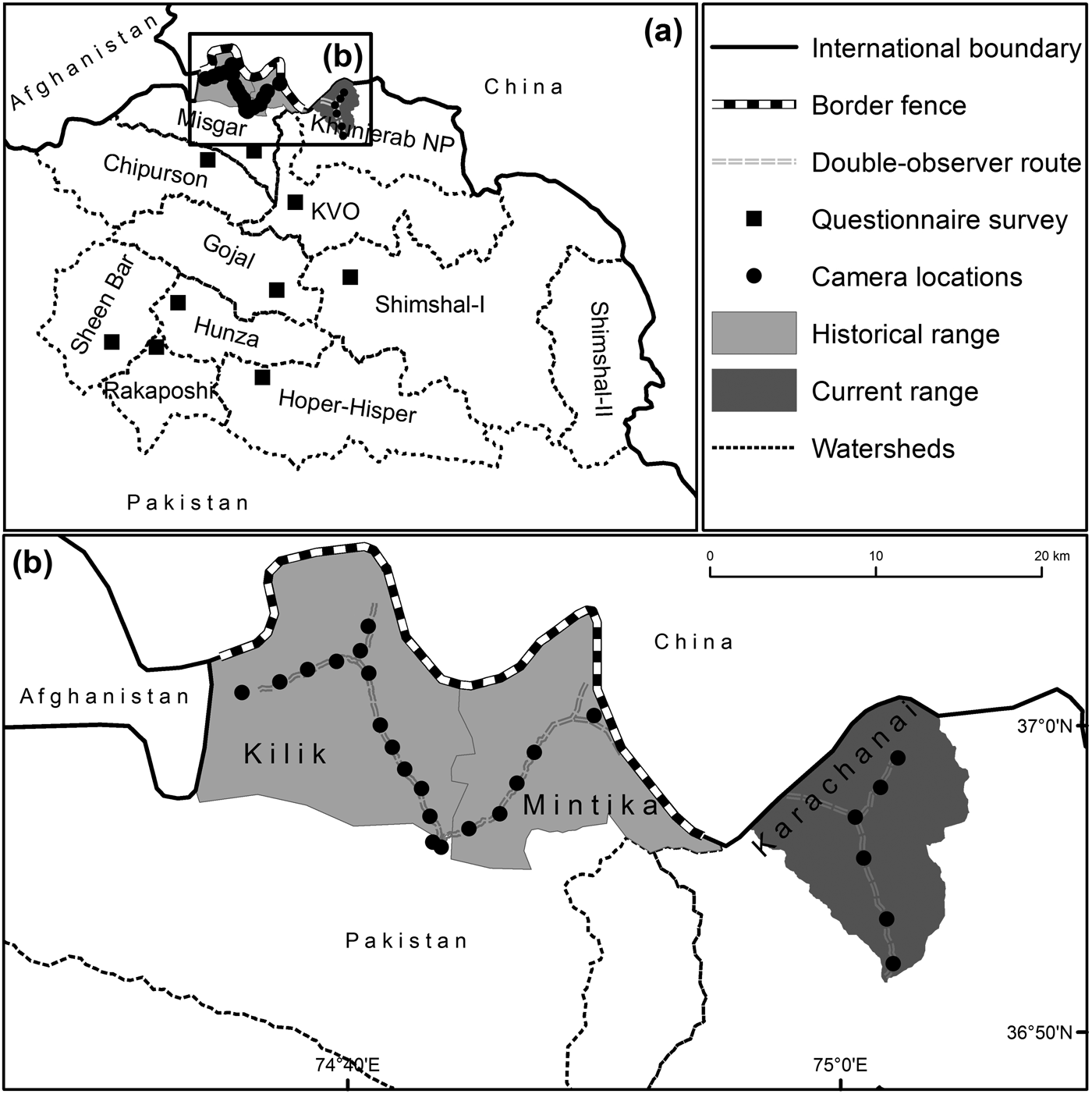
Argali presence was reported only by interviewees in the Khunjerab area. The most recent sighting reported by interviewees in Misgar Valley was from c. 2004. Double-observer surveys (Suryawanshi et al., Reference Suryawanshi, Bhatnagar and Mishra2012; Tumursukh et al., Reference Tumursukh, Suryawanshi, Mishra, McCarthy and Boldgiv2016) were conducted in the second phase of the study, during 25 June–13 July 2012, in the Misgar Valley (956.11 km2) and Khunjerab National Park (1,178.87 km2) areas. These areas were divided into smaller blocks, based on watersheds. In Misgar the surveys focused on Kilik (207 km2) and Mintika (120 km2), and in Khunjerab National Park surveys were conducted in Karachanai (78.3 km2) (Fig. 1). Two observers separated by time (15 minutes), if only one trail was available, and space, if two trails were available, surveyed each watershed by walking along pre-determined routes (Fig. 1). Both observers recorded any pellets, tracks and skulls of argali encountered during the survey.
The third phase took place during 11 May–17 June 2013. Twenty trail cameras (Reconyx HC 500 and HC 900; Reconyx, Holmen, USA) were installed for 1 month in areas where argali occurrence was reported by local people in the Kilik–Mintika area of Misgar and in Khunjerab National Park (Fig. 1).
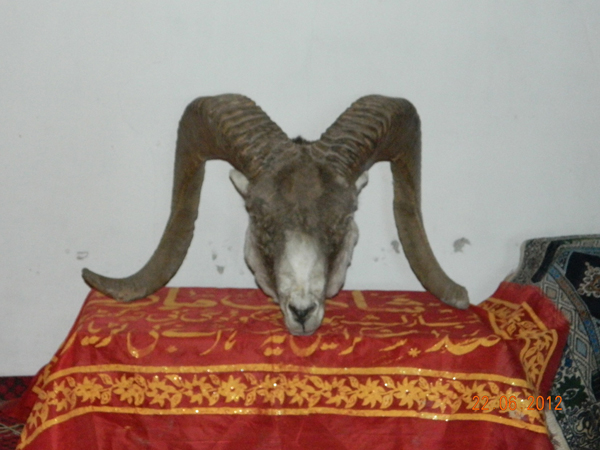
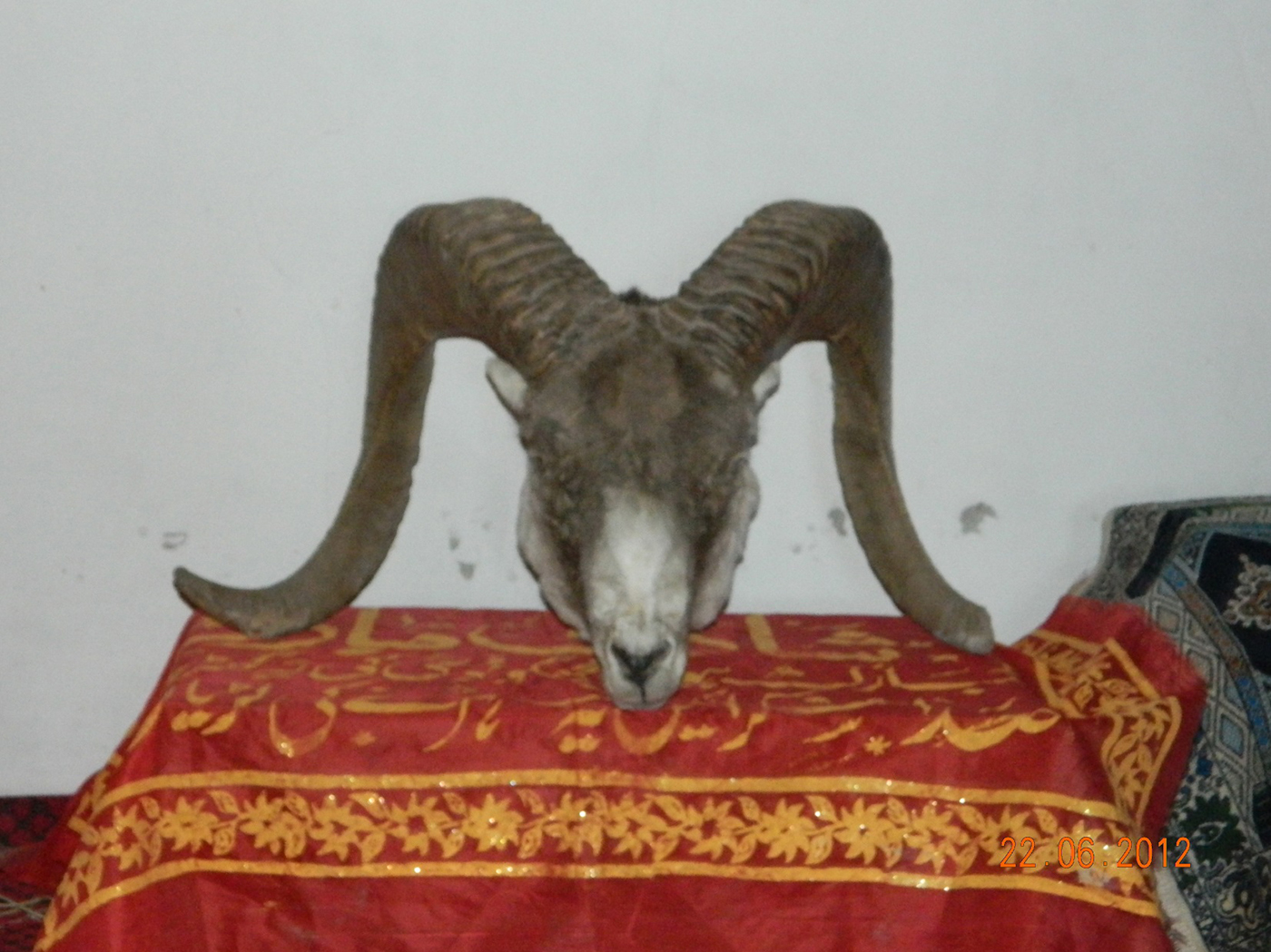
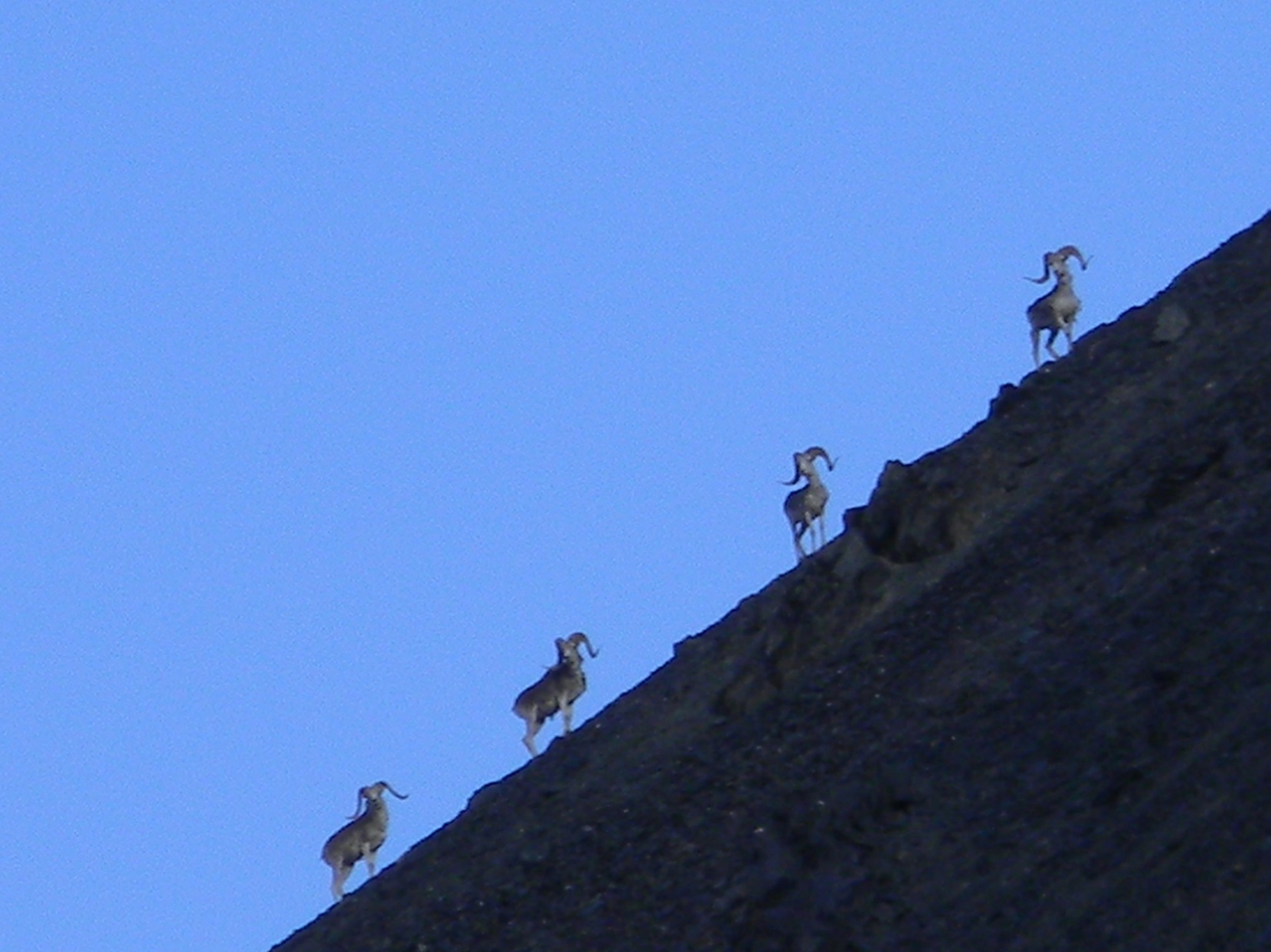
In Chipurson Valley, which is contiguous with Misgar Valley and the Wakhan corridor of Afghanistan (Fig. 1a), neither the map-based questionnaire nor the double-observer survey yielded evidence of Marco Polo argali. Questionnaire respondents reported argali in the Kilik–Mintika area but this was not confirmed by the double-observer survey. In Chipurson Valley a poacher produced the skull of a male argali, which allegedly had been killed illegally at the Pakistan–Afghanistan border in 2007 (Plate 1). In Karachanai Nallah, Khunjerab National Park, both observers encountered a single herd comprising five males, eight females and six lambs (Plate 2). No Marco Polo argali were photographed by camera traps in either the Misgar Valley or Khunjerab National Park.
Skull of a Marco Polo argali Ovis ammon polii ram allegedly poached in 2007 near the Pakistan–Afghanistan border.
Four rams, part of a herd of 19 individuals, sighted in Karachanai Nallah, Khunjerab National Park (Fig. 1) in 2012.
Our surveys in Chipurson Valley, Kilik and Mintika found livestock grazing extensively. These areas lie above 4,000 m, and because of the short growing season for grasses and forbs there was considerable competition for resources, even among livestock (authors, pers. obs.). This may have been sufficient for exclusion of wild sheep from the area (Bagchi et al., Reference Bagchi, Mishra and Bhatnagar2004; Mishra et al., Reference Mishra, Van Wieren, Ketner, Heitkönig and Prins2004; Schaller & Kang, Reference Schaller and Kang2008; Mallon et al., Reference Mallon, Singh and Röttger2014), even in the absence of poaching. Fencing by the Chinese authorities at Kilik Pass may obstruct potential corridors by which argali could cross into Pakistan (Schaller & Kang, Reference Schaller and Kang2008). Snow-capped moutains hinder argali migration from Wakhjir Valley (Afghanistan) into Pakistan.
Hess et al. (Reference Hess, Bollmann, Rasool, Chaudhry, Virk, Ahmad and Shackleton1997) assumed that the extinction of the Marco Polo argali in the Pamir Knot occurred as a result of poaching; however, wildlife authorities did not allow local people to enter Kilik and Mintika prior to 2012. Local people suggested that the extirpation of the Marco Polo argali in the Kilik–Mintika area was a result of the Chinese fence. Similarly, Fox et al. (Reference Fox, Dhondup and Dorji2008) and Luikart et al. (Reference Luikart, Amish, Winnie, Beja-Pereira, Godinho, Allendorf and Harris2011) cited fencing as a hurdle to the movement of the Tibetan antelope Pantholops hodgsonii in China, and there is increasing awareness of the negative ecological impacts of international border fences elsewhere (Lasky et al., Reference Lasky, Jetz and Keitt2011; Linnell et al., Reference Linnell, Trouwborst, Boitani, Kaczensky, Huber and Reljic2016).
In 1991, after meeting with the Khunjerab Village Organization, the Khunjerab National Park administration imposed a total ban on livestock grazing in the Walakdur area in Karachanai Nallah (Hess et al., Reference Hess, Bollmann, Rasool, Chaudhry, Virk, Ahmad and Shackleton1997). The movement of Marco Polo argali has increased since then (Riaz & Akram, 2012, pers. comm.). However, herders and poachers who used to visit Karachanai prior to the establishment of the Park reported that movement and numbers had decreased despite improved monitoring and the livestock grazing ban.
It is likely that livestock grazing and fencing along the international border have had negative effects on the movement and persistence of Marco Polo argali in their historical range in Pakistan. The species now appears to be confined to a single watershed in Khunjerab National Park, which it visits only during the summer. We recommend implementation of more effective monitoring of argali at the Kilik and Mintika game reserves. This could be achieved by recruiting local people as game watchers and involving them in game reserve management planning, as well as convincing them to keep livestock away from core areas of the reserves. We also recommend that government authorities negotiate with their Chinese counterparts for the removal of the fence from the Kilik and Khunjerab passes. Studies to understand resource competition (Namgail, Reference Namgail2006) between the Marco Polo argali and the Himalayan ibex Capra ibex sibirica in Karachanai Nallah are required, as the ibex population is increasing. Cross-border cooperation could also improve the chance of long-term survival of the Marco Polo argali in the Pamirs. Such efforts could include joint studies, for example using camera trapping and faecal DNA analysis to monitor space use and migratory movements by transboundary herds. Since the completion of our study the Parks and Wildlife Department in Gilgit–Baltistan has recruited local guards to protect wildlife in the Kilik–Mintika area but to date the guards have not reported the occurrence of argali there. Neither the Pakistani nor Chinese authorities have initiated discussion regarding the removal of the border fence from the Kilik–Mintika area.
Acknowledgements
We thank the Parks and Wildlife Department in Gilgit–Baltistan, the Chipurson Local Support Organization, the Misgar community, and the Wildlife Conservation Society for their support during the field research.
Author contributions
HA, MAN and JUD conceived and designed the study, with help from RB. HA, JUD and MY collected the data. HA wrote the draft of the article and all authors contributed to subsequent versions.
Biographical sketches
Hussain Ali studies the ecology and conservation of mountain ungulates of Pakistan. Muhammad Younus’ interests lie in understanding livestock–wildlife disease transmission patterns. Jaffar Ud Din is interested in carnivore distribution and conservation. Richard Bischof’s work focuses on wildlife management, non-invasive monitoring, and quantitative ecology. Muhammad Ali Nawaz is interested in molecular and field studies for natural resource management, and has been studying the ecology, co-existence and conservation of carnivores in Pakistan.