




1. Introduction
Electronic dance music is usually produced and played at fixed tempi. Tempo modulation, a change of tempo between two sections of music, occasionally appears as a production technique within a track or as a DJ technique to mix tracks. Tempo modulation is not a prevalent characteristic in electronic dance music but in tracks and performances where it does occur the technique is highly effective and temporally engaging. Pivot mixing, a term and concept introduced by the author for a specific application of tempo modulation in DJ performance, helps to explain current practices and provides a map for their expansion.
The term electronic dance music is used in this article in a broad way to include a broad range of genres and styles such as techno, house, trance, and drum and bass, as well as other musics played at clubs, raves, and festivals. Electronic dance music is a term commonly used in existing research and is more established than the more recent term electronic music and dance, especially when referring to musical rather than cultural issues.
This article explores tempo modulation in electronic dance music and proceeds in four parts. The first part provides a brief history of tempo modulation, its terminology, and applications in instrumental and popular music. The second part presents an overview of tempo modulation in electronic dance music common practice and introduces technical details such as tempo ratios, pivot polyrhythms, and formulae for combinations. The third part explores pivot mixing, a DJ performance technique whereby a sustained loop functions as a pivot between two tempi. In this article, a pivot refers to unchanging musical material around which the tempo is changed. For example, a quarter note loop at 100 bpm can be reinterpreted as a dotted quarter note loop at 150 bpm. A description of the mathematical characteristics of a suitable pivot will help to explain how pivot mixing can leverage a wide variety of tempo ratios. This part concludes with an explanation of how pivot mixing can be executed with standard DJ equipment. The fourth part includes autoethnographic accounts of my experience performing pivot mixing in the Berlin techno scene and concludes with a discussion of potential readings of tempo modulation in electronic dance music. While tempo modulation can apply to electronic dance music in general, the technique is discussed in this article with a particular focus on techno.Footnote 1 This article includes an ethnographic component, whereby the author conducted interviews with two leading techno artists, Chris Liebing and DVS1, about techno production and performance.
Research on techno and electronic dance music ‘has tended to focus on their cultural, historical and sociological aspects’ (Bergemann Reference Bergemann2011, 5), that is, contextual rather than textual matters. Key publications on electronic dance music culture in general include Brewster and Broughton (Reference Brewster and Broughton2014), Thornton (Reference Thornton1996), and Sicko (Reference Sicko2010). Notable publications focused specifically on techno culture include Der Klang Der Familie (Denk and Thülen Reference Denk and von Thülen2014), Lost and Sound: Berlin, Techno und the Easyjetset (Rapp Reference Rapp2009), and Detroit: Techno City (Rietveld and Kolioulis Reference Rietveld, Kolioulis, Lashua, Wagg, Spracklen and Yavuz2019). A modest yet expanding body of research has explored specific elements of electronic dance music production and performance, with a particular emphasis on rhythm. Zeiner-Henriksen analyses the ‘poumtchack’ pattern (Reference Zeiner-Henriksen2010), the steady alternation of kicks (bass drums) and hi-hats featured ubiquitously in techno and other electronic dance music genres. Electronic dance music often features euclidean rhythmic patterns (Jordà et al. Reference Jordà, Gómez-Marín, Faraldo, Herrera, Wilkie and Benetos2016, 367; Toussaint Reference Toussaint, Sarhangi and Moody2005) and microrhythms (Brøvig-Hanssen et al. Reference Brøvig-Hanssen, Sandvik, Aareskjold-Drecker and Danielsen2022; Danielsen et al. Reference Danielsen, Brøvig, Johansson, Sandvik and Bøhler2023). Butler (Reference Butler2006) explains rhythmical features of techno such as polyrhythmic patterns and metric dissonance through the framework of ‘pulse layers’ (Krebs Reference Krebs1999). Butler (Reference Butler2014) offers insight into electronic dance music performance but does not delve into production details. Smith (Reference Smith2021) analyses the function of continuous processes in electronic dance music such as filter movements. There are, to this author’s knowledge, no previous studies on tempo modulation in electronic dance music. DJs, when they do use tempo modulation, often do so to blend genres with different tempi, such as techno with drum and bass. This creative practice is explained, expanded, and formalised in this study as the concept of pivot mixing.
2. Tempo modulation history
A brief history of tempo modulation reveals a crucial aspect of rhythmic groupings, that their prevalence depends on cultural trends. Consequently, tempo modulations that rely on common groupings are more likely to appear in common practice. Conversely, tempo modulations that rely on less common groupings are rarer. Grouping structure is a highly influential system of rhythmic organization proposed by Lerdahl and Jackendoff Reference Lerdahl and Jackendoff1983, whereby groups of pulses are set against a background metrical grid. Rhythmic groupings and temporal relationships are intimately linked, as the first describes the number of pulses in a group and the second describes the proportional relation between two groupings. In this article, tempo modulation refers to establishing a new tempo by reinterpreting a pivot. A pivot is musical material, typically isochronous, with note duration as its salient feature. An isochronous rhythm is a pattern ‘where all intervals between events are equal, like those of a metronome’ (Ravignani and Madison Reference Ravignani and Madison2017, 2). Except for simple edge cases that involve doubling or halving the tempo, pivots create polyrhythms. A tempo modulation ratio expresses the proportions between the tempo before and after the modulation. This ratio is generated by two levels of temporal relationships. The first level, a pair of polyrhythms, expresses the relationships between the pivot duration and the pulse of each tempo. The second level, a tempo modulation ratio, expresses the relationship between the two polyrhythms. The relationship at the heart of tempo modulation, that between initial and new tempo, usually expresses a ratio of natural numbers. For example, a tempo modulation from 140 to 168 bpm expresses a 5:6 ratio. The detailed connections between tempo modulation ratios and polyrhythms will be explored in a later section. For now, it is enough to understand that .tempo modulation effects a change of tempo, a change of tempo can be expressed as a ratio, and ratios emerge from polyrhythms.
Rhythmic groupings theory begins in the 13th century with Magister Lambert, who held that ternary alone was the rhythmic ideal and that duple rhythm was unplayable (Apel Reference Apel1949, 292). The appearance of duple meter, notably in the 14th-century Ars Nova treatise (c. 1322), made nascent forms of tempo modulation possible. Busse Berger’s Mensuration and Proportion Signs (Reference Busse Berger1993) provides a comprehensive study of temporal relationships in early music. The combination of duple and ternary meter enables syncopation, hemiola, and vertical 2:1 or 3:1 temporal relationships between voices. Music from the Ars Nova and Ars Subtilior periods features metric alterations by adding or subtracting tactus values, a process that changes the meter but not the tempo. Tinctoris, in his Proportionale Musicae (1473), placed ‘rhythmic proportions on par with the harmonic ones’ (Busse Berger Reference Busse Berger1993, 168), thereby highlighting an important link between rhythm and harmony that has been expanded on by later theorists. By the late 15th and early 16th century, proportions in use include 2:1, 3:1, 4:1, 3:2, 4:3, 9:4, and 9:8. Busse Berger notes that John Hothby’s motet Ora pro nobis ‘includes the fractions 5:2, 5:4, and 7:4’ (Reference Busse Berger1993, 168), and the motet is described by Brand as ‘an exercise in proportional notation’ (Reference Brand2010, 778). Similarly, a piece from Morley’s Plaine and Easie Introduction to Practicall Musicke (1597), transcribed into modern notation by Wuorinen (Reference Wuorinen1964) includes 5:4 and 7:8 tuplets. By the 16th century, temporal proportions were now ‘used in a linear fashion as opposed to the vertical relationships seen earlier’ (Fawcett-Lothson Reference Fawcett-Lothson2012, 16), thus creating changes of tempo. Weisberg cites 1:2 as a common tempo modulation in Bach between adagio and allegro sections (Reference Weisberg1993, 51). Bouchard mentions the continued practice of 1:2 tempo modulations in 19th-century music and provides examples of 2:3 tempo modulations in Beethoven (Bouchard Reference Bouchard2008, 45). Lau’s study of meter changes in Brahms’ Lieder (Reference Lau2015) reveals an abundance of 2:3 and 3:4 relationships and a single instance, in op. 85, no. 3, of a 5:6 relationship. While 19th-century music does increasingly feature tuplets, for example, in Chopin, these tend to function as florid embellishments of a duple or ternary meter rather than exotic meters or changes of tempo.
The temporal relationships discussed, apart from occasional outliers, are so far mostly 3-limit ratios, that is ratios in which the biggest prime factor of either term is three, such as 2:3 or 9:8. Limit is a term borrowed from tuning theory, introduced by Harry Partch, which ‘indicates the highest prime […] participating in the ratios of a given […] system’ (Wolf Reference Wolf2003, 13). In this article, limit is used to refer to ratios in a temporal system rather than in a tuning system. Fétis (1784–1871) speculated extensively about future rhythmic techniques, yet he ‘explicitly dismissed regular divisions of the beat into five or seven parts’ (Arlin Reference Arlin2000, 265). His refusal to consider the musical potential of rhythmic groupings with prime factors beyond three may have hindered his ability to fully conceive tempo modulation. Regardless, his theory of rhythm in four ordres (‘categories’) – unirhythmique (‘monotemporal’), transirhythmique (‘transtemporal’), plurithyhmique (‘pluritemporal’), and omnirhythmique (‘omnitemporal’) – lays important groundwork for the study of temporal modulation. Fétis’ four categories can be understood respectively as a single tempo, tempo modulation in a 2:3 relationship akin to dominant modulation in harmony, tempo modulation constrained to small 3-limit ratios, and lastly a speculative category that could correspond to tempo modulation with unbounded prime limits. These categories explicitly draw an important parallel between tempo modulation in rhythm and tonal modulation in harmony, echoing Tinctoris, and the trend of 3-limit tempo ratios continues until the 20th century.
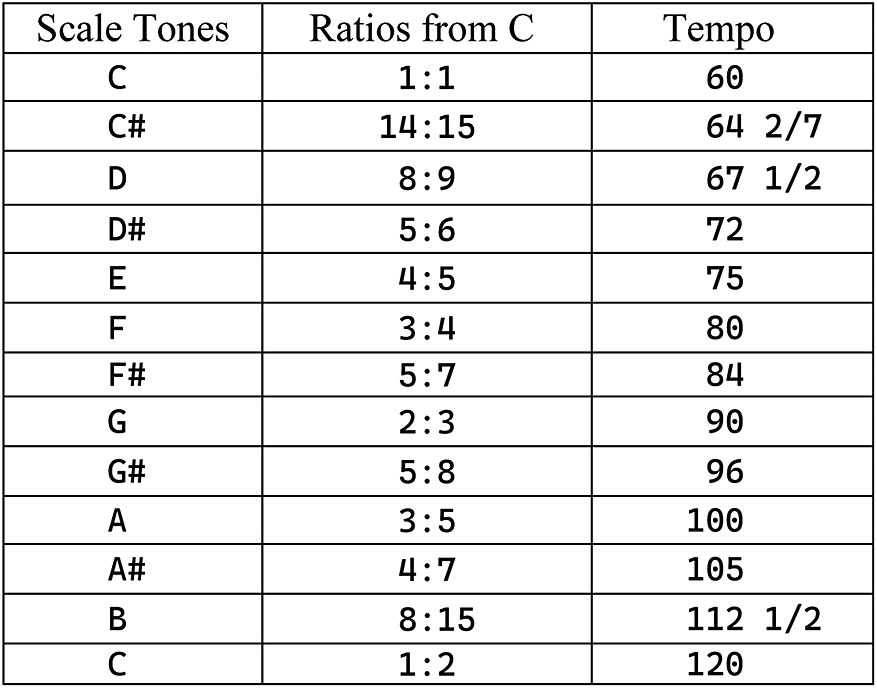
Temporal relationships beyond 3-limit ratios are common in 20th-century contemporary classical music, as are complex ‘multi-layered polyrhythms’ (Wannamaker Reference Wannamaker2012). Cowell’s highly influential New Musical Resources, first published in 1930, makes use of the harmonic series to organise rhythm. He proposed a 7-limit scale (Cowell Reference Cowell1996, 107), reproduced in Example 1, to organise tempi. The 60 bpm (M.M.) reference tempo merely serves to illustrate the principle; the ratios can in fact be applied to any reference tempo. Though not exhaustive, Cowell’s approach significantly expands available tempo ratios.
Tempo scale from Henry Cowell’s New Musical Resources.

Example 1. Long description
From the top row downward, the table has three columns labeled Scale Tones, Ratios from C, and Tempo. The rows list: C, 1 to 1, 60; C sharp, 14 to 15, 64 and two sevenths; D, 8 to 9, 67 and one half; D sharp, 5 to 6, 72; E, 4 to 5, 75; F, 3 to 4, 80; F sharp, 5 to 7, 84; G, 2 to 3, 90; G sharp, 5 to 8, 96; A, 3 to 5, 100; A sharp, 4 to 7, 105; B, 8 to 15, 112 and one half; C, 1 to 2, 120. Each row aligns the scale tone with its ratio from C and the corresponding tempo value.
Disambiguating temporal modulation, tempo modulation, and metric modulation facilitates further discussion. I use ‘temporal modulation’ as a translation of Bouchard’s ‘modulation agogique’, a wide category denoting ‘the passage from one mode of organisation of sounds in time to a different mode’ (Reference Bouchard2008, 13) (tout passage d’un mode d’organisation des sons dans le temps à un mode différent). Bouchard created a meticulous taxonomy of temporal modulation which includes tempo modulation (a change of tempo, for example, from 129 to 172 bpm), many types of metric modulation (a change of meter, for example, from 2/4 to 6/8), and combined modulation (the simultaneous occurrence of both tempo and metric modulation). Although Bouchard rejects accelerando and ritardando because of the challenge of precisely notating them, they nevertheless qualify as a type of tempo modulation. For a summary of Bouchard’s taxonomy and earlier work on tempo modulation from Benadon (Reference Benadon, Lipscomb, Ashley, Gjerdingen and Webster2004), see Quinton (Reference Quinton2017, 146–61). Osborn analyses changing meters in math-rock and clearly distinguishes their use from tempo modulation (Reference Osborn2012, 44). While meter in electronic dance music is a diverse phenomenon that cannot be simply dismissed as 4/4, as Butler explains through metrical dissonance (Reference Butler2006, 138–76), temporal modulation in electronic dance music tends to focus on changes to the tactus and, despite brief potential changes of meter, can often be explained as tempo modulation rather than combined modulation.
Tempo modulation was thoroughly explored in instrumental music by Carter. Bouchard’s analysis (Reference Bouchard2008, 26–27) of Carter’s Eight Pieces for Four Timpani demonstrates a typical case (see Example 2, copied from Bouchard). A dotted eighth note at 126 bpm is reinterpreted as a quarter note at 168 bpm, thereby expressing a 3:4 tempo ratio. The pivot corresponds to a grouping of three 16ths before the shift and four 16ths after the shift.
Tempo Modulation (3:4) in Elliott Carter, Eight Pieces for Four Timpani, ‘Improvisation’, mm. 14-16.

Example 2. Long description
From the left, the bass clef staff begins in B flat major with a tempo marking quarter note equals 126. The first measure contains steady quarter notes, each marked with an accent symbol below. The second measure introduces a group of six notes beamed together, followed by a group of four, all accented. A crescendo hairpin appears below these notes, leading to a double forte (f f) dynamic marking. The third measure shows a tempo modulation: dotted quarter note equals quarter note, then quarter note equals 168. This measure contains a triplet, a dotted quarter, and accented notes, with a marcato marking above. The final measure continues with accented quarter notes and the abbreviation ‘etc.’ indicating continuation. Articulations include accents, marcato, and slurs, with dynamic and tempo changes clearly indicated.
A 4:7 tempo modulation, from 60 to 105 bpm, occurs in the ‘March’ movement of the same piece. Example 3, also copied from Bouchard’s analysis of Carter, features a pivot duration delineated successively in four different ways.
-
• as a half note in a bar of 2/2 at 60 bpm
-
• as a septuplet in a bar of 3/2 at 60 bpm
-
• as a bar of 7/16 implicitly at 105 bpm
-
• as seven 16ths in a bar of 12/16 explicitly at 105 bpm
Tempo Modulation (4:7) in Elliott Carter, Eight Pieces for Four Timpani, ‘Improvisation’, mm. 54-57.

Example 3. Long description
From left to right, the staff is in bass clef with a 3/2 time signature. The tempo marking at the start is quarter note equals 60. The first three measures contain half notes and quarter notes, each marked with an accent. Below the staff, accents are indicated with greater-than symbols. The dynamic marking ‘meno f’ appears under the third measure, with a crescendo hairpin extending rightward. The next measure introduces a group of seven sixteenth notes bracketed with the number 7, followed by a group of twelve sixteenth notes bracketed with the number 12. Above the twelve-note group, the tempo changes to dotted quarter note equals 105. Each note in these tuplets is accented, and the dynamic marking changes to f f, then f, alternating under each group. The excerpt ends with accented f markings under the last notes.
The last three, save for the accents, are rhythmically identical. By the last bar, the pivot, now a grouping of seven 16ths, is subsumed in a 12/16 meter with accents on every beat.
Tempo modulation also appears in jazz, rock, and pop. Wynton Marsalis’ 1987 recording of ‘Autumn Leaves’ (Reference Marsalis1987), 0:00–0:15, includes a quick succession of tempo modulations in the rhythm section – 1:2, 2:3, 3:4, 4:5, 5:6, 6:7, 7:8 – neatly ending up at double-time at the end of the sequence (Hartland Reference Hartland2014, 31). Rage Against The Machine’s ‘Killing In The Name’ (1992) features a 8:9 tempo modulation in the introduction, 0:08–0:24, whereby a pivot first heard in the bass is reinterpreted from a quarter note triplet to a dotted eighth in the bass and guitar riff, thereby shifting the tempo from 110 to approximately 123.75 bpm (Rockwell Reference Rockwell2022). Lionel Richie’s ‘Say You, Say Me’(Richie Reference Richie1986) features a 2:3 tempo modulation, 2:45–2:54, whereby an eighth note triplet drum fill is reinterpreted as an eighth note groove (Hartland Reference Hartland2014, 30). Despite the rich history of tempo modulation, these techniques have not been much exploited in electronic dance music.
Machine aesthetics, ‘whereby the inherent nature of the machine imposes musical and sonic characteristics’ (Stevenson Reference Stevenson2023), is a key component of electronic dance music, evident in rhythmic precision and perfect repetition. Nancarrow was a pioneer in exploring temporal relationships afforded by mechanical performance. His Player Piano Studies, 49 pieces composed between 1948 and 1992, explore vertical temporal relationships in ratios as simple as 3:4 and irrational ratios ‘as complex as e/pi’ (Scrivener Reference Scrivener, Sarhangi and Jablan2001, 160). Study No. 28 notably features a 17:8 vertical tempo relationship, that is, a 17-limit ratio. However, even more than his will to explore rhythmic complexity, it is Nancarrow’s choice of instrument that will be relevant in the present discussion; the player piano, an acoustic automaton driven by piano rolls, rolls of paper with holes punched in patterns, is the progenitor of the modern digital audio workstation (DAW) that is at the heart of electronic dance music. Machine music, whether it be mechanically or electronically produced, is a medium particularly well suited for rhythmic precision and adventurousness. Digital precision enables not only a distinct style of mechanical groove but also the perfect execution of tempo modulation in electronic dance music.
Three types of temporal modulation relevant to electronic music emerge from this historical survey: continuous, irrational, and rational. Two of these types include unprepared temporal modulations, changes of tempi ‘without connecting material’ (Hobert Reference Hobert2010, 21).
-
(1) Continuous Tempo Modulation: continuous tempo changes
-
(a) Accelerando: gradual tempo increase
-
(b) Ritardando: gradual tempo decrease
-
(c) Florid: sequence of gradual tempo changes
-
-
(2) Irrational Tempo Modulation: discrete tempo change expressed by an irrational number
-
(a) Prepared: modulation with an irrational pivot (e.g. e/pi) (Scrivener Reference Scrivener, Sarhangi and Jablan2001, 160)
-
(b) Unprepared: no pivot material
-
-
(3) Rational Tempo Modulation: discrete tempo change expressed by a ratio of whole numbers
-
(a) Prepared: modulation with a rational pivot (e.g. 3/4)
-
(b) Unprepared: no pivot material
-
Continuous tempo modulation is perhaps the most common type of tempo modulation in electronic dance music and constitutes an example of ‘continuous processes [that] contribute to the emotional waves experienced when listening to the music’ (Smith Reference Smith2021). Irrational tempo modulation remains to this author’s knowledge largely hypothetical as an intentional technique in electronic dance music, although it can be created unintentionally by failing to beatmatch in a DJ performance, resulting in two records playing in a complex tempo relationship colloquially known as a ‘trainwreck’ (Veen and Attias Reference van Veen and Attias2011). Discrete tempo modulations, regardless of whether the tempo ratio is irrational or rational, can occur suddenly and unprepared, or they can be prepared with pivot material. Prepared rational tempo modulation corresponds to tempo modulation as it is most commonly understood, as a ‘change of tempo by means of a shared durational unit’ (Benadon Reference Benadon, Lipscomb, Ashley, Gjerdingen and Webster2004), and appears in electronic dance music most commonly with 2:3 and 3:4 ratios. Therefore, unless otherwise noted, ‘tempo modulation’ will continue to refer to a prepared rational modulation. Pivot mixing is the application of a prepared, rational modulation in electronic dance music, especially in DJ performance.
3. Tempo modulation in electronic dance music
Understanding pivot mixing requires first understanding several defining rhythmic and metric characteristics of electronic dance music: pulse trains, kick drums, polyrhythms, steady tempi, and repetition. Electronic dance music, especially techno, ubiquitously features ‘pulse trains’, a term introduced by the author (Reference Bougaïeff, Rietveld and Young2026) and defined as prominent articulations of a steady pulse, especially on the sixteenths grid. The term ‘pulse train’, while similar in concept to ‘pulse layer’ used by Krebs (Reference Krebs1999) and defined by Butler as ‘the fastest regular layer of motion within a given musical passage’ (Reference Butler2006, 327), or to ‘metrical level’ introduced by Lerdahl and Jackendoff (Reference Lerdahl and Jackendoff1983), is favoured for four reasons. Firstly, a pulse train can correspond to any pulse layer. Secondly, the term ‘layer’ is already used in electronic dance music production to refer to a sound playing in rhythmic unison with another sound. Layers are typically used to thicken a timbre. Thirdly, the term ‘pulse train’, borrowed from digital signal processing, evokes a propulsive horizontality matching the mechanical isochronous sound of techno and has its own specific use case in this context, whereas alternative terms evoke a vertical superposition and typically refer to notated instrumental music. Finally, a pulse train refers not only to the pattern of an isochronous rhythm, but also to sonic material explicitly reifying the rhythmic pattern, with every onset played by a sound, whereas an isochronous rhythm can refer strictly to a pattern independent of sound.
A steady kick is a core feature of countless dancefloor genres, including house and techno. As Butler remarks, a ‘repeating [kick] pattern is almost always present’ (Reference Butler2006, 34). Genres predicated on syncopation, such as jungle and its many offshoots, do not feature kicks in quarter note pulse trains but nevertheless maintain a metronomic tactus. The term ‘kick’, or ‘kick drum’, is preferred because it is commonly used in electronic dance music production and often implies an intricately designed electronic sound played with metronomic precision, marking a distinction from the more general term ‘bass drum’ which typically refers to instrumental music. Zeiner-Henriksen writes that the ‘poumtchack’ pattern, a steady stream of alternating downbeats and upbeats typically produced with kicks and hi-hats, ‘not only marks out the rhythmic pulse but communicates the basic rhythmic structure’ (Reference Zeiner-Henriksen2010, 137). Techno DJ and producer Chris Liebing, when asked what an essential element for a techno track might be, replied without hesitation that it is the kick (Reference Liebing2024). Although rare edge cases of electronic dance music may ‘[remove] the kick-drum altogether’ (Ralston Reference Ralston2019), kicks, especially in quarter note pulse trains, are doubtlessly normative.
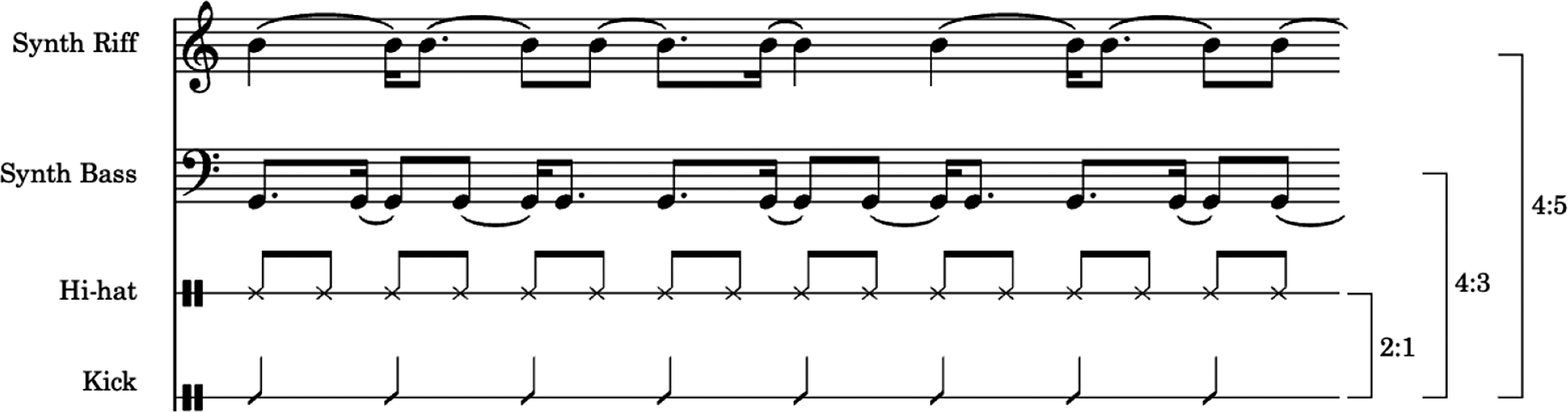
Polyrhythms are an essential feature of techno and electronic dance music in general. In this article, a polyrhythm is defined as the relationship between two pulse trains. Example 4 demonstrates a hypothetical realisation of four different pulse trains emerging from groupings of 4/16, 2/16, 3/16, and 5/16. Ratios on the right-hand side indicate the ratio formed between each pulse train and the tactus (the beat, typically expressed by a kick). While a pulse train is an unbounded sequence, a polyrhythm is a bounded cycle defined by its ratio. The synth bass, for example, an unbounded pulse train proceeds in note values corresponding to 3/16, a dotted eighth, creates a 4:3 polyrhythm against the kick. The synth bass plays four times in the same duration as three kicks before they are once again in phase and the cycle is repeated. The synth riff, a 5/16 pulse train, similarly creates a 4:5 polyrhythm against the kick. While the definition of polyrhythms normally excludes duple relationships such as 2:1, these ratios are also important when calculating tempo relationships. We can either refer to these ratios as temporal relationships or simply expand the definition of polyrhythm to include duple relationships. Polyrhythms in electronic dance music are clearly audible as the periodicities of different sounds. Butler explains that in techno, ‘as long as our tendency to hear drums as timekeepers remains active, we will hear a number of different times being kept at once’ (Reference Butler2006, 99). Any of these different pulse trains can be used as a tempo modulation pivot.
Polyrhythms generated by groupings of 2, 3, and 5 sixteenths.

Example 4. Long description
From top to bottom, the first staff labeled Synth Riff uses treble clef and displays a melodic line in sixteenth notes. The second staff, Synth Bass, uses bass clef and presents a rhythmically distinct pattern. The third staff, Hi-hat, shows repeated x-shaped noteheads for steady sixteenth notes. The fourth staff, Kick, marks downbeats with vertical lines. On the right, three vertical brackets group the staves: the top bracket connects Synth Riff and Synth Bass, labeled 4 to 5; the middle bracket connects Synth Bass and Hi-hat, labeled 4 to 3; the bottom bracket connects Hi-hat and Kick, labeled 2 to 1. These indicate the polyrhythmic relationships between the instrumental layers.
A steady and perfectly accurate tempo is an essential characteristic of electronic dance music. Individual tracks are usually produced at a single unwavering tempo. Entire genres can be defined by tempo range, in addition to other characteristics such as rhythmic patterns and timbre aesthetics. Techno is usually between 130 and 140 bpm, while house is generally slower, and drum and bass is usually around 170 bpm (Alspach Reference Alspach2020). House and techno often feature steady kicks, while drum and bass features various syncopation patterns. The bpm at which a DJ habitually plays can be a mark of identity or a point of pride, as DJs often focus on a narrow tempo range for months or even years of their career. Fans and journalists take notice when a scene (Bennett and Peterson Reference Bennett, Peterson, Bennett and Peterson2004) speeds up or slows down (Macdonald Reference Macdonald2018). Playing even 10 bpm faster or slower than current trends is a significant change. Techno DJ performances often stay at a single tempo or focus on a narrow range of tempi.
Repetition and groove, for centuries a secondary concern in European music, is embraced in electronic dance music as a primary focus, a rich celebration of body movement (Burger and Toiviainen Reference Burger and Toiviainen2020) and patterns inspired especially by West African musics, among others (May Reference May, Burnim and Maultsby2006). While microrhythm, in combination with grid-based rhythms, has been established as a crucial feature of groove in electronic dance music (Brøvig-Hanssen et al. Reference Brøvig-Hanssen, Sandvik, Aareskjold-Drecker and Danielsen2022), microrhythm is not a relevant component of tempo modulation. Repetition in electronic dance music can be leveraged, by way of repetitive pivot material, to create clear and accessible tempo modulation effects. This approach makes it possible to create tempo-shifting tracks and DJ tools,Footnote 2 while also mitigating the risk that tempo changes can pose to sustaining entrainment and maintaining a groove.
3.1. Continuous tempo modulations
Accelerandi and ritardandi are perhaps the most well-known types of temporal modulation in electronic dance music. DJs, for example, can pitch turntables or CDJs (a brand of digital turntable) up or down, thus increasing or decreasing the tempo throughout a performance. Tracks in the electronic dance music repertoire can be found that incorporate accelerandi, ritardandi, or both, for a variety of purposes: as an intensification effect without a specific tempo destination, for example in Moby’s ‘Thousand’ (1993) and in Hardhead’s ‘New York Express’ (1994); as a means to lead from a beatless introductory section to a main beat, for example in Eric Prydz’s ‘Opus’ (2015) and in Deadmau5’s ‘Strobe’ (2009); in at least one case, nsi.’s ‘Risset’ (2008), as a Risset rhythm (Stowell Reference Stowell, Adkins, Evanoff, Isaacs and Pringle2011); and sometimes to connect sections with distinct tempi. The following examples focus on tracks with sections at distinct tempi. Lil Louis’ ‘French Kiss’ (1989) first slows down,Footnote 3 5:11–5:52, from 128 bpm to approximately 42 bpm. The music proceeds with a full bar at 42 bpm, a tempo at which 16th hi-hats articulate a 168 bpm pulse train. The track later accelerates, 6:10–7:18, from 42 bpm back to 124 bpm. These two tempi, 42 and 128 bpm, nearly exactly form a 1:3 ratio. Planet Soul’s ‘Set U Free (Fever Mix)’ (1995) features two ritardandi and an unprepared tempo modulation. The first ritardando proceeds from 126 bpm to 120 bpm, 3:23–3:39, corresponding to a 21:20 tempo ratio. The next section, 3:39–4:43, proceeds at 120 bpm. The second ritardando, 4:43–5:01, proceeds from 120 to 98 bpm, a relationship very close to both 5:4 (which would be 120 to 96 bpm) and 6:5 (which would be 120 to 100 bpm). Finally, an unprepared tempo modulation (6:15) shifts the tempo back to 126 bpm. This final shift, from 98 to 126 bpm, corresponds to a 7:9 tempo ratio. Although these are too few examples to establish statistical significance, these anecdotal findings suggest that the ambitus of continuous tempo modulations tends to express relatively small ratios.
3.2. Prepared rational tempo modulations
Tempo modulation (prepared rational tempo modulation) occurs most frequently in electronic dance music production and performance in 2:3 and 3:4 ratios, matching historical trends. Both ratios will be demonstrated through examples from electronic dance music common practice. Tempo modulation will be revealed to serve not only as an expressive device and mechanism to introduce new relationships in a temporal palette, but as a fundamental shift in tempo and genre. The power of tempo modulation to create and resolve stylistic ambiguity in electronic dance music emerges as one of the technique’s powerful affordances.
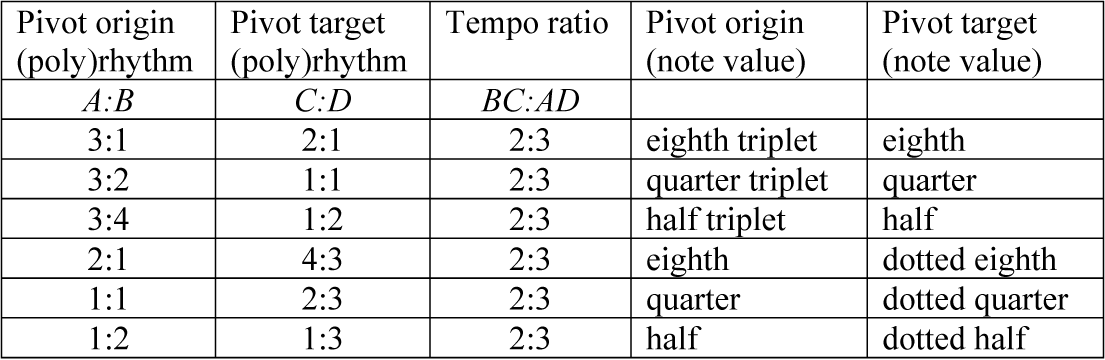
A tempo ratio can be generated by the relationship between two polyrhythms, and each polyrhythm corresponds to a relationship between a pivot and the tactus (the beat). It is therefore useful to adopt polyrhythm notation to identify pivot note values, for example, an eighth note corresponds to a 2:1 polyrhythm and a dotted eighth corresponds to a 4:3 polyrhythm. The formula to generate a tempo ratio from two polyrhythms A:B and C:D is BC:AD. For example, the 2:3 tempo ratio can be generated by a pivot that shifts from 2:1 to 4:3 because BC = 1 × 4 = 4, AD = 2 × 3 = 6, and the resulting 4:6 ratio is equivalent to 2:3. Example 5 tabulates pivot combinations that generate a 2:3 tempo ratio. Parentheses are placed around the word poly to account for 1:1, a rhythmic pattern that cannot be considered a polyrhythm. The BC:AD formula is crucial as a compositional tool to find pivots underpinning more complex ratios such as 21:20, as in ‘Set U Free’ as described above. This ratio, for example, can be generated by a 4:7 to 3:5 pivot (a double dotted quarter note in the origin tempo pivoting to a quarter note tied to a quarter note triplet in the target tempo) because 7 × 3 = 21 and 4 × 5 = 20. Regardless of the complexity of the ratios involved, the variety of notes values revealed by the BC:AD formula is also useful when analysing pivot material.
Pivot pairs generating a 2:3 tempo ratio.
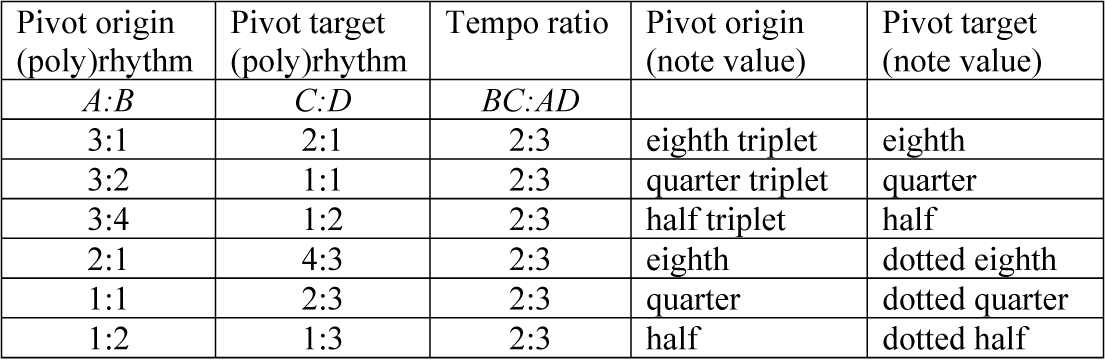
Example 5. Long description
The table has five columns labeled from left to right as Pivot origin polyrhythm, Pivot target polyrhythm, Tempo ratio, Pivot origin note value, and Pivot target note value. The first row under the headers lists 3 to 1, 2 to 1, 2 to 3, eighth triplet, and eighth. The second row lists 3 to 2, 1 to 1, 2 to 3, quarter triplet, and quarter. The third row lists 3 to 4, 1 to 2, 2 to 3, half triplet, and half. The fourth row lists 2 to 1, 4 to 3, 2 to 3, eighth, and dotted eighth. The fifth row lists 1 to 1, 2 to 3, 2 to 3, quarter, and dotted quarter. The sixth row lists 1 to 2, 1 to 3, 2 to 3, half, and dotted half. Each row shows how a specific polyrhythm and note value can be transformed into another using a 2 to 3 tempo ratio.
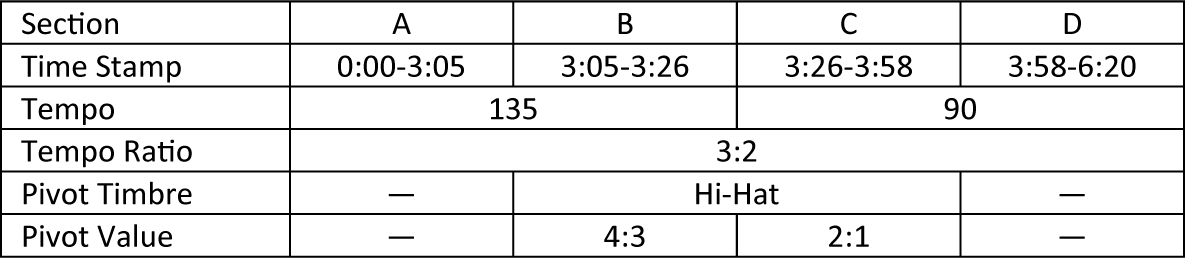
Mosca’s ‘On The Night In Question’ (2021) is structured in two main parts, the first at 135 bpm and the second at 90 bpm (see form chart Example 6). Section B, 3:05–3:26, can be understood either as 12 bars in 4/4 at 135 bpm, or 8 bars in 4/4 at 90 bpm. Ambiguity of tempo constitutes a temporal extension of Butler’s concept of ambiguity of metrical type, that is ‘the larger context in which the patterns are to be interpreted’ (Reference Butler2006, 130). The first interpretation of section B, at 135 bpm, segments the section into a series of phrases of diminishing durations: 16, 8, 8, 4, 4, 4, and 4 beats. Each phrase begins with a kick. A syncopated clap occasionally plays on the second upbeat. The first and last phrases include a turnaround whereby two filtered kicks articulate the two last beats in a brief crescendo. The second interpretation of section B, at 90 bpm, considers the isochronous hi-hats as eighth notes grouped in common time. Regardless of when exactly the tempo shifts in the listener’s mind and body, the 3:2 modulation clearly hinges on the 4:3 to 2:1 pivot pair articulated by the hi-hat. The ambiguity is resolved in section C; every two-bar loop begins with a kick on the first beat, followed by a clap on the second beat. Finally, the last two-bar loop, 3:53–3:58, features a rhythmic reduction whereby the hi-hat only plays on the beat in a 1:1 rhythm, conclusively establishing the new tempo of 90 bpm. Section D, 3:58–6:20, drops with a full beat at 90 bpm, a tempo that is maintained until the end of the track.
Mosca, ‘On The Night In Question,’ form chart.

Example 6. Long description
From top to bottom, the first row lists sections A, B, C, D. The second row gives time stamps: A is 0:00 to 3:05, B is 3:05 to 3:26, C is 3:26 to 3:58, D is 3:58 to 6:20. The third row shows tempo: A and B have 135, C and D have 90. The fourth row, tempo ratio, is blank for A and B, C has 3 to 2, D is blank. The fifth row, pivot timbre, is blank for A, B is blank, C is Hi-Hat, D is blank. The last row, pivot value, is blank for A, B has 4 to 3, C has 2 to 1, D is blank.
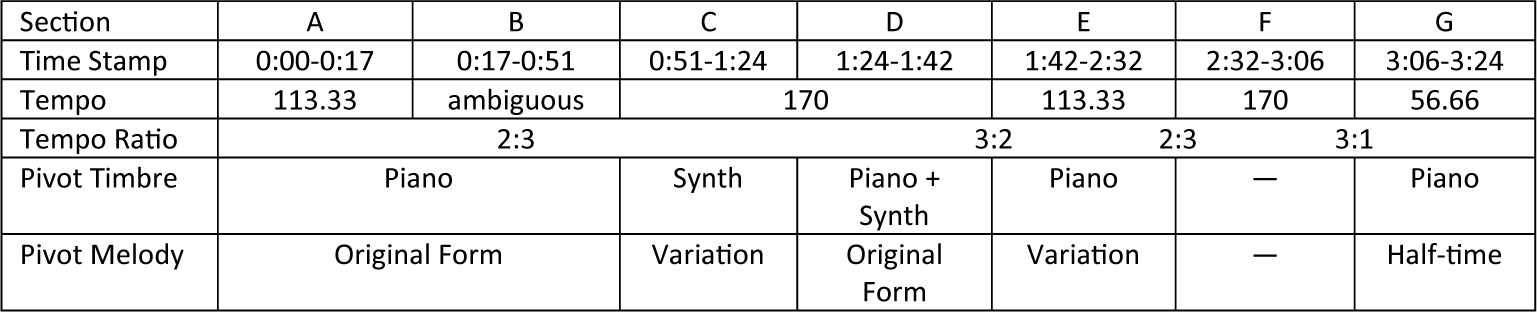
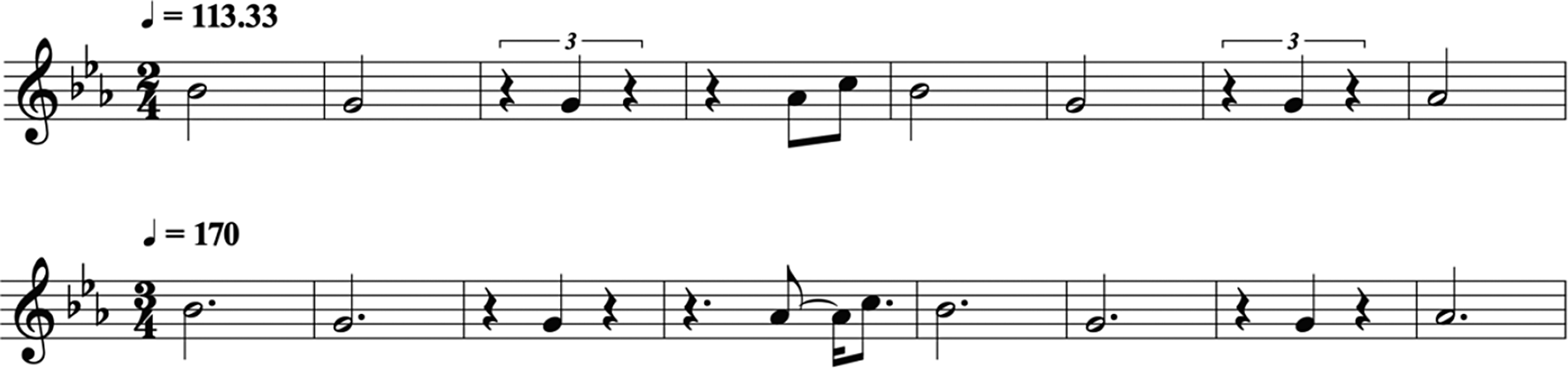
Machinedrum’s ‘Sleepy Pietro (feat. Tigran Hamasyan)’ (2020) is structured in sections alternating between 113.33 and 170 bpm, expressing 2:3 and 3:2 tempo ratios, and ends with a section at 56.66 bpm, expressing a 3:1 tempo ratio (see form chart in Example 7). The track is particularly notable for using elaborate pivot material, transcribed in Example 8, that is not an isochronous rhythmic pattern but rather uses a variety of note values. The pivot is transcribed in 2/4 and 3/4 meters merely to depict the tempo relationship between sections and does not suggest an intention from the composer.
Machinedrum, ‘Sleepy Pietro (feat. Tigran Hamasyan),’ form chart
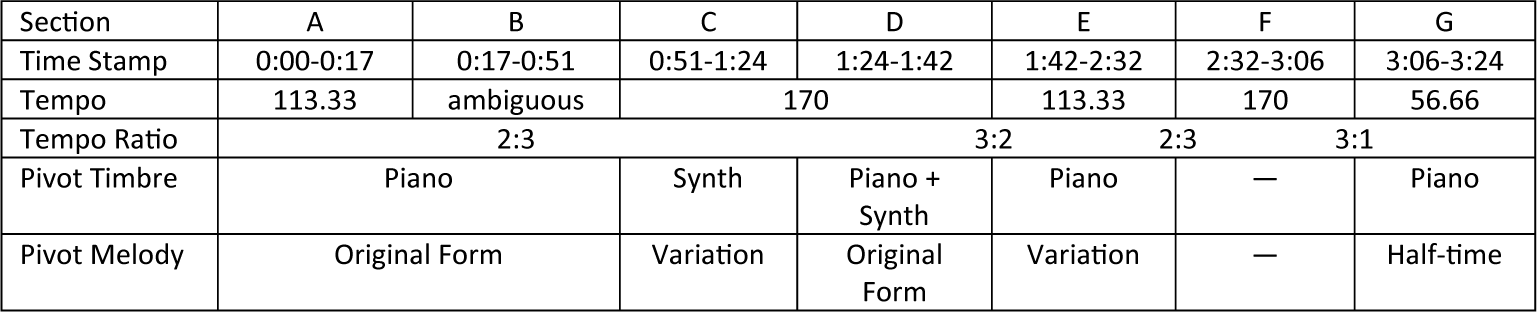
Example 7. Long description
The table has seven columns labeled A to G and six rows. The first row lists sections A to G. The second row, Time Stamp, gives ranges: A is 0:00 to 0:17, B is 0:17 to 0:51, C is 0:51 to 1:24, D is 1:24 to 1:42, E is 1:42 to 2:32, F is 2:32 to 3:06, G is 3:06 to 3:24. The third row, Tempo, lists: A is 113.33, B is ambiguous, C is 170, D is 170, E is 113.33, F is 170, G is 56.66. The fourth row, Tempo Ratio, lists: A is 2 all over 3, B is blank, C is 3 all over 2, D is blank, E is 2 all over 3, F is blank, G is 3 all over 1. The fifth row, Pivot Timbre, lists: A is Piano, B is Piano, C is Synth, D is Piano plus Synth, E is Piano, F is blank, G is Piano. The sixth row, Pivot Melody, lists: A is Original Form, B is Original Form, C is Variation, D is Original Form, E is Variation, F is blank, G is Half-time.
Machinedrum, ‘Sleepy Pietro (feat. Tigran Hamasyan),’ pivot melody.
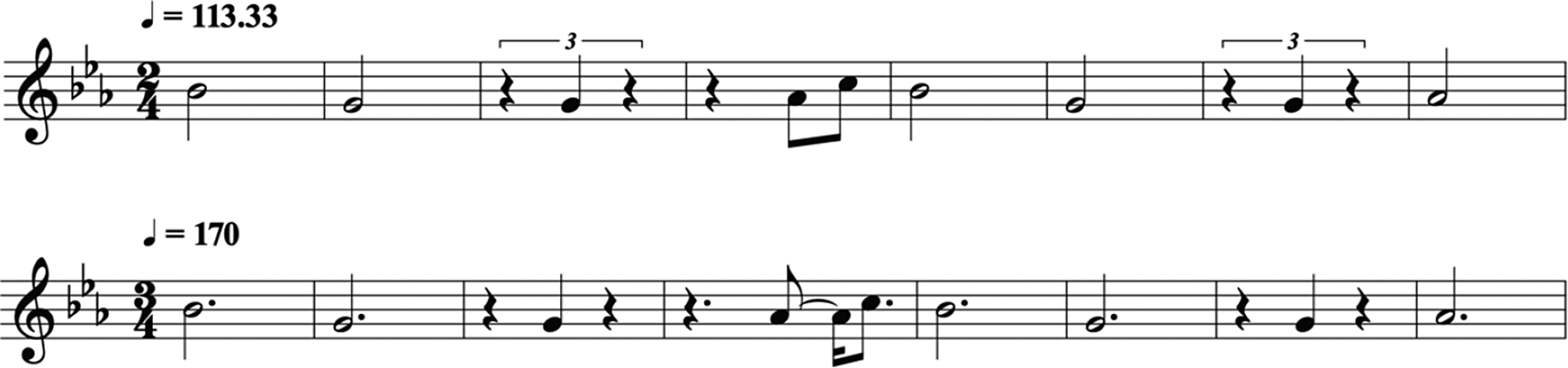
The pivot melody features three different note values which, in the context of a tempo modulation, create three different polyrhythm pairs. The first pair, 1:2 and 1:3, is used in measures one, two, five, and six. The second pair, 3:2 and 1:1, is used in measures three and seven. The third pair, 2:1 and 4:3, is used in measure four. The pivot is rhythmically engaging on three levels: intrinsically through this variety of note values, extrinsically through the changing temporal context of different sections, and structurally through motivic variations that characterise different sections. In sections A and B, the pivot is played in its original form, without variation. In section C, the note in the third measure is displaced by a 1/8th, a displacement that could be understood as a very brief instance of displacement dissonance (Butler Reference Butler2006, 107–8). In section E, the first two measures of the pivot remain intact and are used as a familiar motif that anchors the phrase, while the rest of each 8-bar cycle is devoted to a florid piano solo. Finally, section G features a solo coda with the pivot melody played at half-speed. In addition to its multiplicity of rhythmic functions, the pivot material is played by several different sounds and transformed by many effects, adding the dimensions of timbre and space to its development.
While sections A and E are clearly at 113.33 bpm, and sections C and D clearly at 170 bpm, section B not only reflects temporal ambiguity, but also shows that such ambiguity can arise even from pulse trains competing in a 2:3 relationship, one of the simplest ratios. Section A establishes a tempo of 113.33 bpm with a kick playing on every beat. Every other kick coincides with a pivot note in the first two measures. The pivot melody contains at least two rhythmic cells that strongly suggest a duple meter; the first two measures are half notes, and the turnaround, at the end of measure 4, has two eighth notes. After this duple passage, section B retains the steady kick but introduces sextuplet subdivisions and, most importantly, a drum and bass backbeat snare pattern on the sextuplet pulse train, which corresponds to 16ths at 170 bpm. A new tactus emerges, articulated by a combination of kick and snare hits. The temporal ambiguity is resolved at the turnaround at the end of section B, when a hi-hat clearly articulates the 170 bpm tactus followed by the section C drop which introduces new layers of percussion at 170 bpm and a slow bassline. The combination of the turnaround, the new percussion, and the driving bassline together completes the shift to the new tempo. A listener is likely to dance to two beats in every pivot measure in section A, and either two or three beats in sections B, depending on their preferred perception between slow ternary and fast duple. Section C, by its inclusion of more prominent duple drum and bass percussion patterns at 170 bpm, would seem likely to elicit dancing to three beats per measure of the pivot melody.
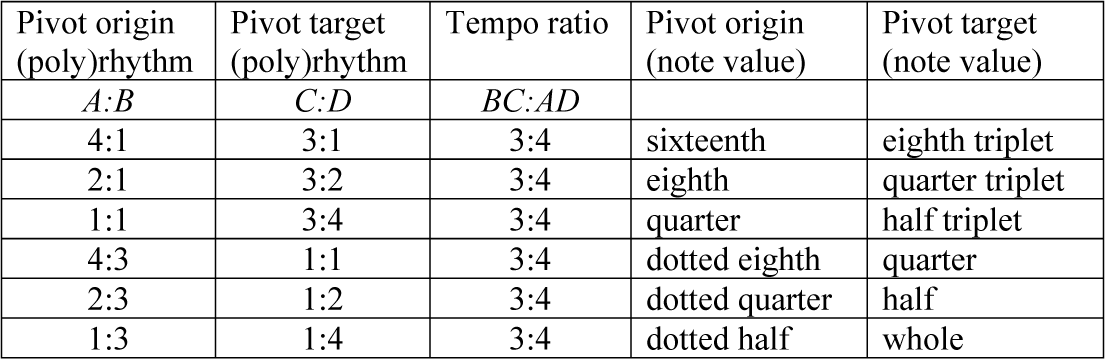
The 3:4 ratio also appears in electronic dance music common practice. Before analysing example tracks from the repertoire, it is once again useful to create a table of pivot pairs (see Example 9).
Pivot pairs generating a 3:4 tempo ratio.

Example 9. Long description
The table has five columns labeled from left to right as Pivot origin polyrhythm, Pivot target polyrhythm, Tempo ratio, Pivot origin note value, and Pivot target note value. The first row under the headers contains 4 to 1, 3 to 1, 3 to 4, sixteenth, and eighth triplet. The second row contains 2 to 1, 3 to 2, 3 to 4, eighth, and quarter triplet. The third row contains 1 to 1, 3 to 4, 3 to 4, quarter, and half triplet. The fourth row contains 4 to 3, 1 to 1, 3 to 4, dotted eighth, and quarter. The fifth row contains 2 to 3, 1 to 2, 3 to 4, dotted quarter, and half. The sixth row contains 1 to 3, 1 to 4, 3 to 4, dotted half, and whole.
Departure Lounge’s ‘Nu Odyssey’ (1997) alternates between two genres (see form chart in Example 10), whereby the 11-minute track starts off as house at 124 bpm for nearly three minutes, modulates in a 3:4 ratio to drum and bass at 165.33 bpm for two and a half minutes, then modulates back in the 4:3 reverse ratio to 124 bpm for five more minutes of house. The pivot material, exemplifying a pulse train, consists of a synth stab followed by delays, a type of echo effect very common in electronic dance music, which slowly decrease in volume. The pivot is first introduced in section B at 2:16 as a 4:3 polyrhythm (dotted eighths) against the steady kick. The track is notable for a pivot solo in section C, during which the pivot plays on its own without any competing rhythmic materials whatsoever, a monophony completely free of rhythmic dissonance. The simplest temporal interpretation of section C would be to group stabs in duple time, thus implying a tempo of 165.33 or half-time at 82.66 bpm. The previous context of 124 bpm, however, seems to retain a powerful presence despite the absence of any signifiers.
Departure Lounge, ‘Nu Odyssey,’ form chart.

Example 10. Long description
The table has eight columns labeled A to H, grouped under three genre headers: House (A, B, C), Drum and Bass (D, E, F), and House (G, H). The first row lists sections A to H. The second row gives time stamps: A is 0:00–2:16, B is 2:16–2:51, C is 2:51–3:14, D is 3:14–3:26, E is 3:26–4:58, F is 4:58–5:41, G is 5:41–5:53, H is 5:53–10:46. The third row shows tempo: A, B, G, and H are 124, C is Ambiguous, D, E, and F are 165.33. The fourth row, Tempo Ratio, lists 3:4 for C and 4:3 for F. The fifth row, Pivot Timbre, lists ‘Synth stab delays’ for C and F. The sixth row, Pivot (Poly)rhythm, lists 4:3 for B, Isochronous for C, 1:1 for D and F, and 4:3 for G. Dashes indicate no value in other cells.
Section C is thus ambiguous as it contains solo material that in isolation would presumably be interpreted at one tempo but is in context likely interpreted at another tempo. It’s only in section D, when drums are introduced at 165.33 bpm, that a new context is established and we can unequivocally interpret the pivot material as a 1:1 rhythm (quarter notes). The reverse tempo modulation, a 4:3 ratio from 165.33 to 124 bpm, occurs between sections F and G, this time without a pivot solo. The 4:3 ratio, as noted by Cowell, is analogous to a sub-dominant; therefore, the journey from home tempo, 124 bpm, to foreign tempo, 165.33, and back again, constitutes a process analogous to a tonal modulation from tonic to sub-dominant and back. Not only is tempo modulation used as a formal device, but the two modulations are executed differently to introduce variation, an element of surprise on the way back to the home tempo. Finally, the synth stabs appear occasionally in section H but they no longer function as pivot material, yet another instance of contextual variation, whereby an unchanging material acquires new meaning by a change of context.
The three-part structure of Dirtyphonics’ remix of ‘Polygon’ by ShockOne (2010) is an inversion of that previously described in ‘Nu Odyssey’. ‘Polygon’ starts out fast at 175 bpm, modulates in a 4:3 ratio down to 131.25 bpm, the temporal sub-dominant, and modulates back in a 3:4 ratio to conclude at 175 bpm. The tempo modulations are deployed within buildups, larger musical gestures ‘designed to create tension and a heightened emotional intensity among clubbers’ (Solberg Reference Solberg2014, 61) that can incorporate stereotypical successions of note value halvings or other diminutions, applied in this case to synth, snare, and kick sounds, and an intensification through various dynamic, timbral, and effect transformations. Even though the surface texture of the buildups somewhat camouflages the tempo modulations, the tempo shifts can be analysed as occurring at two precise moments (see form chart in Example 11), one is the transition from section B to C and the other is the transition from section E to F.
ShockOne, ‘Polygon (Dirtyphonics Remix),’ form chart.

Example 11. Long description
The table consists of eight columns labeled by genre and section: Drum and Bass (A, B), ambiguous (C), Electro-House (D, E), ambiguous (F), Drum and Bass (G, H). Each column provides values for duration in bars (ranging from 8 to 96), time stamps (from 0:02 to 5:45), tempo (175 for Drum and Bass, 131.25 for Electro-House), tempo ratio (4:3 for ambiguous C, 3:4 for ambiguous F), pivot timbre (Synth plus Kick in C and F), and pivot (poly)rhythm (3:2 in C, 2:1 and 4:1 in C and E, 2:1 and 4:1 in F, 3:1, 4:1, 8:1 in F). The table shows how the track transitions through different genres and rhythmic structures, with clear tempo and timbral shifts at ambiguous sections.
These two moments merit attention for the judicious choice of pivot pairs hinged around them. The pivot polyrhythms are listed in the form chart in the order they appear in each section as part of buildup note value diminution sequences. Section E, for example, starts with four bars of a four-note synth loop playing in eighth notes (a 2:1 polyrhythm). The next two bars shorten the synth pattern to two notes but maintain the 2:1 polyrhythm. Finally, the two notes of the synth play double in speed for the last two bars of section E, resulting in a 4:1 polyrhythm (sixteenths). Section F starts with the synth and kick together playing as a temporally ambiguous pulse train. Shortly thereafter, by the end of the first four bars, the ambiguity is resolved by the introduction of a snare drum on the second and fourth beat. The pivot pulse train, still expressed by the synth and kick, is now firmly established as a 3:1 polyrhythm (eighth triplets) at 175 bpm. The tempo modulations in ‘Polygon’ are further notable for their layered pivot timbres composed of two sounds, synth and kick, that before a buildup each have their own distinct patterns, and during the building merge into a rhythmic unison, effectively becoming two layers of a single sound that articulates the pivot rhythms.
The four tracks analysed so far reveal the surprising versatility of what is ultimately a single temporal relationship. The two tracks exemplifying the 3:4 ratio and its reverse 4:3, ‘Nu Odyssey’ and ‘Polygon’, together leverage three distinct pivot pairs, 4:3 to 1:1, 3:2 to 2:1, and 4:1 to 3:1. This rich variety demonstrates not only the analytical utility of pivot pair tables but also the compositional affordances of a simple tempo modulation ratio. The two tempo ratios, 2:3 and 3:4, on which all four examples rely, are in fact so closely related as to be considered two facets of a single construct. The 2:3 and 3:4 tempo ratios are, together, temporal octave complements. Two tempo ratios can be added together by the following formula A:B + C:D = AC:BD (which is different from the earlier formula BC:AD for obtaining a single tempo ratio from two pivot polyrhythms). For example, 2:3 + 3:4 = 6:12. The resulting 6:12 ratio reduces to 1:2, which is double time, the temporal equivalent of an octave. This result makes intuitive sense when approached with tuning terminology, whereby 3/2 is a fifth, 4/3 is a fourth, and adding a fifth and a fourth results in an octave. Furthermore, the 4:3 polyrhythm, four dotted eighths against three quarters, is merely a double-time version of the 2:3 polyrhythm, two dotted quarters against three quarters. Although 3:4 can be considered for these reasons a variation of 2:3, the two tempo ratios are nevertheless replete with executive possibilities.
Tempo modulation in ratios beyond 2:3 and 3:4 was until recently all but absent in electronic dance music and will be explained through examples from the author’s own repertoire. Consequently, one of the research methods underpinning the next examples is analytic autoethnography, an approach to research ‘in which the researcher is (1) a full member in the research group or setting, (2) visible as such a member in published texts, and (3) committed to developing theoretical understandings of broader social phenomena’ (Anderson Reference Anderson2006). Following these guidelines, a previous article (Bougaïeff Reference Bougaïeff, Rietveld and Young2026) described how I became a member of the Berlin techno scene over the course of a decade. I write in this section in the first person to make myself visible and to show my presence in the setting, drawing links between my experience and the wider phenomenon of tempo modulation in electronic dance music.
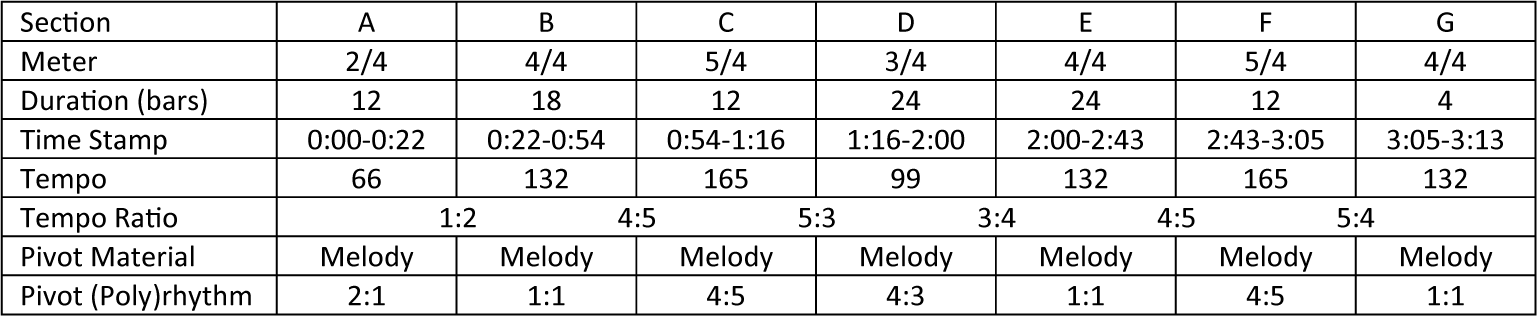
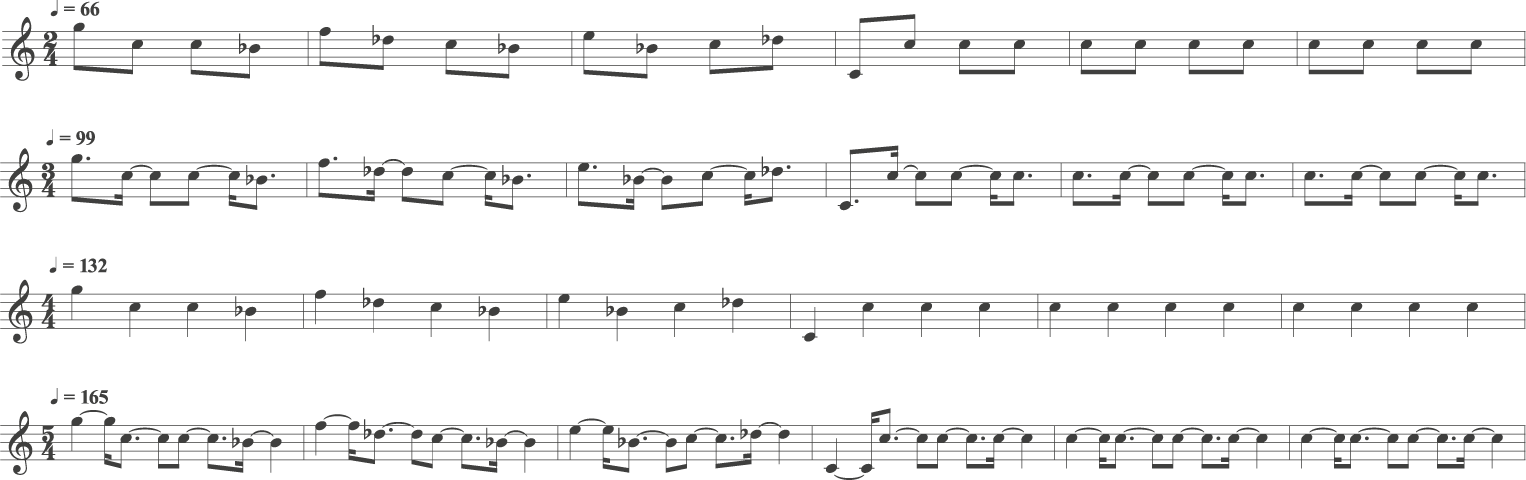
My track ‘Nexus’ (Reference Bougaïeff2020) is structured (see form chart in Example 12) as a journey spanning four tempi, 66, 99, 132, and 165 bpm, which express a 2:3:4:5 tempo ratio series. The temporal modulations in ‘Nexus’ do qualify as combined modulations, as each tempo section clearly features a different meter. However, given the ‘tendency to hear drums as timekeepers’ (Butler Reference Butler2006, 99), what matters first and foremost for the dancing audience member wishing to move in time with the music may be more the tactus rather than the meter or phrase length of any one particular sound. I therefore analyse ‘Nexus’ as a series of tempo modulations. The track is notable for leveraging the same pivot material, a long isochronous synth melody, across all sections (see Example 13).
Nicolas Bougaïeff, ‘Nexus,’ form chart.

Example 12. Long description
The table consists of seven columns labeled A to G and eight rows. The first row lists the sections. The second row, Meter, shows 2/4 for A, 4/4 for B, 5/4 for C, 3/4 for D, 4/4 for E, 5/4 for F, and 4/4 for G. Duration (bars) is 12 for A, 18 for B, 12 for C, 24 for D, 24 for E, 12 for F, and 4 for G. Time Stamp is 0:00-0:22 for A, 0:22-0:54 for B, 0:54-1:16 for C, 1:16-2:00 for D, 2:00-2:43 for E, 2:43-3:05 for F, and 3:05-3:13 for G. Tempo is 66 for A, 132 for B, 165 for C, 99 for D, 132 for E, 165 for F, and 132 for G. Tempo Ratio is 1 to 2 for A, 4 to 5 for B, 5 to 3 for C, 3 to 4 for D, 4 to 5 for E, 5 to 4 for F, and 5 to 4 for G. Pivot Material is Melody for all sections. Pivot (Poly)rhythm is 2 to 1 for A, 1 to 1 for B, 4 to 5 for C, 4 to 3 for D, 1 to 1 for E, 4 to 5 for F, and 1 to 1 for G.
Nicolas Bougaïeff, ‘Nexus,’ pivot melody.

Example 13. Long description
The score consists of four horizontal staves. The top staff is labeled quarter note equals 66 and features a simple melody in the treble clef, mostly using quarter notes and eighth notes. The second staff, labeled quarter note equals 99, repeats the melody with slight rhythmic variation and increased tempo. The third staff, labeled quarter note equals 132, maintains the melodic contour but with more frequent notes, increasing rhythmic density. The bottom staff, labeled quarter note equals 165, presents the melody at its fastest tempo, with sixteenth notes and syncopated rhythms, resulting in the densest and most complex rhythmic texture. All staves are in common time and use standard Western musical notation.
I used the melody throughout to elevate pivot material from its typical role as a temporary hinge across a tempo shift to a formal role in structuring and temporalizing the entire track. This approach, while distinct from Carter’s ‘long-range polyrhythms’ (Aylward Reference Aylward2009), accomplishes a similar purpose of using polyrhythmic relationships to structure a piece. In the case of ‘Nexus’, the pivot material acts as a structural anchor, a stable element around which the temporal context changes. This approach allows repetition, a defining characteristic of electronic dance music in general and techno in particular, to be contrasted not only by timbral variations but also by new metrical interpretations resulting from temporal variations. Tempo can thus be freely wielded as an expressive parameter while pivot material provides a clear and steady pulse train, another defining characteristic of electronic dance music. This approach makes it possible to create tempo-shifting tracks and ‘DJ tools’ (Butler Reference Butler2006, 204), while also mitigating the risk that tempo changes can pose to sustaining entrainment and maintaining a groove.
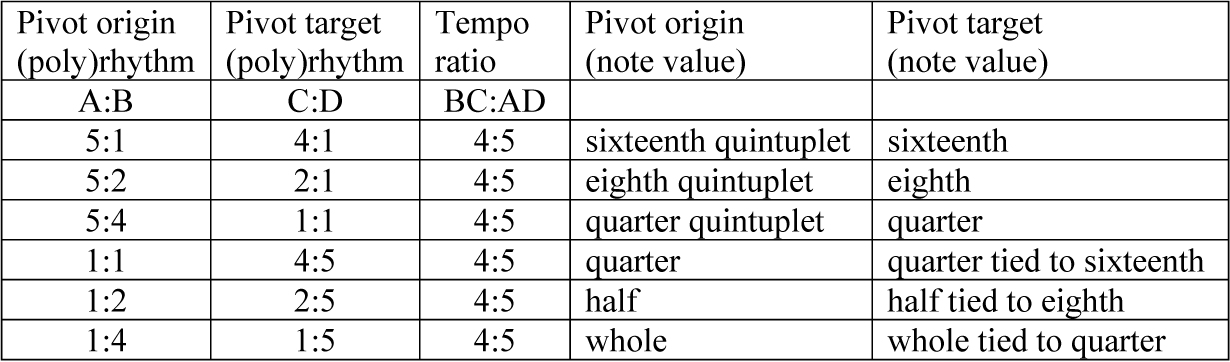
The 4:5 ratio, as exemplified in ‘Nexus’, merits particular attention. The introduction of primes larger than 3 affords a greater variety of tempo modulation ratios. Many pivot pairs generating these ratios, however, necessitate tuplets foreign to electronic dance music in general and certainly to techno in particular. The table of pivot pairs generating the 4:5 tempo ratio featured in ‘Nexus’ (see Example 14) shows that many combinations involve quintuplets. The table also shows which pivot pairs enable a tempo shift strictly with binary note values, that is, note values aligned to a binary pulse train, in this case the 16ths grid. Indeed, the 4:5 tempo ratio in ‘Nexus’ is executed with a 1:1 to 4:5 pivot pair. As previously mentioned, a 4:5 polyrhythm can also be expressed as 5/16. Not only is it more efficient to speak of five sixteenths, rather than in traditional terms as a quarter tied to a sixteenth, 5/16 is terminology perhaps more familiar to any electronic dance music producer.
Pivot pairs generating a 4:5 tempo ratio.

Example 14. Long description
From left to right, columns are labeled Pivot origin polyrhythm A to B, Pivot target polyrhythm C to D, Tempo ratio B C to A D, Pivot origin note value, and Pivot target note value. Each row shows a different polyrhythm pair with the tempo ratio always four to five. The first row lists five to one mapped to four to one, with note values sixteenth quintuplet to sixteenth. The second row is five to two mapped to two to one, with eighth quintuplet to eighth. The third row is five to four mapped to one to one, with quarter quintuplet to quarter. The fourth row is one to one mapped to four to five, with quarter to quarter tied to sixteenth. The fifth row is one to two mapped to two to five, with half to half tied to eighth. The sixth row is one to four mapped to one to five, with whole to whole tied to quarter.
Durations familiar to electronic dance music producers and audiences can be leveraged for a greater variety of tempo modulations including 5- and 7-limit ratios. The following sequence of pivot polyrhythms, 2:1, 4:3, 1:1, 4:5, 2:3, 4:7, 1:2, contains a useful property: each corresponds to a short duration aligned to the 16ths grid, eschewing triplets and tuplets. Scaling these polyrhythm ratios to match antecedents yields 4:2, 4:3, 4:4, 4:5, 4:6, 4:7, 4:8, a sequence of polyrhythm ratios that, when simplified, yields 2:3:4:5:6:7:8, a sequence of tempo ratios. Arranging these tempo ratios back into individual pairs yields 2:3, 3:4, 4:5, 5:6, 6:7, 7:8, a collection of tempo ratios that can be applied to electronic dance music. Tempo modulation ratios suitable for electronic dance music leverage a pivot that is interpreted as conventional note values, i.e., those quantized to the sixteenths grid, and a shift from an origin tempo to a target tempo where both are appropriate for specific genres. Such note values include eighths (2:1 or 2/16), dotted eighths (4:3 or 3/16), quarter notes (1:1 or 4/16), quarter notes tied to a sixteenth (4:5 or 5/16), dotted quarter notes (3:2 or 6/16), double dotted quarter notes (4:7 or 7/16), and half notes (1:2 or 8/16).
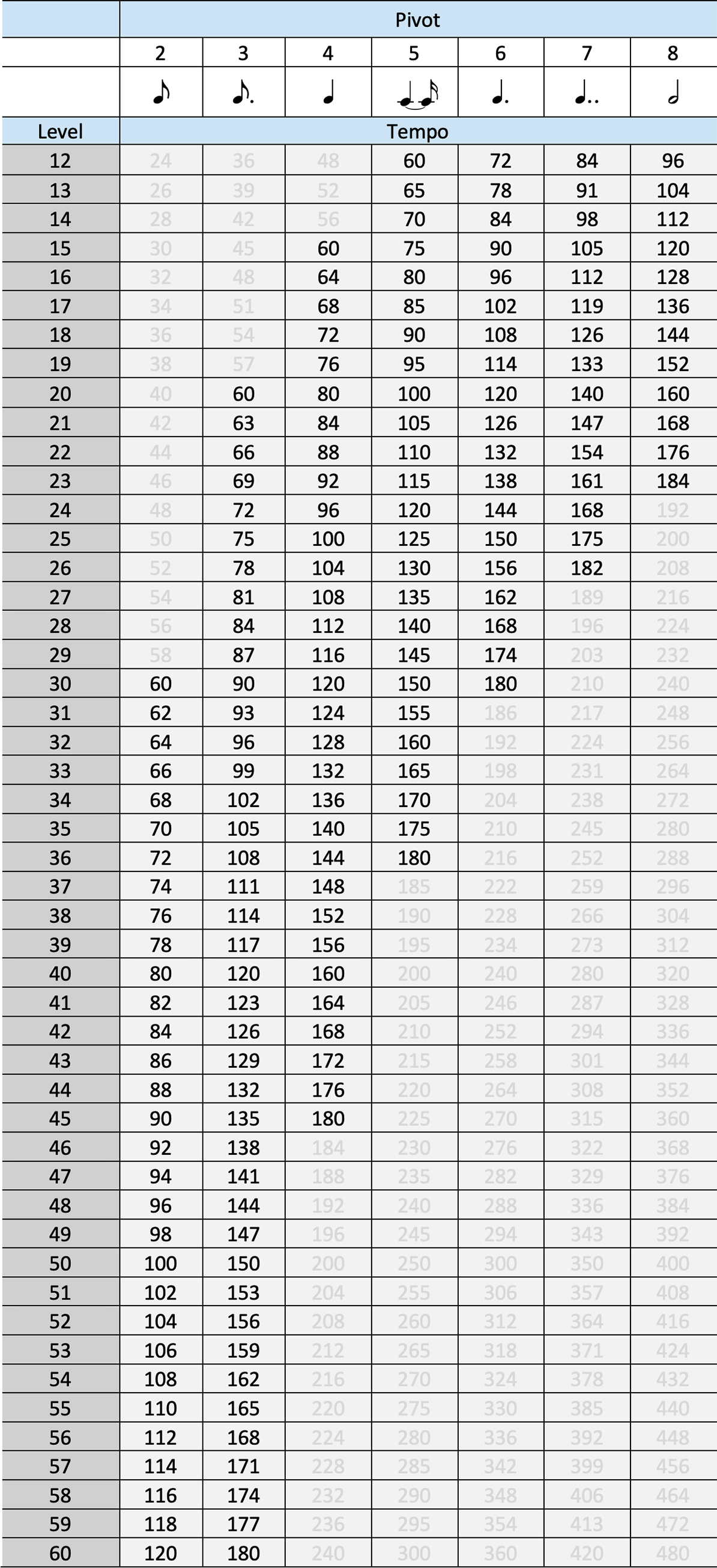
The pivot mixing chart in Example 15 provides a table of these tempo modulation ratios whereby pivots utilise note values that remain quantized to the sixteenths grid in both the origin and target tempi. Two top rows show the pivot duration as the cardinality of sixteenths and as traditional rhythmic figures. Adjacent pairs of pivot cardinalities form tempo ratios and rows below show various hypothetical tempo shift pairs. Each row is identified by ‘level’, in the left-most column, which corresponds to the bpm increase between each column on that row. The tempo modulations in ‘Nexus’, for example, are found on level 33. A level can be understood as a family of closely related tempi. An expansion of this table that includes triplets and other tuplets as pivot note values is beyond the scope of this article.
Pivot mixing chart.

Example 15. Long description
The table consists of eight columns and forty-nine rows. The top row is labeled Pivot, with columns 2 through 8, each displaying a distinct musical note symbol. The first column on the left is labeled Level, listing values from 12 at the top to 60 at the bottom in increments of one. The remaining columns are labeled Tempo and correspond to each pivot value. For each level, tempo values are provided for each pivot, increasing from left to right and from top to bottom. For example, at level 12, tempo values are 60, 72, 84, 96 for pivots 5, 6, 7, 8 respectively, with earlier pivots (2, 3, 4) grayed out and not filled. As the level increases, the tempo values increase proportionally for each pivot. The highest tempo at level 60 and pivot 8 is 480. Some cells in the lower left and upper right are grayed out, indicating unavailable data for those combinations.
4. Pivot mixing
Four key aspects of pivots have so far been demonstrated: their central role in tempo modulation, their structural potential, the affordance of multiple tempo targets from a single pivot, and the multiplicity of pivot pairs that a single tempo ratio can express. These lead to a powerful affordance of pivot mixing: expanding the spectrum of temporal intervals in DJ performance by definitively unseating unisons from the axiomatic definition of beatmatching and introducing intervals beyond 3-limit ratios. Several renowned DJs and various online educators discuss ‘polyrhythmic mixing’, a term suggesting a rich variety of temporal relationships. However, the polyrhythmic elements they discuss focus almost exclusively on the 3:4 ratio, with occasional use of the 2:3 ratio, and pivot material is only weakly emphasised. Pivot mixing, in contrast, affords a greater variety of tempo ratios and emphasises pivot material across the tempo shift. The following section will first explore polyrhythmic mixing and subsequently pivot mixing, that is, it will focus on DJs using this approach to mix existing tracks, rather than producers embedding such approaches within their original works.
American DJ and producer Machinedrum describes his ‘formula for polyrhythmic mixing : take the bpm and divide by 3, then multiply by 2. The new bpm’s 1/4 notes will sound like triplets over the original bpm’ (2023). He is describing a 3:2 tempo modulation, with a 3:2 to 1:1 pivot pair, whereby triplets of quarter notes in the origin tempo sound like quarter notes in the target tempo. While he does not mention pivot material, the modulation he describes corresponds to the same ratio used in ‘Sleepy Pietro’, a track that demonstrated a sophisticated approach to pivot material.
British DJ and producer Objekt writes: ‘there’s quite a lot of triplet DnB at 85/170bpm which mixes fine with straight 4/4 stuff at 128bpm for example’ (2022). The statement is inexact as 128 and 170 express a 64:85 ratio, a ratio for which no conventional note values exist to form a pivot pair. Perhaps he meant 129 and 172, two tempi which express a 3:4 ratio and can indeed be connected by a 4:1 (sixteenth) to 3:1 (eighth triplet) pivot pair. Objekt further remarks in the same post that he ‘kinda cooled off on these kinds of transitions’ and that his practice of the technique peaked with his Dekmantel mix (2017). Indeed, between approximately 42:00 and 48:00, Objekt creates temporal ambiguity by introducing triplets and new kick patterns that can be interpreted as duple or ternary rhythm, without ever clearly forcing the perspective. There does not appear to be any pivot material clearly bridging the tempo shifts.
British-born, Berlin-based DJ and producer CCL demonstrates ‘transitioning from a house tempo track of […] 129 bpm to a drum and bass track at 172’ (Resident Advisor 2024). The transition, 3:15–4:15, expresses a 3:4 tempo ratio and hinges on a 4:1 to 3:1 pivot pair (sixteenths at 129 bpm are equal to eighth triplets at 172 bpm), the same pivot pair described by Objekt. CCL creates a pivot by looping three beats in a breakdown section of the 129 bpm house track. They cut the bass on the pivot and, thirty seconds later, mix in a ternary drum and bass track with the bass also cut. The transition is fully realised when they drop the bass in the drum and bass track, clearly establishing a new tactus at 172 bpm. They simultaneously remove the pivot from the mix, presumably because the pivot material does not blend so well with the full drum and bass track.
British DJ and producer James Zabiela demonstrates a 3:4 tempo modulation from house to drum and bass with a 4:3 to 1:1 pivot pair (Reference Zabiela2020). He first creates a pivot by layering two loops: three sixteenths (a 4:3 polyrhythm) of an acid line with the 3/4 loop function on a Pioneer CDJ-3000, and three eighths (a 2:3 polyrhythm) of a synth line with the 3/2 loop function. He notably does not use the sync button to synchronise the two pivot decks and uses the CDJ platter to occasionally readjust the playback position of a pivot layer. The pivot decks are playing at 129.8 and 130.0 bpm, while the drum and bass deck is playing at 173.4 bpm. The tempi, 130 and 173.4 bpm, do not perfectly match a 3:4 ratio, which would correspond to 130 and 173.33 bpm (or 130.25 and 174 bpm). This discrepancy indicates that Zabiela performs the transition by relying on his ear, adjusting the decks with traditional beatmatching skills, as much as on a numerical estimation of the required tempi, which he identifies as 130 and 174 in the video description. The pivot, through Zabiela’s astute selection and adept performance, fits perfectly at both tempi and is clearly emphasised. The demonstration, while still reflecting the familiar 3:4 tempo ratio, constitutes a clear example of pivot mixing.
I demonstrate pivot mixing with a 5:6 tempo ratio in a video (Bougaïeff Reference Bougaïeff2024b) which received hundreds of thousands of views and generated significant engagement in the form of comments, likes, and direct messages, including from internationally recognised DJs such as Chris Liebing, Kaskade, and Tiga. The 5:6 ratio produces tighter tempo pairs than the 3:4 ratio, resulting in new affordances within ranges suitable for electronic dance music, for example, in this case, a transition from techno at 140 bpm to trance at 168 bpm. The first track, Louis The 4th’s ‘Organza’ (2023), is played at 140 bpm and features a staccato 5/16 synth loop that is leveraged as a pivot during a breakdown. The second track, Liso’s ‘Drench’ (2023), is played at 168 bpm and fades in. In context against ‘Drench’, the pivot now sounds like a 6/16 loop. The pivot creates a 4:5 polyrhythm in the first track and a 2:3 polyrhythm in the second track. Equalising the polyrhythm ratios yields a 4:5 and 4:6 pivot pair, which reduces to a 5:6 tempo ratio. The 5:6 ratio corresponds to the 5 and 6 columns in the pivot mixing chart, where the tempo pair demonstrated in the video, 140 and 168, is found on level 28.
In addition to its use as analytical tool, the pivot mixing chart can also be used as a performance planning tool with a five stage process: firstly find a track with a pivot, secondly identify the loop length of the pivot, third identify the track’s tempo as the origin bpm, fourth find the cell nearest to the origin bpm in the column matching the pivot loop length, and fifth and finally choose a target bpm in the row containing this cell. For example, ‘Organza’ features a synth riff that can serve as a pivot loop, and the track is at 141 bpm. The synth riff outlines a 5/16 loop. The tempo nearest 141 in the 5/16 column is 140. The potential target tempi on this row are 56, 84, 112, 140, 168, 196, and 224. There is no need to calculate the target pivot polyrhythm, as the pivot mixing chart is constructed so that a track at any of the potential target tempi will combine with the pivot in such a way that the pivot loop aligns with the 16ths grid. This method was used to develop the next example.
I demonstrate pivot mixing with a 5:6:7:8 sequence of ratios in a video (Bougaïeff Reference Bougaïeff2024a) that features four tracks, each at a different tempo, mixed around the same pivot. The performance hinges on a 7/16 pivot loop from the breakdown, 2:31-3:21, of my track ‘Cognitive Resonance’ (Bougaïeff Reference Bougaïeff2017). The pivot is used as a sonic anchor around which I successively mix four tracks, each at a different tempo from level 19 in the pivot mixing chart. The first track, Lurka’s ‘Heat Mover’ (2018), is played at 95 bpm and imposes a 5/16 interpretation of the pivot loop. The second track, Daft Punk’s ‘Da Funk’ (1997), is played at 114 bpm and imposes a 6/16 interpretation of the pivot loop. The third track, ‘Cognitive Resonance’, is played at 133 bpm and imposes the original 7/16 interpretation of the pivot loop. The fourth track, Shft.rar’s ‘Dropstep’ (2023), is played at 152 bpm and imposes an 8/16 interpretation of the pivot loop.
5. Discussion
Tempo modulation appears in electronic dance music usually in ratios of 2:3 or 3:4, and is most often used to transition between genres, for example, from house to drum and bass. Tempo modulation can be subsumed in a more elaborate musical gesture, as in ‘Polygon’, or presented with a reduced texture, such as in ‘Nu Odyssey’. In either case, tracks incorporating tempo modulation can be used as DJ tools, and pivot mixing allows DJs the same in the absence of a suitable track. Tempo modulation, whether incorporated into a track’s production or performed as pivot mixing, provides DJs with a method for changing tempo, and often genre, while ensuring a smooth experience for the audience. Pivot mixing can create temporal ambiguity, especially when special emphasis is placed on a transition and pivot material is played solo. Ambiguity is resolved when a new track is mixed in and forces a temporal perspective.
The term ‘pivot mixing’ proposes a new perspective on temporal modulation. While the terms ‘tempo modulation’ and ‘metric modulation’ both focus on what changes, ‘pivot mixing’ focuses on what is unchanging. The pivot is the unchanging element, the anchor of stability around which tempo, meter, or both can change. This new perspective nevertheless aligns with repetition and entrainment, key qualities of electronic dance music. Repetitive pivot material creates a sense of continuity, an approach to tempo modulation that is particularly effective for electronic dance music. A repetitive pivot carried across the tempo shift provides stability and hedges against the potential risk that tempo changes pose of disrupting a flowing groove. I experimented with these techniques in Berlin nightclubs, through both DJ and live performance, and observed that the audience can and will dance to tracks that use tempo modulation. Leading techno DJ DVS1, regarding tempo modulation in performance, opined that ‘most DJs, unless they’re playing multiple genres, don’t know how to move [between tempi]’ (Khutoretsky Reference Khutoretsky2024). He reacted positively to the concept of pivot mixing and video demonstrations of the technique, noting that ‘unless the track does [tempo modulation] for [the dj] … and gives [the dj] an entry point and an exit point … except for the [pivot mixing] videos you showed me of what you do … most people don’t know how to play with tempo beyond sliding the fader or letting the track do it for them’ (Khutoretsky Reference Khutoretsky2024).
Pivot mixing adds a new dimension to familiar musical processes underpinning electronic dance music. Pivot mixing’s focus on what is unchanging, the pivot material, suggests a new take on variation processes familiar in electronic dance music. Changing the timbre of unchanging rhythmic and pitch patterns is a staple of techno. As Butler notes, electronic dance music often exploits a pattern ‘not so much as an established motive but as raw material for timbral development’ (Reference Butler2014, 47). Pivot mixing affords change to an unchanging pattern, a pivot loop, not through timbral but temporal development.
Pivot mixing expands the range of readily available temporal relationships in electronic dance music to include 5- and 7-limit ratios. Temporal modulation, while not overly common, has been shown to appear in electronic dance music common practice, either as continuous or prepared rational modulations. When it is implemented as a prepared rational modulation, it is done so predominantly in a 3:4 ratio, reflecting a major historical trend of an emphasis on 2:3 and 3:4 temporal relationships. It is worth repeating that 2:3 and 3:4, as octave complements, are so similar as to be considered two implementations of the same relationship. An examination of the affordances of pivot loop lengths aligned with the 16ths grid, tabulated in the pivot mixing chart, reveals a rich variety of tempo modulation ratios appropriate to electronic dance music. These pivot loop lengths, exemplified in my track ‘Nexus’ and pivot mixing videos, demonstrate the viability of 5- and 7-limit tempo ratios such as 4:5, 5:6, 6:7, and 7:8 in the context of electronic dance music.
Pivot mixing enables tempo networks in electronic dance music production and performance. Electronic dance music has been hitherto strongly associated with fixed tempi. Contrary to the status quo, pivot mixing expands temporality in electronic dance music by enabling ‘tempo networks’ (Benadon Reference Benadon, Lipscomb, Ashley, Gjerdingen and Webster2004) and formal structures found, for example, in Carter’s First String Quartet (Tingley Reference Tingley1981, 11). Tempo networks can be understood as a parallel to tonal harmony, whereby an origin bpm acts as a tonic tempo and rational intervals enable modulations to related tempi. Tempo networks can be created as local journeys, as in ‘Nexus’, by exploring several tempi on a same level and perhaps even sharing the same pivot material. Tempo networks can also be created as an expansive journey between levels, for example, by first pivot mixing from 144 to 168 bpm on level 24 and then from 168 to 147 bpm on level 21. Tempo networks thus enable modulation to foreign tempi; the relationship between 144 and 147, for example, expresses a 48:49 ratio.
Terminology from tuning theory provides useful parallels. Just intonation (JI) refers to pitch intervals with ratios of small natural numbers, while rational intonation (RI) includes pitch intervals of any natural number ratios. Similarly, just temporality (JT) and rational temporality (RT) can denote tempo intervals with small natural ratios and any natural ratios, respectively. Ratios in the pivot mixing chart are examples of JT, whereas the 48:49 ratio in the hypothetical expansive tempo network example is an example of RT. Pivot mixing is a technique that leverages both just and rational temporality in electronic dance music. The pivot mixing chart and Cowell’s tempo scale are two methods of organising tempo intervals.
This research suggests three directions for future research: identifying additional methods of organising tempo intervals, conducting perception studies to provide insight into the impact of ambiguity in tempo modulation, and examining how pivot mixing impacts entrainment and the experience of time.
Pivot mixing conclusively expands temporality in electronic dance music. Since Francis Grasso ‘made beatmatching a required skill for DJs’ (Broughton and Brewster Reference Broughton and Brewster2007, 58), mixing has been practiced nearly ubiquitously in tempo unisons. Pivot mixing expands the temporal vocabulary of electronic dance music from beatmatching in temporal unisons to temporal intervals. The additional tempo intervals afforded by pivot mixing expand temporality in DJ performance from a single consistent tempo to a sequence of related tempi, from temporal drones to temporal melodies.





 Open access

