


Whereas numerous antelopes dwell in the plains of Africa only four species, the beira Dorcatragus megalotis, klipspringer Oreotragus oreotragus, rhebok Pelea capreolus and mountain reedbuck Redunca fulvorufula, inhabit the Sub-Saharan arid mountains of the continent (Kingdon, Reference Kingdon1997). Among them the beira, categorized as Vulnerable on the IUCN Red List (IUCN, 2008), is the most threatened. It is endemic to the Horn of Africa, occurring in northern Somalia, north-east Ethiopia and Djibouti (Künzel & Künzel, Reference Künzel and Künzel1998; Boitani et al., Reference Boitani, Corsi, De Biase, D'Inzillo Carranza, Ravagli and Reggiani1999; Laurent et al., Reference Laurent, Prévôt and Mallet2002).
In the Republic of Djibouti, where the political and legislative context is more favourable to conservation actions than other countries in the beira's range (Künzel & Künzel, Reference Künzel and Künzel1998), recent observations, and enquiries among shepherds, have shown that the beira is confined to the low mountain range of Aser-Jog in the south (Prévôt, Reference Prévôt1993; Künzel & Künzel, Reference Künzel and Künzel1998; Laurent et al., Reference Laurent, Prévôt and Mallet2002). Population size was estimated to be c. 50 individuals by Künzel & Künzel (Reference Künzel and Künzel1998) and 50–150 by Laurent et al. (Reference Laurent, Prévôt and Mallet2002). However, no census has ever been carried out. The aims of this study were therefore to make a census of the population and estimate its density in the various massifs of Aser-Jog, and to collect data on the occurrence of potential competitors and predators.
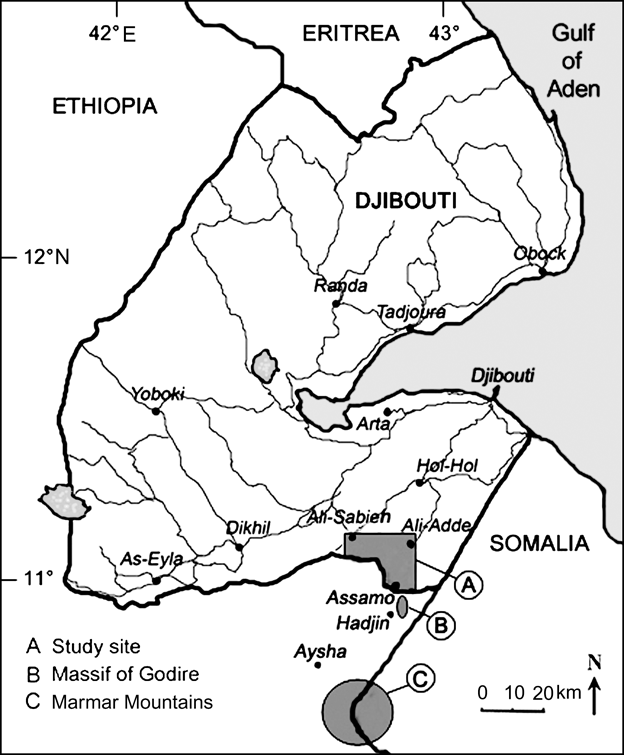
The study area was the low mountain range of Aser-Jog, delimited by the villages of Ali-Sabieh, Ali-Adde, and Assamo (Fig. 1). The region has a tropical arid climate, with a mean annual temperature of c. 30°C and an annual total rainfall of c. 250 mm (Laurent & Laurent, Reference Laurent and Laurent2002). The area includes 143 km2 of mountains in 13 massifs at altitudes of 600–1,300 m. Vegetation cover is sparse, mainly comprising small Acacia etbaica trees, the shrubs Croton somalensis and Iphionopsis rotundifolia, and the grass Cymbopogon schoenanthus. The local human community uses the mountains for goat grazing, with sheep and donkeys generally kept in the valleys.
Location of the study area in the Republic of Djibouti, and of the massif of Godire and Marmar Mountains in Ethiopia, the only area in Ethiopia where beira have been observed in the last 50 years (Künzel & Künzel, Reference Künzel and Künzel1998; Laurent et al., Reference Laurent, Prévôt and Mallet2002).
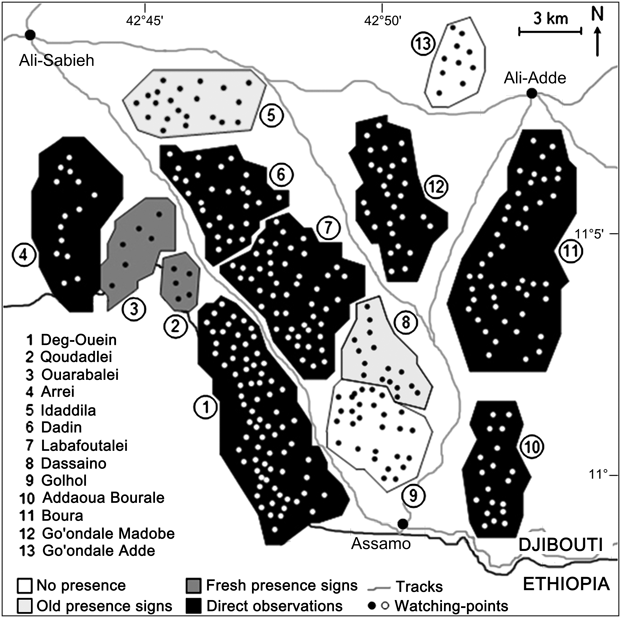
Data were collected during a total of 69 days between October 2005 and June 2006. Because the relief and stony ground precluded mobile observers from walking quietly and thus from making a reliable census, we used fixed observation points on crests (Plate 1). Along a given crest line successive observation points were spaced c. 500 m apart, the exact distance varying according to the local topography, such that the whole area of each massif was covered. Each crest line was walked once by a pair of observers (NG and a local shepherd), and at each observation point the two observers searched for beira and any other large mammals during 1 daytime hour, using 10 × 40 binoculars and a 20 × telescope. In this way we made observations from a total of 347 locations over the whole study area.
View from an observation point (Go'ondale Madobe massif; Fig. 2).

Individuals < 50 m apart were considered members of the same group. Beira were assigned to five age-sex classes: adult females, adult males, subadult males, horned young, and non-horned young. Adult females were distinguished from other classes by the absence of horns and their greater body-size. Males of adult size were classified as adults or subadults according to whether the height of horns was ≥ or < that of the ears. When in the same group subadult males also looked a little more slender than adult males. Individuals were classified as young when smaller than adults.
For each observation point its location and that of any beira groups sighted were recorded using a global positioning system. Between observation points all signs of beira (faeces, resting sites and footprints) were recorded. In another study in the Addaoua Bourale massif (Fig. 2; N. Giotto & J.-F. Gerard, unpubl. data), beira were found to live in cohesive territorial groups, each using a range whose maximum diameter was 1,500 m. Therefore, for the present study, any beira group exhibiting a composition of age-sex classes already observed < 1,500 m apart was considered as already recorded.
Occurrence of beira in the 13 massifs of Aser-Jog (Fig. 1).
A total of 41 beira groups or solitary individuals were sighted, at distances of 110–1,600 m from the observer (median 399 m; Fig. 3a), and 95% were sighted during the first 45 minutes at the observation points (Fig. 3b). However, 13 of these groups were considered already recorded because their composition was identical to that of a group previously sighted 0–1,430 m apart (median 365 m; Fig. 3c).
(a) Distance at which beira groups were observed. (b) Percentage of groups sighted as a function of the time spent at the observation points. (c) Distance separating groups considered as identical.

The 28 sighted groups considered as distinct contained a total of 99 individuals: 42 adult females, 26 adult males, 4 subadult males, 18 young and nine whose age and class could not be determined because of the circumstances of the observations. On this basis, we estimate overall beira density to be 0.69 km-2 in Aser-Jog. Density varied considerably amongst the 13 massifs (Fig. 2; Table 1), beira being observed on only seven massifs, with estimated densities of 0.22–1.25 km-2 (mean 0.95 km-2). In two massifs no beira were sighted but signs of their presence, including fresh faeces, were found, and local shepherds reported having observed beira within the previous few weeks. In two massifs only dry faeces were found, and the shepherds had seen beira there in the course of the previous year but not within the previous 2 months. No signs of beira were recorded in two massifs and beira had last been observed there c. 3 years previously.
Area and altitudinal range of each of the 13 massifs of the Aser-Jog (Fig. 2), with the number of beira sighted and the corresponding estimated density when the groups considered as already recorded are excluded (and when they are included; see text for further details).

1 Fresh faeces found and observations of beira within the previous few weeks (see text)
2 Dry faeces found and observations of beira within the previous year (see text)
3 No signs of beira and last observations of beira c. 3 years previously (see text)
The beira was the only wild ruminant observed, with the exception of a single adult female klipspringer living within a group of four beira in Boura massif. In contrast, domestic goats were common: a total of 9,565 individuals in 107 herds were counted during the census, with an estimated goat density of 29–196 km-2 (mean 67 km-2) over the 13 massifs. During the census we also sighted a caracal Felis caracal, troops of hamadryas baboons Papio hamadryas, and a Verreaux's eagle Aquila verreauxii. According to shepherds, these species and the striped Hyaena hyaena and spotted Crocuta crocuta hyenas are the only predators of the beira in the study area, with the caracal probably being the only species to prey upon adults.
Even though beira groups are very cohesive the members of a group do not always spend 100% of their time together (N. Giotto & J.-F. Gerard, unpubl. data). Thus, the groups that we considered as different might in some cases have included the same individuals. On the other hand, some of the groups considered as already recorded might actually have been different groups, and some groups (based on the presence of faeces) clearly escaped notice. Nevertheless, we believe our method is relatively reliable. In the massif of Addaoua Bourale, where we recorded 10 beira, a subsequent 10-month study revealed the presence of 12 individuals (N. Giotto & J.-F. Gerard, unpubl. data). On this basis it seems reasonable to conclude that the beira population in Aser-Jog was 100–150 individuals at the time of the census.
According to local shepherds beira are regularly sighted on the nearby massif of Godire in Ethiopia, suggesting the possibility of a connection between the beira population of Aser-Jog and that of the Marmar Mountains (Fig. 1). Nonetheless, our results suggest that since the surveys by Prévôt (Reference Prévôt1993) and Laurent et al. (Reference Laurent, Prévôt and Mallet2002) the beira has disappeared from the massif of Idaddila, and also from the massifs of Dassaino, Golhol and Go'ondale Adde. Beira probably suffered from the drought that occurred in 2004–2006. However, the four massifs where the beira now seem to be absent are near villages (Fig. 2), suggesting the possible influence of human activities. Overgrazing by goats may affect the distribution of beira (Laurent et al., Reference Laurent, Prévôt and Mallet2002). The relative abundance of Croton somalensis and Iphionopsis rotundifolia and the lack of several herbaceous species in the Aser-Jog indicate that the area is overgrazed (Collenette & Mallet, Reference Collenette and Mallet1993; Laurent et al., Reference Laurent, Prévôt and Mallet2002). Cutting of trees to produce charcoal for domestic use is another common human activity causing habitat degradation in Aser-Jog. Prévôt (Reference Prévôt1993) reported that 20% of 101 shepherds questioned admitted capturing infant beira when still solitary and hidden, either for food or to keep them as pets.
Rayaleh et al. (Reference Rayaleh, Heckel, Hammer, Hammer and Künzel2006) considered that the beira ‘is not really threatened in the Republic of Djibouti’ but we believe that the small size of the population and the small area it occupies are in themselves a threat to the species’ long-term survival there. The recent settling of traditionally nomadic shepherds in Aser-Jog has enhanced the pressure exerted by humans and their livestock on the flora and fauna. Part of the local community has begun a move from livestock rearing to alternative activities, including agricultural production in the valleys, following the boring of new wells and ecotourism. These initiatives constitute an opportunity for beira conservation in the Aser-Jog. The creation of a wildlife refuge would increase the attractiveness of the area to tourists and encourage international organizations to support a conservation programme for the beira. A proposal has been submitted to the government of Djibouti for the creation of a protected area in the Aser-Jog and to continue further research on this emblematic antelope.
Acknowledgements
We acknowledge the members of ADDLA, especially Mohamed, Boulboul and Yassin, the shepherds who guided and helped us during the field work, and Alain Laurent and Nicolas Prévôt for initiating this study. Thanks are due to Nabil Mohamed (CERD) and Bertrand Lafrance (DECAN association) for their constructive support, and three anonymous referees for their comments. We are grateful to the SCAC/MAE and CEPA for financial support.
Biographical sketches
Nina Giotto works on the social behaviour, ecology and conservation of threatened wild herbivores, especially equids and ruminants inhabiting arid areas. Daher Obsieh is involved in the sustainable development of the Aser-Jog region. Jean Joachim studies the ecology of bird communities and habitat use by various even-toed ungulate species in Europe. Jean-François Gerard works on the behavioural mechanisms generating the social and spatial organization of various large mammalian herbivores.



