

INTRODUCTION
Are Latinos the reliably religious group popular and political media present them to be, or are they more secular than previously thought?Footnote 1 Answering this question is important because it has wide-reaching implications for contemporary politics in the United States. The consistent frame in political media since the 2012 presidential election describes a Republican Party attempting to expand its electorate by attracting Latino voters, based on shared, religiously-based values (Navarrette Reference Navarrette2012). This frame is not without historical precedent. In 1983, in his reelection bid for the Presidency, Ronald Reagan is noted to have said, “Latinos are Republicans, they just don't know it yet” (Ross Reference Ross2012). This statement and others like it are based on the implicit assumption that Latinos’ high levels of religiosity and church attendance make them natural allies of the Republican Party because of the party's stance on policies supported by religiously-oriented groups and individuals (Kelly and Kelly Reference Kelly and Kelly2005). Moreover, the growth of Latino evangelicals — who tend to be more conservative on values issues than their Catholic counterparts — is widely seen as a positive development for the Republican Party (Espinosa Reference Espinosa2012; Pantoja Reference Pantoja2010). Data in the 2008 American Religious Identification Survey (Navarro-Rivera, Kosmin and Keysar Reference Navarro-Rivera, Kosmin and Keysar2010) indicate that a shift from Catholicism toward Protestantism among Latinos has started in recent years, offering support for the common assumption that Latinos could be a constituency-in-waiting for the Republican Party. Thus, the Latino population is often suggested as a key source of support for the Republican Party in the future. As a result of this widely held belief among political elites, much has been written about the religious practices and beliefs of Hispanics in the United States (e.g., Espinosa and Garcia Reference Espinosa and Garcia2008; de la Torre and Espinosa Reference De la Torre and Espinosa2006; Espinosa, Elizonda, and Miranda Reference Espinosa, Elizonda and Miranda2003).
Beyond these electoral aspects of Latino religious participation and identity is the broader reality that, historically, church attendance increases political participation for Latinos (Jones-Correa and Leal Reference Jones-Correa and Leal2001; Wald and Calhoun-Brown Reference Wald and Calhoun-Brown2011). Making Latinos a key group for electoral success (for any party, but certainly for Republicans) is only a viable option if Latinos are either not becoming more secular by attending church less often, or — assuming they are becoming more secular over time — there are other forces driving political participation as well. Research suggests that minority groups like Latinos need churches to help overcome the generally lower levels of civic skills typically found in groups with lower socio-economic status (Verba et al. Reference Verba, Schlozman, Brady and Nie1993; Verba, Schlozman, and Brady Reference Verba, Schlozman and Brady1995), and that churches are a place for building social networks that can reinforce both participation (Djupe and Gilbert Reference Djupe and Gilbert2006) and attitudes (Djupe and Gilbert Reference Djupe and Gilbert2003; Reference Djupe and Gilbert2008).
Latino-courting or incorporation is one of the more difficult intra-party issues the Republican Party has faced since Reagan's declaration, but — according to the conventional wisdom — Latinos are more likely to become Republicans than Democrats based on these shared values; they are merely waiting to be courted in a serious way. Of course, simply because Latino attitudes on abortion or gay rights align with those of the Republican Party does not mean they will vote Republican. Despite their religiosity, so-called values policies may not necessarily be salient to Latino voters (Barreto and Segura Reference Barreto and Segura2014; de la Garza and Cortina Reference De la Garza and Cortina2007; Nicholson, Pantoja, and Segura Reference Nicholson, Pantoja and Segura2006). Recent polling data bears this out, finding that Latinos often rank jobs, unemployment, education, and other issues as more important than abortion and same-sex marriage (Jones, Cox, and Navarro-Rivera Reference Jones, Cox and Navarro-Rivera2013). Is the gap between Republicans and Latinos, as many politicians, pundits, and scholars suggest, due to the Republican Party's inability to effectively target Latino voters or address their policy priorities? A more controversial, though unexplored proposition, is that Latinos may not be as religious as is commonly believed. We examine that possibility in this project, focusing on the expansion and consequences of secularism among Latinos in the United States.
Secularism can be operationalized in both behavioral and attitudinal ways. We take Norris and Inglehart's (Reference Norris and Inglehart2011, 40) definition of secularism as “the lessening importance of religion in people's daily lives, and growing indifference to spiritual matters among the public” as exemplified by decreasing frequency of church attendance. Another method for measuring secularism is by drawing on measures of religiosity, and proceed to categorize individuals on the lowest levels of the religious spectrum as secular (Norris and Inglehart Reference Norris and Inglehart2011). By both of these measures, the United States is becoming increasingly secular (Pew Research Reference Research2007). By all accounts, the Latino population is experiencing a similar phenomenon. For example, data collected in the 2008 American Religious Identification Survey reveals a significant trend toward secularism among Hispanics in the United States. Specifically, Navarro-Rivera, Kosmin, and Keysar (Reference Navarro-Rivera, Kosmin and Keysar2010) found that the number of Latinos claiming “no religion” has increased significantly, doubling in the past two decades. With regard to attendance, the Latino National Survey data we use in this analysis indicates a significant proportion of the Latino population — slightly over 25% — can be considered secular because they attend church so infrequently. Similarly, the 2013 Hispanic Values Survey (Jones, Cox, and Navarro-Rivera Reference Jones, Cox and Navarro-Rivera2013) found that approximately 38% of Latinos “seldom or never attend” church services (Jones, Cox, and Navarro-Rivera Reference Jones, Cox and Navarro-Rivera2013, 10). Thus, survey data collected in recent years using both attitudinal and behavioral measures indicate that secularism has risen among Latinos.
What have heretofore not been examined is why secularism among Latinos may be growing, and what the political implications are for this trend. Some research suggests that the rise in secularism is overblown (Skirbekk, Kaufmann, and Goujon Reference Skirbekk, Kaufmann and Goujon2010). However, in the past few years, there has been ample concern within the religious community that Latinos are becoming more secular and attending church less, but these concerns have not yet bubbled into the mainstream media consciousness (Catholic News Agency 2013). Descriptively, surveys often reveal that levels of secularism are highest among Latinos who are most assimilated (i.e., native born, dominant English speakers) (Navarro-Rivera, Kosmin, and Keysar Reference Navarro-Rivera, Kosmin and Keysar2010). However, little is known about the origins of Latino secularism. Given the relationship between religious practices and political attitudes and behavior (e.g., Jones-Correa and Leal Reference Jones-Correa and Leal2001; Layman and Carmines Reference Layman and Carmines1997), it is critical that we understand the determinants of this shift in modern American politics.
In an effort to understand the origins of Latino secularism through church attendance in the United States, we test two popular theories on secularism: modernization theory and existential security theory (Bruce Reference Bruce1992; Durkheim Reference Durkheim2001; Norris and Inglehart Reference Norris and Inglehart2011). The modernization hypothesis argues that as societies industrialize, there is a premium on scientific rationalism, public education, as well as a growth in the state providing services that were once filled by religious institutions. These and other social forces will lead to a decline in religious institutions. The existential security hypothesis contends that feelings of physical and/or psychological insecurity lead individuals to turn to religion to cope with this precarious existence. As existential security rises, religiosity declines. We also examine the predictors of civic participation to assess if church attendance is still a driving factor in Latino participation, and to what extent — if any — other factors can replicate the impact of churches. Relying on survey data from the 2006 Latino National Survey, we find that both modernization and existential security negatively affect church attendance, but that church attendance and generational status increase political participation.
SECULARISM
Secularism can be defined as a decline in religious participation and beliefs (Norris and Inglehart Reference Norris and Inglehart2011). Social scientists can arrange nations or individuals along a continuum ranging from deeply secular to deeply religious. Measures of secularism can take a myriad of indicators such as frequency of prayer, religious attendance, and the subjective importance of religion to rank nations or individuals along this continuum. Our objective is two-fold. First, we will explore where Latinos fall along this secularism distribution based on previous work. Second, we aim to identify the forces that increase secularism among Latinos in the United States.
The earliest social science studies on secularism used modernization theory to explain the decline of religion. The essence of modernization theory is that the importance of religion or beliefs in supernatural forces fades as a result of industrialization, expansion of scientific reasoning, and mass education (Bruce Reference Bruce1992; Martin Reference Martin1978; Weber Reference Weber2002). Individuals residing in agricultural (pre-modern) societies should be more religious than individuals residing in industrial and post-industrial (modern) societies. Thus, as societies modernize, religious practices and beliefs fade in importance. Predictions over the demise of religion now seem premature, as they appear to be resurgent worldwide (Norris and Inglehart Reference Norris and Inglehart2011; Stark Reference Stark1999). Hence, a number of scholars have sought to understand the stability and decline of religiosity across societies and individuals by employing both quantitative and qualitative methodologies. Quantitative scholars have identified a host of individual-level factors that predict secularism. This research finds that age (youth), gender (men), education, political liberalism, and other socio-demographic and political characteristics are associated with lower levels of religiosity (Baker and Smith Reference Baker and Smith2009; Kosmin and Keysar Reference Kosmin and Keysar2007; Hout and Fischer Reference Hout and Fischer2002) and church attendance (Hunt Reference Hunt2000).
Perhaps one of the most extensive quantitative cross-national studies of secularism is by Norris and Inglehart (Reference Norris and Inglehart2011). Drawing on a number of data sources, they first classify nations into three levels of development: post-industrial, industrial, and agrarian. Using a wide-range of religious indicators, they find that individuals in post-industrial societies were the least religious while those in agrarian societies were the most religious. Industrial societies fell in-between these two poles. Of course, within each category, levels of secularism varied as well. For example among post-industrial nations, Ireland, United States, and Italy tended to score high on levels of religiosity. Although they test several hypotheses to explain this variation, they find that levels of human security or what they call “existential security” explains why individuals are more religious. As existential security increases (being highest in post-industrial nations), religiosity declines (or secularism rises). Although the United States is the outlier case among post-industrial nations, they argue that despite the United States’ level of development, there is also a high degree of economic inequality and insecurity accounting for their heightened levels of secularism. They write, “…the United States is exceptionally high in religiosity in large part, we believe, because it is also one of the most unequal postindustrial societies under comparison” (Norris and Inglehart Reference Norris and Inglehart2011, 108).
Not all studies on secularism are carried out through quantitative methods. Theoretical advances have been made by qualitative scholarship. Zuckerman's work, Society without God, uses in-depth interviews to explore religious belief (or rather non-belief) in two of the world's most secular societies, Denmark and Sweden. While the majority of the respondents showed little to no interest in religion, most were baptized, married, or marked a significant milestone in the Lutheran Church. However, beyond these significant life events, Zuckerman points out that Danes and Swedes almost never attend church services.Footnote 2 At first glance this may seem paradoxical, but Zuckerman explains that respondents participated in these specific religious services for cultural reasons. Hence, Denmark and Sweden may rightly be labeled “societies without god,” but they are not societies without religion. Zuckerman attempts to offer some sociological explanations for Scandinavia's irreligiosity but concludes by writing that “…there is no one single explanation or sole explanation to this puzzle” (Reference Zuckerman2008, 111). In a second study, Zuckerman seeks to understand why previously religious individuals in the United States, become apostates, or disaffiliate themselves from a religious group. Once again, employing in-depth interviews he summarizes his findings as follows:
In sum, a sociological theory of apostasy must remain humble. All that can be asserted with confidence is that a variety of life circumstances, personal experiences, and/or social dynamics can increase the likelihood that certain individuals will go on to reject their religion. But there is no single one “thing” — be it an experience, event, relationship, and so on — that always, in and of itself, causes apostasy (Zuckerman Reference Zuckerman2012, 165).
Although Zuckerman does not believe one factor or theory can explain why individuals become irreligious, he does conclude his work by suggesting that perhaps some are simply predisposed toward irreligion. He reaches this conclusion because the events or reasons for respondents’ withdrawal from religion could lead others to become more religious. For example, the untimely death of a loved one caused some of his respondents to lose their religious beliefs, while this same event could lead others to reaffirm their beliefs.
Existing religiosity in the United States indicates that modernization theory does not wholly explain the rise of secularism, but there is increasing evidence that people in the United States are attending church less over time (Hadaway, Marler, and Chaves Reference Hadaway, Long Marler and Chaves1993; Lipka Reference Lipka2013). Levels of secularism vary cross-nationally and individually, and as a consequence, scholars have looked to other factors that can account for this variation. Increases in education, as predicted by modernization theory, are positively correlated secularism. Yet, variations in education levels or levels of development (another proxy for modernization) do not account for the full variance in secularism. While, Norris and Inglehart (Reference Norris and Inglehart2011) highlight the primacy of existential security, Zuckerman (Reference Zuckerman2008; Reference Zuckerman2012) emphasizes that no one factor can account for why some societies or individuals are secular.
While comparative studies of secularism do include Latin American countries, which are highly religious, they have yet to examine how or if the migration and settlement process changes levels of religiosity and secularism among immigrants/ethnics residing in post-industrial countries like the United States. Indeed, the global migration process can be characterized as a movement of people from agrarian to industrial and post-industrial societies (Massey et al. Reference Massey, Arango, Hugo, Kouaouci and Pellegrino2005). In the context of secular and religious studies, we can characterize the migration process as the movement of people from religious societies to secular societies. Latinos are the largest and oldest immigrant/ethnic group in the United States. Some have been residing in the country for generations, while others are recent arrivals. Clearly, there is diversity in their levels of assimilation and other socio-demographic characteristics. Levels of secularism, as demonstrated through church attendance, may vary as well. What percentage of Latinos can be classified as secular and across what socio-demographic characteristics and other social forces does secularism vary across this population?
THEORIES PREDICTING SECULARISM AMONG LATINOS
Numbering over 50 million, Latinos are poised to be politically significant nationally, and are already a key constituency in several states. As a consequence, the political behaviors and values of this population have generated a great deal of attention. However, researchers have not broadly explored the determinants of and the extent to which Latinos are secular. When Latino secularism is examined, it tends to be treated as an independent variable, used to predict political attitudes, identities, or behavior (e.g., Layman Reference Layman1997; Layman and Carmines Reference Layman and Carmines1997; Ellison, Echenvarria, and Smith Reference Ellison, Echenvarria and Smith2005; Taylor, Gershon, and Pantoja Reference Taylor, Gershon and Pantoja2014).Footnote 3 Given the clear implications for religiosity for Latino partisanship and voting behavior, understanding the origins of this current trend is clearly critical for gauging the potential political impact of this population in the future.
Though empirical work in this area is limited, we know that Latinos who are more secular are more likely to be liberal (Gibson and Hare Reference Gibson and Hare2012). Gibson and Hare's findings mirror the effect of secularism on the population at-large (Layman and Carmines Reference Layman and Carmines1997), but the common assumption about Latinos is that they are deeply religious and have proclivities toward political conservatism (Chavez Reference Chavez1992). In fact, the unusually high level of religiosity in the United States is often attributed to the growth of this population as Norris and Inglehart (Reference Norris and Inglehart2011, 244) write, “…even in the United States, a trend toward secularism is masked by the large-scale immigration of people with traditional world views.” To this point, the research on Latino religiosity demonstrates that Norris and Inglehart's claims are not without merit (e.g., Espinosa and Garcia Reference Espinosa and Garcia2008; de la Torre and Espinosa Reference De la Torre and Espinosa2006; Espinosa, Elizonda, and Miranda Reference Espinosa, Elizonda and Miranda2003). For example, in a 2006 survey by the Pew Hispanic Center and Pew Forum on Religion and Public Life, 71% of Latinos agreed that religion was very important in their lives. Yet, other survey questions paint a different picture. For example, this same survey asked, “In your opinion, should churches and other houses of worship keep out of political mattersor should they express their views on day-to-day social and political questions?” In this case, 40% of Latinos said churches should keep out of politics. If we rely on the findings of Jones, Cox, and Navarro-Rivera (Reference Jones, Cox and Navarro-Rivera2013), 38% percent of Latinos in the United States can be classified as secular since this percentage noted to “seldom or never” attend church services. In short, depending on the measures employed, Latinos may be seen as being secular or very religious. Scholars have also found denominational differences often predict secular and religious behaviors. For example, Hunt (Reference Hunt2000) found that conservative Protestants were significantly more likely than their Catholic counterparts to report high levels of attendance and church engagement. Hunt's analysis also reveals the impact of socio-demographic characteristics (e.g., age, generation, nation of ancestry) in shaping religious activity among Latinos.
From the literature on secularism there are two key theories that explain the rise of secularism across societies and individuals — modernization theory and existential security theory. Modernization theory essentially attributes the decline of religiosity to economic development and socio-cultural changes that accompany that economic change. Hence, Latin Americans in more agricultural societies or settings should be more religious than those residing in industrial societies or areas. As such, religiosity in the south of the Rio Grande should be higher than in the United States, a post-industrial country (Norris and Inglehart Reference Norris and Inglehart2011). Applying this framework to Latinos residing in the United States, we hypothesize that residing for longer periods of time in the United States will lead to an increase in secularism as a result of cultural assimilation (Alba and Nee Reference Alba and Nee2005). In other words, greater exposure to American society should lead to a decline in religiosity. Given that levels of religiosity are high in the United States, increased contact with American society may simply reinforce existing religious beliefs and practices among Latinos. Although modernization theory has been challenged for its failure to explain certain critical cases, this article cannot disregard the theory outright since it has not been applied to Latinos (Zuckerman Reference Zuckerman2008). This article uses generational status as a proxy for modernization. From this we test the following hypothesis:
H1: Generational status will be negatively related to church attendance.
The second hypothesis is derived from the theory of existential security. Essentially, this theory proffers that individuals in societies with higher levels of human security, typically post-industrial countries with extensive welfare systems, are more secular relative to individuals in societies where susceptibility to premature death is high. For individuals in underdeveloped countries, religion provides badly needed social services and a sense of security of a better existence in the afterlife (Norris and Inglehart Reference Norris and Inglehart2011). Nations with high levels of human development such as the Scandinavian countries are among the most secular societies in the world (Zuckerman Reference Zuckerman2008; Reference Zuckerman2012). By contrast, high levels of human poverty and misery also characterize some of the most religious societies. Applying this theory to Latinos, we hypothesize that increases in human security will lead to decreases in church attendance because respondents will be more secular.
Any number of social indicators could be used to measure human or existential security. In this study, we rely on three measures: (1) employment status, (2) socio-tropic, and (3) pocketbook retrospective economic evaluations (Fiorina Reference Fiorina1981). These proxies are used to capture respondents’ sense of economic vulnerability. Financial duress could be devastating on an individual or family as the breadwinner may have difficulty providing food, shelter, clothing, and other basic necessities. The converse is true of someone who is and feels financially secure. Using our measures of existential security we develop two hypotheses:
H2: Employment will be negatively related to church attendance.
H3: Positive retrospective economic evaluations (socio-tropic and pocketbook) will be negatively related to church attendance.
Though adjudicating between modernization theory and existential security advances the literature, the point of this project is to highlight how the secularism among Latinos has implications for politics in the United States. Previous literature shows that church attendance is a positive aspect to civic engagement (Djupe and Gilbert Reference Djupe and Gilbert2008; Jones-Correa and Leal Reference Jones-Correa and Leal2001; Verba, Schlozman, and Brady Reference Verba, Schlozman and Brady1995; Verba et al. Reference Verba, Schlozman, Brady and Nie1993). Essentially, across a variety of civic participation types, church attendance is a positive and significant predictor of engagement (Jones-Correa and Leal Reference Jones-Correa and Leal2001). This follows from the seminal work by Verba et al. (Reference Verba, Schlozman, Brady and Nie1993) and Verba, Schlozman, and Brady (Reference Verba, Schlozman and Brady1995) demonstrating how institutions like churches help minority groups overcome the myriad barriers to entry given their generally lower socio-economic status relative to the Anglo majority. Additionally, there are mixed findings on generational status and participation in previous research (see Barreto and Muñoz Reference Barreto and Muñoz2003; Sanchez Reference Sanchez2006), we posit that the socialization and acculturation process makes later generations more likely to engage in civic participation. We develop two final hypotheses to test this with Latino National Survey (LNS) data:
H4: Church attendance will be positively related to civic participation.
H5: Generational status will be positively related to civic participation.
DATA AND MEASURES
One of the major problems with survey data on Latinos is that it hardly ever includes samples of other groups, making comparisons difficult. In other words, data on Latino religiosity must be placed in the context of the United States, a country where levels of religiosity are high by post-industrial standards. Thus, depending on the measures used, Latinos may indeed look a lot like non-Hispanic whites — who are, on average, very religious. An additional problem is that foreign-born and native-born Latinos are often collapsed together. Not differentiating between these groups may inflate Latino levels of religiosity given that Latin American countries tend to be more religious than the United States (Norris and Inglehart Reference Norris and Inglehart2011). In short, the extent to which Latino levels of religious belief or non-belief are high relative to other groups in the United States is under-explored.
In this article, we draw on data from the 2006 LNS (Fraga et al. Reference Fraga, Garcia, Hero, Jones-Correa, Martinez-Ebers and Segura2006).Footnote 4 The LNS, with a nationally drawn random sample of 8,634 Latinos, is presently the largest national surveys of this population. The measure of our dependent variable is based on a question tapping frequency of religious attendance, one of the most common questions used to measure one aspect of secularism (Norris and Inglehart Reference Norris and Inglehart2011).Footnote 5 Specifically, respondents were asked, “How often do you attend religious services?” Responses to this question were coded on a five-point scale (0 = never, 1 = once a week, 2 = only on major holidays, 3 = once a month, 4 = more than once a week).
The first hypothesis tests modernization theory through the proxy generational status. Our measure of generational status is a four-point scale: 0 = first generation, 1 = second generation (or respondents who are native-born, with parents who are foreign-born), 2 = 2.5 generation (native-born respondents with one parent who is native-born), and 3 = third generation (respondents with parents are native-born). The modernization hypothesis predicts that third generation Latinos should display higher levels of secularism relative to earlier generations (see Hunt Reference Hunt2000). The second and third hypotheses seek to test the existential security theory as developed by Norris and Inglehart (Reference Norris and Inglehart2011). This study uses three economic evaluations questions to measure one's sense of existential security. First we examine Latino's employment (1 = full or part-time employment, 0 = not employed).
We also use economic evaluation measures as proxies for existential security. First, we measure retrospective pocketbook evaluation through the following question: “What about your personal financial situation? Over the past year, has it gotten better, stayed the same, or gotten worse?” Responses were coded on a three-point scale (0 = worse, 1 = same, 2 = better). The second measure is retrospective socio-tropic evaluation (also a three-point scale). Specifically, respondents were asked, “Now thinking about the economy in the country as a whole, would you say that over the past year the nation's economy has gotten better, stayed about the same, or gotten worse.” Recall that our expectation is that secularism should be highest among respondents who answered “gotten better” while lowest among those who answered “gotten worse.”
The literature identifies a number of other variables that may increase or decrease secular beliefs and practices. In order to identify the predictors of secularism among Latinos, controlling for alternative explanations, we employ ordered logistic regression. In addition to our primary variables of interest, we include a number of control variables in our multi-variate model which likely explain some of the variance in secularism among Latinos in the United States (see Appendices I and II for a complete list of all variables and coding). First, we include a continuous measure of age in our analysis. Older Latinos are hypothesized to attend church more than younger Latinos. Our model also accounts for homeownership, relying on a binary variable. Homeownership is used as a proxy for income and we anticipate that homeowners have on average higher incomes and are less likely to attend church. Higher levels of education are often positively related to secularism (Hill Reference Hill2011; Sherkat Reference Sherkat1998). In our analysis, education is measured using an ordinal variable based on the question “What is your highest year of formal education completed?,” and responses range from 0 meaning ‘no education’ to 7 mean ‘graduate or professional degree.’ Women tend to be more religious (less secular) than men (Miller and Hoffmann Reference Miller and Hoffmann1995; Wilson and Sherkat Reference Wilson and Sherkat1994), so we expect they will attend church more. We control for these differences with gender (1 = female, 0 = male). Political conservatism is also associated with lower levels of secularism (Olson, Cadge, and Harrison Reference Olson, Cadge and Harrison2006). We control for ideological differences in our conservative variable (“strong liberal” = 0 to “strong conservative” = 6), and expect this should be positively related to attendance. While we are agnostic as to the effects of the ancestry groups will have a levels of secularism, we do expect that Spanish dominant Latinos will be less secular than their English speaking counterparts (Peña and Frehill Reference Peña and Frehill1998). We control for both these expectations using binary variables for English Dominance, Cubans, Mexicans, and Puerto Ricans. Finally, we anticipate that religious denomination likely shapes secularism, and control for Latinos who are Evangelical, and Mainline Protestant, and Other using binary variables and Catholics as the reference category.Footnote 6
RESULTS
Predicting Church Attendance
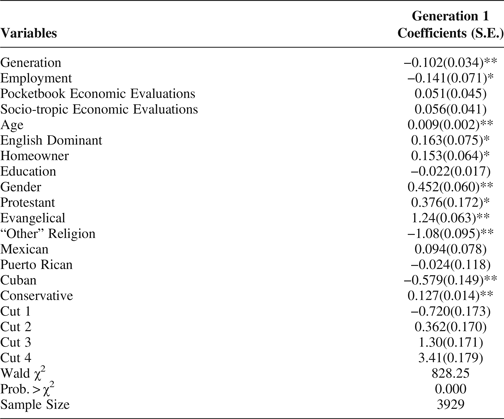
Table 1 reports the results of the multi-variate analysis for church attendance. Our dependent variable, Church Attendance, is ordinal with five categories therefore ordered logistic analysis is used to estimate the impact of the independent variables.Footnote 7 The table reports the coefficients and robust standard errors.
Ordered logistic regression predicting Latino church attendance
Significance = *p < 0.05; **p < 0.01.
The data in Table 1 reveals partial support for our hypotheses. First, the coefficient for generational status is negative and significant, consistent with the modernization hypothesis. This result follows from previous literature (i.e., Alba and Nee Reference Alba and Nee2005; Zuckerman Reference Zuckerman2008), but is a novel finding with regard to the American Latino population as it demonstrates that the forces of acculturation have a direct impact on Latinos’ frequency of attending church. Furthermore, these results indicate that among subsequent generations of Latinos, we can expect secularism to rise, just as it has for other generations of Americans (Kosmin Reference Kosmin2014). Decreasing church attendance among Latinos in the United States has distinct political implications, given the Republican Party's reliance on religious conservatives as active members of their base. The decline of religiosity among Latinos across generations suggests that Republicans have a window of opportunity among first generation Latinos, who are on average more religious and possess weaker partisan identities (Barreto and Segura Reference Barreto and Segura2014).
To examine the impact of existential security on Latino secularism, we rely on three measures — employment, pocketbook and socio-tropic evaluations. Recall that our hypotheses predicted a negative relationship between existential security and church attendance. The results only partially support our expectations in this regard. Specifically, employment is negatively and significantly related to secularism, however, neither pocketbook nor socio-tropic evaluations exert a significant impact on the dependent variable. The reason employment is a significant predictor of increased levels of secularism while retrospective evaluations are not, could be due to the immediacy of employment on the existential security of individuals and their families. Unemployment has an immediate effect as economic insecurity increases feelings of vulnerability as families may need to relocate to more affordable (less desirable) locations and access to health-services may become limited or non-existent (Taylor et al. Reference Taylor, Morin, Cohn, Fry, Kochhar and Clark2009). Economically, vulnerable (unemployed) Latinos may turn to religion to provide psychological security and for some type of material assistance. These data suggest that increases in economic well-being will cause Latinos to move away from religion, attending church less frequently, just like other citizens living in post-industrial societies. Though, the limited effects of the economic evaluations measures suggests that when looking for indicators of existential security it is best to look at variables measuring actual life conditions rather than subjective economic outlooks.
Several of our control variables significantly affect Latino secularism, as hypothesized. First, older Latinos are significantly more likely to attend church frequently than their younger counterparts. Initially, we hypothesize that homeowner ship, a proxy for high income, would be negatively related to church attendance. The model shows it to be positive. However, its effect makes sense in light of the period in which the survey was sampled. The economic context during these years was one of financial insecurity as a result of the collapse in real estate prices and the beginnings of the “great recession.” Latino homeowners, who are largely native-born with higher incomes, were hit particularly hard as they experienced one of the highest rates in foreclosures (Kochhar, Gonzalez-Barrera, and Dockterman Reference Kochhar, Gonzalez-Barrera and Dockterman2009).Footnote 8 Rather than being a measure economic security, homeownership, for Latinos during this period, captures economic insecurity.
Moving to gender, women are significantly more likely to attend church frequently relative to their male counterparts. Using Catholics as the reference category, we see that being Protestant or Evangelical makes one more likely to attend church frequently, but being “Other” religious makes that less likely to be the case. These results conform to expectations — we would expect that people who identify with these religious traditions to be more frequent church attendees (Wald and Calhoun-Brown Reference Wald and Calhoun-Brown2011) — and demonstrate the power of our independent variables of interest. Even while controlling for these factors, we still find significant effects for our modernization and existential security variables. Being Cuban (rather than belonging to another ancestral group) significantly decreases church attendance. Higher levels of secularism among Cubans is not surprising given the higher levels of socio-economic status relative to other Latinos (Portes and Rumbaut Reference Portes and Rumbaut2014). Finally, as predicted, conservatives are significantly more likely to attend church than other Latinos.
Predicting Civic Engagement
Thinking about Latino church attendance is important is because primary drivers of political participation among minority groups have been religious institutions (i.e., Jones-Correa and Leal Reference Jones-Correa and Leal2001; Verba et al. Reference Verba, Schlozman, Brady and Nie1993). For some minority groups, churches foster civic skill building allowing them to overcome socio-economic conditions that usually inhibit political participation (Verba et al. Reference Verba, Schlozman, Brady and Nie1993; Verba, Schlozman, and Brady Reference Verba, Schlozman and Brady1995). So, if Latinos are moving away from the church as they acculturate into the United States over successive generations and become more existentially secure, this could have a countervailing effect on the degree to which they engage politically. To assess the impact of church attendance and our two modernization theories, we estimate an ordered logit using a scale for civic engagement in Table 2.
Ordered logistic regression predicting Latino civic engagement

Significance = *p < 0.05; **p < 0.01.
The dependent variable in this estimation is civic engagement. Civic engagement ranges from zero to three based on three questionsFootnote 9 with increases indicating more civic engagement and activity (Gershon and Pantoja Reference Gershon and Pantoja2014). Given the literature of civic engagement, one might imagine that successive generations of Latinos would be less likely to be politically engaged because they are also less likely to move away from the Church. However, as we see in Table 2, that is not the case. Increasing generational status is a positive and significant predictor for increased civic engagement. Also, as expected based on previous literature, church attendance is a positive and significant predictor of increased civic engagement. In terms of the existential security hypothesis, employment is a positive and significant predictor of civic engagement, but the economic evaluations continue to demonstrate null findings.
For controls, age, being a homeowner, and increased levels of education are all positive and significant predictors, which follows from previous work. The only significant control that lowers civic engagement is being a conservative, and that may have to do with the political context at the time of the survey. In 2006, approval ratings for President George W. Bush were at an all-time low and during the congressional midterm elections, the Democratic Party swept the election. In short, Latino conservatives, like other conservatives at the time, were less inclined to participate in politics.
To this point, we have established that increasing generational status and employment make it less likely that Latinos attend church, supporting both modernization theory and existential security theories of increasing secularism. Additionally, we have established that despite this move away from a participation inducing institution — church — successive generations are likely to be politically engaged, which is counter to expectations given the literature on minority and socio-economic status predictors of civic engagement. The question left open is the extent to which there are changes between these generations, and if there is a “tipping point” where one generation or economic measure begins or no longer matters. To assess this possibility, we break generational status down into dichotomous categories, and re-estimate the model in Table 2 for each generation in Table 3.
Ordered logistic regression predicting Latino civic engagement

Significance = *p < 0.05; **p < 0.01.
As demonstrated in Table 3, church attendance is a positive and significant predictor of political participation across all generations. These results show that, despite the fact that later generations are less likely to attend church, participation in religious institutions is still a significant predictor of participation. Employment, however, only matters for later generations — the 2.5 and third generation respondents. These results suggest that for later generation Latinos, as with other groups in American politics, employment creates more civic participation (see Putnam Reference Putnam2001; Tolbert, Lyson, and Irwin Reference Tolbert, Lyson and Irwin1998).
For control variables, only educational attainment is significant across all four generational cohorts. Education, as one might expect, increases civic engagement no matter the generation. Gender is only significant for the first generation, showing that women are less likely to be engaged for that group. On the religious tradition variables, Evangelicals are more likely to be engaged — compared to Catholics — in the first generation, less likely for the second generation, but there are no differences later. Similarly, there are no differences for engagement between Catholics, Protestants, or “Others” until the third generation where “Others” are more likely than Catholics to be civically engaged. For the country of origin variables, we see that there are some significant effects for Mexicans as 2.5 generation respondents are less likely to be engaged, but for Cubans, the second generation is more likely to be engaged. Finally, for the ideology control, Conservatives are less likely to be engaged for the first generation, but there are no effects thereafter.
The findings we present in this section are an important addition to the literature. We find that religiosity declines across generations. That sounds like bad news according to Verba et al. (Reference Verba, Schlozman, Brady and Nie1993) and Verba, Schlozman, and Brady (Reference Verba, Schlozman and Brady1995) since religion is a positive social force (see also Jones-Correa and Leal Reference Jones-Correa and Leal2001). If religion plays an important role, then its decline should mean a decline in civic engagement. This is not the case. As our results reveal, engagement increases with generational status, despite the decline in religiosity. We conclude by discussing the reasons this may be the case and implications of our findings.
CONCLUSION
There are two dominant narratives surrounding Latinos and their religious beliefs. The first is that they are Catholic and deeply religious. Public opinion surveys show that over two-thirds of Latinos identify as Catholic and an equal number actively participate in religious rituals or have religious beliefs (Pew Research Reference Research2007). The second narrative is that Latinos are leaving Catholicism and embracing Evangelical Christianity (Pew Forum Reference Forum2007; Jones, Cox, and Navarro-Rivera Reference Jones, Cox and Navarro-Rivera2013). In a recent study by Fraga et al. (Reference Fraga, Garcia, Hero, Jones-Correa, Martinez-Ebers and Segura2011), they find that, over time, the number of Latinos self-identifying as Catholics is declining, while the number who self-identify as Evangelical increasing. Some contend that Latinos should naturally align with the Republican Party because of their religious and social conservatism (Pantoja Reference Pantoja2014). Additionally, because both of these narratives place churches at the center of Latino life, there is reason to think Latino participation will continue to rise given the impact of church attendance on increasing participation (see Djupe and Gilbert Reference Djupe and Gilbert2008; Jones-Correa and Leal Reference Jones-Correa and Leal2001; Verba et al. Reference Verba, Schlozman, Brady and Nie1993). This article puts forth an alternative narrative. We argue that Latino religiosity is overstated and that secularism among them is on the rise. Survey data from the 2006 LNS reveals that, based on church attendance, one-quarter of Latinos can be classified as “secular” and that number jumps to one-third among the 2.5 generation. In fact, depending on the question used in opinion surveys, the number of Latinos who can be classified as secular is much higher.Footnote 10 The rise of secularism among Latinos has significant political consequences, yet remains underexplored by social scientists.
The purpose of this study is to explore the factors underlying secularism or the decline in religious participation and beliefs among Latinos, and to adjudicate the impact of secularism and other factors on Latino civic engagement. We test two key theories that explain the rise of secularism across societies and individuals — modernization theory and existential security theory. Modernization theory essentially attributes the decline of religiosity to changes in economic development and socio-cultural shifts that accompany that economic change. Applying this framework to Latinos it is hypothesized that the migration and acculturation process should increase secularism as Latinos adopt the values of non-Hispanic white Americans. Thus, Latinos who are more acculturated, as measured by generational status, will be more secular. The second proposition, the existential security hypothesis, predicts that individuals in societies with higher levels of human security, typically post-industrial countries with extensive welfare systems, are more secular relative to individuals in agricultural societies. Within the American context, a post-industrial society, we hypothesize that variations in economic security, a proxy for existential security, correspond to variations is secularism. Finally, to discuss the political implications, we examine the effects of the measures of modernization and existential security on civic participation, and compare them with the effects of church attendance.
The results of the multi-variate analysis reveal strong support for the modernization thesis and partial support for the existential security thesis. As Latinos acculturate they attend church less, and the same is true for those who are more economically secure. Given the primacy of churches as social context for building civic skills and participation, this may bode poorly for increases in Latino participation. We find, however, that though church attendance is a significant predictor of civic participation, so are other factors — such as generational status and employment — which the exact factors are predicting lower levels of church attendance. Overall, the findings indicate that increases in generational status, coupled with socio-economic mobility will quicken the decline of religious practices among Latinos, but these same characteristics can help alleviate possible decreases in the likelihood for political participation from losing the social network and support churches typically provide to minority groups.
The fact that over a quarter of Latinos can be classified as secular is significant. Other surveys and measures of secularism reveal much higher rates of non-religious belief. If secularism increases over time among Latinos, as we suspect it will, then, religious political appeals are likely to have limited success. This does not fare well for the Republican Party, which is embarking on such a strategy, but — given the role of churches as places of civic and political mobilization — it is not necessarily a boon to Democrats either. Clearly, church attendance is always good for generating civic participation, but what happens as Latinos begin to attend church less? Candidates and parties seeking to win Latino voters must appeal to identities that are more politically meaningful, and other factors begin to be stronger influences on Latino civic engagement taking the place church may once have had in their ancestors’ lives. The case of Cuban-Americans is instructive on this point given that this segment has the high levels of secularism while simultaneously being supportive of the Republican Party. Indeed the case of Cuban-Americans offers a cautionary tale for those who contend that secularism corresponds with liberal political parties or that conservative parties cannot win secular voters. In short, the study of secularism and its political consequences for Latinos could reveal patterns distinct from those found among non-Hispanic whites.
APPENDIX I: MEASURES

APPENDIX II: SUMMARY STATISTICS FOR ALL VARIABLES



