


Introduction
By 2019, the total number of rural-to-urban migrant workers in China reached 291 million, occupying about 3 per cent of the total Chinese workforce (National Bureau of Statistics of China, 2020). This represents a near twofold increase in under a decade, since the number of migrant works was just 153 million in 2010 (National Bureau of Statistics of China, 2011). This large-scale demographic change in China has raised a great number of concerns over the support, health and wellbeing of rural elders. Key questions that are raised here include: who is providing for the care of the elderly in rural areas, what are the consequences of adult child migration on the physical and mental health of rural elders, and so on. While there is plenty of evidence in the literature to link the migration of younger generations to a deterioration in rural elders' mental health and wellbeing, the variable of migration duration rural elders in this relationship remains relatively unexplored. This study explicitly focuses on the temporal dimension of the experience of migration, in order to determine whether rural elders' emotional health worsens or recovers when their adult children's migration becomes an accepted fact over time.
The reasons why rural elderly parents are left behind are twofold. Firstly, the most widely acknowledged reason is that people registered as rural hukou have very limited accessibility to social welfare in cities, and this hinders rural adult children from bringing their elderly parents to cities when they migrate (Cai, Reference Cai2006; Xia and Zhang, Reference Xia and Zhang2006) Secondly, some qualitative studies report that most rural elders prefer to stay at home due to attachments to their villages where they have lived, worked and built social networks, as well as feeling daunted by the prospect of life in cities (Wu, Reference Wu2002). Regardless of being involuntarily or voluntarily left behind, these rural elders feel a great sense of loss, loneliness and abandonment when their children migrate. This is especially the case for older generations who grew up in the traditional Chinese culture that highly values filial piety epitomised in one of the most famous Confucius epigrams, ‘while his parents are alive, the son may not go abroad to a distance’.
In China, rural people are disadvantaged in comparison to urban peers on personal income and social support. According to a National Bureau of Statistics of China report, urban citizens earned an annual average of 42,359 RMB (100 Chinese RMB = US $12), which was only 16,021 RMB for rural citizens (National Bureau of Statistics of China, 2011). This is less than 40 per cent of urban citizens' salaries and about 50 per cent of the per capita gross national product of China (30,733 RMB). The disadvantage of having less accumulated income among rural citizens can be exacerbated when they are old, both because they have less disposable income and because they cannot rely on the social welfare and/or pension systems, which are far less developed in rural areas (Xu, Reference Xu2001).
For rural people, relying on their grown-up children is ‘second nature’ when they become old. First, social norms and values of traditional old-age security are heavily embedded in rural families. For example, the old folk saying, ‘Bringing up children to provide against old age’ (‘养儿防老’, Yǎng er fánglǎo) illustrates the instrumental perspective between the parent–child relationship in traditional Chinese culture. Second, the public social services and welfare system in rural areas are less developed; and so rural elders replying on public old-age care is impossible. In more industrialised and modernised urban areas of China, the traditional reliance on family and children for old-age security has largely changed. A significant number of urban elderly parents now rely on social support and have accepted living in nursing homes rather than expecting their adult children to provide as much daily care and family support as before. However, this may not be ‘acceptable’ in rural areas.
Set against this context, the questions this paper will address include: Are rural elders with migrant children impaired in terms of their emotional health, due to the clash with their traditional values of filial piety? If so, is there an observable difference in the magnitude of the emotional impact on rural elders according to the type of their children's migration? Some rural elders may have seen all their adult children migrate, whereas other rural elders may have had some of their children move away whilst some stay and work at home. Thus far, there is little literature that explores these specificities. Similarly, there have been very few studies concerning whether and how the duration of the adult children's migration can impact the emotional health of these rural elders. Thus, to gain a better understanding of how migration impacts on the emotional health of rural elders, this paper aims to investigate the relationships between adult child migration, duration of the migration and the emotional health of rural elders.
Literature review
Mixed effects of migration on the emotional health of rural elders
In many developing countries, deprived families are using labour migration as one of the most efficient ways to break the poverty cycle (Clemens, Reference Clemens2011). However, due to the geographic distance created by the migration, the frequency of intergenerational interaction and exchanges of assistance between the two generations decrease significantly, leading to adverse effects on intergenerational solidarity (Bengtson and Roberts, Reference Bengtson and Roberts1991) and the health of left-behind family members (Lu, Reference Lu2013).
Much of the literature has reported that offspring migration is detrimental to the health and wellbeing of the left-behind rural elders. Antman (Reference Antman2010) uses data from Mexican Health and Ageing Study to examine the relationship between children's migration status and parental health outcomes, and reports that left-behind older parents in Mexico are more likely to experience poor physical and mental health if their children migrate to the United States of America. Similarly, based on a Thai national survey of older people, Adhikari et al. (Reference Adhikari, Jampaklay and Chamratrithirong2011) also found that the older adults who had migrant children were more likely to report symptoms of mental health issues than their counterparts with no out-migrated adult children. However, their study claimed there were no significant impacts on the physical health of left-behind rural elders.
Meanwhile, other researchers have argued that there are positive associations between adult child migration and rural elders' health. Böhme et al. (Reference Böhme, Persian and Stöhr2015), using data from Moldova which has one of the highest emigration rates in the world, reported positive effects of adult child migration on self-reported health and Body Mass Index of the elders left behind and found no effects on mental health or cognitive abilities.
In China, the volume of literature investigating the social consequences of offspring migration has increased steadily since 2000, and most researchers have confirmed that adult child migration can significantly impair both the physical and mental health of the left-behind senior parents (Ao et al., Reference Ao, Jiang and Zhao2016; Huang et al., Reference Huang, Lian and Li2016; Shu and Tong, Reference Shu and Tong2017).
Channels of how migration makes a difference
As the literature evolves, an increasing number of studies are investigating the mechanisms or channels of how adult children's migration can make a substantial impact on left-behind rural elders' health physically and/or mentally. For example, Antman (Reference Antman2010) argues in his study that intergenerational support from migrant children, including remittances, physical support and emotional support, can significantly affect the physical and mental health of rural elders with migrant children.
Böhme et al. (Reference Böhme, Persian and Stöhr2015) explain that the positive migration effects they found are linked to an income effect. Increased income can significantly improve the senior person's diet, decrease the time needed for farm work, and thereby increase leisure and sleep time. Therefore, it can compensate for the negative effects of decreasing social contact when the elderly parents' family members migrate. The income mentioned by Böhme is the remittance sent by migrant children, which has become one of the central considerations when evaluating the overall effect of migration on the health of the rural elderly who are left behind.
The positive effect brought by remittances can help explain why some studies have found that the migration of adult children does not impose adverse impacts on the wellbeing of the elderly left behind, which runs contrary to popular belief (Gassmann et al., Reference Gassmann, Siegel, Vanore and Waidler2012). Two of the latest studies on remittances and migration have reported that remittance can partly compensate for the negative effects brought by migration (Yi et al., Reference Yi, Liu and Xu2019; Pan and Dong, Reference Pan and Dong2020). However, these two studies hold different opinions on the overall effects of migration on the physical and mental health of the left-behind rural elderly. Yi et al. (Reference Yi, Liu and Xu2019) conclude that, overall, migration benefits left-behind parents both physically and mentally despite the loss of labour due to migration, because the remittances sent back from migrant children can compensate for the adverse effects on physical and mental health. By contrast, Pan and Dong (Reference Pan and Dong2020) report that remittances can only compensate for around 15 per cent of the loss in self-reported health and about 20 per cent of mental health, arguing that, overall, adult children's migration is detrimental to rural elders. Since the migration effects have not been fully explained, researchers are investigating other channels to obtain the whole picture of how migration has an influence on the health of the rural elderly left behind.
The number of migrant children is one of the considerations. Guo et al. (Reference Guo, Aranda and Silverstein2009) use survey data from one of the provinces with the largest migration population in China, and find that after controlling for intergenerational support, older parents with more migrant children reported significantly higher depression and lower life satisfaction. This finding is supported by Ao et al. (Reference Ao, Jiang and Zhao2016), who find that with instrumental variable correction, one additional adult child who migrates for work can increase the likelihood of rural elders' health being ‘poor’ by around 8 per cent.Footnote 1
Meanwhile, living arrangements have also been considered by many researchers because it directly reflects the change of intergenerational support – the physical and emotional support. Due to labour-related migration in the rural working-age population, the proportion of non-traditional households has increased significantly, including empty-nest households and skipped-generation households (SGHs, grandparents living with grandchildren without the middle generation) (Gui, Reference Gui1988; Goldstein et al., Reference Goldstein, Ku and Ikels1990; Huang, Reference Huang2006; Ren and Treiman, Reference Ren and Treiman2015; Wen et al., Reference Wen, Ren, Korinek and Trinh2019). Empty-nest rural elders are reported to be suffering from serious mental health issues (Liu and Guo, Reference Liu and Guo2007; Su et al., Reference Su, Wu, Zhang, Li, Wang, Zhang and Zhou2012), and older people living in SGHs have also reported a lower level of happiness and mental health compared with their counterparts living in a traditional three-generational household (Silverstein et al., Reference Silverstein, Cong and Li2006). Researchers used a dataset from China Family Panel Studies (CFPS), the most nationally representative survey in China, that reported that rural older individuals living in three-generation families have better mental health than those living in SGHs (Ren and Treiman, Reference Ren and Treiman2015; Wen et al., Reference Wen, Ren, Korinek and Trinh2019).
Chinese context and research hypotheses
To understand the association between children's migration and the psychological wellbeing of older parents living in rural areas of China, researchers must refer to the country's unique social and cultural background. As acknowledged by Efklides et al. (Reference Efklides, Kalaitzidou and Chankin2003), the presence of children in a family contributes to higher social support and closer relationships. The presence of children is an essential manifestation of filial piety in China, besides its function of organising a family's economy and agriculture and pooling economic and social support. Intergenerational co-residence reflects both the practical and the symbolic practices of filial piety. Unlike urban seniors, whose later life is strongly supported by a public pension plan and medical coverage, the rural elders have no such access to state welfare services. For them, living in a multigenerational household is still a symbol of success in old age: being cared for, respected and supported by their children.
Therefore, beneath the surface of the increasing number of rural migrants and SGHs and the decreased intergenerational support, it is the rising cultural conflicts between urbanisation and modernisation and traditional family values that explain why migration is detrimental to rural elders' psychological wellbeing. If intergenerational co-residence is one of the expressions of embedded cultural values that affect the wellbeing of rural elders in a household, then it is expected that rural elders have the worst self-evaluated wellbeing and life satisfaction when all their co-resident children have migrated, whereas rural elders with any of their co-resident children out-migrated would probably have a similar evaluation with rural elders who have no migrant children. According to this logic, I propose the first research hypothesis:
• Hypothesis 1: Rural elders for whom all their co-resident children out-migrated have the lowest level of self-evaluated emotional health, while those with any but not all of their co-resident children migrated have a similar self-evaluated emotional health with rural elders with no child migration.
My second hypothesis responds to the fact that little is known, theoretically or empirically, about how the duration of migration is impacting the emotional health of rural elders. Most literature has confirmed that the physical and/or mental health of rural elders are affected by consequential changes followed by migration. However, what are the temporal effects of these life changes on the wellbeing of those who have ‘traditional’ expectations of their children? Will the rural elderly adapt after their children have migrated, in accordance with the theory of social adaptation? Thus, to understand better the impact of migration, another purpose of this paper is to investigate the effects of migration duration, the linear and nonlinear effects on emotional health. The second research hypothesis is:
• Hypothesis 2: The emotional health of rural elders is negatively affected if all their adult children have out-migrated, but the negative influence decreases with time, that is to say there is a turning point of the effects of migration duration.
Methods and data
Data
This research is based on the first wave (2010) of CFPS, an authoritative and nationally representative survey conducted by Peking University. In 2010, CFPS sampled 33,600 adults in 14,960 households from 25 provinces. It is noted that CFPS defines household members as ‘co-residents’ bonded by blood ties or marriages, who ‘share an oven’, that is, being economically dependent within a dwelling unit, the household. Thus, adult children who have left home because of work are still considered household members. In contrast, those who have married off or have established their own households are no longer considered as household members (Xie and Hu, Reference Xie and Hu2014). CFPS did not ask for current socio-economic information of adult children who have married off or have established their own households, nor their migration information, but it obtained primary demographic data from the elderly parents. Not including children who are no longer household members but potentially living nearby could cause potential issues in the study of the emotional wellbeing of elders. But this paper follows the existing literature (Wang and Li, Reference Wang and Li2011; Ren and Tang, Reference Ren and Tang2014) based on the Chinese social context, supporting that members of the same household are more likely to provide instrumental and/or emotional support. Therefore, not including adult children who are no longer economically co-dependent and co-resident with elderly parents would not cause substantial information loss.
The research sample of the paper was first narrowed down to 4,733 observations by selecting rural elders aged 60 and above by two variables: hukou (rural = 0, urban = 1) and age (in years). Second, observations with no financially co-dependent adult children were further dropped (N = 3,014). Finally, due to some random missing cases from used variables, the final sample size was 2,937.
Measures
Emotional health
Emotional health in this study is measured in two aspects: self-reported depression and wellbeing (hereafter, depression and wellbeing). Depression is an aggregated indicator based on six items from the widely accepted Center for Epidemiologic Studies Depression Scale (CES-D scale; Radloff, Reference Radloff1977).Footnote 2 The original scale is composed of 20 items, but the reliability and validity of the Chinese modified version of the CES-D scale have been approved by Zhang et al. (Reference Zhang, Wu, Fang, Li, Han and Chen2010) through 16,047 Chinese participants from 39 cities in 21 provinces. In this study, the aggregated score was reserved, making it range from 6 (the least depressed) to 30 (the most depressed), which was then standardised. The reliability coefficient for these items is 0.87. Wellbeing was also aggregated and standardised by using two survey questions, self-reported happiness and life satisfaction.Footnote 3
Adult child migration and migration duration
As mentioned above, rural elders were selected by having at least one financially co-dependent adult child, from which a three-categorial variable of migration type was also created. According to the operationalisation, ‘no migration’ means ‘none of the adult children who were financially co-dependent with their older parents had migrated in 2010’, ‘any migrated’ refers to ‘any of the adult children who were financially co-dependent with their older parents had migrated in 2010’ and ‘all migrated’ means ‘all of the adult children who were financially co-dependent with their older parents had migrated in 2010’. Hereafter ‘no migration’, ‘any migrated’ and ‘all migrated’ are used, especially in the following Results section for ease of writing.
In CFPS, respondents were asked: ‘how many months has child i (i = 1, 2, 3....10, the sequence of children on the family roaster) been living away from home?’, based on which migration duration was calculated as the mean of migrated children's months not at home. The square of migration duration was also calculated and included because of the potential nonlinear effects of migration duration.
Mediators and moderators
Since intergenerational support, like economic support or remittance from migrant children, can compensate for the negative effects of migration; taking care of grandchildren can help alleviate feelings of depression in rural elders (Silverstein et al., Reference Silverstein, Cong and Li2006; Ren and Treiman, Reference Ren and Treiman2015; Wen et al., Reference Wen, Ren, Korinek and Trinh2019). Financial support was measured by the number of children instead of the exact amount of money as a proxy, because the survey only asked participants whether they received any economic support from their children, measured as whether they have received any remittances but not the exact amount of remittances. Child care was captured by the number of grandchildren rural elders were taking care of when the survey was conducted.
Deviation of parent–child emotional closeness was the moderator. Silverstein et al. (Reference Silverstein, Cong and Li2006) report that stronger parent–child emotional closeness could positively influence rural older persons' wellbeing. However, instead of including the maximum value of the parent–child relationship, this paper is more interested in the within-family dispersion of the parent–child relationship. Emotional closeness was measured through the self-reported item of relationship closeness in the 2010 wave of CFPS.Footnote 4 The deviation of emotional closeness with all children was included in the mode as the moderator.
Controlled variables
Sociodemographic variables that can affect wellbeing were also included as explanatory variables. Variables at the individual level include gender, marital status, age (in years), educational attainment, physical health status and personal annual income (thereafter income).Footnote 5 Medical insurance and social old-age pension accessibility at the individual level were also included because of the progress of pension reform in rural China and the confirmed positive effects on rural elders' life quality (Liu et al., Reference Liu, Han, Xiao, Li and Feldman2015). The number of children alive is included because it reflects one aspect of traditional Chinese culture which speaks highly of the importance and benefits of having more offspring, reflected by the Chinese folk saying ‘more children bring more happiness’ (‘多子多福’, duozi duofu), although the children have left the nest of their parents and the empty-nest rural elders usually suffer from serious mental health (Liu and Guo, Reference Liu and Guo2007; Su et al., Reference Su, Wu, Zhang, Li, Wang, Zhang and Zhou2012). The analytical framework of this study is displayed in Figure 1.
Analytical framework.

Analytic strategy
To investigate how adult child migration affects the emotional health of rural elders, this study firstly used figures and a t-test to examine the association between the two aspects of emotional health and covariates. Secondly, nested ordinary least squares regression models were applied to investigate the main effects of migration and the duration on depression and wellbeing, the effect size and significance level of mediating effects (financial support and child care), and moderating effects (standard deviation (SD) of emotional closeness).
Empirical results
Descriptive statistics
Table 1 presents the descriptive statistics of the research sample. Depression and wellbeing were the measures of emotional health, which were both standardised, with a mean close to zero and a SD close to 1. In our sample, around 4 per cent of rural elders had seen some, but not all their children migrate, while more than 20 per cent had seen all their children migrate. The high percentage of rural elders with children migration is consistent with the increased migration from Chinese rural areas. The average duration of migration in the whole sample was about five months, with a large SD (19.073), which is reasonable since this is the SD of the entire sample with rural elders with no migration included.
Descriptions of analytical variables

Notes: N = 2,937. SD: standard deviation. Ref.: reference category.
In this sample, rural elders had an average of one child providing economic support and a maximum of three. The mean number of grandchildren taken care of by rural elders ranged from zero to six. The mean of emotional closeness deviation reported by rural elders was 0.192, ranging from 0 to 2.310.
Around 48 per cent of these rural elders were males with an average of three adult children; about 70 per cent of them were married or in co-habitation status; around 23 per cent of them have been diagnosed as having any chronic disease in the last six months; 38 per cent of them had been to primary school and above; and only 16 per cent of them had an annual income higher than 4,500 RMB. About 85 per cent had at least one kind of medical insurance, while less than 12 per cent had an old-age pension.
Figure 2 show the distribution of depression and wellbeing in quintiles. It can be found that rural elders with no migration and all migrated had a similarly low level of depression (the first quintile). It was rural elders with any migrated that occupied more than 30 per cent of the medium-high depression level (fourth quintile). Meanwhile, the figure shows that larger percentages of rural elders with any migrated rated themselves in a low and medium level of wellbeing than rural elders with no migration and all migrated. Whereas, at the medium-high and high level of wellbeing, rural elders with no migration have surpassed rural elders with some experience of adult child migration.
Histograms of depression and subjective wellbeing by adult child migration type.
Note: Poly is the abbrevation of polynomial.

Figure 3 reveals the nonlinear effects of migration duration on depression and wellbeing. Also, given the possible heteroscedasticity shown by the wide confidence intervals (CI), this study underwent the White tests, and the tests rejected homoscedasticity (p < 0.05). Thus, robust analyses were performed in this study.
Two-way polynomial distribution t of depression and subjective wellbeing by migration duration
Notes: std: standardised. CI: confidence interval.

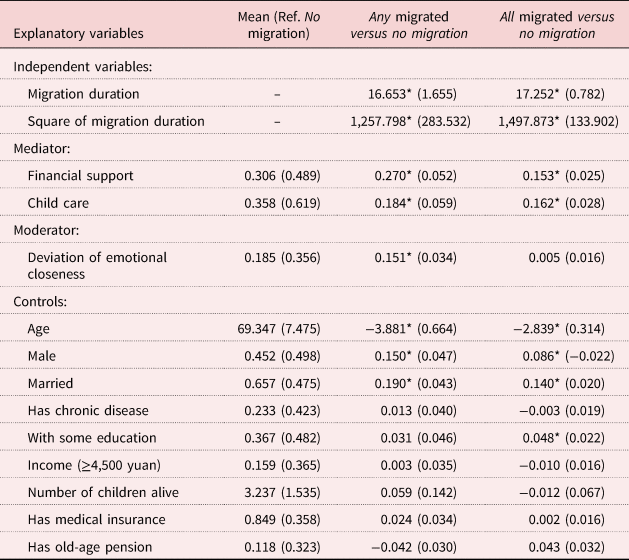
Table 2 presents the pairwise comparisons of all explanatory variables by children migration status. The second column displays the mean and SD of rural elders with no migration. The third and fourth columns display pairwise comparisons of the other two types of rural elders.
T-test of variables used in this research by adult child migration
Notes: N = 2,937. Standard deviations are in parentheses. Ref.: reference category.
Significance level: * p < 0.05.
Descriptive statistics from Table 2 show that controlled variables, including gender, marital status and age, were all differentiated from the reference in two comparisons (any migrated versus no migration; all migrated versus no migration): rural elders with migrant children were more likely to be male, younger, with a marital partner, and more educated than the rural elderly with all migrated. No significant difference was found regarding other important controls. This preliminary analysis could indicate that the household migration decision is potentially correlated with older parents' demographic characteristics, as Pan and Dong (Reference Pan and Dong2020) report that adult children whose older parents are healthier, younger or living with a spouse are more likely to migrate.
In the next section, this paper explores the effects of all variables of interest systematically in the regression analyses. The empirical results are unfolded in two parts: first, the regression analyses of depression followed by wellbeing. Each component is divided into two subsections. As previously discussed, there could be a potential systematic difference between rural elders with any migrated and those with all migrated. If the two types of children migration status were not separated in the regression, differentiated effects of migration duration on rural elders' emotional wellbeing might not be investigated.
Estimating the influence of migration on rural elders’ emotional health by migration type
As displayed in Table 3, the influence of adult-child migration on the emotional health of rural elders differs by the migration type. As shown in Depression 1, all migrated has no significant impact and only any migrated imposes a marginally significant impact on depression (at 90% confidence interval (CI)) when no other explanatory variables are included. When the covariants are included in Depression 2, the effect becomes significant at 95% confidence interval (CI), and the size of the impact has also slightly increased. Interestingly, the trend is that rural elders with any migrated children are more depressed than rural elders with all migrated children, which is against the grain. Concerning the wellbeing, as displayed in Wellbeing 1 and Wellbeing 2 it is significantly and negatively impacted by adult child migration regardless of the migration type, with or without the covariants.Also, the pattern of how elderly's welbeing is associated with adult child migrant is consistent with that of depression; it is rural elders with any migrated children who experience worse wellbeing. In conclusion, this preliminary investigation of the association between the emotinal health of rural elders and adult child migration suggests that it's worthwhile to distinuishwhether all, or any, of the adult children have migrated.
Regression of depression and wellbeing by adult child migration

Notes: N = 2,937. Robust standard errors are in parentheses. Ref.: reference category.
Significance levels: † p < 0.1, * p < 0.05, ** p < 0.01, *** p < 0.001.
Estimating the influence of migration duration on rural elders’ depression
Having established the differentiated effects of migration on emotional health, both on depression and wellbeing, we can now consider migration duration by migration type. This paper investigates the effects of migration duration on depression and wellbeing by migration type, with rural elders with no migration as the reference in the following analysis.
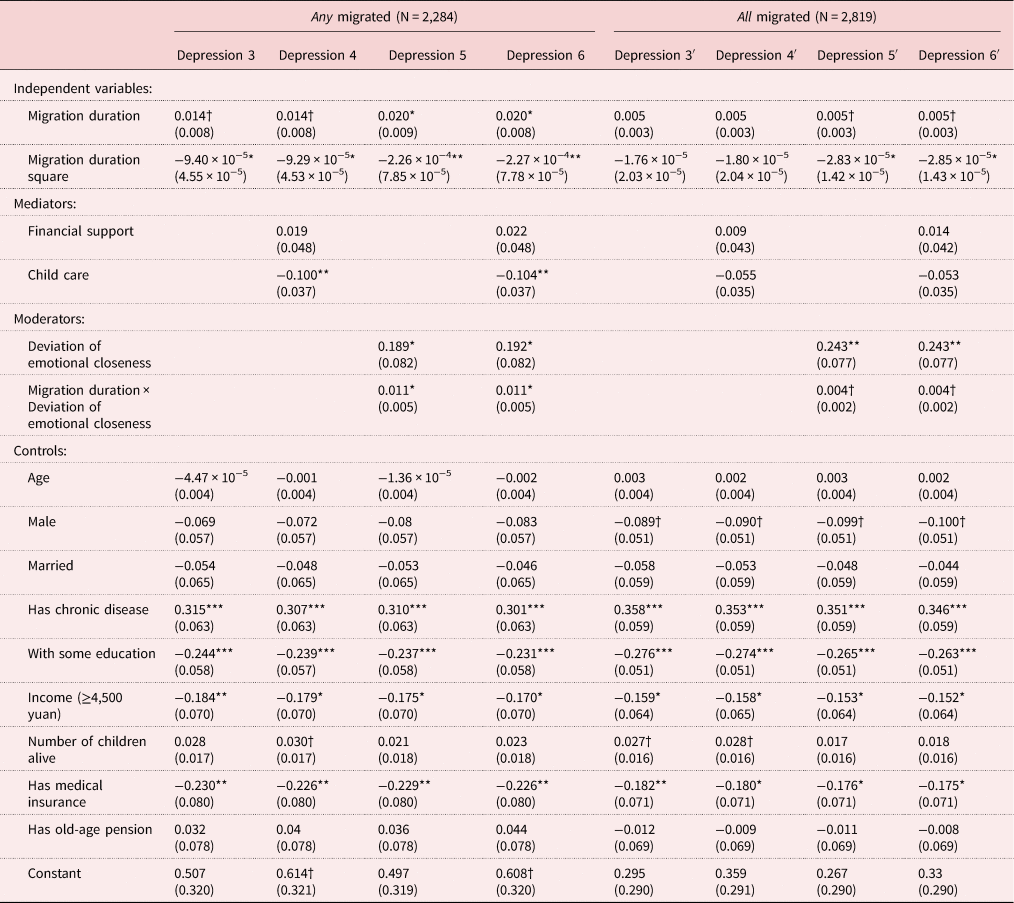
As displayed in Table 4, Depression 3 is the base model with only controls, Depression 4 is the mediating model with controls and mediators, Depression 5 is the moderating model with both controls and moderators, and Depression 6 is the full model, with mediators, moderators and controls. It can be concluded that both the duration of migration and its square display significant effects on depression throughout all models: the results are marginally significant (p < 0.1) in the base model and mediating model while they are significant (p < 0.05) in the moderating model and full model.
Regression of depression on migration duration by adult child migration
Note: Robust standard errors are in parentheses.
Significance levels: † p < 0.1, * p < 0.05, ** p < 0.01, *** p < 0.001.
The coefficient of migration duration in Depression 6 can be interpreted as: with every one-month increase in the duration of migration (any migrated), the standardised aggregated depression of rural elders significantly increased by 2 per cent of a SD compared with rural elders with no child migration. However, the level of depression diminishes over time, since the coefficient of the square of migration duration is significantly negative (coefficient = −2.27 × 10⁻⁴, p < 0.01 at 95% CI). The turning point is at around the 44th month (−b/2a = −0.020/(2 × −2.27 × 10⁻⁴) approximate to 44), indicating that when the migration duration of adult children is prolonged, rural elders' depression keeps increasing by around 1 unit SD (0.02 × 44 = 0.88) before it starts to decrease at the 44th month.
Although the inclusion of mediators does not change the coefficient size of migration duration as shown in Depression 3 and 4, it does show that taking care of grandchildren is significantly related to depression: taking care of one more grandchild can decrease 10 per cent of a SD in the depression level. With moderators included, the coefficient of migration duration increases from 0.014 (in Depression 3) to 0.020 (in Depression 4). The deviation of emotional closeness between the parent and children has a strong correlation with the depression level: every unit increase in the deviation of emotional closeness leads to an increase in depression of 19 per cent of a SD. Also, the interaction is positive and significant, indicating the existence of moderating effects of emotional closeness.
Intriguingly, the social demographics of age, gender and marital status have shown no significant effects on depression. If a potential positive selection exists, the real effects of migration duration on rural older persons' depression could be larger than those in Table 4. Meanwhile, among the sociodemographic variables that show no difference between the categories of migration, most display significant effects on depression (see Table 3). Rural elders diagnosed with any chronic diseases display depression levels around 30 per cent of a SD higher than those with no chronic diseases. Education, income and medical insurance, on the other hand, protect rural elders from being more depressed: rural elders with more than 4,500 RMB annual income report 17 per cent of a SD lower depression level, rural elders with at least some primary education report averagely 23 per cent of a SD lower than those who are illiterate; having medical insurance also helps decrease about 23 per cent of a SD. However, no significant effect is found from the number of children alive or old-age pension.
Within the subsample of rural elders with all migrated, the effect size of migration duration on rural elders' depression level stays steady even when mediators, moderators or both are included in the regression. When mediators (Depression 5') and moderators (Depreesion 6') are introduced, migration duration becomes marginally significant (at 95% CI). The effect of the square of migration duration also becomes statistically significant (coefficient = −2.85 × 10⁻⁵, p < 0.05 at 95% CI). The turning point was the 88th month (−b/2a = −0.005/(2 × −2.85 × 10⁻⁵)), indicating that rural elders with all migrated need twice the time to recover from depression.
Regarding the mediators, neither economic support from adult children nor taking care of grandchildren can significantly decrease depression. However, large deviation in emotional closeness can significantly increase depression (coefficient = 0.243, p < 0.01). This reflects that it could be the differentiated emotional closeness with different out-migrated children that makes the rural elders who are left behind emotionally suffer. For other controllers, still, education, chronic disease, income and medical insurance are significantly correlated with depression, but not gender, marital status and age.
Taken together, the statistical results from Table 4 suggest that although there is a correlation that indicates migration duration can impose negative effects on rural elders' mental health by increasing the depression level, there is possibly a different pattern – the nonlinear effect of migration duration on mental health: rural elders who have migrant children regardless of the migration status have worse mental health, and this depression could become worse when migration prolongs. However, it is the group of rural elders with all children out-migrated who need almost double the time to reach the turning point, the 88th month, after which their depression level decreases.
Regarding the two mediators and moderators, they have also displayed differentiated effects according to migration types. First, taking care of grandchildren can reduce depression for rural elders with any migrated but not for the rural elders with all migrated children. However, care-giving cannot fully mediate the emotional loss of migrant children being away. For the moderators, the deviation of emotional closeness has a stronger positive influence on depression for rural elders with all migrated, and the interactive effect is also smaller.
Estimating the influence of migration duration on rural elders’ wellbeing
As previously established, rural elders' wellbeing was significantly and negatively affected by migration regardless of the migration status of adult children. This paper now separately explores migration duration against migration type, in order to make the analysis systematic.
Table 5 shows the influence of migration and its duration on rural elders' wellbeing: Wellbeing 3 is the base model with only controls; Wellbeing 4 is the mediating model with controls and mediators; Wellbeing 5 is the moderating model with both controls and moderators; and Wellbeing 6 is the full model with mediators, moderators and controls. The results show that both the duration of migration and its square display significant effects on wellbeing throughout all models and with the inclusion of mediators and moderators. The effect size of migration duration also increases, from 0.014 in the base model to 0.016 in the mediating model, from 0.020 in the moderating model to 0.022 in the full model. Although the co-effect of migration duration is as small as 0.02, considering the unit of duration is month, time influence becomes large when migration duration prolongs.
Regression of wellbeing on migration duration by adult child migration

Notes: N = 2,937. Robust standard errors are in parentheses.
Significance levels: † p < 0.1, * p < 0.05, ** p < 0.01, *** p < 0.001.
The coefficient of migration duration in Wellbeing 6 shows us that with every one-month increase in migration duration, the wellbeing of rural elders with any migrated children significantly drops by around 2 per cent of a SD compared with rural elders with no child migration. This negative impact of migration duration diminishes over time, since the coefficient of the square of migration duration is significantly positive (coefficient = 2.45 × 10⁻⁴, p < 0.01 at 99 per cent CI). The turning point is at around the end of the 44th month (−(−0.022/(2 × 2.45 × 10−4) = 44.90)), indicating that when the migration duration of adult children is prolonged, rural elders' wellbeing keeps decreasing by around 1 SD (0.022 × 45 = 0.99) before it starts to bounce back at the 45th month.
In the mediating model (Wellbeing 4), the mediating effects of economic support (coefficient = 0.139, p < 0.01) and child care (coefficient = 0.084, p < 0.05) are both significantly positive: with one more adult child providing economic support, rural older persons' wellbeing increases by 14 per cent of a SD; taking care of one more grandchild, wellbeing also increases by around 8 per cent of a SD. Also both the significance level and effect sizes are consistent when the moderators' deviation of emotional closeness is included in the full model (Wellbeing 6). The main effect of deviation of emotional closeness is significant: with one unit increase of deviation of emotional closeness between the older parent and the children, older persons' wellbeing drops about 20 per cent of a SD. The significantly negative coefficient (coefficient = −0.011, p < 0.01) of the interaction between migration duration and the deviation of emotional closeness indicates that longer migration duration and larger deviation of emotional closeness will lead to even worse wellbeing.
None of the demographic controls, including age, gender, marital status and physical health, is significant in the full model (Wellbeing 6). Neither does education help improve wellbeing. Only material-oriented resources like income, medical insurance and old-age pension display significant positive effects on rural elders' wellbeing.
Regarding the regression results based on the subsample of rural elders with all migrated (with rural elders having no child migration as the reference), the effect size of duration and its square are also statistically significant in the full model (Wellbeing 6′), although the effect size is quite small (coefficient = −0.005, p < 0.01). Still, when considering the measuring unit is a month, the time influence can be large when the migration duration prolongs. The turning point is also calculated, which is the 85th month (0.005/(2 × 2.93 × 10−5) = 85) and the happiness level decreases by around 43 per cent of a SD (0.005 × 85 = 0.425).
Both the mediators – economic support and child care, and the moderators – emotional closeness and its deviation, show statistical significance. Rural elders with more adult children providing economic support and taking care of more grandchildren report significantly higher wellbeing. However, a large deviation of emotional closeness can significantly decrease wellbeing (coefficient = −0.215, p < 0.001).
No significant effects of age, gender or marital status were found, but as shown in Table 5, rural elders with some education (coefficient = 0.124, p < 0.01), a significant amount of income (coefficient = 0.185, p < 0.01), have medical insurance (coefficient = 0.194, p < 0.001) and old-age pension (coefficient = 0.162, p < 0.01) have reported a significantly higher level of wellbeing.
Comparing results from Table 5 confirms that although raising grandchildren and receiving remittances from adult children can significantly mediate the emotional loss of rural elders, a large deviation of emotional closeness with children can increase the emotional loss of migration. Also the negative effect of migration cannot be fully mediated or moderated: if migration happens, rural elders' wellbeing drops no matter if it is any or all of the co-resident children.
Discussion and conclusion
With large-scale internal migration on the rise in China, the number of rural older people affected by the migration of their children is certainly increasing rather than decreasing. These rural elders, as the ‘silent engine’ behind Chinese economic growth (Singapore Management University, 2016), deserve to live a happier and more supported older life.
Based on the data of the first wave of CFPS, this paper found that the impact of adult children's migration on rural elders' emotional health differed according to the type of migration relating to their adult children. In a significant contribution to the current literature, this paper has indicated that rural elders with any of their financially co-dependent children having migrated experienced significantly higher levels of depression, rather than rural elders with all migrated when compared with rural elders with no migration. The possible explanation could be that these older parents did not determine their adult children to have lower filial piety after they had migrated (Luo and Zhan, Reference Luo and Zhan2012), and that is why they suffer less mentally. Whereas, when it comes to wellbeing, both groups of rural elders with any or all migrant children reported significantly lower levels of wellbeing than rural elders with no migration. This reveals that possibly filial piety still plays a large part in wellbeing as these old rural parents are still possibly holding on to the same preference of household living arrangements, values and attitudes of filial piety like other rural elders (Silverstein et al., Reference Silverstein, Cong and Li2006; Ren and Treiman, Reference Ren and Treiman2015). This explains why their wellbeing decreased as long as they have migrant children.
Interestingly, the effects of care-giving on depression varied by the type of adult child migration. Child care can decrease the depression of rural elders with any migrant children but not for those with all children migrated. This supports previous findings that rural elders living in three-generation families have better mental health than those living in SGHs (Ren and Treiman, Reference Ren and Treiman2015; Wen et al., Reference Wen, Ren, Korinek and Trinh2019). This is because child care can be harmful to rural older persons' emotional and cognitive health if they are not supported by adult children (Silverstein and Zuo, Reference Silverstein and Zuo2020), especially for the rural elders who have more farm work after adult child migration (Du et al., Reference Du, Ding, Li and Gui2004; Chang et al., Reference Chang, Dong and MacPhail2011).
Effects of child care on wellbeing were consistent regardless of the adult child migration type. It could be explained that older parents who took care of grandchildren evaluated themselves with higher filial piety (Luo and Zhan, Reference Luo and Zhan2012), and care-giving does positively increase the psychological wellbeing of rural grandparents (Cong and Silverstein, Reference Cong and Silverstein2008). Besides, this paper found receiving economic support from adult children cannot decrease rural elders' depression level, whereas it can significantly increase the level of wellbeing.
In addition, this paper also found that the depression and wellbeing of rural elders were highly associated with living resources, including personal income, medical insurance and old-age pension, which is in line with the findings mentioned by Biao (Reference Biao2007) that hardship is fundamentally caused by the left-behind social and economic development in many rural communities.
This study, however, is limited in the following aspects. First, due to the survey constraints, this paper has not investigated the role of family reunions. It is very likely that rural elders, whose migrant children come back home regularly for family get-togethers, would have better emotional wellbeing compared to those whose migrant children have never come back since moving away. Second, as the survey did not investigate rural older persons' opinions on filial piety, this paper cannot directly explore how filial piety has played on rural parents' view of their adult children's migration. If future surveys can include both the old and young generations' opinions on filial piety, more fruitful research can be produced on how economic development has reshaped a society's traditional culture through the younger generation's migration and modifications of family values. Therefore, this research advocates for longitudinal social surveys covering filial piety in order to shed light on the ways that cultures and traditions are shaped and reshaped by modernity and the social consequences.
Despite these limitations in the dataset, the present study is one of the few that has empirically investigated the temporal dimension of the emotional impact of adult child migration on rural elders' emotional health, disaggregated by migration type. This study has shed some light on the understanding of how family life and emotional wellbeing of rural elders have been strongly influenced by societal change under the Chinese social and cultural context – the economic reform and internal migration since the late 1970s. As for how to maintain the balance (or a healthy relationship) between material-oriented resources and the emotional wellbeing of family members because of migration, this paper suggests that, fundamentally, the central government should invest more in less-developed areas, creating more job opportunities to accommodate rural surplus labours . This could largely diminish the scale and duration of migration while still allowing rural young generations to earn material-oriented resources for the family. If the migration is unavoidable, more social support and social resources should be given to the rural elders, especially to those who are experiencing long-term children's migration and those who are left behind.
Acknowledgements
The author would like to express appreciation to the two anonymous reviewers for the very positive comments to polish the paper into a better version, and to Professor Maria Iacovou, Dr Jacques Wels and Professor Brendan Burchell for the very helpful feedback on the earlier drafts, to Mr Joe Cotton for his proofreading support, and to the Institute of Social Science Survey, Peking University for the high-quality data.
Financial support
This work was not supported by funding.
Conflict of interest
The author declares no conflicts of interest.
Ethical standards
Ethical consideration followed the basic principles for research given by the University of Cambridge. Ethics approval for using the data in this study was granted by the Institute of Social Science Survey, Peking University.


 Open access

