


In the UK, health outcomes and life expectancy improve substantially with increased socio-economic status (SES)( Reference Marmot, Allen and Goldblatt 1 ). Inequalities cannot be entirely attributed to behaviours such as diet and smoking, also arising from structural factors such as housing and employment security( Reference Marmot 2 ). However, more healthful behaviours are typically observed among higher-SES individuals( Reference Law, Power and Graham 3 , Reference Stringhini, Sabia and Shipley 4 ). Socio-economic discrepancies in many health behaviours emerge in childhood( Reference Hanson and Chen 5 ). Hence, interventions to improve childhood health behaviours, increasingly delivered through schools( Reference Inman, van Bakergem and LaRosa 6 ), may play a significant role in reducing inequalities.
One potential behavioural contributor to health inequalities, commonly targeted by school-based interventions, is breakfast consumption. Skipping breakfast is associated with a variety of detrimental outcomes, including dental caries( Reference Bruno-Ambrosius, Swanholm and Twetman 7 ), dysmenorrhoea( Reference Fujiwara 8 ) and reduced weight control( Reference Berkey, Rockett and Gillman 9 ), while breakfast contributes significantly to the overall nutritional adequacy of children's diets( Reference Nicklas, Bao and Webber 10 – Reference Williams, O'Neil and Keast 12 ). Consumption of breakfast has also been associated with improved cognitive performance( Reference Smith, Clark and Gallagher 13 – Reference Benton and Sargent 17 ), with potential implications for educational attainment. However, many children do not eat adequate breakfasts( Reference Corder, van Sluijs and Steele 18 , Reference Hoyland, McWilliams and Duff 19 ), while breakfast skipping and consumption of lower-quality breakfasts are more common among children from lower-SES families( Reference Moore, Tapper and Murphy 20 ).
Possibly the most common school-based intervention for promoting healthful breakfast consumption is through ‘breakfast clubs’. These were first adopted in North America in the 1960s with the aim of improving the nutritional status of children in more deprived areas( Reference Friedman and Hurd-Crixell 21 ). By 1997 approximately six million children in the USA were attending a school breakfast club each day( 22 ). In the UK, their introduction has occurred more recently. By 2012 however, breakfast clubs were available in almost half of schools in England, with delivery concentrated in areas of deprivation( Reference Hoyland, McWilliams and Duff 19 ). In Wales, the Welsh Government's Primary School Free Breakfast Initiative (PSFBI) was implemented from 2005( Reference Moore, Moore and Tapper 23 ), offering all primary schools resources and guidance to provide free, healthy breakfasts before the start of the school day. An estimated three-quarters of primary schools throughout Wales have taken up this scheme to date( Reference Thomas 24 ). While there is some evidence that school breakfast programmes can help improve nutrition and may lead to improvements in attendance, academic performance and behaviour( Reference Belderson, Brandon and Camina 25 – Reference Pollitt 29 ), findings have been inconsistent( Reference Friedman and Hurd-Crixell 21 ) with robust evaluation hampered by difficulties such as contamination between trial arms( Reference Shemilt, Harvey and Shepstone 30 ). Furthermore, the aims of breakfast clubs, and hence the outcomes measured by their evaluations, have diverged considerably, with some focusing on provision of a healthy breakfast while others emphasise child care, education or informal interaction between children and school staff( Reference Shemilt, O'Brien and Thoburn 31 ). One trial from the USA( Reference Crepinsek, Singh and Bernstein 32 ) for example provides robust evidence that universal breakfast provision can improve pupil nutrition, although a recent trial in deprived areas in New Zealand emphasised school attendance and educational attainment as primary goals, finding no impact on these outcomes( Reference Mhurchu, Gorton and Turley 33 ).
As described above, breakfast clubs originated as a means of reducing inequality through improving the nutritional status of children in more deprived areas and, with some notable exceptions( Reference Crepinsek, Singh and Bernstein 32 ), evaluations have typically focused on targeted provision( Reference Shemilt, Harvey and Shepstone 30 , Reference Mhurchu, Gorton and Turley 33 ). However, while targeting resources towards schools in areas of deprivation is intuitively appealing, targeted approaches may not always be the most effective means of reducing inequality. Targeting may stigmatise individuals, schools, families or communities through labelling them as needy; widely recognised as a barrier to the uptake of free school meals (FSM) among many children from poorer families( Reference Harper and Wood 34 ). In addition, given that relationships between SES and health outcomes are typically graded rather than dichotomous, targeting the very poorest will do little to address inequalities throughout the distribution( Reference Whitehead 1 ).
For these reasons, attention is increasingly turning to the need to identify universal interventions whose impacts are proportionately greater further down the socio-economic distribution( Reference Marmot, Allen and Goldblatt 1 ). Of course, universal interventions may also have the opposite effect, widening inequality through disproportionately benefiting more affluent groups. Hence, Whitehead( Reference Whitehead 35 ) has called for all evaluations of health improvement interventions to evaluate impacts on inequality, regardless of whether their explicit aim is to reduce inequality or to improve population-level health, in order to build an evidence-based typology of actions which reduce or worsen inequality. At present, there is tentative evidence that actions based on education, information provision and promotion of voluntary change are more likely to generate inequality, while altering higher-level factors to make healthy behaviours easier may be more likely to reduce inequalities( Reference Whitehead 35 – Reference Lorenc, Petticrew and Welch 38 ). Breakfast provision represents an attempt to improve behaviour through altering the environment to improve the availability of healthy breakfasts, therefore making the behaviour easier. Hence, one would perhaps expect it to be more likely to narrow inequality than approaches such as educating children about the benefits of breakfast while the option of eating a healthy breakfast continues to be unavailable for some. No studies to date have examined differential effectiveness of universal breakfast provision by SES.
The current paper presents secondary analysis of data from the cluster-randomised controlled trial of the PSFBI in Wales and aims to understand its role in reducing inequalities in children's consumption of breakfast. The PSFBI formed a Welsh Labour Party manifesto commitment to offer Welsh primary schools guidance and resources to offer free healthy breakfasts to all children. Although schools in areas of deprivation were targeted in the initial phases of implementation, it was ultimately made available to all schools. At the aggregate level, trial data published in this journal indicate that while PSFBI had no impact on breakfast skipping, with children substituting breakfast at home for a breakfast at school( Reference Murphy, Moore and Tapper 39 ), the shift from home-based to school-based consumption appeared to significantly improve the healthfulness of items consumed for breakfast, also leading to more positive attitudes towards breakfast.
Analysis of baseline data, also published in this journal, indicated that children attending more deprived schools ate poorer-quality breakfasts than their higher-SES counterparts and had less positive attitudes towards breakfast than did children from more affluent schools( Reference Moore, Tapper and Murphy 20 ). Hence, while there was no overall impact on breakfast skipping, given that children from more deprived backgrounds were eating poorer-quality breakfasts at home prior to intervention, the move from eating breakfast in the home towards eating healthy breakfasts in school may have disproportionately improved dietary quality among children from more deprived backgrounds. The present paper examines impacts of PSFBI on socio-economic gradients in dietary behaviours and cognitive performance, in order to evaluate the potential impact of universal breakfast provision on inequalities in health and educational attainment.
Method
The Primary School Free Breakfast Initiative
The intervention provided a school-based breakfast before the commencement of classes, without any cost being borne by parents. The aim of the intervention was not only to encourage breakfast consumption per se, but also to improve the nutritional quality of children's breakfasts. Hence a particular focus was placed upon limiting available food choices to breakfast items considered to be healthful. Breakfasts provided included items from four food types: non-sugar coated cereals, bread, milk products and fruits, in addition to drinks. Schools were provided with guidelines regarding how the scheme should be run, in terms of staff to student ratios and the food to be provided, but were given a reasonable degree of autonomy in the operation of the scheme. At the time of writing, information about the scheme can be found on the Welsh Assembly Government's website( 40 ).
Participants
Primary schools located in Wales were approached to take part in a cluster-randomised controlled trial of the Welsh Government's PSFBI. A total of 111 schools took part, of which fifty-eight were ‘Communities First’ schools (located in socio-economically deprived areas). Participants were Year 5 and 6 students (i.e. aged 9–11 years) within these 111 schools. One Year 5 and one Year 6 class from each school was selected to complete the attitudes and dietary recall questionnaires. A total of 4350 students at baseline and 4472 at 12-month follow-up completed the classroom-based measures within all 111 schools. The fact that a higher number of children participated at follow-up is a consequence of the fact that the study involved repeated cross-sections in the same schools at baseline and 12-month follow-up. Due to increased class sizes in some schools, the eligible pool of children increased slightly, although response rates were identical at baseline and follow-up (88·3 %). Teacher-completed behavioural questionnaires were completed in relation to 1034/947 children within 105/99 schools at baseline/follow-up. Of the 4472 children who completed follow-up measures, individual-level FSM entitlement data were obtained for 3068 (68·6 %).
Measures
Deprivation
This was assessed using data on FSM entitlement. Two variables were used for school-level analyses: (i) the percentage of all children within the school entitled to FSM (provided by the Welsh Government) and (ii) the percentage of study participants within each school entitled to FSM at Key Stage 2 (aged 7–11 years; data obtained from the Secure Anonymised Information Linkage (SAIL) databank). For individual-level analysis, children's own entitlement to FSM (yes or no) was used as a binary indicator of deprivation.
Attitudes towards eating breakfast
Attitudes were assessed by asking pupils to indicate agreement with thirteen statements on a scale of 1 (strongly agree) to 5 (strongly disagree). Items referred to a variety of domains, such as concentration and behaviour, energy, and the general importance placed on breakfast. The measure has demonstrated good construct and convergent validity using baseline data used in the present study( Reference Tapper, Murphy and Lynch 41 ).
Dietary recall questionnaire
The questionnaire was a modified version of the Day in the Life Questionnaire( Reference Edmunds and Ziebland 42 ). This measure has been validated against 24 h recall interviews with a sub-sample of children from the present study and offers an acceptable level of validity and reliability( Reference Moore, Tapper and Murphy 43 ). In fact, the measure covered a period slightly in excess of 24 h; children were asked to list all foods and drinks consumed at chronologically ordered time points throughout the previous day and for breakfast on the day of reporting. Outcome variables are the proportion of children consuming less than two breakfasts over 2 d, the number of healthy items (i.e. cereals, bread, fruits and milk products) consumed for breakfast, the number of unhealthy items consumed for breakfast (i.e. crisps and sweet snacks), the number of fruit and vegetables consumed during the rest of the day and the number of unhealthy items (i.e. crisps and sweet snacks) consumed during the rest of the day.
Classroom cognitive tests
Classroom-level measures were pen-and-paper tests which had previously been shown to be sensitive to the effects of breakfast in experimental studies( Reference Smith, Kendrick and Maben 44 , Reference Smith, Clark and Gallagher 45 ). These included: a word recall test of episodic memory( Reference Smith, Kendrick and Maben 44 ); a backward letter span test of working memory, similar in nature to the backward digit span test( Reference Smith and Miles 46 ); and two search and memory task (single & five letter) tests( Reference Smith and Miles 46 ) of discrimination, sustained attention and psychomotor speed. Episodic memory was identified as the primary cognitive outcome in the published protocol, so analysis focuses on this measure.
Behavioural problems
The Strengths and Difficulties Questionnaire (SDQ)( Reference Goodman 47 ) provides measures of behavioural difficulties in four domains: (i) conduct problems, (ii) emotional problems, (iii) hyperactivity and (iv) peer problems; as well as strengths in terms of pro-social behaviour. The SDQ was completed by teachers to assess the classroom behaviour of a randomly selected sub-sample of five of their students in each year group (i.e. ten students in total for each school). Hyperactivity was identified as a key secondary outcome in the published protocol, so analysis focuses on this subscale.
Procedure
For the original trial, parents were informed of the research by means of a letter and information sheet sent home with children and were asked to contact the school if they did not wish their child to participate in the study. Parents of fifteen children requested that their child be excluded. At each data collection, children were also informed that they were under no obligation to participate. The present study received ethical approval from the Cardiff University Social Science Ethics Committee.
Class-level measures were completed in the morning (between 09.00 and 11.00 hours) as a supervised classroom exercise with a maximum class size of forty children. For the attitudes questionnaire, the researcher read statements one by one and children marked their response for each statement after it was read out, to minimise conferring and ensure that children did not distract one another. For the dietary recall measure and the cognitive measures, the researcher read out the instructions and asked children to complete the task independently from one another. If children had finished or needed help with spelling or further clarification, they were asked to put their hand up. Three members of the research team were present to assist children.
The SAIL databank is a data warehouse which was established at the Health Information Research Unit (HIRU) at the College of Medicine at Swansea University. It brings together a wide range of person-based data, using a split-file approach to anonymisation to overcome issues of confidentiality and disclosure( Reference Lyons, Jones and John 48 ), and operates within a robust series of guidelines in line with the Caldicott principles and the National Information Governance Board for Health and Social Care( Reference Ford, Jones and Verplancke 49 ). Participating children were each assigned an Anonymised Linking Field (ALF_E)( Reference Lyons, Jones and John 48 ) and thereby linked to the National Pupil Database for Wales, a version of which is held on the SAIL databank.
Statistical analysis
For each variable, school-level mean scores were calculated by summing scores for each child and dividing the total by the number of children within the school. That is, data from the 4350 children at baseline and 4472 at follow-up for measures collected within the whole class were aggregated at the school level (approximately forty children per school at each time point). For the sub-sample of children for whom the behavioural questionnaire was completed, data from the 1034/947 children at baseline/follow-up were aggregated (approximately ten children per school at each time point). School-level weighted regression models were constructed (i.e. each school formed a single unit of analyses, with models weighted to adjust for variability in the number of pupils sampled within each school) adjusting for baseline score and the four stratification variables. All models examine post-intervention follow-up data as the dependent variable. As is standard practice in testing moderation of intervention effects by SES( Reference Moore, Currie and Gilmore 50 ), models are presented in two stages: first, containing variables for intervention status and FSM entitlement without an interaction term; and second, with an FSM × intervention status interaction term added.
Percentage FSM entitlement was converted to proportions, so that b coefficients reflect change in the dependent variable if all children within a school are entitled to FSM v. none. Separate models were run for each of two markers of deprivation (e.g. proportion FSM entitlement among the whole school or among study participants). The first set of models, using school-level FSM percentages, replicates and extends analyses published in the main trial outcomes paper( Reference Murphy, Moore and Tapper 39 ). The second set of models replicates these models, but uses aggregated values from data on the FSM entitlement of individual children (linked to trial data via the SAIL databank), providing a more precise estimate of the socio-economic composition of the specific groups of 9–11-year-old children participating in the study. Analyses were conducted on an intention-to-treat basis, with ‘intervention status’ representing the treatment condition to which the school had been randomised (control, n 56; intervention, n 55). However, no individual-level FSM data were available for three schools (all of which were intervention schools), with models using these data including 108 schools (control, n 56; intervention, n 52).
Finally, individual-level analyses examined differences in key outcomes between children in intervention and control schools who completed measures at follow-up (n 3068), with models including the same control variables entered into aggregate-level analysis, including school-level mean baseline scores for the dependent variable. Linear regression was used for normally distributed variables, with highly skewed or categorical variables divided into tertiles and subjected to ordinal logistic regression. Test of parallel lines statistics in SPSS indicated no violation of proportional odds assumptions. Models were adjusted for clustering at the school level using the complex samples module in the statistical software package IBM SPSS Statistics 18. In discussion of findings, a P value of 0·05 or less is considered statistically significant.
Results
Deprivation
The percentage of children in each school entitled to FSM ranged from 3·1 % to 65·9 % with the mean (26·1 %; sd 13·5 %; n 111) higher than the national average of 17 %. The percentage of study participants within each school entitled to FSM ranged from 0 to 61·0 % (mean 22·8 %; sd 13·2 %; n 108). The two deprivation markers were highly correlated (r = 0·82), indicating that the socio-economic composition of classes selected for testing within each school was similar to that of the school as a whole. Baseline characteristics of intervention and control schools are presented in Table 1.
Baseline characteristics of stratification variables by randomisation status: cluster-randomised controlled trial examining the impact of the Primary School Free Breakfast Initiative in Wales on inequalities in children's dietary behaviours and cognitive functioning

Post-intervention school-level mean values (and standard deviations) for outcome variables of interest (baseline values are reported in Murphy et al.( Reference Murphy, Moore and Tapper 39 )): cluster-randomised controlled trial examining the impact of the Primary School Free Breakfast Initiative in Wales on inequalities in children's dietary behaviours and cognitive functioning

Dietary behaviour and attitudes towards breakfast
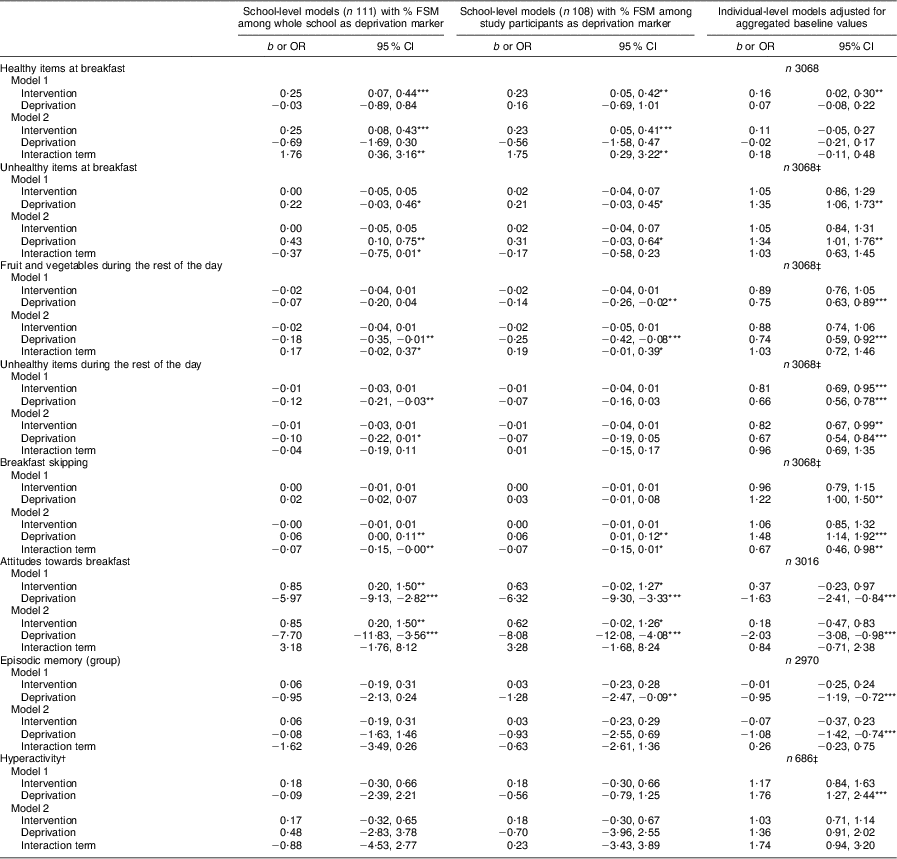
Mean and standard deviation of post-intervention scores for key variables are presented in Table 2. As indicated in Table 3, children in schools randomised to receive the PSFBI consumed significantly more healthy items at breakfast and had more positive attitudes towards breakfast than children in control schools in school-level analyses. The b coefficient indicates the difference between groups in the average number of healthy items consumed; hence the b coefficient of 0·25 indicated that, on average, pupils in intervention schools ate 0·25 more servings of healthy items than did those in control schools. In individual-level analyses however, intervention effects were smaller, with differences significant only in relation to consumption of healthy items for breakfast and unhealthy items throughout the remainder of the day. Differences between intervention and control groups in relation to all other dietary behaviours were non-significant.
b coefficients or odds ratios and 95 % confidence intervals for associations of the Primary School Free Breakfast Initiative and deprivation with 12-month dietary and cognitive outcomes (model 1) and interactions with deprivation (model 2)
FSM, free school meals.
Statistically significant: *P < 0·1, **P < 0·05, ***P < 0·01.
†Data collected from a sub-sample in each of 105/99 schools at baseline/follow-up.
‡Odds ratios from ordinal logistic regression models.
When the measure of deprivation was the overall percentage of children in the school entitled to FSM, a higher level of deprivation was associated with decreased consumption of unhealthy items during the rest of the day and poorer attitudes towards breakfast. Positive associations between deprivation and breakfast skipping, and between deprivation and consumption of unhealthy items at breakfast, became significant only after entry of an FSM × randomisation interaction term. A negative association of deprivation and fruit and vegetable consumption also became significant. Conversely, an association of deprivation with consumption of unhealthy items during the rest of the day became non-significant on entry of the interaction term. Findings were similar when the percentage of study participants within the school entitled to FSM was used as the marker of deprivation, although a significant association of deprivation and consumption of fruit and vegetables during the remainder of the day was observed both before and after entry of an interaction term. In individual-level analyses, household deprivation was significantly associated with increased consumption of unhealthy items for breakfast, increased breakfast skipping, poorer attitudes towards breakfast, consumption of fewer fruit and vegetables throughout the rest of the day, as well as consumption of fewer unhealthy items throughout the rest of the day. Only the consumption of healthy items for breakfast was not significantly associated with household deprivation.
In school-level analyses, significant interactions were observed between intervention status and deprivation in relation to both consumption of healthy items at breakfast and breakfast skipping, although only the association with breakfast skipping was significant in individual-level analysis. Hence, school-level analysis (though not individual-level analysis) indicated that the number of healthier items eaten at breakfast differed across trial arms to a greater extent in more deprived schools than in less deprived schools, while despite no aggregate differences between trial arms in terms of breakfast skipping, significantly greater differences between trial arms were observed in more deprived schools.
Episodic memory
There were no intervention effects upon episodic memory. Episodic memory was significantly poorer in children in receipt of FSM in individual-level analysis, although no association was observed in analysis using school-level FSM entitlement. No interaction between deprivation and intervention status was observed.
Behavioural outcomes
No significant associations were found between intervention status, deprivation or the interaction term in terms of hyperactivity, apart from a significant association between FSM entitlement and hyperactivity in individual-level analyses.
Discussion
The present study aimed to examine the impact of universal breakfast provision on socio-economic inequalities in children's dietary behaviours and cognitive functioning. When assessed at the school level, deprivation was associated with poorer attitudes towards breakfast, higher levels of breakfast skipping and consumption of unhealthy breakfast items and consumption of fewer fruits and vegetables in final models. However, in contrast to associations apparent in the baseline data( Reference Moore, Tapper and Murphy 20 ), consumption of ‘healthy’ items for breakfast was no longer associated with school-level deprivation at follow-up. Deprivation appeared to be a stronger and more consistent predictor of adverse outcomes when assessed at the household level rather than the school level. At the household level (i.e. individual-level FSM entitlement), deprivation was associated with consumption of a significantly higher number of unhealthy breakfast items, consumption of fewer fruits and vegetables, a higher risk of breakfast skipping, poorer attitudes towards breakfast, poorer episodic memory and higher levels of hyperactivity. Only consumption of healthy items for breakfast was not associated with deprivation, while counter to the dominant trend for poorer health behaviours among more deprived children, children entitled to FSM also reported eating fewer unhealthy items throughout the day following breakfast. This may reflect the greater likelihood of such children to have a school meal rather than a packed lunch, and hence fewer snacks. It should however be noted that at baseline, children from poorer schools were shown to under-report consumption of more unhealthy food items to a greater extent than those from more affluent schools, with this trend perhaps therefore an artifact of biased reporting( Reference Moore, Tapper and Moore 51 ).
In relation to some dietary behaviours, there was evidence that universal breakfast provision disproportionately benefited children from lower-SES schools and families. For the consumption of healthy items for breakfast, school-level models indicated larger differences between control and intervention groups among children from more deprived schools, with this narrowing of inequality perhaps accounting for the lack of significant association between deprivation and consumption of healthy breakfast items in follow-up data. In individual-level analysis however, this interaction was not significant. Notably, despite the fact that aggregate-level analyses indicated that breakfast skipping was not significantly reduced by the intervention( Reference Murphy, Moore and Tapper 39 ), a significant interaction was observed between intervention status and breakfast skipping, indicating that breakfast skipping was reduced among children from more deprived schools and households. Further interactions indicating decreased consumption of unhealthy breakfast items at breakfast, and increased fruit and vegetable consumption throughout the rest of the day, among children from poorer schools were significant at the 10 % level. Importantly, there was no evidence in relation to any measured outcomes of worsening of inequalities. Hence, the study provides support for the notion that universal interventions which involve changing the environment in order to facilitate healthier behaviours may be more likely to reduce inequalities than to make them worse( Reference Marmot, Allen and Goldblatt 1 ).
A number of strengths and limitations of the study merit consideration before considering its implications. It benefits from a large sample of schoolchildren from Wales and the use of pre-validated measures, or measures validated for the purpose of the study. Nevertheless, while validated, the study relies upon self-report measures, likely subject to social desirability biases. Furthermore, it was not possible to link all participating children to data on individual-level FSM entitlement, potentially introducing error to estimates of the percentage of children in participating classes entitled to FSM.
Nevertheless, while in some settings breakfast provision continues to be targeted towards areas of deprivation, the present paper provides important evidence that universal provision of free school breakfasts can disproportionately benefit children from poorer backgrounds, in terms of discouraging breakfast skipping and increasing the consumption of healthier breakfast items. For no outcome was there evidence that universal breakfast provision disproportionately benefited children from more affluent backgrounds. Hence, offering breakfast provision on a universal rather than targeted basis may play a significant role in reducing inequalities in health and is unlikely to widen them. This avoids the stigmatisation of individuals, schools, families or communities, which may occur when labelling them as needy( Reference Mhurchu, Gorton and Turley 33 ), and may play a greater role in reducing social gradients in health outcomes. In addition, given that relationships between SES and health outcomes are typically graded rather than dichotomous, targeting the very poorest will do little to address inequalities throughout the distribution( Reference Harper and Wood 34 ). On a broader level, the study supports assertions that universal interventions can play an important role in reducing inequalities( Reference Marmot, Allen and Goldblatt 1 ) and that interventions targeting higher-level environmental factors in order to facilitate healthier behaviours, rather than focusing upon influencing individual choice through education and information provision, may be more likely to reduce inequalities( Reference Whitehead 35 – Reference Lorenc, Petticrew and Welch 38 ). It demonstrates the importance of heeding Whitehead's calls for interventions which aim to promote population-level change to be evaluated not only in terms of aggregate effectiveness, but also in terms of impact on inequalities( Reference White, Adams and Heywood 37 ).
Acknowledgements
Sources of funding: The work was funded via the National Prevention Research Initiative http://www.npri.org.uk (grant number 87122). Funding from the British Heart Foundation, Cancer Research UK, the Department of Health, Diabetes UK, the Economic and Social Research Council, the Medical Research Council, the Research and Development Office for the Northern Ireland Health and Social Services, the Chief Scientist Office, the Scottish Executive Health Department, The Stroke Association, the Welsh Assembly Government and the World Cancer Research Fund is gratefully acknowledged. The work was undertaken with the support of The Centre for the Development and Evaluation of Complex Interventions for Public Health Improvement (DECIPHer), a UKCRC Public Health Research: Centre of Excellence. Funding from the British Heart Foundation, Cancer Research UK, the Economic and Social Research Council (RES-590-28-0005), the Medical Research Council, the Welsh Government and the Wellcome Trust (WT087640MA), under the auspices of the UK Clinical Research Collaboration, is gratefully acknowledged. The funders played no role in the design, analysis or writing of this article. Conflicts of interest: The authors have no conflicts of interest to declare. Ethics: The study received ethical approval from the Cardiff University School of Social Sciences Research Ethics Committee. Authors’ contributions: G.F.M. drafted the manuscript. G.F.M. and K.C. conducted analysis. M.A. contributed to the linkage of trial and routine data, managed by R.A.L. All authors commented on drafts and approved the final manuscript. Acknowledgements: The authors are grateful to Chris Roberts and Janine Hale within the Welsh Government's Health Improvement Division for supporting the original trial and data linkage.


 Open access

