

Introduction
The theoretical literature seeking to explain women's status in Muslim-majority states centers on religious, cultural, and economic variables. Existing empirical scholarship has examined the effect of these factors on different sociopolitical outcomes such as women's participation in the labor force, political activities, and higher education (Fish, Reference Fish2002; Donno and Russett, Reference Donno and Russett2004; Ross, Reference Ross2008; Cherif, Reference Cherif2010). In this paper, I am shifting away from behavioral outcomes to focus on state policy on women's economic rights—in particular state laws that affect a woman's ability to access economic opportunities in her state.
The focus on economic rights as the outcome of interest is two-fold. First, the effect of Islam on women's economic rights in the Muslim world has not been empirically studied. These particular rights are contested within Islamic doctrine. It is an area of Islamic doctrine affecting women that offers counteracting rules; therefore, the effect on women's status cannot be easily predicted. While the Quran explicitly allows women to seek employment and maintain full control of their income, Islamic law prescribes gendered norms, in which men are primarily breadwinners and women are homemakers. Similarly, while Islamic law does not explicitly stop women from working outside of the home, it recognizes potential spousal disapproval. An empirical examination of states' adoption of Islamic doctrine will reveal whether the inconsistent position produces ambiguity in states' policies on women's economic rights or whether one position within the doctrine has a greater effect.
Most other rights in Islamic doctrine are specified unambiguously, whether supporting gender equality or not, and are supported by consistent explanations across core Islamic doctrine: the Quran, Hadith, and Islamic law.Footnote 1 Three significant examples are property, inheritance, and divorce. Men and women are granted the same property rights in Islam, with both having the same right to own and manage property (Ali, Reference Ali2012; Bishin and Cherif, Reference Bishin and Cherif2017). There is also consistency across Islamic doctrine regarding inheritance law, which prescribes a son double the share of a daughter, due to his responsibility as the primary breadwinner of the family. The right to divorce, while granted to both men and women, is not equal as it comes with greater restrictions for women including forfeiture of alimony. The uniformity within doctrine regarding most rights, like property, inheritance, and divorce present clear predictions for gender equality outcomes. While property rights foster equality, inheritance and divorce rights are an impediment. As discussed, Islamic doctrine's consistent position on most issue-areas including the ones just discussed is lacking in its handling of women's economic rights.
The second motivation for the focus on economic rights is their consequence for women's status at large. The extent to which a state allows a woman to freely access economic opportunities may affect women's labor force participation. Labor force participation, in turn, is one of the core rights which along with education is argued to provide women with the foundation to attain other rights such as political, citizenship, and inheritance, thereby elevating women's status in general in society (Moghadam, Reference Moghadam2003; Cherif, Reference Cherif2010; Iversen and Rosenbluth, Reference Iversen and Rosenbluth2010; Bishin and Cherif, Reference Bishin and Cherif2017). As one of the two major core rights, labor force participation endows women with the ability to advocate for their rights through mechanisms both at the individual and collective levels. At an individual level, women have the knowledge, education, and financial independence to navigate the state's legal, bureaucratic, and political system to advocate for their rights. At a collective level, the workplace allows them to build a social network and coordinate political action (Lin, Reference Lin2001; Cobble, Reference Cobble2004; Mutz and Mondak, Reference Mutz and Mondak2006; Bishin and Cherif, Reference Bishin and Cherif2017). Thus, the degree to which a state allows women to access economic opportunities has consequences for their status in other realms.
Additionally, low female labor force participation, resulting from inadequate women's economic rights may have implications for legal reform. Without access to the workplace, women are limited in their means and resources to lobby for legal reform that would elevate women's economic rights in the first place. Thus, we may see a vicious cycle of stagnation in which state policy that limits women's economic rights results in low female labor force participation, which in turn renders women, as the main advocacy group for change, dormant.
In order to understand the effect of the opposing rules in Islamic doctrine on women's economic rights at the state level, I test the relationship while controlling for a set of competing variables that may also affect state policy on women's economic rights. I use data from 1990 to 2014 on the population of Muslim-majority states.Footnote 2 I employ a multilevel mixed-effects linear regression model to test the hypotheses seeking to explain women's economic rights. I find that a state's adoption of Islamic laws and policies, the presence of Islamic family law courts, and the establishment of Islam as the state religion do not have any significant influence on the economic rights it grants women. The Arab region, oil wealth, and a communist legacy are significant predictors. Then, to better understand the processes through which the significant variables affect women's economic rights, I conduct a most similar systems case study comparing two Arab monarchies: Jordan and Morocco. These two states are selected because they are similar in most respects, yet Jordan has failed to advance the economic rights of women while Morocco has made substantial progress. Their otherwise similar profiles allow me to isolate the key mechanism producing the contrasting outcomes: the dominance of patriarchal interests in policy formulation.
Women's economic rights
Women's economic rights in this paper are referring to the legal rights that the state grants women to enable them to work outside of the home and earn an income. These rights are not limited simply to equal employment opportunity and pay, but include other legal factors that affect economic opportunities. These include choice of profession, the ability to travel freely, and work at night. Also included are workplace laws regarding parental leave and harassment, access to bank and credit, the right to sign contracts, and access to pension benefits. The outcomes of interest are the rights that allow women's financial independence through work opportunities rather than inheritance or family money.
Explanations of gender inequality in the Muslim world
Most explanations of women's status in the Muslim world center on either religio-cultural or economic factors. The religio-cultural frameworks examine different aspects of religion and culture, both institutions and norms, arguing that they are accountable for gender inequality in the Muslim world. These explanations have been empirically substantiated by a set of cross-national studies that find a negative correlation between majority Muslim states and women's status as well as majority Arab states and women's status (Fish, Reference Fish2002; Inglehart and Norris, Reference Inglehart and Norris2003; Donno and Russett, Reference Donno and Russett2004; Cherif, Reference Cherif2010, Reference Cherif2015). The negative correlation between culture and women's status is attributed largely to the socialization of traditional gender norms which are promoted by institutionalized Islamic family law as well as long-standing patriarchal traditions predating Islam which are particularly pervasive in the Arab world (al-Mughni and Tetreault, Reference Al-Mughni, Tetreault and Joseph2000; Amawi, Reference Amawi and Joseph2000; Charrad, Reference Charrad and Joseph2000, Reference Charrad2001, Reference Charrad2009; Joseph, Reference Joseph and Joseph2000).
The norms-based argument maintains that the gendered traditionalism advanced by Islamic family law informs society's standard for appropriate behavior for both men and women. Because these societies value religion and often times have high religiosity levels, the effect of the religiously prescribed gender roles has a substantial effect on informing societal norms (Tessler, Reference Tessler2003; Inglehart, Reference Inglehart and Moaddel2007; Alexander and Welzel, Reference Alexander and Welzel2011; Bishin and Cherif, Reference Bishin and Cherif2017). Because the primary role of women is inside the home sphere, it discourages women from actively participating outside of that sphere, therefore resulting in fewer women seeking employment and political office (Rahman, Reference Rahman2012).
The norms do not emanate only from Islamic family law but also from cultural, patriarchal traditions predating Islam. In the domestic realm, Arab regional experts argue that women are culturally expected to submit to the decisions of the men in the family, and the father in particular maintains a dominant role (Sharabi, Reference Sharabi1988; Joseph, Reference Joseph and Sabbagh1996; Masoud et al., Reference Masoud, Jamal and Nugent2016). The governments of many Muslim-majority states, particularly those of Arab states maintain political alliances with tribes and long-standing kinship networks (Charrad, Reference Charrad and Joseph2000, Reference Charrad2009). These political alliances, which are active in the policymaking process, ensure the perpetuation of a gendered power dynamic in which men maintain control over the major decision-making positions in all societal institutions including the family, the mosque, the corporate world, and politics. This institutionalized patriarchal system not only keeps women out of positions of power, but it additionally does not allow a space for reformist voices that seek to change the laws and the transmitted norms. These alliances were cemented during the time of independence and continue to be used today by many Arab governments as a means of maintaining political legitimacy (Keddie, Reference Keddie1990; Charrad, Reference Charrad and Joseph2000, Reference Charrad2001, Reference Charrad2007, Reference Charrad2009; Joseph, Reference Joseph and Joseph2000). This cultural explanation is empirically supported by cross-national studies which find that the Arab region, rather than Islam, is negatively linked to women's status (Donno and Russett, Reference Donno and Russett2004; Ross, Reference Ross2008).
A second cultural explanation examines the effects of a communist legacy. Although a communist past is linked to problems with democratic transition in general (Linz and Stepan, Reference Linz and Stepan1996; Fish, Reference Fish, Anderson, Fish, Hanson and Roeder2001; Cameron, Reference Cameron2007; Reynolds, Reference Reynolds2011), an exception is the favorable precedent for legal gender equality that it sets. Former communist states imposed a top-down dual worker model which led to a greater inclusion of women in higher education and the workplace (Ferber, Reference Ferber1994; Pascall and Lewis, Reference Pascall and Lewis2004). The dual worker model, as opposed to the male breadwinner model, endorses both men and women working outside of the home. Policies to implement the dual worker model were part of a host of legal gender equality measures adopted by the state (Ghodsee and Mead, Reference Ghodsee and Mead2018). Critics argue that although these states legally equalized the status of women to that of men in the public realm, women did not experience actual empowerment (Drakulic, Reference Drakulic1992; Ferber, Reference Ferber1994). Despite the problems with the approach, the legacy of policies that required women to participate in areas that were traditionally considered the realm of men, may still have a positive effect on women's access to the workforce in formally communist Muslim-majority states today (Molyneux, Reference Molyneux1990; Ferge, Reference Ferge1998; Fajth, Reference Fajth1999; Pascall and Lewis, Reference Pascall and Lewis2004).
Other scholars have pointed out that the root cause of the inequality is not culture but rather economic factors, in particular oil-rent dependent economies which allow women's exclusion from spheres outside of the home to endure (Moghadam, Reference Moghadam2003, Reference Moghadam, Hunter and Malick2005; Ross, Reference Ross2008). Ross (Reference Ross2008) explains that oil-rent dependent economies are characterized by a larger non-traded sector, which includes construction and services, and a smaller traded sector which includes agriculture and manufacturing. This asymmetry occurs because of an increase in the oil-rich state's real exchange rate which makes it cheaper to import traded goods rather than buy locally, and simultaneously increases the local demand for non-traded goods which cannot be imported. This negatively affects women's labor force participation because women are typically employed in the traded sector rather than the non-traded sector (Ross, Reference Ross2008, 3–4). This then has a series of consequences for women's empowerment including fewer women in the labor force, which subsequently negatively impacts their political influence (Sapiro, Reference Sapiro1981; Schlozman et al., Reference Schlozman, Burns and Verba1994; Chibber, Reference Chibber2003; Moghadam, Reference Moghadam2003; Ross, Reference Ross2008).Having examined the major explanations of gender inequality in the Muslim world, the next section examines more closely the particular aspects of Islamic doctrine that deal with women's economic rights.
Dueling prescriptions for women's economic rights in Islamic doctrine
Islamic doctrine presents evidence that is used to justify different understandings of women's economic rights. Some Muslims interpret the doctrine to argue for the inclusion of women in the workforce, while others read it in a way that limits their role largely to the domestic sphere.
In some ways, the Quran is incredibly progressive toward women, more so than other holy scriptures. Unlike other scriptures, the Quran unequivocally mandates that women have the right to work and maintain their income. Chapter 4 of the Quran is titled “The Women,” and section 5 of that chapter which is titled “Women's Rights over their Earnings” discusses just that (Ali, Reference Ali1994). Verse 32 from that chapter states, “For men is the benefit of what they earn. And for women is the benefit of what they earn” (Ali, Reference Ali1994, 198). Given the Quran's status as the primary and inviolate source of Islam, theologians present this verse as evidence to argue that Islam allows women to work and earn a salary, allowing them to be financially independent from their fathers and husbands. In discussing a woman's right to work, Islamic scholars have commented that the right is not limited to a pre-marriage state but rather is permitted after marriage as well (Ali, Reference Ali2012, 451).
After the Quran, the second most significant source of Islam is the Hadith which chronicles the life of Prophet Muhammad and his family, serving as a guide for how Muslims should conduct their lives. The Quranic injunction permitting women to seek employment finds support in the Hadith, from the family model of Prophet Muhammad, in which traditional gender roles were switched. Prophet Muhammad's wife, Khadija, was a successful business woman, owning one of the most profitable businesses in Arabia. Throughout their marriage, she was the primary breadwinner as Muhammad worked under her as an employee. As Muhammad's ministry progressed and he became busier, Muhammad stopped working, and Khadija became the sole breadwinner for the family. The Hadith documents that while Khadija was out earning money for their family, Muhammad, in addition to spreading the message of Islam, would split the housework with Khadija and take care of their daughter Fatima (Sahih al-Bukhari 676, 5363, 6039). This detailed accounting of the Prophet's family life in the Hadith serves as a blueprint for Muslims, presenting a model that is contrary to the gender traditionalism underlying Islamic family law and supported by many traditionalists.
Beyond the non-traditional family model presented in the Hadith, Islamic doctrine also reveres Khadija as one of the four ideal women of Islam that Muslim women are encouraged to emulate (Sahih al-Bukhari 3432; Sahih Muslim 2430). Khadija, her daughter Fatima, Mary the mother of Christ, and Asiya the wife of the Pharaoh are singled out in Islam as role models for women because of the qualities that they embody. Khadija is admired for her strength as a successful career woman, who provided both financial and emotional support to her husband. Khadija's strength as a working woman who bore the responsibility of the family's finances is seen as a positive endorsement for Muslim women joining the labor force.
Scholars also point to aspects of Islamic law that support a women's right to work. They point to the gender equal legal capacity of women to manage property (Amin, Reference Amin2000, 64). Additionally, they argue that Islamic law is based on the premise of equality of the sexes, but cultural customs have produced interpretations that undermine its actual intent. They further maintain that authoritarian governments throughout the Muslim world are responsible for stripping women of their religiously granted rights, in an effort to maintain their power by oppressing half the population (Amin, Reference Amin2000; Kurzman, Reference Kurzman2002).
The support for women's financial independence from core Islamic sources, the Quran and Hadith, is met by counteracting forces in Islamic family law. While Islamic family law does not explicitly restrict a woman's right to work, married women face particular stipulations to do so, according to some traditional theological interpretations. While interpretation of Islamic law varies by confessional community, school of thought, and theological perspective one leading classical interpretation is that if a woman does intend to work after marriage, the terms must be decided and spelled out in the marriage contract, to ensure agreement between spouses (Bakhtiar, Reference Bakhtiar1996). If, however, it is not specified at the time of the marriage contract formation, then the wife must obtain her husband's approval to work after the wedding because the husband has the final say over family decisions. If she continues to work without her husband's permission, then she forfeits her right to be financially provided by her husband (Bakhtiar, Reference Bakhtiar1996). These stipulations not only create disincentives for women to seek employment, but they actually undermine women's equal right to work. Contemporary theologians, however, rebut this traditional interpretation, stating that the scriptural basis from which this rule is drawn does not allow husbands to exercise supreme control over their wives' decisions, but rather both partners have a voice in coming to a mutual decision (Fadel, Reference Fadel2012, 18).
In addition to aspects of the law itself, the assumption of gender roles that underlies Islamic family law may also have an inhibitory effect on women's employment through the norms-based argument that was discussed earlier. These traditional gender roles are rooted in a particular Quranic verse, which classical jurists used as a foundation to form many of the rules of Islamic family law. The Quranic verse states that, “Men are the maintainers of women” (Ali, Reference Ali1994). Classical Islamic scholars have interpreted this verse to grant the man the legal position of financial provider and the woman the position of caretaker and manager of household affairs (Tucker, Reference Tucker2008). These different responsibilities are based on what is described as each gender's natural advantage:
The man excels the woman in constitution and physique, which is capable of bearing greater hardships and facing greater dangers than the physique of woman.
On the other hand, the woman excels the man in the qualities of love and affection. Hence there is a natural division as between man and woman of the main work which is to be carried on for the progress of humanity (Ali, Reference Ali2012, 453).
These gender roles serve as a foundation of laws regarding marriage, divorce, custody, and inheritance regardless of the school of thought, madhab (Rahman, Reference Rahman2012). The man, in accordance with the duty of, nafaqah, or maintenance, is responsible for the material well-being of the wife and children. In return for this maintenance, the wife is responsible for household duties, childcare, and provision of companionship to her husband (Doi, Reference Doi1989, 39–40; al-Mughni and Tetreault, Reference Al-Mughni, Tetreault and Joseph2000; Moghadam, Reference Moghadam2003, Reference Moghadam, Hunter and Malick2005; Husni and Newman, Reference Husni and Newman2007; Tucker, Reference Tucker2008). Earning an income is not a primary responsibility for women and can even be interpreted as disrupting the division of labor encouraged by Islamic family law.
Without refuting biological differences between the sexes or the division of responsibilities resulting from it, reformist theologians argue that neither preclude women from entering the workforce or political participation. Some even go further as to argue that participation in the public sphere including work outside of the home is Islamically required for the spiritual fulfillment of women (Fadel, Reference Fadel2012, 21–27). Empirical support for this theological approach is found in a recent experimental study from select Arab states. The study finds that the participation of women in the political decision-making process rendered the process more legitimate in the eyes of the experimental subjects (Kao et al., Reference Kao, Lust, Shalaby and Weiss2024).
These reformist theologians maintain reverence for the foundations of Islamic family law, and utilize the same rules of interpretation as classical Islamic scholars. But in doing so, they also consider conditions of the modern world and come to different logical conclusions about women's right to work and exercise political leadership than classical scholars (Kurzman, Reference Kurzman2002; Fadel, Reference Fadel2012).
Another group of thinkers, Islamic feminists, also use Islamic doctrine to argue for women's economic rights. But they go a step further than reformist theologians by interpreting Islamic sources in a way that almost completely refutes classical interpretations and promotes complete gender equality. Islamic feminists present an Islam that empowers women, by drawing on evidence found in core Islamic sources (Mernissi, Reference Mernissi1991; Wadud, Reference Wadud2006; Lamrabet, Reference Lamrabet2016; Barlas, Reference Barlas2019; Mir-Hosseini, Reference Mir-Hosseini2022). These thinkers reinterpret the Quran, Hadith, and Islamic law through a purely feminist lens. Recent experimental research finds that their arguments merit persuasion as Quran based arguments elicit supportive attitudes toward women's political leadership (Masoud et al., Reference Masoud, Jamal and Nugent2016).
Thus, we see the complexity surrounding a woman's role in the family and society in Islamic doctrine, with two opposing sets of guidelines presented regarding a woman's right to work. States that adopt Islamic doctrine are faced with the decision to prioritize one set of guidelines over the other when determining state policies that affect women's economic opportunities.
Causal mechanisms
Figure 1 illustrates the two ways, direct and indirect, in which a state's adoption of Islamic doctrine may influence its laws and policies on women's economic rights. Islamic doctrine includes particular tenets which are directly relevant to women's economic rights. If a state chooses to institutionalize Islam, it may decide to simply translate the relevant tenets of Islamic doctrine into official state policy because a commitment to Islam would necessitate that Islamic principles pertaining to women's economic rights be reflected in the state's laws and policies. Thus, in the direct path, states by adopting Islamic doctrine are simply translating the features pertinent to women's economic rights into their legal framework. A few examples will further clarify this mechanism. Tenets that support women's employment like the Hadith of Khadija as a prominent businesswoman, both prior to and after her marriage, could translate into state policy that allows women to register a business and sign contracts in the same way permitted to men. The Quran's content in the chapter titled “Women's Rights over their Earnings” could translate into state policy that authorizes women to maintain administrative control over their assets. On the other hand, Islamic tenets that discourage women's employment like Islamic family law's stipulation of spousal approval for major decisions made by the wife could be legislated into state law that requires married women to obtain their husbands' consent before signing a work contract. Similarly, the characterization of men as the providers of women, as found both in the Quran and Islamic family law, could be adopted into state policy that does not penalize gender discriminatory hiring practices. Thus, as shown by these examples, the commitment of a state to incorporate Islam in its governance could include the state looking to Islamic doctrine to find aspects that could directly inform its policies.
Mechanisms linking state adoption of Islamic doctrine to state policy on women's economic rights.
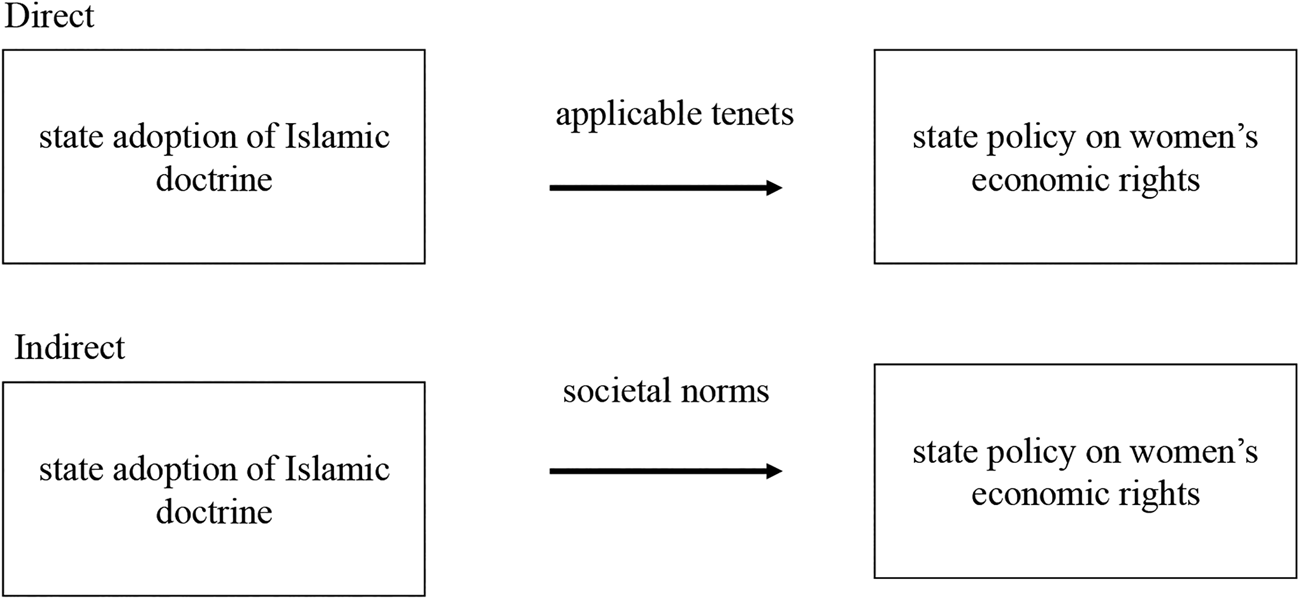
We can expect Muslim-majority states to adopt Islamic doctrine in the first place due to precedent. The majority of Islam's political history is characterized by a merging of religion and politics that takes different forms including governance of society through Islamic law (Rahman, Reference Rahman2013, 556). Islamic law goes beyond simply providing theological instruction for spiritual practices, by laying out a set of rules to govern society. This legacy born and developed in the Islamic empires is carried on by Muslim-majority states today in some shape or form. This is borne out empirically. Examining Muslim-majority states from 1990 to 2014, every state with the exception of Albania for a 3 year period, has at least one law in its legal code that is based on Islamic law (Fox, Reference Fox2019). The average number of laws or policies based on Islamic law over the course of the 24 year period for Muslim-majority states is 17 (Fox, Reference Fox2019). Furthermore, Islamic family law, which is particularly relevant to women's access to employment opportunities, is the specific area of Islamic law that is most adopted in Muslim-majority states today (Stilt et al., Reference Stilt, Waheedi and Griffin2018, 302). Thus, the expectation that states would adopt Islamic doctrine is probable, setting off the direct path in Figure 1.
In the indirect path, the societal norms that form from religious tenets may influence the state's creation of laws regarding women's economic rights. As discussed earlier, the characterization of gender found in Islamic family law, produces societal gender norms which are valued by members of that society. Because these gender norms are based on doctrine that has both the weight of law and religion, they are regarded as particularly influential in society, prescribing proper and acceptable behavior (Rahman, Reference Rahman2012, 350–351). This conservative gender characterization is seen in individual attitudes toward women's involvement in politics and the workforce in some Arab states, which view men as more capable of political leadership and as having a greater right to economic opportunities than women (Masoud et al., Reference Masoud, Jamal and Nugent2016, 1559). As members of society, policymakers may hold these attitudes. These attitudes would compel them to legislate laws that reflect these norms like prohibiting women's employment in certain fields or passing laws that require women to provide extra documentation to work, thereby encouraging them to stay home. Similarly, policymakers may face public pressure to adopt policy that reflects traditional gender norms.
The lack of economic opportunities which may result from such laws then affect the perpetuation of conservative gender attitudes by creating economic incentives for women to adopt the exact beliefs that strip them of job opportunities in the first place. Previous research finds that due to limited access to employment in Muslim-majority states, women adopt conservative gender norms, which are valued by society. They do this to elevate their status as potential wives, thereby securing their financial future as an alternative to employment (Blaydes and Linzer, Reference Blaydes and Linzer2008).
The direct and indirect mechanisms flesh out the means through which state adoption of Islamic doctrine can influence states' formulation of policy. The mechanisms can theoretically work independently, but in reality, are likely complementary rather than working in isolation. The direct path focuses on aspects of Islamic doctrine which speak directly to women's economic rights and are likely to be adopted because the state is committed to institutionalizing Islam. The indirect path focuses on the power of societal norms to influence the decisions of policymakers as they craft policy. The beliefs valued by society may create pressure on policymakers to codify those beliefs into law. Additionally, as members of society, the policymakers are likely to hold the same beliefs as the rest of society, further encouraging them to enact policies that reflect the religiously rooted norms.
Different interpretations of Islam
It should be acknowledged that there is variation in interpretations of Islam. This could result in differences in the type of doctrine adopted by states, which could then potentially result in varying effects on state policy on women's economic rights. Here the argument is not so much how much of Islam is adopted by a state, but rather which variant. Notably, there are five different schools of thought, madhahib, within Islamic law, resulting in different compendiums of law. However, when it comes to gender, all five schools of thought share the same characterization, and so the differences in Islamic doctrine relevant to women's economic rights are negligible (Rahman, Reference Rahman2012). In addition to the schools of thought, there are a number of movements within Islam that have completely contrasting approaches. For example, the Sufi-influenced Barelvi Islam practiced in South Asia presents a clearly different understanding than its Deobandi rival which is influenced by puritanical Wahhabism. These differences are both intra-state and inter-state.
There may also be regional influences on the understanding of Islam (Amin, Reference Amin2000). Islam in eastern Europe and central Asia is impacted by atheist influences of communism, and its traditions are shaped by close geographical proximity to Christian populations. It is reasonable to imagine that these differences may result in the institutionalization of different forms of Islam, resulting in different effects on state policy on women's economic rights. For example, five laws based on Islamic doctrine in Bosnia may look very different than five laws adopted in Saudi Arabia.
Empirically it is challenging to accurately account for all of the variation in the interpretations of Islam in a cross-national study. In an attempt to account for some of the variation that may be due to region, control variables for Arab and South Asian states are included. Additionally, the variable measuring the effect of post-communism can be conceived of as a control for a Eurasian variant of Islam, since all the post-communist Muslim-majority states are located in eastern Europe or central Asia.
Data and methods
In order to understand the effect of the opposing rules in Islamic doctrine on women's economic rights at the state level, I test the relationship while controlling for a set of competing variables that may also affect state policy on women's economic rights. I use data from 1990 to 2014 on the population of Muslim-majority states. I employ a multilevel mixed-effects linear regression model to test the hypotheses seeking to explain women's economic rights. Conceptually, the model can be thought of as working at two levels simultaneously to generate the results. Level one estimates changes in women's economic rights within states, using generalized least-squares estimation. Level two estimates changes in rights between states, using restricted maximum-likelihood estimation. The composite model estimates population level effects of the independent variables on women's economic rights along with a random intercept for each state which captures a state's unique trajectory that is not captured by the independent variables. Thus, the model distinguishes between the effect of the independent variables in the model and the effect of omitted explanatory variables which impact the individual trajectory of women's economic rights in different states. In order to employ a multilevel mixed-effects linear regression, there must be statistically significant within-state variation and between-state variation of women's economic rights. A likelihood ratio test was performed to make sure that the two variance components are significantly different from zero. The tests found that there is significant variation in both components.
Dependent variable
Women's economic rights are measured using the World Bank's Women, Business, and the Law (WBL) index.Footnote 3 The variable measures the degree to which a state legally guarantees and protects women's access to economic opportunities. It evaluates 35 areas of the law across eight indicators: mobility, workplace, pay, marriage, parenthood, entrepreneurship, assets, and pensions. Each state's score is standardized, ranging from 0 to 100, with 100 indicating that a state gives women the same rights as men.
Figure 2 displays the distribution of scores across the Muslim world from 2014. There is substantial variation in the legal support for women's access to economic opportunities across the Muslim world. The mean score of 53.55 is indicative of the need for improvement. For context, the average global WBL score in 1970, which is the earliest year World Bank has data on this measure was 45.8, and it has risen to 77.1 in 2022 (World Bank, 2023). The average for the Muslim world in 2014 is only slightly above the world's average in 1970.
Women's economic rights in Muslim-majority states, 2014.

Independent variables
To test the effect of the main factor of interest, the state adoption of Islamic doctrine, I use three variables from the Religion and State Project.Footnote 4 Each variable is selected to test different aspects of state adoption of Islam, and to check for robustness. The first Islamic Laws and Policies is a composite variable of government laws and policies that legislate aspects of religion, ranging from 0 to 52. It indicates the total number of state laws and policies which are based on religion, and is a direct measure of the adoption of Islamic doctrine. I include a second variable, Islamic Family Law Courts, in a second model. It measures whether the state establishes religious courts in its judicial system to exercise jurisdiction over matters related to personal status including marriage, divorce, custody, and inheritance. This measure taps into the aspect of Islamic law, Islamic family law, that has the most potential for influencing state policy on women's economic rights. If a state has Islamic family law courts, it indicates that the state codifies Islamic family law and enforces it. A third final variable capturing the potential effect of Islam is a measure for secularism. The variable State Religion indicates whether or not a state establishes Islam as the state religion, capturing a state's commitment to Islam.
Along with the Islam variables, a set of control variables that may also explain variation in state policy on women's economic rights are added to the model. To capture the possible positive effect of economic development, the variable log GDP per capita is added.Footnote 5 A dummy variable, Oil, measures the predicted negative effect of economies dependent on oil rents, producing oil-rich states. Along with these two economic variables, two variables capturing cultural arguments are also included. A dummy variable, Arab, tests for the negative effect associated with the Arab region. A second dummy variable Post-Communist tests for the predicted positive relationship between a communist legacy and women's economic rights. I also add a dummy variable for South Asia to capture any potential regional effect. To control for a state's level of democracy, I add the variable Democracy. I use Polity 5's 21 point measure for regime authority, with a −10 indicating a fully institutionalized autocracy and a 10 indicating a fully institutionalized democracy.Footnote 6 Finally, the model estimates a coefficient for the effect of time on women's economic rights. This is indicated by Year.
Results
The results of the regressions, modeling women's economic rights as a function of state adopted Islamic doctrine and other factors are presented in Table 1. Because there is a relatively strong correlation between the three measures of Islam, three separate models were run, each including one of the three measures. All other independent variables are included in each of the three models because various tests for potential multicollinearity did not indicate a problem.
Women's economic rights as a function of state adopted Islamic doctrine and other determinants, 1990–2014
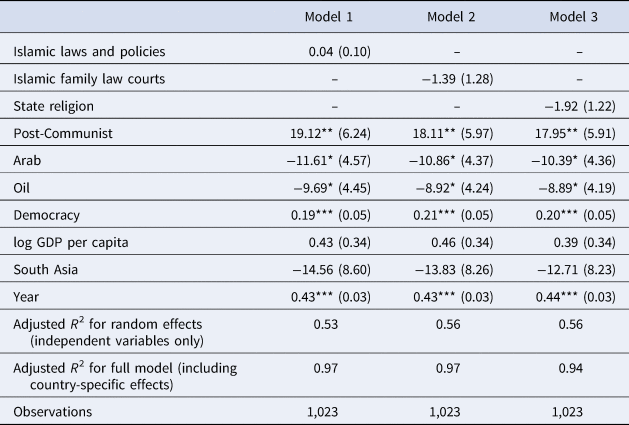
Note: Standardized regression coefficients are not generated for multilevel mixed-effects models because standardization cannot occur both between and within groups.
*p < 0.05, **p < 0.01, ***p < 0.001 (standard errors).
The effect of Islamic doctrine on women's economic rights was unclear and so two competing hypotheses were tested, one indicating a positive and the other a negative effect. The results indicate that neither of the hypotheses is supported. The effect of Islamic laws and policies is almost zero and statistically insignificant.Footnote 7 While the coefficients for Islamic family law courts and established state religion are negative, the substantive effect is small and statistically insignificant. These results indicate that states that are more Islamic neither impede nor foster women's economic rights. The findings reveal that there may be a counteracting influence of the different aspects of Islamic doctrine at the state level. The absence of an effect for all three measures of Islam could indicate that when states institutionalize Islam, the fostering and impeding aspects of Islamic doctrine cancel each other out, resulting in no observed influence on the ground. The results of the models, which evaluate three different forms of a state's commitment to Islam, laws, courts, and formal recognition, indicate that the absence of an effect is robust.Footnote 8 As readers will recall, economic rights were of particular interest because of two strong and opposing sets of rules that Islam prescribes. The results indicate that the lack of a significant effect on state policy mimics the absence of a single, clear-cut prescription in the teachings.
While a state's adoption of Islamic doctrine does not seem to affect the economic opportunities women have, other cultural factors do. A former communist past is the most significant predictor of a state's commitment to equitable economic policies for women. Controlling for all other factors, a state with a communist past scores around 18–19 points higher than a state without a communist past. This is a sizeable effect considering that overtime the average WBL score of a Muslim-majority state is about 47. The results confirm that the push by communist regimes to foster a dual-income model prior to independence still has a residual effect today. The magnitude of the effect is not surprising since legalized gender equality was a hallmark trait of communist policies. The other cultural explanation focuses on the Arab world, pointing to an embedded patriarchal system in the region as a causal mechanism that impedes women's access to the workforce. The regression results indicate that Arab states exhibit about a 10–11 point lower score on the WBL index compared to non-Arab states. While an entrenched patriarchal system is one of the mechanisms that creates obstacles for women's access to economic opportunities in Arab states, this is not to suggest that there is some cultural exceptionalism of the region. The pervasiveness of patriarchal norms, in fact in its most extreme form, in a non-Arab state like Afghanistan, explains why it has one of the worst records on women's economic rights in the Muslim world, with a WBL index score of 28.75 in 2014.
The other major finding from Table 1 is that states dependent on oil rents tend to adopt laws that make it harder for women to work. This confirms previous scholarship that finds a robust link between oil wealth and poor women's status. The effect is substantial, with oil wealthy states scoring about 8–9 points below their non-oil wealthy counterparts. The combination of a regional effect and an oil wealth problem explains the poor performance of many Arab states. Finally, there is a positive effect of democratic government and time, though it is substantively less compared to the effects of the other predictors.Footnote 9
Morocco and Jordan: contrasting records on women's economic rights
While the regression models provide a broad overview of the determinants of women's economic rights across Muslim-majority states, the mechanisms linking these determinants to state policy can be better understood through a closer look at two revealing cases. One of the striking findings of the regression models is that while one of the religio-cultural variables, Islam, has no significant effect, the other, Arab, does. Using a most similar systems case study, we can, first, corroborate the absence of an Islam effect. Second, we can identify how the dominance of patriarchal interests in policymaking, which is the primary theorized mechanism impeding gender equality in Arab states, creates poor outcomes for women's economic empowerment.
Morocco and Jordan are selected for the case study because they share many institutional and historical similarities, including their relationship with Islam, yet have resoundingly different state policy on women's economic rights. This allows us to pinpoint their different policy outcomes to variation in one key causal mechanism: the political dominance of patriarchal interests. While not exactly alike, both states are authoritarian, hereditary constitutional monarchies with a parliamentary legislative system. Both achieved independence from European colonial powers in the mid-20th century. Neither are oil exporters. Both monarchies are seen as Western oriented, with strong ties to the United States and diplomatic relations with Israel. Both states also have a similar profile when it comes to religion. Their constitutions establish Islam as the official religion. Their family law codes are based on Islamic law, and a system of Islamic family law courts exercise jurisdiction over personal status matters. Despite these similarities, Morocco has substantially reformed its policy on women's economic rights while Jordan remains stagnant. We can rule out a significant effect of their shared factors, including Islam, and focus instead on the explanatory significance of mechanisms that differentiate them. Most notably, the dominance of political interests that sustain Bedouin tribal traditions including patriarchy is an important distinction between the two states. While Morocco has managed to overcome the influence of these powerful interests, Jordan has not.
Table 2 categorizes Muslim-majority states by their 2014 WBL score. It shows that of the Arab states, Morocco has the highest score on women's economic rights. This score reflects Morocco's adoption of a series of national policies, starting in 2004, that aim to elevate the status of women, with a focus on their economic empowerment. Based on the results of the regression models, Morocco's progress, compared to other Arab states is not surprising. The models predict that non-oil and gas exporters, communist influence, and limits on embedded patriarchy, are all positives for women's economic rights. Morocco exhibits these predictors, making it a likely candidate for progress. First, its economy is not dependent on oil rents. Second, while not a former communist state by any means, the driving force behind change is a powerful coalition of leftist, socialist parties alongside domestic women's advocacy groups, many of which were born out of the state's socialist parties. It was a strong ideological push from the left based on socialist principles of gender equality that spurred King Muhammad VI to prioritize national reforms (Clark and Young, Reference Clark and Young2008). Third, and the focus of this case study, compared to other Arab states, King Muhammad VI and the Moroccan Parliament have to a large degree managed to overcome the influence of the society's patriarchal kinship structures to pass legislation aimed at improving women's status in general and their economic rights in particular.
Women's economic rights scores, 2014
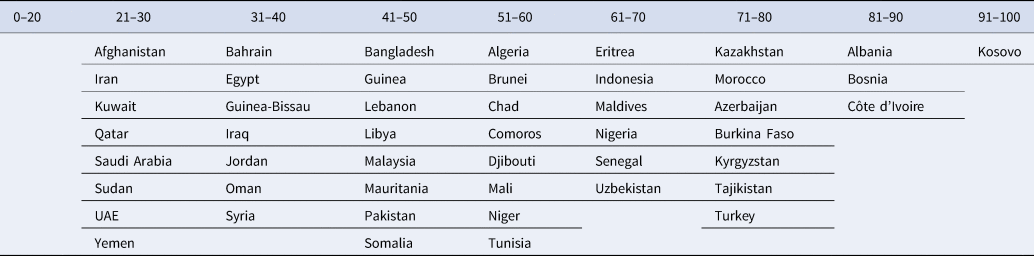
World Bank's women business and law index score, 0–100. 100 indicates that the state grants equal economic rights to women.
The Moroccan government's efforts to reform its laws and implement policies to foster women's access to economic opportunities have been gradual but comprehensive. Its first significant action was reform of the Moudawana, the family law code. It included granting the status of head of household to both spouses, each sharing equal responsibility for maintaining and managing the household and family.Footnote 10 This was followed by a series of national reforms that were part of Morocco's adoption of a multi-year, on-going national policy on gender equality titled Government Plan for Equality.Footnote 11 The policy is aimed at elevating women's status in general, but one of the major objectives is the economic empowerment of women through several avenues including increasing their employment opportunities, creating funds for women-led startups, and implementing workplace policies that accommodate pregnancy and motherhood. In addition, the Moroccan Labor Code was changed to formally codify gender non-discrimination in every aspect related to employment and benefits.Footnote 12 These measures were taken in fulfillment of the ratification of international gender equality and labor conventions, most notably the Convention on the Elimination of All Discrimination against Women as well as several of the gender discrimination conventions of the International Labor Organization.
One of the notable aspects of Morocco's latest 2011 Constitution is its emphasis on the country's commitment to gender equality. There are at least 15 mentions of equal rights and access to state benefits for women. The Constitution also specifically mentions the national monitoring agency, the Gender Parity and Anti-Discrimination Authority, which has the objective of monitoring discrimination against women, including in the workplace.Footnote 13 Morocco continues to implement reforms. Most recently, in 2021, the Moroccan Parliament passed a law that mandates public limited companies to achieve equitable representation of women in corporate governance bodies through quotas.Footnote 14 This law was motivated by a goal of promoting women's management and leadership in the corporate world, with the aim of achieving 40% women's representation on these boards by 2027 (Mouline et al., Reference Mouline, Ozlu and Herzog2022).
The relative success of Morocco can be compared to the lack of progress Jordan has made. Jordan's 2014 WBL score is over 41 points lower than that of Morocco. In fact, in the decade preceding 2014, women's economic empowerment in particular, regressed substantially (Fassihian and Wilson, Reference Fassihian and Wilson2016). Jordan's failure to improve the economic status of women is corroborated by consecutively low scores on the World Economic Forum's Global Gender Gap index. In 2014, it ranked 134 out of 142 states (Bekhouche et al., Reference Bekhouche, Hausmann, Massoudi, D'Andrea Tyson and Zahidi2014). The effect of Jordan's state policy on women's economic rights is evidenced by its low female labor force participation rate, which in 2014 was 12.27% (World Bank, 2024). Of the Muslim-majority states, only Yemen had a worse rate.
Previous case studies on Jordan find that it is not Islam, as substantiated by the results of the regression models in this study, but rather embedded Bedouin patriarchal norms which are heavily represented in the policymaking process that create obstacles for women to access employment and compete for management positions (Metcalfe, Reference Metcalfe2008; Sawalha and Meaton, Reference Sawalha and Meaton2012; Koburtay et al., Reference Koburtay, Abuhussein and Sidani2023). Through the comparative case study, we can largely rule out the role of Islam as both Jordan and Morocco have similar religious profiles. Instead, it is the enduring, tribal traditions pre-dating Islam that influence Jordan's policy formulation. The prevalence of these tribal traditions, in Jordan, is evident in both law and society. For example, Jordan's citizenship law does not allow a mother to pass on Jordanian nationality to her children, while a father can.Footnote 15 This law is a clear indicator of institutionalized patrilineality that has no Islamic foundation. In society, women, both Muslim and Christian, are frequently coerced by male family members to give away their rightful inheritance to them (Abu Sneineh, Reference Abu Sneineh2014). For Muslim women, their right to inheritance is guaranteed to them by Islamic family law, but because tribal traditions often take primacy over Islamic rights, primitive norms surrounding inheritance remain robust in Jordanian society, stripping women of their rights.
Any push for gender equality legislation is halted by a strong coalition of tribal-based parties and independents in the Parliament that support Bedouin patriarchal norms (Clark and Young, Reference Clark and Young2008, 343). These groups perpetuate pre-Islamic tribal concepts of shame and dishonor associated with mingling with men, hindering women from seeking employment (Abu-Rabia-Quedor, Reference Abu-Rabia-Queder2007). Any effort to change policy is largely symbolic, because there is no actual willpower to empower women (Abu Taleb et al., Reference Abu Taleb, Essaid and Sajdi2019). Bedouin patriarchal culture also views masculinity as superior, and so positions of status and leadership such as management are reserved for men. Children are socialized into these patriarchal values from a young age through the national school curriculum which presents ideal occupations for men as professionals, political leaders, and managers, while appropriate vocations for women are depicted as homemakers, teachers, and librarians (Al-Khalidi, Reference Al-Khalidi2016, 103). The dissemination of these norms and their preservation by tribal interests create a cycle that inhibits the advancement of reform.
Thus, while both Morocco and Jordan are oil poor, Arab monarchies with similar levels of institutionalized Islam, the different trajectories of the two cases can be traced to the varying influence of patriarchal, tribal structures in the two states. Morocco has been able to overcome the influence with a heavy push from socialist parties to gradually adopt policies that enhance women's economic rights. On the other hand, Jordan's patriarchal system remains heavily embedded in the power structure, blocking any meaningful reform. Like with any case study, the findings may be limited in their applicability to other Muslim-majority states. Every state is unique, and different political systems and varied interpretations of religion and culture, for example, may affect the processes through which religio-cultural variables influence state policy.
Discussion and conclusion
This study empirically examined the determinants of women's economic rights in Muslim-majority states. After controlling for a set of competing factors, I find that a state's adoption of Islamic laws and policies, the presence of Islamic family law courts, and the establishment of Islam as the state religion are not significant predictors. This has significant implications for policy in the Muslim world. It indicates that states can incorporate Islamic teachings into law and policy without it necessarily interfering in women's access to economic opportunities. This is a reassuring finding for women's status in Muslim-majority states because most of them today incorporate at least some Islam into their legal and governing structures, and the use of Islamic doctrine as a source of state law finds widespread popular support (Pew Research Center, 2013).
Additionally, the findings of this paper refute conventional wisdom, which attributes women's poor status in the Muslim world to Islam. While states that are more Islamic do not have more favorable policy for women's access to work than states that are less Islamic, they also do not have more disadvantageous laws which is what common belief would predict. Even though Islam is not significantly linked to women's economic opportunities, one way or the other, there are still other factors present in the Muslim world that do explain the progress of some states and lack thereof of others. The Arab region and oil wealth are two of the strongest obstacles impeding equitable policies. These findings are consistent with prior scholarship on other measures of gender equality like education, political representation, and labor force participation (Donno and Russett, Reference Donno and Russett2004; Ross, Reference Ross2008). This is not to say that the region is destined for failure. States that are free from the consequences of oil wealth and are able to overcome long-standing patriarchal institutions, like Morocco, are making progress. The results of the regression models leave us with other positive takeaways as well for the future. First, states with a communist past already have a head start on adopting policies that make it easier for women to access and retain employment throughout their lives. Second, democratic governance has a positive effect, so as Muslim-majority states transition toward democracy, they are also likely to legalize gender equality. Finally, the positive effect of time on women's economic rights is another welcome finding for continued reform, albeit gradual.
This study while contributing to the scholarship on women's status in Muslim-majority states, presents a number of limitations that can motivate future research. First, because of data availability constraints, the results of the regression models are based on 25 years of data, ending in 2014. The evolution of rights can take much longer than this, and the models do not capture changes occurring in the last decade. Second, this research while providing empirical evidence to support theories that seek to explain women's status in Muslim-majority states, does not test the processes through which the religio-cultural variables influence policy. There is a need for future studies to test the explanatory mechanisms theorized to link Arab states, a communist legacy, oil wealth, and Islam to women's economic rights.
Competing interests
None.
Appendix
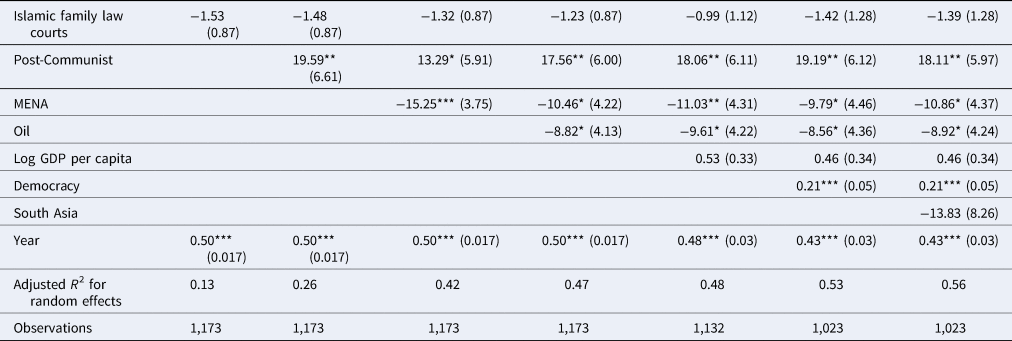
Women's economic rights as a function of state adopted Islamic doctrine and other determinants, 1990–2014 (robustness test)
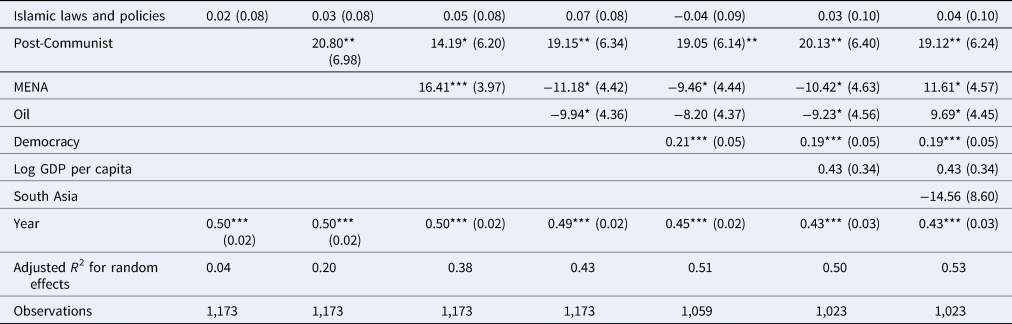
Women's economic rights as a function of state adopted Islamic doctrine and other determinants, 1990–2014 (robustness test)
Dr. Fatima Z. Rahman is a visiting assistant professor in the International Studies Concentration and co-director of the Center for Race, Ethnicity, and Human Rights at the Soka University of America. As a political scientist, her research focuses on the intersection of Islam and politics and its implications for women, minorities, and democracy. Her previous scholarship has been published in Polity, Australian Journal of Political Science, and Interdisciplinary Journal of Research on Religion.


 Open access

