


Introduction
In Republican Rome, death was deeply political for the elite.Footnote 1 Funerary practices and monuments were an integral part of the city’s political culture, encompassing the ways in which individuals and groups articulated power, narrated history, and made political claims.Footnote 2 Although similar mechanisms must have existed elsewhere, they are hard to find in other areas of Hellenistic-Republican Italy. In Daunia, in northern Apulia and Basilicata, the funerary archaeology of Canosa provides valuable insights into the relationships between political culture, elite consolidation, and urban communities under Roman control. The city is famous for its monumental chamber tombs, where the local elite amassed lavish burial goods between the 4th and 2nd c. BCE. However, most tombs were uncovered in the 18th and 19th c., leading to a looting spree that dispersed their delicate decorations and abundant assemblages across Italy and beyond.
To analyze Canosan funerary practices “in action,” we focus on the Catarinella Askos, a unique vessel portraying a funeral scene.Footnote 3 Both a material component of a funeral and a visual artifact within it, the Askos exemplifies the rich material record produced for and by funerary performances in Canosa and the surrounding region. We begin by discussing the date of the Askos and contextualizing it within Hellenistic-Republican Canosa and Lavello, where it was made and found respectively. We then use its imagery as a portal through which to explore Canosan funerals, revealing aspects of movement, procession, gesture, utterance, sensation, and emotion. We argue that these spectacles were essential for expressing social distinction, competitive consumption, and political consolidation among elite families during the age of Roman hegemony, highlighting the resilience of Italian elite culture and social structures rooted in the pre-Roman period.
The Catarinella Askos: image and object
The Catarinella Askos was found in the 1920s in Lavello (Basilicata) but was most likely produced in the city of Canosa (Apulia) (Fig. 1).Footnote 4 The vessel represents a triple-mouthed askos with a central mouth and two smaller lateral spouts, with a filter at the upper end of one and the lower end of the other (Fig. 2). It shows a multi-figural scene, with a richly adorned female head on each side (Fig. 3). Chains emerge from the neck of head I4 and connect it to a stylized flower (I7) and a bird or bird-hybrid (I1), while head II4 is attached to another flower (II9), two birds (II3, II7), and a lenticular object (II1), commonly interpreted as a bush or tree.Footnote 5 Both heads are surrounded by other elements: wheel-shaped ornaments (I3, I5, II5, II8), stars or pentagrams (I6, II2, II6), and a dolphin (I2).Footnote 6
Northern Apulia and Basilicata, main settlements and cities of the Hellenistic-Republican period. (Map: T. Leutgeb. Data: S. Tarquini, I. Isola, M. Favalli, F. Mazzarini, M. Bisson, M. T. Pareschi, E. Boschi (2007), TINITALY/01: a new triangular irregular network of Italy, Annals of Geophysics, https://doi.org/10.4401/ag-4424; European Environment Agency. European catchments and rivers network system (Ecrins), rivers – version 1, June 2012.)

Catarinella Askos, Museo Archeologico Nazionale “Massimo Pallottino” di Melfi, images based on a 3D model, with the QR code linking to the 3D model at https://doi.org/10.5281/zenodo.14073549. (Photos: N. Gabalin, E. Hoy, R. Schwaiger, C. Heitz. Images and 3D model: D. Grissemann.)

Catarinella Askos, elastic unrolling of the scene, with a stress map of the digital flattening and a redrawing of the figures and other elements. (Unrolling: P. Preiner. Drawing: M. Hoernes. Digital unrolling methodology: Preiner et al. Reference Preiner, Karl, Bayer and Schreck2018; see also Houska et al. Reference Houska, Lengauer, Karl and Preiner2021.)

We focus on the funeral procession on both sides (Fig. 3).Footnote 7 In Section A, the first three figures wear striped cloaks, have disheveled hair, and are carrying a pair of vessels (A1), a two-handled cup (A2), and what appears to be a garland (A3). The following two figures (A4, A5) exhibit gestures that suggest despair, which is probably also reflected in dark clothing and short hair. In Section B, the procession continues with two more figures in striped robes, one with an askos on their head (B1) and the other with raised arms and unkempt hair (B2). Further to the right, a group of figures (B3–B5) are dressed in short tunics with crossed bands on the chest, and while figure B4 carries a garland, the others are playing wind instruments. The scene revolves around an arched canopy: in front of the bier, two smaller musicians (B6, B7), dressed like the figures in the procession, are playing two-piped instruments. Alongside, a pi-shaped element (B10) with attachments is shown. The bier carries a corpse (B8), accompanied by a taller figure (B11), who is turning away and carrying a branch from a bush-like object (II1). A smaller figure (B9) stands at the head end of the bier, seemingly attempting to climb onto it and facing the body.
The Askos is the most elaborate example of Hellenistic-Republican Listata pottery, which rarely includes animal or human figures, let alone complex scenes.Footnote 8 The ware emerged in the late 4th c. BCE as the successor to the regional matt-painted pottery and was produced primarily at Canosa. Most artifacts have been found along the Ofanto river, and later Listata pottery spread throughout northern and, to a lesser extent, central Apulia, but the sheer quantities from Canosan tombs indicate that the pottery was mainly intended for the local market. Like many of the crafts produced there, it was made exclusively for funerals. This is particularly true of the askos, which replaced the olla as the central piece in the grave-good assemblages. Askoi account for more than half of the approximately 500 Listata vessels of identifiable shape, although the three-mouthed version is extremely rare, with only 19 known examples.
The Catarinella Askos has been conventionally dated to the late 4th or first half of the 3rd c. BCE,Footnote 9 but it has recently been shown that Listata production continued for much longer.Footnote 10 According to Fabia Curti, the Askos, like all triple-mouthed askoi, belongs to phase II Listata, and specifically to subgroup IIf,Footnote 11 which is dated to the end of the 2nd c. and a good part of the 1st c. BCE, tentatively between 120 and 80 BCE.Footnote 12 The revised chronology implies that the Askos does not represent the beginning of Listata production but rather its final phase in the Late Republican period. It also means abandoning the idea that the Askos illuminates early Roman Daunia and instead placing it within the socio-cultural framework of a world emerging from the Second Punic War and approaching the threshold of the Social War.
Local contexts: Lavello and Canosa
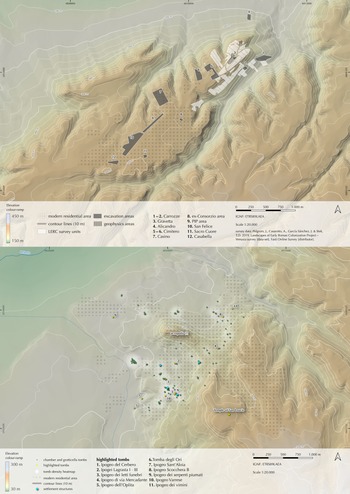
The Askos likely came from the Carrozze valley at Lavello, where numerous chamber tombs were installed in the late 4th to 2nd c. BCE, often rich in imports from Canosa (Fig. 4).Footnote 13 This burial area bordered a dense settlement on the Gravetta plateau, also home to a sacellum active from around 300 to 100 BCE.Footnote 14 The settlement emerged in the late 4th or early 3rd c. BCE, as earlier dispersed settlement clusters faded away, reflecting a trend in northern Apulia and the Melfese region, where Hellenistic-Republican settlements developed next to earlier sites, a transition that involved a reduction in size, an increase in density, new concepts of urban planning, and a separation of funerary, domestic, and religious spaces.Footnote 15 Lavello has been identified with ancient Forentum, a site conquered by Rome in 317 or 316/15 BCE, but topographical evidence challenges this notion.Footnote 16 It was thought to have been under the control of Canosa or garrisoned by Canosan troops loyal to Rome,Footnote 17 a scenario based on the Askos and on a grave-good assemblage that included Canosan pottery and a Roman Montefortino helmet,Footnote 18 but more likely it became part of Venusia’s territory by the 3rd c. BCE.
Above: Lavello, areas of archaeological exploration. (Map: T. Leutgeb, based on Pelgrom et al. Reference Pelgrom, Sánchez, Stek, Colivicchi and McCallum2024, 436 fig. 23.5.) Below: Canosa, chamber and grotticella tombs and settlement structures of the Hellenistic-Republican period. (Map: T. Leutgeb, based on Cassano Reference Cassano1992, 147 fig.; Corrente Reference Corrente2003, 20 fig. 5, 21 fig. 6; Corrente Reference Corrente, Thomas, Kathleen and Edward2014, 170 fig. 8.1; Lippolis 2012, 308 fig. 5.)

Canosa, or Canusium, was a major political player, serving Rome as a loyal civitas foederata, even as other Daunian communities rebelled during the Third Samnite War or the Second Punic War.Footnote 19 This loyalty was rewarded with autonomy, as the city did not suffer from Roman interference, retained its territory, and did not receive colonial settlers. It was only during the Social War that Canosa deviated from its policy, for which it paid in 88 BCE when it became a municipium. What made Roman interventionism unnecessary was a ruling class of elite oligarchic families that dominated the city in the 3rd and 2nd c. BCE.Footnote 20 These lineage-groups controlled land, resources, and international trade, gaining legitimacy through wealth and military achievement. Such gentes-based regimes existed in Daunia as early as the 4th c. BCE and were reinforced under Roman control, allowing some families to flourish more than others, with the Second Punic War as a decisive phase of elite consolidation.Footnote 21
This elite lives on most vividly in Canosa’s monumental tombs and the materials that come from them.Footnote 22 Built between the 4th and 2nd c. BCE, they shaped the cityscape, with some 130 chamber tombs and rock-cut grotticella graves scattered around the Castello hill (Fig. 4). It has been suggested that the Republican city contracted around the hill,Footnote 23 but settlement evidence is largely lacking, and the widespread distribution of new tombs in the 3rd and 2nd c. BCE suggests rather the persistence of dispersed settlement clusters.Footnote 24 It seems it was only in the first half of the 1st c. BCE, with the urban reorganization, that the cemeteries moved to zones along the roads leading out of the city.Footnote 25 For most of the pre-municipal history of the city, the local elite did not invest in public architecture, the first example of which is the extra-urban sanctuary of San Leucio, built in the late 3rd/first half of the 2nd c. BCE or perhaps, less likely, a century earlier.Footnote 26 Hellenistic-Republican Canosa was, therefore, above all, a city of tombs, since the urban and funerary landscapes were always intertwined.
Unpacking the scene: images and materials in dialogue
To the grave: grave goods, mourning, and processions
Elite funerals in Hellenistic-Republican Daunia were complex events that utilized opulence, aesthetics, performance, and theatricality to constitute a fully-fledged politics of pageantry. The Askos does not provide a documentary snapshot of such a funeral, but it is still a rich source for such spectacles. In the rest of this paper, we therefore use the Askos as a guide, contextualizing it alongside other evidence from Canosa and Daunia, in order to understand the experiences of sound, sight, scent, taste, touch, and movement that ensnared performers, participants, and spectators alike.Footnote 27
All the objects carried in the procession have material counterparts. The two elongated vessels carried by figure A1 have been identified as fusiform unguentaria, small perfume containers,Footnote 28 or as double situla, the most common Listata vessel shape after double-mouthed askoi.Footnote 29 However, their shape does not resemble a double situla, and the scene does not distort the proportions as much as would be expected if they were unguentaria. A more plausible explanation is that the vessels are transport amphorae,Footnote 30 which usually occur in pairs as part of rich assemblages in northern Apulia and Basilicata from the late 4th to the 1st c. BCE.Footnote 31 Such amphorae may document gravesite banquets or cult practices in the tomb,Footnote 32 but they also appear in other parts of Apulia and as far north as Ancona, suggesting a wider phenomenon of elite display.Footnote 33 Clearly identifiable is the double-mouthed askos that figure B1 balances on their head, illustrating the inclusion of this prominent vessel type in funerary rituals. How askoi were used, however, remains a matter of debate, with ideas ranging from holding liquids for libations,Footnote 34 cleaning and purifying the grave,Footnote 35 or extinguishing the fire of funeral pyresFootnote 36 to holding wine for banquets.Footnote 37 We tentatively follow the suggestion that the spout with the low-set filter contained aromatic ingredients for flavoring the wine, while the second spout filtered the drink as it was poured. We can only speculate as to whether the wine or other liquids in the askoi and amphorae were consumed or whether they were utilized in the tombs, but the vessels must have been carried along in the procession and into the burial chambers, with the sight of the bearers mingling with the scent of the substances.
The cup held by figure A2, initially thought to be a strainer, probably contains small objects, possibly food.Footnote 38 A close parallel is a terracotta model depicting a procession of mourning women, with the leading kanephoros balancing on her head a basket containing what appears to be cakes and other food (Fig. 5, no. 2). Evidence from Canosa shows burials with vessels containing fruits, seeds, and endocarps, indicating the deposition of plants and produce.Footnote 39 Similarly ephemeral are garlands, such as those carried by A3 and B4. Festoons are often inferred from nails in tomb walls, as well as from tomb paintings imitating garlands made of textiles or organic materials, popular throughout southern Italy and particularly in the chamber tombs of Taranto from the late 3rd to early 2nd c. BCE.Footnote 40 Directly attested are perishable tomb decorations with a willow rod plait and five “coasters” from the Ipogeo dei vimini, as well as a cord and fabric of organic fibers from a tomb at Ascoli Satriano.Footnote 41 Such organic materials must have contributed significantly to the sensory scenography of the burial chambers.
1: Mourning gestures in the terracotta statues (C1) and smaller terracotta figurines (C2) from Canosa and in the funerary paintings (P) from Paestum. (Drawing: M. Hoernes.) 2: Canosa, terracotta model of mourning figurines in a procession. (Object: Paris, Louvre, inv. Cp 4439/S 820. Photo: GrandPalaisRmn [musée du Louvre]/Hervé Lewandowski.) 3: Canosa, askoi with mounted mourning figurines. (Object: Bari, Museo Archeologico di Santa Scolastica [Ipogeo Varrese]. Photo: M. Hoernes.)

Canosan funeral processions were a spectacle mainly because of the performances they enacted, as reflected in mourners A4, A5, and B2. If the long robes indicate gender, these three figures are probably female, like the gift bearers but unlike the musicians. The stubbled hair of figures A4 and A5 may suggest a mourning haircut.Footnote 42 Meanwhile, figure B2 appears to be touching strands of their disheveled hair, though this may be due to the format of the scene rather than being an indication of hair-pulling. The gestures find parallels in two types of Canosan terracotta figures of young women in mourning. The largest of these statues, of which there are 48 known examples, are up to one meter high (Fig. 6).Footnote 43 They are made from a tube for the body, with modelled dress and anatomical features and heads that are molded but hand finished; they have a kaolin slip and some of them were brightly painted.Footnote 44 Made exclusively in Canosan workshops for local funerary performances, they are conventionally dated to the late 4th and 3rd c. BCE, but they have also been found in tombs containing burials from the 2nd/1st c. BCE, and smaller figurines are known from 2nd c. tombs,Footnote 45 so that the statues can bridge the gap to the time of the Askos.
Canosa, terracotta mourners. (Objects: J. Paul Getty Museum, inv. 85.AD.76.1–85.AD.76.4. Photo: J. Paul Getty Museum.)

The statues can be divided into three groups based on their hair and dress.Footnote 46 Many statues wear only a chiton, belted under the chest with a long overfold, and have hair either falling over the back and shoulders or tied at the back of the head. Others wear a short himation covering the upper arms, while the third category features a longer mantle covering the entire upper body. In the second and third groups, the statues have long, loose hair or hair tied back in a braid or a sleek triangular shape. Attempts have been made to classify the statues by age, suggesting that those wearing only a chiton represent young girls, while those with a cloak represent older teenagers or married women.Footnote 47 However, these distinctions are somewhat arbitrary, and as all the statues emphasize the developing female body, it has been argued convincingly that they represent pubescent girls.Footnote 48
The gestures of the statues, emphasized by their large hands, follow four variants (Fig. 5, no. 1), the most common of which is raised arms with open palms facing inwards (C1.1).Footnote 49 This gesture has led to different interpretations of whether the figures are mourning or praying,Footnote 50 practices separated only by a thin line. Like the statues with both hands on the chest (C1.2/P2),Footnote 51 this variant corresponds to female figures in the earlier Paestum tombs (P1), who are clearly mourning, given their position at the bier.Footnote 52 The spectrum excludes more expressive gestures (cf. P5–P10) and rather evokes an atmosphere of solemn mourning. It is in keeping with this atmosphere that most of the five head types represented by the statues have neutral expressions, and only some show subtle signs of grief in the form of furrowed eyebrows, wrinkles, and slightly open mouths. These statues resemble smaller molded figurines, applied to askoi and other funerary vessels, which were produced until the 2nd c. BCE (Fig. 5, no. 3).Footnote 53 The figurines depict young women with gestures similar to the statues, again visually accentuated by their disproportionate hands (C2.1–C2.5). Given the links between the figurines and the statues, it has been plausibly argued that there was a collaboration “among potters, painters, and coroplasts in creating a substantially unified expressive language” for Canosan funerals.Footnote 54
Both types of figurines were made for display in funerals. Only a few of the statues can be re-contextualized,Footnote 55 but it is plausible to assume that they were placed close to the corpse to reenact and prolong the ritual mourning.Footnote 56 As for the time prior to their deposition, Tiziana D’Angelo and Maya Muratov have pointed out that most of the statues have holes in the seams of their clothing, arguing that they were mounted on wheeled platforms and accompanied the procession.Footnote 57 It is clear from the Askos that objects were ceremonially carried to the tombs, and there is now evidence of carts that may have followed the cortège.Footnote 58 Such processions were thus spectacles enacted by human and non-human mourners moving through the city of Canosa, with participants following gendered protocols, forming groups with specific dress, hairstyles, and conduct, and the rhythm of movement set to solemn lamentation and the rumble of carts as they descended into the burial chambers.
At the grave: music, the prothesis, and the body
The Askos scene suggests that, like in Rome, musicians led the procession and played in front of the bier. They wore special costumes, and although all figures in the prothesis scene are smaller, due to limited space, it is possible that B6 and B7 represent subadult performers. Adolescent musicians occasionally appear in Paestum tomb paintings,Footnote 59 and children are depicted mourning by the bier,Footnote 60 carrying offerings,Footnote 61 or joining the procession.Footnote 62 Figure B3 carries a Roman cornu, B5 plays the tuba, and the potential subadults, B6 and B7, perform with the two-pipe aulos or tibia.Footnote 63 While there is no material evidence for brass instruments from southern Italy, auloi are well documented, including a piece from Lavello.Footnote 64 All three instruments are prominent in texts on Roman funerals: the tibicines, or Greek auletai, accompanied lament singers at the bier, as depicted on the Askos and in Paestum tomb paintings,Footnote 65 and cornu and tuba players led funerary processions, again as on the Askos, creating an impressive soundscape.Footnote 66 While the image on the Askos is necessarily silent, we can imagine the combined noise of the mourners and the music as the procession moved down the street towards the tomb.
What follows in the central scene differs markedly from Roman burial customs. If we trust its narrative structure, rather than seeing it as a visual conflation of space, the scene suggests that the bier was placed at the entrance to the tomb and that the procession went to the place where the body was laid out, rather than transporting it to the tomb. This interpretation is based on the pi-shaped element (B10) in front of the bier, which has been identified as a stretcher or cart for transporting the body, or as a table for food offerings,Footnote 67 but we see it rather as the entrance to a chamber tomb, and the rectangular structures inside it as funerary beds.Footnote 68 At Paestum, tomb 47, from the second half of the 4th c. BCE, shows the deceased lying under a similar canopy, with mourning figures playing pipes and approaching with offerings, but without indicating the location of this canopy (Fig. 7). There is also no evidence from Canosa of bodies being laid out close to the tombs, but it exists from the wider region, albeit for the 4th c. BCE (Fig. 8): at Lavello and Ascoli Satriano, postholes and roof-tile assemblages indicate free-standing structures associated with pebble mosaics, all linked to tombs. In Lavello’s Cimitero area, a pergola-like structure has been identified among Early Hellenistic tombs,Footnote 69 a similar structure has been hypothesized in Contrada Casino,Footnote 70 and two roofs are known from the Sacro Cuore zone.Footnote 71 At Colle Serpente in Ascoli Satriano, a mosaic was flanked by two roof-tile assemblages, covering large quantities of eating and drinking vessels and animal bones,Footnote 72 and another L-shaped mosaic included a square of postholes.Footnote 73 In the Giarnera Piccola zone, a pavement leads to a multi-burial tomb, with flat stones integrated into the surface, possibly used as bases for a canopy.Footnote 74 It has been suggested that these pavilions were used for laying out the body and for later post-burial ceremonies, with the mosaics indicating the routes taken by participants or the places where they stood during these events, implying wide public participation in rituals associated with the lying-in-state.Footnote 75 Taken together with these 4th-c. contexts, the Askos suggests that home-to-bier processions continued well into the Roman period.
Paestum, Andriuolo, tomb 47, funerary painting with prothesis and procession scene. (Photo: M. Hoernes.)

Pebble mosaics. 1: Ascoli Satriano, Giarnera Piccola, pavement 391 with tomb 5/07. (Orthophoto: M. Laimer.) 2: Ascoli Satriano, Colle Serpente, saggio VII. (Data: M. Laimer.) 3: Lavello, Contrada Casino. (Based on Mutino Reference Mutino2012, 200 fig. 10.) 4: Ascoli Satriano, Colle Serpente, saggio V. (Based on Osanna Reference Osanna, Volpe, Strazzulla and Leone2008a, 161 fig. 13.) 5: Lavello, Sacro Cuore/Villa Comunale. (Based on Osanna Reference Osanna2008b, pl. 11. Drawings: M. Hoernes.)

The space around Canosan tomb entrances may therefore have been more significant than the evidence suggests. Canosa is known for semi-cremations, a hybrid procedure where the body was partially cremated but left mostly intact.Footnote 76 This practice is documented for at least 10 chamber tombs from the 4th to 2nd c. BCE,Footnote 77 but the modalities are debated. Initially, a partial primary cremation, that is, in situ, was supposed, with a pyre inside the chamber burning the body beside it.Footnote 78 However, few tombs contained remains of pyres, none had visible soot on the walls, and ventilation issues were unresolved. This scenario seems unlikely, especially for tombs used for successive burials, since earlier depositions do not indicate procedures repeated in later ceremonies. Alternatively, it has been proposed that semi-cremation was performed in the open air before the body was transported into the chamber.Footnote 79 Although no ustrina have been published from Canosa, the theory of partial secondary cremation at the entrance to the tomb currently fits best with the available evidence.
Close to the bier, figure B11 is holding or taking a branch with something attached to it, presumably a fillet.Footnote 80 The purpose of the branch is not revealed, nor do similar paintings from Paestum provide any clarity.Footnote 81 In the Roman world, trees and flowers set the scene for cemeteries,Footnote 82 cypress branches marked the entrance to the house of the deceased, plants and wood were used to fuel the pyre, and fragrant plants could be burned as incense, as documented by oak wood and conifer bark found in the 4th-c. Ipogeo dei vimini from Canosa.Footnote 83 The local funerary record also attests to the use of plants to support the body, with some tombs featuring mats of water and marsh plants.Footnote 84 Similar evidence comes from a tomb in Ascoli Satriano, where the deceased was laid on grasses, herbs, and flowers.Footnote 85 Whether ignited as incense or piled up on the deathbed, plants were part of the Canosan burial ritual and enhanced the olfactory experience, as did the burning of a funeral pyre and the partial cremation of flesh. Behind the branch-bearer, the small figure B9 interacts with the corpse on the bier, suggesting a moment of closeness and intimacy. In Paestum tomb paintings, figures near the bier may place a pillow under the deceased’s head, arrange objects on the bier, or decorate the body with fillets or a crown of branches.Footnote 86 Roman literary sources mention other practices, such as kissing, embracing, or decorating the body, closing the eyes, or calling out the name of the deceased.Footnote 87 While it remains unclear exactly what action is being performed on the Askos, the image illustrates that touch was another important element of funerary ritual in Daunia, creating a physical link between the deceased and the living beyond the preparation of the body and its placement on the bier.
Senses and status: Daunian elite burials under Roman hegemony
Initially dated to the late 4th/early 3rd c. BCE, the Catarinella Askos was seen as a testament to the cultural disruption that the first contact with Rome brought to Daunia, particularly with the rapid adoption of Roman customs such as the pompa and musical instruments.Footnote 88 Following its chronological reassessment, the Askos has been taken as evidence that Daunia’s “Romanization” was completed in the late 2nd and early 1st c. BCE.Footnote 89 We propose a third interpretation, suggesting that the Askos spotlights the vibrant culture of Canosa’s ruling class at the end of the pre-municipal era and its mechanisms of social distinction, competitive consumption, and political consolidation. Rather than being passive in the face of Rome, this elite presented itself as an equal interlocutor, resiliently managing and metabolizing change while continuing to draw on pre-Roman traditions, particularly in funerary representation.
While their peers in Arpi also promoted exquisite domestic architecture and interior design,Footnote 90 the ruling families of Canosa relied exclusively on funerals as a means of elite display and competition. The funerary landscape of Canosa is therefore a sensitive historical barometer. In the early 3rd c. BCE, red-figure pottery disappeared and new materials were mass produced exclusively for burials, including Listata vessels, polychrome pottery with plastic applications, and terracotta statues and figurines. Rather than representing a rupture, the new funerary culture renegotiated the local past and gave rise to a “new but traditional language” of representation,Footnote 91 with the expansion and diversification of grave goods and the increase in performative efforts as interrelated mechanisms of elite demeanor. In the 2nd c. BCE, Canosan elites continued along this path, albeit often with more limited assemblages, but they did internationalize funerary consumption by importing luxury goods from the eastern Mediterranean, such as glass and jewelry, silver and faience, diadems, scepters and amphorae, demonstrating their Mediterranean lifestyles and linking them to the wider Hellenistic world.Footnote 92
The cosmopolitanism of the Daunian elites coincided with their desire to demonstrate local roots.Footnote 93 Members of the elite such as Dasius Altinius of Arpi claimed descent from Diomedes,Footnote 94 who, in the Hellenistic period, was said to have founded Arpi and Canosa, as well as Siponto and Salapia.Footnote 95 Such foundation stories were intertwined with family histories, links that could be exploited at banquets and funerals to praise the gentes, not unlike what the Roman nobiles did.Footnote 96 The most spectacular and substantial form of tradition-building, however, was the funeral, for which the Canosan elite transformed the local chamber tombs into complex multi-room family mausolea.Footnote 97 A prominent example is the Tomba Varrese, built in the mid-4th c. BCE and enlarged in the 3rd c. BCE, before being integrated into an enclosure with a pilaster that connected the underground vestibule to the portico above, perhaps forming a place of lineage-related cult.Footnote 98 Embedded in the cityscape and visited in processions and veneration, the chamber tombs became sites of multi-generational elite display and construction of the local past.
Much more than the monuments, it must have been the funerals themselves that made a powerful impression on the local communities. In the funerary spectacles they staged, the Daunian ruling class demonstrated their economic power and international networks, retold the stories of their gentes, and competed with their peers. These funerals were not anemic scripted exercises but lived experiences that relied heavily on sensory qualities. As modern scholars, we have to closely scrutinize the evidence to create a holistic impression of Canosan funerals, taking into account what has been preserved and what might be missing, but our approaches, at the same time, mute what was fundamentally vibrant or even garish. For contemporary viewers, however, the imagery of the Askos would immediately have evoked the atmosphere of a funeral of the sort that every Canosan regularly witnessed in the city: the richly textured visuality of bodies and artifacts in motion, the soundscape of musical performances and mournful noises, the odor of plants, incense, and burning pyres, and the emotional weight staged in mourning, funerary ritual, and eschatological belief. Similar but not identical to Roman pompae, Canosan funerals engaged all the senses by combining various media and modes to enhance the ceremonies’ efficacy both as an emotional experience and as a strategy in the regional politics of pageantry.
Supplementary material
A 3D model of the Catarinella Askos can be accessed via https://doi.org/10.5281/zenodo.14073549. Other supplementary material for this article comprises four Excel spreadsheets: (1) tombs in the Carrozze zone at Lavello, (2) a list of Apulian funerary assemblages containing amphorae, (3) a list of funerary paintings from Paestum featuring funerary iconography, and (4) a list of semi-cremation burials in Canosa, along with bibliographic references. To access the spreadsheets, please visit https://doi.org/10.1017/S1047759426100658
Acknowledgments
We are deeply grateful to Dr Erminia Lapadula, Director of the Melfi Museum, for her warm welcome and kind support of our work. Many thanks are due to Donat Grissemann (Innsbruck) for creating the 3D model (Fig. 2), to Reinhold Preiner and Peter Houska (Graz) for providing the flattened image of the model (Fig. 3), and to Thomas Leutgeb (Vienna) for the maps (Figs. 1 and 4), as well as to Alexander Heinemann (Tübingen) and Daniel P. Diffendale (Pisa). Grace Stafford commented on the paper and greatly helped us to structure our thoughts. Audiences in London and Rome shared stimulating feedback on earlier versions, as did the reviewers and Seth Bernard of JRA.




 Open access

