




Introduction
In the Low Countries, many artefacts are recovered from cesspits (Hupperetz Reference Hupperetz, De Groote, Tys and Pieters2010: 279; van Oosten Reference van Oosten, Sosna and Brunclíková2016a: 41, 49), but the archaeological value of the material (the cess) that these pits contain is often underestimated. This article examines material from six medieval cesspits in a Low Countries town, integrating analysis of organic remains with textual records relating to town regulations and to the households within which the cesspits were located. Leiden was selected due to its promising archaeological record and the survival of documents detailing medieval street plans and inhabitants.
Eggs from a broad range of endoparasites have been identified in soil samples from cesspits in other regions of the Low Countries (Rocha et al. Reference Rocha, Harter-Lailheugue, Le Bailly, Araújo, Ferreira, Serra-Freire and Bouchet2006; Appelt et al. Reference Appelt, Armougom, Le Bailly, Robert and Drancourt2014; Deforce et al. Reference Deforce, Van Hove and Willems2015; Rácz et al. Reference Rácz2015; Graff et al. Reference Graff2020; De Cupere et al. Reference De Cupere2021; Rabinow et al. Reference Rabinow, Deforce and Mitchell2023). The presence of these eggs—and the attendant infection by genera or species of parasites that may be identified—can help us to create a picture of parasitic infection and its interplay with social practices such as diet and sanitation in past populations (Mitchell Reference Mitchell2015a, Reference Mitchell2023). The nematodes Ascaris (roundworm) and Trichuris (whipworm), for example, can trigger such symptoms as abdominal cramps, diarrhoea, anorexia, nausea and vomiting (Stephenson et al. Reference Stephenson, Latham and Ottensen2000). Certain species of protozoa, including Entamoeba histolytica, Giardia sp. and Cryptosporidium sp., can also cause diarrhoea and dysentery. Ascaris, Trichuris and these protozoa are therefore generally considered to be indicators of sanitation conditions. Species of the genera Taenia (pork and beef tapeworm), Echinostoma (intestinal flukes) and Dibothriocephalus (fish tapeworm) are zoonotic parasites, which can be transferred from non-human animals to humans by eating raw or undercooked meat and fish (Ledger & Mitchell Reference Ledger and Mitchell2022). By assessing cesspit contents and determining the types of parasites present in the medieval population of Leiden, we can improve our understanding of the health and lifestyle of the city's inhabitants. We can also address the question of whether households with indicators of more costly or poorer diet (potentially indicators of income or status) were infected by the same parasites, or if differences in infection might exist between these two groups.
Leiden
The town of Leiden (Figure 1), known primarily for its textile industry, was home to approximately 13 000 inhabitants at around AD 1500 (Brand Reference Brand2008: 96; van Steensel Reference Van Steensel and Nigro2020: 372), making it one of the larger urban centres of the Northern Netherlands at this time (van Oosten Reference van Oosten2015: 28). In the later Middle Ages (up to AD 1500), textile production was already significantly higher than in other Dutch cities (Posthumus Reference Posthumus1908: 368–9) and by the seventeenth century Leiden became known as the largest textile producer in Europe (de Vries et al. Reference De Vries, Lucassen, Lourens, Nijboer and Groenveld2003: 88). From the last quarter of the sixteenth century, Leiden grew at a rapid pace and the city welcomed thousands of religious refugees, mostly textile workers from what is now Belgium. A significant increase in the number and sizes of houses in the city and an expansion in its territory is therefore seen in the seventeenth century. During the early modern period (c. AD 1500–1800) for which significantly more detailed written records are available than for the Middle Ages, it has been estimated that two-thirds of the population was involved in the textile industry (de Vries et al. Reference De Vries, Lucassen, Lourens, Nijboer and Groenveld2003: 88).
a) location of Leiden within the Netherlands; b) a site plan of locations of pits excavated (figure by authors).

Materials
In 2019 an area in Leiden demarked by the present-day Haarlemmerstraat to the north and the Stille Rijn to the south was excavated (administratively known as Haarlemmerstraat 101–111/Stille Rijn 8–9). The Rhine, running on the other side of the Stille Rijn, was an important transport route in the Middle Ages and the Haarlemmerstraat, then called Marendorp, was a key street connecting the Zijlpoort in the east of the city to the Rijnsburgerpoort in the west.
Thanks to the ongoing project Historisch Leiden in Kaart (Mapping Historical Leiden), which provides access to historical data via a website, it is possible to look up the owners of properties that stood on the excavated site during the period c. 1550–1606. Map 28 from the so-called Stratenboek (Book of streets) (Figure 2) presents a good starting point, as it shows that in 1591 the excavated area was occupied by one large square ‘plot’ and two smaller ones. The purpose of this map was not, however, to accurately depict the contours of each plot but to record façade width, presumably to determine a proportional cost for street maintenance paid by the owners (de Baar Reference de Baar1985). As a result, adjacent plots owned by the same individual were schematically drawn as one ‘plot’. Figure 2 shows the number of houses occupying the block for three sample years (1561, 1581 and 1606). While in 1561 the block consisted of only five properties (two of which were rented), this had increased to seven in 1581 and to 26 (including 12 rentals) in 1606. This increase in property numbers, and particularly in the number of rental properties, is a development that is also observed elsewhere in Leiden as population density increases significantly in the last quarter of the sixteenth century (van Oosten Reference van Oosten2016b: 715, fig. 8).
Detail from Stratenboek (Book of streets) 28 ‘Kaart van Marendorp van de Vrouwenkerk tot de Marebrug’ dd. 1591 (Erfgoed Leiden en Omstreken, 501A, inv. nr. 5153 Stratenboek 28, available at: https://www.erfgoedleiden.nl/collecties/archieven/archievenoverzicht/details/NL-LdnRAL-0501A/path/1.2.2.8.1.6.5.1/deep:view/scans/deep:highlight/8/deep:start/50/deep:limit/10). The occupations of the main occupants (not the owners) of the houses are indicated with dots in the years 1561, 1581 and 1606. The numbers correspond with Mapping Historical Leiden (www.historischleideninkaart.nl) and can be looked up via Looproutes, 1561 Tiende Penning (Tenth Penny), 1581 Volkstelling (Census) and 1606 Schoorsteengeld (Hearth tax) and then by selecting the ward Overmare Rijnzijde (RvO) (figure by authors).

There is a remarkable difference in social status between the residents of this block. Most were middle-class or poor residents: they rented instead of owning (hence their occupations were not recorded), the size of each plot was small and the tax they paid was low. In contrast, the largest plot was occupied from at least 1498 until c. 1605 by the brewery and home of a family of wealthy brewers who paid high taxes. While the business was located on the Stille Rijn side of the block, as map 2 of the Grachtenboek (Book of Canals) (Erfgoed Leiden en Omstreken, 0501A, inventory number 5113) shows, the home of the brewer was located on the Haarlemmerstraat. When the 1591 map was made (Figure 2), brewer Cornelis Adriaensz van Barrevelt owned the plot. He had been the owner since 1558. A few years earlier, in 1543, his father Adriaen Jans van Barrevelt (also a brewer) was the owner and it is very likely that as early as 1498 this site was already a brewery (van Steensel Reference Van Steensel2016).
Leiden had at least 22 brewers in 1498 (van Steensel Reference Van Steensel2016) and 15 brewers in 1607 (Walle & Hooymans Reference Walle and Hooymans2021). Brewers in the mid-sixteenth century belonged to the financial elite (Noordam Reference Noordam2001: 31). That their wealth was visibly greater than that of other residents can be illustrated by the size of the area occupied by breweries. The plot of Cornelis Adriaensz is five to six times wider than the average plot within the city. A further illustration of their prominent role in society is that quite a few brewers had seats on the city council. Cornelis Adriaensz served on the town council for 30 years, following in the footsteps of his father who served for 23 years.
A total of 14 features within the excavated area were interpreted as potential cesspits (Figure 3, Table 1). One or more sediment samples of at least 1 litre were taken from each pit, and where more than one sample was available from the same cesspit, these were taken from different sediment layers. The samples were assessed using the quickscan approach for the presence of botanical macro remains (van Haaster Reference Van Haaster and Meijer2020). Based on this assessment, six of the pits were regarded as cesspits used for human faecal waste and submitted for further analysis for organic macro remains (van Amerongen Reference Van Amerongen and Meijer2022) and intestinal parasites. Analysing samples for parasite eggs also allowed us to double check whether the quick-scan approach was a reliable method for identifying cesspits. Two of the features disregarded based on the quick-scan results were tested for parasite eggs and both were found to be negative (marked in green on Figure 1b), supporting the original interpretation. Feature S724 did contain three parasite eggs (two whipworm and one trematode) but the paucity of parasite eggs compared with other samples (which contained in excess of a thousand times more eggs) suggests that these may represent contamination, perhaps having been washed in by flooding in the past. It cannot, however, be excluded that the feature was originally a cesspit that was subsequently emptied and filled with other material.
a) cesspit S859 during excavation, showing round brick lining; b) its cross-section (cesspit use dates from 1475–1525) (figure by authors).

Details of the cesspits analysed in this study.

Methods
Microscopy for intestinal parasite eggs
Fourteen sediment samples from the six cesspits dating from AD 1250–1600 underwent analysis for intestinal parasites. They were dated from pottery fragments recovered from the cesspit fill, and the type and size of the bricks used to construct the cesspits. Analysis was performed at the Ancient Parasites Laboratory at the University of Cambridge, following the modified RHM (rehydration, homogenization, micro-sieving) protocol described by Anastasiou and Mitchell (Reference Anastasiou and Mitchell2013). A 0.2g subsample was measured and disaggregated (placed into suspension) using 0.5% trisodium phosphate. The suspension was washed through three microsieves (mesh sizes 300, 160 and 20μm). The material trapped on the 20μm micro-sieve was rinsed free with distilled water, collected in a 15mL tube, centrifuged for five minutes at 4000rpm, and the supernatant removed. The concentrated material at the base of the tube was mixed with glycerol, mounted on microscope slides and analysed with digital light microscopy at 400× magnification (Olympus BX40F microscope with GXCAM-9 digital camera). The eggs of intestinal parasitic worms were identified by their shape, colour, dimensions and special characteristics using reference manuals such as Garcia (Reference Garcia2016). Egg dimensions were measured using the GX Capture-T software. Egg counts per gram were calculated by multiplying the number of eggs noted in each 0.2g sample by five.
ELISA for intestinal protozoa
Enzyme-linked immunosorbent assay (ELISA) kits, Entamoeba histolytica IITM, Giardia IITM and Cryptosporidium IITM, produced by TECHLAB® (Blacksburg, Virginia, USA), were used to analyse five of the samples for three species of protozoan parasites which can cause diarrhoea and dysentery. We did not test all 14 samples for reasons of cost, but the samples chosen covered the full time depth while focusing on those samples with good parasite egg survival. A 1g subsample was measured and disaggregated (placed into suspension) using 0.5% trisodium phosphate and passed through the sieves. The material from the catchment container measuring less than 20μm was collected, as the cysts and oocysts of protozoa that cause diarrhoea and dysentery in humans typically measure 5–19μm in diameter. The fluid was centrifuged to concentrate it to the volume required for the ELISA analysis. Eight wells were tested for each sample. Each ELISA analysis was repeated one month after the first run using a new sample prepared using the same method, and results were only considered positive if both tests were positive. Following manufacturer instructions, a positive and negative control were included in each plate. The absorbance values for each well were generated using an ELISA plate reader (BioTek Synergy HT). Past research has indicated these test kits have 97–100% sensitivity and specificity in modern samples (Boone et al. Reference Boone, Wilkins, Nash, Brandon, Macias, Jerris and Lyerly1999; Silva et al. Reference Silva2016).
Results
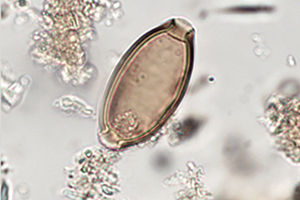
All 14 samples from the six cesspits analysed contained intestinal parasite eggs (Table 2). We identified six species of helminth parasite in total: whipworm (Trichuris sp.), roundworm (Ascaris sp.), fish tapeworm (Diphyllobothriidae), Dicrocoelium sp., cf. Echinostoma sp. fluke and cf. Fasciola hepatica fluke (Figure 4).
Digital-light microscopy and ELISA results. ‘Trematode’ indicates eggs whose measurements fit both with Echinostoma sp. and Fasciola sp. Egg counts represent an estimate of number of eggs per gram (raw counts for 0.2g multiplied by 5). ELISA results are not quantified, positive samples are shown with ‘+ve’, negative samples are shown with ‘-ve’.

Parasite eggs from the Leiden cesspits. Top left: cf. Echinostoma sp. (dimensions 119 × 72μm); top centre: Diphyllobothriidae (52 × 36μm); top right: cf. Dicrocoelium sp. (36 × 22μm); bottom left: roundworm (78 × 48μm); bottom centre: whipworm (53 × 26μm); bottom right: cf. Fasciola hepatica (141 × 73μm) (figure by authors).

The dominant parasites were whipworm and roundworm, which were found in all samples (Table 2). Whipworm was identified by its lemon shape, polar plugs, smooth wall, and dimensions, while roundworm was identified by its mamillated coat, oval shape, brown colour and dimensions. The eggs of trematodes from the genera Echinostoma and Fasciola are morphologically similar and overlap in size: the size range for Echinostoma eggs (80–135μm long by 55–80μm wide (Centers for Disease Control and Prevention 2019a) is only slightly lower than for Fasciola (130–150μm long by 60–90μm wide (Centers for Disease Control and Prevention 2019b), although Valero and colleagues (Reference Valero, Panova, Comes, Fons and Mas-Coma2002) report Fasciola eggs as short as 125μm in modern cattle). Significantly however, the literature reports different size ranges for trematode eggs (for example, compare the ranges described in Ash and Orihel (Reference Ash and Orihel2015: 177) with those in Garcia (Reference Garcia2016)); egg sizes were also noted to vary regionally and by host (Valero et al. Reference Valero, Perez-Crespo, Periago, Khoubbane and Mas-Coma2009). Here we rely on the egg size ranges provided by the Centers for Disease Control and Prevention (CDC) because these references are easily accessible (https://www.cdc.gov/) for no charge and are commonly employed in the palaeoparasitological literature. The eggs of the fish tapeworm (Diphyllobothriidae) cestodes are oval and range between 55–75μm long and 40–50μm wide, although Leštinová and colleagues (Reference Leštinová, Soldánova, Scholz and Kuchta2016) report eggs of Dibothriocephalus latus as long as 59–81μm in modern human populations in Italy. Dicrocoelium was identified by its dimensions (typically 35–45μm long and 20–30μm wide), operculum, wall thickness and shape, often with one side flatter and the other more curved.
ELISA analysis was positive in two cesspits (S728, dated 1375–1500, and S703, dated 1375–1550) for the protozoan Giardia duodenalis, which causes severe watery diarrhoea (Table 3). All ELISA tests were negative for Entamoeba histolytica and Cryptosporidium parvum.
Raw data for the samples positive for Giardia duodenalis on ELISA analysis. Manufacturer guidance for the ELISA test kits state that a result with absorbance value greater than 0.150 is positive.

Discussion
The taxonomic diversity of parasites and the dominance of roundworm and whipworm are consistent with previous findings from the Low Countries (Rocha et al. Reference Rocha, Harter-Lailheugue, Le Bailly, Araújo, Ferreira, Serra-Freire and Bouchet2006; Appelt et al. Reference Appelt, Armougom, Le Bailly, Robert and Drancourt2014; Deforce et al. Reference Deforce, Van Hove and Willems2015; Rácz et al. Reference Rácz2015; Graff et al. Reference Graff2020; De Cupere et al. Reference De Cupere2021; Rabinow et al. Reference Rabinow, Deforce and Mitchell2023). Roundworm, whipworm and the protozoan Giardia duodenalis are all spread via the faecal-oral route of parasite transmission. Their presence within cesspits indicates that the level of sanitation in medieval Leiden was insufficient to prevent the contamination of food and drink with faeces and the reinfection of the population with these parasites.
Parasites spread by the consumption of raw freshwater fish or other freshwater foods (cf. Echinostoma and Diphyllobothriidae) were also present in some cesspits. Both these helminths can infect humans through the consumption of raw, undercooked, smoked or pickled freshwater fish; Echinostoma can also infect freshwater shellfish and waterfowl and may be passed to humans if consumed (Huffman & Fried Reference Huffman and Fried1990; Garcia Reference Garcia2016). We should bear in mind the possibility that Echinostoma eggs might theoretically be found in cesspit sediments in the absence of human infection, for example if infected rodents accessed the cesspits, or if the offal discarded from infected waterfowl was tossed into the cesspit. While mussel shells were found discarded in two of the cesspits, these were of marine species and not freshwater species, so could not have spread Echinostoma. Similarly, low numbers of Dicrocoelium and Fasciola hepatica eggs in human faeces are unlikely to indicate true human infection. These parasites generally infect the liver of ruminant animals such as sheep and cattle. If humans then eat raw or undercooked animal liver, the eggs can pass through the digestive system largely unaltered. Use of cesspits for the disposal of animal manure could also explain the presence of these parasite eggs.
Whipworm and roundworm eggs were consistently found in all six cesspits in high counts relative to the zoonotic parasites present, as is common in palaeoparasitological studies of medieval populations (Mitchell Reference Mitchell2015b). Zoonotic parasites are often present in much lower counts (Graff et al. Reference Graff2020; Rabinow et al. Reference Rabinow, Deforce and Mitchell2023). In our study area, zoonotic parasites were not found in every sample, or even in every latrine. This suggests parasites contracted by eating meat or seafood caused considerably fewer infections among the population of Leiden than did parasites caused by poor sanitation. We have chosen not to statistically interrogate differences in the egg counts for whipworm and roundworm in the different cesspits, as such differences could be caused by taphonomic and depositional factors irrelevant to infection burdens, for example the number of eggs produced (which varies by individual worm), the number of people using the cesspits, and the degree to which the eggs may have been diluted with non-faecal refuse.
Modern clinical understanding of the health consequences of parasitic infections suggests that Giardia duodenalis would have had the greatest impact upon the population of medieval Leiden. This protozoan can cause outbreaks of severe diarrhoea, which can lead to dehydration and death, especially in children (Ryan et al. Reference Ryan, Hijjawi, Feng and Xiao2019). The cesspits positive for Giardia duodenalis date from 1375–1500/1550. From just two samples it is hard to tell if this was by chance or if it might indicate that diarrhoea was more of a public health problem around the 1400s compared with earlier or later centuries. Roundworm and whipworm infection may cause malnutrition, stunted growth and reduced intelligence in children when significant numbers of worms are present (Brooker Reference Brooker2010). In adults with a healthy diet, roundworm and whipworm in low numbers may be tolerated without significant symptoms.
Given the similarity in dating and location, it seems possible that cesspit S467 was used by the household of the brewer Cornelis Adriaensz van Barrevelt. The cesspit contained crab or lobster (Table 4), a typical high-status food (Brinkhuizen et al. Reference Brinkhuizen, Cooremans, Ervynck, Stoops and Van Neer2018), similar to the abundance illustrated in many late sixteenth- and seventeenth-century still-life paintings (Kwak Reference Kwak2014). Cesspit S859 is located closer to the Stille Rijn, directly next to a fire pit and therefore probably belonged to the business premises. This cesspit fell into disuse in 1525–1550, long before Cornelis Adriaensz Barrevelt was in charge of the brewery, but at this time it was probably already a brewery and was potentially run by his grandfather. The archaeological assessment of the cess identified pomegranate seeds (Table 4), a typical food of the upper-class (Van Haaster Reference Van Haaster2008: 11).
Summary of organic macro remains, parasitological and historical data by cesspit. ‘Trematode’ indicates eggs whose measurements fit both with Echinostoma sp. and Fasciola sp. Archaeological macro remains results from Van Haaster (2020) and Van Amerongen (2022).

Map 28 from the Stratenboek indicates that cesspit S598 was located within a much smaller plot in the second half of the sixteenth century so was probably used by craftsmen. This is likely to also have been the case around 1450–1500—the date for the layer analysed from this pit—because quite a few marine mussel shells were found in the cesspit. Marine mussels were a typical food of the less fortunate, as illustrated in the print ‘The Lean Kitchen’ from 1563: while the table in ‘The Fat Kitchen’ is lavish with fresh meat, mussels are the only food depicted in ‘The Lean Kitchen’ (Figure 5) (van der Heyden Reference Van Der Heyden1563). Cesspits S703 and S728 also belong to plots that were inhabited by craftsmen, at least in the second half of the sixteenth century (Figure 2). The cesspits may have been used by several households as they were located near the property boundary. The finds in cesspit S703 include marine mussels, as well as grains, the seeds of fig, apple, black mulberry, cherry, plum and grape, and bone from cattle and sheep/goat.
Engravings by P. Van der Heyden, after P. Bruegel. Printed in Antwerp in 1563: a) Magere Keuken (lean kitchen); b) Vette Keuken (fat kitchen) (© Rijksmuseum, Amsterdam; figure by authors).

The archaeological organic data seem to be consistent with historical records: cesspits S467 (1350–1600) and S859 (1475–1525) contained rare and exotic taxa, while S598 (1450–1500), S703 (1375–1550) and S728 (1375–1500) did not and are therefore interpreted as households of low or moderate wealth. Despite this, parasite data did not identify variation between different households and professions. Roundworm and whipworm were the dominant species of parasite in all the cesspits and the eggs of zoonotic trematodes occurred in cesspits from both the poorer (S728) and possibly wealthier (S736, S859) families.
Conclusion
Here we present the parasite analysis of samples from six cesspits in use from 1250 to 1600 in Leiden, and integrate our findings with archaeological organic and historical evidence for the same properties. Most of the eggs identified within the cess were from roundworm and whipworm, and ELISA tests indicated the presence of the protozoan Giardia duodenalis within two cesspits. These species can all infect humans, causing symptoms that include diarrhoea, and are spread by poor sanitation. The zoonotic parasites Diphyllobothriidae and Echinostoma fluke were also likely present in the population. Identification of Dicrocoelium and Fasciola hepatica eggs within the cess likely indicates the consumption of infected ruminant livers rather than infection of the human population by these parasites. Parasite analyses also verified archaeological organic findings by contributing to the characterisation of the function of the six archaeological features as cesspits (AD 1250–1600).
Combined macro and micro analysis of animal and plant remains and parasite eggs can provide a more comprehensive understanding of the lifestyle, diet and disease of past groups, while historical records can be valuable for contextualising archaeological data. However, the narrative they provide cannot be understood as a faithful or unbiased record for specific archaeological contexts. Earlier pre-urban contexts may also lack any historical records. For these reasons the potential for analysing the contents of cesspits as a proxy for intestinal health is more straightforward than when considering the wealth and social status of their users, which remains a complex and challenging area.
Here, the taxonomic diversity of the parasites identified showed similarity between the different professions of the Leiden households, which may suggest broad consistency in lifestyle between different households or the shared use of the cesspits. These findings contrast with the archaeobotanical and zooarchaeological data, which showed variation between households, consistent with the professions outlined in historical records. Parasites therefore appear to be a less effective proxy for identifying social variation, but remain significant as broad dietary markers and for characterising the function of archaeological features.
Acknowledgements
We are grateful to Techlab©, Blacksburg, USA for donating the ELISA test kits used in this study. Thanks also go to Martin Hooymans (Leiden, coordinator Mapping Historical Leiden), Nina Linde Jaspers (Amsterdam, Terra Cotta Incognita) and Otto Brinkkemper (Cultural Heritage Agency of the Netherlands). Use of material from the CDC does not constitute endorsement or recommendation by the United States Government or CDC. All material from the CDC is available on the agency website (https://www.cdc.gov/) for no charge.
Funding
SR would like to acknowledge the following funding bodies: the H.M. Chadwick Fund Studentship (University of Cambridge, UK), the Mary P. Dole Medical Fellowship (Mount Holyoke College, USA) and The Louise Fitz-Randolph Fellowship (Mount Holyoke College, USA).


 Open access

