

AN OVERVIEW OF THE TERRACOTTA FIGURINES IN THE EARLY IRON AGE CYCLADES
As non-utilitarian objects, the small-scale representations of humans and animals in clay, present in the Aegean since the Neolithic period, have largely puzzled archaeologists, who have deployed specific methodological tools and interpretative frameworks for the illumination of their functions and use-lives. Stylistically classified and set into a chronological sequence, the function and meaning of the Late Bronze Age terracotta figurines has been interpreted at every point in their biography.Footnote 1 Those of the Late Helladic IIIC period have been approached in a comparable way, with recently excavated material offering fertile grounds for new interpretative discourses (Alram-Stern Reference Alram-Stern, Papakonstantinou, Kritzas and Touratsoglou2018; Vetters Reference Vetters, Alram-Stern, Blakolmer, Deger-Jalkotzy, Laffineur and Weilhartner2016a; Thurston Reference Thurston2015).
Early Iron Age terracotta figurines have received a similar treatment only very recently. With the exception of publications from particular sanctuaries, including the Samian Heraion (Ohly Reference Ohly1940; Reference Ohly1941), Olympia (Heilmeyer Reference Heilmeyer1972; Eder Reference Eder, Laffineur and Hägg2001), and Isthmia (Morgan Reference Morgan1999), only two syntheses of them as data exist to date (Averett Reference Averett2007; Thurston Reference Thurston2015). Averett (Reference Averett2007) focused on the figurines’ religious significance within a rather restricted geographical and chronological scope, including the Peloponnese and the islands of the eastern Aegean. A few years ago, Thurston (Reference Thurston2015) examined all data from the Greek mainland and the islands dating from the Late Helladic IIIC to the end of the Early Iron Age within a specific theoretical framework. Unlike Averett, Thurston focused upon the multi-functionality of the clay figurines, as indicated by their context. The Cyclades occupy a minor position in both syntheses,Footnote 2 since, except for the Late Helladic IIIC assemblage from Phylakopi on Melos, comprising c. 200 figurines and figures,Footnote 3 examples from other islands, in the period from the Protogeometric period to the end of the eighth century, remain limited. The remarkable quantitative increase of figurines at several sites, especially in cultic contexts, noted in the second half of the eighth century, does not seem to have affected the Cycladic region (Thurston Reference Thurston2015, 222, 244–9, 282).
Τhe largest number of figurines from the Early Iron Age Cyclades is known from Naxos, where they are attested in different sites and contexts. The hollow leg of a wheelmade bull is the earliest specimen from the sanctuary at Hyria. Possibly more than 30 cm long,Footnote 4 it has been dated to the Late Helladic IIIC or the Submycenaean period,Footnote 5 confirming a continuity in the production of wheelmade figures in the Cyclades after the end of the Mycenaean era (Thurston Reference Thurston2015, 139). It is followed by a single handmade clay bird with folded wings interpreted as Geometric (Simantoni-Bournia Reference Simantoni-Bournia, Yeroulanou and Stamatopoulou2002, 278 n. 66). Two birds (one of which was used as a pendant: Simantoni-Bournia Reference Simantoni-Bournia2001–2, 147, pl. 7b), a duck, and the horns of a small bull, all Late Geometric, were made of bronze (Simantoni-Bournia Reference Simantoni-Bournia, Yeroulanou and Stamatopoulou2002, 278 n. 67). The rest of the figurines from the sanctuary, whether made of clay or bronze, date from the sixth century onwards (Simantoni-Bournia Reference Simantoni-Bournia, Yeroulanou and Stamatopoulou2002, 278; Reference Simantoni-Bournia, Muller and Laflı2015b, 488).
Terracotta figurines are found in the Naxian cemeteries too. Two Late Helladic IIIC mourning figurines are known from the necropolis of Kamini (Zapheiropoulos Reference Zapheiropoulos1960; Thurston Reference Thurston2015, 140 and nos CAT1069–70). A large assemblage comes from the South Necropolis in Naxos town on the island's west coast: 26 handmade clay birds furnished a Middle Geometric I grave (Kourou Reference Kourou1999, 24–5, nos 57, 69–81, 179–82, fig. 15, pls 46–51). Figurines also served as kterismata at the necropolis of Tsikalario in the Naxian interior, where most burials date to the eighth century BC. Three anthropomorphic and two avian terracotta figurines were recovered from the interior of a cist grave, possibly of an adolescent or a child (Charalambidou Reference Charalambidou, Promponas and Psarras2013; Reference Charalambidou, Vlachou and Gadolou2017, 383–4; Reference Charalambidou2018, 165, figs 35–9). Another bird figurine was located outside the grave (Charalambidou Reference Charalambidou2018, 167, fig. 49). An amphoriskos-pyxis with a plastic animal attached to its lid comes from the same context.Footnote 6
A few horse and animal figurines, as well as a female protome, dated to the Geometric period, are reported from Delos with the majority located in the vicinity of the Artemision (Laumonier Reference Laumonier1956, 13). The clay horses (Laumonier Reference Laumonier1956, 43–4, nos 11–17, pl. 1) have been recently recognised as attachments on lids of pyxides (Brisart Reference Brisart and Roland2017, 319). However, they were not alone. A few clay animal figurines (Laumonier Reference Laumonier1956, 44, nos 18–20, pl. 1) and a female protome (Laumonier Reference Laumonier1956, 42–3, no. 10, pl. 1) have been included in the list of the early figurines.
Terracotta figurines are known from two sites on the island of Siphnos. A bird, interpreted as Geometric, was found on the north-east slope of the acropolis of Kastro (Brock and Mackworth-Young Reference Brock and Mackworth-Young1949, 22, no. 5, pl. 6:3–4; Kourou Reference Kourou1999, 78), occupied by houses in the Early Iron Age (Brock and Mackworth-Young Reference Brock and Mackworth-Young1949, 11–16). Clay figurines – horses (Televantou Reference Televantou and Mazarakis Ainian2017, fig. 14ab), birds, dogs, and femalesFootnote 7 – are mentioned among the votive dedications from the sanctuary on the acropolis of Agios Andreas (Televantou Reference Televantou and Mazarakis Ainian2017, 372–3). Animals in the round (bull?) were attached on clay wreaths (Televantou Reference Televantou and Mazarakis Ainian2017, 375, fig. 15).
A clay horse (Rubensohn Reference Rubensohn1962, 168, no. 98) and a contemporary female bust (Rubensohn Reference Rubensohn1962, 144, no. T36, pl. 26) are the only Geometric figurines from the Delion of Paros. The other c. 200 clay figurines are Archaic or later.Footnote 8 Clay figurines formed part of the votive assemblage from the temenos explored at the site of Koukounaries. The terracotta snakes, mentioned by the excavator, are not associated with any particular chronological period (Schilardi Reference Schilardi1985, 138; Reference Schilardi, Hägg, Marinatos and Nordquist1988, 45; Reference Schilardi and Mazarakis Ainian2017, 288). A handmade phallus from the interior of a hearth in a rock cavity below a Late Geometric structure of unclear character (Schilardi Reference Schilardi1978, 204, n. 1; Reference Schilardi and Hägg1983, 175–7; Mazarakis Ainian Reference Mazarakis Ainian1997, 107) has been assigned to a domestic cult (Averett Reference Averett2007, 13).
Two terracotta figurines have been reported from the settlement of Zagora on the island of Andros. The torso of a horse, bearing an insiced decoration of the Middle Geometric II or Late Geometric I, was discovered close to the surface near the gate of the settlement's fortification wall.Footnote 9 A Late Geometric fragmentary clay bird – which could have been attached to a vessel or a lid – was found in the area of the temple (Cambitoglou Reference Cambitoglou1981, 91, no. 290, fig. 51; Cambitoglou et al. Reference Cambitoglou, Birchall, Coulton and Green1988, 227, pl. 274a–c). Kourou (Reference Kourou1999, 77–8) correlated this figurine with those from the South Cemetery of Naxos and assigned it to the same Naxian workshop.
The Early Iron Age terracotta figurines from the Cyclades appear in all kinds of contexts: domestic, cultic, or ritually charged, but also funerary. With the exception of the Naxian ‘grave’ figurines, deriving from a primary context, the rest were recovered from secondary contexts, not stratified depositions. Most of them have been the subject of only preliminary publication, and have not been treated as a distinct category – since they were not found in any concentration – and were discussed by the excavators alongside the rest of the finds. They have been very often considered as providing criteria for reconstructing cult activity, as gender/character identificators of the venerated deity, and occasionally as bearers of symbolic or social meanings.
This corpus of the early terracotta Cycladic figurines has been recently enriched by a small assemblage, discovered at the site of Mandra on the uninhabited islet of Despotiko in the middle of the Aegean Sea. This paper contextually analyses these specimens together with the material found alongside them and treats them not simply as ‘correlates’ of ritual, but as agents of activity with a biography and, more interestingly, the potential to eludicate human perceptions of animals while enlightening aspects of life at the site during the Early Iron Age.
THE DESPOTIKO TERRACOTTA FIGURINES AND THEIR ODDITIES
Despite the well-established fluidity of their meanings and functions, Early Iron Age figurines are still largely treated by scholars as ritual, or at least ritually charged, objects and as material correlates of such activities, often independently from their archaeological context.Footnote 10 Accordingly, trapped in a circular argument, the figurines discovered in sanctuaries acquire a religious significance, and consequently, a site/area, a structure/building, or a practice is designated as cultic (Tzonou-Herbst Reference Tzonou-Herbst2002, 218).
The Early Iron Age figurines from Despotiko formed part of a secondary deposition:Footnote 11 an extended assemblage, whose contents were intentionally discarded sooner or later after their initial use, for use as fill in construction work. The micro-context/exact location of the figurines within this deposition, as well as their condition – differences in the fragmentarity and degree of wear – could illuminate their primary use, overcoming the lacunae caused by the lack of stratigraphy or evidence for episodes of disturbance (Thurston Reference Thurston2015, 34–5). Their associated finds within their contemporary structured environment are also of primary importance in this respect. Moreover, any unique characteristics, differentiating this group of figurines and its context from its contemporaries in the Cycladic milieu, are indispensable for better grasping their function.Footnote 12
The figurines might have been recovered beneath the Archaic temenos of Apollo, founded approximately in the middle of the sixth century, but, nevertheless, their biography, consisting of stages in their lifecycle, needs to be carefully reassembled, before assigning them a priori religious significance.Footnote 13 Considering them within a firm contextual frame, it is worth treating the Despotiko figurines as biographical things, whose life narrative is interwoven with human lives, actions, feelings, and memories. The biographical approach to artefacts, understood as integral to human behaviour and activity, has been increasingly employed in archaeological research during the last few decades.Footnote 14 The emphasis has been placed either on people's material lives with the objects inseparable from their personhood and identity (e.g. Hoskins Reference Hoskins1998; Whitley Reference Whitley2002) or on the social lives of the objects as shaped within different contexts (e.g. Langdon Reference Langdon2001; Shanks Reference Shanks1998). Οn a secondary level, the figurines – all of them animal representations in clay – should be treated as subjects, supplied with agency, for yielding possible insights into the connections between humans and the natural world.
The eight terracotta figurines studied here include two bovids, two large birds, the tails of two more birds or bird askoi, a small bird, and a snake head. None was recovered complete, but the breaks are sharp, their surface is not worn, and the paint is well retained.
The best-preserved example is a handmade, solid bovid with a long, cylindric torso, strong thighs, and well-formed genitals and tail (Fig. 1).Footnote 15 The head and the lower part of the legs are missing. It is made of a coarse grey to brown fabric, containing large portions of silver mica visible on its rough surface. Its body is significantly affected by fire with a large crack running along a central line over its back. The second bovid, consisting of coarse reddish fabric with a finer and less crude surface, must have been of smaller dimensions. All that is preserved is one of its carefully shaped legs with a hoof (Fig. 2).
Terracotta bovid (author's photograph).

Leg of terracotta bovid (author's photograph).

The bovids cannot easily be dated.Footnote 16 Coarse fabric was used for a number of Middle Geomeric large solid bovids from the Samian Heraion. Rather like the Despotiko figurine, the Samian bovids have their genitalia, dewlap and hooves well-formed (Jarosch Reference Jarosch1994, nos 238, 454–5; Thurston Reference Thurston2015, 215–16). Nevertheless, its body formation points to the second half of the eighth century BC, finding parallels among the bulky examples from the Heraion (cf. Jarosch Reference Jarosch1994, 120, no. 312, pl. 22 [Late Geometric]; Muhly Reference Muhly2008, 83, nos 215–16, pl. 48 [775–750 BC]). Its dimensions and volume are shared by earlier examples too (Vierneisel-Schlörb Reference Vierneisel-Schlörb1997, 166, no. 524, pl. 92 [Submycenaean/Early Protogeometric]).
The hollow terracotta bird, recovered in two large parts, is made of a deep reddish brown rough fabric with a grey-black core, containing silver mica (Fig. 3). The figurine has a small head, distinctly rounded on top, and a beak of slightly oblong section, whose edge is missing.Footnote 17 Its short, cylindrical, neck leads to a closed wing, preserved only on one side. The details are provided by black paint, thinning to brown. The eye is represented as a round convexity surrounded by two painted rings. Two more rings appear on the neck, while the plumage is indicated by two leaf-shaped borders, the inner of which bears slightly diagonal bands.
Terracotta bird (author's photograph).
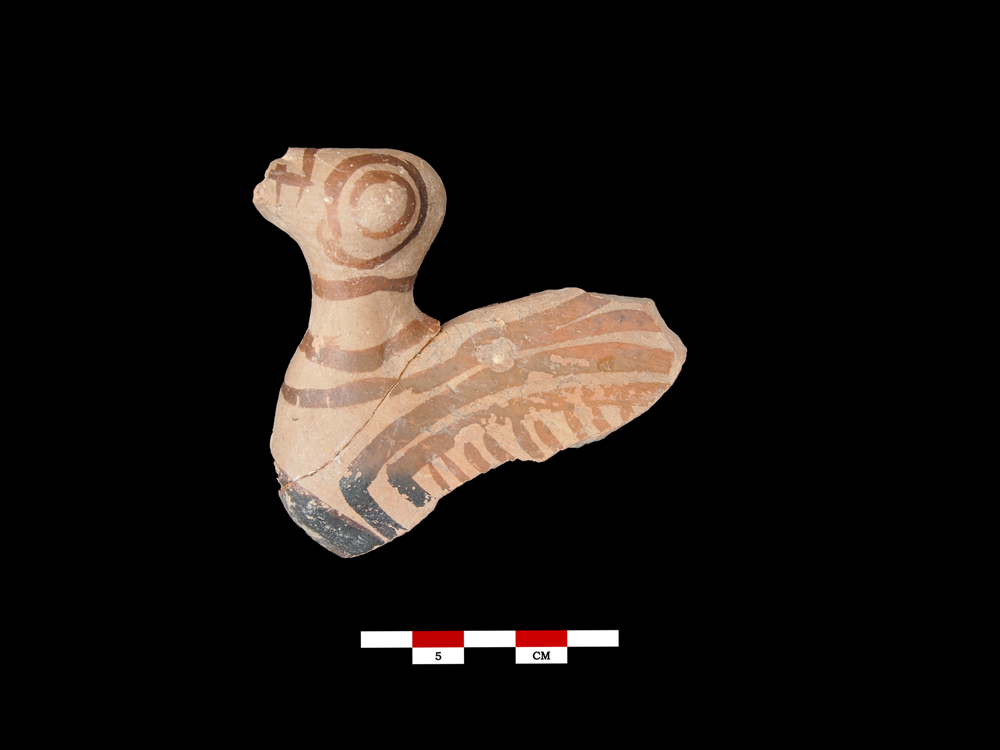
The Despotiko bird is quite unique. Although a figurine, it should be better compared with bird askoi.Footnote 18 In particular, it stands close to those of Desborough's (Reference Desborough1972) Type I and Guggisberg's (Reference Guggisberg1996, 256) Type A6.Footnote 19 The earliest examples of this type are known from Achaia (Guggisberg Reference Guggisberg1996, 62, pl. 13; Kourou Reference Kourou2005, 250, fig. 4) and the island of Naxos (Vlachopoulos Reference Vlachopoulos2006, vol. Β, chapt. 9, no. 15) and date to the twelfth century BC. After a gap of slightly more than a century, bird askoi are attested on Crete and the Dodecanese from the ninth century onwards (Lemos Reference Lemos and Karageorgis1994, 231, 234). The only bird vessel rather than askos from the Early Iron Age Cyclades comes from the Naxian necropolis of Tsikalario, and it has been dated to the Middle Geometric period (Charalambidou Reference Charalambidou, Vlachou and Gadolou2017, 378–9, fig. 12). The head and eye formation of the Despotiko figurine can be compared to Late Helladic IIIC examples (Kallithea Achaia: Guggisberg Reference Guggisberg1996, 62, no. 190, pl. 12.9; Amyklai: Guggisberg Reference Guggisberg1996, 57, no. 177, pl. 12:3) with which it shares the short neck. On the other hand, the elongated, almost cylindrical, beak is characteristic of the Protogeometric bird askoi with high, cylindrical neck from Crete and especially Knossos.Footnote 20
A date of the second half of the eighth century is proposed here, on the basis of the figurine's painted decoration, which brings it very close to the birds depicted on many of the Parian Late Geometric vases from the same deposition. It is striking that, although of such a late date, the terracotta bird seems to strongly preserve the traditions of the twelfth and tenth centuries BC, known from Achaia and Crete, respectively. More interestingly, it is completely different from all Naxian examples, both those of the Late Helladic IIIC (Kamini: Vlachopoulos Reference Vlachopoulos2006, vol. B, 131–4, nos 1735, 1802, 397–8, fig. 28, colour pls 10–11, pls 47–8) and the Middle Geometric periods (Tsikalario).
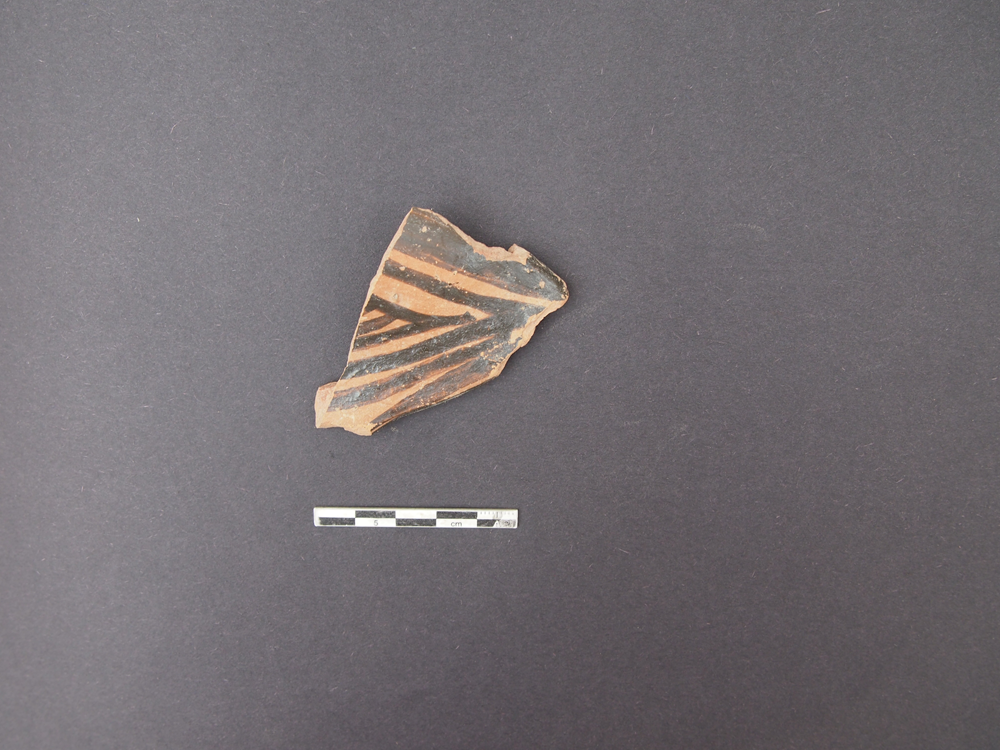
The bird might not find parallels outside Despotiko, but the wing of a contemporary example from the same deposition suggests that at least two existed at the site. The wing is similarly painted: the triangular endings of the double-outlined plumage, whose interior preserves a diagonal band, are bordered by bands along the wing's edges (Fig. 4).
Wing of terracotta bird (author's photograph).
Two small clay birds are represented by their double swallow tail (Figs 5–6) (Kourou Reference Kourou1999, 72: variant Γ, fig. 15δ, variant Δ, fig. 15β,ε,ζ). One of them has a hole at the transition from the tail to the lower body. In both cases, the body was wheelmade and not handmade, as in the case of the Middle Geometric birds from the South Necropolis of Naxos town (Kourou Reference Kourou1999, 24–5, nos ΜΝ 383–91, 393–400, 403–10, fig. 15, pls 46–51, colour pl. ΙΙΙ). The use of the wheel for the manufacture of the Despotiko bird distinguishes it from the Naxian counterparts and directs comparisons to the bird askoi. The bird askos from Kamini has a comparably decorated tail, while there are also similarities with examples from Knossos (Guggisberg Reference Guggisberg1996, 160, no. 560, pl. 41:1) and Rhodes (Guggisberg Reference Guggisberg1996, 130–1, nos 443, 446, pl. 35:3[Early Geometric],5[Middle Geometric]). The third trapezoid tail is decorated with horizontal bands (Fig. 7).Footnote 21 Were it not a bird askos, this banded tail could belong to a handmade bird, rather like the Naxian examples. We cannot conclude firmly whether or not the Despotiko birds date to the ninth century: the horizontal bands on the birds’ bodies could point to a later date (e.g. Guggisberg Reference Guggisberg1996, 200, nos 677, 680, pl. 51:3).
Trapezoid double swallow tail of terracotta bird with suspension hole (author's photograph).

Trapezoid double swallow tail of terracotta bird (author's photograph).
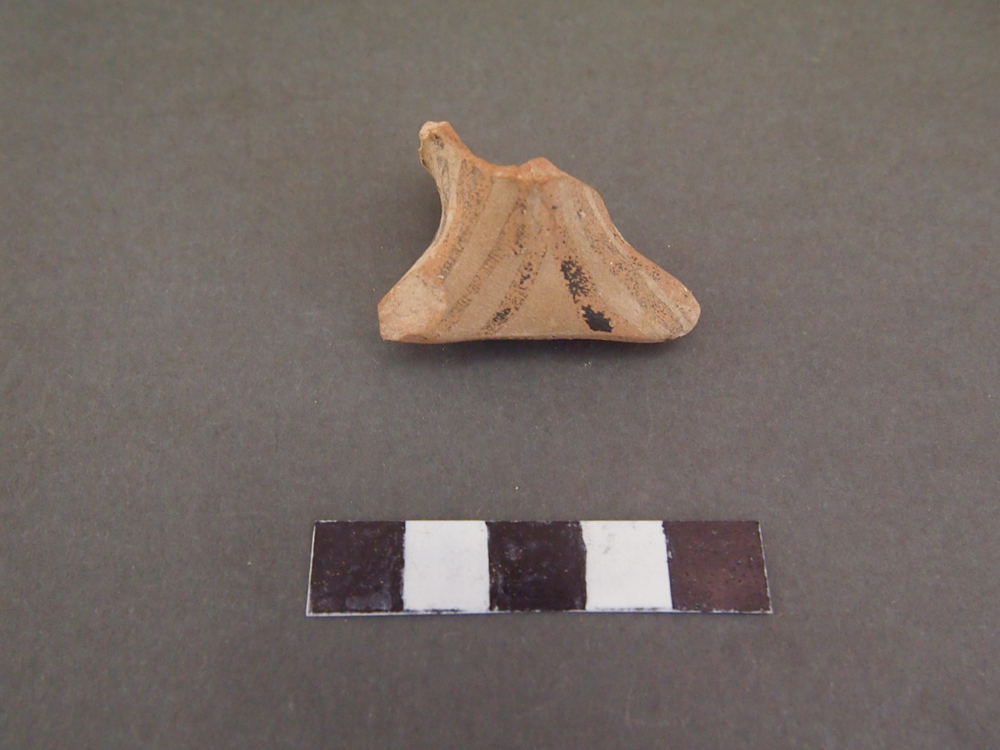
Trapezoid tail of terracotta bird with horizontal bands (author's photograph).

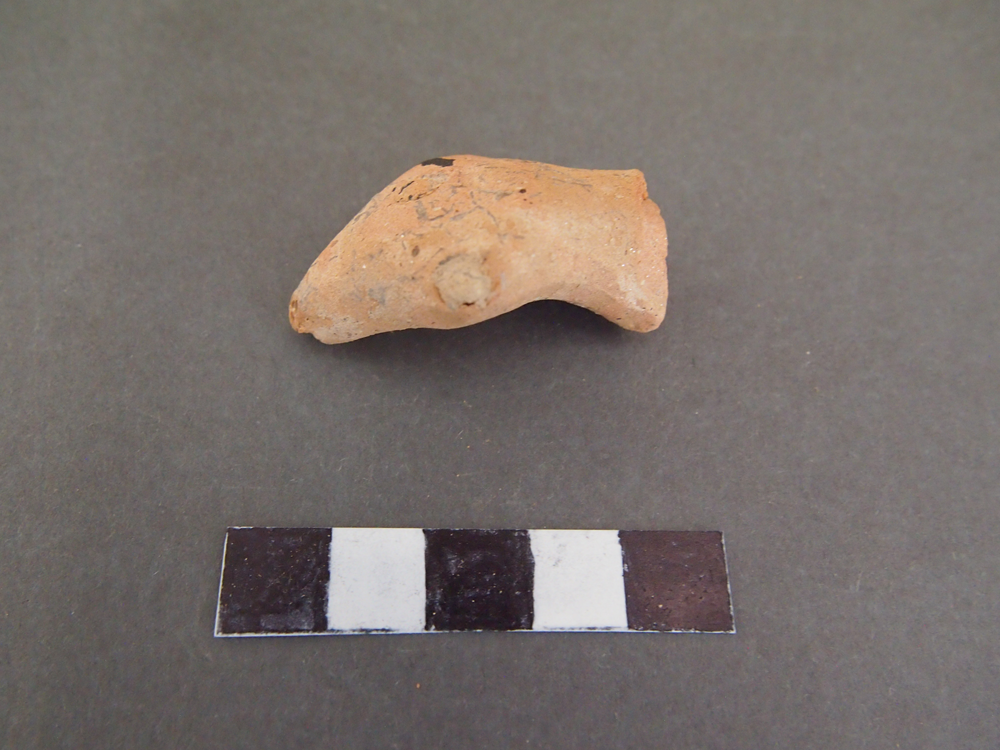
The flattened snakehead of triangular shape could have been an independent figurine, if it were not attached to a vessel or another object (Fig. 8).Footnote 22 The eyes are denoted as deep, incised, circles around two round low convexities. Remains of concentric small circles in almost completely flaked black paint can be seen around the eyes with horizontal and vertical lines on the edge of the head and body. Once again, the painted decoration seems to point to the latter part of the eighth century (cf. Sinn Reference Sinn1981, nos 73–6, pl. 10:1,30).
Clay plastic snakehead (author's photograph).
Mandra of Despotiko is one of the few Cycladic sites where a concentration of figurines, rather than a few examples, is attested. The different types of terracotta animals attested at the site might be consistent with the enrichment of the figurine repertoire in the Aegean after the ninth century BC (Averett Reference Averett2007, 240, 297), but their heterogeneity is exceptional for the Cyclades. Bovids might have been common at the time, but the snake is an extremely rare type; moreover, the idiosyncratic nature of the large birds is noteworthy too.
CONTEXTUALISING THE DESPOTIKO FIGURINES
Mandra, a plateau at the northernmost and largest peninsula of the uninhabited islet of Despotiko, is now renowned as one of the most important cultic centres of the Cyclades, owing to the discovery of an extended temenos dedicated to Apollo (esp. Kourayos Reference Kourayos2009; Reference Kourayos2012; Reference Kourayos2018; Kourayos and Burns Reference Kourayos and Burns2004–5; Kourayos et al. Reference Kourayos, Daifa, Ohnesorg and Papajanni2012). The foundation of an altar in the form of a semicircular structure at the centre of the later temenos, in combination with several votive dedications, securely places the earliest secure traces of cult activity at the site in the early seventh century BC.
The middle of the sixth century saw a radical transformation of the site (Fig. 9): a monumental temenos protected by an almost square enclosure was erected over an area of c. 1600 m2, as part of a conscious, costly, and ambitious construction programme, run by the thriving Archaic polis of Paros (Kourayos and Daifa Reference Kourayos, Daifa and Mazarakis Ainian2017). Building A, composed of five rooms, occupied the west part of the temenos, facing towards the entrance of the harbour. Its north part – Rooms A1 and A2 – has been recognised as the temple of the temenos. Its south part – Rooms A3 to A5 – might have served as a feasting hall. More buildings were erected, creating a densely built grid around the sacred peribolos. The north-west part was occupied by the temple-shaped Building Δ, and the eastern part by the late sixth-century Building E (Kourayos et al. Reference Kourayos, Daifa, Ohnesorg and Papajanni2012). The still ongoing excavation has brought to light many more buildings at Mandra – 26 in total – part of an extended establishment, which extended over to the smaller islet of Tsimintiri bordering the bay of Mandra (Alexandridou and Daifa Reference Alexandridou, Daifa and Papadopoulouin press).
Aerial photo of the temenos in 2020 (courtesy of Y. Kourayos).

The parts of two Early Iron Age buildings, which came to light recently (2012–16) at a deeper level below the Archaic temenos, reveal the occupational history of the site, which can be now placed well before the sixth century BC (Fig. 10). Building O with a north–south orientation was found lying just east of the porch of Building A's Rooms A1 and A2 and south of the porch of Building Δ, just inside the north-west corner of the Archaic temenos. The building preserved a north apse and a large part of the east wall, running north–south with its lower edge slightly curving. No remains of the west wall were detected, while only a few stones have fallen from the south wall. The width of the preserved walls indicates that the building was of large dimensions with the mudbrick upper structure placed on a stone foundation. The building must have been established in the late ninth or the first half of the eighth century. It remained in use for some decades until the construction of Building Ξ at the end of the eighth century. This rectangular building, retaining only a small part of its north and west walls, is in exact alignment with Building A, with which it shares the same orientation. It was found at a distance of 1.50 m from the east walls of the Archaic building's north part (Alexandridou Reference Kourayos, Alexandridou, Papajanni, Draganits and Mazarakis Ainian2019, 185–90). A rectangular eschara of stone slabs, 0.70 m long and 0.60 m wide, was found 1.80 m east of the building's north wall at the same depth as its foundations. The lower part of two large pithoi, both fire-affected, were detected in situ by its north-west and north-east internal corners. A kantharos and an olpe of the very end of the eighth century rested by the pithos at the north-west corner, while the other pithos contained bones.
Photogrammetric-architectural plan of the Early Iron Age buildings Ο & Ξ (G. Orestidis). Drawn representation (A. Zourbaki).
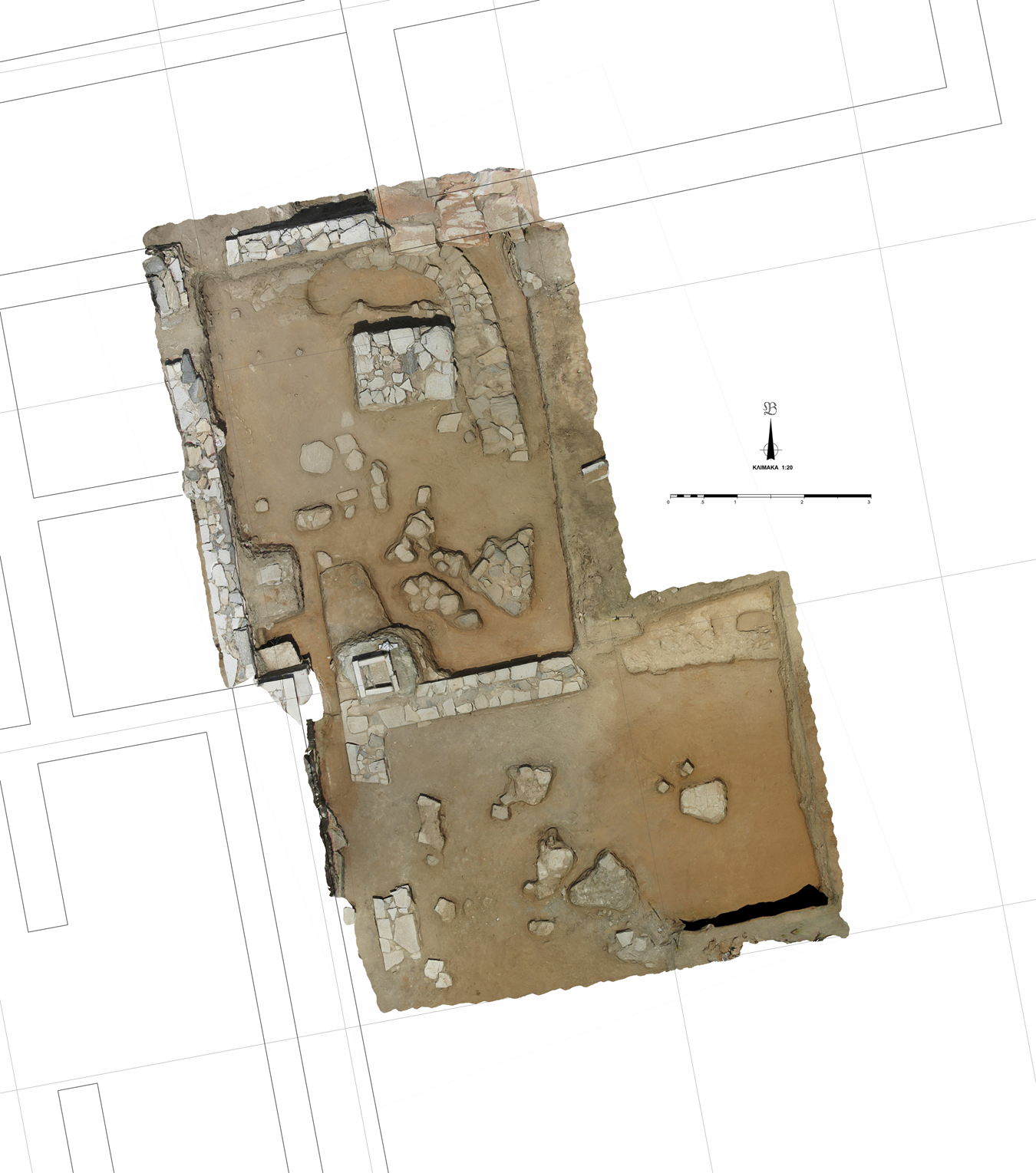
Α muddy layer of soil, 0.30 m to 0.50 m thick, mixed partly with ashes, covered a wide area extending from the northern part of Building O to the porch of Building Δ and further to the north, as well as below the north-west room of the structure in shape Γ connecting the Archaic Buildings A and Δ. The core of this deposition was detected below the porch of Building Δ, and inside Building O, especially towards its north apse. Except for the eight terracotta animal figurines, this layer contained thousands of sherds from a variety of clay shapes, chronologically extending from the ninth to the second half of the sixth century BC, as well as numerous metal objects, two Egyptian scarabs and quantities of animal bones. Clay sherds were found widely dispersed under the Archaic building, but also in its surroundings, with their concentration thinning out towards Building Ξ. On the other hand, almost all terracotta figurines and metal objects were found concentrated in a trench just west of Building's Δ porch.
Although most of the Early Iron Age components of this layer are compatible with Building Ξ's period of use, spanning the second half of the eighth century, it is not at all certain that they originated from the building's interior nor that they should be related to it. They may well represent the archaeological remains of activities, operating either in the open air or in association with another structure – not yet discovered – in both cases in close proximity to these buildings. The wide chronological spectrum of the pottery discovered, including many Archaic vessels, is an additional argument for assigning the activities to different loci.
In all cases, the clay, metal, and other objects, as well as the zooarchaeological remains, have been removed from their original context, before being transformed into construction debris for the foundation of Building Δ of the Archaic temenos in the second half of the sixth century.
The pottery
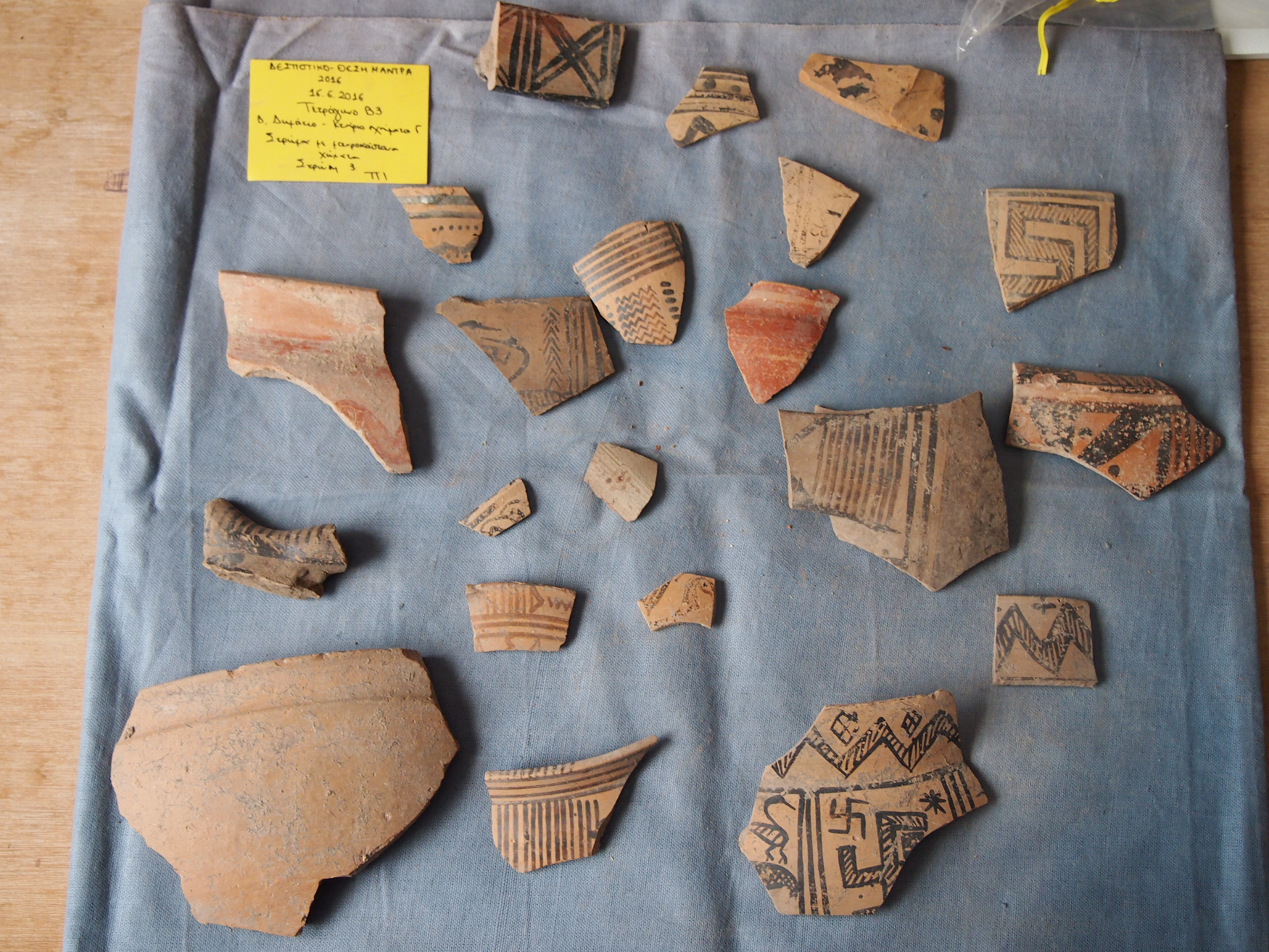
The terracotta figurines might have been few in this deposition, but the sherds of clay vases amount to almost 10,000 in number.Footnote 23 Their surface remained smooth with no wear or depositions, and their painted decoration is not flaking. Fine-decorated vessels largely outnumber coarseware. Although each vase is represented by a single or a few fragments, their broken edges are sharp. A few sherds have slight remains of secondary burning. The earliest vases date to the Middle Geometric period and the ninth century BC, but the largest bulk of the Geometric pottery spans the second half of the eighth (Alexandridou Reference Αlexandridou, Katsonopoulous and Dentiin press). Most of the deposited sherds are Archaic, extending chronologically to the second half of the sixth century.
The Geometric assemblage is dominated by small open vessels, mainly skyphoi followed by kantharoi (Fig. 11). Large open shapes, most possibly kraters, as well as plates, are numerous. On the other hand, closed forms – amphoras or hydriai – are limited. Except for a few Protocorinthian kotylai and three conical lekythoi of the ‘Argive Monochrome’ ware,Footnote 24 the rest of the Geometric vases are Parian products presenting a large homogeneity in their technological features.Footnote 25
Sherds of Geometric skyphoi and kantharoi from the deposition (author's photograph).
It is necessary to juxtapose the Geometric vases from the Despotiko deposition with the contemporary assemblages of vases from Antiparos, Paros and Delos/Rheneia in order to discern any oddities or special characteristics.
Sherds of Early Iron Age skyphoi and kantharoi, an oinochoe and another closed shape (Bakalakis Reference Bakalakis1969, 128–30, fig. 4:1–5) are published from the cave situated at the south-eastern part of Antiparos with a view across to Despotiko. The pottery could have been used in ritual meals held in a cave whose cultic use in the historical period is securely attested by an inscription on a stalagmite (Bakalakis Reference Bakalakis1969; Mavridis Reference Mavridis2007–8; Angliker Reference Angliker, Katsarou and Nagel2020).
Koukounaries on the naturally fortified hill, south-west of the Naousa bay on the north side of Paros, provides the ideal case for attempting a comparison with the site of Mandra, since domestic structures coexisted there with a sanctuary. After the destruction of the Late Mycenaean fortified acropolis at c. 1150 BC, the hill accommodated a settlement, occupied from the Protogeometric period until its peaceful abandonement around the middle of the seventh century BC. A sanctuary, dedicated to Athena, was located on the hill's south-eastern slope. According to the preliminary reports and articles, many skyphoi and kantharoi were recovered from the houses of the Upper Plateau, while coarse ware and relief pithoi are also mentioned. The ongoing study of the material attests to the proliferation of skyphoi with linear or bird decoration, painted solid one-handled cups, and skyphos-kraters spanning the Middle and Late Geometric periods.Footnote 26
According to the excavator, pottery dominated the various offerings to the deity of the site's sanctuary. Open shapes are found broken near to the altar together with burnt animal bones. A variety of Parian Geometric clay shapes, including oinochoai, skyphoi, tripods and fenestrated supports (Schilardi Reference Schilardi and Mazarakis Ainian2017), as well as a small portion of Protocorinthian sherds, are reported (Schilardi Reference Schilardi1984, 289–91; Reference Schilardi1989, 257).
An Early Iron Age clay assemblage from Paros comes from the Delion, situated on top of a low hill, c. 3 km north of Paroikia (Rubensohn Reference Rubensohn1962). The pottery was found in a very fragmentary state almost exclusively below the foundation of the temple's cella. Most vases date to the Geometric and Archaic periods.Footnote 27 On the basis of the published material, open shapes, mainly skyphoi, dominate, combined with one-handled cups and plates. Large open vessels, kantharoi, amphoras or hydriai are represented by a few fragments, while painted solid juglets were more common. ‘Argive-monochrome’ ware is present too.
The Early Iron Age Parian material from the Delion provides the closest parallel to the Despotiko assemblage, though the number of both large, closed shapes and kantharoi is greater at Mandra. More interestingly, the quality of the vases from Despotiko is higher, with a much larger number of vases decorated with birds or other animals. On the other hand, the Delion seems to have attracted more Corinthian vases of a variety of forms, including aryballoi, alabastra, kotylai, and oinochoai. The Corinthian imports at Despotiko are limited to a few kotylai, most possibly of the Middle Protocorinthian period.
A large assemblage of Early Iron Age Parian pottery – not yet fully published – was discovered in relation to the two polyandria in the main necropolis of Paroikia (esp. Zapheiropoulou Reference Zapheiropoulou and de la Genière1994; Reference Zapheiropoulou1999; Reference Zapheiropoulou2000; Reference Zapheiropoulou, Stamatopoulou and Yeroulanou2002, 283–4; Agelarakis Reference Αgelarakis2017). Medium-sized and small amphoras served as urns for the cremains of the deceased, with skyphoi or cups sealing their mouths (see e.g. Zapheiropoulou Reference Zapheiropoulou1999, 15, fig. 5, 20–1, figs 16–19, 22, figs 20–3; Coulié Reference Coulié and Luce2007, 58, 60). Athough no other grave offerings are reported, several Protocorinthian vases have been recently published, whose exact context and use at the necropolis, however, is not mentioned (Detoratou Reference Detoratou2003–9).
Moving outside Paros, two assemblages of Parian pottery are of interest: the material from the purification pit of Rheneia (see Dugas Reference Dugas1925; Reference Dugas1935; Dugas and Rhomaios Reference Dugas and Rhomaios1934; Zapheiropoulou Reference Zapheiropoulou2003), and that recently published from the sanctuary of Apollo on Delos (Brisart Reference Brisart and Roland2017). The clay forms from Rheneia do not differ significantly from those coming from the necropolis of Paroikia. Closed vases – mostly hydriai rather than amphoras – dominate, due to their use as ash urns, followed by oinochoai. The repertoire of the open shapes includes skyphoi and kantharoi, as well as plates (Brisart Reference Brisart and Roland2017, 324), a shape absent from the necropolis of Paroikia, but present at both the Delion of Paros and Despotiko.
Parian pottery is attested among the ceramic finds from the ‘hieron’ of Apollo on Delos (Brisart Reference Brisart and Roland2017, 322–4). The recently published sherds from the sanctuary make up just a small fraction of the excavated material, which remains unpublished, but they provide some important insights into several issues concerning their context, function, and chronological range, as well as the origin of the visitors at the site from the Early Iron Age onwards. Although the earliest vases from the sanctuary date to the Protogeometric period, the second half of the eighth century marked an increase in the volume of fine-decorated pottery, as well as a diversity in the represented styles originating from various workshops. Two Late Geometric hydriai or amphoras of the Groups Aa and Ad, respectively, are of Parian origin (Brisart Reference Brisart and Roland2017, 327, nos 18–19, pl. 83:18–19). Their presence at the sanctuary is important, since the shape was until now exclusively known from the purification pit of Rheneia (Brisart Reference Brisart and Roland2017, 328). Brisart chose to examine the pottery from the sanctuary through the ‘angle de la céramique funéraire’, appearing quite reluctant to acknowledge any non-funerary function for many of the shapes. This scepticism has also affected two Parian amphoras, the second of which is of large dimensions, which he did not wish to interpret as possible votive dedications for the deities (Brisart Reference Brisart and Roland2017, 335–6).
The Early Iron Age ceramic assemblage from the sanctuary of Hyria on the neighbouring island of Naxos should be brought into this discussion, owing to the volume of the data and its similarities with those from Mandra. Open shapes represent 78 per cent of the Early Iron Age fine wheelmade ware. Small- and medium-sized drinking shapes, mostly skyphoi, dominate. One-handled cups, kotylai, and a few kantharoi complete the repertoire of small open shapes, which included also skyphoid kraters and kraters. Forty per cent of these drinking vessels are painted solid, though skyphoi with linear decoration, birds and horses are not absent. According to Simantoni-Bournia, the decoration is not as varied and ornate as in most sanctuaries. Only a few Protocorinthian imports are reported, dating after the Early Protocorinthian period (see esp. Simantoni-Bournia Reference Simantoni-Bournia and Vlachou2015a). The quantity of eating, drinking and cooking vessels, together with the burnt animal bones and the ashes from the early temples (I–III), suggest that ritual dining played an important role in the sanctuary's cult life (Lambrinoudakis Reference Lambrinoudakis, Leclant and Balty2002, 7; Simantoni-Bournia Reference Simantoni-Bournia, Yeroulanou and Stamatopoulou2002, 275–7; Reference Simantoni-Bournia and Vlachou2015a, 194).
Despite the lack of detailed publications of the pottery from most of the above-mentioned sites, rough comparisons with the ceramic assemblage from Mandra can be attempted. Based on the above-presented data, all shapes from the examined deposition are attested in all kinds of contexts, domestic, cultic or funerary. The dominance of closed shapes is the main distinguishing feature of the Despotiko assemblage compared to that from the necropoleis. On the other hand, the concentration of open shapes, mostly of small drinking forms, is a common feature in settlements and cult sites. The plates, well represented at Mandra, might be attested at the Delion of Paros, but they are not absent from the pit of Rheneia. ‘Argive monochrome ware’ is present at the Parian Delion (Paros Archaeological Museum AK 4461) and on Delos (Dugas Reference Dugas1928, cat. no. 539, pl. 45), but absent from Rheneia and the necropolis of Paroikia. It is worth noting that some of the specimens from the Artemision of Delos are Attic products (Brisart Reference Brisart and Roland2017, 337), comparably to those from Despotiko.
The large number of kantharoi and cooking vessels, as well as the high quality of all fine-decorated vases, often depicting birds and horses, distinguish the Despotiko assemblage from those from Paros, Delos and Naxos. The aesthetic value of the kantharoi is characteristic. Unlike those from the purification pit of Rheneia, where they are numerous, they are not decorated with linear patterns but with animals (Alexandridou Reference Αlexandridou, Katsonopoulous and Dentiin press).
The metal objects
The Despotiko deposition contains 64 metal objects, with iron items (of which there are 40) dominating over bronze. They are all badly eroded and fragmentary, with their condition in many cases impeding their identification.Footnote 28 They belong to two main categories: items of personal ornament – limited to fibulae and rings – and tools/weapons exclusively represented by knives, which form the core of this metal assemblage.
Six very fragmentary bronze arched fibulae have been recovered, the better preserved of which have globules on the bow. Two bronze and two iron rings, all solid and closed, complete the identifiable group of the metal pieces of jewellery from this context. Five bronze and silver rings of the same type were included in the deposit, detected below the floor slabs of Room A1 of the Archaic ‘temple’ (Kourayos and Burns Reference Kourayos, Burns and Mazarakis Ainian2017, 331).
At least 10 knives, most of which preserve part of their blade, are included among the iron objects. One of them seems to have been ‘ritually killed’ (Petrakis Reference Petrakis2020, 316). Knives might not have been the only iron objects in this deposition, but their high number should be related to the large assemblage coming from the deposit of the ‘temple's’ Room A1, the largest known in the Cyclades to date.Footnote 29 These knives, some of which are of large dimensions, have been interpreted as votive dedications serving sacrificial practices, but more importantly revealing a strong male focus (Kourayos and Burns Reference Kourayos, Burns and Mazarakis Ainian2017, 336–7). Knives are attested in most cult sites of the Greek mainland and the islands with their numbers being particularly high during the Early Iron Age and the Archaic periods. In this context, they have been associated with animal sacrifice, necessary either for slaughtering the sacrificial victim or for cutting the meat that had to be distributed to those participating in the communal meal (Sossau Reference Sossau2019, 34–6, 49–50; Petrakis Reference Petrakis2020, 97–409).
Τhe Egyptian scarabs
The excavated deposition contained two Egyptian scarabs, which either date to the Late Bronze Age IB–IIB period or are imitations of Egyptian prototypes. In the former case, they are heirlooms and the only Bronze Age objects from Mandra so far identified. The first scarab bears the motif of the four cobras, pointing to the Second Intermediate Period. The second example shows Pharaoh smiting an enemy with a mace, possibly of Tuthmosis III (1479–1425 BC).Footnote 30
Aegyptiaca, Egyptian and Egyptianising artefacts, were widely distributed in the Mediterranean with a special concentration in the Aegean, where they have been mosty discovered in votive depositions in coastal sanctuaries. These objects date from the eighth to the sixth centuries BC (see esp. Hölbl Reference Hölbl, Beck, Bol and Bückling2005; Reference Hölbl and Fischer2014; Kousoulis and Morenz Reference Kousoulis, Morenz and Fitzenreiter2007). The Rhodian sanctuaries might have yielded the largest portion of these objects (Apostola and Kousoulis Reference Apostola and Kousoulis2019 with further references), but they are not absent from other cultic sites, including the Parian Delion (Rubensohn Reference Rubensohn1962, 73–9, pl. 11de).
The animal bones
Animal bones together with clay sherds formed the main components of the Mandra deposition. The bones have been precisely studied by a specialist – Dr Simon Davis – given their potential in illuminating the character of the assemblage and of the practices related to them.Footnote 31 According to the study of the remains, sheep and goats were the most frequently attested animals in this context, forming 91 per cent of the assemblage, with sheep occurring slightly more than goats. Pigs represent 9 per cent.Footnote 32 A few other animals are represented, including the single tooth of a cow, five bones of hares and two dog bones. The layer revealed abundant seashells, several fish bones and crab claws.
Less than 7 per cent of the analysed bones from this assemblage were calcinated, and these all belonged to caprines. According to Davis, despite the small size of the sample, there might have been a preference for femora. Τhe rest of the zooarchaeological material bears no traces of burning, while a small percentage preserved cut marks.
The study revealed that almost two-thirds of the sheep and goats were four to eight months old. Moreover, almost all pigs were slaughtered at a very young age when probably still suckling. The narrow range of the species attested at the site, limited to sheep, goats and pigs, as well as their slaughter at a particularly young age, point to a specific meat-eating policy.
RITUAL OR WHAT?
‘Ritual’, the ‘paramount archaeological safe-word’ (Haysom Reference Haysom, Lemos and Tsingarida2019, 54), commonly follows anything that cannot be understood or functionalised in the archaeological record for three decades now (Pakkanen Reference Pakkanen, Pakkanen and Bocher2015, 31–2). The relevant bibliography is vast, and the notions of ritual, religion and cult still remain contested. Archaeologists largely draw from the related extensive anthropological studies,Footnote 33 with those of Catherine Bell (Reference Bell1992; Reference Bell1997) being among the most used. Bell underlined the difficulty of separating clear-cut ritual and profane activities by shedding light upon a series of interemediate zones between the two ends consisting of ritualised events, that, is ritual-like activities. According to her view, ritual does not solely apply to religious institutionalised activity (Bell Reference Bell1997, 164); on the contrary, it is mostly related to the process of ritualisation and the degree to which activities are ritualised. That is, ‘the degree to which the participants suggest that the authoritative values and forces shaping the occasion lie beyond the immediate control or inventiveness of those involved’ (Bell Reference Bell1997, 169). A highly influential framework has been proposed by Clifford Geertz (Reference Geertz1973), who attempted to provide an anthropological definition of religion as a system of symbols, a symbolic communication between people, with rituals defined as one of the system's elements. In Geertz's framework, rituals are interwoven in humans’ everyday existence, bridging it with religious reality.Footnote 34
Archaeologists have largely adopted Colin Renfrew's anthropologically inspired framework for cult identification on the basis of particular archaeological correlates, often with revisions.Footnote 35 Over the last two decades, archaeologists studying Early Iron Age materials have used methodologies built on particular theoretical frameworks in an attempt to characterise a context or a site as cultic/religious and to identify ritual activities (Morgan Reference Morgan1999; Eder Reference Eder and Kyrieleis2006, 202–10; Kenzelmann Pfyffer and Verdan Reference Kenzelmann Pfyffer, Verdan and Mazarakis Ainian2011 [sanctuary of Apollo at Eretria]; Kerschner Reference Kerschner, Schmaltz and Söldner2003, 248 [sanctuary of Artemis at Ephesos], Haysom Reference Haysom, Lemos and Tsingarida2019).
The material evidence from the extended deposition discovered at Mandra of Despotiko shares a lot in common – a set of clay vases for feasting, terracotta figurines, metal implements, animal bones – with the assemblages from other early sanctuaries, ticking most of the boxes of a religious rather than domestic context. Since the Early Iron Age buildings were discovered below the level of the Archaic temenos in close association with the ‘temple’ and the cultic Building Δ, the most convenient assumption would be to recognise the earliest structures as cultic and the associated deposition as containing the remains of the earliest ritual activities at the site traced back to the ninth century BC. Is this, however, the whole story?
The large assemblage of Early Iron Age pottery, containing a high percentage of small open shapes in combination with fewer mixing shapes and numerous cooking pots, must have served for the preparation and consumption of food and drink at the site during that time (Alexandridou Reference Kourayos, Alexandridou, Papajanni, Draganits and Mazarakis Ainian2019, 199–200; Reference Αlexandridou, Katsonopoulous and Dentiin press). Such activities are further supported by the zooarcheological remains. Ζooarchaeological depositions have been examined from a number of Early Iron Age cult sites.Footnote 36 In almost all cases, they were mixed, including both burned and unburned bones (Ekroth Reference Ekroth2007, 260–3): the burnt ones are the result of sacrificial activity, related directly to the altar, while the unburnt bones represent the remains of ritual meals consumed at the site.
Feasting has been recognised as the core of ritual practices in the early Greek sanctuaries.Footnote 37 Nevertheless, this communal consumption of food and/or drink did not only mark ritual events, but it formed part of everyday social life, occurring at special or unusual occasions even within the household (see esp. Dietler and Hayden Reference Dietler and Hayden2001, 3; Hayden Reference Hayden, Dietler and Hayden2001, 28, 47). The archaeological traces of commensality can be strong in early Greek cult sites, but they can be firmly identified in domestic and funerary contexts too. Moreover, we should not infer that all animal bones in cult sites belong to sacrificial victims nor should all meat consumption be related to ritual activities of sacrifice. Killing and consuming an animal in a sanctuary or a house may not have differed (Ekroth Reference Ekroth2007, esp. 268; Reference Ekroth, Hitch and Rutherford2017, 43–6). Comparably, the clay equipment necessary for cooking and consuming meat and beverages did not differ in cultic and domestic environments (Morgan Reference Morgan1999, 321–4; Kenzelmann Pfyffer and Verdan Reference Kenzelmann Pfyffer, Verdan and Mazarakis Ainian2011, 894–5; Eder Reference Eder and Kyrieleis2006, 204).
At Mandra, the actual thysia is rather thinly evidenced without secure identification of the specific body part chosen to be burnt on the altar, even though the burnt bones exclusively of goats and sheep are compatible with the species representing the god's portion burnt on the altar. The largest percentage of the faunal remains from the site represents consumption debris, with the high fragmentation of the bones and the visible cut marks reflecting that they had been chopped up into portions and broken for the marrow to be accessed. Not sacrificed at the altar, most of the sheep, goats and pigs must have been slaughtered and subsequently boiled for alimentary purposes. This cooking method was the most commonly applied in the Greek sanctuaries (Ekroth Reference Ekroth2007, 266–8; Reference Ekroth, Matthaiou and Polinskaya2008), and the abundant fragments of cooking pots included in this deposition point to their use for boiling meat. In this frame, the iron knives could well have been used for butchering.Footnote 38 At the same time, the young age of the slaughtered animals, contradicting most animal husbandry strategies, the presence of clay shapes, like dishes or lekythoi of the ‘Argive Monochrome ware’,Footnote 39 in combination with the fine quality of the decorated vases could be considered as compatible with the operation of animal sacrifice and ritual meals.
The question is whether this archaeological evidence from Mandra is enough for reconstructing a site as exclusively cultic. As analysed elsewhere, the Early Iron Age evidence from the site allows the reconstruction of an extended establishment (Alexandridou Reference Kourayos, Alexandridou, Papajanni, Draganits and Mazarakis Ainian2019; Alexandridou and Daifa Reference Alexandridou, Daifa and Papadopoulouin press). Buildings Ξ and O are its best-preserved components, whose function, however, cannot be easily deciphered (Alexandridou Reference Kourayos, Alexandridou, Papajanni, Draganits and Mazarakis Ainian2019, 193–7). The relation of Building Ξ with the Archaic Building A, recognised as the ‘temple’ of the temenos, could indicate a cultic rather than a domestic edifice. The small eschara and the two pithoi, reminiscent of the large pithos, possibly a container for sacrificial debris found in association with an apsidal building at Asine (Wells Reference Wells1983, 34; Pilz Reference Pilz, Vlachou and Gadolou2017, 457–9), could form positive arguments in the same direction. Building Ξ might then have been the first hestiatorion at the site, if adapted to Wecowski's (Reference Wecowski2014, 185) model and seen as an intermediate step between rulers’ dwellings and temples, a hypothesis which seems to be supported by the Late Geometric fragments of open small and large vessels revealed from its interior, as well as the pithoi, the related bones and the knife. In constrast to Building Ξ, no special features or spatial factors confront the interpretation of Building O as a residence, which could have housed feasting activities too (Alexandridou Reference Kourayos, Alexandridou, Papajanni, Draganits and Mazarakis Ainian2019, 201–5).
On these grounds and solely on the basis of the available data, life at Early Iron Age Mandra should be considered as flowing into different directions: the cultic elements, including very possibly animal sacrifice, are present, but at the same time the pottery and the inferred feasting could also be placed in a domestic framework with the quality of the equipment reflecting the high status of the participants, as well as the individuality of the occasions. Such high living standards are also inferred by the fact that animals were not kept for secondary products.
The coexistence of domestic and religious structures in other sites, like Delos, where a domestic nucleus together with its burial grounds surrounded the sanctuary of Apollo in the Early Iron Age (Poulsen and Dugas Reference Poulsen and Dugas1911, 385; Gallet de Santerre Reference Santerre1958, 219–20, 233–7; Étienne Reference Étienne, Simantoni-Bournia, Lemou, Mendoni and Kourou2007, 331–2; Brisart Reference Brisart and Roland2017, 336–7, 345), supports our reluctance to push all early evidence from the Mandra of Despotiko into an exclusive religious frame (Alexandridou Reference Kourayos, Alexandridou, Papajanni, Draganits and Mazarakis Ainian2019, 201–5).
BACK TO THE DESPOTIKO FIGURINES
The terracotta animal figurines from Mandra lack wear or signs of rework/re-use. Acquired on the island of Paros, where they had been produced, they were brought to the site after a sea journey of a few hours for the fulfilment of some purpose, or for playing a role which cannot be determined as their original context remains unknown.
All figurines were found in the ‘heart’ of the deposition, and their condition indicates that the trench where they were discovered was not far from their original location. This may suggest that they had been initially all placed together, whether placed in relation to some structure, no longer extant, or in the open air. We will never know whether they were placed alone or alongside other objects. If its condition was not an accident of the procedure of firing, the heavily burnt clay bovid may have been disposed in fire, possibly after some action, which might or might not be related to a sacrifice.
Another indication of their possible use is provided by the hole above the tail of one of the birds (Fig. 5). The function of such holes is not always easy to determine (Muhly Reference Muhly2008, 77). It does not seem to have been dictated by the firing process, as in the case of the examples from Tsikalario (Charalambidou Reference Charalambidou, Vlachou and Gadolou2017, 383–4). Unlike the Naxian small birds from the South Cemetery, which have their extended wings pierced (Κοurou Reference Kourou1999, 76–7), the position of the hole on the Despotiko bird suggests that it could have been mounted on a wooden stick or suspended with a string. In the latter case, another hole would have been necessary on the top of the head for counterbalance. After being used or simply left at the site, the figurines may have acted as tangible memories of the related activities for some time before being removed and ending up as construction debris: during this last stage of their life circle, they lost any symbolic and spiritual significance they carried.
If the Despotiko clay figurines are treated ‘traditionally’ as indicators of the gender and character of the venerated deities in Greek sanctuaries (see e.g. Televantou Reference Televantou and Mazarakis Ainian2017, 374; Schilardi Reference Schilardi and Mazarakis Ainian2017; Kourou Reference Kourou and Vernikos-Eugenides2000), then they could be associated with the cult of a female deity with the characteristics of a potnia theron (Kourayos et al. Reference Kourayos, Alexandridou, Papajanni, Draganits and Mazarakis Ainian2017, 359–61). Nevertheless, I find it more attractive to adopt an ontological and sensorial approach, enabling us to view these clay animals as part of the islet's landscape and physical environment – holistically examined together with the topography and the built structures (Knapp Reference Knapp, Given and Knapp2003) – and more importantly in relation with the humans, examining how the latter conceived of, experienced and interacted with both the objects and the living beings which they embodied.
Bovids are the earliest three-dimensional clay representations of animals, appearing in the Early Iron Age since the eleventh century,Footnote 40 being widespread both in mainland Greece and the islands (Guggisberg Reference Guggisberg1996, 319–22; Averett Reference Averett2007, 125–7). They could not have acted as clay substitutes of sacrificial animals, since the burnt zooarchaeological material from sanctuaries does not include cattle bones,Footnote 41 an absence also noted in the case of Despotiko. Alternatively, they demonstrate their importance in agricultural and pastoral life at that time,Footnote 42 while acting as symbols of power and fertility too (Guggisberg Reference Guggisberg1996, 341–3). The presence of the clay bovids at the site is not surprising, since Mandra is the largest and most fertile peninsula of Despotiko. Bovids no longer exist on Despotiko or neighbouring Antiparos, but were used for ploughing on both islands at least until the end of the 1960s.Footnote 43
The number of clay birds either in the form of figurines or as vessels at the site is worth noting due to their rarity in the Early Iron Age Aegean, where they are mostly attached to vessels or other objects rather than being free standing.Footnote 44 With the exception of three Late Protogeometric ducks from the cemeteries of Lefkandi (Popham, Sackett and Themelis Reference Popham, Sackett, Themelis, Popham, Sackett and Themelis1980, 150, pls 137:29, 254d [Tombs 22, 28 and 29]; Thurston Reference Thurston2015, 201), the next examples come from the Samian Heraion and date to the first half of the eighth century (Jarosch Reference Jarosch1994, 100, no. 31, pl. 24, 170, no. 1040, pl. 74 [Middle Geometric]; Guggisberg Reference Guggisberg1996, 352–3). Another possible bird figurine has been recognised among the material from the North Sacrificial Area at Eretria (Huber Reference Huber2003, 47–8, nos 7–8, pl. 113). Small birds with a flat body and spread wings are known particularly from Crete and Rhodes.Footnote 45 As already mentioned, except for a large concentration from the Naxian South Necropolis, the other examples from the Cyclades are very few.
Since they are attested in various contexts, bird figurines have been mostly associated with a symbolic meaning, either linked to the divine or the deceased (see e.g. Bevan Reference Bevan1986, 163–9; Papadopoulos Reference Papadopoulos and Descoeudres1990, 22; Guggisberg Reference Guggisberg1996, 311–13; Xagorari Reference Xagorari1996, 54–5; Kourou Reference Kourou1999, 179–82; Charalambidou Reference Charalambidou, Vlachou and Gadolou2017, 387). The numerous Late Helladic IIIC water birds at the site of Kynos in central Greece have been associated with fecundity rituals operating in settlements or shrines,Footnote 46 a function also assumed for those coming from the so-called ‘ritual zone’ at Lefkandi. The symbolism of the examples from the Naxian graves is, on the other hand, mentioned as funerary (Charalambidou Reference Charalambidou2018, 186). Whether the Despotiko birds should also be seen as symbols of fertility, or of a female deity, particularly Artemis or her potnia predecessor (Christou Reference Christou1968, 52, 141–7; Bevan Reference Bevan1986, 262–3, 272–3, 283), cannot be concluded.
On the other hand, the two larger bird figurines with their careful painted decoration, denoting details of their plumage, head and beak, must have been manufactured in imitation of specific bird species. The seasonal wetlands around the island of Antiparos, the calm waters between Despotiko and Antiparos, as well as the uninhabited islets nearby form an ideal, protective environment for various aquatic seabirds or other bird species. The better-preserved clay bird that does not find exact parallels among its contemporary clay figurines could represent either a shag (Phalacrocorax aristotelis), which tends to nest at the rocky islets, or a woodcock (Scolopax rusticola), living in the island's inland areas.
The snake is also part of the islet's ecosystem. A number of species live today on both Antiparos and Despotiko, including javelin sand boas (Eryx jaculus) and vipers (Vipera ammodytes), whose head can be compared with that of the figurine. Snake figurines might be rare in the Early Iron Age Aegean, but the clay snakehead, as well as the plastic snakes attached on the handles of a few fine and coarse vessels, suggest a creature important for Mandra. Clay snakes are reported from the sanctuary of Athena at Koukounaries on Paros (Schilardi Reference Schilardi1985, 138; Reference Schilardi, Hägg, Marinatos and Nordquist1988, 45; Reference Schilardi and Mazarakis Ainian2017, 288). Outside the Cyclades, handmade clay snakes are known from the sanctuary of Artemis Limnatis at Kombothekra in western Peloponnese (Sinn Reference Sinn1981, 69, nos 73, 77–80, pl. 10), where possibly part of a local cult tradition with a chthonic dimension. They are often treated as guardians of a site or of the contents of vessels, on whose handles they are attached.Footnote 47
As representations of different elements of Despotiko's fauna, they could be further used as media for approaching the issue of the interrelation of humans and animals at that time. Since the 1990s, the dichotomy between nature and culture and the distinctions between humans and animals (Ingold Reference Ingold and Ingold1988; Reference Ingold2000) has been rejected in the archaeological discourse of early prehistoric Britain and north-west Europe, though this discussion has not so much affected Mediterranean archaeology (Jones Reference Jones2009, 76, with relevant references). Despite the recent research attempts towards a different perception of animals in other cultures (see e.g. Hill Reference Hill2011; Argent Reference Argent2013), non-humans are still rarely treated as agents of activity with an active role in cultural processes in Greek archaeology (Jones Reference Jones2009), especially during the ‘historical periods’, which still remain deeply rooted in the Western mentality of regarding animals as ‘objects’ rather than ‘subjects’.
Taking into consideration ethnographic data combined with the principles of the archaeology of ontology, I suggest that notwithstanding any symbolic connotations related to land and fertility, the manufacture and use of these clay figurines on Despotiko reflect the assignment to these animals of a concept of personhood by the locals, and that they were treated as conscious objects, deeply embedded in their everyday life and the perception of their world. Moreover, the engagement of people with the clay figurines must have been much more intense than that with the vases from this deposition. Materiality and tangibility are two of the main features of the figurines, since they were easy to hold, handle, carry, assemble, disassemble and even break.Footnote 48 From a sensorial point of view, they could not only have acted as a prelude to certain activities (Peatfield and Morris Reference Peatfield, Morris, Rountree, Morris and Peatfield2012, 233, 243), but as objects activating senses, thoughts, experiences, feelings and memories of their carriers as extensions of their body (Hamilakis Reference Hamilakis2013).
The condition and the oddities of these types and the uniqueness of this assemblage indicate some role of the Mandra clay figurines in the frame of a ritual behaviour. Such a behaviour is better conceived if inserted into Geertz's (Reference Geertz1973) conception of religion – a unitary phenomenon in people's daily experience and life – and Bell's (Reference Bell1997, 164, 169) wide spectrum of ritualisation, as not limited to clear-cut examples of ritual, solely related to formally institutionalised religions, but to gradable ritualised activities in everyday life. After all, terracotta figurines are not absent from settlements in the Early Iron Age Cyclades (Kastro Siphnos, Koukounaries Paros),Footnote 49 while ritual practices in a domestic environment are also evidenced (Pilz Reference Pilz, Vlachou and Gadolou2017).
This fluidity of the early contexts at Mandra and the implausibility of distinguishing clearly between sacred/religious and profane/domestic, notions and loci largely intersecting in the Early Iron Age, places the figures studied here outside the confines of such dichotomies. If such fragile, contrasting notions can be indeed cross-fertilised and the too readily accepted equatations – figurines = cult, birds/snakes = goddesses – are questioned, the focus of our research can be more emphatically placed on the early occupants of Mandra themselves, elucidating aspects of their lives, their multifaceted activities and ideally their concerns, thoughts and feelings.
ACKNOWLEDGEMENTS
Firstly, I would like to express my sincere gratitude to the Director of the systematic excavation at Despotiko, Yannos Kourayos, who entrusted to me the excavation of the Early Iron Age buildings and the study of the recovered material, as well as to the archaeologist Ilia Daifa for always supporting and encouraging this study in various ways. I offer thanks to Dr Simon Davis for undertaking the study of the animal bone remains and for his valuable conclusions. I am grateful to Professor Nota Kourou for her comments on the figurines, Dr Maria Chountasi for reading the first drafts of this paper and for discussing with me some ‘ritual’ issues, the anonymous reviewers for their comments and suggestions for further reading, and Anastasia Mallikopoulou for polishing my English.


 Open access

