

INTRODUCTION
A large body of research in political science indicates that contemporary politics continues to struggle with strong gender disparities. Women are usually underrepresented in higher political office (Goddard Reference Goddard2019; Krook and O’Brien Reference Krook Mona and O’Brien2012). Female representatives tend to find themselves in a disadvantaged position early in electoral and legislative processes (Wängnerud Reference Wängnerud2009), they are less active on the parliamentary floor (Bäck and Debus Reference Bäck and Debus2019), and also less likely to play a role in traditionally powerful committees (Baekgaard and Kjaer Reference Baekgaard and Kjaer2012). Adding to this research on political gender inequality, a growing literature has turned attention to gender differences in political news. For politicians, the media is an arena where visibility provides structural advantages in the competition for voter attention (Van Aelst and Walgrave Reference Van Aelst and Walgrave2017, 8–10). Whether their goal is to promote issues, specific policies, constituency interests, or themselves and their respective parties, elected representatives need access to the media. Media visibility is a political resource, and if political news is gendered—favoring men over women representatives—this constitutes a serious democratic problem.
In a recent meta-analysis summarizing the state of this literature (Van der Pas and Aaldering Reference Van der Pas and Aaldering2020), electoral systems proved to be the only significant predictor of variations across 70 studies on gender differences in news visibility. More concretely, there is a considerable gender gap in news visibility strongly favoring male politicians in proportional electoral systems (PR). In systems with a plurality/majorityFootnote 1 electoral formula, this bias is absent. This surprising yet compelling finding serves as the starting point for the present study, which addresses two important shortcomings in existing research. First, we put forward a novel theoretical argument that concentrates on explaining variations in bias across electoral systems. We do so by applying—as well as moderating and supplementing—existing explanations of the gender gap in news visibility. Our claim is that these explanations have yet to be sufficiently integrated with theories and knowledge about representation and electoral institutions. To make sense of varying levels of bias across electoral systems, we theorize how the difference between single-member (SMD) and multimember (MMD) districts shapes both the demand for and supply of women politicians in the production processes that underlie political news. The demand-side argument rests on dominant narratives in this literature, emphasizing how gendered networks and stereotypes affect which sources journalists use. The supply-side argument builds on the assumption that such gendered news practices, in combination with gendered patterns of negative feedback following news appearances, potentially limit efforts to seek media access more for women politicians. The thrust of the argument holds that both demand- and supply-side mechanisms underlying gender bias are moderated by electoral institutions in a manner that renders plurality systems with SMDs less prone to inequality. From the demand-side perspective, SMDs create no within-district hierarchies from which journalists can choose sources based on gendered preferences: if they want a relevant network of sources, where various important districts are included, they must work with whomever was elected. From the supply-side perspective, the personalized MP–constituency link of SMDs makes individual news visibility more important for representing constituents and sustaining reelection chances. When women MPs are disproportionally discouraged by negative feedback and gendered stereotyping in political news, SMDs facilitate continued efforts to gain media access to a larger extent than do MMDs.
Second, we address the lack of comparative work within this field of study noted by Van der Pas and Aaldering (Reference Van der Pas and Aaldering2020, 116). The analysis is performed on identical data from two unitary, West European parliamentary democracies: one with a PR electoral system (Norway), the other with a plurality voting system (United Kingdom). It covers members of parliament (MPs) from the House of Commons and Storting for a 16-year period (2000–2015/16). We combine biographical data on MPs with data on their speeches in parliamentary debates (approximately 850,000) and an extensive collection of their daily news visibility (approximately 600,000 news appearances). Consequently, the inferences we make from the cross-country comparisons are strong and not subject to the many uncertainties, limiting conclusions based on pooling individual country studies of different designs. Our findings reveal a considerable descriptive gender gap in news visibility in both countries: A simple tally reveals that men MPs receive nearly twice the coverage of women MPs. However, analyzing the gender gap in multivariate models controlling for experience and a range of other confounders, our findings echo those of Van der Pas and Aaldering (Reference Van der Pas and Aaldering2020). The United Kingdom exhibits gender equality in the news coverage of MPs, whereas women MPs in Norway lag considerably behind their male colleagues.
Two cases admittedly constitute a limited sample from which to draw inferences about the role of electoral systems in gendered political news. In other words, although we are confident about the differences we find between the UK and Norway, the empirical pattern uncovered could potentially be ascribed to characteristics that have little to do with the size of electoral districts. Therefore, we proceed to test our theoretical argument indirectly by leveraging the considerable within-country variation in this unique dataset. We do so by formulating two observable implications of our argument that could be explored using the variation in district features within our PR and plurality cases. First, our argument that SMDs function as a barrier against gendered networks and biased sourcing in political news assumes that districts are important from a journalistic perspective. To the extent that they are not, plurality rules provide a less efficient protection from gender bias. Results show that geographically distant districts in the UK, which score low on the key news value of proximity, do in fact exhibit a gender gap in news attention. Second, the relationship between district size and the news visibility gap could theoretically be applied to distinctions between a low number of seats and a high number of seats in a PR system. Accordingly, in the Norwegian MMD context, we find that the gender gap broadens with increasing district magnitude, which implies that the smallest Norwegian districts approach the more gender-equal distribution of attention found in the UK. Although future research should continue to explore this link, our analyses provide initial evidence for the argument that SMDs lower the risk of women MPs being underrepresented in political news.
THEORY
We argue that electoral systems condition the influence that gendered demand- and supply-side mechanisms have on the balance between women and men politicians in the news. Before discussing these moderating mechanisms in detail, the next section introduces the theoretical foundations of gender gaps in news visibility. Descriptive underrepresentation of women in politics explains a large share of their comparative absence from news. But what could explain the tendency of news media to allocate less attention to the women that have passed the threshold of representation?
Theoretical Perspectives on the News Visibility Gender Gap
Extensive research over several decades leaves little doubt that politicians with influential positions (e.g., ministers, senior politicians, incumbents, committee leaders) receive more media attention (see Vos Reference Vos2014 for an overview). Focusing specifically on the role of gender in news visibility, Kahn’s groundbreaking studies (e.g., Reference Kahn1994) from the early 1990s uncovered how women in politics in the United States were underrepresented in news coverage.Footnote 2 Her findings inspired numerous studies of gender inequality in political news in the following decades. Most of the explanations put forward in this body of research can largely be characterized as demand-side perspectives, focusing on how news production is infused by the same gender imbalances as the rest of society, which in turn leads to a lower demand for female voices in political news. There are also potential supply-side explanations underlying the news visibility gap, but these have received little attention in the literature. They are nevertheless important because they allow us to address how, for instance, negative experiences could depress efforts to gain news access more among women politicians than among their male counterparts.
Examining the demand-side arguments first, the two dominant narratives regarding gender inequality in political news emphasize different aspects of the news production process. The first stresses the importance of informal, same-gender networks in a context where a majority of journalists (and politicians) are still male (Aalberg and Strömbäck Reference Aalberg and Strömbäck2011, 170–1; Sreberny-Mohammadi and Ross Reference Sreberny-Mohammadi and Ross1996; Van der Pas and Aaldering Reference Van der Pas and Aaldering2020, 117). In very simple terms, the point is that male journalists tend to favor male sources in their networks. Thus, in a world where men have dominated political journalism (Byerly Reference Byerly2016; Van Dalen Reference Van Dalen2012), women in politics lag behind their male counterparts in establishing close ties with journalists. In sum, the outcome would be that “the male majority of journalists reach out more easily to a male politician as a source for an article, resulting in men politicians being more visible in the news” (Van der Pas and Aaldering Reference Van der Pas and Aaldering2020, 117). However, the same-gender aspect should not necessarily be interpreted on the level of the individual journalist; female journalists have also been shown to prioritize male sources (Ross et al. Reference Ross, Evans, Harrison, Shears and Wadia2013, 13), indicating that this mechanism can be understood on an aggregate, professional level. Although there are more women political journalists than in the past, the practices of the male majority will likely continue to influence how women journalists establish networks.
The second narrative on gender inequality in news reporting builds on theories of cognitive processes that are believed to influence whom journalists pay attention to. Van der Pas and Aaldering (Reference Van der Pas and Aaldering2020, 117) explain this as resulting from stereotypes, the main idea being that stereotypical representations of men are more closely linked to stereotypical representations of politics. Men are associated with public (as opposed to private) life (O’Neill, Savigny, and Cann Reference O’Neill, Savigny and Cann2016) and with qualities often deemed important to politics and political positions such as leadership, ambition, aggression, independence, and self-confidence (Brescoll Reference Brescoll2016; Eagly and Karau Reference Eagly and Karau2002; Lawless Reference Lawless2004). Consequently, the argument is that journalists are programmed to think more often (and differently) of male politicians when reporting on politics. Gendered networks and stereotypes likely reinforce each other, lowering the demand for female voices in political news: Traditional stereotypes induce journalists to build and maintain male-dominated networks, and male-dominated networks serve to reinforce stereotypical conceptions of men, women, and politics.
Supply-side perspectives have been less visible in the academic debate. Consequently, the argument below builds on a theoretical reasoning for which we have only limited empirical inspiration. Although the demand-side perspective is firmly rooted in the literature and could stand on its own, we choose to include supply-side considerations because we believe they deserve more scholarly attention. Our starting assumption is that women and men in politics have similar levels of media motivation. Therefore, their supply of input to political news should be comparable. However, as is clearly evident from research on the demand-side mechanisms, women politicians face greater obstacles in relation to media work. They seek access to networks that are male dominated and less open to women, and they experience gendered stereotyping of politics and power. Furthermore, women in politics are subject to more negativity following their public performances (Rheault, Rayment, and Musulan Reference Rheault, Rayment and Musulan2019). We argue that these obstacles, caused by a combination of gendered journalistic practices and gendered patterns of public harassment, cannot be assumed to be independent of supply-side mechanisms. In other words, we find it reasonable to assume that negative experiences could depress the motivation for media work or the value attached to media work among women in politics. Relevant empirical examples are scarce in this literature, but a study of parliamentarians in Norway and Sweden did find that men MPs value media coverage more highly than their women colleagues do (Aalberg and Strömbäck Reference Aalberg and Strömbäck2011, 179). Still, to the extent that media access is vital for their job and career, we contend that women politicians continue to seek media access on the same level as do their male colleagues despite a larger share of negative experiences.
Prior research (see Van der Pas and Aaldering Reference Van der Pas and Aaldering2020 for an overview) suggests that the gender inequality mechanisms discussed above might not be present or equally strong across contexts. Therefore, the subsequent section develops our core theoretical argument and explains how electoral systems significantly moderate the effects of both the demand- and supply-side mechanisms of gender bias.
Electoral Systems and the Gender Gap in Political News
The literature on gender bias in news coverage is still lacking in theoretical perspectives addressing the role of political systems. Covering thousands of politicians from several countries, Van der Pas and Aaldering (Reference Van der Pas and Aaldering2020) pick up this challenge in a recent meta-analysis. Of the potential moderators they examine, using the findings of 70 studies on news visibility, only one proves decisive: electoral systems. According to their results, there is no gender gap in countries with plurality voting, whereas the difference between the genders in countries with proportional representation is statistically and substantively significant, averaging approximately 17 percentage points.
Although this conclusion seems robust, its explanations are lacking. The authors’ own expectation was exactly the opposite, on the grounds that personal characteristics would be more important in systems with plurality voting because they tend to produce a personalized electoral connection.Footnote 3 We believe this argument fails to sufficiently integrate knowledge about electoral systems with the study of differences in news coverage of men and women politicians. The broad and ambitious focus of Van der Pas and Aaldering’s (Reference Van der Pas and Aaldering2020) study leaves little room for a more elaborate theoretical discussion of electoral systems. Therefore, our discussion below picks up this thread, elaborating on why electoral systems are likely to affect gender disparities differently in the context of political communication than in terms of political representation. As for the latter, research leaves little doubt that PR systems are better at promoting gender-equal representation (Tremblay Reference Tremblay2012). In terms of the former, however, we argue that an opposite relationship between PR and plurality systems concerning the gender balance in political news is in fact no surprise at all.
Electoral districts play a central role in our explanation. Plurality voting systems usually have SMDs, whereas PR systems are characterized by MMDs. This means that when representatives go to their respective legislative bodies, they do so in two different ways: alone or in groups. This fundamental distinction affects the extent to which both the demand- and supply-side mechanisms of gender bias can affect political news. Starting with the demand-side arguments, MMDs create an opportunity for gendered hierarchies within a group of MPs from the same district. This is an entirely different structure of potential sources for journalists when compared with the SMD context. In each district in a PR-system, there is a list of potential contacts and thus a choice to be made, consciously or not, as to whom one approaches. This is not the case in a plurality system, where the electoral institution produces a much more restricted set of alternatives for journalists. Consequently, the threshold for establishing gendered networks is lower in the PR context, and gendered stereotypes potentially play a larger role because journalists can choose between MP sources in a district.
By this we do not mean that electoral districts dominate other considerations in news source selection or that journalists never have the possibility to choose among sources from different districts. Instead, we merely posit that geography and districts matter to the production of political news. This is neither a controversial nor a demanding assumption. Concrete domestic events reported in the news take place somewhere, and whenever politics is somehow involved, the political representative(s) of this somewhere will be a relevant source. More generally, democratic representation is territorial (with a few exceptions) in the sense that geographical areas hold seats in parliament, and political news reporting should be able to reflect this territorial dimension of politics. Note, for instance, how districts vary in terms of their (actual or perceived) interests: some are considered particularly important for specific industries or businesses; some might be symbolic or substantive strongholds of specific voter segments; and some are considered as dominant in—or representative of—the surrounding region. MPs are thus newsworthy when events take place in their district or when the interests typical of their district are on the agenda. When this is the case, differences between electoral systems become decisive for source selection: a plurality system provides practically no leverage for gendered networks and stereotypes simply because there can be no gendered hierarchy within a single-member district. All else being equal, the likelihood of a woman politician to access the news—relative to a male colleague—should therefore be higher in an SMD system.
Note also that once she has gained media access, she is likely to be contacted again. The constant pressure to produce content pushes journalists to lower the costs of source selection (Vos and Wolfgang Reference Vos and Wolfgang2018, 767). Furthermore, the reciprocal nature of journalist–politician relations (Maurer and Beiler Reference Maurer and Beiler2018, 2025), where each in turn provides the other with political information or public attention, is conducive to mutually beneficial exchanges also in the future. Both of these perspectives can explain why journalists work with largely fixed lists of contacts (Hooghe, Jacobs, and Claes Reference Hooghe, Jacobs and Claes2015, 409). The point is that the lower SMD barrier toward gender equality stems from news where districts matter but that it eventually also spills over to source selection in news stories where districts might be irrelevant.
Turning to the supply-side argument, there are also elements of electoral systems that can affect how highly MPs prioritize getting into journalists’ networks and the news. Politicians know that the media is important for their careers and the promotion of their political work (Lengauer, Donges, and Plasser Reference Lengauer, Donges, Plasser and Pfetsch2014). They also know that the interests of their districts can be advanced through news attention. Even though women politicians experience greater obstacles when seeking media attention, they are not likely to reduce their media efforts, unless they can do so at low costs to themselves and their districts. Again, the electoral system acts as an important moderator. There are two main aspects to this argument. First, there is a stronger individualization of reelection chances and campaign strategies in SMDs (André, Freire, and Papp Reference André, Freire, Papp, Deschouwer and Depauw2014), producing stronger incentives to be visible to the electorate compared with MMDs. In the latter context, different campaign tasks can be distributed among party candidates of a district, which also raises the possibility of a gendered division of labor (Van der Pas Reference Van der Pas2022, 1488). Second, the personalized electoral connection of SMDs also entails a stronger district orientation among MPs compared with the MMD context (Pilet, Freire, and Costa Reference Pilet, Freire and Costa2012). Translated to our case, MPs in an SMD system are individually responsible for representing their district and ensuring that interests and concerns are voiced, also in the media. This responsibility is fragmented in a PR system, divided among all the MPs from the district. Media work, then, is a more necessary requirement for MPs who represent a district alone than for those who represent a district together with, say, 10 other MPs.
Recalling our discussion above, we have argued that there is a potential gender gap in the value attached to media work by MPs, stemming from a systematically biased distribution of negative experiences with incivility or harassment, gendered stereotyping, and gendered networks in news production. The theoretical mechanism we propose is that MMDs lower the costs associated with reduced media visibility and that MPs who are more exposed to negative experiences therefore can downgrade their media work. Meanwhile, in an SMD setting, the costs of reduced media visibility are simply higher. Therefore, men and women politicians alike have no choice but to make the required effort regardless of their previous experience with the media.
In summary, the discussion above turns previous theoretical arguments (Van der Pas and Aaldering Reference Van der Pas and Aaldering2020) upside down: a plurality system with a personalized electoral connection makes personal characteristics such as gender less important to the news visibility of politicians. Our argument thus contributes with new perspectives on the important mechanisms connecting electoral systems and gender equality—and should by extension also provide nuances to the debate about what a “good” electoral system is. The barriers to gender equality in formal political representation are fewer and lower in a PR system than in a plurality system (Tremblay Reference Tremblay2012). But those that pass this threshold will experience that the underrepresentation of women in political news is worse in a PR system.
Even if we observe the hypothesized difference between an MMD and SMD context, a causal claim about electoral institutions and the gender gap is still in want of stronger support. The opportunity to manipulate district sizes in our chosen cases would strengthen causal inferences, but this is obviously not possible; we cannot observe the gender gap of an SMD in Norway or the difference between men and women MPs from an MMD in the UK. What we can do, though, is to formulate additional observable implications of our theoretical argument (King, Keohane, and Verba Reference King, Keohane and Verba1994, 24). We will do this by making use of the variation in district features within both the MMD and SMD contexts.
First, although there is no variation in the number of seats across districts in (most) plurality systems, the SMDs still vary on other dimensions. Our main argument holds that SMDs provide a barrier against gender bias, in part because districts are important at different stages in the news production process. First, important districts should be represented in journalists’ networks or lists of contacts. And second, as a journalist, you cannot choose from a gendered hierarchy of MPs whenever districts matter to a news story. But this also means that if we flip the latter part of our original argument, the theoretical expectation would be that when districts matter less to news production, SMDs will provide a weaker barrier to gender bias. The question then becomes how to proxy situations in which districts are less important from a journalistic perspective.Footnote 4 As it happens, research has repeatedly shown that proximity is a key news value (e.g., Shoemaker et al. Reference Shoemaker, Lee, Han, Cohen and Devereux2007), which is why, for instance, geographical proximity to the capital affects news attention in national media (Jones Reference Jones2008). The hypothesized protection against gender bias inherent to SMDs could therefore be expected to wear off when the distance to the capital increases. Put differently, the gendered demand logic kicks in when distance increases: journalists are more likely to establish contacts with and report about the male MP from the remote district X than the female MP from the remote district Y. If this is correct, we should observe a gender gap in news where MPs from remote districts are present, presumably because they are more often selected as sources for reasons other than the district they represent. Any indication of such a pattern will strengthen our belief in the general argument about electoral systems and the gender gap. Note that this first observable implication of our argument relates to the demand-side explanation, emphasizing the role of gendered news practices and the decisions made by journalists and news institutions.
Finally, although we have no SMDs in a PR system, we can make use of the considerable variation in the number of seats across districts in Norway. It follows from our general argument that district size (in seats) could matter beyond the binary SMD–MMD distinction (see also Pilet, Freire, and Costa Reference Pilet, Freire and Costa2012 for a similar argument relating to district orientation among MPs). In contrast to the previous discussion, it is the supply-side logic in particular that is relevant here. The demand-side logic is more strongly aligned with the original argument based on the binary distinction (one seat vs. many) between electoral systems; the possibility of gendered journalistic practices already arises with four seats (lowest number in Norway), as long as MPs are of different genders. But from the supply-side perspective, moving from a binary (one seat vs. many) to a continuous (number of seats) distinction should add relevant nuances. The incentives for a woman MP in a PR system to prioritize media work should be stronger if she represents a district where MPs compete over few seats and where the burden of representing district interests in media debates is shared with a small (as opposed to high) number of colleagues. In terms of our original argument, which holds that PR lowers the costs associated with downgrading media work, the idea is simply that this cost reduction should be weaker in districts with fewer seats. Thus, in a PR context, we should be able to observe a pattern where the gender gap in news visibility varies according to district size.
METHODS AND DATA
We test our theoretical expectations using data from two parliamentary democracies: Norway and the UK. The latter is of course the quintessential European “first-past-the-post” electoral system, where the lower chamber of parliament (House of Commons) is elected through a plurality vote in 650 single-member districts. Selecting a proportional voting system with which to compare the UK is harder, as there are many to choose from, especially in Europe. On the other hand, this choice is perhaps less important than we make it out to be. Electoral systems are strongly related to other significant features of political systems (Lijphart Reference Lijphart2012), which implies that it is not feasible to select a country that is equal to the UK in “everything” but its electoral system. Although data availability in the shape of extensive news corpuses and parliamentary datasets dictated our choice of the Norwegian Storting, we believe the Norwegian case is well-suited for the comparison we seek. Norway has a proportional voting system with 19 multimember districts, each filling between 4 and 19 parliamentary seats. In addition to the cross-system comparison, this variation also allows us to investigate whether the news visibility of men and women MPs from the smallest districts bears a closer resemblance to the coverage of their SMD counterparts.
Our two countries also differ with respect to media systems. We will return to this in the conclusion and for now concentrate on differences in terms of general gender equality, which in theory could pose a threat to cross-country comparisons. Norway is generally perceived to be a gender-equality front-runner, both in terms of cultural gender norms and gender equality in politics and work life. In Inglehart and Norris’s (Reference Inglehart and Norris2003) extensive study of gender cultures, Norwegians stand out as comparatively egalitarian, not least with respect to perceptions about women in politics and the professional and educational rights of women. Unlike the UK, Norway has also applied more progressive gender equality measures, such as the gender quota requiring 40% women board representation in public limited and state-owned companies.Footnote 5 Moreover, differences in welfare regimes and policies have implications—for instance, making it much easier to be a working mother in Norway than in the UK (Sümer et al. Reference Sümer, Smithson, Dores Guerreiro and Granlund2008). In summary, Norway usually scores somewhat higher than the UK does in international rankings of gender equality that cover work life/economic participation, education, health, and politics. For instance, in the gender gap report put together by the World Economic Forum in 2009,Footnote 6 Norway ranked third and UK fifteenth out of 134 countries. Therefore, gender equality might be getting more attention in the UK because of all the work that remains necessary to close the gap. On the other hand, the differences noted above could also work against the expectations tested in this study. Because Norway is generally considered among the most gender-equal countries, we should also expect to see a lower gender gap in political news. Overall, the main point here is that an opposite ranking—where the UK was more gender equal than Norway—would have been of greater concern to our conclusions.
Data and Operationalization
We rely on three main sources of data to explore the news visibility of all MPsFootnote 7 serving in our period of investigation: biographical data, a newspaper corpus, and records of parliamentary speeches. Regarding the first, MP data were collected from official records available on the respective parliament websites and the British Parliamentary Constituency Database compiled by Pippa Norris.Footnote 8 These sources provide information about the individual MP’s name, gender, age, and legislative experience, measured as the number of years since first elected and the district they represent. Based on the district name, we have then gathered data for the size of districts (in population) and electoral turnout. Models also include country-specific measures of an MP’s electoral safety. In the single-member UK context, we have used the margin of vote, which is the difference in votes between the elected MP and the runner-up. It reflects popularity and could therefore be a potential confounder in the UK case. In the context of Norwegian multimember districts with de facto closed lists (Aardal and Bergh Reference Aardal and Bergh2018), electoral safety is primarily related to the size of parties within districts and the position of MPs in within-district party nominations. Therefore, we have constructed a measure that indicates the position of an MP on the list of elected MPs from the district relative to the number of seats occupied by the same party in the same district for the same period. This number is then inverted to match the logic of the corresponding UK proxy, higher numbers indicating higher electoral safety.
The news corpus contains all the articles from three British and three Norwegian newspapers from 2000 until the final year for which we have parliamentary speech data (Norway: 2016; UK: 2015). We are interested in how attention to MPs is distributed in the national political discourse and have therefore targeted national news sources. Our argument on the supply-side gender gap builds on how SMDs and MMDs provide MPs with different incentives to represent their district interests in the national public debate. Although local media coverage is not part of our study, it is of course important and will often constitute the main share of MP news appearances. But even for UK back-benchers, Davis (Reference Davis2007, 191) finds that a majority are regularly in contact with national reporters. Our own data additionally reveal that only 13 British (of 1,065) and three Norwegian (of 406) MPs from our sample have no appearances in our selected national news sources during the course of their career.
The selection of newspapers was inspired by a recent comparative study on political journalism (de Vreese, Esser, and Hopmann Reference De Vreese, Esser and Hopmann2017). The Online Appendix (part B) contains more details about the newspapers, including choices regarding source selection, filtering of articles, and preprocessing of the corpus. In short, we cover all news from six dominant news sources with different formats and political leanings. The final corpus contains 3.2 million news articles from the six newspapers for the period 2000–2015/16. To measure each MP’s news presence, the news corpus was queried for the presence of all MPs. The queries were constructed by looking for the given name and surname in close proximity to each other (allowing for the use of middle names), limited to the period the MP occupied a seat in parliament. The result is a measure of news visibility on sentence level, our dependent variable in the models below, counting the number of sentences in which a given MP is present during a given period (see Appendix Table A1 for descriptives).
We exclude government ministers and party leaders for several reasons. First, they are at the margins of our target population because the attention they attract primarily reflects something other than their role as an MP. Consequently, it is also theoretically challenging to study potential gender biases in their news visibility based on an argument about differences between electoral districts. Second, ministers do not retain their seat in the Norwegian parliament as they do in the UK, in fact they do not have to be elected to the Storting. Therefore, we considered it necessary to focus only on MPs who were not cabinet members, also in the UK, to render the results from the two systems more comparable. Third, this decision also makes it useful to drop party leaders, as they are the (noncabinet) politicians receiving the most media coverage.Footnote 9 Including party leaders from opposition parties while excluding ministers would have biased the sample in favor of opposition politicians. Furthermore, the number of party leaders is limited and, as most of them get extensive coverage, this introduces a great deal of complexity and uncertainty for statistical modeling when parties elect new leaders (of a different gender).
Finally, two existing databases containing parliamentary records were used to collect the necessary data on MP speech activity. In Norway, this was the Talk of Norway (ToN) dataset (Lapponi et al. Reference Lapponi, Søyland, Velldal and Oepen2018), which is a collection of the digitized records of all transcribed debates in the Norwegian Storting. The name of the speaker is included as metadata, making it possible to match the ToN data with our news visibility measure. A similar process underlies the construction of the UK speech data, the major difference being the data source. The House of Commons dataset from the ParlSpeech database (Rauh and Schwalbach Reference Rauh and Schwalbach2020), scraped from the digital Commons Hansard, contains the text of parliamentary debates and the name of the relevant speaker. As in the case of the ToN dataset, we were able to match speech data for MPs in the UK with our own collection of MP news visibility. In other words, the independent variable Legislative speeches measures speech activity in the Storting and House of Commons as the number of times an MP has spoken in parliament for a given period. Note that this should not be interpreted as a proxy of other, less visible aspects of MPs’ work—for example, in committees. But given our research question, speech activity is a critical confounder to control for, as it relates to gender (Bäck and Debus Reference Bäck and Debus2019) and news visibility (Tresch Reference Tresch2009).
To control for regional disparities in news attention, the distance to capital variable is included in our models. This is a proxy based on the driving distance (estimated using Google maps) from the capital to the administrative center of the region in which the district is located. Using driving distance instead of linear distance solves some of the challenges related to regions that might be relatively close to the capital but still remote due to physical barriers (e.g., mountains, rivers, fjords) and/or the transportation infrastructure. To make this measure more comparable for two countries varying in size, we use relative distances (on a 0–1 scale) by dividing the absolute distances with the maximum distance within the country.
The models reported in the analysis section also include several control variables that account for party or cabinet-level characteristics: party size, measured as seat share in parliament; status as incumbent or opposition party (dummy variable party in cabinet); cabinet size, also measured as seat share in parliament; the left–right extremity of parties; and cabinet color, measured with a dummy variable, 1 indicating a conservative government. The latter two are constructed based on expert surveys (Chapel Hill Expert Survey; see Bakker et al. Reference Bakker, De Vries, Edwards, Hooghe, Jolly, Marks, Polk, Rovny, Steenbergen and Vachudova2015). Left–right extremity is measured as the absolute distance between parties’ left–right position on a 0–10 scale and the center value (5) on the scale. All party and cabinet variables have been retrieved from the ParlGov-database (Döring and Manow Reference Döring and Manow2020).
Next, to control for different temporal aspects of the relationships under study, we use a running counter of quarters (time counter), a counter of months since previous election, together with an election period dummy variable that is given the value of 1 in election quarters and 0 in nonelection quarters.Footnote 10 Finally, there are a couple of factors that we do not have the opportunity to control for in both countries. When analyzing the Norwegian data, we use additional information from the ToN dataset about MP committee leadership and a distinction between “soft” and “hard” committees (see Appendix C for details). Prior research has found that men and women vary regarding parliamentary leadership positions and that they tend to serve in committees with different issue profiles (Bäck, Debus, and Müller Reference Bäck, Debus and Müller2014; Wängnerud Reference Wängnerud2009). These are aspects of the position and work that potentially influence news attention and—given our expectations and findings in the present study (larger gender gap in PR system)—we consider it particularly important to include them in our modeling of the Norwegian gender gap. Note, however, that the inclusion of the two committee variables does not substantially change our original results.
Modeling the Gender Gap
Research questions about gender gaps in news visibility sound simple and straightforward. Unfortunately, though, it is not simply a matter of somehow tallying who is in the news. The reason why this literature is important is that it addresses the sensitive, normative, and complex topic of differential treatment. We not (only) compare counts per se but also target causal inference: do women politicians receive less news coverage due to their gender? When studying the gender gap with observational data, we must therefore control for a number of potential confounders in order to distinguish differences in coverage due to gender from differences caused by, for instance, the work politicians do, their experience, or position. Failure to do so will result in omitted-variable bias, as several authors note to be a recurring challenge in this literature (Midtbø Reference Midtbø2011, 227; Van der Pas Reference Van der Pas2022; Van der Pas and Aaldering Reference Van der Pas and Aaldering2020; Vos Reference Vos2014). Past scholarship indicates several factors other than gender that are consequential for news coverage (see Vos Reference Vos2014 for an overview). Importantly, many of these factors are also gendered in the sense that women in politics tend to have less experience, are typically placed further down the ballot, and are less likely to hold committee leadership positions (Lühiste and Banducci Reference Lühiste and Banducci2016). Therefore, our statistical models account for relevant individual-level, party-level, and district-level characteristics.
However, a note of warning is in place regarding the interpretations of the statistical models presented below. The “ceteris paribus” logic of multivariate statistical models should not tempt us to conclude quickly by only examining the coefficient of a gender dummy variable. The collected data on gender differences in political news make it abundantly clear that “all else” is still not equal. The point is that a null finding in a multivariate analysis is not necessarily tantamount to gender equality. Put differently, raw counts still carry meaning in themselves. Whenever the raw counts of news appearances are higher for men than for women politicians, gender inequality continues to exist, not in the news reporting as such but, for instance, in the likelihood of women being elected as MPs and selected to leadership positions, speaking in parliament, or having a lengthy political track record. In other words, the effort we have put into improving model specification not only provides stronger causal inferences about disparities in news visibility but also allows us to identify where important barriers to more gender-equal politics and political communication lie.
The analyses have been performed on two close-to-identical datasets from Norway and the UK, respectively. In both datasets, the unit of analysis is MP-quarter for the period of 2000–2015/16. Although the data could in theory be aggregated on any level, we have used a quarterly aggregation for the models reported in the analysis section, as shorter periods produce datasets with a high share of zeros on the primary variables. We replicate our original models using monthly and annual data and report these results in the online appendix (see Appendix A, Table A6).
Given that we have a count variable as dependent variable, the expectations from the theory section are tested with a series of negative binomial regression models. Additionally, the modeling accounts for the multilevel structure of the dataset, where we have multiple observations for each MP. A likelihood-ratio test supports the choice of a multilevel specification when compared with a negative binomial regression without random effects. Similarly, a comparison between a multilevel negative binomial and a multilevel Poisson regression favors the former. Toward the end of the analysis section, we report the results of additional model specifications that were tested.
ANALYSIS
Before reporting the multivariate models of the gender gap in our two selected country cases, the first set of analysis below describes the gender differences in the UK and Norway regarding formal political representation, parliamentary experience and activity, and news visibility.
Describing the Gender Gap in News Visibility
Figure 1 illustrates two very different paths toward more gender-balanced political representation in Norway and the UK. The share of female MPs is below 50% in both countries, but it is considerably higher in Norway. Moreover, it is mostly during the recent decade that women in the UK have started to close the gap in formal representation.
Percentage of Women MPs, Norway and UK, 1997–2020
Source: World Development Indicators.

On an aggregate level, the persistent male dominance in political representation inevitably affects parliamentary activities as well as the content of political news. Table 1 shows the summed counts of news appearances and legislative speeches by gender, which clearly communicates a story about biases.Footnote 11, Footnote 12 Men MPs receive 3–5.5 times the coverage of women MPs and give 2–4 times the legislative speeches of women MPs. Of course, these ratios are largely dictated by the graph in Figure 1 above. They nevertheless tell us something about the dominating presence of men in politics and political communication. Although the bias is certainly present in both countries, the PR system appears substantially more balanced than the plurality system when examining aggregate numbers.
Summed Counts of News Appearances and Legislative Speeches, Norway and UK

Presenting the same data on the individual MP level as the mean counts of news visibility and legislative speeches, the story communicated in Table 2 is slightly different. The gender gap in legislative speeches largely disappears when accounting for the number of men and women MPs in this manner. Although a large imbalance in news visibility remains, the UK now appears to be the less-biased system. Men MPs in Norway receive 1.8 times their women colleagues’ news attention, and the corresponding ratio in the UK is substantially lower (1.4). We also added here the gender gap in terms of legislative experience to highlight another remarkable difference between the two systems. The slow pace at which women have entered the House of Commons in the UK means that the experience gap in the UK remains considerable, whereas the average man and woman MP in Norway have careers of nearly equal length.
Mean News Appearances, Legislative Speeches, and Experience, Norway and UK
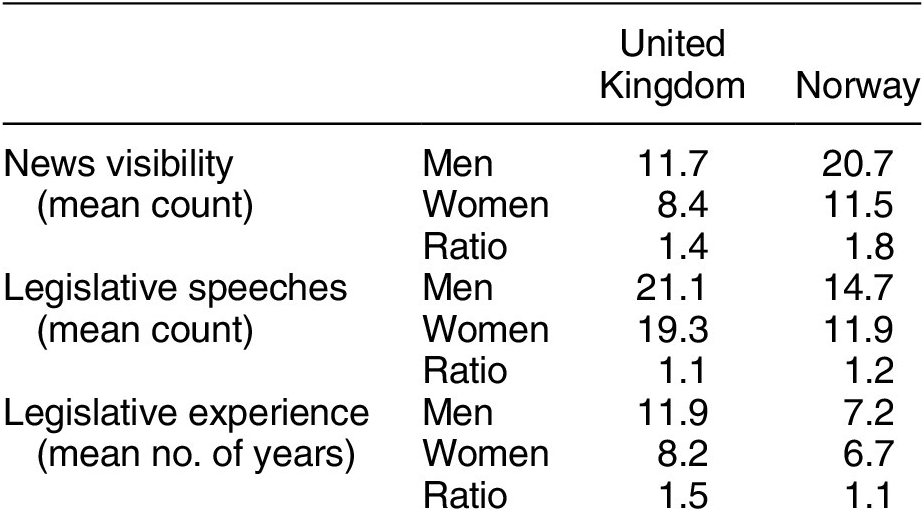
Summing up the raw counts, the gender gap can be experienced quite massively by the public each day, considering how the news we consume on the aggregate contains up to more than five times the coverage of male MPs. And it can be experienced by the MPs themselves of course, as woman MPs must accept that their male colleagues receive up to twice their coverage. However, a more nuanced picture of gender differences requires multivariate models, which we present below.
Multivariate Models of the Gender Gap in News Visibility
We report our multivariate models of the visibility gap in Table 3. The stepwise inclusion of variables indicates that neither list position nor legislative speeches and experience can account for the gender gap in Norway. Party, cabinet, and district characteristics matter somewhat though, reducing the coefficient for the gender variable from –0.524 to –0.413. In the UK, stepwise modeling clearly suggests that the individual-level visibility gap from Table 2 is strongly linked to the gender gap in parliamentary experience. When including this in the multivariate models, the gender effect almost disappears.
Multilevel Negative Binomial Regression Models of Quarterly News Visibility for MPs, United Kingdom and Norway

Note: Standard errors in parentheses.
aUK—Margin of votes; NO—List position (inverted).
*p < 0.10, **p < 0.05, ***p < 0.01.
Given that coefficients from negative binomial regression models do not have intuitive or easy interpretations, we estimate predicted news visibility counts for men and women MPs, with all control variables held constant at their means. The results, based on the full models in both countries, are reported in Table 4.
Predicted News Visibility of MPs by Gender, United Kingdom and Norway

Note: *p < 0.10, **p < 0.05, ***p < 0.01.
Overall, when controlling for experience and a range of other confounders, the UK exhibits gender equality in MP news coverage, whereas Norway appears to lag. In fact, the predicted news coverage of men and women MPs in the UK is practically equal. In contrast, male Norwegian MPs receive 6.6 more counts per quarter than do female MPs, a difference equaling a ratio of 1.6. In the UK, the descriptive gender gaps in the raw counts shown above are still relevant: women are less likely to be MPs, and once they are, they are likely to have less experience. But the multivariate models show that for each step taken in terms of bridging the formal gender gap (in representation and experience), gender equality also in aggregate news visibility should come ever closer. In Norway, however, the gap that was apparent in the descriptive statistics does not disappear in our extensive, multivariate models.
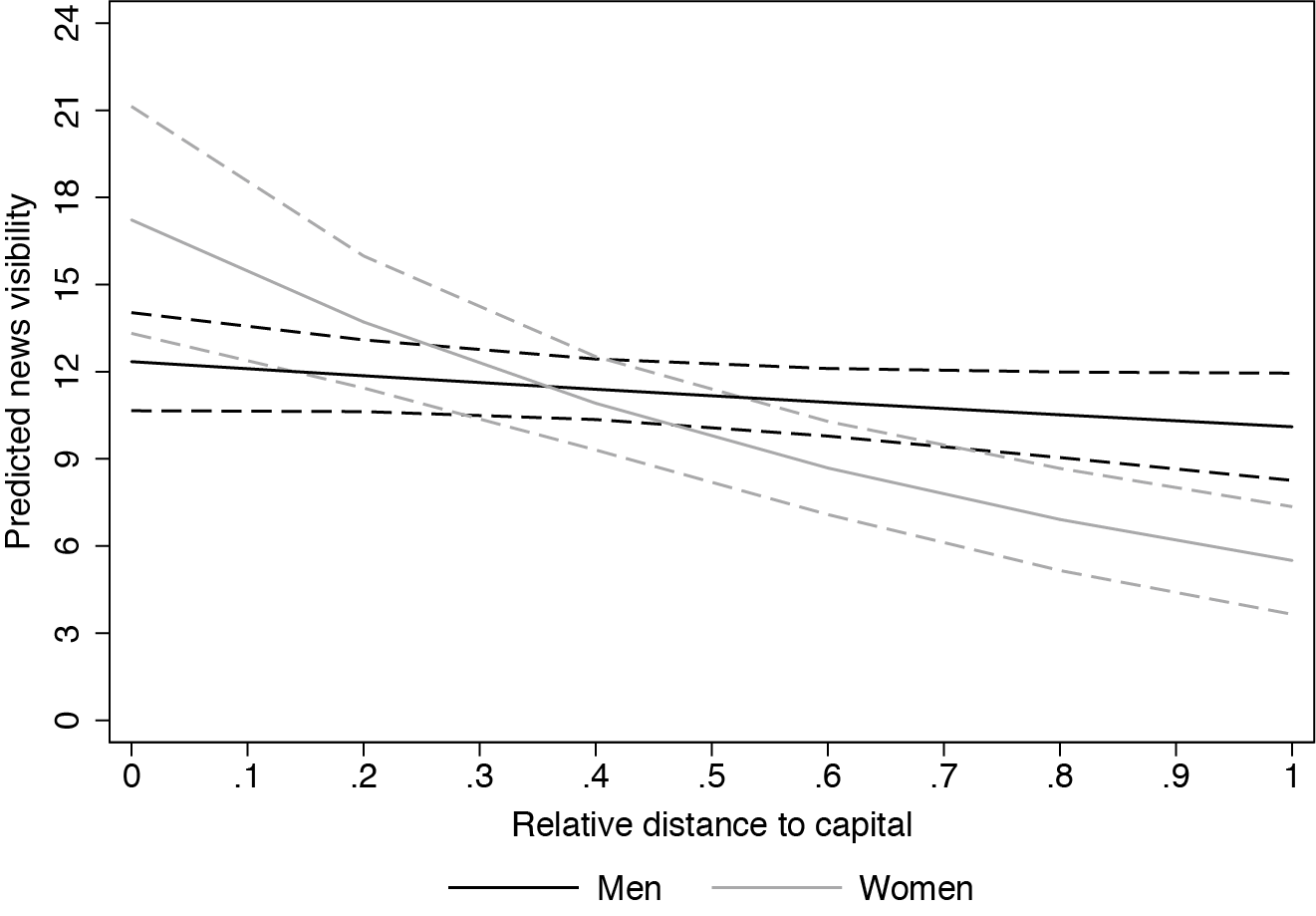
Figures 2 and 3 report the results of two additional analyses designed to test the observable implications of our general argument.Footnote 13 Looking at Figure 2 first, the UK plot is based on a model in which the gender variable was interacted with district distance from capital. The expected relationship is clearly visible. Predicting the news visibility for MPs from the most remote districts (e.g., northern Scotland), we find that women representatives receive nearly half the attention their male counterparts receive (6.2 vs. 11.7 appearances per quarter). Although the news visibility of men MPs is unaffected by the geographical distance from their district to the capital, women MPs gradually receive less news attention as this distance increases. In other words, journalists report less on MPs from remote districts only when these MPs are women.
The Effect of District Distance to Capital on News Visibility across Gender, UK
The Effect of District Size (in Seats) on News Visibility across Gender, Norway

Figure 3 is based on the Norwegian data, illustrating how district size in seats matters for the gender gap within a PR system. The plot graphs predicted news visibility estimated from a model where district size (in seats) was interacted with gender (see Appendix A, Table A2). The results indicate that although male MPs become more visible as their district size increases, the corresponding trend is weaker for women MPs.Footnote 14 Thus, when considering the smallest districts, these bear a closer resemblance to the gender balance in the UK, whereas districts with higher numbers of seats exhibit a larger gender gap. In fact, the constituencies with the most seats have a gender gap that is nearly four times as large as the corresponding gap in smaller constituencies.Footnote 15 Overall, both the main results and the supplementary tests provide support for the idea that electoral systems, and particularly the size of electoral districts, matter to the gender visibility gap in political news.
Several alternative models and data set-ups have been tested to assess the robustness of the findings reported above. The outcome clearly indicates that our conclusions remain the same regardless of model specifications: neither robust standard errors nor the inclusion of a lagged dependent variable influences results (see Appendix A, Table A5). Furthermore, pooling the Norwegian and UK data in one model using only the common variables across systems makes no difference (see Appendix A, Table A6 and A7). The same goes for replacing quarterly data with either monthly or yearly observations (see Appendix A, Table A8).
In a final robustness test, we explore whether separating campaign periods from routine times affects our findings of, respectively, a gender bias (Norway) and a lack of gender bias (the UK). The motivation stems from the idea that mechanisms underlying gender gaps could be different during election campaigns due to stronger incentives to be visible to the public. Additionally, we find it useful to explore this distinction because we rely on data from both routine times and campaign periods, whereas the bulk of previous empirical work rests more strongly on data from campaign periods.Footnote 16 Table A9 in Appendix A displays the four models (two models for each country), suggesting no substantial differences in the gender coefficient across campaign and routine contexts in either Norway or the UK.
CONCLUSION
Based on an original and rich dataset covering the news visibility of hundreds of MPs from Norway and the UK over more than 15 years, this study has contributed to our understanding of gender balance in political news in several ways. First, the results emphasize that much ground remains to be covered before political news can be called “gender equal” in both countries. The raw counts tell a story of a strong imbalance on the aggregate: the average news content features a man to woman ratio of 3 to 5.5 for ordinary MPs. Even after controlling for the gender gap in formal political representation, the average male MP gets up to nearly twice the coverage of the average female MP. Although the numbers become less biased when we start controlling for various explanations, the grossly gender-imbalanced image of politics observed in the news every day should not be ignored. Little imagination is required to see how this likely has slowed down—and still slows down—the closing of gender gaps, by reinforcing existing gendered stereotypes of politics.
Second, through multivariate models we have reproduced the recent finding that only in PR systems does the news visibility gap persist after controlling for the many aspects of MPs, parties, and districts that influence their news value (Van der Pas and Aaldering Reference Van der Pas and Aaldering2020). The stepwise inclusion of variables also reveals how parliamentary experience accounts for most of the gender differences in UK news, at the same time painting a discouraging picture of a robust and defiant gender gap in Norwegian political news.
Third, we have put forward a novel theoretical argument that explains how electoral systems, by moderating the demand for and the supply of female voices in political news, influence the gender gap in news visibility. This argument basically turns previous theoretical expectations upside down and to a larger extent integrates the narratives of this literature with knowledge about electoral districts in PR and plurality systems. In our view, this is a valuable and necessary step toward uncovering the mechanisms behind one of the most recent and puzzling findings in the literature: that plurality electoral systems are more gender balanced than are PR systems in terms of news visibility. Specifically, we argue that MMDs lower the barrier for informal discrimination practices, such as the creation of gendered networks and the influence of gendered stereotypes on source selection, at the same time making individual, negative experiences from media work—and thus also gender—more important for how strongly MPs prioritize getting into the news.
Fourth, acknowledging from the start that a comparative study of only two countries will always be limited in terms of causal inferences about electoral systems, we have leveraged the considerable within-country variation in our data to test observable implications of the theoretical argument in both Norway and the UK. The results of these tests produce additional, albeit indirect, support for our claim and for the demand- and supply-side arguments. In the UK, the hypothesized protection from gender bias offered by single-member districts disappears when the districts can be considered less important. For example, the news value of proximity indicates that distant districts are less interesting. Therefore, journalistic decisions regarding networks, reporting, and sourcing become less restricted and more vulnerable to gendered practices. In line with this reasoning, we observe that women MPs from distant districts are systematically bypassed. In Norway, the gender gap is lowest in districts with fewer seats, illustrating that biases are smaller when electoral districts in PR systems are more similar to plurality districts. When districts are larger, the rewards of being in the news decreases, which suggests that those MPs who face more obstacles can afford to reduce media work.
Future research must carefully address alternative and supplementary explanations in more elaborate comparative (and potentially also experimental) research designs (see conclusion in Van der Pas and Aaldering Reference Van der Pas and Aaldering2020). A larger number of cases could tell us more about how differences in PR countries (e.g., between open and closed lists, small and large populations, or concentrated and dispersed political elites) affect the gender gap. For instance, studies suggest that candidates in open-list systems, where preference votes for individual candidates matter, run more personalized campaigns than candidates in fixed or closed-lists systems do (Zittel Reference Zittel2015). It is a fair assumption that this distinction is relevant to how candidates prioritize media access, so future research should investigate whether these different incentive structures also influence gender gaps. Indeed, debates about electoral reforms will clearly benefit from more knowledge about the relationship between preferential voting and the news bias that others and we find in PR systems.
The more general point here is that we have focused on electoral systems because they have a profound and varied influence on democratic politics (Gallagher and Mitchell Reference Gallagher and Mitchell2005). This also means that their influence on the gender gap in political news could work through several mechanisms. Therefore, it is important that future research address more cases and more distinctions between electoral systems. For instance, the variation between open and closed lists mentioned above points to a potential supplemental explanation of the difference between PR and plurality systems. It could be that the personalized electoral campaigns of SMDs build stronger, generic media skills than do the less personalized campaigns in MMDs. The argument would be that this is crucial to women MPs (more so than to men) due to the gendered practices and negative feedback they are exposed to. Women MPs in an MMD context could have benefited from such campaign experience when trying to close the gap that gendered news production mechanisms otherwise create. To the extent that this is the case, electoral systems would matter in more ways than we have argued.
The amount of outreach MPs do to get into the news, through social media, press-releases, and informal contacts, is another topic deserving attention in the study of gender gaps (Midtbø Reference Midtbø2011). Studies additionally covering local and regional news would also be of great interest, as would exploring the gender gap in light of news media regulations and news market structures comparatively (Sjøvaag and Pedersen Reference Sjøvaag and Pedersen2019). In terms of research gaps, we again point to the lack of empirical work on the supply-side explanations addressed in this study. More research is needed to better understand how the different gender biases facing women in politics influence their role perceptions and work. To give just a couple of examples, we should explore whether and how women MPs are affected by, on the one hand, the prevalence of traditional and conservative gender norms in their networks or districts and, on the other hand, the biases they encounter in the public discourse.
Van der Pas (Reference Van der Pas2022, 1488) recently suggested that differences in media systems could underlie the remarkable difference between the UK and other European countries. According to Hallin and Mancini (Reference Hallin and Mancini2004), the liberal media system in the UK is characterized to a larger degree by commercialization and journalistic professionalism, whereas the democratic corporatist model in Norway affords more room for state intervention in the media. We agree that a potential link between professionalism and gender-equal reporting deserves more research attention. Nevertheless, there are good reasons why we believe the differences in media systems do not invalidate our comparison and results. First, a process of convergence (Hallin and Mancini Reference Hallin and Mancini2017, 163–4) has made Nordic media systems more similar to those of the UK and the liberal models (Nord Reference Nord2008). Second, we find that there is in fact a gender gap also in the UK, applying to MPs from remote districts. News about these MPs is made by the same institutions and journalists as is the gender-balanced news about more centrally located MPs. To our mind, this at least questions whether the observed variation in the visibility bias between Norway and the UK is down to system-level differences in journalistic professionalism.
Finally, putting the present paper in a broader perspective, the overall picture that emerges is one where PR and plurality systems each have specific challenges and advantages in the fight against gender inequality in politics and political news. In line with what we already know about electoral systems and the representation of women (Tremblay Reference Tremblay2012), PR combined with strong party control of nominations and a gender-equal society lowers the initial threshold for achieving a more gender-equal political representation. And this is also duly reflected in the more favorable (but still imbalanced) aggregate-level news visibility gap in Norway. But our results, in combination with recent findings in the field, suggest that PR systems may face a substantially higher threshold of gender equality for those who have passed the representation threshold—at least in terms of their representation in political news. In other words, it again becomes clear that a development toward more formal gender equality does not guarantee actual equality, as we observe for instance with the visibility gap in Norway, which shows no sign of abating. The finding that women MPs in the UK receive as much attention as their male counterparts do and that the current gap on the aggregate level is more or less fully explained by an experience gap put plurality systems in a different light. Logic dictates that women MPs will gradually close the experience gap, and if the progress continues in terms of gender equality in formal representation, the massive, aggregate news visibility gap is destined to disappear over time in the UK. Challenges to gender equality remain, of course, as this says nothing about how women are portrayed in the news. Nor does it tell us anything about gendered practices and cultures within the legislative bodies of PR and plurality systems. But it nevertheless nuances the dominant story, where PR is portrayed as the more gender-inclusive electoral institution.
SUPPLEMENTARY MATERIALS
To view supplementary material for this article, please visit http://doi.org/10.1017/S0003055422000776.
DATA AVAILABILITY STATEMENT
Research data that support the findings of this study are openly available at the American Political Science Review Dataverse: https://doi.org/10.7910/DVN/AIKUDN.
ACKNOWLEDGMENTS
We thank Peter Bjerre Mortensen, Erik De Vries, Christoffer Green-Pedersen, Will Jennings, Annelien Van Remoortere, Rens Vliegenthart, and Stefaan Walgrave, as well as the editors and anonymous reviewers for their helpful comments and suggestions.
FUNDING STATEMENT
This research was funded by the University Fund for Rogaland, Stavanger, Norway.
CONFLICT OF INTEREST
The authors declare no ethical issues or conflicts of interest in this research.
ETHICAL STANDARDS
The authors affirm this research did not involve human subjects.


 Open access


Comments
No Comments have been published for this article.