





Our global food system is distorted by inequalities in access and fails the people most in need. For over a decade, evidence has emerged to show that more than enough food is generated for the 7 billion population, yet half the global population is malnourished(Reference McGruire2) and about 2 billion are deficient in key micronutrients (3). The consequent ‘double burden’ of disease (obesity and malnutrition), partially driven by ‘the nutrition transition’(Reference Popkin4) with increased dietary intakes of refined sugars, fats, oils and processed meats, is related to a pandemic of ill health, which in the UK costs the NHS over £6 billion each year(5). If unchecked, it is predicted that by 2050 current dietary trends will cause significant damage to the environment (e.g. biodiversity loss and increased pollution), as well as increased ill health (i.e. higher prevalence of chronic non-communicable disease). The implementation of solutions to address the tightly linked ‘diet–environment–health’ trilemma has been flagged as a pressing global challenge(Reference Tilman and Clark6) particularly for lower socio-economic (less affluent) communities, for whom the food system should provide sustainable access to safe, nutritious, affordable food.
The purpose of this review paper is to provide a critical overview of the need for food system transformation with a focus on how to engage ‘less affluent’ communities more effectively within this discourse. The paper firstly provides extensive context on the nature of the ‘wicked problems’ faced by less affluent communities, including (i) sustainability of the food system and social justice; (ii) food choices to achieve a healthy and sustainable diet; (iii) dietary impact of socio-demographic characteristics; (iv) (diet-related) social and economic inequities. The paper then proposes the use of more creative community-centric approaches as solutions to support the transformation required to improve the food system to build community capacity and capital. A current exemplar is provided (the community food researcher model: FoodSEqual project) and critiqued to reflect on this approach of engaging communities in research processes. The paper ends with practice insights and critical considerations making recommendations on how to optimize the utility of such creative community-centric approaches to support food system transformation.
Sustainability of the food system and social justice
The term ‘sustainability’ is widely used and refers to three pillars for sustainable development – social, economic and environmental. The relevant related historical definition is that: ‘Sustainable development [meets] the needs of the present without compromising the ability of future generations to meet their own needs’(Reference Burndtland7). In public health nutrition, ‘sustainability’ refers to the ability to maintain food system capacity to support the nutritional health needs of current and future populations whilst protecting the ecological systems that produce food(Reference Lawrence, Burlingame and Caraher8). Traditionally, sustainability has been largely overlooked in public health nutrition activities as they have tended to focus on addressing relatively short-term nutritional needs of populations and framed these needs mainly within a biological health context. Yet in 2005, the Giessen Declaration highlighted how ‘new nutrition science’ needed to move beyond biomedical science to address ethical concerns that include social and ecological factors(Reference Beauman, Cannon and Elmadfa9) and proposed more problem-solving scientific approaches coupled with compassion, socio-economics and a planetary perspective(Reference Wahlqvist10). The Giessen Declaration stated that an integrative approach with strong technology links is needed to address human security(Reference Beauman, Cannon and Elmadfa9).
When considering sustainable (food) development, the goal should be to ensure a future when the expanded global population – predicted to reach 10 billion people by 2050(11) – has enough food available to eat and access to high-quality nutritious foods. Despite substantial evidence linking diets with human health and environmental sustainability(Reference Fischer and Garnett12–Reference Marson and Lang14) historically, there has been a lack of globally agreed targets for healthy diets from sustainable food systems. In 2019, the Eat Lancet Commission assessed existing evidence and developed global scientific targets that define a ‘safe operating space’ for food systems(Reference Willett, Rockström and Loken15). These targets focus on (i) healthy diets and (ii) sustainable food production and are projected to reduce harmful environmental impacts (climate, freshwater use, biodiversity loss, nitrogen and phosphorous use), to be capable of sustainably feeding the world’s population in 2050 and also to prevent approximately 11 million premature deaths among adults globally. For example, reduction in red and processed meats is a key target because they are known to have the single biggest environmental impact of any type of food(13) as well as also being associated with high rates of mortality and morbidity(Reference Schwingshackl, Schwedhelm and Hoffmann16) and poor health outcomes such as colorectal cancer(17).
The food system includes ‘all the elements (environment, people, inputs, processes, infrastructures, institutions, etc.) and activities that relate to the production, processing, distribution, preparation and consumption of food, and the outputs of these activities, including socio-economic and environmental outcomes’ (18). In the UK, this system affects social, economic and natural environments(19) and aims to provide access to safe, nutritious, affordable food for all citizens(20,Reference Border and Barnes21) . But strong evidence suggests this aim is not being met. Food is known to be an ‘identifier and maker of class, culture and civilization’(Reference Coveney22), and its symbolic potential is powerful, both individually and collectively within society. Yet, because food sits at the intersection of multifarious disciplines (of which nutrition is one, others include humanities; food science; climate science; geography), it feeds into a highly complex and often contradictory, nuanced and politically driven social justice discourse.
Food choices to achieve a healthy and sustainable diet
There is well-established evidence to support our food choices being influenced by a complex mix of interrelated factors such as socio-cultural, psychological, traditional and political(Reference Monterrosa, Frongillo and Drewnowski23). Similarly, environmental elements like marketing and labelling play an important role on influencing an individual’s preferences and understanding of what constitutes a healthy diet(Reference Leng, Adan and Belot24). These food practices are learned at an early age from parents/carers as well as via the school environment(Reference Monterrosa, Frongillo and Drewnowski23,Reference Hardcastle and Blake25,Reference Swinburn, Caterson and Seidell26) . Consequently, the socio-economic background and cultures of the family/household have a significant influence on early habit-shaping, leading to longer-term dietary preferences.
Evidence shows that the UK population does not currently consume the right balance of food recommended for either a healthy or a sustainable diet(Reference Scheelbeek, Green and Papier27). Poor diets are characterized by irregular eating patterns, high intake of ‘less healthy’ – processed meats, refined grains, fried and processed foods containing sugar, salt and fat(Reference Rauber, Da Costa Louzada and Steele28,Reference Rauber, Steele and Louzada29) and low intake of ‘healthy foods’ – fruit and vegetables(Reference Salvin and Lloyd30), nuts and seeds(Reference d’Angelo31). Due to the constant development in understanding the roles that foods play in health and disease, the definition of a ‘healthy diet’ continues to evolve(Reference Cena and Calder32). Yet, the adverse health outcomes linked to poor diet continue to rise, including escalating rates of overweight and obesity (currently 64 % of the UK adult population are overweight or obese), type 2 diabetes, cardiovascular diseases and some cancers(Reference Afshin, Sur and Fay33–35). Indeed, 15·5 % of Western European deaths are known to have been attributed to poor dietary habits alone(Reference Afshin, Sur and Fay33). Furthermore, strong evidence supports the role diet and nutrition plays in affecting mental health outcomes(Reference Firth, Gangwisch and Borsini36,Reference Grajek, Krupa-Kotara and Bialek-Dratwa37) often due to ‘marginalization’ and social isolation.
How a healthy diet links to a sustainable diet is of key importance. Strong evidence shows that the Greenhouse gas emissions of the average UK diets are reported to be higher than the whole European Union average(Reference Scheelbeek, Green and Papier27). This Scheelbeek study analysed the UK Eat Well Guide(38) and found that if the population could adopt this way of eating, the overall carbon footprint would be reduced by almost a third as well as improvements in mortality risks from diet-related diseases(Reference Scheelbeek, Green and Papier27). But this same study also showed very low adherence to the Eatwell guide, with less than 1 % of the UK population adhering to all nine of the recommendations. The value of how food choices are influenced by such socio-cultural factors are vital considerations for health practitioners and policymakers(Reference Monterrosa, Frongillo and Drewnowski23) to better understand food system sustainability.
Dietary impact of socio-demographic characteristics
What’s more, dietary patterns are strongly associated with socio-demographic characteristics(Reference Roberts, Cade and Dawson39) with lower socio-demographic groups suggested as being less likely to consume diets aligned with public health guidance(Reference Maguire and Monsivais40). According to the National Diet and Nutrition Survey (NDNS), when compared with more affluent households, less affluent households consume fewer fruits and vegetables (2·7 portions per day compared to 4·3 portions per day) and less fish (12 g compared to 21 g per week). Similarly, sugar-sweetened soft drinks consumption (108 g per day) is high in less affluent households(41) which is several times higher than the recommended intake for health(42). These findings support evidence suggesting UK less affluent communities are failing to eat healthy diets.
Socially and economically disadvantaged communities can be defined as ‘individuals and families at risk of food and housing insecurity, often culturally diverse, who can experience multiple challenges; financial, mental health and physical health’(1). Such communities are particularly at risk of food insecurity due to their inability to afford healthier foods(Reference Pechey and Monsivais43,Reference Gillies, Super and Te Molder44) . Food access, quality and quantity are significant social determinants of health, and there remains a lack of understanding about what underpins food choices (or lack of choices) in such communities(Reference Graham, Stolte and Hodgetts45–Reference Antin and Hunt47). This is because multiple and complex factors underpin food consumption patterns such as low income(Reference Hough and Sosa48), homelessness(Reference Sprake, Russell and Barker49), drug and alcohol addictions(Reference Spooner and Hetherington50), lack of nutritional knowledge and life skills such as food preparation, cooking and shopping(Reference Pooler, Morgan and Wong51) and limited cooking facilities(Reference Oakley, Nikolaus and Ellison52). Moreover, the food experiences of socially excluded adults vary widely with individual circumstance(Reference Burnett, Hallam and Kirby53), further accentuating the complexity of this topic. Although keen to improve their diets, socially and economically disadvantaged communities are often prevented from doing so by barriers such as poor access to affordable and healthy fresh produce(Reference Wang, Touboulic and O’Neill54). Indeed, structural factors(Reference Hunt, Pettinger and Wagstaff55) and the food environment are known to play a key role in food/nutrition inequities, with disadvantaged communities having compromised access to and availability of healthier foods(Reference Sawyer, Van Lenthe and Kamphuis56) and higher availability of low-quality, highly obesogenic foods,(Reference Eskandari, Lake and Rose57) for example hot food takeaways(Reference Turbutt, Richardson and Pettinger58) and convenience offerings(Reference Williamson, Mcgregor-Shenton and Brumble59). For this reason, disadvantaged communities are often treated as powerless recipients of dietary and health initiatives or as ‘choiceless’ consumers within food supply chains.
(Diet-related) social and economic inequities
More recently, socially and economically disadvantaged communities have faced further challenges due to the coronavirus pandemic and now the cost-of-living crisis(60), which is exacerbating affordability issues(Reference Goudie and Hughes61), coupled with escalating risk of food insecurity(Reference Loopstra62). This means enhanced potential for physical and mental health concerns. Food insecurity is more than just an economic issue; however, it is also driven by social determinants. Inequalities in diets contribute to overall health inequalities(63) and are key preventable risk factors to ill health. Health inequalities arise because of the conditions in which we are born, grow, live work(Reference Marmot, Allen and Boyce64). This aligns with evidence on the state of equality and human rights in England(65) highlighting geographical variation in life expectancy and health, supporting lack of fairness across England. COVID-19 had a stark impact on nutrition(Reference Rodriguez-Leyva and Pierce66) and exposed widening inequalities in the UK food system(Reference Power, Doherty and Pybus67). Indeed inequity, as a known cause of malnutrition, was found to be linked to worse COVID outcomes(Reference Nabarro68). There exists a growing recognition of unequal nutritional health and fragmented/insufficient welfare provision, particularly affecting vulnerable individuals, for example, unemployed, households with children, people with health conditions and disabilities(Reference Barker and Russell69) and most notably ethnic minority groups, illuminating stark racial disparities(Reference Alkon, Bowen and Kato70). Consequently, there are short-term and longer-term implications for well-being and equity(Reference Marmot, Allen and Boyce64).
When it comes to diet and nutrition, in terms of their measurement, Dowler(Reference Dowler71) confirmed a lack of UK research on the food and nutritional experience of individuals whose circumstances fall outside official surveys. Indeed, traditionally quantitative datasets (i.e. using dietary survey methodologies, such as NDNS outlined above) are the predominant source of information about UK diets,(Reference Campbell, Smith and Baird72) yet it is known that such datasets may misrepresent the diets in disadvantaged communities because sub-sample sizes are small(Reference Holmes, Dick and Nelson73) and they fail to consider the wider structural perspectives(Reference McLaren74). Interventions addressing individual factors and physical environments are necessary cornerstones for dietary reform but on their own are insufficient to bring about the large-scale social and system changes needed to fully respond to sustainability challenges(Reference Lawrence, Burlingame and Caraher8). Recent qualitative scoping review evidence highlights the need for food systems research to focus more on macro/structural factors, such as the nuances of socio-economic interactions and affordability and access issues(Reference Hunt, Pettinger and Wagstaff55). The same review highlights the need to take a systems thinking approach, embrace new theoretical perspectives and adopt innovative ‘co-production’ methods to support food system transformation and amplify community voices to build resilience, resourcefulness and community capital.
The need for (socially driven) food system transformation
As illustrated above, our dietary behaviours and the way we have developed and operated food systems are contributing to the disruption of ecological systems that are crucial to sustainability. The consequences of this disruption are profound and include adverse impacts on food security(75), nutritional quality(Reference Miller, Webb and Cudhea76), variety, food safety(Reference Uyttendaele, Franz and Schlüter77) and ultimately public health nutrition(Reference Lawrence, Burlingame and Caraher8), not to mention the quality of lives of those producing the food, especially in resource-poor settings(11). The need for urgent action is critical – action to remove the causes of the problem(s), build resilience to the problem(s) and treat the symptoms of the problem(s). Equitable dietary and food system change is needed at scale, and to do this, a multi-criteria approach is warranted, one that gives equal weight to nutrition and public health, the environment, socio-cultural issues, food quality, economics and governance(Reference Marson and Lang14).
The fact that diet-related inequalities continue to widen, and the food system is implicated in this, points to the need for urgent food system transformation(Reference Dimbleby78) but it is highly complex (and political!). Indeed, Haerlin(Reference Haerlin79) highlights the scope and complexity of this task calling for a paradigm shift integrating the ‘previously segregated sectors of production, processing, trade, consumption, environmental assessment, and health, as well as knowledge systems’. In response to increasing social inequality, the government’s recent levelling up agenda(80) purports to highlight ‘social capital’ (i.e. the strength of community’s relationships and trust) as one of their key drivers and priorities. However, there is debate around the nature of the term ‘social capital’(Reference Thomson, Balaam and Hymers81), and the levelling up agenda has been critiqued by researchers as unrealistic with limited potential to reduce health inequalities(Reference Bambra82,Reference Fransham, Herbertson and Pop83) . Despite this, the proposed agenda aligns with the ‘social sustainability’ pillar [mentioned above] and supports the need to engage the communities within the food system that serves them(Reference Cachelin, Ivkovich and Jensen84). This translates into working more closely with local people in their communities, empowering and enabling them to drive the change required, whilst also acknowledging power and the political landscape(Reference Booth85). Thus, tackling the reality of community members often feeling like powerless recipients of dietary and health initiatives or as ‘choiceless’ consumers within food supply chains.
The vision should be, therefore, for a food system where the values of health, society and the ecosystem are of equal importance(Reference Carlsson, Mehta and Pettinger86). Critical food justice scholars use a more expansive lens to suggest that a ‘bottom-up’ democratized food system is needed(Reference Cachelin, Ivkovich and Jensen84). This requires systemic change that embraces diversity and respects the variability in foodways (‘choices’) within our society. This would also embrace the proposed problem-solving scientific approaches of ‘new nutrition science’ coupled with compassion, socio-economics and a planetary perspective(Reference Wahlqvist10). Such a model would liberate both the underrepresented and underserved, advocating with rather than for less affluent communities, as well as the elite, and result in more equitable and lasting solutions to complex social problems in the food system(Reference Moore and Swisher87). Engaging citizens in the complex food connections that shape their well-being is, however, challenging. Roe and Buser(Reference Roe and Buser88) argue the need for arts-based participatory activities, formed through food’s agentive potential, to support collaborative ecological citizenship, in a way, using creative food activities as a means for enhancing and rebuilding self-organizing community capacity(Reference Blake89).
Creative community food system solutions
There is an urgent need to ‘get creative’ with the way we tackle social and nutritional inequalities. Indeed, ‘health inequalities should be addressed via processes that allow marginalized groups to have a “seat at the table” and a real voice in decisions affecting their lives’ (Reference Minkler90). Community participation is believed to hold a number of benefits, including the incorporation of local knowledge in planning, generation of greater support for and sustainability of local actions and consistency with democratic values(Reference Pelletier, McCullum and Kraak91). Community engagement interventions have been shown to improve health behaviours and self-efficacy(Reference O’Mara-Eves, Brunton and Oliver92) and co-production approaches can, if carried out comprehensively, radically redistribute power within the research process(Reference Thomas-Hughes93), Participation in food/nutrition projects in particular can build trust, self-esteem and improve food skills(Reference Pettinger and Whitelaw94–Reference Pettinger, Parsons and Letherby96). The inherently social activity of engagement with food combines positive health outcomes with other cultural activities, such as the arts(Reference Stuckey and Nobel97). Creative expression has the potential to engage individuals in personal and community-level change through reflection, empowerment and connectedness(Reference Gray, Oré De Boehm and Farnsworth98). This suggests that novel methods (with food) can be seen as ‘co-creative’ in empowering people to re-connect with their food which might have the potential to lead to transformative food discourses(Reference Pettinger, Parsons and Letherby96,Reference Pettinger, Letherby and Parsons99) . Such suggestions form important building blocks of cohesion and social capital and are therefore worthy of investigation.
Participatory research methods are geared towards planning and conducting the research process with those people whose life-world and meaningful actions are under study(Reference Bergold and Thoman100). Participatory Action Research (PAR) specifically is defined as a ‘systematic inquiry, with the participation of those affected by the problem, for the purposes of education and action or affecting social change’ (Reference Minkler90,Reference Green, George and Daniel101) . PAR is a well-documented strategy to improve the situations of vulnerable people(Reference Pettinger, Letherby and Parsons99,102) . Such creative approaches can empower communities more effectively(Reference Booth85) in research processes cultivating narratives of hope and getting people more involved in decision-making(Reference Thomas-Hughes93). By challenging elite models of policy and research, they can also subvert traditional top-down expertise and professional authority in favour of more democratically inclusive and participatory quests for knowledge(Reference Richardson103). Thus, we advocate for ‘co-production’ methodologies, which are more inclusive, democratic, fair and non-stigmatizing, challenging issues of power and transparency we often see in research practices(Reference Hunt, Pettinger and Wagstaff55,Reference Booth85,Reference Pettinger, Letherby and Parsons99) .
Participatory methods with food
As illustrated above, arts-based methods offer emancipatory approaches to health research with the potential to promote social justice(Reference Fraser, Brady and Lordly104), challenging more traditional positivist/reductionist ‘biomedical’ approaches for nutrition and other health professionals. By using such creative methods of engagement, the paradigm can be shifted towards more relational and progressive socially inclusive food system research with human connection at its heart(Reference Cottam105).
Creative approaches within food research have been extensively explored. Participatory visual methods specifically are considered to be ‘modes of inquiry that can engage participants and communities, eliciting evidence about their own health and well-being’(Reference Mitchell and Sommer106), for example, photo-elicitation methods(Reference Pettinger, Parson and Cunningham95), which involve inserting photography and photographs into a research process in order to maximize the possibilities for empirical and ethnographic enquiry. The photograph can be a neutral third party(Reference Schulze107) and can ‘evoke deeper elements of consciousness than words’(Reference Harper108). Similarly, participatory food events(Reference Pettinger, Parsons and Letherby96) can offer knowledge exchange and public engagement opportunities to build relationships and social connections. Collage (or visual mind mapping) is an important arts-based method for engagement and empowerment(Reference Wheeler109,Reference Flint, Pettinger and Schoen110) , which utilizes sought images and objects to foster the process of de-construction in the tearing, cutting and gluing of images and objects(Reference Pettinger, Parsons and Letherby96). Music/song communicates expressively as a deeply reflexive tool(Reference Pettinger111) and can, within food justice discourses, enhance political potency, ‘providing meaning to express things we don’t know how to articulate in words’(Reference Douglas112). Finally, documentary filmmaking has a rich history in humanities research and successful documentary films use compelling stories to influence positive individual and environmental changes(Reference Brandt, Freedman and Friedman113). Powerful and authentic food stories can be relayed in this authentic manner, falling within the tradition of public sociology(Reference Burawoy114) to generate new knowledge(Reference Pettinger and Elwood115). These methods (and others) are known to empower a wider range of individuals to share their ‘lived food experience’ narratives, building relationships and corroborating ‘co-production’ philosophies. The deeper understanding that emerges from close attention being paid to hearing and interpreting people’s food stories through such creative methods can offer alternative ways to understand the lived experience of food insecurity(Reference O’Kane and Pamphilon116) and build a more collective voice that can democratize the food system(Reference Cachelin, Ivkovich and Jensen84).
Another participatory approach that is emerging within the food system transformation space is the use of community food researchers to support research endeavours. The remainder of this paper will critique this as one example of a model to achieve positive outcomes.
Situating the community food researcher model
Within participatory research methods, many researchers have attempted to quantify levels of public participation, for example with scoring systems(Reference Khodyakov, Stockdale and Jones117,Reference Johnson, Diaz and Arcury118) , and visualization as a spectrum(119) (Fig. 1) or citizen participation ladder(Reference Arnstein121). Questions are also asked on whether the participation is ‘genuine’(Reference Jagosh, Bush and Salsberg122) and who actually has rights within research decision-making processes(Reference Bergold and Thoman100). This is about how research processes are done and who does what within them.
The spectrum of public participation from informed to empowered, taken from.(119) See also(Reference Vaughn and Jacquez120) for an adapted version tailored towards research. Please note that the use of such spectrums has been critiqued as allowing research which only consults with people in some way (e.g. through interviewing) to class itself as participatory.(Reference Bergold and Thoman100)

The community researcher model attempts to sit within the parts of the spectrum where community members collaborate or are empowered(Reference Booth85). This is enacted by them taking researcher roles and co-delivering research (Fig. 1). Community researchers are normally ‘peers’ to those being researched(Reference Thomas-Hughes and Brake123), usually due to geographical proximity or shared characteristics or experiences, for example, people who use drugs(Reference Damon, Callon and Wiebe124) or cancer survivors(Reference Mosavel and Sanders125).
Across different disciplines and geographic regions, there are many models and terms used for participatory research(Reference Minkler126), for example PAR(Reference Fals-Borda127,Reference Fals-Borda and Rahman128) as already discussed; Community-Based Participatory Research(Reference Minkler126); Community-Based Research(Reference Israel, Schulz and Parker129,Reference Caine and Mill130) ; and Co-Production(Reference Ostrom131,Reference Smith, Williams and Bone132) . All of these models aim to engage non-academic stakeholders in knowledge production processes, but the roles given and engagement methods vary widely. In fact, even those using the same terminologies may implement delivery very differently(Reference Smith, Williams and Bone132–Reference Masterson, Areskoug Josefsson and Robert134). Thus, by instating the community members as ‘researchers’, projects make a statement of intent in terms of engagement. Other terms with similar intent include peer researchers(Reference Damon, Callon and Wiebe124,Reference Guta, Flicker and Roche135) and co-investigators(Reference Wallerstein136).
Benefits of working with community researchers include the social capital brought to the project by their community knowledge and embeddedness(Reference Mosavel, Henderson and Beck-Berman137). As they are insiders, they can gain the access and trust required to carry out effective research(Reference Salway, Chowbey and Such138) and support in developing accessible language and culturally safe research practices(Reference Hearn, Biggs and Brown139). There are also benefits for those who take the role of community researcher, such as developing new skills and expanding their social network(Reference Salway, Chowbey and Such138,Reference Vaughn, Jacquez and Zhen-Duan140) ; increased self-confidence and self-efficacy(Reference Vaughn, Jacquez and Zhen-Duan140,Reference Rodríguez Espinosa, Sussman and Pearson141) ; and personal lifestyle changes or progression to further opportunities(Reference Rodríguez Espinosa, Sussman and Pearson141).
Nonetheless, engaging community researchers brings novel practical and ethical challenges and considerations(Reference Pettinger, Parsons and Letherby96). Community Researcher relationships to the ‘community’ they are researching are variable(Reference Thomas-Hughes and Brake123). They may have personal relationships with those they are researching, creating potential for coercion and conflicts of interest(Reference Flicker, Roche and Guta142). Similarly, they may also be emotionally triggered by topics for which they have personal experience. These phenomena have been called ‘cultural proximity’(Reference Simon and Mosavel143,Reference Mosavel, Ahmed and Daniels144) . Challenges also arise when working in ‘physical proximity’ to domains controlled by the target research participants, including conflicts between keeping themselves safe, a sense of duty to help others (relational ethics) and research norms(Reference Richman, Alexander and True145). During research delivery, they must navigate shifting identities and competing priorities(Reference True, Alexander and Fisher146), and tensions can exist between different lines of accountability(Reference Facer and Enright147). Gaining increased knowledge about their community through research can also be experienced as a burden(Reference Salway, Chowbey and Such138).
Given these complexities and the known power asymmetries within the food system(Reference Clapp148,149) , there is a need for careful consideration of community research design and process, for example, including appropriate emotional and peer support for community researchers(Reference Thomas-Hughes and Brake123) and ‘wrap up’ activities to create closure at the end of initiatives(Reference Flicker, Roche and Guta142). Role-specific training is also essential to prepare peer researchers for group facilitation, for example counselling sessions(Reference Logie, James and Tharao150) and exploration of challenges and tensions of the ‘insider research role’, such as conflicts of interest and confidentiality(Reference Flicker, Roche and Guta142). Furthermore, it is important to remember Community Researchers have varied backgrounds and motivations(Reference Facer and Enright147,Reference Thomas-Hughes151) . To reflect these varied learning styles, training should offer different types of value, and the research design includes next steps for the Community Researchers to progress with their new skills(Reference Thomas-Hughes and Brake123). Training can also be a space for power dynamics to be re-written, if intentionally delivered to facilitate this(Reference Thomas-Hughes and Brake123). For example, by demystifying academic terms, community researchers can be enabled to have more input into the process(Reference Thomas-Hughes and Brake123). Existing inequalities can also be worsened if certain communities or stakeholders are excluded, so barriers to participation must be addressed, including social, logistical, financial and cultural(Reference Facer and Enright147). As use of these techniques grows, giving research attention to aspects of process will be crucial, for example exploring outcomes for and experiences of participants(Reference Gardiner, Pettinger and Hunt152).
It is clear that the community researcher model has powerful potential to support community-centred action and perhaps also to tackle the identified food system problems. But this model has not been extensively explored to date in the context of food system transformation research. As well as the [disputed] ‘levelling up’ agenda, recent government-led funding (UKRI Strategic Priorities Fund Transforming the UK Food Systems programme of work) has been realized to create an active ‘Community of Practice’ across food system researchers to address the ‘broken’ food system(153).
Food Systems Equality (FoodSEqual) – a community food researcher model example of good practice
One of the funded consortium projects is the Food Systems Equality (FoodSEqual) project(1), which aims to ‘co-produce healthy and sustainable food systems for disadvantaged communities’. The project focusses on innovating food products, food supply chains and food policies for a more sustainable food system. The most important aspect of the project, however, is putting ‘community’ at its heart, so that change can be catalysed by the communities themselves. The project has set up and run community food researcher models in four geographical urban areas in England to support the research project and adhere to its co-production philosophies. Co-production has core values relating to (i) ‘being human’; (ii) inclusivity (participation); (iii) transparency (sharing of power); and (iv) challenging the status quo(154). Central to FoodSEqual’s model of engagement and co-production are four local sites or research hubs hosting trans-disciplinary research teams comprising community researchers, academic researchers and community partners and practitioners(1,155) .
The following account critiques the setup and training of a group of community food researchers within an urban geographic community in the Southwest of England, with the aim of facilitating the group to participate in research processes in their local community and within the wider FoodSEqual research team.
The potential benefits and complexities for individual community members participating in research have already been discussed above and include the development of personal and social capital(Reference Blake89), clear ‘insider, outsider’ positions(Reference Alexander, Rosalind and Willians156) and recognition of power relations between community researchers and academic researchers as dynamic and contingent(Reference Alexander, Rosalind and Willians156). The (co)development of a framework of training and support which can respond appropriately to the local context and the individual and collective needs of this group(Reference Thomas-Hughes93,Reference Thomas-Hughes and Brake123) is therefore a key focus for this group.
Project resources have created capacity within the community partner(155), a local food partnership and network, which acts as a community liaison, utilizing existing knowledge and relationships to facilitate the engagement of community researchers at a local ‘Well-being Hub’ – a provider of low cost and emergency food, health services and a focal point for community activity in the area. Such organizations are identified as assets for community research endeavours: comprising physical and social and relational(Reference Cachelin, Ivkovich and Jensen84) spaces and knowledge of local issues, creating the potential to galvanize around shared values and goals(Reference Blake89) and as such are understood to play an important role in shaping determinants of health(80).
A series of participatory recruitment events at the Well-being Hub were advertised using flyers and social media as invitations to informal (creative) discussions about local food issues in a relaxed and social environment(Reference Wheeler109,157) . These events provided the preliminary framework to introduce the idea of community (food) research and the aims of the FoodSEqual project to potential community researchers, many with existing roles and connections to local food and community action(155).
Consideration of individual circumstances and potential challenges for community researchers gathering data within their community(Reference Alexander, Rosalind and Willians156) informed a training package, which focused on professional research skills(Reference Digirolamo, Geller and Tendulkar158), the practicalities of community research up-skilling(Reference Thomas-Hughes and Brake123) and essential ethical practices(159) [informed consent, confidentiality safeguarding and managing data]. Training sessions facilitated discussion about motivations for taking part in research about the local food system and outlined fiscal support offered, an hourly rate and expenses. Equitable compensation to remunerate community researchers is essential(Reference Black, Victora and Walker160) to fairly acknowledge their input and expertise.
Conceptualizing activity in three distinct and interlinked strands, (1) learning and personal development of community researchers; (2) actual research activities and (3) community-based creative events, has offered flexibility(Reference Minkler161). Indeed, this approach provides varied entry points into the co-research process supporting diverse interests, individual capacities and learning styles whilst maintaining an important dialogue with local context and priorities(Reference Blake89) all of which are essential drivers of FoodSEqual project processual deliverables.
Creating different ‘spaces’ to meet and learn(Reference Wheeler109,157) has enabled training sessions to be focussed – weekly ‘catch-ups’ at the community base as well as more formal team meetings at the University support learning and social interaction in different settings, building relationships(Reference Chak162) and confidence(Reference Thomas-Hughes and Brake123) across the team. Developing the practice of ongoing debriefing, reflection and reflexivity(Reference Olmos-Vega, Stalmeijer and Varpio163) will address emerging questions from community researchers(Reference Alexander, Rosalind and Willians156) and provide depth of learning about the different skills and types of labour involved in supporting community researchers within this highly complex shared learning process(Reference Salway, Chowbey and Such138,Reference Mosavel, Ahmed and Daniels144) .
Training in research skills has supported the co-design of appropriate participatory research tools(157) and strategies for gathering data within local research workshops and for the meaningful participatory analysis(Reference Nind164) and presentation of that data(Reference Liebenberg165). Foregrounding creative and participatory approaches throughout all aspects of the research process, by integrating drawing and making within research activities and analysis(157), diverse learning and communication preferences and inclusion in the research process, are supported, for community researchers, workshop participants and potential audiences for research outputs(Reference Fitzgerald, Stride and Enright166).
Opportunities to co-design informal and social community-based activities are welcomed and prioritized by community researchers, in line with Blake(Reference Blake89). This has included programming monthly drop in Breakfast Meet Ups, foraging walks in the local woods, a Cream Tea event and creation of a Community Cookbook (155), facilitating local engagement with and mediation of the FoodSEqual project and its aims(1).
Applying the community food researcher model within food system transformation
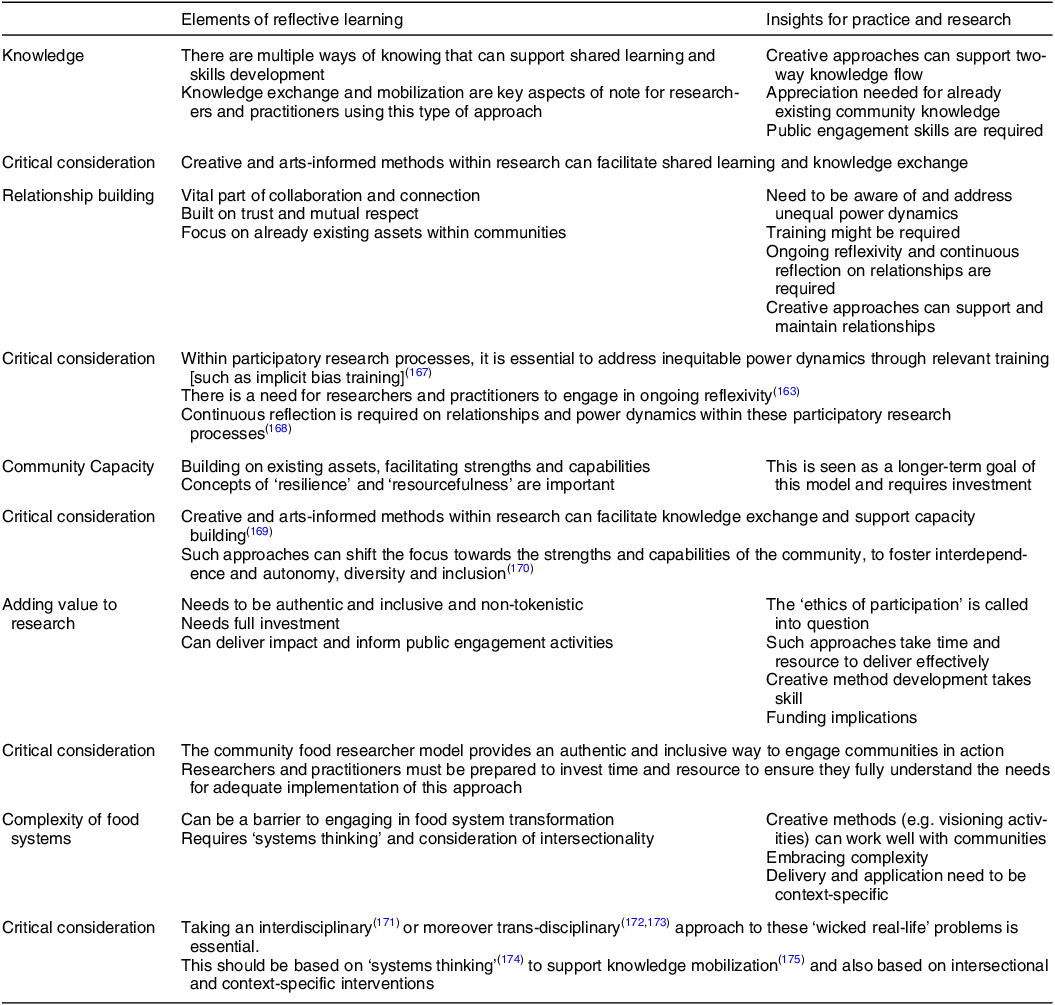
Using the FoodSEqual project’s development of the community food researcher model as an exemplar, the team have learnt and reflected on the benefits of this type of model to support its potential to facilitate food system transformation. We appreciate this is one example of good practice, and others also exist. Five key reflective learnings are appraised below, with practice insights and critical considerations offering recommendations for readers, researchers and practitioners, enabling them to better understand and put into practice if/when using similar approaches. See Table 1 for further details.
-
1) ‘Knowledge’ matters and is crucial to societies(Reference Campbell and Vanderhoven176). This is a well-known aspect of co-production whereby there exists shared learning and skills development. With the community food researcher model approach comes the opportunity to explore knowledge mobilization to address the complex nature of contemporary sustainability challenges better than more traditional approaches(Reference Norström, Cvitanovic and Löf177) as well as power relations inherent in research practices(Reference Booth85,Reference Campbell and Vanderhoven176) . Similarly, the sharing of knowledge and dialogue are essential expressions of the lived experience of poverty towards political change and transformation(Reference Freire178). This also links to related themes of capability, agency and empowerment(Reference Thomas-Hughes and Brake123,Reference Alexander, Rosalind and Willians156) , some of which have already been discussed. There is a known historical contextual definition that links poverty with ‘capability deprivation’(Reference Sen179). What’s more, engagement in an occupation (in this case a food system project) is important for the development of self-concept, self-identity health and well-being(Reference Chard, Faulkner and Chugg180). The community food researcher model, therefore, aligns with other inclusive models such as the ‘social cooperative model’(Reference Villotti, Zaniboni and Fraccaroli181) because it offers skills development (and potentially employability) opportunities which might address individual determinants of poverty (e.g. social abilities) as well as infrastructural factors(Reference Hunt, Pettinger and Wagstaff55). In this context, therefore, the transfer of knowledge can more authentically support and facilitate relationship building.
-
2) Relationship building is a vital part of collaboration and connection and has been a visible ongoing outcome of the FoodSEqual community food researcher model to date. Relationships can be facilitated by shared identities, support, reciprocity and trust(Reference Colistra, Bixler and Schmalz182). For the paradigm to be shifted towards more relational and transformative socially inclusive food (system) research, human connection(Reference Cottam105) and community assets need to be placed at its heart(Reference Campbell and Vanderhoven176). This chimes with the principles of Asset-based Community Development(Reference Foot and Hopkins183) and ‘human learning systems’(184) which appreciate and mobilize community talents, skills and assets, rather than focussing on problems. This can more effectively serve to address health inequalities(Reference Marmot, Allen and Boyce64) and improve mental health outcomes(Reference Southby, Bidey and Grimes185). This not only applies to community relationships but also community-academic relationships(Reference Chak162). The inherent issue of power dynamics is, therefore, a vital consideration within community food researcher practices(Reference Booth85,Reference Pettinger, Parsons and Letherby96,Reference Thomas-Hughes151) . Training, reflection and reflexivity are also required to deliver such approaches equitably. Acknowledging and acting on these considerations can enable community capacity building and resilience(Reference Blake89).
-
3) Community capacity building is one of the intended outcomes of using an approach such as the community food researcher model. The capacity to self-organize is a vital community asset that is necessary for building resourcefulness and social sustainability(Reference Blake89). In this manner, new pathways can be forged to more self-sustaining communities(Reference Blake89), that can flourish and achieve their full potential as proposed by Marmot(Reference Marmot, Allen and Boyce64). Here we deliberately substitute ‘resilience’ for resourcefulness. This is because although the term ‘resilience’ has been widely used recently in response to the UK’s efforts to ‘build back better’ post-COVID(Reference Shaw186,187) , it is critiqued as being defined by state agencies operating within capitalist social relations(Reference MacKinnon and Derickson188). The concept of ‘resourcefulness’ is proposed as an alternative, which centres community agency. It is hoped that the FoodSEqual community approach will have a positive impact on this (although it is too early to say).
-
4) Adding value to research process is clearly recognized as a current emerging methodological push from funders(Reference Hearn, Biggs and Brown139). There is a requirement for academics to meet impact and public engagement outputs as part of their research. The National Coordinating Centre for Public Engagement(159) describes public engagement as ‘the myriad ways in which the activity and benefits of higher education and research can be shared with the public’. Engagement is, by definition, a two-way process, involving interaction and listening, with the goal of generating mutual benefit. Yet this has been critiqued as being often somewhat tokenistic(Reference Watermeyer189) and that the research community should be more intimately and proximally associated [or entwined] with ‘the public’(Reference Bond and Paterson190). The community food researcher model offers a legitimate, yet inclusive, way for researchers to achieve social impact. Investment is needed, however, to ensure that such methods are delivered effectively and with mutual benefits.
-
5) The complexity of food system challenges is well known(Reference Ng’endo and Connor191). Although often seeming overwhelming for researchers and communities, with challenges relating to conceptual and definitional diversity, changing (socio-political) structures and seeming lack of individual control over these factors(184), food system research and action need to acknowledge and embrace this complexity. Emerging food system research (such as FoodSEqual, using a community food researcher model) advocates more strongly for collaborative and co-production approaches with multiple stakeholder involvement. This goes some way to embrace the need for interdisciplinarity(Reference Foran, Butler and Williams171) or moreover trans-disciplinary(Reference Schwarz, Vanni and Miller172,Reference West and Schill173) and considers ‘systems thinking’(Reference Peters174) and intersectionality to support knowledge mobilization(Reference Haynes, Rychetnik and Finegood175) within context-specific interventions. In this manner, authentic social action can be facilitated, and social capital consolidated ensuring that public services can be more responsive to the needs of individuals and communities.
Reflective learning, practice insights and critical considerations for the community food researcher model to support food system transformation

Conclusions
This review has demonstrated the extent of the (wicked) ‘problems’ that need to be tackled in relation to food system transformation for less affluent communities. As part of the proposed solutions, it critiques the utility of creative co-production methods, in particular the use of the community food researcher model (explored within the FoodSEqual(1) project), in advocating with rather than for less affluent communities. This progressive model serves to facilitate effective human relationships that can explore a better understanding of people’s food narratives, lives and contexts. Therefore, it shows real promise for positive health and well-being outcomes, as well as building community capacity, thus leading to more equitable and lasting solutions for food system transformation.
We acknowledge that this is one approach that has the potential to contribute to community-led food system transformation. Other approaches exist that may contradict or challenge some of our critiques of this topic. Despite this, we offer reflective learning, practice insights and critical considerations for researchers and practitioners around the importance of building such approaches in an authentic and inclusive manner, acknowledging the time and resource required to do them justice. Many concepts are given critical consideration for this purpose, such as the appreciation of power dynamics and transparency. Similarly, knowledge exchange, mobilization and training needs are critically reviewed as essential for effective application, as well as the importance of relationships and community capacity building as core components. When applying such approaches, it is essential to recognize the building blocks of good co-production practice and the need to embrace complexity and systems thinking. We advocate for these more collaborative ways of working (embedding inter/trans-disciplinarity) which can lead to enhancement for both research and practice, whereby social and community action can build stronger and more resourceful communities that can tackle their own food system challenges.
Acknowledgements
Acknowledging our Plymouth Community Food Researchers who have contributed to the FoodSEqual Plymouth project – Yve, Star, Joanna, Laura, Julia
Financial support
This review paper relates to the FoodSEqual project (Food Systems Equality: co-production of healthy and sustainable food systems for disadvantaged communities) which is funded by UKRI Strategic Priorities Fund – BBSRC Grant Ref BB/V004905/1.
Author contributions
CP led the review paper: drafts, writing, reviewing, collation and management of contributions; LH and HG reviewed the paper and contributed to specific sections; PG reviewed the paper, contributed to specific sections and worked on reference management; CW is chief investigator of the FoodSEqual project.
Competing interests
There are no conflicts of interest.


 Open access

