




1. Introduction
This article is about how to integrate information about usage frequency – here, the token frequency of morphemes in the language experience of an individual speaker – into a constraint-based phonological grammar formalism that characterises that speaker’s generative linguistic knowledge.
We take as our empirical case the frequency-conditioned variability in optional paradigm uniformity in voiced velar nasalisation (henceforth simply nasalisation) in phonologically conservative Japanese dialects, recently studied using corpus data by Breiss et al. (Reference Breiss, Katsuda and Kawahara2022) and experimentally verified in Breiss et al. (Reference Breiss, Katsuda and Kawahara2026). These studies are the latest in a long research tradition centring on the allophonic distribution of /g/ in conservative Japanese dialects, where a static phonotactic restriction requires /g/ to be realised as [g] prosodic-word-initially and [ŋ] elsewhere (e.g., Kindaichi [1942] Reference Kindaichi1967; Trubetzkoy [1939] Reference Trubetzkoy1969; Labrune Reference Labrune2012). This correspondence is disrupted in compounds with a /g/-initial second member (N2) that can occur as a free morpheme: in compounds with N2s that do not occur as free-standing words, the /g/ → [ŋ] mapping is exceptionless, but in compounds where N2 may additionally occur as a free-standing word (i.e., with initial [g]), the nasalisation process is optional (Ito & Mester Reference Ito, Mester and Roca1996, Reference Ito and Mester2003).
The contribution of recent work by Breiss et al. (Reference Breiss, Katsuda and Kawahara2026) (reviewed in §3) is to characterise this variation in quantitative detail, and in particular to highlight how the token frequency of both the compound and the free N2 affect the outcome of optional nasalisation: higher frequency compounds encourage more nasalisation of medial /g/ to [ŋ], while higher-frequency free N2s encourage more retention of medial /g/ as [g], remaining uniform across the paradigm of their free-standing forms and compound forms (Benua Reference Benua2000; Steriade Reference Steriade, Broe and Pierrehumbert2000).
The novel contribution of this article is to provide a formally explicit model of the experimental data. The model builds upon the Voting Bases model of lexicon–grammar interaction (Breiss Reference Breiss2024), originally proposed to model Lexical Conservatism (Steriade Reference Steriade1997). Lexical Conservatism is a type of paradigm uniformity where the distribution of stem allomorphs (referred to as ‘bases’) in a paradigm influences the way that paradigm accommodates new members. The canonical example comes from Steriade (Reference Steriade1997), who observed that the phonologically similar forms rémedy and párody differ in their behaviour when affixed with -able, yielding remédiable with shifted stress, but párodiable, with fixed stress. She argued that this difference stems not from the forms remedy and parody themselves, but from the fact that remedy has a stem allomorph remédi- in remédial that satisfies the marked lapse arising from affixation.
Breiss (Reference Breiss2024) examines the same Lexical Conservatism dependency using novel derived forms (like lábor + -able, with related form labórious, and pláster + -able with no phonologically advantageous related form), and found that in experimental settings, speakers are sensitive not only to the presence of the phonologically beneficial stem allomorph (like remédial and labórious), but also to its salience in the lexicon as manipulated by priming. To account for these data, he proposes a formal phonological model that integrates the influence of the contents of the lexicon along with their resting activation, enabling the phonological grammar to be sensitive to the psycholinguistic properties of the morphemes which it manipulates. Breiss (Reference Breiss2024) terms this formal model of lexicon–grammar interaction the Voting Bases model.
In this article, we demonstrate that the Voting Bases model extends, without modification, to the separate case of lexicon–grammar interaction found in Japanese nasalisation. The success of the model suggests that the foundational principles of the Voting Bases model may be a good candidate for a general theory of the way that the lexicon and grammar interact. This finding also underscores the explanatory value to be gained for phonological phenomena by adopting a more psycholinguistically nuanced portrait of the lexicon as a dynamic substrate that can influence the computations of the grammar on the items which it contains. In §6.3, we take up a series of questions which arise when adopting this boundary-blurring approach, in light of the traditional dichotomy between generative and usage-based perspectives on linguistic data.
The layout of the article is as follows: the first two sections review in some depth basic facts about Japanese nasalisation drawn from the literature (§2), and then specifically review in detail Experiment 1 of Breiss et al. (Reference Breiss, Katsuda and Kawahara2026) (§3). Though this may not constitute new information, we hope the reader will find its inclusion helpful in contextualising the theoretical analysis. §4 focuses on the Voting Bases model and how we apply it to the context of optional paradigm uniformity. §5 then actually fits the model to the experimental results and discusses relative and absolute model fit in comparison to minimally different models that incorporate only some of the assumptions of the Voting Bases model. The article closes in §6 with a discussion of broader issues, touching on how such a system might come to be in the mind of the learner, on the merits of a joint model of psycholinguistic and grammatical influence on word formation, and on what a unified theory of token frequency effects on the phonological grammar might look like.
2. The traditional picture of Japanese nasalisation
The data that we model in this article come from Experiment 1 of Breiss et al. (Reference Breiss, Katsuda and Kawahara2026), which investigated the variation between [g] and [ŋ] induced by the phonotactics of phonologically conservative dialects of Japanese. The pattern, which has been well-studied in both descriptive (Kindaichi [1942] Reference Kindaichi1967; Trubetzkoy [1939] Reference Trubetzkoy1969; Hibiya Reference Hibiya1995) and generative (Ito & Mester Reference Ito, Mester and Roca1996, Reference Ito and Mester2003; Labrune Reference Labrune2012) literature on Japanese linguistics, is exemplified in the complementary distribution of [g] and [ŋ] shown in the monomorphemic data in (1), where the voiced oral velar stop is permitted only word-initially, and the velar nasal is permitted only word-medially.

We assume throughout that non-alternating forms are stored as surface-true URs in the lexicon, in accordance with the phonological tradition of (Strong) Lexicon Optimisation (Prince & Smolensky [1993] Reference Prince and Smolensky2004; Sanders Reference Sanders2003). This stance is supported by psycholinguistic research on the contents of lexical representations, reviewed in §4.1.
Japanese’s extensive use of compounding in word formation gives the opportunity for the phonotactic restriction to drive alternations, as in (2)–(5). Here, we see that when a /g/-initial morpheme is word-initial (either as a prosodically free word, in (2)–(4), or as the first member (N1) of a compound, in (5)Footnote 1 ), it is realised with an initial [g], while when it occurs as the second member of a compound (N2), it is realised with initial [ŋ]. Critically for the current study, Ito & Mester (Reference Ito, Mester and Roca1996) observed that although in all cases the /g/-initial N2 may be realised word-medially with initial [ŋ], nasalisation is optional when the N2 can stand on its own as a prosodically free form (compare (2b), (3b), and (4b) with (5c)) – a case of optional paradigm uniformity.
![Linguistic notation showing two examples. a. /hai + gan/ yields [haiŋan] or [haigan] meaning lung cancer. b. /gan/ yields [gan] meaning cancer.](https://static.cambridge.org/binary/version/id/urn:cambridge.org:id:binary:20260710043043491-0681:S0952675726100402:S0952675726100402_tabu2.png?pub-status=live)
![Linguistic transcription showing phonological changes. (3) a. /noo + geka/ yields [nooŋeka] or [noogeka] meaning brain surgery. b. /geka/ yields [geka] meaning surgery.](https://static.cambridge.org/binary/version/id/urn:cambridge.org:id:binary:20260710043043491-0681:S0952675726100402:S0952675726100402_tabu3.png?pub-status=live)
![Linguistic diagram 4 showing two examples. a. /doku + ga/ yields [dokuŋa] or [dokuga] meaning poison moth. b. /ga/ yields [ga] meaning moth as a free morpheme.](https://static.cambridge.org/binary/version/id/urn:cambridge.org:id:binary:20260710043043491-0681:S0952675726100402:S0952675726100402_tabu4.png?pub-status=live)

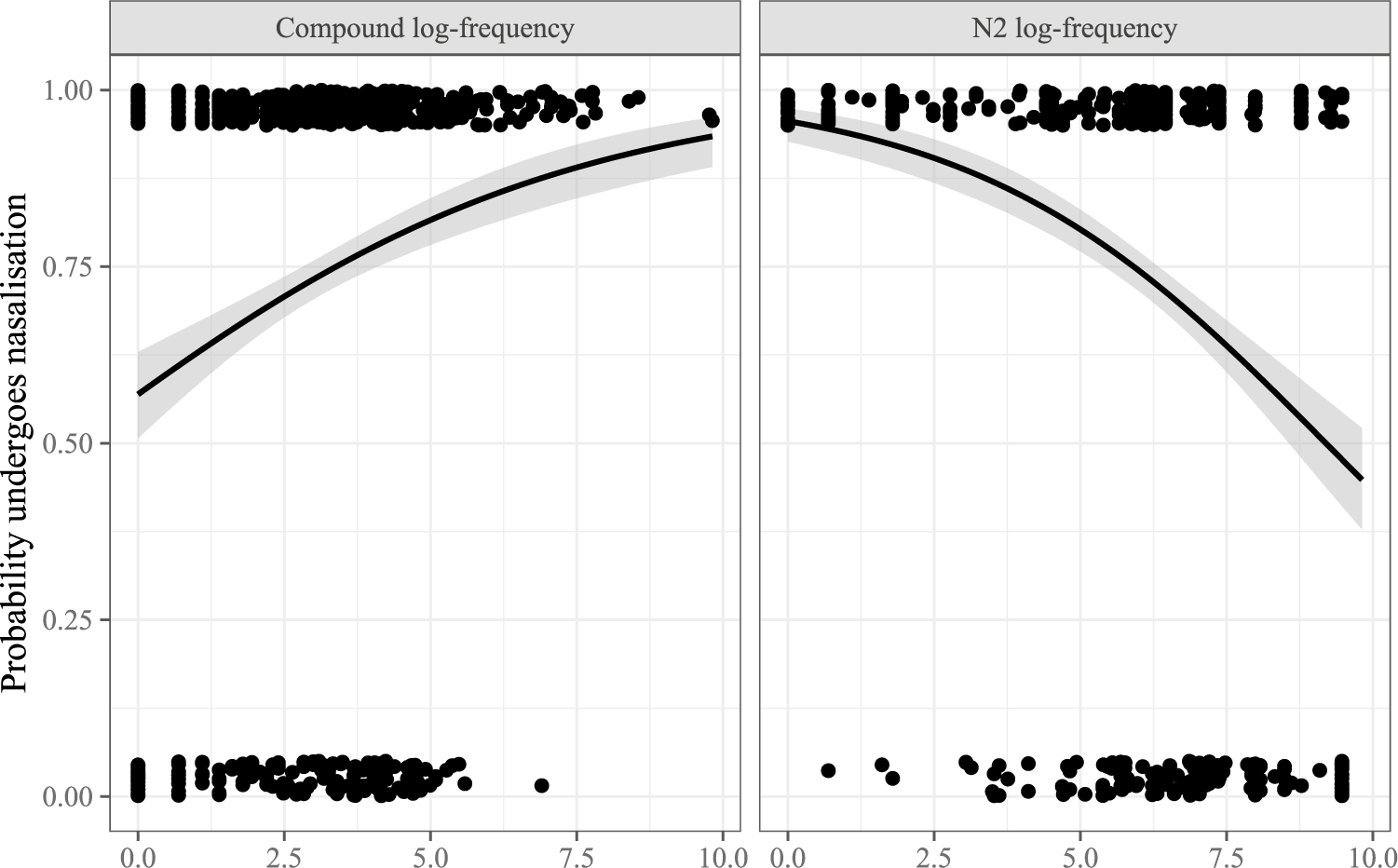
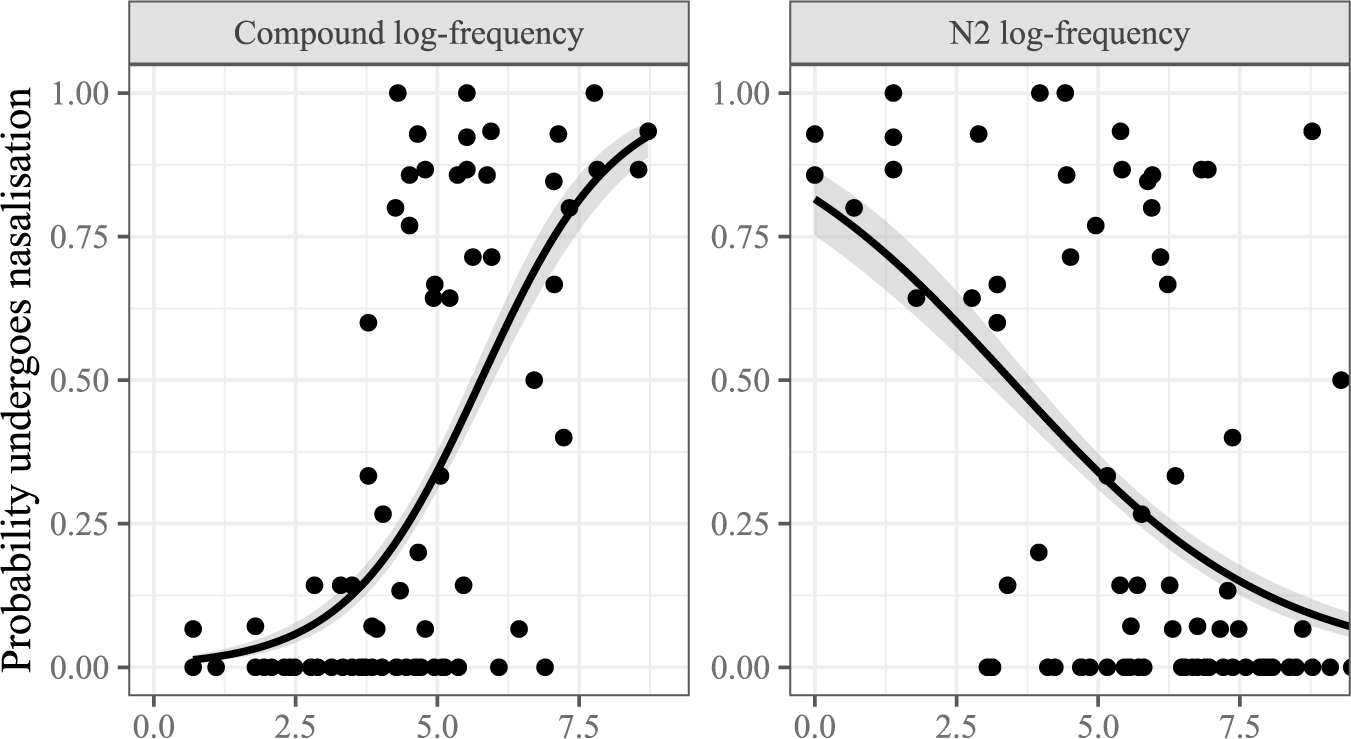
Breiss et al. (Reference Breiss, Katsuda and Kawahara2022) examined this variation in a corpus derived from a pronunciation dictionary (NHK Broadcasting Culture Research Institute 2016) and found that among compounds with free N2s, the two most prominent predictors of whether an item would be nasalised were the frequency of the N2’s free [g]-initial form and the frequency of the whole compound. These effects ran in opposite directions: higher-frequency compounds were more likely to be nasalised (the left facet of Figure 1), but the more frequent the free N2 was, the less likely it was to nasalise (the right facet of Figure 1).
The effects of whole-compound frequency (left) and N2 frequency (right) on the probability of nasalisation (vertical axis), with binomial smooths in the corpus data. One dot represents one lexical item; vertical jitter has been added for readability. Figure and caption adapted from Breiss et al. (Reference Breiss, Katsuda and Kawahara2026), data from Breiss et al. (Reference Breiss, Katsuda and Kawahara2022).

Figure 1 Long description
A two-panel scatter plot. Both panels share a vertical Y axis labeled Probability undergoes nasalisation, with values from 0.00 to 1.00 in increments of 0.25. Individual data points are clustered at the top and bottom of each plot with vertical jitter. The left panel is titled Compound log-frequency. The horizontal X axis ranges from 0.0 to 10.0. A binomial smooth line shows a logarithmic increase, starting at a probability of approximately 0.57 at X equals 0 and rising to nearly 0.95 at X equals 10. A grey shaded area indicates the confidence interval, which is wider at the lower end of the frequency scale. The right panel is titled N2 log-frequency. The horizontal X axis ranges from 0.0 to 10.0. A binomial smooth line shows a downward trend, starting at a probability of approximately 0.95 at X equals 0 and curving downward to approximately 0.45 at X equals 10. The grey shaded confidence interval widens as the frequency increases.
The corpus data were modelled as a case of probabilistic paradigm uniformity in Breiss et al. (Reference Breiss, Katsuda and Kawahara2021) using output–output faithfulness constraints (Benua Reference Benua2000) indexed to items binned by the relative frequency of each compound and N2. This article was limited, however, by the untested assumption of their model that the frequency modulation of paradigm uniformity in their corpus data actually represents the synchronic knowledge of speakers. Additionally, their formal model was not explicitly informed by psycholinguistic considerations, and thus its linking hypothesis between frequency (necessarily a lexical characteristic) and the phonological grammar had a problem of simply being stipulative – in other words, there was nothing in their model that prevented the opposite relation between frequency and paradigm uniformity from holding.
In this article, we offer two improvements on the state of affairs in Breiss et al. (Reference Breiss, Katsuda and Kawahara2021). First, we model experimental data from Breiss et al. (Reference Breiss, Katsuda and Kawahara2026) where the frequency conditioning of the variable paradigm uniformity is reproduced in existing compounds and extended to novel ones. Second, we do this by extending the Voting Bases model of Breiss (Reference Breiss2024), which is compatible with consensus understanding of how lexical frequency is connected to the lexical representation and activation, and which offers an explicit linking hypothesis relating the real-time dynamics of the lexicon to the representation and computations of the phonological grammar.
3. Breiss et al.’s (Reference Breiss, Katsuda and Kawahara2026) Experiment 1
Breiss et al. (Reference Breiss, Katsuda and Kawahara2026) carried out two experiments on Japanese nasalisation, with the goal of seeing whether the corpus patterns were representative of speakers’ generalisable knowledge, both in the aggregate and as individuals. They found that both individually and in aggregate, speakers’ propensity to nasalise displayed sensitivity to the frequency of the free N2 and compound, in existing and novel compounds. In this article, we focus our modelling efforts on the results of their Experiment 1, which we describe in some detail below.Footnote 2
Breiss et al.’s (Reference Breiss, Katsuda and Kawahara2026) stimuli were roughly balanced between existing Japanese compounds of varying frequencies, and novel (i.e., zero-frequency) semantically compositional Sino-Japanese compounds. Both existing and novel stimuli had attested free N2s of a range of frequencies. Out of a desire to sample compounds with a wide range of frequencies that would likely be known to participants, existing compounds ranged from 2 to 8 moras in length, while all novel compounds were four moras long. Complete details of the experimental materials are available from Breiss et al.’s (Reference Breiss, Katsuda and Kawahara2026) OSF repository at https://osf.io/avnpw/.
Breiss et al. (Reference Breiss, Katsuda and Kawahara2026) recruited speakers of the phonologically conservative Tōhoku dialect of Japanese and used a short dialect questionnaire to ensure that participants’ speech exhibited the allophonic distribution of word-initial [g] and word-medial [ŋ]. For the purposes of the model which we develop, we will see that these monomorphemic words provide crucial evidence for the lower bound of the weight of the markedness constraint driving nasalisation, since with data from compounds alone, it is not uniquely identified against the background of faithfulness constraints that the Voting Bases model uses (see §5 for further details).
The dialect questionnaire consisted of a production task where speakers were asked to read aloud ten monomorphemic words of varying frequencies with word-initial [g], and ten monomorphemic words with word-medial [ŋ]. The stimuli were written with kanji orthography, which does not distinguish between [g] and [ŋ] – this is also true of the main production experiment described below, so we follow Breiss et al. (Reference Breiss, Katsuda and Kawahara2026) in assuming that the participants’ production was not influenced by orthographic factors. The 20 words were shown to the participant in random order, and their productions were recorded; only the eight participants who exhibited the target pattern of allophony in all monomorphemes were invited to participate in the main experiment.
After this knowledge check, participants saw each compound one at a time in a random order and produced the form aloud while their speech was recorded. Participants also produced and indicated knowledge of all of the free N2s in the experiment, as well as all of the compounds. See Breiss et al. (Reference Breiss, Katsuda and Kawahara2026: §3.2) for complete details.
3.1. Results
Breiss et al. (Reference Breiss, Katsuda and Kawahara2026) found that the participants reflected at an individual level the frequency-conditioned variability seen in the corpus study of Breiss et al. (Reference Breiss, Katsuda and Kawahara2022). In existing compounds (Figure 2), their productions were influenced by both the frequency of the compound (the left facet), for which higher values correlated with more nasalisation, and by the frequency of the free N2 (the right facet), where higher values correlated with less nasalisation.
Probability of nasalisation (vertical axis) plotted against compound log-frequency (left) and N2 log-frequency (right) in existing words, with binomial smooths for readability, in the experiment by Breiss et al. (Reference Breiss, Katsuda and Kawahara2026).
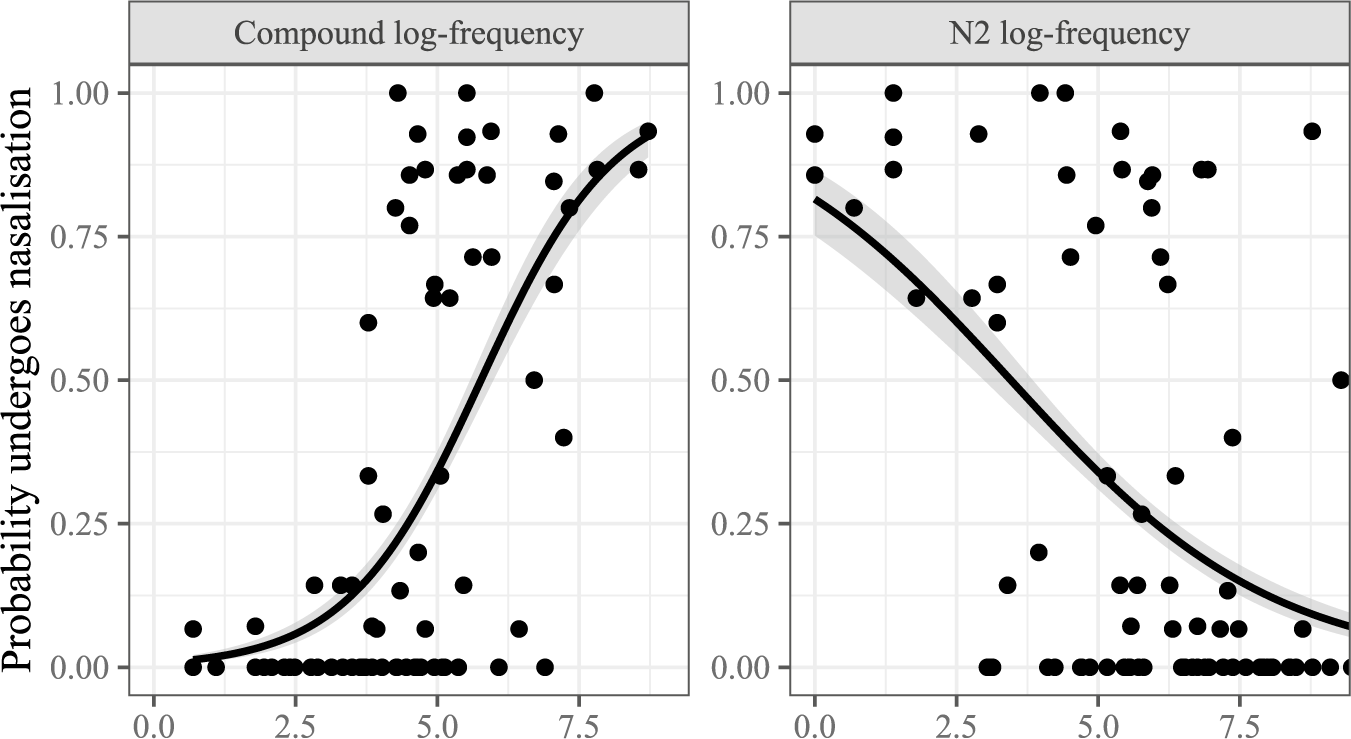
Figure 2 Long description
A two-panel scatter plot. The vertical y-axis for both panels is labeled Probability undergoes nasalisation, ranging from 0.00 to 1.00 in increments of 0.25. The horizontal x-axis for both panels ranges from 0.0 to 7.5 or greater. Left Panel: Titled Compound log-frequency. The data points are concentrated at the bottom left and top right. A binomial smooth curve starts near 0.00 on the y-axis at x-value 0.0 and follows an S-shaped logistic growth pattern, rising sharply between x-values 4.0 and 7.0, and leveling off near 0.90 at the far right. Right Panel: Titled N2 log-frequency. The data points are widely dispersed. A binomial smooth curve starts high at approximately 0.80 on the y-axis at x-value 0.0 and shows a steady non-linear decrease, curving downward to end near 0.10 at the far right. Both panels include a light gray shaded area around the black trend lines representing the confidence interval.
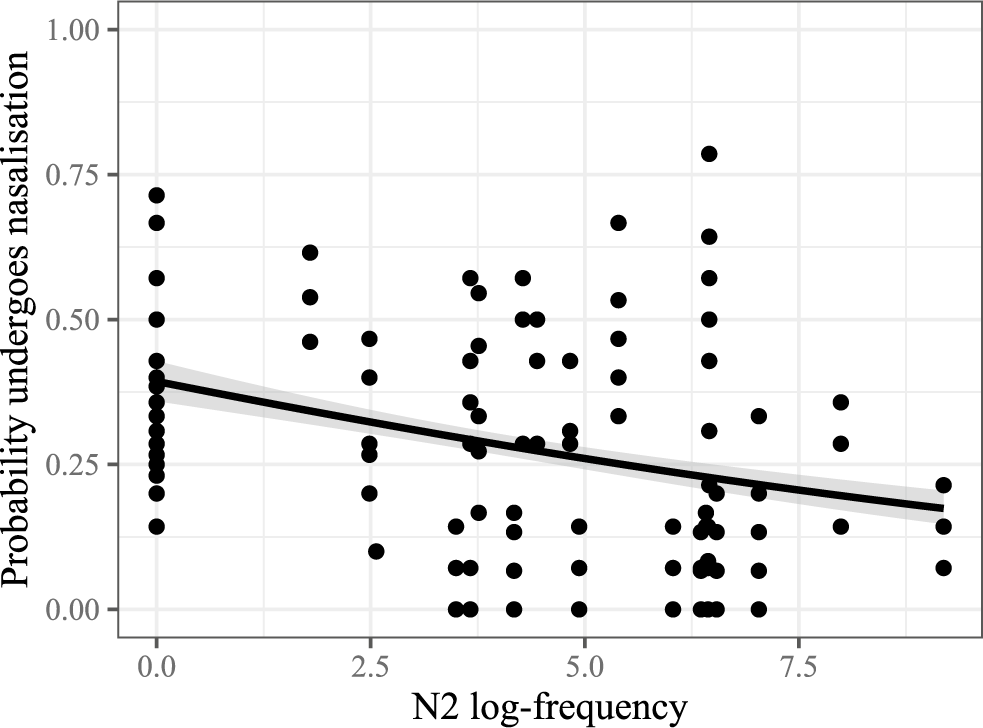
Figure 3 plots the same effect of N2 frequency in novel compounds: forms with higher-frequency N2s were less likely to undergo nasalisation relative to those with lower-frequency N2s.
The probability of undergoing nasalisation in novel compounds, plotted against N2 log-frequency, with a binomial smooth to aid readability, taken from Breiss et al. (Reference Breiss, Katsuda and Kawahara2026).

Figure 3 Long description
The x-axis is labeled N2 log-frequency with major tick marks at 0.0, 2.5, 5.0, and 7.5. The y-axis is labeled Probability undergoes nasalisation with tick marks at 0.00, 0.25, 0.50, 0.75, and 1.00. The data is presented as a scatter plot of black dots. At an N2 log-frequency of 0.0, there is a dense vertical cluster of points ranging from approximately 0.15 to 0.72. As the log-frequency increases toward 9.0, the points become more dispersed but generally lower on the y-axis. A solid black binomial smooth line begins at a y-value of approximately 0.40 when x is 0.0 and follows a steady linear decrease to a y-value of approximately 0.18 when x is 9.0. The line is surrounded by a light gray shaded area representing the confidence interval, which remains narrow and consistent across the entire frequency range.
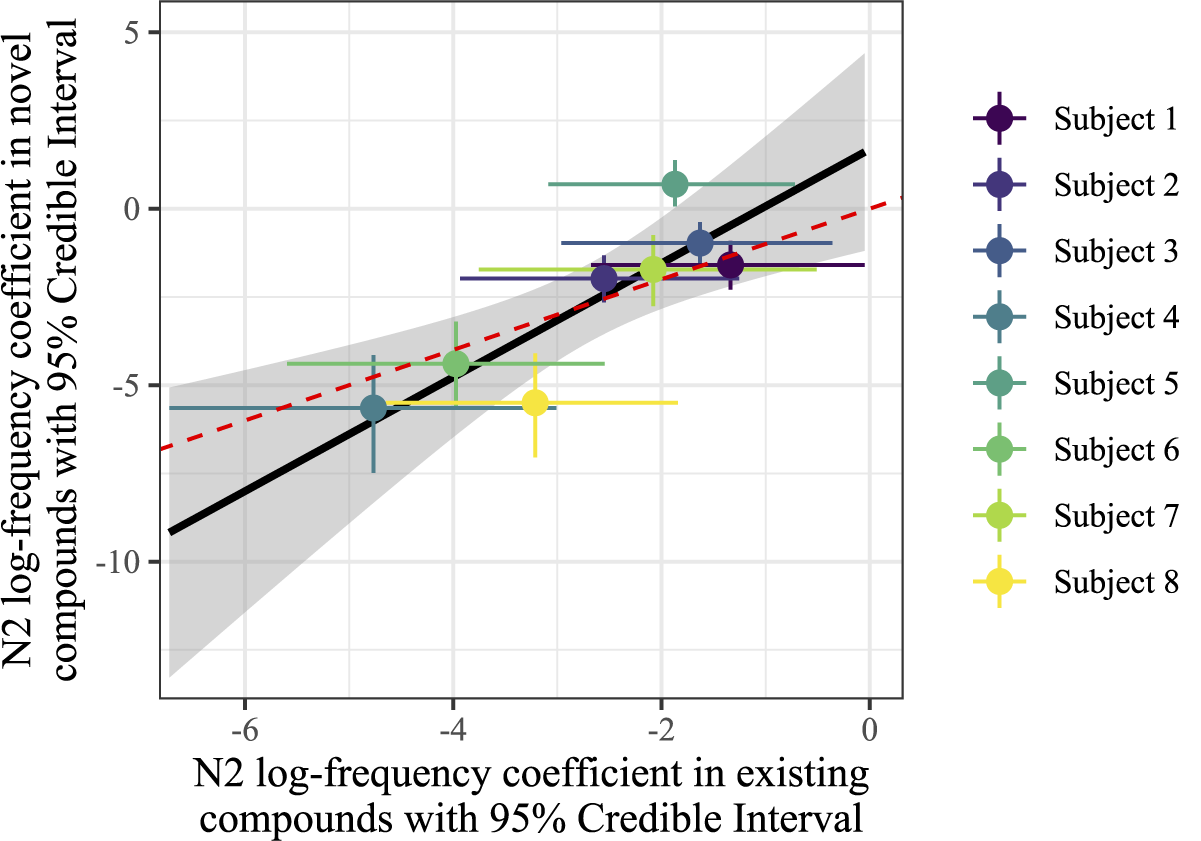
Finally, Breiss et al. (Reference Breiss, Katsuda and Kawahara2026) found that the frequency effect was stable at the level of the individual, across existing and novel compounds, which is plotted in Figure 4. In this figure, the horizontal axis plots the strength and direction of the effect of N2 log-frequency in novel compounds, and the vertical axis plots the strength and direction of the effect of N2 log-frequency in existing compounds. Although different participants were more or less sensitive to the frequency of a given N2, lying higher or lower on each axis, there was uniformity in this degree of sensitivity such that the two covaried along a diagonal line through the centre of the plot. Breiss et al. (Reference Breiss, Katsuda and Kawahara2026) interpret this correlation as evidence that morpheme usage frequency and phonological markedness have separable, distinct influences on speaker productions.
The coefficient of N2 log-frequency in novel compounds, derived from the model in Breiss et al. (Reference Breiss, Katsuda and Kawahara2026: Table 1), is plotted on the horizontal axis, and the coefficient for N2 log-frequency in existing compounds, derived from the model summarised in Breiss et al. (Reference Breiss, Katsuda and Kawahara2026: Table 3), is plotted on the vertical axis. Points represent median values of the posterior with ranges encompassing 95% Bayesian credible intervals; colours represent speakers; and a linear smooth has been added for readability, with the line of slope 1 intersecting the origin in dotted red.

Figure 4 Long description
The scatter plot uses a Cartesian coordinate system. The horizontal X axis is labeled N2 log-frequency coefficient in existing compounds with 95 percent Credible Interval, ranging from negative 6 to 0. The vertical Y axis is labeled N2 log-frequency coefficient in novel compounds with 95 percent Credible Interval, ranging from negative 10 to 5. To the right of the plot, a legend identifies eight subjects by color:
* Subject 1 is dark purple. Subject 2 is indigo. Subject 3 is blue-gray. Subject 4 is teal. Subject 5 is seafoam green. Subject 6 is light green. Subject 7 is lime green. Subject 8 is yellow. Data points for each subject are plotted as colored circles representing median values, each with horizontal and vertical error bars indicating the 95 percent Bayesian credible intervals. The points are generally clustered between negative 5 and 0 on both axes, showing a positive correlation.
A solid black linear smooth line runs diagonally from the bottom-left to the top-right, surrounded by a gray shaded area representing the confidence ribbon. A dotted red line with a slope of 1 passes through the origin, serving as a reference for a perfect one-to-one relationship between the two coefficients.
3.2. Summary and goals for modelling
To summarise, the findings of Breiss et al. (Reference Breiss, Katsuda and Kawahara2026) that are relevant for the modelling task of this article are the following. Among those speakers for whom the phonotactic restriction enforcing [g]\~{}[ŋ] allophony was exceptionless in monomorphemic words:
-
1. Phonotactically driven nasalisation is variable in compounds with free N2s.
-
2. In these compounds, the probability of nasalisation is increased by higher compound frequency, and decreased by higher N2 frequency.
-
3. Within individuals, the frequency effect is uniform across existing and novel compounds.
Below, we propose a formal model of these facts, using the Voting Bases model to relate a lexicon containing usage-frequency information to a phonological grammar couched in the maximum entropy (MaxEnt) framework.Footnote 3
4. Modelling token frequency in the phonological grammar
Based on the facts laid out above, we seek a model of the phonological grammar that allows non-phonological properties of individual lexical items (here, frequency) to influence their participation in phonological processes (here, paradigm uniformity). Note that we specifically aim to model phonological and non-phonological influences on the outputs of the phonological grammar, rather than any possible morphological or paradigmatic effects on phonetic realisation (see Purse et al. Reference Purse, Fruehwald and Tamminga2022 for a review), about which the Voting Bases model as laid out in Breiss (Reference Breiss2024) makes no predictions.
4.1. The contents of a lexical entry
As prolegomena to the grammatical model, it will be important to establish some relevant context regarding the contents of the lexicon, because it is these representations that are at stake in discussions of token frequency. Psycholinguistic research has amassed a large body of evidence that the lexicon is richly structured, with numerous types of linked representations of various levels of detail grouped under the same lexical entry. We do not review this research in depth here, but simply highlight the findings relevant to developing the type of integrated phonological theory referenced above. For a thorough discussion and literature review on the (phonologically relevant) contents of a lexical entry, see Pierrehumbert (Reference Pierrehumbert2016); for more on how this information interacts with the Voting Bases theory in cases beyond those relevant for the nasalisation, see Breiss (Reference Breiss, Katsuda and Kawahara2021, Reference Breiss2024).
Since nasalisation concerns paradigm uniformity, we assume the lexical entry for an existing word lists (among many other things) its allomorphs (cf. Strong Lexicon Optimisation, embraced by Sanders Reference Sanders2006, as well as arguments by Wang & Hayes (Reference Wang and Hayesin press) on the sufficiency of less-abstract URs): for a non-alternating monomorpheme like [kaŋami] ‘mirror’, this would be simply /kaŋami/; for a monomorpheme that can appear as an N2 and undergo nasalisation, such as [ga]\~{}[ŋa] ‘moth’, the lexical entry would list both /ga/ and /ŋa/. Finally, we assume that existing compounds are stored whole, with nasalisation applied so as to respect the phonotactics in the lexicon (Martin Reference Martin2007; Albright Reference Albright2008).Footnote 4
With regard to non-phonological characteristics of the lexicon, we follow a large body of evidence that lexical representations have differing degrees of salience or strength of encoding. Following Breiss (Reference Breiss, Katsuda and Kawahara2021, Reference Breiss2024), we refer to this quantity as resting activation, borrowing the term (though not the theory) from Morton (Reference Morton and Norman1970). For us, resting activation corresponds to the strength of a memory representation itself, not a number or rank stored in long-term memory as a characteristic of the lexical item. Thus, characteristics (long-term or dynamic) of lexical items like their frequency, and whether or not they have recently been activated (e.g., by priming), all contribute dynamically to an item’s resting activation. Importantly, also following Breiss, we use the term ‘resting activation’ as a stand-in for any scalar summary statistic that can be derived from an implemented model of lexical dynamics. We remain intentionally agnostic as to the specific model of these dynamics, whether the specific model endorsed by Morton (Reference Morton and Norman1970) or not, simply stressing that so long as such a model can be used to derive a measure of relative salience influenced by the factors just mentioned, the Voting Bases model can make reference to it to scale faithfulness constraint violations (cf., e.g., Luce & Pisoni Reference Luce and Pisoni1998). We discuss how resting activation is modelled as influencing the phonological grammar in §4.4.
4.2. The Voting Bases model
We now turn to a formal phonological model of the Japanese nasalisation data. We use the Voting Bases model of competition proposed in Breiss (Reference Breiss, Katsuda and Kawahara2021, Reference Breiss2024). This approach has been used to model data in Lexical Conservatism in English and Spanish and is broadly compatible with the view of the lexicon laid out above. Here, we extend the scope of the model by analysing the probabilistic paradigm uniformity found in Japanese nasalisation.
The Voting Bases model has two parts: the first is that all listed stem allomorphs in the lexicon exert an analogical pull on derivatives (operationalised using allomorph-specific faithfulness constraints), violations of which are scaled in proportion to the resting activation of the representation to which faithfulness is being assessed. We note that the terminology of ‘bases’ comes from the original context for which the model was developed, but here the term can be read as a synonym for ‘stored allomorph’.Footnote 5 The second part is that markedness constraints evaluate candidates in the standard way for any constraint-based phonological model.
The Voting Bases model assumes a probabilistic, weighted-constraint phonological grammar; here, we use MaxEnt Harmonic Grammar (Smolensky Reference Smolensky1986a; Goldwater & Johnson Reference Goldwater, Johnson, Spenader, Eriksson and Dahl2003), but in principle, we could also use another grammar formalism that has these characteristics, like Stochastic (or Noisy) Harmonic Grammar (Boersma & Pater Reference Boersma, Pater, McCarthy and Pater2016). We use MaxEnt since it has various strengths – for example, it directly relates Harmony to probability (Hayes Reference Hayes2022); permits constraint cumulativity by default (Jäger & Rosenbach Reference Jäger and Rosenbach2006; Breiss Reference Breiss2020); has a learning algorithm to set its weights and is rooted in well-understood statistical techniques used widely outside linguistics (Jurafsky & Martin Reference Jurafsky and Martin2009: ch. 5). We stress, however, that our analyses can be recast in terms of other stochastic constraint-based frameworks.
4.3. Constraints
In the analysis developed in this article, we adopt the general approach of Ito & Mester (Reference Ito, Mester and Roca1996, Reference Ito and Mester2003), loosely following Breiss et al. (Reference Breiss, Katsuda and Kawahara2021). We use only three constraints: a single markedness constraint to motivate nasalisation (extending the spirit of the constraint *VgV from Ito & Mester Reference Ito and Mester2003 to be compatible with nasal-final N1s, which pattern identically to vowel-final N1s), and a pair of faithfulness constraints which correspond to the second member’s free form and to the analogical pull of the compound as a whole, if one exists. The constraints are listed in (6).Footnote 6

Note that the constraint definitions do not make reference to scaling or the contents of the lexicon; the proposal in the Voting Bases model is an architectural one about how psycholinguistic, ‘extra-grammatical’ factors act within and beside the phonological grammar to influence certain variable phenomena.
4.4. Modelling resting activation
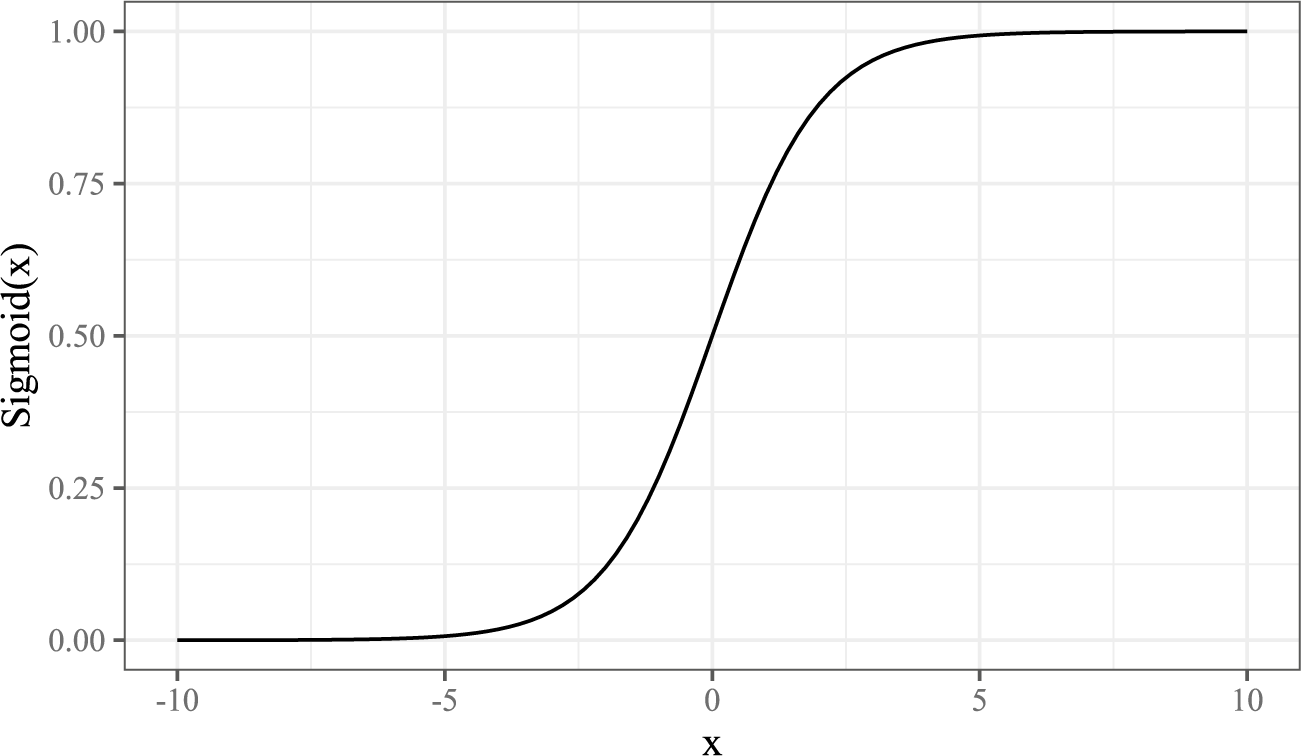
The discussion in §4.1 left open how a specific numerical value for resting activation might be calculated on the basis of the psycholinguistic characteristics of an item’s lexical entry. Here, we model the data using the log-frequency of the allomorph, passed through a sigmoid function
$\frac{1}{1+e^{-logfreq}}$
 that translates the linear predictor (i.e.,
${-logfreq}$
that translates the linear predictor (i.e.,
${-logfreq}$
 ) into the bounded interval of
  , which will be the scaling factor applied to faithfulness violations. This is illustrated in Figure 5. The effect of this non-linear transformation will be to preserve the idea that unfaithfulness to low-frequency lexical items is penalised less than to unfaithfulness to higher-frequency ones, while damping down the difference among extreme values of the scale and rendering it bounded.
Sigmoid function that translates the (centred) frequencies into the scaling factors.

The final move we make here is that rather than using raw log-frequencies, we use scaled and centred log-frequencies, following the statistical analysis in Breiss et al. (Reference Breiss, Katsuda and Kawahara2026). This corresponds to the notion that it is not so much the absolute frequency of each item that is important, but how frequent it is relative to the other competitor items in the lexicon (here approximated by the population of items in the experiment), which is in line with previous work on morphological decomposition in stored forms (Hay Reference Hay2001). Finally, in the analysis that we develop below, we do not model the priming of N2, since Breiss et al. (Reference Breiss, Katsuda and Kawahara2026) did not find substantial evidence that it affected their experimental data.Footnote 7
4.5. Schematic illustrations
Before modelling the experimental data itself, it will be useful to work with some toy data to get a feel for how resting-activation-scaled faithfulness violations interact with the dynamics of a MaxEnt grammar. First, let us consider the case of novel compounds, since they are the simplest case to lay out the workings of the analysis. Recall the empirical pattern: here, although the frequency of the compound is zero, we nevertheless find that nasalisation is modulated by the frequency of N2. Now, consider the case of two hypothetical novel compounds, one with a higher-frequency N2, and one with a lower-frequency N2, such that when the sigmoid transformation is applied to their frequencies, the higher-frequency form scales its violations of Id-[nasal]N2 by 0.7, and the lower scales its violations of the same constraint by 0.3 (these specific numbers are chosen purely for the sake of illustration). Using the constraints defined in §4.3 above, we can construct the tableaux shown in (7):
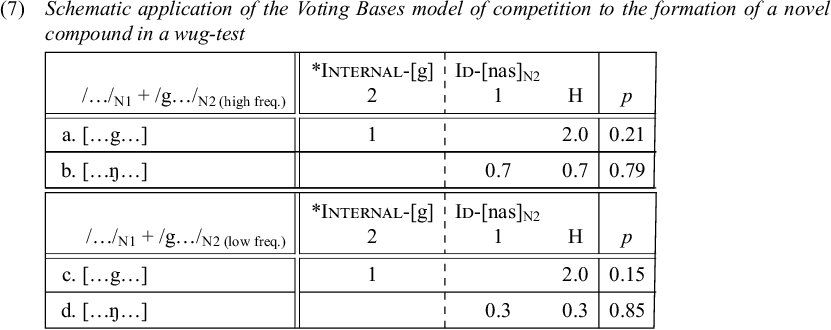
We can see that the pull of faithfulness to the N2 with higher frequency is stronger than the one with lower frequency, though both are relatively marginal outcomes since the weight of *Internal-[g] dominates the distribution of probabilities in this scenario.
Moving on to existing compounds, we now must add another item to the lexical entry we are considering in the input to our tableaux, as shown in (8). For the sake of minimal contrasts, we assume that the frequencies of the two N2s are equal and medial relative to the examples in (7), allowing us to examine the effect of compound frequency holding N2 frequency constant. However, in our analysis of the actual data, the two scaling factors are set independently on a per-item basis.

Here, we see that the scaling of the compound again depends on frequency, but because of the assumption we made about the listed form of the compound – specifically, that phonologically well-formed words are preferentially the target of lexicalisation (Martin Reference Martin2007; Albright Reference Albright2008) – we find that the constraint that mandates faithfulness to the compound’s UR further penalises the candidate that violates markedness by lacking nasalisation.
Finally, we lay out the case where the competition between candidates is driven primarily by faithfulness. In (7) and (8), where markedness had a high weight, the candidate that satisfied markedness had a higher probability than the one which violated it, and the effects of the faithfulness constraints were on the probability of the minority candidate. In the scenario where markedness is low and the weights of the faithfulness constraints are dominant, the majority candidate is the one that satisfies faithfulness to the whole compound, and the presence of the N2 is the main reason that the unfaithful (but markedness-satisfying) candidate gets appreciable probability; this is a type of ‘analogical’ effect where markedness has little role, as in (9), in which the markedness constraint is assigned a very low weight (here arbitrarily set at 0.1). Below, we will see that this scenario is most similar to the state of the nasalisation alternation.

5. The model in action
Moving on to the analysis itself, we fitted a model to the data from existing compounds and monomorphemes, assessing its fit in that setting as well as its generalisation to data from novel compounds. We fitted the MaxEnt models using the Solver function in Microsoft Excel (Fylstra et al. Reference Fylstra, Lasdon, Watson and Waren1998) and used a weakly informative Gaussian prior of Normal(0, 10) on constraint weights, which has the effect of allowing weights to vary in response to values that best fit the data, while making extreme values (here, above 20 or so) less appealing. For more on priors on weights in MaxEnt phonological models, see Wilson (Reference Wilson2006) and White (Reference White2017). All models fitted in this paper are provided in the OSF archive at https://osf.io/wcvyx/.
5.1. Existing compounds
We first applied the analysis sketched in §4.5 to data from existing compounds. Recall that in these forms, compounds with higher-frequency N2s are more likely to resist nasalisation than those with lower-frequency N2s, but that compound frequency itself also influences nasalisation, with higher-frequency compounds favouring the surface realisation of their underlying [ŋ]. We model the counts of compounds produced having undergone nasalisation or not.
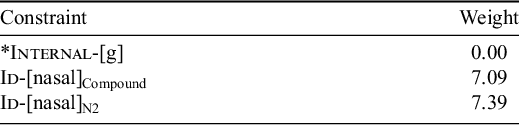
We also integrate the fact that the participants were included in the experiment on the basis of exhibiting complementary distribution of [g] and [ŋ] in monomorphemes. Therefore, the model included the monomorphemes used in the dialect questionnaire to screen participants for inclusion in the experiment, including frequency-based scaling of their faithfulness violations. Since we assume lexicon optimisation (i.e., non-alternating monomorphemes are restructured to have underlying /ŋ/), and since the monomorphemes we surveyed are only a small subset of the lexicon that exhibits the complementary distribution of [g] and [ŋ] – and so do not allow us to train phonotactic learning models that rely on implicit negative evidence (Hayes & Wilson Reference Hayes and Wilson2008) – we cannot accurately assess the weight of *Internal-[g]. However, we can find a lower bound on its weight by constraining the sets of weights we consider to those that maximise the likelihood of the compound data while simultaneously preserving allophony in monomorphemes (operationalised as having 95% or greater probability of faithful realisation). The final model yielded the weights listed in Table 1, and the predictions plotted in Figure 6.
Best-fitting weights for the experimental data, existing and novel compounds combined, that preserves the allophony in monomorphemes.

Table 1 Long description
The table consists of two columns titled Constraint and Weight. The first row under the headers lists the constraint asterisk Internal-open bracket g close bracket with a weight of 0.00. The second row lists the constraint I d-open bracket nasal close bracket sub Compound with a weight of 7.09. The third row lists the constraint I d-open bracket nasal close bracket sub N2 with a weight of 7.39.
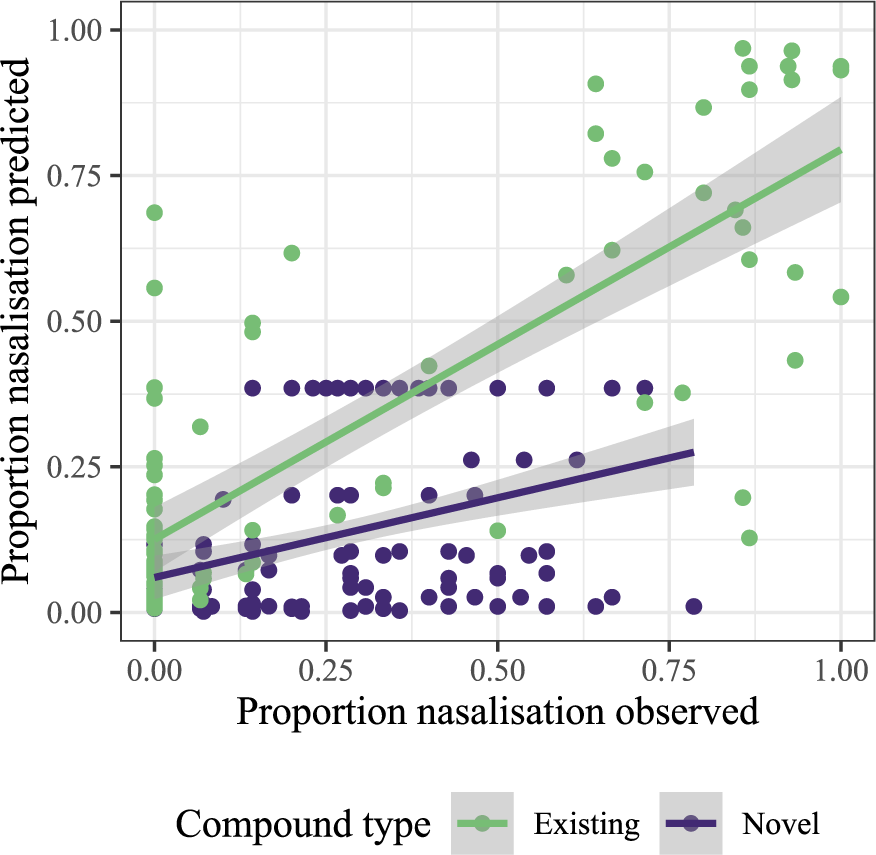
Predicted (vertical axis) vs. observed (horizontal axis) rates of nasalisation for existing (green) and novel (purple) compounds under the combined model (weights in Table 1).

Figure 6 Long description
The scatter plot features a horizontal x-axis labeled Proportion nasalisation observed and a vertical y-axis labeled Proportion nasalisation predicted, both ranging from 0.00 to 1.00. Existing compounds are represented by green dots and a green regression line. These data points are widely dispersed across the plot, showing a strong positive linear correlation. The green regression line starts near 0.12 on the y-axis at an x-value of 0.00 and rises to approximately 0.80 on the y-axis at an x-value of 1.00. A light gray shaded area represents the confidence interval around this line. Novel compounds are represented by purple dots and a purple regression line. These points are more concentrated in the lower half of the graph, specifically between 0.00 and 0.40 on the y-axis. The purple regression line shows a shallower positive slope compared to the green line, starting near 0.05 on the y-axis at an x-value of 0.00 and reaching approximately 0.28 on the y-axis at an x-value of 0.75. This line also includes a light gray confidence interval. A legend at the bottom identifies the Compound type with green for Existing and purple for Novel.
The weights of the two faithfulness constraints were not significantly different from each other, as assessed by a likelihood ratio test:  ; p = 0.10. A similar conclusion was suggested by the near-zero difference in the sample-size corrected AIC of the two models:
  . AICc differences greater than 10 are typically taken to indicate strong support for the model with the lower AICc value; for more on model comparison in statistical models and phonological grammars, see Shih (Reference Shih2017) and Wilson & Obdeyn (Reference Wilson and Obdeyn2009). This result suggests that the attractive influence of both bases is critical in driving the alternation in attested forms; the zero weight of the markedness constraint *Internal-[g] indicates that in existing compounds, analogical faithfulness is doing all the work, despite the assumption in the literature that the alternation is markedness-driven. We will revisit the role of markedness in §6.2.
We also compared the full model to one where the two faithfulness constraints were allowed to take on different values but were not scaled by frequency. As one might expect, since low- and high-frequency forms have the same violation profiles in the phonological grammar, a grammar without access to frequency information can only predict one rate of nasalisation across all forms; this model fits the data dramatically less well ( ; p < 0.001 with one degree of freedom;
  ).
).
Finally, we evaluate the absolute performance of the model by examining how well it fits the data it was trained on: although the two models have different internal structures, we can ask whether the theoretically informed MaxEnt model here does as good a job in explaining the data patterns as the theory-neutral mixed-effects logistic regression model reported by Breiss et al. (Reference Breiss, Katsuda and Kawahara2026).Footnote
8
We do this using the measure of
$R^{2}$
 , which ranges from 0 to 1, and can be thought of as the proportion of the variation in the dependent variable (here, whether nasalisation applies) explained by the collection of independent variables (the phonological and lexical characteristics of interest).
We used the r2_bayes() function from the performance package (Lüdecke et al. Reference Lüdecke, Ben-Shachar, Patil, Waggoner and Makowski2021) to obtain the marginal
$R^{2}$
 of the statistical model – that is, the amount of variance in the data explained by the fixed effects – and compared it to the
$R^{2}$
of the statistical model – that is, the amount of variance in the data explained by the fixed effects – and compared it to the
$R^{2}$
 for the MaxEnt model.Footnote
9
Since the statistical model is Bayesian, we obtain a median and 95% credible interval for our
$R^{2}$
for the MaxEnt model.Footnote
9
Since the statistical model is Bayesian, we obtain a median and 95% credible interval for our
$R^{2}$
 : 0.48 and [0.31, 0.56], respectively. This is lower than, though still relatively comparable to, the MaxEnt model’s
$R^{2}$
: 0.48 and [0.31, 0.56], respectively. This is lower than, though still relatively comparable to, the MaxEnt model’s
$R^{2}$
 of 0.63, for which we have only a point estimate. Although the two are relatively close, the point value for the marginal
$R^{2}$
of 0.63, for which we have only a point estimate. Although the two are relatively close, the point value for the marginal
$R^{2}$
 of the MaxEnt model is outside the 95% credible interval of the statistical model; this comparison suggests that the theoretically structured model outperforms the theory-blind statistical one. While we find this result encouraging, this conclusion is tentative – since the MaxEnt model does not capture variation at the level of the speaker, it may be that the non-hierarchical structure of the model mismatches the structure in the data in a way that distorts the results, attributing to the population grammar variance that should more conservatively be attributed to speaker-level idiosyncrasies.
5.2. Novel compounds
We take advantage of the fact that we have data for both existing and novel forms to administer a more severe test of the model. We do this by asking how well the grammar that was fitted to the existing items generalises to the novel forms. We evaluate the probability of the two candidate outcomes in the novel forms using the learned weights reported in Table 1, with the relevant frequency information for the N2s, and zero frequency for the compounds (since they are novel). The fit to the data is shown in Figure 6, alongside the fit to the existing compounds.
We found that the model of the existing forms generalises to the novel forms quite poorly; the obvious problem is that while the range of attested proportions of nasalisation range between 0 and 0.79, the model predicts outcomes only in the range of 0.002–0.39. This indicates that either the grammar that best fits the existing compounds is a poor estimate of the knowledge that speakers used when generalising to novel compounds (because of incompatible weights, constraints, or both), or that the novel compound data are simply extremely variable. To check whether the mis-fit is due to incompatible constraint weights, we fitted a model with the same constraints to the novel forms directly, without regard for data from monomorphemes or existing forms. This yields a shifted range of predicted proportions (0.29–0.70), but a marginally lower
$R^{2}$
 (0.11, compared to 0.12 based on the grammar fit to only the existing forms), which indicates that the data are still poorly fitted. Therefore, the unexpected finding about the faithfulness-driven nature of the alternation is not to blame for the poor generalisation performance of the model.
Next, we compare the fit of our theoretically motivated MaxEnt model to the purely statistical model fitted by Breiss et al. (Reference Breiss, Katsuda and Kawahara2026)Footnote
10
and find that the
$R^{2}$
 of our primary model when generalising to the novel compounds, 0.11, falls within the 95% credible interval of the median of that of the statistical model, 0.06 [0.00, 0.18]. The model also predicts a range of 0.07–0.64 for proportion undergoing nasalisation, which more closely matches the true data. While still low in absolute terms, it lessens the possibility that our theoretical commitments are what is limiting us in being able to account for the data well. Therefore, we suspect that the cause of the poor model fit may be that there is simply less signal in the novel compound data.
6. Discussion
This paper has proposed a model of variable voiced velar nasalisation in Japanese, drawing on experimental data published in Breiss et al. (Reference Breiss, Katsuda and Kawahara2026). The model integrates grammatical and functional determinants of variation, drawing on the Voting Bases framework of lexicon–grammar interaction, which was originally developed to model an entirely separate phonological phenomenon, Lexical Conservatism in English and Spanish (Breiss Reference Breiss2024). Here, we address several major issues that the model raises, notably about whether the proposed system can be learned from the actual Japanese lexicon (§6.1); about the unexpected (lack of) role markedness appears to play in driving the alternation (§6.2); about the competence–performance distinction (§6.3); and about how the Voting Bases model’s mechanism for integrating usage frequency and formal grammar compares to other proposals in the literature (§6.4). Finally, we close the paper with a more general discussion about how we might understand the broader empirical landscape of frequency effects in phonological patterning in light of the proposal in this paper.
6.1. Whence the weights? Evidence in the lexicon
Having observed that there is robust frequency conditioning of nasalisation in both existing and novel compounds, we can ask what the source of this frequency conditioning might be. A sensible null hypothesis would be that the relation between frequency and resting activation is one that is automatic and not overtly learned. However, we find that the model performs significantly better when allowed to set different weights for faithfulness constraints referencing different allomorphs. This result suggests that, setting aside the relation between frequency and activation, speakers must be able to attribute different amounts of influence to different faithfulness constraint violations depending on which base the violation is assessed against. Put another way, the learner needs to be able to figure out how analogically driven their lexicon is. Here, we present a preliminary investigation of what kind of evidence might exist in the Japanese lexicon that could allow speakers to assign different weights to Id-[nasal]Compound and Id-[nasal]N2.
We fitted a grammar with the constraints in §4.3 and frequency-driven scaling of faithfulness violations to the set of compounds in the corpus analysed by Breiss et al. (Reference Breiss, Katsuda and Kawahara2022) that had a free N2. We found that the optimal weights of the grammar were zero for both *Internal-[g] and Id-[nasal]Compound, and 1.08 for Id-[nasal]N2. We had anticipated there would be little to no weight assigned to the markedness constraint in this data set for the same reasons discussed in §5, but we also found that instead of a tension between faithfulness to the compound itself and faithfulness to the N2, the grammar instead left it to the paradigm uniformity effect alone to perturb the otherwise at-chance distribution of variation (at chance because the weight of Id-[nasal]Compound was at zero, indicating that, all else being equal, the alternating and non-alternating candidates were equiprobable). This is qualitatively the same finding as for the novel compounds.
We compared the model fit to the corpus data to one where the grammar was forced to assign the same weight to Id-[nasal]Compound and Id-[nasal]N2 and found that it was significantly outperformed by the model that allowed the grammar to allot differing weights to different faithfulness constraints to different bases ( ; p < 0.001 with one degree of freedom). We take this as tentative evidence that there is an empirical basis in the lexicon for assigning different degrees of faithfulness to different bases.
6.2. On the role of markedness
We began our discussion of voiced velar nasalisation by reviewing various sources that have assumed that the alternation observed in monomorphemes is a byproduct of a word-level markedness constraint banning word-medial /g/. This is a typologically common scenario and is built quite deeply into the foundations of constraint-based models (see Prince & Smolensky ([1993] Reference Prince and Smolensky2004) and the more recent summary in Chong Reference Chong2017). Separating marked structures from their repair makes it possible to derive both alternations and phonotactic restrictions from a common source. This, in turn, helps resolve the ‘duplication problem’ (Kenstowicz & Kisseberth Reference Kenstowicz and Kisseberth1977).
However, the weight of evidence drawn from Breiss et al.’s (Reference Breiss, Katsuda and Kawahara2026) data to this point suggests that rather than being driven by markedness, nasalisation may instead be driven by competing faithfulness pressures. Evidence comes from the zero weight assigned to the markedness constraint *Internal-[g] in the model fitted to the existing data in §5, and from the zero weight assigned to the same constraint when fitting the data from the corpus and when trying to model the novel N2 data directly. In both these scenarios, however, faithfulness constraints both to allomorphs with /g/ and to ones with /ŋ/ received non-zero weight, allowing the data to nevertheless be accounted for. Only in a model that assumes no scaling of faithfulness constraints by resting activation does markedness get weight, underscoring the importance of jointly modelling usage-based and grammatical influences on probabilistic phonology (see §6.3).Footnote 11
Further, though more indirect, evidence that the weight of the markedness constraint may be in decline comes from the general pattern of change in many Japanese dialects, including the spoken style of the Tokyo dialect, which has almost entirely lost the allophony in favour of retaining /g/ as [g] in all contexts. This fact does not bear directly on the actual formal model we propose, but it suggests that something in the learning data – be it phonetic, phonological or otherwise – is contributing to the loss of the allophony and the markedness constraint behind it.
Although this type of faithfulness-driven alternation is unexpected based on the literature reviewed in §2, the Voting Bases model nevertheless predicts these outcomes should occur, as shown in the tableaux in (9).
6.3. Competence, performance and formal modelling
This article has proposed a model of Japanese voiced velar nasalisation that integrates token frequency into the workings of the phonological grammar. Since the prospect of integrating a putatively performance-related factor like token frequency into a formal phonological model is not an uncontroversial one, below we directly address some possible criticisms of this approach. We certainly do not think that these are the last words on this topic, but we do feel that by explicitly discussing what we are doing and our motivations for doing it, we take a first step towards a clearer understanding of the stakes and consequences of the choices made in modelling information about usage jointly with the phonological grammar.
One initial objection to formally modelling the frequency-conditioned variation in nasalisation might be that there is nothing competence-related to model here at all – the variation is solely driven by ‘performance’ factors (Chomsky Reference Chomsky1965). We respond that this cannot be true of Japanese nasalisation: the fact that only compounds whose N2 is morphologically free exhibit frequency-sensitive variation, despite the existence of bound morphemes with [g]- and [ŋ]-initial forms like [ga]/[ŋa] ‘fang’, as shown by the examples in (5), requires an explanation that makes reference to grammatical structures.
Further afield, cases like Lexical Conservatism much more strongly blur the line between the contents of the lexicon and the phonological grammar and are well-modelled by a framework like Voting Bases. The fact that this article demonstrates that both paradigm uniformity and Lexical Conservatism emerge as special cases of the same theory speaks to the theoretical insight that can be gained by jointly modelling ‘performance-related’ and ‘competence-related’ influences on the phonological grammar.
Another objection is that by incorporating both resting activation (a psycholinguistic construct) and phonological markedness (a grammatical one), the model blurs the line between competence and performance, raising the question of what exactly the model is modelling. If so, this would be a legitimate concern. However, a virtue of the Voting Bases model is that lexical influence on the grammar is clearly delimited: the model only allows the lexicon to scale the weights of faithfulness constraints to corresponding lexical representations. Manipulating the resting activation of a given UR has identifiable, localised influences on the computations of the phonological grammar, and instantiates a linking hypothesis consistent with a consensus view of the basic structure of the lexicon. This mechanism can be seen as one way of implementing the idea of ‘grammar dominance’ put forth, for example, by Coetzee (Reference Coetzee2016) and Coetzee & Kawahara (Reference Coetzee and Kawahara2013). The ‘core’ phonological grammar – weighted constraints which can assess violations of novel candidates – can be recovered by simply ignoring the influence of the lexicon on constraint violations, and can be studied in novel contexts like wug-tests, where there is no relevant lexical representation to bear on the grammar.
A final objection that we consider is that the very act of jointly modelling usage frequency and the phonological grammar risks leading the analyst to think of fundamentally performance-related factors as in fact competence-related, thus undercutting the goal of researchers whose focus is only understanding linguistic competence. We contend that this is simply false, and in fact, the reverse is true: for a researcher who only cares about linguistic competence, modelling usage factors jointly with theories of competence is vital. When confronting data derived from language use (i.e., modelling corpus data as in Breiss et al. Reference Breiss, Katsuda and Kawahara2021, or experimental data where stimuli are existing morphemes of the language as in Breiss et al. Reference Breiss, Katsuda and Kawahara2026), a joint model will better expose the true influence of competence-related factors on the data under study, with the performance-related parts of the model accounting for the otherwise distorting influence of these factors. Simply ignoring performance-related factors in a formal model makes the strong claim that they have no effect, an assumption which is untenable in the cases examined here, and, we suggest, is also false in many (if not all) types of linguistic data that speakers might have prior usage-based experience with (Arnon & Snider Reference Arnon and Snider2010; Morgan & Levy Reference Morgan and Levy2016, Reference Morgan and Levy2024; Smith & Moore-Cantwell Reference Smith and Moore-Cantwell2017; Zymet Reference Zymet2018). Rather, an integrated approach that jointly models grammar and usage is essential to disentangle and distill an understanding of competence from its entanglement with performance factors, if this is the goal of the analysis.
The foregoing discussion, as well as comments from reviewers, raises the question of whether the analysis proposed here still cleaves to the generative roots of the constraint-based model formalism that it adopts (though cf. Smolensky Reference Smolensky1986a, Legendre et al. Reference Legendre, Miyata and Smolensky1990 and Smolensky Reference Smolensky1986b on the shared roots of Optimality Theory, Harmonic Grammar, MaxEnt and connectionism of the sort proposed by Rumelhart & McClelland Reference Rumelhart and McClelland1986). This, in our opinion, is somewhat a matter of perspective, and is in any case rather beside the point. Depending on how one defines ‘generative’ or ‘functionalist’, our model may be seen as aligned with either point of view – since it, too, aims to model grammar and its use and acquisition at a certain necessary level of abstraction. What we hope this exercise demonstrates, rather, is that by reifying our theories about what the data-generating process is in a computational model, we can confront complex data with many interlocking or moving parts, and recover transportable analytical insights that we are confident are common desiderata shared by many strands of linguistic analysis. We also note that we are far from the first to pursue this approach; for very closely related discussions of what it means for a linguistic theory to model frequency, see Coetzee & Kawahara (Reference Coetzee and Kawahara2013) and Coetzee (Reference Coetzee2016), among others.
6.4. Comparison with other models
The Voting Bases model is one of several approaches in the literature that propose to model the interaction of usage frequency and phonological grammar. In particular, it is similar to the methods proposed in Coetzee (Reference Coetzee2016) and Coetzee & Kawahara (Reference Coetzee and Kawahara2013), which directly scale the weight of faithfulness constraints by the frequency of the form they refer to, and that of Baird (Reference Baird2021), where a simulated perception–production loop comes to the same result through online learning. This family of approaches involves lowering the weight of faithfulness constraints to high-frequency forms relative to lower-frequency forms, which enables them to model data like coronal stop deletion in English (Coetzee & Kawahara Reference Coetzee and Kawahara2013), where higher-frequency monomorphemes (like just) tend to get produced with a deleted coronal stop more often than phonologically similar words that are less frequent (like jest). Common to these models is that they assume that the underlying form contains the final /t/, and thus the task of their model must relate higher frequency to lower-weighted faithfulness.
A weakness of these models is that, with the possible exception of Baird (Reference Baird2021), the directionality between frequency and constraint weight is arbitrary – the primary goal set in these studies was to fit the data, which is better than the alternative which does not model the effects of lexical frequencies at all, but they suffer somewhat from the lack of clear functional grounding for the relation.
By contrast, the frequency–faithfulness relation that Voting Bases model adopts runs in the opposite direction: more frequent forms exact a greater penalty for unfaithful realisations relative to less frequent forms; constraint violations are less severe for low-frequency forms than for high-frequency ones. This allows the model to fit a similar range of data, but with a linking hypothesis that is explicitly rooted in resting activation, a construct that is externally justified by a large body of work in psycholinguistics, as reviewed in Breiss (Reference Breiss, Katsuda and Kawahara2021, Reference Breiss2024). Lexical items with higher resting activation are more insistent on faithfulness to themselves, corresponding to their increased salience in the language processing system. The main contribution of the Voting Bases model in modelling this phenomenon is that the influence of the lexicon on the grammar should be, in principle, derivable without reference to any facts about the experiment in question; given some independently established computationally implemented model of lexical dynamics that represents a scalar quantity of resting activation (or similar construct), the strong prediction of the Voting Bases model is that that quantity should be able to be a fully adequate scaling factor for faithfulness constraint violations. The specific mechanism that is used in this paper – scaling the weights by the sigmoidal transformation of the resting activation – is used since it represents, to us, a reasonable first stab, but the linking function may need to be revised in light of future findings.
In summary, we suggest that the Voting Bases model, because of its functional grounding of frequency effects in externally motivated psycholinguistic phenomena, is on firmer footing than theories that have alternative linking functions between frequency and grammar, which are arguably arbitrary.
6.5. Towards a unified picture of token frequency in phonology
In this section, we broaden our view of token-frequency effects in phonology and discuss how considering the varying functional roles of frequency can reconcile some seemingly contradictory bodies of evidence (cf. also Bybee Reference Bybee2003).
First, there is evidence that higher token frequency leads to more markedness-reducing alternations. Coetzee & Kawahara (Reference Coetzee and Kawahara2013) found that higher-frequency lexical items were more likely to undergo phonological processes of simplification and (markedness-)reduction: high-frequency English words like jus(t) underwent an optional process of coronal stop deletion at a higher rate than low-frequency words like jes(t), and high-frequency Japanese words like [baggu] ‘bag’ underwent geminate devoicing more often than low-frequency words like [budda] ‘Buddha’ (Kawahara & Sano Reference Kawahara and Sano2013). Zuraw (Reference Zuraw2007) examines frequency-conditioned application of markedness-reducing phonological processes in a corpus of written Tagalog, and likewise finds higher rates of repair within higher-frequency units (words, clitic groups, etc.), subject to the markedness principles of the language.
On the other hand, there is also evidence to show that higher-frequency forms are more likely to be exceptional, and thus marked with regard to the overall properties of the grammar. Smith & Moore-Cantwell (Reference Smith and Moore-Cantwell2017) found that higher-frequency comparative constructions are more likely to flout grammar-wide trends driven by markedness. In a similar vein, Anttila (Reference Anttila2006) and Mayer (Reference Mayer2021) found that higher-frequency morphologically complex forms were more likely to behave opaquely with respect to grammar-wide phonological processes.
We can compare these effects to the ones observed in Breiss et al. (Reference Breiss, Katsuda and Kawahara2022, Reference Breiss, Katsuda and Kawahara2026): higher-frequency N2s act as stronger attractors, yielding more faithfulness to their preserved surface [g] and thus lower rates of nasalisation, whereas higher compound frequency as a whole yielded higher rates of nasalisation. Thus, it seems that for compounds, higher frequency is correlated with more phonological-process application and markedness reduction; this is broadly in line with the findings of Coetzee & Kawahara (Reference Coetzee and Kawahara2013), where higher-frequency words undergo more phonological alternations. However, we found that at the same time, in compounds with free N2s, higher N2 frequency is related to less process application, with higher frequency supporting the retention of a marked structure (word-medial [g]).
We suggest that we can resolve this tension by distinguishing between the processes that token frequency can affect: one is whether to set up an independent lexical representation for a surface allomorph, and the other is influencing the strength of that representation in the lexicon of the speaker.
If a form is exceptional and high-frequency, it may be more economical for a speaker to pay a one-time ‘cost’ of encoding the exception as a listed form that is not derived by the grammar, thus relieving the phonology of the difficulty of having to generate the exceptional or idiosyncratic form on each of the many frequent occasions of use (cf. the Adaptor Grammars of Johnson et al. Reference Johnson, Griffiths and Goldwater2007 et seq., or the Fragment Grammars of O’Donnell Reference O’Donnell2015, which offer computationally explicit implementations of this general idea). For lower-frequency exceptional forms, the likelihood of listing is less, since the price trades off less favourably with the number of times it is used; thus lower-frequency forms are more susceptible to change and regularisation to the dominant grammatical trends over time compared to higher-frequency forms.
Another aspect of this trade-off is the emergence of Lexicon Optimisation (Prince & Smolensky [1993] Reference Prince and Smolensky2004; Sanders Reference Sanders2003, Reference Sanders2006); even if a form is not particularly exceptionful, if a UR almost always surfaces with a phonological process applied to it, then with sufficient frequency it becomes less costly to just store the form with phonological process applied – that is, to create a separate allomorph specific to the environment that would trigger the phonological rule. This, similarly, relieves the grammar of the job of having to repair the form every time. Thus, we find Lexicon Optimisation targeting forms like jus(t) over forms like jest, restructuring them with the phonological alternation already applied, thus giving them the appearance of having undergone a markedness-improving repair in the grammar, when actually the frequency of the form has resulted in restructuring in the lexicon (see Breiss & Wilson Reference Breiss and Wilson2020 for an initial attempt at a computational model of the phonological grammar and lexicon that exhibits this property).
As reviewed above, lexical frequency also influences the resting activation of a lexical item once it is listed in the lexicon. In the Voting Bases model, higher resting activation leads to the listed form exerting a stronger pull on the surface realisation of a related form. Where this pressure goes against the broader principle of markedness in the grammar, as in cases of paradigm uniformity, we find that marked structures with high-frequency output bases are preserved; in cases where the listed form coincides with the output of the markedness-reducing process, as in many cases of Lexical Conservatism (Steriade Reference Steriade1997; Steriade & Stanton Reference Steriade and Stanton2020; Breiss Reference Breiss2021), the higher-frequency form promotes an unmarked surface form.
Recent work by Jarosz et al. (Reference Jarosz, Hughes, Lamont, Prickett, Baird, Kim and Nelson2025) has laid out a class of models which exhibit characteristics that align favourably with the dynamics of frequency laid out here, suggesting that an integrated, implemented model that can jointly account for the variety of frequency effects reviewed in this section is perhaps quite close at hand. Future work may profitably explore how well these models can provide converging evidence from computational learning simulations to support the psycholinguistic, experimental and diachronic evidence for the contents of the lexicon that the Voting Bases theory relies on. In sum, the broader landscape of token frequency in phonology is compatible with the functional grounding given to frequency under the Voting Bases model, though much empirical and formal work remains to be done to further support the predictions of the framework more broadly as a candidate for a general theory of the influence of the dynamic lexicon on the probabilistic grammar.
Data availability statement
R scripts, input data and MaxEnt model fits can be accessed at https://osf.io/wcvyx/.
Acknowledgements
Thanks to Connor Mayer, as well as audiences at the University of Southern California and the University of Pennsylvania, for valuable discussion and feedback.
Funding statement
This work was supported in part by JSPS Grant No. 22K00559 to the third author.
Competing interests
The authors declare no competing interests.



 Open access

