



Children, regardless of language, experience difficulty producing /r/-sounds or rhotics. These are among the last sounds to be produced developmentally and they are one of the most frequent sounds in error amongst children with speech sound disorders (Klein, Grigos, McAllister Byun & Davidson, Reference Klein, Grigos, McAllister Byun and Davidson2012). The difficulty children experience with rhotics may be due to phonetic factors related to their articulatory complexity (McGowan, Nittrouer & Manning, Reference McGowan, Nittrouer and Manning2004; Solé, Reference Solé2002), or due to phonological factors related to their ambiguous status in terms of place of articulation (Goad & Rose, Reference Goad, Rose, Kager, Pater and Zonneveld2004; Rose, Reference Rose2000). The current study explores the development of /r/ in German and Spanish-speaking monolingual and bilingual children. German and Spanish are characterized by different /r/s. The German /r/ is a uvular approximant whereas Spanish has two /r/s: an alveolar tap and trill.
The aim of the study is to investigate whether there is autonomy or interaction in the development of /r/ across a bilingual's two languages. This will be determined by comparing the bilinguals' development of /r/ to those of monolinguals. Previous studies suggest that uvular /r/ is acquired earlier than alveolar /r/ (Rūķe-Draviņa, Reference Rūķe-Draviņa1965). Thus, we seek to determine whether the same developmental order is observed in the current data. Following an introduction to rhotics in German and Spanish, we review findings of /r/ development in monolingual and bilingual children concentrating on languages which contain uvular /r/ and an alveolar tap and trill.
The phonetics and phonology of rhotics
Rhotics are one of the most difficult classes of sounds to characterize (Lindau, Reference Lindau and Fromkin1985; Spreafico & Vietti, Reference Spreafico and Vietti2013; Wiese, Reference Wiese and Hall2001). They may be realized with a variety of places- and manners-of-articulation, meaning that there is no single phonetic trait that links all /r/ sounds. Resemblance between rhotics is often claimed on the basis of acoustic criteria such as a low third formant (Lindau, Reference Lindau and Fromkin1985; McGowan et al., Reference McGowan, Nittrouer and Manning2004); however, lowering of the third formant is not characteristic of all rhotics (Wiese, Reference Wiese2003). Some generalizations may be made about /r/ sounds when referring to phonological behavior or phonotactic properties. Wiese (Reference Wiese and Hall2001) argues that rhotics may be defined in terms of their behavior on the sonority hierarchy. They are more sonorous than laterals but less sonorous than vowels. Other authors, working within generative phonology, claim rhotics to be placeless or to lack featural specification (Goad & Rose, Reference Goad, Rose, Kager, Pater and Zonneveld2004; Walsh Dickey, Reference Walsh Dickey1997).
/r/ in German
In standard German, /r/ is best characterized as a voiced uvular approximant [ ]Footnote 1; however, it may have other realizations including alveolar, retroflex, or velar in terms of place of articulation, and tap or fricative, in terms of manner of articulation (Wiese, Reference Wiese2003). In southern Germany, and parts of Austria and Switzerland, it is typically produced as an alveolar trill [r] (Mangold, Reference Mangold2005). In postvocalic position, German /r/ is vocalized (e.g., Tier [tiːɐ] “animal”).
/r/ in Spanish
Spanish is one of the few languages of the world characterized by more than one rhotic. All varieties contain a voiced alveolar tap [ɾ] and a second rhotic which is most commonly a voiced alveolar trill [r]. The production of taps and trills is characterized by one or several rapid interruptions of the airstream. All sources agree that the alveolar trill is articulatorily difficult, requiring precise control of aerodynamics and tongue positioning (Solé, Reference Solé2002).
The two Spanish /r/s contrast with each other in intervocalic position (e.g., pero [peɾo] “but” vs. perro [pero] “dog”). In other positions, they are in complementary distribution. The trill occurs in word-initial position (e.g., rey [re] “king”) and in syllable-initial position after /l/, /n/, /s/ (e.g., al[r]ededor “around”, en[r]iquecer “to enrich”, Is[r]ael “Israel”); the tap occurs as part of a complex onset (e.g., tres [tɾes] “three”).
Given that the German /r/ is vocalized in syllable-final position, the present study focuses on the development of /r/ in syllable-initial position, in simple and in complex onsets.
Development of /r/ in monolingual children
Acquisition of uvular /r/
Studies on the acquisition of uvular /r/ in French and German show it to be a consonant of intermediate difficulty (Fox, Reference Fox and McLeod2007, Reference Fox2015; Fox & Dodd, Reference Fox and Dodd2001; MacLeod, Sutton, Trudeau & Thordardottir, Reference MacLeod, Sutton, Trudeau and Thordardottir2011; Möhring, Reference Möhring1938). In German, Fox and Dodd (Reference Fox and Dodd2001) report that 90% of German children, aged 2;6 to 2;11, have uvular /r/ in their phonetic inventory (i.e., produce uvular /r/ on at least two occasions) and 90% of German children, aged 3;0 to 3;6, have uvular /r/ in their phonemic inventory (i.e., produce /r/ with at least 67% accuracy). The most common errors are substitutions by [h] and [ʔ] (Fox, Reference Fox2015). In French, uvular /r/ is produced by 90% of children, aged 2;6 to 2;11, in word-final position, and by 90% of children, aged 3;0 to 3;5, in word-initial position (MacLeod et al., Reference MacLeod, Sutton, Trudeau and Thordardottir2011). Similar findings have been reported for the uvular rhotic in Hebrew (Ben-David, Adi-Bensaid & Ezrati, Reference Ben-David, Adi-Bensaid and Ezrati2011). It is produced correctly approximately 80% of the time by children, aged 2;6 to 3;3.
Acquisition of alveolar trill and tap
Multiple sources indicate that the alveolar trill is a late acquired sound, and that children acquire the alveolar tap earlier than the trill in Spanish (Acevedo, Reference Acevedo1993; Jimenez, Reference Jimenez1987; Linares, Reference Linares and Padilla1981). Jimenez (Reference Jimenez1987) reported that the tap reached 90% accuracy at 4;7 in the productions of Spanish-speaking children of Mexican descent, whereas the trill did not reach this level of accuracy until 5;7. Rūķe-Draviņa (Reference Rūķe-Draviņa1965) reports earlier acquisition times for the alveolar trill (and its allophones) in Czech and Latvian (3;8 to 4;5 for Czech and 4;11 to 5;0 for Latvian), whereas Acevedo (Reference Acevedo1993) and Linares (Reference Linares and Padilla1981) report later acquisition times for the trill in Spanish, that is, around 6;0.
In terms of error patterns, Goldstein (Reference Goldstein1988) found that the trill most often substituted for the tap and the tap most often substituted for the trill in Spanish. Other less common error processes were deletion and substitution by /l/. Rūķe-Draviņa (Reference Rūķe-Draviņa1965) noted multiple error patterns for the trill in Czech and Latvian, the most frequent being /l/, /j/, and uvular /r/ (see also Ball, Müller & Munro, Reference Ball, Müller and Munro2001, who note an extraordinary number of different realizations for the Welsh trill).
In sum, a review of studies on the acquisition of uvular /r/ and the alveolar tap and trill show a different time-line of acquisition for each of these /r/ sounds. Uvular /r/ is typically acquired around 2;6 to 3;0, the alveolar tap, around 4;0, and the trill, later than 4;0.
Development of /r/ in bilingual children
The theme of this study is to examine cross-linguistic interaction in the acquisition of /r/ by bilingual German–Spanish children. We are interested in knowing whether the two phonological systems of the bilingual child influence each other. According to the framework of Paradis and Genesee (Reference Paradis and Genesee1996), three types of interaction patterns can be expected: acceleration, delay and transfer. Recent work by Kehoe (Reference Kehoe2015a), however, recommends an enlargement of this set to include patterns observed in second language acquisition such as Merging (similar to perceptual assimilation) or Deflecting (similar to perceptual dissimilation) (Flege, Reference Flege and Strange1995) (see Lleó, Reference Lleó2015, for additional interaction patterns).
Merging is when there is bidirectional influence between the bilinguals’ two languages such that the two phonological systems approximate each other. This pattern has been observed when measuring rhythm in bilingual German–Spanish children (Kehoe, Lleó & Rakow, Reference Kehoe, Lleó and Rakow2011). Rhythmic variability was more extreme in bilingual children speaking Spanish compared to monolingual Spanish and less extreme in bilingual children speaking German compared to monolingual German, resulting in reduced differences between the bilinguals’ two systems. Deflecting is when a greater difference emerges between the bilinguals’ two systems than in the respective monolingual ones. For example, Dodane and Bijeljic-Babic (in press) observed that bilingual French–English children exaggerated the difference between stressed and unstressed syllables in French making the contrast between the two types of syllables greater than what would typically be seen in monolingual children.
What types of interaction effects may we expect in the acquisition of /r/? Given that rhotics are complex sounds both phonetically and phonologically, one likely scenario is that their acquisition is delayed in bilingual children. The rationale for this delay would be similar to that used by Kehoe (Reference Kehoe2002) to account for the delay of phonological vowel length in the German of bilingual children. Acquiring a marked phenomenon requires a certain amount of positive evidence; in the bilingual situation, there is a dilution of this evidence (due to reduced input) leading to a delay. There is some indication that /r/ sounds may be delayed in bilingual children. Goldstein and Washington (Reference Goldstein and Washington2001) report that bilingual Spanish–English children, aged 4 years, had lower percent correct scores for the Spanish tap and trill than monolingual Spanish children did, based on the results of Goldstein and Iglesias (Reference Goldstein and Iglesias1996). The accuracy of the tap and trill was 72% and 77% respectively in the bilinguals’ speech compared to 86% and 93% in the monolinguals’ speech. Fabiano-Smith and Barlow (Reference Fabiano-Smith and Barlow2010) found that the phonetic inventories of monolingual Spanish children, aged three to four years, were commensurate with those of bilingual Spanish–English children in terms of complexity; however, if we examine their data closely, we note that there were differences between the two groups with respect to the acquisition of Spanish /r/s. Six of the eight monolingual Spanish speaking children had both the tap and the trill in their phonetic inventories; one child had only the tap, and another child, only the trill. None of the eight bilingual children had both the tap and the trill in their inventories; six had only the tap, one had only the trill, and one child had neither the tap nor the trill. Both of these studies suggest that /r/ is acquired earlier by monolinguals than bilinguals in Spanish.
Another possible cross-linguistic effect is transfer. In contrast to findings in second language acquisition where transfer is prolific (see Face, Reference Face, Klee and Face2006), transfer is generally not frequent in early bilingual speech (Fabiano-Smith & Goldstein, Reference Fabiano-Smith and Goldstein2010; Salameh, Nettelbladt & Norlin, Reference Salameh, Nettelbladt and Norlin2003); however, /r/ is one of the few sounds which is reported to undergo transfer. Fabiano-Smith and Barlow (Reference Fabiano-Smith and Barlow2010) document transfer of Spanish /r/ (i.e., [ɾ]) in five out of eight bilingual children's English phonetic inventories. Ball et al. (Reference Ball, Müller and Munro2001) in their study of rhotics in Welsh–English bilinguals present evidence consistent with transfer. The English approximant was a common substitute for the Welsh trill and the trill was also produced for the English approximant /r/, particularly in the older children.
We predict that delay and transfer are the most likely patterns of cross-linguistic interaction in the German–Spanish data. However, other types of cross-linguistic interaction patterns may be envisaged for /r/. Recent research in bilingual speech has drawn attention to the wide range of outcomes that may result even when bilingual children are acquiring languages with similar linguistic properties (Hambly, Wren, McLeod & Roulstone, Reference Hambly, Wren, McLeod and Roulstone2013; Kehoe, Reference Kehoe2015a). These diverse outcomes make it difficult to make precise predictions when and in what direction cross-linguistic interaction will occur. For example, we have posited that /r/s due to their phonetic and phonological complexity may be delayed in bilingual speech. There is also evidence that bilingualism leads to heightened attention to phonemic contrasts and more developed motor control (Grech & Dodd, Reference Grech and Dodd2008; Johnson & Lancaster, Reference Johnson and Lancaster1998; Schmidt & Post, Reference Schmidt and Post2015). A bilingual by virtue of being exposed to different forms of linguistic complexity across his two languages may have accelerated performance in comparison to a monolingual (Keffala, Barlow & Rose, published online May 12, 2016; Tamburelli, Sanoudaki, Jones & Sowinska, Reference Tamburelli, Sanoudaki, Jones and Sowinska2015). In the case of /r/, acceleration may arise because acquiring two or more different /r/ sounds leads to improved acoustic-perceptual and articulatory representations and improved speech-motor abilities. Another possible effect is merging in which there is both delay and acceleration at the same time. This effect may be due to a common speech-motor base which limits or constrains differences between developing systems. For example, we might see alveolar taps or trills acquired at the same time as uvular /r/, which would not be expected given the robust findings which indicate that uvular /r/ is acquired earlier than alveolar taps and trills.
Studies on the phonological development of bilingual children have also observed that bilingual children may evidence atypical error patterns in comparison to monolingual children (Holm & Dodd, Reference Holm and Dodd1999; Holm, Dodd, Stow & Pert, Reference Holm, Dodd, Stow and Pert1999). For example, Goldstein and Washington (Reference Goldstein and Washington2001) report differences in error patterns between monolingual and bilingual Spanish–English children for the Spanish alveolar tap and trill. The bilingual children deleted the tap or substituted it with a [l], errors which were not observed in the monolinguals. The bilinguals evidenced variable error patterns for the trill, including substitutions by the tap, [l], and a range of other sounds such as [s], [t], and [tj] whereas the monolinguals primarily used the tap as substitute for the trill. Overall, they found that monolinguals employed more /r/-like substitutions for target taps and trills than did the bilinguals. Thus, analysis of error patterns may provide information on differences between monolinguals and bilinguals in their development of /r/.
Finally, studying asymmetries between /r/ and /l/ may enrich our understanding of differences between monolingual and bilingual speech with respect to /r/. Kehoe, Hilaire-Debove, Demuth and Lleó (Reference Kehoe, Hilaire, Demuth and Lleó2008) observed that Spanish-speaking children acquired /l/ before /r/ complex onsets. We are interested in knowing whether the same asymmetry between /l/ and /r/ complex onsets exists in the bilingual German and Spanish data.
In conclusion, we predict that bilingual children will display different patterns of /r/ development in comparison to monolingual children. Findings on /r/ acquisition in previous studies of bilingual children lead us to believe that the most likely patterns of interaction are delay or transfer. Our prediction of delay is also based on the assumption that bilinguals may have difficulty acquiring marked/complex phenomena due to reduced input (Kehoe, Reference Kehoe2002). Two alternate predictions are considered: 1. Development of /r/ may be faster in bilingual versus monolingual children due to the fact that they are exposed to different types of (complex) /r/ sounds, and 2. There may be a merging pattern in which the acquisition of /r/ is more similar in the bilingual's two languages than in the respective monolingual controls. The inclusion of this prediction is based on findings in second language acquisition, which show that a frequent pattern is the merging of two phonological categories into one (Flege, Reference Flege and Strange1995). In the case of young bilinguals, we believe the merging effect may have a basis in production, reflecting common articulatory capacities.
Method
Data-base
The data-base consists of longitudinal recordings of five monolingual German, three monolingual Spanish, and four bilingual German–Spanish children tested from the onset of their first words (see Lleó, Reference Lleó, Schmidt and Wörner2012, for a detailed description of the corpus). The monolingual German and bilingual children were recorded in Hamburg, Germany, and the monolingual Spanish children were recorded in Madrid, Spain. The bilinguals were children of Spanish-speaking mothers and German-speaking fathers. Each parent followed the “une personne, une langue” rule by addressing the child in his/her respective language. The parents’ language of communication was German in the case of Jens, Manuel and Nils, and Spanish in the case of Simon. All children were from middle-class educated families. All parents had graduated from high school and had undertaken university or tertiary-level studies.
Children were audio-recorded in their homes, while interacting with a parent and an experimenter. The bilingual children were visited by two separate teams: a German- and a Spanish-speaking team. If one of the parents was present, he/she had to be a native speaker of the language of the recording session. Analyses based on Mean Length of Utterance (MLU) and percentage of utterances corresponding to the target language within a recording session indicated that three of the bilingual children (Simon, Jens, and Manuel) were balanced bilinguals whereas one of them (Nils) was dominant in German (Kehoe, Lleó & Rakow, Reference Kehoe, Lleó and Rakow2004).
Following testing, all sessions were glossed and phonetically transcribed by native speakers of the respective languages. Reliability tests on a sample of the data indicated inter-tester reliability for the phonetic transcription of consonant productions (according to agreement in terms of manner and place of articulation) to be greater than 84%: 84% (Spanish) and 90% (German) for manner features; and 90% (Spanish) and 97% (German) for place features. Agreement as to whether a segment was deleted or inserted was 88% (German) and 89% (Spanish). These results constitute acceptable reliability.
Data analyses
For the purposes of the current study, target words containing /r/ were extracted from the data-base. In German, /r/ was examined in two phonological environments: 1. Complex onsets (e.g., Paprika “green/red pepper”, drauf “on top of”); and 2. Simple onsets before stressed syllables (e.g., rote “red”, waˈrum “why”). In Spanish, /r/ was examined in four phonological environments: the tap was studied in 1. Complex onsets (e.g., tren “train”, grande “big”) and 2. Word-medial position (e.g., mariposa “butterfly”, mira “look”) and the trill was studied in 3. Word-initial (e.g., reloj “clock”, roto “broken”) and 4. Word-medial positions (e.g., gorro “cap”, marrón “brown”).
In coding productions of /r/, three types of realization patterns were distinguished. They are illustrated in Table 1. In the case of the German uvular /r/, a completely incorrect realization was deletion or substitution by a place or manner class that did not resemble /r/; an almost-correct realization included substitution by a dorsal fricative (e.g., [x, ɣ]) or the voiceless uvular fricative (e.g., [χ]) or alternatively by another /r/ sound (e.g., [ɾ, r, ɽ, ɻ]). As for a target-like /r/, we accepted productions of the uvular trill [ʀ], fricative [ʁ], or approximant []. In the case of the Spanish /r/s, a similar coding system was utilized. An incorrect production included deletion or substitution by a non-/r/ sound (e.g., [d, ð, l, j]). An almost-correct realization included substitution by another /r/ sound (e.g., [ʀ, ʁ, ɾ, r, ɽ, ɻ, ɹ]) or by a sound that may have resulted from transfer from German (e.g., [ɣ, χ]), and target-like production was realization of the target /r/ (i.e., alveolar tap or trill in the appropriate position). The separation between incorrect and almost-correct realizations proved useful since we were able to observe developmental progression in /r/ even when acquisition of target /r/ (e.g., alveolar trill) was late.
Coding of /r/ realizations in German and Spanish
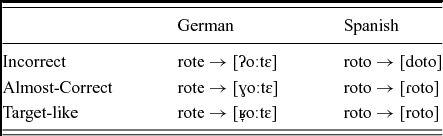
All target words containing /r/ were included in the analysis (with the exception of /r/ in syllable-final position and /r/ preceding unstressed syllables in German). We present the results in three-monthly age intervals: 2;0 (2;0.00 to 2;02.30), 2;3 (2;3.00 to 2;5.30), 2;6 (2;6.00 to 2;8.30) etc. Data were analyzed as of age 2;0; however, if the child was already producing a substantial number of /r/s (greater than 50% including almost-correct forms) at 2;0, age-range 1;9 was included (German: Britta, Thomas, Johannes, Nils and Manuel). In German, data were analyzed through to 3;0 for the monolinguals and through to 3;3 for the bilinguals (with the exception of Jens) allowing us to track almost complete acquisition of /r/.Footnote 2 This was not the case for Spanish. Monolingual data were only available until the age range 2;6 (i.e., 2;6 to 2;8.30) for two of the Spanish monolinguals and to 3;0 (3;0 to 3;2.30) for the third monolingual, thus, not allowing us to track complete acquisition. We were able to track acquisition of /r/ through to age ranges 3;3/3;6 for the bilinguals, however. Difference in ending times (3;3 vs. 3;6) depended upon the availability of recordings for individual children. Due to the reduced data possibilities for monolingual Spanish, we rely on literature findings for /r/ acquisition. Nevertheless, we still present our analyses on monolingual Spanish. Given that the monolingual and bilingual data were collected under similar experimental conditions, they represent an important point of comparison.
In addition to target words with /r/, target words containing complex onsets with /l/ were selected. Children's productions of C/l/ were analyzed in a similar way to C/r/ complex onsets, with the exception of them being coded in terms of two realization patterns only: 1. Correct (e.g., glauben [ˈglaʊb ] “to believe”; globo [ˈgloβo] “balloon”) or 2. Incorrect (e.g., glauben [ˈgaʊb]; globo [ˈlobo]).
Results
Uvular /r/
Monolingual German
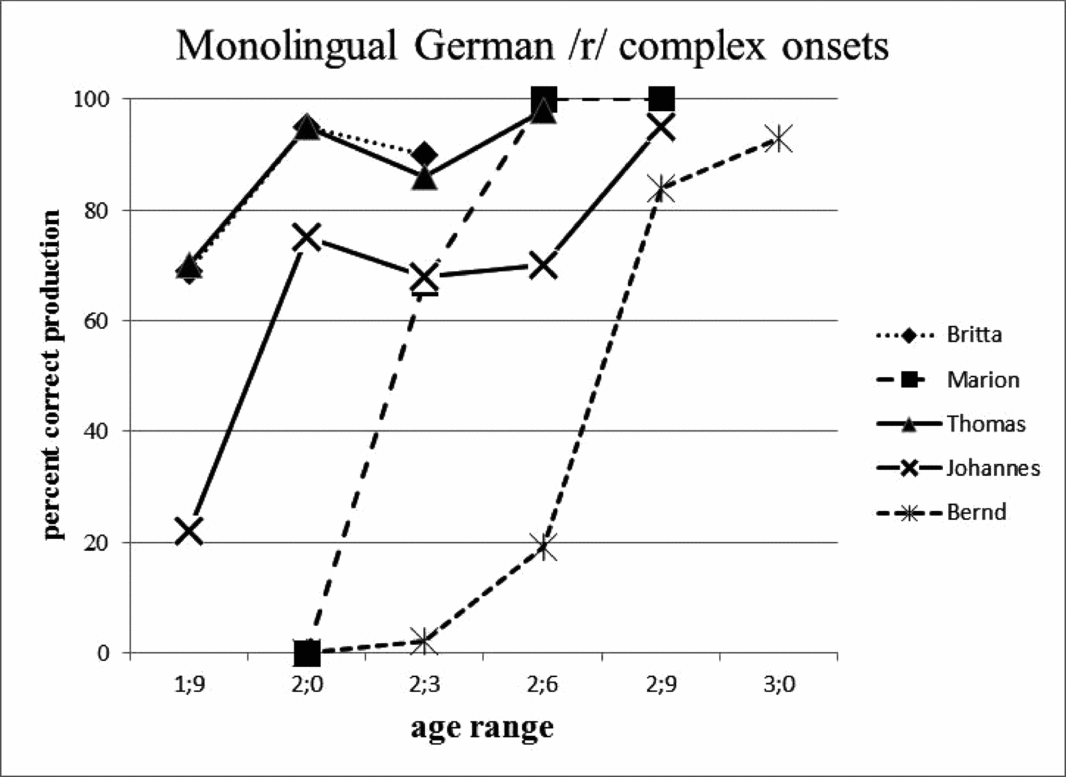
Figures 1 and 2 show the acquisition patterns of /r/ complex onsets and /r/ (simple) onsets for the five monolingual children across the age range 1;9 to 3;0. These results group together target-like and almost-correct productions. Appendix A (see Supplementary Materials) provides the total number of productions and percentages of target-like and almost-correct productions for the individual children. If we use 90% correct production as the criterion level of /r/ mastery, results show that two children (i.e., Britta and Thomas) have acquired /r/ complex onsets at 2;0, one child at 2;6 (i.e., Marion), one child at 2;9 (Johannes), and one child at 3;0 (Bernd). 90% correct production for /r/ onsets is achieved by one child as of 2;0 (Thomas), one child as of 2;3 (Britta), and three children as of 2;9 (Marion, Johannes, Bernd)Footnote 3. In sum, the acquisition times for uvular /r/ in simple and complex onsets range from 2;0 to 3;0.
Percent correct production of /r/ complex onsets in five monolingual German-speaking children across the time period 1;9 to 3;0.
Percent correct production of /r/ in simple onsets (before stressed syllables) in five monolingual German-speaking children across the time period 1;9 to 2;9.
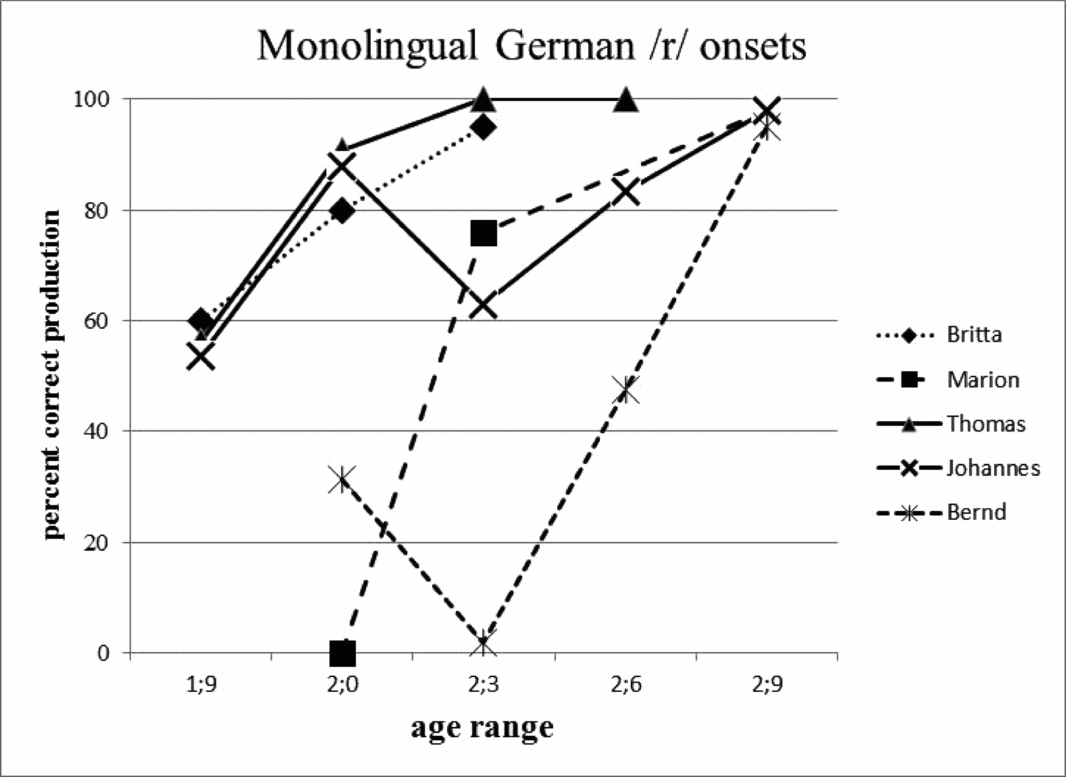
In terms of incorrect forms, the main pattern observed for /r/ complex onsets was reduction to one segment, typically, the non-sonorant segment (96% or 275/285 where 275 is the number of errors counted as deletions and 285 is the total number of errors; e.g., [deːt] for dreht /dʁeːt/ “turned” Marion, 2;00.19). Only a small percentage of target /r/ complex onsets were realized as complex onsets with the /r/ substituted by another segment (4% or 10/285; e.g., [ˈgɬɔːs] for grossen /ˈgʁoːs/ “big” Bernd, 3;0.00). The main errors for /r/ onsets were deletion (or substitution by glottal stop) (26% or 56/215; e.g., [ˈʔoːtɛ] for rote /ˈʁoːtə/ “red” Marion, 2;0.19), substitution by /h/ (40% or 86/215; e.g., [ˈhaɪpɛn] for Reifen /ˈʁaɪf/ “tyres” Bernd, 2;4.12), or substitution by a variable consonant, the latter, often motivated by assimilatory processes (34% or 73/215; e.g., [ˈkʰo:tə] for rote /ˈʁoːtə/ “red” Johannes, 1;11.22; [ˈtɔɐdat] for Motorrad /moˈtoːˌʁaːt/ “motorbike” Bernd, 2;5.03). Of the 73 errors that were not deletions or /h/ substitutions, the majority (68% or 50/73) came from Bernd, who displayed the slowest development of /r/, suggesting that this was an early developmental pattern. The error patterns that characterized all five children were deletion and substitution by /h/.
Almost-correct productions represented 11% of productions counted as correct (63/550) for /r/ complex onsets and 24% of productions counted as correct for /r/ onsets (135/563). They consisted predominantly of the voiced dorsal fricative or voiceless uvular fricative ([ɣ, χ]) but two children produced some alveolar trills for target /r/ onsets (8 examples in total) and all children produced some alveolar trills and taps for target /r/ complex onsets (7 examples in total).
Bilingual German
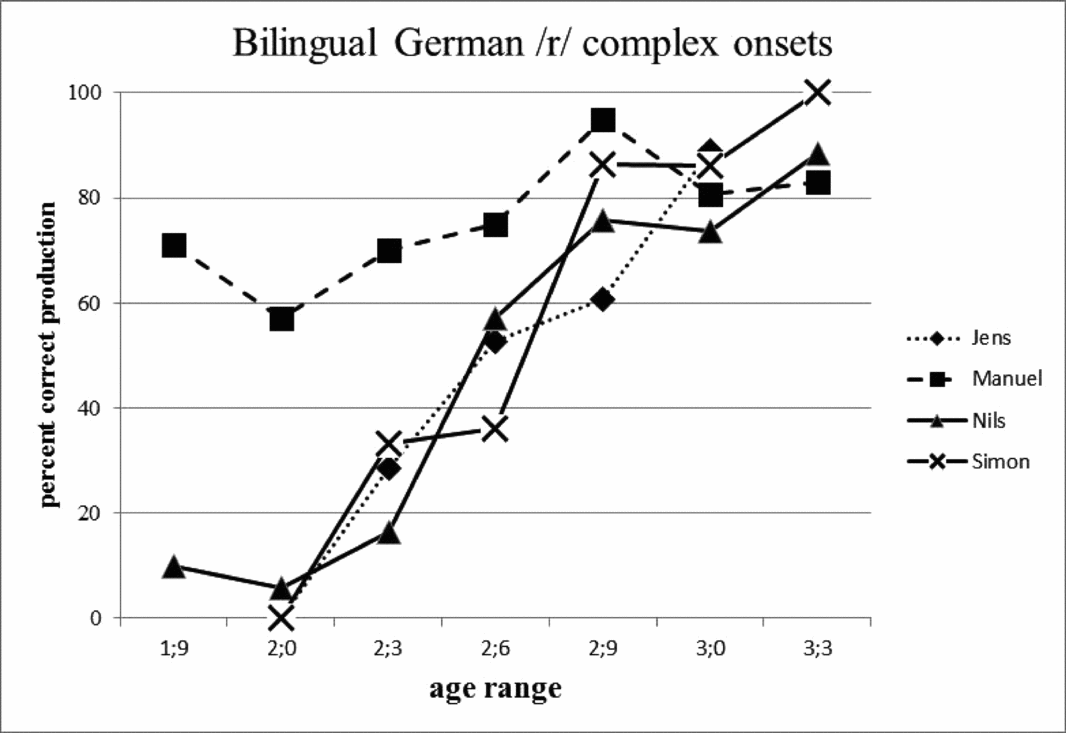
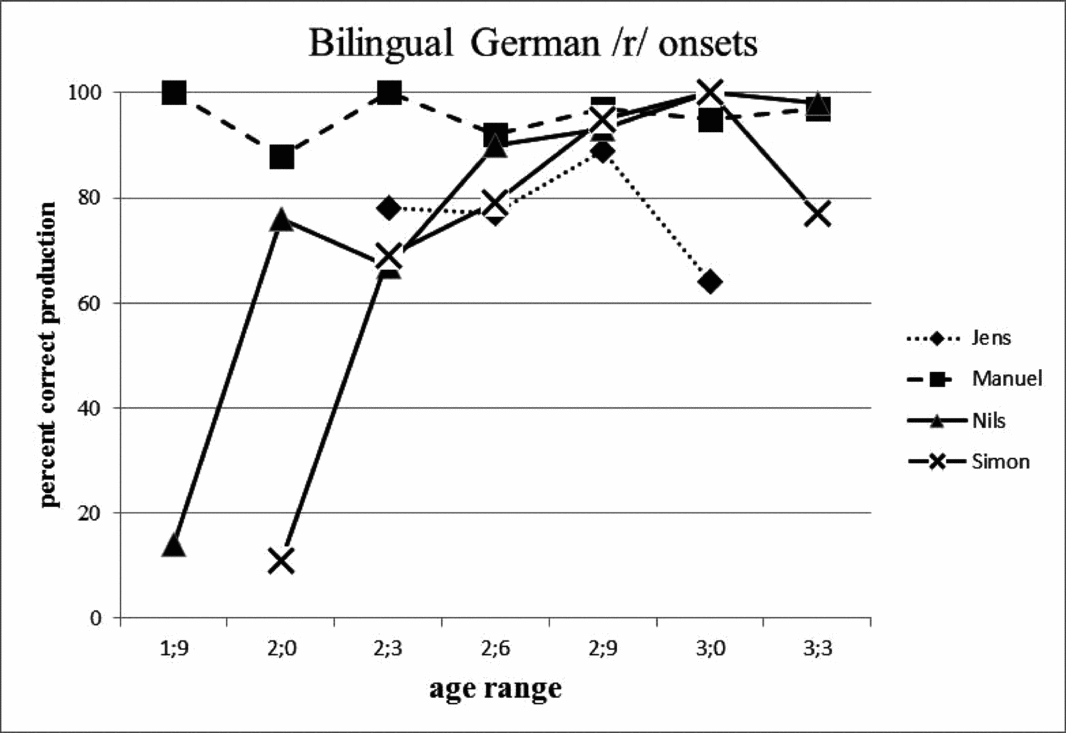
Figures 3 and 4 show the acquisition patterns of /r/ complex onsets and /r/ onsets for the four bilingual children across the period 1;9 to 3;3. Appendix B (see Supplementary Materials) provides the total numbers of productions and percentages for the individual children. Findings indicate that one of the bilingual children achieved 90% correct production of complex onsets at 2;9 (Manuel), and the remaining three children at 3;0 or 3;3Footnote 4. As for /r/ onsets, 90% correct production was achieved by one child (Manuel) already at 1;9, by one child (Nils) at 2;6, and by the other two children (Simon and Jens) at 2;9. In sum, the acquisition times for /r/ in complex onsets appear to be somewhat later for the bilingual children, ranging from 2;9 to 3;3, in comparison to the monolingual children which ranged from 2;0 to 3;0, although the bilingual children's patterns were commensurate with the phonologically less advanced monolinguals, Johannes and Bernd. The acquisition times for /r/ in onsets were similar: 1;9 to 2;9 for the bilinguals versus 2;0 to 2;9 for the monolinguals.
Percent correct production of /r/ complex onsets in four bilingual German-speaking children across the time period 1;9 to 3;3.
Percent correct production of /r/ in simple onsets (before stressed syllables) in four bilingual German-speaking children across the time period 1;9 to 3;3.
In terms of errors, the predominant error pattern for target complex onsets was deletion of one of the cluster elements, typically the sonorant element (95% or 230/243; e.g., [gʏ:n] for grün /gʁyːn/ “green” Nils 2;5.03). Only a small percentage of target clusters was realized as a cluster with one of the elements substituted (e.g., 5% or 13/243; e.g., [ˈdlɪ:ts] for Spritze /ˈʃpʁɪʦə/ “injection” Nils 2;5.03). These error patterns were similar to those of the monolinguals. The predominant error patterns for target /r/ onsets were deletion (or substitution by a glottal stop) (52% or 62/119; e.g., [ˈʔɪːnɐ] for Mandarine /ˌmandaˈʁiːnə/ “mandarin” Nils 1;10.00) or substitution by a variable consonant (36% or 43/119) (e.g., [deːgənˈboln] /ˈʁeːgˌboːg/ Regenbogen “rainbow” Manuel 2;7.15; [ˈtotʰ ] for rote /ˈʁoːtə/ “red” Jens 3;0.04). Substitution by /h/, although present in the bilinguals was not as frequent as in the monolinguals (12% or 14/119 vs. 40% or 86/215 in monolinguals) (e.g., [ˈho:za] for rosa /ˈʁoːza/ “pink” Nils 2;6.00).
The monolingual and bilingual groups differed greatly in terms of the percentage of almost-correct productions. Almost-correct productions represented 86% of productions counted as correct (344/401) for /r/ complex onsets and 77% of productions counted as correct for /r/ onsets (342/445). This is in contrast to the monolingual population in which the percentages were 11% and 24% respectively for /r/ complex onsets and onsets. Of the group of productions counted as “almost correct”, 22% (151/686) were due to potential transfer effects. Three of the four bilingual children produced on occasion an alveolar trill or tap for the German uvular /r/ (e.g., Manuel 17 examples, Jens 13 examples, Simon 6 examples); however, one child, Nils, produced many /r/s in complex onsets with taps from the period 2;6 through to 3;3 (115 examples). Apart from transfer patterns, almost-correct productions were mostly transcribed as the voiced velar fricative [ɣ]. Examples of /r/ complex onsets and /r/ onsets produced with the alveolar tap or trill, or with the voiced velar fricative are given in (1) and (2).
(1) Productions of target /r/ complex onsets and /r/ onsets produced with the alveolar tap and trill by the bilingual children

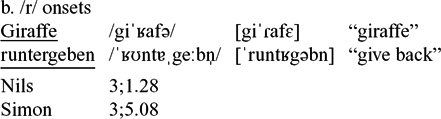
(2) Productions of target /r/ complex onsets and /r/ onsets produced with the voiced velar fricative by the bilingual children


In sum, bilingual children's acquisition of German /r/ was characterized by several differences in comparison to monolingual children's. They were slightly slower in the acquisition of /r/ in complex onsets. They were not different in terms of the timing of acquisition of /r/ onsets; however, they displayed different error patterns. They only infrequently substituted /r/ onsets with [h] whereas this was a more prominent pattern in the monolinguals. Their productions included a high percentage of almost-correct forms, of which the most frequently transcribed variant was the voiced velar fricative [ɣ]. They also displayed varying degrees of transfer. The number of examples was limited in three of the four children, but in one of the children, Nils, the number of examples was high: /r/s in complex onsets were frequently realized with alveolar taps.
Complex onset acquisition: C/l/ vs C/r/
The preceding section indicated that the bilingual children acquired /r/ complex onsets later than most of the monolingual children. We may wonder whether bilingual children had difficulty with complex onsets in general or with /r/ complex onsets in particular. Thus, we compare their acquisition of C/l/ and C/r/. The age range at which the monolingual and bilingual children achieved 90% (or close to 90%) correct production of C/l/ and C/r/ is shown in Table 2. The monolingual children acquired C/l/ around the same time as they acquired C/r/ (i.e., at the same age-range or within one age-range of each other). The only exception was Bernd who produced C/l/ with higher percent scores than C/r/ at 2;6 (86% accuracy for C/l/ vs. 19% accuracy for C/r/); but in the end he did not achieve the 90% criteria for C/l/ during the recording period (at 2;9 and 3;0, he obtained 77% and 76% respectively), whereas he did so in the case of C/r/. The bilingual children, in contrast, acquired C/l/ considerably earlier than C/r/. The age-range in which they acquired C/l/ was comparable to that of the monolinguals: 2;0 to 2;6. In sum, the differences we observed between the monolinguals and bilinguals in the acquisition of complex onsets pertained specifically to C/r/ and not to complex onsets in general.
Age-range in which the monolingual and bilingual children achieved 90% correct production of C/l/ versus C/r/ complex onsets in German
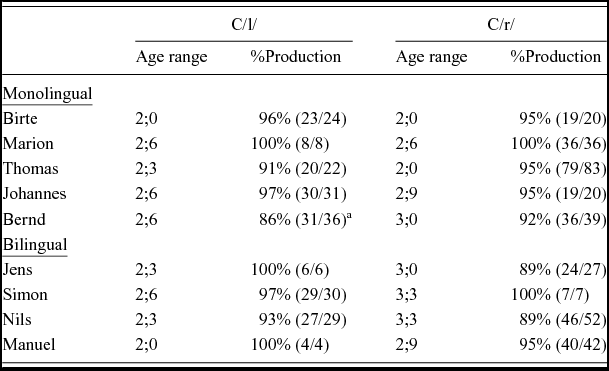
a Bernd did not achieve 90% correct
Alveolar tap
Monolingual Spanish
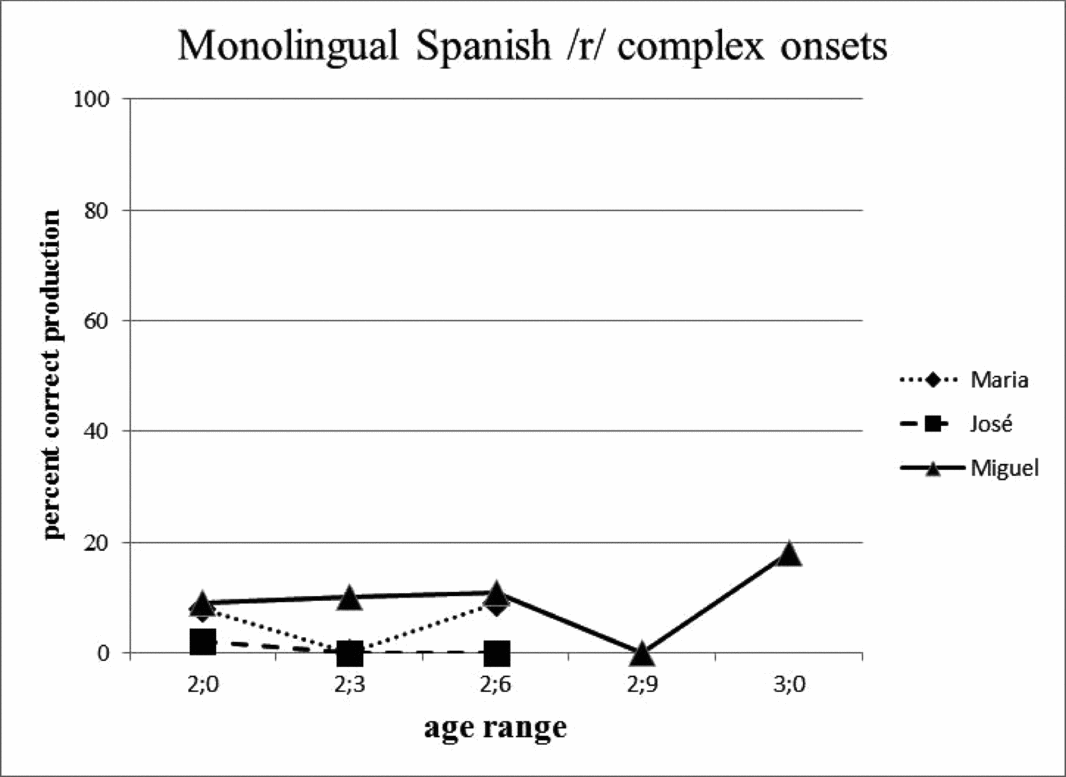
Figures 5 and 6 show the acquisition patterns for /r/ complex onsets and medial tap in the Spanish monolingual data. Appendix C (see Supplementary Materials) provides the total numbers of productions and percentages for the individual children. The findings for /r/ complex onsets are straightforward. There is no development of /r/ during the period analysed. Even Miguel, whose data were analysed through to age range 3;0, did not produce /r/ complex onsets with greater than 20% accuracy. The children managed better with production of alveolar taps in medial position. José and María achieved approximately 20% and 50% correct production respectively through to time period 2;6, and Miguel achieved 80% production at age range 3;0.
Percent correct production of /r/ complex onsets in three monolingual Spanish-speaking children across the time period 2;0 to 3;0. María and José are tested through to time period 2;6 and Miguel through to 3;0.
Percent correct production of medial taps in three monolingual Spanish-speaking children across the time period 2;0 to 3;0. María and José are tested through to time period 2;6 and Miguel through to 3;0.

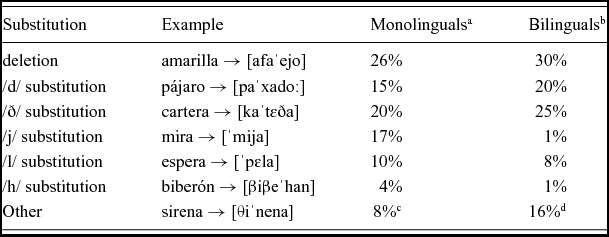
In terms of incorrect forms, virtually all the error patterns for target complex onsets were deletions (327/331) of one of the elements of the onset, typically the sonorant element (e.g., grande /ˈgɾande/ [ˈkanːə] “big” María 2;1.09). The error patterns for medial tap are given in Table 3 (column 3). They consisted predominantly of segment deletions (e.g., pajarito /paxaˈɾito/ [pataˈitɔ] “little bird” José 2;1.03), and substitutions by [ð] (e.g., cartera /kaɾˈteɾa/ [kaˈtɛða] “wallet” María 2;4.22), [j] (e.g., mira /ˈmiɾa/ [ˈmija] “look” Miguel 2;6.17), [d] (e.g., espera /esˈpeɾa/ [ˈpedɐ] “wait” María 2;2.11), and [l] (e.g., para /ˈpaɾa/ [ˈpalɐ] “for” José 2;1.03).
Error patterns for medial taps in monolingual and bilingual children
a Total number of errors = 626
b Total number of errors = 599
c Errors included [p, v, w, t, n, ʒ]
d Errors included [p, b, β, w, t, n, s, z, ʦ, ʣ, k]
The monolingual Spanish children realized most of their /r/s in complex onsets with almost correct productions (77% or 17/22), predominantly with uvular /r/s (e.g., 11/17; e.g., grande /ˈgɾande/ [ˈɣʀande] “big” Miguel 2;6.17) or with trills (4/17; e.g., frito /ˈfɾito/ [ˈfrito] “fried” Miguel 2;8.14). As for medial taps, almost-correct productions counted for 38% (125/325) of the realizations. The largest percentage of almost-correct productions was realizations of the alveolar approximant [ɹ] (e.g., 68% or 85/125; e.g., espera /esˈpeɾa/ [ˈpɛɹa] “wait” María 2;2.11) followed by the trill (e.g., 21% or 26/125, e.g., mira /ˈmiɾa/ [ˈmira] “look” José 2;2.16) and the uvular /r/ (e.g., 7% or 9/125, e.g., para /ˈpaɾa/ [ˈpaʁæ] “for” José 2;1.03).
Bilingual Spanish
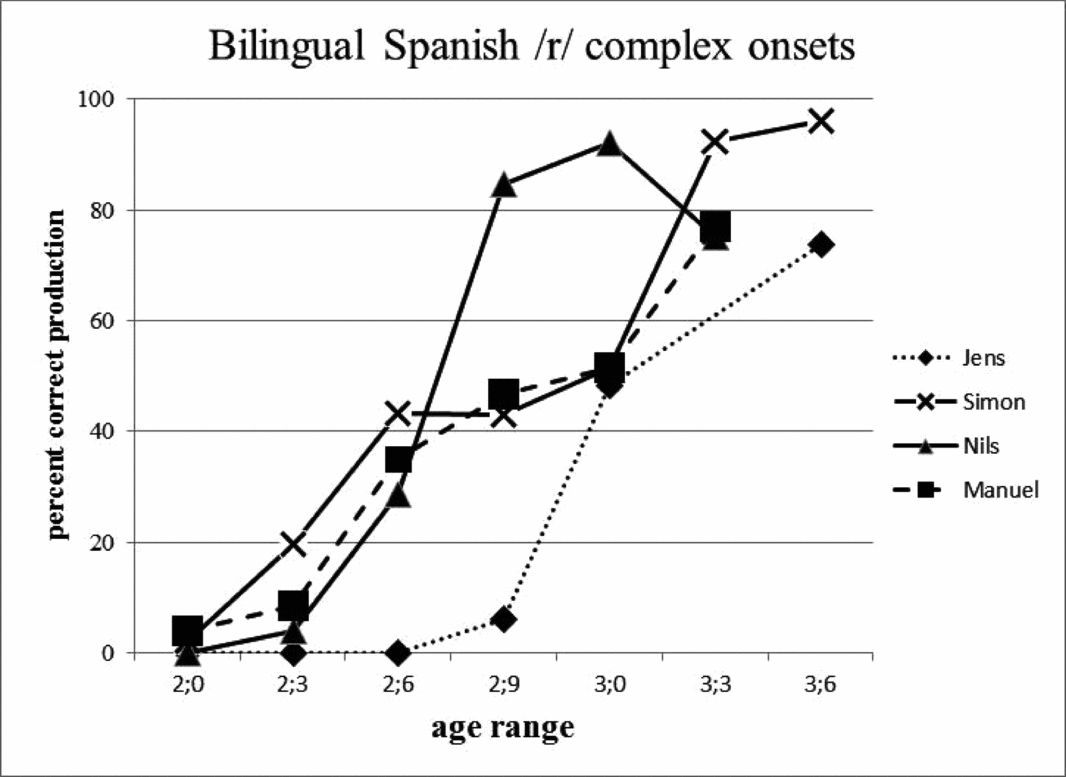
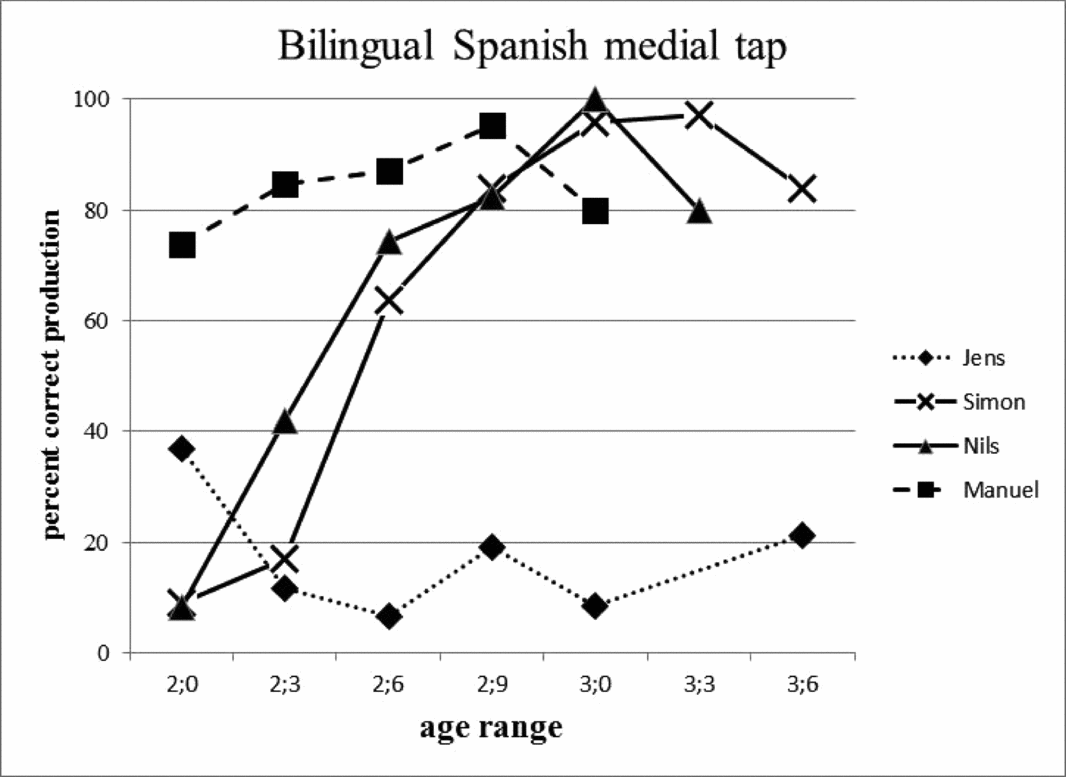
Figures 7 and 8 present the acquisition patterns for /r/ complex onsets and medial tap in the bilingual data. Appendix D (see Supplementary Materials) provides the total numbers of productions and percentages for individual children. In comparison to the monolingual children, the bilingual children display superior mastery of /r/ complex onsets. At age-range 2;6, the monolingual children produce very few complex onsets (less than 10%), whereas three of the four bilingual children produce /r/ complex onsets with 30 to 40% accuracy. Miguel, the monolingual child, whose data is tracked through to 3;0, produces few complex onsets (less than 20%) whereas all the bilingual children have percentages of 50% or greater at that age. As for the medial tap, three of the four bilingual children achieve high percentages of r-like realizations already by 2;6 (i.e., percentages greater than 60%) and thus appear to be in advance of the monolingual children. They achieve greater than 80% accuracy by 2;9 whereas Miguel, the monolingual child, only approaches this at 3;0. However, the data are complicated by the fact that one bilingual child, Jens, does not acquire a tap (or an r-like realization) through to 3;6.
Percent correct production of /r/ complex onsets in four bilingual Spanish-speaking children across the time period 2;0 to 3;6.
Percent correct production of medial taps in four bilingual Spanish-speaking children across the time period 2;0 to 3;6.
Like the monolinguals, the predominant error pattern of target complex onsets for the bilinguals was deletion of the sonorant element of the cluster (95% or 609/641; sombrero /somˈbɾeɾo/ [sonˈpeto] Jens 2;4.27). A small percentage of target complex onsets was realized as a complex onset with one of the elements substituted (e.g., 3% or 19/641; e.g., gris /gɾis/ [twis] “grey” Jens 2;4.27) or as an epenthesized form (2% or 13/641; grande /ˈgɾande/ [geɾande] “big” Nils 2;7.04). The error patterns of medial taps are shown in the right hand column of Table 3. The bilinguals resembled the monolinguals in having a high percentage of /r/ deletions, and substitutions by [d] and [ð] as well as a lesser percentage of [l] substitutions. They differed from the monolinguals in hardly using the semivowel [j] as a substitute and in having a wider range of variable consonants as substitutes (16% vs 8%).
The bilinguals mostly realized their complex onsets with target-like productions, that is, taps. Almost-correct productions represented only 11% (i.e., 41/375) of the complex onset forms displayed in Figure 7. They consisted predominantly of complex onsets with trills (i.e., 51% or 21/41). Complex onsets realized with the uvular /r/ were not more frequent in the bilingual than in the monolingual data, being attested on only 12 occasions (i.e., 29% or 12/41). Similarly, the percentages shown in Figure 8 for medial taps were mostly due to productions of target-like medial taps. Almost-correct productions represented only 6% of the data (55/861). Most of the almost-correct forms were due to realizations of the alveolar trill (i.e., 55% or 29/55; madera /maˈdeɾa/ [maˈrera] “wood” Simon 3;4.17) or the uvular /r/ (i.e., 38% or 21/55; amarillo /amaˈɾiʎo/ [amaˈʀijo] “yellow” Manuel 2;11.06). The uvular /r/ as substitute for medial tap was produced by three of the four bilingual children but it was not a frequent realization form.
In sum, three of the four bilingual children displayed superior mastery of /r/ complex onsets and medial taps in comparison to the monolingual children. They also had a smaller percentage of almost-correct productions than the monolinguals, meaning that they realized the tap when attempting target taps.
Complex onset acquisition: C/l/ vs C/r/
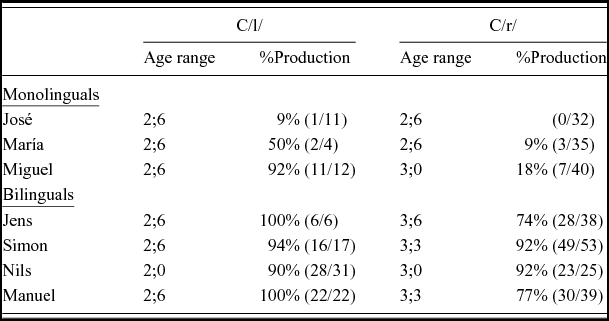
Table 4 contrasts the monolinguals’ and bilinguals’ acquisition of /l/ and /r/ complex onsets. It presents the age-range at which children achieved 90% correct production of complex onsets or, if this was not achieved, it presents their maximum percent score. The findings are inconclusive for monolinguals, José and María, because we were not able to track acquisition of either C/l/ or C/r/ due to the limited testing range; however, Miguel, the third monolingual child whose data extended through to 3;0, acquired C/l/ in advance of C/r/. The same held true for the bilingual children. All four of them acquired C/l/ before they acquired C/r/, similar to the pattern displayed in their German complex onsets.
Age-range in which the monolingual and bilingual children achieved 90% correct production (or their maximum score) of C/l/ versus C/r/ complex onsets in Spanish
Spanish trill
Monolingual Spanish
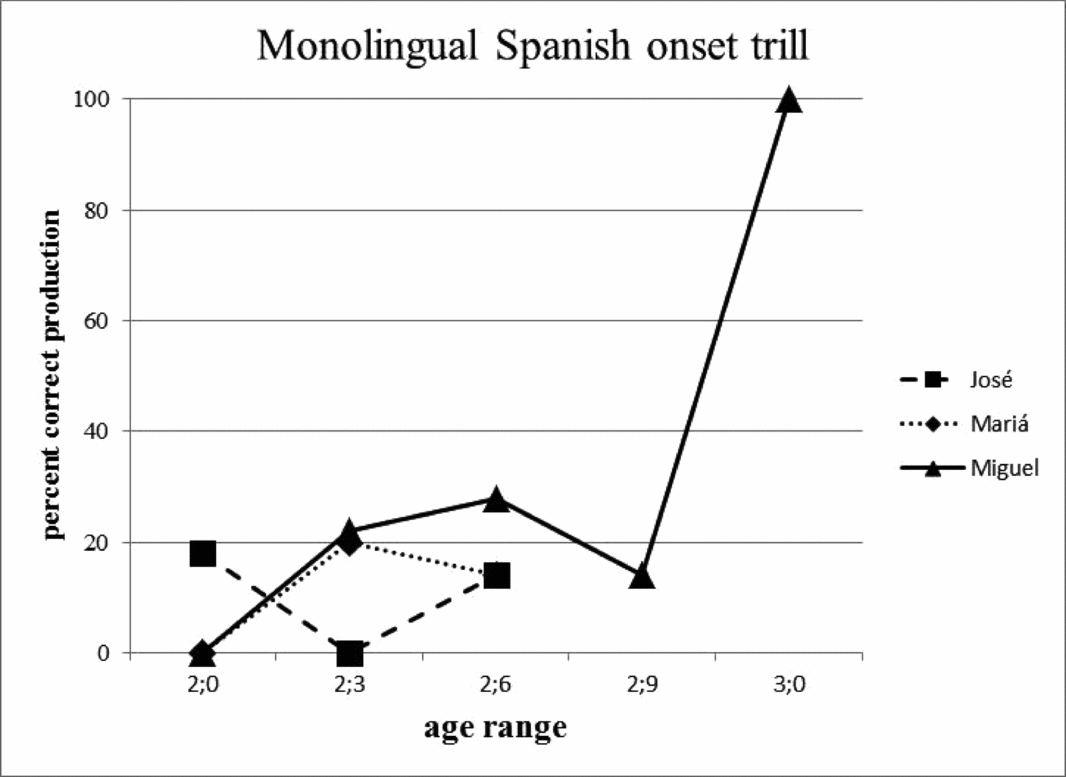
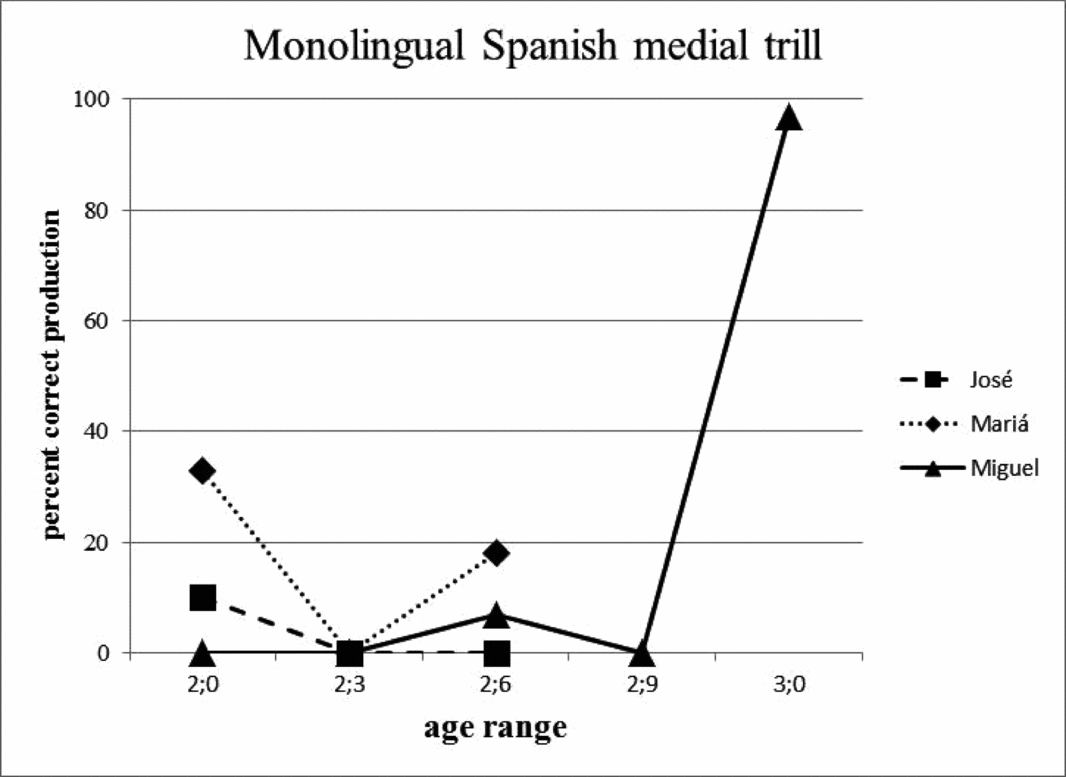
Figures 9 and 10 show the acquisition patterns for onset and medial trill in the Spanish monolingual data. Appendix E (see Supplementary Materials) provides the total numbers of productions and percentages for the individual children. Target words containing the trill were much less frequent than those containing the tap; hence, the number of productions at certain age ranges is low. Results indicate that there were only sporadic productions of the trill up until the age range of 2;6 for José and María. Similarly, Miguel shows very little progression in trill production before the age of 3;0. At time period 3;0, he realizes an /r/-like sound most of the time in word-onset and -medial position; and, approximately 60% of the time, this sound is a trill. We must add, however, that other sources report less accurate realizations of trills in Spanish-speaking monolinguals of this age (Jimenez, Reference Jimenez1987). The predominant (non /r/-like) error patterns for the trill are given in columns three and four of Table 5. The most frequent errors were substitutions by [d] and [l]. Word-onset position was also characterized by deletions and a variety of occasional substitutions, whereas word-medial position was characterized by substitutions of [ð]. The almost-correct productions included the tap (onset: 9/16 Rafa /ˈrafa/ [ˈɾaθa] “name” Miguel 3;00.23; medial: 9/18 carreras /kaˈreɾas/ [kaˈɾeɾas] “race (pl)” Miguel 2;6.17) or uvular /r/ (onset: 4/16 ratitos /raˈtitos/ [ʀaˈdidʌ] “short time (pl)” Miguel 2;8.14; medial: 7/18 sierra /ˈsjera/[ˈsjeʁa] “saw” Miguel 3;1.28).
Percent correct production of onset trills in three monolingual Spanish-speaking children across the time period 2;0 to 3;0. María and José are tested through to time period 2;6 and Miguel through to 3;0.
Percent correct production of medial trills in three monolingual Spanish-speaking children across the time period 2;0 to 3;0. María and José are tested through to time period 2;6 and Miguel through to 3;0.
Error patterns for onset and medial trill in monolingual and bilingual children
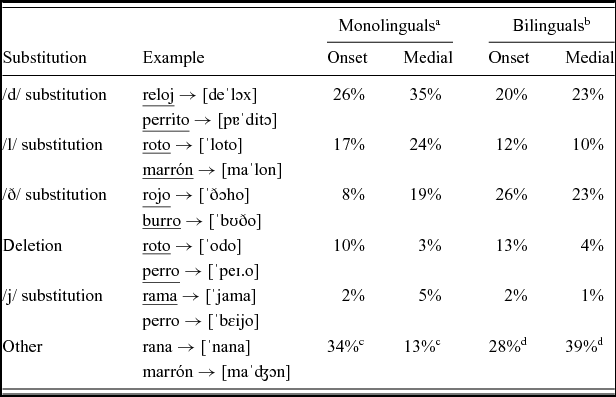
a Total number of errors in onset position = 93; total number of errors in medial position =75
b Total number of errors in onset position = 213; total number of errors in medial position =103
c Errors for onset and medial trills included [p, v, t, s, n, ʤ, g]
d Errors for onset and medial trills included [b, β, v, t, n, s, z, ʦ, ʣ, ʧ, g, h]
Bilingual Spanish
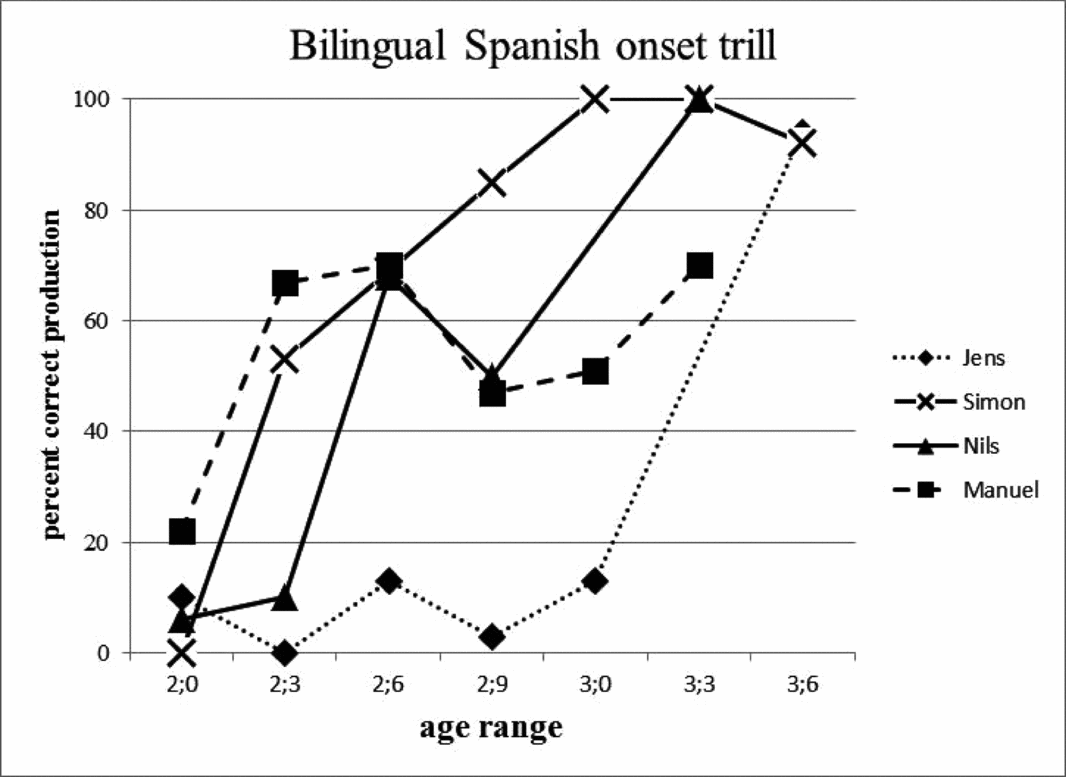
The acquisition patterns of the trill in word-onset and -medial positions are given in Figures 11 and 12 for the bilingual children. Appendix F (see Supplementary Materials) provides the total numbers of productions and percentages for the individual children. In word-onset and –medial position, /r/-like realizations are already present (i.e., 50% or greater) in three of the four children (Simon, Nils, Manuel) by 2;6. Only two of the four children (i.e., Jens in onset and medial position and Simon in medial position), however, produce target-like productions (i.e., 50 to 60% of the time) by the end of the study, that is, at 3;6.
Percent correct production of onset trills in four bilingual Spanish-speaking children across the time period 2;0 to 3;6.
Percent correct production of medial trills in four bilingual Spanish-speaking children across the time period 2;0 to 3;6.
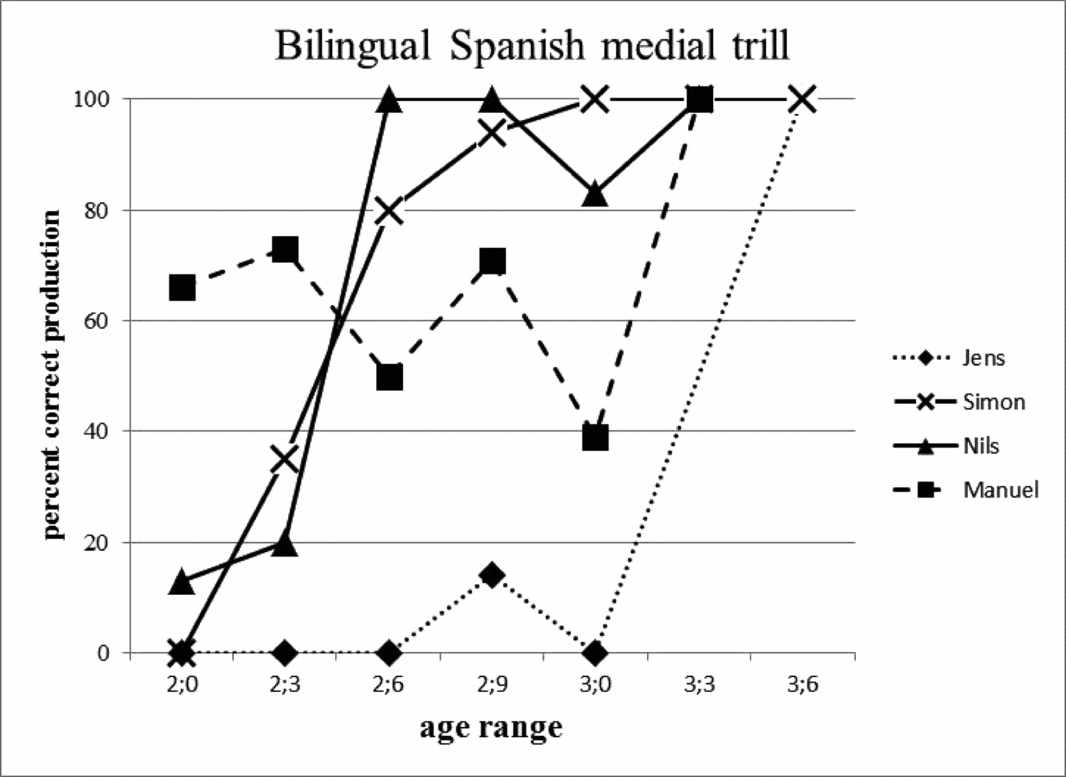
The main (non /r/-like) error patterns were similar to those for the tap (see columns five and six of Table 5). They included substitutions by [d], [ð], and [l]. Substitutions by [ð] were more frequent in the bilinguals than in the monolinguals whereas substitutions by [l] were less frequent. As in the monolinguals, deletions were present in word-initial position but were not frequent in word-medial position. In both positions, a high proportion of substitutions by variable consonants were present (e.g., rojo /ˈroxo/ [ˈʤoχo] “red” Nils 2;1.12; arriba /aˈriβa/ [aˈviva] “upstairs” Nils 2;1.12). The almost-correct productions were for the most part realizations of the tap (onset: 83% or 149/179; medial: 88% or 85/97). A small percentage of r-like realizations in word-onset position were productions of uvular /r/ (16% or 29/179), whereas in word-medial position, the alveolar approximant [ɹ] was attested (11% or 11/97).
In sum, three of the four bilingual children appear to be in advance of the monolingual children in that they produce /r/-like sounds for target trills at an earlier stage of development. However, in the production of target trills, they were not in advance of the monolingual child, Miguel. Only one of the bilinguals achieved 40 to 60% production of trills in word-onset position and only two in word-medial position, and this occurred at a later stage of development than the monolingual child (i.e., at age-range 3;6 in comparison to 3;0).
Comparison of German and Spanish /r/s
Our final analysis consists of a comparison of the German and Spanish /r/s in the bilingual children. Figure 13 and 14 display results for /r/ in complex onsets and onsets at age ranges 2;0 to 3;0. We consider these conditions only because analysis of medial /r/ was not comparable between German and Spanish. The findings in Figure 13 should be interpreted in terms of the monolingual results presented in Figures 1 and 5 in which we observe a clear difference between the acquisition of /r/ complex onsets in German and Spanish with superior results in German. Similarly, the findings in Figure 14 should be interpreted in terms of the monolingual results presented in Figures 2 and 9 in which we observe clear differences between the acquisition of /r/ onsets in German and Spanish monolinguals from 2;0 through to 2;9. By age 3;0, Miguel, the only Spanish monolingual to be tested at this age, achieved 100% correct performance; however, caution must be heeded in the interpretation of this result since it is based on eight productions only (see Appendix E, Supplementary Materials).
Comparison of the acquisition of German and Spanish /r/ complex onsets in the four bilingual children. German results are shown in the dark font; Spanish results are shown in the light font.
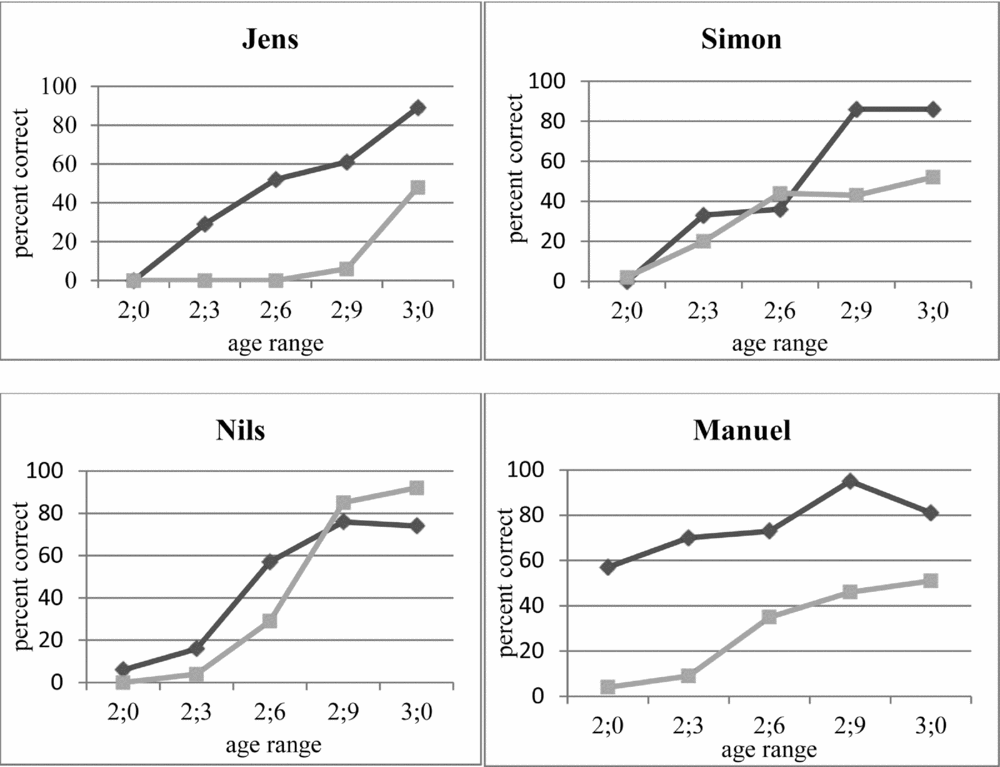
Comparison of the acquisition of German and Spanish /r/ simple onsets in the four bilingual children. German results are shown in the dark font; Spanish results are shown in the light font.
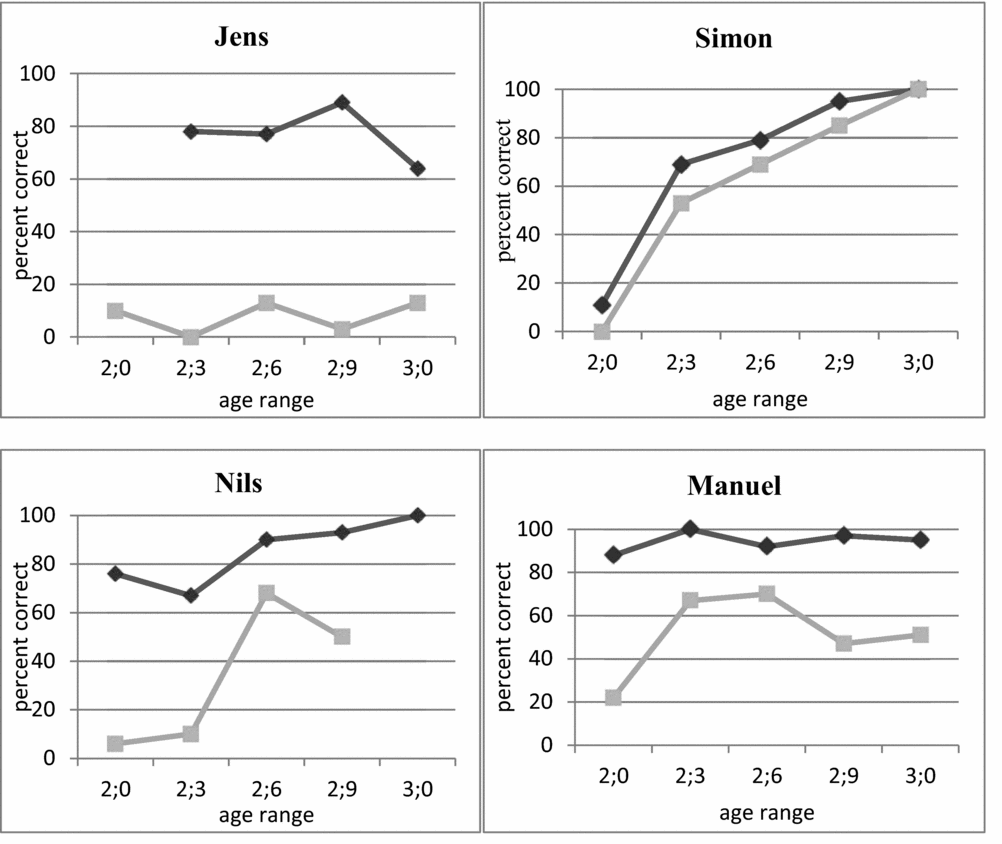
Figure 13 indicates that two of the four bilingual children (Jens and Manuel) maintain a clear difference between their German and Spanish /r/ complex onsets, but the other two children (Simon and Nils), do not. Differences between German and Spanish complex onsets are considerably reduced at all the age ranges for Nils and at the earlier age ranges for Simon. In general, percent correct scores tend to be lower in German and higher in Spanish than in the monolingual children.
Figure 14 reveals considerable individual variation in the acquisition patterns of German and Spanish /r/ onsets in the bilingual children. Jens is the only bilingual child who maintains the same type of asymmetry as we see in the monolinguals. Two of the bilinguals, Nils and Manuel, still produce more /r/-like sounds in German than in Spanish but the differences between languages are reduced. Simon, in contrast, displays similar percent correct scores for German and Spanish /r/ onsets across all age ranges.
Discussion
This study examined acquisition of /r/ in monolingual and bilingual German- and Spanish-speaking children, with the aim of determining whether bilingual children display cross-linguistic interaction in their development of /r/. Based on previous literature findings and on the fact that /r/s are phonetically and phonologically complex, we predicted that bilingual children may display delay or transfer. Our findings instead revealed a more complicated pattern of acquisition. The bilingual children were commensurate with monolingual children in their acquisition of the German /r/ in onsets but mildly delayed in their acquisition of German /r/ in complex onsets. In contrast, they were advanced in their acquisition of the Spanish tap. They also displayed more /r/-like substitutions for the Spanish trill. Thus, we observed a pattern in which there was both acceleration and some delay at the same time. Transfer of Spanish /r/ into German and of the German /r/ into Spanish was not frequent except in the productions of one bilingual child, Nils, who produced German complex onsets with the alveolar tap. In the following sections, we discuss the results in more detail, first summarizing the findings and then proceeding to a discussion of cross-linguistic interaction.
Monolingual development of /r/
Our findings are consistent with previous studies on /r/ acquisition in German which show acquisition of /r/ already by 2;6 through to 3;0 (Fox, Reference Fox2015; Fox & Dodd, Reference Fox and Dodd2001). Our monolingual children displayed a range of acquisition rates with greater than 90% accuracy being achieved between 2;0 through to 3;0 for both /r/ complex and simple onsets. The analyses counted both target-like (i.e., [ʀ] & [ʁ]) and almost-correct (i.e., [ɣ] & [χ]) realizations of /r/ as correct, which is consistent with other analyses of /r/ acquisition in German children (Fox, personal communication). Error patterns reported for uvular /r/, namely, substitution by [ʔ] or [h] (Fox, Reference Fox2015), were also the most frequent ones observed in our monolingual data.
Comparison of our monolingual Spanish findings with those of the existing literature are complicated by the fact that our data are based on children younger than 3;3 whereas most studies report on children older than three years (Goldstein & Iglesias, Reference Goldstein and Iglesias1996; Jimenez, Reference Jimenez1987). Nevertheless, where comparisons could be made, results between studies were comparable. Jimenez (Reference Jimenez1987) reports acquisition rates of 40% for medial tap, 7% for onset trills, and 13% for medial trills at age 3;3 by Spanish-speaking children of Mexican descent whereas Miguel, in our study, produces medial taps with 63% accuracy (referring to target-like forms only), onset trills with 63% accuracy, and medial trills with 57% accuracy at time period 3;0, results which are slightly better than the Mexican children of Jimenez's study. Analyses of Spanish complex onsets indicate that Spanish-speaking children, aged 3;9, produce /r/ complex onsets with approximately 31% accuracy (Mendoza, Carballo, Perez, Ávila, Fresneda & Bernhardt, Reference Mendoza, Carballo, Perez, Ávila, Fresneda and Bernhardt2015), whereas Miguel's results were lower than this (i.e., 18%) but he was tested at an earlier age. Regarding errors, taps and trills were characterized by a number of different error patterns, including deletions and substitutions by [d], [ð], [l], and [j]. Target taps were often replaced by trills and target trills were replaced by taps in the current data set, similar to Goldstein's (Reference Goldstein1988) findings with monolingual Spanish-speaking children. We observed that target trills and taps were realized as uvular /r/s a small percentage of the time, a pattern also observed by Rūķe-Draviņa (Reference Rūķe-Draviņa1965).
Bilingual development of /r/
In comparing the bilingual to the monolingual data, we consider three types of information: acquisition rate, substitutions, and transfer patterns.
Acquisition rate
The bilingual children were mildly delayed in their acquisition of /r/ complex onsets in German. They acquired C/r/ later than C/l/, indicating that the delay was a problem with /r/ and not with the production of complex onsets in general. In contrast, the monolingual children did not display differences between acquisition of /r/ and /l/ complex onsets with the exception of a slight asymmetry in the case of Bernd. Interestingly, the same asymmetry between acquisition of /r/ and /l/ complex onsets was observed in the Spanish productions of the bilingual children. Monolingual-bilingual differences were not evident in the acquisition of /r/ onsets, whereby the age-range of acquisition was similar between the two groups of children; however, it must be remembered that the high rates of /r/ acquisition in the bilingual children came about from the production of almost-correct rather than target-like productions, which was not the case with the monolinguals.
In contrast to the German findings, /r/ complex onsets were not delayed in the bilingual children speaking Spanish. Our bilingual children appeared to have superior mastery of /r/ complex onsets in comparison to the monolinguals in this study or to those of other studies on cluster development (Mendoza et al., Reference Mendoza, Carballo, Perez, Ávila, Fresneda and Bernhardt2015). Keffala et al. (Reference Keffala, Barlow and Rose2016) also found accelerated acquisition of complex onsets in both languages of Spanish–English bilingual children. Three of our four bilingual children also produced medial taps with higher percent accuracy than our monolingual children or to the Mexican children in Jimenez (Reference Jimenez1987). The findings are less clear-cut for the acquisition of the alveolar trill. The three bilingual children who produced target taps with a high degree of accuracy also produced taps when attempting target trills, thus, displaying a more sophisticated pattern of errors than Miguel, who primarily produced non-/r/-like substitutions for trills. However, the bilingual children displayed only limited acquisition of target trill.
Substitutions
Our analysis of errors patterns showed some potential differences between the monolingual and bilingual children. Bilingual children displayed fewer [h] substitutions for uvular /r/ than the monolingual children possibly due to the fact that /h/ is not a phoneme in Spanish. The bilingual children also produced more obstruent (i.e., [d] and [ð]) and fewer sonorant (i.e., [j] and [l]) substitutions for medial taps than the monolingual children. Similarly, they produced more [ð] substitutions for onset trills and fewer sonorant (i.e., [j] and [l]) substitutions for medial trills than the monolingual children. We do not know, however, whether these diverse effects reflect language influence or individual differences amongst children. Bilingual children also displayed a greater range of more occasional substitutions for target medial taps (16% vs 8%) and medial trills (39% vs. 13%) than the monolingual children. A wide range of substitutions for target trills has been observed in Welsh–English bilinguals (Ball et al., Reference Ball, Müller and Munro2001) and Spanish–English bilinguals (Goldstein & Washington, Reference Goldstein and Washington2001).
One other difference between the two groups was that the bilingual children realized target uvular /r/ predominantly with velar ([ɣ], [χ]) rather than with uvular ([ʁ],[ʀ]) renditions, whereas the opposite was true of the monolingual population. It is tempting to argue that the high percentages of velar forms are due to influence from Spanish since velar fricatives appear as allophones in Spanish. We interpret these results cautiously however since there are few detailed phonetic studies on /r/ development in child and adult German so it cannot be excluded that velar variants may be typical of child speech or may be present in the adult input.
Transfer
Transfer of /r/ has been observed in previous studies of bilinguals’ phonological acquisition (Ball et al., Reference Ball, Müller and Munro2001; Fabiano-Smith & Barlow, Reference Fabiano-Smith and Barlow2010); thus, we were interested to observe whether it also occurred in the German–Spanish data. Given that there were very few examples of alveolar trills and taps in the monolingual German data, their presence in the bilingual data was most likely due to cross-linguistic interaction. In contrast, the monolingual Spanish children sometimes employed uvular /r/ for target taps and trills, thus, the occasional presence of uvular /r/ in the bilinguals’ Spanish data did not provide clear evidence of transfer.
In German, three of the bilinguals produced small numbers of taps and trills, but, as mentioned, one child, Nils, produced a large number of taps for German /r/ in complex onsets. In fact, he achieved high accuracy rates for complex onsets in German and Spanish from 2;6 onwards by producing them primarily with taps. Why does Nils, in particular, display transfer? First it must be noted that markedness does not explain the current results. Previous literature findings, as well as the current results, support the fact that uvular /r/ is acquired earlier than the Spanish tap. This would explain transfer of uvular /r/ into Spanish but not the reverse, transfer of the tap into German. In addition, dominance does not account for the findings. Of the four bilingual children, Nils was the child who was dominant in German. Thus, we could expect the presence of the German /r/ in Spanish but not the reverse, the presence of the Spanish /r/ in German. One pertinent observation is that Nils evidences transfer in other phonetic domains such as Voice Onset Time. Prior analyses revealed that at age 2;0 he produced many voiced stops in German with lead voicing (rather than short lag) and at age 2;3 and later at 5;0, he produced voiceless stops in Spanish with long lag (rather than short lag) values (Kehoe et al., Reference Kehoe, Lleó and Rakow2004; Rakow & Lleó, Reference Rakow and Lleó2008). These results indicate that Nils’ phonetic/phonological system was particularly susceptible to interaction effects, suggesting that transfer may be child-specific.
Cross-linguistic interaction
The current findings are consistent with cross-linguistic interaction in /r/ acquisition; however, the pattern of interaction is not straightforward. Given that /r/ as a class of sounds is phonetically and phonologically marked, we predicted that /r/ would be delayed in German and Spanish. We also posited an alternate prediction, namely that bilinguals may evidence accelerated acquisition of /r/ in comparison to monolinguals, since they are exposed to different types of linguistic complexity in the input. Instead, we find the two patterns, delay and acceleration together. The bilingual children were delayed (albeit mildly) in their acquisition of German /r/ complex onsets but they displayed superior performance in their development of the Spanish tap and trill. We interpret these findings in terms of a second alternate prediction: namely, that there is bi-directional influence between languages, resulting in a “merging” pattern. These results join others in the literature, which indicate that a bilingual child's two phonologies approximate each other. These findings include the presence of similar templates (Kehoe, Reference Kehoe2015b; Vihman, Reference Vihman2002; Vihman, Reference Vihman2016), of merging patterns in acoustic measures of rhythm and vowel length (Kehoe et al., Reference Kehoe, Lleó and Rakow2011; Kehoe & Lleó, in press) and of similar orders of acquisition of phonological structures (Almeida, Rose & Freitas, Reference Almeida, Rose, Freitas, Biller, Chung and Kimball2012; Lleó, Reference Lleó2015). Indeed, in the current study, the clear asymmetry between the acquisition of German and Spanish /r/ in complex and simple onsets, evident in the monolingual children, was lessened and, in some cases, disappeared in the bilingual children (see Nils and Simon in Figures 13 and Simon in Figure 14). We posit that this “merging effect” is the result of mutual influence between the two languages. Being able to master /r/ in one language may provide bilingual children with enhanced perceptual and articulatory capacities enabling them to master /r/ more easily in the other language. It may also reflect a common speech-motor base which constrains rather than promotes differences between the child's two phonological systems.
We may ask, however, whether it is necessary to extend the framework of Paradis and Genesee (Reference Paradis and Genesee1996) to include additional interaction patterns. “Merging” could be derived from the basic patterns of delay and acceleration, and, as such, adding it would be superfluous. We claim, however, that patterns such as “merging” and “deflecting” provide a global depiction of what takes place when two languages come into contact, which is not always obtained by looking at patterns such as “acceleration” and “delay” separately in one of the languages of the bilingual. They capture the notion of “contrast” which is absent from Paradis and Genesee's (Reference Paradis and Genesee1996) framework. In acquiring two different phonological categories, some bilingual children may maintain or enlarge the contrast between categories whereas other children may lose it. These two patterns were evident in the current study. Jens, for example, maintained a clear asymmetry between the acquisition of /r/ onsets commensurate or even greater to the one seen in the monolinguals (see Figure 14; see also Manuel in Figures 13 and 14), whereas Nils and Simon reduced the contrast between their /r/ sounds. Why it is that some children maintain contrast between their two phonological systems and other children do not remains unanswered; however, both types of phenomena have been documented in adult second language learners (Flege, Reference Flege and Strange1995). An important goal of future research is to understand what factors explain individual differences in cross-linguistic interaction in bilingual phonology.
Conclusion
Our analyses of the development of /r/ in bilingual German–Spanish children revealed that /r/ was subject to cross-linguistic interaction. The bilingual children were mildly delayed in acquisition of uvular /r/ (in /r/ complex onsets) in comparison to monolingual German, and they were in advance of monolingual Spanish children in their acquisition of taps and in their use of /r/-like substitutions for trills. These findings are consistent with mutual influence between languages, with the resultant effect that the phonological systems of the two languages approximate each other. Other examples of interaction included some isolated differences in substitution patterns and transfer of Spanish /r/ into German in one of the bilingual children. These findings cannot be easily captured by current frameworks of cross-linguistic interaction (Paradis & Genesee, Reference Paradis and Genesee1996), suggesting the need for future research to delimit possible patterns of interaction in the phonologies of young bilinguals.
Supplementary Material
For supplementary material accompanying this paper, visit https://doi.org/10.1017/S1366728916001279



