





1. Introduction
Since the inception of the field of formal semantics of natural language (Montague Reference Montague and Visentini1970a,b, Reference Montague, Hintikka, Moravcsik and Suppes1973), Church’s simple type theory (Church Reference Church1940) and its variations have been dominant in formal natural language analysis (Gamut Reference Gamut1990). More recently, however, there is growing interest in using dependent type theory (Martin-Löf, Reference Martin-Löf, Rose and Shepherdson1975) for this purpose (Sutton Reference Sutton2024). Unlike simple type theory, dependent type theory allows greater expressivity at the type level by allowing types to be indexed by terms, making it possible to analyze or model certain natural language phenomena that are problematic or impossible in the setting of simple type theory (Chatzikyriakidis and Cooper Reference Chatzikyriakidis and Cooper2018; Chatzikyriakidis and Luo Reference Chatzikyriakidis and Luo2020; Sutton Reference Sutton2024; Chatzikyriakidis et al. Reference Chatzikyriakidis, Cooper, Gregoromichelaki and Sutton2025).
In this paper, we develop a framework within dependent type theory for modeling fragments of natural language involving the phenomena of telicity, the property of an event having an inherent endpoint, culminativity, the property of a telic event attaining its endpoint, and their counterparts atelicity and non-culminativity.Footnote 1 As widely discussed in the linguistic literature (Verkuyl Reference Verkuyl1972, Reference Verkuyl1993; Dowty Reference Dowty1979; Tenny Reference Tenny1987, Reference Tenny1994; Moens and Steedman Reference Moens and Steedman1988; Krifka Reference Krifka, Bartsch, van Benthem and van Emde Boas1989, Reference Krifka, Sag and Szabolcsi1992, Reference Krifka and Rothstein1998; Jackendoff Reference Jackendoff1991, Reference Jackendoff1996), for a large class of verbs, the telicity of an event depends on the properties of its undergoer, the most patient-like argument of the verb describing the event.
Our framework makes essential use of type dependency not only to account compositionally for the relationship between the telicity of events and the properties of their undergoers, but also to account for the fact that the property of (non-)culminativity is only defined for telic events, because (non-)culminativity presupposes the existence of an inherent endpoint.
1.1 Telicity and culminativity
A verbal predicate is telic if the eventuality it characterizes has an inherent endpoint. We will speak of a telic event to mean an eventuality characterized by a telic verbal predicate.Footnote 2 Although it is difficult to precisely define inherent endpoints, it is relatively easy to illustrate what does and does not constitute an inherent endpoint, and what it means for that endpoint to be attained.
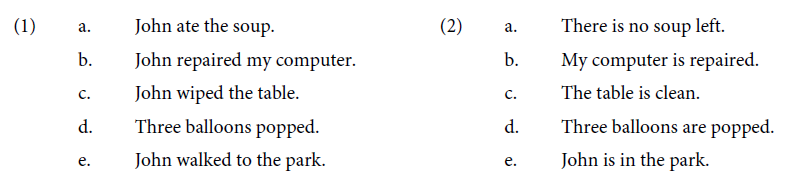
Every sentence in (1) below describes an event with an inherent endpoint. (By abuse of language, we henceforth conflate sentences describing events with the described events.) The endpoint is lexically specified in each sentence either as an argument of the verb, as in (1-a)–(1-d),Footnote 3 or as an adjunct, as in (1-e). For example, in (1-a), the soup supplies an inherent endpoint, and we say that this endpoint is attained if the soup is completely consumed.Footnote 4 In other words, any event with an inherent endpoint has some resulting state that is naturally associated with it, and we say that this endpoint is attained if the resulting state ensues. The resulting states associated with the sentences in (1) can be expressed by the sentences in (2).
In contrast, the sentences in (3) below have no inherent endpoints. For example, the sentence (3-a) has no inherent endpoint because it can potentially continue indefinitely; unlike (1-a), there is no point at which the event of eating soup would naturally stop.Footnote 5 Unlike the soup in (1-a), soup in (3-a) does not supply an inherent endpoint, and as a result, there does not exist any intended resulting state associated to (3-a).
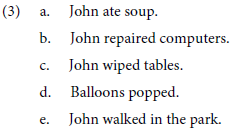
(Note that although the sentences in (3) have no natural notion of (intended) resulting state, they do all nevertheless involve some change of state due to their dynamic nature.)
An event (or more generally eventuality; see Remark 1.1.1) is telic if and only if it has an inherent endpoint; otherwise, it is atelic. Thus, the events in (1) are telic, and the events in (3) are atelic. The main feature that distinguishes telic and atelic events is that telic events have the capacity to culminate, or attain their inherent endpoint. In contrast, the question of whether or not an atelic event culminated is not sensible because there is no inherent endpoint with respect to which culmination can take place.
Remark 1.1.1. Following Bach (Reference Bach and Cole1981, Reference Bach1986), we use the term “eventuality” in a very broad sense, similarly to the term “state of affairs” in Van Valin and LaPolla (Reference Van Valin and LaPolla1997), subsuming the four classical Aktionsart classes of Vendler (Reference Vendler1957, Reference Vendler1967), namely states, activities, achievements, and accomplishments. It is common to divide eventualities into states and non-states and, among non-states, to distinguish processes – Vendlerian activities – and events – Vendlerian achievements and accomplishments – see Mourelatos (Reference Mourelatos1978); Bach (Reference Bach1986). To keep the metalanguage lighter, we adopt the terminological convention that “event” is a cover term for nonstatic eventualities (thus including both processes and events in the narrower sense). This convention is purely terminological, and it is not meant to collapse the process–event distinction. Our analysis of telicity will be restricted to the class of verbal predicates whose telicity varies with the properties of an argument (rather than being induced by adjuncts); from this perspective, purely process predicates that we mention in the paper, such as ${run}$
or
${run}$
or $\textit{drive a car}$
, function mainly as atelic points of comparison.
$\textit{drive a car}$
, function mainly as atelic points of comparison.
A brief comment is in order regarding the potentially distinct fifth Aktionsart class of semelfactives, such as $cough$
,
$cough$
, $blink$
, or
$blink$
, or ${knock}$
(Smith, Reference Smith1997). There is no agreement in the literature on how semelfactives should be situated relative to the classical classes and relatedly on whether they should be classified as telic or atelic. One reason is that different traditions connect these labels to different diagnostics: for example, Mourelatos (Reference Mourelatos1978) treats semelfactives as events in his sense on the grounds of countability (one can say
${knock}$
(Smith, Reference Smith1997). There is no agreement in the literature on how semelfactives should be situated relative to the classical classes and relatedly on whether they should be classified as telic or atelic. One reason is that different traditions connect these labels to different diagnostics: for example, Mourelatos (Reference Mourelatos1978) treats semelfactives as events in his sense on the grounds of countability (one can say $blink\ twice$
), whereas Smith (Reference Smith1997) treats semelfactives as a separate class, characterized by instantaneousness and the absence of an inherent resulting state (e.g., there is no natural resulting state that ensues upon John knocking on the door). Since we are only concerned with the telicity–atelicity distinction and not with the distinction between particular Aktionsart classes, the only thing that matters for us is that semelfactives are atelic according to our definition, where telicity is understood in terms of an inherent endpoint associated with an intended resulting state, rather than countability. Accordingly, semelfactives count as atelic in our setting, since they do not have a natural resulting state associated with them.
$blink\ twice$
), whereas Smith (Reference Smith1997) treats semelfactives as a separate class, characterized by instantaneousness and the absence of an inherent resulting state (e.g., there is no natural resulting state that ensues upon John knocking on the door). Since we are only concerned with the telicity–atelicity distinction and not with the distinction between particular Aktionsart classes, the only thing that matters for us is that semelfactives are atelic according to our definition, where telicity is understood in terms of an inherent endpoint associated with an intended resulting state, rather than countability. Accordingly, semelfactives count as atelic in our setting, since they do not have a natural resulting state associated with them.
An event attains its inherent endpoint (i.e., culminates) if that event entails its associated intended resulting state. In English, events expressed by most non-progressive verb phrases with a specified inherent endpoint automatically culminate. For example, the events in (1) (with the possible exception of (1-c), as discussed below) attain their inherent endpoints and thus culminate. We illustrate this in (4): with the exception of (4-c), the first clause of each sentence entails culmination with respect to its endpoint, and for that reason the second clauses introduce contradictory information.
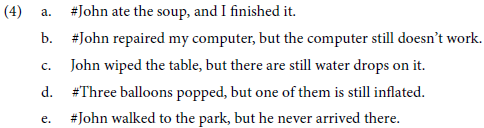
As for (4-c), this is about as close as we can get in English to a telic but non-culminating event. The verb wipe is arguably ambiguous between at least two readings. On one reading of wipe, it denotes an activity – the mere motion of moving a cloth back and forth – with no inherent endpoint; hence, under this reading, (4-c) is atelic. On a result-oriented reading of wipe, the first clause in (4-c) denotes a telic event whose inherent endpoint is that the entire relevant surface has been wiped (at least once). In ordinary discourse, this telic reading often gives rise to a pragmatic inference that the table is clean or dry, but that inference is not entailed by the verb itself. In (4-c), the continuation denies the expected result state (“there are still water drops”), showing that this is an approximation of a telic but non-culminating event: the inherent endpoint is defined, but the culmination condition fails to hold. This is, however, not a true telic non-culminating event, since dryness is not entailed by wipe.
Cross-linguistically, there are languages in which non-culminating events (often termed non-culminating accomplishments) are more robust and prominent than in English. We restrict ourselves to just one example from Mandarin Chinese, which is given in (5); the English translation is semantically unacceptable in English, but the original sentence is acceptable in Mandarin.

The first clause chı-le yı-gè píngguǒ ‘ate an apple’ is telic (it has a natural endpoint: the apple’s being fully consumed), while the follow-up hái sh $\grave{e}$
ng li
$\grave{e}$
ng li $\check{a}$
ng-k
$\check{a}$
ng-k $\check{o}$
u ‘there were two bites left’ denies that endpoint. The particle -le marks event occurrence/completion but does not force culmination, permitting a genuinely telic but non-culminated reading.
$\check{o}$
u ‘there were two bites left’ denies that endpoint. The particle -le marks event occurrence/completion but does not force culmination, permitting a genuinely telic but non-culminated reading.
Finally, we note that there is a class of verbs including push, stroke, and drive, whose lexical semantics does not involve an approach toward any goal, unlike verbs such as repair, pop, and melt, whose lexical semantics does involve an approach toward some goal. Arguments of verbs such as push, stroke, or drive can never introduce inherent endpoints; only adjuncts can. This is illustrated in (6).

To sum up, events can be telic or atelic. Telic events may be culminating or non-culminating, whereas the status of (non-)culminativity is undefined for atelic events. In events described by verbs whose lexical semantics encode an aim toward some goal, telicity may arise either from an argument of the verb or from an adjunct. In contrast, events described by verbs without an aim toward any goal are always atelic in the absence of extra linguistic content, although adding extra linguistic content such as adjuncts to the predicate describing them may render the event telic. (We ignore such cases in this paper, leaving them to future work.)
1.2 Relationship between telicity and undergoers
Following Role and Reference Grammar (Van Valin and LaPolla Reference Van Valin and LaPolla1997; Bentley et al. Reference Bentley, Usón, Nakamura, Van Valin and Robert2023), we use the terms actor and undergoer to label the two arguments of a transitive verb. Actors and undergoers are semantic macroroles: actors (resp., undergoers) represent the most agent-like (resp., patient-like) participants of an event. Actors are more general than agents; they do not have to be sentient and include other agent-like roles, such as instruments or forces. Our notion of undergoer also encompasses a variety of traditional semantic roles, such as patient, theme, experiencer, holder of a state, and similar roles. For example, the grammatical subjects in all the transitive sentences in (1) and (3) are actors, and the grammatical objects are undergoers; the grammatical subjects in the intransitive sentences in (2) are all undergoers.
As discussed in Section 1.1, for verbs whose lexical semantics encodes an aim to achieve a goal, an inherent endpoint may be supplied either by an argument of the verb or by an adjunct. Restricting attention to the former case and verbs with at most two arguments, linguists have observed that the property of telicity in the verbal domain correlates with a certain property of the undergoer in the nominal domain (Verkuyl Reference Verkuyl1972, Reference Verkuyl1993; Dowty Reference Dowty1979; Tenny Reference Tenny1987, Reference Tenny1994; Krifka Reference Krifka, Bartsch, van Benthem and van Emde Boas1989, Reference Krifka, Sag and Szabolcsi1992, Reference Krifka and Rothstein1998; Jackendoff Reference Jackendoff1991, Reference Jackendoff1996).
Jackendoff (Reference Jackendoff1991, Reference Jackendoff1996) refers to the latter property as boundedness. A bounded noun phrase, according to Jackendoff, is one that describes a delimited quantity of some thing or a substance, such as three apples, five liters of water, several books, a tomato. Examples of noun phrases that are not bounded, or unbounded, include apples, water, and custard.
We can detect the correlation between telicity and boundedness by the in-adverbial test: only telic events can be followed by temporal in-adverbials. Indeed, temporal in-adverbials specify the time span within which something has happened, and this “happening” can occur only if there is an inherent endpoint to begin with; cf. Peck et al. (Reference Peck, Lin, Sun, Eom and Zhang2016, 223). On the other hand, in English, only sentences with bounded undergoers are compatible with in-adverbials, as the contrast in (7) shows. This illustrates the correlation between the telicity of an event and the boundedness of its undergoer.

Remark 1.2.1. There are some known exceptions, notably with noun phrases involving quantifiers. For example, the noun phrase $\textit{at least three apples}$
is not delimited in any sense, but it ought to be bounded according to the in-adverbial test. On the other hand, the noun phrase
$\textit{at least three apples}$
is not delimited in any sense, but it ought to be bounded according to the in-adverbial test. On the other hand, the noun phrase $\textit{some apples}$
seems to be delimited, but it behaves like an unbounded noun phrase with respect to the
$\textit{some apples}$
seems to be delimited, but it behaves like an unbounded noun phrase with respect to the $\textit{in}$
-adverbial test.
$\textit{in}$
-adverbial test.
In English, bounded and unbounded noun phrases are syntactically marked: the unbounded noun phrases are the bare noun phrases (i.e., noun phrases expressed by bare nouns, possibly modified by adjectives, but without any determiners), whereas the bounded noun phrases are the non-bare noun phrases.Footnote 6 In article-less languages, however, bare noun phrases can have a definite reading.
To account for this cross-linguistic variation, we redefine the notion of boundedness so as to not refer to the syntactic structure of a noun phrase. Under our definition, a noun phrase is bounded if it is capable of supplying an inherent endpoint and unbounded otherwise. That is, we treat boundedness (resp., unboundedness) as the nominal counterpart of telicity (resp., atelicity), in the sense that an event is telic if and only if its undergoer is bounded. (Of course, this is only adequate for verbs whose lexical semantics encodes an aim to achieve a goal.) In Kovalev (Reference Kovalev2024), the first author argues that this definition, together with appropriate diagnostics for detecting bounded and unbounded undergoers, is an adequate generalization of Jackendoff’s (Reference Jackendoff1996) notion of boundedness to at least some languages that lack articles, such as Russian and that the two notions of boundedness agree when restricted to English.
In this paper, we will restrict our attention to transitive and intransitive (but not ditransitive) verbs whose lexical semantics encode an aim to achieve a goal (i.e., those verbs which some may call “non-activity” verbs) and on the cases in which telicity is induced by a verbal argument as opposed to an adjunct. These are the verbs for which the telicity of an event correlates to the boundedness of its undergoer.
As discussed above, we will treat the boundedness of a noun phrase as a primitive notion. In English, the bounded noun phrases will be the non-bare noun phrases (i.e., those containing determiners). As for languages where bare noun phrases have both bounded and unbounded readings, such as Russian, the first author has argued in Kovalev (Reference Kovalev2024) that bounded readings of bare noun phrases in Russian can be interpreted either as definite descriptions or as having an unspecified numerical quantifier. We restrict ourselves to the latter interpretation for the purposes of this paper, leaving the modeling of definite descriptions (and more generally, inter-clausal relationships) to future work.
1.3 Comparison to prior work on telicity and culminativity
Although telicity and culminativity are well-studied in the linguistic literature, previous studies focus almost exclusively on explaining the origins of these phenomena. In comparison, our focus is on the entailment relations associated with these notions. One can argue that the notion of entailment is a central and the most important notion in all of semantics (Montague Reference Montague1970b; Moss Reference Moss, Lappin and Fox2015); indeed, it is what distinguishes semantics from the adjacent field of pragmatics, whose central notion is that of implicature. Despite this, prior work has not focused on formally modeling entailment relations arising in the context of telicity. Nor are we aware of studies that use dependent types to model telicity; the closest work we are aware of is Corfield’s (Reference Corfield2020) sketch of the modeling of Vendler’s Aktionsart classes (Vendler Reference Vendler1957, Reference Vendler1967).
The vast majority of current formal analyses of telicity and culminativity can be broadly categorized as following either the mereological approach, involving parts of events and entities, or the lexico-semantical approach, involving predicate decomposition. The former goes back to Krifka (Reference Krifka1986, Reference Krifka, Bartsch, van Benthem and van Emde Boas1989, Reference Krifka, Sag and Szabolcsi1992, Reference Krifka and Rothstein1998, Reference Krifka2001), while the latter was originally proposed in Dowty (Reference Dowty1979) and further developed in Van Valin and LaPolla (Reference Van Valin and LaPolla1997); Van Valin (Reference Van Valin2005); Bentley et al. (Reference Bentley, Usón, Nakamura, Van Valin and Robert2023), with Rappaport Hovav and Levin (Reference Rappaport Hovav, Levin, Butt and Geuder1998) providing a close alternative. The two approaches were combined in Rothstein (Reference Rothstein2004).
To oversimplify, the mereological approach assumes that an event comes to an end if and only if the undergoer of the event is completely “used up.” For example, the event John ate three apples comes to an end if and only if the three apples are completely consumed. This approach conflates telicity and culminativity, as we have discussed in Section 1.1, such a conflation is generally suitable for modeling telicity in English, but – unlike our approach – is not straightforwardly suitable to languages with telic but non-culminating events.
On the other hand, approaches based on lexical decomposition encode the relevant inner aspectual properties of events in the symbolic representation of the predicate describing that event. To illustrate, (8) and (9) provide examples of certain kinds of lexical representations in Role and Reference Grammar (Bentley et al. Reference Bentley, Usón, Nakamura, Van Valin and Robert2023, 99).
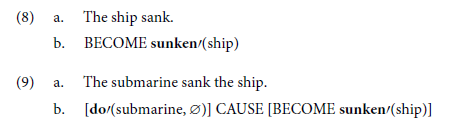
Our main critique of such representations is that they are typically not accompanied with a formal semantics (be it model-theoretic, proof-theoretic, or otherwise). Thus, although they provide a suitable symbolic representation for sentences, the absence of a semantics makes it impossible to discuss entailments (and consequently to perform natural language inference).
We note that – like the mereological approaches described earlier – the examples from Role and Reference Grammar mentioned above conflate telicity with culminativity. There have been attempts to unify the two approaches and add a separate predicate governing culminativity, notably by Rothstein (Reference Rothstein2004). Although these works attempt to define the semantics, they appear to be informal in many aspects and to conflate syntax and semantics, making them unsuitable for formalization in the context of automated natural language inference.
In this paper, we aim to rectify these issues. In particular, we distinguish the notions of telicity and culminativity, noting further that (non-)culminativity is a property only defined for telic events. Our approach to modeling telicity can be seen as an improvement of lexical decomposition approaches, in which we work within (dependent) type theory instead of creating a separate representation language.
Using type theory provides us with several benefits. First, type theory is a rich enough framework to model the relevant aspects of telicity and culminativity, and their relationship to the argument structure in a way that does not conflate the two notions. Second, there is a general notion of a model of dependent type theory (e.g., as induced by the theory of generalized algebraic theories (Cartmell Reference Cartmell1986; Uemura Reference Uemura2021)), allowing us to equip our framework with a semantics as a straightforward extension of the standard set-theoretic semantics of type theory (Hofmann Reference Hofmann1997). (See Section 6 for further discussion of this point.)
Finally, type theory has many computer implementations in modern proof assistants such as Agda (The Agda Development Team 2020), Rocq/Coq (The Rocq Development Team 2025), Lean (de Moura and Ullrich Reference de Moura, Ullrich, Platzer and Sutcliffe2021), and Lego/Plastic (Luo and Pollack Reference Luo and Pollack1992; Callaghan and Luo Reference Callaghan and Luo2001). As a result, the framework we develop in this paper is amenable to implementation in proof assistants; indeed, in Section 5, we describe an Agda implementation of all the rules and examples in this paper. Such implementations can in turn be used for automated natural language inference or, more generally, natural language reasoning (Chatzikyriakidis and Luo Reference Chatzikyriakidis, Luo, Amblard, de Groote, Pogodalla and Retoré2016). Fragments of English have previously been implemented in Rocq/Coq (Luo Reference Luo2011; Chatzikyriakidis and Luo Reference Chatzikyriakidis and Luo2014), Plastic (Xue and Luo Reference Xue, Luo, Béchet and Dikovsky2012), and Agda (Domanov Reference Domanov2024).
1.4 Prior use of dependent types for language modeling
The use of dependent types for natural language analysis goes back at least as far as Mönnich (Reference Mönnich1985) and Sundholm (Reference Sundholm1986), in which they were used to model anaphoric relationships in so-called donkey sentences (Geach Reference Geach1962). Although the first comprehensive work on using dependent types for natural language analysis appeared around the same time (Ranta Reference Ranta1994), relatively few studies followed in the subsequent years (Boldini Reference Boldini and Retoré1997,Reference Boldini2000,Reference Boldini2001; Krahmer and Piwek Reference Krahmer, Piwek, Bunt and Muskens1999; Piwek and Krahmer Reference Piwek, Krahmer, Bonzon, Cavalcanti and Nossum2000; Ahn Reference Ahn2001).
Over the last ten to fifteen years, several lines of work have emerged applying dependent types in the context of natural language. Perhaps the most fully developed framework among these is the so-called MTT-semantics (Luo Reference Luo2009, Reference Luo2012b; Chatzikyriakidis and Luo Reference Chatzikyriakidis and Luo2020). Another developed line of work is dependent type semantics (Bekki Reference Bekki, Asher and Soloviev2014; Bekki and Mineshima Reference Bekki, Mineshima, Chatzikyriakidis and Luo2017; Bekki Reference Bekki2023; Matsuoka et al. Reference Matsuoka, Bekki and Yanaka2024), type theory with records (Cooper Reference Cooper2005, Reference Cooper, Bertino, Gao, Steffen and Yung2011; Cooper and Ginzburg Reference Cooper, Ginzburg, Lappin and Fox2015; Cooper Reference Cooper, Chatzikyriakidis and Luo2017.Reference Cooper2023), and there are many other isolated works as well (Dapoigny and Barlatier Reference Dapoigny and Barlatier2010; Asher Reference Asher2011; Asher and Luo Reference Asher and Luo2013; Retoré Reference Retoré, Matthes and Schubert2014; Grudzińska and Zawadowski Reference Grudzińska and Zawadowski2014,Reference Grudzińska, Zawadowski, Hansen, Murray, Sadrzadeh and Zeevat2017,Reference Grudzińska and Zawadowski2019, Reference Grudzińska, Zawadowski and Loukanova2020; Mery et al. Reference Mery, Moot and Retoré2018; Ortega-Andrés and Vicente Reference Ortega-Andrés and Vicente2019; Zawadowski and Grudzińska Reference Zawadowski and Grudzińska2024).
In addition to the general virtues of dependent type theory mentioned above, many researchers are turning to dependent type theory for natural language analysis because in comparison to Church’s simple type theory, it provides a more elegant account of – or in some cases, allows any account whatsoever of – natural language phenomena including anaphoric relationships, copredication, selectional restriction, the event quantification problem, and adverbial modification, among others (Chatzikyriakidis and Cooper Reference Chatzikyriakidis and Cooper2018; Chatzikyriakidis and Luo Reference Chatzikyriakidis and Luo2020; Sutton Reference Sutton2024; Chatzikyriakidis et al. Reference Chatzikyriakidis, Cooper, Gregoromichelaki and Sutton2025).
Our framework in this paper is inspired in many ways by MTT-semantics. We note that the term “MTT-semantics” stands for “formal semantics in modern type theories” and in principle is meant to cover any kind of formal semantics that employs a modern (dependent) type theory. In practice, however, this term seems to refer to the specific framework developed by Luo (Reference Luo2009, Reference Luo2012b); Chatzikyriakidis and Luo (Reference Chatzikyriakidis and Luo2020), whose underlying type theory is the unifying theory of dependent types (UTT) (Luo Reference Luo1994), and it is in this sense that we use the term.
The principal commonality between our work and MTT-semantics is the use of the common nouns as types paradigm (Luo Reference Luo2012a,b), which goes back to earlier type-theoretic works (Mönnich Reference Mönnich1985; Sundholm Reference Sundholm1986; Ranta Reference Ranta1994), but stands in opposition to the treatment in Montague semantics of common nouns as predicates. In MTT-semantics, modeling common nouns as the types of their instances enables the modeling of linguistic phenomena that involve subtyping, such as copredication. In this paper, it makes our treatments of the nominal and verbal domains more uniform.Footnote 7
We also adopt a variant of the dependent event types of MTT-semantics (Luo and Soloviev Reference Luo and Soloviev2017), although our approach is different in that our dependent event types are collections of events that are themselves types. As we will discuss in Section 4, this modification allows us to apply adverbial modification in parallel with adjectival modification while also keeping track of the telicity and culminativity status of events.
Our biggest departure from MTT-semantics is the underlying type theory itself. MTT-semantics is built on the impredicative UTT (Luo Reference Luo1994) extended by numerous features such as coercive subtyping (Luo Reference Luo1997,Reference Luo1999; Luo et al. Reference Luo, Soloviev and Xue2013), subtype universes (Maclean and Luo Reference Maclean and Luo2021; Bradley and Luo Reference Bradley and Luo2023), and dot-types (Luo Reference Luo2009, Reference Luo2011, Reference Luo2012b; Chatzikyriakidis and Luo Reference Chatzikyriakidis and Luo2015, Reference Chatzikyriakidis and Luo2017b, Reference Chatzikyriakidis and Luo2018). These features play key roles in modeling various natural language phenomena; for example, dot-types were introduced to handle copredication, subtype universes to handle gradable adjectives, and weak sums (which are definable using impredicativity) are used to account for the donkey anaphora (Luo Reference Luo2021).
In contrast, we work inside predicative intensional Martin-Löf type theory (Martin-Löf Reference Martin-Löf, Rose and Shepherdson1975), a very well-understood system from both the theoretical and practical standpoint. In part, this is because we are not attempting to model all the linguistic phenomena considered by MTT-semantics. In other cases, we make a concerted effort to avoid sophisticated features; for example, in Section 3.3, we model subset inclusions not using coercive subtyping as in MTT-semantics but rather in terms of explicit inclusion functions.
Working inside a more standard dependent type theory has several benefits. First, it allows us to formalize our framework inside the Agda proof assistant with minimal modifications. Second, by making fewer background assumptions, our work is directly compatible with more extensions of type theory, including homotopy type theory (Univalent Foundations Program 2013). Most importantly, the set-theoretic (and category-theoretic and even homotopy-theoretic) semantics of Martin-Löf type theory are well-studied (Hofmann Reference Hofmann1997), in contrast to the model theory of impredicative type theories with coercive subtyping, which is much less clear. The latter has led to several papers attempting to clarify that MTT-semantics is model-theoretic in addition to being proof-theoretic (Luo Reference Luo2014,Reference Luo2019).
1.5 Contributions
We develop a cross-linguistic framework within Martin-Löf dependent type theory for analyzing event telicity, culminativity, and associated entailments. As far as we know, this is the first analysis of telicity in the context of dependent type theory. In this paper, we focus on our framework as it applies to English; the first author’s dissertation (Kovalev Reference Kovalev2024) also includes an extended discussion of Russian. In particular, our analysis is careful to distinguish the phenomena of telicity and culminativity, which (as discussed in Section 1.1) generally coincide in English but not in for example Russian or Mandarin.
Our analysis is based on the well-observed idea that for a large class of verbs, the telicity of an event correlates with the boundedness of its undergoer, its most patient-like participant (Verkuyl Reference Verkuyl1972,Reference Verkuyl1993; Dowty Reference Dowty1979; Tenny Reference Tenny1987,Reference Tenny1994; Krifka Reference Krifka, Bartsch, van Benthem and van Emde Boas1989,Reference Krifka, Sag and Szabolcsi1992,Reference Krifka and Rothstein1998; Jackendoff Reference Jackendoff1991,Reference Jackendoff1996). Much of this paper is thus dedicated to developing a thorough ontology of the structure of noun phrases, and particularly of the internal structure of overtly bounded noun phrases: numerical quantifiers, measure words, adjectival modification, instances of noun phrases, and mereological sums thereof. We believe this part of our framework is of independent interest.
Following Luo and Soloviev (Reference Luo and Soloviev2017), we consider events as a dependent type family indexed by actors and undergoers. Unlike previous work in dependent type theory, we regard events as giving rise to their collections of occurrences, allowing us to easily model adverbial modification. Because the type of events is indexed by the type of undergoers, and the type of undergoers is further indexed by boundedness, we are able to detect telicity purely through type dependency. We then associate to each telic event a resulting state and define culminativity as the property that a telic event obtains its resulting state if it occurs.
In addition to modeling telicity and culminativity, we aim to build a reasonable ontology of eventualities – both static and dynamic – and to advance the use of dependent types for event structure, to which relatively little attention has been paid. In addition to the dependent event types of Luo and Soloviev (Reference Luo and Soloviev2017), some preliminary work on this has been done by Corfield (Reference Corfield2020) in his sketch of the modeling of Vendler’s Aktionsart classes (Vendler Reference Vendler1957,Reference Vendler1967), as we discuss in Section 6.
Finally, although many aspects of our framework are heavily inspired by MTT-semantics (Chatzikyriakidis and Luo Reference Chatzikyriakidis and Luo2020), we restrict ourselves to working inside a standard intensional type theory (Martin-Löf Reference Martin-Löf, Rose and Shepherdson1975) rather than the unifying theory of dependent types (Luo, Reference Luo1994) extended with various complex features such as coercive subtyping. Using a standard type theory not only simplifies our framework but has also enabled us to formalize all the rules and examples in this paper in the Agda proof assistant and provides a clear path toward a set-theoretic semantics with respect to which we can validate our entailments. In this respect, our work can be seen as an improvement on lexical (or predicate) decomposition approaches, in that it provides both a representation language and also an associated semantics.
Outline The rest of the paper is structured as follows. In Section 2, we provide a very quick summary of intensional Martin-Löf type theory, our ambient type theory. In Sections 3 and 4, we present the nominal and verbal fragments of our framework, respectively, interspersed with examples. Our nominal framework places a particular emphasis on tracking the boundedness of noun phrases and particularly in the internal structure of overtly bounded noun phrases, which we believe to be of independent interest. The verbal framework builds on the nominal framework to define and analyze eventualities of different kinds – including static eventualities and telic, atelic, culminating, and non-culminating dynamic eventualities – and entailments between these. In Section 5, we discuss and briefly showcase our Agda formalization of the rules and examples from Sections 3 and 4. Finally, in Section 6, we close with a discussion of possible extensions to our framework and how it compares to prior work.
2. Type-Theoretic background
Our framework builds on predicative intensional Martin-Löf dependent type theory (Martin-Löf Reference Martin-Löf, Rose and Shepherdson1975), a standard variant of type theory which corresponds roughly to the intersection of features available in modern type-theoretic proof assistants, such as Agda (The Agda Development Team 2020), Rocq/Coq (The Rocq Development Team 2025), and Lean (de Moura and Ullrich Reference de Moura, Ullrich, Platzer and Sutcliffe2021). Readers unfamiliar with type theory are encouraged to consult one of the many references on this theory or variations thereof, such as the books of Nordström et al. (Reference Nordström, Petersson and Smith1990); Luo (Reference Luo1994); Nederpelt and Geuvers (Reference Nederpelt and Geuvers2014). In this section, we quickly recall some basics and fix notation.
Dependent type theory consists of four main judgments. The first, $\Gamma \vdash A\textsf { type}$
, states that
$\Gamma \vdash A\textsf { type}$
, states that $A$
is a type relative to context
$A$
is a type relative to context $\Gamma$
, a list of variables/hypotheses
$\Gamma$
, a list of variables/hypotheses $x_1:A_1,x_2:A_2,\dots ,x_n:A_n$
. The second,
$x_1:A_1,x_2:A_2,\dots ,x_n:A_n$
. The second, $\Gamma \vdash a:A$
, states that
$\Gamma \vdash a:A$
, states that $a$
is a term of type
$a$
is a term of type $A$
, again both relative to context
$A$
, again both relative to context $\Gamma$
. We can understand the judgment
$\Gamma$
. We can understand the judgment $\Gamma \vdash a:A$
in one of two ways: either that
$\Gamma \vdash a:A$
in one of two ways: either that $a$
is a proof of the proposition
$a$
is a proof of the proposition $A$
under a list of hypotheses
$A$
under a list of hypotheses $\Gamma$
or that
$\Gamma$
or that $a$
is a
$a$
is a $\Gamma$
-indexed family of elements of the (
$\Gamma$
-indexed family of elements of the ( $\Gamma$
-indexed) collection
$\Gamma$
-indexed) collection $A$
. (In particular, when
$A$
. (In particular, when $\Gamma$
is empty,
$\Gamma$
is empty, $\cdot \vdash a:A$
can be understood as a proof of the proposition
$\cdot \vdash a:A$
can be understood as a proof of the proposition $A$
, or as an element of the set
$A$
, or as an element of the set $A$
.) Finally, we have judgmental equalities
$A$
.) Finally, we have judgmental equalities $\Gamma \vdash A = A'\textsf { type}$
and
$\Gamma \vdash A = A'\textsf { type}$
and $\Gamma \vdash a = a' : A$
which state that the two types (resp., terms)
$\Gamma \vdash a = a' : A$
which state that the two types (resp., terms) $A$
and
$A$
and $A'$
(resp.,
$A'$
(resp., $a$
and
$a$
and $a'$
) are the same. These four judgments are inductively defined by a collection of natural deduction–style rules, which can be formally understood as collectively specifying the signature of a generalized algebraic theory (Cartmell Reference Cartmell1986).
$a'$
) are the same. These four judgments are inductively defined by a collection of natural deduction–style rules, which can be formally understood as collectively specifying the signature of a generalized algebraic theory (Cartmell Reference Cartmell1986).
In this paper, we rely almost exclusively on three type formers: $\Pi$
-types (dependent products),
$\Pi$
-types (dependent products), $\Sigma$
-types (dependent sums), and the universe
$\Sigma$
-types (dependent sums), and the universe $\textbf {Prop}$
of homotopy propositions.Footnote
8
$\textbf {Prop}$
of homotopy propositions.Footnote
8 $\Pi$
-types are the dependent generalization of ordinary function types and correspond logically to universal quantification. If
$\Pi$
-types are the dependent generalization of ordinary function types and correspond logically to universal quantification. If $B(x)$
is a family of types indexed by
$B(x)$
is a family of types indexed by $x:A$
, then the
$x:A$
, then the $\Pi$
-type
$\Pi$
-type $(x:A)\to B(x)$
consists of functions
$(x:A)\to B(x)$
consists of functions $\lambda x.b$
, which send any
$\lambda x.b$
, which send any $x:A$
to an element
$x:A$
to an element $b$
of
$b$
of $B(x)$
. We write
$B(x)$
. We write $f\ a : B(a)$
for the application of any function
$f\ a : B(a)$
for the application of any function $f : (x:A)\to B(x)$
to an argument
$f : (x:A)\to B(x)$
to an argument $a : A$
.
$a : A$
.
 \begin{align*} &\frac {\Gamma ,x:A \vdash B(x) \textsf { type}}{\Gamma \vdash (x:A)\to B(x) \textsf { type}} \quad \quad \frac {\Gamma ,x:A \vdash b : B(x)}{\Gamma \vdash \lambda x.b : (x:A)\to B(x)}\\[6pt] &\qquad \qquad \frac {\Gamma \vdash f : (x:A)\to B(x) \qquad \Gamma \vdash a : A}{\Gamma \vdash f\ a : B(a)} \\[-20pt] \end{align*}
On the other hand, $\Sigma$
-types are the dependent generalization of ordinary pair types and correspond to a form of existential quantification. If
$\Sigma$
-types are the dependent generalization of ordinary pair types and correspond to a form of existential quantification. If $B(x)$
is a family of types indexed by
$B(x)$
is a family of types indexed by $x:A$
, then the
$x:A$
, then the $\Sigma$
-type
$\Sigma$
-type $\sum _{x:A} B(x)$
consists of pairs of a term
$\sum _{x:A} B(x)$
consists of pairs of a term $a:A$
and a term
$a:A$
and a term $b:B(a)$
. Given
$b:B(a)$
. Given $p : \sum _{x:A} B(x)$
, we write
$p : \sum _{x:A} B(x)$
, we write $\textbf {fst}(p) : A$
and
$\textbf {fst}(p) : A$
and $\textbf {snd}(p) : B(\textbf {fst}(p))$
for its first and second projections.
$\textbf {snd}(p) : B(\textbf {fst}(p))$
for its first and second projections.
 \begin{align*} &\frac {\Gamma ,x:A \vdash B(x) \textsf { type}}{\Gamma \vdash \textstyle \sum _{x:A} B(x) \textsf { type}} &\quad \frac {\Gamma \vdash a : A \qquad \Gamma \vdash b : B(a)}{\Gamma \vdash (a,b) : \textstyle \sum _{x:A} B(x)} \\[10pt] &\frac {\Gamma \vdash p : \textstyle \sum _{x:A} B(x)}{\Gamma \vdash \textbf {fst}(p) : A} &\quad \frac {\Gamma \vdash p : \textstyle \sum _{x:A} B(x)}{\Gamma \vdash \textbf {snd}(p) : B(\textbf {fst}(p))} \\[-10pt] \end{align*}
Our treatment of the type of propositions, $\textbf {Prop}$
, requires more discussion. We model adjectives, adverbs, and static eventualities using families of “proof-irrelevant” propositions, or types that have at most one term; this ensures that, for instance, there is at most one proof that a given cat is black. There are many different versions of
$\textbf {Prop}$
, requires more discussion. We model adjectives, adverbs, and static eventualities using families of “proof-irrelevant” propositions, or types that have at most one term; this ensures that, for instance, there is at most one proof that a given cat is black. There are many different versions of $\textbf {Prop}$
in the type-theoretic literature, such as homotopy propositions (Univalent Foundations Program 2013, Section 3.3), strict propositions (Gilbert et al. Reference Gilbert, Cockx, Sozeau and Tabareau2019), and impredicative propositions (Coquand and Huet Reference Coquand and Huet1988). Our requirements are very mild: we need a type
$\textbf {Prop}$
in the type-theoretic literature, such as homotopy propositions (Univalent Foundations Program 2013, Section 3.3), strict propositions (Gilbert et al. Reference Gilbert, Cockx, Sozeau and Tabareau2019), and impredicative propositions (Coquand and Huet Reference Coquand and Huet1988). Our requirements are very mild: we need a type $\textbf {Prop}$
whose elements
$\textbf {Prop}$
whose elements $P:\textbf {Prop}$
give rise to types
$P:\textbf {Prop}$
give rise to types $\textbf {Prf}(P)$
with at most one element up to the intensional identity type.
$\textbf {Prf}(P)$
with at most one element up to the intensional identity type.
 \begin{align*} \frac {}{\Gamma \vdash \textbf {Prop} \textsf { type}} \qquad \frac {\Gamma \vdash P : \textbf {Prop}}{\Gamma \vdash \textbf {Prf}(P) \textsf { type}} \qquad \frac {\Gamma \vdash P : \textbf {Prop} \qquad \Gamma \vdash p : \textbf {Prf}(P) \qquad \Gamma \vdash p' : \textbf {Prf}(P)}{\Gamma \vdash \mathbf{irr}(p,p') : \mathbf{Id}_{\textbf {Prf}(P)}(p,p')} \end{align*}
In our Agda formalization, we choose $\textbf {Prop}$
to be the type of homotopy propositions
$\textbf {Prop}$
to be the type of homotopy propositions
 \begin{equation*} \textbf {Prop} \triangleq \textstyle \sum _{X : \textbf {Type}} (x:X)\to (y:X)\to \mathbf{Id}_{X}(x,y) \end{equation*}
and assume function extensionality in Section 4.5 to show that $X\to \textbf {Prf}(P)$
is a proposition when
$X\to \textbf {Prf}(P)$
is a proposition when $P:\textbf {Prop}$
. However, any other variation of
$P:\textbf {Prop}$
. However, any other variation of $\textbf {Prop}$
satisfying these properties is equally suitable for our purposes. Notably, unlike Chatzikyriakidis and Luo (Reference Chatzikyriakidis and Luo2020), we do not require any form of impredicativity in our type theory.
$\textbf {Prop}$
satisfying these properties is equally suitable for our purposes. Notably, unlike Chatzikyriakidis and Luo (Reference Chatzikyriakidis and Luo2020), we do not require any form of impredicativity in our type theory.
In order to model various linguistic phenomena, our framework extends intensional type theory by various primitive type and term formers and judgmental equalities over these new primitives, such as the dependent type $\textbf {NP}^b$
of noun phrases of a given boundedness
$\textbf {NP}^b$
of noun phrases of a given boundedness $b:\textbf {Bd}$
. These extensions are described throughout Sections 3 and 4. In those sections, we also illustrate how to use our framework to analyze fragments of English in a series of examples that temporarily extend the framework by additional constants modeling English words, such as the unbounded noun phrase human represented by the constant
$b:\textbf {Bd}$
. These extensions are described throughout Sections 3 and 4. In those sections, we also illustrate how to use our framework to analyze fragments of English in a series of examples that temporarily extend the framework by additional constants modeling English words, such as the unbounded noun phrase human represented by the constant $\textsf {human} : \textbf {NP}^{\textsf {U}}$
.
$\textsf {human} : \textbf {NP}^{\textsf {U}}$
.
3. The nominal domain
Before developing our account of telicity and culminativity in the verbal domain, we must first lay some groundwork in the nominal domain. In particular, we refine the common nouns as types paradigm of Luo (Reference Luo2012a,b); Chatzikyriakidis and Luo (Reference Chatzikyriakidis and Luo2020) by using dependent types to track the boundedness of noun phrases, which we will use in Section 4 to detect telicity.
In Section 3.1, we introduce two types corresponding to the collections of bounded and unbounded noun phrases, respectively. Because we are working in the common nouns as types paradigm, we associate to every element of these types (such as human) a collection of its instances (in this case, the type of all humans). In Section 3.2, we define the type of proper names, which are pairs of a noun phrase and a particular instance of that noun phrase (such as John, a particular human).
In Section 3.3, we define a notion of inclusion between noun phrases, allowing us to express the relation that (e.g.) every man is a human. Note that terms have at most one type in our setting of Martin-Löf type theory; we do not express inclusion in terms of coercive subtyping (Luo Reference Luo1997,Reference Luo1999; Luo et al. Reference Luo, Soloviev and Xue2013) as in MTT-semantics (Luo Reference Luo2009,Reference Luo2012b; Chatzikyriakidis and Luo Reference Chatzikyriakidis and Luo2020), nor can we refer to a subset relation as one might in set theory.
In our framework, bare nouns in English such as human, whether mass or count, correspond to unbounded noun phrases. In Section 3.4, we discuss the origin of bounded noun phrases as those which express some delimited quantity, such as three apples. These quantities are measured in terms of degrees and units, following Lønning (Reference Lønning1987) and Champollion (Reference Champollion2017). We focus primarily on the case in which bounded noun phrases have an overt determiner, as in English; however, our framework can also account for article-less languages such as Russian (Remark 3.4.4), where bare nouns can be used in a bounded sense. In this section, we also account for the distinction between mass and count nouns and model a way to obtain composite individuals from primitive individuals, laying the groundwork for future potential analyses of distributivity phenomena.
We believe that Section 3.4 is of independent interest beyond its role in our framework of generating bounded noun phrases because the internal structure of overtly bounded noun phrases has not received much attention in the context of dependent types. As far as we know, our presentation is the first more or less complete treatment of the internal structure of noun phrases in the setting with dependent types.
Finally, in Section 3.5, we discuss adjectives, paying particular attention to the boundedness of adjectivally modified noun phrases. We limit our study to intersective adjectives and their interaction with the rest of our framework, namely boundedness, the subtyping relation of Section 3.3, the property of being count, and composite individuals.
3.1 Universes in the nominal domain
As discussed in Section 1.4, standard MTT-semantics (Chatzikyriakidis and Luo Reference Chatzikyriakidis and Luo2020) includes a universe $\textbf {CN}$
of common nouns (possibly modified by adjectives). Our counterpart is the universe
$\textbf {CN}$
of common nouns (possibly modified by adjectives). Our counterpart is the universe $\textbf {NP}$
of noun phrases, but we crucially divide
$\textbf {NP}$
of noun phrases, but we crucially divide $\textbf {NP}$
into two subuniverses: the universe
$\textbf {NP}$
into two subuniverses: the universe $\textbf {NP}^{\textsf {B}}$
of bounded noun phrases and the universe
$\textbf {NP}^{\textsf {B}}$
of bounded noun phrases and the universe $\textbf {NP}^{\textsf {U}}$
of unbounded noun phrases.
$\textbf {NP}^{\textsf {U}}$
of unbounded noun phrases.
Remark 3.1.1. Note that we use the term “noun phrase” not in the same sense as it is used in generative syntax. Specifically, we do not consider proper names as noun phrases; instead, we assign them the separate type of $\textbf {Entity}$
, which we introduce in Section 3.2.
$\textbf {Entity}$
, which we introduce in Section 3.2.
First, we introduce the type $\textbf {Bd}$
of “kinds of boundedness,” with two elements:
$\textbf {Bd}$
of “kinds of boundedness,” with two elements: $\textsf {B}$
(for bounded) and
$\textsf {B}$
(for bounded) and $\textsf {U}$
(for unbounded). This is essentially the type of booleans with a different name, although we will not consider any case analysis on
$\textsf {U}$
(for unbounded). This is essentially the type of booleans with a different name, although we will not consider any case analysis on $\textbf {Bd}$
until Example4.5.2.
$\textbf {Bd}$
until Example4.5.2.
 \begin{align*} \frac { }{\Gamma \vdash \textbf {Bd} \textsf { type}} \quad \quad \frac {}{\Gamma \vdash \textsf {B}: \textbf {Bd}} \qquad \frac {}{\Gamma \vdash \textsf {U}: \textbf {Bd}} \end{align*}
For any $b:\textbf {Bd}$
, we introduce a type
$b:\textbf {Bd}$
, we introduce a type $\textbf {NP}^b$
of “NPs with boundedness
$\textbf {NP}^b$
of “NPs with boundedness $b$
,” or
$b$
,” or $b$
-noun phrases:
$b$
-noun phrases:
 \begin{equation*} \frac {\Gamma \vdash b:\textbf {Bd}}{\Gamma \vdash \textbf {NP}^b \textsf { type}} \end{equation*}
A “bounded noun phrase” is a term of type $\textbf {NP}^{\textsf {B}}$
and an “unbounded noun phrase” is a term of type
$\textbf {NP}^{\textsf {B}}$
and an “unbounded noun phrase” is a term of type $\textbf {NP}^{\textsf {U}}$
. We associate to every
$\textbf {NP}^{\textsf {U}}$
. We associate to every $b$
-noun phrase
$b$
-noun phrase $\textit {np}:\textbf {NP}^b$
a type of “instances of
$\textit {np}:\textbf {NP}^b$
a type of “instances of $\textit {np}$
,” written
$\textit {np}$
,” written $\textbf {El}_{\textbf {NP}}^b(\textit {np})$
, for the collection of “elements of”
$\textbf {El}_{\textbf {NP}}^b(\textit {np})$
, for the collection of “elements of” $\textit {np}$
.
$\textit {np}$
.
 \begin{equation*} \frac {\Gamma \vdash b:\textbf {Bd} \qquad \Gamma \vdash \textit {np}:\textbf {NP}^b}{\Gamma \vdash \textbf {El}_{\textbf {NP}}^b(\textit {np}) \textsf { type}} \end{equation*}
Notation 3.1.2. We use bold for term and type constructors that are part of our framework, and sans-serif for term constants introduced to model a fragment of language using our framework. We use ${italics}$
to refer to arbitrary terms (as in the premises of inference rules).
${italics}$
to refer to arbitrary terms (as in the premises of inference rules).
The type $\textbf {NP}$
of all noun phrases is defined as the indexed sum (
$\textbf {NP}$
of all noun phrases is defined as the indexed sum ( $\Sigma$
-type) over all
$\Sigma$
-type) over all $b:\textbf {Bd}$
of
$b:\textbf {Bd}$
of $\textbf {NP}^b$
, so that terms of type
$\textbf {NP}^b$
, so that terms of type $\textbf {NP}$
are pairs
$\textbf {NP}$
are pairs $(b,\textit {np})$
of a boundedness
$(b,\textit {np})$
of a boundedness $b:\textbf {Bd}$
along with some
$b:\textbf {Bd}$
along with some $b$
-noun phrase
$b$
-noun phrase $\textit {np}:\textbf {NP}^b$
. The type
$\textit {np}:\textbf {NP}^b$
. The type $\textbf {El}_{\textbf {NP}}(\textit {n})$
of instances of a noun phrase
$\textbf {El}_{\textbf {NP}}(\textit {n})$
of instances of a noun phrase $n:\textbf {NP}$
is definable in terms of the primitive type families
$n:\textbf {NP}$
is definable in terms of the primitive type families $\textbf {El}_{\textbf {NP}}^b$
stipulated above.
$\textbf {El}_{\textbf {NP}}^b$
stipulated above.
 \begin{align*} \frac { }{\Gamma \vdash \textbf {NP} \triangleq \textstyle \sum _{b:\textbf {Bd}} \textbf {NP}^b \textsf { type}} \quad \quad \frac {\Gamma \vdash n:\textbf {NP}}{\Gamma \vdash \textbf {El}_{\textbf {NP}}(n) \triangleq \textbf {El}_{\textbf {NP}}^{\textbf {fst}(n)}(\textbf {snd}(n)) \textsf { type}} \end{align*}
Likewise, without extending our framework, we can regard any $b$
-noun phrase as a noun phrase. We say that terms of type
$b$
-noun phrase as a noun phrase. We say that terms of type $\textbf {NP}^b$
can be “lifted” to type
$\textbf {NP}^b$
can be “lifted” to type $\textbf {NP}$
.
$\textbf {NP}$
.
 \begin{equation*} \frac {\Gamma \vdash b:\textbf {Bd} \qquad \Gamma \vdash \textit {np}:\textbf {NP}^b}{\Gamma \vdash \textbf {Lift}_{\textbf {NP}}^b(\textit {np}) \triangleq (b,\textit {np}) : \textbf {NP}} \end{equation*}
Note that $\textbf {Lift}_{\textbf {NP}}^b$
is well-typed by the definition of
$\textbf {Lift}_{\textbf {NP}}^b$
is well-typed by the definition of $\textbf {NP}$
as a
$\textbf {NP}$
as a $\Sigma$
-type. In addition, by expanding definitions, it is easy to see that
$\Sigma$
-type. In addition, by expanding definitions, it is easy to see that $\textbf {El}_{\textbf {NP}}(\textbf {Lift}_{\textbf {NP}}^b(\textit {np})) = \textbf {El}_{\textbf {NP}}^b(\textit {np})$
for any
$\textbf {El}_{\textbf {NP}}(\textbf {Lift}_{\textbf {NP}}^b(\textit {np})) = \textbf {El}_{\textbf {NP}}^b(\textit {np})$
for any $b:\textbf {Bd}$
and
$b:\textbf {Bd}$
and $\textit {np}:\textbf {NP}^b$
.
$\textit {np}:\textbf {NP}^b$
.
Finally, we require that $\textbf {NP}^b$
be closed under
$\textbf {NP}^b$
be closed under $\Sigma$
-types of predicates over
$\Sigma$
-types of predicates over $\textbf {El}_{\textbf {NP}}^b$
. That is, for any
$\textbf {El}_{\textbf {NP}}^b$
. That is, for any $b$
-noun phrase
$b$
-noun phrase $\textit {np}:\textbf {NP}^b$
and any family of propositions
$\textit {np}:\textbf {NP}^b$
and any family of propositions $P$
indexed by
$P$
indexed by $\textbf {El}_{\textbf {NP}}^b(\textit {np})$
, we require that “the subset of nps satisfying
$\textbf {El}_{\textbf {NP}}^b(\textit {np})$
, we require that “the subset of nps satisfying $P$
” is again a
$P$
” is again a $b$
-noun phrase. This is a generalization of the condition that noun phrases modified by adjectives are again noun phrases (in particular, it is not limited to adjectival modification). Note also that this operation preserves boundedness.
$b$
-noun phrase. This is a generalization of the condition that noun phrases modified by adjectives are again noun phrases (in particular, it is not limited to adjectival modification). Note also that this operation preserves boundedness.
 \begin{align*} \frac {\Gamma \vdash b:\textbf {Bd} \qquad \Gamma \vdash \textit {np}:\textbf {NP}^b \qquad \Gamma ,p:\textbf {El}_{\textbf {NP}}^b(\textit {np})\vdash P : \textbf {Prop}}{\Gamma \vdash \textstyle \sum ^{\textbf {NP}}_{p:\textit {np}} P : \textbf {NP}^b}\\[6pt] \qquad \frac {\Gamma \vdash b:\textbf {Bd} \qquad \Gamma \vdash \textit {np}:\textbf {NP}^b \qquad \Gamma ,p:\textbf {El}_{\textbf {NP}}^b(\textit {np})\vdash P : \textbf {Prop}}{\Gamma \vdash \textbf {El}_{\textbf {NP}}^b\left (\textstyle \sum ^{\textbf {NP}}_{p:\textit {np}} P\right ) = \textstyle \sum _{p:\textbf {El}_{\textbf {NP}}^b(\textit {np})} \textbf {Prf}(P) \textsf { type}} \end{align*}
When modeling a particular fragment of English, we will populate $\textbf {NP}^{\textsf {U}}$
with bare nouns as well as bare nouns modified by intersective adjectives (Section 3.5). Thus,
$\textbf {NP}^{\textsf {U}}$
with bare nouns as well as bare nouns modified by intersective adjectives (Section 3.5). Thus, $\textbf {NP}^{\textsf {U}}$
plays the same role as
$\textbf {NP}^{\textsf {U}}$
plays the same role as $\textbf {CN}$
in Chatzikyriakidis and Luo (Reference Chatzikyriakidis and Luo2020).
$\textbf {CN}$
in Chatzikyriakidis and Luo (Reference Chatzikyriakidis and Luo2020).
Example 3.1.3. Suppose we are interested in analyzing a fragment of English containing the word ${human}$
. We extend our framework with a term
${human}$
. We extend our framework with a term
 \begin{equation*} \frac { }{\Gamma \vdash \textsf {human}:\textbf {NP}^{\textsf {U}}} \end{equation*}
corresponding to the unbounded noun phrase ${human}$
. The type
${human}$
. The type $\textbf {El}_{\textbf {NP}}^{\textsf {U}}(\textsf {human})$
is then the type of all humans. To further include the word
$\textbf {El}_{\textbf {NP}}^{\textsf {U}}(\textsf {human})$
is then the type of all humans. To further include the word ${John}$
– a particular instance of a human – in our fragment, we would extend our framework with a second term
${John}$
– a particular instance of a human – in our fragment, we would extend our framework with a second term
 \begin{align*} \frac { }{\Gamma \vdash \textsf {john} : \textbf {El}_{\textbf {NP}}^{\textsf {U}}(\textsf {human})} \\[-30pt] \end{align*}
3.2 Entities
With respect to telicity, proper names such as John (Example3.1.3) behave in the same way as bounded noun phrases. However, we do not assert that $\textsf {john}$
has type
$\textsf {john}$
has type $\textbf {NP}^{\textsf {B}}$
. For one, our framework assigns
$\textbf {NP}^{\textsf {B}}$
. For one, our framework assigns $\textsf {john}$
the type
$\textsf {john}$
the type $\textbf {El}_{\textbf {NP}}^{\textsf {U}}(\textsf {human})$
, and it cannot have two different types at the same time. Nor do we wish to assert a lift
$\textbf {El}_{\textbf {NP}}^{\textsf {U}}(\textsf {human})$
, and it cannot have two different types at the same time. Nor do we wish to assert a lift $\iota : \textbf {El}_{\textbf {NP}}^{\textsf {U}}(\textsf {human}) \to \textbf {NP}^{\textsf {B}}$
stating that every instance of
$\iota : \textbf {El}_{\textbf {NP}}^{\textsf {U}}(\textsf {human}) \to \textbf {NP}^{\textsf {B}}$
stating that every instance of $\textsf {human}$
s is a
$\textsf {human}$
s is a $\textbf {NP}^{\textsf {B}}$
because this forces us to consider the type
$\textbf {NP}^{\textsf {B}}$
because this forces us to consider the type $\textbf {El}_{\textbf {NP}}^{\textsf {B}}(\iota (\textsf {john}))$
of “instances of
$\textbf {El}_{\textbf {NP}}^{\textsf {B}}(\iota (\textsf {john}))$
of “instances of $\textsf {john}$
s,” which is semantically questionable.
$\textsf {john}$
s,” which is semantically questionable.
Instead, we introduce a new type of proper names, or entities, whose elements are pairs of a noun phrase $n:\textbf {NP}$
of any boundedness along with an instance
$n:\textbf {NP}$
of any boundedness along with an instance $p:\textbf {El}_{\textbf {NP}}(n)$
of
$p:\textbf {El}_{\textbf {NP}}(n)$
of $n$
. In fact, the type of entities is once again already definable as a
$n$
. In fact, the type of entities is once again already definable as a $\Sigma$
-type:
$\Sigma$
-type:
 \begin{equation*} \frac { }{\Gamma \vdash \textbf {Entity} \triangleq \textstyle \sum _{n:\textbf {NP}} \textbf {El}_{\textbf {NP}}(n) \textsf { type}} \end{equation*}
Expanding the definition of $\textbf {NP}$
from Section 3.1, terms of type
$\textbf {NP}$
from Section 3.1, terms of type $\textbf {Entity}$
are tuples
$\textbf {Entity}$
are tuples $((b,\textit {np}),p)$
where
$((b,\textit {np}),p)$
where $b : \textbf {Bd}$
,
$b : \textbf {Bd}$
, $\textit {np} : \textbf {NP}^b$
, and
$\textit {np} : \textbf {NP}^b$
, and $p : \textbf {El}_{\textbf {NP}}^b(\textit {np})$
. For example,
$p : \textbf {El}_{\textbf {NP}}^b(\textit {np})$
. For example, $((\textsf {U},\textsf {human}),\textsf {john}):\textbf {Entity}$
is the entity corresponding to the human named John.
$((\textsf {U},\textsf {human}),\textsf {john}):\textbf {Entity}$
is the entity corresponding to the human named John.
Entities will play an important role in our treatment of adjectival modification (Section 3.5) and in our formulation of dependent event types in Section 4.
3.3 Subtyping in the nominal domain
Next, we need a way of asserting (e.g.) that every man can be regarded as a human. We define a family of types $\textbf {isA}(\textit {np},\textit {np}')$
capturing the proposition that Every
$\textbf {isA}(\textit {np},\textit {np}')$
capturing the proposition that Every $\textit {np}$
is an
$\textit {np}$
is an $\textit {np}'$
for
$\textit {np}'$
for $\textit {np},\textit {np}'$
noun phrases of arbitrary (and in particular, potentially different) boundedness:
$\textit {np},\textit {np}'$
noun phrases of arbitrary (and in particular, potentially different) boundedness:
 \begin{equation*} \frac {\Gamma \vdash b:\textbf {Bd} \qquad \Gamma \vdash \textit {np}: \textbf {NP}^b \qquad \Gamma \vdash b':\textbf {Bd} \qquad \Gamma \vdash \textit {np}': \textbf {NP}^{b'}}{\Gamma \vdash \textbf {isA}(\textit {np},\textit {np}') \textsf { type}} \end{equation*}
Proofs of $\textbf {isA}(\textit {np},\textit {np}')$
induce inclusions
$\textbf {isA}(\textit {np},\textit {np}')$
induce inclusions $\textbf {El}_{\textbf {NP}}^b(\textit {np})\to \textbf {El}_{\textbf {NP}}^{b'}(\textit {np}')$
from the type of instances of
$\textbf {El}_{\textbf {NP}}^b(\textit {np})\to \textbf {El}_{\textbf {NP}}^{b'}(\textit {np}')$
from the type of instances of $\textit {np}$
s to the type of instances of
$\textit {np}$
s to the type of instances of $\textit {np}'$
s.Footnote
9
We write
$\textit {np}'$
s.Footnote
9
We write $\textbf {El}_{\textbf {isA}}$
for the map from such proofs to such inclusions:Footnote
10
$\textbf {El}_{\textbf {isA}}$
for the map from such proofs to such inclusions:Footnote
10
 \begin{equation*} \frac {\Gamma \vdash b:\textbf {Bd} \qquad \Gamma \vdash \textit {np}: \textbf {NP}^b \qquad \Gamma \vdash b':\textbf {Bd} \qquad \Gamma \vdash \textit {np}': \textbf {NP}^{b'} \qquad \Gamma \vdash \textit {prf} : \textbf {isA}(\textit {np},\textit {np}')}{\Gamma \vdash \textbf {El}_{\textbf {isA}}(\textit {prf}) : \textbf {El}_{\textbf {NP}}^b(\textit {np})\to \textbf {El}_{\textbf {NP}}^{b'}(\textit {np}')} \end{equation*}
Example 3.3.1. Suppose we are interested in modeling a fragment of English with ${human}$
,
${human}$
, ${woman}$
,
${woman}$
, ${Ann}$
(as an instance of
${Ann}$
(as an instance of $\textit{woman}$
), and
$\textit{woman}$
), and ${talk}$
, the latter being a predicate over (instances of)
${talk}$
, the latter being a predicate over (instances of) ${humans}$
.
${humans}$
.
 \begin{align*} & \quad \quad \qquad \frac { }{\Gamma \vdash \textsf {human} : \textbf {NP}^{\textsf {U}}} \qquad \frac { }{\Gamma \vdash \textsf {woman} : \textbf {NP}^{\textsf {U}}} \\[4pt] & \frac { }{\Gamma \vdash \textsf {ann} : \textbf {El}_{\textbf {NP}}^{\textsf {U}}(\textsf {woman})} \qquad \frac { }{\Gamma \vdash \textsf {talk}:\textbf {El}^{\textsf {U}}(\textsf {human})\to \textbf {Prop}} \end{align*}
To model the fact that every woman is a human, we further add
 \begin{equation*} \frac { }{\Gamma \vdash \textsf {womanIsHuman} : \textbf {isA}(\textsf {woman}, \textsf {human})} \end{equation*}
giving us an inclusion $\textbf {El}_{\textbf {isA}}(\textsf {womanIsHuman}):\textbf {El}_{\textbf {NP}}^{\textsf {U}}(\textsf {woman})\to \textbf {El}_{\textbf {NP}}^{\textsf {U}}(\textsf {human})$
which allows us to regard
$\textbf {El}_{\textbf {isA}}(\textsf {womanIsHuman}):\textbf {El}_{\textbf {NP}}^{\textsf {U}}(\textsf {woman})\to \textbf {El}_{\textbf {NP}}^{\textsf {U}}(\textsf {human})$
which allows us to regard $\textsf {ann}$
as a
$\textsf {ann}$
as a $\textsf {human}$
:
$\textsf {human}$
:
 \begin{equation*} \textsf {annQuaHuman} \triangleq \textbf {El}_{\textbf {isA}}(\textsf {womanIsHuman})\ \textsf {ann} : \textbf {El}_{\textbf {NP}}^{\textsf {U}}(\textsf {human}) \end{equation*}
We may then state the proposition $\textit{Ann talks}$
as
$\textit{Ann talks}$
as $\textsf {talk}(\textsf {annQuaHuman})$
. Note that
$\textsf {talk}(\textsf {annQuaHuman})$
. Note that $\textsf {talk}(\textsf {ann})$
is not well-formed because
$\textsf {talk}(\textsf {ann})$
is not well-formed because $\textsf {talk}$
is a predicate over humans and not women.
$\textsf {talk}$
is a predicate over humans and not women.
Finally, we require that $\textbf {isA}$
be reflexive and transitive.Footnote
11
$\textbf {isA}$
be reflexive and transitive.Footnote
11
 \begin{align*} & \qquad \qquad \qquad \frac {\Gamma \vdash b : \textbf {Bd} \qquad \Gamma \vdash \textit {np} :\textbf {NP}^b}{\Gamma \vdash \textbf {isArefl}(\textit {np}) : \textbf {isA}(\textit {np},\textit {np})}\\[4pt] \qquad &\frac {\substack {\displaystyle \Gamma \vdash b,b',b'':\textbf {Bd} \qquad \Gamma \vdash \textit {np} : \textbf {NP}^b \qquad \Gamma \vdash \textit {np}' : \textbf {NP}^{b'} \qquad \Gamma \vdash \textit {np}'' : \textbf {NP}^{b''} \\[2pt] \displaystyle \Gamma \vdash \textit {prf} : \textbf {isA}(\textit {np},\textit {np}') \qquad \Gamma \vdash \textit {prf}\;' : \textbf {isA}(\textit {np}',\textit {np}'')}}{\Gamma \vdash \textbf {isAtrans}(\textit {prf},\textit {prf}\;'): \textbf {isA}(\textit {np},\textit {np}'')} \\[-20pt] \end{align*}
3.4 Internal structure of overtly bounded noun phrases
In Section 3.1, we said that when modeling a particular fragment of English, the type $\textbf {NP}^{\textsf {U}}$
will be populated by bare noun phrases. In contrast,
$\textbf {NP}^{\textsf {U}}$
will be populated by bare noun phrases. In contrast, $\textbf {NP}^{\textsf {B}}$
will be populated by terms corresponding to noun phrases which express some delimited quantity,Footnote
12
including noun phrases such as 3 apples, 3 kilograms of apples, a couple of apples, the apples, an apple, few apples, etc. Before introducing our representation of such noun phrases, we must discuss degrees and units.
$\textbf {NP}^{\textsf {B}}$
will be populated by terms corresponding to noun phrases which express some delimited quantity,Footnote
12
including noun phrases such as 3 apples, 3 kilograms of apples, a couple of apples, the apples, an apple, few apples, etc. Before introducing our representation of such noun phrases, we must discuss degrees and units.
Degrees have been used in the linguistic literature to model gradable adjectives and nouns as well as measure and comparative constructions. We will be only concerned with measure constructions. Our treatment of degrees and units will be close to Lønning (Reference Lønning1987) and Champollion (Reference Champollion2017). However, we will take degrees to be fully primitive, as in Chatzikyriakidis and Luo (Reference Chatzikyriakidis and Luo2020); we will not think of degrees as things in the range of measure functions, as it is done in Champollion (Reference Champollion2017). Specifically, we declare a type $\textbf {Degree}$
of degrees, which will contain primitive terms such as
$\textbf {Degree}$
of degrees, which will contain primitive terms such as $\textsf {height}, \textsf {weight}, \textsf {width}, \textsf {volume}, \textsf {quantity}$
, etc. (
$\textsf {height}, \textsf {weight}, \textsf {width}, \textsf {volume}, \textsf {quantity}$
, etc. ( $\textsf {quantity}$
in particular will play an important role momentarily.) This is the type that is needed to distinguish between, for example, 3 apples and 3 kilograms of apples, where in the former case the relevant degree is quantity, whereas in the latter, it is weight.
$\textsf {quantity}$
in particular will play an important role momentarily.) This is the type that is needed to distinguish between, for example, 3 apples and 3 kilograms of apples, where in the former case the relevant degree is quantity, whereas in the latter, it is weight.
 \begin{align*} \frac { }{\Gamma \vdash \textbf {Degree} \textsf { type}} \quad \quad \frac { }{\Gamma \vdash \textsf {quantity} :\textbf {Degree}} \end{align*}
Next, for any $d:\textbf {Degree}$
we have a type
$d:\textbf {Degree}$
we have a type $\textbf {Units}(d)$
of units for
$\textbf {Units}(d)$
of units for $d$
. This allows us to distinguish between, for example, 50 kilograms of apples and 50 g of apples. To ensure a uniform treatment, we adopt the concept of natural units, written
$d$
. This allows us to distinguish between, for example, 50 kilograms of apples and 50 g of apples. To ensure a uniform treatment, we adopt the concept of natural units, written $\textsf {nu}$
, as proposed in Krifka (Reference Krifka, Bartsch, van Benthem and van Emde Boas1989) when dealing with noun phrases like five apples. Examples of units include
$\textsf {nu}$
, as proposed in Krifka (Reference Krifka, Bartsch, van Benthem and van Emde Boas1989) when dealing with noun phrases like five apples. Examples of units include $\textsf {meter} : \textbf {Units}(\textsf {height})$
,
$\textsf {meter} : \textbf {Units}(\textsf {height})$
, $\textsf {kilogram} : \textbf {Units}(\textsf {weight})$
,
$\textsf {kilogram} : \textbf {Units}(\textsf {weight})$
, $\textsf {liter} : \textbf {Units}(\textsf {volume})$
,
$\textsf {liter} : \textbf {Units}(\textsf {volume})$
, $\textsf {nu} : \textbf {Units}(\textsf {quantity})$
, etc. (
$\textsf {nu} : \textbf {Units}(\textsf {quantity})$
, etc. ( $\textsf {nu}$
will also play an important role in the framework shortly.)
$\textsf {nu}$
will also play an important role in the framework shortly.)
 \begin{align*} \frac {\Gamma \vdash d:\textbf {Degree}}{\Gamma \vdash \textbf {Units}(d) \textsf { type}} \quad \quad \frac { }{\Gamma \vdash \textsf {nu} : \textbf {Units}(\textsf {quantity})} \\[-25pt] \end{align*}
Remark 3.4.1. Note that the dependency of $\textbf {Units}$
on
$\textbf {Units}$
on $\textbf {Degree}$
s allows us to express that each unit is only compatible with certain degrees; for example, one cannot measure volume in meters, so
$\textbf {Degree}$
s allows us to express that each unit is only compatible with certain degrees; for example, one cannot measure volume in meters, so $\textsf {meter}$
is not a term of type
$\textsf {meter}$
is not a term of type $\textbf {Units}(\textsf {volume})$
. In contrast, for us
$\textbf {Units}(\textsf {volume})$
. In contrast, for us $\textbf {Degree}$
s do not depend on the noun being measured, so we permit phrases such as
$\textbf {Degree}$
s do not depend on the noun being measured, so we permit phrases such as $\textit{three kilograms of books}$
. One might imagine that
$\textit{three kilograms of books}$
. One might imagine that $\textbf {Degree}$
(and thus
$\textbf {Degree}$
(and thus $\textbf {Units}$
) should depend on
$\textbf {Units}$
) should depend on $\textbf {NP}^{\textsf {U}}$
, so that
$\textbf {NP}^{\textsf {U}}$
, so that $\textsf {weight}$
is not a valid degree for
$\textsf {weight}$
is not a valid degree for $\textsf {book} : \textbf {NP}^{\textsf {U}}$
, but we have opted not to model this. Note that – whereas volume cannot be measured in meters under any circumstances – the phrase
$\textsf {book} : \textbf {NP}^{\textsf {U}}$
, but we have opted not to model this. Note that – whereas volume cannot be measured in meters under any circumstances – the phrase $\textit{three kilograms of books}$
is perfectly meaningful, describing a collection of books whose total weight is three kilograms.
$\textit{three kilograms of books}$
is perfectly meaningful, describing a collection of books whose total weight is three kilograms.
Our notion of units can also account for less conventional units, such as ${glass}$
in
${glass}$
in $\textit{five glasses of water}$
, as well as for the so-called nominal classifiers, which are rare in English (one example from being
$\textit{five glasses of water}$
, as well as for the so-called nominal classifiers, which are rare in English (one example from being $\textit{head}$
in
$\textit{head}$
in $\textit{five head of cattle}$
) but are abundant in languages like Chinese. However, if one wishes to consider classifiers more seriously, one may need to introduce the above-mentioned dependence of
$\textit{five head of cattle}$
) but are abundant in languages like Chinese. However, if one wishes to consider classifiers more seriously, one may need to introduce the above-mentioned dependence of $\textbf {Units}$
on
$\textbf {Units}$
on $\textbf {NP}^{\textsf {U}}$
, since numeral classifiers usually depend on the noun they classify.
$\textbf {NP}^{\textsf {U}}$
, since numeral classifiers usually depend on the noun they classify.
Finally, for any unbounded noun phrase $\textit {np}:\textbf {NP}^{\textsf {U}}$
and any
$\textit {np}:\textbf {NP}^{\textsf {U}}$
and any $d:\textbf {Degree}$
,
$d:\textbf {Degree}$
, $u:\textbf {Units}(d)$
, and natural number
$u:\textbf {Units}(d)$
, and natural number $m:\textbf {Nat}$
, we introduce a bounded noun phrase
$m:\textbf {Nat}$
, we introduce a bounded noun phrase $\textbf {AmountOf}(\textit {np},d,u,m):\textbf {NP}^{\textsf {B}}$
for the corresponding amount of
$\textbf {AmountOf}(\textit {np},d,u,m):\textbf {NP}^{\textsf {B}}$
for the corresponding amount of $\textit {np}$
.
$\textit {np}$
.
 \begin{equation*} \frac {\Gamma \vdash \textit {np}:\textbf {NP}^{\textsf {U}} \qquad \Gamma \vdash d:\textbf {Degree} \qquad \Gamma \vdash u: \textbf {Units}(d) \qquad \Gamma \vdash m:\textbf {Nat}}{\Gamma \vdash \textbf {AmountOf}(\textit {np},d,u,m):\textbf {NP}^{\textsf {B}}} \end{equation*}
Example 3.4.2. To model a fragment of English containing the noun phrases $\textit{3 humans}$
and
$\textit{3 humans}$
and $\textit{3 kilograms of apples}$
, we additionally assert the following rules:
$\textit{3 kilograms of apples}$
, we additionally assert the following rules:
 \begin{align*} &\qquad \qquad \frac { }{\Gamma \vdash \textsf {apple} : \textbf {NP}^{\textsf {U}}} \quad \quad \frac { }{\Gamma \vdash \textsf {human} : \textbf {NP}^{\textsf {U}}} \\[4pt] & \frac { }{\Gamma \vdash \textsf {weight} : \textbf {Degree}} \quad \quad \frac { }{\Gamma \vdash \textsf {kilogram} : \textbf {Units}(\textsf {weight})} \end{align*}
Using the framework rules described above, we obtain terms
 \begin{align*} \textsf {threeHumans} &\triangleq \textbf {AmountOf}(\textsf {human},\textsf {quantity},\textsf {nu}, 3):\textbf {NP}^{\textsf {B}} \\[4pt] \textsf {threeKgApples} &\triangleq \textbf {AmountOf}(\textsf {apple},\textsf {weight},\textsf {kilogram}, 3):\textbf {NP}^{\textsf {B}} \end{align*}
respectively encoding the English phrases $\textit{3 humans}$
and
$\textit{3 humans}$
and $\textit{3 kilograms of apples}$
. Terms of type
$\textit{3 kilograms of apples}$
. Terms of type $\textbf {El}_{\textbf {NP}}^{\textsf{B}}(\textsf {threeHumans})$
are particular 3 humans, such as John, Mary, and Susan; likewise, terms of type
$\textbf {El}_{\textbf {NP}}^{\textsf{B}}(\textsf {threeHumans})$
are particular 3 humans, such as John, Mary, and Susan; likewise, terms of type $\textbf {El}_{\textbf {NP}}^{\textsf {B}}(\textsf {threeKgApples})$
are particular 3 kilograms of apples (although, unlike humans, one typically does not give names to particular instantiations of 3 kilograms of apples).
$\textbf {El}_{\textbf {NP}}^{\textsf {B}}(\textsf {threeKgApples})$
are particular 3 kilograms of apples (although, unlike humans, one typically does not give names to particular instantiations of 3 kilograms of apples).
We do not distinguish between, for example, $\textit{an apple, the apple}$
, and
$\textit{an apple, the apple}$
, and $\textit{one apple}$
; the first two noun phrases are modeled as the third one.
$\textit{one apple}$
; the first two noun phrases are modeled as the third one.
3.4.1 Count nouns
In light of Example3.1.3, we now have two ways of representing a particular human, such as John: as terms of type $\textbf {El}_{\textbf {NP}}^{\textsf {U}}(\textsf {human})$
and as terms of type
$\textbf {El}_{\textbf {NP}}^{\textsf {U}}(\textsf {human})$
and as terms of type $\textbf {El}_{\textbf {NP}}^{\textsf {B}}(\textbf {AmountOf}(\textsf {human},\textsf {quantity},\textsf {nu}, 1))$
. The same applies to other count nouns and count nouns modified by adjectives (collectively, count noun phrases), but not to mass nouns. In fact, we will never consider instances of mass nouns (e.g., terms of type
$\textbf {El}_{\textbf {NP}}^{\textsf {B}}(\textbf {AmountOf}(\textsf {human},\textsf {quantity},\textsf {nu}, 1))$
. The same applies to other count nouns and count nouns modified by adjectives (collectively, count noun phrases), but not to mass nouns. In fact, we will never consider instances of mass nouns (e.g., terms of type $\textbf {El}_{\textbf {NP}}^{\textsf {U}}(\textsf {water})$
) because (unlike for human) it is not clear how one should think of an instance of water.Footnote
13
$\textbf {El}_{\textbf {NP}}^{\textsf {U}}(\textsf {water})$
) because (unlike for human) it is not clear how one should think of an instance of water.Footnote
13
To enforce that $\textbf {El}_{\textbf {NP}}^{\textsf {U}}(\textsf {human})$
and
$\textbf {El}_{\textbf {NP}}^{\textsf {U}}(\textsf {human})$
and $\textbf {El}_{\textbf {NP}}^{\textsf {B}}(\textbf {AmountOf}(\textsf {human},\textsf {quantity},\textsf {nu}, 1))$
are the same, we first define a predicate expressing that an unbounded noun phrase is count:
$\textbf {El}_{\textbf {NP}}^{\textsf {B}}(\textbf {AmountOf}(\textsf {human},\textsf {quantity},\textsf {nu}, 1))$
are the same, we first define a predicate expressing that an unbounded noun phrase is count:
 \begin{align*} \frac {\Gamma \vdash \textit {np}:\textbf {NP}^{\textsf {U}}}{\Gamma \vdash \textbf {isCount}(\textit {np}) :\textbf {Prop}} \\[-30pt] \end{align*}
Then, for any count noun phrase $\textit {np}$
, we say that a
$\textit {np}$
, we say that a $\textit {np}$
is a
$\textit {np}$
is a $\textbf {AmountOf}(\textit {np},\textsf {quantity}, \textsf {nu}, 1)$
and vice versa.
$\textbf {AmountOf}(\textit {np},\textsf {quantity}, \textsf {nu}, 1)$
and vice versa.
 \begin{align*} \frac {\Gamma \vdash \textit {np}:\textbf {NP}^{\textsf {U}} \qquad \Gamma \vdash \textit {prf}:\textbf {Prf}(\textbf {isCount}(\textit {np}))} {\Gamma \vdash \textbf {NPIsOneNP}(\textit {np},\textit {prf}):\textbf {isA}(\textit {np}, \textbf {AmountOf}(\textit {np},\textsf {quantity},\textsf {nu},1))}\\[6pt] \qquad \frac {\Gamma \vdash \textit {np}:\textbf {NP}^{\textsf {U}} \qquad \Gamma \vdash \textit {prf}:\textbf {Prf}(\textbf {isCount}(\textit {np}))}{\Gamma \vdash \textbf {OneNPIsNP}(\textit {np},\textit {prf}):\textbf {isA}(\textbf {AmountOf}(\textit {np},\textsf {quantity},\textsf {nu},1),\textit {np})} \\[-8pt] \end{align*}
Count noun phrases are also closed under $\Sigma$
-types: if
$\Sigma$
-types: if $\textit {np}$
is a count noun phrase, then “the subset of nps satisfying
$\textit {np}$
is a count noun phrase, then “the subset of nps satisfying $P$
” (for any predicate
$P$
” (for any predicate $P$
) is also a count noun phrase:
$P$
) is also a count noun phrase:
 \begin{equation*} \frac {\Gamma \vdash \textit {np}:\textbf {NP}^{\textsf {U}} \qquad \Gamma \vdash \textit {prf}:\textbf {isCount}(\textit {np}) \qquad \Gamma \vdash P : \textbf {El}_{\textbf {NP}}^{\textsf {U}}(\textit {np})\to \textbf {Prop}}{\Gamma \vdash \Sigma \textbf {IsCount}(\textit {np},\textit {prf},P) : \textbf {Prf}\left (\textbf {isCount}\left (\textstyle \sum ^{\textbf {NP}}_{p:\textit {np}} P(p)\right )\right )} \end{equation*}
In Example3.4.2, we said that terms of type $\textbf {El}_{\textbf {NP}}^{\textsf {B}}(\textbf {AmountOf}(\textsf {human},\textsf {quantity},\textsf {nu}, 3))$
correspond to a particular three humans, but we have not yet introduced any mechanism for deriving such a term from three particular individual humans. To rectify this, we introduce:
$\textbf {El}_{\textbf {NP}}^{\textsf {B}}(\textbf {AmountOf}(\textsf {human},\textsf {quantity},\textsf {nu}, 3))$
correspond to a particular three humans, but we have not yet introduced any mechanism for deriving such a term from three particular individual humans. To rectify this, we introduce:
 \begin{align*} \frac {\substack {\displaystyle \Gamma \vdash \textit {np}:\textbf {NP}^{\textsf {U}} \qquad \Gamma \vdash d:\textbf {Degree} \qquad \Gamma \vdash u:\textbf {Units}(d) \qquad \Gamma \vdash m, n : \textbf {Nat} \\[4pt] \displaystyle \Gamma \vdash p:\textbf {El}_{\textbf {NP}}^{\textsf {B}}(\textbf {AmountOf}(\textit {np},d,u,m)) \qquad \Gamma \vdash q:\textbf {El}_{\textbf {NP}}^{\textsf {B}}(\textbf {AmountOf}(\textit {np},d,u,n))}}{\Gamma \vdash p \oplus q : \textbf {El}_{\textbf {NP}}^{\textsf {B}}(\textbf {AmountOf}(\textit {np},d,u,m+n))} \\[-25pt] \end{align*}
Example 3.4.3. We construct a term of type $\textbf {El}_{\textbf {NP}}^{\textsf {B}}(\textbf {AmountOf}(\textsf {human},\textsf {quantity},\textsf {nu}, 2))$
out of two terms of type
$\textbf {El}_{\textbf {NP}}^{\textsf {B}}(\textbf {AmountOf}(\textsf {human},\textsf {quantity},\textsf {nu}, 2))$
out of two terms of type $\textbf {El}_{\textbf {NP}}^{\textsf {U}}(\textsf {human})$
, using
$\textbf {El}_{\textbf {NP}}^{\textsf {U}}(\textsf {human})$
, using $\oplus$
and
$\oplus$
and $\textbf {NPIsOneNP}$
. Suppose we have:
$\textbf {NPIsOneNP}$
. Suppose we have:
 \begin{align*} &\frac { }{\Gamma \vdash \textsf {human} : \textbf {NP}^{\textsf {U}}} &\quad \frac { }{\Gamma \vdash \textsf {prf}: \textbf {Prf}(\textbf {isCount}(\textsf {human}))} \\[4pt]& \frac { }{\Gamma \vdash \textsf {john}: \textbf {El}_{\textbf {NP}}^{\textsf {U}}(\textsf {human})} &\quad \frac { }{\Gamma \vdash \textsf {mary}: \textbf {El}_{\textbf {NP}}^{\textsf {U}}(\textsf {human})} \end{align*}
Note that we cannot directly apply $\oplus$
to
$\oplus$
to $\textsf {john}$
and
$\textsf {john}$
and $\textsf {mary}$
because they do not have the appropriate type for arguments to
$\textsf {mary}$
because they do not have the appropriate type for arguments to $\oplus$
. However, note that
$\oplus$
. However, note that $\textbf {NPIsOneNP}$
(and
$\textbf {NPIsOneNP}$
(and $\textsf {prf}:\textbf {Prf}(\textbf {isCount}(\textsf {human}))$
) induces a function from
$\textsf {prf}:\textbf {Prf}(\textbf {isCount}(\textsf {human}))$
) induces a function from $\textbf {El}_{\textbf {NP}}^{\textsf {U}}(\textsf {human})$
to the appropriate type. Writing
$\textbf {El}_{\textbf {NP}}^{\textsf {U}}(\textsf {human})$
to the appropriate type. Writing $\textsf {oneHuman} \triangleq \textbf {AmountOf}(\textsf {human}, \textsf {quantity}, \textsf {nu}, 1)$
,
$\textsf {oneHuman} \triangleq \textbf {AmountOf}(\textsf {human}, \textsf {quantity}, \textsf {nu}, 1)$
,
 \begin{align*} &\qquad \qquad \qquad \frac {}{\Gamma \vdash \textsf {human} : \textbf {NP}^{\textsf {U}}} \qquad \frac { }{\Gamma \vdash \textsf {prf}: \textbf {Prf}(\textbf {isCount}(\textsf {human}))}\\[6pt] &\frac {\Gamma \vdash \textbf {NPIsOneNP}(\textsf {human}, \textsf {prf}): \textbf {isA}(\textsf {human}, \textsf {oneHuman})}{\Gamma \vdash f \triangleq \textbf {El}_{\textbf {isA}}(\textbf {NPIsOneNP}(\textsf {human}, \textsf {prf})) : \textbf {El}_{\textbf {NP}}^{\textsf {U}}(\textsf {human}) \to \textbf {El}_{\textbf {NP}}^{\textsf {B}}(\textsf {oneHuman})} \end{align*}
Thus, $f(\textsf {john}),f(\textsf {mary}) : \textbf {El}_{\textbf {NP}}^{\textsf {B}}(\textsf {oneHuman})$
, so we have
$f(\textsf {john}),f(\textsf {mary}) : \textbf {El}_{\textbf {NP}}^{\textsf {B}}(\textsf {oneHuman})$
, so we have
 \begin{equation*} f(\textsf {john})\oplus f(\textsf {mary}) : \textbf {El}_{\textbf {NP}}^{\textsf {B}}(\textbf {AmountOf}(\textsf {human}, \textsf {quantity}, \textsf {nu}, 2)) \end{equation*}
representing $\textit{John and Mary}$
.Footnote
14
$\textit{John and Mary}$
.Footnote
14
The above argument generalizes to all count nouns. As for mass nouns, because we do not consider instances of mass nouns (such as water) we cannot sum such instances; however, we may consider instances of three liters of water, and we can sum instances of three liters of water and four liters of water to obtain an instance of seven liters of water.
3.4.2 Ambiguous noun phrases
So far, we have populated $\textbf {NP}^{\textsf {B}}$
with noun phrases expressing some delimited quantity of some
$\textbf {NP}^{\textsf {B}}$
with noun phrases expressing some delimited quantity of some $\textbf {NP}^{\textsf {U}}$
, where elements of
$\textbf {NP}^{\textsf {U}}$
, where elements of $\textbf {NP}^{\textsf {U}}$
are bare noun phrases. However, as noted in Section 1.2, bare noun phrases in article-less languages may have definite readings, and thus may have bounded readings (in addition to unbounded readings) despite not explicitly expressing a delimited quantity. For example, the bounded reading of the Russian counterpart of apples, can mean either the apples, or something like n apples for some n, as discussed in Kovalev (Reference Kovalev2024). Modeling the former reading would require cross-sentential relationships, which is out of scope of this work, but it is straightforward to account for the latter reading. Namely, we introduce a new form of bounded noun phrase:
$\textbf {NP}^{\textsf {U}}$
are bare noun phrases. However, as noted in Section 1.2, bare noun phrases in article-less languages may have definite readings, and thus may have bounded readings (in addition to unbounded readings) despite not explicitly expressing a delimited quantity. For example, the bounded reading of the Russian counterpart of apples, can mean either the apples, or something like n apples for some n, as discussed in Kovalev (Reference Kovalev2024). Modeling the former reading would require cross-sentential relationships, which is out of scope of this work, but it is straightforward to account for the latter reading. Namely, we introduce a new form of bounded noun phrase:
 \begin{equation*} \frac {\Gamma \vdash \textit {np}:\textbf {NP}^{\textsf {U}} \qquad \Gamma \vdash d:\textbf {Degree} \qquad \Gamma \vdash u:\textbf {Units}(d)}{\Gamma \vdash \textsf {several}(\textit {np},d,u) : \textbf {NP}^{\textsf {B}}} \end{equation*}
For example, $\textsf {several}(\textsf {apple}, \textsf {quantity}, \textsf {nu}) : \textbf {NP}^{\textsf {B}}$
represents the English phrase several apples.
$\textsf {several}(\textsf {apple}, \textsf {quantity}, \textsf {nu}) : \textbf {NP}^{\textsf {B}}$
represents the English phrase several apples.
To capture that several apples means n apples for some n, we add an equation specifying that the type of instances of the former is the type of instances of the latter, where for some $n$
is represented as a
$n$
is represented as a $\Sigma$
-type:
$\Sigma$
-type:
 \begin{align*} \frac {\Gamma \vdash \textit {np}:\textbf {NP}^{\textsf {U}} \qquad \Gamma \vdash d:\textbf {Degree} \qquad \Gamma \vdash u:\textbf {Units}(d)}{\Gamma \vdash \textbf {El}_{\textbf {NP}}^{\textsf {B}}(\textsf {several}(\textit {np},d,u)) = \textstyle \sum _{n:\textbf {Nat}} \textbf {El}_{\textbf {NP}}^{\textsf {B}}(\textbf {AmountOf}(\textit {np}, d, u, n)) \textsf { type}} \\[-25pt] \end{align*}
Remark 3.4.4. While modeling definiteness is out of scope of this paper, we can use $\textsf {several}$
to approximate the meaning of definite noun phrases in English. For example, we can model
$\textsf {several}$
to approximate the meaning of definite noun phrases in English. For example, we can model $\textit{the water}$
(as well as the bounded reading of the bare noun phrase corresponding to
$\textit{the water}$
(as well as the bounded reading of the bare noun phrase corresponding to $\textit{water}$
in article-less languages) as
$\textit{water}$
in article-less languages) as $\textit{n liters of water for some n}$
. This is a heavy oversimplification, but if one is only interested in telicity, it is an acceptable oversimplification because both
$\textit{n liters of water for some n}$
. This is a heavy oversimplification, but if one is only interested in telicity, it is an acceptable oversimplification because both $\textit{the water}$
and
$\textit{the water}$
and $\textit{n liters of water for some n}$
yield events with the same telicity status. However, this raises an important question: why did we pick volume and
$\textit{n liters of water for some n}$
yield events with the same telicity status. However, this raises an important question: why did we pick volume and $\textit{liters}$
as the contextually relevant degree and units? A similar question – when dealing with the bare noun phrase corresponding to
$\textit{liters}$
as the contextually relevant degree and units? A similar question – when dealing with the bare noun phrase corresponding to $\textit{water}$
in article-less languages, how do we know whether to use the bounded or unbounded representation of that word?
$\textit{water}$
in article-less languages, how do we know whether to use the bounded or unbounded representation of that word?
Our answer is that, in formal semantics, all ambiguities must be resolved before modeling a fragment of natural language. So before even modeling a sentence like $\textit{John drank water}$
in an article-less language, we must decide (e.g., based on the prior discourse) whether the undergoer has a bounded or unbounded reading, and in the latter case, what are the relevant degree and units. If we disambiguate
$\textit{John drank water}$
in an article-less language, we must decide (e.g., based on the prior discourse) whether the undergoer has a bounded or unbounded reading, and in the latter case, what are the relevant degree and units. If we disambiguate $\textit{water}$
as having an unbounded reading, then we represent it as
$\textit{water}$
as having an unbounded reading, then we represent it as $\textsf {water} : \textbf {NP}^{\textsf {U}}$
; if we instead disambiguate it as bounded, with volume and liters as its degree and units, respectively, then we represent it as
$\textsf {water} : \textbf {NP}^{\textsf {U}}$
; if we instead disambiguate it as bounded, with volume and liters as its degree and units, respectively, then we represent it as $\textsf {several}(\textsf {water}, \textsf {volume}, \textsf {liter}) : \textbf {NP}^{\textsf {B}}$
.
$\textsf {several}(\textsf {water}, \textsf {volume}, \textsf {liter}) : \textbf {NP}^{\textsf {B}}$
.
3.5 Adjectival modification
In this section, we refine the MTT-semantics approach to modification by intersective adjectives (Chatzikyriakidis and Luo Reference Chatzikyriakidis, Luo, Morrill and Nederhof2013b, Reference Chatzikyriakidis and Luo2017a, Reference Chatzikyriakidis and Luo2020), paying particular attention to the boundedness of adjectivally modified noun phrases. We will not consider other kinds of adjectives, leaving them for future work.Footnote 15
We introduce a type $\textbf {IntAdj}$
of intersective adjectives and assert that every
$\textbf {IntAdj}$
of intersective adjectives and assert that every $\textit {adj}:\textbf {IntAdj}$
gives rise to a predicate over entities, that is, a function
$\textit {adj}:\textbf {IntAdj}$
gives rise to a predicate over entities, that is, a function $\textbf {Entity}\to \textbf {Prop}$
:
$\textbf {Entity}\to \textbf {Prop}$
:
 \begin{align*} \qquad \qquad \frac { }{\Gamma \vdash \textbf {IntAdj} \textsf { type}}\qquad \frac {\Gamma \vdash \textit {adj}:\textbf {IntAdj}}{\Gamma \vdash \textbf {El}_{\textbf {IA}}(\textit {adj}) : \textbf {Entity}\to \textbf {Prop}} \end{align*}
Intersective adjectival restriction preserves boundedness. Unbounded noun phrases such as bare plurals and mass nouns in English (e.g., cats) remain unbounded under intersective restriction (e.g., black cats). Likewise, adding an intersective adjective does not affect whether a quantity expression yields a bounded noun phrase: two cats and two black cats are both bounded. This is because cats and black cats both yield atelic events, whereas two cats and two black cats both yield telic events.
Recall from Section 3.1 that for any predicate $P$
over instances of a
$P$
over instances of a $b$
-noun phrase
$b$
-noun phrase $\textit {np}$
, the subset of
$\textit {np}$
, the subset of $\textit {np}$
s satisfying
$\textit {np}$
s satisfying $P$
,
$P$
, $\textstyle \sum ^{\textbf {NP}}_{p:\textit {np}} P$
, is again a
$\textstyle \sum ^{\textbf {NP}}_{p:\textit {np}} P$
, is again a $b$
-noun phrase. In particular, for any
$b$
-noun phrase. In particular, for any $b:\textbf {Bd}$
,
$b:\textbf {Bd}$
, $\textit {np}:\textbf {NP}^b$
, and intersective adjective
$\textit {np}:\textbf {NP}^b$
, and intersective adjective $\textit {adj} : \textbf {IntAdj}$
, we have another
$\textit {adj} : \textbf {IntAdj}$
, we have another $b$
-noun phrase
$b$
-noun phrase
 \begin{equation*} \textit {np}' \triangleq \textstyle \sum ^{\textbf {NP}}_{p:\textit {np}} \left (\textbf {El}_{\textbf {IA}}(\textit {adj})\ ((b,\textit {np}),p)\right ) : \textbf {NP}^b \end{equation*}
whose instances are pairs of an instance $p$
of
$p$
of $\textit {np}$
along with a proof that
$\textit {np}$
along with a proof that $p$
, regarded as an
$p$
, regarded as an $\textbf {Entity}$
, satisfies the predicate
$\textbf {Entity}$
, satisfies the predicate $\textbf {El}_{\textbf {IA}}(\textit {adj})$
:
$\textbf {El}_{\textbf {IA}}(\textit {adj})$
:
 \begin{equation*} \textbf {El}_{\textbf {NP}}^b(\textit {np}') = \textstyle \sum _{p:\textbf {El}_{\textbf {NP}}^b(\textit {np})} \textbf {Prf}(\textbf {El}_{\textbf {IA}}(\textit {adj})\ ((b,\textit {np}),p)) \textsf { type} \end{equation*}
Example 3.5.1. Let’s illustrate how to represent the (unbounded) noun phrase $\textit{black cats}$
. First we declare:
$\textit{black cats}$
. First we declare:
 \begin{align*} \frac { }{\Gamma \vdash \textsf {cat} : \textbf {NP}^{\textsf {U}}} \quad \quad \frac { }{\Gamma \vdash \textsf {black} : \textbf {IntAdj}} \end{align*}
Expanding the definitions of $\textbf {El}_{\textbf {IA}}$
and
$\textbf {El}_{\textbf {IA}}$
and $\textbf {Entity}$
,
$\textbf {Entity}$
, $\textbf {El}_{\textbf {IA}}(\textsf {black})$
is a predicate over pairs of an
$\textbf {El}_{\textbf {IA}}(\textsf {black})$
is a predicate over pairs of an $\textbf {NP}$
and an instance of that
$\textbf {NP}$
and an instance of that $\textbf {NP}$
:
$\textbf {NP}$
:
 \begin{equation*} \textbf {El}_{\textbf {IA}}(\textsf {black}) : \left (\textstyle \sum _{n:\textbf {NP}} \textbf {El}_{\textbf {NP}}(n)\right ) \to \textbf {Prop} \end{equation*}
On the other hand, expanding the definitions of $\textbf {NP}$
and
$\textbf {NP}$
and $\textbf {El}_{\textbf {NP}}$
:
$\textbf {El}_{\textbf {NP}}$
:
 \begin{equation*} \lambda p.((\textsf {U},\textsf {cat}),p) : (p : \textbf {El}^{\textsf {U}}_{\textbf {NP}}(\textsf {cat})) \to \left (\textstyle \sum _{n:\textbf {NP}} \textbf {El}_{\textbf {NP}}(n)\right ) \end{equation*}
By composition, $\lambda p.\textbf {El}_{\textbf {IA}}(\textsf {black})((\textsf {U},\textsf {cat}),p)$
is therefore a predicate over cats:
$\lambda p.\textbf {El}_{\textbf {IA}}(\textsf {black})((\textsf {U},\textsf {cat}),p)$
is therefore a predicate over cats:
 \begin{equation*} \lambda p.\textbf {El}_{\textbf {IA}}(\textsf {black})\ ((\textsf {U},\textsf {cat}),p) : \textbf {El}^{\textsf {U}}_{\textbf {NP}}(\textsf {cat}) \to \textbf {Prop} \end{equation*}
We thus model $\textit{black cats}$
as the noun phrase – automatically forced by our framework to be unbounded – corresponding to the subset of
$\textit{black cats}$
as the noun phrase – automatically forced by our framework to be unbounded – corresponding to the subset of $\textit{cats}$
that are
$\textit{cats}$
that are $\textit{black}$
:
$\textit{black}$
:
 \begin{equation*} \textsf {blackCat} \triangleq \textstyle \sum ^{\textbf {NP}}_{p:\textsf {cat}} (\textbf {El}_{\textbf {IA}}(\textsf {black})\ ((\textsf {U},\textsf {cat}),p)) : \textbf {NP}^{\textsf {U}} \end{equation*}
An instance of $\textsf {blackCat}$
is a term of type
$\textsf {blackCat}$
is a term of type $\textbf {El}_{\textbf {NP}}^{\textsf {U}}(\textsf {blackCat})$
, which computes to:
$\textbf {El}_{\textbf {NP}}^{\textsf {U}}(\textsf {blackCat})$
, which computes to:
 \begin{equation*} \textbf {El}_{\textbf {NP}}^{\textsf {U}}(\textsf {blackCat}) = \textstyle \sum _{p:\textbf {El}_{\textbf {NP}}^{\textsf {U}}(\textsf {cat})} \textbf {Prf}(\textbf {El}_{\textbf {IA}}(\textsf {black})\ ((\textsf {U},\textsf {cat}),p)) \textsf { type} \end{equation*}
Terms of this type are pairs $(p,\textit {prf})$
of a cat
$(p,\textit {prf})$
of a cat $p : \textbf {El}_{\textbf {NP}}^{\textsf {U}}(\textsf {cat})$
and a witness
$p : \textbf {El}_{\textbf {NP}}^{\textsf {U}}(\textsf {cat})$
and a witness $\textit {prf} : \textbf {Prf}(\textbf {El}_{\textbf {IA}}(\textsf {black})\ ((\textsf {U},\textsf {cat}),p))$
that
$\textit {prf} : \textbf {Prf}(\textbf {El}_{\textbf {IA}}(\textsf {black})\ ((\textsf {U},\textsf {cat}),p))$
that $p$
is black. For example, if we further declare
$p$
is black. For example, if we further declare
 \begin{align*} \frac { }{\Gamma \vdash \textsf {tom}:\textbf {El}_{\textbf {NP}}^{\textsf {U}}(\textsf {cat})}\qquad \qquad \frac { }{\Gamma \vdash \textsf {tomIsBlack} : \textbf {Prf}(\textbf {El}_{\textbf {IA}}(\textsf {black})\ ((\textsf {U},\textsf {cat}),\textsf {tom}))} \end{align*}
then $(\textsf {tom},\textsf {tomIsBlack}) : \textbf {El}_{\textbf {NP}}^{\textsf {U}}(\textsf {blackCat})$
is an instance of a black cat.
$(\textsf {tom},\textsf {tomIsBlack}) : \textbf {El}_{\textbf {NP}}^{\textsf {U}}(\textsf {blackCat})$
is an instance of a black cat.
There are several properties of intersective adjectives that we want to ensure are modeled accurately by our framework. We illustrate these properties in the context of Example3.5.1:
-
(i) a black cat is black;
-
(ii) two black cats are the same just in case they are the same as cats;
-
(iii) a black cat is a cat;
-
(iv) if every cat is an animal, then a black cat is a black animal;
-
(v) two black cats are two black cats; and
-
(vi) two black cats are a black instance of two cats.
Property (i) holds by definition given the way we represent black cats as a pair of a cat and a proof that the corresponding entity is black. Property (ii) follows from the fact that $\textbf {El}_{\textbf {IA}}(\textit {adj})$
is
$\textbf {El}_{\textbf {IA}}(\textit {adj})$
is $\textbf {Prop}$
-valued: in type theory, two pairs are equal if and only if each of their projections are equal, and any two terms of type
$\textbf {Prop}$
-valued: in type theory, two pairs are equal if and only if each of their projections are equal, and any two terms of type $\textbf {Prf}(\textbf {El}_{\textbf {IA}}(\textsf {black})\ e)$
are equal (where
$\textbf {Prf}(\textbf {El}_{\textbf {IA}}(\textsf {black})\ e)$
are equal (where $e:\textbf {Entity}$
).
$e:\textbf {Entity}$
).
For Property (iii), we assert that any instance of a noun phrase modified by an intersective adjective “ $\textbf {isA}$
” instance of the underlying noun phrase, in the sense of Section 3.3:
$\textbf {isA}$
” instance of the underlying noun phrase, in the sense of Section 3.3:
 \begin{equation*} \frac {\Gamma \vdash b:\textbf {Bd} \qquad \Gamma \vdash \textit {np}:\textbf {NP}^b \qquad \Gamma \vdash \textit {adj}:\textbf {IntAdj}}{\Gamma \vdash \textbf {IANPIsNP}(\textit {np},\textit {adj}) : \textbf {isA}\left (\textstyle \sum ^{\textbf {NP}}_{p:\textit {np}} \textbf {El}_{\textbf {IA}}(\textit {adj})\ ((b, \textit {np}),p), \textit {np}\right )} \end{equation*}
For Property (iv), we assert that whenever $\textbf {isA}(\textit {np},\textit {np}')$
holds and we have some instance
$\textbf {isA}(\textit {np},\textit {np}')$
holds and we have some instance $p : \textbf {El}_{\textbf {NP}}^b(\textit {np})$
satisfying an intersective adjective
$p : \textbf {El}_{\textbf {NP}}^b(\textit {np})$
satisfying an intersective adjective $\textit {adj}:\textbf {IntAdj}$
, then
$\textit {adj}:\textbf {IntAdj}$
, then $p$
also satisfies
$p$
also satisfies $\textit {adj}$
when regarded as an instance of
$\textit {adj}$
when regarded as an instance of $\textit {np}'$
:
$\textit {np}'$
:
 \begin{align*} \frac {\substack {\displaystyle \Gamma \vdash b, b': \textbf {Bd} \qquad \Gamma \vdash \textit {np} : \textbf {NP}^b \qquad \Gamma \vdash \textit {np}': \textbf {NP}^{b'} \qquad \Gamma \vdash \textit {isA} : \textbf {isA}(\textit {np},\textit {np}') \\[3pt] \displaystyle \Gamma \vdash \textit {adj} : \textbf {IntAdj} \qquad \Gamma \vdash p : \textbf {El}_{\textbf {NP}}^b(\textit {np}) \qquad \Gamma \vdash \textit {prf} : \textbf {Prf}(\textbf {El}_{\textbf {IA}}(\textit {adj})\ ((b,\textit {np}),p))}}{\Gamma \vdash \textbf {IARespectsIsA}(\textit {isA}, \textit {adj}, p, \textit {prf}) : \textbf {Prf}(\textbf {El}_{\textbf {IA}}(\textit {adj})\ ((b',\textit {np}'), \textbf {El}_{\textbf {isA}}(\textit {isA})\ p))} \end{align*}
Remark 3.5.2. The above rule is the reason why we introduced $\textbf {isA}$
in Section 3.3 rather than simply modeling
$\textbf {isA}$
in Section 3.3 rather than simply modeling $\textit{every}$ $\textit {np}$ $\textit{is an}$ $\textit {np}'$
by the existence of a function
$\textit {np}'$
by the existence of a function $\textbf {El}_{\textbf {NP}}^b(\textit {np})\to \textbf {El}_{\textbf {NP}}^{b'}(\textit {np}')$
. It is much too general to say that intersective adjectives respect arbitrary functions because there are too many definable functions between the types of instances of noun phrases. Nor can we directly say that
$\textbf {El}_{\textbf {NP}}^b(\textit {np})\to \textbf {El}_{\textbf {NP}}^{b'}(\textit {np}')$
. It is much too general to say that intersective adjectives respect arbitrary functions because there are too many definable functions between the types of instances of noun phrases. Nor can we directly say that $\textbf {El}_{\textbf {NP}}^b(\textit {np})$
is a “subset” of
$\textbf {El}_{\textbf {NP}}^b(\textit {np})$
is a “subset” of $\textbf {El}_{\textbf {NP}}^{b'}(\textit {np}')$
in type theory.
$\textbf {El}_{\textbf {NP}}^{b'}(\textit {np}')$
in type theory.
For example, given $\textsf {john}:\textbf {El}_{\textbf {NP}}^{\textsf {U}}(\textsf {human})$
, we can define a constant function
$\textsf {john}:\textbf {El}_{\textbf {NP}}^{\textsf {U}}(\textsf {human})$
, we can define a constant function $\lambda a.\textsf {john} : \textbf {El}_{\textbf {NP}}^{\textsf {U}}(\textsf {cat})\to \textbf {El}_{\textbf {NP}}^{\textsf {U}}(\textsf {human})$
. If we defined
$\lambda a.\textsf {john} : \textbf {El}_{\textbf {NP}}^{\textsf {U}}(\textsf {cat})\to \textbf {El}_{\textbf {NP}}^{\textsf {U}}(\textsf {human})$
. If we defined $\textbf {isA}(\textit {np},\textit {np}')$
as the type
$\textbf {isA}(\textit {np},\textit {np}')$
as the type $\textbf {El}_{\textbf {NP}}^{\textsf {U}}(\textsf {cat})\to \textbf {El}_{\textbf {NP}}^{\textsf {U}}(\textsf {human})$
, then the rule for
$\textbf {El}_{\textbf {NP}}^{\textsf {U}}(\textsf {cat})\to \textbf {El}_{\textbf {NP}}^{\textsf {U}}(\textsf {human})$
, then the rule for $\textbf {IARespectsIsA}$
above would entail that
$\textbf {IARespectsIsA}$
above would entail that $\textit{a black cat is a black human}$
.
$\textit{a black cat is a black human}$
.
Example 3.5.3. As an illustration of Properties (iii) and (iv), we derive a function from instances of $\textit{striped (black cat)}$
to instances of
$\textit{striped (black cat)}$
to instances of $\textit{striped cat}$
. To our framework, we add:
$\textit{striped cat}$
. To our framework, we add:
 \begin{align*} \frac { }{\Gamma \vdash \textsf {cat} : \textbf {NP}^{\textsf {U}}}\qquad \frac { }{\Gamma \vdash \textsf {black} : \textbf {IntAdj}}\qquad \frac { }{\Gamma \vdash \textsf {striped} : \textbf {IntAdj}} \end{align*}
Following Example 3.5.1, we model $\textit{black cat}$
,
$\textit{black cat}$
, $\textit{striped black cat}$
, and
$\textit{striped black cat}$
, and $\textit{striped cat}$
as follows:
$\textit{striped cat}$
as follows:
 \begin{align*} \textsf {blackCat} &\triangleq \textstyle \sum ^{\textbf {NP}}_{p:\textsf {cat}} \left (\textbf {El}_{\textbf {IA}}(\textsf {black})\ ((\textsf {U},\textsf {cat}),p)\right ) : \textbf {NP}^{\textsf {U}} \\[4pt] \textsf {stripedCat} &\triangleq \textstyle \sum ^{\textbf {NP}}_{p:\textsf {cat}} \left (\textbf {El}_{\textbf {IA}}(\textsf {striped})\ ((\textsf {U},\textsf {cat}),p)\right ) : \textbf {NP}^{\textsf {U}} \\[4pt] \textsf {stripedBlackCat} &\triangleq \textstyle \sum ^{\textbf {NP}}_{p:\textsf {blackCat}} \left (\textbf {El}_{\textbf {IA}}(\textsf {striped})\ ((\textsf {U},\textsf {blackCat}),p)\right ) : \textbf {NP}^{\textsf {U}} \end{align*}
By the $\textbf {IANPIsNP}$
rule, we have that every black cat is a cat:
$\textbf {IANPIsNP}$
rule, we have that every black cat is a cat:
 \begin{equation*} \textsf {bcIsC} \triangleq \textbf {IANPIsNP}(\textsf {cat},\textsf {black}) : \textbf {isA}(\textsf {blackCat},\textsf {cat}) \end{equation*}
Applying the $\textbf {IARespectsIsA}$
rule to
$\textbf {IARespectsIsA}$
rule to $\textit{every black cat is a cat}$
and the adjective
$\textit{every black cat is a cat}$
and the adjective $\textit{striped}$
, we have that for any
$\textit{striped}$
, we have that for any $p : \textbf {El}_{\textbf {NP}}^{\textsf {U}}(\textsf {blackCat})$
and proof
$p : \textbf {El}_{\textbf {NP}}^{\textsf {U}}(\textsf {blackCat})$
and proof $\textit {prf} : \textbf {Prf}(\textbf {El}_{\textbf {IA}}(\textsf {striped})\ ((\textsf {U},\textsf {blackCat}),p))$
that
$\textit {prf} : \textbf {Prf}(\textbf {El}_{\textbf {IA}}(\textsf {striped})\ ((\textsf {U},\textsf {blackCat}),p))$
that $p$
is striped as a black cat, we also have a proof that
$p$
is striped as a black cat, we also have a proof that $\textbf {El}_{\textbf {isA}}(\textsf {bcIsC})\ p : \textbf {El}_{\textbf {NP}}^{\textsf {U}}(\textsf {cat})$
is striped as a cat.
$\textbf {El}_{\textbf {isA}}(\textsf {bcIsC})\ p : \textbf {El}_{\textbf {NP}}^{\textsf {U}}(\textsf {cat})$
is striped as a cat.
 \begin{equation*} \textbf {IARespectsIsA}(\textsf {bcIsC}, \textsf {striped}, p, \textit {prf}) : \textbf {Prf}(\textbf {El}_{\textbf {IA}}(\textsf {striped})\ ((\textsf {U},\textsf {cat}), \textbf {El}_{\textbf {isA}}(\textsf {bcIsC})\ p)) \end{equation*}
To construct a function $\textbf {El}_{\textbf {NP}}^{\textsf {U}}(\textsf {stripedBlackCat}) \to \textbf {El}_{\textbf {NP}}^{\textsf {U}}(\textsf {stripedCat})$
, we must take as input a pair of some
$\textbf {El}_{\textbf {NP}}^{\textsf {U}}(\textsf {stripedBlackCat}) \to \textbf {El}_{\textbf {NP}}^{\textsf {U}}(\textsf {stripedCat})$
, we must take as input a pair of some $p : \textbf {El}_{\textbf {NP}}^{\textsf {U}}(\textsf {blackCat})$
and a proof
$p : \textbf {El}_{\textbf {NP}}^{\textsf {U}}(\textsf {blackCat})$
and a proof $\textit {prf} : \textbf {Prf}(\textbf {El}_{\textbf {IA}}(\textsf {striped})\ ((\textsf {U},\textsf {blackCat}),p))$
that
$\textit {prf} : \textbf {Prf}(\textbf {El}_{\textbf {IA}}(\textsf {striped})\ ((\textsf {U},\textsf {blackCat}),p))$
that $p$
is striped as a black cat, and produce as output a pair of some
$p$
is striped as a black cat, and produce as output a pair of some $p' : \textbf {El}_{\textbf {NP}}^{\textsf {U}}(\textsf {cat})$
and a proof
$p' : \textbf {El}_{\textbf {NP}}^{\textsf {U}}(\textsf {cat})$
and a proof $\textit {prf}\;' : \textbf {Prf}(\textbf {El}_{\textbf {IA}}(\textsf {striped})\ ((\textsf {U},\textsf {cat}),p'))$
that
$\textit {prf}\;' : \textbf {Prf}(\textbf {El}_{\textbf {IA}}(\textsf {striped})\ ((\textsf {U},\textsf {cat}),p'))$
that $p'$
is striped as a cat. We take
$p'$
is striped as a cat. We take $p' \triangleq \textbf {El}_{\textbf {isA}}(\textsf {bcIsC})\ p$
, and we take
$p' \triangleq \textbf {El}_{\textbf {isA}}(\textsf {bcIsC})\ p$
, and we take $\textit {prf}\;' \triangleq \textbf {IARespectsIsA}(\textsf {bcIsC}, \textsf {striped}, p, \textit {prf})$
as described above.
$\textit {prf}\;' \triangleq \textbf {IARespectsIsA}(\textsf {bcIsC}, \textsf {striped}, p, \textit {prf})$
as described above.
Property (v) – that two black cats are two black cats – follows from several properties of count noun phrases already stipulated in Section 3.4, as shown in the example below.
Example 3.5.4. As an illustration of Property (v), we show how to derive one instance of $\textit{two black cats}$
from two instances of
$\textit{two black cats}$
from two instances of $\textit{black cat}$
. Let us continue on from Example 3.5.1, in which we defined
$\textit{black cat}$
. Let us continue on from Example 3.5.1, in which we defined $\textit{black cat}$
as follows:
$\textit{black cat}$
as follows:
 \begin{equation*} \textsf {blackCat} \triangleq \textstyle \sum ^{\textbf {NP}}_{p:\textsf {cat}} \left (\textbf {El}_{\textbf {IA}}(\textsf {black})\ ((\textsf {U},\textsf {cat}),p)\right ) : \textbf {NP}^{\textsf {U}} \end{equation*}
and showed that $(\textsf {tom},\textsf {tomIsBlack}) : \textbf {El}_{\textbf {NP}}^{\textsf {U}}(\textsf {blackCat})$
is a
$(\textsf {tom},\textsf {tomIsBlack}) : \textbf {El}_{\textbf {NP}}^{\textsf {U}}(\textsf {blackCat})$
is a $\textit{black cat}$
, where
$\textit{black cat}$
, where $\textsf {tom}:\textbf {El}_{\textbf {NP}}^{\textsf {U}}(\textsf {cat})$
and
$\textsf {tom}:\textbf {El}_{\textbf {NP}}^{\textsf {U}}(\textsf {cat})$
and $\textsf {tomIsBlack} : \textbf {Prf}(\textbf {El}_{\textbf {IA}}(\textsf {black})\ ((\textsf {U},\textsf {cat}),\textsf {tom}))$
. If we further suppose
$\textsf {tomIsBlack} : \textbf {Prf}(\textbf {El}_{\textbf {IA}}(\textsf {black})\ ((\textsf {U},\textsf {cat}),\textsf {tom}))$
. If we further suppose
 \begin{align*} \frac { }{\Gamma \vdash \textsf {felix} : \textbf {El}_{\textbf {NP}}^{\textsf {U}}(\textsf {cat})}\qquad \frac { }{\Gamma \vdash \textsf {felixIsBlack} : \textbf {Prf}(\textbf {El}_{\textbf {IA}}(\textsf {black})\ ((\textsf {U},\textsf {cat}),\textsf {felix}))} \end{align*}
then we have a second instance $(\textsf {felix},\textsf {felixIsBlack}) : \textbf {El}_{\textbf {NP}}^{\textsf {U}}(\textsf {blackCat})$
of a
$(\textsf {felix},\textsf {felixIsBlack}) : \textbf {El}_{\textbf {NP}}^{\textsf {U}}(\textsf {blackCat})$
of a $\textit{black cat}$
.
$\textit{black cat}$
.
If we model that $\textit{cat}$
is a count noun phrase by adding the following rule:
$\textit{cat}$
is a count noun phrase by adding the following rule:
 \begin{equation*} \frac { }{\textsf {catIsCount} : \textbf {Prf}(\textbf {isCount}(\textsf {cat}))} \end{equation*}
then by the closure of count noun phrases under $\Sigma$
-types (
$\Sigma$
-types ( $\Sigma \textbf {IsCount}$
from Section 3.4), it follows that
$\Sigma \textbf {IsCount}$
from Section 3.4), it follows that $\textit{black cat}$
is also a count noun phrase:
$\textit{black cat}$
is also a count noun phrase:
 \begin{equation*} \textsf {prf} \triangleq \Sigma \textbf {IsCount}(\textsf {cat},\textsf {catIsCount},\lambda p.\textbf {El}_{\textbf {IA}}(\textsf {black})\ ((\textsf {U},\textsf {cat}),p)) : \textbf {Prf}(\textbf {isCount}(\textsf {blackCat})) \end{equation*}
Then, by the fact that a $\textit {np}$
is a
$\textit {np}$
is a $\textbf {AmountOf}(\textit {np},\textsf {quantity}, \textsf {nu}, 1)$
for any count noun phrase
$\textbf {AmountOf}(\textit {np},\textsf {quantity}, \textsf {nu}, 1)$
for any count noun phrase $\textit {np}$
(
$\textit {np}$
( $\textbf {NPIsOneNP}$
from Section 3.4), we have a function
$\textbf {NPIsOneNP}$
from Section 3.4), we have a function $f$
that converts instances of
$f$
that converts instances of $\textit{black cat}$
into instances of
$\textit{black cat}$
into instances of $\textit{one black cat}$
:
$\textit{one black cat}$
:
 \begin{align*} \textsf {isa} &\triangleq \textbf {NPIsOneNP}(\textsf {blackCat},\textsf {prf}) : \textbf {isA}(\textsf {blackCat}, \textbf {AmountOf}(\textsf {blackCat},\textsf {quantity},\textsf {nu},1)) \\ f &\triangleq \textbf {El}_{\textbf {isA}}(\textsf {isa}) : \textbf {El}_{\textbf {NP}}^{\textsf {U}}(\textsf {blackCat})\to \textbf {El}_{\textbf {NP}}^{\textsf {B}}(\textbf {AmountOf}(\textsf {blackCat},\textsf {quantity},\textsf {nu},1)) \end{align*}
Given two instances of $\textit{one black cat}$
, we easily obtain an instance of
$\textit{one black cat}$
, we easily obtain an instance of $\textit{two black cats}$
by
$\textit{two black cats}$
by $\oplus$
:
$\oplus$
:
 \begin{equation*} f\ (\textsf {tom},\textsf {tomIsBlack}) \oplus f\ (\textsf {felix},\textsf {felixIsBlack}) : \textbf {AmountOf}(\textsf {blackCat},\textsf {quantity},\textsf {nu}, 2) \end{equation*}
Note that our framework automatically determines that $\textit{two black cats}$
is bounded: an
$\textit{two black cats}$
is bounded: an $\textbf {AmountOf}$
an
$\textbf {AmountOf}$
an $\textbf {NP}^{\textsf {U}}$
(such as
$\textbf {NP}^{\textsf {U}}$
(such as $\textit{black cat}$
) is an
$\textit{black cat}$
) is an $\textbf {NP}^{\textsf {B}}$
.
$\textbf {NP}^{\textsf {B}}$
.
Finally, for Property (vi) – two black cats are a black instance of two cats – we assert that $\oplus$
preserves intersective adjectives. Although the rule appears intimidating, it simply states that if we have an instance
$\oplus$
preserves intersective adjectives. Although the rule appears intimidating, it simply states that if we have an instance $p$
of
$p$
of $m$
$m$ $\textit {np}$
s, a second instance
$\textit {np}$
s, a second instance $q$
of
$q$
of $n$
of the same
$n$
of the same $\textit {np}$
(in the same degree and units), and both
$\textit {np}$
(in the same degree and units), and both $p,q$
satisfy some intersective adjective
$p,q$
satisfy some intersective adjective $\textit {adj}$
, then
$\textit {adj}$
, then $p\oplus q$
also satisfies
$p\oplus q$
also satisfies $\textit {adj}$
:
$\textit {adj}$
:
 \begin{align*} \frac {\displaystyle \begin{array}{c}\Gamma \vdash \textit {np}:\textbf {NP}^{\textsf {U}} \quad \quad \Gamma \vdash d:\textbf {Degree} \quad\quad \Gamma \vdash u:\textbf {Units}(d) \quad \quad \Gamma \vdash m, n : \textbf {Nat} \\ \displaystyle \Gamma \vdash p:\textbf {El}_{\textbf {NP}}^{\textsf {B}}(\textbf {AmountOf}(\textit {np},d,u,m)) \quad \quad \Gamma \vdash q:\textbf {El}_{\textbf {NP}}^{\textsf {B}}(\textbf {AmountOf}(\textit {np},d,u,n)) \\ \displaystyle \Gamma \vdash \textit {adj} : \textbf {IntAdj} \,\,\, \Gamma \vdash \textit {prf} : \textbf {Prf}(\textbf {El}_{\textbf {IA}}(\textit {adj})\ ((\textsf {B}, \textbf {AmountOf}(\textit {np},d,u,m)),p)) \\ \displaystyle \Gamma \vdash \textit {prf}\;' : \textbf {Prf}(\textbf {El}_{\textbf {IA}}(\textit {adj})\ ((\textsf {B}, \textbf {AmountOf}(\textit {np},d,u,n)),q)) \end{array}}{\Gamma \vdash \oplus \textbf {PreservesIA}(\textit {prf},\textit {prf}\;') : \textbf {Prf}(\textbf {El}_{\textbf {IA}}(\textit {adj})\ ((\textsf {B}, \textbf {AmountOf}(\textit {np},d,u,m+n)),p\oplus q)) } \end{align*}
Example 3.5.5. To illustrate Property (vi), we continue on from Example 3.5.4, sketching how to obtain a $\textit{black}$
instance of
$\textit{black}$
instance of $\textit{two cats}$
from the
$\textit{two cats}$
from the $\textit{black cats}$
Tom and Felix. As always, such an instance is a pair of an instance of
$\textit{black cats}$
Tom and Felix. As always, such an instance is a pair of an instance of $\textit{two cats}$ $\textbf {AmountOf}(\textsf {cat},\textsf {quantity},\textsf {nu}, 2):\textbf {NP}^{\textsf {B}}$
along with a proof that the given instance is
$\textbf {AmountOf}(\textsf {cat},\textsf {quantity},\textsf {nu}, 2):\textbf {NP}^{\textsf {B}}$
along with a proof that the given instance is $\textit{black}$
.
$\textit{black}$
.
Because we have stipulated that $\textit{cat}$
is a count noun phrase, any
$\textit{cat}$
is a count noun phrase, any $\textit{cat}$
is
$\textit{cat}$
is $\textit{one cat}$
:
$\textit{one cat}$
:
 \begin{equation*} \textsf {isa}' \triangleq \textbf {NPIsOneNP}(\textsf {cat},\textsf {catIsCount}) : \textbf {isA}(\textsf {cat},\textbf {AmountOf}(\textsf {cat},\textsf {quantity},\textsf {nu},1)) \end{equation*}
In particular, $\textsf {tom} : \textbf {El}_{\textbf {NP}}^{\textsf {U}}(\textsf {cat})$
can be regarded as
$\textsf {tom} : \textbf {El}_{\textbf {NP}}^{\textsf {U}}(\textsf {cat})$
can be regarded as $\textit{one cat}$
:
$\textit{one cat}$
:
 \begin{equation*} \textbf {El}_{\textbf {isA}}(\textsf {isa}')\ \textsf {tom} : \textbf {El}_{\textbf {NP}}^{\textsf {B}}(\textbf {AmountOf}(\textsf {cat},\textsf {quantity},\textsf {nu},1)) \end{equation*}
and likewise with $\textbf {El}_{\textbf {isA}}(\textsf {isa}')\ \textsf {felix}$
. In addition, because intersective adjectives respect
$\textbf {El}_{\textbf {isA}}(\textsf {isa}')\ \textsf {felix}$
. In addition, because intersective adjectives respect $\textbf {isA}$
, we know that
$\textbf {isA}$
, we know that $\textsf {tom}$ $\textit{qua}$ $\textit{one cat}$
is also
$\textit{one cat}$
is also $\textit{black}$
(and likewise for
$\textit{black}$
(and likewise for $\textsf {felix}$
):
$\textsf {felix}$
):
 \begin{align*} \textbf {IARespectsIsA}&(\textsf {isa}', \textsf {black}, \textsf {tom}, \textsf {tomIsBlack}) : \\ \textbf {Prf}(\textbf {El}_{\textbf {IA}}(\textsf {black})\ ((\textsf {B},\textbf {AmountOf}&(\textsf {cat},\textsf {quantity},\textsf {nu},1)), \textbf {El}_{\textbf {isA}}(\textsf {isa}')\ \textsf {tom})) \end{align*}
Putting the pieces together, we obtain an instance of $\textit{two cats}$
as the sum of
$\textit{two cats}$
as the sum of $\textsf {tom}$ $\textit{qua}$ $\textit{one cat}$
and
$\textit{one cat}$
and $\textsf {felix}$ $\textit{qua}$ $\textit{one cat}$
,
$\textit{one cat}$
,
 \begin{equation*} (\textbf {El}_{\textbf {isA}}(\textsf {isa}')\ \textsf {tom}) \oplus (\textbf {El}_{\textbf {isA}}(\textsf {isa}')\ \textsf {felix}) : \textbf {El}_{\textbf {NP}}^{\textsf {B}}(\textbf {AmountOf}(\textsf {cat},\textsf {quantity},\textsf {nu}, 2)) \end{equation*}
and we obtain a proof that the above instance is $\textit{black}$
by applying
$\textit{black}$
by applying $\oplus \textbf {PreservesIA}$
to the two previously constructed proofs that
$\oplus \textbf {PreservesIA}$
to the two previously constructed proofs that $\textsf {tom}$
(resp.,
$\textsf {tom}$
(resp., $\textsf {felix}$
)
$\textsf {felix}$
) $\textit{qua}$ $\textit{one cat}$
are
$\textit{one cat}$
are $\textit{black}$
.
$\textit{black}$
.
Remark 3.5.6. Property (vi) should be read as a derived entailment about instances: from an instance of $\textit{two black cats}$
, we obtain an instance of
$\textit{two black cats}$
, we obtain an instance of $\textit{two cats}$
together with a proof that it is
$\textit{two cats}$
together with a proof that it is $\textit{black}$
. It is not meant to suggest that the English phrase
$\textit{black}$
. It is not meant to suggest that the English phrase $\textit{two black cats}$
is composed by first forming
$\textit{two black cats}$
is composed by first forming $\textit{two cats}$
and then applying
$\textit{two cats}$
and then applying $\textit{black}$
; rather,
$\textit{black}$
; rather, $\textit{two black cats}$
is formed by applying the quantity expression
$\textit{two black cats}$
is formed by applying the quantity expression $\textit{two}$
to the intersectively restricted noun phrase
$\textit{two}$
to the intersectively restricted noun phrase $\textit{black cats}$
, as in Example 3.5.4.
$\textit{black cats}$
, as in Example 3.5.4.
4. The Verbal Domain
Having now accounted for boundedness and unboundedness in the nominal domain, we turn our attention to the main focus of our work: telicity, atelicity, and culminativity in the verbal domain. Our treatment of telicity relies on a variation of event semantics in which we treat events themselves as types, namely, the collections of their occurrences. This is different from previous type-theoretic approaches to event semantics (Ranta Reference Ranta1994,Reference Ranta2015; Luo and Soloviev Reference Luo and Soloviev2017; Cooper Reference Cooper2023), where events are not treated as types but as either variables in the fashion of neo-Davidsonian event semantics (Parsons Reference Parsons1990) or as proof objects of propositions.
Rather than having a single type universe of events, we follow Luo and Soloviev (Reference Luo and Soloviev2017) by considering a dependent family of event types indexed by two semantic macroroles, which we call the actor and the undergoer. In Section 4.1, we define types of actors and undergoers, where the type of undergoers is further indexed by boundedness. In Section 4.2, we define our types of events along with a family of types which sends every event to its type of occurrences. In Section 4.3, we show how our dependent event types allow us to compositionally determine the (a)telicity of an event in terms of the type of the event’s undergoer.
In Section 4.4, we introduce the notion of states, the static counterpart to events. In Section 4.5, we associate a resulting state to every telic event, and define culminating events as telic events that, once they occur, obtain their resulting state. In Section 4.6, we discuss how our treatment of events as types allows us to easily model adverbial modification along the lines of Ranta (Reference Ranta2015). Finally, in Section 4.7, we discuss how to model various entailments between events not covered in previous sections.
We note that our approach to event semantics, in addition to accounting for questions related to telicity and culminativity, also provides an ontology of eventualities and their structure, an area with little research in the context of type theory. (The only other work we are aware of is that of Corfield (Reference Corfield2020).) This treatment can be also seen as a type-theoretic analog of lexical decomposition of verbs as studied in Dowty (Reference Dowty1979); Rappaport Hovav and Levin (Reference Rappaport Hovav, Levin, Butt and Geuder1998); Van Valin (Reference Van Valin2005). The benefit of our type-theoretic approach is that it provides us an avenue for developing a set-theoretic semantics of our representation (see Section 6), while non-type-theoretic works on lexical decomposition do not provide any semantics at all.
Our event semantics preserves the main benefits of neo-Davidsonian event semantics (notably a straightforward model of adverbial modification and its associated entailments) while avoiding its main unappealing feature: the need for an existential quantifier in the representation of every sentence. This is usually achieved by either including the existential quantifier in the lexical semantics of verbs or using an existential closure rule, which is as ad hoc as the meaning postulates for entailments involving adverbial modification that event semantics aims to overcome in the first place. The necessity of existential quantifiers in neo-Davidsonian event semantics also gives rise to the infamous event quantification problem (Winter and Zwarts Reference Winter and Zwarts2011; de Groote and Winter Reference de Groote and Winter2015; Champollion Reference Champollion2015), which does not arise in our case due to the absence of quantifiers. Although this is not a unique feature of our approach, we also avoid the problem of non-compositionality that arises in neo-Davidsonian event semantics, as discussed in Ranta (Reference Ranta1994, Reference Ranta2015).
4.1 Preliminaries
In our framework, we will index the type of eventualities (and in particular events, which as discussed in Remark 1.1.1 are dynamic eventualities) by two arguments, actors and undergoers. As discussed in Section 1.2, an actor is the most agent-like participant in an event, whereas an undergoer is the most patient-like participant. In the sentence John ate apples, for example, John is the actor and apples are the undergoer.
One might be tempted to imagine that the types of actors and undergoers are both the type $\textbf {NP}$
, but there are three issues with this. First, entities (Section 3.2) such as John can be actors or undergoers, but they are not noun phrases in our framework (see also Remark 3.1.1). Second, some events (e.g., those described by intransitive verbs) lack an actor or an undergoer, such as John died (which lacks an actor) or John ran (which lacks an undergoer). Finally, we want to use type dependency to track the boundedness of undergoers, because this determines the telicity of an event.
$\textbf {NP}$
, but there are three issues with this. First, entities (Section 3.2) such as John can be actors or undergoers, but they are not noun phrases in our framework (see also Remark 3.1.1). Second, some events (e.g., those described by intransitive verbs) lack an actor or an undergoer, such as John died (which lacks an actor) or John ran (which lacks an undergoer). Finally, we want to use type dependency to track the boundedness of undergoers, because this determines the telicity of an event.
With these issues in mind, we declare the type of actors, $\textbf {Act}$
, as a disjoint union of the type of noun phrases
$\textbf {Act}$
, as a disjoint union of the type of noun phrases $\textbf {NP}^b$
(for any
$\textbf {NP}^b$
(for any $b : \textbf {Bd}$
), the type of entities
$b : \textbf {Bd}$
), the type of entities $\textbf {Entity}$
, and a “dummy actor”
$\textbf {Entity}$
, and a “dummy actor” $\textbf {act}_\star$
:
$\textbf {act}_\star$
:
 \begin{align*} \frac { }{\Gamma \vdash \textbf {Act} \textsf { type}} \quad \frac {\Gamma \vdash b : \textbf {Bd} \qquad \Gamma \vdash \textit {np} : \textbf {NP}^b} {\Gamma \vdash \textbf {act}_{\textbf {NP}}(\textit {np}) : \textbf {Act}}\quad \frac {\Gamma \vdash e : \textbf {Entity}}{\Gamma \vdash \textbf {act}_{\textbf {Entity}}(e) : \textbf {Act}}\qquad \frac { }{\Gamma \vdash \textbf {act}_\star : \textbf {Act}} \end{align*}
Example 4.1.1. The following three sentences exemplify the three kinds of actors:
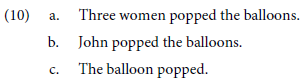
Assuming the relevant constants have been added to the theory, (10-a) has actor
 \begin{equation*} \textbf {act}_{\textbf {NP}}(\textbf {AmountOf}(\textsf {woman},\textsf {quantity},\textsf {nu}, 3)) : \textbf {Act} \end{equation*}
(10-b) has actor $\textbf {act}_{\textbf {Entity}}((\textsf {U},\textsf {human}),\textsf {john}) : \textbf {Act}$
, and (10-c) has dummy actor
$\textbf {act}_{\textbf {Entity}}((\textsf {U},\textsf {human}),\textsf {john}) : \textbf {Act}$
, and (10-c) has dummy actor $\textbf {act}_\star : \textbf {Act}$
.
$\textbf {act}_\star : \textbf {Act}$
.
As for undergoers, for any $b:\textbf {Bd}$
we introduce the type
$b:\textbf {Bd}$
we introduce the type $\textbf {Und}^b$
of “undergoers with boundedness
$\textbf {Und}^b$
of “undergoers with boundedness $b$
.” Terms of type
$b$
.” Terms of type $\textbf {Und}^{\textsf {B}}$
are bounded undergoers and terms of type
$\textbf {Und}^{\textsf {B}}$
are bounded undergoers and terms of type $\textbf {Und}^{\textsf {U}}$
are unbounded undergoers.
$\textbf {Und}^{\textsf {U}}$
are unbounded undergoers.
 \begin{equation*} \frac {\Gamma \vdash b:\textbf {Bd}}{\Gamma \vdash \textbf {Und}^b \textsf { type}} \end{equation*}
There are again three sources of undergoers – noun phrases, entities, and a dummy undergoer – but now we must specify the boundedness of each kind of undergoer. $b$
-noun phrases yield
$b$
-noun phrases yield $b$
-undergoers, entities yield bounded undergoers, and the dummy is an unbounded undergoer:
$b$
-undergoers, entities yield bounded undergoers, and the dummy is an unbounded undergoer:
 \begin{align*} \frac {\Gamma \vdash b:\textbf {Bd} \qquad \Gamma \vdash \textit {np}:\textbf {NP}^b}{\Gamma \vdash \textbf {und}_{\textbf {NP}}(\textit {np}) : \textbf {Und}^b \textsf { type}} \qquad \frac {\Gamma \vdash e : \textbf {Entity}}{\Gamma \vdash \textbf {und}_{\textbf {Entity}}(e) : \textbf {Und}^{\textsf {B}}} \qquad \frac { }{\Gamma \vdash \textbf {und}_\star : \textbf {Und}^{\textsf {U}}} \end{align*}
Example 4.1.2. Consider the following four sentences:
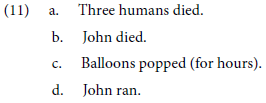
Assuming the relevant constants have been added to the theory, (11-a) has a bounded undergoer $\textbf {und}_{\textbf {NP}}(\textbf {AmountOf}(\textsf {human},\textsf {quantity},\textsf {nu}, 3)) : \textbf {Und}^{\textsf {B}}$
because
$\textbf {und}_{\textbf {NP}}(\textbf {AmountOf}(\textsf {human},\textsf {quantity},\textsf {nu}, 3)) : \textbf {Und}^{\textsf {B}}$
because $\textit{three humans}$
is a bounded noun phrase; (11-b) has a bounded undergoer
$\textit{three humans}$
is a bounded noun phrase; (11-b) has a bounded undergoer $\textbf {und}_{\textbf {Entity}}((\textsf {U},\textsf {human}),\textsf {john}) : \textbf {Und}^{\textsf {B}}$
because all entities yield bounded undergoers. Unbounded undergoers include unbounded noun phrases, such as
$\textbf {und}_{\textbf {Entity}}((\textsf {U},\textsf {human}),\textsf {john}) : \textbf {Und}^{\textsf {B}}$
because all entities yield bounded undergoers. Unbounded undergoers include unbounded noun phrases, such as $\textbf {und}_{\textbf {NP}}(\textsf {balloon}) : \textbf {Und}^{\textsf {U}}$
in (11-c), and the dummy undergoer
$\textbf {und}_{\textbf {NP}}(\textsf {balloon}) : \textbf {Und}^{\textsf {U}}$
in (11-c), and the dummy undergoer $\textbf {und}_\star :\textbf {Und}^{\textsf {U}}$
in (11-d).
$\textbf {und}_\star :\textbf {Und}^{\textsf {U}}$
in (11-d).
As with $\textbf {NP}$
in Section 3.1, we can define a type of undergoers with arbitrary boundedness:
$\textbf {NP}$
in Section 3.1, we can define a type of undergoers with arbitrary boundedness:
 \begin{equation*} \frac { }{\Gamma \vdash \textbf {Und} \triangleq \textstyle \sum _{b:\textbf {Bd}} \textbf {Und}^b \textsf { type}} \end{equation*}
Because actors and undergoers exist purely to index the type of events, some nuances of their definitions are best illustrated after we explain how our framework models events. We will explain the purpose of dummy actors and undergoers in Section 4.2; in Section 4.3, we will explain why entity undergoers are bounded and the dummy undergoer is unbounded.
4.2 Events and entailments
With the types of actors and undergoers in hand, we now declare the type of events $\textbf {Evt}^b(a,\textit {und})$
with actor
$\textbf {Evt}^b(a,\textit {und})$
with actor $a:\textbf {Act}$
and
$a:\textbf {Act}$
and $b$
-undergoer
$b$
-undergoer $\textit {und}:\textbf {Und}^b$
(where
$\textit {und}:\textbf {Und}^b$
(where $b:\textbf {Bd}$
).
$b:\textbf {Bd}$
).
 \begin{equation*} \frac {\Gamma \vdash b:\textbf {Bd} \quad \Gamma \vdash a:\textbf {Act} \quad \Gamma \vdash \textit {und}:\textbf {Und}^b}{\Gamma \vdash \textbf {Evt}^b(a,\textit {und}) \textsf { type}} \end{equation*}
Examples of events include the sentences in Examples4.1.1 and 4.1.2.
In the same way that we associate to every noun phrase $\textit {np}:\textbf {NP}^b$
a type
$\textit {np}:\textbf {NP}^b$
a type $\textbf {El}_{\textbf {NP}}^b(\textit {np})$
of its instances, we will associate to every event
$\textbf {El}_{\textbf {NP}}^b(\textit {np})$
of its instances, we will associate to every event $\textit {evt}: \textbf {Evt}^b(a,\textit {und})$
a type
$\textit {evt}: \textbf {Evt}^b(a,\textit {und})$
a type $\textbf {El}_{\textbf {Evt}}(e)$
of its occurrences.
$\textbf {El}_{\textbf {Evt}}(e)$
of its occurrences.
 \begin{equation*} \frac {\Gamma \vdash b:\textbf {Bd} \quad \Gamma \vdash a:\textbf {Act} \quad \Gamma \vdash \textit {und}:\textbf {Und}^b \quad \Gamma \vdash \textit {evt}:\textbf {Evt}^b(a,\textit {und})}{\Gamma \vdash \textbf {El}_{\textbf {Evt}}(\textit {evt}) \textsf { type}} \end{equation*}
The type $\textbf {El}_{\textbf {Evt}}(\textit {evt})$
serves two important roles in our framework. First, it gives us a way to represent whether an event
$\textbf {El}_{\textbf {Evt}}(\textit {evt})$
serves two important roles in our framework. First, it gives us a way to represent whether an event $\textit {evt}:\textbf {Evt}^b(a,\textit {und})$
has occurred, namely that
$\textit {evt}:\textbf {Evt}^b(a,\textit {und})$
has occurred, namely that $\textbf {El}_{\textbf {Evt}}(\textit {evt})$
is inhabited (has at least one element). Second, treating events as types rather than merely propositions will allow us in Section 4.6 to account for adverbial modification in the spirit of what is proposed in Ranta (Reference Ranta2015).
$\textbf {El}_{\textbf {Evt}}(\textit {evt})$
is inhabited (has at least one element). Second, treating events as types rather than merely propositions will allow us in Section 4.6 to account for adverbial modification in the spirit of what is proposed in Ranta (Reference Ranta2015).
Example 4.2.1. To model the event $\textit{John ate apples}$
, our framework must include at least the following constants previously considered in Section 3:
$\textit{John ate apples}$
, our framework must include at least the following constants previously considered in Section 3:
 \begin{align*} \frac { }{\Gamma \vdash \textsf {human}:\textbf {NP}^{\textsf {U}}}\qquad \frac { } {\Gamma \vdash \textsf {john} : \textbf {El}_{\textbf {NP}}^{\textsf {U}}(\textsf {human})}\qquad \frac { } {\Gamma \vdash \textsf {apple} : \textbf {NP}^{\textsf {U}}} \end{align*}
We can model the transitive verb $\textit{eat}$
as a dependent product of events, as follows:
$\textit{eat}$
as a dependent product of events, as follows:
 \begin{equation*} \frac { }{\Gamma \vdash \textsf {eat}: (a:\textbf {Act})\to (u:\textbf {Und})\to \textbf {Evt}^{\textbf {fst}(u)}(a,\textbf {snd}(u))} \end{equation*}
By the rules for actors and undergoers in Section 4.1, we have
 \begin{align*} \textsf {john}_{\textbf {Act}} \triangleq \textbf {act}_{\textbf {Entity}}&((\textsf {U},\textsf {human}),\textsf {john}) : \textbf {Act} \\ \textbf {und}_{\textbf {NP}}&(\textsf {apple}) : \textbf {Und}^{\textsf {U}} \end{align*}
and thus the term
 \begin{equation*} \textsf {jaa} \triangleq \textsf {eat}\ \textsf {john}_{\textbf {Act}}\ (\textsf {U} , \textbf {und}_{\textbf {NP}}(\textsf {apple})) : \textbf {Evt}^{\textsf {U}}(\textsf {john}_{\textbf {Act}}, \textbf {und}_{\textbf {NP}}(\textsf {apple})) \end{equation*}
represents the event $\textit{John ate apples}$
. The type
$\textit{John ate apples}$
. The type $\textbf {El}_{\textbf {Evt}}(\textsf {jaa})$
then represents the collection of instantiations or occurrences of the event of John eating apples, i.e., various times and places when a particular John ate apples.
$\textbf {El}_{\textbf {Evt}}(\textsf {jaa})$
then represents the collection of instantiations or occurrences of the event of John eating apples, i.e., various times and places when a particular John ate apples.
The fact that every event is a term of type $\textbf {Evt}^b(a,\textit {und})$
seems to suggest that every event has both an actor and an undergoer, but of course sentences in natural language often lack one of these, either because the event inherently has no actor or undergoer, or because the actor or undergoer is left implicit. In the former case, we model the absence of an actor or undergoer by the dummies
$\textbf {Evt}^b(a,\textit {und})$
seems to suggest that every event has both an actor and an undergoer, but of course sentences in natural language often lack one of these, either because the event inherently has no actor or undergoer, or because the actor or undergoer is left implicit. In the former case, we model the absence of an actor or undergoer by the dummies $\textbf {act}_\star : \textbf {Act}$
and
$\textbf {act}_\star : \textbf {Act}$
and $\textbf {und}_\star : \textbf {Und}^{\textsf {U}}$
.
$\textbf {und}_\star : \textbf {Und}^{\textsf {U}}$
.
Example 4.2.2. Consider the sentences $\textit{John died}$
(Example 4.1.1), which has no actor, and
$\textit{John died}$
(Example 4.1.1), which has no actor, and $\textit{John ran}$
(Example 4.1.2), which has no undergoer. Because the verb
$\textit{John ran}$
(Example 4.1.2), which has no undergoer. Because the verb $\textit{die}$
never has an actor, we model it in our framework by the following dependent product of events, which can have any undergoer but always the dummy actor
$\textit{die}$
never has an actor, we model it in our framework by the following dependent product of events, which can have any undergoer but always the dummy actor $\textbf {act}_\star$
:
$\textbf {act}_\star$
:
 \begin{equation*} \frac { }{\Gamma \vdash \textsf {die} : (u:\textbf {Und})\to \textbf {Evt}^{\textbf {fst}(u)}(\textbf {act}_\star ,\textbf {snd}(u))} \end{equation*}
Similarly, the verb $\textit{run}$
can have any actor but always the dummy undergoer
$\textit{run}$
can have any actor but always the dummy undergoer $\textbf {und}_\star$
:
$\textbf {und}_\star$
:
 \begin{equation*} \frac { }{\Gamma \vdash \textsf {run} : (a:\textbf {Act})\to \textbf {Evt}^{\textsf {U}}(a,\textbf {und}_\star )} \end{equation*}
We thus model the sentences $\textit{John died}$
and
$\textit{John died}$
and $\textit{John ran}$
as the following events:
$\textit{John ran}$
as the following events:
 \begin{align*} &\textsf {die}\ (\textsf {B},\textbf {und}_{\textbf {Entity}}((\textsf {U},\textsf {human}),\textsf {john})) : \textbf {Evt}^{\textsf {B}}(\textbf {act}_\star , \textbf {und}_{\textbf {Entity}}((\textsf {U},\textsf {human}),\textsf {john})) \\ &\textsf {run}\ (\textbf {act}_{\textbf {Entity}}((\textsf {U},\textsf {human}),\textsf {john})) : \textbf {Evt}^{\textsf {U}}(\textbf {act}_{\textbf {Entity}}((\textsf {U},\textsf {human}),\textsf {john}), \textbf {und}_\star ) \end{align*}
Remark 4.2.3. It is possible to avoid dummy actors and undergoers by adding primitive types of events that have no actor (resp., undergoer), and then defining the type of all events as the disjoint union of those with specified actor and undergoer, those with specified actor and no undergoer, and those with no actor and specified undergoer. Such a treatment would be substantially more complicated for apparently little gain. Moreover, as we will remark in Example 4.2.5, dummy actors and undergoers give us a convenient way to model verbs such as $\textit{pop}$
that can be used both transitively and intransitively.
$\textit{pop}$
that can be used both transitively and intransitively.
The other reason why a sentence might lack an actor or undergoer is that it might be left implicit by the sentence despite existing. Such is the case with the undergoer in the sentence John ate: it must be that John ate something, but that thing is left unspecified.
Actors may likewise be left unspecified. Verbs that participate in the causative–anticausative alternation illustrate this point. Depending on context, the sentence The balloon popped supports two alternative event construals: an internally-caused event with no actor, or an externally caused event whose actor is implicit. Because there is no overt actor, the syntax favors the no-actor construal; however, world knowledge often pragmatically enriches the interpretation toward an implicit external cause such as environmental conditions or a sentient individual. We do not attribute these two construals to a lexical semantic ambiguity for pop, but rather to contextual/pragmatic inference.
This perspective also explains why a speaker who has just watched John puncture the balloon may still felicitously say The balloon popped: the utterance leaves the actor unexpressed, while the context supplies a specific value for the implicit actor, similar to a specific-indefinite reading of Someone popped the balloon where the someone is known to be John.
We may account for unspecified actors or undergoers using $\Sigma$
-types. For example, we define the type of events
$\Sigma$
-types. For example, we define the type of events $\textbf {Evt}_{\textsf {A}}(a)$
with a specified actor
$\textbf {Evt}_{\textsf {A}}(a)$
with a specified actor $a:\textbf {Act}$
but unspecified undergoer as consisting of pairs of an undergoer
$a:\textbf {Act}$
but unspecified undergoer as consisting of pairs of an undergoer $u:\textbf {Und}$
and an event with actor
$u:\textbf {Und}$
and an event with actor $a$
and undergoer
$a$
and undergoer $u$
. We likewise define the type of events
$u$
. We likewise define the type of events $\textbf {Evt}_{\textsf {Und}}(\textit {und})$
with a specified undergoer
$\textbf {Evt}_{\textsf {Und}}(\textit {und})$
with a specified undergoer $\textit {und}:\textbf {Und}^b$
but unspecified actor, and even the type of events
$\textit {und}:\textbf {Und}^b$
but unspecified actor, and even the type of events $\textbf {Evt}$
whose actor and undergoer are both unspecified.
$\textbf {Evt}$
whose actor and undergoer are both unspecified.
 \begin{align*} \frac {\Gamma \vdash a:\textbf {Act}}{\Gamma \vdash \textbf {Evt}_{\textsf {A}}(a) \triangleq \textstyle \sum _{u:\textbf {Und}} \textbf {Evt}^{\textbf {fst}(u)}(a,\textbf {snd}(u)) \textsf { type}}\\ \frac {\Gamma \vdash b:\textbf {Bd} \qquad \Gamma \vdash \textit {und}:\textbf {Und}^b} {\Gamma \vdash \textbf {Evt}_{\textsf {Und}}^b(\textit {und}) \triangleq \textstyle \sum _{a:\textbf {Act}} \textbf {Evt}^{b}(a,\textit {und}) \textsf { type}}\\ \frac { }{\Gamma \vdash \textbf {Evt} \triangleq \textstyle \sum _{a:\textbf {Act}}\textstyle \sum _{u:\textbf {Und}} \textbf {Evt}^{\textbf {fst}(u)}(a,\textbf {snd}(u)) \textsf { type}} \end{align*}
Note that an unspecified actor/undergoer may be, but is not required to be, the dummy actor/undergoer, so these types are not those discussed in Remark 4.2.3. (See also Example4.2.5 and Remark 4.2.6 for more discussion of the distinction between unspecified and dummy actors/undergoers.)
The rules for $\Sigma$
-types let us define functions that suppress an actor and/or undergoer, for example,
$\Sigma$
-types let us define functions that suppress an actor and/or undergoer, for example,
 \begin{equation*} \lambda \textit {evt}. ((b,\textit {und}),\textit {evt}) : \textbf {Evt}^b(a,\textit {und}) \to \textbf {Evt}_{\textsf {A}}(a) \end{equation*}
Furthermore, by postcomposing the second projection
 \begin{equation*} \textbf {snd} : (\textit {evt}:\textbf {Evt}_{\textsf {A}}(a)) \to \textbf {Evt}^{\textbf {fst}(\textbf {fst}(\textit {evt}))}(a,\textbf {snd}(\textbf {fst}(\textit {evt}))) \end{equation*}
by the previously-asserted $\textbf {El}_{\textbf {Evt}}$
, we can associate to each
$\textbf {El}_{\textbf {Evt}}$
, we can associate to each $\textit {evt}_{\textsf {A}}:\textbf {Evt}_{\textsf {A}}(a)$
the type
$\textit {evt}_{\textsf {A}}:\textbf {Evt}_{\textsf {A}}(a)$
the type $\textbf {El}_{\textbf {Evt}_{\textsf {A}}}(\textit {evt}_{\textsf {A}})$
 \begin{equation*} \frac {\Gamma \vdash a:\textbf {Act} \qquad \Gamma \vdash \textit {evt}_{\textsf {A}} : \textbf {Evt}_{\textsf {A}}(a)} {\Gamma \vdash \textbf {El}_{\textbf {Evt}_{\textsf {A}}}(\textit {evt}_{\textsf {A}}) \triangleq \textbf {El}_{\textbf {Evt}}(\textbf {snd}(\textit {evt}_{\textsf {A}})) \textsf { type}} \end{equation*}
of its occurrences. We likewise define $\textbf {El}_{\textbf {Evt}_{\textsf {Und}}^b}(\textit {evt}_{\textsf {Und}}) \triangleq \textbf {El}_{\textbf {Evt}}(\textbf {snd}(\textit {evt}_{\textsf {Und}}))$
.
$\textbf {El}_{\textbf {Evt}_{\textsf {Und}}^b}(\textit {evt}_{\textsf {Und}}) \triangleq \textbf {El}_{\textbf {Evt}}(\textbf {snd}(\textit {evt}_{\textsf {Und}}))$
.
Example 4.2.4. Continuing on from Example 4.2.1, we can model the event $\textit{John ate}$
as a term of type
$\textit{John ate}$
as a term of type $\textbf {Evt}_{\textsf {A}}(\textsf {john}_{\textbf {Act}})$
. Such terms are a pair
$\textbf {Evt}_{\textsf {A}}(\textsf {john}_{\textbf {Act}})$
. Such terms are a pair $(u,\textit {evt})$
of an undergoer
$(u,\textit {evt})$
of an undergoer $u:\textbf {Und}$
and an event
$u:\textbf {Und}$
and an event $\textit {evt} : \textbf {Evt}^{\textbf {fst}(u)}(\textsf {john}_{\textbf {Act}},\textbf {snd}(u))$
involving the entity John and the undergoer
$\textit {evt} : \textbf {Evt}^{\textbf {fst}(u)}(\textsf {john}_{\textbf {Act}},\textbf {snd}(u))$
involving the entity John and the undergoer $u$
. (Here we are ignoring the fact that there are some restrictions on what type of undergoer the verb
$u$
. (Here we are ignoring the fact that there are some restrictions on what type of undergoer the verb $\textit{eat}$
can take, since modeling this kind of selectional restriction is not the focus of this paper.)
$\textit{eat}$
can take, since modeling this kind of selectional restriction is not the focus of this paper.)
Because the type of occurrences $\textbf {El}_{\textbf {Evt}_{\textsf {A}}}(u,\textit {evt})$
of an event-with-unspecified-undergoer
$\textbf {El}_{\textbf {Evt}_{\textsf {A}}}(u,\textit {evt})$
of an event-with-unspecified-undergoer $(u,\textit {evt}) : \textbf {Evt}_{\textsf {A}}(\textsf {john}_{\textbf {Act}})$
is defined as the type of occurrences
$(u,\textit {evt}) : \textbf {Evt}_{\textsf {A}}(\textsf {john}_{\textbf {Act}})$
is defined as the type of occurrences $\textbf {El}_{\textbf {Evt}}(\textit {evt})$
of its underlying event-with-specified-undergoer, the collection of occurrences of
$\textbf {El}_{\textbf {Evt}}(\textit {evt})$
of its underlying event-with-specified-undergoer, the collection of occurrences of $\textit{John ate}$
is precisely the collection of occurrences in which
$\textit{John ate}$
is precisely the collection of occurrences in which $\textit{John ate something}$
, that is, the collection of occurrences that this particular John ate some undergoer.
$\textit{John ate something}$
, that is, the collection of occurrences that this particular John ate some undergoer.
Rephrasing the observation at the end of Example4.2.4, if it is true that John ate apples, then it is also true that John ate, but the converse does not necessarily hold. Thus, we have automatically a one-way entailment between the sentences involving verbs like eat, which may describe events-with-unspecified-undergoers.
Example 4.2.5. We now consider an example of the causal-noncausal alternation, namely John popped balloons versus Balloons popped, and the associated entailment relations. As discussed earlier in this section, a sentence like Balloons popped may be interpreted as describing an event either with no actor or with an unspecified actor. In the former case, the sentence would be interpreted as Balloons popped by themselves, without anything or anyone causing that, while in the latter case the sentence would be interpreted as Balloons popped, and in fact, someone/something popped them (where someone/something is used in the specific sense – i.e., it is known to the utterer). Accordingly, the entailment John popped balloons $\Rightarrow$
Balloons popped should not hold in the former case (since John popping balloons contradicts balloons popping by themselves), and it should only hold in the latter case if the “someone” that the utterer has in mind is John.
$\Rightarrow$
Balloons popped should not hold in the former case (since John popping balloons contradicts balloons popping by themselves), and it should only hold in the latter case if the “someone” that the utterer has in mind is John.
We now show how our theory accounts for this. To model these events, we postulate:
 \begin{align*} \frac { }{\Gamma \vdash \textsf {human}:\textbf {NP}^{\textsf {U}}} \qquad \frac { }{\Gamma \vdash \textsf {john} : \textbf {El}_{\textbf {NP}}^{\textsf {U}}(\textsf {human})} \qquad \frac { }{\Gamma \vdash \textsf {balloon}:\textbf {NP}^{\textsf {U}}}\\ \frac { } {\Gamma \vdash \textsf {pop}: (a:\textbf {Act})\to (u:\textbf {Und})\to \textbf {Evt}^{\textbf {fst}(u)}(a,\textbf {snd}(u))} \end{align*}
Because of our treatment of dummy undergoers, $\textsf {pop}$
represents both the transitive and intransitive versions of the English verb
$\textsf {pop}$
represents both the transitive and intransitive versions of the English verb $\textit{pop}$
. Again writing
$\textit{pop}$
. Again writing
 \begin{equation*} \textsf {john}_{\textbf {Act}} \triangleq \textbf {act}_{\textbf {Entity}}((\textsf {U},\textsf {human}),\textsf {john}) : \textbf {Act} \end{equation*}
we can represent John popped balloons as
 \begin{equation*} \textsf {evt}_1 \triangleq \textsf {pop}\ \textsf {john}_{\textbf {Act}} \ (\textsf {U},\textbf {und}_{\textbf {NP}}(\textsf {balloon})) : \textbf {Evt}^{\textsf {U}}(\textsf {john}_{\textbf {Act}},\textbf {und}_{\textbf {NP}}(\textsf {balloon})) \end{equation*}
we can represent Balloons popped (in fact, John popped them) as
 \begin{equation*} \textsf {evt}_2 \triangleq (\textsf {john}_{\textbf {Act}} , \textsf {pop}\ \textsf {john}_{\textbf {Act}} \ (\textsf {U},\textbf {und}_{\textbf {NP}}(\textsf {balloon}))) : \textbf {Evt}^{\textsf {U}}_{\textsf {Und}}(\textbf {und}_{\textbf {NP}}(\textsf {balloon})) \end{equation*}
and finally, we can represent Balloons popped by themselves, without anything or anyone causing that as
 \begin{equation*} \textsf {evt}_3 \triangleq (\textbf {act}_\star , \textsf {pop}\ \textbf {act}_\star \ (\textsf {U},\textbf {und}_{\textbf {NP}}(\textsf {balloon}))) : \textbf {Evt}^{\textsf {U}}_{\textsf {Und}}(\textbf {und}_{\textbf {NP}}(\textsf {balloon})) \end{equation*}
Note that $\textsf {evt}_2$
and
$\textsf {evt}_2$
and $\textsf {evt}_3$
have the same type
$\textsf {evt}_3$
have the same type $\textbf {Evt}^{\textsf {U}}_{\textsf {Und}}(\textbf {und}_{\textbf {NP}}(\textsf {balloon}))$
because they are both events with unspecified actor and balloon undergoer, but the actor in the first case is
$\textbf {Evt}^{\textsf {U}}_{\textsf {Und}}(\textbf {und}_{\textbf {NP}}(\textsf {balloon}))$
because they are both events with unspecified actor and balloon undergoer, but the actor in the first case is $\textit{John}$
, and the actor in the second case is the dummy actor.
$\textit{John}$
, and the actor in the second case is the dummy actor.
In our framework, we can express the entailment John popped balloons $\Rightarrow$
Balloons popped (in fact, John popped them) by a function of type
$\Rightarrow$
Balloons popped (in fact, John popped them) by a function of type $\textbf {El}_{\textbf {Evt}}(\textsf {evt}_1)\to \textbf {El}_{\textbf {Evt}^{\textsf {U}}_{\textsf {Und}}}(\textsf {evt}_2)$
. (Such functions witness an entailment by the standard propositions as types reading; indeed, if there is at least one occurrence of
$\textbf {El}_{\textbf {Evt}}(\textsf {evt}_1)\to \textbf {El}_{\textbf {Evt}^{\textsf {U}}_{\textsf {Und}}}(\textsf {evt}_2)$
. (Such functions witness an entailment by the standard propositions as types reading; indeed, if there is at least one occurrence of $\textsf {evt}_1$
, then via such a function there is at least one occurrence of
$\textsf {evt}_1$
, then via such a function there is at least one occurrence of $\textsf {evt}_2$
.)
$\textsf {evt}_2$
.)
In this case, because $\textit{John}$
is the suppressed actor in
$\textit{John}$
is the suppressed actor in $\textsf {evt}_2$
, the two types in the implication are identical once we expand definitions, so the identity function suffices to establish the implication, as well as the reverse implication
$\textsf {evt}_2$
, the two types in the implication are identical once we expand definitions, so the identity function suffices to establish the implication, as well as the reverse implication $\textbf {El}_{\textbf {Evt}^{\textsf {U}}_{\textsf {Und}}}(\textsf {evt}_2)\to \textbf {El}_{\textbf {Evt}}(\textsf {evt}_1)$
.
$\textbf {El}_{\textbf {Evt}^{\textsf {U}}_{\textsf {Und}}}(\textsf {evt}_2)\to \textbf {El}_{\textbf {Evt}}(\textsf {evt}_1)$
.
However, the entailment John popped balloons $\Rightarrow$
Balloons popped by themselves, without anything or anyone causing that,
$\Rightarrow$
Balloons popped by themselves, without anything or anyone causing that, $\textbf {El}_{\textbf {Evt}}(\textsf {evt}_1)\to \textbf {El}_{\textbf {Evt}^{\textsf {U}}_{\textsf {Und}}}(\textsf {evt}_3)$
, does not hold in our framework, because there is no relationship between these two types. Nor do we have John popped balloons
$\textbf {El}_{\textbf {Evt}}(\textsf {evt}_1)\to \textbf {El}_{\textbf {Evt}^{\textsf {U}}_{\textsf {Und}}}(\textsf {evt}_3)$
, does not hold in our framework, because there is no relationship between these two types. Nor do we have John popped balloons $\Rightarrow$
Balloons popped (in fact, Mary popped them).
$\Rightarrow$
Balloons popped (in fact, Mary popped them).
Remark 4.2.6. How do we determine whether the sentence balloons popped means someone popped balloons or balloons popped by themselves – that is, whether the sentence has a dummy undergoer or a suppressed non-dummy undergoer? As in Remark 3.4.4, our answer is that the ambiguity of who or what popped the balloons must be resolved, since in general any sentence must be disambiguated prior to modeling.
4.3 Telic and atelic events
At this point, it is simple to define the types of telic and atelic events. Recall from Section 1.1 that telic events are events with inherent endpoints (or equivalently, a naturally associated resulting state) such as John ate the soup. As discussed in Section 1.2, we are restricting our attention to cases in which inherent endpoints come from undergoers (not adjuncts), so we say that an event is telic (resp., atelic) if and only if its undergoer is bounded (resp., unbounded).
Because our type of events already tracks the boundedness of its undergoer, we can simply define the type of telic events $\textbf {Tel}(a,\textit {und})$
with actor
$\textbf {Tel}(a,\textit {und})$
with actor $a:\textbf {Act}$
and bounded undergoer
$a:\textbf {Act}$
and bounded undergoer $\textit {und}:\textbf {Und}^{\textsf {B}}$
as the type of events
$\textit {und}:\textbf {Und}^{\textsf {B}}$
as the type of events $\textbf {Evt}^{\textsf {B}}(a,\textit {und})$
and analogously for the type of atelic events:
$\textbf {Evt}^{\textsf {B}}(a,\textit {und})$
and analogously for the type of atelic events:
 \begin{align*} \frac {\Gamma \vdash a:\textbf {Act} \qquad \Gamma \vdash \textit {und}:\textbf {Und}^{\textsf {B}}}{\Gamma \vdash \textbf {Tel}(a,\textit {und}) \triangleq \textbf {Evt}^{\textsf {B}}(a,\textit {und}) \textsf { type}} \\ \frac {\Gamma \vdash a:\textbf {Act} \qquad \Gamma \vdash \textit {und}:\textbf {Und}^{\textsf {U}}} {\Gamma \vdash \textbf {Atel}(a,\textit {und}) \triangleq \textbf {Evt}^{\textsf {U}}(a,\textit {und}) \textsf { type}} \end{align*}
Using $\Sigma$
-types, we can once again define types of telic/atelic events where one or none of actor or undergoer are specified:
$\Sigma$
-types, we can once again define types of telic/atelic events where one or none of actor or undergoer are specified: $\textbf {Tel}_{\textsf {A}}(a)$
,
$\textbf {Tel}_{\textsf {A}}(a)$
, $\textbf {Tel}_{\textsf {Und}}(\textit {und})$
,
$\textbf {Tel}_{\textsf {Und}}(\textit {und})$
, $\textbf {Tel}$
,
$\textbf {Tel}$
, $\textbf {Atel}_{\textsf {A}}(a)$
,
$\textbf {Atel}_{\textsf {A}}(a)$
, $\textbf {Atel}_{\textsf {Und}}(\textit {und})$
, and
$\textbf {Atel}_{\textsf {Und}}(\textit {und})$
, and $\textbf {Atel}$
.
$\textbf {Atel}$
.
Recall from Section 4.1 that there are three kinds of undergoers: noun phrases, whose boundedness is that of the underlying noun phrase; entities, which are always bounded; and the dummy undergoer, which is always unbounded. We now reconsider each of these undergoers in turn.
Example 4.3.1. Revisiting $\textit{John ate apples}$
from Example 4.2.1, recall that
$\textit{John ate apples}$
from Example 4.2.1, recall that $\textit{eat}$
has type:
$\textit{eat}$
has type:
 \begin{equation*} \frac { }{\Gamma \vdash \textsf {eat}: (a:\textbf {Act})\to (u:\textbf {Und})\to \textbf {Evt}^{\textbf {fst}(u)}(a,\textbf {snd}(u))} \end{equation*}
and that $\textit{apple}$
is an unbounded noun phrase and thus
$\textit{apple}$
is an unbounded noun phrase and thus $\textbf {und}_{\textbf {NP}}(\textsf {apple}) : \textbf {Und}^{\textsf {U}}$
. The event
$\textbf {und}_{\textbf {NP}}(\textsf {apple}) : \textbf {Und}^{\textsf {U}}$
. The event $\textit{John ate apples}$
is thus modeled as an atelic event
$\textit{John ate apples}$
is thus modeled as an atelic event
 \begin{equation*} \textsf {eat}\ \textsf {john}_{\textbf {Act}}\ (\textsf {U} , \textbf {und}_{\textbf {NP}}(\textsf {apple})) : \textbf {Atel}(\textsf {john}_{\textbf {Act}}, \textbf {und}_{\textbf {NP}}(\textsf {apple})) \end{equation*}
as predicted by the $\textit{in}$
-adverbial test described in Section 1.2, (7-b).
$\textit{in}$
-adverbial test described in Section 1.2, (7-b).
On the other hand, $\textit{three apples}$
is a bounded noun phrase
$\textit{three apples}$
is a bounded noun phrase
 \begin{equation*} \textsf {threeApples} \triangleq \textbf {AmountOf}(\textsf {apple},\textsf {quantity},\textsf {nu}, 3):\textbf {NP}^{\textsf {B}} \end{equation*}
by Section 3.4, so the event $\textit{John ate three apples}$
is modeled as a telic event
$\textit{John ate three apples}$
is modeled as a telic event
 \begin{equation*} \textsf {eat}\ \textsf {john}_{\textbf {Act}}\ (\textsf {B} , \textbf {und}_{\textbf {NP}}(\textsf {threeApples})) : \textbf {Tel}(\textsf {john}_{\textbf {Act}}, \textbf {und}_{\textbf {NP}}(\textsf {threeApples})) \end{equation*}
again as predicted by the $\textit{in}$
-adverbial test described in Section 1.2, (7-a).
$\textit{in}$
-adverbial test described in Section 1.2, (7-a).
What about entity undergoers? Recalling that an entity is an instance of a noun phrase, the events $\textit{John ate a particular apple}$
and
$\textit{John ate a particular apple}$
and $\textit{John ate a particular three apples}$
both have an entity as undergoer. Supposing that
$\textit{John ate a particular three apples}$
both have an entity as undergoer. Supposing that $a_1,a_2,a_3 : \textbf {El}_{\textbf {NP}}^{\textsf {U}}(\textsf {apple})$
are three particular apples, then
$a_1,a_2,a_3 : \textbf {El}_{\textbf {NP}}^{\textsf {U}}(\textsf {apple})$
are three particular apples, then
 \begin{equation*} \textbf {und}_{\textbf {Entity}}((\textsf {U}, \textsf {apple}), a_1) : \textbf {Und}^{\textsf {B}} \end{equation*}
is the undergoer representing the $\textit{particular apple}$ $a_1$
, and
$a_1$
, and
 \begin{equation*} \textbf {und}_{\textbf {Entity}}((\textsf {B}, \textsf {threeApples}), f(a_1) \oplus f(a_2) \oplus f(a_3)) : \textbf {Und}^{\textsf {B}} \end{equation*}
is the undergoer representing the $\textit{particular three apples}$ $a_1,a_2,a_3$
, where
$a_1,a_2,a_3$
, where $f$
in the above term is a function that converts an apple into a
$f$
in the above term is a function that converts an apple into a $\textit{one apple}$
, along the lines of Example 3.4.3.
$\textit{one apple}$
, along the lines of Example 3.4.3.
Crucially, although $\textit{apple}$
is unbounded and
$\textit{apple}$
is unbounded and $\textit{three apples}$
is bounded, both
$\textit{three apples}$
is bounded, both $\textit{a particular apple}$
and
$\textit{a particular apple}$
and $\textit{a particular three apples}$
are bounded because all entities are bounded undergoers. Thus, our framework correctly detects both
$\textit{a particular three apples}$
are bounded because all entities are bounded undergoers. Thus, our framework correctly detects both $\textit{John ate a particular apple}$
and
$\textit{John ate a particular apple}$
and $\textit{John ate a particular three apples}$
as telic events.
$\textit{John ate a particular three apples}$
as telic events.
Remark 4.3.2. Note that our treatment of bare plurals differs from the mereological framework (Champollion and Krifka Reference Champollion, Krifka, Aloni and Dekker2016) widely used to model plurality. In that framework, the bare plural $\textit{apples}$
denotes the set of all mereological sums of apples ( Champollion Reference Champollion2017, 44), and
$\textit{apples}$
denotes the set of all mereological sums of apples ( Champollion Reference Champollion2017, 44), and $\textit{John ate apples}$
is true just in case there exists some sum of apples that John ate. Such treatments are inadequate in our setting: representing this existential commitment amounts to selecting a particular sum (an entity) as an undergoer, and since entity undergoers are classified as bounded in our event ontology, this incorrectly forces
$\textit{John ate apples}$
is true just in case there exists some sum of apples that John ate. Such treatments are inadequate in our setting: representing this existential commitment amounts to selecting a particular sum (an entity) as an undergoer, and since entity undergoers are classified as bounded in our event ontology, this incorrectly forces $\textit{John ate apples}$
to be telic.
$\textit{John ate apples}$
to be telic.
Finally, the dummy undergoer $\textbf {und}_\star : \textbf {Und}^{\textsf {U}}$
is unbounded because, at least in English, sentences with unspecified undergoers seem to always be atelic. For example, the unspecified undergoer in John sang seems to refer to songs rather than a song; John sang is atelic (by the in-adverbial diagnostic), and if the unspecified undergoer was a song, then it should have been telic. Moreover, verbs that never take undergoers, such as John ran (11-d), seem to always be atelic – at least if one does not add adjuncts, which are beyond the scope of our analysis.
$\textbf {und}_\star : \textbf {Und}^{\textsf {U}}$
is unbounded because, at least in English, sentences with unspecified undergoers seem to always be atelic. For example, the unspecified undergoer in John sang seems to refer to songs rather than a song; John sang is atelic (by the in-adverbial diagnostic), and if the unspecified undergoer was a song, then it should have been telic. Moreover, verbs that never take undergoers, such as John ran (11-d), seem to always be atelic – at least if one does not add adjuncts, which are beyond the scope of our analysis.
4.4 States
So far, our discussion on the verbal domain has focused on events, such as The balloon popped, which express dynamic eventualities. We now turn our attention to static eventualities, such as The balloon is popped, which we will call states. We introduce states for two reasons. First, one of our objectives is to build a reasonable ontology of eventualities, and any such ontology should include states. Second, in Section 4.5, we will characterize culminating events as telic events that attain their resulting state.
Being the static analog of events, the type of states mirrors the type of events defined in Section 4.2: for any actor $a:\textbf {Act}$
and
$a:\textbf {Act}$
and $b$
-undergoer
$b$
-undergoer $\textit {und}:\textbf {Und}^b$
(where
$\textit {und}:\textbf {Und}^b$
(where $b:\textbf {Bd}$
), we have a type
$b:\textbf {Bd}$
), we have a type $\textbf {State}^b(a,\textit {und})$
of states involving that actor and undergoer.
$\textbf {State}^b(a,\textit {und})$
of states involving that actor and undergoer.
 \begin{equation*} \frac {\Gamma \vdash b:\textbf {Bd} \qquad \Gamma \vdash a:\textbf {Act} \qquad \Gamma \vdash \textit {und}:\textbf {Und}^b}{\Gamma \vdash \textbf {State}^b(a,\textit {und}) \textsf { type}} \end{equation*}
For any state $s:\textbf {State}^b(a,\textit {und})$
, we can consider the proposition
$s:\textbf {State}^b(a,\textit {und})$
, we can consider the proposition $\textbf {El}_{\textbf {State}}(s) : \textbf {Prop}$
that the state
$\textbf {El}_{\textbf {State}}(s) : \textbf {Prop}$
that the state $s$
holds. Note that unlike events
$s$
holds. Note that unlike events $\textit {evt} : \textbf {Evt}^b(a,\textit {und})$
, which give rise to a type of occurrences
$\textit {evt} : \textbf {Evt}^b(a,\textit {und})$
, which give rise to a type of occurrences $\textbf {El}_{\textbf {Evt}}(\textit {evt})$
, a state only gives rise to a proposition; this is because we do not consider a state to be able to hold in more than one way.
$\textbf {El}_{\textbf {Evt}}(\textit {evt})$
, a state only gives rise to a proposition; this is because we do not consider a state to be able to hold in more than one way.
 \begin{equation*} \frac {\Gamma \vdash b:\textbf {Bd} \qquad \Gamma \vdash a:\textbf {Act} \qquad \Gamma \vdash \textit {und}:\textbf {Und}^b \qquad \Gamma \vdash s:\textbf {State}^b(a,\textit {und})}{\Gamma \vdash \textbf {El}_{\textbf {State}}(s) : \textbf {Prop}} \end{equation*}
Using $\Sigma$
-types, we can also define types of states in which one or none of actor or undergoer are specified –
$\Sigma$
-types, we can also define types of states in which one or none of actor or undergoer are specified – $\textbf {State}_{\textsf {A}}(a)$
,
$\textbf {State}_{\textsf {A}}(a)$
, $\textbf {State}_{\textsf {Und}}^b(\textit {und})$
, and
$\textbf {State}_{\textsf {Und}}^b(\textit {und})$
, and $\textbf {State}$
– each of which has an underlying state of type
$\textbf {State}$
– each of which has an underlying state of type $\textbf {State}^b(a,\textit {und})$
and is therefore also associated to a proposition. As with events, suppressed arguments may or may not be dummies.
$\textbf {State}^b(a,\textit {und})$
and is therefore also associated to a proposition. As with events, suppressed arguments may or may not be dummies.
For example, the sentence John loves Mary expresses a state whose undergoer is Mary and whose actor is John; the sentence Mary is loved expresses a state whose undergoer is Mary and whose actor is suppressed (but possibly John). As with events (John ran), some states may be required to have a dummy argument: the sentence The balloon is popped is a state whose undergoer is the balloon and whose actor must be the dummy.
4.5 Culminating events
We finally turn our attention to culminativity. Recalling that telic events are events that have a naturally associated resulting state, we define culminating events as telic events that obtain their resulting state. Note that it is not sensible to even ask whether an atelic event is culminating because there is no resulting state to be obtained. Our definition is in line with previous work that mentions culminativity, such as Moens and Steedman (Reference Moens and Steedman1988). In other works on lexical semantics that equate culminating events with telic events, such as Dowty (Reference Dowty1979), the defining property of telic (for us, culminating) events is that they entail the resulting state.
We note that atelic events can involve a change in state; they simply do not have a resulting state. For instance, the event John popped balloons involves a change of state, since some balloons are being popped, but it has no resulting state and is thus atelic. To see that it has no resulting state, observe that it would be strange to continue …and he finished popping them all; this is because finish refers to a telos, and John popped balloons doesn’t involve one. In contrast, the telic event John popped three balloons has a clear resulting state, namely that the three balloons are popped, and in fact the event culminates because it reaches that state.
We start by associating to every telic event a resulting state.
 \begin{equation*} \frac {\Gamma \vdash a:\textbf {Act} \qquad \Gamma \vdash \textit {und}:\textbf {Und}^{\textsf {B}} \qquad \Gamma \vdash \textit {evt}:\textbf {Tel}(a,\textit {und})}{\Gamma \vdash \textbf {Result}(\textit {evt}):\textbf {State}^{\textsf {B}}(\textbf {act}_\star ,\textit {und})} \end{equation*}
Note that the resulting state of an event with actor $a$
and undergoer
$a$
and undergoer $\textit {und}$
involves the same undergoer but always the dummy actor
$\textit {und}$
involves the same undergoer but always the dummy actor $\textbf {act}_\star$
. Indeed, sentences describing the resulting state of some event seem to always have the property that they do not have a counterpart in which an actor is specified. On the other hand, not every
$\textbf {act}_\star$
. Indeed, sentences describing the resulting state of some event seem to always have the property that they do not have a counterpart in which an actor is specified. On the other hand, not every $s:\textbf {State}^{\textsf {B}}(\textbf {act}_\star ,\textit {und})$
is the resulting state of a telic event; counterexamples include The apple is tasty and John is tired.
$s:\textbf {State}^{\textsf {B}}(\textbf {act}_\star ,\textit {und})$
is the resulting state of a telic event; counterexamples include The apple is tasty and John is tired.
With the notion of resulting state in hand, we can now formally define the culminativity of a telic event as the proposition that if the event occurs, then its resulting state holds.
 \begin{align*} \frac {\Gamma \vdash a : \textbf {Act} \qquad \Gamma \vdash \textit {und} : \textbf {Und}^{\textsf {B}} \qquad \Gamma \vdash \textit {evt} : \textbf {Tel}(a,\textit {und})}{\Gamma \vdash \textbf {isCul}(\textit {evt}) : \textbf {Prop}} \\ \frac {\Gamma \vdash a : \textbf {Act} \qquad \Gamma \vdash \textit {und} : \textbf {Und}^{\textsf {B}} \qquad \Gamma \vdash \textit {evt} : \textbf {Tel}(a,\textit {und})}{\Gamma \vdash \textbf {Prf}(\textbf {isCul}(\textit {evt}))\triangleq \textbf {El}_{\textbf {Evt}}(\textit {evt}) \to \textbf {Prf}(\textbf {El}_{\textbf {State}}(\textbf {Result}(\textit {evt}))) \textsf { type}} \end{align*}
Depending on which formal definition of $\textbf {Prop}$
we use, this definition of
$\textbf {Prop}$
we use, this definition of $\textbf {isCul}$
may be self-evidently a proposition (because it is of the form
$\textbf {isCul}$
may be self-evidently a proposition (because it is of the form $X\to \textbf {Prf}(Y)$
where
$X\to \textbf {Prf}(Y)$
where $Y$
is a proposition) or we may need to prove it. In our Agda formalization, we define
$Y$
is a proposition) or we may need to prove it. In our Agda formalization, we define $\textbf {Prop}$
as the type of homotopy propositions (Univalent Foundations Program 2013) and use function extensionality to prove that
$\textbf {Prop}$
as the type of homotopy propositions (Univalent Foundations Program 2013) and use function extensionality to prove that $\textbf {isCul}$
is an homotopy proposition.
$\textbf {isCul}$
is an homotopy proposition.
Finally, for any actor $a : \textbf {Act}$
and bounded undergoer
$a : \textbf {Act}$
and bounded undergoer $\textit {und} : \textbf {Und}^{\textsf {B}}$
, we define culminating events
$\textit {und} : \textbf {Und}^{\textsf {B}}$
, we define culminating events $\textbf {Cul}(a,\textit {und})$
as pairs of a telic event with a proof that it culminates:
$\textbf {Cul}(a,\textit {und})$
as pairs of a telic event with a proof that it culminates:
 \begin{equation*} \frac {\Gamma \vdash a : \textbf {Act} \qquad \Gamma \vdash \textit {und} : \textbf {Und}^{\textsf {B}}}{\Gamma \vdash \textbf {Cul}(a,\textit {und}) \triangleq \textstyle \sum _{\textit {evt}:\textbf {Tel}(a,\textit {und})} \textbf {Prf}(\textbf {isCul}(\textit {evt})) \textsf { type}} \end{equation*}
We can again define the types of culminating events in which one or none of actor or undergoer are specified – $\textbf {Cul}_{\textsf {A}}(a)$
,
$\textbf {Cul}_{\textsf {A}}(a)$
, $\textbf {Cul}_{\textsf {Und}}(\textit {und})$
, and
$\textbf {Cul}_{\textsf {Und}}(\textit {und})$
, and $\textbf {Cul}$
– and associate to each of these types the type of its occurrences (namely, the type of occurrences of the underlying telic event). Note that the undergoer of a culminating event must be bounded because telic events are events with a bounded undergoer. In particular, the undergoer cannot be the dummy undergoer.
$\textbf {Cul}$
– and associate to each of these types the type of its occurrences (namely, the type of occurrences of the underlying telic event). Note that the undergoer of a culminating event must be bounded because telic events are events with a bounded undergoer. In particular, the undergoer cannot be the dummy undergoer.
Example 4.5.1. Consider the sentence John popped three balloons, a telic and culminating event whose resulting state is three balloons are popped. The general setup is the same as in Example 4.2.5. We postulate:
 \begin{align*} \frac { }{\Gamma \vdash \textsf {human}:\textbf {NP}^{\textsf {U}}} \qquad \frac { }{\Gamma \vdash \textsf {john} : \textbf {El}_{\textbf {NP}}^{\textsf {U}}(\textsf {human})} \qquad \frac { }{\Gamma \vdash \textsf {balloon}:\textbf {NP}^{\textsf {U}}} \\ \frac { }{\Gamma \vdash \textsf {pop}: (a:\textbf {Act})\to (u:\textbf {Und})\to \textbf {Evt}^{\textbf {fst}(u)}(a,\textbf {snd}(u))} \end{align*}
From these we can define the actor John, the undergoer three balloons (which is automatically determined by the framework to be bounded), and the (automatically determined to be) telic event $\textsf {evt}_1$
representing John popped three balloons.
$\textsf {evt}_1$
representing John popped three balloons.
 \begin{align*} \textsf {john}_{\textbf {Act}} &\triangleq \textbf {act}_{\textbf {Entity}}((\textsf {U},\textsf {human}),\textsf {john}) : \textbf {Act} \\ \textsf {threeBalloons}_{\textbf {Und}} &\triangleq \textbf {und}_{\textbf {NP}}(\textbf {AmountOf}(\textsf {balloon},\textsf {quantity},\textsf {nu},3)):\textbf {Und}^{\textsf {B}} \\ \textsf {evt}_1 &\triangleq \textsf {pop}\ \textsf {john}_{\textbf {Act}}\ (\textsf {B} , \textsf {threeBalloons}_{\textbf {Und}}) : \textbf {Tel}(\textsf {john}_{\textbf {Act}},\textsf {threeBalloons}_{\textbf {Und}}) \end{align*}
To model the culminativity of pop, we add three further postulates: (1) an undergoer-indexed family of states, $\textsf {popped}$
, representing the static predicate be popped; (2) an equation stating that the
$\textsf {popped}$
, representing the static predicate be popped; (2) an equation stating that the $\textbf {Result}$
of the event of
$\textbf {Result}$
of the event of $\textsf {pop}$
ping a bounded undergoer is the state of being
$\textsf {pop}$
ping a bounded undergoer is the state of being $\textsf {popped}$
; and (3) the axiom
$\textsf {popped}$
; and (3) the axiom $\textsf {popC}$
that any occurrence of the event of
$\textsf {popC}$
that any occurrence of the event of $\textsf {pop}$
ping a bounded undergoer causes the state of being
$\textsf {pop}$
ping a bounded undergoer causes the state of being $\textsf {popped}$
to hold.
$\textsf {popped}$
to hold.
 \begin{align*} &\qquad\qquad \qquad \qquad \frac { }{\Gamma \vdash \textsf {popped} : (\textit {und}:\textbf {Und}^{\textsf {B}})\to \textbf {State}^{\textsf {B}}(\textbf {act}_\star ,\textit {und})}\\ &\qquad\quad \qquad \frac {\Gamma \vdash a : \textbf {Act} \Gamma \vdash \textit {und} : \textbf {Und}^{\textsf {B}}}{\Gamma \vdash \textbf {Result}(\textsf {pop}\ a\ (\textsf {B},\textit {und})) \triangleq \textsf {popped}\ \textit {und} : \textbf {State}^{\textsf {B}}(\textbf {act}_\star ,\textit {und})}\\ &\frac { }{\Gamma \vdash \textsf {popC} : (a:\textbf {Act})\to (\textit {und}:\textbf {Und}^{\textsf {B}})\to \textbf {El}_{\textbf {Evt}}(\textsf {pop}\ a\ (\textsf {B},\textit {und}))\to \textbf {Prf}(\textbf {El}_{\textbf {State}}(\textsf {popped}\ \textit {und}))} \end{align*}
Note that all three of these postulates refer only to bounded undergoers.
From these postulates, we can show that $\textsf {pop}$
is culminating when its undergoer is bounded. We can express this by giving a more refined type to
$\textsf {pop}$
is culminating when its undergoer is bounded. We can express this by giving a more refined type to $\textsf {pop}$
restricted to bounded undergoers; the following term type-checks straightforwardly by expanding definitions.
$\textsf {pop}$
restricted to bounded undergoers; the following term type-checks straightforwardly by expanding definitions.
 \begin{equation*} \textsf {pop}^{\textsf {B}} \triangleq \lambda a. \lambda \textit {und}. (\textsf {pop}\ a\ \textit {und} , \textsf {popC}\ a\ \textit {und}) : (a : \textbf {Act})\to (\textit {und} : \textbf {Und}^{\textsf {B}})\to \textbf {Cul}(a,\textit {und}) \end{equation*}
Using $\textsf {pop}^{\textsf {B}}$
, we can easily show that the events
$\textsf {pop}^{\textsf {B}}$
, we can easily show that the events $\textit{John popped three balloons}$
and
$\textit{John popped three balloons}$
and $\textit{three balloons popped by themselves}$
are both culminating:
$\textit{three balloons popped by themselves}$
are both culminating:
 \begin{align*} \textsf {evt}_1' &\triangleq \textsf {pop}^{\textsf {B}}\ \textsf {john}_{\textbf {Act}}\ \textsf {threeBalloons}_{\textbf {Und}} : \textbf {Cul}(\textsf {john}_{\textbf {Act}},\textsf {threeBalloons}_{\textbf {Und}}) \\ \textsf {evt}_2 &\triangleq \textsf {pop}^{\textsf {B}}\ \textbf {act}_\star \ \textsf {threeBalloons}_{\textbf {Und}} : \textbf {Cul}(\textbf {act}_\star ,\textsf {threeBalloons}_{\textbf {Und}}) \end{align*}
Moreover, we can show that if the event $\textit{John popped three balloons}$
occurs, this entails the state that
$\textit{John popped three balloons}$
occurs, this entails the state that $\textit{three balloons are popped}$
:
$\textit{three balloons are popped}$
:
 \begin{equation*} \textbf {snd}(\textsf {evt}_1') : \textbf {El}_{\textbf {Evt}}(\textsf {evt}_1)\to \textbf {Prf}(\textbf {El}_{\textbf {State}}(\textsf {popped}\ \textsf {threeBalloons}_{\textbf {Und}})) \end{equation*}
Example 4.5.2. English verbs such as $\textit{pop}$
and
$\textit{pop}$
and $\textit{eat}$
are the most common kind of verbs in English: they yield telic and culminating events when their undergoer is bounded and atelic events otherwise. In Example 4.5.1, we saw that we can capture the culminativity of bounded
$\textit{eat}$
are the most common kind of verbs in English: they yield telic and culminating events when their undergoer is bounded and atelic events otherwise. In Example 4.5.1, we saw that we can capture the culminativity of bounded $\textit{pop}$
in the type of
$\textit{pop}$
in the type of $\textsf {pop}^{\textsf {B}}$
. In this example, we show that dependent type theory can capture both the culminativity of bounded
$\textsf {pop}^{\textsf {B}}$
. In this example, we show that dependent type theory can capture both the culminativity of bounded $\textit{pop}$
and the atelicity of unbounded
$\textit{pop}$
and the atelicity of unbounded $\textit{pop}$
in a single type. This will require some more advanced features of dependent type theory, namely dependent pattern matching (Coquand Reference Coquand, Nordström, Petersson and Plotkin1992) and type universes
$\textit{pop}$
in a single type. This will require some more advanced features of dependent type theory, namely dependent pattern matching (Coquand Reference Coquand, Nordström, Petersson and Plotkin1992) and type universes $\textbf {Type}$
.
$\textbf {Type}$
.
Using dependent pattern matching, we can define a family of types $\textbf {CulOrAtel}$
by cases on the boundedness
$\textbf {CulOrAtel}$
by cases on the boundedness $b$
of an undergoer
$b$
of an undergoer $u=(b,\textit {und}):\textbf {Und}$
. Specifically, we define
$u=(b,\textit {und}):\textbf {Und}$
. Specifically, we define $\textbf {CulOrAtel}\ a\ (b,\textit {und})$
to be
$\textbf {CulOrAtel}\ a\ (b,\textit {und})$
to be $\textbf {Cul}(a,\textit {und})$
when
$\textbf {Cul}(a,\textit {und})$
when $b=\textsf {B}$
and
$b=\textsf {B}$
and $\textbf {Atel}(a,\textit {und})$
when
$\textbf {Atel}(a,\textit {und})$
when $b=\textsf {U}$
:
$b=\textsf {U}$
:
 \begin{align*} &\textbf {CulOrAtel}\ : (a : \textbf {Act}) \to (u : \textbf {Und}) \to \textbf {Type} \\ &\textbf {CulOrAtel}\ a\ (\textsf {B} , \textit {und}) \triangleq \textbf {Cul}(a,\textit {und}) \\ &\textbf {CulOrAtel}\ a\ (\textsf {U} , \textit {und}) \triangleq \textbf {Atel}(a,\textit {und}) \end{align*}
Then, we define by dependent pattern matching a function $\textsf {pop}'$
which for any actor
$\textsf {pop}'$
which for any actor $a:\textbf {Act}$
and undergoer
$a:\textbf {Act}$
and undergoer $u:\textbf {Und}$
produces a term of type
$u:\textbf {Und}$
produces a term of type $\textbf {CulOrAtel}\ a\ u$
:
$\textbf {CulOrAtel}\ a\ u$
:
 \begin{align*} &\textsf {pop}'\ : (a : \textbf {Act}) \to (u : \textbf {Und}) \to \textbf {CulOrAtel}\ a\ u \\ &\quad\qquad\,\, \textsf {pop}'\ a\ (\textsf {B} , \textit {und}) \triangleq \textsf {pop}^{\textsf {B}}\ a\ \textit {und} \\ &\qquad\quad\textsf {pop}'\ a\ (\textsf {U} , \textit {und}) \triangleq \textsf {pop}\ a\ (\textsf {U},\textit {und}) \end{align*}
To see that each clause of $\textsf {pop}'$
type-checks, we must unfold the definition of
$\textsf {pop}'$
type-checks, we must unfold the definition of $\textbf {CulOrAtel}\ a\ u$
according to the boundedness of the undergoer.
$\textbf {CulOrAtel}\ a\ u$
according to the boundedness of the undergoer.
The type of $\textsf {pop}'$
fully captures the behavior of
$\textsf {pop}'$
fully captures the behavior of $\textit{pop}$
with respect to its telicity and culminativity. Thus, rather than postulating
$\textit{pop}$
with respect to its telicity and culminativity. Thus, rather than postulating $\textsf {pop}$
,
$\textsf {pop}$
, $\textsf {popped}$
, and
$\textsf {popped}$
, and $\textsf {popC}$
, we could have equivalently and more directly modeled
$\textsf {popC}$
, we could have equivalently and more directly modeled $\textit{pop}$
(
$\textit{pop}$
( $\textit{eat}$
, etc.) by a function
$\textit{eat}$
, etc.) by a function $(a : \textbf {Act}) \to (u : \textbf {Und}) \to \textbf {CulOrAtel}\ a\ u$
.
$(a : \textbf {Act}) \to (u : \textbf {Und}) \to \textbf {CulOrAtel}\ a\ u$
.
Remark 4.5.3. There are also examples in English of telic but non-culminating events. The resulting state of the telic event $\textit{John cleaned the table}$
can be described by
$\textit{John cleaned the table}$
can be described by $\textit{The table is clean}$
, but it is not necessarily the case that
$\textit{The table is clean}$
, but it is not necessarily the case that $\textit{John cleaned the table}$ $\Rightarrow$ $\textit{The table is clean}$
. Such verbs are assigned the following type in our framework:
$\textit{The table is clean}$
. Such verbs are assigned the following type in our framework:
 \begin{equation*} (a : \textbf {Act})\to (\textit {u} : \textbf {Und})\to \textbf {Evt}^{\textbf {fst}(u)}(a,\textbf {snd}(\textit {u})) \end{equation*}
As we discussed in Section 1.1, there are also ambiguous verbs. The word $\textit{wipe}$
has two readings, one involving merely moving a cloth back and forth on some surface, and the other involving an actual attempt to make the surface clean. The latter reading, like
$\textit{wipe}$
has two readings, one involving merely moving a cloth back and forth on some surface, and the other involving an actual attempt to make the surface clean. The latter reading, like $\textit{clean}$
, is telic but non-culminating when its undergoer is bounded and atelic when its undergoer is unbounded. The former reading does not involve an approach toward any goal and so exhibits no alternations in the telicity of the resulting event; it is therefore out of scope of our investigation, as mentioned in Section 1.2.
$\textit{clean}$
, is telic but non-culminating when its undergoer is bounded and atelic when its undergoer is unbounded. The former reading does not involve an approach toward any goal and so exhibits no alternations in the telicity of the resulting event; it is therefore out of scope of our investigation, as mentioned in Section 1.2.
Example 4.5.4. Our framework can be also used to model kinds of verbs that do not exist in English. For example, as discussed in Kovalev (Reference Kovalev2024), the so-called prototypical perfective verb forms in Russian can only take bounded undergoers as arguments, giving rise to telic events which are moreover necessarily culminating. (If their undergoer is a bare noun, then it receives a bounded reading.) In our framework, we can assign such verb forms the type:
 \begin{equation*} (a : \textbf {Act})\to (\textit {und} : \textbf {Und}^{\textsf {B}})\to \textbf {Cul}(a,\textit {und}) \end{equation*}
4.6 Adverbial modification
Treating events as the types of their occurrences makes it easy to account for adverbial modification in a parallel fashion to adjectival modification (Section 3.5). We will be concerned only with manner adverbs; see Chatzikyriakidis (Reference Chatzikyriakidis, Asher and Soloviev2014); Chatzikyriakidis and Luo (Reference Chatzikyriakidis and Luo2017a,Reference Chatzikyriakidis and Luo2020) for a discussion of dependently-typed treatments of other kinds of adverbs, as well as other treatments of manner adverbs. We note that our treatment below is in the spirit of Ranta (Reference Ranta2015, 359), although that work is not concerned with dependent event types; rather unlike our treatment, Ranta (Reference Ranta2015) models events as proof objects of propositions.
Just as adjectives give rise to predicates over entities – instances of some noun phrase – we model adverbs as predicates over occurrences, or instances of some event. Occurrences are the equivalent in the verbal domain of the nominal domain’s entities (Section 3.2). Thus far, we have only had occasion to discuss occurrences $\textit {occ}:\textbf {El}_{\textbf {Evt}}(\textit {evt})$
of a fixed event
$\textit {occ}:\textbf {El}_{\textbf {Evt}}(\textit {evt})$
of a fixed event $\textit {evt}:\textbf {Evt}^b(a,\textit {und})$
, but we can define the type of all occurrences
$\textit {evt}:\textbf {Evt}^b(a,\textit {und})$
, but we can define the type of all occurrences $o:\textbf {Occ}$
as pairs of events
$o:\textbf {Occ}$
as pairs of events $e:\textbf {Evt}$
with an instance of that event. (In the following rule, recall that
$e:\textbf {Evt}$
with an instance of that event. (In the following rule, recall that $e:\textbf {Evt}$
is of the form
$e:\textbf {Evt}$
is of the form $(a,(u,\textit {evt}))$
where
$(a,(u,\textit {evt}))$
where $\textit {evt}:\textbf {Evt}^{\textbf {fst}(u)}(a,\textbf {snd}(u))$
.)
$\textit {evt}:\textbf {Evt}^{\textbf {fst}(u)}(a,\textbf {snd}(u))$
.)
 \begin{align*} \frac { }{\Gamma \vdash \textbf {Occ} \triangleq \textstyle \sum _{e:\textbf {Evt}} \textbf {El}_{\textbf {Evt}}(\textbf {snd}(\textbf {snd}(e))) \textsf { type}} \\[-4pt] \end{align*}
To mirror our construction of adjectival modification (Section 3.5), we require that for any predicate $P$
over occurrences of some event
$P$
over occurrences of some event $\textit {evt}$
, the “subset of occurrences of
$\textit {evt}$
, the “subset of occurrences of $\textit {evt}$
satisfying
$\textit {evt}$
satisfying $P$
,”
$P$
,” $\textstyle \sum ^{\textbf {Evt}}_{\textit {occ}:\textit {evt}} P$
, is again an event with the same actor and undergoer. That is, analogously to the rules for
$\textstyle \sum ^{\textbf {Evt}}_{\textit {occ}:\textit {evt}} P$
, is again an event with the same actor and undergoer. That is, analogously to the rules for $\textbf {NP}^b$
in Section 3.1, we require that the types
$\textbf {NP}^b$
in Section 3.1, we require that the types $\textbf {Evt}^b(a,\textit {und})$
are closed under
$\textbf {Evt}^b(a,\textit {und})$
are closed under $\Sigma$
-types of predicates over
$\Sigma$
-types of predicates over $\textbf {El}_{\textbf {Evt}}(\textit {evt})$
:
$\textbf {El}_{\textbf {Evt}}(\textit {evt})$
:
 \begin{align*} \frac {\substack {\displaystyle \Gamma \vdash b:\textbf {Bd} \quad \Gamma \vdash a:\textbf {Act} \quad \Gamma \vdash \textit {und}:\textbf {Und}^b \\ \displaystyle \Gamma \vdash \textit {evt}:\textbf {Evt}^b(a,\textit {und}) \quad \Gamma ,\textit {occ}:\textbf {El}_{\textbf {Evt}}(\textit {evt})\vdash P : \textbf {Prop}}}{\Gamma \vdash \textstyle \sum ^{\textbf {Evt}}_{\textit {occ}:\textit {evt}} P : \textbf {Evt}^b(a,\textit {und})}\\[4pt] \frac {\substack {\displaystyle \Gamma \vdash b:\textbf {Bd} \quad \Gamma \vdash a:\textbf {Act} \quad \Gamma \vdash \textit {und}:\textbf {Und}^b \\ \displaystyle \Gamma \vdash \textit {evt}:\textbf {Evt}^b(a,\textit {und}) \quad \Gamma ,\textit {occ}:\textbf {El}_{\textbf {Evt}}(\textit {evt})\vdash P : \textbf {Prop}}}{\Gamma \vdash \textbf {El}_{\textbf {Evt}}\left (\textstyle \sum ^{\textbf {Evt}}_{\textit {occ}:\textit {evt}} P\right ) = \textstyle \sum _{\textit {occ}:\textbf {El}_{\textbf {Evt}}(\textit {evt})} \textbf {Prf}(P) \textsf { type}} \end{align*}
We can then model adverbs using predicates over $\textbf {Occ}$
. For example, using the predicate
$\textbf {Occ}$
. For example, using the predicate $\textsf {quick}:\textbf {Occ}\to \textbf {Prop}$
which holds for every quick occurrence, we can represent an event happening quickly.
$\textsf {quick}:\textbf {Occ}\to \textbf {Prop}$
which holds for every quick occurrence, we can represent an event happening quickly.
Example 4.6.1. Let’s illustrate how to represent the event $\textit{John ate apples quickly}$
. As in Example 4.2.1, we have a family of events
$\textit{John ate apples quickly}$
. As in Example 4.2.1, we have a family of events $\textsf {eat}$
for any actor and undergoer,
$\textsf {eat}$
for any actor and undergoer,
 \begin{equation*} \frac { }{\Gamma \vdash \textsf {eat}: (a:\textbf {Act})\to (u:\textbf {Und})\to \textbf {Evt}^{\textbf {fst}(u)}(a,\textbf {snd}(u))} \end{equation*}
which we can apply to the actor John and unbounded undergoer apple to obtain the term $\textsf {jaa} : \textbf {Evt}^{\textsf {U}}(\textsf {john}_{\textbf {Act}}, \textsf {apple}_{\textbf {Und}})$
representing the event John ate apples.
$\textsf {jaa} : \textbf {Evt}^{\textsf {U}}(\textsf {john}_{\textbf {Act}}, \textsf {apple}_{\textbf {Und}})$
representing the event John ate apples.
 \begin{align*} &\qquad\textsf {john}_{\textbf {Act}} \triangleq \textbf {act}_{\textbf {Entity}}((\textsf {U},\textsf {human}),\textsf {john}) : \textbf {Act} \\&\qquad\quad \textsf {apple}_{\textbf {Und}} \triangleq \textbf {und}_{\textbf {NP}}(\textsf {apple}) : \textbf {Und}^{\textsf {U}} \\ & \textsf {jaa} \triangleq \textsf {eat}\ \textsf {john}_{\textbf {Act}}\ (\textsf {U} , \textsf {apple}_{\textbf {Und}}) : \textbf {Evt}^{\textsf {U}}(\textsf {john}_{\textbf {Act}}, \textsf {apple}_{\textbf {Und}}) \end{align*}
We further add the predicate $\textsf {quick}$
to our framework.
$\textsf {quick}$
to our framework.
 \begin{equation*} \frac { }{\Gamma \vdash \textsf {quick}:\textbf {Occ}\to \textbf {Prop}} \end{equation*}
We can apply $\textsf {quick}$
to any occurrence
$\textsf {quick}$
to any occurrence $o:\textbf {Occ}$
whatsoever, but we can also restrict it by precomposition to a predicate over occurrences
$o:\textbf {Occ}$
whatsoever, but we can also restrict it by precomposition to a predicate over occurrences $\textit {occ}:\textbf {El}_{\textbf {Evt}}(\textsf {jaa})$
of the event John ate apples:
$\textit {occ}:\textbf {El}_{\textbf {Evt}}(\textsf {jaa})$
of the event John ate apples:
 \begin{equation*} \lambda \textit {occ}.\textsf {quick}\ ((\textsf {john}_{\textbf {Act}},(\textsf {apple}_{\textbf {Und}},\textsf {jaa})),\textit {occ}) : \textbf {El}_{\textbf {Evt}}(\textsf {jaa})\to \textbf {Prop} \end{equation*}
Using that observation, we model John ate apples quickly as the event corresponding to the subset of occurrences of John ate apples that were quick:
 \begin{equation*} \textsf {jaaQuickly} \triangleq \textstyle \sum ^{\textbf {Evt}}_{\textit {occ}:\textsf {jaa}} \textsf {quick}\ ((\textsf {john}_{\textbf {Act}},(\textsf {apple}_{\textbf {Und}},\textsf {jaa})),\textit {occ}) : \textbf {Evt}^{\textsf {U}}(\textsf {john}_{\textbf {Act}}, \textsf {apple}_{\textbf {Und}}) \end{equation*}
An occurrence of John ate apples quickly is a term of type $\textbf {El}_{\textbf {Evt}}(\textsf {jaaQuickly})$
. By
$\textbf {El}_{\textbf {Evt}}(\textsf {jaaQuickly})$
. By
 \begin{equation*} \textbf {El}_{\textbf {Evt}}(\textsf {jaaQuickly}) = \textstyle \sum _{\textit {occ}:\textbf {El}_{\textbf {Evt}}(\textsf {jaa})} \textbf {Prf}(\textsf {quick}\ ((\textsf {john}_{\textbf {Act}},(\textsf {apple}_{\textbf {Und}},\textsf {jaa})),\textit {occ})) \textsf { type} \end{equation*}
such terms are pairs of an occurrence $\textit {occ}:\textbf {El}_{\textbf {Evt}}(\textsf {jaa})$
of
$\textit {occ}:\textbf {El}_{\textbf {Evt}}(\textsf {jaa})$
of $\textit{John ate apples}$
with a witness
$\textit{John ate apples}$
with a witness $\textit {prf} : \textbf {Prf}(\textsf {quick}\ ((\textsf {john}_{\textbf {Act}},(\textsf {apple}_{\textbf {Und}},\textsf {jaa})),\textit {occ}))$
that
$\textit {prf} : \textbf {Prf}(\textsf {quick}\ ((\textsf {john}_{\textbf {Act}},(\textsf {apple}_{\textbf {Und}},\textsf {jaa})),\textit {occ}))$
that $\textit {occ}$
is quick. In particular, we can trivially prove the entailment
$\textit {occ}$
is quick. In particular, we can trivially prove the entailment $\textit{John ate apples quickly}$ $\Rightarrow$ $\textit{John ate apples}$
:
$\textit{John ate apples}$
:
 \begin{equation*} \textbf {fst} : \textbf {El}_{\textbf {Evt}}(\textsf {jaaQuickly}) \to \textbf {El}_{\textbf {Evt}}(\textsf {jaa}) \end{equation*}
4.7 Further entailments
We have already discussed several kinds of entailments: from transitive to intransitive sentences (Examples4.2.4 and 4.2.5), from culminating sentences to their resulting states (Section 4.5), and from adverbially-modified sentences to non-adverbially-modified sentences (Example4.6.1). All of these entailments were accounted for by construction, but there are some other kinds of entailments that our theory does not yet capture. In this section, we consider two additional principles that each account for a class of entailments concerning the undergoer of an event.
The first class of entailments is that the sentences describing telic events must entail the sentences describing the corresponding atelic events. For example, John ate three apples should entail John ate apples; that is, we should be able to construct a term of type
 \begin{equation*} \textbf {El}_{\textbf {Evt}}(\textsf {eat}\ \textsf {john}_{\textbf {Act}}\ (\textsf {B},\textbf {und}_{\textbf {NP}}(\textsf {threeApples})))\to \textbf {El}_{\textbf {Evt}}(\textsf {eat}\ \textsf {john}_{\textbf {Act}}\ (\textsf {U},\textbf {und}_{\textbf {NP}}(\textsf {apple}))) \qquad \qquad (\dagger ) \end{equation*}
where $\textsf {threeApples} \triangleq \textbf {AmountOf}(\textsf {apple},\textsf {quantity},\textsf {nu}, 3):\textbf {NP}^{\textsf {B}}$
as in Example4.3.1.
$\textsf {threeApples} \triangleq \textbf {AmountOf}(\textsf {apple},\textsf {quantity},\textsf {nu}, 3):\textbf {NP}^{\textsf {B}}$
as in Example4.3.1.
The general principle is as follows: for any event that occurs for actor $a$
and undergoer
$a$
and undergoer $(\textsf {B},\textbf {und}_{\textbf {NP}}(\textbf {AmountOf}(\textit {np},d,u,m)))$
, that same event should also occur with actor
$(\textsf {B},\textbf {und}_{\textbf {NP}}(\textbf {AmountOf}(\textit {np},d,u,m)))$
, that same event should also occur with actor $a$
and undergoer
$a$
and undergoer $(\textsf {U},\textbf {und}_{\textbf {NP}}(\textit {np}))$
. We add the following rule to our framework:
$(\textsf {U},\textbf {und}_{\textbf {NP}}(\textit {np}))$
. We add the following rule to our framework:
 \begin{equation*} \frac {\substack {\displaystyle \Gamma \vdash d : \textbf {Degree} \qquad \Gamma \vdash u : \textbf {Units}(d) \qquad \Gamma \vdash m : \textbf {Nat} \\ \displaystyle \Gamma \vdash a : \textbf {Act} \qquad \Gamma \vdash f : (u : \textbf {Und})\to \textbf {Evt}^{\textbf {fst}(u)}(a,\textbf {snd}(u))\\ \displaystyle \Gamma \vdash \textit {np}:\textbf {NP}^{\textsf {U}} \qquad \Gamma \vdash \textit {occ} : \textbf {El}_{\textbf {Evt}}(f\ (\textsf {B} , \textbf {und}_{\textbf {NP}}(\textbf {AmountOf}(\textit {np},d,u,m))))}}{\Gamma \vdash \textbf {EvtAmtIsNP}(f,\textit {occ}) : \textbf {El}_{\textbf {Evt}}(f\ (\textsf {U},\textbf {und}_{\textbf {NP}}(\textit {np})))} \end{equation*}
This rule has one subtlety worth noting: in the premise $f$
, we see that the event (really, family of events) must be applicable to any undergoer, bounded or unbounded, because the premise involves a bounded undergoer and the conclusion a different, unbounded undergoer.
$f$
, we see that the event (really, family of events) must be applicable to any undergoer, bounded or unbounded, because the premise involves a bounded undergoer and the conclusion a different, unbounded undergoer.
It is straightforward to check that $\lambda \textit {occ}.\textbf {EvtAmtIsNP}(\textsf {eat}\ \textsf {john}_{\textbf {Act}},\textit {occ})$
has type
$\lambda \textit {occ}.\textbf {EvtAmtIsNP}(\textsf {eat}\ \textsf {john}_{\textbf {Act}},\textit {occ})$
has type $(\dagger )$
and thus establishes the entailment John ate three apples
$(\dagger )$
and thus establishes the entailment John ate three apples $\Rightarrow$
John ate apples.
$\Rightarrow$
John ate apples.
The second class of entailments involves changing an undergoer from an entity to a bounded noun phrase: Tom ate Jerry and Mickey should entail Tom ate two mice, that is
 \begin{equation*} \begin{gathered} \textbf {El}_{\textbf {Evt}}(\textsf {eat}\ \textsf {tom}_{\textbf {Act}}\ (\textsf {B},\textbf {und}_{\textbf {Entity}}((\textsf {B},\textsf {twoMice}),\textsf {jerryAndMickey})))\to \\ \textbf {El}_{\textbf {Evt}}(\textsf {eat}\ \textsf {tom}_{\textbf {Act}}\ (\textsf {B},\textbf {und}_{\textbf {NP}}(\textsf {twoMice}))) \end{gathered} \qquad \qquad {(\ddagger )} \end{equation*}
assuming that we have terms
 \begin{align*} &\qquad\qquad\qquad\qquad\textsf {tom}_{\textbf {Act}}:\textbf {Act} \\ &\qquad\qquad\qquad\qquad\textsf {mouse} : \textbf {NP}^{\textsf {U}} \\ &\qquad\textsf {twoMice} \triangleq \textbf {AmountOf}(\textsf {mouse},\textsf {quantity},\textsf {nu},2) : \textbf {NP}^{\textsf {B}} \\ &\qquad\qquad\textsf {jerryAndMickey} : \textbf {El}_{\textbf {NP}}^{\textsf {B}}(\textsf {twoMice}) \end{align*}
The general principle is expressed by the following rule, which we also add to our framework. Note that the family of events $f$
need only be applicable to any bounded undergoer.
$f$
need only be applicable to any bounded undergoer.
 \begin{equation*} \frac {\substack {\displaystyle \Gamma \vdash d : \textbf {Degree} \qquad \Gamma \vdash u : \textbf {Units}(d) \qquad \Gamma \vdash m : \textbf {Nat}\\ \displaystyle \Gamma \vdash a : \textbf {Act} \qquad \Gamma \vdash f : (\textit {und} : \textbf {Und}^{\textsf {B}})\to \textbf {Evt}^{\textsf {B}}(a,\textit {und})\\ \displaystyle \Gamma \vdash \textit {np}:\textbf {NP}^{\textsf {U}} \qquad \Gamma \vdash p : \textbf {El}_{\textbf {NP}}^{\textsf {B}}(\textbf {AmountOf}(\textit {np},d,u,m))\\ \displaystyle \Gamma \vdash \textit {occ} : \textbf {El}_{\textbf {Evt}}(f\ \textbf {und}_{\textbf {Entity}}((\textsf {B} , \textbf {AmountOf}(\textit {np},d,u,m)),p))}}{\Gamma \vdash \textbf {EvtEntIsNP}(f,p,\textit {occ}) : \textbf {El}_{\textbf {Evt}}(f\ \textbf {und}_{\textbf {NP}}(\textbf {AmountOf}(\textit {np},d,u,m)))} \end{equation*}
Using the above rule, we can construct a term of type $(\ddagger )$
as follows:
$(\ddagger )$
as follows:
 \begin{equation*} \lambda \textit {occ}. \textbf {EvtAmtIsNP}\left (\left (\lambda \textit {und}.\textsf {eat}\ \textsf {tom}_{\textbf {Act}}\ (\textsf {B},\textit {und})\right ), \textsf {jerryAndMickey},\textit {occ}\right ) \end{equation*}
thereby establishing the entailment Tom ate Jerry and Mickey $\Rightarrow$
Tom ate two mice.
$\Rightarrow$
Tom ate two mice.
5. Agda implementation
All of the framework rules and examples in this paper have been formalized in the Agda proof assistant (The Agda Development Team, 2020); our code is available at https://doi.org/10.5281/zenodo.15602618. Our Agda formalization confirms that the rules in our framework are syntactically well-formed, and that all our example definitions and entailments follow from the framework as described in the paper.
Our development consists of 637 lines of Agda code, including blank lines and comments, and is fully self-contained. The code can be divided into the following components:
-
• Basic imports, definition of $\textbf {Prop}$
, and function extensionality: 30 lines.
$\textbf {Prop}$
, and function extensionality: 30 lines. -
• Rules from Section 3 (nominal framework): 130 lines.
-
• Examples from Section 3: 164 lines.
-
• Rules from Section 4 (verbal framework): 113 lines.
-
• Examples from Section 4: 200 lines.

We encode the framework rules into Agda using a combination of postulates, rewrite rules along postulated equations, and ordinary data and function definitions. For example,
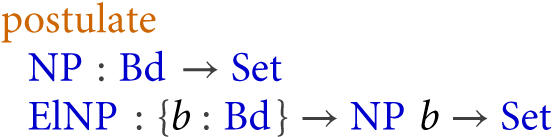
postulates two functions  and
and  whose codomains are Agda’s lowest type universe
  .Footnote
16
This has the same effect as the following two rules from Section 3.1:
.Footnote
16
This has the same effect as the following two rules from Section 3.1:
 \begin{align*} \frac {\Gamma \vdash b:\textbf {Bd}}{\Gamma \vdash \textbf {NP}^b \textsf { type}} \qquad \frac {\Gamma \vdash b:\textbf {Bd} \qquad \Gamma \vdash \textit {np}:\textbf {NP}^b}{\Gamma \vdash \textbf {El}_{\textbf {NP}}^b(\textit {np}) \textsf { type}} \end{align*}
Some of our framework rules express judgmental equalities, such as the second rule below:
 \begin{align*} \frac {\Gamma \vdash b:\textbf {Bd} \qquad \Gamma \vdash \textit {np}:\textbf {NP}^b \qquad \Gamma ,p:\textbf {El}_{\textbf {NP}}^b(\textit {np})\vdash P : \textbf {Prop}}{\Gamma \vdash \textstyle \sum ^{\textbf {NP}}_{p:\textit {np}} P : \textbf {NP}^b}\\ \frac {\Gamma \vdash b:\textbf {Bd} \qquad \Gamma \vdash \textit {np}:\textbf {NP}^b \qquad \Gamma ,p:\textbf {El}_{\textbf {NP}}^b(\textit {np})\vdash P : \textbf {Prop}} {\Gamma \vdash \textbf {El}_{\textbf {NP}}^b\left (\textstyle \sum ^{\textbf {NP}}_{p:\textit {np}} P\right ) = \textstyle \sum _{p:\textbf {El}_{\textbf {NP}}^b(\textit {np})} \textbf {Prf}(P) \textsf { type}} \end{align*}
We encode these equations by first postulating them as propositional equalities and then declaring them as rewrite rules (Cockx et al. Reference Cockx, Tabareau and Winterhalter2021), a feature of Agda which allows upgrading some propositional equalities (satisfying certain conditions) to judgmental equalities.
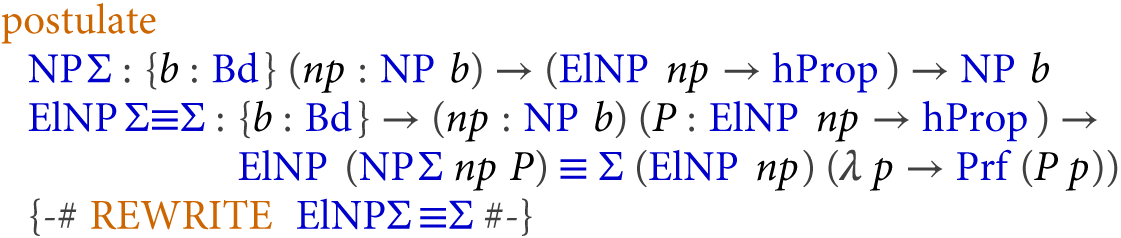
We can then use the Agda version of our framework to model fragments of natural language by postulating the relevant terms ( ,
,  ,
,  , etc.) and defining terms corresponding to various events and entailments. Revisiting Example4.6.1 (John ate apples quickly), we can define the event John ate apples as follows:

We then define a function  which adverbially modifies any event by pairing its occurrences with a proof that they satisfy a given predicate $\textbf {Occ}\to \textbf {Prop}$
.
$\textbf {Occ}\to \textbf {Prop}$
.

In particular, applying  to
to  corresponds exactly to the definition of $\textsf {jaaQuickly}$
given in Example4.6.1.
$\textsf {jaaQuickly}$
given in Example4.6.1.

Agda then confirms that $\textbf {fst}$
is a proof that John ate apples quickly entails John ate apples.
$\textbf {fst}$
is a proof that John ate apples quickly entails John ate apples.

6. Related and future work
In this paper, we have developed a cross-linguistic framework within Martin-Löf type theory for analyzing event telicity and culminativity. Our framework consists of two parts. First, in the nominal domain, we develop a compositional analysis of the boundedness of noun phrases and of the internal structure of overtly bounded noun phrases. Then, in the verbal domain, we develop a dependently-typed calculus for static and dynamic eventualities as a backdrop for defining telicity and culminativity, and deriving associated entailments (in particular, that occurrences of culminating events entail the associated resulting state). We illustrate the applicability of our framework through a series of examples modeling English sentences; the first author’s dissertation additionally discusses Russian (Kovalev Reference Kovalev2024).
We have already discussed prior work at length in Section 1; in this section, we close with some more detailed comparisons to related work, particularly to Corfield’s (Reference Corfield2020) type-theoretic approach to Vendler’s Aktionsart classes, and to MTT-semantics (Chatzikyriakidis and Luo Reference Chatzikyriakidis and Luo2020) and its treatment of event types (Luo and Soloviev Reference Luo and Soloviev2017) and noun phrases (Chatzikyriakidis and Luo Reference Chatzikyriakidis and Luo2013a). We also indicate some possible directions for future work.
Martin-Löf type theory and its semantics As previously discussed, many aspects of our framework are inspired by MTT-semantics; perhaps our largest departure from MTT-semantics is that we build atop Martin-Löf type theory (Martin-Löf Reference Martin-Löf, Rose and Shepherdson1975) rather than the UTT (Luo Reference Luo1994) extended with coercive subtyping and other features. We have opted to use Martin-Löf type theory because it is more theoretically parsimonous and more widely used, studied, and implemented than UTT with coercive subtyping; the former is, roughly speaking, the core language of the Agda proof assistant.
As an example of this parsimony, Section 3.3 demonstrates that we can model subtyping relationships such as every man can be regarded as a human by positing a family of types $\textbf {isA}(\textit {np},\textit {np}')$
along with a function
$\textbf {isA}(\textit {np},\textit {np}')$
along with a function $\textbf {El}_{\textbf {isA}}(-) : \textbf {isA}(\textit {np},\textit {np}')\to \textbf {El}_{\textbf {NP}}^b(\textit {np})\to \textbf {El}_{\textbf {NP}}^{b'}(\textit {np}')$
and an axiom
$\textbf {El}_{\textbf {isA}}(-) : \textbf {isA}(\textit {np},\textit {np}')\to \textbf {El}_{\textbf {NP}}^b(\textit {np})\to \textbf {El}_{\textbf {NP}}^{b'}(\textit {np}')$
and an axiom $\textbf {IARespectsIsA}$
(in Section 3.5) stating that intersective adjectives lift along
$\textbf {IARespectsIsA}$
(in Section 3.5) stating that intersective adjectives lift along $\textbf {isA}$
relationships. In MTT-semantics, linguistic subtyping is modeled by coercive subtyping relations such as
$\textbf {isA}$
relationships. In MTT-semantics, linguistic subtyping is modeled by coercive subtyping relations such as $\textsf {man}\leq \textsf {human}$
, which in turn are governed by rules in the ambient type theory which insert implicit coercions at function applications (Luo Reference Luo2009). Although coercive subtyping is conceptually more direct, it complicates the metatheory and semantics of type theory (Soloviev and Luo Reference Soloviev and Luo2001) in comparison to our explicit inclusion functions. We do not claim that all of MTT-semantics can be reconstructed in Martin-Löf type theory, but at least for the purposes of this paper, we were able to avoid using any non-standard type-theoretic features.
$\textsf {man}\leq \textsf {human}$
, which in turn are governed by rules in the ambient type theory which insert implicit coercions at function applications (Luo Reference Luo2009). Although coercive subtyping is conceptually more direct, it complicates the metatheory and semantics of type theory (Soloviev and Luo Reference Soloviev and Luo2001) in comparison to our explicit inclusion functions. We do not claim that all of MTT-semantics can be reconstructed in Martin-Löf type theory, but at least for the purposes of this paper, we were able to avoid using any non-standard type-theoretic features.
In particular, building on a standard type theory means that our framework has a straightforward set-theoretic semantics with respect to which we can validate the entailment relations asserted throughout this paper. Luo (Reference Luo2019) has previously argued that, in addition to being evidently proof-theoretic, MTT-semantics also provides a model-theoretic semantics “not [in the sense of being] given a set-theoretic semantics” but rather that “an MTT can be employed as a meaning-carrying language to give the model-theoretic semantics to Natural Language.”
We agree with the latter point but wish to emphasize that our framework also has a set-theoretic semantics, obtained by extending the set-theoretic semantics of Martin-Löf type theory as explicated for example by Hofmann (Reference Hofmann1997) or Angiuli and Gratzer (Reference Angiuli and Gratzer2025, Section 3.5). This semantics interprets closed types $\cdot \vdash A\textsf { type}$
as sets
$\cdot \vdash A\textsf { type}$
as sets $[\![ A ]\!]$
, closed terms
$[\![ A ]\!]$
, closed terms $\cdot \vdash a:A$
as elements of
$\cdot \vdash a:A$
as elements of $[\![ A ]\!]$
, dependent families of types
$[\![ A ]\!]$
, dependent families of types $x:A\vdash B(x)\textsf { type}$
as
$x:A\vdash B(x)\textsf { type}$
as $[\![ A ]\!]$
-indexed families of sets
$[\![ A ]\!]$
-indexed families of sets $[\![ B ]\!](x)$
for
$[\![ B ]\!](x)$
for $x\in [\![ A ]\!]$
, and dependent families of terms
$x\in [\![ A ]\!]$
, and dependent families of terms $x:A\vdash b(x) : B(x)$
as elements of the
$x:A\vdash b(x) : B(x)$
as elements of the $[\![ A ]\!]$
-indexed product of sets
$[\![ A ]\!]$
-indexed product of sets $\prod _{x\in [\![ A ]\!]} [\![ B ]\!](x)$
. This semantics moreover interprets
$\prod _{x\in [\![ A ]\!]} [\![ B ]\!](x)$
. This semantics moreover interprets $\Pi$
-types as set-indexed products of sets,
$\Pi$
-types as set-indexed products of sets, $\Sigma$
-types as set-indexed disjoint unions of sets, and intensional identity types
$\Sigma$
-types as set-indexed disjoint unions of sets, and intensional identity types $\mathbf{Id}_A(a,a')$
as subsingleton sets
$\mathbf{Id}_A(a,a')$
as subsingleton sets $\{\star \mid a = a'\}$
.
$\{\star \mid a = a'\}$
.
As for the additional rules stipulated by our framework, a set-theoretic semantics of our framework in the case of, for example, English would take $[\![ \textbf {Bd} ]\!]$
to be the set
$[\![ \textbf {Bd} ]\!]$
to be the set $\{\textsf {B},\textsf {U}\}$
;
$\{\textsf {B},\textsf {U}\}$
; $[\![ \textbf {NP}^{\textsf {B}} ]\!]$
(resp.,
$[\![ \textbf {NP}^{\textsf {B}} ]\!]$
(resp., $[\![ \textbf {NP}^{\textsf {U}} ]\!]$
) to be the set of bounded (resp., unbounded) English noun phrases under consideration; for a given English noun phrase
$[\![ \textbf {NP}^{\textsf {U}} ]\!]$
) to be the set of bounded (resp., unbounded) English noun phrases under consideration; for a given English noun phrase $\textit {human}\in [\![ \textbf {NP}^{\textsf {U}} ]\!]$
under consideration, takes
$\textit {human}\in [\![ \textbf {NP}^{\textsf {U}} ]\!]$
under consideration, takes $[\![ \textbf {El}_{\textbf {NP}}^{\textsf {U}} ]\!](\textit {human})$
to be the set of instances of human under consideration; takes
$[\![ \textbf {El}_{\textbf {NP}}^{\textsf {U}} ]\!](\textit {human})$
to be the set of instances of human under consideration; takes $[\![ \textbf {isA} ]\!](\textit {np},\textit {np}')$
to be
$[\![ \textbf {isA} ]\!](\textit {np},\textit {np}')$
to be $\{\star \mid [\![ \textbf {El}_{\textbf {NP}}^b ]\!](\textit {np}) \subseteq [\![ \textbf {El}_{\textbf {NP}}^{b'} ]\!](\textit {np}') \}$
; and so forth.
$\{\star \mid [\![ \textbf {El}_{\textbf {NP}}^b ]\!](\textit {np}) \subseteq [\![ \textbf {El}_{\textbf {NP}}^{b'} ]\!](\textit {np}') \}$
; and so forth.
These sets validate the rules of our framework – at least insofar as our framework correctly models the English language – and provide a reference semantics with respect to which we can check the entailments predicted by our framework. Describing and validating this semantics is one clear avenue for future work.
We stress in particular that the formal semantics of natural language based on Martin-Löf type theory is no less model-theoretic than traditional Montague semantics based on simple type theory, nor the semantics based on type theory with records (Cooper Reference Cooper2005,Reference Cooper, Bertino, Gao, Steffen and Yung2011; Cooper and Ginzburg Reference Cooper, Ginzburg, Lappin and Fox2015; Cooper Reference Cooper, Chatzikyriakidis and Luo2017, Reference Cooper2023) as suggested, for example, by Sutton (Reference Sutton2024, 116–117). Nor does working inside type theory commit semanticists to constructivity; in set-theoretic models, sentences can still be understood as being simply true or false. For instance, in the context of Example3.5.1, one can create models in which $\textsf {tom}:\textbf {El}_{\textbf {NP}}^{\textsf {U}}(\textsf {cat})$
is a black cat without stipulating a term
$\textsf {tom}:\textbf {El}_{\textbf {NP}}^{\textsf {U}}(\textsf {cat})$
is a black cat without stipulating a term $\textsf {tomIsBlack} : \textbf {Prf}(\textbf {El}_{\textbf {IA}}(\textsf {black})\ ((\textsf {U},\textsf {cat}),\textsf {tom}))$
in the syntax.
$\textsf {tomIsBlack} : \textbf {Prf}(\textbf {El}_{\textbf {IA}}(\textsf {black})\ ((\textsf {U},\textsf {cat}),\textsf {tom}))$
in the syntax.
Event semantics and dependent event types Various forms of event semantics or event calculi have long been used in both linguistics and philosophy for natural language semantics (Davidson Reference Davidson and Rescher1967; Castañeda Reference Castañeda and Rescher1967; Higginbotham Reference Higginbotham1985, Reference Higginbotham, Higginbotham, Pianesi and Varzi2000; Parsons Reference Parsons1990, Reference Parsons, Higginbotham, Pianesi and Varzi2000)Footnote 17 and for reasoning about action and change in artificial intelligence (Kowalski and Sergot Reference Kowalski and Sergot1986; Shanahan Reference Shanahan1995, Reference Shanahan1997, Reference Shanahan, Wooldridge and Veloso1999; Miller and Shanahan Reference Miller and Shanahan2002; Mueller Reference Mueller, van Harmelen, Lifschitz and Porter2008, Reference Mueller2014).
A type-theoretic approach to event semantics goes back at least as far as Ranta (Reference Ranta2015), who was motivated by the non-compositional nature of standard event semantics: as discussed in Ranta (Reference Ranta2015, 359), the Davidsonian representation of the sentence John buttered the toast in the bathroom with a knife at midnight, given in (12-a), is not compositional because John buttered the toast is not a constituent of the final proposition. This problem can be resolved through the use of $\Sigma$
-types, as demonstrated in (12-b).
$\Sigma$
-types, as demonstrated in (12-b).

Here, Ranta (Reference Ranta2015) treats $\textsf {butter}(\textsf {john},\textsf {toast})$
as a proposition, and events
$\textsf {butter}(\textsf {john},\textsf {toast})$
as a proposition, and events $e:\textsf {butter}(\textsf {john},\textsf {toast})$
as proofs of that proposition. A similar approach is taken by Cooper (Reference Cooper2023, 19), in which
$e:\textsf {butter}(\textsf {john},\textsf {toast})$
as proofs of that proposition. A similar approach is taken by Cooper (Reference Cooper2023, 19), in which $e: \textsf {run}(a)$
means that
$e: \textsf {run}(a)$
means that $e$
is an event in which the individual
$e$
is an event in which the individual $a$
is running.
$a$
is running.
Our approach is compositional in the sense of Ranta (Reference Ranta2015) but differs from his approach in two respects. First, we represent events as types rather than propositions; for us $\textsf {butter}(\textsf {john},\textsf {toast})$
is itself an event whose terms (of which there may be many) are occurrences of that event. Second, since we keep track of actors, undergoers, and telicity,
$\textsf {butter}(\textsf {john},\textsf {toast})$
is itself an event whose terms (of which there may be many) are occurrences of that event. Second, since we keep track of actors, undergoers, and telicity, $\textsf {butter}(\textsf {john},\textsf {toast})$
is not just a bare type but an element of the collection (universe) of events
$\textsf {butter}(\textsf {john},\textsf {toast})$
is not just a bare type but an element of the collection (universe) of events $\textbf {Tel}(\textsf {john},\textsf {toast})$
(assuming that
$\textbf {Tel}(\textsf {john},\textsf {toast})$
(assuming that $\textsf {toast}$
represents a bounded noun phrase).
$\textsf {toast}$
represents a bounded noun phrase).
Our way of keeping track of actors and undergoers is inspired by Luo and Soloviev’s (Reference Luo and Soloviev2017) dependent event types, which incorporate the so-called neo-Davidsonian event semantics (Parsons Reference Parsons1990) into the framework of MTT-semantics. Luo and Soloviev (Reference Luo and Soloviev2017) introduce event types with a fixed agent and/or patient (or more generally actor and undergoer, in our terminology); for example, $Evt_{AP}(a,p)$
(resp.,
$Evt_{AP}(a,p)$
(resp., $Evt_A(a)$
) is the type of events with agent
$Evt_A(a)$
) is the type of events with agent $a$
and patient
$a$
and patient $p$
(resp., with agent
$p$
(resp., with agent $a$
), and these are related by coercive subtyping relationships such as
$a$
), and these are related by coercive subtyping relationships such as $Evt_{AP}(a,p) \leq Evt_A(a)$
.
$Evt_{AP}(a,p) \leq Evt_A(a)$
.
In contrast, we have a single primitive type $\textbf {Evt}^b(a,\textit {und})$
of events with a specified actor and undergoer, in terms of which the less-specified types of events (and explicit coercion functions between them) can be defined using
$\textbf {Evt}^b(a,\textit {und})$
of events with a specified actor and undergoer, in terms of which the less-specified types of events (and explicit coercion functions between them) can be defined using $\Sigma$
-types. Unlike Luo and Soloviev (Reference Luo and Soloviev2017), we also explicitly distinguish between events that have no actor and/or undergoer, which we represent with dummy arguments, and events with an unspecified actor and/or undergoer.
$\Sigma$
-types. Unlike Luo and Soloviev (Reference Luo and Soloviev2017), we also explicitly distinguish between events that have no actor and/or undergoer, which we represent with dummy arguments, and events with an unspecified actor and/or undergoer.
As an illustration of dependent event types in MTT-semantics, (13-a) is the type of bark in MTT-semantics without event types, and (13-b) is its type in the presence of event types.

A sentence like Fido barks is then modeled as (14).

The main application of dependent event types discussed in Luo and Soloviev (Reference Luo and Soloviev2017) is their elegant solution to the event quantification problem (Winter and Zwarts Reference Winter and Zwarts2011; de Groote and Winter Reference de Groote and Winter2015; Champollion Reference Champollion2015), roughly, that, for example, the sentence No dog barks should mean “There’s no dog $d$
for which there exists a corresponding barking event whose agent is
$d$
for which there exists a corresponding barking event whose agent is $d$
” as opposed to “There exists an event in which no dog is barking.”
$d$
” as opposed to “There exists an event in which no dog is barking.”
Like traditional (non-dependent) event semantics, however, their approach treats events as variables and represents every sentence as starting with an existential quantifier over events, as in (14). We find this quite unnatural for several reasons. First, it requires a stipulative post-compositional operation to bind the event variable. Second, having every sentential representation begin with an existential quantification over events unnecessarily complicates sentential representations. Third, there is no reasonable way to interpret the event variable. The original motivation for such variables in linguistic semantics was to allow for adverbial modification, but we have already demonstrated an alternate solution in Section 4.6.
In summary, the dependent event types in our framework are similar to those of Luo and Soloviev (Reference Luo and Soloviev2017) except that we treat events as types instead of variables, which not only avoids the issues described above but also avoids the event quantification problem altogether.
More detailed event structure Our work focuses on the inner aspectual properties of telicity, culminativity, and to some extent, staticity, but has ignored other interesting inner aspectual properties such as punctuality or durativity (which we use as the antonym of punctuality).Footnote 18 If one considers culminativity, punctuality, and staticity, one arrives at Vendler’s ontology of Aktionsart classes (Vendler Reference Vendler1957,Reference Vendler1967): states, activities, achievements, and accomplishments.Footnote 19 Our work explicitly covers states; it partially covers activities – all atelic events are activities, but our framework does not cover activities such as push the cart, and we have collapsed achievements and accomplishments (either culminating or non-culminating ones) into telic events because we do not distinguish durativity and punctuality. One interesting avenue for future work is to extend our framework with the punctuality–durativity distinction.
Some work on this has already been done by Corfield (Reference Corfield2020), who uses $\Sigma$
-types to formalize Moens and Steedman’s (Reference Moens and Steedman1988) notion of event nucleus, which is described as “an association of a goal event, or culmination, with a preparatory process by which it is accomplished, and a consequent state, which ensues” (Moens and Steedman Reference Moens and Steedman1988, 15). Corfield (Reference Corfield2020) introduces the types of states, activities, achievements, and accomplishments, the first three being primitive and the fourth defined as in (15-a). The event nucleus is then defined either as in (15-b) or as in (15-c), where
$\Sigma$
-types to formalize Moens and Steedman’s (Reference Moens and Steedman1988) notion of event nucleus, which is described as “an association of a goal event, or culmination, with a preparatory process by which it is accomplished, and a consequent state, which ensues” (Moens and Steedman Reference Moens and Steedman1988, 15). Corfield (Reference Corfield2020) introduces the types of states, activities, achievements, and accomplishments, the first three being primitive and the fourth defined as in (15-a). The event nucleus is then defined either as in (15-b) or as in (15-c), where $\textbf {Culminate}$
and
$\textbf {Culminate}$
and $\textbf {Consequent}$
are taken as primitive.
$\textbf {Consequent}$
are taken as primitive.
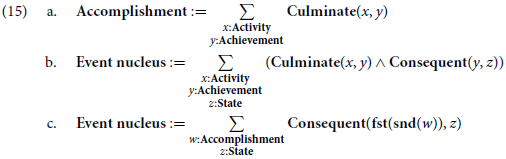
Relative to Corfield (Reference Corfield2020), our work is both an improvement and an oversimplification. It is an improvement in the sense that we account for verbal arguments and define what it means for an event to culminate, in terms of a resulting state. On the other hand, as mentioned above, we do not attempt to model the distinction between accomplishments and achievements. Further work is needed to combine the two approaches in a reasonable way.
Structure of noun phrases Surprisingly, the internal structure of noun phrases (e.g., the distinction between apples, two apples, and two kilograms of apples) has received little to no attention in the literature on type-theoretic semantics of natural language.
Work on copredication (Chatzikyriakidis and Luo Reference Chatzikyriakidis and Luo2017b, Reference Chatzikyriakidis and Luo2018) has proposed treating numerical quantifiers in the spirit of generalized quantifier theory, that is, taking nouns and verbs as arguments. We deviate from this approach for several reasons. First, this treatment relies on modeling collections of common nouns as setoids, which we have avoided. Second, this treatment of numerical quantifiers makes the structure of sentences like John ate three apples very different from that of sentences like John ate apples, which introduces a non-uniformity and may complicate entailments such as the former sentence entailing the latter.
Mass nouns (such as water) as well as the so-called pseudo-partitive constructions (such as a glass of water or three kilograms of apples) seem to have barely received any attention in the literature on MTT-semantics. We are only aware of a paragraph in Luo (Reference Luo2012a), which proposes representing John drank a glass of water as in (16), which treats glass of water as one atomic unit. Luo (Reference Luo2012a) also proposes that mass nouns used without a measure word are underspecified and can thus be modeled with overloading in MTT-semantics, but no further details are given.

In this paper, we account for the internal structure of overtly bounded noun phrases using degrees and units. A similar but less refined treatment can be found in Chatzikyriakidis and Luo (Reference Chatzikyriakidis and Luo2013a), in which the type of John and Mary is $\textsf {Vec}(\textsf {human},2)$
(in contrast to our
$\textsf {Vec}(\textsf {human},2)$
(in contrast to our $\textbf {AmountOf}(\textsf {human},\textsf {quantity}, \textsf {nu}, 2)$
), and coercive subtyping relationships such as
$\textbf {AmountOf}(\textsf {human},\textsf {quantity}, \textsf {nu}, 2)$
), and coercive subtyping relationships such as $\textsf {human} \leq \textsf {Vec}(\textsf {human},1)$
allow considering terms of type
$\textsf {human} \leq \textsf {Vec}(\textsf {human},1)$
allow considering terms of type $\textsf {human}$
as having type
$\textsf {human}$
as having type $\textsf {Vec}(\textsf {human},1)$
.
$\textsf {Vec}(\textsf {human},1)$
.
Connection to mereological approaches Our framework also contains an $\oplus$
operation for producing sums of instances. This idea goes back at least as far as Link (Reference Link, Bäuerle, Schwarze and von Stechow1983), where pluralities are modeled as “sums of individuals” in the sense of classical extensional mereology (Champollion and Krifka Reference Champollion, Krifka, Aloni and Dekker2016; Pietruszczak Reference Pietruszczak2020; Cotnoir and Varzi Reference Cotnoir and Varzi2021).Footnote
20
$\oplus$
operation for producing sums of instances. This idea goes back at least as far as Link (Reference Link, Bäuerle, Schwarze and von Stechow1983), where pluralities are modeled as “sums of individuals” in the sense of classical extensional mereology (Champollion and Krifka Reference Champollion, Krifka, Aloni and Dekker2016; Pietruszczak Reference Pietruszczak2020; Cotnoir and Varzi Reference Cotnoir and Varzi2021).Footnote
20
Mereological sums have also proved useful in the study of the properties of distributivity (e.g., John and Mary ran entails John ran and Mary ran) and collectivity (e.g., John and Mary met does not entail John met and Mary met); see Champollion (Reference Champollion2019) for an overview. To the best of our knowledge, there are no studies of mereological approaches to natural language semantics in dependent type theory. There is only one mention of collective verbs such as meet in Chatzikyriakidis and Luo (Reference Chatzikyriakidis and Luo2013a), in which meet would have the following type:

Some interesting future research directions would be to develop a system within dependent type theory which treats the distributive-collective opposition, as well as the related phenomena of cumulativity (Champollion Reference Champollion, Gutzmann, Matthewson, Meier, Rullmann and Zimmermann2020) and reciprocity (Winter Reference Winter2018). More modestly, one might add further axioms to our framework that make $\oplus$
a join semilattice operator.
$\oplus$
a join semilattice operator.
Adjectival and adverbial modification We have only discussed modification of noun phrases by intersective adjectives, but not by other kinds of adjectives or relative clauses. With respect to boundedness – our primary concern in the nominal domain – these other kinds of modifiers seem to, like intersective adjectives, preserve the boundedness of noun phrases.
Of course, these modifiers will behave differently in other respects and are worth consideration. Subsective, privative, non-committal, gradable, and multidimensional adjectives have been studied in MTT-semantics (Chatzikyriakidis and Luo Reference Chatzikyriakidis and Luo2017a, Reference Chatzikyriakidis and Luo2020, Reference Chatzikyriakidis and Luo2022). We expect that our framework can account for subsective and privative adjectives without additional machinery; gradable and multidimensional adjectives will require some additional work on degrees; and non-committal adjectives will require stepping into the modal territory.
In the verbal domain, we have only considered adverbial modification of events. Other kinds of adverbs include manner adverbs (e.g., John wrote illegibly, where it is not the event, that is, illegible, but rather the manner in which John wrote), actor-oriented verbs (e.g., Clumsily, John dropped his cup of coffee, where it is John’s act of dropping his cup of coffee that was clumsyFootnote 21 ), speech act adverbs (as in Frankly, my dear, I don’t give a damn), and intensional adverbs (as in Oedipus allegedly married Jocaste), the latter of which require modalities as in Chatzikyriakidis and Luo (Reference Chatzikyriakidis and Luo2020). The other types of adverbs listed above are accounted for in Chatzikyriakidis and Luo (Reference Chatzikyriakidis and Luo2020) by adding more dependency to event types, which can be adapted to our framework. For example, to account for manner adverbs, one can introduce the type of events with a given actor, undergoer, and manner.
Extensions to other sources of telicity In this paper, we have restricted ourselves to considering verbs whose lexical semantics involves the aim of achieving a certain goal – thereby ignoring sentences like John pushed a cart – and have only considered sentences in which telicity comes from verbal arguments rather than adjuncts (as in John drove a car to Bloomington) or resultative complements (as in John wiped the table clean). Future work is needed to extend our framework to account for these other kinds of telicity.
Acknowledgments
This article extends and reformulates parts of the first author’s dissertation (Kovalev Reference Kovalev2024). The second author’s contributions were supported by the Air Force Office of Scientific Research under award number FA9550-24-1-0350. We are grateful to Thomas Grano and Larry Moss for helpful discussions with the first author during the preparation of that dissertation, particularly concerning linguistics. We also thank the anonymous reviewer for helpful comments and suggestions.












 is the notation for a


 Open access

