

How can we live and work in the world of archaeology, where social relationships are conditioned by the laws of supply and demand? How can we fulfill ourselves and enjoy archaeological practice without this meaning the use and exploitation of others? How can we ensure that our academic and professional relationships generate new ways of being and existing? All these questions have arisen for several of the authors from the moment we began working in the world of archaeology. The fact is that in today’s world, where neoliberal thinking is hegemonic (Bauman Reference Bauman2006:88; Harvey Reference Harvey2007:7), neoliberalism has become naturalized in the way we do archaeology. Thus, it sometimes seems and sounds absurd to ask such questions and, worse still, to propose alternative scenarios (Han Reference Han2014:43, 105). Finally, if we ask ourselves such questions, we are still left with others, such as: Is it possible to effectively change these naturalized ways of relating? And what are the specific challenges we must face?
This article does not aim to answer all these questions completely; nor does it seek to be the final word or position itself as a model. On the contrary, it humbly aspires to briefly describe a scenario in Peruvian archaeology, present an alternative archaeological practice currently under development framed in the Programa Arqueológico Chicama (PRACH), and propose some ideas on the basis of which we could rethink and counteract the rules of the market and focus on the people of today and yesterday in their true dimension: the human one.
Neoliberal Practices and “Normal” Relationships in Peruvian Archaeology
The neoliberal social practices officially established by the Peruvian government in the early 1990s condition the practice of Peruvian archaeology. They are the result of a long process generated between people and things throughout Peruvian history, beginning with the colonial-era commercial extraction and ideologically motivated destruction of prehispanic Andean antiquities (Delibes Reference Delibes2012; Haber and Tantaleán Reference Tantaleán, Tantaleán and Muro2022; Quijano Reference Quijano2014).
Alongside the emergence of the Peruvian Republic in the mid-nineteenth century, the development of science in the nineteenth century legitimized a new process of extractivism, especially on the part of foreign scientists. The emergence of new methodologies and techniques made it possible to obtain greater and new evidence to establish and confirm the laws of natural history and human evolution, which set the standards for archaeological work (Heaney Reference Heaney2023) and precipitated the arrival of countless traveling collectors with the aim of recovering archaeological material for European museums.
The exploitation of archaeological sites continued, and local specialists also became increasingly involved in these relationships, facilitating transnational scientific knowledge (Gänger Reference Gänger2014). In this context, different links were established between researchers, collectors, and huaqueros (“tomb-looters”; Chirinos Reference Chirinos2018), relationships that continued throughout the twentieth century (Coe Reference Coe and Boone1993; Smith Reference Smith2005). The Peruvian state established the legal basis for the defense of what later became known as “archaeological heritage,” although with few practical results during that century (Tello and Mejía Xesspe Reference Tello and Mejía Xesspe1967).
By the twentieth century, scientific archaeology had established the basic canons and standards of archaeological fieldwork, which to a certain extent remain in place today; namely, the relationships between patron/archaeologist director/visible versus worker/research assistant/invisible. Max Uhle, Julio C. Tello, and Rafael Larco Hoyle, the “fathers of Peruvian archaeology,” established such relationships with their local colleagues and excavation assistants, in which social distance, paternalistic relationships, military-inspired hierarchies, and an obsession with finding extraordinary, spectacular, and monumental bodies and objects from the past prevailed (Asensio Reference Asensio2012, Reference Asensio2018). Added to this were the dynamics of various foreign archaeological traditions, especially those of the United States, which consolidated and generated their own ways of relating to local archaeologists (Peters and Ayarza Reference Peters, Ayarza, Tantaleán and Astuhuamán2013). Thus, the academic world of that time, both nationally and internationally, established priorities and justifications for how to relate at the academic and professional levels. The primary objective was the generation of discoveries and scientific data, which justified the exploitation of people and diverted attention from such issues as the unrecognized and, in many cases, unpaid work of “local archaeologists,” collectors, colleagues, students, and native workers. The relationship between archaeology and official policy also became evident, giving rise to the “heritage pact” (sensu Asensio Reference Asensio2018), a characteristic of Peruvian archaeology that cuts across and intervenes in these academic, political, economic, and ideological relationships and seeks to regulate them.
In the 1990s, the Peruvian state itself, through the actions of President Alberto Fujimori, established a neoliberal political economy (Ewig Reference Ewig2012; Jiménez Reference Jiménez2017). In this way, government institutions, in alliance with national and transnational business elites, reproduced the principles of the free market and competitiveness (Méndez Reference Méndez2025). Likewise, the Peruvian neoliberal model focused on a new extractivism (neo-extractivism) of raw materials, mainly minerals and oil (Jiménez Reference Jiménez2017; Svampa Reference Svampa2019).
Contract archaeology facilitated the preparation of the ground for the exploitation of Peru’s land and raw materials (for other Latin American cases, see International Journal of Historical Archaeology 19[4] and Gnecco and Schmidt [Reference Gnecco and Schmidt2017]). This became an essential stage of the legalistic bureaucracy by which neo-extractivist economic elites have shaped the management of the archaeological legacy. Thus, both research and contract archaeology have become a form of “archaeological neo-extractivism” that conditions the relationships between people and things, past and present.
Consequences and Challenges of Neoliberal Social Relations in Peruvian Archaeology
The ways of relating socially in Peruvian archaeology, specifically in research, have led to a series of consequences. The first of these is the widespread alienation of archaeologists from the deep social and political contexts in which these archaeological projects operate. Although in recent decades projects that include “community archaeology,” “public archaeology,” and “Indigenous archaeology” have been proposed, these proposals, led by foreign archaeologists or funded by foreign institutions, do not offer alternative and sustainable long-term alternatives to the current neoliberal economic relations.
With regard to all these alternative proposals in archaeology, there is an interesting phenomenon in relation to Peru: all of them were originally proposed in the Global North; that is, mainly in the United States and Anglophone countries (Atalay Reference Atalay2012; Marshall Reference Marshall2002; Moshenska Reference Moshenska2017). Furthermore, when these proposals have been applied to Latin American countries, such as Peru, they have remained approaches without a deep understanding of the social reality and, without continuous practice, have had little impact on the archaeological community and Peruvian society. In fact, although such publications focus on Peruvian problems, they include very few bibliographical references to the work of local archaeologists, rendering their contributions invisible, a practice that reveals a “coloniality of knowledge” (Lander Reference Lander2000).
In the cases of “community archaeology” and “public archaeology,” their applications to Peruvian archaeology have been scarce and heterogeneous (Bria and Casanova Reference Bria, Casanova, Mithen, Rabbani and Rabbani2025; Kellett Reference Kellett2006; Pacifico and Vogel Reference Pacifico and Vogel2012; Saucedo-Segami Reference Saucedo-Segami, Okamura and Matsuda2011; Weaver et al. Reference Weaver, Fhon and Santana2022). Furthermore, such proposals do not offer any significant criticism of the underlying neoliberal economic model; nor have they been put into practice or developed sustainably over time. More importantly, they continue to maintain a paternalistic and patronizing view of communities. For its part, “Indigenous archaeology” (Atalay Reference Atalay2012; Colwell-Chanthaphonh et al. Reference Colwell-Chanthaphonh, Ferguson, Lippert, McGuire, Nicholas, Watkins and Zimmerman2010), although it has been discussed and proposed years ago for the central Andes (Herrera Reference Herrera, Gnecco and Ayala2011; Tantaleán Reference Tantaleán, Tantaleán and Muro2022), has not been explicitly or effectively developed in Peruvian archaeology.
Another consequence related to the rise of neoliberalism is the promotion of individualism and competition as fundamental principles that have been internalized and materialized in the struggle for the “survival of the academically fittest,” paraphrasing Herbert Spencer (Reference Spencer1969). Such individualism and competition have even become so naturalized that they are reproduced from the directors of archaeological projects to the students who participate in them. One example of this practice is reflected in the authorship of the articles and papers where many times Peruvian archaeologists, students, or collaborators are not included. Public and private universities have prioritized this model, in which the production of scientific articles and the struggle for scholarships and funding take priority over all others. In public universities, the dynamic of seeking the best grades in courses and for theses also leads students to compete with each other, creating social distances and conflicts, as well as anxiety and distress (Aguirre Morales et al. Reference Aguirre Morales, Tantaleán-Terrones and Livia2025; Huamani-Calloapaza et al. Reference Huamani-Calloapaza, Mendoza-Zuñiga, Pizarro-Osorio, Larico-Uchamaco, Yana-Salluca, Yana-Salluca, Pérez-Argollo, Mora-Estrada and Pandia-Yañez2024).
One consequence of the way Peruvian archaeology is practiced and, above all, financed is that much of the scientific research is directed or sponsored by foreign archaeologists. This situation continues to be a determining factor in the development of unequal relationships between Peruvian and foreign archaeologists. In particular, scientific production is analogous to the extractivism of other resources in the country: Peruvian archaeologists, students, and technicians extract raw materials from archaeological “sites,” and foreign archaeologists or those funded by foreign institutions generate the final products. Although the current Reglamento de Intervenciones Arqueológicas (Archaeological Interventions Regulations) of the Ministry of Culture require foreign archaeologists to have a Peruvian codirector, it does not take much research to recognize the inequality in academic and even economic benefits that such a relationship of dependency generates. This does not mean that there are no cases in which some foreign archaeologists have developed more equitative relationships with their codirectors and other members of the Peruvian team. However, these cases remain exceptional.
The situation described above poses a series of challenges. One of the main ones is raising awareness about “normalized” social relationships in Peruvian archaeology, especially when collaborating with colleagues and other groups. To this end, it is also necessary to have information on the status, situation, and perceptions of people working in Peruvian archaeology. Fortunately, in recent years, new data and testimonies have been provided by archaeologists and other groups involved in Peruvian archaeology (Gonzales Panta Reference Gonzales Panta2010; Rivera Prince et al. Reference Rivera Prince, M. Blackwood, Brough, A. Landázuri, Leclerc, Barnes and Douglass2022; Tavera Medina Reference Tavera Medina2019, Reference Tavera Medina, Cobb and Hawkins2025).
Once a critical awareness of the situation has been accepted and integrated, a second challenge would be to create different spaces with alternative social relationships and promote collaboration, cooperation, solidarity, and fraternity. Obviously, this challenge also involves transforming the ways in which we relate to each other economically and politically. To do so, however, we must also take into account the limitations of the capitalist world. In our case, our proposal for transformation takes place within the framework of PRACH.
PRACH
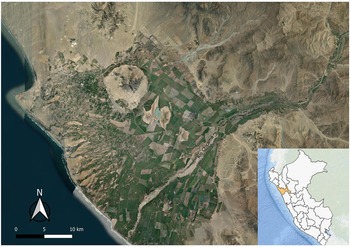
The Chicama Valley is located in the department of La Libertad on the north coast of Peru (Figure 1). It is famous for its impressive archaeological monuments, but above all because in the twentieth century it attracted the attention of numerous researchers, especially for its remarkable archaeological sites related to the Moche society (Franco Jordán Reference Franco Jordán2016; Gálvez and Briceño Reference Gálvez, Briceño and Pillsbury2001; Larco Hoyle Reference Larco Hoyle and Variedades1938, Reference Larco Hoyle and S.A1939; Mujica Reference Mujica2007).
Map showing the location of the Chicama Valley (PRACH 2025).

Figure 1 Long description
The satellite map displays the Chicama Valley located in the department of La Libertad on the north coast of Peru. The main map shows a detailed view of the valley, highlighting agricultural fields, natural land formations and the coastline. A compass rose indicates north and a scale bar shows distances in kilometers. An inset map in the bottom right corner provides a broader view of Peru, with the Chicama Valley's location marked within the country. The inset map helps contextualize the valley's position relative to the rest of Peru.
PRACH was created in 2020 as a long-term research project that aims to understand the deep history of a valley on the northern coast of Peru (Tantaleán et al. Reference Tantaleán, Medina, Campos, Gastello and Osores2022). Although it is a research program, it was also designed as a collaboration and training opportunity to challenge the conventional way of doing archaeology. Above and beyond the academic sphere, care, cooperation, and solidarity among its participants have always been prioritized. This vision of the codirectors, Tantaleán and Tavera Medina, has spread to other members of PRACH, past and present, and to other people with whom they have become involved. It is also necessary to establish that many of these principles of cooperation and solidarity are inspired by our theoretical and practical influences in former collectives heavily influenced by Marxism, especially on the part of the first author (Tantaleán), and feminism in the case of the second author (Tavera Medina).
Although Marxism has a long history in the Peruvian social sciences and in Peruvian archaeology, the work of Luis Guillermo Lumbreras and his school of “Social Archaeology” in the last century stands out (Lumbreras Reference Lumbreras1974; Tantaleán Reference Tantaleán2024). At present it is a very reduced current of thought and archaeological practice and has been subject to criticism (Jackson et al. Reference Jackson, Troncoso, Salazar, Tantaleán and Aguilar2012). In the case of the first author (Tantaleán), his Marxism is more linked to the influences of Vicente Lull and his research group at the Autonomous University of Barcelona, Spain (Lull Reference Lull2005, Reference Lull2007). For its part, feminism, in its Marxist-influenced strand (Davis Reference Davis2005; Federici Reference Federici2018), is also a reduced and underdeveloped current of thought and political activism in Peruvian archaeology (Tantaléan Reference Tantaleán2024). In the case of the second author, Tavera Medina, her influences combine such Marxist feminisms and intersectional studies (Crenshaw Reference Crenshaw2017) with political activism sustained by participation in feminist collectives such as FLAMA (Colectiva Feminista de Mujeres en Arqueología; Tavera Medina Reference Tavera Medina, Cobb and Hawkins2025; Tavera Medina and Santana Reference Tavera Medina and Santana2021).
Beyond such theoretical and political influences, in both cases, the codirectors of PRACH come from working-class and migrant families and communities associated with collectives where principles such as mutual support are part of their heritage and practice, enhanced by knowledge and personal growth under Andean and local forms of solidarity and reciprocity.
The choice of the Chicama Valley as a study area responds to an academic context and also a human one, where we have long observed a series of social practices that we have often wanted to learn more about. There is an academic community there that is relevant not only for research but also for debating and questioning Peruvian archaeology itself.
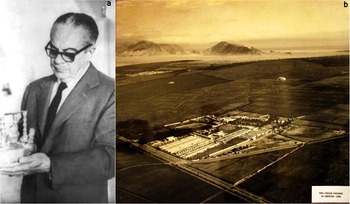
There are currently several national, foreign, and mixed archaeological projects operating in the Chicama Valley. Likewise, there is a long tradition of research that can be traced back to the nineteenth century (Tavera Medina et al. Reference Tavera Medina, Tantaleán, Huachaca, Gastello, Quispe-Baquedano and Sanandres2025), but which found its apogee in the work carried out by Rafael Larco Hoyle in the first half of the twentieth century (Figure 2a). In fact, one of the first archaeological museums in Peru and the most important on the northern coast was also founded at his hacienda in Chiclín during the first part of the twentieth century (Figure 2b). This research tradition continued to be cultivated by such emblematic projects as the Virú Project, which incorporated Huaca Prieta, located in the lower Chicama Valley, into its work in the 1940s. Later, a plethora of archaeological projects continued to investigate in the valley, and one of the most emblematic sites, the El Brujo Complex, has amalgamated a history and a set of archaeological artifacts that continue to arouse the interest of the public and researchers. Despite such a history of archaeological research, the valley still has spaces, sites, and themes that remain to be investigated in greater depth (Tantaléan et al. Reference Tantaleán, Medina, Campos, Gastello and Osores2022; Tavera Medina et al. Reference Tavera Medina, Tantaleán, Huachaca, Gastello, Quispe-Baquedano and Sanandres2025).
(a) Rafael Larco Hoyle; (b) Hacienda Chiclín (Larco Hoyle Reference Larco Hoyle and Variedades1938).

Figure 2 Long description
Image a shows Rafael Larco Hoyle holding an object in his hands, wearing a suit and tie. Image b displays an aerial view of Hacienda Chiclín, featuring expansive fields and a large building complex. The landscape includes mountains in the background and a coastline visible in the distance. A label in the bottom right corner reads 'Hda. Chiclin. Vista General.'.
Likewise, the wealth of this valley is not only prehispanic but also historical. The Chicama Valley was home to an interesting socioeconomic phenomenon known as the “haciendas,” especially the sugar plantations (Klarén Reference Klarén1976). The owners and authorities of these haciendas established a series of deep social relationships that still survive today and also condition the way archaeologists have related to the inhabitants of the valley. In fact, the most important cities in the valley have been formed on the basis of sugar haciendas, and contemporary sugar companies accumulate the economic, political, and symbolic capital of the region.
It is also important to emphasize that this is an area where the looting of archaeological sites is a very old and widespread practice among some members of the valley communities as collectors and huaqueros. The Larco family owned several haciendas, and their main collections were the result of excavations throughout the lower valley (Klarén Reference Klarén1976:58).
In our case, the PRACH “base camp” is located in the town of Huanchaco, in the city of Trujillo. However, in recent years we have also stayed and interacted with communities in the Chicama Valley, such as Puerto Malabrigo, Chicama, Paiján, Sausal, Garrapón, and Casa Grande. These stays, lasting weeks or even months, have been devoted not only to research but also to understanding and building relationships with the inhabitants.
Social Relations among the Codirectors of PRACH
As we have pointed out, the codirectors of PRACH reflected on and launched their activities with objectives that, while continuing to fulfill scientific aspects, have been concerned with the people who make up the project. A starting point is that each of the codirectors has a different personal background and is aware of their privileges. In this regard, an important point is that the first author has achieved several of their academic and professional goals; therefore, their job is to support the academic development of their codirector and younger researchers as much as possible. Likewise, we have always sought to build relationships that are as horizontal as possible, sharing the duties and rights of such responsibility. In this way, we propose a more equitable form of professional collaboration, especially in a classist/racist context and patriarchal and decidedly male chauvinist/machista/sexist milieu (Santana Reference Santana2019; Tavera Medina Reference Tavera Medina2019). This type of relationship faces many challenges, as it is not the common way of collaborating, especially given the overlap that these relationships imply for practitioners of Peruvian archaeology (Rivera Prince et al. Reference Rivera Prince, M. Blackwood, Brough, A. Landázuri, Leclerc, Barnes and Douglass2022; Young Reference Young, Medina and Santana2021).
As codirectors of PRACH, one of our main responsibilities is to obtain funding to continue our research. Funding is obtained in order to maintain the program but also to provide, as far as possible, the material conditions for financial compensation for crew members and excavation technicians. This is a crucial point, as it allows for the material reproduction of the social relationships that we hope to achieve. Obviously, as in any contemporary social relationship, we are conditioned by such economic constraints, especially because the funding agencies themselves have imposed rules that, for example, do not allow us to pay salaries.
Therefore, a series of alternative strategies has been developed to obtain additional funds to compensate crew members financially and as fairly as possible. We also take into account other expenses that are rarely considered in other projects, such as assistance and care for our members and their families, professional training, collaboration with charitable causes, household accidents, health problems, socialization activities with communities, materials for workshops in schools, et cetera.
Social Relations between Codirectors and the Crew
Like any archaeological program, this one is made up of a group of people who work together collectively. Additionally, in our case, we hope that undergraduate students can also enjoy a safe space for research and work, especially with regard to women, who have experienced a series of disadvantages and mistreatment in some workplaces of Peruvian archaeology. This perception of students has already been addressed elsewhere, and the goal is to transform these vertical relationships into more horizontal ones. In this way, all major activities of PRACH are consulted and discussed with its members.
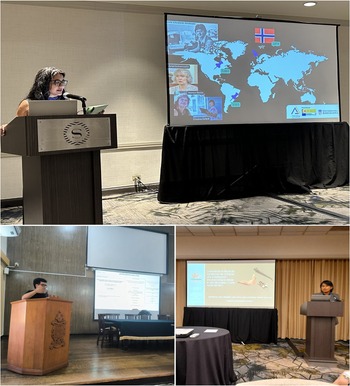
Within PRACH, the codirectors maintain primary responsibility, as mentioned above, but the students, our colleagues, also have responsibilities, duties, and rights. A very important issue is that although we are often unable to pay “competitive” salaries like those offered by contract archaeology, we make it clear that each student will obtain academic benefits, starting with coauthoring articles (such as this contribution) and presentations in different national and international academic spaces (Figure 3).
Presentations by the PRACH crew at various national and international academic meetings (PRACH 2025).

Figure 3 Long description
The image A showing a speaker standing behind a podium with a gooseneck microphone and an open laptop on the podium. A projection screen shows a slide with a world map graphic, several small portrait photos, a flag graphic and a triangular logo with additional small text. The room has a patterned carpet, a wall with recessed ceiling lights and a long table covered with a tablecloth beneath the screen. The image B showing a speaker standing behind a wooden podium in a room with a wooden floor. A large projection screen shows a slide with multiple blocks of text and images. A long table sits in front of the screen. The image C showing a speaker standing behind a podium in a room with patterned carpet and a wall with vertical panels. A projection screen shows a slide with a logo at the upper left, multiple lines of text and a graphic on the right side. A round table with a tablecloth is in the foreground.
Likewise, the goal is for their academic and professional lives to be the best possible. Bachelor’s and Licenciatura theses are another issue that we promote—not only because of an obligation of “scientific productivity” but also because, for them, it translates into better job opportunities and an improvement in their quality of life in the immediate future. But we also prepare, advise, and support them with everything at our disposal so that they can pursue postgraduate studies and, above all, scholarships to study abroad or in Peru. For example, thanks to the economic support that PRACH can obtain, a fund has been created to finance training courses for members; financial support has been provided for the stays of PRACH members who are pursuing master’s or doctoral degrees abroad, or national and international trips; and stays to attend academic meetings have been paid for. Likewise, when a PRACH member has had personal problems, material and emotional support has been provided.
Our collaboration has not only been with undergraduate students from the National University of San Marcos but also with students from the National University of Trujillo, the National University Pedro Ruiz Gallo, and the National University San Antonio Abad of Cusco. In this way, PRACH has supported and financed fieldwork, analysis of materials, and elaboration of theses for different students. Some of them are still part of PRACH and coauthored this article.
A key and decisive decision was the elimination of the concept of “volunteering” within PRACH, an action that limits the number of junior members of the project but, at the same time, recognizes the importance of objective recognition of the work of students within the projects. It is important to point out that archaeology volunteering in Peru has a series of nuances and particularities. The most negative facet of this type of volunteering is the exploitation of the student labor force without any benefit other than the “experience.” In some cases, such experience is restricted to their use as labor. Although other projects on the Peruvian north coast have generated real exchanges where the volunteer develops skills, in our case we believe that all work should be remunerated and that participation in the PRACH is something that should be agreed upon.
All of these policies have yielded great results. We can say that virtually all of our colleagues (some coauthors of this article) are pursuing master’s or doctoral degrees at prestigious universities, and almost all have obtained scholarships or other income that has allowed them to live abroad. Likewise, upon their return to the country, they have been able to access very well-paid jobs. However, our relationship continues outside of PRACH because we continue to conduct joint research. The idea is that regardless of their employment situation, we form a collective that shares topics and ways of doing archaeology.
Our former students also train new generations within PRACH, as we encourage them to establish supportive and mentoring relationships. This dynamic is sustained by the constant encouragement we give them, which takes the form of funding their training in various subjects and specialties, with the aim of ensuring that each member has distinctive but complementary skills. All this is done with the aim of enabling them to share and apply what they have learned in our research and to train new students and technicians.
Social Relations between Codirectors, Crew, and Technicians
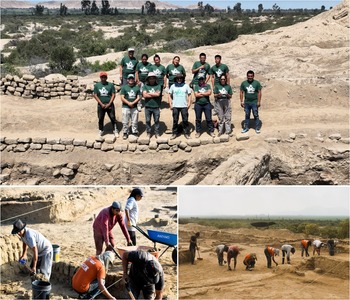
Those commonly referred to in Peruvian archaeology projects as “laborers,” “operators,” “workers,” or “technicians” are the most important group of people in PRACH (Figure 4). Since the beginning of our archaeological practice in the Chicama Valley, and especially during the excavations at the Licapa II site, we have established that the “technicians” are members of the crew beyond the fact that they are paid a salary. In fact, we have always sought to ensure that this salary is higher than the typical salary for other research projects and higher than the local labor market, which is predominantly agricultural and commercial. Unlike other archaeological projects, our relationship with our companions has become more constant and deeper, beyond simply paying them higher wages.
PRACH members at the Licapa II site (PRACH 2025).

Figure 4 Long description
The top image shows a group of 13 people standing in a line on a stone structure at an archaeological site. They are wearing casual clothing, with some in matching green shirts. The background features a landscape with sparse vegetation and distant hills. The bottom left image depicts several individuals engaged in excavation work, using tools like shovels and a wheelbarrow. The bottom right image shows a wider view of the site with multiple people working in a field, bent over as they dig or sift through the soil. The setting is an open area with a flat landscape and some vegetation in the distance.
The goal is to ensure that technicians are not exploited, understanding that our activity in each locality in the valley provides income for their families. In this sense, we live with and care for them, train them, and explain the logic behind the tasks of archaeological recording, as well as the institutional dynamics that maintain the project with its funding and supervisory agencies, such as the Ministry of Culture.
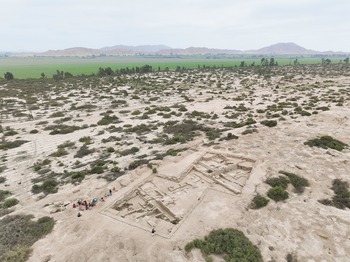
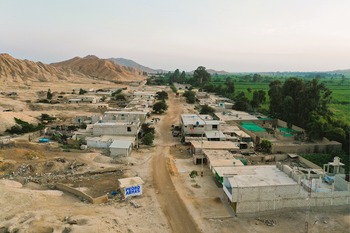
This is the case of the community of Garrapón, the closest to Licapa II, the site we have been investigating for five years (Figure 5). This community originated from groups of people who worked on the old sugar plantation and who went through the formation of cooperatives until, finally, most of them ended up working as salaried employees for the sugar company, owning their own agricultural land, or doing other technical jobs. In fact, the community of Garrapón is located in a landscape dominated by the cultivated fields of the Empresa Azucarera Casa Grande (Casa Grande Sugar Company). A strong influence from the Evangelical church is also very present and conditions their social relations. Many of them are immigrants or children of immigrants from the highlands of La Libertad or Cajamarca. The community is located on the slope and base of a hill with archaeological remains of the Moche society (Figure 6). Garrapón currently has about 700 inhabitants, about 100 houses, two small Evangelical churches, a primary school, a community center, and a soccer field. The nearest town is Casa Grande, with which most of the economic, political, and cultural relations are established.
PRACH excavations at the Licapa II archaeological site (PRACH 2025).

Figure 5 Long description
The site features several rectangular excavation areas with visible trenches and structures. A group of people is gathered near the excavation, possibly working or observing. Surrounding the site is a sparse desert terrain with scattered vegetation. In the background, there are green fields and distant mountains, providing a contrast to the arid foreground.
Garrapón community (PRACH 2025).

Figure 6 Long description
An aerial view shows a rural community with several houses arranged along dirt roads. The landscape includes arid terrain with hills in the background and green fields to the right. The houses are mostly single-story structures and there are trees scattered throughout the area. A sign is visible in the foreground, positioned near the road.
Over the years, we have seen our relationship with them grow, and we have supported each other in different ways, genuinely caring about improving their quality of life and transforming our professional and academic relationships into more human and everyday ones. For example, PRACH has put at its service our expertise as archaeologists to advise and support the Garrapón community with its doubts and problems related to the Ministry of Culture and other state institutions.
Therefore, we have established that they are companions before they are workers, and we treat them with all the respect and dignity they deserve, listening to their interests and seeking to fulfill them as much as possible. Our communication and social relations go beyond fieldwork, and we maintain a connection that goes beyond the archaeological work.
On the other hand, their local knowledge has also been a great contribution to the project, and we consider it to be an important part of our archaeological interpretations. In a formal and continuous way, PRACH records digitally the interpretation of our local technicians about the archaeological sites and remains and its own way of seeing the world (ontologies). This is not an ethnographic exercise, but a way of understanding and knowing what our companions think about what we do together. Likewise, we are always attentive to their individual and collective needs. PRACH, with its own resources and donations, maintains an economic fund that is used for such personal and collective needs.
Social Relations between PRACH and the Garrapón Community
In line with the above, our social relations with the members of the Garrapón community have built bridges for cooperation in a series of meetings and activities with the members and educational institutions of that community. In fact, one of our first actions in Garrapón was to meet with the population and ask for their permission and consent to work in the area. This is a process that is still ongoing, because, just as there are people who are interested in our work, there are other groups who are not. Although there is tension caused—mainly by the appropriation of land with archaeological content—our practice also seeks to understand the historical situation in which these tensions have arisen. Due to the demographic growth of the Garrapón community and, in general, the increase in the price of land in the region, many settlers have begun to look forward to previously uninhabited spaces that incorporate archaeological sites. This is an issue that obviously intersects with the economic issue and generates a conflict between the need for housing and the defense of the archaeological heritage.
Communities are microcosms where “micropolitics” (Foucault Reference Foucault2019; Vercauteren et al. Reference Vercauteren and Müller2010) develop, with their own historical trajectory and individual and collective interests. Being aware of this, our position is to try to interfere as little as possible in such situations, while supporting the necessary and just causes of the community, but also defending archaeological sites. This is a difficult task in an area where the Peruvian state has little presence. The actions of the Ministry of Culture, through its local office in the city of Trujillo, have little or no impact on rural communities such as those in the Chicama Valley. Their activities are mainly restricted to receiving complaints of damage to archaeological heritage and, when appropriate, initiating sanctioning processes, although with few visible results. Thus, our advice in such situations is necessary and an obligation that goes beyond simple archaeological work in the area.
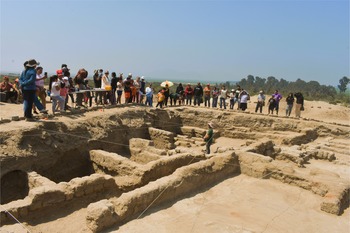
We have also committed ourselves to community initiatives, especially with the local primary school, where teachers and parents have been our main collaborators, and with whom we have developed advisory and outreach activities, and also annual visits to the archaeological site during the excavation seasons. During these visits, the excavation technicians, who are their own relatives, tell them about the work and discoveries they are making at the Licapa II site (Figure 7). These activities involve planning, outreach, the creation of materials, and budgetary investment, all of which we consider essential in our archaeological practice. For several years PRACH has held meetings and workshops with the children, parents, and teachers of the Garrapón school, and its success has awakened deep interest and sympathy among the population toward our archaeological activities.
Visit by the Garrapón community to the Licapa II archaeological site (PRACH 2025).

Figure 7 Long description
A large group of people stands along the edge of an archaeological excavation site. The site features several exposed structures and walls made of earth or stone. The visitors are observing the site, with some taking photos. The background includes a clear sky and distant trees, indicating an outdoor setting. The group is diverse, with individuals wearing various types of clothing suitable for an outdoor visit.
Social Relations between PRACH and Other Archaeological Projects
Finally, our social relations with other projects seek to promote collaboration among colleagues, actively participating not only in the presence but also in the design and support of academic and other types of meetings. The idea is to participate and collaborate, leaving aside the academic and professional competition that is widespread in Peruvian academia and, especially, in foreign academia. The main objective is that our presence on the northern coast of Peru and in the archaeological community will improve social relations among colleagues and avoid the tensions that arise in such a competitive and individualistic environment. Thus, PRACH is committed to a medium- and long-term practice where people are more important than careers and individual prestige. In this sense, we believe that the highly promoted “Fast Science” and the consequent “Fast Archaeology” contribute to the breakdown of the social fabric and destabilize social relations inside and between research crews (Conkey Reference Conkey, Abadía, Conkey and McDonald2024; Cunningham and MacEachern Reference Cunningham and MacEachern2016; Hamilakis Reference Hamilakis2026:7). What is now developing on the northern coast of Peru is something we call “SWAT archaeology.” This is a practice in which a team of archaeologists arrives quickly and unexpectedly at a locality, extracts archaeological materials to build data (outside of Peru), does not engage with local communities or archaeologists, and publishes quickly (in English, in paywalled journals). We believe that such practices do not promote the building of deep social relationships between colleagues, students, and communities.
Discussion
Contemporary capitalist social relations are oriented toward the primary goal of the dominant social classes of accumulating capital through the social exploitation of the dominated class (Eagleton Reference Eagleton2012; Federici Reference Federici2018; Marx Reference Marx1975). To this end, institutions and ideologies have been created that promote and justify such uneven social relations (Althusser Reference Althusser1974; Foucault Reference Foucault2007; Gramsci Reference Gramsci1999). The main and hegemonic form of ideology, logic, or rationality of modern capitalism is neoliberalism (Escalante Reference Escalante2016; Han Reference Han2014; Harvey Reference Harvey2007; Klein Reference Klein2007; Laval and Dardot Reference Laval and Dardot2013).
Any attempt to subvert such capitalist social relations and their neoliberal logic requires, first and foremost, an awareness of them, followed by analysis and criticism, and, finally, their dialectical overcoming. Being aware of such social relations also means understanding that neoliberalism focuses on and reduces human activity to the specifically economic (wage labor). However, the nature and purpose of human beings in the world are broader: the production and reproduction of social life (Lull Reference Lull2005, Reference Lull2007:291). Only by recognizing the true dimension, meaning, and purpose of human social life can we fully understand and critique contemporary economic forms and social relations. Evidently, the objective overcoming of such social relations is the most difficult to achieve, mainly because we are strongly conditioned by capitalist institutions, practices, and ideologies.
Consequently, the capitalist and neoliberal social relations that exist in Peruvian archaeology are characterized by the pursuit of economic profit, competitiveness, and individualism, principles and practices that have been internalized and normalized throughout the history of republican Peru by various institutions, mainly by the Peruvian state itself. Although in recent years new and alternative ways of relating within Peruvian archaeology have been proposed (Bria and Casanova Reference Bria, Casanova, Mithen, Rabbani and Rabbani2025; Pacifico Reference Pacifico2018), in general, we still continue to reproduce the laws of the market, especially with regard to our “colleagues,” “students,” and “workers.”
This situation has raised the awareness of several institutions and archaeological project directors, who have proposed ways to “mitigate” such tensions and offer safe working spaces. However, a profound critique of the capitalist system is not part of these proposals, which instead offer economic, paternalistic, or rhetorical solutions to address situations that impact those involved in archaeological practice in Peru.
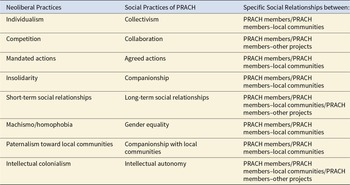
In opposition to the prevailing trends, PRACH has proposed and practiced new ways of relating among the different actors involved in archaeological research in the Chicama Valley and other spaces of academic and professional participation (Table 1). Such relationships are based on a profound reflection on our own social and archaeological praxis and on proposals that we are developing as we relate socially and dialectically with participants in our academic and professional environment. However, we do not believe that we have resolved all the contradictions described above, although we do believe that we are doing our best to improve the conditions and social relations between our own collective and others. Many more challenges are yet to be revealed and contested, and new ways of relating will have to be explored, which we hope to address in the coming years.
Main Differences between Neoliberal Social Practices and PRACH Social Practices.

Table 1 Long description
The table contrasts paired social practices associated with neoliberal approaches versus those associated with PRACH, and notes which relationships these differences apply to. Neoliberal individualism is contrasted with PRACH collectivism, and competition with collaboration, especially in relationships among PRACH members and between PRACH members and other projects. Mandated actions are contrasted with agreed actions, and insolidarity with companionship, primarily in interactions between PRACH members and local communities. Short-term social relationships are contrasted with long-term social relationships, applying both to PRACH member–community ties and PRACH member–other project ties. Machismo/homophobia is contrasted with gender equality in PRACH member–community relationships. Paternalism toward local communities is contrasted with companionship with local communities, again focused on PRACH member–community interactions. Intellectual colonialism is contrasted with intellectual autonomy, applying to both PRACH member–community and PRACH member–other project relationships. The entries are qualitative pairings rather than numerical measurements, so the table indicates thematic differences and where they are most relevant, not magnitude or frequency.
Final Comments
Current social relations in archaeology on the northern coast of Peru are a reflection of neoliberal social relations at the global level. This may sound like a pleonasm, but it requires a deeper analysis of why we have reached the current situation and the reason for its naturalization. As we have seen, this article has described a series of stories, actions, and social relations that can be extended to other archaeological projects in Peru. Obviously, each project or group linked to archaeological activity has its own specific forms and social relations, although several of the main elements highlighted here seem to be constant. Recognizing and feeling uncomfortable with such situations means making a series of decisions to improve the conditions of archaeological practice, but above all, to generate more humane, fair, and dignified social relations for all those involved in such activity.
PRACH does not want or expect to be presented as an example of overcoming such challenges and social situations that have developed under the umbrella of neoliberal economic and political relations. On the contrary, it is a proposal in progress and an effort to challenge social relations imposed from above and outside. Many obstacles will appear along the way, and only social cooperation and the generosity of each human group will be able to transform such social relations. In the end, each crew makes its own decisions, which are always political. We hope that more archaeological projects will recognize and challenge such “normal” social relations and transform them. Only then will Peruvian archaeology be able to have a positive and beneficial impact on society as a whole.
Acknowledgments
PRACH works are authorized by Resolución Directoral N° 000308-2025-DCIA-DGPA-VMPCIC/MC from the Ministerio de Cultura del Perú. We would like to thank our companions at Garrapón for their solidarity and cooperation, especially Carlos Flores, Presbítero Estrada, Isabel Flores, Priscilla Vigo, Luis Flores, Deysi Romero, James Flores, Nolly Cóndor, Junior Estrada, Cristóbal Leiva, Celia Cóndor, José Pascual, Jhoel Vigo, Natan Vigo, Jairo Vigo, and the entire community that has allowed us to share their social space in different ways.
Funding Statement
This research was supported by the Universidad Nacional Mayor de San Marcos – R.R. N° 005446-2025 and project number E25151401.
Data Availability Statement
No original data were used.
Competing Interests
The authors declare none.

 Open access

