





Imagine two 11-year-olds who were just rebuffed from a peer group. One thought: “No one likes me or wants to play with me,” and felt deeply hurt. The other: “Oh well, I will play somewhere else,” and moved on without being so emotionally affected. Peer rejection, in general, has been associated with negative child outcomes (Chiu et al., Reference Chiu, Clark and Leigh2021; Nepon et al., Reference Nepon, Pepler, Craig, Connolly and Flett2021). But certain children – like the first child described – may be more profoundly affected. Why is that? One possible explanation is that some children may be more sensitive to their surroundings, reflected in higher levels of sensory processing sensitivity (SPS; Aron et al., Reference Aron, Aron and Jagiellowicz2012; Pluess et al., Reference Pluess, Assary, Lionetti, Lester, Krapohl, Aron and Aron2018). Indeed, this trait has been linked to better emotion recognition skills (Kähkönen et al., Reference Kähkönen, Lionetti and Pluess2025), deeper processing of emotional information (Acevedo et al., Reference Acevedo, Aron, Aron, Sangster, Collins and Brown2014; Greven et al., Reference Greven, Lionetti, Booth, Aron, Fox, Schendan, Pluess, Bruining, Acevedo, Bijttebier and Homberg2019; Lionetti & Pluess, Reference Lionetti and Pluess2024), and heightened emotional reactivity in response to environmental input (e.g., Cadogan et al., Reference Cadogan, Lionetti, Murphy and Setti2023; Li et al., Reference Li, Li, Jiang and Yan2022; Lionetti et al., Reference Lionetti, Aron, Aron, Burns, Jagiellowicz and Pluess2018; Liu et al., Reference Liu, van Dijk, Deković and Dubas2023). For children high in SPS, heightened (emotional) responses to everyday social interactions may accumulate over time, potentially shaping behavior and increasing risk for psychological difficulties – especially following negative social experiences such as peer rejection (Bagwell et al., Reference Bagwell, Newcomb and Bukowski1998; Falkenstein et al., 2025).
But could this sensitivity also be a double-edged sword? If more sensitive children are more negatively affected by rejection, could they also experience more positive outcomes from peer acceptance, such as greater boosts in well-being and prosocial behavior (Wentzel & Muenks, Reference Wentzel, Muenks, Wentzel and Ramani2016; Weyns et al., Reference Weyns, Colpin and Verschueren2021)? Environmental sensitivity models, including SPS theory and differential susceptibility theory, suggest they can (Aron et al., Reference Aron, Aron and Jagiellowicz2012; Greven et al., Reference Greven, Lionetti, Booth, Aron, Fox, Schendan, Pluess, Bruining, Acevedo, Bijttebier and Homberg2019; Pluess, Reference Pluess2015). These models suggest that individuals with higher SPS levels are more aware of others’ mood and subtle social cues, and tend to register, process and respond to both positive and negative social incidents to a greater extent (Aron et al., Reference Aron, Aron and Jagiellowicz2012; Pluess, Reference Pluess2015). Hence, these individuals may be more strongly affected by both positive and negative environmental influences in a “for better” and “for worse” manner (Belsky & Pluess, Reference Belsky and Pluess2009; Ellis et al., Reference Ellis, Boyce, Belsky, Bakermans-Kranenburg and van Ijzendoorn2011; Pluess et al., Reference Pluess, Assary, Lionetti, Lester, Krapohl, Aron and Aron2018).
Research indeed shows that children vary considerably in their responses to positive and negative peer experiences (Grapsas et al., Reference Grapsas, Denissen, Lee, Bos and Brummelman2021; Liu et al., Reference Liu, van Dijk, Deković and Dubas2023; Thomaes et al., Reference Thomaes, Reijntjes, Orobio de Castro, Bushman, Poorthuis and Telch2010). Yet, two overarching issues continue to limit our understanding of children’s differential susceptibility to peer feedback. First, are the same children who suffer more from peer rejection also those who benefit more from peer acceptance (i.e., within-child differential susceptibility)? Second, can SPS serve as a reliable marker to identify these differentially susceptible children? Addressing these issues can refine models of environmental sensitivity and improve intervention targeting (Falkenstein et al., Reference Falkenstein, Sartori, Malanchini, Hadfield and Pluess2026).
The current study focuses on preadolescents aged 10 to 12, a developmental period when peer relationships become increasingly central to children’s social and emotional lives (Ellis & Zarbatany, Reference Ellis and Zarbatany2017; Harter, Reference Harter2012). Children at this age tend to show heightened susceptibility to peer feedback, exhibiting pronounced mood and state self-esteem fluctuations, strongly valenced attributions of peers’ intentions (i.e., positive or negative), and strong prosocial or aggressive responses to peer input (e.g., Grapsas et al., Reference Grapsas, Denissen, Lee, Bos and Brummelman2021; Reijntjes et al., Reference Reijntjes, Thomaes, Kamphuis, Bushman, de Castro and Telch2011; Thomaes et al., Reference Thomaes, Reijntjes, Orobio de Castro, Bushman, Poorthuis and Telch2010). These effects may be exacerbated in children with higher SPS levels, who attend to and process peer-related information even more deeply (Greven et al., Reference Greven, Lionetti, Booth, Aron, Fox, Schendan, Pluess, Bruining, Acevedo, Bijttebier and Homberg2019; Liu et al., 2023). Against this backdrop, we examined within-child differential susceptibility and SPS as a marker by addressing three complementary goals.
Goal 1: Are peer rejection and acceptance effects stronger for children with higher levels of SPS?
Prior peer research has documented individual differences in susceptibility to positive and negative peer experiences depending on personality traits, brain structure, and genotype (e.g., DiLalla et al., Reference DiLalla, Bersted and John2015; Grapsas et al., Reference Grapsas, Denissen, Lee, Bos and Brummelman2021; Schriber & Guyer, Reference Schriber and Guyer2016). However, only two studies to date have tested whether such peer effects vary with SPS. One longitudinal study found that adolescents (average age 13) who had a negative relationship with their best friend showed increased externalizing behavior one year later, only when they had higher SPS levels (Fischer et al., Reference Fischer, Larsen, van den Akker and Overbeek2022). Because this study did not find SPS-based amplification of positive relationship effects, it supports only the “for worse” side of the differential susceptibility model. Moreover, it focused on relationship quality with the best friend rather than children’s immediate responses to short-term peer feedback, as examined in the present study.
A second study is more directly relevant. Using a between-person experimental design, it showed that (pre)adolescents (ages 9 to 15) with higher SPS levels not only exhibited stronger increases in positive mood following a peer acceptance manipulation but also stronger increases in negative mood following a peer rejection manipulation, supporting the view that SPS indexes heightened susceptibility to peer feedback both “for better” and “for worse” (Liu et al., Reference Liu, van Dijk, Deković and Dubas2023). Yet, this study manipulated peer feedback via hypothetical vignettes that were imagined but not experienced. Building on this work, in the current study we manipulated peer rejection and acceptance via an ecologically valid social media task. We examined whether children with higher (vs. lower) SPS levels exhibited more pronounced pre–post feedback changes in mood and state self-esteem, as well as in their post-feedback attributions and behaviors towards the peer who provided the feedback. This approach allowed us to examine SPS as a marker of heightened short-term susceptibility to peer feedback (Slagt et al., Reference Slagt, Dubas, van Aken, Ellis and Deković2017).
Goal 2: Does a subgroup of children exist who show heightened mood and self-esteem reactivity to both rejection and acceptance, and can SPS differentiate this subgroup from other subgroups?
Most prior studies testing differential susceptibility have used moderation analyses, testing children’s responses to peer rejection and acceptance separately (as in Goal 1). While informative, these variable-centered approaches cannot determine whether the same children are more reactive to both positive and negative peer interactions – a key assumption of differential susceptibility (Ellis et al., Reference Ellis, Boyce, Belsky, Bakermans-Kranenburg and van Ijzendoorn2011).
Addressing this assumption requires within-child designs combined with person-centered analyses. Although such studies exist, they have mostly focused on parenting and yielded mixed findings. For example, a longitudinal study tracked parents and adolescents over a year and identified one subgroup of adolescents (26%) whose psychological functioning improved with positive parenting and worsened with negative parenting, supporting within-child susceptibility (Boele et al., Reference Boele, Bülow, De Haan, Denissen and Keijsers2024). In contrast, an experimental study found no susceptible subgroup among young children (ages 4-6) exposed to puppet play mimicking positive and negative parental feedback, possibly due to the mild and artificial nature of the manipulation (Slagt et al., Reference Slagt, Dubas, van Aken, Ellis and Deković2017).
Building on this work, we conducted person-centered analyses on children’s mood and self-esteem reactivity to experimentally manipulated peer rejection and acceptance. This approach allowed us to determine whether a subgroup of children exists who show heightened reactivity to both rejection and acceptance (i.e., within-child differential susceptibility) and to test whether SPS can differentiate this subgroup from other identified subgroups (e.g., a low reactivity subgroup). We did not include attributions or behavior in Goal 2, as these were assessed only post-feedback and reflected responses to an online peer rather than pre-to-post changes in reactivity.
Goal 3: Do children fall into distinct SPS subtypes that show heightened responsivity to either rejection or acceptance?
Extending the concept of differential susceptibility, recent work on SPS suggests that, in addition to children who are sensitive to both positive and negative experiences (as in Goal 2), there may also be subgroups of children sensitive to only one type of experience. Specifically, it has been proposed that the valence of early environments may shape the expression of sensitivity later in development, giving rise to subtypes such as generally sensitive (i.e., more sensitive to both), vantage-sensitive (more sensitive to supportive environments), vigilant (more sensitive to negative environments), and non-sensitive (Huang & Pluess, Reference Huang and Pluess2025; Pluess, Reference Pluess2015; Pluess et al., Reference Pluess, Lionetti, Aron and Aron2023). For instance, children with high SPS levels who are exposed to harsh parenting may develop a vigilant profile, showing stronger responses to peer rejection but not acceptance, as they have not been sensitized to promotive contexts.
Valence-specific sensitivity is supported, albeit indirectly, by studies identifying positive and negative SPS dimensions through factor analysis (Assary et al., Reference Assary, Zavos, Krapohl, Keers and Pluess2021; Weyn et al., Reference Weyn, Van Leeuwen, Pluess, Lionetti, Goossens, Bosmans, Van Den Noortgate, Debeer, Bröhl and Bijttebier2022), as well as by findings showing that these dimensions have distinct genetic underpinnings, moderating roles, and associations with other traits (Assary et al., Reference Assary, Zavos, Krapohl, Keers and Pluess2021; Li et al., Reference Li, Li, Jiang and Yan2022; Vander Elst et al., Reference Vander Elst, Sercu, Van den Broeck, Van Hoof, Baillien and Godderis2019). However, because these findings are based on variable-centered analyses, they do not directly indicate whether valence-specific SPS subgroups exist. One person-centered study did identify low, medium, and high SPS subgroups (Pluess et al., Reference Pluess, Assary, Lionetti, Lester, Krapohl, Aron and Aron2018), but these subgroups were derived from SPS item scores and it did not examine valence-specific responsivity to positive versus negative feedback. Building on this work, we conducted person-centered analyses on children’s positive and negative SPS subscale scores. This approach allowed us to examine whether more differentiated positive and negative SPS dimensions could yield distinct SPS subgroups, and whether these subgroups would exhibit differences in responsivity to peer rejection and acceptance (i.e., SPS subtypes as marker).
The present study
Using a social media task, we manipulated peer rejection and acceptance in two experimental sessions spaced three weeks apart (i.e., within-child). We included a control group receiving neutral feedback in both sessions to establish our manipulation effects (i.e., between-child). We assessed children’s mood and state self-esteem reactivity (i.e., pre- to post-feedback changes) as well as intent attribution and behavior (i.e., post-feedback levels). For each outcome, we included both positive and negative aspects (e.g., prosocial and antisocial behavior) to test both the “for better” and “for worse” sides of differential susceptibility (Belsky & Pluess, Reference Belsky and Pluess2009; Ellis et al., Reference Ellis, Boyce, Belsky, Bakermans-Kranenburg and van Ijzendoorn2011; Slagt et al., Reference Slagt, Dubas, van Aken, Ellis and Deković2017).
This study offers the first test of within-child differential susceptibility to peer rejection and acceptance, as well as a comprehensive examination of SPS as a marker of differential susceptibility to peer feedback. Consistent with our preregistration, we tested three hypotheses across three goals. Goal 1 concerns SPS moderation: We hypothesized that the positive effects of acceptance and the negative effects of rejection would be amplified in children with higher levels of SPS. Goal 2 concerns reactivity subgroups: We hypothesized that person-centered analyses of mood and state self-esteem reactivity scores would identify a subgroup of children with heightened mood and state self-esteem reactivity to both rejection and acceptance, and that this subgroup would report higher SPS levels than other identified subgroups. Goal 3 concerns SPS subgroups: We hypothesized that person-centered analyses of positive and negative SPS dimension scores would identify distinct SPS subgroups, potentially including generally sensitive children (i.e., more sensitive to both positive and negative environments), vantage-sensitive children (more sensitive to supportive environments), vigilant children (more sensitive to negative environments), and non-sensitive children. If such SPS subgroups emerged, we expected them to differ in their responses to peer rejection and acceptance accordingly. For example, we would expect vantage-sensitive children to show stronger responses to acceptance but not rejection.
Our study was confirmatory. We have preregistered our hypotheses, design, measures, and analyses at the Open Science Framework (https://osf.io/f7zpb), where we also documented minor deviations from the original plan. We have made our data and analysis code publicly available (https://osf.io/y3c9g).
Method
Participants
Participants were 455 Chinese preadolescents ages 10–12 (M age = 10.86, SD = 0.38; 49.5% boys; 99.5% Han ethnicity), recruited from the fifth grade of an elementary school located in an urban area of Hubei, China. The sample was relatively low-risk. Caregiver reports revealed that 95.1% of fathers and 89.6% of mothers completed China’s 9-year compulsory education (up to middle school), aligning with typical urban norms in China. In addition, 63.6% of families reported an annual income of more than 60,000 Chinese Yuan (about $8,408), about the provincial average (Hubei Provincial Statistics Bureau, 2022).
Data collection partly overlapped with the third wave of a larger longitudinal study (Liu et al., Reference Liu, Van Dijk, Deković and Dubas2026) for which we sent informed consent forms to the school headmaster, headteachers, caregivers (90.3% provided consent), and children (100%). Most caregivers (83.1%) provided demographic information (via a link shared by headteachers). For practical reasons (i.e., computer room size), we randomly selected 462 (73.9%) children from the 10 participating classrooms (N = 625) to participate in the present experiment. After excluding children who were absent during both sessions (n = 1) or erroneously received peer acceptance or rejection twice (n = 6), the final sample size was 455. We oversampled the experimental versus control group at a 2:1 ratio to increase statistical power for detecting moderator effects and latent profiles within the experimental group.
We did not conduct power analyses because these require population parameters that are unavailable for this novel design (Wang & Rhemtulla, Reference Wang and Rhemtulla2021). However, our sample size compares favorably with prior studies that detected significant effects using similarly complex models (e.g., Bernard et al., Reference Bernard, Peloso, Laurenceau, Zhang and Dozier2015, N = 168; Field et al., Reference Field, Choukas-Bradley, Giletta, Telzer, Cohen and Prinstein2024, N = 250; Quinn et al., Reference Quinn, Wagner, Petscher and Lopez2015, N = 316). Moreover, experimental designs like ours offer greater statistical power to detect differential susceptibility effects than correlational or longitudinal designs, as they create standardized, clearly defined manipulations that reduce measurement error in environmental exposure (Overbeek, Reference Overbeek2017; Slagt et al., Reference Slagt, Dubas, van Aken, Ellis and Deković2017).
Procedure
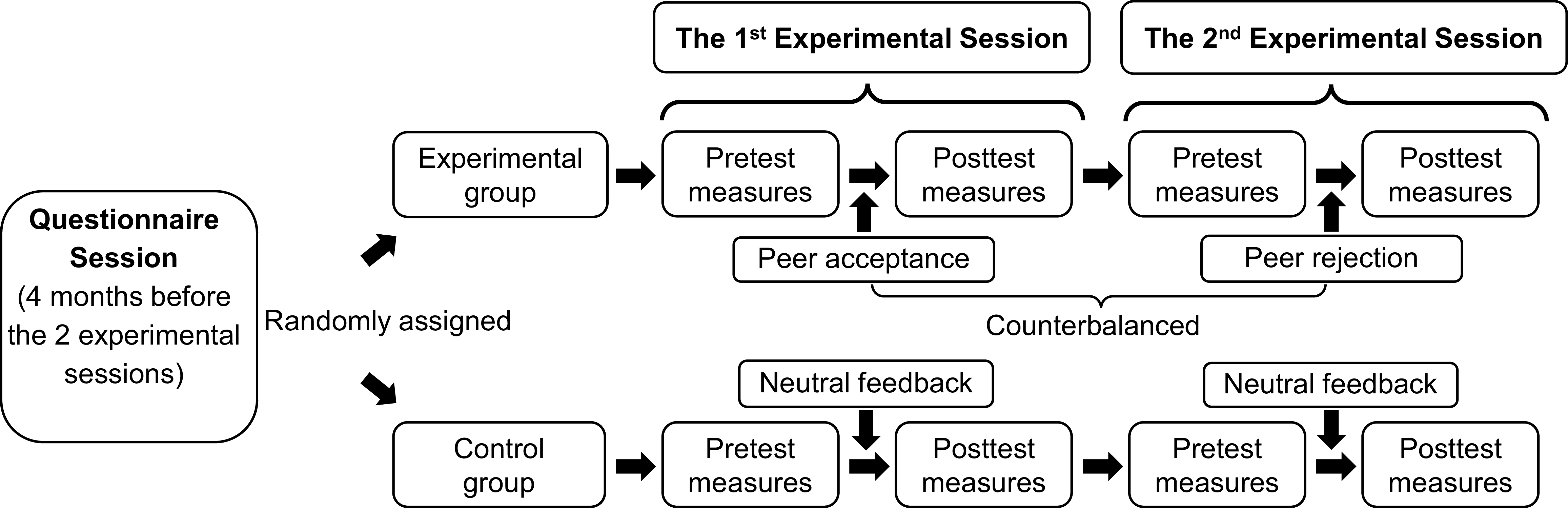
Children participated in three study sessions at their schools (Figure 1). During the initial questionnaire session (December 2021), they completed classroom-based surveys reporting on their SPS, potential control variables (i.e., frequency of smartphone, computer, and social media use; real-life peer rejection and acceptance assessed with peer nominations), and other measures not relevant to the current study (Liu et al., Reference Liu, Van Dijk, Deković and Dubas2026).
Study design.
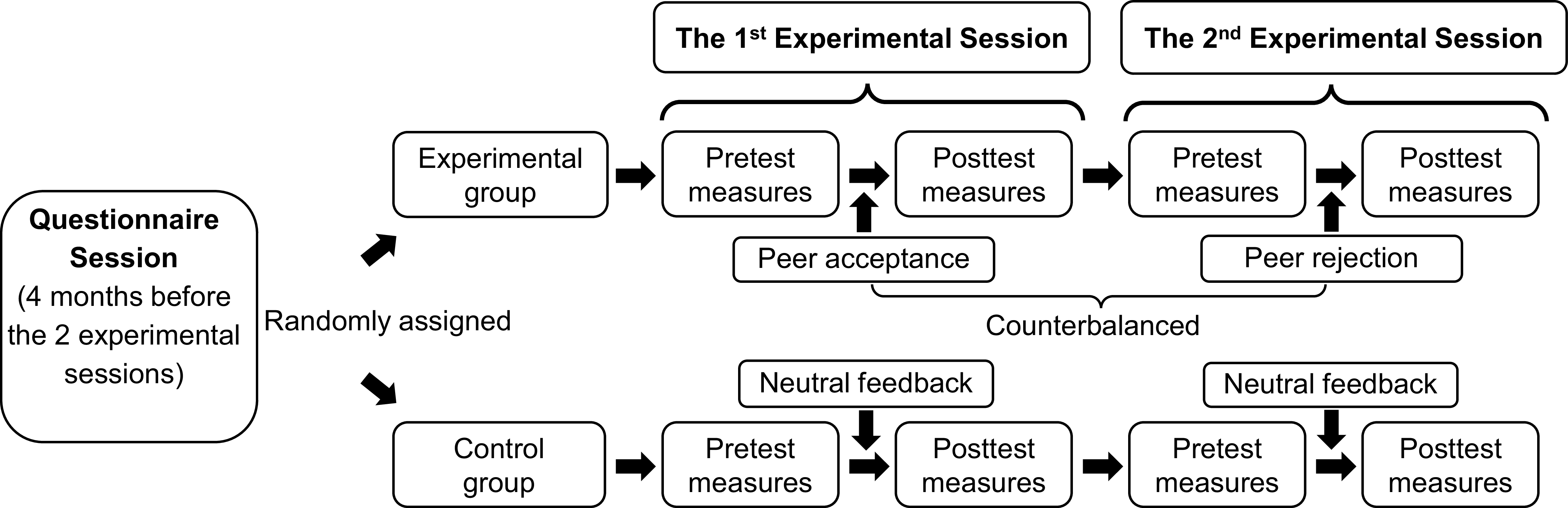
After this session, we randomly assigned children to either the experimental group (n = 315) or control group (n = 140). Within the experimental group, we further randomized across the two experimental sessions: (1) the order in which children experienced the peer rejection and acceptance conditions, and (2) which of the two parallel versions of gender-matched peer profiles they received first. All randomization was conducted at the individual level within classrooms using a random number generator.
Four months later (April–May 2022), children participated in two 25-minute experimental sessions spaced three weeks apart. Each session consisted of pretest measures, a social media task manipulating peer rejection and acceptance, and posttest measures, all administered via Qualtrics in classrooms, with children seated at individual computer stations equipped with headphones and cardboard dividers. Two trained experimenters and one headteacher supervised each session. The experimenter briefly introduced the study’s goal and procedure, after which children received further instructions via prerecorded audio in Qualtrics. The two sessions were identical in procedure and content, differing only in the counterbalanced condition and profile version.
To provide a credible rationale for the repeated session and prevent carryover effects, the experimenter staged a phone call at the end of the first session. During this call – conducted audibly in front of the class – she “learned” of a “technical glitch” on the social media platform that had “mixed up” children’s received feedback. She then explained the glitch, reassured the children, explained that the task would be repeated in three weeks, and emphasized that the feedback should not be taken personally.
To mitigate any lingering effects of the rejection manipulation, all children played the inclusion version of the Cyberball game at the end of each session (Williams, Reference Williams and Zanna2009), receiving an equal number of tosses as two simulated peers. Such inclusion has been shown to alleviate post-exclusion distress (Tang & Richardson, Reference Tang and Richardson2013).
At the end of the second session, the experimenter fully debriefed children, explaining that the peer feedback was fictional and pre-programmed. Children were encouraged to ask questions or share concerns (no concerns were raised). Children received a small gift after each session (e.g., a highlighter). This study procedure was approved by the ethics board of Social and Behavioral Sciences at Utrecht University (approval number: 21-0271).
Experimental manipulation of peer rejection and acceptance
We developed a social media platform to manipulate peer rejection and acceptance by same-age simulated peers who provided Likes and Dislikes on children’s profiles (based on Lee et al., Reference Lee, Jamieson, Reis, Beevers, Josephs, Mullarkey, O’Brien and Yeager2020; Lutz & Schneider, Reference Lutz and Schneider2021; see Figure 2 and Supplementary Material for details). The experimenter explained to the children that they would interact online with 5th graders from another school via a website called “Get-to-Know-People.” To enhance credibility, the experimenter made a phone call aloud – ostensibly to an experimenter at the other school – to confirm the other students were ready. Children then opened the website, which guided them through five phases:
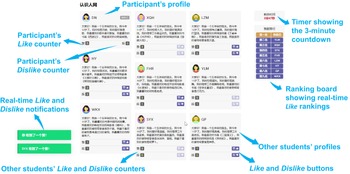
The acceptance condition of the social media task. Note. During the 3-minute interaction, children’s profile appeared at the top left corner, while simulated peers’ profiles were displayed in random order (e.g., the YLM profile read: “Hello everyone! I am a fifth-grade girl. I am 11 years old this year. I have a gentle personality. My hobby is dancing. My dream job is to be a dance teacher. My favorite book is “Andersen’s Fairy Tales.” My favorite food or snack is chocolate.”). Whenever children received a Like or Dislike from a peer, the counter below their profile was updated, a green notification window appeared at the bottom left corner of their screen, and the Like ranking on the right corner was reordered. The distribution and timing of preprogrammed Likes and Dislikes for the simulated peers was constant across conditions (see Supplementary Material). Video simulations of all three conditions are available at: https://osf.io/y3c9g.
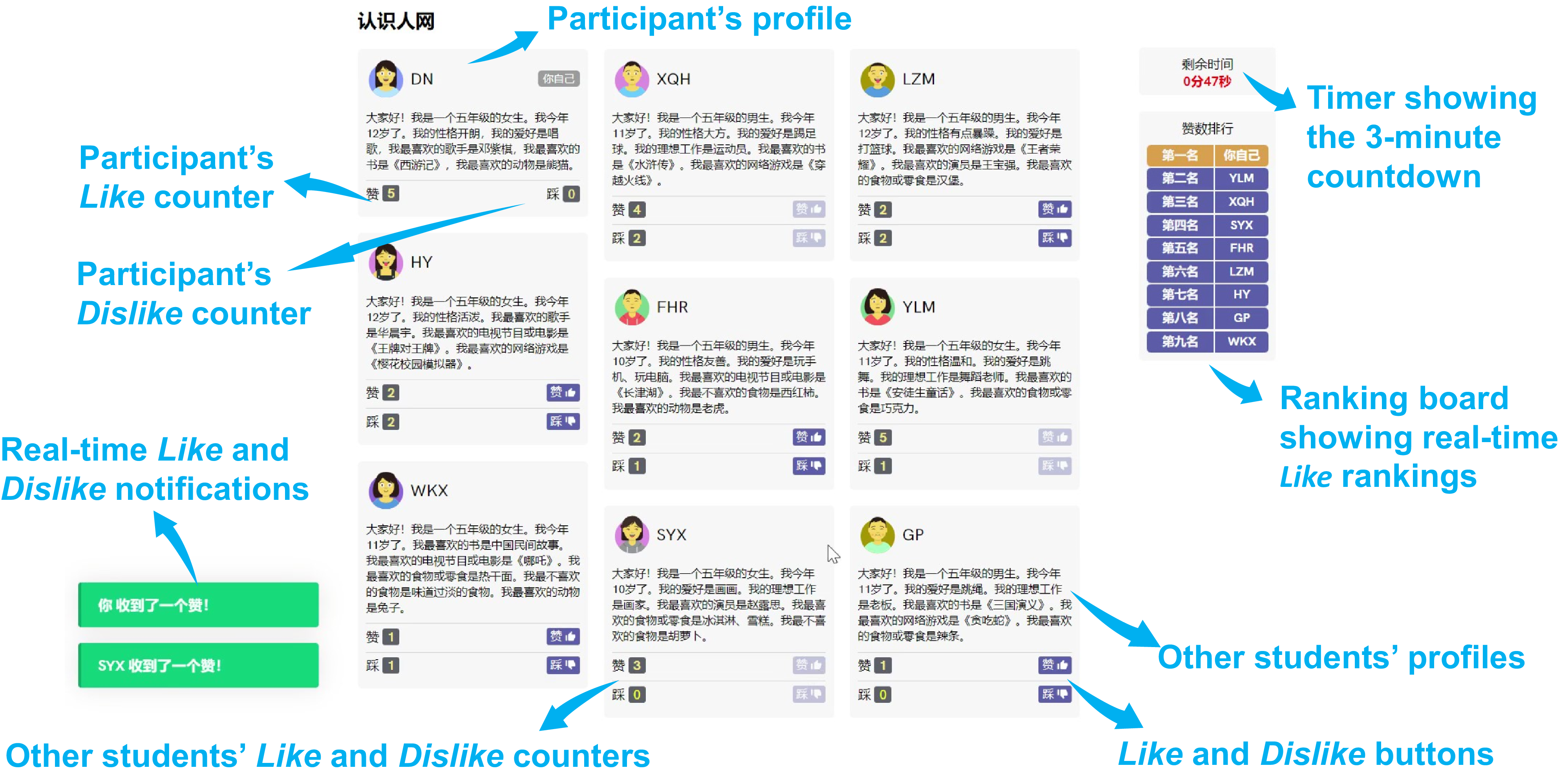
First, children created a profile. They entered their initials and selected their gender, age, and an avatar to represent them (a cartoon image). Next, they chose five topics from a list of eleven (e.g., hobbies, personality traits). For each chosen topic, they chose one of five provided options (e.g., playing basketball, being outgoing) or typed their own response. Their responses were synthesized into a brief profile description. All provided topics and response options were based on a pilot study asking 50 5th-graders to describe their personal profiles, as were the fictitious peer profiles (see Supplementary Material for full details).
Second, children received audio instructions: “You will interact with other students on this website. During this interaction, you can like or dislike other students’ profiles.” For the experimental group, the instructions continued with: “Other students can also like or dislike your profile.” For the control group, the instructions continued with: “This is a test version of the website. Therefore, you will be in incognito mode: your profile will be invisible to others. You won’t receive any likes or dislikes from other students.”
Third, children followed a simulated website tour, familiarizing them with all features of the website (e.g., Like and Dislike buttons and counters, the 3-minute countdown, and the ranking board showing their real-time Like ranking; Figure 2).
Fourth, children started the 3-minute interaction. They saw their profile together with eight simulated peers’ profiles (Figure 2). For the rejection condition, children received 1 Like and 5 Dislikes, causing them to gradually sink to the last place on the ranking board (i.e., most disliked and least liked). For the acceptance condition, children received 6 Likes and 0 Dislikes, causing them to gradually rise to the first place on the ranking board (i.e., most liked and least disliked). In the control group, children did not receive Likes or Dislikes and were not displayed on the ranking board. We carefully designed the distribution of Likes and Dislikes among simulated peers, ensuring that children in the experimental group always received the most Likes (for the acceptance condition) or Dislikes (for the rejection condition), regardless of how many profiles they ‘liked’ or ‘disliked’ themselves.
Fifth, children received the peer feedback results. At the end of the interaction, a “Final Result” pop-up appeared, summarizing the number of Likes and Dislikes children received (experimental group) or gave out (control group). For the rejection condition, it showed “You got the most Dislikes (5 Dislikes) and the least Likes (1 Like).” For the acceptance condition, it showed “You got the most Likes (6 Likes) and the least Dislikes (0 Dislikes).” For the neutral condition, it showed “You gave out # Likes and # Dislikes.” Following that, a “Message Received!” pop-up appeared from a simulated peer (i.e., the most liked and least disliked peer, matched to the participant’s gender). The message in the acceptance condition was: “I looked through all those profiles and I really liked yours. I’d really want to be friends with you if we met.” In the rejection condition, it was: “I looked through all those profiles and I don’t think I like yours that much. I probably wouldn’t want to be friends with you if we met.” In the control group, it was: “I didn’t see your profile, but I did view someone else’s. I liked some profiles but not others. I’d be interested in being friends with some people but not others.” Ten seconds after the pop-up, children proceeded with the posttest measures.
Measures
We used a back-translation procedure to ensure the equivalence of all measures between the original English and the Chinese translated version (see Supplementary Material).
Sensory processing sensitivity
Children reported on their SPS using the 21-item version of the Highly Sensitive Child Scale (HSC-21; Weyn et al., Reference Weyn, Van Leeuwen, Pluess, Lionetti, Goossens, Bosmans, Van Den Noortgate, Debeer, Bröhl and Bijttebier2022). General sensitivity is captured by the total score. The negative and positive SPS dimensions are captured by the subscales “Ease Of Excitation – Low Sensory Threshold” (EOE-LST; 13 items; e.g., “I find it unpleasant to have a lot going on at once”) and “Aesthetic Sensitivity” (AES; 8 items; e.g., “How food tastes matters me very much”), respectively. Children rated the items on a 7-point Likert scale with three anchors (1 = not at all, 4 = moderately, and 7 = extremely) with higher scores indexing greater sensitivity. We calculated the total and subscale scores as the mean across items. Internal consistency was sufficient for the total score (α = 0.75), EOE-LST (α = 0.68), and AES (α = 0.71). Using Confirmatory Factor Analysis (CFA), we validated the bifactor structure of the HSC-21 within our sample (CFI = 0.903; RMSEA = 0.037; SRMR = 0.048).
Positive and negative mood
We assessed children’s mood before and after the manipulation, using the 8-item mood subscale of the need threat questionnaire (Williams, Reference Williams and Zanna2009). We assessed positive mood (4 items; i.e., “Good,” “Friendly,” “Pleasant,” and “Happy”) and negative mood (4 items; i.e., “Bad,” “Unfriendly,” “Angry,” and “Sad”). Children rated how they felt right now, at the present time on a 5-point Likert scale (1 = Not at all, 5 = Extremely). We calculated positive and negative mood as the mean across items (αs > 0.74 for both scales at both time points across both experimental sessions).
Positive and negative state self-esteem
We assessed children’s state self-esteem before and after the manipulation, using the 6-item state self-esteem scale (Thomaes et al., Reference Thomaes, Reijntjes, Orobio de Castro, Bushman, Poorthuis and Telch2010). We assessed positive state self-esteem (3 items; e.g., “I am proud of myself right now”) and negative state self-esteem (3 items; e.g., “I am disappointed in myself right now”). Children rated how they felt right now, at the present time on a 5-point Likert scale (1 = Not at all, 5 = Extremely). We calculated positive and negative state self-esteem as the mean across items (αs > 0.74 for both scales at both time points across both experimental sessions).
Benign and hostile intent attribution
We assessed children’s intent attributions after the manipulation. These attributions addressed the accepting/rejecting message sent by the gender-matched peer. We created 2 items reflecting benign attributions (i.e., “He or she wanted to be nice,” “He or she tried to help me”) and 2 items reflecting hostile attributions (i.e., “He or she wanted to be mean,” “He or she tried to hurt me”), based on previous research (e.g., Saleem et al., Reference Saleem, Anderson and Barlett2015). Children rated their agreement with each item on a 5-point Likert scale (1 = Not at all; 5 = Extremely). We calculated benign and hostile intent attribution as the mean across the 2 items (rs > .63 for both scales across both experimental sessions).
Prosocial and aggressive behavioral responses
We assessed children’s behavioral responses after the manipulation, using a help or hurt task (Saleem et al., Reference Saleem, Anderson and Barlett2015). Children learned that the peer who had sent them the message was participating in a talent competition for which he or she was eagerly asking for online votes. Children could either help or harm this peer by giving votes (clicking a “+” button) or removing votes (clicking a “–” button) within a time frame of 20 s. The numbers of “+” and “–” clicks indexed prosocial and aggressive behavioral responses, respectively. We instructed children that they could choose not to click any button, providing a neutral response option.
Condition and suspicion check
After each session, we checked whether children accurately remembered the peer feedback they received by asking them to choose between: 1) I received more Likes than Dislikes; 2) I received more Dislikes than Likes; or 3) I did not receive Likes or Dislikes myself. After the second session, we checked whether children expressed suspicion about the manipulation or inferred the study’s goals, asking two open-ended questions: “Do you have any thoughts about the other students you interacted with on the ‘Get-to-Know-People’ website?” and “What do you believe is the aim of this research?”.
Data analysis strategy
Preliminary analyses
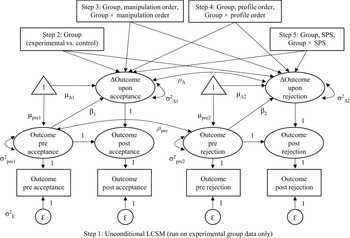
We conducted four sets of preliminary analyses. First, we checked whether children in the experimental and control groups showed statistically significant differences on (a) main study variables before the manipulation (i.e., gender, age, SPS, mood and state self-esteem) and (b) potential control variables (i.e., frequency of smartphone, computer, and social media use; real-life peer rejection and acceptance), using ANOVAs and Chi-square tests. Second, we checked whether children significantly varied in their responses to peer rejection and acceptance, using unconditional latent change score models (LCSMs; McArdle, Reference McArdle2009) modeling children’s pre-to-post changes in mood and state self-esteem (Step 1 in Figure 3) or unconditional regression models modeling children’s posttest levels of attributions and behavior. Third, we examined whether children in the acceptance and rejection conditions differed in their responses compared to children in the control group (i.e., manipulation main effects), using LCSMs for mood and state self-esteem, and regression for attributions and behavior. To conduct these analyses, we randomly coupled control group children – who received neutral peer feedback twice – with experimental group children who received either the rejection or acceptance condition first. We then used Group (experimental vs. control) to predict latent change scores or posttest scores (Step 2). Fourth, we checked manipulation order and profile order effects. We regressed latent change scores or posttest scores on Group, manipulation order, and their interaction (Step 3); and Group, profile version, and their interaction (Step 4).
Conceptual diagram of the Latent Change Score Models (LSCMs). Note. The unconditional latent change score model includes the following parameters: latent change scores (μΔ1, μΔ2), and their variances (σ2 Δ1, σ2 Δ2); latent pretest means (μpre1, μpre2) and their variances (σ2 pre1, σ2 pre2); the latent posttest score, defined as a one-to-one function of the latent pretest score and latent change score, with paths fixed to 1; the regression of latent change scores on their corresponding pretest scores (β1, β2); the correlation between the two pretest scores (ρ pre) and between the two latent change scores (ρ Δ); and errors (σ2 E) that are assumed to have a mean of 0 and equal variances across time.
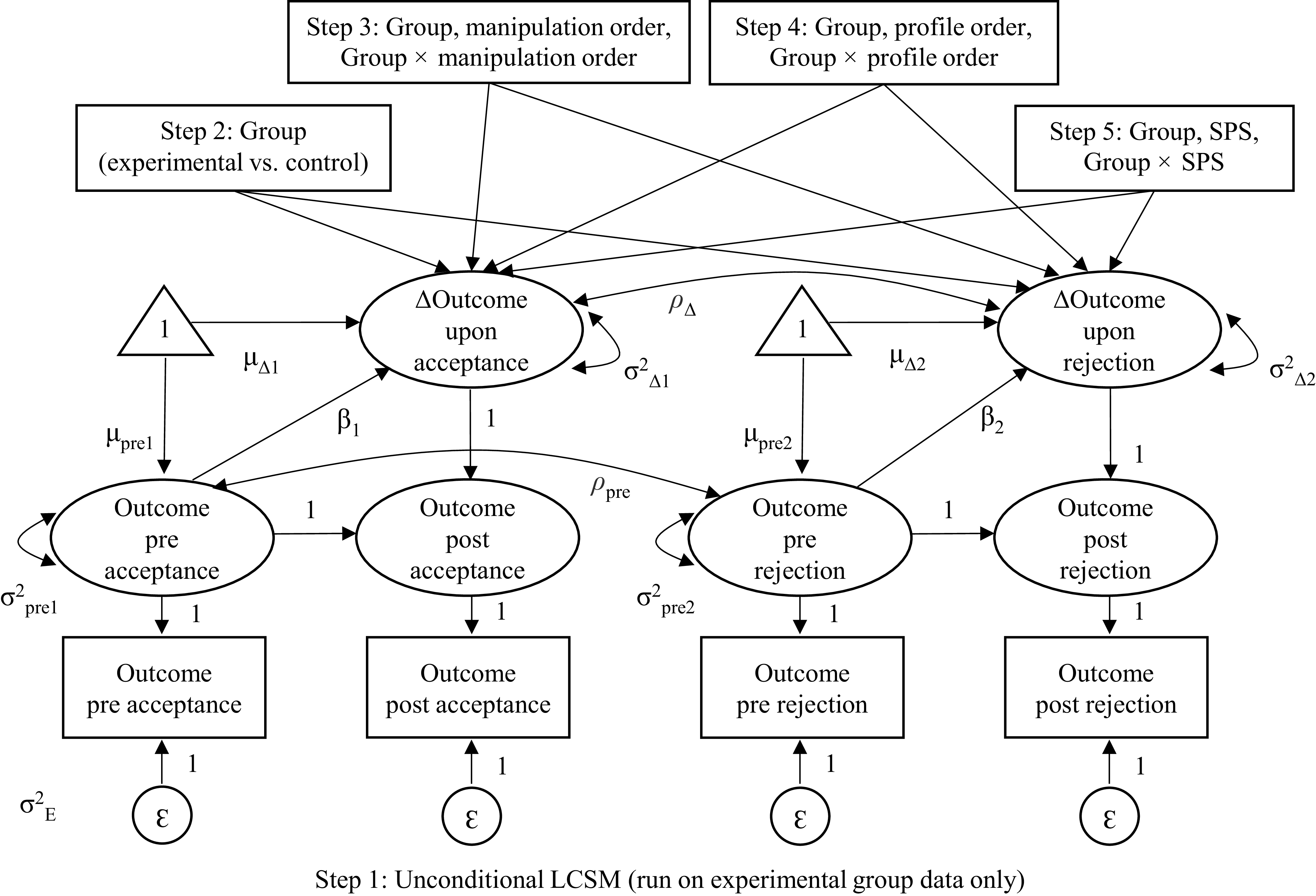
Figure 3 Long description
A conceptual diagram of the Latent Change Score Models (LSCMs). The diagram includes the following parameters: latent change scores (1, 2), and their variances (2 1, 2 2); latent pretest means (pre1, pre2) and their variances (2 pre1, 2 pre2); the latent posttest score, defined as a one-to-one function of the latent pretest score and latent change score, with paths fixed to 1; the regression of latent change scores on their corresponding pretest scores (1, 2); the correlation between the two pretest scores (pre) and between the two latent change scores (); and errors (2 E) that are assumed to have a mean of 0 and equal variances across time. The diagram is divided into two main sections: acceptance and rejection. Each section includes outcomes pre and post acceptance or rejection, and the change in outcome upon acceptance or rejection. The relationships between these parameters are depicted with arrows indicating the direction of influence.
Goal 1: SPS as a moderator of peer feedback effects
To test whether SPS moderated children’s responses to peer rejection and acceptance, we regressed latent change scores (for mood and state self-esteem) or posttest scores (for intent attributions and behavior) on Group, SPS, and their interaction (Step 5 in Figure 3).
Goal 2: Reactivity subgroups and differentiation by SPS
To examine whether there is a subgroup of children who show heightened reactivity to both rejection and acceptance (i.e., within-child differential susceptibility), we ran latent profile analyses (LPAs) using eight indicators: children’s latent changes in positive and negative mood and state self-esteem upon rejection and acceptance (derived from the unconditional LCSMs). We used only experimental group data as the control group received neutral feedback. We compared 2–6 profile solutions, aiming to select the model with the lowest Akaike Information Criterion (AIC) and Bayesian Information Criterion (BIC), entropy closest to 1, a significant Lo-Mendell-Rubin Likelihood-Ratio Test (LMR) and Bootstrapped Likelihood Ratio Test (BLRT), no profiles consisting of <5% of participants, and good interpretability. To interpret the best-fitting model, we examined indicator differences between profiles using one-way ANOVAs. Last, we examined whether a differentially susceptible profile would be characterized by higher SPS scores. To do so, we compared SPS levels across profiles using pairwise comparisons within the selected LPA model. We used the Bolck-Croon-Hagenaars (BCH) method (Asparouhov & Muthén, Reference Asparouhov and Muthén2021), which accounts for classification errors and avoids shifts in latent profiles that may occur when variables are added.
Goal 3: SPS subgroups and differences in responsivity to peer feedback
To examine whether there are distinct subtypes of children based on their positive and negative SPS dimension scores, we ran LPAs using two indicators: children’s standardized EOE-LST and AES scores. We used only experimental group data, so that we could compare the obtained profiles on their responses to peer rejection and acceptance (using both control and experimental group data, we identified the same best-fitting SPS profile solution; Table S10). We compared 2–6 profile solutions, selecting the best-fitting model (see criteria above), and tested indicator differences between profiles using one-way ANOVAs. Last, we examined whether a vantage or vigilant sensitivity subgroup would show heightened responsivity to either acceptance or rejection, respectively. Within the selected LPA model, we ran pairwise comparisons separately for each outcome (derived from the unconditional LCSMs and regression models above). We used the BCH method as in Goal 2.
Technical specifications, missing data, and false discovery rate (FDR) procedure
We used SPSS for descriptive analyses and Mplus version 8.9 for all other analyses. We standardized all continuous variables into z-scores. For posttest scores with corresponding pretests, we used the pretest means and standard deviations to create z-scores, enhancing the interpretation of latent change scores (Quinn et al., Reference Quinn, Wagner, Petscher and Lopez2015). We used the maximum likelihood robust (MLR) estimator to address nonnormality for both LCSMs and LPAs, but used the Bayes estimator for the unconditional LCSMs on the experimental group data to prevent negative residual variances. We used default non-informative priors in Mplus; see Supplementary Materials for full details. Missingness ranged from 0% to 8.4% across variables (M = 4.2%). Little’s MCAR test on all study variables suggests that data were missing completely at random, χ 2(185) = 188.70, p = .411. We handled missing data using full-information-maximum-likelihood (FIML; Enders & Bandalos, Reference Enders and Bandalos2001). We used a False Discovery Rate (FDR) procedure to control for inflated Type I errors (Benjamini & Hochberg, Reference Benjamini and Hochberg1995). For Goal 1, we applied FDR across all outcomes in both conditions for each step separately. For Goals 2 and 3, we applied FDR across all pairwise comparisons between profiles for each outcome separately.
Robustness checks
We ran two sets of robustness checks: (1) participant exclusion checks and (2) SPS measure checks using the original 12-item version. First, we repeated the Goal 1–3 analyses, excluding data of children who: (a) did not accurately remember the peer feedback they received (i.e., did not succeed condition check; Experimental group: n = 20; Control group: n = 70); (b) expressed suspicion or guessed the study goal (n = 16); (c) experienced technical issues (n = 50); (d) showed low compliance as noted by the experimenter (i.e., n = 48); (e) had outcome scores defined as outliers (z > 3.29 or z < −3.29; ns ≤ 14, depending on the outcome), and (f) rated intent attribution items that were slightly differently worded (n = 93). All results remained consistent (Tables S12–S16), with one exception, detailed below. Second, we examined the robustness of our findings across the revised 21-item HSC and the original 12-item HSC (Pluess et al., Reference Pluess, Assary, Lionetti, Lester, Krapohl, Aron and Aron2018) for Goal 1 and Goal 2 (note that Goal 3 relies on the HSC-21 structure distinguishing positive and negative SPS dimensions). All findings remained consistent across measures (Tables S17–S18).
Results
Preliminary analyses
Randomization check
We found no significant differences between children in the experimental and control group on gender, age, SPS, pretest mood, pretest state self-esteem, real-life peer rejection and acceptance, or frequency of smartphone, computer and social media use (all ps > .05), indicating successful randomization (see Tables S1 and S2 for descriptive statistics).
Individual differences in children’s responses to peer rejection and acceptance
Children showed significant variances in their responses to peer rejection and acceptance (Figure 1, Step 1), for all outcomes (Tables S3–S5). The variances were generally larger for rejection than for acceptance, suggesting greater variability in children’s responses to rejection compared to acceptance.
Main effects of peer rejection and acceptance
The rejection and acceptance manipulations significantly affected children’s responses for 15 out of 16 effects (all but post-acceptance aggressive behavior). These effects were in condition-congruent directions (Table S6). For instance, children in the experimental group had larger decreases in positive mood upon peer rejection and higher levels of benign intent attribution upon peer acceptance, compared to children in the control group. Overall, peer rejection had moderate-to-large effects (with standardized absolute coefficients ranging from 0.66 to 1.86) and peer acceptance had small-to-moderate effects (ranging from 0.28 to 0.69).
Order effects
We found no order effects of the manipulation (rejection or acceptance first) or peer profile version (Table S7).
Goal 1: SPS as a moderator of peer feedback effects
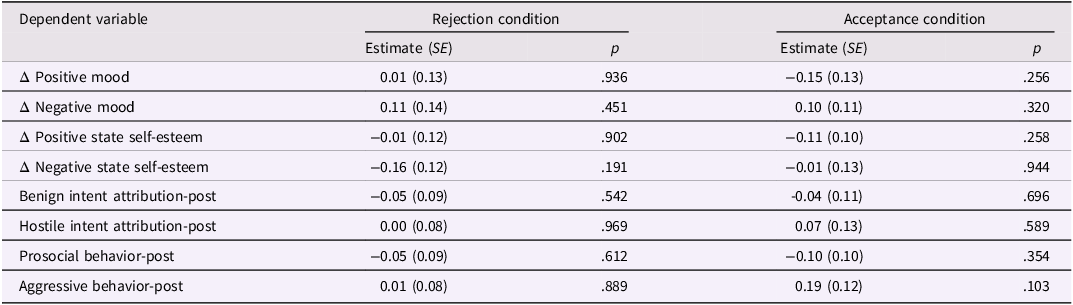
Unexpectedly, we found no significant Group × SPS interactions for any of the 16 tested effects, even before applying FDR (Table 1). Thus, our data provided no support for SPS as a moderator of children’s responses to peer rejection or acceptance.
Goal 1 interaction effects of group (0 = Control, 1 = Experimental) × SPS on children’s standardized latent changes (Δ) in mood and state self-esteem (N = 455) and posttest levels of intent attribution and behavior (n = 449a)
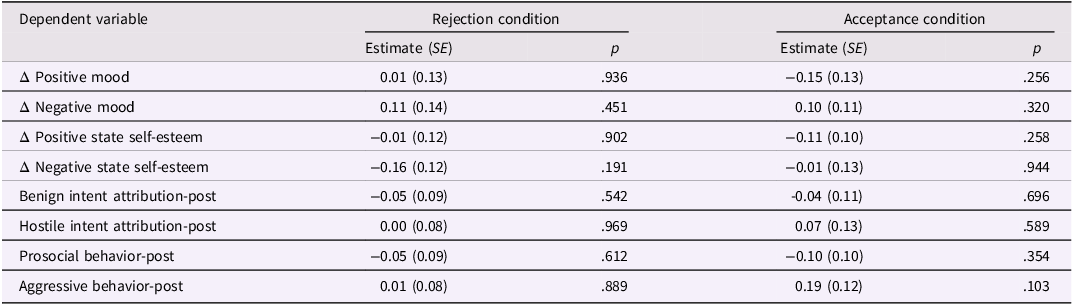
Table 1 Long description
A table comparing the effects of group SPS on children's standardized latent changes in mood, self-esteem, and behavior. The table has 8 rows and 6 columns. The columns are labeled as follows: Dependent variable, Rejection condition Estimate (SE), Rejection condition p, Acceptance condition Estimate (SE), Acceptance condition p. The rows are labeled as follows: Δ Positive mood, Δ Negative mood, Δ Positive state self-esteem, Δ Negative state self-esteem, Benign intent attribution-post, Hostile intent attribution-post, Prosocial behavior-post, Aggressive behavior-post. Row 1: Δ Positive mood, 0.01 (0.13), 0.936, -0.15 (0.13), 0.256. Row 2: Δ Negative mood, 0.11 (0.14), 0.451, 0.10 (0.11), 0.320. Row 3: Δ Positive state self-esteem, -0.01 (0.12), 0.902, -0.11 (0.10), 0.258. Row 4: Δ Negative state self-esteem, -0.16 (0.12), 0.191, -0.01 (0.13), 0.944. Row 5: Benign intent attribution-post, -0.05 (0.09), 0.542, -0.04 (0.11), 0.696. Row 6: Hostile intent attribution-post, 0.00 (0.08), 0.969, 0.07 (0.13), 0.589. Row 7: Prosocial behavior-post, -0.05 (0.09), 0.612, -0.10 (0.10), 0.354. Row 8: Aggressive behavior-post, 0.01 (0.08), 0.889, 0.19 (0.12), 0.103.
Note. For each outcome, interaction effects were estimated for both the Rejection and Acceptance conditions compared to the control group in a single latent change score model (see Figure 3). Estimates for each condition (i.e., Rejection and Acceptance) are presented in separate columns.
SPS = sensory processing sensitivity. Estimate = unstandardized parameter estimate derived from standardized scores. SE = standard error.
a Six participants were excluded because they missed all intent attribution and behavior data for both sessions. Such missing data could not be handled by the FIML method in Mplus as these cases had no available information on outcome variables.
Goal 2: Reactivity subgroups and differentiation by SPS
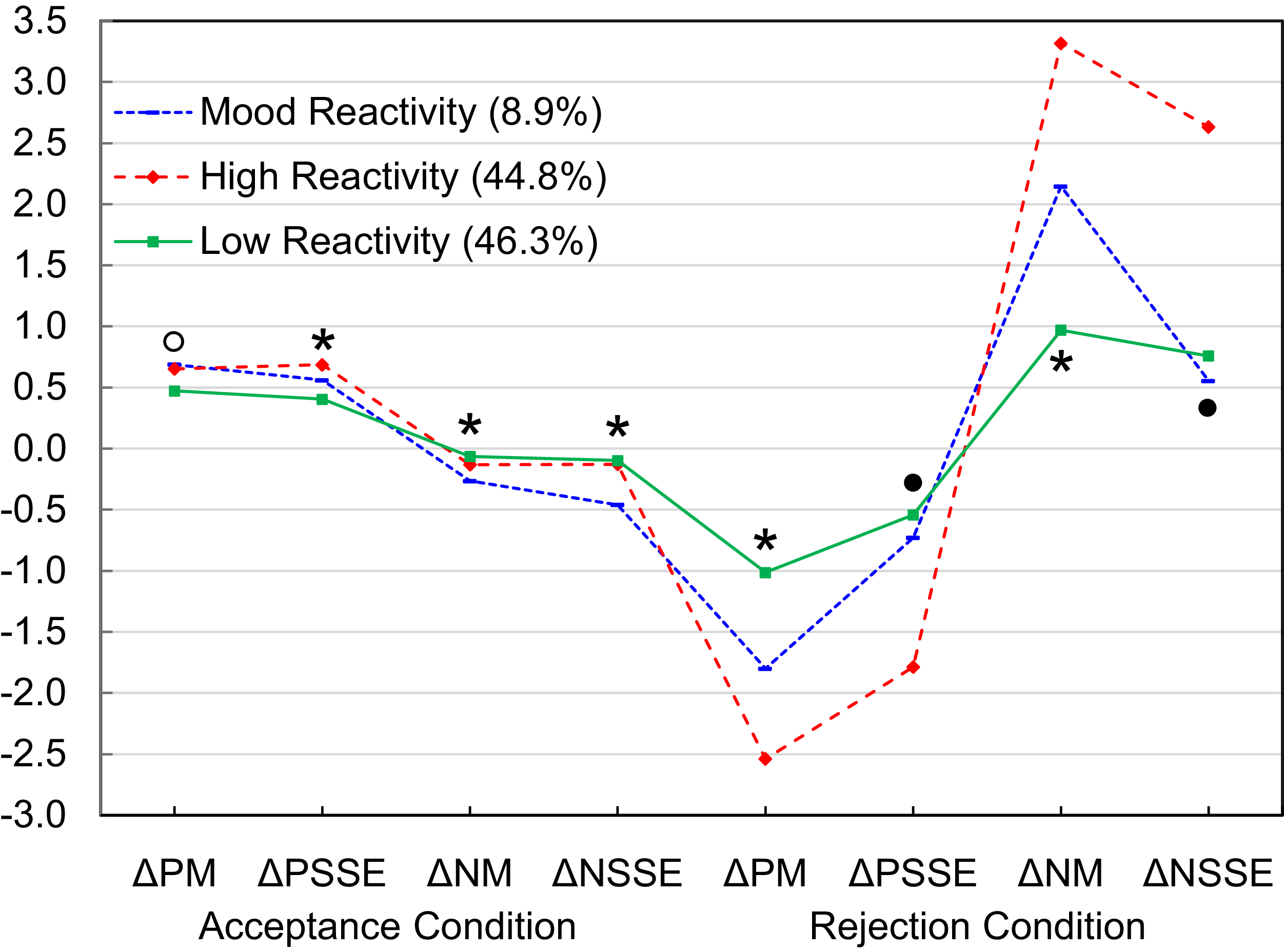
LPAs identified three groups of children who differed in their mood and state self-esteem reactivity to peer rejection and acceptance. Although fit indices were inconsistent, they seemed to favor the 3-profile solution (Table 2), which had relatively high Entropy, significant LMR and BLRT p-values, no profile with fewer than 5% of cases, and yielded the most substantial reductions in AIC, BIC, and aBIC. To interpret the profiles, we inspected children’s mean scores (Figure 4). Children from all profiles showed significant reactions to peer rejection and acceptance across all outcomes (i.e., non-zero mean changes; Table S8), but the strength of these reactions significantly differed between the profiles, most strongly so for peer rejection (Table S9). Two profiles reflected within-child differential susceptibility. Children in the High Reactivity profile (44.8%) showed significantly stronger mood and state self-esteem reactivity to both peer rejection and acceptance, compared to children in the Low Reactivity profile (46.3%). Children in the Mood Reactivity profile (8.9%) also showed significantly stronger reactivity to both rejection and acceptance than the Low Reactivity profile, but only in their mood (they had similar state self-esteem changes). Children in the High Reactivity profile seemed the most reactive: they also showed significantly stronger reactivity to peer rejection than children in the Mood Reactivity profile, both in mood and state self-esteem. Last, we did not identify a subgroup characterized by heightened reactivity to only rejection or acceptance.
Goal 2 reactivity subgroups: latent profile analyses fit statistics (n = 315)

Table 2 Long description
A table comparing fit statistics for different numbers of profiles in a latent profile analysis. The table has six rows and eight columns. The columns are labeled Number of profiles, AIC, BIC, aBIC, Entropy, p LMR, p BLRT, and LT5 percent. The rows are labeled with the number of profiles ranging from 2 to 6. Row 1: 2 Profiles, 2753.830, 2847.645, 2768.351, 0.821, <.001, <.001, 0. Row 2: 3 Profiles, 2536.416, 2664.004, 2556.165, 0.888, .0149, <.001, 0. Row 3: 4 Profiles, 2399.421, 2560.781, 2424.397, 0.866, .0993, <.001, 0. Row 4: 5 Profiles, 2344.565, 2539.699, 2374.770, 0.880, .5141, <.001, 1. Row 5: 6 Profiles, 2290.295, 2519.202, 2325.727, 0.898, .6775, <.001, 2.
Note. AIC = Akaike’s Information Criterion. BIC = Bayesian Information Criterion. aBIC = sample-size-adjusted BIC. p LMR = p-value for the Lo-Mendel-Rubin adjusted likelihood ratio test for K versus K-1 classes. p BLRT = p-value for the Bootstrapped likelihood ratio test for K versus K-1 classes. LT5% Number of profiles containing less than 5% of cases.
Goal 2 reactivity subgroup: means of standardized latent changes (Δ) in mood and state self-esteem by latent profile membership for experimental group children (n = 315). Note. PM = Positive mood. PSSE = Positive state self-esteem. NM = Negative mood. NSSE = Negative state self-esteem. A hollow circle (○) indicates that the two reactive profiles differed significantly from the Low Reactivity profile, but not from each other. An asterisk (*) indicates significant differences between all profiles. A solid circle (●) indicates that the High Reactivity profile differed significantly from the others, which did not differ from each other.
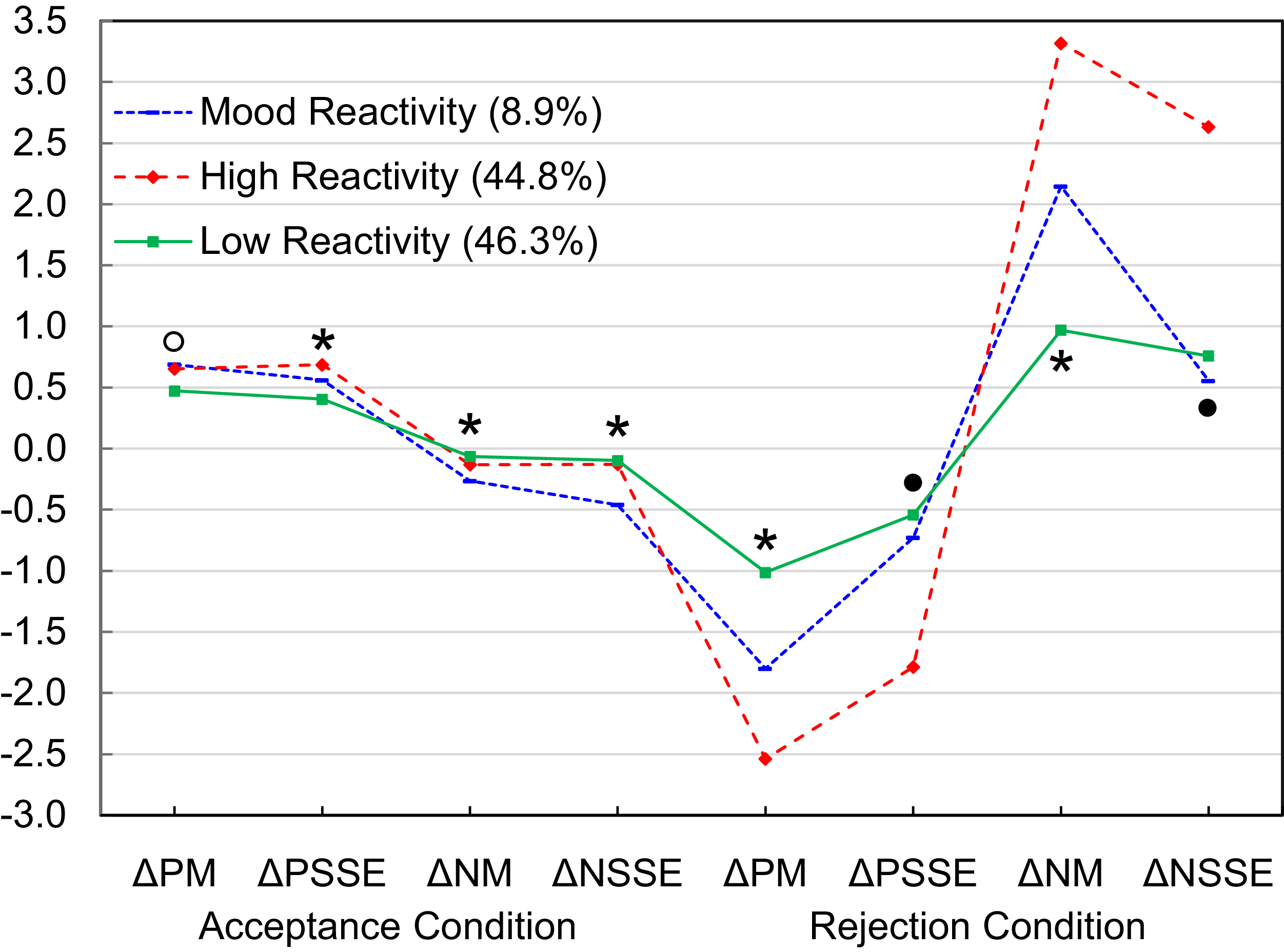
Unexpectedly, SPS did not seem to differentiate so well between the three profiles (Table S14). Children in the Mood Reactivity profile had significantly higher SPS scores (M = 4.55, SE = 0.17) than children in the Low Reactivity profile (M = 4.16, SE = 0.00), but this difference was significant (ps < .02) only in three out of six robustness checks (i.e., excluding children with suspicion, low compliance, and technical issues). Moreover, children in the High Reactivity profile did not have higher SPS scores than the other profiles.
Goal 3: SPS subgroups and differences in responsivity to peer feedback
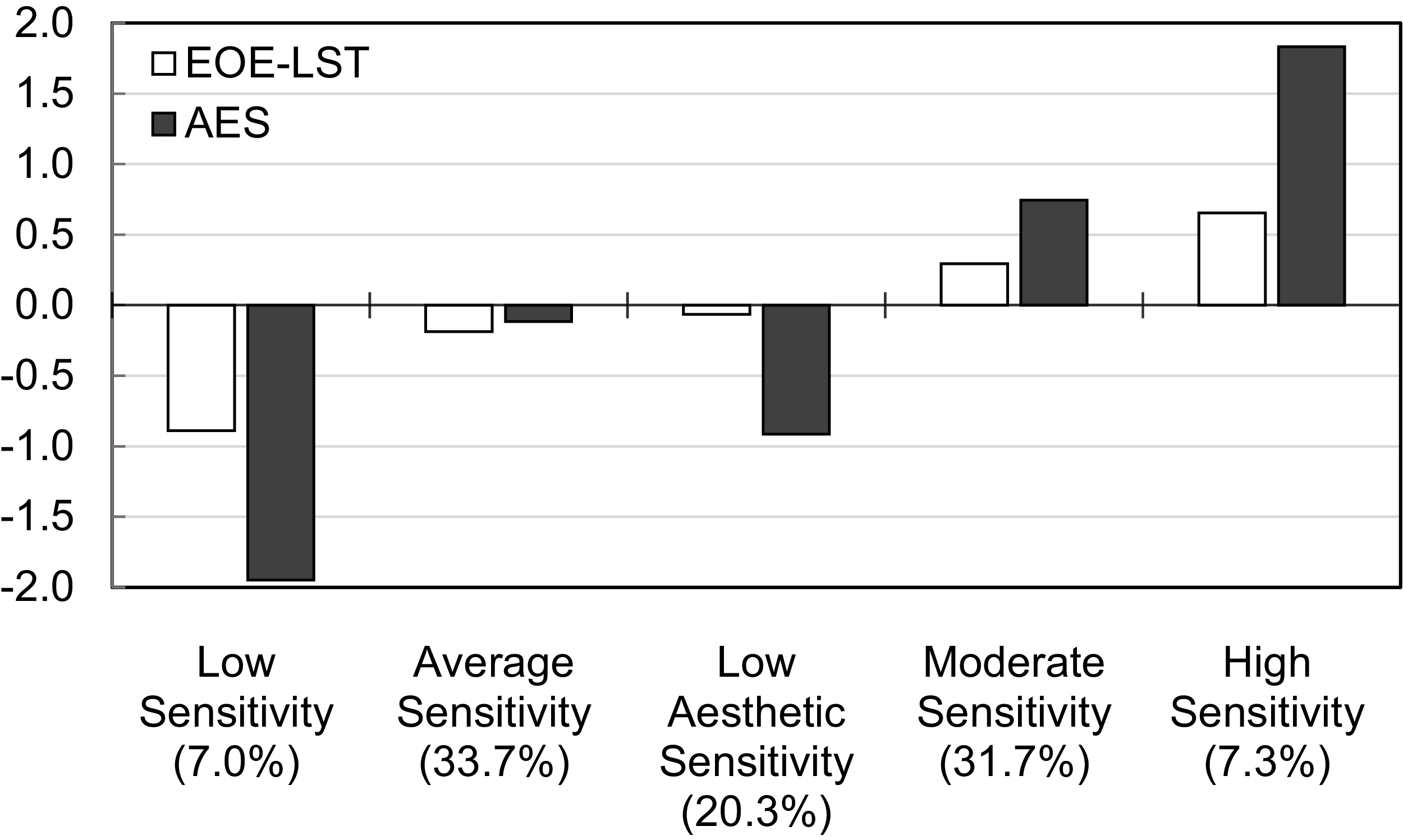
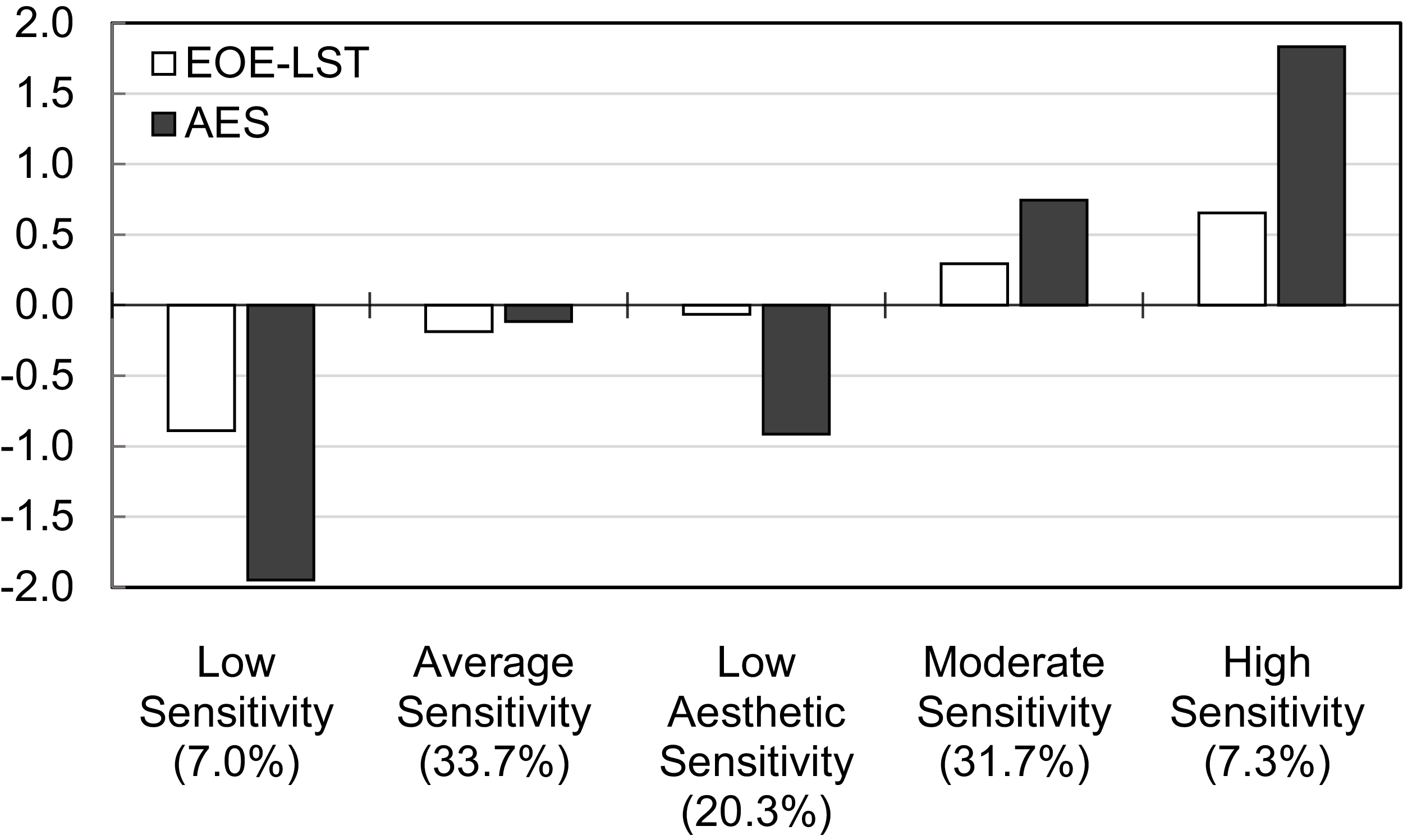
LPAs identified five groups of children who differed in their positive and negative SPS scores. Fit indices favored the 5-profile solution (Table 3), which had relatively low AIC and BIC values, relatively high Entropy, reasonable LMR and BLRT p-values compared to other solutions (i.e., p < .10), and no profile with fewer than 5% of cases. We inspected children’s mean scores to interpret the profiles (Figure 5; Table S11). The profiles differed in their degree of sensitivity, but no profile scored high only on positive or negative sensitivity (i.e., AES or EOE-LST). We found a High Sensitivity profile (7.3%) with high scores on both scales, an Average Sensitivity profile (33.7%) with near-zero z-scores on both scales, a Low Sensitivity profile (7.0%) with low scores on both scales, a Moderate Sensitivity profile (31.7%) with both scores between the Average Sensitivity and the High Sensitivity profiles, and a Low Aesthetic Sensitivity profile (20.3%) with low scores on positive sensitivity and average scores on negative sensitivity. Thus, we found no support for vantage or vigilant sensitivity subgroups. Last, these SPS-based subgroups did not differ in their responses to peer rejection and acceptance for any outcome (Tables S15 and S16).
Goal 3 SPS subgroups: latent profile analyses fit statistics (n = 315)

Table 3 Long description
A table with six rows and eight columns comparing fit statistics for different profile solutions. The columns are labeled Number of profiles, AIC, BIC, aBIC, Entropy, p LMR, p BLRT, and LT 5 percent. The rows are labeled with the number of profiles ranging from 2 to 6. Each row contains values for AIC, BIC, aBIC, Entropy, p LMR, p BLRT, and LT 5 percent. The table shows the fit statistics for each profile solution, with the 5-profile solution having relatively low AIC and BIC values, relatively high Entropy, and reasonable LMR and BLRT p-values compared to other solutions.
Note. AIC = Akaike’s information criterion. BIC = Bayesian information criterion. aBIC = sample-size-adjusted BIC. p LMR = p-value for the Lo-Mendel-Rubin adjusted likelihood ratio test for K versus K-1 classes. p BLRT = p-value for the Bootstrapped likelihood ratio test for K versus K-1 classes. LT5% Number of profiles containing less than 5% of cases.
*p-value not trustworthy due to local maxima, even with 10,000 random starts.
Goal 3 SPS subgroup: means of standardized scores on negative sensitivity (EOE-LST) and positive sensitivity (AES) by latent profile membership for experimental group Children (n = 315). Note. EOE-LST = Ease of Excitation and Low Sensory Threshold (negative SPS dimension/subscale). AES = Aesthetic Sensitivity (positive SPS dimension/subscale).
Discussion
This experiment provides the first test of within-child differential susceptibility to peer rejection and acceptance, as well as a comprehensive examination of SPS as a potential marker of differential susceptibility to peer feedback. Using a developmentally meaningful, ecologically valid peer interaction task, we found that brief online peer interactions had small to large effects on children’s mood, self-esteem, intent attributions, and behavior. These findings add to a growing body of experimental work showing that even short episodes of manipulated peer feedback can meaningfully impact children’s emotional and social functioning, highlighting the developmental salience of peer experiences in youth (e.g., Grapsas et al., Reference Grapsas, Denissen, Lee, Bos and Brummelman2021; Lee et al., Reference Lee, Jamieson, Reis, Beevers, Josephs, Mullarkey, O’Brien and Yeager2020; Liu et al., Reference Liu, van Dijk, Deković and Dubas2023 ; Reijntjes et al., Reference Reijntjes, Thomaes, Kamphuis, Bushman, de Castro and Telch2011; Sebastian et al., Reference Sebastian, Viding, Williams and Blakemore2010; Thomaes et al., Reference Thomaes, Reijntjes, Orobio de Castro, Bushman, Poorthuis and Telch2010).
Our findings offer the first experimental evidence supporting the idea that some children were markedly more reactive to both acceptance and rejection than their peers – consistent with within-child differential susceptibility (Goal 2). Across three goals, however, we found little support for SPS as a reliable marker of differential susceptibility to experimentally manipulated peer feedback. SPS did not moderate children’s responses to acceptance or rejection feedback from peers (Goal 1), did not distinguish highly reactive from less reactive subgroups (Goal 2), and SPS subdimensions did not yield subgroups that differed in their responses to peer feedback (Goal 3). Thus, while heightened reactivity to both peer acceptance and rejection co-occurred within the same children, SPS showed limited utility as a marker of differential susceptibility to experimentally manipulated peer feedback.
Within-child differential susceptibility to peer rejection and acceptance
Supporting within-child differential susceptibility, we identified two subgroups of children who displayed heightened reactivity to both peer rejection and acceptance feedback: a Mood Reactivity subgroup with notable changes only in mood, and a High Reactivity subgroup with notable changes in both mood and state self-esteem; these changes were significantly larger than those observed in the Low Reactivity subgroup. Together, the two more reactive subgroups comprised 53.7% of our sample. This high rate may reflect the significance of peer feedback in influencing mood and self-esteem during preadolescence (Grapsas et al., Reference Grapsas, Denissen, Lee, Bos and Brummelman2021; Thomaes et al., Reference Thomaes, Reijntjes, Orobio de Castro, Bushman, Poorthuis and Telch2010).
Three points are worth mentioning. First, all children reacted more strongly to peer rejection than acceptance. This supports the ‘bad-is-stronger-than-good’ phenomenon (Baumeister et al., Reference Baumeister, Bratslavsky, Finkenauer and Vohs2001) and echoes prior research revealing larger effect sizes for negative versus positive peer feedback (Liu et al., Reference Liu, van Dijk, Deković and Dubas2023; Reijntjes et al., Reference Reijntjes, Thomaes, Kamphuis, Bushman, de Castro and Telch2011; Thomaes et al., Reference Thomaes, Reijntjes, Orobio de Castro, Bushman, Poorthuis and Telch2010). Second, children’s reactivity was more clearly expressed in their mood compared to their state self-esteem (also within the High Reactivity subgroup). Possibly, mood is more transient and fluctuating, whereas state self-esteem also depends on more stable traits like self-esteem (Leary, Reference Leary1999) and narcissism (Thomaes et al., Reference Thomaes, Reijntjes, Orobio de Castro, Bushman, Poorthuis and Telch2010). Third, our evidence concerns children’s short-term responses to manipulated peer feedback, aligning with what is known as nano- or microtrials in differential susceptibility experiments (Bakermans-Kranenburg & Van IJzendoorn, Reference Bakermans-Kranenburg and van IJzendoorn2015). Short-term differential susceptibility may be crucial for understanding the mechanisms underlying long-term susceptibility (Bakermans-Kranenburg & Van IJzendoorn, Reference Bakermans-Kranenburg and van IJzendoorn2015). Yet, it is not yet clear whether, in the longer run, subgroups of children would exist who develop more positively upon peer acceptance and more negatively upon peer rejection.
SPS as a marker of differential susceptibility to peer feedback
We found limited support for SPS as a marker of differential susceptibility to experimentally manipulated peer rejection and acceptance: SPS did not moderate children’s responses to peer rejection or acceptance (Goal 1), did not differentiate between the High Reactivity subgroup and the Low Reactivity subgroup (Goal 2), and yielded subgroups that did not differ in their responses to peer rejection or acceptance (Goal 3). The only suggestive finding for SPS as a marker was that children in the Mood Reactivity subgroup had higher SPS levels than children in the Low Reactivity subgroup (Goal 2). While this finding aligns with research indicating heightened emotion recognition and emotion reactivity as key characteristics of high SPS (Acevedo et al., Reference Acevedo, Aron, Aron, Sangster, Collins and Brown2014; Kähkönen et al., Reference Kähkönen, Lionetti and Pluess2025; Lionetti et al., Reference Lionetti, Aron, Aron, Burns, Jagiellowicz and Pluess2018), it only emerged in half of the robustness checks. Thus, our findings contrast with research supporting SPS as a susceptibility marker to social experiences, including peer experiences (Fischer et al., Reference Fischer, Larsen, van den Akker and Overbeek2022; Liu et al., Reference Liu, van Dijk, Deković and Dubas2023). We offer two explanations.
First, SPS may only express itself in low-stakes and naturalistic situations, whereas our peer manipulations were likely experienced as high-stakes and consequential given the developmental salience of peer evaluations in preadolescents (Harter, Reference Harter2012; Thomaes et al., Reference Thomaes, Reijntjes, Orobio de Castro, Bushman, Poorthuis and Telch2010). Indeed, previous experiments have linked SPS to greater emotional reactivity in low-stakes or even calming situations, such as imagining hypothetical peer scenarios (Liu et al., Reference Liu, van Dijk, Deković and Dubas2023), or watching videos (Li et al., Reference Li, Li, Jiang and Yan2022). In contrast, our experiment involved real-time peer interactions with immediate social feedback. In such situations, highly sensitive preadolescents might have exhibited more cautious and inhibited responses to avoid potential risks or mistakes (Hoffmann et al., Reference Hoffmann, Marhenke and Sachse2022; Li et al., Reference Li, Sturge-Apple and Davies2021; Xiao et al., Reference Xiao, Baetens and Deroost2024), resulting in a restrained expression of heightened reactivity. Future studies could explore SPS expression in less consequential situations that still allow for real-time social feedback – situations that afford the expression of the SPS trait (Li & Wilt, Reference Li and Wilt2025; Li, Reference Li2023). This, for instance, could be video game environments with unlimited restart opportunities.
Second, SPS may only express itself in situations abundant in subtle social cues, whereas our peer manipulations concerned receiving straightforward feedback (e.g., “Likes” and “Dislikes”) from peers represented by simplistic avatars. Subtlety in cues may matter because more sensitive individuals are characterized by “low sensory thresholds and awareness of subtlety” (Aron & Aron, Reference Aron and Aron1997, p. 349) and “greater awareness of sensory stimulation, so that more subtleties are noted” (Aron et al., Reference Aron, Aron and Jagiellowicz2012, p. 267). Indeed, individuals with higher SPS levels showed greater brain activation in visual attentional areas when responding to minor (vs. major) changes in stimuli (Jagiellowicz et al., Reference Jagiellowicz, Xu, Aron, Aron, Cao, Feng and Weng2011). This stronger notice for more subtle information may translate into stronger reactions to facial expressions, tone of voice, or micro-expressions in social situations (Acevedo et al., Reference Acevedo, Aron, Aron, Sangster, Collins and Brown2014). In contrast, our manipulated Likes and Dislikes are likely signals to which most adolescents tend to respond. Future studies could test this hypothesis by experimentally manipulating the presence of subtle social cues. For instance, using virtual reality, one could contrast a scenario where a peer responds to a joke with subtle emotional expressions (e.g., smiling or frowning) versus only overt signals (e.g., thumbs up/down with neutral expression).
In sum, our findings challenge that SPS would be a general marker of susceptibility to manipulated peer rejection and acceptance. Instead, its expression as a “for better and for worse” marker may be conditional on situational factors such as the significance of stakes and the presence of subtle social cues.
Sensory processing sensitivity subgroups
Our study also empirically addressed a novel theoretical development in SPS research: the idea that subgroups may exist that exhibit either positive or negative sensitivity (i.e., vantage or vigilant sensitivity; Pluess, Reference Pluess2015; Pluess et al., Reference Pluess, Lionetti, Aron and Aron2023). We found no such subgroups. This is somewhat unexpected, given that the positive and negative SPS dimensions have distinct genetic underpinnings, moderating roles, and associations with other traits (Assary et al., 2020; Li et al., Reference Li, Li, Jiang and Yan2022; Vander Elst et al., Reference Vander Elst, Sercu, Van den Broeck, Van Hoof, Baillien and Godderis2019), and were only modestly correlated in this study (i.e., r = .30). Instead, our results suggest that SPS may represent a generalized sensitivity, aligning with Aron and Aron’s (Reference Aron and Aron1997) unidimensional conceptualization of SPS and with research identifying low, medium, and high SPS groups (Pluess et al., Reference Pluess, Assary, Lionetti, Lester, Krapohl, Aron and Aron2018). Alternatively, sensitivity subtypes may indeed exist but not in our relatively low-risk and homogeneous sample. Possibly, only extreme early life experiences would give rise to the “dark” or “bright” sensitivity profiles (Pluess, Reference Pluess2015). Thus, future research with more diverse samples is needed to clarify whether vigilant or vantage sensitivity subgroups may emerge in children (Pluess et al., Reference Pluess, Lionetti, Aron and Aron2023).
Strengths and limitations
Our study had several strengths. First, we manipulated peer rejection and acceptance in the same children and used person-centered analyses, enabling us to provide the first evidence for within-child differential susceptibility to peer rejection and acceptance. Second, our peer manipulations were effective, eliciting significant variances and small to large effects across almost all outcomes. Third, by including a control group receiving neutral feedback, we were able to establish the independent effects of both peer rejection and acceptance (rather than assessing the contrast between rejection and acceptance). This enabled a more precise test of the distinct “for better” and “for worse” aspects of the differential susceptibility model.
Our study also had its limitations. First, although our social media task has ecological validity as it mirrors the increasing prevalence of online social interactions (Achterhof et al., Reference Achterhof, Kirtley, Schneider, Hagemann, Hermans, Hiekkaranta, Lecei, Lafit and Myin-Germeys2022), real-life peer experiences are more complex and occur in both online and offline settings. Further research is needed to examine to what extent our findings generalize to in-person interactions. Second, despite pilot testing and carefully designed manipulations, nearly half of the control group children believed that they received more Likes than Dislikes, possibly making the neutral condition more positive than intended. However, robustness checks confirmed that this did not affect Goal 1 results, and the control group was not used in Goals 2 and 3 analyses. Third, we conducted our study in one urban elementary school in China. Despite this being a first step to include more underrepresented samples in child development research (Nielsen et al., Reference Nielsen, Haun, Kärtner and Legare2017), further research is needed to examine to what extent our findings generalize to children from rural and affluent areas, and across diverse cultural backgrounds and regions.
Conclusion
“No one likes me or wants to play with me!“ Our findings show that preadolescents who react more strongly to peer rejection also tend to react more strongly to peer acceptance – substantiating the key within-person assumption of the differential susceptibility model. Over half of the preadolescents in our sample showed heightened reactions to both peer rejection and acceptance, underlining the developmental importance of peer feedback. Additionally, highly sensitive preadolescents exhibited both positive and negative aspects of SPS, rather than exclusively one aspect. These patterns of generalized reactivity and sensitivity highlight the necessity of comprehensive peer-related intervention and counseling programs. Such programs should not only seek to address or prevent negative peer experiences but also foster and maintain positive interactions, helping not only to relieve preadolescents’ social pains but also to enhance their social well-being.
Supplementary material
The supplementary material for this article can be found at https://doi.org/10.1017/S0954579426101382.
Data availability statement
Availability of Data: The data necessary to reproduce the analyses presented in this paper are publicly accessible at: https://osf.io/y3c9g.
Availability of Code: The analytic code necessary to reproduce the analyses presented in this paper is publicly accessible at: https://osf.io/y3c9g.
Availability of Methods/material: The materials necessary to replicate the findings presented in this paper are publicly accessible at: https://osf.io/y3c9g.
Acknowledgements
The authors would like to thank Sander Thomaes and Stathis Grapsas for their feedback on the peer manipulation paradigm; Stefan Vermeent for his programming advice; Shuyang Dong and Shanyan Lin for their help with the backward translation of the questionnaire measures; Jianqing Liu and Yuping Liu for their contributions to data collection; and all the students and teachers who participated in this study.
Funding statement
The first author was financially supported by the China Scholarship Council (Grant No. 201906870051). Open access funding provided by University of Amsterdam. Open access funding provided by Utrecht University.
Competing interests
The authors declare no competing interests.
Ethical standards
The ethics review board of the Faculty of Social and Behavioural Sciences at Utrecht University approved this study (approval number: 21-0271). Written informed consent was obtained from caregivers and children.
Pre-registration statement
The analyses presented in this paper were preregistered.
Active link: https://osf.io/f7zpb.
Date stamped: Apr 17, 2022
Deviation: On 31 January 2024, we updated the preregistration to restructure the analyses so they better matched the paper’s revised three-goal structure. Specifically, we reorganized the planned analyses into three goals, kept the variable-centered SPS moderation analyses and SPS subgroup analyses, added person-centered analyses of children’s outcome reactivity to peer acceptance and rejection to address the core within-child differential susceptibility question, and dropped the planned SPS subscale moderation analysis because it no longer aligned with the revised goal structure.




 Open access

