



The prevalence of childhood overweight and obesity is a significant public health issue(Reference Reilly, Methven and McDowell1–3). In Australia, one in four children aged 2 to 5 years are reported to be overweight or obese(4), with a similar rate for children aged 5–18 years(5). This is concerning as children who are overweight are at higher risk of overweight or obesity as adolescents and adults(Reference Ogden, Carroll and Kit6). Obesity is associated with a number of chronic diseases, including CVD, cancer and diabetes mellitus(Reference Reilly, Methven and McDowell1,Reference Sokol7–9) .
The causes of overweight and obesity in childhood are complex; however, poor diet quality is one of the main contributing factors(3,Reference Biro and Wien10) . For example, more than one-third of Australian children’s daily energy intake comes from energy-dense, nutrient-poor foods and beverages such as snack foods, confectionery and sugar sweetened beverages, and most children are generally not meeting their recommended daily serves of vegetables(4). Understanding factors that influence children’s dietary intake in early years could facilitate the development of interventions to improve diet across childhood. Parents are one of the main influences on the dietary intake of children, with mothers being of significant importance as they generally spend more time with their children and undertake more of the food provision than fathers(Reference Park and Walton-Moss11,Reference Scaglioni, Salvioni and Galimberti12) .
The influence a mother has over her child’s dietary intake is thought to be strongest in early childhood(Reference Campbell and Hesketh13–Reference Story, Neumark-Sztainer and French16), which is important as habits formed in early childhood are likely to track into adolescence when greater independence and autonomy over food choices are developed(Reference Lytle, Seifert and Greenstein17). The increase in independence that a child has during adolescence and a busier lifestyle can lead to greater reliance on convenience foods(Reference Vereecken, Pedersen and Ojala18). Previous research has suggested that the transition to secondary school is associated with increased consumption of unhealthy foods and a decrease in consumption of fruit and vegetables(Reference Lytle, Seifert and Greenstein17). Less than 3 % of Australians aged 12–18 years consume the recommended five portions of vegetables/d and about three out of five consume the recommended two portions of fruit(5,19) .
Maternal parenting styles in early childhood may be an important determinant of the quality of a child’s diet across childhood, as parenting styles are assumed to be stable(Reference Darling and Steinberg20), with only one study which examined their stability in parents of adolescents showing they are stable(Reference Zhang, Wei and Ji21). Parenting styles are defined as parenting behaviours and practices which influence the development of a child and are a part of the broader parenting environment(Reference Baumrind22,Reference Vollmer and Mobley23) . The four commonly recognised parenting styles, based on two dimensions, are authoritative (high control/high warmth), authoritarian (high control/low warmth), permissive (low control/high warmth) and disengaged (low control/low warmth)(Reference Maccoby, Martin and Mussen24). Understanding the influence of parenting styles on the dietary intake of children will inform future interventions by identifying groups of parents who may need additional support in promoting healthy eating behaviours for their children.
In cross-sectional studies, parenting styles have been found to be associated with the dietary intakes of pre-school children aged 1·5–5 years(Reference Park and Walton-Moss11,Reference Peters, Dollman and Petkov25–Reference Burnett, Lamb and McCann27) as well as older children (5–18 years)(Reference Kremers, Brug and de Vries28–Reference Pearson, Atkin and Biddle30). The literature shows that children with authoritative parents had higher intakes of fruits and vegetables(Reference Park and Walton-Moss11,Reference Peters, Dollman and Petkov25–Reference Pearson, Atkin and Biddle30) and lower intakes of unhealthy snack foods(Reference Pearson, Atkin and Biddle30). However, findings are inconsistent; one study examining parenting styles and dietary quality in older children (8–12 years) did not find an association(Reference Lopez, Schembre and Belcher31). Notably, the samples in these studies were relatively small (all less than 400) and only one study, from Australia, was nationally representative(Reference Burnett, Worsley and Lacy26). Furthermore, these studies were all cross-sectional which prohibits changes in outcomes to be examined.
Although associations between parenting styles and intakes of individual foods have been reported previously, to our knowledge, no studies have examined the associations between parenting styles and dietary quality in pre-school children. It is important to consider a child’s comprehensive dietary consumption (known as dietary scores or diet quality) as people do not consume individual foods in isolation(Reference Kant32). Diet quality scores including multiple food groups are important as they retain the complexity of foods and diets without reducing the assessment to a single nutrient or food item; they are increasingly recognised as important predictors of non-communicable diseases(Reference Fallaize, Livingstone and Celis-Morales33).
To date, no studies have examined associations between parenting style and diet quality in a longitudinal sample tracking from early childhood to early adolescence. Therefore, this study aims to examine associations between maternal parenting styles in early childhood, when a mother is likely to have the most influence over her child’s dietary intake, and change in diet quality score from early childhood into early adolescence in a large nationally representative sample of Australian children aged 4 to 14 years.
Methods
Study design and sample
This study used data from the Longitudinal Study of Australian Children (LSAC). The LSAC collected data from two cohorts biennially from 2004; the infant cohort (aged 0–1 years at baseline) and the child cohort (aged 4–5 years at baseline). The full methodology of the LSAC is described elsewhere(Reference Soloff, Lawrence and Johnstone34). Briefly, participants were randomly selected from the Health Insurance Commission Medicare database in which most Australians are represented. Medicare is Australia’s universal healthcare scheme.
The data for the LSAC were collected primarily from the children’s parents (usually the mother, known as Parent 1), with additional data provided by other caregivers (e.g. Parent 2, usually the father) and the children themselves (beginning when children were 10 years of age for only some questions, including the dietary questions). Data were collected using both face-to-face interviews and interviewer-assisted questionnaires for primary carers and written questionnaires for the secondary carer.
Of the 18 800 families that were invited to participate in the LSAC, 10 090 (54 %) agreed to take part, with 4983 children in the child cohort at baseline (the remainder were in the infant cohort)(Reference Soloff, Lawrence and Johnstone34). The present longitudinal study involves data from all six waves of the child cohort available at the time of analysis (i.e. to the age of 14–15 years), as the focus was on examining changes in dietary intake of children over time through to adolescence. The infant cohort was therefore omitted as it does not yet have adolescent data available at this time.
Outcome measures
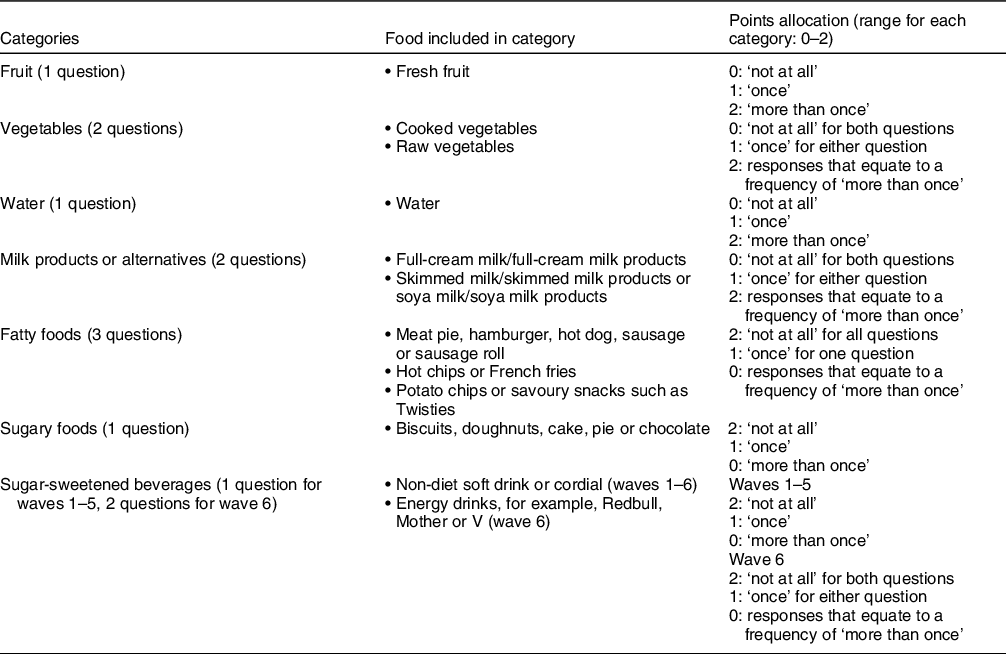
The LSAC collected data on the consumption of twelve food and drink items during face-to-face interviews including raw and cooked vegetables, fruit, water, full-cream and skimmed milk products, hot takeaway foods, hot takeaway snacks, savoury snacks, sweet snacks, soft drinks and energy drinks (outlined in Table 1). The questions were from the Amherst Health and Activity Study(Reference Sallis, Taylor and Dowda35) and have not been validated previously. The primary parent was asked to report the frequency of their child’s food and drink consumption in the 24 h prior to the interview at 4, 6, and 8 years of age. The children reported their own consumption at 10, 12, and 14 years of age. The question asked of the parents was: ‘in the last 24 h has your child had the following foods and drinks once, more than once, or not at all?’. Questions asked of the child included ‘thinking about yesterday, how often did you have takeaway foods including meat pie, hamburger, hot dog, sausage or sausage roll?’, with a separate question asked for each food or drink and response options of once, more than once, or not at all.
Derivation of the dietary score from the LSAC dietary questions
The question asked of the parents was: ‘In the last 24 h has your child had the following foods and drinks once, more than once, or not at all?’. The question repeatedly asked of the child was ‘Thinking about yesterday, how often did you have…[fresh fruit].?’.
This study used a derived dietary score for each wave, as previously adopted elsewhere(Reference Gasser, Kerr and Mensah36); details of the derivation of the dietary score are described in Table 1. Briefly, the dietary score is based on food group alignment with the Australian Dietary Guidelines(37). The twelve food and drink items were collapsed into seven categories of foods and drinks, which were each allocated a score and then summed together. Fruit, vegetables, water and milk products or alternatives were positively scored (i.e. highest consumption scored 2 and lowest consumption scored 0), whereas fatty foods, sugary foods and sugar-sweetened beverages were reverse scored (i.e. highest consumption scored 0 and lowest consumption scored 2). The possible range of dietary scores was therefore from 0 to 14, with 14 representing the healthiest score. A similar method has shown to be a valid and reliable tool to assess dietary quality(Reference Wilson, Magarey and Mastersson38).
Exposure measures
Parenting styles were assessed based on two parenting dimensions: warmth and control(Reference Thornton and Williams39). A written questionnaire was self-completed by parents during face-to-face interviews at baseline (children aged 4 years); the interviewers were present to assist the completion of the questionnaire if needed. The questionnaire contained 11 questions pertaining to parenting behaviours. Responses were recorded on five-point Likert scales ranging from 1 (never/almost never) to 5 (all the time). The warmth parenting dimension was assessed by averaging the scores of the six items from the Child Rearing Questionnaire(Reference Paterson and Sanson40), which included items such as ‘How often do you have warm, close times together with this child?’. The control parenting dimension was assessed by averaging the scores of the five items from the Canadian National Longitudinal Survey of Children and Youth, which included items such as ‘When you discipline this child, how often does he/she ignore the punishment?’ (three questions were reverse scored)(41). This is an accepted method of assessing parenting styles that is consistent with previous literature(Reference Park and Walton-Moss11,Reference Burnett, Worsley and Lacy26,Reference Alsharairi and Somerset42) . Each parenting dimension has previously demonstrated good reliability and internal consistency in the same sample (r = 0·73–0·83), as well as good validity when modelled against a variety of coexisting family and parental characteristics in previous studies in Australia(Reference Zubrick, Smith and Nicholson43,Reference Wake, Nicholson and Hardy44) .
The warmth and control parenting dimension scores were dichotomised and combined into four categorical parenting styles: authoritative, authoritarian, permissive and disengaged, as per Wake et al. (Reference Wake, Nicholson and Hardy44). Following this approach, as the warmth and control scales were both shown to be positively skewed and there are no standard cut points for these scales, the scores were dichotomised at the least positive tertile. Scores that fell above the 33rd percentile were classified as high warmth and/or high control, while scores that fell below the 33rd percentile were considered low warmth and/or low control. The combination of high warmth and high control was classified as authoritative; low warmth and high control as authoritarian; high warmth and low control as permissive; and low warmth and low control as disengaged. This study focused on the parenting styles from baseline (i.e. child aged 4 years) of mothers who were the primary caregiver of their child; 2 % (n 77) of participants reported someone other than the mother as the primary caregiver and were excluded from this analysis.
Parenting styles at the age of 14 years were considered in a sensitivity analysis to assess if the estimated associations were consistent when only including parents who had the same parenting style at 4 and 14 years of age. The same cut points used at baseline were used at wave 6.
Potential confounders
Potential confounders, which were considered likely to be related to exposure and outcome, based on previous literature(Reference Peters, Dollman and Petkov25,Reference Alsharairi and Somerset42,Reference Boots, Tiggemann and Corsini45,Reference McPhie, Skouteris and Fuller-Tyszkiewicz46) , included maternal age, child sex, number of children in the household (0, 1, 2 or 3+), maternal country of birth (Australia/not Australia), maternal education level (less than year 12, year 12, trade/certificate or tertiary) and parenting arrangements (1 or 2 parent home). Maternal education was used as an indicator of socio-economic status, as many people within the LSAC sample did not report their income (12 %), and previous research suggests that education status is a reliable indicator of socio-economic status(Reference Cameron, Ball and Pearson47). All confounders were measured at baseline.
Statistical analysis
The statistical analyses were conducted using Stata 15 (Stata Corp.)(48). Multilevel modelling was used to examine change in diet quality score over time (six waves) by maternal parenting style, accounting for the nesting of study waves within participants. Participants had to have complete data for all study variables (parenting styles, diet quality score and confounders) at baseline and have diet quality score measured in at least one of the subsequent waves (waves 2–6) to be included in the analysis (since multilevel models permit subjects with missing outcome data at some of the time points(Reference Kwok, Underhill and Berry49)). Of the 4983 children who participated at baseline, 4570 had complete data at baseline, and 4282 (86 %) also had at least one further wave of dietary data to enable inclusion in the longitudinal analysis (Fig. 1). Missing diet quality and confounder data at baseline were assumed to be missing completely at random, as the baseline characteristics for the full sample were compared to those in the complete case sample.
Flow chart of included participants from wave 1 (baseline) of the child cohort of the LSAC

A multilevel linear regression model, with both a random intercept and random slope for time, was used to model the outcome measure (child’s diet quality score) by wave (model 1) to determine if diet quality score changed over time for all participants from early childhood (wave 1) to adolescence (wave 6). Likelihood ratio tests were used to determine if the model fit improved by including a random intercept in addition to a random slope. The random coefficient for time allows for random variability in the change in dietary score over time for each individual. To assess whether change in diet quality score over time differed dependent on maternal parenting style, an interaction between maternal parenting style and time was included in the model, in addition to the main effect of maternal parenting style (model 2). To examine whether there was evidence of an interaction after accounting for other covariates, potential confounding variables were included (model 3). As per previous studies, disengaged parenting style was considered as the reference category for models 2 and 3(Reference Park and Walton-Moss11,Reference Burnett, Worsley and Lacy26,Reference Alsharairi and Somerset42) .
To interpret the interaction effects, a post hoc analysis was conducted (margins test) to estimate the change in diet quality score over time for each of the four maternal parenting styles.
To examine the associations between parents who had the same parenting style at 4 and 14 years of age and change in child dietary quality score over time, a sensitivity analysis was conducted. Of the 3559 participants included in the study at wave 6, 3043 had complete data; 1370 (45 %) were included in the sensitivity analysis, as these were mothers with the same parenting style at 4 and 14 years of age. This was conducted using the same multilevel linear regression models and post hoc analysis.
Results
Table 2 shows the baseline characteristics of the total sample. Just over half of the children were male (50·7 %), and the mean age of the children at baseline was 4·2 years and at wave 6 it was 14·4 years. The mean age of the mothers at baseline was 34·6 years (sd = 5·3). Of the 4570 participants included in the study at baseline, 36 % of mothers were classified as having an authoritative parenting style, 27 % authoritarian, 18 % permissive and 19 % disengaged. The average diet quality score for all children at baseline was 9·79 (sd = 2·22), and the average diet quality score at age 14 years was 9·65 (sd = 2·34).
Demographic and parenting style characteristics of the LSAC child cohort at baseline (n 4570)

* Warmth range 4.5–5.0.
† Control range 4.0–5.0.
‡ Warmth range 2.3–4.3.
§ Control range 1.2–3.8.
Model 1 showed that child diet quality score declined on average over time between 4 and 14 years of age (–0·10, 95 % CI (–0·11, –0·08)). The estimates of subsequent models (2 and 3) from the multilevel models are presented in Table 3. There was evidence that the change in diet quality score over time differed dependent on maternal parenting style (P < 0·001). Children with authoritative and authoritarian mothers at baseline had the highest diet quality score at baseline. Results showed that the diet quality score appeared to decline over time for all parenting styles. However, the magnitude of decline differed dependent on the parenting style. Findings from the post hoc analysis showed that children with authoritative mothers had the greatest diet quality score decline over time (–0·13; 95 % CI (–0·18, –0·08)), while children of authoritarian (–0·04; 95 % CI (–0·09, 0·01)), permissive (–0·06; 95 % CI (–0·11, 0·00)) and disengaged mothers (–0·03; 95 % CI (–0·07, 0·01)) showed less decline over time. However, children of authoritative and authoritarian mothers had a better dietary quality score than children of permissive or disengaged mothers for most of their childhood. These findings are illustrated in Fig. 2.
Multilevel models of associations between parenting styles and diet quality score over 10 years (2004–2014) in the LSAC child cohort (n 4282)

* A multilevel linear regression model, with both a random intercept and random slope for time, and an interaction between maternal parenting style and time included.
† A multilevel linear regression model, with both a random intercept and random slope for time, an interaction between maternal parenting style and time, and potential confounding variables included.
Change in dietary score over time by parenting style from fully adjusted multilevel model of the association between parenting styles and child diet quality score

Sensitivity analysis showed similar associations. Findings from the post hoc analysis showed that children with authoritative mothers had the greatest diet quality score decline over time (–0·13; 95 % CI (–0·21, –0·05)), while children of authoritarian (–0·05; 95 % CI (–0·13, 0·02)), permissive (–0·10; 95 % CI (–0·23, 0·02)) and disengaged mothers (–0·02; 95 % CI (–0·08, 0·04)) showed less decline over time (see online Supplemental Table 1).
Discussion
This is the first study to examine associations between maternal parenting styles in early childhood and changes in diet quality score across childhood. The study found a small decline in average diet quality score amongst a nationally representative sample of children from 4 to 14 years of age. The study also found that children of the authoritative parenting style had the greatest decline in diet quality score. Previous studies have found that the percentages of children consuming fruit and vegetables decline significantly as they move into adolescence, while sugar-sweetened beverage and unhealthy snack consumption increase over this time(Reference Lytle, Seifert and Greenstein17,Reference Marks, Barnett and Allender50–Reference Jongenelis, Scully and Morley52) . These negative dietary changes are similar to the current findings as diet quality score declined, though the decline was quite small. The overall average decline in diet quality score was estimated to be one-tenth of a unit per 2 years. A one-point decrease in diet quality score equated to a decrease of one frequency of fruit or vegetables (e.g. reporting they had vegetables once or more than once in the past 24 h) or an increase by one frequency of fatty foods, sugary foods or sugar-sweetened beverages per d.
The results presented in the current study question the previous assumptions that early exposure to an authoritative parenting style has lasting positive effects. Children of authoritative mothers started with a higher diet quality score than those with permissive or disengaged mothers but had the greatest decline in diet quality score following the transition to adolescence. Previous cross-sectional studies have shown the authoritative parenting style to be associated with healthier child dietary intake(Reference Park and Walton-Moss11,Reference Peters, Dollman and Petkov25,Reference Burnett, Worsley and Lacy26,Reference Kremers, Brug and de Vries28–Reference Pearson, Atkin and Biddle30,Reference Langer, Seburg and JaKa53) . However, the longitudinal findings presented here add important depth to this field by showing that, although authoritative parenting of young children was associated with the highest diet quality score at the age of 4 years, this was not the case by the age of 14 years. Nevertheless, findings presented in Fig. 2 suggest that although they had the greatest decline in diet quality score, on average, children with authoritative mothers had a better diet quality score than children with disengaged and permissive mothers across the study period. Future interventions should focus on providing support for all parents to improve their child’s dietary quality over time and avoid the age-related decline seen in children in the current and previous studies(Reference Lytle, Seifert and Greenstein17,Reference Marks, Barnett and Allender50–Reference Jongenelis, Scully and Morley52) . Support would be particularly important for permissive, disengaged and even authoritative parents to adopt and maintain parenting behaviours that support long-term dietary quality for their children. Interventions should provide support at the important stage of early childhood, when it is thought that a mother has the strongest influence over her child’s dietary intake(Reference Campbell and Hesketh13–Reference Story, Neumark-Sztainer and French16); however, public health interventions would benefit from longer time frames to ensure sustained benefits(Reference Hesketh, Salmon and McNaughton54). For example, providing specific support to promote healthy eating behaviours for their children to different groups of parenting styles as the child grows could be a consideration for future interventions.
Children of authoritative mothers had the greatest decline in diet quality score followed by children of permissive mothers. This suggests that the key dimension for a decline in diet quality score over childhood could be higher levels of maternal warmth, as high levels of warmth are defining characteristics of both permissive and authoritative parenting styles. Parents with high levels of warmth offer nurturance, open parent–child communication and may even adjust their parenting behaviour according to their child’s point of view(Reference Coplan, Hastings and Lagacé-Séguin55). Therefore, it is possible that the warmth dimension may create a highly responsive environment in the home where children are able to indulge in unhealthy foods(Reference Berge, Wall and Loth56). This is a new finding in the literature and warrants further research using measures that allow for further variability in the responses to allow for the nuances of parenting to be explored(Reference Phillipson, McFarland and Studies57).
A major strength of the present study was the use of a longitudinal nationwide dataset. Thus, findings may be broadly generalisable to a wider Australian population and temporal ordering in exposure–outcome relationships was able to be assessed, as well as the possibility of examining change over time. The use of a diet quality score capturing multiple food groups was also a strength, as many previous studies have only used single food items(Reference Park and Walton-Moss11,Reference Peters, Dollman and Petkov25,Reference Kremers, Brug and de Vries28–Reference Pearson, Atkin and Biddle30,Reference Langer, Seburg and JaKa53) . This is important as consumption of any food does not happen in isolation but as part of a whole dietary pattern(Reference Kant32). While the use of a diet quality score is novel and important, limitations of the dietary questions used to derive the scores include their lack of prior validation, the limited response categories assessing only intake frequency, the use of the same response categories for both healthy and unhealthy foods, the limited number of foods considered, and the assessment of only a single day of food intake, which may have limited the estimates of the child’s dietary intake and therefore dietary quality. While assessing frequency from the previous 24 h may not be completely representative of a child’s regular dietary intake, including the dietary intake data from multiple time points (up to six waves) is likely to reduce the error associated with this issue(Reference Gasser, Kerr and Mensah36). However, future research should focus on a more comprehensive diet quality measure.
A further consideration is that the parenting styles were derived according to the sample distribution of the parenting dimensions rather than to set cut points. While this was consistent with previous literature(Reference Park and Walton-Moss11,Reference Burnett, Worsley and Lacy26,Reference Alsharairi and Somerset42,Reference Wake, Nicholson and Hardy44) , the positive skew of the parenting dimension scores affects classification of parenting styles. For example, parents who scored <4·4 out of 5 on warmth were classified as ‘low warmth’, which is relative to others in the sample rather than an absolute classification. However, the cut points (tertiles) used in previous studies are not reported for comparison(Reference Park and Walton-Moss11,Reference Burnett, Worsley and Lacy26,Reference Alsharairi and Somerset42,Reference Wake, Nicholson and Hardy44) .
Additionally, some factors that may influence parental feeding were not taken into consideration in the LSAC and hence in the present study. Of particular importance are feeding practices that can influence children’s food consumption, such as parental modelling of eating healthy food and structured meal timing(Reference Jansen, Williams and Mallan58). Future research might also examine how parenting styles change over time and how this in turn impacts child diets, as parenting styles are assumed to be stable(Reference Darling and Steinberg20), with one study showing that they are stable throughout adolescence(Reference Zhang, Wei and Ji21). Conversely, just under half of the mothers in the current study had the same parenting style at 4 and 14 years of age. However, results were similar when including children of mothers who changed parenting styles as when only considering children of mothers who had the same parenting style at 4 and 14 years of age. Additionally, the measured confounders such as family structures may have changed since measurement at baseline. Furthermore, parenting dimensions and styles and health-related behaviours, such as dietary intake, may be considered to have different degrees of social desirability bias, especially when questions are asked in face-to-face interviews. It is possible that mothers in this study may have over- or under-reported both their parenting behaviours and their children’s dietary behaviours. The influence of social desirability bias on these and related variables needs to be examined in future research. It is also possible that the change in respondent for the dietary measures may introduce some reporting bias or that children may have difficulty remembering their dietary intake.
Conclusion
The present study found that children of mothers who reported an authoritative parenting style at child age of 4 years had a greater dietary quality score at baseline, however, exhibited greater declines in diet quality score over childhood (between 4 and 14 years of age) compared to children reared with other parenting styles at 4 years of age. Future interventions should focus on providing support for parents to avoid a decline in their child’s dietary quality, especially for authoritative, permissive and disengaged parents. The current findings question previous assumptions based on cross-sectional studies that early exposure to an authoritative parenting style has lasting positive effects for promoting healthy child food consumption. Future studies could include other factors important in parental feeding, such as feeding practices, which would be important in future nutrition interventions.
Acknowledgements
Acknowledgements: None. Financial support: Funding for this study was provided from HDR funding support from the School of Exercise and Nutrition Sciences, Faculty of Health, Deakin University. The funder had no role in the design, analysis or writing of this article. Conflict of interest: There are no conflicts of interest. Authorship: All authors contributed to the research design. A.J.B. performed the statistical analysis for the manuscript and drafted the paper. All authors contributed to a critical review of the manuscript during the writing process. All authors approved the final version to be published. Ethics of human subject participation: This study was conducted according to the guidelines laid down in the Declaration of Helsinki and all procedures involving human subjects were approved by the Australian Institute of Family Studies Ethics Committee. Written informed consent was obtained from all subjects.
Supplementary material
For supplementary material accompanying this paper, visit https://doi.org/10.1017/S1368980021003062



