





Introduction
Over the past 40 years, and through the groundbreaking contributions of Dr Dante Cicchetti, the field of developmental psychopathology has made enormous strides in understanding the dynamic processes by which children and adults develop across the life span (Cicchetti, Reference Cicchetti1984; Cicchetti, Reference Cicchetti2016; Cicchetti & Rogosch, Reference Cicchetti and Rogosch1996; Cicchetti & Toth, Reference Cicchetti and Toth2009). This research has illuminated risk and protective factors underlying adaptive and maladaptive trajectories of health and development and has contributed to novel individual, family, and community level interventions to support healthy development. Indeed, and as underscored by Cicchetti, a major goal of the field of developmental psychopathology is to generate knowledge that will inform prevention and intervention programs to effectively bridge the gap between basic science and applied work with children and families (Cicchetti & Hinshaw, Reference Cicchetti and Hinshaw2002; Cicchetti & Toth, Reference Cicchetti and Toth2009). Examples from Cicchetti’s own work are seen in realizing this goal (Cicchetti et al., 2000, 2006, 2011), yet the work is not done. People continue to suffer the consequences of developing in the contexts of poverty, trauma, maltreatment, racism, and everyday stress, and although we have a better understanding of the individual and contextual factors that support healthy adaptation to such factors, we do not fully understand how to support positive development in the contexts in which people live. To continue to advance and innovate the field, we must move beyond the physical and conceptual walls of our research laboratories and institutions and into the real world. In this article, we define and describe the importance of community-engaged research and outline four overarching principles and associated best practices to support this work. Examples from our own research grounded in a developmental psychopathology perspective are presented, and recommendations for the future of the discipline of development and psychopathology are described.
Why is it important to engage the community in research?
To understand how best to engage with the community for research, we must first understand the past. Historically, research has often been one sided and researcher led, with community involvement occurring for the purposes of participant recruitment, obtainment of data, and other researcher-driven goals. At a minimum, this approach raises the risk of generating knowledge that is irrelevant and of low utility and uptake in the real world (Tittlemier et al., Reference Tittlemier, Cooper, Steliga, Woodgate and Sibley2022). At its worst, this approach contributed to severe ethical misconduct (Barrow et al., Reference Barrow, Brannan and Khandhar2017), resulting in the creation of several international and national guiding principles for ethics in human subjects research, including the Belmont Report in the United States in 1979 (National Commission for the Protection of Human Subjects of Biomedical and Behavioural Research, 1979).
Even in the years following release of the Belmont Report, which emphasizes the principles of autonomy, beneficence, and justice, value has been placed on “objective” mainstream approaches to research derived from theoretical and methodological traditions that are biased by the exclusion of diverse researchers and research participants (Cokley & Awad, Reference Cokley, Awad, Heppner, Kivlighan and Wampold2008, Reference Cokley and Awad2013; Grzanka & Moradi, Reference Grzanka and Moradi2021, Grzanka & Cole, Reference Grzanka and Cole2021). For example, historically, qualitative, naturalistic, and mixed-methods approaches have been undervalued in psychological science, and research teams and research participants have been predominantly white and of little racial and ethnic diversity (Buchanan et al., Reference Buchanan, Perez, Prinstein and Thurston2021, Howard & Hoffman, Reference Howard and Hoffman2018, Roberts et al., Reference Roberts, Bareket-Shavit, Dollins, Goldie and Mortenson2020). Researchers of color, who are more likely to recruit diverse participants, engage in applied work within communities, and use qualitative or mixed methods approaches, have faced significant devaluation of their scholarship (Settles et al., Reference Settles, Jones, Buchanan and Dotson2021). Furthermore, the lived experience and community membership of researchers was often not acknowledged and frequently stigmatized when identified during the research process. These practices and beliefs have perpetuated institutional racism and other forms of discrimination, both within academia and in the larger community. Only recently have some professional organizations begun to systematically acknowledge these problematic practices and beliefs (American Psychological Association, 2021). As researchers, we must approach the development of community collaborations with this history in mind so as not to perpetuate our mistakes from the past. Fortunately, as a field we are beginning to move toward greater appreciation of diverse perspectives, both among researchers and community members, and there is greater effort to center the voices of community members in the research process. This shift has enormous potential to advance the field of developmental psychopathology and others and to more broadly promote health and social equity.
Increasing involvement of community partners in the research processes, and shifting from researcher-driven approaches to more collaborative and community partner-driven approaches increases the likelihood that the knowledge generated will be used to advance health and address critical social problems. By engaging the community, our research is more likely to be relevant and useful in the real world and to have a stronger impact on policy and practice (Colder Carras et al., Reference Colder Carras, Machin, Brown, Marttinen, Maxwell, Frampton, Jackman and Jones2023; Jull et al., Reference Jull, Davidson, Dungan, Nguyen, Woodward and Graham2019). As previously noted by Cicchetti and other developmental psychopathologists, interventions and recommendations for best practices that are generated by the community for the community are also more likely to be feasible, sustainable, and impactful (Luthar & Cicchetti, Reference Luthar and Cicchetti2000; Masten, Reference Masten2011). Community-engaged research approaches also have potential to promote community empowerment and allow for the development of trust in the research process and of researchers more broadly (Hoekstra et al., Reference Hoekstra, Mrklas, Khan, McKay, Vis-Dunbar, Sibley, Nguyen, Graham and Gainforth2020). In a nutshell, results of individual research studies and the science of developmental psychopathology more broadly will have the greatest public health impact when research is developed in partnership with the community.
What is community-engaged research?
Community-engaged research takes many forms and is referred to using various terms and frameworks, including community-based participatory research, research–community partnerships, and integrated knowledge translation (Tittlemier et al., Reference Tittlemier, Cooper, Steliga, Woodgate and Sibley2022). These terms and frameworks share the common theme of authentic and meaningful partnership and collaboration between researchers and community members who are impacted by the phenomena under consideration (e.g. social condition, disease, public policy). To this end, we conceptualize community members as individuals with lived experience related to a specific phenomenon, as well as those who oversee and administer the programs, policies, and systems that address and/or intersect with the phenomena (Jull et al., Reference Jull, Davidson, Dungan, Nguyen, Woodward and Graham2019). Community-engaged research can be conceptualized as occurring along a continuum from little or no engagement of community members to high levels of engagement wherein the research process is driven by the recommendations and intellectual contributions of the community (Brown, Reference Brown2022; Key et al., Reference Key, Furr-Holden, Lewis, Cunningham, Zimmerman, Johnson-Lawrence and Selig2019).
Principles and best practices for engaging the community in research
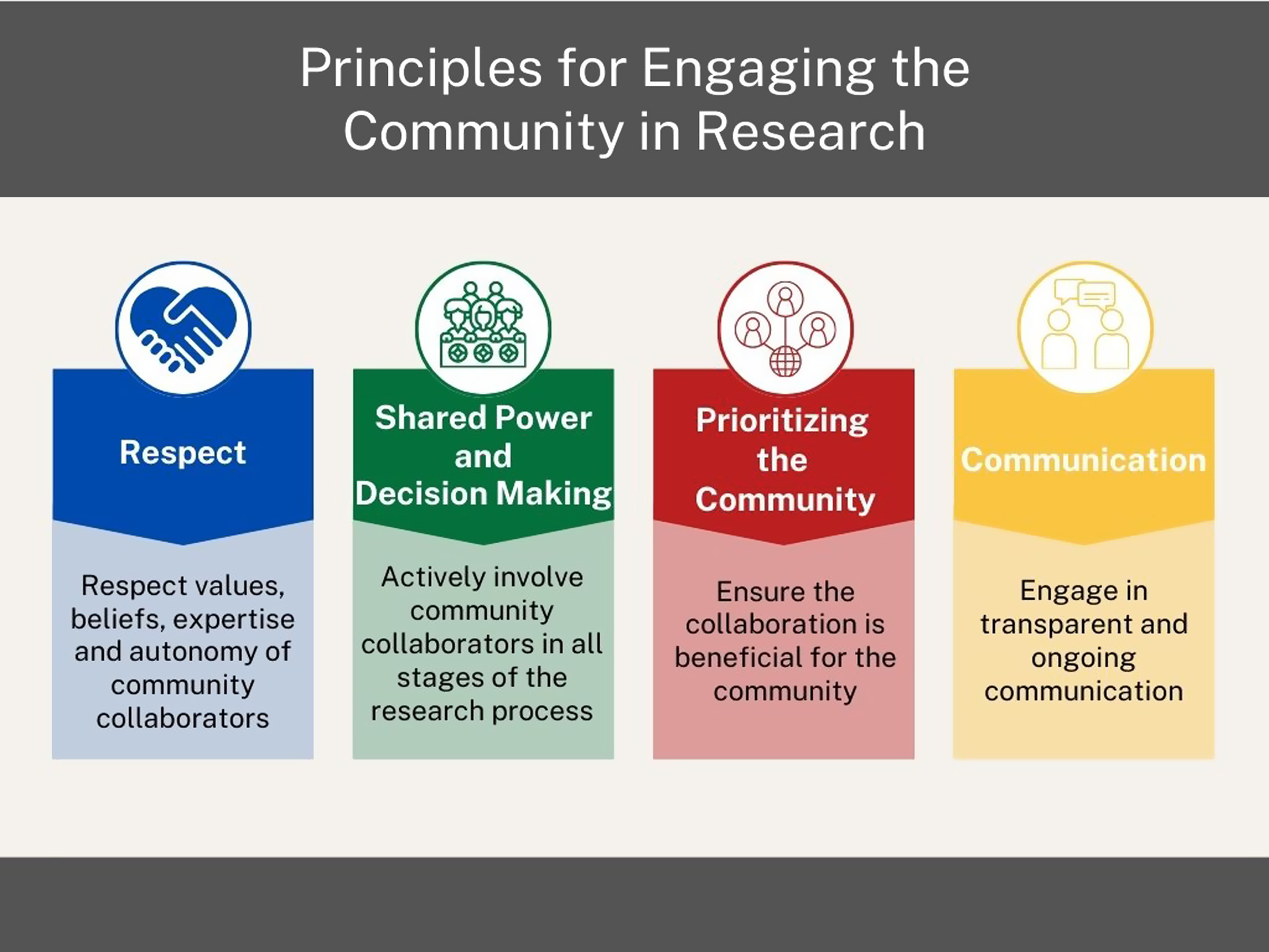
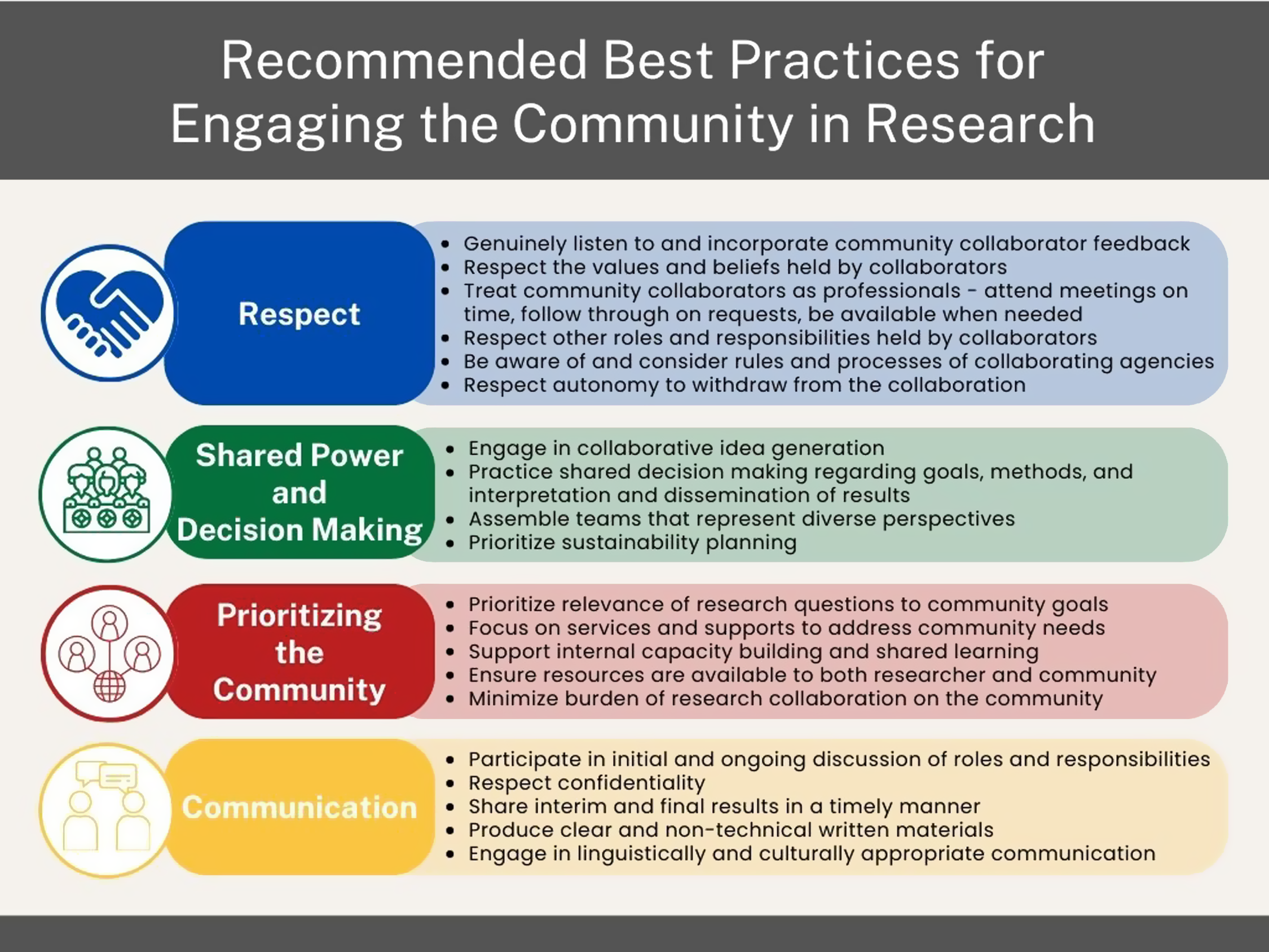
Below we describe four principles that promote best practice for engaging with the community in research. These include ensuring respect and shared power and decision-making, prioritizing the community, and communicating in a transparent and ongoing fashion (Figures 1 and 2). These principles also encompass major ethical considerations for community-based research (Mikesell, Reference Mikesell, Bromley and Khodyakov2013).
Principles for engaging the community in research.
Recommended best practices for engaging the community in research.
Respect
Respect is often conceptualized as the foundation for a successful research–community partnership (Ahmed & Palermo, Reference Ahmed and Palermo2010; Fielding-Miller et al., Reference Fielding-Miller, Kim, Bowles, Streuli and Davidson2022; Harrison et al., Reference Harrison, Auerbach, Anderson, Fagan, Carnie, Hanson, Banta, Symczak, Robinson, Schnipper, Wong and Weiss2019; Hoekstra et al., Reference Hoekstra, Mrklas, Khan, McKay, Vis-Dunbar, Sibley, Nguyen, Graham and Gainforth2020). As in all relationships, respect allows for healthy patterns of interaction, growth of individuals and relationships over time, and longevity of formal and informal relationships. In a research context, respect occurs between individual researchers and individual community members, as well as between researchers and larger professional organizations and agencies embedded within the community.
Researchers convey respect for individuals by genuinely listening to and incorporating the feedback and ideas of partners, and respecting the values and beliefs held by partners. On a practical level, being available to partners when questions arise, clearly and expeditiously answering questions, following through on requests for support and/or information, and attending meetings on time and with consistency conveys respect. Failure to exhibit this level of professionalism in everyday interactions with community partners conveys the message that the researcher does not truly respect them as a partner in the research process. Researchers must also hold in mind and respect the various roles and responsibilities that partners have outside the relationship that may limit their availability to engage in the research process.
Researchers convey respect for professional organizations and agencies by being cognizant of and taking into consideration the rules and regulations of the organization that they are partnering with. To accomplish this, researchers have a responsibility to ask questions and initiate dialog to fully understand agency rules and processes. Policies and procedures regarding confidentiality, professional roles and responsibilities, establishing formal and informal research partnerships, and recruitment of individuals for research and services must be followed. Lack of adherence to these policies has potential to significantly undermine the relationship. Researchers also have the responsibility to respect the autonomy of agencies and organizations to decide if and how they will remain engaged in the research collaboration over time.
Shared power and decision-making
For a successful research–community partnership, researchers must be willing to share power and responsibility with community partners (Ahmed & Palermo, Reference Ahmed and Palermo2010; Harrison et al., Reference Harrison, Auerbach, Anderson, Fagan, Carnie, Hanson, Banta, Symczak, Robinson, Schnipper, Wong and Weiss2019; Hoekstra et al., Reference Hoekstra, Mrklas, Khan, McKay, Vis-Dunbar, Sibley, Nguyen, Graham and Gainforth2020). This includes actively involving partners in all stages of the research process, from initial idea generation through dissemination of results and planning for sustainability of activities when desired. The diverse expertise and unique contributions of all members of the partnership must be valued. Researchers and community partners should engage in shared decision-making throughout the process, including shared responsibility for deciding upon the goals, methods, and plans for sharing results of the project.
It is important to acknowledge that this equitable distribution of power may be inconsistent with traditional models of academic-led research, where a researcher independently generates research questions and hypotheses based on theory, prior research, and/or the researcher’s professional interests and career goals. Engaging in shared decision-making may result in the identification of project goals that diverge from the researcher’s primary area of expertise, or research questions that on face value appear to be more foundational for knowledge than innovative in focus. Researchers must hold in mind that from a historical perspective, community partners have been inconsistently involved as equitable partners in the research process, resulting in the need for many “established” areas of knowledge to be revisited. Research questions examined in the past may not have been appropriate for the community and knowledge generated from that work less useful than research questions that arise with involvement of community partners and feedback from individuals with lived experience. Increasingly, funding agencies are recognizing the need to develop a broader, diverse, and community-engaged foundation for our research.
Related to this, traditional research methods may be identified as incompatible with the goals, values, and/or everyday lives of the community. For example, partners may identify that laboratory-based assessment methods, which aim to maximize scientific control and rigor, are inappropriate for the community or the research question, and that less-controlled home-based assessment approaches are more appropriate and feasible. Likewise, there may be concerns regarding clinical trial approaches that randomize individuals to a control condition that would prevent them from receiving a treatment that is perceived to be of high benefit. Quasi-experimental methods, such as propensity score matching, may be identified by community collaborators as most appropriate. Researchers have a responsibility to engage in open conversation with their partners regarding research methodology and to collaboratively develop a plan that is viewed to be appropriate, feasible, and useful to all.
Prioritizing the community
Community-engaged research must also be mutually beneficial for both the researcher and the community (Ahmed & Palermo, Reference Ahmed and Palermo2010; Hoekstra et al., Reference Hoekstra, Mrklas, Khan, McKay, Vis-Dunbar, Sibley, Nguyen, Graham and Gainforth2020). Researchers and community partners must come together to identify and prioritize the benefits and minimize the burden of the research. By collaborating with the community for research, researchers benefit in a de facto way from the collaboration, and, as mentioned previously, the research agenda has historically been researcher led. Thus, prioritizing the needs and interests of the community is necessary to make the work mutually beneficial. Researchers have a responsibility to actively hold this principle in mind throughout the research process.
Community needs should be prioritized when deciding upon the goals of the research. This is achieved by developing research questions that are relevant to the community, putting into place services and supports that address identified needs of the community, and utilizing the research as an opportunity for capacity building. These practices are consistent with the Belmont Report ethical principle of justice. To effectively prioritize the community when developing goals, researchers must engage in close communication where they actively seek input from community partners in an ongoing manner through the research process.
To effectively prioritize the community, tangible and intangible burden of the research collaboration on the community must be minimized. At a basic level, resources to facilitate the research process should be available to all involved. If financial support is available to support the time and effort of staff on a research project, community members who are engaged in the research process should be financially compensated for their effort. If this financial support is not available, the researcher must strive to provide the community with other services, supports, or resources to support their work. For example, a researcher may not have the financial resources to compensate professionals from a community agency to regularly attend research project meetings, but instead they may provide the agency with ongoing training or workshops to support staff professional development.
Communication
Finally, transparent and ongoing communication is essential for a successful research-community collaboration (Ahmed & Palermo, Reference Ahmed and Palermo2010; Harrison et al., Reference Harrison, Auerbach, Anderson, Fagan, Carnie, Hanson, Banta, Symczak, Robinson, Schnipper, Wong and Weiss2019; Hoekstra et al., Reference Hoekstra, Mrklas, Khan, McKay, Vis-Dunbar, Sibley, Nguyen, Graham and Gainforth2020). Roles and responsibilities should be discussed at the start of the collaboration and subsequently throughout. Confidentiality is also an important theme for discussion, and researchers should regularly check-in with collaborators to clarify information that should be held in confidence. Throughout the research process, researchers must also engage in timely sharing of results and progress toward attainment of research goals. Results should be shared with community collaborators prior to presentation to larger audiences and publication in scientific journals. Community partners should also be offered the opportunity to co-present results at both the national and local levels, for example in presentations to legislators, leaders of local programs that support the community, and to other community members. Opportunities to co-present results provides partners with public and professional recognition of their work and has potential to build their self-efficacy as partners in the research process.
Importantly, written materials generated for community collaborators must be clear and free of technical jargon. This can be a difficult task, and researchers must engage in self-reflection and seek feedback from others to challenge their assumptions regarding the clarity and meaning of their oral and written communication. Related to this, communication strategies must be linguistically and culturally appropriate.
Examples of community-engaged research
Our research group has been collaborating with diverse communities in the State of Rhode Island and in other areas of the county on research projects to support the healthy development of children and families in the real world. Below are three illustrative examples of how we have applied the overarching principles of community-engaged research to our work that is grounded in the science of developmental psychopathology.
Understanding and promoting family involvement in evidence-based home visiting
For the past decade, Dr Parade has been collaborating with the Office of Family Visiting at the Rhode Island Department of Health to understand factors that promote family involvement in perinatal home visiting programs. Decades of research have demonstrated the efficacy of perinatal home visiting for the promotion of maternal and child health, positive parenting, and the prevention of child maltreatment and family violence. Yet families often do not enroll in these programs when they are offered, and among families who do enroll retention is a challenge. Furthermore, the factors that predict family involvement in home visiting are not well understood, and novel implementation approaches to support family involvement are needed. Dr Parade’s program of research has been focused on collaborating with the Office of Family Visiting, and local home visiting implementation agencies, to directly address this public health problem. Through this collaboration, we are beginning to understand the important role that a mother’s own childhood experiences play in her subsequent involvement in family visiting services when she becomes a parent herself and that family visitors may benefit from professional development opportunities to support their work with mothers with a trauma history. This research has been funded by the Health Resources and Services Administration (HRSA R40MC28318) and the Centers for Disease Control and Prevention (CDC R01CE003103) and encompasses many of the recommended principles for community-engaged research.
The principle of Shared Power and Decision-Making is perhaps the most central to this work. This program of research is the direct result of collaborative idea generation between the academic research team and the professionals who oversee and implement home visiting programs in the state of Rhode Island. For example, when research funding opportunities have arisen, the research team looked to experts at the Health Department and local community implementation agencies to hear their perspectives on the needs for supporting the home visiting workforce. This resulted in the development of a successfully funded grant proposal focused on understanding factors that promote family involvement in home visiting. Rather than coming into these meetings with a specific set of research questions in mind, the academic research team raised the question of what would be helpful to the community, and the research questions were collaboratively developed during planning meetings. Several years later, when the opportunity to apply for CDC research funding to test innovative strategies to prevent family violence arose, this same process was undertaken with the academic research team, Health Department collaborators, and home visitors who work directly with families identifying the research questions, generating novel ideas for interventions to enhance home visiting, and planning the methodology for a randomized trial that could be feasibility and ethically implemented in the real world. Importantly, the principles of Respect, Prioritizing the Community, and Communication are practiced in this work. The research methodology across these projects has taken into account the values and beliefs of home visiting professionals, and the implementation strategies tested in the randomized trial are focused on developing the internal capacity of home visiting programs. For example, rather than members of the research team directly implementing an intervention with families, the research team has provided home visitors with professional development opportunities to strengthen their work with families with a trauma history. Several strategies have been implemented to minimize burden of the research on the community, including providing financial resources to support the time and effort of home visitors to participate in this research. Regularly scheduled meetings facilitate communication, and plans for sustainability are an ongoing point of discussion. This has resulted in a highly successful and rewarding collaboration that has potential for high public health impact in our state and eventually across the country.
Sleep wizard: development of a digital sleep intervention for children in foster care
Several principles of community engagement have also been applied to our work focused on the promotion of sleep among children in foster care. Children in foster care are at high risk for sleep disturbances, which are a major contributor to the development and exacerbation of chronic health conditions like depression, cardiovascular disease, obesity, and even mortality risk (Alvaro et al., Reference Alvaro, Roberts and Harris2013; Matthews & Pantesco, Reference Matthews and Pantesco2016; Miller et al., Reference Miller, Kruisbrink, Wallace, Ji and Cappuccio2018; Owens, Reference Owens2014; Parthasarathy et al., Reference Parthasarathy, Vasquez, Halonen, Bootzin, Quan, Martinez and Guerra2015), yet behavioral sleep interventions for this population are nonexistent. Investigators on our team, led by Dr Rojo-Wissar, seek to address this critical gap in care and promote health equity in this underserved population through the development and implementation of a trauma-informed digital public-health-level sleep intervention called Sleep Wizard, which will be administered to foster caregivers of preschool aged children. This ongoing project is funded by the National Heart, Lung, and Blood Institute (NHLBI 1K01HL169495). Central to our approach are the principles of Shared Power and Decision-Making, and Prioritizing the Community. We have developed a planning group of foster care workers, parents, and experts in sleep, trauma, health, and interventions in the context of foster care from across the country. The first aim of this project is to develop and digitize initial content for the Sleep Wizard intervention together with the planning group, informed by the literature on trauma-informed care, evidence-based strategies to support healthy sleep, foster care licensing regulations, and foster parent needs and experiences. In Aim 2, Sleep Wizard will be pretested by foster caregivers who will provide quantitative and qualitative data on acceptability, feasibility, and appropriateness of the intervention, which will be used to make final intervention modifications. Finally, Aim 3 will evaluate whether Sleep Wizard is associated with improvements in foster caregiver behaviors around sleep, and in child sleep from pre to post intervention, and at a 3-month follow-up. This will be the first large scale sleep intervention developed and tested in this population, and community collaborators are enthusiastic about Sleep Wizard and committed to involvement in its development and implementation.
The idea for Sleep Wizard began several years ago when Dr Rojo-Wissar conducted her MPH internship at a nonprofit organization in Arizona that provides various services and support to families involved in the foster care system. During her internship, Dr Rojo-Wissar spent time in group homes with the children in care and their house parents, observing routines and schedules, and asking about their experiences and concerns around sleep- both in the children, and in themselves (principles of Prioritizing the Community and Respect). She also spent time with the director of the program, initially collaboratively designing the internship plan to be mutually beneficial and impactful, and later learning logistics of how the foster parents receive training, its content, follow-up support, and rules and regulations that they must follow (principles of Respect, Shared Power and Decision-Making, and Prioritizing the Community). These experiences allowed Dr Rojo-Wissar to provide sleep education training to the organization that addressed issues that were important and relevant for them and that took their unique setting and context into account (principles of Communication, Shared Power and Decision-Making, and Prioritizing the Community). The organization found the training and resources so valuable that they integrated them into their training curriculum and have been administering them ever since. They are now a strong community partner and are involved in the planning group for Sleep Wizard. They will also help facilitate foster parent recruitment, group home staff recruitment and participation in providing feedback on intervention content during the development phase and for testing of the intervention during the implementation phase. In addition to supporting children’s sleep, we hope that Sleep Wizard will have secondary benefits of reducing foster parent burnout and increasing foster parent retention.
RISE: training leaders in early care and education in reflective supervision
The RISE (Reflection in Supervision of Educators) project, funded by the Eunice Kennedy Shriver National Institute of Child Health and Human Development (NICHD K23HD107243), represents a collaborative effort between researchers at an academic medical center–led by Dr Huffhines–and the Rhode Island Department of Education to enhance the quality of state-funded pre-kindergarten (RI Pre-K) programs to benefit underserved children. By training directors and education coordinators to use reflective supervision with their staff, teachers will be continually supported in using positive, evidence-based teaching practices in their classrooms to promote healthy social-emotional development. From the outset, RISE was designed not only to be a research study, but also a professional development opportunity for supervising professionals in RI Pre-K. Therefore, the goal of the RISE project was two-fold: to gather evidence for reflective supervision as a gold-standard practice using a randomized controlled trial (RCT) design, while providing professional development training to enhance community-based programs in need of support. RISE includes two phases. The first phase is an open trial to (1) establish feasibility, acceptability, and preliminary effectiveness of the professional development series in reflective supervision, (2) understand contextual factors that either help or hinder implementation of this practice, and (3) inform development of the RCT. The second phase is a cluster RCT to investigate whether supervisor, teacher, classroom, and child outcomes change as a function of supervisors receiving training in reflective supervision.
Given the intent of this project to be mutually beneficial for the researcher as well as the community, the principle of Prioritizing the Community is perhaps the most relevant. RISE exemplifies the approach of maximizing benefits to the community while minimizing burden. For example, we chose to use a waitlist control group design that would build workforce capacity in our state while rigorously collecting valuable effectiveness data. Supervisors who are randomized to the experimental condition participate in the professional development series in reflective supervision immediately, while those who are randomized to the waitlist control condition continue providing supervision to their staff as usual, but wait until the following academic year before receiving the training. This allows us to compare outcomes between those who participate in the training and those who don’t, while ensuring that all RI Pre-K supervisors who want the training ultimately receive it. Although it would have been more cost effective from a traditional research standpoint to never offer the training to the control group, doing so ensured that RI Pre-K could benefit without waiting years for research findings to become available. Furthermore, in order to minimize burden on participants, the research team and state partners coordinated data collection, such that any assessments RISE administered had clinical relevance for the early care and education setting and could be used by Rhode Island Department of Education, and that any assessments already in use by the state would be shared with the research team. The principle of Communication has been, and will continue to be, essential to the success of RISE. RISE was designed with the hope that the professional development series in reflective supervision will be an ongoing offering in Rhode Island, and because of this, the conversations that happen after the grant ends will be just as important as the conversations that happened before and during the project. Once RISE concludes, the research team and state partners will ask and answer questions inspired by the data, collaboratively solve challenges brought to light by the study, and think together about how to move forward with supporting reflective supervision as a sustainable practice in the state. Again, RISE is not simply a research study, but an opportunity to engage in long-term systems building.
Importantly, all three projects described above were possible because of long-standing relationships between the academic researchers and the community partners. Close collaborations allowed for a mutual relationship based on trust to grow over time, and the resulting research studies were a natural progression of these relationships. For example, RISE came about after several years of our research group partnering with the Rhode Island Department of Education to implement an early childhood consultation program, wherein members of the research team who are also licensed psychologists support RI Pre-K programs in promoting healthy social-emotional development in their children. Moreover, our research team, alongside other state partners and community agencies, has been working for well over a decade to implement the aforementioned professional development series in reflective supervision in multiple early childhood-based settings in our state, including home visiting and early care and education contexts. As a whole, our research team has made a significant effort to partner with leaders in our state to make our shared vision of effective, relationship-based services for young children and their families and caregivers in Rhode Island a reality, while adhering to the principles of Respect, Shared Power and Decision-Making, Prioritizing the Community, and Communication. Through these activities we have been able to effectively translate knowledge generated from the science of developmental psychopathology to support people in the real world.
Potential challenges and pitfalls
In the process of shifting toward more community-engaged approaches to the research process, we must be aware of challenges and take responsibility to protect against potential pitfalls of this approach, including burden on the community, tokenism, and unintended disruptions to the relationship. Involvement in research requires time and effort on the part of community members. Community members have reported that involvement in research can sometimes result in unanticipated financial and time burden (Tittlemier et al., Reference Tittlemier, Cooper, Steliga, Woodgate and Sibley2022) and as described above, researchers must make efforts to minimize the burden of the research partnership. Importantly, potential burden on the community should be carefully monitored throughout the research process. Community systems are constantly undergoing change, and programs and policies that may be in place to support the feasibility of a research collaboration at the start of a project may change over time.
Tokenism may occur when there is minimal effort to engage the community but the research process is presented as occurring with high levels of community involvement (Colder Carras et al., Reference Colder Carras, Machin, Brown, Marttinen, Maxwell, Frampton, Jackman and Jones2023; Hahn et al., Reference Hahn, Hoffmann, Felzien, LeMaster, Xu and Fagnan2017). This process silences the voices of community members with lived experience and enforces patterns of injustice and serves as a barrier to equity (Colder Carras et al., Reference Colder Carras, Machin, Brown, Marttinen, Maxwell, Frampton, Jackman and Jones2023). As researchers, we have a responsibility to not overstate the involvement of community partners and to be explicit when describing the ways that the community was (and was not) involved in the research process. Self-reflection over time regarding this issue is key to avoiding this potential pitfall.
Finally, even with the best of intentions, researchers may unknowingly undermine relationships they have built with community partners. For example, the academic institution’s policies or practices may prevent the researcher from responding to the request of a community collaborator in a timely or transparent manner. A research method previously agreed upon by all collaborators may be incompatible with a new policy or practice of the community partner. A respected individual from the community who is in a leadership role may not have been invited to participate in the collaboration because the researcher was not aware of their role. All these examples pose a potential threat to relationships. Fortunately, ongoing close communication with community partners allows researchers to prevent or mitigate the effects of such challenges. Importantly, by genuinely approaching the collaboration with the principles of community-engaged research in mind, when these types of events occur there is strong potential for repair.
Recommendations for the science of developmental psychopathology
Federal research funding opportunities are now increasingly calling for community-engaged approaches to research (Haapanen & Christens, Reference Haapanen and Christens2021; Kim et al., Reference Kim, Cheney, Black, Thorpe, Cene, Dave, Schaal, Vassar, Ruktanonchai, Frerichs, Young, Jones, Burke, Varma, Striley, Cottler, Brown, Sullivan and Corbie-Smith2020; Pérez-Stable et al., Reference Pérez-Stable, Hodes and Schwetz2022; Wallerstein et al., Reference Wallerstein, Oetzel, Sanchez-Youngman, Boursaw, Dickson, Kastelic, Koegel, Lucero, Magarati, Ortiz, Parker, Peña, Richmond and Duran2020). Furthermore, meaningfully engaging the community in research has potential to promote equity within academia and in the larger world (Duron et al., Reference Eder, Duron, Carter-Edwards, Greene-Moton, Minkler, Morales, Norris and Wallerstein2023). As developmental scientists, it is imperative that we center the community at the core of our work and pursue broader and more developed implementation of community-engaged approaches. This commitment is essential to ensure the effectiveness, innovation, impact, and sustainability of our work. Indeed, Cicchetti has long noted that a major goal of the field of developmental psychopathology is to bridge basic science and applied work to prevent and mitigate maladaptive developmental outcomes (Cicchetti & Hinshaw, Reference Cicchetti and Hinshaw2002; Cicchetti & Toth, Reference Cicchetti and Toth2009) and that collaboration with community members will support this goal (Luthar & Cicchetti, Reference Luthar and Cicchetti2000). To accomplish this, methods and best practices for engaging the community in research must be a standard component of research training from the bachelor’s level through the postdoctoral level and in continuing education for established researchers.
In our own work in Rhode Island and through our recently funded Center of Biomedical Research Excellence for Stress, Trauma, and Resilience (STAR COBRE; 1P20GM139767), we established a Community Collaborative Core to support research–community partnerships. This core aims to facilitate relationships with community collaborators to enhance the impact of our research at the state and local levels. Additionally, this core is tasked with developing capacity and support for investigators to engage in community collaborations through consultation and formal training opportunities. Finally, the core aims to enhance community collaborations by developing and supporting the competence of investigators regarding issues of diversity, equity, inclusion, and belongingness.
An example of Community Collaborative Core efforts is a three-part workshop series we developed for researchers and community partners to learn about and apply the principles of community-engaged research described here and in prior work (Ahmed & Palermo, Reference Ahmed and Palermo2010). This workshop series brings together researchers from an academic medical school and community partners who want to learn more about working together. Part 1 of the series introduces the principles of community-engaged research. This segment emphasizes the importance of defining community for both the researcher and the community partner. Additionally, the group discusses the history of research in the community and the harm that may have been done (intentionally or unintentionally). Part 2 consists of applying the principles to specific scenarios from previous experiences of community partners. This activity highlights the challenge of putting into practice the principles given the unique systems of academic institutions and the community organizations. Finally, Part 3 is a panel of community partners and researchers sharing their current experiences conducting community-engaged research. Throughout the workshop series, the conversation highlights the time commitment needed to build and maintain relationships, strategies for dealing with the difference of viewpoints among partners, the importance of leveraging resources for community organizations, and the importance of maintaining community trust. This workshop series is one example of an approach to support training in the development of community collaborations.
In this article, we highlighted the importance of engaging the community in research and outlined our recommended principles and best practices to effectively accomplish this. We encourage the field to prioritize training the next generation of developmental psychopathologists - as well as established researchers - in the methods of community engagement to ensure our work has the greatest impact. Centering the community in our work through shared power and decision-making, prioritizing the needs identified by the community, practicing respect, and engaging in consistent, transparent communication will allow us to most successfully advance the field of developmental psychopathology and improve health and health equity in the community.
Funding statement
This work was supported by grants CDC R01CE003103 (SHP), HRSA R40MC28318 (SHP), NICHD K23HD107243 (LH), NHLBI 1K01HL169495 (DMR) and 1P20GM139767. SHP was also supported by NICHD R01HD095837. LRS was also supported by 5U24ES028507, 5R01DA045492, 1R01DA056787, and 5R01DA044504. The contents are those of the authors and do not necessarily represent the official views of, nor an endorsement, by the CDC, HRSA, NIH, HHS, or the U.S. Government.
Competing interests
None.


 Open access

