



All results in the paper [Reference Fiscella and Vitillaro1] are stated under the assumption that  $\Omega$ is a bounded open subset of $\mathbb R^n$ ( $n\geqslant 1$) with $C^{1,1}$ boundary $\Gamma=\Gamma_0\cup\Gamma_1$, where $\Gamma_0$ and $\Gamma_1$ are disjoint subsets of $\Gamma$. The manifold $\Gamma$ is equipped with the natural Lebesgue measure $\sigma$ on the manifold, $\Gamma_0$ and $\Gamma_1$ are assumed to be measurable with respect to $\sigma$ and, finally, $\sigma(\Gamma_0)$ is assumed to be positive. The authors recently pointed out that $\Omega$ must be connected for most of these results to make sense.
The paper [Reference Fiscella and Vitillaro1] was aimed to relax the assumption  $m \lt \frac {2(n+1)p-4(n-1)}{n(p-2)+4}$, which appears in [Reference Vitillaro3, Theorem 7], to the assumption $m \lt 1+p/2$, which appears in [Reference Fiscella and Vitillaro1, Theorems 1.1 and 3.2]. But in [Reference Vitillaro3] the open set $\Omega$ was assumed to be connected, while in [Reference Fiscella and Vitillaro1] this assumption is missing. Unfortunately, as we are going to show, the variational setting under which [Reference Fiscella and Vitillaro1, Theorems 1.1 and 3.2] are stated may fail to hold when $\Omega$ is disconnected, depending on the location of $\Gamma_0$.
We recall that, at p. 761 of [Reference Fiscella and Vitillaro1], we introduced the Hilbert space
 \begin{equation*}H^1_{\Gamma_0}(\Omega)=\left\{u\in H^1(\Omega): u_{|\Gamma_0}=0\right\},\end{equation*}
where  $u_{|\Gamma_0}$ is intended in the trace sense. Moreover, by recalling the setting of [Reference Vitillaro3], the space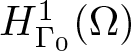 $H^1_{\Gamma_0}(\Omega)$ was equipped with the norm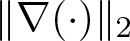 $\|\nabla (\cdot)\|_2$, which was asserted to be equivalent to the standard norm of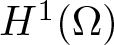 $H^1(\Omega)$, that is to the norm defined by
 \begin{equation*}\|u\|_{H^1(\Omega)}=\left(\|u\|_2^2+\|\nabla u\|_2^2\right)^{1/2}\quad\text{for all}~u\in H^1(\Omega).\end{equation*}
Now the authors realized that this setting is correct only when  $\Omega$ is connected, i.e. in the original setting of [Reference Vitillaro3], since when $\Omega$ is disconnected the bilinear form $(\cdot,\cdot)$ defined on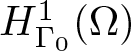 $H^1_{\Gamma_0}(\Omega)$ by
 \begin{equation*}(u,v)=\int_\Omega \nabla u\nabla v\quad\text{for all}~u,\,v\in H^1_{\Gamma_0}(\Omega),\end{equation*}
may even fail to be positive definite.
Indeed, let us consider the particular case when  $\Omega=\Omega_1\cup\Omega_2$, $\Omega_1$ and $\Omega_2$ being open and nonempty, $\overline{\Omega_1}\cap\overline{\Omega_2}=\emptyset$, and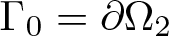 $\Gamma_0= \partial\Omega_2$,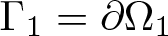 $\Gamma_1= \partial\Omega_1$. Let us set the characteristic function $\chi_{\Omega_1}$, defined on $\Omega$, that is
 \begin{equation*}\chi_{\Omega_1}(x)=
\begin{cases}
0\quad\text{when}~x\in\Omega_2,\\
1\quad\text{when}~x\in\Omega_1.
\end{cases}\end{equation*}
\begin{equation*}\chi_{\Omega_1}(x)=
\begin{cases}
0\quad\text{when}~x\in\Omega_2,\\
1\quad\text{when}~x\in\Omega_1.
\end{cases}\end{equation*}
Its equivalence class with respect to a.e. equivalence, still denoted (as usual) as  $\chi_{\Omega_1}$, belongs to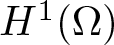 $H^1(\Omega)$, and one has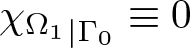 ${\chi_{\Omega_1}}_{|\Gamma_0}\equiv 0$, while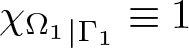 ${\chi_{\Omega_1}}_{|\Gamma_1}\equiv 1$, and hence $\chi_{\Omega_1}\in H^1_{\Gamma_0}(\Omega).$ Since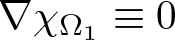 $\nabla \chi_{\Omega_1}\equiv 0$ in $\Omega$, we then have $(\chi_{\Omega_1},\chi_{\Omega_1})=0$, while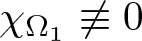 $\chi_{\Omega_1}\not\equiv 0$.
On the other hand, when  $\Omega$ is connected, the setting is correct. Indeed, by the Area Formula, see [Reference Leoni2, Chapter 9, Theorem 9.27, p. 253], $\sigma(\Gamma_0)=\mathcal{H}^{N-1}(\Gamma_0)$, where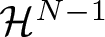 $\mathcal{H}^{N-1}$ denotes the Hausdorff measure. Hence, by [Reference Ziemer4, Chapter 2, Theorem 2.6.16, p. 75], one derives that the capacity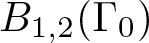 $B_{1,2}(\Gamma_0)$ is positive. One then applies [Reference Ziemer4, Chapter 4, Corollary 4.5.2, p. 195] to conclude that the following Poincaré-type inequality holds: there is a positive constant $c_1=c_1(\Omega,\Gamma_0)$ such that
 \begin{equation*} \|u\|_2\le c_1 \|\nabla u\|_2\end{equation*}
for all 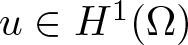 $u\in H^1(\Omega)$ such that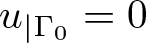 $u_{|\Gamma_0}=0$. Unfortunately, the authors have not noticed, before the publication of [Reference Fiscella and Vitillaro1], that [Reference Ziemer4, Chapter 4, Corollary 4.5.2, p. 195] is obtained as a consequence of [Reference Ziemer4, Chapter 4, Theorem 4.5.1, p. 195], where $\Omega$ is assumed to be connected, so this proof is based on the connectedness assumption.
Most of the results of [Reference Fiscella and Vitillaro1] can be misleading when  $\Omega$ is disconnected. For example, in the particular case $\Omega=\Omega_1\cup\Omega_2$ considered above, the potential well depth $d$ defined in [Reference Fiscella and Vitillaro1, (1.4)] vanishes. Indeed, we recall that
 \begin{equation}
d=\inf_{u\in H^1_{\Gamma_0}(\Omega)\setminus\{0\}}\sup_{\lambda \gt 0} J(\lambda u),
\end{equation}
\begin{equation}
d=\inf_{u\in H^1_{\Gamma_0}(\Omega)\setminus\{0\}}\sup_{\lambda \gt 0} J(\lambda u),
\end{equation}
where the functional  $J$ is defined by
 \begin{equation*}
J(u)=\tfrac 12 \|\nabla u\|_2^2 -\tfrac 1p \|u\|^p_p\quad\text{for all}~u\in H^1_{\Gamma_0}(\Omega),
\end{equation*}
\begin{equation*}
J(u)=\tfrac 12 \|\nabla u\|_2^2 -\tfrac 1p \|u\|^p_p\quad\text{for all}~u\in H^1_{\Gamma_0}(\Omega),
\end{equation*}
vanishes. An easy calculation shows, as in the proof of [Reference Fiscella and Vitillaro1, Lemma 4.1] that, for any  $u\in H^1_{\Gamma_0}(\Omega)\setminus\{0\}$, one has
 \begin{equation*}\sup_{\lambda \gt 0}J(\lambda u)=\max_{\lambda \gt 0}J(\lambda u)=\left(\frac 12 -\frac 1p\right)\left(\frac {\|\nabla u\|_2}{\|u\|_p}\right)^{\frac {2p}{p-2}}\geqslant 0.\end{equation*}
Since we have  $\sup_{\lambda \gt 0}J(\lambda \chi_{\Omega_1})=0$, we get that the infimum in (0.1) is attained, as a minimum, when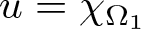 $u=\chi_{\Omega_1}$, so $d=0$. Consequently, the so-called ‘bad part of the potential well’ defined in [Reference Fiscella and Vitillaro1, (1.5)] does not exist in this case, and [Reference Fiscella and Vitillaro1, Theorem 1.1] is wrong. In the particular case considered above, also [Reference Fiscella and Vitillaro1, Theorem 3.2] cannot be stated. Indeed, the positive constant $K_0$ defined in formula [Reference Fiscella and Vitillaro1, (2.15)], that is
 \begin{equation*}
K_0=\sup_{u\in H^1_{\Gamma_0}(\Omega)\setminus\{0\}} \frac
{\int_\Omega F(\cdot,u)}{\|\nabla u\|_2^p},\end{equation*}
\begin{equation*}
K_0=\sup_{u\in H^1_{\Gamma_0}(\Omega)\setminus\{0\}} \frac
{\int_\Omega F(\cdot,u)}{\|\nabla u\|_2^p},\end{equation*}
is clearly ill-defined, since 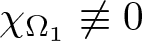 $\chi_{\Omega_1}\not\equiv 0$, so we can take it in the supremum, but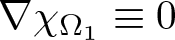 $\nabla \chi_{\Omega_1}\equiv 0$, so the fraction does not make sense.
Finally, also the local existence of weak solutions of problem [Reference Fiscella and Vitillaro1, (1.1)], which is asserted in [Reference Fiscella and Vitillaro1, Theorem 2.6], cannot be taken for granted when  $\Omega$ is disconnected. Indeed [Reference Fiscella and Vitillaro1, Remark 2.7], when it asserts that in [Reference Vitillaro3] one can consider also disconnected open sets, is wrong. Indeed, when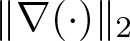 $\|\nabla (\cdot)\|_2$ is not an equivalent norm in the space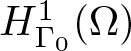 $H^1_{\Gamma_0}(\Omega)$, as in the case $\Omega=\Omega_1\cup\Omega_2$ considered above, the functional $I$ defined in the last line of [Reference Vitillaro3, p. 383] is not coercive, so there is substantial gap in the proof of [Reference Fiscella and Vitillaro1, Theorem 2.6]. The same phenomenon occurs when dealing with [Reference Fiscella and Vitillaro1, Theorem 2.8].
In conclusion, the assumption that ‘ $\Omega$ is a bounded open subset of $\mathbb R^n$’ must be replaced in paper [Reference Fiscella and Vitillaro1] by ‘ $\Omega$ is a bounded domain (that is, a connected open subset) of $\mathbb R^n$’. This assumption appears in three instances, in the Abstract and twice at the beginning of Section 1. Under this new assumption, all the results in paper [Reference Fiscella and Vitillaro1] hold. As correctly pointed out in [Reference Fiscella and Vitillaro1, Remark 2.7], the case in which $\Omega$ is disconnected is not of particular interest.
Acknowledgements
This work has been funded by the European Union - NextGenerationEU within the framework of PNRR Mission 4 - Component 2 - Investment 1.1 under the Italian Ministry of University and Research (MUR) programme ‘PRIN 2022’ - 2022BCFHN2 - Advanced theoretical aspects in PDEs and their applications - CUP: J53D23003700006.
The authors are members of Gruppo Nazionale per l’Analisi Matematica, la Probabilità e le loro Applicazioni (GNAMPA) of the Istituto Nazionale di Alta Matematica (INdAM), Italy.
A. Fiscella realized the manuscript within the auspices of the CNPq project titled Variational methods for problems with mixed nature and non-standard growth (303986/2024-7), of the FAEPEX - PIND project titled Problems and functionals with non-standard growth (2583/25), and of the FAPESP project titled Non-uniformly elliptic problems (2024/04156-0).


