

- LDL-C
-
cholesterol carried by LDL
- HDL-C
-
HDL cholesterol
- RR
-
relative risk
Despite advances in prevention and treatment, CVD still represents the greatest cause of death and disease burden in Europe. Busse et al. ( Reference Busse, Blümel and Scheller-Kreinsen 1 ) reported that in 2005 CVD caused 5·07 million or 52% of all deaths together with an overall disease burden of 34·42 million disability-adjusted life years. Already, CVD costs the EU some €200 billion annually in direct and indirect charges and notably the cost per person in the UK is already higher than the EU average( Reference Allender, Scarborough and Peto 2 ). The increasing burden of obesity and the increasing age of populations will increase the risk and cost of CVD. These issues mean that diet, an important moderator of CVD risk needs to play an increasingly important role.
While dietary issues like the amount and type of fat have had very considerable attention in relation to CVD risk, there has been less direct focus on the role of individual foods although milk and dairy products have been heavily criticised by the popular media, mainly because milk fat is rich in SFA. Also, as highlighted by Elwood et al. ( Reference Elwood, Givens and Beswick 3 , Reference Elwood, Pickering and Givens 4 ), judgments on the CVD risk associated with consumption of milk and dairy products have often been based on single determinants, usually serum cholesterol despite the fact that dairy products are highly complex foods. Ideally, the chronic impact of milk and dairy product consumption on CVD would be studied in adequately powered randomised control intervention studies. So far no studies have been done which have CVD events and CVD-related deaths as determined outcomes. Such studies would need to be of very long duration, with obvious compliance and drop out problems and would be very expensive. As a result Elwood et al. ( Reference Elwood, Givens and Beswick 3 , Reference Elwood, Pickering and Givens 4 ) proposed that the most valuable evidence on links between milk and dairy products and CVD is likely to come from long-term prospective cohort studies.
This paper will briefly review the currently available evidence from prospective studies but since these can only identify associations and not mechanisms, the paper will also examine the role and weaknesses of lipid and non-lipid markers of CVD risk although the latter will be restricted to effects on blood pressure. In addition, the potential of current animal nutrition-based approaches aimed at reducing CVD risk from consumption of milk and dairy products will be outlined.
Milk, dairy products and CVD: evidence from prospective studies
A recent meta-analysis of all suitable prospective data on milk/dairy product and CVD events was reported( Reference Elwood, Pickering and Givens 4 ). Table 1 summarises the outcome of this study and includes data on type 2 diabetes. Although the analyses include studies that involve a range of dairy products, the vast majority relate to milk and we believe the results can be interpreted as the effect of milk consumption. The evidence on milk consumption and IHD is substantial as the data in the studies were homogeneous and the meta-analysis of all of the available evidence suggests that there is a small but worthwhile reduction in relative risk (RR) of IHD (RR 0·92; 95% CI 0·80, 0·99) in the subjects who drink the most milk. The evidence on milk consumption and the risk of stroke are also noteworthy and suggest a reduction in both ischaemic (RR 0·79; 95% CI 0·68, 0·91) and in haemorrhagic stroke (RR 0·75; 95% CI 0·60, 0·94) in subjects with the highest consumption of milk. Interestingly, a reduction in RR for sub-arachnoid haemorrhage was also seen although this was based on few studies and was NS. Elwood et al. ( Reference Elwood, Pickering and Givens 4 ) also examined the evidence for differential effects of milk, cheese and butter on RR for vascular disease. This essentially showed that there were very few prospective cohort studies available for cheese (five) and butter (six). For butter, only three studies were suitable for meta-analysis giving a non-significant RR for high v. low consumption (0·93, 95% CI 0·84, 1·02). For cheese, only two studies were suitable for meta-analysis. While there is some additional evidence related to butter and cheese from retrospective case-control studies, this is weaker evidence than from cohort studies and overall this highlights a large gap in knowledge.
Summary of meta-analyses of prospective studies of milk and dairy consumption and CVD events and type 2 diabetes (from Elwood et al. ( Reference Elwood, Pickering and Givens 4 ))

RR, relative risk; NS, not significant.
In most studies available to Elwood et al. ( Reference Elwood, Pickering and Givens 4 ) the type of milk (full fat, semi-skimmed, etc.) was not identified, and since many studies took place over long periods there may have been a shift from full fat to fat-reduced types with time. Some studies did identify the type but the data were not powerful enough to draw firm conclusions on the relative merits of full fat v. fat-reduced milk or milk products. Also, most studies used quartiles or quintiles of the distribution of intakes, while others defined intake in terms of ‘glasses’ drunk and others simply accepted the number of occasions on which milk or dairy foods were consumed. Nevertheless, some guidance can be taken from definitions in several of the studies. Thus, several studies defined a ‘high’ intake as the consumption of 568 ml or more per day, others two or more ‘glasses’ per day, while in one study based on weighed dietary intakes, the mean daily consumption of milk in the subjects who showed a reduction in vascular disease and diabetes was more than 190 ml.
Other reported meta-analyses include those of Gibson et al. ( Reference Gibson, Makrides and Smithers 5 ) who identified twelve cohort studies and reported that there were ‘no consistent findings to support the concept that dairy food consumption is associated with a higher risk of CHD’, Mente et al. ( Reference Mente, de Koning and Shannon 6 ) who analysed data from five cohort studies and reported that ‘milk has no significant association with CHD’ (RR 0·91; 95% CI 0·73, 1·00) and Soedamah-Muthu et al. ( Reference Soedamah-Muthu, Ding and Al-Delaimy 7 ) who analysed seventeen prospective studies and showed that ‘milk is not associated with total mortality and may be inversely associated with overall CVD risk’.
The analysis of prospective data provides good evidence that consumers of large quantities of milk/dairy products are certainly at no greater risk of CVD than low consumers and indeed there may be a small, but useful, reduction in vascular disease risk from increased consumption. Essentially all of the prospective studies relate to adults and there is little information on the long-term effects of milk/dairy consumption by children. One recently published study presented the outcome of the 61-year follow-up of the Boyd–Orr cohort that involved the recruitment of 4999 children in England and Scotland in 1937–39( Reference van der Pols, Gunnell and Williams 8 ). The subsequent causes of death were recorded from 1948 and showed that a family diet in childhood rich in dairy products did not lead to a greater risk of death from CVD. In fact all-cause mortality was significantly less in those with high dairy product and milk intake (basic hazard ratio for both, 0·69, 95% CI 0·57, 0·84, P<0·002). Ca intake during childhood was inversely related to stroke mortality but was not significantly related to death from IHD. The rather larger effect of Ca than milk or dairy products seen in the Boyd–Orr study is of much interest since dietary Ca has many effects including the binding of cholesterol and bile acids in the gut( Reference Ditchfield, Keller and Jahreis 9 ) and blood pressure lowering.
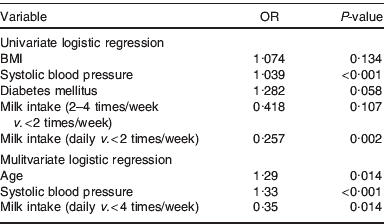
There are increasing concerns about the increasing prevalence of dementia with cases in the UK projected to double between 2001 and 2040( Reference Jagger, Matthews and Lindesay 10 ). Some aspects of dementia are related to vascular disease but there is a dearth of information on any relationship between milk/dairy product consumption and dementia risk. The Japanese Adult Health prospective study involving a cohort of 1774 subjects in Hiroshima born before September 1932 has, however, reported on this( Reference Yamada, Kasagi and Sasaki 11 ). This showed that over the period 1992–97, 1660 subjects were shown to have no dementia, 114 had dementia (fifty-one with Alzheimer's disease, thirty-eight with vascular dementia). Vascular dementia prevalence significantly increased with age but interestingly was also increased in those with the low milk intakes. The OR for vascular dementia for age (in 5-year increments) and milk intake (almost daily v. less than four times weekly) were 1·29 and 0·35, respectively (Table 2). The authors concluded that increased blood pressure and low milk intake in midlife were associated with vascular dementia detected 25–30 years later. The reasons for the apparent protective effect of milk cannot be stated with any certainty but since other data show a link between milk consumption and reduced blood pressure, it may be that this is a crucial aspect. There may, however, be concerns about how typical this cohort is, given its likely exposure to radiation during the Second World War, but clearly more work is needed in this area.
The association between milk consumption and other variables with vascular dementia in the Adult Health Study cohort (from Yamada et al. ( Reference Yamada, Kasagi and Sasaki 11 ))
Lipid-related risk factors of vascular disease
Dairy fat is high in SFA (typically about 70 g/100 g total fatty acids being SFA) and there is general agreement that many of these SFA increase serum cholesterol concentrations (see recent review( Reference Givens, Kliem and Talbot 12 )). Evidence from a number of prospective studies( Reference Abbott, Curb and Rodriguez 13 , Reference Ness, Davey Smith and Hart 14 ) indicates somewhat higher serum total cholesterol in high consumers of dairy product than in low consumers. In addition, using data from studies carried out across the EU, a positive relationship between intake of SFA from dairy products and total cholesterol (R 2=0·53) was reported( Reference Givens 15 ); although such studies can be unreliable due to multiple confounding factors. Of the total cholesterol pool, cholesterol carried by LDL (LDL-C) is accepted as a better indicator of CVD risk due to the atherogenicity of LDL. Increased LDL-C is associated with increased consumption of SFA; however, a number of intervention studies that have specifically fed milk and other dairy fats have not given rise to significantly increased LDL-C( Reference Pfeuffer and Schrezenmeir 16 – Reference Biong, Muller and Seljeflot 18 ). For example in the study of Poppitt et al. ( Reference Poppitt, Keogh and Mulvey 17 ) involving healthy normocholesterolaemic males, the consumption of 20% of dietary energy as butter for 21 d resulted in no significant change in the blood lipid or apo profile.
It is recognised that an increased proportion of small dense LDL particles represents a greater atherogenic risk than larger, less dense LDL and of note is one cross-sectional study( Reference Sjogren, Rosell and Skoglund-Andersson 19 ) in healthy Swedish men which indicated that dietary fatty acids typically found in dairy foods gave rise to significantly less small dense LDL particles (size 23·5–22·5 nm; density 1·04–1·05 g/l). This was found to be the case for dietary fatty acids C4:0–C10:0 and 14:0 (P<0·05) (Table 3) and C15:0 and C17:0 (markers of dairy fat intake) in serum phospholipids (P<0·05). Clearly the implication that LDL particle size distribution can be favourably modified by dairy products in the diet needs further investigation. The Swedish study( Reference Sjogren, Rosell and Skoglund-Andersson 19 ) also showed that the tertile of men with the lowest proportion of small dense LDL also had a significantly (P<0·0001) higher concentrations of HDL cholesterol (HDL-C), which has been shown to have a negative relationship with CVD. The positive association between dairy fatty acids and HDL-C would have been predicted by the meta-analysis of Mensink et al. ( Reference Mensink, Zock and Kester 20 ). This involved sixty selected human studies and predicted that when dietary carbohydrates are replaced with an isoenergetic amount of C12:0–C16:0 SFA an increase in LDL-C occurs but crucially this is associated with an increase in the protective HDL-C. This study( Reference Mensink, Zock and Kester 20 ) highlighted that the ratio of total:HDL-C gives the most powerful predictor of the effect of dietary fatty acids on risk of IHD and the meta-analysis suggested that C12:0 may be somewhat beneficial as it significantly (P<0·05) reduced the total:HDL-C. C16:0 was the only SFA to increase this ratio though the effect was NS.
Fatty acid composition of diet in healthy Swedish men grouped according to tertiles of serum small dense LDL (sdLDL) concentration (after Sjogren et al. ( Reference Sjogren, Rosell and Skoglund-Andersson 19 ))
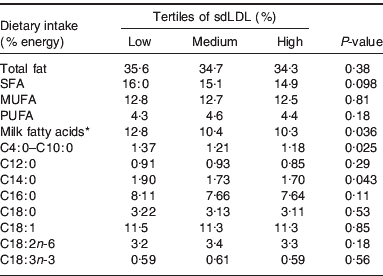
* Fatty acids from milk, yoghurt, cream, cheese, ice-cream and butter.
Taken together the current evidence suggests that with the possible exception of C16:0, the SFA in milk fat may not pose such a large risk to CVD as was previously thought based mainly on serum total cholesterol. More work is needed, however, and in particular whether replacing some of the SFA in milk fat (and C16:0 in particular) with cis-MUFA and/or cis-PUFA will give rise to benefits for vascular health.
Dairy products and blood pressure
The Dietary Approaches to Stop Hypertension study( Reference Appel, Thomas and Moore 21 ) showed that a diet rich in fruit, vegetables and low-fat dairy products (combination diet) reduced blood pressure in both normotensive and hypertensive subjects more than a fruit and vegetable diet or the control diet. The combination diet containing low-fat dairy products lowered mean 24 h ambulatory systolic blood pressure by 5·5 and 2·7 mmHg more (P<0·001) than the control and fruit and vegetable diets, respectively, although these reductions were increased to 11·4 and 4·2 mmHg in a sub-group of hypertensives. The authors concluded that such a diet could provide an additional nutritional approach to the prevention and treatment of hypertension. While the study design did not allow the effects of the combination diet to be attributed just to milk/dairy products, changes in other dietary factors known to affect blood pressure (e.g. Na) were small and is suggestive of a key role for dairy foods in blood pressure regulation. More recently, a sound body of evidence has evolved showing that in general, increased consumption of milk/dairy products leads to a reduction in blood pressure with responses usually being greater in hypertensive subjects. The evidence from population studies (eleven cross-sectional and eight prospective) and eight intervention trials (five dairy food and three dietary pattern studies) has recently been reviewed by Kris-Etherton et al. ( Reference Kris-Etherton, Grieger and Hilpert 22 ) The results from the cross-sectional studies showed that in all but one case, increased consumption of at least one dairy product was associated with a reduction in systolic blood pressure although the effect on diastolic pressure was seen in only eight studies. One study( Reference Beydoun, Gary and Caballero 23 ) compared the effects of milk, yoghurt and cheese and showed that while milk and yoghurt was significantly (P<0·05) associated with reduced systolic and diastolic blood pressure, cheese was associated with a significant (P<0·05) increase in both pressures. Of the eight prospective cohort studies, two showed no effect of either low- or high-fat dairy products on blood pressure although in one of the studies no record of dairy consumption was available. Four of the prospective studies differentiated the effects of low- v. high-fat dairy products and in each case increased consumption of milk or low-fat dairy product reduced blood pressure or the risk of hypertension whereas high-fat dairy products did not. A similar response was seen in the Rotterdam cohort( Reference Engberink, Hendriksen and Schouten 24 ) that was not included in the recent review( Reference Kris-Etherton, Grieger and Hilpert 22 ). A summary of the outcomes from these five prospective studies is shown in Table 4 and overall is suggestive of a benefit of milk and reduced fat products. Of the five dairy food intervention studies reviewed, three were concerned with Ca supplementation or exchange. The remaining two studies were of different design making an overall interpretation difficult and it is probable that at present the best available evidence is provided by the prospective cohort studies.
Summary of outcomes from prospective cohort studies reporting differential effects of low- and high-fat dairy products on blood pressure.

* HR (95% CI), highest intake v. lowest.
† RR (95% CI), highest intake v. lowest.
‡ Data after 2 years.
Kris-Etherton et al. ( Reference Kris-Etherton, Grieger and Hilpert 22 ) also reviewed the mechanisms whereby milk/dairy products can influence blood pressure. Broadly there seems to be at least two key mechanisms involved. Increased consumption of dairy products leads to increased intake of Ca and K both of which have been shown to affect vasoconstriction and improve arterial stiffness. There is, however, some evidence that the effects of Ca and dairy products are somewhat independent( Reference Ruidavets, Bongard and Simon 25 ). The independent effect of dairy foods may be because, in addition to the effect of Ca and K, the milk proteins casein and whey proteins release bioactive peptides during digestion which may have a beneficial effect on blood pressure by inhibiting the angiotension-1-converting enzyme, thus modulating endothelial function and leading to vasodilatation( Reference Clare and Swainsgood 26 ). A further chronic effect may relate to body weight since reducing this will reduce blood pressure and increased consumption of milk has been associated with body weight reduction in a number of studies. Indeed a recent 23-week study( Reference Baer, Stote and Paul 27 ) with obese and overweight adults showed that relative to carbohydrate, whey protein but not soya protein reduced body weight and waist circumference.
While blood pressure is a valuable predictor of CVD, it is usually measured by assessing the pressure in the brachial artery in the upper arm. The structure of this artery is rarely affected by hypertension whereas the large central arteries are susceptible to hypertension and associated ischaemic disease. For this reason, it is now recognised that functional measures of central arterial health are more valuable holistic predictors of vascular health outcome( Reference Yasmin and Brown 28 ). Various measures exist but broadly most assess aspects of arterial stiffness/flexibility. In this regard, a recent study( Reference Pal and Ellis 29 ) is particularly interesting as it seems to be the only study to have examined the effects of milk proteins on arterial stiffness measured by pulse-wave analysis. They measured upper arm blood pressure and central augmentation index (simply defined as the proportion of the late systolic peak central pulse pressure attributable to the reflected pulse wave) after 6 and 12 weeks in subjects who had consumed either 54 g/d casein or whey protein or a glucose-based control. They showed that while both casein and whey proteins significantly reduced systolic and diastolic blood pressure after 6 and 12 weeks, only the whey protein supplement significantly reduced the augmentation index after 12 weeks (Fig. 1). The subjects in this study were overweight and obese middle-aged men and women but they were not hypertensive. Clearly more studies of this type are needed, including those in hypertensive subjects, but confirmation of a differential effect of the two major families of milk proteins would be most valuable in designing diets aimed at reducing risks of CVD.
Changes in mean systolic blood pressure and augmentation index from baseline to 6 and 12 weeks due to consumption of control, casein or whey protein supplements (from( Reference Pal and Ellis 29 )). *Significant differences from baseline (P<0·05); a, b, different letters indicate significant treatment effects (P<0·05).

Replacing SFA in milk fat with the aim of reducing CVD risk
Several reports indicate that in much of the EU milk and dairy products make the single greatest contribution to SFA intake. The TRANSFAIR study( Reference Hulshof, van Erp-Baart and Anttolainen 30 ) reported that in the UK milk/dairy products supply about 40% of all SFA, somewhat higher than the values from the National Diet and Nutrition Survey( Reference Henderson, Gregory and Irving 31 ). Replacing a proportion of the SFA in milk fat with cis-MUFA or cis-PUFA can be achieved by modification of the diet of the dairy cow. The main approach used is to include supplements of plant oils or oilseeds rich in unsaturated C18 fatty acids in the diet (see review( Reference Givens, Shingfield, Williams and Buttriss 32 )), which reduce the synthesis of short- and medium-chain SFA (C6:0–C16:0) by the mammary gland and increase the concentrations of long-chain fatty acids in milk. Replacing SFA with cis-MUFA leads to a considerably greater replacement of SFA than replacing with cis-PUFA. Some selected data from a recent study( Reference Kliem, Shingfield and Humphries 33 ) that included conventional oleic-acid rapeseed or high oleic-acid rapeseed in the diet of dairy cows at 128, 168 or 207 g/kg diet dry matter is shown in Table 5. Ca salts of palm-oil distillate were used in the control diet. Both rapeseed types decreased linearly (P<0·001) milk-fat SFA content which was partially replaced by a linear increase (P<0·001) in cis-9 C18:1 concentration. The greatest effect on SFA content was due to reductions in C16:0.
Effect of replacing Ca salts of palm oil distillate with incremental amounts of conventional or high oleic acid milled rapeseeds on selected milk fatty acids (from( Reference Kliem, Shingfield and Humphries 33 ))

† 1, 2 and 3, refer to rapeseed inclusion levels of 73, 96 and 118 g/kg dry matter, respectively.
‡ sem for n 35 measurements, 13 error Df.
§ Refers to the significance of five comparisons; 1, CPO diet v. COR diet level 1; 2, CPO v. HOR diet level 1; 3, linear response to COR inclusion level; 4, linear response to HOR inclusion level; 5, average of COR diet responses v. average of HOR responses. *P<0·05, **P<0·01 and ***P<0·001, respectively.
Whether or not partially replacing SFA with cis-MUFA or cis-PUFA in milk fat will lead to milk and dairy products which when consumed lead to a reduced CVD risk was recently reviewed( Reference Givens, Minihane and Watson 34 ). This showed that despite the relatively large number of studies on manipulating milk fatty acid composition, only six intervention studies were identified using milk/milk products with SFA having been reduced from typically 70 to 55 g/100 g total fatty acids and cis-MUFA increased from typically 20 to 33 g/100 g total fatty acids. In addition, all studies used butter wholly or in part as the test food and thus the effect of milk, cheese, etc., remains unknown. In all cases outcome measures relied heavily on serum cholesterol. For example, Noakes et al. ( Reference Noakes, Nestel and Clifton 35 ) observed a significant 4·3% (P<0·001) and 5·3% (P<0·001) reduction in total cholesterol and LDL-C, respectively, in healthy adults, following the inclusion of modified dairy products (51 g/100 g SFA, 39 g/100 g cis-MUFA) v. normal dairy (70 g/100 g SFA, 28 g/100 g cis-MUFA) in a low-fat diet for 3 weeks. These changes were within the range seen in some of the other studies and taken in isolation are suggestive that such modified foods will provide vascular health benefits but as discussed earlier, for dairy products reliance on a single predictor of risk can be quite misleading. This is an area of study requiring considerable investment.
Conclusions
There is now convincing evidence from prospective studies that increased consumption of milk does not result in increased risk of CVD and may provide some long-term benefits for CVD risk reduction. There is a need for more information on the relationship between milk consumption and dementia. Prospective studies do not confirm cause or mechanism, but do suggest that simply reducing milk/dairy consumption in order to reduce SFA intake may be counterproductive. It is, however, important to note that the prospective evidence relates mainly to milk and in the UK at least, cheese and butter provide most of the dairy-derived SFA( Reference Henderson, Gregory and Irving 31 ). Also, recent data are suggestive that many of the SFA in dairy products may be less of a risk factor than previously thought, although this is based on serum cholesterol responses which taken in isolation may be misleading. This is in part due the counterbalancing effects of dairy products on blood pressure and possibly BMI control. Despite this, animal nutrition strategies to produce milk with reduced SFA and increased cis-MUFA or cis-PUFA are extensive and intuitively are likely to produce benefits although this is largely unproven especially for milk. There is an urgent need for robust intervention studies to evaluate the impact of such milk-fat modifications in a whole diet context using more holistic markers of CVD risk including vascular reactivity and arterial stiffness.
Acknowledgements
I thank my colleagues Professor Julie Lovegrove and Dr Kirsty Kliem (University of Reading) for valuable comments and Professor Peter Elwood (Cardiff University Hospital) and Katherine Livingstone (University of Reading) for their valuable collaboration in our work on this subject. The author declares no conflict of interests.



