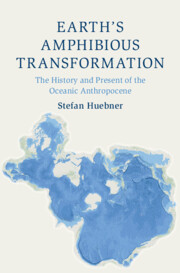


In this chapter I revisit the necessity for a paradigm shift and for moving beyond an Orientalism-like, biased perspective of the ocean in historical narratives – especially those of the twentieth and twenty-first centuries. When we focus solely on ports and the water column, we only glimpse a fraction of the ocean’s role in the Anthropocene. After all, our current predicament is largely a result of water-related problems, from climate change–caused local lack of freshwater to sea level rise, more intense storms, water pollution, and marine biodiversity and biomass decline. A paradigm shift requires us to “think through water” – not merely within the water column but also through it, up or down, to other important spatial layers to fully understand the ocean vertically. Our analysis needs to be volumetric, encompassing everything from the subsoil beneath the seabed to the atmosphere and even outer space. In this vertical context, the Earth’s amphibious transformation has led to various unforeseen outcomes. One of them began in 1966, when offshore oil exploration in the southern Gulf of Mexico entailed surveying the subsoil from the sea surface through the water column. The offshore survey uncovered a mysterious anomaly slightly north of the Yucatan Peninsula, though the findings – like the other survey data industry secrets – were not publicly disclosed at the time. More than a decade later, an aeromagnetic survey conducted by an airplane, exploring the subsoil from the airspace downward, revealed a massive, partially submerged circular structure at that location and the land south of it. No artificial islands were constructed there due to the absence of offshore oil. However, in 1991, this partially submerged crater, now known as the Chicxulub crater, was identified as the impact site where the large asteroid that killed all nonavian dinosaurs had hit the Earth.Footnote 1 What has since then been a feature of the seabed and subsoil is at the same time a chilling vertical connection to outer space. The asteroid’s impact had rapidly unfolding, planetary-scale effects, including climate change, akin to a nuclear winter.Footnote 2 This apocalyptic event contrasts sharply with the impacts of Earth’s amphibious transformation. The former was a random mass extinction event, overwhelming the Earth system long before human existence. The latter, however, is an anthropogenic process resulting from numerous local, vertical interactions with spatial layers like the subsoil, seabed, water column, sea surface, and airspace or atmosphere. “Thinking through water” for a paradigm shift involves examining these multiple spatial layers volumetrically from an oceanic-vertical perspective. This approach opens our eyes to Earth as a celestial body where verticality is the only pathway “in” or “out,” and as a planet predominantly covered by water, highlighting that verticality is as crucial for historical processes as horizontality is. Reflecting on the Spilhaus Projection that opens this book, where one views the sea surface from an outer space–like vantage point, after nine chapters, one’s inner eye can envision marine regions filled with vertical connections stemming from artificial island usage and the extension of the human habitat.
For a paradigm shift, we need to understand Earth’s amphibious transformation as the primary driver of the oceanic Anthropocene. The use of artificial islands has become intertwined with accelerated climate change, rising sea levels, ocean acidification, sea use change, nitrogen and phosphorus overflows, synthetic chemical pollution, and biosphere degradation, as the book’s different chapters have shown. This amphibious transformation also led to localized anthropogenic pollution such as light, noise, heat, and oil, which did not alter planetary-scale cycles. The prevalence of plastic waste in the ocean, partly due to artificial island use, is also notable. Concurrently, other aspects of the oceanic Great Acceleration, the first stage of the oceanic Anthropocene, illustrate the increases in economic production, contributing to income, nutrition, fuel, and human safety. In the early twenty-first century, about one-third of annual oil production originated from offshore reserves. Mariculture now substantially contributes to seafood production, already surpassing capture fisheries in terms of value. Offshore electricity generation is rapidly rising, and the growing number of rocket booster landings and reuses is reducing the cost of accessing outer space. Improvements in position fixing and data transmission have been exponential. The number of high-tech floating homes is rising as well. Navigating the oceanic Anthropocene’s second stage, focused on Earth system stabilization, involves considering marine regions not only as anthropogenically transformed spaces but also as potential sources of waterborne solutions to very substantial problems. For example, while climate justice is crucial for rural, agrarian land areas, seaweed farming, comparable to terrestrial reforestation, is a practical, localized tool for implementing such justice. It can slightly mitigate climate change on a planetary scale through seaweed growth, possibly have a larger impact as cattle feed by reducing methane releases and, importantly, locally adapt mollusk mariculture to ocean acidification by sequestering dissolved carbon dioxide. Another example is the consideration of floating structures as alternatives to land reclamation and its disastrous consequences on marine ecosystems. The removal of nursery grounds, intertidal zones, and migratory bird habitats are well-known indications of biosphere degradation. However, land reclamation projects can also intensify local climate change and urban heat problems in already hot climates, as they can permanently warm surrounding waters. This is exemplified by the extreme case of a 7.5°C increase in mean sea surface temperature around the well-known Palm Jumeirah project in Dubai between 2001 and 2020.Footnote 3 Therefore, “thinking through water” for a paradigm shift means analyzing the intertwined growth of both socioeconomic development and the pollution and overexploitation of ecosystem services, which collectively have altered the Earth system. This paradigm shift also involves studying those people who have sought realistic, sustainable solutions within this framework of intertwined socioeconomic and pollution growth, despite facing inevitable criticism, instead of crafting more apocalyptic, terra-centric narratives that may lead to fatalism, indifference, and social division rather than the desired public mobilization.
For a paradigm shift, investigating the rootedness of artificial islands in energy regimes is highly valuable for periodization purposes. The energy regimes of the terrestrial Anthropocene are not applicable to marine regions. Key to oceanic periodization is the fact that marine regions did not experience an Age of Coal, not having seen the use of coal mining–related artificial islands. It was only in the mid-twentieth century, during the ascent of the Age of Oil, that coal-dependent construction materials like steel and cement began to be utilized for building platforms stable enough for open water conditions. Therefore, the impact of energy regimes on the use of marine built environments includes their construction materials that enabled adaptation to oceanic material conditions. Analogously, one aspect of the growing demand for oil was plastics mass production, which led to the development of artificial islands connected to this new construction material and its energy regime, among them mariculture facilities and floating homes. The surfaces of these energy-intensive construction materials, colonized by marine life, and the mobility of artificial islands marked what should be seen as a new epoch in marine species translocation. The oil-centered energy regime further manifested itself in the upward-oriented design of oil and gas drilling platforms and offshore launch platforms, used by helicopters and rockets often combusting refined kerosene or similar oil-derived fuels. The onset and intensification of the Oil Age varied across marine regions. However, artificial islands are so embedded in energy regimes that the mid-twentieth century marks the first key periodization point, evidenced by their growing use in the framework of the oil-dominated fossil fuel energy regime. Thinking through water for a paradigm shift involves recognizing the importance of low-carbon innovation and the transition to a low-carbon energy regime for periodization, as they reshape and resituate artificial islands. Discussions in the 1970s about low-carbon offshore energy generation already pointed to new vertical interactions, like harnessing lower atmospheric offshore winds or using the water column for cooling. Ongoing innovations, such as vertically mobile floating solar photovoltaics in lakes, which can submerge during storms or for cleaning, further highlight the connection between aquatic surfaces and the upper water column. Current carbon capture and storage ideas, where offshore wind turbines generate electricity to extract carbon dioxide from the atmosphere or ocean for storage in former fossil fuel reserves beneath the sea, are mainly a public relations campaign, as using their electricity to reduce carbon emissions seems much more efficient for climate change mitigation. But the image represents a stark reversal of earlier energy regimes’ focus on offshore oil or gas extraction and the resulting carbon emissions in the atmosphere and ocean. Another illustration is the connection between aquatic surfaces and the airspace in which destructive tropical storms operate. Their absence in equatorial regions provides huge potential for harvesting floating solar energy, for example in Africa and Southeast Asia.Footnote 4 Finally, the electrification of marine built environments reconnects with outer space history, where solar energy is the most reliable source and electrification a logical consequence. This is particularly relevant given that fossil fuel deposits on Earth developed in genuinely different ways compared to those on lifeless celestial bodies in the solar system. The extension of the human habitat through post-ISS space stations, as artificial islands in outer space, also relies on solar energy, perceived as emanating vertically from the solar system’s center. Concepts of ecologically largely autonomous structures connect them, for example, to floating or raft homes as tools for transformative climate adaptation.
For a paradigm shift, the coevolution between humans and other species must be analyzed within the context of the extension of the human habitat to sea surfaces and the vertical expanse of artificial islands. Dual-habitat structures, such as fish net-cages and oyster rafts, provide humans workspace above water and facilitate vertical access to marine species concentrated below, rather than dispersed in typical natural habitats like deeper water layers or on the seabed. The tendency of marine species to attach themselves to artificial islands – all dual habitats due to submerged biofouling communities – presents bioinvasion risks unlike those posed by fast-moving ships. The relative ease of moving such structures across oceanic space, compared with doing it on land, bears important implications for historical comparisons between two locations where increasingly similar material conditions may lead to a bioinvasion if marine species translocations connects them to each other. For example, the growing number of hard surfaces for arriving species or their offspring to attach to is a critical factor in these comparisons. Yet, the primary element lending meaning to these comparisons between two locations is the hard-surfaced platform itself. As a high-risk bioinvasion vector, its movement between the two locations enables a nonsynchronous presence in both for comparative analysis while also creating the historical connection between them. This is but one example that, more generally, ocean-related comparisons of coevolutionary processes at different locations frequently require consideration of mobile elements, underlining the importance of applying a post-sedentary perspective to analyze artificial island uses by humans and other species. Thinking through water for a paradigm shift means integrating this perspective into the oceanic-vertical perspective to recognize the impacts of an archipelago of mobile and static artificial islands on human and nonhuman coevolution during the oceanic Anthropocene. The potential of human–seaweed–animal coevolution to mitigate climate change has been previously noted. More radical ideas, such as large-scale iron fertilization of nutrient-rich Antarctic waters to induce substantial algae growth and carbon dioxide sequestration – followed by algae death and the resulting carbon sinking to the deep seabed, where it would likely remain for centuries – represent a speculative geoengineering approach against climate change. This concept, evoking earlier, more limited OTEC ideas leveraging water mobility for nutrient fertilization, comes with numerous unknown impacts on the marine environment. More generally, this and other geoengineering ideas are important reminders that any strong focus only on mitigating climate change leaves open the problem of ocean acidification.Footnote 5 Earth’s amphibious transformation also intersects with the future of capture fisheries and strategies to reverse biosphere degradation from overfishing. Subsidies are widely recognized among fisheries experts as a primary cause of excessive fishing, leading to stock depletion and habitat destruction. Many large predatory fish, including tuna, sharks, and groupers, have seen a 90–99 percent biomass reduction over the last century. Although the total catch of marine and freshwater fisheries in 2019 was valued at around US$146 billion, subsidies for marine capture fisheries in 2018 amounted to approximately US$35.4 billion, nearly 25 percent of the 2019 combined catch value.Footnote 6 In addition to cutting subsidies, the creation of no-take marine protected areas that ban all fishing activities has emerged as a promising coevolution strategy, aiding in biodiversity and biomass recovery. Studies indicate that within a decade, these areas, on average, can experience a biomass increase of about 670 percent and a 21-percent rise in the number of species. The mobility of marine organisms means they also enhance biomass and biodiversity beyond these protected zones.Footnote 7 Without question, these areas must be strategically located around vital marine nutrient flows, particularly on continental shelves, rather than in regions of marginal importance to fisheries.Footnote 8 The recent UN High Seas Treaty of 2023, while a pioneering legal framework for establishing marine protected areas beyond national jurisdiction, is limited in scope, primarily covering less relevant space. Therefore, the selection and establishment of no-take marine protected areas, without exceptions, is a crucial global political issue. This is particularly relevant for initiatives like the UN-driven “30 by 30” campaign, which aims to protect 30 percent of the ocean by 2030. Thus, studying Earth’s amphibious transformation from a post-sedentary perspective and through nonsynchronous comparisons offers insights into the huge anthropogenic impacts on marine biomass concentration resulting from coevolution.
For a paradigm shift, exploring the clashes and incompatibilities between various spatial representations of marine regions and their impacts is essential. I discussed three principal “schools” of thought – bright green environmentalism, dark green environmentalism, and fossil fuel–based developmentalism – along with their subschools such as ecomodernism, focusing on their effects on several oceanic trajectories. Initially, in the mid-twentieth century, fossil fuel–based developmentalisms played a pivotal role in Earth’s amphibious transformation. My Asian case studies showed that both capitalist and communist government-led developmentalisms were deeply intertwined with the territorialization of oceanic space, granting individual governments jurisdictional control over vast areas. This process was not uniformly welcomed by all governments. Some resented the creation of EEZs, which allowed other governments to exclude the overseas activities of foreign fishing fleets. Consequently, governments grabbing jurisdictional control over 39 percent of Earth’s marine space highlighted the relevance of establishing new national legal frameworks within which socioeconomic, developmentalist, and environmentalist agendas unfolded. These agendas sometimes involved governmental overplanning and moral hazards, as exemplified by the Japanese government–funded offshore oil exploration. On the other hand, they could be hampered by a lack of governmental capacity to enforce legislation, as seen in illegal fishing in Oceania and other regions. However, even operating in the high seas beyond EEZs could mean that companies were still subject to national legal frameworks through their home ports and headquarters that defined their licensing jurisdiction, as the Sea Launch case illustrated. Thinking through water for a paradigm shift means understanding the material conditions of marine regions, exploring the knowledge historical actors had about them, and analyzing how this knowledge shaped developmentalist and environmentalist agendas. For example, the creation of marine protected areas is a component of bright green environmentalism and particularly ecomodernism. The goal of decoupling socioeconomic development from the overexploitation of ecosystem services is to separate parts of nature from those areas undergoing intense and dense transformation. In mariculture, this entails viewing parts of the open ocean as experimental sites for fish farming, which, in terms of seafood production, is supposed to compensate for a reduction in capture fisheries and coastal fish mariculture. Conversely, dark green environmentalism is often highly critical of fish mariculture, considering its ecological effects to be unacceptable.
For a paradigm shift, understanding the growth in spatial competition among users of marine regions and its implications for the oceanic Anthropocene is crucial. The amphibious transformation’s local variations stem from differing uses of artificial islands and the spatial competition between them, shaped by developmentalist and environmentalist agendas. Marine spaces underwent a multiplicity of environmental, financial, and intellectual conversions, such as into land, capital, energy, biomass, or “islomania,” among others. The first stage of ocean-to-land globalization was predominantly driven by offshore oil and gas platforms and mariculture structures. Since the 2010s, the synergy of high-speed internet and highly precise position fixing has fostered new industries, increasing spatial competition. Governmental priorities, reflected in (eco-)developmentalist agendas, have strongly influenced marine spatial planning and corresponding legislation. For example, Japan’s coastal waters demonstrated the incompatibility of capture fisheries and industrial pollution. The same incompatibility exists between fisheries and mariculture, but this was addressed by the same cooperatives operating both, reducing conflicts. However, the situation varies with other industries, such as offshore wind turbines, which, due to construction work and later due to safety zones, can deter fisheries’ activities. This is evident in Dutch waters, where fishing areas were substantially reduced.Footnote 9 In contrast, in Japanese waters, some fisheries cooperatives have obstructed the construction of offshore wind turbines.Footnote 10 The Chinese experiments combining offshore wind and floating solar photovoltaics with fish farming offer an alternative perspective.Footnote 11 They showcase a vertical integration of practices as opposed to the typical horizontal exclusions in marine spatial planning, creating synergies that would benefit marine organism growth and the mechanical disposal of fish feces and food leftovers. Thinking through water for a paradigm shift requires analyzing both the vertical and horizontal compatibilities and incompatibilities of uses emerging from the territorialization of marine space and the decision-making regarding usage priorities. For example, a politically induced incompatibility between mariculture and wind energy versus leisure activities and environmental aesthetics is evident. This is particularly noticeable when comparing Asian marine regions with US ones. While Asian bays and inlets have become the world’s main mariculture production sites, in most cases US environmental regulations have restricted such developments, also impacting initiatives like seaweed farming, which aim to reduce water overfertilization. The US Coastal Zone Management Act of 1972 and other legislation have not supported mariculture, discouraging its implementation in US federal waters (usually starting three nautical miles offshore, beyond state waters) by not creating clear administrative structures, contrary to the recommendations of the 1969 Our Nation and the Sea report. This ocean-related decision was a notable divergence from the extensive terrestrial agriculture in the United States. State-level legislation further preserved many bays and inlets, giving conservation and water sports a stronger position over mariculture. For seaweed farming, the situation has only recently changed in some US regions, such as the Northeast. In contrast, capture fisheries and offshore oil and gas drilling had more influential lobbies.Footnote 12 Satellite imagery comparisons of US waters with those of East and Southeast Asia, Norway, and Chile reflect the distinct priorities that shaped marine space allocation and the competition among different uses. Similarly, US environmental and aesthetic legislation, favoring nonindustrial seascape aesthetics, for decades discouraged offshore wind turbine demonstration projects instead of granting permission if environmental considerations were addressed.Footnote 13 Hence, the spatial uses in European and Chinese waters were unlike those in the United States.
Finally, for a paradigm shift, the terrestrial mindset and its inherent bias must be shed. Both Western and Japanese cultures have shown a fascination with islands, yet the geo-ontological change stemming from the adoption of a coal-based energy regime in Europe, and subsequently worldwide, redirected focus toward continents, seen as the epicenters of terra-centric civilization. This change, fueled by the use of energy-intensive, coal-dependent construction materials like steel and cement, led to new architectural styles. As a result, long-standing practices of adapting to amphibious or aquatic conditions, once commonplace in Asia and other regions, came to be viewed as backward and outdated. The European and later global adoption of technologies of terrestrialization, which focused on water removal and control when affordable access to coal as the fuel source was gained, further entrenched this global mental shift. Land reclamation using coal-powered steam engine pumps and, in the twentieth century, the coal-dependent construction of seawalls and hydroelectric dams on a global scale reinforced terra-centric urban and regional development plans. Furthermore, advanced artificial islands, such as oil drilling platforms with their stringent social and safety measures due to explosive and flammable materials, unsurprisingly were not considered by anyone as viable models for comfortable living. At the same time, a growing cruise industry resulted in cruise ships operating as large power plants supplying hundreds or thousands of cabins with light, air-conditioning, and electricity for other applications, but for everyone but their crews such sea surface inhabitation was mentally removed to the realm of temporary vacations. The mental change also diminished the social acceptance of adapting to water flows through flotation or elevation. Urban and regional development plans that prioritized adaptation rather than land reclamation, like those proposed in the 1960s and 1970s by Tange Kenzō, Buckminster Fuller, John P. Craven, Kikutake Kiyonori, and their teams for Japanese and US waters, appeared as eccentric and unconventional. Nonetheless, the construction of artificial islands is a megatrend showing no signs of abating. For example, the public’s increasing awareness of changes in planetary-scale cycles, previously occurring over almost imperceptible timescales, has now heightened intergovernmental organizations’ interest in transformative urban climate adaptation strategies, floating forms of urbanization, and oceanic low-carbon energy generation.
A second aspect of Earth’s amphibious transformation is the geo-ontological change among users, emerging from advancements in communication and navigation technologies. These technologies, similar to construction materials, have been essential for adapting to the liquid, turbulent, and unstable marine conditions. Projecting cartographic fictions like coordinate systems or political borders onto physical ocean space was part of a technological advancement process that also made these projections increasingly accurate and affordable. Since the late nineteenth century, particularly from the mid-twentieth century onward, Earth’s global communication space has undergone tremendous changes. Cybernetic extensions of visual, audio, and tactile senses through high-speed satellite internet have turned many marine regions, which were communication dead zones 150 years ago, into centers of the global communication space. Vertical connections to satellites in outer space have supported the adaptation of artificial islands to oceanic conditions and the corresponding extension of the human habitat. However, the material conditions of the water column serve as a reminder that satellite communication is ineffective below the sea surface, where communication relies on acoustic signals. Thus, the extension of cyberspace as an artificial space is still constrained by physical geography. In the cyberspace above sea level, automation and remote access experiments have created connections between artificial islands and terrestrial spaces through autonomous surface vehicles operating in horizontal space, such as autonomous ships, cleaning robots for plastic waste removal, and ride hailing of boats and ferries.Footnote 14 Such automation means that Earth’s amphibious transformation may not always involve a physical extension of the human habitat but only a virtual one. For example, Argo Floats, a type of artificial island capable of descending to depths of over 1,000 meters, have since the first decade of the twenty-first century formed an ocean-spanning network gathering and transmitting marine data.Footnote 15 Thinking through water for a paradigm shift involves analyzing the geo-ontological changes caused by both aspects of Earth’s amphibious transformation: the public’s confrontation with local environmental transformations due to changes in planetary-scale cycles, and the technological advancements in communication and navigation. These factors help dismantle the terra-centric, Orientalism-like view of the ocean in historical accounts. A paradigm shift involves acknowledging the social acceptance, or lack thereof, of coastal adaptation strategies that advance onto sea surfaces. Such presence or absence, in turn, determines the options available to governments and individuals facing sea level rise, climate change, and the perennial threat of flooding. A paradigm shift also entails recognizing and examining the impact of communication and navigation technology advancements on geographical subjectivity among users, such as new understandings of voluminous space and the redefinition of centers and peripheries due to globalization, along with risk and environmental impact assessments of specific areas, and evaluations of economic opportunities.
Historians have tackled various forms of “centrism,” such as “Eurocentrism” and “anthropocentrism,” as well as narratives centered on nation-states and specific regions that create artificial barriers. Adopting an oceanic-vertical perspective, coupled with a flexible application of different political-cultural scales – local, national, regional, and global – and integrating insights from environmental history, technology history, development history, biology, architecture, engineering, and other disciplines, is pivotal for creating oceanic histories of the Anthropocene and for comprehensively understanding the causes of our current predicament.

 Open access