Introduction
The archaeology of Amazonia, the world’s largest tropical forest, has experienced a revolution during the past few decades (Neves & Heckenberger Reference Neves and Heckenberger2019; Iriarte Reference Iriarte2024). What was once considered pristine forest is now understood as a biome deeply affected by Indigenous action stretching back thousands of years before the European invasion (Clement et al. Reference Clement, Denevan, Heckenberger, Braga Junqueira, Neves, Teixeira and Woods2015); a region that offers a unique opportunity to examine the relationship between cultural and biological diversity (Fausto & Neves Reference Fausto, Neves and Sanz2018). About 1000 BP (calendar years before present), widespread socioecological transformations took place along the Amazon basin including the rise of large, nucleated settlements in the Upper Xingu River, along the central branch of the Amazon River, near the modern city of Santarém and in the Bolivian Llanos de Moxos. The drivers of these transformations are the subject of intense and ongoing study (Heckenberger et al. Reference Heckenberger, Kuikuro, Kuikuro, Russell, Schmidt, Fausto and Franchetto2003; Schaan & Travassos Alves Reference Schaan, Travassos Alves, Schaan and Travassos Alves2015; Prümers et al. Reference Prümers, Betancourt, Iriarte, Robinson and Schaich2022). Cultural dispersals and expansion processes in the Amazon have been discussed as archaeologically visible outcomes of palaeodemographic dynamics among highly diverse, stateless societies, spotlighting the insights that long-distance population movement can provide of the impacts of Indigenous groups on the biome (de Souza et al. Reference de Souza2019; Arroyo-Kalin & Riris Reference Arroyo-Kalin and Riris2021; Almeida et al. Reference Almeida, Lopes, Stampanoni Bassi, Bonomo and Archila2021; Riris & Silva Reference Riris and Silva2021; Shock Reference Shock, Bonomo and Archila2021).
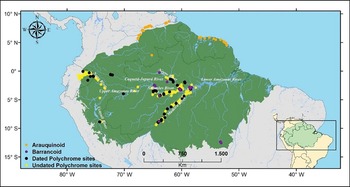
The most widespread of these dispersals is associated with the dissemination of ceramics of the Amazonian Polychrome Tradition (Figure 1), which are ultimately found across an estimated 1.7million sq km of the Central and Western Amazon (Figure 2). Referred to as the Polychrome Expansion, this dispersal is identifiable as singular Polychrome occupation layers in the upper strata of mono- and multicomponent archaeological sites. Earthworks, from middens (Pessoa et al. Reference Pessoa, Zuse, Costa, Kipnis and Neves2020) to artificial islands, are associated with this industry, and occupations are characterised by the presence of an emblematic pottery style, featuring red, brown and black painting over white slip, grooving in anthropomorphic and snakelike motifs, and distinctive morphologies that include mid-rim vessels and anthropomorphic burial urns (Almeida et al. Reference Almeida, Lopes, Tamanaha, Kater, Alcántara, García Montero and Sánchez López2018).
Examples of the Polychrome Tradition: a) Polychrome urn, Lower Urubu River (Museu Paraense Emílio Goeldi collection); b) Polychrome urn, unknown geographic (collection of the Instituto Histórico e Geográfico de Manaus; photograph by Cristiana Barreto); c) Polychrome plate, Lauro Sodré site, Solimões River (Universidade Federal do Amazonas collection); d) Polychrome urn, Tauary site, Solimões river (Instituto de Desenvolvimento Sustentável Mamirauá Institute collection); e) Polychrome vase, Solimões River (Museu Paraense Emílio Goeldi collection); f) mid-rim vase, Lauro Sodré site, Solimões river (photographs a, c–f) by the authors).

Distribution of Polychrome (dated and undated), Arauquinoid and Barrancoid sites (figure by Rafael de Almeida Lopes).

The earliest dates for the Polychrome Expansion come from the Middle Solimões region around 1500 BP (Belletti Reference Belletti, Barreto, Pinto Lima and Jaimes Betancourt2016), with assumed growth of occupations from 1000 BP onwards, and persistence during the colonial period (c. 350–100 BP) (Figure 3). Recent research has greatly advanced regional data gathering, though systematic syntheses remain scarce (Belletti Reference Belletti, Barreto, Pinto Lima and Jaimes Betancourt2016; Almeida et al. Reference Almeida, Lopes, Tamanaha, Kater, Alcántara, García Montero and Sánchez López2018). The Polychrome Expansion represents a second pan-Amazonian dispersal, following the expansion of populations related to the earlier Pocó-Açutuba Tradition 2000 years prior (Kater Reference Katerin press). New data have reopened debates on the timing and routes of the Polychrome Expansion and highlighted the potential importance of conflict. This article approaches these debates through exploratory chronological and spatial modelling, providing novel findings with transformative implications for understanding the Polychrome Expansion.
Boxplots of Polychrome chronology based on 97 radiocarbon dates and separated by river basin (figure by Jaqueline Belletti).

The Polychrome Expansion
The initial debate regarding the Polychrome Tradition and its expansion began in the 1950s, permeated by the viewpoint of the Amazon as a pristine forest with ecological restrictions that inhibited cultural development (Meggers Reference Meggers1971). For Betty Meggers and Clifford Evans, the spread of Polychrome ceramics was evidence of a migratory wave of farmers that descended the Andes down the headwaters of the Amazon and followed the river to its estuary at Marajó Island, the only area where occupations would not quickly collapse due to poor soils for agriculture (Meggers & Evans Reference Meggers and Evans1957, Reference Meggers, Evans and Lothrop1961; Evans & Meggers Reference Evans and Meggers1968). The eastward march was hypothesised from sites in the Napo, the Solimões and the Amazon estuary with an inconsistent use of radiocarbon dates (Roosevelt Reference Roosevelt1991).
Donald Lathrap and his colleagues challenged this model from the 1960s onward, relying on a distinction between river bluffs (terra firme) and floodplains (várzeas). In their view, while the former zone would fit into the previous model of inadequate terrain for agriculture, the latter, especially along main Amazonian rivers, represented highly fertile ground that would facilitate agriculture and, consequently, stimulated population growth (Lathrap Reference Lathrap1970a & Reference Lathrapb; Neves Reference Neves1998). That growth from the várzeas would thus generate periodic demographic pressures that would give rise to large expansion processes associated with widespread Indigenous linguistic families and cultural traditions. Lathrap used data from previous excavations at Polychrome sites in the Central Amazon (Hilbert Reference Hilbert1968) to pinpoint the region around the Negro-Solimões and Amazon-Madeira confluences (henceforth referred as NSAM area) as the heart of these processes, from where demographic pulses spread through the main tributaries (‘arteries’) of the Amazon. This was the ‘cardiac model’ (Neves Reference Neves1998). The Polychrome Expansion would be one of these expansion processes, where Tupí-Guaraní speakers, such as the Upper Amazon Omágua, would be associated with the rapid spread of polychromic pottery within and beyond Amazonia (Brochado Reference Brochado1989). These population movements included the Guarani expansion through the Paraná Basin and the Tupinambá expansion down the Brazilian coast (Bonomo et al. Reference Bonomo, Costa Angrizani, Apolinaire and Silva Noelli2015, Reference Bonomo, Apolinaire, Alves Corrêa, Silva Noelli and Joaquín Dalto2025).
More recently, testing of Lathrap’s cardiac model in the NSAM area showed that although this region was home to large-scale and long-lasting occupations, it did not present corresponding dates to validate the model (Neves & Petersen Reference Neves, Petersen, Balée and Erickson2006). Growing datasets from across the Amazon also challenge both Meggers’ and Lathrap’s models (Heckenberger & Neves Reference Heckenberger and Neves2009). The concept of environmental limitations inhibiting cultural development in the Amazon has been largely rejected, even for terra firme areas, as increasing numbers of large-scale occupations and earthworks are discovered away from varzeas and main rivers (Shepard et al. Reference Shepard, Clement, Lima, Mendes dos Santos, Moraes and Neves2020).
New data and outlooks have rekindled debates on the dynamics of the Polychrome Expansion. Most recent literature now agrees that the Polychrome Expansion was a Central and Western Amazon phenomenon, apart from Eastern Amazonian historical developments (such as the Marajoara, Tupi-Guarani and late occupations in the Guianas). The plastic nature of Polychrome occupations is now widely acknowledged, with high diversity in ceramic production and occupation dynamics indicating adoption of Polychrome Tradition ceramics by different, pre-existing riverine populations, rather than simply population movement (Belletti Reference Belletti, Barreto, Pinto Lima and Jaimes Betancourt2016; Almeida et al. Reference Almeida, Lopes, Tamanaha, Kater, Alcántara, García Montero and Sánchez López2018; Oliveira Reference Oliveira2022). This more fluid view addresses the extensive presence of Polychrome ceramics along the Rio Negro, where there are no historical accounts of the presence of Tupi-Guarani peoples. Linguistic studies (e.g. Michael Reference Michael2014) have also re-classified the Omágua—formerly the historical example that enabled Lathrap to propose the Tupi-Guarani/Polychrome link—as peoples who were assimilated by Tupi groups, probably during pre-colonial times (Almeida et al. Reference Almeida, Lopes, Stampanoni Bassi, Bonomo and Archila2021). Hence, the nature of the Polychrome Expansion has steadily gained complex outlines (e.g. see Ferraz Gerardi Reference Ferraz Gerardi, Tresoldi, Coelho Aragon, Reichert, de Souza and Silva Noelli2023).
The timing of the Polychrome Expansion remains unclear; both a fast dispersal process from 1000 BP onwards (Neves Reference Neves2022) and a more drawn-out process commencing some centuries earlier (Belletti Reference Belletti, Barreto, Pinto Lima and Jaimes Betancourt2016; Tamanaha Reference Tamanaha2018) are proposed. A multiroute dispersal is typically favoured, possibly from south-west Amazonia, particularly the Upper Madeira (Almeida & Moraes Reference Almeida, Moraes., Barreto, Pinto Lima and Jaimes Betancourt2016), or from the Middle Solimões (Lopes Reference Lopes2018; Tamanaha Reference Tamanaha2018). Lopes (Reference Lopes2018) and Tamanaha (Reference Tamanaha2018) argue for a two-phase spread, proceeding through secondary rivers until around 900 BP when bluffs overlooking main rivers became favoured spots for occupations. The warlike nature of the expansion was first emphasised based on evidence for defensive structures in the NSAM area (Moraes & Neves Reference Moraes and Neves2012)—circular ditches and palisades around dark earth sites—contemporaneous with the substitution of Incised Rim/Barrancoid sites for Polychrome occupations. This view was later balanced by evidence of trade and hybridism between Polychrome producers and other, contemporaneous ceramic-producing groups (Belletti Reference Belletti, Barreto, Pinto Lima and Jaimes Betancourt2016; Lopes Reference Lopes2018). Emerging topics include the relations between Polychrome occupations and European colonisation (Lopes Reference Lopes2021) and the association of land-use patterns and climate change with the rise of Polychrome occupations (Azevedo et al. Reference Azevedo2019; de Souza et al. Reference de Souza2019).
Methods
To model the Polychrome Expansion, we evaluated, selected and enhanced data from AmazonArch, an existing database that encompasses data from more than 12 000 Amazonian archaeological sites (Tamanaha Reference Tamanaha2018). As part of data preparation, we circumscribed the regional ceramic styles and occupations of the Polychrome Tradition (see online supplementary material (OSM) Table S2). The concepts of phases and traditions still hold an important place in Amazonian archaeology. Although initially applied as narrow categories, such concepts have recently been revaluated as useful tools for organising the archaeological record. In this article, we consider archaeological traditions as durable and cohesive material productions that were reproduced dynamically generation to generation and can thus help access long-term cultural structures (Almeida et al. Reference Almeida, Lopes, Stampanoni Bassi, Bonomo and Archila2021). This data preparation allows us to differentiate between the Polychrome Tradition and other Amazonian polychromic ceramics (see Almeida et al. Reference Almeida, Lopes, Stampanoni Bassi, Bonomo and Archila2021). Selection of regional pottery styles and occupations was grounded in a thorough comparison of spatial distribution, chronology and specific aspects of pottery technology and design. Marajoara and other Eastern Amazon styles have recently been excluded from the Polychrome Expansion (Almeida et al. Reference Almeida, Lopes, Stampanoni Bassi, Bonomo and Archila2021), despite some shared traits, and are not considered here. Discussion of this selection process and full methods and dataset compilation are available in the accompanying OSM.
In short, available radiocarbon dates associated with Polychrome occupations were calibrated, binned and aggregated. Summed probability distributions (SPD) were employed for palaeodemographic modelling (Crema & Bevan Reference Crema and Bevan2021), focusing first on apparent variation in time of dated Polychrome occupations in the context of other, broadly contemporaneous lowland South American traditions, and then on the rate of rise and decline in the Polychrome Expansion as reflected in the radiocarbon data, as well as the timing of the shift between these two hypothetical states.
Comparison with contemporaneous historical processes is crucial for understanding what, if any, chronological variability is particular to the Polychrome Expansion in its broader Amazonian context. Additionally, insights into the internal dynamics of the expansion may be important for understanding the palaeodemographic processes that underpinned it, as well as for the generation of hypotheses for testing with future archaeological work. For these purposes, data on Incised Rim/Barrancoid and Arauquinoid sites were also compiled (Figure 2). Arauquinoid dates were used to compare the Polychrome Expansion with a contemporaneous, but apparently unrelated, process in Amazonia, which could point to broader influences on patterns from factors such as climate change and the systematic under-dating of archaeological sites. The Barrancoid tradition was included due to its direct relationship with Polychrome occupations, which replace it in several contexts (Moraes & Neves Reference Moraes and Neves2012). Comparisons could point to the timing of this substitution, which relates, for example, to ideas of a rapid conquest. We address these questions through mark permutation testing (Crema et al. Reference Crema, Habu, Kobayashi and Madella2016) and the application of a Bayesian inferential framework developed for radiocarbon data (Crema & Shoda Reference Crema and Shoda2021). The workflow for both approaches is described in the OSM and an accompanying online repository (https://github.com/philriris/m2m-bayesian).
To assess the timing and probable routes of dispersal we explicitly modelled different dispersal scenarios using a Fast Marching algorithm that computed the arrival time of an expanding wavefront at each cell of discrete lattice or raster (Silva & Steele Reference Silva and Steele2012, Reference Silva and Steele2014). Predicted arrival times were then compared to the empirical dates in the database, and the model parameters optimised to provide the best-fit to the chronometric data. Finally, the different models were compared using Akaike’s Information Criteria (AIC), thereby allowing the identification of the scenario that best describes the available archaeological data.
Ten models for the source and ease-of-movement in the Amazonian landscape were developed and, with respect to the dynamics of the dispersal itself, five hypotheses were modelled. The first hypothesis proposes that the dispersal speed is the same throughout the entire region (model 0), while a second and third propose that dispersal is faster along rivers, with travel along all rivers equal (model 1) or with differentiation in dispersal speed between main and secondary rivers (model 2). Two additional hypotheses follow models 1 and 2 but allow for a defended region around the NSAM, which would have slowed down dispersal (model 1+D and model 2+D). Two possible source locations were considered—Conjunto Vilas in the Middle Solimões and Teotônio in the Upper Madeira—and all models were run for each source location to enable explicit and quantitative comparison of model predictions with empirical data.
Results
Summed probability distributions (Figure 4) show a gradual increase in Polychrome occupations culminating in the fourteenth century, rather than a rapid growth around 1000 BP. Nonetheless, discrete pulses are apparent during this increase, most overtly around 700 BP (1250 AD). A subsequent decrease around 550 BP (1400) pre-dates the expected decrease associated with the arrival of the first Europeans in the sixteenth century and the Portuguese conquest of Central Amazonia in the seventeenth century. This decrease is followed by another around 300 BP (1650). Mapped Polychrome dates (Figure 4) indicate an initial range (orange) and a dispersal process that starts locally and gradually expands to a few other regions. The subsequent period (yellow) registers a larger general expansion in Central and Western Amazonia, with a final phase (purple) in which Polychrome production is maintained in most dispersal areas.
Summed probability density and map of Polychrome sites, based on 97 dates. The grey area represents growth rates and the red line represents the smoothed summed probability density. The dashed line indicates the changepoint between positive and negative growth rates. Map uses medians of calibrated dates (figure by authors).

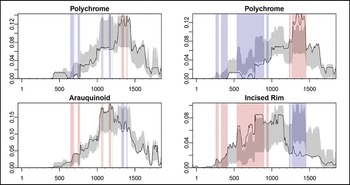
Mark permutation tests of Polychrome and Arauquinoid (Figure 5) occupations show distinctions, such as a more pronounced rise in dates around 1000 BP and an earlier decaying of dates for Polychrome occupations. Overall, however, there are no significant variations, including the decrease of dates before the sixteenth century. These data point to similar moments of inflection for both Polychrome and Arauquinoid occupations around 600 BP. Mark permutation tests with Barrancoid dates (Figure 5) reinforce the perspective of a substitution process of Barrancoid occupations by Polychrome occupations, seen in Central Amazonian sites (de Souza et al. Reference de Souza2019; Neves Reference Neves2022). Observed deviations in the permutation test indicate that the general process of transition occurs around 800 BP.
Mark permutation tests of Polychrome versus Arauquinoid (p > 0.1) (177 dates) and Barrancoid (Incised Rim) traditions (p < 0.001) (109 dates). Locally significant anomalies are shown in red (positive) and blue (negative) (figure by authors).

In modelling the dispersal of Polychrome sites, lower Fast Marching ΔAIC values identify models that better fit the empirical data. Conjunto Vilas in the Solimões is preferred as the source of the dispersal when compared with Teotônio in the Upper Madeira, for all tested models (see Table S3). All models except model 2+D produce a ΔAIC greater than 4, placing them outside of the equivalent of a 95.4% confidence envelope and thus indicating that they are statistically poorer explanatory models.
Model 2+D—with different speeds of dispersal for main and secondary rivers and the addition of a defended area around NSAM—is a much better fit to the chronometric data than the other dispersal models, although speed difference between main rivers and defended area is negligible. Dispersal parameters for this model are: ×0.05 speed boost in main rivers; ×13.92 speed boost in secondary rivers; and ×0.06 speed boost in defended area. It is important to remember that a value lower than ×1 indicates a speed decrease, while a value above ×1 indicates a speed increase. Our spatially heterogeneous dispersal modelling, therefore, indicates that, along the main rivers, Polychrome dispersed at a considerably slower speed, corresponding to only 5 per cent of its inland dispersal speed. The same applies to the defended areas around NSAM, where the speed was six per cent of inland spread. On secondary rivers, however, the dispersal of Polychrome was accelerated almost 14 times. Figure 6 shows the predicted latest arrival time in different regions for best-fitting model 2+D.
Predicted latest arrival time map for best-fitting dispersal model. The shaded colours indicate the latest arrival time. Also shown are the rivers used (in blue) and the location of Vilas, which was taken to be the source of the dispersal (figure by authors).

Discussion
The data gathered, prepared, analysed, modelled and visualised with computational methods present a complex new picture of the Polychrome Expansion. They also point to critical data gaps that must be addressed to build more robust models. These gaps are both spatial, with dated Polychrome sites currently absent from vast stretches of the Western and South-Central Amazon, and temporal, and must be bridged through systematic archaeological research and dating. Possible chronological biases are apparent in the data for the Polychrome Expansion, especially at the beginning of the chronology—between earlier dates around 1500 BP and later dates around 1200 BP—and at the end of the sequence, where a drop in Polychrome dates is observed before the sixteenth century. Although this drop might represent an actual pattern in the data, it could also be symptomatic of systematic ‘under-dating’ of later Polychrome occupations. These later occupations usually correspond to the upper layers of archaeological deposits in the Western and Central Amazon, and are thus invariably next to site surfaces that are commonly related to previous and contemporary (re)occupations and activities. Substantial numbers of Amazonian archaeological sites are also located beneath modern occupations. At such sites, material for dating may have been preferentially selected from deeper and more ancient strata. The recurrence of this pattern in summed probabilities for the Arauquinoid sequence could signal a broader scale for this issue. Privileging the dating of ceramics, and the lipid residues or tree-bark ash temper contained in sherds, could help counteract this discrepancy.
While these data gaps may present some bias, our results provide a platform for interrogating existing hypotheses on the source points and expansion routes for the Polychrome Expansion, while also offering clear pathways to bridge these gaps and form more robust expansion models. With regards to the timing of the Polychrome Expansion, modelling of available data indicates a time-extended process with key moments of spatial dispersal around 900 BP and an increase in dates around 700 BP when expansion hit its maximum spatial distribution. The period between 900 and 700 BP is also when an inversion between growth rates of Polychrome and Barrancoid occupations occurs across Central Amazonia, after centuries of co-occurrence. These data reinforce the notion of a change in modes of dispersal after 1000 BP in relation to the slower and more localised spread of Polychrome occupations in the previous period. The data reviewed here are therefore consistent with a turning point for Polychrome occupations in the period around 1000 BP (see Neves Reference Neves2022).
In reference to expansion routes, our model underlines Tamanaha’s (Reference Tamanaha2018) proposition of a secondary river dispersal around a defended NSAM area. Fast Marching strongly reinforces a Middle Solimões (or surrounding areas) point of origin, as opposed to the Upper Madeira. The inferred speed for dispersal along secondary rivers is superior to all proposed alternatives, differing from previous models. Instead of cardiac pulses spreading from the NSAM region or the Upper Madeira through main rivers and then descending secondary rivers, the Fast Marching model indicates a ‘venous’ pattern of combined interfluvial and secondary river dispersal that surrounds main rivers, occupying the NSAM only later. Although not centred in main rivers, this model does reinforce Lathrap’s ideas of a Central Amazon origin (outside of the NSAM region) for the Polychrome Expansion and a spread on riverine pathways in all directions (Lathrap Reference Lathrap1970).
Before 1000 BP, routes of dispersal would privilege southern and northern tributaries of the Middle Solimões. Paths to the Middle Negro might have favoured the Jaú and Unini rivers, popular Indigenous trade routes recognised by the first European chroniclers (Lopes Reference Lopes2021), while early Nofurei dates could indicate influences from the Middle Solimões up the Caquetá-Japurá. As for the southern routes, ethnohistorical data also indicate long-distance interfluvial roads in the region that could reach the Upper Madeira and South-west Amazon (Lopes Reference Lopes2021). After 1000 BP dispersal routes would expand to western and eastern tributaries. This pattern of secondary river dispersal resembles the Mura expansion, which occurred in the Central Amazon during the eighteenth century (Amoroso Reference Amoroso and Carneiro da Cunha2008). Highly mobile Mura groups would advance through surrounding secondary rivers of the Solimões and Madeira, avoiding Portuguese-defended areas of the main rivers and benefiting from the scattering of previous groups by colonial forces. Mura territories would be built deep within smaller rivers, from where they spread greatly (Harris et al. Reference Harris, Bailão and Amoroso2015). Mura also waged a fierce and long-lasting guerrilla war with the Portuguese, preying on their ships and main river villages and missions (Hemming Reference Hemming1978). Seen as a response to colonial pressure, the Mura expansion could represent a colonial-era rendition of a previous pattern of secondary river dispersal, possibly even benefitting from ancient Polychrome routes—which would help to explain how Mura groups branched from the Lower Madeira to the Upper Solimões in just a few decades. This similarity in dispersal mode between the Mura of the colonial period and the Polychrome Tradition poses a hypothesis for future studies, in which the groups that produced Polychrome Tradition pottery had a role in the ethnogenesis of the Mura—an idea strengthened by documented Mura practice of incorporating distinct ethnicities in their own groups (Amoroso Reference Amoroso and Carneiro da Cunha2008).
The proposed role of the NSAM area in slowing down expansion highlights inter-group conflict and warfare as important aspects of the Polychrome Expansion, although similar numbers between NSAM area and main river dispersal could indicate a similar context of conflict beyond this area. Reduced dispersal rates in this area correspond with evidence for ditches and palisades surrounding NSAM sites, pointing to possible territorial disputes on highly prized areas of intersection between basins (Moraes & Neves Reference Moraes and Neves2012). Initial expansion of Polychrome occupations connecting Middle Solimões and the Middle Negro rivers signals use of ethnohistoric trade routes; complementary trade aspects that are also visualised in pottery production (Belletti Reference Belletti, Barreto, Pinto Lima and Jaimes Betancourt2016; de Almeida Lopes Reference Lopes2018).
The aggregate analysis of radiocarbon data presents an interesting outlook on the final centuries of Polychrome occupations: a first drop in dates before European conquest—that could be caused by systematic under-dating—and a second drop around the seventeenth century. If not associated with under-dating, a pre-conquest drop in both Polychrome and Arauquinoid occupations could represent late regional examples of a general process of population decline and social reorganisation in Amazonia after 800 BP (Moraes Reference Moraes2015; Arroyo-Kalin & Riris Reference Arroyo-Kalin and Riris2021), the causes of which are still undetermined. However, the persistence of post-colonial Polychrome occupations shows the resilience of these groups (especially considering under-dating). Persistence in practices and pottery production related to Polychrome occupations have recently been traced up until the beginning of the twentieth century in key areas such as the Upper Amazon, the Middle Negro and the Middle Solimões (Lopes et al. Reference Lopes, Almeida, Tamanaha and Neves2024).
Finally, in regard to climate change and land use, recent studies (Azevedo et al. Reference Azevedo2019; de Souza et al. Reference de Souza2019) using local Polychrome chronologies have argued for a correlation between climate events and the Polychrome Expansion. For example, the switch from wetter to drier conditions around 1150 AD arguably had a substantial influence on the substitution of Paredão (Incised Rim/Barrancoid) by Guarita (Polychrome) occupations in the Central Amazon (Azevedo et al. Reference Azevedo2019). Paredão occupations, depending on more intensive and specialised land-use systems, may have been more vulnerable to climate change, while Guarita occupations, being more extensive and generalist, would be more resilient (de Souza et al. Reference de Souza2019). That would result particularly from a distinction in land-use systems, Paredão being more intensive and specialised and Guarita being more extensive and generalist. Data for the Polychrome Expansion reinforces a twelfth- and thirteenth-century ascension for these occupations. Yet, the drop in dates occurring before European arrival coincides with the beginning of the Little Ice Age (c. 1450 AD), another drier period in Amazonia, casting doubt on the association between Polychrome occupations and extensive land-use systems more resilient in drier periods—an association that is itself based on limited information on land-use for Polychrome sites (Riris Reference Riris2019). Nevertheless, other contemporaneous and apparently unrelated processes in the Amazon, such as Arauquinoid occupations and the Lomas in the Llanos de Mojos (Prümers & Betancourt Reference Prümers and Betancourt2014), seem to share this pre-conquest decline. Associations concerning the Polychrome Expansion and climate events therefore need to be better qualified and treated in a more holistic fashion, as one factor in a context of widespread social transformations.
Conclusions
Through the synthesis of modelled data, the Polychrome Expansion can be tentatively divided into three periods, each with two phases. The first period (c. 1500–1000 BP) saw relatively localised Polychrome occupations, with an initial spread in the Middle Solimões (1500–1100 BP), followed by an expansion to the Caquetá-Japurá, Negro and southern and south-western tributaries (1100–1000 BP). In the second period (1000–500 BP), the Polychrome Expansion reshaped Western and Central Amazonia. Beginning with a branching out of Polychrome occupations on main and secondary rivers and interflows (1000–700 BP), a surge in occupations followed (700–500 BP). The third period (500–50 BP) encompasses two contractions: first, a possible diminishment in dates before European arrival (500–300 BP) and second, the final phase of Polychrome occupations (300–50 BP), where it again becomes a localised phenomenon, in colonial and postcolonial Amazonia (Lopes Reference Lopes2021).
This exploratory framework, gathered with the help of computational methods and modelling, allows for new lines of questioning, reinforcing the value of such tools in understanding ancient expansions (e.g. Riris & Silva Reference Riris and Silva2021). Although the current results must be treated with caution, they provide innovative forms of viewing and interpreting data, signalling gaps and possible paths for advancing discussion. In particular, the ‘venous’ pattern of the Polychrome Expansion suggested here redirects focus away from main rivers—that oriented colonial and modern regional occupation and have guided research since the inception of Amazonian archaeology—and towards secondary rivers and interfluvial areas, seen originally as peripheral. As the transformation of Amazonian archaeology recentres the region in the ancient history of South America, new studies like this article suggest further recentring within Amazonia. Simultaneously, chronological biases caused by colonial overlap with Polychrome occupations are highlighted along with the need for more detailed study of the relationship between the producers of Polychrome Tradition pottery and colonialism.
Acknowledgements
We thank Manuel Arroyo-Kalin and Cristiana Barreto for insights on the Polychrome Expansion.
Funding statement
Research for the article was funded by Fundação de Amparo à Pesquisa do Estado de São Paulo (FAPESP) (projects 2018/21941-1 and 2021/11357-3).
Online supplementary material (OSM)
To view supplementary material for this article, please visit https://doi.org/10.15184/aqy.2026.10286 and select the supplementary materials tab.