




“Flotsan, jetsan and lagan are goods on or in the sea, and … they belong to the king.”
Robert Callis, The Reading of that Famous and Learned Gentleman, Robert Callis … upon the Statute of 23 H.8, Cap. 5, of Sewers (London, 1647), i. 18.
“Nothing of him that doth fade, but doth suffer a Sea-change into something rich, & strange.”
William Shakespeare, Tempest (1623) i. ii. 403.
“Moving northeast and losing its identity.”
UK Met Office Shipping Forecast, 30 Oct. 2024.
Introduction
This article charts the life cycle of a mobile object: a painting commissioned in late eighteenth-century Peru by an indigenous man, painted by an indigenous artist, and intended for the king of Spain. Sadly for these men, it never reached its destination. During its five-month voyage from Lima to Cadiz, between late 1792 and the spring of 1793, it was captured, twice, by enemy ships, and ended up in Portsmouth, on the south coast of England. There it embarked on a new European career, first as a painting that has since disappeared, and then as a set of illustrations, used to advance images of Peru that were more or less the polar opposite of those intended by the man who commissioned it. The movement that this painting experienced transformed its significance, much as the scholarship on art and mobility would lead us to expect.
Mobility has become a central focus of scholars interested in material culture. Objects in motion undergo all sorts of changes, taking on new identities, purposes, and values, in ways that confound museum classification systems and destroy any idea of essential or fixed meanings. As objects moved, everything from their place of origin to their practical use was unmoored. Detritus—a coconut shell, for instance—might become an object d’art, while something described in an early-modern Italian inventory as “Indian” might originate almost anywhere. A rich body of research explores the ways in which movement can transform an object’s significance, and also how mobile objects can reshape artistic practice as they travel. For the early-modern era, in particular, mobility is often “a key aspect of an object’s meaning.”Footnote 1
We aim to contribute to this rich scholarship by showing not simply that objects acquired new meanings as they travelled, but specifically that these new meanings might themselves reflect the particular types of mobility the object experienced. The nature of the mobility mattered. The global turn puts increasing emphasis on the concrete ways in which objects travelled, which, in the early-modern era, was predominantly by sea. In the case of artworks, Jennifer Roberts is one of a number of scholars who have urged us to pay closer attention to “the movement of pictures in the clunky and literal sense’—the packing of statues into crates, the rolling and wrapping of paintings, the transit of a ship across water.Footnote 2 The sea was both a place of travel and transformation, and a zone where injuries are inflicted and damage occurred. The sea voyage, scholars suggest, should be seen not as a hiatus but as a historical moment in its own right. We take seriously this growing body of scholarship urging us to examine the experience of mobility itself: the spaces where it occurred and the reasons an object might be in motion in the first place.Footnote 3
Violence and war, we argue, were important forces setting objects in motion, and they left their marks on artworks not only in dents and breakage but also in the ways in which these artworks were conceived and reinterpreted. In the case of our Peruvian painting, its mobile history reflects two sorts of damage that characterised the global eighteenth century: colonial violence and imperial warfare. Colonial violence resulted in destruction of artworks; it also led to the creation of other sorts of art, including the painting discussed here. The painting depicted the costly and elaborate festivities staged by Lima’s indigenous population to celebrate the 1788 coronation of Charles IV as Spain’s new monarch. Although the painting has vanished from the visual record—there are no reproductions of its original appearance and its location is unknown—we know from written descriptions that it was a very large canvas showing a parade of indigenous figures representing mining, Spain, and other allegorical visualisations of Peru’s colonial status. It also depicted the audience of high-ranking colonial officials who watched the procession in Lima’s main plaza.
The painting was a direct result of colonial violence. It was commissioned as a response to the Tupac Amaru Rebellion, an indigenous uprising that spread across the Andes in the 1780s, to which the Spanish colonial state responded with devastating force. In the aftermath of this serious challenge to Spanish rule, the painting offered a visual reconstitution of Peru as a harmonious, multi-ethnic colonial polity. Bartolomé de Meza, the indigenous man who helped fund the festivities and commissioned the painting, intended to send it by sea to Charles IV; violence (the Tupac Amaru Rebellion and its suppression) and movement (a sea voyage) were integral to the painting’s very existence.Footnote 4
A further form of violence—the endemic naval warfare of the eighteenth century—likewise moved art around the world, and at times also changed artworks physically. In her 2018 Art and War in the Pacific World, JoAnne Mancini demonstrated the importance of these imperial conflicts in the “making, circulation, alteration, and destruction of art and architecture.”Footnote 5 The sea was not only a space where artworks moved or suffered damage; it was also a place where they changed hands, as ships were captured and cargos taken to unintended destinations. During its ocean transit to Spain, the violence of the Napoleonic Wars wrenched Meza’s painting from its trajectory, bringing it into Britain. There the picture that Meza had intended to demonstrate the unity of Peru’s colonial society was repurposed by its new owner as a series of separate prints, which he used to illustrate a volume extolling Peru’s potential as a site of British investment. Much as Britain hoped Spanish America itself might be broken up into independent polities open to British trade, so Meza’s vision was split into pieces through its conversion into a set of prints. The painting’s visual disassembly mirrored the imperial violence that brought it to Britain.
By the 1830s, Meza’s painting had vanished, as had the colonial world he hoped to restore. The painting’s public existence was reduced to fragments in the form of prints depicting everyday life in Peru, imagined as a romantic but ultimately archaic country peopled by Incas, a vision very far from the one intended by Meza. Loyal vassals had become apolitical folkloric types. The transformations experienced by his painting were refractions of the multiple violences that surrounded its creation, trajectory, disappearance, and afterlives. Its movements, from South America to Europe, and then around Europe, were shaped by different forms of violence, which in turn left their mark on the painting’s meanings and materiality. Drawing on printed primary sources from Europe and Latin America, as well as archival material from Spain and the UK, we reconstruct this now-vanished painting’s biography to highlight the interconnections between art, warfare, mobility, and meaning.
A Painting for the King
On 14 December 1788, the Spanish king Charles III died in Madrid, age 72. His son, promptly crowned Charles IV, succeeded him on the throne, and officials across the Spanish Empire were instructed to organise public commemorations to mark both landmarks. In the viceregal capital of Lima, 9,500 kilometres away, the news arrived in May 1789. Commemorations began in October and continued into the following year; they included fireworks, speeches, services of thanksgiving, concerts, and other events. To this larger programme the city’s indigenous community contributed a series of parades, bullfights, and dances, which took place in February 1790. These were masterminded (and largely paid for) by one Bartolomé de Meza (d.1810), a merchant and officer in Peru’s militia. Meza, like the men and women who participated in the festivities he funded, was indigenous. (Meza’s full name was Bartolomé de Meza Túpac Yupanqui. (See figure 1.) For him, Charles IV’s coronation offered an opportunity to demonstrate the indigenous population’s loyalty to the colonial state, at the same time furthering his own ambitions to advance within the colonial hierarchy, and he made the most of it.Footnote 6
This portrait of the indigenous merchant Bartolomé de Meza was the frontispiece of El sol en el medio día, a description of the elaborate festivities he organised in honour of the newly crowned Charles IV. José Vázquez, ‘Dn. Bartolome de Mesa, Teniente d[e] Milicias, Comerciante Almazenero, y Comisario d[e] las funciones d[e] la nacion Yndica’, 10.9x7.3cm, frontispiece to Esteban de Terralla y Landa, El sol en el medio día: Año feliz, y júbilo particular con que la nación Indica de esta muy noble ciudad de Lima solemnisó la exaltación al trono de … Don Carlos IV (Lima, 1790), John Carter Brown Library, B790 T323.
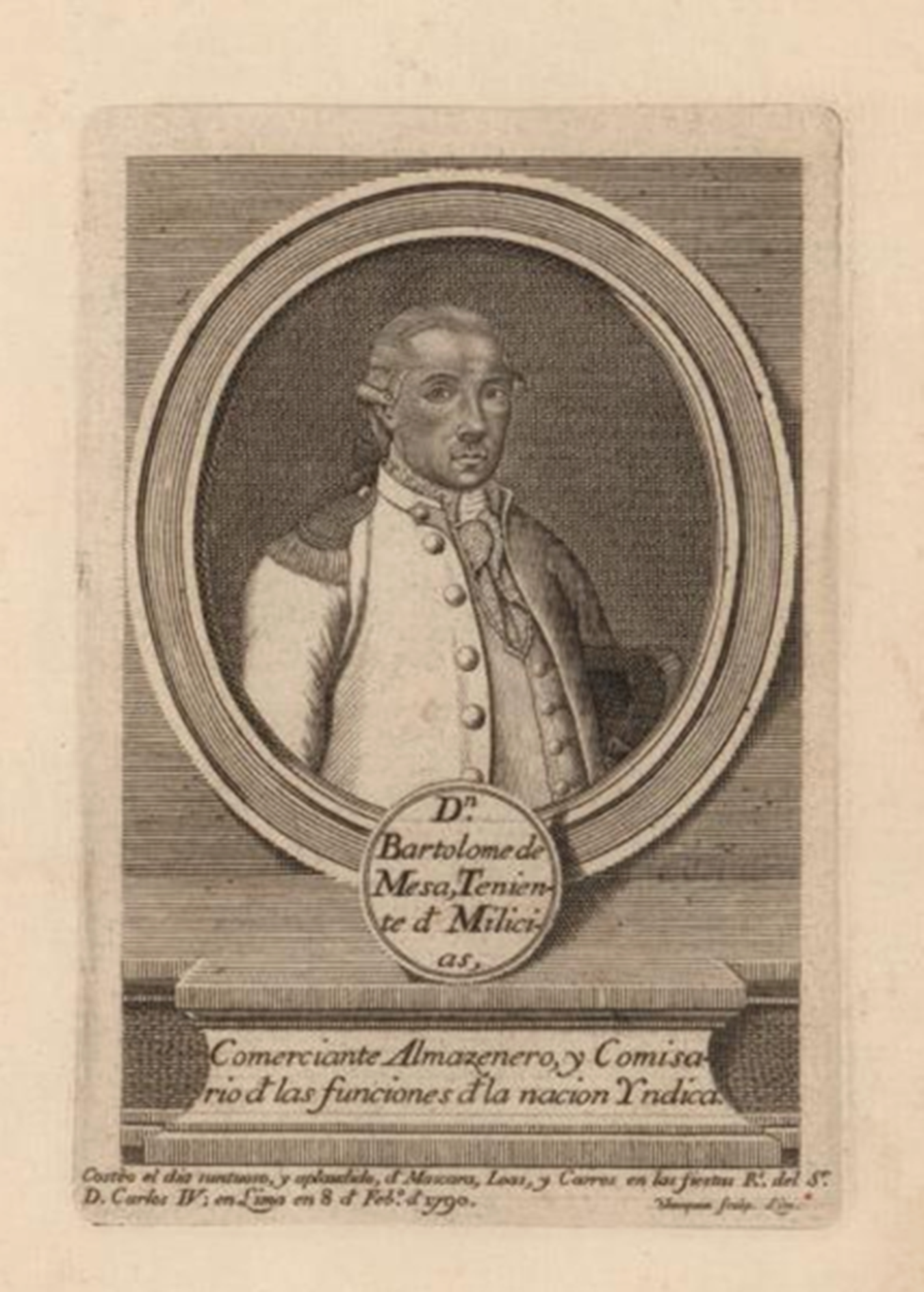
Figure 1 Long description
The portrait is framed within an oval border. Below the portrait, there is text that reads: 'Don Bartolomé de Mena, Teniente de Milicias, Comerciante Almacenero y Comisario de las funciones de la nación Indica.' Additional text at the bottom provides details about the engraving's creation, mentioning the engraver and location: 'Cuarto de la Real Sociedad de Amigos del País de México, Luis, y Carnero, en las puertas de la R. S. de D. Carlos IV, Agosto 8 de 1804.'.
In 1790 the loyalty of Andean people was not something the colonial state took for granted. Between 1780 and 1783 a vast anticolonial rebellion had swept across the viceroyalty, posing a serious threat to the colonial state. Upwards of 100,000 people were killed in the uprising, known as the Tupac Amaru Rebellion, which had been suppressed with great ferocity and considerable difficulty. The rebellion shattered the colony’s fragile stability. Officials were confronted with the Andean population’s profound rejection of colonial rule; Andean people were confronted with the profound violence of the state. Since viceregal officials blamed the uprising in part on enduring memories of the precolonial Inca Empire, after the rebellion’s defeat they unleashed what one scholar has called a programme of cultural genocide, which sought to eradicate all commemoration of the Incas, as well as many aspects of indigenous culture more generally.Footnote 7 Portraits of the indigenous nobility dressed in Inca-style garments had become popular in the decades before 1780; these were now proscribed. Paintings of the Inca kings were destroyed; some officials spoke of banning altogether the use of the indigenous language Quechua.Footnote 8 The 1789–90 festivities thus took place against a backdrop of tension and fear.
Meza was a prominent figure in Lima’s indigenous neighbourhood of Santiago del Cercado, where he held the post of lieutenant in the indigenous militia. He was proud of his descent from indigenous nobility and from a Spanish conquistador. Funded by his wealthy wife, in 1790 he owned a number of properties and ran a business selling local and imported merchandise.Footnote 9 For the royal coronation Meza organised several days of festivities, described in lavish detail by a local poet whom Meza hired to immortalise the proceedings. He also commissioned two enormous paintings of the main procession. The artworks were to be grand affairs, four varas wide (over 300 cm), to match the grandeur of the events they depicted. Meza intended to send one of these to the new king; the other was to remain in Peru.Footnote 10
The indigenous festivities included parades, elaborate floats, bullfights, dances, flowery speeches, and the conversion of Lima’s central fountain into a sort of aquarium containing exotic sea-life. The participants—over four hundred—wore elaborate, jewel-bedecked costumes representing Minerva, the Indian nation, Flora, and other allegorical figures. Although, prior to the Tupac Amaru Rebellion, indigenous festivals had often included figures dressed as Incas, these now-banned references to the Inca Empire were conspicuously absent.Footnote 11
Meza intended the different components of the celebration to reinforce a single, coherent message: Peru’s indigenous population were obedient subjects of the crown. They enjoyed the “great privilege” of being governed by Spain, which was credited with bringing law, science, and civilisation to Peru’s backward lands.Footnote 12 The programme’s repeated assurances that Andean people were faithful vassals aimed to calm the nerves of the colonial administrators who watched the celebrations from a special platform erected in Lima’s main square. The festivities conveyed a reassuring picture of a harmonious colonial society, in which the king’s indigenous subjects laboured diligently in the viceroyalty’s silver mines, producing the mineral wealth that made the kingdom prosper. Decorative floats carried allegorical figures representing metallurgy, gold, silver, and mercury through Lima’s streets, and dancers dressed as miners performed in front of the viceroy, the archbishop, and other members of the colonial elite. Llamas adorned with silver tissue and bearing gold, silver, and mining tools accompanied the dancers. The speeches offered these riches to the new king. Harmony, contentment, and happiness were the watchwords of the overall festivities—a welcome message for colonial officials.Footnote 13
The speeches, processions, and floats also highlighted Meza’s role in the spectacle, as María Soledad Barbón has observed.Footnote 14 The frontispiece of the lengthy El sol en el medio día, in which Meza’s hired poet offered a detailed account of the celebrations, was an engraving not of the monarch but of Meza, by the well-known Peruvian artist José Vázquez (See figure 1).Footnote 15 Meza presumably hoped that his self-fashioning as a loyal subject would be welcomed by a colonial administration that had lost confidence in the indigenous population’s commitment to the colonial project. He stressed this point in the multiple petitions he subsequently sent to the crown requesting formal recognition of his services. Persuaded by the costly and eye-catching display of fidelity Meza had masterminded, the viceroy endorsed Meza’s 1790 petition for acknowledgement, labelling him a faithful subject of the crown.Footnote 16
Meza’s choice of an artist most likely also reflected his ambition to elevate the contributions of indigenous people to the colonial state. According to several accounts, the artist was an “untutored native” of Peru.Footnote 17 It is unlikely that Meza would have entrusted this (to him) important commission to an untrained artist; after all, he selected the reputable José Vázquez to engrave his own image. There was, however, a well-known indigenous artist active in Lima in the 1790s: Julián Jayo. Jayo’s status as a respected indigenous painter whose images circulated in Europe may have attracted Meza’s attention when he looked to commission his large commemorative paintings.
Born in Lima, Julián Jayo Apumayta Taurichumbi Sabá Mango Capac Inga (ca. 1736–1821) was, like Meza, the descendant of indigenous nobility.Footnote 18 On his marriage license he listed his name as Julián Dávila; only recently have scholars determined that Julián Jayo and Julián Dávila were the same person.Footnote 19 By the 1790s, Jayo was a significant artist, commissioned to provide artworks for major religious institutions in Lima and portraits of prominent individuals. His workshop was on the Calle de Veracruz, a distinguished street where the Condes de Santa Ana de las Torres had a residence; Jayo also owned two enslaved people, inherited from a cousin.Footnote 20 He is best known for his contribution to the murals commemorating the life of the Italian saint Pedro Nolasco in Lima’s Convento de la Merced. He also executed commissions for Lima’s Convento de los Descalzos and the Dominican Iglesia de Santa María Magdalena Recoleta. His portraits depicted religious figures such as the abbess Micaela Barba de Cabrera, and prominent colonial officials, including Peru’s last viceroy, Joaquín de la Pezuela.Footnote 21 Both Jayo’s reputation as a painter with close ties to the colonial elite and his status as a respectable indigenous man would have recommended him to Meza, when the latter sought an artist to execute his commemorative paintings.
Meza’s festivities and his paintings together offered a tranquil image of post–Tupac Amaru Peru. During the rebellion, representations of colonial society had became “a battleground of sorts over which both parties sought to assert interpretive control,” as Ananda Cohen-Aponte noted.Footnote 22 Meza’s programme attempted a symbolic and visual recomposition of a broken colony, in which indigenous men and women danced to celebrate the new Spanish monarch and the colonial state. As the administration struggled to reconstruct a functional colonial order, Meza’s programme responded directly to the anxiety and disbelief that pervaded Spanish colonial society. His combination of song, dance, and visual spectacle represented the new monarch as the ruler of a rich, united, and happy kingdom; the commissioned paintings aimed to render permanent this comforting but evanescent image of harmony.
A Sea-Change
Meza intended his commemorative painting as a gift to Charles IV, a reassuring depiction of unity restored in his once-rebellious colony. It would show the new monarch that he ruled indigenous people who “at such distances serve him faithfully.”Footnote 23 Meza’s distance, however, proved a substantial obstacle; the painting’s journey to Spain faced disruption before it even left Peru. It was first packed into the hold of the Aquiles, due to sail from Callao (Lima’s port) in early 1792. After delays caused, ostensibly, by the late arrival of some of the cargo, the Aquiles eventually left in April.Footnote 24 Twelve days later, it returned, leaking badly. The cargo was transferred to the newly built Santiago Apostol. The Santiago finally departed in November 1792, more than six months after the Aquiles had attempted the voyage, and nearly three years after the coronation celebrations.Footnote 25 The route would take the vessel around Cape Horn, in a journey that would last nearly six months.
These delays proved unfortunate. While the other ships that left Callao in the spring of 1792 arrived safely in Spain, the Santiago was still at sea on 7 March 1793, when France declared war on Spain. This laid Spanish shipping open to capture by the French. The Santiago’s captain, Manuel Calbo, was an experienced officer, well aware of the tense international situation resulting from the French Revolution.Footnote 26 He was therefore reassured when a passing Spanish vessel informed him, incorrectly, on 15 March 1793 that “our Spain was generally at peace with all nations,” even “the Moors.”Footnote 27 Barely three weeks later, the Santiago was captured by a French privateer, the Général Dumourier.
The crew of the Général Dumourier was overjoyed to discover that their prize carried a spectacular cargo of gold, silver, quinine, and other commodities later estimated to be worth over two million pesos, an astronomical sum equivalent today to something on the order of a hundred million pounds.Footnote 28 These goods and specie had been building up in Lima for several years, and included taxes owed to the crown and a diverse array of commercial goods, as well as, of course, Meza’s painting. The French privateers speedily set about transferring the cargo onto their ship and preparing to pilot the Santiago to Bordeaux. The captured crew was tied up and put in the hold.
French celebrations were short-lived. Ten days later, the Santiago’s crew, passengers, and cargo experienced their second capture at sea, when British naval vessels took the French ship. Calbo’s crew were released and transferred to the British ships, which carried them to “Protsmouth,” as Calbo called it.Footnote 29 By then his crew had been at sea for nearly six months and were suffering badly from scurvy. The British, however, were jubilant. “You may easily imagine, as success has a very sensible effect upon the human mind, how much we are elated at this stroke of fortune,” reported one of the British officers.Footnote 30 News of the valuable capture spread quickly across Britain; the Santiago’s cargo, reported the Scots Magazine, was “without exception, the richest that ever was trusted on board of any single ship.”Footnote 31 Everyone tried to calculate the bounty likely to be paid to officers and ordinary sailors. Public houses in Portsmouth presumably did a roaring trade in the days after the convoy sailed into port.
Celebrations again proved short lived. While France and Britain had been at war since March 1793, Spain and Britain were not. On the contrary, they were allies in the pan-European fight against revolutionary France, and the Spanish government wasted no time in asking for their boat back. The ambassador brandished a recently signed treaty in which Britain and Spain agreed to protect each other’s shipping from French aggression. The ensuing lawsuit dragged on for years.Footnote 32 Perhaps unsurprisingly, the British courts eventually concluded that the capture was perfectly legitimate. Spain soon declared war on their former ally, citing Britain’s outrageous treatment of the Santiago as a precipitating factor.
Throughout these years Santiago’s cargo lay in storage. The gold and silver were transferred to London, accompanied by much fanfare and an armed guard, where they remained until the conclusion of the legal case.Footnote 33 Perishable items such as the cacao were auctioned off in May 1793, but the distribution of proceeds and the fate of the remaining cargo were in limbo until 1795, when the British Admiralty at last determined that the capture had been legitimate.Footnote 34 Only then was a full inventory compiled, which revealed the range of objects carried on the Santiago. From the moment of its first capture by the French to its definitive confiscation by the British, all attention had focused on the gold, silver, sugar, vicuña wool, quinine, and dye-woods that made the ship such a valuable prospect. These to be sure were the most interesting goods from a monetary perspective, but alongside them the Santiago transported a diverse array of objects: bundles of arrows and canoe paddles, chair covers, “Indian earthenware vessels,” twenty-one fringed silk handkerchiefs, a gilt-headed cane, bunches of coloured feathers, and, together with several other pictures, Meza’s painting, described as “1 large picture, representing a procession at Lima, 7 feet 8 inches by 10 feet, 4 inches.” It was auctioned off, along with the rest of the cargo and the ship itself, in a series of sales in 1795. It sold for £8.Footnote 35
For Meza’s painting, its sea-voyage proved transformative. The double capture of the Santiago brought it to Britain, rather than the Spanish court. It was therefore unable to perform its office of representing to Charles IV a tranquil vision of post–Tupac Amaru Peru. Its visual recomposition of the shattered Peruvian polity was rendered invisible. Utterly immaterial to the growing conflict between Spain and Britain, it lost all political resonance. Merely a “picture representing a procession,” it now appeared in the auction inventories alongside bags of cocoa fat and six damaged cannons.Footnote 36 Elsje van Kessell has explored the ways in which such ship inventories are a means of converting the chaotic process of capture into certifications of ownership. These tidy lists, with their estimates of monetary value, transformed captured objects into legitimate possessions.Footnote 37 Thus Meza’s world-mending painting became an insignificant but perfectly legitimate purchase picked up at an auction in Garraway’s Coffee House, in the City of London, in the summer of 1795.
The violence of the Tupac Amaru Rebellion and its suppression led Meza to commission his large painting and determined its content, which he hoped would illustrate the detailed written description of his programme of festivities.Footnote 38 The violence of international conflict provoked by the French Revolution brought the painting to Britain. Decontextualised, it lost its political edge, but the particular nature of its entry into Britain did more than change its significance for its new audience. It also dramatically changed its physical form from painting to print.
Losing Its Identity
Meza’s painting was purchased by Joseph Skinner, a surgeon employed in the Royal Navy with an interest in herbal medicines from the Americas. Given this interest, he was attracted to the Santiago sale by the possibility of acquiring a sample of calaguala (Phlebodium decumanum), a fern used as a medicinal treatment; the Santiago carried over a tonne of the herb.Footnote 39 While at the auction he picked up some issues of the Mercurio Peruano, a short-lived journal edited in Lima by a group of elite men of philosophical bent.Footnote 40 (By coincidence the young sons of the Mercurio’s editor were also travelling on the Santiago.Footnote 41 ) The Mercurio published essays on Peru’s population, economy, and other matters that were little understood in Britain at the time. It was, Skinner recognised, an unusual source of information about this large territory. Skinner in addition bought Meza’s large painting, along with some of the six other paintings on the Santiago, described in the auction catalogues as portraits of ladies, gentlemen, and clergy.Footnote 42
Inspired by his purchases, Skinner published translations of several articles from the Mercurio. In 1805, he was able to offer the British public something more substantial: The Present State of Peru, a book-length work that made much more extensive use of the Mercurio.Footnote 43 The book provided an account of Peru’s geography, civic and religious institutions, indigenous population, and economy. For Skinner, the information in the Mercurio demonstrated plainly the potential of the Spanish colony as a future site of British trade and investment. Peru, Skinner stated in his introduction, was a country of “a more than common interest” to “the British patriot, and the British statesman.”Footnote 44
The British government and individual Britons indeed viewed Spain’s American colonies with increasing interest in this period. The hemisphere offered an enticing market for British goods, if Spanish legislation preventing British merchants from trading could be circumvented, or perhaps discarded altogether should Spanish America follow its neighbour to the north in overthrowing colonial rule.Footnote 45 From its first pages The Present State of Peru remarked on the “strong spirit of independence” that characterised Peru’s educated classes, and stressed both the paucity of manufactures and availability of silver and gold.Footnote 46 Mining and commerce featured prominently in Skinner’s index. Drawing on the acerbic comments of the Mercurio’s own writers, Skinner relayed a picture of a region rich in natural resources but suffering from lack of investment and neglect. Skinner also interposed his own comments on, for instance, the feasibility of commercial llama ranching, an enterprise that was in fact attempted some decades later in the Scottish highlands.Footnote 47 Peru, readers might conclude, provided fertile ground for British trade and perhaps British governance.
To illustrate his book, Skinner drew on elements of Meza’s painting. Instead of reproducing the entire picture, he selected details that appeared as separate, disconnected prints, which he hoped would render the account “more agreeable to the reader.”Footnote 48 A large painting of a procession thus became some twenty individual illustrations of mining, different social classes, indigenous culture, and the like. Skinner, in other words, disassembled Meza’s harmonious vision into a set of discrete vignettes of Peruvian society.
In addition to rendering Skinner’s book more agreeable to the reader, the illustrations also bolstered its claim to provide accurate, first-hand information about distant Peru. This claim was stated explicitly on the title page, which announced that The Present State of Peru was based on “original and authentic documents” from Peru. These included not only the materials Skinner had extracted from the Mercurio but also the prints extracted from the painting, which, Skinner emphasised, was by a genuine Peruvian artist. We can imagine Skinner and his unnamed engraver standing in front of the very large canvas to select suitable figures. Many of the plates served to reinforce Skinner’s view that Peru represented an attractive opportunity for British trade; readers were reminded of Peru’s wealth through images of well-dressed Limeños (plates 10–12) and a mining official (plate 4).
Skinner stated that the Peruvian artist’s design was “strictly adhered to,” but his use of these extracted vignettes in fact departed quite significantly from the painting’s original composition and purpose.Footnote 49 He first of all repurposed several figures to illustrate entirely unrelated stories from the Mercurio. Plate 3 was labelled a portrait of Basilio Huaylas, a Peruvian with gigantism, whose history was recounted in the Mercurio. The Mercurio’s account was unillustrated; this description of the figure shown in Plate 3 was Skinner’s invention. The figure as it appeared in Meza’s painting was probably intended to represent one of the comic disguises from the 1790 procession.Footnote 50 As a spoil of war, Meza’s painting could be made to mean whatever its new owner wished it to mean, and Skinner intended it as a pleasant illustration to the account of “the Peruvian giant.”
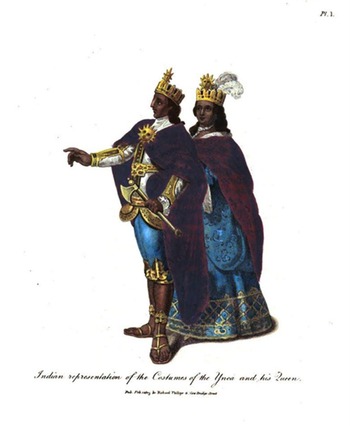
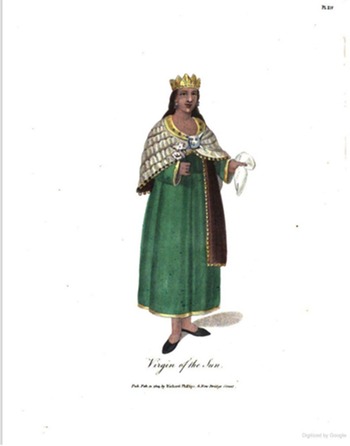
Skinner also transformed Meza’s loyal Indians into Incas. The very first plate, Skinner claimed, showed “the costumes of the Ynca, and his Queen, as represented by the modern Indians in their processions.” (See figure 2). Plate 14 depicted “a virgin, or priestess, of the sun,” again taken, Skinner claimed, from his large painting.Footnote 51 (See figure 3). It is worth reiterating that the written accounts of the festivities show that Meza had scrupulously avoided drawing the slightest parallel between his spectacle and the Inca Empire. Given the prohibitions against the celebration of the Inca past, issued in the wake of the Tupac Amaru Rebellion, it would have been extremely impolitic for Meza to have done so. Far from dressing his performers as Incas and sun virgins, he drew on European classical heritage. The allegorical figures appearing in his festivities represented Minerva and Flora, not Inca princesses. The radiant suns and bright moons that adorned these figures symbolised Peru’s abundant gold and silver, Meza was careful to explain, not the Inca Empire with which these celestial bodies were also associated.Footnote 52 In relabelling the images as depictions of Incas, Skinner erased the context that had given rise to the painting, and imposed a new one.
Meza probably intended these figures to represent gold and mercury; alongside silver these metals featured prominently in the festivities he organised. Skinner relabelled them as ‘the Inca and his queen’.Joseph Skinner, The Present State of Peru: Comprising its Geography, Topography, Natural History, etc (London, 1805), plate 1.
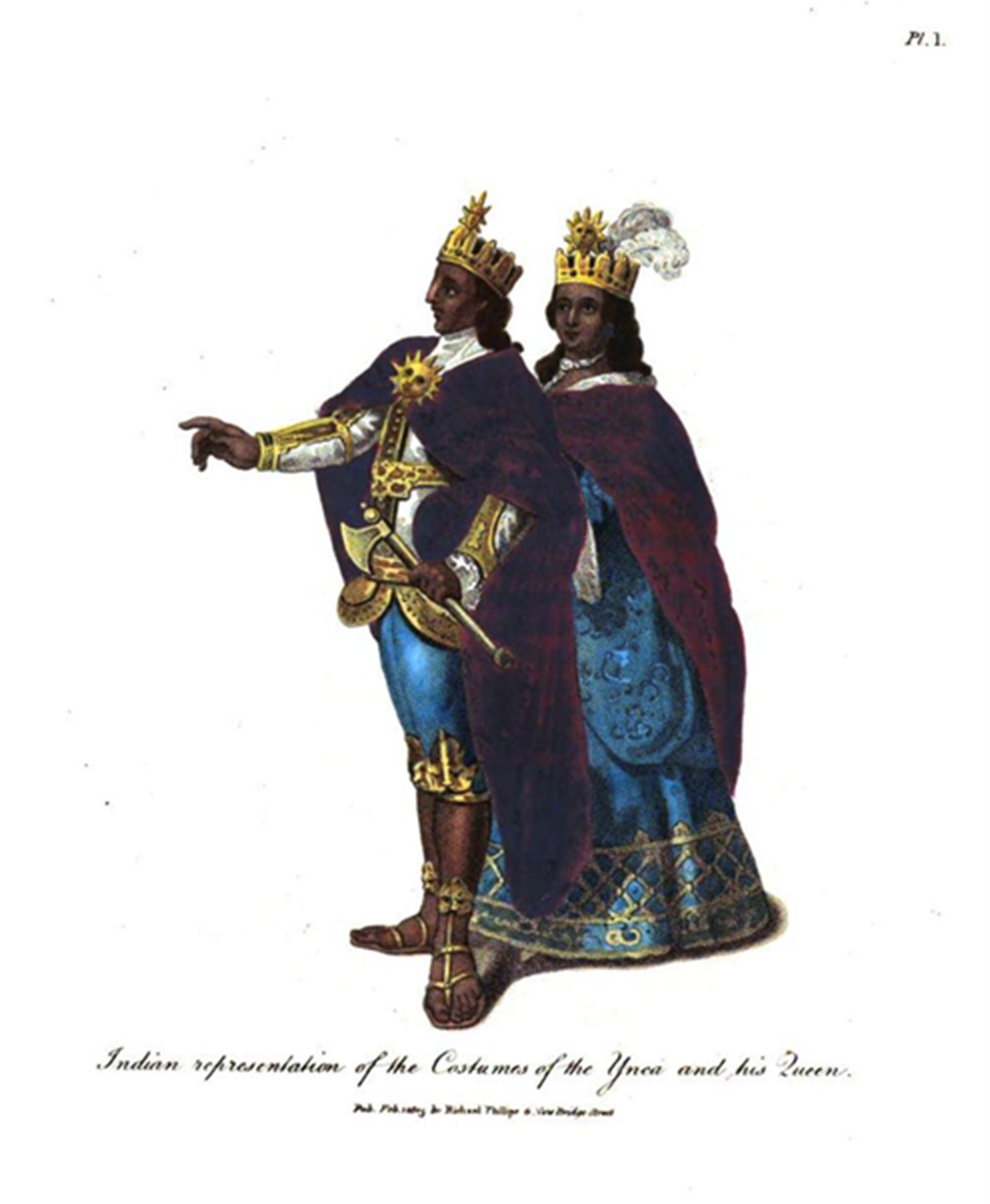
Figure 2 Long description
Two individuals are depicted in elaborate royal attire. The person on the right stands slightly behind, also wearing a crown and a long cape. Both figures are adorned with intricate patterns and accessories, suggesting a regal status. The text below reads 'Indian representation of the Costume of the Yese and his Queen.'.
Another figure perhaps representing silver has been isolated from the context provided by Meza’s painting, and reinterpreted as an Inca vestal virgin dedicated to the sun. Joseph Skinner, The Present State of Peru: Comprising its Geography, Topography, Natural History, etc (London, 1805), plate 14.
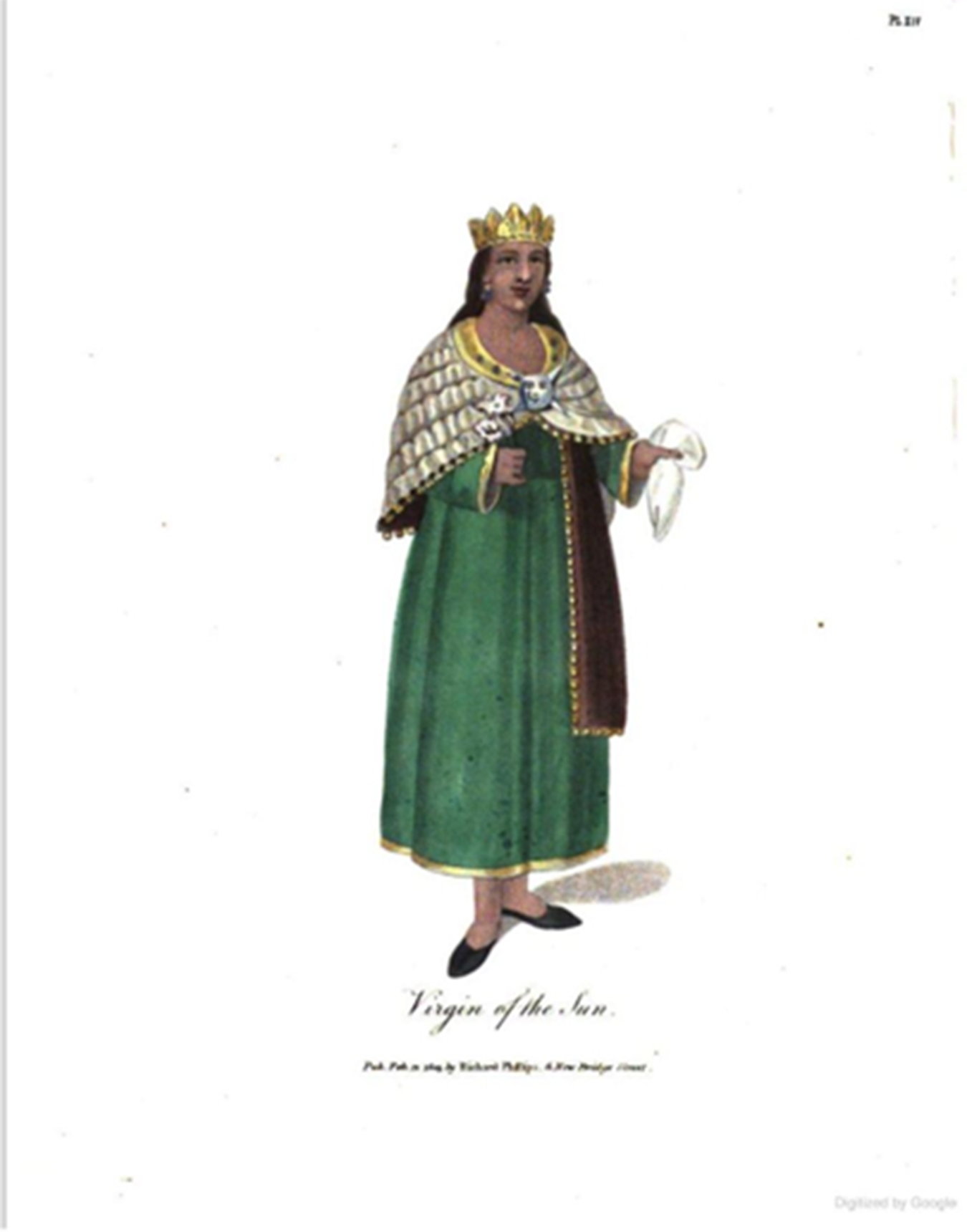
Figure 3 Long description
The attire suggests a ceremonial or regal theme. The text below reads 'Virgin of the Sun'.
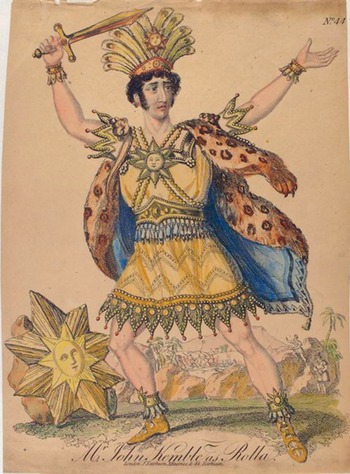
For British readers, the Incas were most often presented as a noble and tragic race, whose sufferings at the hands of the Spanish provided fertile soil for both condemnation of Spain and romantic intrigue.Footnote 53 The melodramatic possibilities of love triangles involving sun virgins, Inca warriors, and conquistadors featured prominently in popular Inca-inspired plays, novels, poems, and ballets. Mme de Graffigny’s epistolary novel Lettres d’une Péruvienne (1747), in which an Inca sun virgin is separated from her betrothed by conquistadors, was swiftly translated into English, as was Jean-François Marmontel, Les Incas, ou, La Destruction de l’Empire du Pérou (1777). Richard Sheridan’s five-act play Pizarro: A Tragedy (1799) revolved around the competition between the Peruvian Rolla and the Spaniard Alonzo for the love of the Inca princess Cora. Pizarro was the most popular play in the Britain of the 1790s, performed repeatedly across the country well into the nineteenth century. (See figure 4).Footnote 54
John Kemble as the heroic Peruvian general Rolla in the first of many stagings of Sheridan’s Pizarro, playing opposite the celebrated actor (and his sister) Sarah Siddons. ‘Mr. John Kemble as Rolla’ (1827), The New York Public Library Digital Collections, available via https://digitalcollections.nypl.org/items/510d47dd-ed00-a3d9-e040-e00a18064a99 (accessed 02/04/2026).
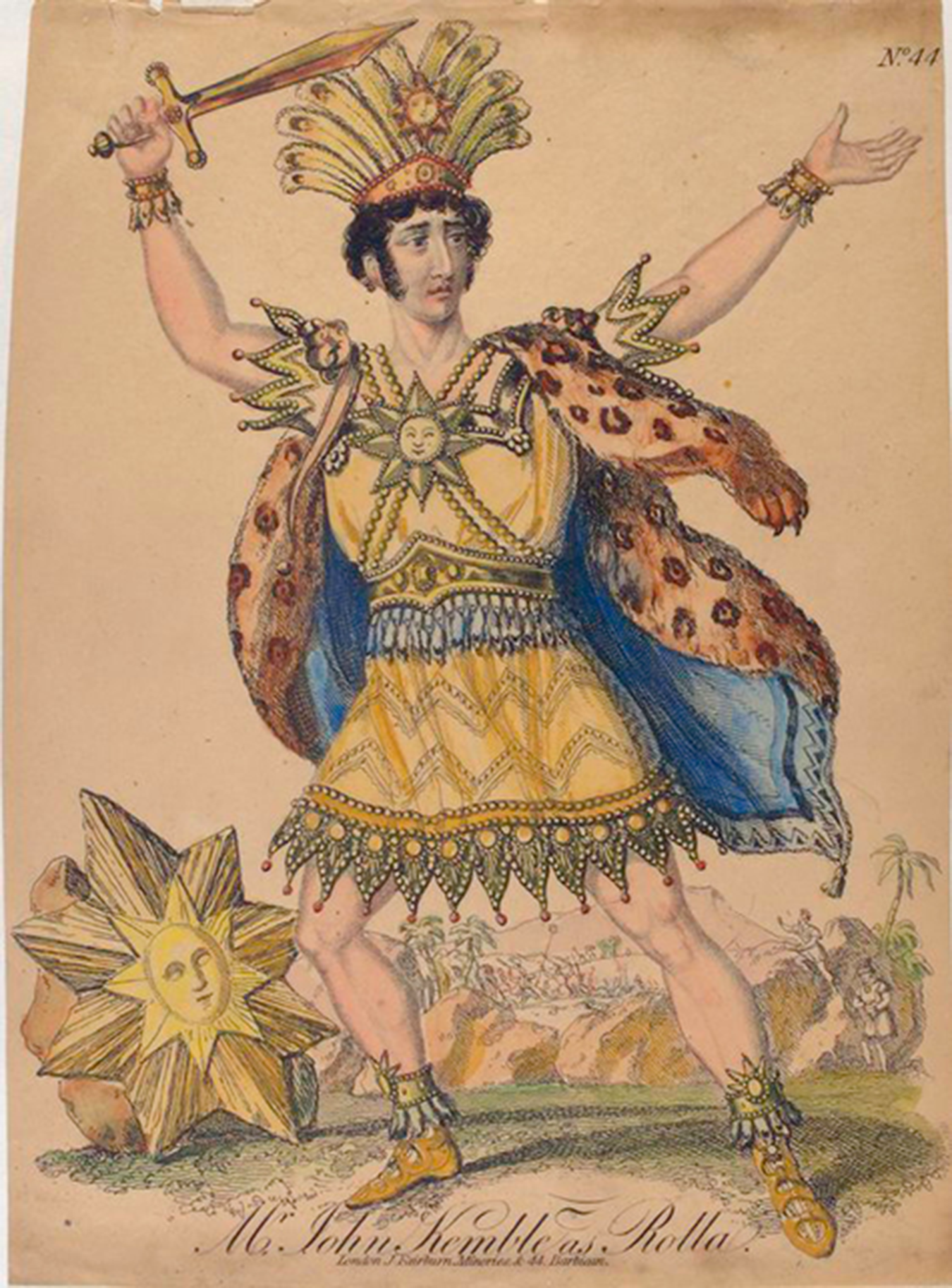
Figure 4 Long description
The person is holding a sword in one hand and has their arms raised in a dynamic pose. There is a large star-shaped object with a face on the ground beside them. The background includes rocks and a small palm tree. Text at the bottom reads 'Mr. John Kemble as Rolla'.
These works often alluded to the possibility of Peru’s throwing off Spanish rule. Contemporaries agreed that one of the most affecting scenes in Sheridan’s Pizarro was the rousing Act II speech delivered by Rolla, in which he called on his compatriots to resist the Spanish invaders. Spain’s mistreatment of its American colonies likewise featured regularly. The opening lines of Elizabeth Scott’s 1801 poem Alonzo and Cora (based on Marmontel) are “When o’er the western world IBERIA’s bands/with blood and rapine stain’d their guilty hands.”Footnote 55 Helen Maria Williams’s 1784 Peru, a Poem, in Six Cantos deplored the “unparalleled sufferings” Spain inflicted on the “innocent and amiable” Incas. The poem ends with the unfurling of the “flag of freedom,” humbling proud Iberia.Footnote 56 Overall, such works helped British audiences form a sympathetic attachment to the oppressed Incas, and encouraged them to view themselves as allies in the continent’s liberation from Spanish rule.
Skinner’s disassembly and reinterpretation of the painting thus converted Meza’s message into its opposite. Meza intended his picture to illustrate a reinstated, peaceful colonial order in the wake of Tupac Amaru. Skinner remade it to illustrate his vision of a Peru heading towards independence. The disassembled painting mirrored Skinner’s wishful deconstruction of the Spanish Empire. The mobility it experienced, in other words, altered not only the meanings attached to this artwork. It also altered its physical form in a way that directly reflects the broader violence of the process that brought it to Britain, refracted through the broken fragments of Meza’s grand painting.
Flotsam and Jetsam
The Present State of Peru attracted a modest level of attention in Britain and abroad.Footnote 57 Up-to-date information about the region was scarce in Europe, and the book offered the novelty of an insider’s view, complete with illustrations by a Peruvian artist. Skinner’s own interest in the sources he had employed in its writing and in his painting seems not, however, to have outlasted the book’s publication in 1805. Once he had extracted his illustrative prints from the canvas, he put it up for auction.
The auction catalogue described it, accurately enough, as “a very large Peruvian Painting.”Footnote 58 Most of the works for sale on 22 April 1806 at Alexander Cassano’s London auction house were said to belong to the Italian painter and art dealer Biaggio Manfredi, but lot 47 had a different provenance. The very large Peruvian painting, the catalogue explained, was captured from the St. Jago register ship, and had been destined for the court in Madrid. It was, the catalogue promised, “extremely curious, and it may justly be said unique.” It is worth quoting the catalogue entry in full, as it offers the fullest description we have of the painting:
It represents the Indian Festival at Lima, the Capital of Peru, on the occasion of the Accession of Charles IV. the present Sovereign, to the Throne of Spain. By the inscription at the top it appears, that this festival in honour of His Catholic Majesty, cost upwards of forty thousand piastres;Footnote 59 the Indians having endeavoured to render it as splendid as possible. For this purpose they have introduced into the Procession whatever tradition has handed down to them relative to their ancestors before the Spanish conquest; such as the Costume of the Inca and his Queen, that of the Virgins of the Sun, of the Female Warriors, or Amazons, &c. The magnificent Cars contain emblematical figures representing the Goddess of Peru, Minerva, &c. &c. Among the spectators who are seated to view the procession, and who compose the different classes of the inhabitants of Lima, the Viceroy is seen above in the centre, accompanied by his court, and in his front the Viceregal guards. On the right side of the painting, the Archbishop of Lima appears, surrounded by his clergy. These are, together with many others, genuine portraits, and pencilled with great precision by the untutored Indian artist. It would be difficult to describe all the various objects contained in this picture, which has no rival in England, and is highly interesting in an historical point of view.Footnote 60
The London papers agreed that this was “a real Peruvian painting of the utmost curiosity.”Footnote 61 Serendipitously, performances of Sheridan’s Pizarro were (yet again) being staged across the country, providing free publicity.Footnote 62
A year later, it was once more on the market, this time with a rather less grandiose description and no provenance. It was simply as “a curious Picture of a Festival in Lima, in S. America.” The painting failed to reach its reserve and so remained unsold. The auctioneer jotted down the name of the seller, who was presumably the person who had bought it the previous year: Lee.Footnote 63 He was most likely the Rev. Francis Lee (ca. 1768–1826), chaplain to the Prince of Wales, translator of Greek poetry, and amateur artist, most famous for his unhappy marriage to Catherine Ball, later Baroness of Calabrella (1788–1856).Footnote 64 He committed suicide in May 1826; an obituary described him as “a very original and eccentric character.”Footnote 65
Six months after Lee’s death, the painting was again up for auction, labelled “The Coronation of Charles IV. at Lima, a very curious picture.”Footnote 66 The connection to the events that had brought it to Britain had disappeared entirely. Once again it went unsold, and remained at the auction house for another decade, gathering dust. It was eventually sold, in 1836, to “Prosser,” who paid seventeen shillings for what had become a “Spanish” painting of “a curious Ceremony and Procession.”Footnote 67 The grand painting Meza envisioned as worthy of royalty, and for which Skinner had paid eight pounds, had depreciated in value by 90 per cent. This is the last firm sighting of Meza’s painting. It’s possible that it reappeared two years later at Christies, in 1838, this time as “A procession at a fête at Madrid, with numerous figures—torchlight; capitally painted,” ascribed to Velázquez. If this was Meza’s painting, it failed to sell.Footnote 68 Its current location is unknown.
These auction catalogues chart the progressive disintegration of the painting’s identity. It moved from being a Peruvian painting celebrating the reconstruction of post–Tupac Amaru society, to, perhaps, a Spanish painting of a procession, located either nowhere in particular, or in the Madrid that it ironically never reached. As Elsje van Kessel has noted, as goods captured at sea spread through English society, their origins and moment of entry into Britain were often lost.Footnote 69
Skinner’s prints, however, enjoyed a flourishing career. Once liberated from the constraints of Meza’s painting and Skinner’s book, they circulated rapidly, taking on new meanings. Publishers in Europe and the United States used Skinner’s prints to illustrate children’s books, albums of clothing from around the world, and other encyclopaedic compendia. Friedrich Justin Bertuch and his son Carl, for instance, used ten in their multivolume Bilderbuch für Kinder, an illustrated children’s encyclopaedia covering topics from cacti to mermaids, published in Weimar between 1790 and 1824. Seven Skinner prints appeared in volume 5, published mere months after The Present State of Peru, and three more in 1806 in the subsequent volume.Footnote 70 Eighteen were reprinted in the 1816 Costume of the Inhabitants of Peru, and seven years later, John Wilkes used four in his Encyclopaedia Londinensis; or Universal Dictionary of Arts, Sciences, and Literature—to give a few examples.Footnote 71
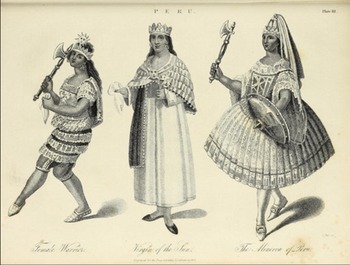
Most often reproduced were the figures that Skinner labelled “a virgin of the sun,” “the Inca and his consort,” and a figure representing “the Minerva of Peru.” The fancifully dressed woman described by Skinner as a “female warrior of the Yurimagua tribe” was also popular. (See figure 5). The prints showing elite and middle-class Limeños, and indigenous men and women, each in their distinctive garb, appeared frequently as well. Meza’s allegorical figures were thus converted into an array of individual prints illustrating typical Peruvian dress. In their theatrical poses and costumes, these figures closely resembled the actors who performed the roles of Rolla and the other protagonists of the popular Inca-themed dramas. (See figure 4). Inca-style costumes were also popular at the grand masquerades hosted across the UK in these years; indeed, at a masked ball held in Preston in 1802 both Miss Buckley and Mr Strickland chose to dress as sun virgins.Footnote 72
Three of the figures from The Present State of Peru appeared in John Wilkes’ 1823 encyclopaedia. Together they conveyed an image of Peru as a folkloric land inhabited by Incas. John Wilkes, Encyclopaedia Londinensis; or Universal Dictionary of Arts, Sciences, and Literature, vol. 19 (Containing A Comprehensive Treatise on Pathology; and a History of Persia and Peru to the Present Time) (London, 1823).
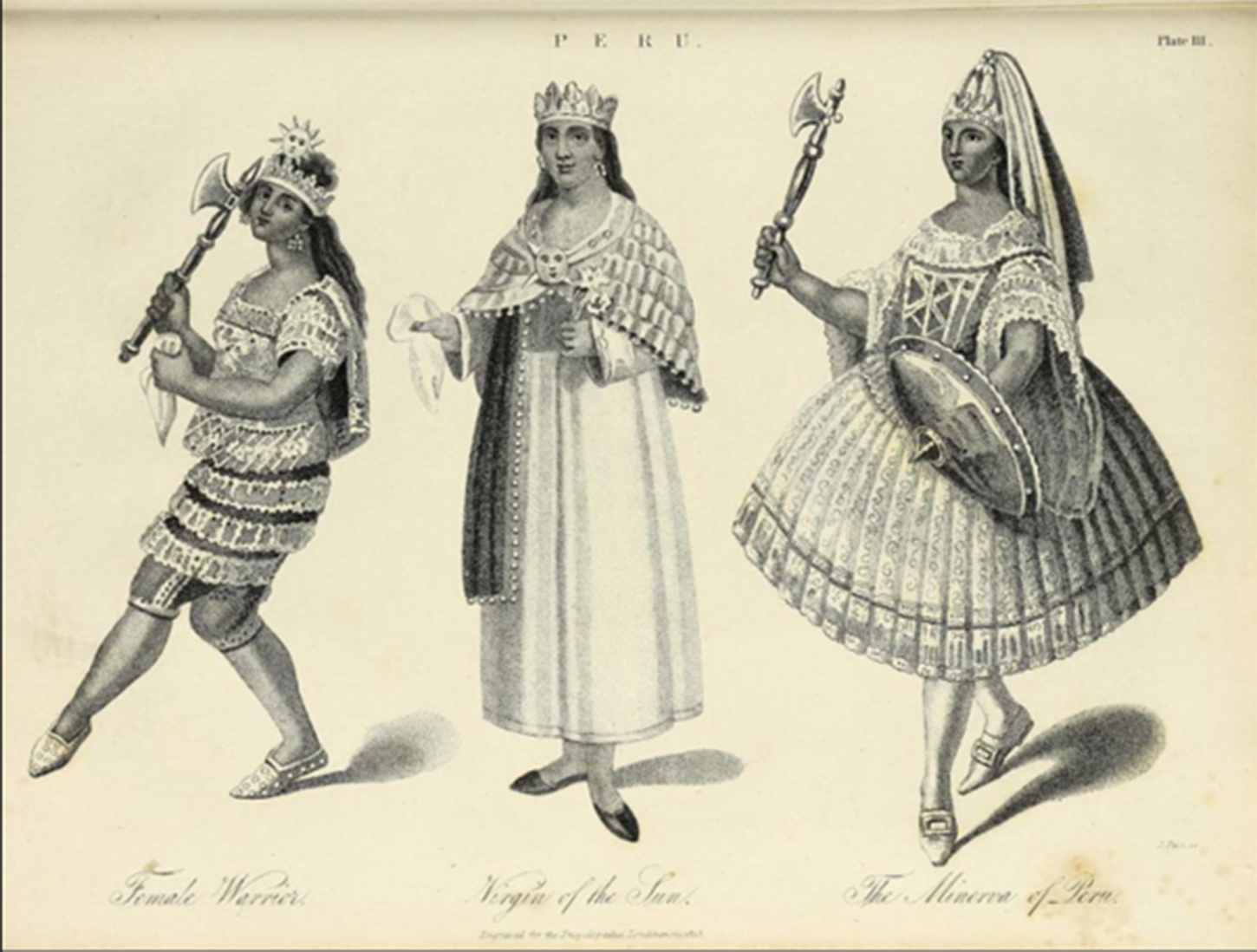
Figure 5 Long description
On the left, a female warrior holds an axe and wears a decorated skirt and headdress. The central figure, labeled 'Virgin of the Sun', wears a long robe with a patterned shawl. On the right, 'The Minerva of Peru' is dressed in a long gown with a headdress, holding a shield and a staff. Each figure is distinct in their attire and accessories.
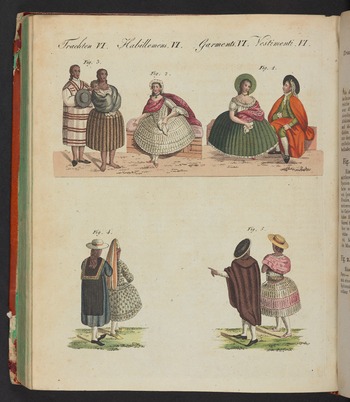
As depictions of Peruvian clothing, the prints fit neatly into the model established by costume books, a genre long popular in Europe. These compendia of the clothing worn in different parts of the world generally presented single figures on abstract white backgrounds, each labelled as showing the dress worn by a particular group. By representing people in this way, costume books implied that each person belonged to a discrete cultural group that could be identified by its distinctive clothing.Footnote 73 The disassembled Skinner prints employed the same format. The Bilderbuch für Kinder, for instance, reorganised seven of Skinner’s plates into five different illustrations of Peruvian dress, categorised by class, race, and gender. Figure 4, for instance, showed “natives of Peru in their Sunday dress.” Figure 2 was a Spanish lady of high rank, in full dress. Presented side-by-side, these plates offered a supposed overview of typical Peruvian garments, and typical Peruvian social classes, of the sort familiar from costume books. (See Figure 6).
Skinner’s prints were used to illustrate a variety of encyclopaedia and other compendia of knowledge; in this German children’s encyclopaedia they depict typical Peruvian costume. Friedrich Justin Bertuch and Carl Bertuch, Bilderbuch für Kinder: enthaltend eine angenehme Sammlung von Thieren, Pflanzen, Früchten, Mineralien … alle nach den besten Originalen gewählt, gestochen und mit einer … den Verstandes-Kräften eines Kindes angemessenen Erklärung begleitet, vol. 5 (Weimar, 1805).
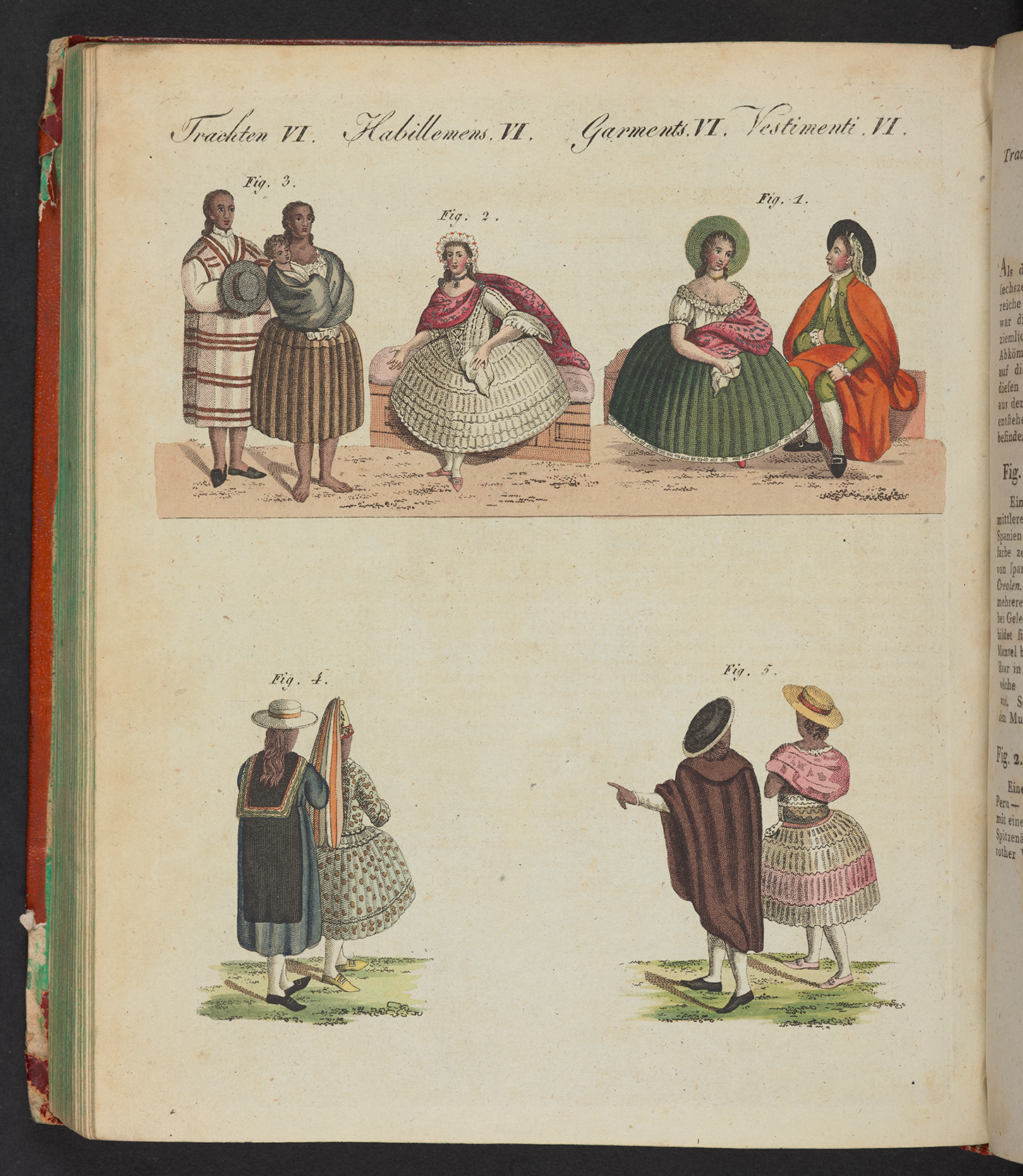
Figure 6 Long description
The figures are labelled with captions. Fig. 1 shows two men standing side by side, wearing patterned garments. Fig. 2 depicts a woman seated, wearing a wide skirt and a shawl. Fig. 3 shows another seated woman in a similar outfit. Fig. 4 presents a man seated with crossed legs, wearing a tunic and cape. Fig. 5 illustrates two women standing, wearing patterned skirts and shawls, with one holding a basket. Fig. 6 shows a man and a woman standing together, with the man pointing forward and the woman wearing a hat and patterned skirt. Each figure is dressed in distinct attire.
This reuse of Skinner’s plates was not unusual. Good business could be made selling books of “types” from around the world, and publishers were always in want of new images to illustrate these volumes. Engravings were regularly reprinted, and at times repurposed, to support demand.Footnote 74 Skinner’s plates addressed a commercial need by providing novel images of Peruvian types and costumes, which could illustrate encyclopaedias and other accounts of the people and cultures of Spanish America. They augmented the meagre corpus of Peruvian types available to European printers.
In this process, their meaning changed yet again. Skinner’s Peru was an investment opportunity for British business, inhabited by enlightened but badly governed men; his plates accordingly showed not only Incas but also scholars and mining officials. Separated from the publication in which they first appeared, they were now used to represent Peru as a nation of fancifully dressed folkloric types. This final transformation was wrought not by colonial or imperial violence, but by the increasingly powerful forces of the market.
Conclusions: Mobility, Materiality, and Meaning
This article draws inspiration from research into both the transformative effects of mobility and war’s role in the “making and breaking” of artworks to offer a new reading of a mobile painting’s multiple transformations from its first conception to its disappearance.Footnote 75 We argue that the particular ways that it was interpreted, and the particular forms of mobility that it experienced, were conditioned by different forms of violence. The reasons why an object was in motion, in other words, may help explain the new meanings that it accrues as it travels. We should pay attention not only to the fact that an object circulated but also why and in what ways it became mobile.
Meza had intended his painting to depict a harmonious and united society, bound together by loyalty to the Spanish monarchy and deeply indebted to indigenous labour. In response to the Tupac Amaru Rebellion’s attack on the colonial state, he devised a festive programme that performed Peru’s continued obedience. His painting for Charles IV distilled that ambition into a large canvas, whose existence was a response as much to the violence unleased on Peru after 1780 as it was to the coronation of the new monarch. It was, fundamentally, a product of that violence. A further form of violence—imperial warfare—catapulted the painting from its intended trajectory, carrying it to Britain, and in the process stripping it of its political meaning. Thereafter not a single person linked the painting to the Tupac Amaru Rebellion. It became merely one of the less interesting parts of the Santiago’s cargo.
Its purchase by Skinner transformed not only its meaning but its physical form. Skinner’s disassembly of Meza’s painting into a series of prints recapitulated the very disintegration of Spain’s American empire that his book anticipated. Their subsequent piecemeal circulation around Europe as illustrations of Peruvian types further undermined their ability to represent Peru as a happy, productive, or modern society. On the contrary, Peru became to some degree equated with the very Inca Empire that Meza had so deliberately excluded from his festival.
Over time Meza’s own attitude towards Spanish rule changed. In 1795 his request to be promoted to colonel in the indigenous militia was declined in part on the grounds that, regardless of his contributions to the coronation festivities, this rank should not be accorded to shopkeepers who sold inexpensive goods to “Blacks, zambos and mulattoes.”Footnote 76 He eventually tired of loyalty to an unappreciative, and racist, colonial regime. In 1809, as the Spanish Empire began to fragment in the wake of Napoleon’s invasion of the Iberian Peninsula, Meza was arrested, charged with plotting an anticolonial conspiracy. He died in prison before trial; Teresa Vergara Ormeño argues that Meza was motivated in part by the prejudice he faced as an indigenous man in the aftermath of the Great Rebellion.Footnote 77 Julián Jayo, the artist Meza perhaps employed to paint his enormous picture, walked the same path. Notwithstanding Jayo’s well-established connections to high-ranking colonial officials, shortly before his death in 1821 he signed Peru’s declaration of independence. In the end, it seems, they were themselves unpersuaded by the vision of colonial unity they had so carefully designed.
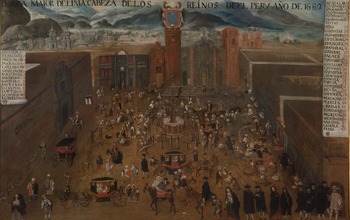
In a now-classic analysis, Arjun Appardurai argued that, to understand “the concrete, historical circulating of things… we have to follow the things themselves, for their meanings are inscribed in their forms, their uses, their trajectories… . It is the things-in-motion that illuminate their human and social context.”Footnote 78 Does it matter to this analysis that Meza’s painting, the thing-in-motion, has disappeared?Footnote 79 This article has suggested that even without the thing itself, we can understand some of the interconnections between its mobility, meanings, and materiality. To be sure, we can try to imagine Meza’s painting: possibly it resembled other birds-eye views of colonial Spanish American cities, of which there are a number. (See figure 7). But still … what if we could find it? Does it yet hang on the wall of a country estate somewhere in England? Scholars have explored this hopeless longing to recover vanished artworks. Michael Ann Holly suggests this fantasy of rescue is a constituent part of any sort of writing about art.Footnote 80 We can dream that it will reappear one day at auction. In the end, perhaps we may not be able to salvage this submerged painting, but we can pay attention to its wake.
Possibly Meza’s painting resembled this birds-eye view of Lima’s main plaza, painted a century earlier. Like Meza’s it features the unusual central fountain and a considerable crowd of people of various ranks and classes. Anon., Plaza Maior de Lima Cabeza de los Reinos de el Perú, Año de 1680, c.1680, 109x168cm, Museo de América, 2013/03/01.
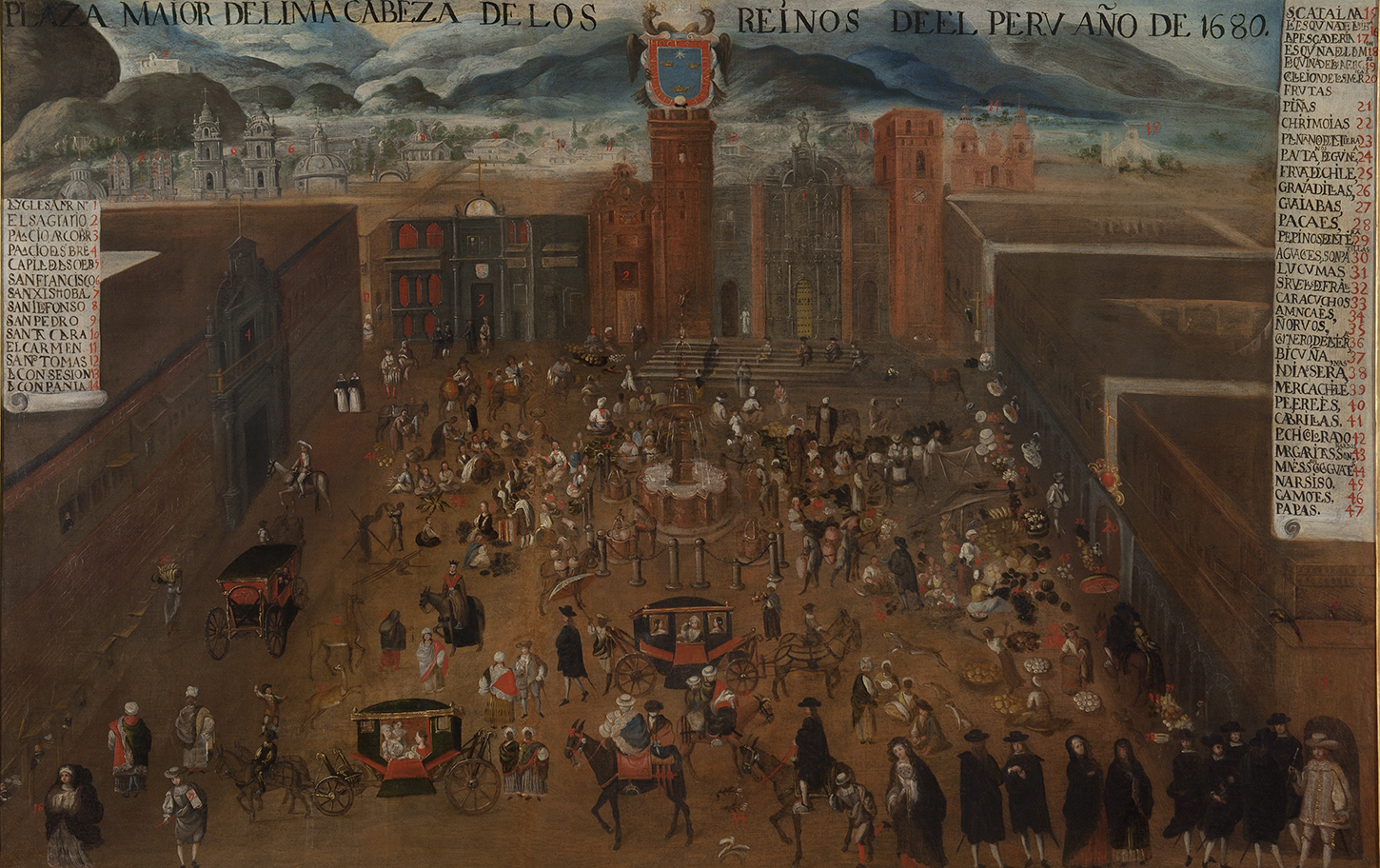
Figure 7 Long description
Several carriages are visible, with horses and drivers. The square is surrounded by tall buildings and a prominent fountain is in the center. People are gathered around the central fountain; others are walking or conversing. The background features a mountainous landscape under a cloudy sky. Text is present at the top and sides of the painting, providing a description of the buildings.
Acknowledgements
Many colleagues have offered guidance. We’re particularly grateful to Amanda Beven, Randolph Cock, Mattia Biffis, Olivar Finnegan, and Natalia Majluf.


 Open access

