

Statement of Research Significance
Research Question(s) or Topic(s): This study explores mental fatigue after a type of stroke called subarachnoid hemorrhage. It investigates the role of cognitive problems and emotional stress. Two subtypes of subarachnoid hemorrhage are studied: one caused by a ruptured blood vessel and one where no bleeding source is found. Main Findings: Patients with subarachnoid hemorrhage felt much more mentally and physically tired than healthy people, with mental fatigue being more common. Their thinking speed and attention were also worse. In one subtype, worse attention was linked to more mental fatigue, while in the other, slower thinking speed played a role. Both mental and physical fatigue were connected to emotional stress. Study Contributions: The study shows that mental fatigue may have different causes depending on the type of subarachnoid hemorrhage. It emphasizes the importance of personalized recovery plans that focus on both cognitive difficulties and emotional well-being.
Introduction
A subarachnoid hemorrhage (SAH) is a type of stroke characterized by bleeding in the subarachnoid space. SAH accounts for approximately 5% of all strokes and is associated with a high risk of mortality and morbidity (Feigin et al., Reference Feigin, Lawes, Bennett, Barker-Collo and Parag2009). In 85% of cases, the cause is a ruptured intracranial aneurysm, termed aneurysmal subarachnoid hemorrhage (aSAH), while in the remaining 15% the cause of the bleeding is unidentified and classified as angiographically negative subarachnoid hemorrhage (anSAH) (van Gijn et al., Reference van Gijn, Kerr and Rinkel2007). One of the most commonly reported and most disabling symptoms after SAH is fatigue, with estimates of prevalence ranging from 30% to 90% (Buunk et al., Reference Buunk, Groen, Wijbenga, Ziengs, Metzemaekers, van Dijk and Spikman2018; Kutlubaev et al., Reference Kutlubaev, Barugh and Mead2012; Western et al., Reference Western, Sorteberg, Brunborg and Nordenmark2020). Fatigue after SAH persists over time and interferes with daily life, such as the ability to return to work, social participation, and general well-being (Boerboom et al., Reference Boerboom, Heijenbrok-Kal, Khajeh, Van Kooten and Ribbers2016; Kutlubaev et al., Reference Kutlubaev, Barugh and Mead2012; Western et al., Reference Western, Sorteberg, Brunborg and Nordenmark2020).
Fatigue following acquired brain injury (ABI), including stroke, is considered a multidimensional construct that can be divided into mental and physical fatigue, of which mental fatigue is the most characteristic symptom in patients with brain injury (Visser-Keizer et al., Reference Visser-Keizer, Hogenkamp, Westerhof-Evers, Egberink and Spikman2015). Mental fatigue is characterized by a sustained feeling of exhaustion and lack of initiative after performing mentally demanding activities, whereas physical fatigue manifests as exhaustion after bodily exercise. Previous research found that 57–58% of patients experience mental fatigue one year after aSAH (Sörbo et al., Reference Sörbo, Eiving, Löwhagen Hendén, Naredi, Ljungqvist and Odenstedt Hergès2019; Wenneberg et al., Reference Wenneberg, Block, Oras, Hendén, Liljencrantz, Hayden and Hergès2025). Long-term follow-up studies found that mental fatigue was still present in around 50% of patients at five years and even more than 15 years after aSAH (Samuelsson et al., Reference Samuelsson, Jakobsson, Rentzos, Jakola and Nilsson2021; Wenneberg et al., Reference Wenneberg, Block, Oras, Hendén, Liljencrantz, Hayden and Hergès2025). Mental fatigue was found to be more prevalent than physical fatigue in patients three to ten years after both aSAH and anSAH, with nearly half of the patients affected (Buunk et al., Reference Buunk, Groen, Wijbenga, Ziengs, Metzemaekers, van Dijk and Spikman2018). Moreover, only mental fatigue was significantly related to unfavorable functional outcomes after both aSAH and anSAH (Buunk et al., Reference Buunk, Groen, Wijbenga, Ziengs, Metzemaekers, van Dijk and Spikman2018). However, the underlying mechanisms contributing to mental fatigue after SAH are largely unknown.
Mental fatigue following SAH may be explained by impairments in information processing speed and attentional control resulting from brain damage after SAH. Impairments in information processing speed and attention are frequently found after both aSAH and anSAH (Al-Khindi et al., Reference Al-Khindi, M., S., Al-Khindi, Macdonald and Schweizer2010; Burke et al., Reference Burke, Hughes, Carr, Javadpour and Pender2018; Buunk et al., Reference Buunk, Groen, Veenstra, Metzemaekers, van der Hoeven, van Dijk and Spikman2016; Khosdelazad et al., Reference Khosdelazad, Jorna, Rakers, Kof, Groen, Spikman and Buunk2023). The coping hypothesis about fatigue in brain injury proposes that mental fatigue is the result of increased mental effort to overcome impairments in information processing speed and attention, to meet the demands of everyday life (Van Zomeren & Van den Burg, Reference Van Zomeren and Van den Burg1985). A recent meta-analysis revealed that information processing speed and attention were consistently associated with fatigue after ABI (Dillon et al., Reference Dillon, Casey, Gaskell, Drummond, Demeyere and Dawes2022). Previous research in patients with aSAH showed that fatigue was higher in patients with cognitive impairment than in those without (Passier et al., Reference Passier, Post, Van Zandvoort, Rinkel, Lindeman and Visser-Meily2011). Furthermore, it has been shown that fatigue is strongly related to both subjective and objective cognitive functioning in patients with perimesencephalic SAH, a subtype of anSAH (Boerboom et al., Reference Boerboom, van Zandvoort, van Kooten, Khajeh, Visser-Meily, Ribbers and Heijenbrok-Kal2017). Although the meta-analysis by Dillon et al. (Reference Dillon, Casey, Gaskell, Drummond, Demeyere and Dawes2022) included some studies measuring mental fatigue, most previous research measured fatigue as a unitary construct. Consequently, it remains largely unknown whether these associations also apply to mental fatigue specifically.
Another potential contributor to mental fatigue is psychological distress, including anxiety and depressive symptoms, which are common after both aSAH and anSAH (Boerboom et al., Reference Boerboom, van Zandvoort, van Kooten, Khajeh, Visser-Meily, Ribbers and Heijenbrok-Kal2017; Passier et al., Reference Passier, Post, Van Zandvoort, Rinkel, Lindeman and Visser-Meily2011). Reviews including studies on aSAH and anSAH report a weighted prevalence of 31% for anxiety and 28% for depression after SAH, which does not decrease over time (Tang et al., Reference Tang, Wang, Tsoi, Kim, Lee and Kim2021, Reference Tang, Wang, Wong, Ungvari, Yasuno, Tsoi and Kim2020). Anxiety and depressive symptoms are also frequently observed in patients with aSAH with good functional outcome (Powell et al., Reference Powell, Kitchen, Heslin and Greenwood2002, Reference Powell, Kitchen, Heslin and Greenwood2004). Fatigue was found to be higher in patients with aSAH experiencing either anxiety or depressive symptoms than in those without these symptoms (Passier et al., Reference Passier, Post, Van Zandvoort, Rinkel, Lindeman and Visser-Meily2011). Fatigue was also found to be strongly related to depressive symptoms in patients with perimesencephalic SAH (Boerboom et al., Reference Boerboom, van Zandvoort, van Kooten, Khajeh, Visser-Meily, Ribbers and Heijenbrok-Kal2017). It is not yet clear to what extent psychological factors associated with general fatigue may also contribute to mental fatigue post-SAH.
Research on mental fatigue after SAH has mainly focused on patients with aSAH, while studies in patients with anSAH are still very limited. One study found that mental fatigue was significantly higher in patients with aSAH than in those with anSAH (Buunk et al., Reference Buunk, Groen, Wijbenga, Ziengs, Metzemaekers, van Dijk and Spikman2018). Another study reported that about one-third of patients with perimesencephalic anSAH experienced long-term fatigue (Boerboom et al., Reference Boerboom, van Zandvoort, van Kooten, Khajeh, Visser-Meily, Ribbers and Heijenbrok-Kal2017). It remains unclear whether the mechanisms underlying mental fatigue differ between patients with aSAH and anSAH.
Although mental fatigue is widely recognized as a major long-term symptom after aSAH and anSAH, prior research has often treated fatigue as a unitary construct, without differentiating mental from physical fatigue (Passier et al., Reference Passier, Post, Van Zandvoort, Rinkel, Lindeman and Visser-Meily2011; Visser-Keizer et al., Reference Visser-Keizer, Hogenkamp, Westerhof-Evers, Egberink and Spikman2015). Moreover, most studies have focused predominantly on aSAH, with limited research into those with anSAH (Buunk et al., Reference Buunk, Groen, Wijbenga, Ziengs, Metzemaekers, van Dijk and Spikman2018; Boerboom et al., Reference Boerboom, van Zandvoort, van Kooten, Khajeh, Visser-Meily, Ribbers and Heijenbrok-Kal2017). Consequently, there remains an important gap in understanding whether distinct factors contribute differently to mental and physical fatigue within these specific patient subgroups.
This study aims to (1) investigate the prevalence of mental and physical fatigue following aSAH and anSAH; (2) explore information processing speed and attentional control as possible contributors to mental fatigue following aSAH and anSAH; and (3) explore psychological distress (anxiety and depressive symptoms) as possible contributor to mental fatigue following aSAH and anSAH. By addressing these objectives, we aim to enhance the understanding of the mechanisms underlying mental fatigue in patients with aSAH and anSAH as this may yield possibilities to develop targeted rehabilitation protocols, ultimately improving patient outcomes and quality of life.
Method
Participants and procedure
Patients with nontraumatic aSAH and anSAH admitted to the neurosurgery unit at the University Medical Center Groningen (UMCG) between August 2019 and April 2024 were invited to participate in the study upon discharge from the hospital through an information letter. Inclusion criteria included SAH confirmed by imaging, age above 18 years, and Dutch proficiency. Exclusion criteria were severe neurologic or psychiatric comorbidities and inability to complete the neuropsychological assessment. SAH severity was assessed using the World Federation of Neurological Surgeons (WFNS) grading scale (Teasdale et al., Reference Teasdale, Drake, Hunt, Kassell, Sano, Perat and De Villeers1988). Educational level was scored using Verhage (Verhage, Reference Verhage1964), ranging from 1 (no primary school) to 7 (university degree). Neuropsychological assessment took place approximately five months post-SAH. This subacute stage is characterized by increased patient awareness of limitations during reintegration into society. Controls were recruited via social media and the researcher’s network. All participants provided informed consent prior to the assessment. This study is part of the ICONS study (Khosdelazad et al., Reference Khosdelazad, Jorna, Groen, Rakers, Timmerman, Borra, van der Hoorn, Spikman and Buunk2022). The study was approved by the UMCG Medical Ethics Committee (2019/346) and conducted in accordance with the World Medical Association Declaration of Helsinki.
Materials
Mental and physical fatigue
The Dutch Multifactor Fatigue Scale (DMFS) (Visser-Keizer et al., Reference Visser-Keizer, Hogenkamp, Westerhof-Evers, Egberink and Spikman2015) assesses fatigue after brain injury with 38 items rated 1 (totally disagree) to 5 (totally agree) across five subscales. This study used only the Mental Fatigue (DMFS-M, 7 items) and Physical Fatigue (DMFS-P, 6 items) subscales. Scores were compared to a norm group, with scores ≥ 89th percentile labeled as “high” to “very high,” which is considered severe fatigue. The DMFS-M has good reliability, and the DMFS-P has acceptable reliability (Visser-Keizer et al., Reference Visser-Keizer, Hogenkamp, Westerhof-Evers, Egberink and Spikman2015).
Information processing speed
Information processing speed was assessed using the Trail Making Test Part A (TMT-A) (Reitan & Wolfson, Reference Reitan and Wolfson1993) and the Vienna Test System Reaction Test subtasks 1 (RT-S1) and 2 (RT-S2) (Prieler, Reference Prieler2008). In TMT-A, participants need to connect 25 encircled numbers in numerical order as quickly as possible, scored by completion time in seconds. The reliability for TMT-A is good (ICC = .94) (Park & Schott, Reference Park and Schott2022a). In the RT, participants must react as quickly as possible to either optical (RT-S1) or acoustic (RT-S2) signals. The score is the mean reaction time in milliseconds. Both RT-S1 and RT-S2 have demonstrated good reliability (Prieler, Reference Prieler2008). Raw scores and norm scores were available for all tests.
Attentional control
Attentional control was assessed using the Trail Making Test Part B (TMT-B) (Reitan & Wolfson, Reference Reitan and Wolfson1993) and the Vienna Test System Reaction Test subtask 3 (RT-S3) and Determination Test subtest 1 (DT-S1) (Neuwirth & Benesch, Reference Neuwirth and Benesch2007; Prieler, Reference Prieler2008). TMT-B consists of 25 encircled numbers and letters that participants must connect while alternating between the two, scored by completion time in seconds. TMT-B demonstrated good reliability (ICC = .94) (Park & Schott, Reference Park and Schott2022b). RT-S3, a choice reaction test, requires participants to respond only when they simultaneously perceive a yellow light and hear a tone. The score is the mean reaction time in milliseconds. DT-S1 is a complex multi-stimuli reaction test that combines visual and acoustic stimuli. The score is the number of correct responses. Both RT-S3 and DT-S1 have demonstrated good reliability and validity (Neuwirth & Benesch, Reference Neuwirth and Benesch2007; Prieler, Reference Prieler2008). Raw scores and norm scores were available for all tests.
Psychological distress
The Hospital Anxiety and Depression Scale (HADS) (Zigmond & Snaith, Reference Zigmond and Snaith1983) measures anxiety (HADS-A) and depressive symptoms (HADS-D) using 7 items rated 0–3. Subscale scores indicate severity: normal (0–7), mild (8–10), moderate (11–14), and severe (15–21). Scores > 7 are considered symptoms of anxiety or depression. Homogeneity and reliability of the total scale and the subscales are good (Spinhoven et al., Reference Spinhoven, Ormel, Sloekers, Kempen, Speckens and Van Hemert1997).
Statistical analysis
Statistical analyses were performed using IBM SPSS Statistics. Independent samples t-tests and chi-square tests were used to compare demographic variables, fatigue levels, and the prevalence rates of psychological distress across groups. Effect sizes were calculated using Cohen’s d (small = 0.20, medium = 0.50, large = 0.80) for t tests or Cramer’s V (small = .10, medium = .30, large = .50) for chi-square tests (Cohen, Reference Cohen1988). Since SAH subtypes differ in clinical severity and pathophysiology, subgroup analyses were conducted in addition to overall comparisons between the total SAH group and controls. McNemar’s test was used to examine the difference in prevalence of severe mental and physical fatigue within patient groups. ANCOVA was used to compare information processing speed and attentional control across groups, adjusting for education (SAH vs. control) or sex and age (aSAH vs. anSAH). Effect sizes were calculated using ηp 2 (small = 0.01, medium = 0.06, large = 0.14). The proportion of patients scoring > 1 SD below the mean relative to normative data has been reported as an indication of the degree of impairment. Spearman’s correlations examined associations between mental and physical fatigue, information processing speed, attentional control, and psychological distress. To obtain more robust estimates and to account for potential violations of normality assumptions, bootstrapping with 1,000 resamples was applied to calculate 95% confidence intervals for all correlation coefficients. Correlation coefficients were interpreted as small (r = .10), medium (r = .30), and large (r = .50)(Cohen, Reference Cohen1988). Composite scores for information processing speed (TMT-A, RT-S1, RT-S2) and attentional control (TMT-B, RT-S3, DT-S1) were calculated by averaging the summed t-scores across tests. Composite scores were used to increase statistical power and reduce the risk of Type I error by limiting the number of comparisons. A two-sided alpha level of .05 was set for all analyses.
Results
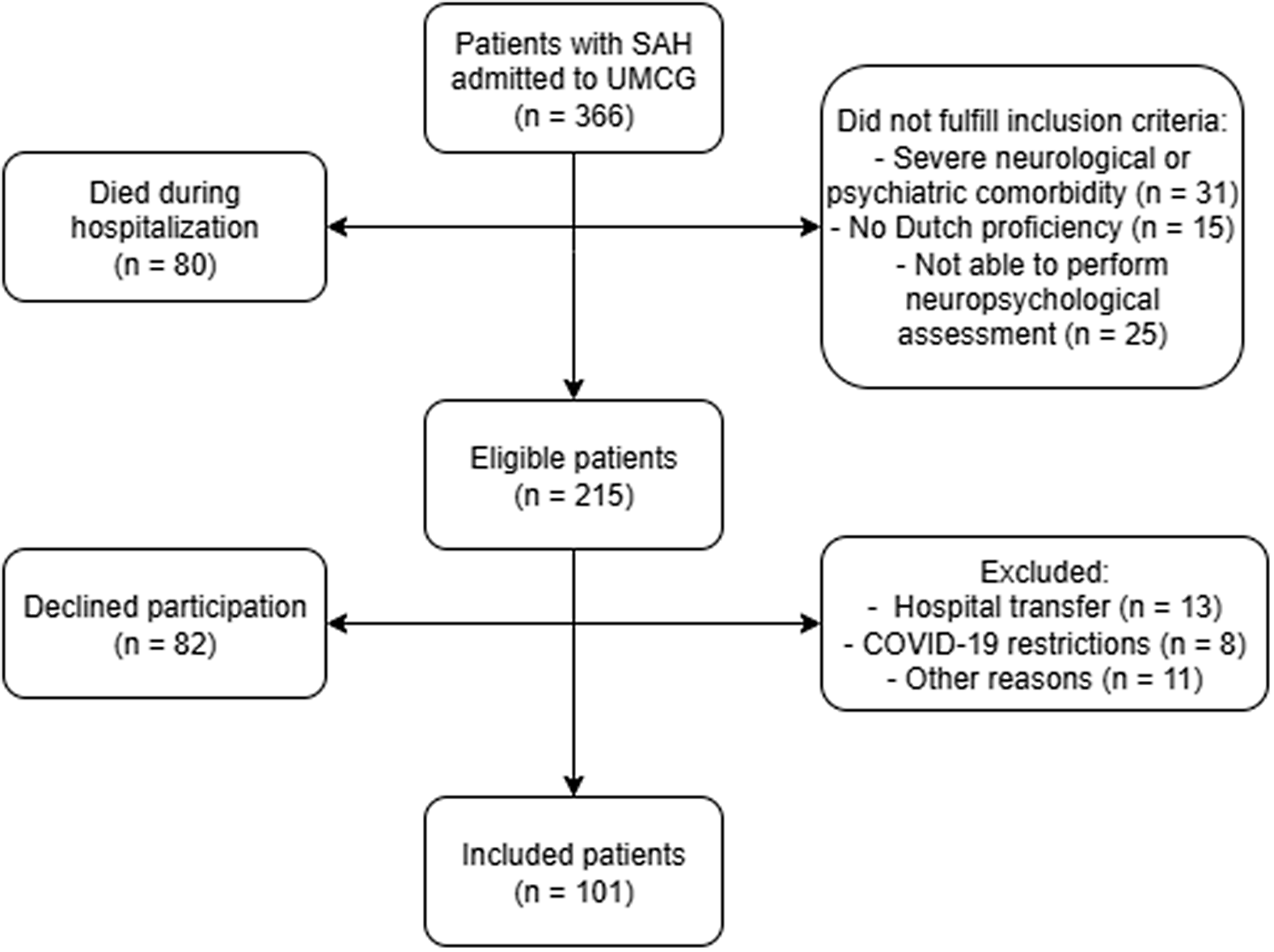
From a total of 366 patients admitted to the UMCG between August 2019 and April 2024, 101 (70 aSAH and 31 anSAH) took part in the study. The flowchart is presented in Figure 1. Additionally, 86 controls were enrolled in the study.
Flowchart of patient inclusion.

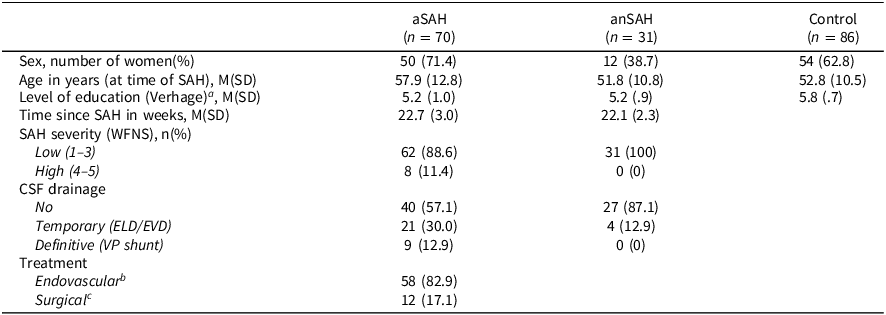
Table 1 shows demographic and medical characteristics of participants. The total patient group and control group did not differ in age (t(185) = −1.86, p = .065, d = .27) and sex (X 2 = .04, p = .844, Cramer’s V = .01), but controls had a higher level of education than patients (t(185) = 4.71, p < .001, d =.68). There were no differences in level of education between the two patient groups (t(99) = .12, p = .905, d =.03). In the aSAH group, both age (t(99) = 2.29, p = .024, d =.49) and the percentage of women (X 2 = 9.81, p = .007, Cramer’s V = .31) were higher than in the anSAH group.
Demographic and medical characteristics

Note: anSAH = angiographically negative subarachnoid hemorrhage; aSAH = aneurysmal subarachnoid hemorrhage; CSF = cerebrospinal fluid; ELD = external lumbar drain; EVD = external ventricular drain; SAH = subarachnoid hemorrhage; VP shunt = ventriculoperitoneal shunt; WFNS = World Federation of Neurological Surgeons SAH grading scale. a ranging from 1 (no primary school) to 7 (university degree) b Coiling, stenting, and placement of a Woven Endo Bridge device c Clipping.
Prevalence of mental and physical fatigue
The total SAH group had significantly higher levels of both mental and physical fatigue compared to controls, with a medium effect size for physical fatigue and a large effect size for mental fatigue (Table 2). Patients with aSAH and anSAH did not differ significantly.
Comparison of mental and physical fatigue

Note: DMFS-M = Dutch Multifactor Fatigue Scale – Mental Fatigue; DMFS-P = Dutch Multifactor Fatigue Scale – Physical Fatigue; SAH = subarachnoid hemorrhage. DMFS norm scores are used (0 = very low to 6 = very high), two-sided p.
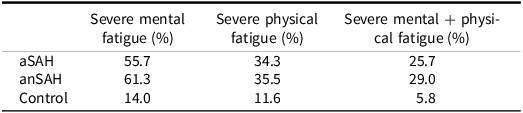
A significant, though moderate, positive correlation was found between mental and physical fatigue across both patient groups: aSAH (r = .46, p < .001) and anSAH (r = .55, p = .002). Table 3 shows that over half of the patients in both SAH categories experience severe mental fatigue. Severe mental fatigue is more common than severe physical fatigue (aSAH: p = .006 and anSAH: p = .039). 25% of patients with aSAH and 29% of patients with anSAH experience both severe mental and severe physical fatigue.
Prevalence of severe mental and physical fatigue

Note: anSAH = angiographically negative subarachnoid hemorrhage; aSAH = aneurysmal subarachnoid hemorrhage. Dutch Multifactor Fatigue Scale scores ≥ 89th percentile are considered severe fatigue.
Information processing speed and attentional control
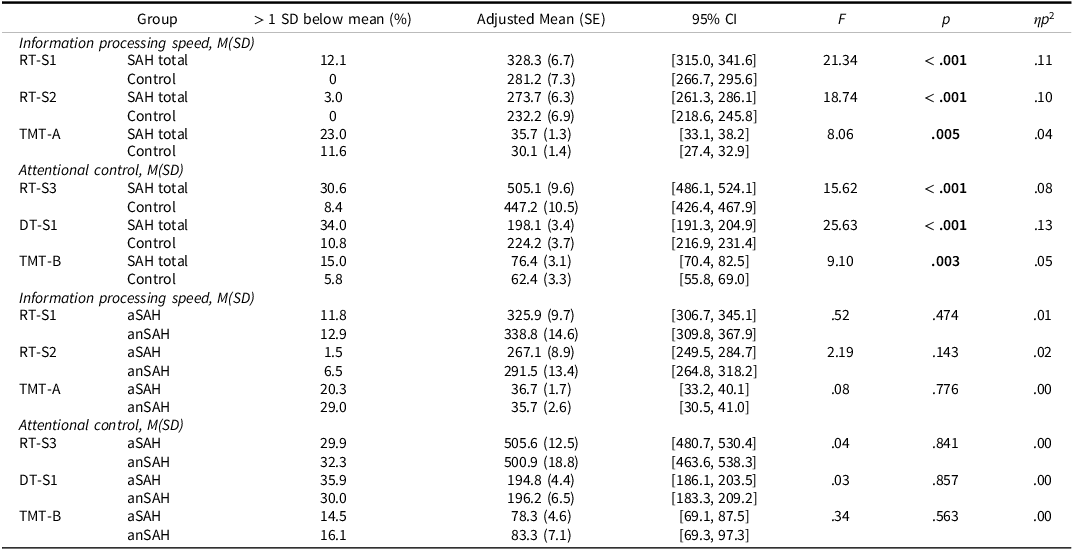
Table 4 shows that the total SAH group scored significantly worse compared to controls on all measures of information processing speed and attentional control, with effect sizes ranging from small to large. The largest effect size was observed for DT-S1 (ηp 2 =.13), where 34% of patients in the total SAH group scored > 1 SD below the mean compared to 11% of the controls. No significant differences were found between the aSAH and anSAH subgroups.
Comparison of information processing speed and attentional control

Note: anSAH = angiographically negative subarachnoid hemorrhage; aSAH = aneurysmal subarachnoid hemorrhage; DT-S1 = Determination Test – subtask 1, RT-S1 = Reaction Test – subtask 1; RT-S2 = Reaction Test – subtask 2; RT-S3 = Reaction Test – subtask 3; SAH = subarachnoid hemorrhage; TMT-A = Trail Making Test Part A; TMT-B = Trail Making Test Part B. Scores < 9th percentile are considered low to impaired (Bouma et al., (Reference Bouma, Mulder, Lindeboom and Schmand2012). All measures assess reaction time, DT measures number of correct responses. Comparison SAH and controls adjusted for level of education. Comparison aSAH and anSAH adjusted for age and sex. Two-sided p.
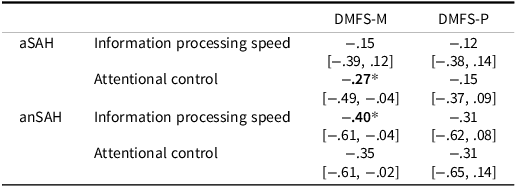
Significant correlations were found between fatigue and cognitive performance in both patient groups, with correlation coefficients indicating medium effect sizes (Table 5). Higher mental fatigue in patients with aSAH was associated with poorer attentional control (r = −.27), while in patients with anSAH, it was associated with slower information processing speed (r = −.41). No associations were found between cognitive functioning and physical fatigue. In line with these findings, patients with aSAH reporting severe mental fatigue performed significantly worse on attentional control compared to those without severe mental fatigue (t(61) = 2.99, p = .004, d = .76) (Supplementary Table). The effect size was large. Patients with anSAH reporting severe mental fatigue did not differ in either information processing speed or attentional control from those without severe mental fatigue. Furthermore, there were no significant differences in information processing speed or attentional control between patients with and without severe physical fatigue.
Spearman’s correlations between information processing speed, attentional control and fatigue in patients with aSAH and anSAH

Note: anSAH = angiographically negative subarachnoid hemorrhage; aSAH = aneurysmal subarachnoid hemorrhage; DMFS-M = Dutch Multifactor Fatigue Scale – Mental Fatigue; DMFS-P = Dutch Multifactor Fatigue Scale – Physical Fatigue. Bootstrapping with 1,000 resamples was applied. For information processing speed and attentional control mean t-scores are used. Confidence intervals in brackets. *p < .01.
Psychological distress
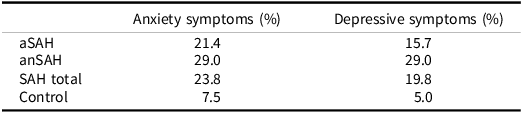
Table 6 displays the prevalence of anxiety and depressive symptoms. The total patient group showed a significantly higher prevalence of anxiety (X 2 = 8.54, p = .003, Cramer’s V = .22) and depressive symptoms (X 2 = 8.50, p = .004, Cramer’s V = .22) than controls. The effect size is small. No significant differences were found between the two patient groups for either anxiety (X 2 = .69, p = .408, Cramer’s V = .08) or depressive symptoms (X 2 = 2.40, p = .121, Cramer’s V = .15). Patients with either aSAH or anSAH who experience severe mental or physical fatigue had significantly higher HADS-A and HADS-D scores than those without severe mental or physical fatigue (Supplementary Table). Effect sizes were large.
Prevalence of psychological distress

Note: anSAH, angiographically negative subarachnoid hemorrhage; aSAH = aneurysmal subarachnoid hemorrhage; HADS-A = Hospital Anxiety and Depression Scale – Anxiety; HADS-D = Hospital Anxiety and Depression Scale – Depression. HADS scores > 7 are considered anxiety or depressive symptoms.
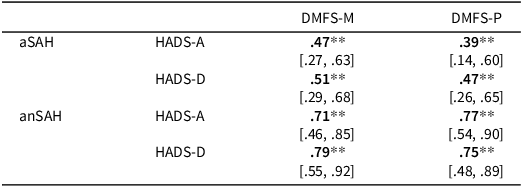
In both patient groups, scores on the HADS-A and HADS-D are significantly and positively correlated with DFMS-M and DMFS-P scores, indicating that higher levels of psychological distress are associated with higher levels of both mental and physical fatigue (Table 7). Correlations in the aSAH group are moderate, while strong correlations were found in the anSAH group.
Spearman’s correlations between psychological distress and fatigue in patients with aSAH and anSAH

Note: anSAH = angiographically negative subarachnoid hemorrhage; aSAH = aneurysmal subarachnoid hemorrhage; DMFS-M = Dutch Multifactor Fatigue Scale – Mental Fatigue; DMFS-P = Dutch Multifactor Fatigue Scale – Physical Fatigue; HADS-A = Hospital Anxiety and Depression Scale – Anxiety; HADS-D = Hospital Anxiety and Depression Scale – Depression. Bootstrapping with 1,000 resamples was applied. Confidence intervals in brackets. **p < .001.
Discussion
This study found that severe mental fatigue was prevalent in more than half of the patients with aSAH and anSAH, substantially more than severe physical fatigue, which affected about one-third of patients. Levels of mental and physical fatigue did not differ between patients with aSAH and anSAH. Higher mental fatigue correlated with worse attentional control in patients with aSAH and with lower information processing speed in patients with anSAH. Both mental and physical fatigue correlated with anxiety and depressive symptoms, particularly after anSAH. These findings indicate that mental and physical fatigue represent distinct constructs with unique associations to cognitive functioning and psychological distress.
The total group of patients with aSAH and anSAH experiences significantly more mental fatigue than controls, and also significantly more than physical fatigue. This adds to growing evidence that mental fatigue is typical for brain injury and aligns with previous research indicating that mental fatigue outweighs physical fatigue even years after aSAH or anSAH (Buunk et al., Reference Buunk, Groen, Wijbenga, Ziengs, Metzemaekers, van Dijk and Spikman2018; Visser-Keizer et al., Reference Visser-Keizer, Hogenkamp, Westerhof-Evers, Egberink and Spikman2015). No differences in mental and physical fatigue levels were observed between patients with aSAH and anSAH, which is remarkable given that patients with aSAH generally have a worse neurological outcome (Khan et al., Reference Khan, Smith, Kirkman, Robertson, Wong, Dott, Grieve, Watkins and Kitchen2013; Nesvick et al., Reference Nesvick, Oushy, Rinaldo, Wijdicks, Lanzino and Rabinstein2019). While a significant, though moderate, correlation between mental and physical fatigue was found in both patient groups, only 25% of patients with aSAH and 29% of patients with anSAH reported both severe mental and severe physical fatigue, corroborating that mental and physical fatigue are largely distinct constructs. Consequently, generic fatigue scales may fail to adequately capture the specific nature of fatigue after ABI.
Impairments in information processing speed and attentional control were found in the total SAH group, with no differences between patients with aSAH and anSAH, consistent with previous research (Al-Khindi et al., Reference Al-Khindi, M., S., Al-Khindi, Macdonald and Schweizer2010; Burke et al., Reference Burke, Hughes, Carr, Javadpour and Pender2018; Buunk et al., Reference Buunk, Groen, Veenstra, Metzemaekers, van der Hoeven, van Dijk and Spikman2016; Khosdelazad et al., Reference Khosdelazad, Jorna, Rakers, Kof, Groen, Spikman and Buunk2023). Information processing speed and attentional control were linked to mental fatigue. This is consistent with the coping hypothesis, which proposes that individuals with cognitive impairments require additional mental effort to maintain performance, resulting in mental fatigue. Brain imaging studies in traumatic brain injury (TBI) patients support the coping hypothesis by demonstrating a relationship between increased default mode network connectivity and impairments in information processing speed and attention (Bonnelle et al., Reference Bonnelle, Leech, Kinnunen, Ham, Beckmann, De Boissezon, Greenwood and Sharp2011; Sharp et al., Reference Sharp, Beckmann, Greenwood, Kinnunen, Bonnelle, De Boissezon, Powell, Counsell, Patel and Leech2011). A similar relationship between information processing speed and mental fatigue was previously found in TBI and stroke patients (Johansson & Ronnback, Reference Johansson and Ronnback2013). Interestingly, distinct patterns emerged in both SAH groups: higher mental fatigue was associated with poorer attentional control in patients with aSAH, while in anSAH, it was associated with slower information processing speed. The coping hypothesis may explain why, in patients with aSAH, mental fatigue was particularly associated with attentional control tests, as the cognitive demands required for these tests are higher. This is further supported by the DT-S1, the test with the highest cognitive load, showing the largest effect. However, this relationship was not observed in patients with anSAH. Apparently, while patients with SAH uniformly show impairments in information processing speed and attentional control, the relationship between these impairments and mental fatigue differs based on the type of SAH. Notably, no associations were found between information processing speed, attentional control and physical fatigue in either patient group. These findings again highlight that mental and physical fatigue are distinct constructs.
The study found that anxiety symptoms were present in 24% of patients in the total SAH group, while depressive symptoms occured in 20%, both of which were more prevalent than in controls. No significant differences were found between the two patient groups, which is notable given the generally worse functional outcome in patients with aSAH (Khan et al., Reference Khan, Smith, Kirkman, Robertson, Wong, Dott, Grieve, Watkins and Kitchen2013; Nesvick et al., Reference Nesvick, Oushy, Rinaldo, Wijdicks, Lanzino and Rabinstein2019). The absence of an identifiable cause for the hemorrhage in patients with anSAH may lead to feelings of insecurity and increased psychological distress. Additionally, since anSAH is often described by doctors as a relatively mild condition, with no need for neurosurgical or endovascular treatment, patients may develop unrealistic expectations regarding recovery which, when not met, can lead to increased psychological distress (Khosdelazad et al., Reference Khosdelazad, Spikman, Solvang, Wermer, Pender, Jorna, Rakers, van der Hoorn, Javadpour, Groen and Buunk2024). Psychological distress was associated with higher levels of mental fatigue, particularly in patients with anSAH. Psychological distress may drain mental resources, resulting in heightened levels of mental fatigue. Conversely, prolonged mental fatigue may affect psychological resilience, leaving patients more vulnerable to anxiety and depressive symptoms. Psychological distress was also associated with physical fatigue in both patient groups. Physical fatigue may lead to anxiety and depressive symptoms as it limits patients’ ability to engage in meaningful activities, thereby affecting their sense of autonomy and quality of life. Physical fatigue itself is also a well-documented characteristic of anxiety and depressive symptoms, often accompanied by sleep disturbances and somatic symptoms further perpetuating a cycle of fatigue and psychological distress (Rakel, Reference Rakel1999). Altogether, anxiety and depressive symptoms are related to both mental fatigue and physical fatigue in patients with aSAH and anSAH.
This study has several limitations that should be considered when interpreting the findings. First, the central question of this study concerns the determinants of mental fatigue, with both cognitive impairments and psychological distress considered plausible candidates. However, in the present study, the assumed causal relationship could not be established, as the design was observational and based on correlational analyses. Nevertheless, the significant correlations observed suggest an association between the constructs. Second, generalizability of the study may be limited because the sample was restricted to patients eligible for neuropsychological assessment. As a result, levels of fatigue, impairments in information processing speed and attentional control and psychological distress may have been underestimated. Third, the sample included only a small number of patients with anSAH (n = 31), potentially reducing statistical power and the robustness of subgroup comparisons. Fourth, the patient group differed from controls in educational level, and the patient subgroups differed in terms of age and sex. Where possible, these group differences were accounted for by using ANCOVA and adjusted norm scores. Additionally, we did not collect data on participants’ engagement in rehabilitation programs. Such programs may have influenced test performance through learned compensatory strategies. Finally, mental fatigue following SAH likely arises from a complex interplay of neurobiological, inflammatory, psychosocial, and pharmacological factors, many of which are not accounted for in this study. For example, fatigue during the 6 months after aSAH and anSAH was associated with higher IL1β, IL6, and TNF-α plasma concentrations (Byun et al., Reference Byun, McCurry, Kwon, Tsai, Jun, Bammler, Becker and Thompson2024). Moreover, higher mental fatigue was found to be related to more maladaptive avoidant coping strategies (Ghafaji et al., Reference Ghafaji, Nordenmark, Western, Sorteberg, Karic and Sorteberg2023). Consequently, the findings should be interpreted with caution, as confounding factors may have influenced the results.
We acknowledge that the observed cognitive and psychological changes in this study may represent a combination of ongoing recovery processes and early long-term effects. However, a recent longitudinal study in patients with aSAH and anSAH found that cognitive impairments in the subacute stage (3–6 months) after SAH, show little to no improvement over time (Khosdelazad et al., Reference Khosdelazad, Jorna, Rakers, Kof, Groen, Spikman and Buunk2023). Longitudinal studies are needed to examine how the observed associations evolve over time. Besides, future research should integrate other potential relevant measures, such as biomarkers and neuroimaging, to better understand the mechanisms underlying mental fatigue after aSAH and anSAH. Furthermore, multicenter collaboration could help to improve statistical power for subgroup comparisons.
In conclusion, the prevalence of severe mental fatigue in over half the patient cohort underscores the urgent need for routine screening in clinical practice and the importance of a nuanced approach to patient communication. Importantly, understanding the high prevalence of mental fatigue requires consideration of the complex interplay between information processing speed, attentional control and psychological distress in mental fatigue following SAH. Notably, the associations vary depending on the type of SAH, suggesting distinct underlying mechanisms. These findings suggest that mental fatigue is a multifaceted phenomenon that can present in similar ways despite diverse contributing factors. In clinical practice, mental and physical fatigue should be evaluated separately, along with possibly related factors. Given that patients with aSAH and anSAH experience similar levels of fatigue and psychological distress, equal psychosocial follow-up for both groups is essential (Khosdelazad et al., Reference Khosdelazad, Spikman, Solvang, Wermer, Pender, Jorna, Rakers, van der Hoorn, Javadpour, Groen and Buunk2024). This study emphasizes the need for individualized rehabilitation strategies addressing both cognitive and psychological factors to effectively manage mental fatigue after SAH.
Supplementary material
The supplementary material for this article can be found at https://doi.org/10.1017/S1355617725101549.
Funding statement
This work was supported by the charitable foundation Stichting Catharina Heerdt.
Competing interests
None.



 Open access

