

Introduction
Research on issue-based strategies in election campaigns has evolved over decades. Initially, studies focused on parties adopting divergent positions to attract ideologically aligned voters (Downs, Reference Downs1957; Davis et al., Reference Davis, Hinich and Ordeshook1970). Researchers then favoured the “emphasis” approach, where parties are seen to compete not by taking opposing positions on issues but by varying the attention they give to issues to highlight their strengths to voters (Robertson, Reference Robertson1976; Budge and Farlie, Reference Budge and Farlie1983; Petrocik, Reference Petrocik1996; Green and Hobolt, Reference Green and Hobolt2008).
This perspective assumes that campaigns are characterized by parties talking past each other, each emphasizing favourable issues. However, research shows that parties often give similar visibility to issues (Sigelman and Buell, Reference Sigelman and Buell2004; Damore, Reference Damore2005; Green-Pedersen, Reference Green-Pedersen2023), with around 70 per cent convergence in democracies studied (Sigelman and Buell, Reference Sigelman and Buell2004; Green-Pedersen and Mortensen, Reference Green-Pedersen and Mortensen2010; Reference Green-Pedersen and Mortensen2015a; Dolezal et al., Reference Dolezal, Ennser-Jedenastik, Müller and Katharina Winkler2014; Meyer and Wagner, Reference Meyer and Wagner2016).Footnote 1 Recent work seeks to understand why parties either engage with their opponents on specific issues or distinguish themselves by focusing on less common topics (Green-Pedersen, Reference Green-Pedersen2023; Kristensen et al., 2022; Seeberg, Reference Seeberg2022; Poljak and Seeberg, Reference Poljak and Seeberg2024).
This study refines our understanding of issue competition by re-examining whether parties consistently address the same issues, adding Quebec to the limited cases studied. The case under analysis is the four elections held in Quebec between 2012 and 2022.
This period saw significant electoral volatility, with the number of competitive parties increasing from three to five, three different governments being elected and political cleavages being reconfigured (Bélanger et al., Reference Bélanger, Daoust, Mahéo and Nadeau2022; Dubois et al., Reference Dubois, Villeneuve-Siconnelly, Montigny and Giasson2022). The Quebec case offers an opportunity to examine whether the degree of convergence between parties on electoral issues might be stable or circumstance-dependent.
Another contribution of this study is the analysis of party strategies through their press releases and tweets during campaigns. While party manifestos are widely used in research (Green-Pedersen and Mortensen, Reference Green-Pedersen and Mortensen2010; Reference Green-Pedersen and Mortensen2015a; Dolezal et al., Reference Dolezal, Ennser-Jedenastik, Müller and Katharina Winkler2014; Kristensen et al., 2022), press releases offer a more dynamic measure of tactical agendas (Meyer and Wagner, Reference Meyer and Wagner2016). Unlike manifestos, which are prepared weeks or months before the campaign, press releases are published daily, allowing parties to react to and engage with ongoing issues. Whereas manifestos may target party activists, press releases are intended to influence public debate through the media (Hopmann et al., Reference Hopmann, Christian Elmelund-Præstekær, Vliegenthart and de Vreese2012).
A further limitation of relying on manifestos for studying Quebec elections from 2012 to 2022 concerns their inconsistent availability across parties. The Coalition avenir Québec (CAQ), for instance, did not publish a manifesto in 2018, reinforcing the need to examine alternative campaign documents. Additionally, this study examines short-term campaign dynamics emerging from interactions between parties, media and voters. As Green-Pedersen (Reference Green-Pedersen2019: 43) notes, “Party manifestos are not particularly well suited for this.” He demonstrates this limitation through concrete cases: “Events like the flooding in Germany during the 2002 election campaign or the conflict between the Netherlands and Turkey during the Dutch 2017 election campaign will be picked up by media data, not by party manifestos” (Reference Green-Pedersen2019, p.42).
While the use of press releases is common and presents definite advantages (Klüver and Sagarzazu, Reference Klüver and Sagarzazu2016; Meyer and Wagner, Reference Meyer and Wagner2016; Seeberg, Reference Seeberg2022), tweets offer additional insights. In this study, we argue that tweets disseminated by political parties during campaigns share several characteristics with press releases, such as the timing of their dissemination and the motivations behind them. However, tweets have unique features: They can be disseminated in greater numbers, more quickly, and to a larger audience than press releases. By analyzing tweets, we aim to determine whether the conclusions of existing research on issue engagement and issue avoidance are confirmed when examining parties’ electoral communication on social media.
The third contribution of this study is to explore the concepts of convergence (or issue engagement) and divergence (or issue avoidance). While existing studies highlight the high level of convergence in the attention given to issues by parties and candidates during election campaigns—a key finding warranting validation (Seeberg, Reference Seeberg2022)—it is equally crucial to deepen our comprehension of this dynamic. Specifically, this study aims to explore the implications of the observed prevalence of convergence, where parties tend to address similar issues, alongside its counterpart—divergence—which occurs at a level estimated to be around 30 per cent in established democracies.
We might ask, for example, whether these patterns of convergence and divergence reflect a core set of issues addressed by all parties in a given system, alongside issue domains that individual parties emphasize more prominently. If so, which issues belong to each category? Could these observed levels of convergence and divergence be attributed to an “issue-emphasis” strategy, where parties focus on a few topics to highlight their distinctions while remaining attuned to the concerns of a broad electorate?
We now turn to a review of the literature on these questions to identify avenues for further investigation.
Party System Agenda and Electoral Agenda
Why do parties give similar visibility to electoral issues? Although extensive research has been conducted, this question remains unresolved. Seeberg (Reference Seeberg2023: 270) notes, “Despite a large literature on this topic [issue engagement], it remains largely unknown when parties engage.” Another important question is why parties choose to engage and to what extent. This question is crucial because, as Green-Pedersen (Reference Green-Pedersen2019: 172–83) notes, “a general finding is a considerable cross-national similarity in terms of the issue content of party politics,” which prompts for a better understanding of “the driving mechanism behind changes in the party system agenda.”
Literature suggests parties often avoid issues where they lack a strong reputation, focusing instead on areas of strength (Budge and Farlie, Reference Budge and Farlie1983; Petrocik, Reference Petrocik1996; Green and Hobolt, Reference Green and Hobolt2008). However, they may engage with other issues out of necessity. As Kristensen et al. (Reference Kristensen, Green-Pedersen, Mortensen and Bech Seeberg2023: 2856) note, “parties respond to the emphasis of other parties, especially if they are an electoral threat.” While emphasizing issue avoidance can lead to neglecting other important issues, addressing a less favourable issue can signal responsiveness to voter concerns and enhance the party’s reputation. However, overemphasizing such issues can contribute to their salience, potentially benefiting opponents and harming the party’s reputation.
In this article, we argue that understanding the strategic use of issues by parties requires a better recognition of the contradictory objectives they must pursue simultaneously. On the one hand, parties seek to distinguish themselves from their opponents, to capitalize on their reputation on certain issues and to mobilize their voters and activists. The pursuit of these objectives should lead parties to adopt a strong issue strategy to make certain issues more salient and send a clear signal to their voters and activists about their commitment to tackling issues that matter to them. However, according to the point raised by Ansolabehere and Iyengar (Reference Ansolabehere and Iyengar1994) in their important article on the notion of “riding-the-wave,” political parties must also show concern for issues on which their competence is less established but which are of concern to voters so they do not appear out of touch with voters’ needs. This concern takes into account both the specific context of each election—an economic slowdown, for example, will push all parties to address this issue—and the broader trends whereby certain issues, such as the environment (Green-Pedersen, Reference Green-Pedersen2007; Reference Green-Pedersen2023; Martel and Nadeau, Reference Martel and Nadeau2023), are gradually making their way onto the public agenda.
Green-Pedersen and Mortensen (Reference Green-Pedersen and Mortensen2010; Reference Green-Pedersen and Mortensen2015) suggest that the visibility parties give to issues is driven by their inclination to highlight strengths (a concept known as issue ownership) and the need to respond to voter concerns, even in areas where they lack competence. Election contexts push parties to focus on diverse issues, creating a “party system agenda” shaped by mutual reinforcement as parties adjust to public opinion preferences. As these authors note, “The existence of a party system agenda is thus due to the perceptions across all parties that certain issues are more important than others” (Reference Green-Pedersen and Mortensen2015: 749). Grossman and Guinaudeau (Reference Grossman and Guinaudeau2022: 164–67) argue that this results in a dynamic where “parties contribute to the construction of the ‘tunnel of attention’” and they “differentiate themselves within the limits fixed by the party system agenda.”
Recent findings suggest that these dynamics should not vary significantly between press releases and tweets. For instance, examining Danish politicians’ Twitter attention across non-electoral years, Eriksen (Reference Eriksen2024: 352) finds that “tweeting on social media has become an integrated element in politicians’ daily activities,” and his results indicate that “their communication on these platforms largely follows the same dynamics as their communication in more established arenas, such as when asking parliamentary questions or appearing in news media.” Moreover, Ivanusch (2024: 20) points out that, “in hybrid media environments, journalists increasingly use alternative sources of information (e.g., social media), and political actors adapt to this new logic, leading to a blurring of direct and mediated channels.”
This framework leads us to identify three key expectations to be tested in this study. First, we expect that the prominence a party gives to issues during an election is linked to its reputation on those issues and tends to remain consistent over time (Adams and Somer-Topcu, Reference Adams and Somer-Topcu2009; Green-Pedersen and Mortensen, Reference Green-Pedersen and Mortensen2015). Second, we anticipate that the prominence a party assigns to an issue relates to the attention other parties give to the same issue, contributing to the collective “party system agenda” (Bale, Reference Bale2003; Green-Pedersen and Mortensen, Reference Green-Pedersen and Mortensen2010; Reference Green-Pedersen and Mortensen2015; Meyer and Wagner, Reference Meyer and Wagner2016). Recent research by Grossman and Guinaudeau (2024) suggests that this latter dynamic may be stronger than the former.
Finally, we expect that the pressure to engage is stronger among ideologically similar parties competing for the same voters (Meyer and Wagner, Reference Meyer and Wagner2016; Green-Pedersen and Mortensen, Reference Green-Pedersen and Mortensen2015; Adams and Somer-Topcu, Reference Adams and Somer-Topcu2009).
Research on parties’ issue-engagement strategies is both conceptually convincing and empirically well-founded. To examine the factors shaping party agendas, we test two complementary hypotheses (H) that examine distinct relationships expected to drive parties’ issue attention allocation in the context of Quebec from 2012 to 2022:
H1. The visibility given to different issues by parties from one election to the next shows a significant degree of continuity.
H2. The level of attention given to various issues by a political party in Quebec during a given election should be significantly linked to the level of attention given to the same issues by other political parties (“party agenda system”).
Additionally, we examine how ideological distance affects issue attention patterns:
H3. The level of attention that political parties pay to various issues is more aligned among ideologically close parties compared with those that are ideologically distant.
These hypotheses aim to corroborate and expand our understanding of issue engagement and issue avoidance in established democracies. The work by Green-Pedersen and Mortensen (Reference Green-Pedersen and Mortensen2010; Reference Green-Pedersen and Mortensen2015) on the “party system agenda” underscores the influence of public concerns and mutual party responsiveness. However, this approach has limitations, particularly in explaining how various issues contribute to issue engagement and issue avoidance.
Studies show that party behaviour changes with election proximity and that the severity of societal problems influences issue overlap among parties. For instance, Seeberg (Reference Seeberg2022) finds that Danish parties shift from long-term strategies to engagement with opponents’ issues as an election approach. Kristensen et al. (Reference Kristensen, Green-Pedersen, Mortensen and Bech Seeberg2023) highlight that greater problem severity increases issue overlap, regardless of issue ownership. This is in line with Green-Pedersen’s (Reference Green-Pedersen2019: 183) proposition that changes in the party system agenda depend on mainstream parties’ incentives for paying attention to issues, including “changes in policy problems or the information on them.”
These studies highlight two key findings: Party behaviour changes during campaigns, and the severity of social problems likely influences voter and party priorities. These insights are central to our proposition on the dynamics of issue engagement and issue avoidance, which we argue have distinct characteristics during campaigns due to their short-term nature. This period’s brevity suggests that voters’ priorities are unlikely to change significantly. We also contend that the party system agenda reflects voters’ concerns during elections, shaping parties’ strategic choices (Nadeau, Pétry and Bélanger, Reference Nadeau, Pétry and Bélanger2010; Seeberg, Reference Seeberg2022).
We argue, however, that during election campaigns, parties must not only respond to voters’ immediate concerns but also present themselves as capable of governing by addressing the core issues of democratic governance. An essential aspect of understanding parties’ issue-engagement and issue-avoidance strategies is recognizing that voters and the media have specific expectations for the issues parties should address during election campaigns. Parties must conform to these expectations, which often requires them to cover a broad range of topics expected of a governing party.
Research on government and institutional agendas provides insights into the components that make up media and party agendas during elections (Jennings et al., Reference Jennings, Bevan and John2010; Jennings et al., Reference Jennings, Bevan, Timmermans, Breeman, Brouard, Chaqués-Bonafont, Green-Pedersen, John, Mortensen and Palau2011; Grenne and O’Brien, Reference Grenne and O’Brien2016; Möller et al., Reference Möller, Trilling, Helberger and van Es2018). These studies show that government agendas in the USA and Europe tend to focus on fundamental missions such as security, international relations and the economy, with economic issues gaining prominence during crises. These studies also observe a gradual diversification of priorities with emerging issues such as immigration and the environment, which align with findings that citizens’ agendas narrow during crises and broaden with emerging issues such as global warming (Jennings et al., Reference Jennings, Bevan, Timmermans, Breeman, Brouard, Chaqués-Bonafont, Green-Pedersen, John, Mortensen and Palau2011; Edy and Meirick, Reference Edy and Meirick2018).
This collection of studies sheds light on the nature of a governing agenda. Consequently, it can be posited that, during a campaign, it is expected for all parties to address the principal issues that correspond to the anticipated governance agenda in a specific region or country. This agenda includes economic and financial issues, foreign policy, the major missions of the state (health, education and social and family policies), the environment more recently and specific issues depending on the context (culture and identity in Quebec for instance). The relative weight of issues within this common core of central governance questions may vary according to the particular context of each election, but the composition of this group of issues should be relatively stable over time, insofar as the major missions of the State are of a certain permanent nature. That said, emerging issues may, over time, contribute to partially modifying the list of major challenges associated with the image of competent, responsible governance. The environment and the fight against climate change represent a clear example of this type of evolution. All political parties today must address this theme in election campaigns, regardless of their inclination to do so.
Finally, these observations lead us to believe that parties’ electoral agendas should be composed of two types of issues. The first group includes “core” governance issues that dominate party communications owing to their necessity in presenting a serious governance plan. The focus on these core issues should lead parties to converge. The second group comprises more peripheral issues, which receive less attention and offer parties greater flexibility in addressing them.
In view of the above observations, the following hypotheses will be examined:
H4. The visibility given to issues by political parties in Quebec is stable and significant for a small number of governance issues (economy and finance, social missions, environment, identity and culture, etc.) and low and unstable for peripheral issues.
If H4 is supported and certain issues are identified as governance issues that garner sustained attention from all parties, the following hypothesis will also be examined:
H5. The level of convergence between parties is higher for governance issues than for peripheral issues.
A final observation is warranted. Since voters’ concerns focus on a small number of issues, these same issues may explain both the convergence and divergence between parties. Voters’ significant preoccupation with a few issues (for example, the economy and health) necessitates that all parties address these issues in their electoral communications. Given the centrality of these issues, the dynamic between issue engagement and issue avoidance likely revolves around a limited and relatively constant number of core issues that all parties must address, to the maximum extent for parties that are advantaged on an issue and to the minimum extent for those that are not.
Methodology
In this section, we outline our approach to investigating the issue-engagement and issue-avoidance tendencies of political parties. Our study focuses on the electoral context in Quebec from 2012 to 2022, a period marked by high electoral volatility. As Canada’s second-largest province, Quebec represents an interesting case study of a subnational democracy that differs from previously studied cases in several key dimensions, making findings potentially relevant to similar democratic systems.
Quebec’s cultural distinctiveness as a French-speaking nation within Canada, coupled with its minority status within the country, has led culture and identity to become salient issues during election campaigns (Bélanger and Nadeau, Reference Bélanger and Nadeau2009; Bélanger et al., Reference Bélanger, Daoust, Mahéo and Nadeau2022).Footnote 2 Examining such systems is particularly useful for assessing whether convergence depends on the specific content of party politics or whether it represents a general outcome that may occur regardless of the particular issues addressed in a given system. In Quebec, the sovereignty cleavage, combined with traditional economic left–right and new politics divides, could lead to lower levels of convergence by providing parties with multiple avenues for differentiation.
Furthermore, Quebec’s political system exhibits moderate multipartyism within a majoritarian electoral framework, where coalition governments remain uncommon. Hence, coalition considerations should not be driving parties’ issue emphasis in Quebec’s election campaigns, unlike the strategic considerations that Green-Pedersen (Reference Green-Pedersen2019) identifies as influential in some Western European countries. This absence of coalition dynamics could also contribute to lower convergence levels.
Additionally, Damore (Reference Damore2005) suggests that subnational races may show reduced convergence, which could further lower convergence in our case. However, it remains unclear whether Quebec elections should exhibit the typical patterns of lower-level races, given that nationalist sentiment in Quebec may lead part of the electorate to consider provincial elections as particularly significant contests.
While research offers limited guidance on how electoral volatility relates to issue convergence, the emergence of challenger parties during the 2012–2022 period suggests that new issues may be exploited by those parties, creating more distinctive issue profiles between dominant and challenger parties (Vries and Hobolt, Reference de Vries and Hobolt2020), which would further reduce convergence expectations.
Quebec thus represents a difficult case for observing convergence, combining characteristics of a lower-level race, moderate multipartyism, the presence of an independentist cleavage and the rise of challenger parties. This case can inform us about whether findings on issue engagement and convergence also apply under these more challenging conditions, thereby testing the robustness of existing theoretical expectations about issue competition dynamics. Convergence observed here would suggest that issue engagement may be a more general feature of democratic competition than previously demonstrated, extending beyond the specific institutional and contextual conditions examined in earlier studies.
Data
This study examines the four political parties in the Assemblée Nationale du Québec: the Coalition avenir Québec (CAQ), Parti Libéral du Québec (PLQ), Parti Québécois (PQ) and Québec Solidaire (QS). The CAQ, a center-right party, emphasizes economic development, lower taxes and Quebec nationalism without sovereignty. The PLQ, also center-right, supports federalism, economic liberalism and social progressivism. The PQ, a center-left party, advocates for Quebec sovereignty and social democracy. QS, a left-wing party, champions social justice, environmental sustainability and Quebec independence through inclusive policies. The CAQ’s 2018 victory, which ended decades of PQ–PLQ dominance, marked a shift in Quebec’s politics, with less focus on sovereignty and more on immigration and climate change, sparking debates on a possible political realignment in the province (Bélanger and Nadeau, Reference Bélanger and Nadeau2009; Bélanger et al., Reference Bélanger, Daoust, Mahéo and Nadeau2022; Martel and Nadeau, Reference Martel and Nadeau2023).
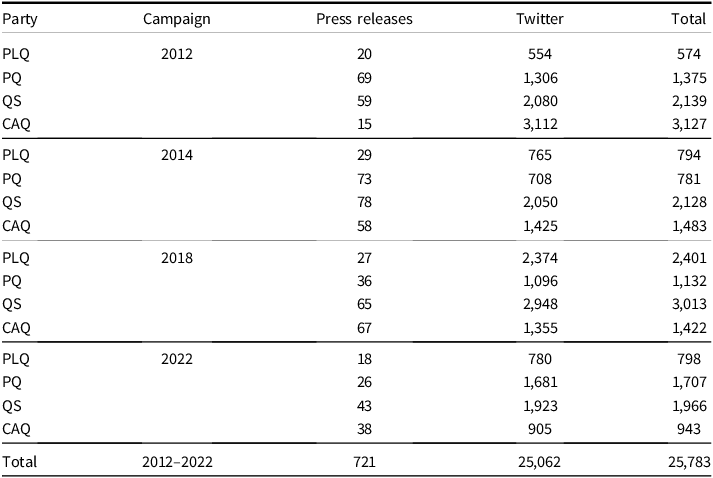
The study focused specifically on the election campaigns of 2012, 2014, 2018 and 2022. A comprehensive corpus was compiled, which served as the primary data source for the research. This corpus is a collection of 721 press releases and 25,062 tweets, providing a rich dataset for the analysis. Each of these communications was disseminated during a formal campaign, that is, between the election call and polling day. The tweets originated from the accounts of the leaders or spokespersons, as well as from the official accounts of the respective parties. Data were collected from 2019 to 2022 from a variety of sources. Press releases were retrieved from political party websites and the Wayback Machine, facilitated by the archiving efforts of the Bibliothèque et Archives nationales du Québec. Twitter data were obtained through Twitter application programming interface (API). Table 1 presents a detailed breakdown of the number of documents per party, per year and per platform. Appendix A.1 provides comprehensive details, including a breakdown by party accounts and leader accounts.
Corpus Composition across Political Parties, Campaigns and Platforms
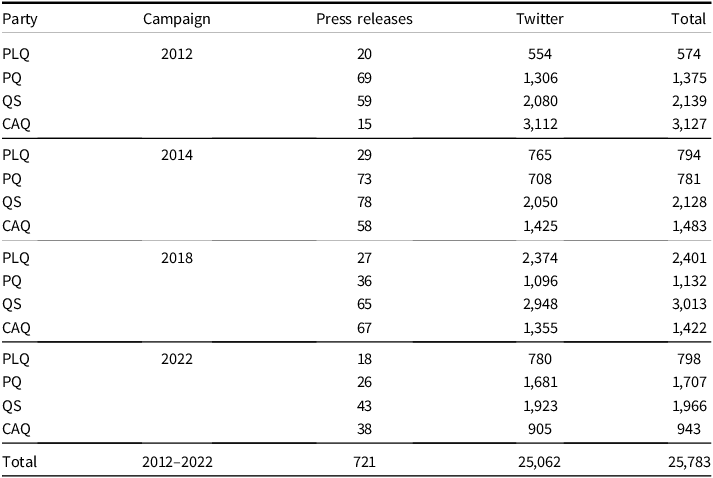
Note: This table offers a breakdown of the message corpus for each political party, campaign year and platform from 2012 to 2022.
Source: Authors.
Method
The corpus underwent automated dictionary content analysis, a technique that facilitates the recognition and categorization of words based on predefined classifications (Young and Soroka, Reference Young and Soroka2012; Grimmer and Stewart, Reference Grimmer and Stewart2013; Guo et al., Reference Guo, Vargo, Pan, Ding and Ishwar2016). Given the extensive volume of data and the study’s objective to quantify issue prioritization in electoral communications by various parties, this methodology was deemed appropriate. The dictionary developed by Martel and Nadeau (Reference Martel and Nadeau2023) was utilized. This is a French-language dictionary with a comprehensive list of defined issues, consisting of more than 2,500 tokens and syntagms.Footnote 3 The keywords included in the dictionary were drawn from election coverage by two major dailies in the province between 1994 and 2018.Footnote 4 This dictionary is therefore perfectly suited to the study of electoral communication in Quebec.
As mentioned earlier, the issues at the center of party competition in Quebec are expected to differ from those in other democratic settings. This distinction is reflected in the topics identified in Martel and Nadeau’s dictionary (Reference Martel and Nadeau2023). Their categorization does not follow the Comparative Agenda Project (CAP) master codebook, which presents considerations about directly comparing convergence levels across schemes. Nevertheless, we contend that the two categorizations overlap substantially and thus provide a suitable basis for comparison. Our analysis covers the following key issues: agriculture, culture and identity, economy and finance, education, energy and natural resources, environment, family, immigration, democratic institutions, integrity and corruption, justice and public safety, municipalities, social policy, regions, health, sports and recreation, Quebec’s political status and transportation. For complete details on the dictionary, including the full list of keywords and a systematic comparison between our categorization and the CAP coding scheme, please see Appendix A.10.
Automated text analysis enables systematic examination of extensive corpora (Haselmayer and Jenny, Reference Haselmayer and Jenny2017). Nevertheless, this method has limitations. The dictionary was based on a corpus that does not encompass the 2022 election. Consequently, some words might be absent from the dictionary (for example, “coronavirus disease 2019” (“COVID-19”)). Nonetheless, related terms such as “hospital,” “patient,” “illness” or “vaccine” can gauge messages mentioning health.
Operationalization
In this article, “visibility,” “salience” and “attention” refer to how much emphasis political parties place on different issues in their communications. An “agenda” is the distribution of attention across these issues. To measure agendas, a unique sub-corpus is created for each party, campaign and communication channel. This sub-corpus is analyzed using automated content analysis to count mentions of 18 specific issues.Footnote 5 Multiple mentions of an issue can occur within a single document or sentence. The relative significance of each issue category is calculated and expressed as a percentage. This is achieved by dividing the keyword count in each issue category by the total keyword count across all categories, independent of document frequency. Our analysis prioritizes textual volume over document count: While press releases are less numerous than tweets, they typically contain substantially more words per document. The analytical focus remains on the proportional keyword density allocated to each issue domain, rather than the distribution across individual documents or sentences.
Our approach allows for multi-issue coding where a syntagm such as “health tax” captures both health and fiscal policy dimensions since “health” appears as a keyword in one category while “tax” belongs to another. This contrasts with the Comparative Agendas Project (CAP) methodology, which employs quasi-sentence coding units with single-issue identification (Baumgartner, Breunig and Grossman, Reference Baumgartner, Breunig and Grossman2019).
Our coding framework provides several key advantages. First, it captures the complexity inherent in political communication, where party messages frequently address multiple policy domains simultaneously. For example, the statement “We will boost job creation, expand public transit, and strengthen healthcare services” would be coded across three dimensions—economy, transportation and health—rather than forcing a single classification based on arbitrary criteria such as word order.
Second, this approach reveals important nuances in party positioning that single-issue coding would miss. Consider a party platform advocating for the elimination of carbon taxes while emphasizing the fiscal burden on citizens. Our method would capture both the environmental policy dimension (through carbon tax references) and the more prominent fiscal policy emphasis, providing a more accurate representation of the party’s strategic emphasis.
Normalizing the issue salience measure to a percentage allows for easier comparison across different corpora, regardless of their message quantities or lengths. This method facilitates the comparison of various types of messages (for example, press releases versus tweets) and different entities (for example, two parties with different message counts or two campaigns with varying numbers of salient issues). In this context, issue visibility is considered relative rather than absolute.
Measuring issue engagement and issue avoidance
We use the measure proposed by Sigelman and Buell (Reference Sigelman and Buell2004) to assess the convergence between pairs of parties during the campaigns under study. First, we find what percentage (P) of their total attention each party (A and B) dedicated to that issue. Then, we add up the absolute differences between these percentages for all n possible issues in a campaign. This sum is divided by 2 to adjust the measure to range from 0 to 100. Finally, we subtract this value from 100 to change the measure from one of dissimilarity to one of similarity.
As Sigelman and Buell (Reference Sigelman and Buell2004: 653) explain:
Thus, a convergence score of, say, 40 for a campaign would indicate a 40% overlap in the two sides’ attention profiles; in that case […], in order to achieve perfect similarity between the two profiles (i.e., total convergence), one side or the other would have to reallocate 60% of its attention to match that of the other side.
We also calculate the total convergence by considering the average of the scores obtained by all possible pairs of parties.
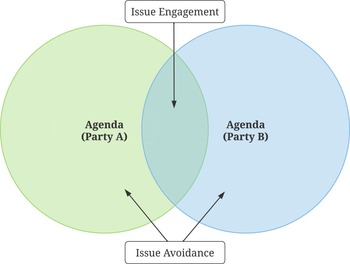
Figure 1 illustrates issue engagement and issue avoidance between two political parties. Issue convergence is the proportion of overlap between two political parties’ agendas. Convergence and divergence form a zero-sum game (for example, 70% convergence means 30% divergence). Divergence may occur when parties assign varying levels of attention to issues they both address, or when they focus on different issues.
However, Sigelman and Buell’s measure of convergence does not provide detailed information on which issues lead to convergence. To determine the proportion of convergence attributable to different issues, we compare the visibility given to issues by two parties and use the minimum value as the convergence indicator. For example, if Party A gives 15 per cent attention to an issue and Party B gives 30 per cent, the overlap is 15 per cent. This method allows us to bring back the individual issue convergences to the total convergence measure, thereby obtaining the proportionate contribution of each issue towards overall issue engagement.
Regression models
We explore the continuity of issue visibility within the party system agenda and the influence of ideological proximity on convergence, using insights from Green-Pedersen and Mortensen (Reference Green-Pedersen and Mortensen2015). We employ an ordinary least squares (OLS) regression to test whether ideologically close parties prioritize the same issues in their campaign messages. Parties are classified into groups—ideologically close and ideologically distant—on the basis of a typology derived from past characterizations of these parties (Bélanger and Nadeau, Reference Bélanger and Nadeau2009; Bélanger et al., Reference Bélanger, Daoust, Mahéo and Nadeau2022). This classification groups parties along two key dimensions: constitutional preferences (federalist versus independentist) and economic orientation (left-leaning versus right-leaning). Québec Solidaire (QS) and Parti Québécois (PQ) are both independentist and economically left-leaning, while the Parti Libéral du Québec (PLQ) and Coalition avenir Québec (CAQ) are federalist and economically right-leaning. Table 2 shows this classification.
Party Classification in OLS Regression Analysis

Note: The table categorizes Quebec’s political parties into close and distant groups on the basis of their ideological proximity, as used in our OLS regression analysis. Parties within the same group are considered ideologically closer to each other.
Source: Authors.
The model is mathematically expressed as:
 $$\begin{align}{reference \ party}_{i, p,t} =& {\beta }1 + {\beta}2 \cdot {reference \ party}_{i, p,t - {1}} + {\beta 3} \cdot {close \ party}_{i, p,t - {1}} close \\&+ {\beta 4} \cdot {distant \ parties}_{i, p, t - {1}} + {\varepsilon }\end{align}$$
Where:
-
reference party i,p,t represents the share of attention that party p devotes to issue category i at election time (t).
-
reference party i,p,t − 1 denotes the share of attention that party p devoted to issue category i at the previous election time (t − 1).
-
close party i,p,t − 1 signifies the share of attention that the ideologically closest party to party p devoted to issue category i at the previous election time (t − 1).
-
distant parties i,p,t − 1 is the mean share of attention that ideologically distant parties to party p devoted to issue category i at the previous election time (t − 1).
-
β1, β2, β3 and β4 are parameters to be estimated.
-
ϵ is the error term, capturing the unexplained variation in the dependent variable not accounted for by the independent variables.
Having discussed our methodology, we shall now direct our focus to the examination of the results.
Results
In this section, we present our findings on electoral competition in Quebec from 2012 to 2022. We aim to determine whether political parties focus on the same issues in a volatile electoral environment by examining issue-engagement and issue-avoidance dynamics across two communication channels: press releases and party tweets. We investigate the prevalence of issue convergence and explore the factors behind it by identifying the types of issues parties engage with. Detailed findings and implications will follow in subsequent sections.
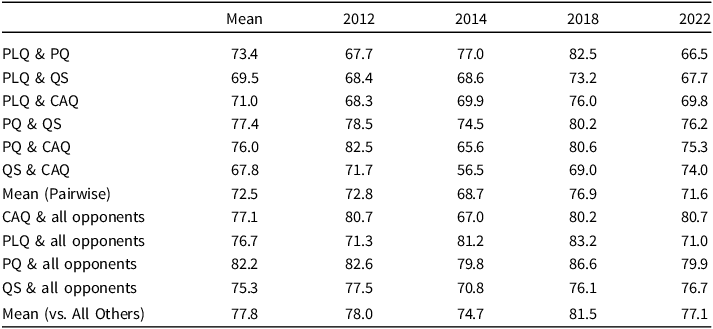
To provide context for our analysis, we first examine the level of issue engagement by political parties during election campaigns in Quebec and compare it with patterns observed in other democracies. Table 3 presents the issue-engagement levels between political parties and their opponents in their press releases from 2012 to 2022. The table focuses on two aspects: engagement between individual pairs of parties and engagement between each party and all their respective opponents.
Issue Engagement in Press Releases between Political Parties and Their Opponents
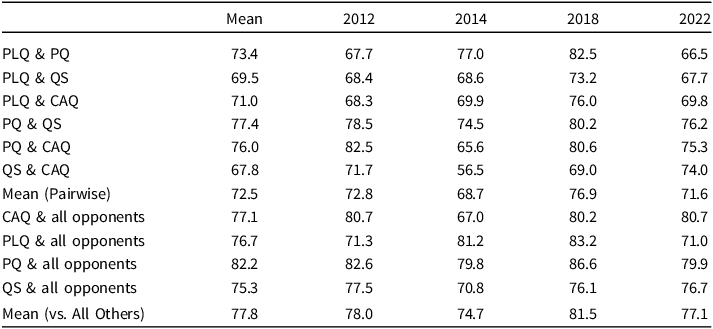
Note: This table presents the level of convergence (%) between parties in press releases during election campaigns.
Source: Authors.
The findings reveal that the mean convergence score among the agendas of individual party pair stands at 72.5 per cent. This score is similar to those observed in other democratic systems (Sigelman and Buell, Reference Sigelman and Buell2004; Green-Pedersen and Mortensen, 2010; Reference Green-Pedersen and Mortensen2015a; Dolezal et al., Reference Dolezal, Ennser-Jedenastik, Müller and Katharina Winkler2014; Meyer and Wagner, Reference Meyer and Wagner2016), suggesting that Quebec’s patterns of party convergence align with broader democratic trends. The levels of issue-engagement experiences variations of a few percentage points through time. For instance, the level of issue engagement is measured to be 68.7 per cent in 2014 and increased to 76.9 per cent in 2018. However, when observed over a longer time span, the engagement level demonstrates relative stability. The engagement level was 72.8 per cent in 2012 and slightly decreased to 71.6 per cent a decade later.
QS and the CAQ, two ideologically distant parties, have the lowest average convergence score at 67.8 per cent. In contrast, QS and the PQ, both generally considered to be left-wing, have the highest average convergence score, at 77.4 per cent. This suggests that ideological proximity may be associated with a higher level of convergence. Additionally, the trend towards convergence is also observable from issue-engagement scores between each party and all their respective opponents, although these scores are 5 per cent higher on average. This suggests the existence of pressures encouraging all parties to converge around a common party system agenda. As expected, patterns are very similar in tweets, with a mean convergence score of 72.1 per cent for individual party pairs (see Appendix A.2 for complete results).
H1–3: Continuity, party agenda system and ideological links
Hypotheses 1–3 examine whether parties consistently focus on various issues across elections and whether they influence each other’s focus.
First, we employ a data visualization to evaluate whether the divergence of party agendas indicates a deliberate emphasis on certain issues or whether these differences are more sporadic and randomly distributed across various issues. If H3 is true (ideologically similar parties focus on the same issues), then deviations in issue attention should align more closely between these parties.
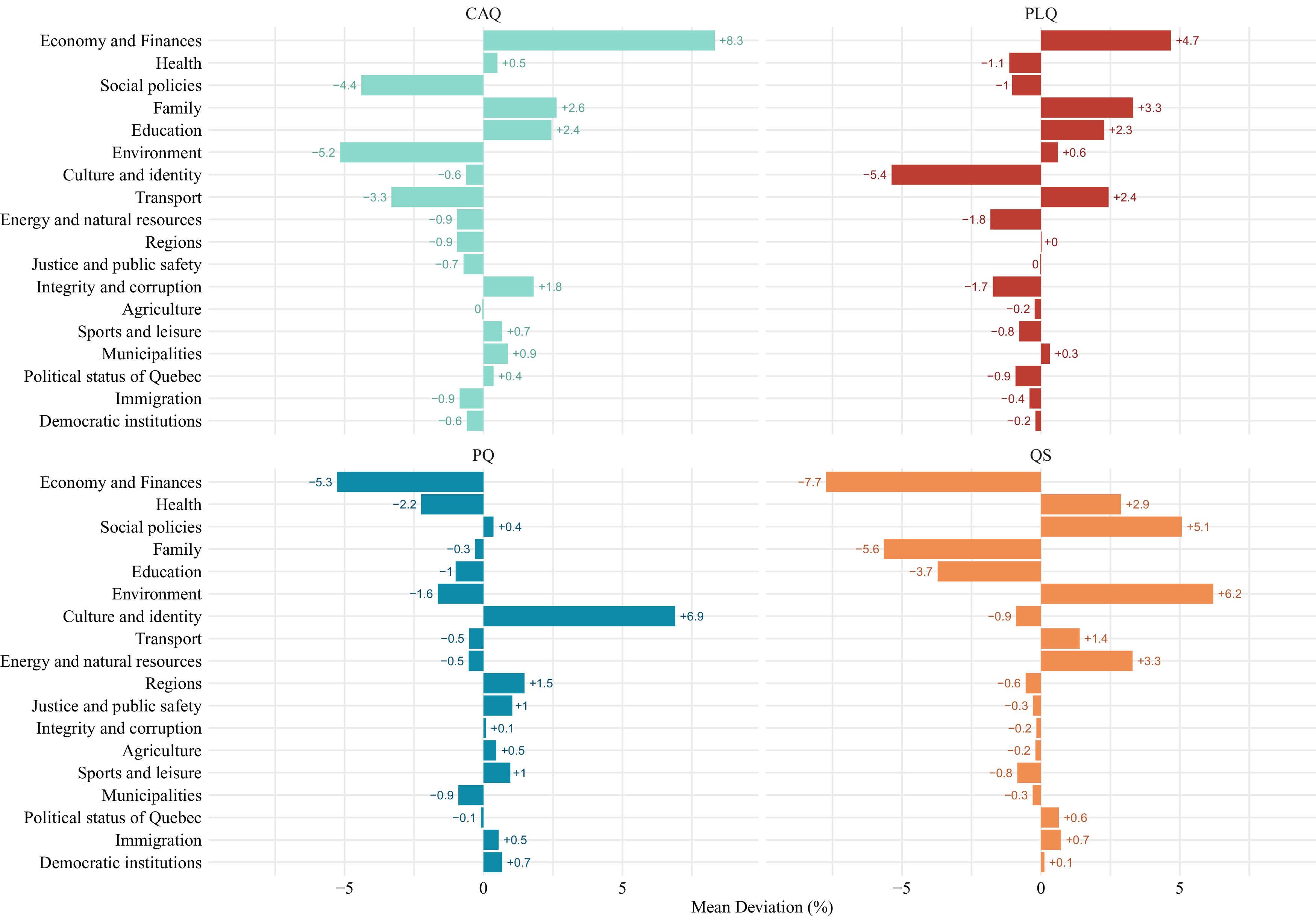
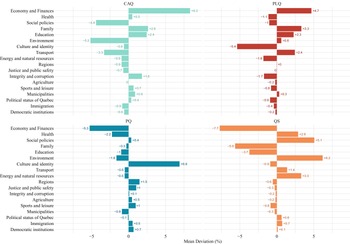
Figure 2 illustrates the average discrepancy in the visibility parties give to various issues in press releases, relative to the mean visibility given by other parties, over the decade from 2012 to 2022. The results suggest that the divergence between party agendas is not arbitrary. In fact, parties appear to strategically emphasize issues appealing to their electoral base. Right-wing parties, specifically the CAQ (+8.3%) and the PLQ (+4.7%), prioritize economic and financial issues, while left-wing parties, the PQ (−5.3%) and QS (−7.7%), de-emphasize these issues. The PQ, a sovereigntist party, highlights culture and identity (+6.9%), whereas the PLQ, a federalist party, avoids this issue (−5.4%). QS, representative of the new left, accentuates environmental (+6.2%) and social policy issues (+5.1%), contrasting with the CAQ, which de-emphasizes these issues (−5.2% on environment and −4.4% on social policies).
Conceptual Illustration of Issue Engagement and Issue Avoidance.
Note: This figure illustrates the convergence and divergence between the agendas of two political parties. Overlapping areas represent convergence, or mutual attention to the same issues (issue engagement). Non-overlapping areas represent divergence, or distinct attention to issues (issue avoidance). Source: Authors.

Mean Deviation in Attention to Issues by Political Parties in their Press Releases Compared with the Average of Other Parties from 2012 to 2022.
Note: This figure illustrates the mean deviation in attention (measured in percentage points) that political parties pay to different issues in their press releases, compared with the average attention given by other parties, over the decade from 2012 to 2022. Source: Authors.
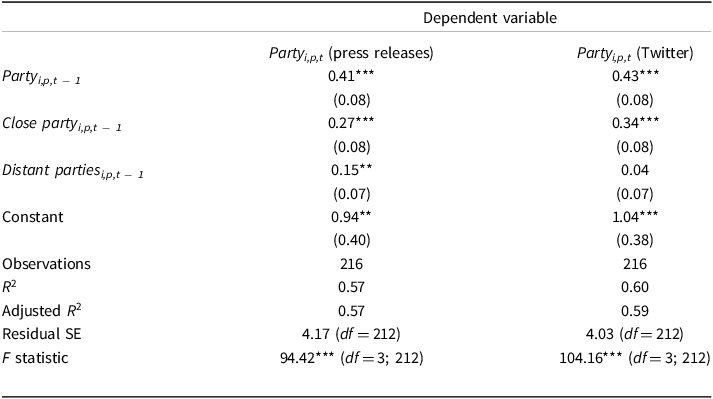
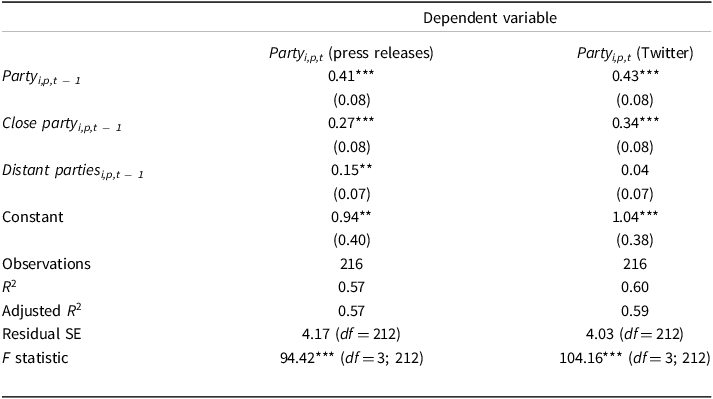
Building on the strategic issue emphases identified in Figure 2, Table 4 presents the regression analysis to shed light on the factors that influence parties’ electoral agendas. The first column of this table pertains to the results for press releases. These findings confirm that political parties’ agendas exhibit a degree of continuity, as the visibility given to an issue by a party during one electoral campaign (Party i,p,t − 1 ) is a predictor (β = 0.41, p < 0.01) of the visibility given to that same issue by the same party during the subsequent campaign. This suggests that there is a significant element of consistency in how parties promote issues, thereby providing support for H1.
Regression Analysis: Continuity of Partisan Agendas over Time and Opponents’ Influence on Subsequent Agendas
Note: This regression explores the continuity of issue visibility within the party system agenda and the influence of ideological proximity on convergence. Abbreviations: df, degrees of freedom; SE, standard error.
**p < 0.05; ***p < 0.01.
Source: Authors.
Moreover, the findings suggest that political parties demonstrate adaptability in response to changing circumstances. This is particularly evident in their strategic decision to highlight issues previously addressed by their opponents (Close party i,p,t − 1 , p < 0.01; and Distant parties i,p,t − 1 , p < 0.05). These observations lend support to H2 and align with findings from Green-Pedersen and Mortensen (Reference Green-Pedersen and Mortensen2015a: 755), who concluded that “this makes sense from an agenda-setting perspective, but challenges the standard view on issue competition that parties to a large extent ignore each other and attend to widely different issues.”
The first column of Table 4 also shows that the level of attention paid to different issues by political parties is closer between ideologically close parties (β = 0.27) than for parties that are not ideologically close (β = 0.15), in line with H3, though this difference is not statistically significant. The coefficients indicate that, when parties choose to give visibility to certain issues, their own past is a stronger determinant (β = 0.41) than the past of other parties (β = 0.27 and β = 0.15), although not an exclusive one, with only distant parties showing a statistically significant difference from the reference party’s own past influence (p = 0.03).
The results in the second column of Table 4 allow us to extend once again the findings from press releases to the Twitter corpus. Indeed, the visibility given to an issue by a party during an electoral campaign (Party i,p,t − 1 ) is a predictor (β = 0.43, p < 0.01) of the visibility given to that same issue by the same party during the subsequent campaign. Results also show that parties tend to focus on issues previously addressed by their opponents (Bloc party i,p,t − 1 , p < 0.01). Unlike in the first model, however, the behavior of ideologically distant parties does not significantly affect the subsequent agendas of a given political party. Hence, H2 is only true when considering parties that are ideologically close on Twitter.
These effects become even more pronounced when examining a simplified model that directly compares a party’s own past emphasis (t − 1) against the concurrent mean emphasis of all other parties (t). In this specification, the coefficient for the mean emphasis of all other parties at time t (β = 0.59 for press releases; β = 0.57 for Twitter) exceeds that for the party’s own past emphasis at t − 1 (β = 0.35 for press releases; β = 0.38 for Twitter). These results, presented in Table A.41 of Appendix A.9, further demonstrate the strong influence of the collective party system agenda on individual party issue emphasis and suggest parties’ responsiveness to emerging common priorities. While the difference between these coefficients does not reach statistical significance, meaning we cannot conclusively determine which effect is stronger, our models show that both parties’ own stable issue preferences and issues on the common agenda drive parties’ issue focus. These results, coupled with the convergence levels presented previously, provide evidence consistent with Grossmann and Guinadeau’s (2024) “tunnel of attention” argument that parties are driven more by issues on the common agenda than by their own stable issue preferences.
Having established the similarity between the dynamics of issue engagement for press releases and Twitter, our subsequent hypotheses will be examined exclusively using the press release corpus, thereby simplifying the presentation of our findings. The comprehensive results from the Twitter corpus are available in Appendix A.2.
H4: Visibility of governance and peripheral issues
The fourth hypothesis posits that the visibility given to issues by political parties in Quebec is stable and significant for a small number of governance issues (economy and finance, social missions, environment, identity and culture, etc.) and low and unstable for peripheral issues.
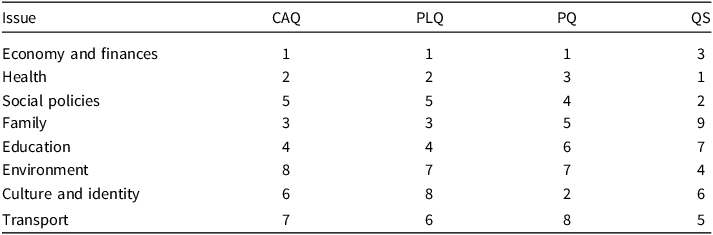
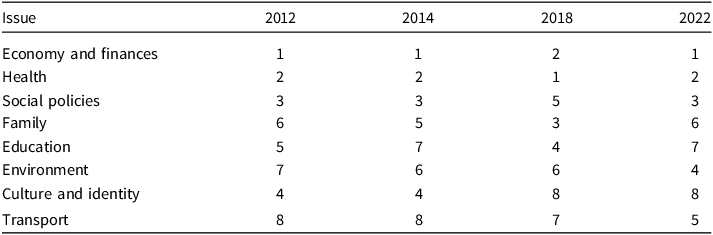
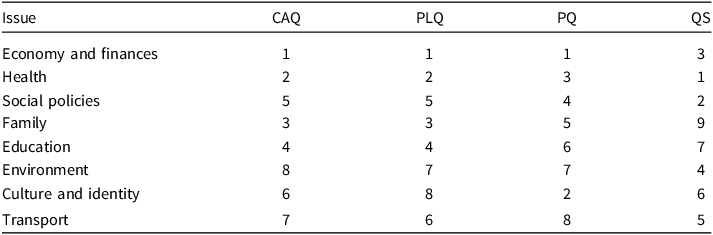
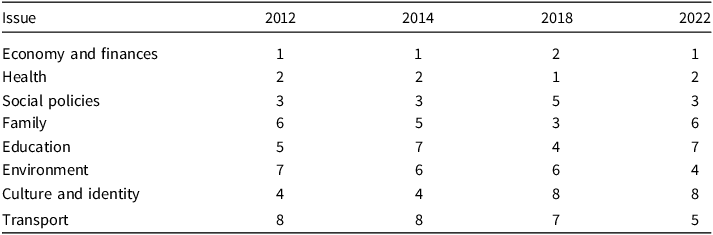
Tables 5 and 6, respectively, display the rank of the top eight issues that garnered the most attention on average in the press releases of various parties from 2012 to 2022, broken down by party and by year. The findings indicate a recurring pattern in party agendas during election campaigns, with certain issues consistently taking precedence. Specifically, the domains of economy and finances, as well as health, stand out as the only two subjects to have ever secured the top rank across parties or election campaigns. Conversely, the issue of transports has never managed to climb higher than the fifth position. The eight issues in these tables receive sustained attention from all parties, supporting H4 and the idea that parties focus on these “core” issues to present the image of a serious party of government with a comprehensive program.
Ranking of the Eight Most Visible Issues in Press Releases by Party (2012–2022)
Note: This table presents the ranking of the eight most visible issues in parties’ press releases from 2012 to 2022. The ranking is based on the visibility of issues, with 1 being the most salient.
Source: Authors.
Ranking of the Eight Most Visible Issues in Press Releases by Year (2012–2022)
Note: This table presents the ranking of the eight most visible issues in parties’ press releases from 2012 to 2022. The ranking is based on the visibility of issues, with 1 being the most salient.
Source: Authors.
H5: Convergence level for governance and peripheral issues
Finally, the fifth hypothesis posits that parties converge more on governance issues than peripheral ones. Calculating convergence levels separately is crucial because important issues naturally attract more attention, leading to higher convergence. The typology of governance and peripheral issues used to present the results in this section is derived from the findings above. The eight issues that tend to receive sustained attention from all parties (economy and finances, health, social policies, education, family, environment, culture and identity and transport) are considered governance issues, while the other issues are considered peripheral.
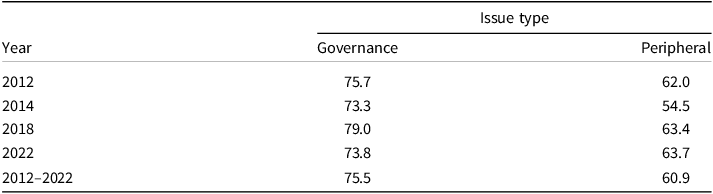
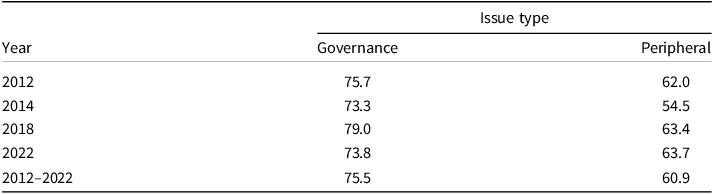
Table 7 provides the mean convergence levels (%) in press releases between all pairs of political parties from 2012 to 2022, calculated for each issue type separately. Notably, governance issues demonstrate consistently higher convergence levels than peripheral issues, with an average of +14.6 per cent more convergence for governance issues. This observation lends support to H5 and suggests that parties face more pressure to address governance issues than peripheral issues.
Convergence Levels of Party Agendas in Press Releases by Issue Type (2012–2022)
Note: This table displays the mean issue convergence (%) in press releases between pairs of political parties from 2012 to 2022, calculated for each issue type separately.
Source: Authors.
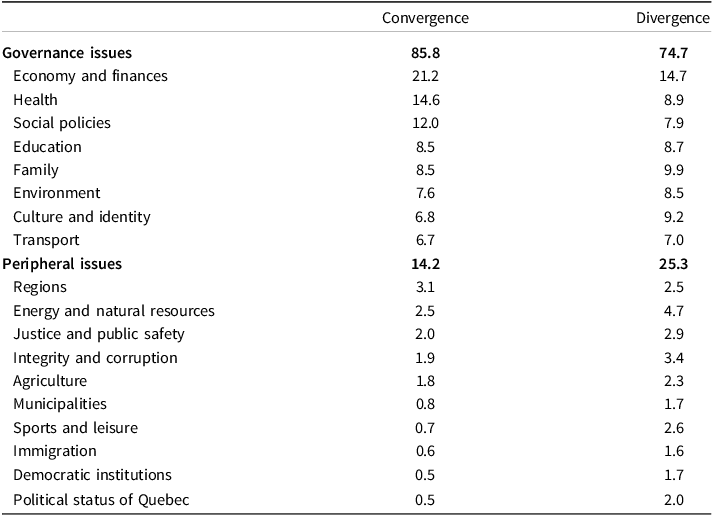
Above, we suggested that the predominance of what we have termed governance issues could mean that the same issues largely account for both convergence and divergence dynamics. Table 8 presents the percentage of overall convergence and divergence attributable to governance and peripheral issues in press releases (2012–2022). The results show once again that only eight issues exceed an average contribution to convergence of 5 per cent. In fact, four issues—economy and finances, health, social policies and education—account for more than 50 per cent of the average issue engagement between political parties during election campaigns. Notably, the prominence of what we term “governance issues” largely accounts for the similarities and disparities in the electoral agendas of Quebec’s political parties.
Overall Convergence and Divergence Levels of Party Agendas in Press Releases by Issue (2012–2022)
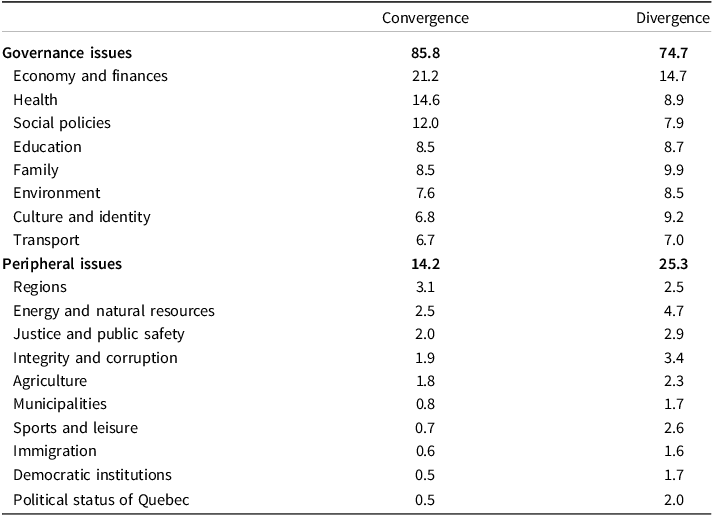
Note: This table presents the mean issue convergence and divergence (%) in press releases between all individual pairs of political parties from 2012 to 2022, per issue.
Source: Authors.
It may seem surprising that the issues accounting for most of the convergence are also the issues accounting for most of the divergence. In fact, divergence may occur when parties give different levels of attention to issues they both address or when they focus on different issues altogether. Our findings indicate that the former explains the observed patterns most of the time.
Conclusions
This study has provided valuable insights into the dynamics of issue engagement in the context of electoral competition. It has been observed that parties, irrespective of the volatility of the electoral environment, tend to address the same issues, a phenomenon that is not unique to Quebec but is also seen in other major democracies. This convergence is not limited to traditional press releases but is also evident in party tweets. The study further reveals that parties that are ideologically closer are more likely to address the same issues. This suggests that ideological proximity plays a significant role in shaping the issues that parties choose to engage with. Moreover, our analysis has identified two distinct types of issues: peripheral issues, which receive less visibility and are less likely to be the focus of convergence, and governance issues, which form the core of the electoral agenda. These core issues, to which all parties give significant visibility, seem to align with voters’ expectations of what constitutes the agenda of a competent and responsible government.
While core governance issues exhibit similarities across democratic systems (security, health, education, etc.), the anticipated governance agenda within specific jurisdictions may vary according to the institutional competences of different governmental levels and the particular challenges confronting distinct regions. The minority status of the francophone Quebec nation within Canada, and associated concerns regarding cultural preservation, exemplifies how culture and identity emerge as distinctively salient issues in party competition relative to other democratic contexts. Such region-specific issues nevertheless achieve high visibility in a given party system agenda owing to documented factors, including citizen concerns, compelling all parties to address these governance priorities. These findings support the proposition that, although the substantive content of party competition varies across democracies, the structural patterns and dynamics of party agendas demonstrate remarkable consistency.
Moreover, this study underscores the importance of examining issue convergence and divergence dynamics through a detailed analysis of the underlying issues to gain deeper insights into the strategies of political parties and the nature of electoral competition.
A question that remains beyond the empirical scope of this investigation concerns whether the factors structuring issue competition during electoral campaigns operate similarly during periods of governance. Examining politician issue attention on Twitter across multiple years outside electoral campaigns in the Danish context, Eriksen (Reference Eriksen2024) demonstrates that “party issue ownership and the status of a party as a government or opposition party strongly influence politicians’ attention to issues on the platform.” These findings suggest that certain factors, such as issue ownership, consistently shape party issue emphasis across both governance and electoral periods, while others, including government versus opposition status, exert influence following electoral outcomes and coalition formation.
Further research could investigate the mechanisms through which issues acquire prominence and achieve governance status, as well as examine how socio-political transformations may affect the stability of these core issues over time across both electoral and governance periods.
Supplementary material
The supplementary material for this article can be found at https://doi.org/10.1017/S0008423925100747.
Competing interests
The authors declare none.
Statements and Declarations
This project was supported by funding from the Social Sciences and Humanities Research Council (SSHRC) and the Fonds de recherche du Québec (FRQ).



 Open access

