





Highlights
-
• Provides further empirical evidence that second language (L2) processing partially employs an embodied mechanism.
-
• Systematically shows that L2 age of acquisition (AoA), L2 exposure and L2 dominance correlate with the L2 embodiment effect.
-
• Reveals that L2 AoA and L2 exposure modulate the L2 embodiment, with L2 exposure playing a more significant role.
-
• Contributes novel insights into L2 embodiment and suggests a future research direction that integrates both embodied and disembodied perspectives.
1. Introduction
The traditional symbolic theory proposed that concepts are represented as abstract and amodal symbols (Binder, Reference Binder2016; Fodor, Reference Fodor1975; Pylyshyn, Reference Pylyshyn1984). However, the emergence of the embodied perspective challenged this view by postulating that conceptual knowledge is grounded in sensorimotor mechanisms (Barsalou, Reference Barsalou2008). Specifically, language processing activates linguistic and nonverbal multimodal representations (e.g., sensations, emotions, and actions) associated with the depicted event. This embodiment effect stems from the collaboration between a linguistic system conveying meaning through words and a simulation system employing sensorimotor memories to recreate real-life experiences (Anderson et al., Reference Anderson, Binder, Fernandino, Humphries, Conant, Raizada, Lin and Lalor2019; Bi, Reference Bi2021).
Numerous studies have provided supporting evidence for this assertion: first language (L1) semantic comprehension spontaneously evokes perceptual (e.g., Sato et al., Reference Sato, Schafer and Bergen2013; Winter & Bergen, Reference Winter and Bergen2012; Yaxley & Zwaan, Reference Yaxley and Zwaan2007) and motor (e.g., Fischer & Zwaan, Reference Fischer and Zwaan2008; Glenberg & Kaschak, Reference Glenberg and Kaschak2002; Pulvermüller & Fadiga, Reference Pulvermüller and Fadiga2010; Zhang et al., Reference Zhang, Yang, Wang and Li2020) information that aligns with the linguistic descriptions of perceptions and actions. For example, encountering a sentence such as “She gave him a warm smile” triggers neural pathways associated with the sensation of physical warmth (e.g., Sato et al., Reference Sato, Schafer and Bergen2013). Similarly, reading a sentence like “He grasped the cup tightly” can evoke neural responses in the motor cortex linked to hand movements despite no physical action (e.g., Pulvermüller & Fadiga, Reference Pulvermüller and Fadiga2010).
While most research in this field has focused on the L1 embodiment, there has been limited exploration of the second language (L2) embodiment. As is well-known, L1 is typically acquired through daily interactive experiences involving diverse scenarios and integrated multimodal exposures, potentially leading to a robust L1 embodiment (Jeong et al., Reference Jeong, Li, Suzuki, Sugiura and Kawashima2021; Li & Jeong, Reference Li and Jeong2020). In contrast, formal L2 acquisition is usually characterized by a lack of exposure to and interactions with multimodal stimuli (Li & Jeong, Reference Li and Jeong2020; Norman & Peleg, Reference Norman and Peleg2022). Thus, L2 semantic representations may involve less sensorimotor information and have weaker connections to real-life experiences (Ahlberg et al., Reference Ahlberg, Bischoff, Kaup, Bryant and Strozyk2017; Tian et al., Reference Tian, Chen, Zhao, Wu, Zhang, De, Leppänen, Cong and Parviainen2020). The distinct learning experiences between L1 and L2 contribute to variations in their semantic representations.
Although non-proficient bilinguals activate their L1 during L2 processing (Li et al., Reference Li, Zheng and Yang2018), it remains uncertain whether L2 processing engages the perceptual and motor simulation and whether the simulation arises from the automatic L1 activation during L2 processing or reflects the embodied characteristics of L2. Furthermore, individual variations in bilingual learning experience, conceptualized as a multidimensional spectrum (DeLuca et al., Reference DeLuca, Rothman, Bialystok and Pliatsikas2019; Gullifer et al., Reference Gullifer, Kousaie, Gilbert, Grant, Giroud, Coulter, Klein, Baum, Phillips and Titone2021), may modulate the extent to which L2 processing recruits the embodied mechanism. Therefore, this study aims to investigate L2 embodiment in the semantic processing of action verbs among Chinese–English bilinguals and assess how diverse multidimensional bilingual experiences influence this effect.
1.1. L1 and L2 embodiment in bilinguals
Over the past decades, extensive research has demonstrated that L1 semantic processing is inherently linked with the sensorimotor system (e.g., Bergen et al., Reference Bergen, Lau, Narayan, Stojanovic and Wheeler2010; Glenberg & Kaschak, Reference Glenberg and Kaschak2002; Marino et al., Reference Marino, Sirianni, Volta, Magliocco, Silipo, Quattrone and Buccino2014). These studies used behavioral experimental paradigms, such as verb–picture matching tasks, go/no-go tasks or semantic judgment tasks, uncovering the cognitive mechanisms underlying language processing. Building on the established groundwork, we review the existing literature, concentrating specifically on processing action-related language.
In the verb–picture matching task (e.g., Bergen et al., Reference Bergen, Lau, Narayan, Stojanovic and Wheeler2010), a widely used paradigm in this field, native English and Cantonese speakers viewed action verbs (e.g., jump) paired with corresponding pictures (e.g., a drawing depicting jumping). The verbs either appropriately described the depicted action (e.g., jump) or did not (e.g., walk). Participants judged whether each picture semantically matched the preceding verb. Unknown to them, in the verb–picture mismatched condition (“No” response), there were two types of picture stimuli, one (e.g., walk.jpg) implicating the same effector (i.e., feet) as the verb (jump) and the other (e.g., eat.jpg) implying a different effector (i.e., mouth). In the mismatched condition where a “No” response occurred (same-effector vs. different-effector), embodiment effects emerged if response times for the same-effector pairs (e.g., jump vs. walk.jpg) were slower than those for the different-effector pairs (e.g., jump vs. eat.jpg). This embodiment effect, calculated as the difference in response time between the same and different effectors, may arise from interference caused by mentally simulating the original action (Bergen et al., Reference Bergen, Lau, Narayan, Stojanovic and Wheeler2010). In their study, Bergen et al. (Reference Bergen, Lau, Narayan, Stojanovic and Wheeler2010) found that participants took significantly longer to determine mismatches between pictures and verbs when they shared an effector compared to when they did not.
Consistent with the behavioral findings, researchers have utilized sophisticated neuroimaging technologies and other neurological tools to delve deeper into the neural substrates of sensorimotor engagement in L1 semantic processing (Hauk et al., Reference Hauk, Johnsrude and Pulvermüller2004; Johari et al., Reference Johari, Riccardi, Malyutina, Modi and Desai2022; Klepp et al., Reference Klepp, Weissler, Niccolai, Terhalle, Geisler, Schnitzler and Biermann-Ruben2014; Tettamanti et al., Reference Tettamanti, Buccino, Saccuman, Gallese, Danna, Scifo, Fazio, Rizzolatti, Cappa and Perani2005). Klepp et al. (Reference Klepp, Weissler, Niccolai, Terhalle, Geisler, Schnitzler and Biermann-Ruben2014) used magnetoencephalography to examine the involvement of sensorimotor areas in processing action-related verbs. They studied native German speakers who silently read individual action verbs describing hand, foot or non-body actions on a screen and then made lexical decisions. The results showed activation of specific brain areas (e.g., primary motor cortex) responsible for hand and foot motor control during silent reading of the verbs related to these corresponding effectors. More recently, Johari et al. (Reference Johari, Riccardi, Malyutina, Modi and Desai2022) explored the neural underpinnings of action word processing by examining the effects of high-definition transcranial direct current stimulation on primary and higher-order motor areas while English speakers performed lexical decision and semantic similarity judgment tasks. The study revealed that the targeted motor areas facilitated action-related language processing, suggesting specialized roles for these areas in action semantics.
While considerable evidence supports semantic embodiment in L1 processing, limited attention has focused on L2 embodiment and its modulators (Kühne & Gianelli, Reference Kühne and Gianelli2019; Monaco et al., Reference Monaco, Jost, Gygax and Annoni2019; Zhang et al., Reference Zhang, Yang, Wang and Li2020). Some researchers contend that L2 processing demonstrates semantic embodiment comparable to L1, as both languages engage similar cognitive and neural mechanisms (Ahn & Jiang, Reference Ahn and Jiang2018; Buccino et al., Reference Buccino, Marino, Bulgarelli and Mezzadri2017; De Grauwe et al., Reference De Grauwe, Willems, Rueschemeyer, Lemhofer and Schriefers2014; Dudschig et al., Reference Dudschig, de la Vega and Kaup2014). These studies have observed L2 embodiment effects in multiple tasks like Stroop tasks and go/no-go paradigms or through neuroimaging technologies such as electroencephalography (EEG) and functional magnetic resonance imaging (fMRI) measurements, though some studies note that the L2 embodiment effects may not be as robust as those in L1 (e.g., Ahlberg et al., Reference Ahlberg, Bischoff, Kaup, Bryant and Strozyk2017; Tian et al., Reference Tian, Chen, Zhao, Wu, Zhang, De, Leppänen, Cong and Parviainen2020; Vukovic & Shtyrov, Reference Vukovic and Shtyrov2014; Zhang et al., Reference Zhang, Yang, Wang and Li2020). For example, Vukovic and Shtyrov (Reference Vukovic and Shtyrov2014) observed a reduced embodiment in L2 semantic processing by investigating German–English bilinguals’ motor-cortex recruitment in processing action verbs. They used high-density EEG to track cortical motor system activity changes as participants read action words in L1 and L2. The results reflected rapid motor-cortex involvement during action-semantic processing in both languages, but there was a decreased motor activation in L2 compared to L1. This phenomenon implied the presence of more integrated action-perception substrates formed in L1 processing.
Conversely, some investigations suggest that L2 embodiment may resemble L1, indicating a common underlying mechanism. For instance, Buccino et al. (Reference Buccino, Marino, Bulgarelli and Mezzadri2017) used a go/no-go paradigm to test whether fluent L2 speakers would exhibit similar motor system modulation when processing graspable nouns in L2 as they would in L1. The study presented fluent Italian–English bilinguals with English nouns and images of graspable and non-graspable objects as stimuli, as well as pseudowords and scrambled images as controls. Participants were tasked with pressing a key when the stimulus represented a real object and refraining from responding to the scrambled or pseudo stimuli. The results displayed that graspable items (both images and nouns) elicited slower responses than non-graspable ones, consistent with the expected pattern in L1, suggesting that fluent L2 speakers engage the motor system similarly, irrespective of language. While the study did not present a direct within-participant comparison of L1 and L2 processing, its results align with a previous experiment by Marino et al. (Reference Marino, Sirianni, Volta, Magliocco, Silipo, Quattrone and Buccino2014) that utilized the same paradigm with Italian native speakers processing similar stimuli in L1.
However, other research findings challenge the notion of L2 embodiment, positing that the formal acquisition of L2 is usually devoid of the rich sensorimotor experiences inherent in L1, thereby lacking robust perceptual and motor simulations during L2 comprehension (Chen et al., Reference Chen, Wang, Zhang and Liu2020; Norman & Peleg, Reference Norman and Peleg2022). Their empirical results also revealed an absence of L2 embodiment effects. For example, Chen et al. (Reference Chen, Wang, Zhang and Liu2020) investigated Cantonese–Mandarin–English trilinguals in a delayed sentence–picture verification (SPV) task. Participants identified whether objects depicted in presented pictures were mentioned in preceding sentences. These sentences, such as “The boy saw a car driving past,” either matched (e.g., “a car is driving on the road”) or mismatched (e.g., “a car is parked in the garage”) the pictured objects in perceptual features (e.g., shapes, sizes, and positions). If language comprehension is embodied, the match condition should have facilitated verification, leading to faster responses than the mismatch condition. However, results showed that this facilitation effect was only evident in L1, with no effect observed in L2 or L3, even among highly proficient L2 speakers.
Using a similar paradigm, Norman and Peleg (Reference Norman and Peleg2022) documented that proficient Hebrew–English bilinguals exhibited quicker response times when the shape of the depicted object matched the shape implied by the sentence. Nonetheless, this effect manifested exclusively in L1, specifically when the L1 block preceded the L2 block. The two studies suggest that the diminished embodiment in L2 is likely due to less integrated linguistic and perceptual representations in L2 comprehension. Similarly, Morey et al. (Reference Morey, Kaschak and Díez-Álamo2021) conducted a multi-lab, preregistered replication study to test the action–sentence compatibility effect (ACE) proposed by Glenberg & Kashak (Reference Glenberg and Kaschak2002). ACE denotes the phenomenon where responses are faster when the movement direction aligns with the action described in a sentence. Multiple labs participated in the experiment, where both native and non-native English speakers made sensibility judgments (by executing movements toward or away from the body) based on sentences describing actions either toward (e.g., “Tom handed the pen to you”) or away from (e.g., “You handed the pen to Tom”) their bodies. However, none of the labs observed a reliable ACE in L1 or L2.
The above inconsistent findings lead to the ongoing debate surrounding whether semantic processing in L2 and even L1, involves the recruitment of sensorimotor resources. Furthermore, empirical evidence (Anderson et al., Reference Anderson, Binder, Fernandino, Humphries, Conant, Raizada, Lin and Lalor2019; Momenian et al., Reference Momenian, Bakhtiar, Chan, Cheung and Weekes2021) and theoretical assumptions (e.g., the dual-coding knowledge neural framework from Bi, Reference Bi2021; Wang et al., Reference Wang, Men, Gao, Caramazza and Bi2020) have emerged, postulating an integrated view that language comprehension encompasses both symbolic and embodied mechanisms, highlighting the need for more robust empirical studies to delve deeper into the L2 embodiment effect.
In addition, we should note that the embodiment effects elicited from the SPV and the ACE are typically construed as facilitation effects, which occur when congruent sensorimotor activation enhances cognitive performance, leading to faster processing speeds due to consistency between sensorimotor activation and the cognitive task. Conversely, inhibitory effects, also termed interference effects (e.g., observed in the verb–picture matching task), arise when incongruent sensorimotor activation hinders cognitive performance, in which a discrepancy between sensorimotor activation and the cognitive task results in slower processing speeds.
Although these two effects, reflecting how sensorimotor experiences influence cognitive processes, have been extensively investigated, there is substantial debate regarding whether embodiment effects are facilitatory or inhibitory and what determines the direction of these effects (Momenian et al., Reference Momenian, Privitera and Weekes2024; Montero-Melis et al., Reference Montero-Melis, van Paridon, Ostarek and Bylund2022; Shebani & Pulvermüller, Reference Shebani and Pulvermüller2013; Zeelenberg & Pecher, Reference Zeelenberg, Pecher and Ross2016). Relevant research suggests that task complexity (e.g., Shebani & Pulvermüller, Reference Shebani and Pulvermüller2018), specific contexts (e.g., Tsaregorodtseva & Kaup, Reference Tsaregorodtseva and Kaup2024; von Sobbe et al., Reference von Sobbe, Ulrich, Gangloff, Scheifele and Maienborn2021) and task execution (e.g., Winter et al., Reference Winter, Dudschig, Miller, Ulrich and Kaup2022) potentially influence the direction of these effects. Moreover, studies have demonstrated that facilitatory and inhibitory effects coexist within the same experimental paradigm (Buccino et al., Reference Buccino, Colagè, Gobbi and Bonaccorso2016; Zwaan & Pecher, Reference Zwaan and Pecher2012). Thus, Ostarek and Huettig (Reference Ostarek and Huettig2019) highlighted that one of the critical challenges for embodiment research is to clarify these effects’ directions and identify which paradigms (facilitation or interference) could indicate a causal role of the sensorimotor system in embodiment effects. Some studies suggested that the facilitation effect alone may not fully demonstrate the functional role of sensorimotor systems in language processing, although it does indicate their involvement (Bergen, Reference Bergen, Gonzalez-Marquez, Mittelberg, Coulson and Spivey2008; Ostarek & Huettig, Reference Ostarek and Huettig2019). On the contrary, despite mixed evidence in the literature (Montero-Melis et al., Reference Montero-Melis, van Paridon, Ostarek and Bylund2022; Zeelenberg & Pecher, Reference Zeelenberg, Pecher and Ross2016), the interference effect comparatively holds promise in illuminating sensorimotor simulation (Ostarek & Bottini, Reference Ostarek and Bottini2021). Considering these factors, the present study proposes to adopt the interference paradigm to explore the involvement of the sensorimotor system in L2 semantic processing and its potential modulators.
1.2. Bilingual experience and L2 embodiment
Recent evidence underscores that bilingual experience is a multidimensional spectrum (Gullifer et al., Reference Gullifer, Kousaie, Gilbert, Grant, Giroud, Coulter, Klein, Baum, Phillips and Titone2021; Luk & Bialystok, Reference Luk and Bialystok2013; Li & Dong, Reference Li and Dong2020), encompassing multiple experience-based factors such as L2 age of acquisition (AoA), L2 proficiency, L2 exposure, and L2 dominance (e.g., DeLuca et al., Reference DeLuca, Rothman, Bialystok and Pliatsikas2019; Li et al., Reference Li, Zhang, Yu and Zhao2019). Several studies have proposed that L2 proficiency modulates L2 embodiment effects (e.g., Bergen et al., Reference Bergen, Lau, Narayan, Stojanovic and Wheeler2010; Birba et al., Reference Birba, Beltrán, Caro, Trevisan, Kogan, Sedeño, Ibáñez and García2020; Gu et al., Reference Gu, Wang, Beltrán, Liu, Liang, Wang and de Vega2021; Tang et al., Reference Tang, Fu, Wang, Liu, Zang and Kärkkäinen2023; Vukovic, Reference Vukovic2013). For example, Birba et al. (Reference Birba, Beltrán, Caro, Trevisan, Kogan, Sedeño, Ibáñez and García2020) investigated how embodied semantic systems interacted with varying levels of L2 proficiency for Spanish–English bilinguals. Participants read action and neutral texts naturally in both languages, while EEG was used to track their neural activities. Results showed higher L2 proficiency correlated with enhanced EEG functional motor-related connectivity during L2 action text reading. Similarly, Tang et al. (Reference Tang, Fu, Wang, Liu, Zang and Kärkkäinen2023) instructed Chinese-English bilinguals to perform an emotional valence categorization task in both languages, where participants assessed whether the given words were positive, negative or neutral. Findings revealed faster responses in L2 among participants with higher English proficiency.
Nevertheless, studies by Chen et al. (Reference Chen, Wang, Zhang and Liu2020), Kogan et al. (Reference Kogan, García-Marco, Birba, Cortés, Melloni and Ibáñez2020a), Monaco et al. (Reference Monaco, Mouthon, Britz, Sato, Stefanos-Yakoub, Annoni and Jost2023), and Zhang et al. (Reference Zhang, Yang, Wang and Li2020) suggest that L2 proficiency exerts minimal influence on the embodied representations in L2 processing. Specifically, in an fMRI study, Zhang et al. (Reference Zhang, Yang, Wang and Li2020) investigate embodied semantics in L2 processing. Participants judged the semantic relatedness of English words. Researchers found that Chinese–English bilinguals, regardless of proficiency level, primarily engaged the semantic system during L2 processing, unlike native speakers whose sensorimotor systems were connected with the semantic system. The discrepancy in findings regarding the L2 proficiency modulation effects on L2 embodiment may stem from differences in the tasks’ ecological validity and the measures of proficiency assessed. As a whole, existing literature presents varied perspectives on the relationship between L2 proficiency and L2 embodiment, underscoring the intricate nature of this relationship.
Within the limited body of research on L2 embodiment, prior studies have primarily focused on examining the association between L2 proficiency and L2 embodiment. Concerning the influence of L2 AoA, Monaco et al. (Reference Monaco, Jost, Gygax and Annoni2019) noted in a review that existing findings showed early bilinguals’ L2 semantic processing engages sensorimotor areas to a similar extent as their L1, implying a potential impact of L2 AoA on L2 embodiment. This proposition gained support from specific investigations. As illustrated earlier, Norman and Peleg (Reference Norman and Peleg2022) observed attenuated perceptual simulations in late Hebrew–English bilinguals during an SPV task in their L2. These observations were in line with prior literature. For instance, Caldwell-Harris et al. (Reference Caldwell-Harris, Tong, Lung and Poo2011) examined late Chinese–English bilinguals’ perception of emotional content, asking them to judge words’ emotionality in L1 and L2 through the bilingualism and emotions questionnaire (Dewaele, Reference Dewaele2010). The authors discovered that late bilinguals perceived their L1-Chinese as more emotional, while early bilinguals rated both languages equally emotional. Pavlenko (Reference Pavlenko2012) further indicated in a review that later-acquired languages rely more on semantic than emotional processing mechanisms. However, Kogan et al. (Reference Kogan, Muñoz, Ibáñez and García2020b) noted from their review that some studies showed adult learners could also experience sensorimotor resonance shortly after exposure to a new language, suggesting that L2 AoA may not invariably influence L2 embodiment effects. Therefore, further exploration is warranted to elucidate the role of L2 AoA in L2 embodiment.
In short, a few attempts have explored the role of L2 proficiency or L2 AoA in L2 embodiment. These studies typically regarded bilingualism as a categorical label, focusing on a single dimension, such as L2 proficiency or L2 AoA. However, bilingual individuals vary across multiple dimensions, including L2 exposure and L2 dominance related to language use (de Bruin, Reference de Bruin2019; Li et al., Reference Li, Zhang, Yu and Zhao2019). These aspects have received limited attention in bilingual studies on embodiment to date. The current study seeks to address these questions by characterizing the bilingual experience along multiple dimensions (including L2 AoA, L2 proficiency, L2 exposure, and L2 dominance) on a continuum, aiming to elucidate how these dimensions of bilingual experience uniquely contribute to L2 embodiment.
2. The present study
The present study aims to investigate L2 embodiment and explore how bilingual experience may modulate this phenomenon. We conducted two experiments focusing on action verbs semantically associated with specific body parts known as effectors (e.g., mouth, hand, and foot). Experiment 1 employed the verb–picture matching paradigm to examine the automatic activation of effector information embedded in action verbs during L1 and L2 semantic comprehension (Bergen, Reference Bergen, Gonzalez-Marquez, Mittelberg, Coulson and Spivey2008). Participants made match-or-not judgments of verb–picture pairs presented successively. A “Yes” response indicated matched actions, whereas a “No” response indicated mismatched actions, where verb–picture pairs denoted two distinct actions, with half of the pairs sharing effectors (same effector) and the other half not (different effector). Participants were unaware of these two sub-conditions (same effector vs. different effector) under the mismatched condition.
To eliminate potential visual confounds of pictures in Experiment 1, we employed a semantic judgment task based on verb–verb pairs in Experiment 2. Both experiments examined the modulation effects of L2 AoA, L2 proficiency, L2 exposure, and L2 dominance on the L2 embodiment effect. Participants performed equivalent tasks in their L1 and L2, allowing us to compare embodiment effects across languages and explore the possible influence of bilingual experience on the embodiment effect.
Participants were native Chinese speakers with English as their L2. We hypothesize that if L2 action words are grounded in body and motor information, embodiment effectors may modulate the processing of mismatched pairs in Experiment 1 (verb–picture) and semantically unrelated pairs in Experiment 2 (verb–verb). Specifically, we expect increased response times and error rates when participants reject unrelated semantic pairs sharing the same effectors compared to pairs with different effectors. Furthermore, considering the varying findings in the literature regarding the impact of bilingual experience on L2 embodiment, we anticipate that, along the spectrum of bilingualism, differences in learning experiences, such as the timing of L2 acquisition, L2 proficiency levels, and the extent of L2 exposure, contribute to variations in L2 embodiment. Specifically, individuals with rich learning experiences, characterized by early L2 acquisition, higher L2 proficiency, and substantial L2 exposure, are likely to have semantic systems more closely integrated with the sensorimotor system, thereby relying more on embodied mechanisms for language processing and exhibiting L1-like L2 embodiment. Conversely, those with limited L2 learning experiences, marked by late L2 acquisition, lower L2 proficiency, and minimal L2 exposure, may have semantic representations less connected to sensorimotor systems. Consequently, they may depend more on symbolic processing mechanisms and are less likely to display or even lack L2 embodiment effects. Therefore, variations in bilingual experience could modulate the observed differences in response patterns between same- and different-effector pairs, generating varying degrees of L2 embodiment.
3. Experiment 1
3.1. Method
3.1.1. Participants
Sixty-one healthy Chinese–English bilinguals (52 females; mean age: 21 ± 1.93 years) from Guangdong University of Foreign Studies participated in Experiment 1. They learned L2 (English) at an average age of 8 (SD = 2.01) in traditional classroom settings without travel experience (for more than 3 months) to a country or an area where English was the native language. The current study was approved by the Ethics Committee of the Bilingual Cognition and Development Lab at Guangdong University of Foreign Studies. Participants signed consent forms and received compensation for their participation.
3.1.2. Bilingual experience measures
All participants completed a brief version of the Language History Questionnaire (LHQ 3.0, Li et al., Reference Li, Zhang, Yu and Zhao2019), a widely used tool for assessing the language background of bilingual and multilingual individuals. The questionnaire comprises several modules, totaling 16 questions, covering demographics (e.g., age, gender, and education), linguistic background in both L1 and L2, language usage habits across various contexts, and self-assessed linguistic abilities (see sample questionnaire in Table S1 in the Supplementary Material). Among the four language experience dimensions, AoA was directly derived from the participants‘ self-reports. As for language proficiency, exposure and dominance, we quantitatively assessed them through aggregated scores, representing overall proficiency, exposure, and dominance levels in each learned language. These scores were computed from self-reported data, and we outlined their calculation methods as follows:
-
1) AoA represents the age at which an individual starts acquiring, learning or using a specific language. Participants reported the onset ages for Listening, Speaking, Reading, and Writing (hereafter LSRW). We determined AoA for each language by identifying the earliest reported age when participants began using it.
-
2) Language proficiency pertains to an individual’s competence in effectively understanding and producing a specific language. Participants evaluated their proficiency in LSRW for each language on a 7-point scale (1-very poor to 7-excellent). Each LSRW aspect carried equal weight (25%, the same applied to other dimensions below), contributing to the overall proficiency score based on the weighted sum of a participant’s self-rated proficiency across different language aspects. Besides, participants completed the Oxford Quick Placement Test (QPT, Syndicate, Reference Syndicate2001) for an objective English proficiency assessment (M = 47.27, SD = 4.47). Given the positive correlation between the L2 proficiency score obtained from the LHQ 3.0 and the QPT score (r = .68, p = .003), along with empirical evidence demonstrating that LHQ proficiency scores align well with objective language tests and predict linguistic competence reliably (e.g., Zhang et al. Reference Zhang, Zhang, Zheng and Yang2020), we chose the L2 proficiency score from LHQ 3.0 to maintain consistency in measurement across other bilingualism dimensions.
-
3) Language exposure denotes the time individuals dedicate to learning and using a language. Participants indicated their AoA (in LSRW) and the years they spent using each language, and then an aggregated exposure score for each language was computed based on age, AoA, and years of language use.
-
4) Language dominance relates to language usage patterns, highlighting the relative proficiency and usage of each language compared to the native language (Treffers-Daller, Reference Treffers-Daller2019; Treffers-Daller & Silva-Corvalán, Reference Treffers-Daller and Silva-Corvalán2015). Participants reported daily hours spent in various communicative contexts (e.g., conversation, social media, Internet, academic, and recreation) for each language in LSRW. We derived overall dominance aggregated scores from the participants’ self-assessed proficiency and time allocation across these contexts.
The aggregated scores for proficiency, exposure and dominance were standardized within a range of 0–1 following LHQ’s calculation methods, with 1 indicating the most native-like level. This quantification enabled us to assess participants’ bilingual experiences across a spectrum from native-like to less native-like, summarized in Table 1. Please refer to Li et al. (Reference Li, Zhang, Yu and Zhao2019) for more detailed methods for computing these scores.
Language background of participants in Experiment 1
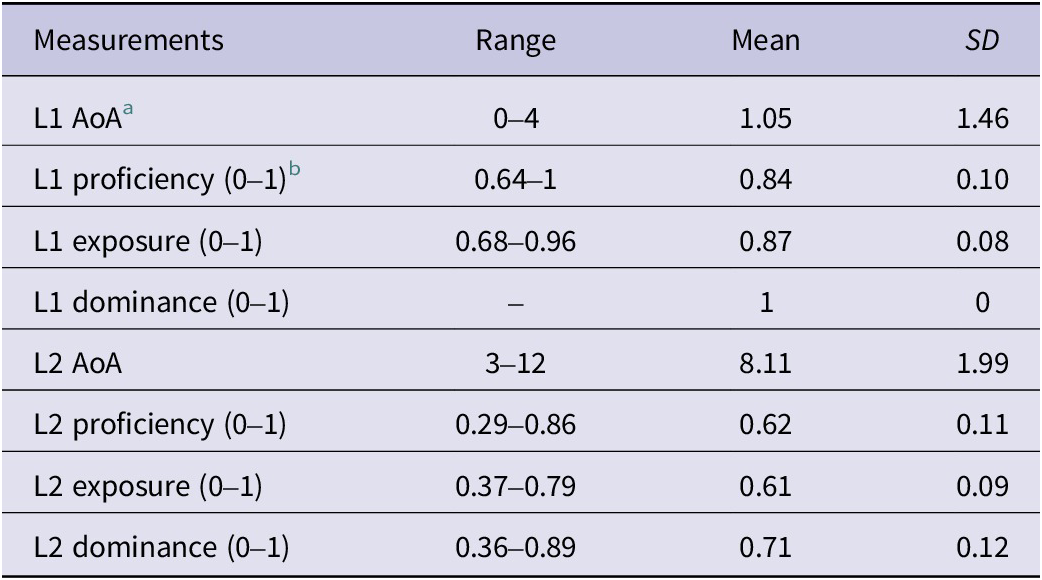
a AoA = age of acquisition;
b The scores from LHQ have been normalized into a range between 0 and 1.
3.1.3. Design and stimuli
Experiment 1 employed a verb–picture matching paradigm that manipulated two categorical variables: language (L1, L2) and effector type (matched same-effector, mismatched same-effector, mismatched different-effector)Footnote 1. As noted earlier, embodiment effects in this experimental paradigm are indicated by slower responses to same-effector pairs compared to different-effector pairs in the mismatched condition, which were the primary focus of our analysis. Therefore, consistent with the prior research (Bergen et al., Reference Bergen, Lau, Narayan, Stojanovic and Wheeler2010), we directly compared the critical differences between same-effector and different-effector sub-conditions using a 2 (Language: L1, L2) × 2 (Effector type: same-effector, different-effector) within-participant design. Moreover, we included L2 AoA, L2 proficiency, L2 exposure, and L2 dominance as continuous variables to assess bilingual experience.
Fifty-two black-and-white stick figures served as picture stimuli: 30 were adapted from Bergen et al. (Reference Bergen, Lau, Narayan, Stojanovic and Wheeler2010), and the remaining 22 were created by the experimenter of this study. These pictures depicted motor actions primarily performed by specific effectors, including mouth/face (17), hand/arm (22), and foot/leg (13), illustrated in Table 2. Accordingly, we selected 52 English and 52 Chinese verbs to match the picture stimuliFootnote 2, which made for matched verb–picture pairs. We used the same set of verbs from the matched pairs to create the mismatched verb–picture pairs, in which we randomly assigned each picture a verb representing a different action with the same effector (e.g., lick–scream.jpg) and a verb depicting an action with different effectors (e.g., kick–scream.jpg). English action verbs consisted of one-syllable words with 3–7 letters. Chinese action verbs included one-character words (e.g., “跑[run],” “吃[eat]”) and two-character words corresponding to single English verbs (e.g., “私语[whisper],” “溜冰[ski]”).
Sample stimuli of Experiment 1
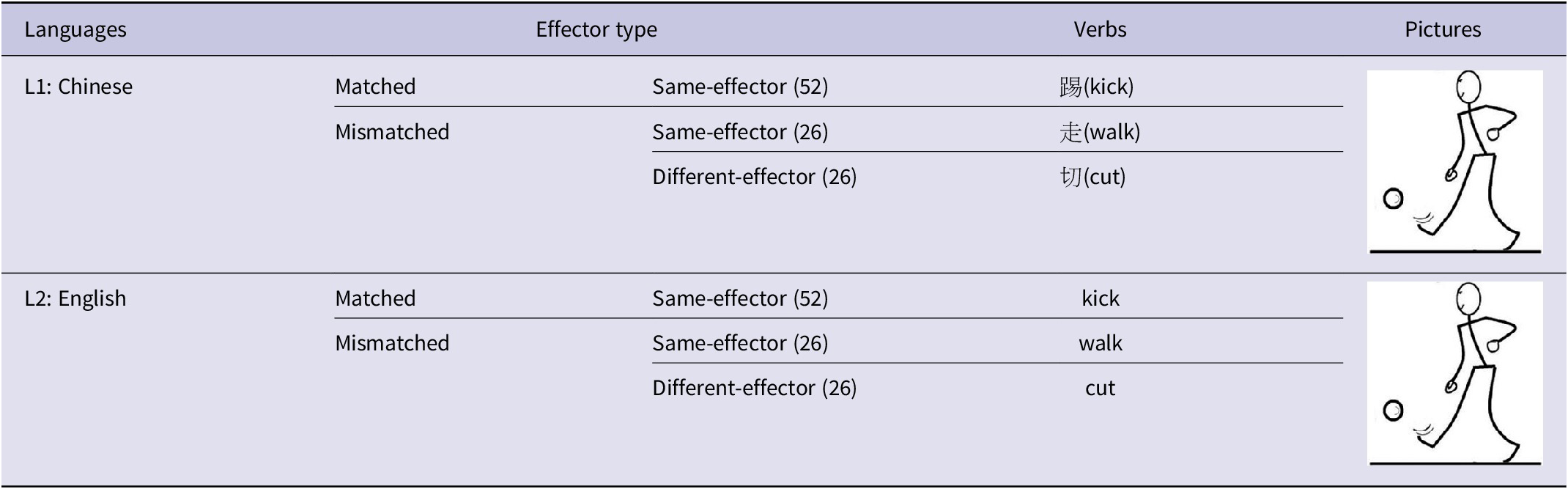
Note: L2 stimuli are equivalent to L1 in terms of meaning. The numbers in parentheses following each effector type indicate the number of verb–picture pairs.
We recruited 20 participants (from the same university as the participants but did not participate in the experiments) to rate the familiarity, imageability, visual complexity, and degree of effector involvement of the picture and verb stimuli on a 7-point scale. Chinese and English verb frequencies were derived from the frequency dictionaries by Cai and Brysbaert (Reference Cai and Brysbaert2010) and Brysbaert and New (Reference Brysbaert and New2009). All the verbs were high-frequent words (Chinese: M = 2739.56, SD = 532.22; English: M = 156.58, SD = 320.06). These frequencies, strokes of Chinese verbs and word length of English verbs matched across different conditions (see Table S2 for details in the Supplementary Material).
Overall, each participant completed the verb–picture matching task in L1 and L2. Each language block contained 52 verb–picture matched pairs and 52 verb–picture mismatched pairs. Half of the mismatched pairs shared the same effector, and half did not. Our focus was comparing the mismatched pairs with the same effector and those with different effectors during L1 and L2 processing.
3.1.4. Procedure
Chinese and English blocks were counterbalanced across participants. The matched and mismatched verb–picture pairs were presented in a pseudorandomized order in each block. Each trial started with a 500-ms fixation at the center of the screen, followed by an action verb lasting 1500 ms and then a 500-ms blank interval. The target picture then appeared for a maximum of 2000 ms or stopped upon responses (Figure S1). Participants were requested to accurately and quickly indicate whether the picture matched the preceding verb by pressing the Yes/No buttons, counterbalanced across participants. E-prime 2.0 (Psychology Software Tools Inc., Pittsburgh, USA) was used for programming and data collection encompassing reaction times (RTs) and accuracy.
3.2. Data analysis and results
All participants had more than 70% accuracy rates, so no one was excluded from the data analysis. Incorrect responses (4.81%) and outliers (M ± 3 SDs per participant under each condition) were removed from the RT data (0.98%). Table 3 summarizes the descriptive statistics of RT and accuracy rates. Given our focus, we only analyzed the mismatched pairs with same-effectors and different-effectors to examine the L2 embodiment effect.
Mean (SD) reaction times and accuracy rates for matched and mismatched (same-/different-effector) conditions in Experiment 1 and semantic-related and semantic-unrelated (same-/different-effector) conditions in Experiment 2
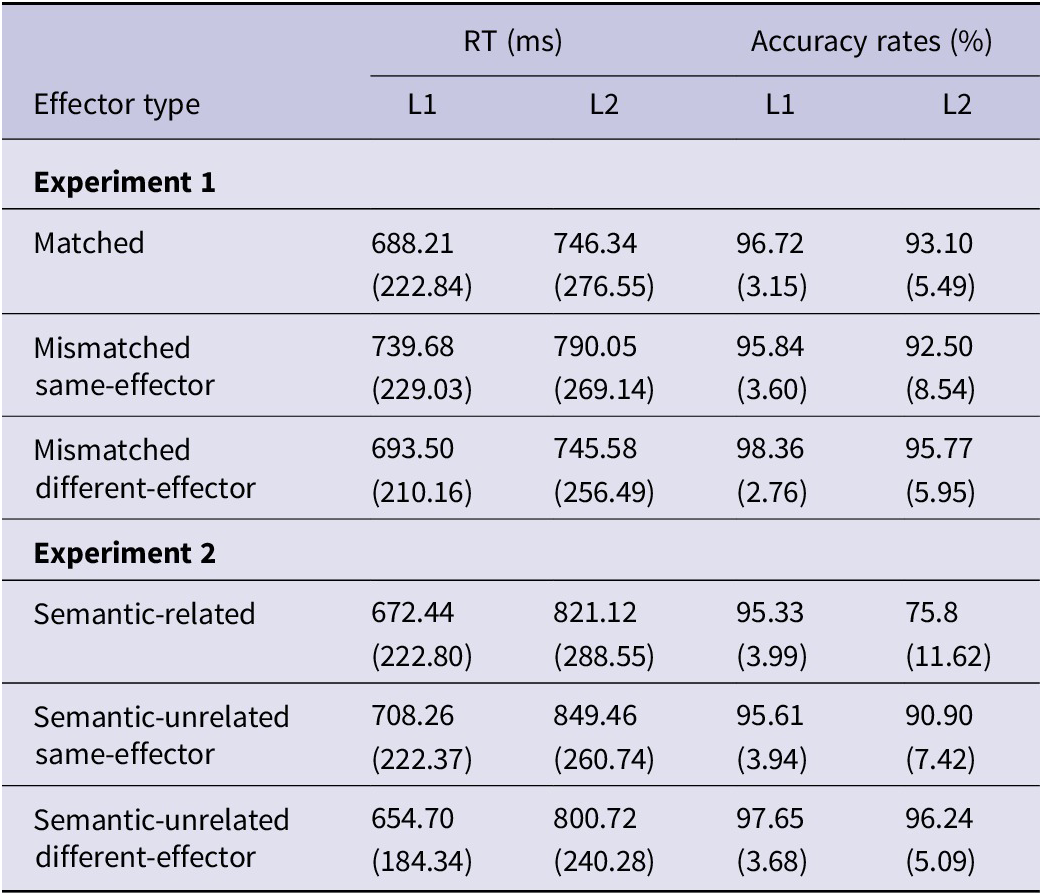
Note: RT = reaction time.
3.2.1. L2 embodiment effect
We applied linear mixed-effects models (LME) to log-transformed RTs in the statistical software R (version 4.3.1, R Core Team, 2023) using the lme4 (version 1.1-27, Bates et al., Reference Bates, Mächler, Bolker and Walker2015) and the lmerTest packages (version 3.1-3, Kuznetsova et al., Reference Kuznetsova, Brockhoff and Christensen2017). To examine the embodiment effect in L1 and L2, we constructed a basic model with language (L1, L2), effector type (same-effector, different-effector) and their interactions as fixed effects. Contrast coding was performed for language (L1 = −0.5, L2 = 0.5) and effector type (different-effector = −0.5, same-effector = 0.5). We started with the maximal random effects structure, which covered random intercepts for participants and items and random slopes for all predictors (Barr et al., Reference Barr, Levy, Scheepers and Tily2013; Matuschek et al., Reference Matuschek, Kliegl, Vasishth, Baayen and Bates2017). When the model failed to converge, we removed the terms in the random effects structure that could not significantly improve the model’s goodness of fit. The final model included by-participant and by-item random intercepts, and by-participant random slopes for language. Significance (p-value) was evaluated using the Satterthwaite approximation (Kuznetsova et al., Reference Kuznetsova, Brockhoff and Christensen2017).
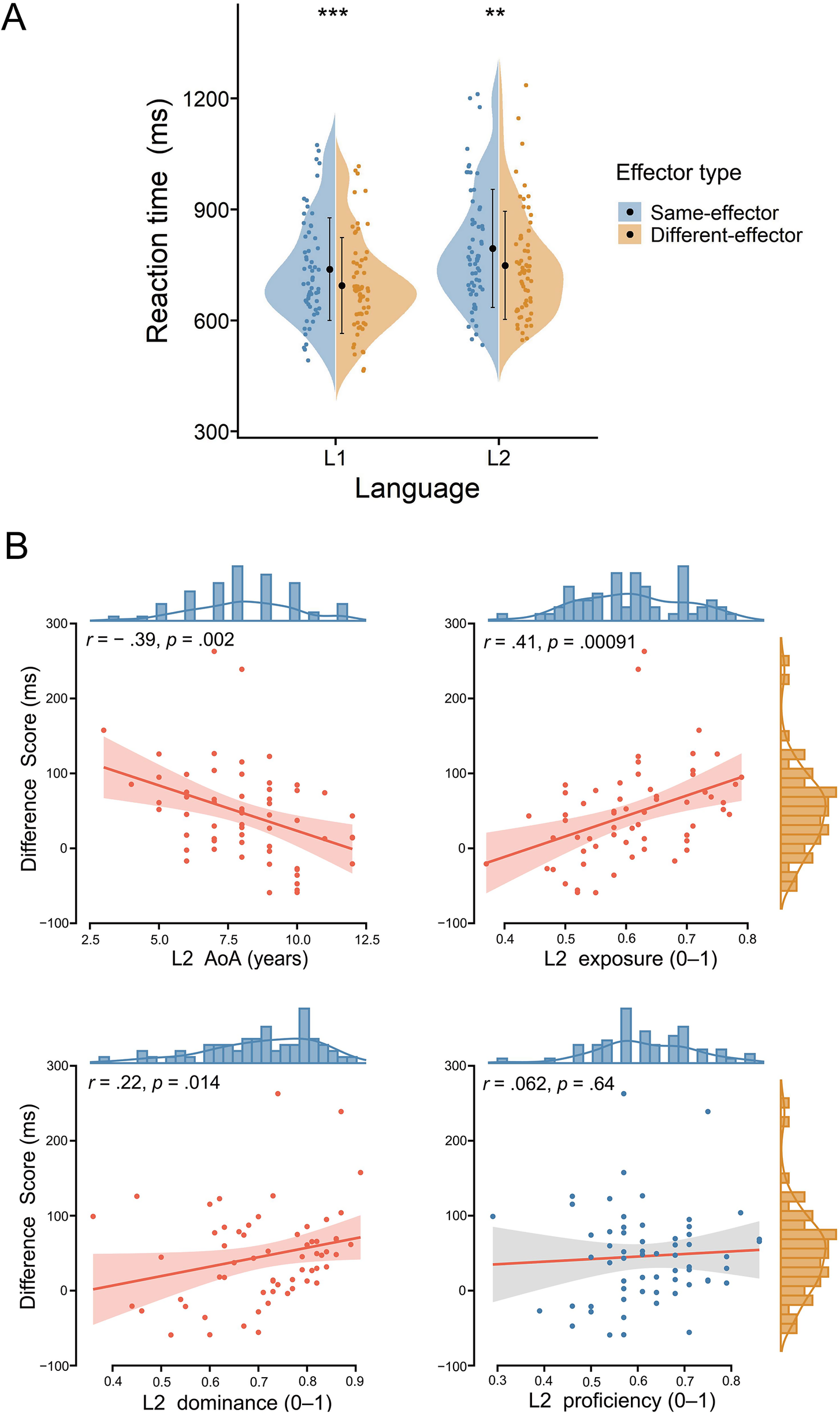
Figure 1A presents the RTs from the verb–picture matching task. The main effect of the effector type was significant (β = 0.06, SE = 0.02, t = 3.53, p < .001). Figure 1A and Table 3 show that participants took longer to make match-or-not judgments in the same-effector sub-condition (M = 765 ± 249 ms) than in the different-effector sub-condition (M = 720 ± 233 ms), indicating an embodiment effect (RTsame-effector > RTdifferent-effector). The main effect of language was significant as well (β = 0.07, SE = 0.02, t = 3.33, p < .01), with faster responses in L1 (M = 717 ± 220 ms) than in L2 (M = 768 ± 263 ms), showing semantic processing differences between the two languages. The interaction effect between language and effector type was not significant (β = −0.001, SE = 0.01, t = −0.12, p = .91). We further examined the main effect of effector type for L1 and L2, respectively, revealing that semantic comprehension of action-related verbs exhibited embodiment effects in both languages: L1 (β = −0.06, SE = 0.02, t = −3.45, p < .001) and L2 (β = −0.06, SE = 0.02, t = −3.20, p < .01), paving the way for exploring the impact of bilingualism on L2 embodiment in subsequent analyses.
(A) Split violin plots showing the RTs of the verb–picture matching task (Experiment 1) in L1 and L2 across different effector types. The black dots show the mean value, and the vertical black lines represent the standard deviation. Asterisks indicate the significance level (**p < .01, ***p < .001). (B) Correlational relationships between L2 AoA, L2 exposure, L2 dominance, L2 proficiency, and the L2 embodiment effect (difference score = RTsame-effector − RTdifferent-effector). Smooth bands represent 95% confidence intervals (the gray band in the bottom-right line graph signifies no statistical significance). Additional histograms in the margins show the distribution of the data.
3.2.2. Correlations between bilingual experience and L2 embodiment
We analyzed the relationship between bilingual experience and L2 embodiment by correlating the four dimensions of bilingual experience with the L2 embodiment effect. Bilingual experiences were quantified using the aggregated scores (see Table 1) of L2 AoA, L2 proficiency, L2 exposure, and L2 dominance. The L2 embodiment effect was calculated as the RT difference between the same and different effector sub-conditions (Difference score = RTsame-effector − RTdifferent-effector). Figure 1B illustrates the significant correlations between L2 AoA, L2 exposure, and L2 dominance with the L2 embodiment effect, which was unrelated to L2 proficiency.
3.2.3. Modulation effect of bilingual experience
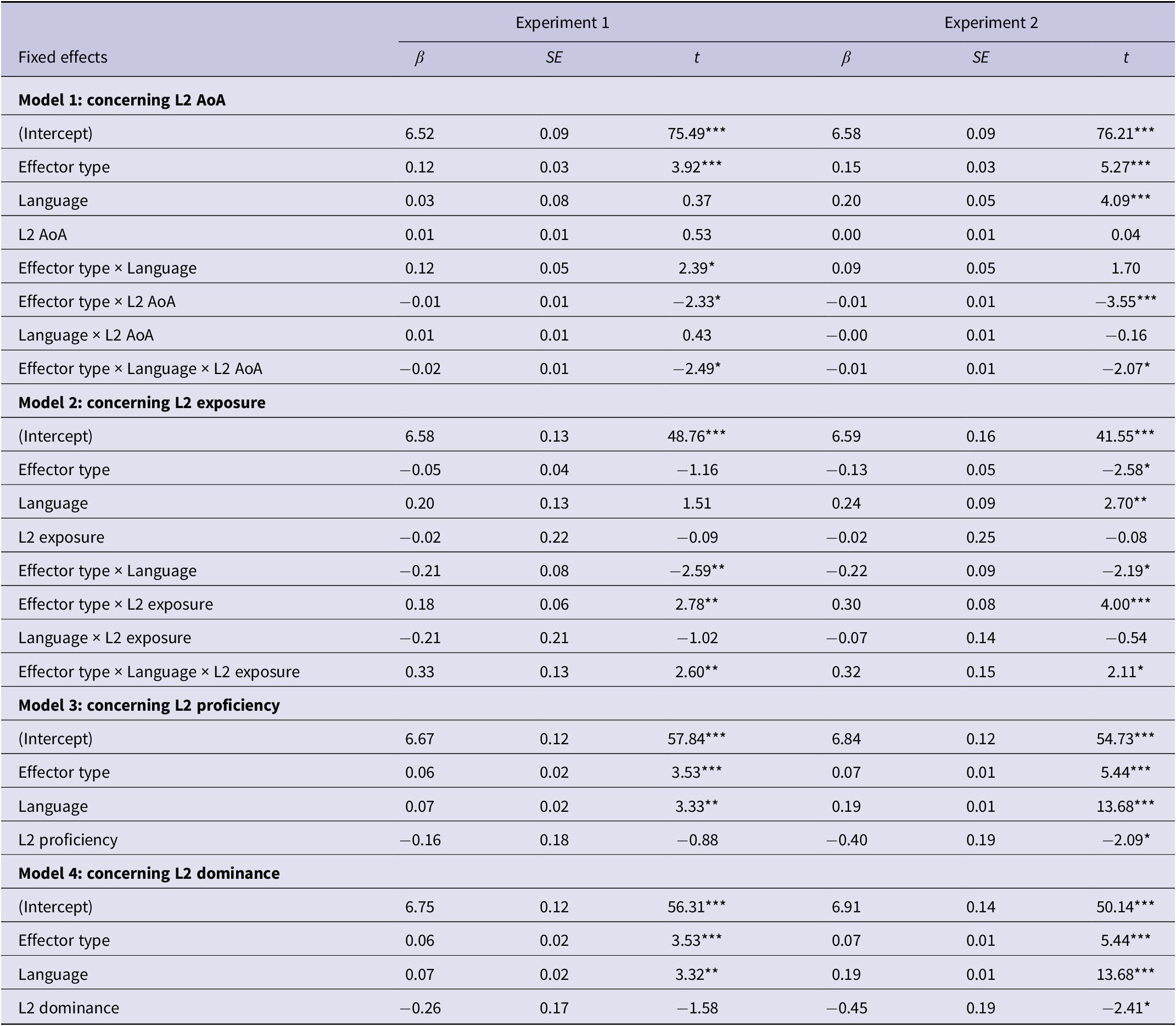
To examine the distinct modulation effects of L2 AoA, L2 exposure, L2 proficiency, and L2 dominance on L2 embodiment, we added each dimension of bilingual experiences one at a time to the prior basic mixed-effects model and constructed four models, respectively. In each model, fixed effects included language, effector type, one dimension of bilingual experience and their interactions (except models 3 and 4)Footnote 3. When the maximal random effects structure met convergence issues, we iteratively simplified each model by removing random effect terms that accounted for the least variance until the model converged. Finally, each model’s best-fitting random effects structure included by-participant and by-item random intercepts alongside by-participant random slopes for Language. Since the effector type denoted the L2 embodiment effect, the interactions between the effector type and the four dimensions of bilingual experience estimated the modulation effect of bilingual experience on L2 embodiment. Table 4 displays the results of the four models.
Summary of the model results for Experiments 1 and 2
Note: *p < .05, **p < .01, ***p < .001.
In what follows, considering our theoretical focus on how bilingual experience modulates the L2 embodiment effect, we primarily concentrated on the interaction effect between the effector type (same-effector vs. different-effector) and the four dimensions of bilingual experience. We employed the releveling/nested effects to analyze these interactions, which entails rearranging levels within independent variables (e.g., language) to create subsets based on specific combinations of variables (e.g., Effector type × L2 AoA).
In model 1 (concerning L2 AoA), we found a significant two-way interaction between the effector type and L2 AoA. Critically, a three-way interaction involving effector type, language, and L2 AoA was also significant. Follow-up analysis of the three-way interaction showed that the Effector type × L2 AoA two-way interaction was significant (β = −0.01, SE = 0.005, t = −3.16, p = .002) in L2 processing (Figure 2) but not in L1 (β = 0.001, SE = 0.004, t = 0.14, p = .89). Specifically, the L2 embodiment effect was evident when L2 AoA was before 9.5 years oldFootnote 4, while this effect diminished beyond this age threshold. Besides, the nonsignificant Effector type × Language interaction (when L2 AoA was before 9.5) implied that bilinguals engage the sensorimotor system similarly in L2 as in L1 when acquiring an L2 at a relatively young age.
Interaction results in Experiment 1. Left: The interaction of L2 AoA with Effector type and Language. Smooth bands represent 95% confidence intervals. The vertical dashed line in the right panel indicates the critical value of L2 AoA for L2 embodiment. Right: The interaction of L2 exposure with Effector type and Language. Smooth bands represent 95% confidence intervals. The vertical dashed line in the right panel indicates the critical value of L2 exposure for L2 embodiment.
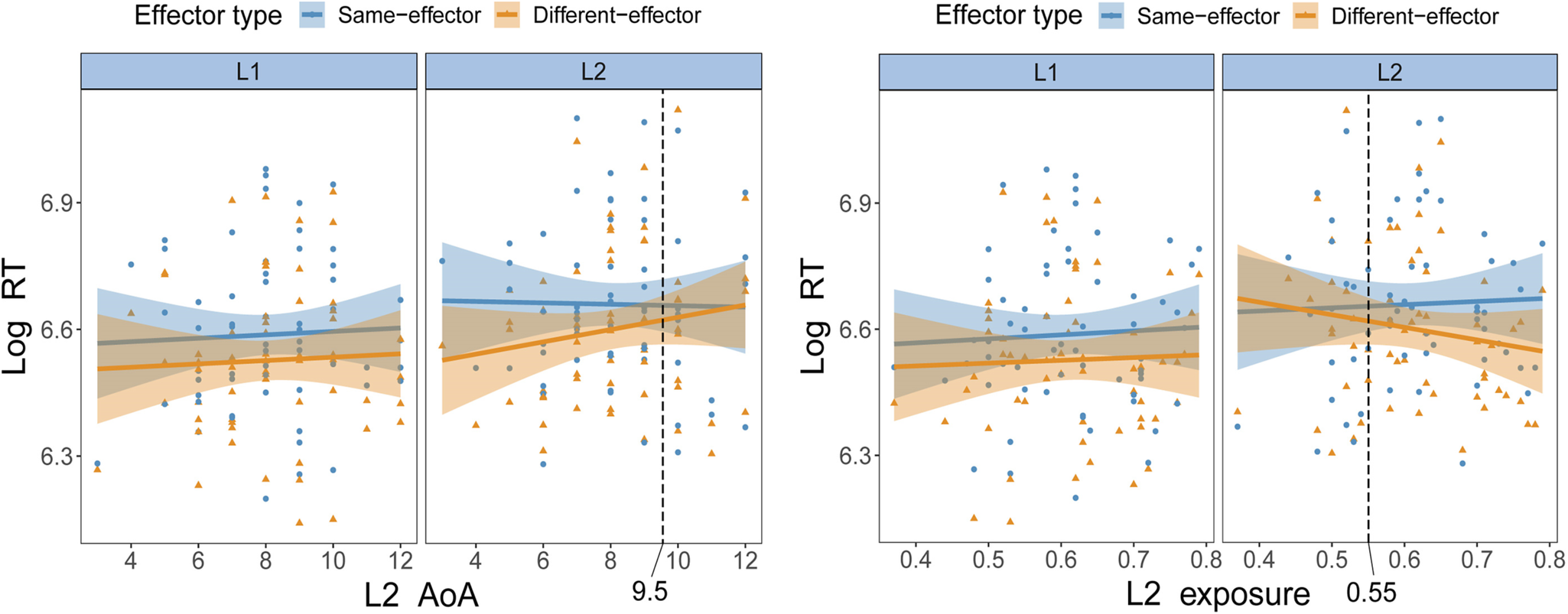
In model 2 (concerning L2 exposure), the interaction between Effector type and L2 exposure was significant. Crucially, the three-way interaction of Effector type × Language × L2 AoA was also significant. Further analyses indicated a significant Effector type × L2 exposure interaction (β = 0.34, SE = 0.10, t = 3.54, p < .001) in L2 processing (Figure 2) but not in L1 (β = 0.01, SE = 0.08, t = 0.12, p = .91). Specifically, the L2 embodiment effect occurred when L2 exposure ranged from 0.55 to 0.79Footnote 5, but it was not evident at lower levels (0.37–0.55). In addition, the nonsignificant Effector type × Language interaction (when L2 exposure exceeded 0.55) suggested that L2 semantic processing entails the sensorimotor system to a similar extent as native language processing when bilinguals have relatively sufficient exposure to an L2. Furthermore, we conducted a principal component regression analysis to explore the individual contributions of the four dimensions to the L2 embodiment effect. The analysis revealed that L2 exposure had the greatest relative weight (see supplementary Text 1, Tables S3 and S4 and Figure S2 for details in the Supplementary Material), indicating a crucial role of L2 exposure in facilitating the employment of embodied mechanisms in L2 semantic processing.
In models 3 (concerning L2 proficiency) and 4 (concerning L2 dominance), only the main effects of effector type and language were significant. There were no interactions between effector type and L2 proficiency or L2 dominance.
4. Experiment 2
Experiment 1 showed that participants were slower to determine whether a picture semantically matched a preceding verb when the verb–picture pairs represented two distinct actions using the same effector, compared to when the actions involved different effectors. However, using visual pictures in Experiment 1 introduced a potential confound due to their inherent visual properties. One possibility is that participants’ slower responses to actions involving the same effector demonstrated the picture’s visual similarity rather than motor property activation (Bergen et al., Reference Bergen, Lau, Narayan, Stojanovic and Wheeler2010). Moreover, the task involved matching pictures with verbs, potentially prompting visual imagery instead of purely linguistic processing. Participants might consciously employ visual strategies in response to the picture stimuli, thereby leading to the observed effects. Experiment 2 addressed these issues by using written verbs instead of pictures and modifying the task to involve semantic relatedness judgments, including verb pairs without obvious effector-related information as fillers. These changes aimed to clarify whether the observed effects stemmed from the automatic activation of motor information during semantic comprehension.
4.1. Method
4.1.1. Participants
The same group of participants in Experiment 1 completed the semantic-relatedness judgment task in Experiment 2.
4.1.2. Design and stimuli
Similar to Experiment 1, we manipulated two independent variables: language (L1 and L2) and effector type (semantic-related same-effector, semantic-unrelated same-effector and semantic-unrelated different-effector)Footnote 6. We focused on the participants’ responses to the same and different effectors in the semantic-unrelated conditions and therefore employed a 2 (Language: L1, L2) × 2 (Effector type: same-effector, different-effector) within-participant design. Moreover, we incorporated L2 AoA, L2 proficiency, L2 exposure, and L2 dominance as continuous variables measuring different dimensions of bilingual experiences.
Table 5 illustrates the samples of experimental materials in Experiment 2, which involved a semantic relatedness judgment task with successive presentation of two verbs. Participants judged whether the target verb was semantically related to the preceding verb in Chinese and English blocks. Each language block comprised 100 verb–verb pairs with effectors (critical trials) and 100 verb–verb pairs without effectors (filler trials). Specifically, critical trials included 50 semantic-related pairs (e.g., flee–escape) and 50 semantic-unrelated pairs, equally divided between same-effector (e.g., swallow–whisper) and different-effector (e.g., applaud–stroll) trials. Likewise, filler trials featured semantically related (e.g., blend–merge) and unrelated (e.g., crack–fade) pairs. All trials were presented in a pseudorandom sequence. Our primary interest is to compare the semantic-unrelated pairs with the same effector versus those with different effectors during L1 and L2 processing.
Sample stimuli of Experiment 2
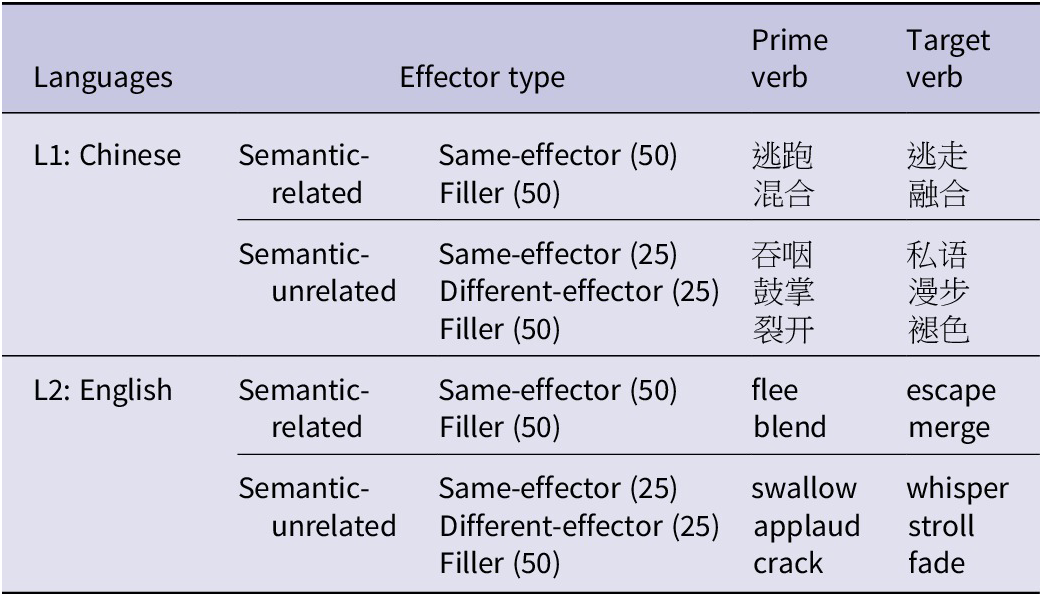
Note: The Chinese prime and target words used in the experiment correspond to the English words. The numbers in parentheses following each effector type indicate the number of verb–verb pairs.
Twenty participants (from the same university as our participants but did not participate in the experiments) rated the verbs’ familiarity, imageability, concreteness, and degree of effector involvement on a 7-point scale. Chinese and English verb frequencies were derived from the frequency dictionaries by Cai and Brysbaert (Reference Cai and Brysbaert2010) and Brysbaert and New (Reference Brysbaert and New2009). All the verbs were high-frequent words (Chinese: M = 1660.30, SD = 570.46; English: M = 100.43, SD = 208.18). These frequencies, strokes of Chinese verbs, and word length of English verbs matched across different conditions (see Table S5 in the Supplementary Material).
4.1.3. Procedure
Experiment 2 followed a procedure akin to Experiment 1. Participants completed Chinese and English blocks in a counterbalanced sequence. Their task involved judging the semantic relatedness of visually presented verb pairs (Figure S1). Each trial began with a 500-ms black fixation cross, followed by a prime verb lasting 1500 ms, then a 500-ms blank interval. Subsequently, participants viewed the target verb for a maximum of 2000 ms or until they responded. They were instructed to press the Yes/No buttons accurately and promptly to indicate whether the target verb was semantically related to the preceding one, with button assignments counterbalanced across participants. RTs and accuracy data were collected.
4.2. Data analysis and results
We excluded 10 participants’ data due to their low accuracy rates (<70%), leaving a final sample of 51 participants (mean age: 22 ± 1.86 years). Table S6 details the remaining participants’ backgrounds. Incorrect responses (7.66%), outliers (M ± 3 SDs) of RT data (0.78%), and filler trials were eliminated from the analysis. We focused solely on the semantic-unrelated trials involving the same and different effectors for analysis. Table 3 provides the descriptive results.
4.2.1. L2 embodiment effect
Following the same modeling procedure (the basic model) in Experiment 1, we put log-transformed RT into an LME, with language (L1 and L2), effector type (same-effector and different-effector), and their interactions as fixed effects. Random effects included by-participant and by-item random intercepts, and by-participant and by-item random slopes for Language. We removed terms accounting for the least variance in the random effects structure from the model. Language and effector type were contrast-coded (L1 = −0.5, L2 = 0.5; different-effector = −0.5, same-effector = 0.5).
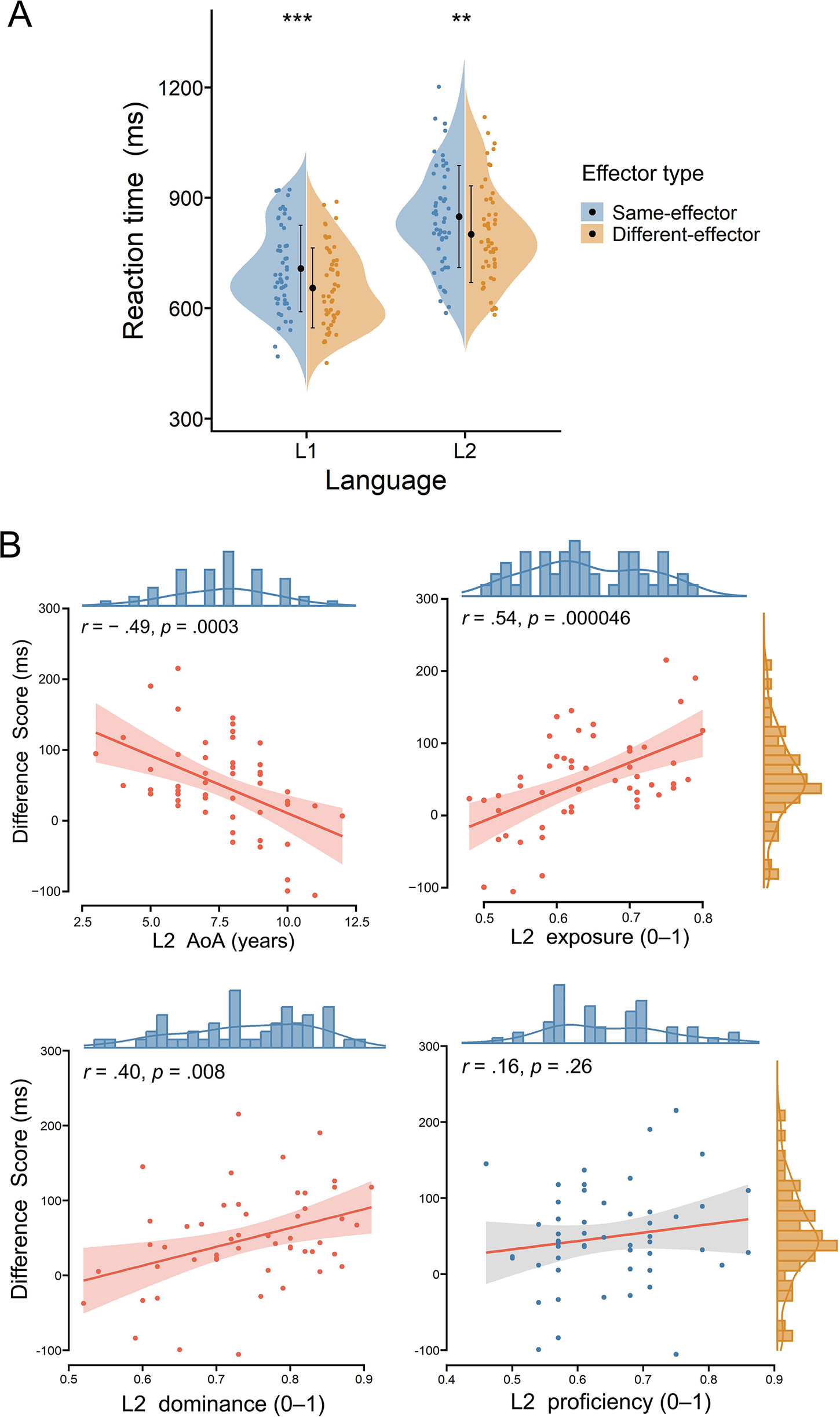
Figure 3A illustrates the RTs from the semantic relatedness judgment task. The main effect of the effector type was significant (β = 0.06, SE = 0.01, t = 4.43, p < .001). Figure 3A and Table 3 show that participants responded more slowly to the same-effector sub-condition (M = 779 ± 242 ms) compared to the different-effector sub-condition (M = 728 ± 212 ms). The main effect of language was significant as well (β = 0.19, SE = 0.01, t = 13.63, p < .001), reflecting faster responses in L1 (M = 681 ± 203 ms) than in L2 (M = 825 ± 251 ms). The interaction between language and effector type did not reach significance (β = −0.012, SE = 0.02, t = −0.62, p = .54). Further examination of the main effect of effector type for L1 and L2 revealed that semantic comprehension of action-related verbs was embodied in both L1 (β = −0.07, SE = 0.01, t = −5.28, p < .0001) and L2 (β = −0.06, SE = 0.02, t = −2.91, p < .01).
(A) Split violin plots showing the RTs of the semantic relatedness judgment task (Experiment 2) in L1 and L2 across different effector types. The black dots show the mean value, and the vertical black lines represent the standard deviation. Asterisks indicate the significance level (**p < .01, ***p < .001). (B) Correlational relationships between L2 AoA, L2 exposure, L2 dominance, L2 proficiency, and the L2 embodiment effect (difference score = RTsame-effector − RTdifferent-effector). Smooth bands represent 95% confidence intervals (the gray band in the bottom-right line graph signifies no statistical significance). Additional histograms in the margins show the distribution of the data.
4.2.2. Correlations between bilingual experience and L2 embodiment
We investigated whether and how bilingual experience interacts with the L2 embodiment by correlating the four dimensions of bilingual experience with the L2 embodiment effect. Figure 3B displays the significant correlations between L2 AoA, L2 exposure, and L2 dominance with the L2 embodiment effect. The L2 proficiency correlation yielded null results, consistent with findings from Experiment 1.
4.2.3. Modulation effect of bilingual experience
To further investigate how bilingual experience modulates the L2 embodiment, similar to Experiment 1, we added each dimension of bilingual experiences one at a time to the prior basic mixed-effects model, constructing four separate models. Each model included language, effector type, one dimension of bilingual experiences and their interactionsFootnote 7 as fixed effects. When the maximal random effects structure cannot converge, we iteratively streamlined the random effect structure until achieving convergence. The final models left by-participant and by-item random intercepts, and by-participant and by-item random slopes for language as the best-fitting random effects structure. Table 4 summarizes the results of the four models. We mainly focused on the interactions between the effector type (same-effector vs. different-effector) and the four dimensions. We analyzed these interactions through the releveling/nested effects.
In model 1 (concerning L2 AoA), we found a significant two-way interaction between the effector type and L2 AoA. Critically, a three-way interaction among effector type, language and L2 AoA was also significant. Follow-up analysis for the three-way interaction showed a significant Effector type × L2 AoA interaction (β = −0.02, SE = 0.005, t = −3.85, p < .001) in L2 processing (Figure 4), but not in L1 (β = −0.005, SE = 0.005, t = −1.07, p = .28). Specifically, the L2 embodiment effect occurred for L2 AoA before 8.4 years old but disappeared after that. Additionally, the nonsignificant Effector type × Language interaction (when L2 AoA was before 8.4) implied that L2 processing engages the sensorimotor system to a similar extent as L1 when one learned an L2 earlier in life.
Interaction results in Experiment 2. Left: The interaction of L2 AoA with Effector type and Language. Smooth bands represent 95% confidence intervals. The vertical dashed line in the right panel indicates the critical value of L2 AoA for L2 embodiment. Right: The interaction of L2 exposure with Effector type and Language. Smooth bands represent 95% confidence intervals. The vertical dashed line in the right panel indicates the critical value of L2 exposure for L2 embodiment.
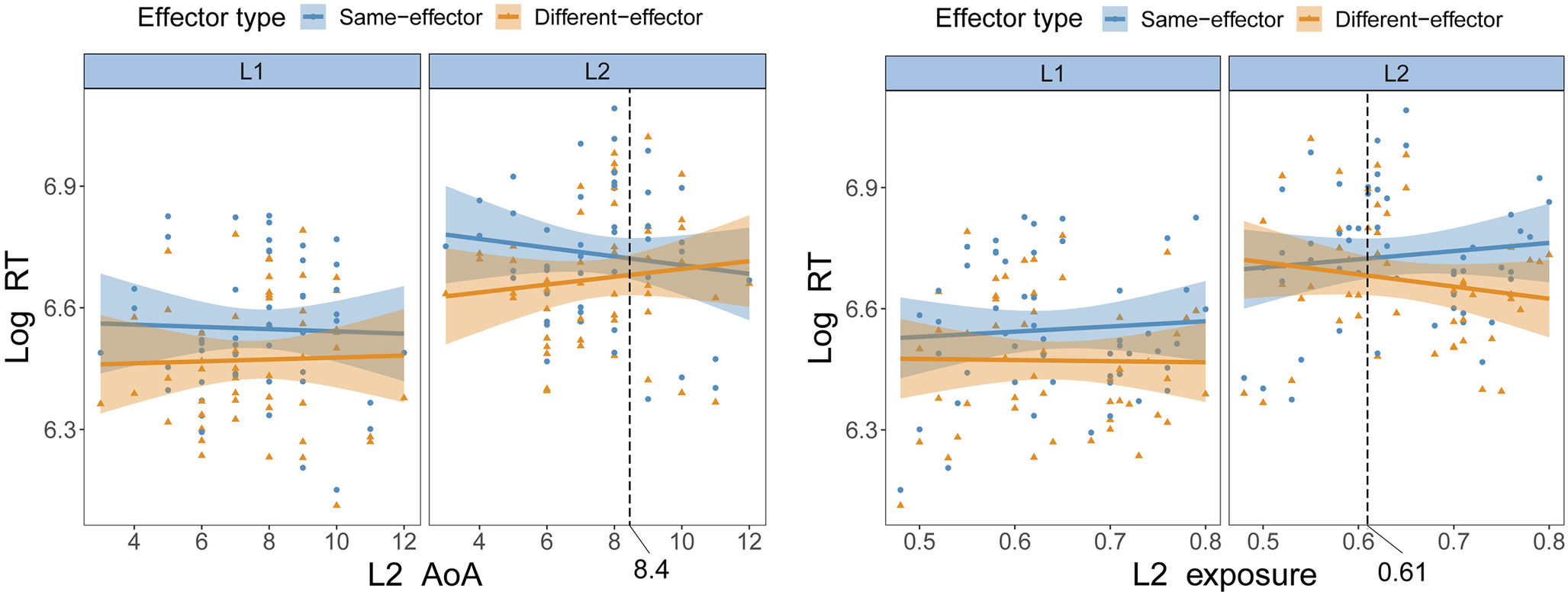
In model 2 (concerning L2 exposure), the three-way interaction between effector type, language, and L2 exposure was significant. Follow-up analysis showed a significant Effector type × L2 exposure interaction (β = 0.46, SE = 0.11, t = 4.20, p < .001) in L2 processing (Figure 4), but not in L1 (β = 0.14, SE = 0.10, t = 1.36, p = .18). Specifically, the L2 embodiment effect was present when L2 exposure ranged from 0.61 to 0.80, but disappeared at lower levels (0.48–0.61). Moreover, the nonsignificant Effector type × Language interaction (when L2 exposure was beyond 0.61) indicated that bilinguals engage the sensorimotor system similarly in L2 as in L1 when sufficiently exposed to an L2. We further performed a principal component regression analysis to explore the individual contributions of the four dimensions to the L2 embodiment effect. Results highlighted that L2 exposure had the greatest relative impact (see supplementary Text 2, Tables S7 and S8 and Figure S3 for details), underscoring its crucial role in the embodiment of L2 semantic processing.
In models 3 (concerning L2 proficiency) and 4 (concerning L2 dominance), we found significant main effects for effector type and language, as well as for L2 proficiency and L2 dominance. There were no interactions between effector type and L2 proficiency or L2 dominance.
In addition, in both Experiments 1 and 2, we analyzed the influence of specific effectors (foot, hand, and mouth) on participants’ response times by adding the effector as an additional covariate in the LME model. Table S9 shows that effector variations did not significantly affect participants’ responses. These findings are specific to our current behavioral data investigation. Future research might explore effector effects using neural methods like EEG or fMRI for more nuanced insights.
Furthermore, as the same participants performed in both experiments, we conducted a repeated measures omnibus analysis, integrating data from both experiments by including “experiment” as a variable in our LME models. The results from the best-fitted model (see Table S10) showed no significant main effect of the experiment, suggesting no obvious differences between the two. Besides, given that the two experiments primarily differed in stimulus modality (words vs. pictures), this finding indicates no significant effect of representation between these modalities in the context of the current study. Future research should further explore how different modalities of representation affect embodiment mechanisms.
To recapitulate, Experiment 2 replicated the findings of Experiment 1, confirming that the embodiment effect existed in both L1 and L2. Moreover, L2 AoA, L2 exposure, and L2 dominance correlated with the L2 embodiment effect, with the strength of this effect modulated by the level of L2 AoA and L2 exposure.
5. Discussion
This study investigated how and to what extent the spectrum of bilingual experience influences the L2 embodiment. We confirmed the involvement of the sensorimotor system in L2 semantic processing among Chinese–English bilinguals by examining participants’ effector-specific responses to mismatched verb–picture pairs (Experiment 1) and semantically unrelated verb–verb pairs (Experiment 2). Meanwhile, using a continuous measurement approach, we quantified various dimensions of bilingual experience and observed that sensorimotor engagement varied as a function of L2 AoA and L2 exposure. These findings offer empirical support for embodied cognition theory in L2 contexts and enhance our understanding of how L2 embodiment interacts with bilingualism.
5.1. L2 embodiment effect
Our study initially investigated whether L2 semantic processing utilizes sensorimotor resources by manipulating effector information embedded in action verbs. As predicted, Chinese–English bilinguals exhibited slower response times to mismatched pairs in Experiment 1 (verb–picture) and semantic-unrelated pairs in Experiment 2 (verb–verb) when the pairs shared the same effector. This outcome reflects a general embodiment of L2 processing and reveals a complex interplay between semantic and sensorimotor processes.
Our findings support the hypothesis that L2 action semantics are grounded in sensorimotor experiences, as evidenced by the increased response times for same-effector pairs. Cognitively, participants tended to incorrectly respond with “yes” to verb–picture/verb pairs sharing an effector, whether perceptually or physically. This inclination may stem from the greater perceived resemblance of same-effector pairs compared to different-effector pairs, particularly when their semantic representations are anchored in multimodal experiences. Consequently, participants needed more time to accurately reject these same-effector pairs with a “no” response. This effector-specific response pattern suggests that L2 learners’ semantic representations are influenced by sensorimotor experiences associated with the action semantics, compatible with the embodied cognition framework.
Further, the cognitive mechanisms underlying L2 embodiment may be linked to bilingual experience. Participants with richer learning experiences, such as early L2 acquisition and abundant L2 exposure, demonstrated a stronger embodiment effect as opposed to those with less extensive L2 learning experiences, indicating that their semantic systems are more tightly coupled with sensorimotor information (Ahn & Jiang, Reference Ahn and Jiang2018; Buccino et al., Reference Buccino, Marino, Bulgarelli and Mezzadri2017). Additionally, the influence of bilingual experience on L2 embodiment at the behavioral level supports the concept of structural and functional plasticity in neural systems (De Grauwe et al., Reference De Grauwe, Willems, Rueschemeyer, Lemhofer and Schriefers2014; Zhang et al., Reference Zhang, Yang, Wang and Li2020). Extensive L2 learning experiences likely shape the neural substrates of semantic and sensorimotor processes (Pliatsikas et al., Reference Pliatsikas, DeLuca and Voits2020), potentially accounting for the observed differences in response times for same-effector pairs in our experiments.
Overall, the present study corroborates the role of sensorimotor networks in L2 processing. This result aligns well with previous studies (Ahlberg et al., Reference Ahlberg, Bischoff, Kaup, Bryant and Strozyk2017; Ahn & Jiang, Reference Ahn and Jiang2018; Bergen et al., Reference Bergen, Lau, Narayan, Stojanovic and Wheeler2010; Buccino et al., Reference Buccino, Marino, Bulgarelli and Mezzadri2017; Dudschig et al., Reference Dudschig, de la Vega and Kaup2014; Vukovic & Shtyrov, Reference Vukovic and Shtyrov2014), though some studies did not observe the embodiment effect in L2, in which, as noted earlier, facilitation effects (e.g., detected using the ACE paradigm in Morey et al., Reference Morey, Kaschak and Díez-Álamo2021 and the SPV task in Chen et al., Reference Chen, Wang, Zhang and Liu2020; Norman & Peleg, Reference Norman and Peleg2022) were taken as signs of the embodiment effect. Drawing methodological insights from prior literature (Shebani & Pulvermüller, Reference Shebani and Pulvermüller2013; Ostarek & Huettig, Reference Ostarek and Huettig2019), our study alternatively used interference effects as an embodiment proxy, potentially offering more compelling evidence than facilitation. Specifically, the interference effect occurs when responding to mismatched or semantic-unrelated pairs describing similar but incompatible actions (same-effector pairs), which simultaneously recruits incongruent motor systems responsible for particular actions. Then stronger mutual inhibition that emerges from actions involving the same effector compared to different effectors (Bergen et al., Reference Bergen, Lau, Narayan, Stojanovic and Wheeler2010; Ostarek & Huettig, Reference Ostarek and Huettig2019) likely interferes with participants’ responses, leading to longer response times for same-effector pairs. This interference suggests a functional role of the sensorimotor system in L2 processing (Bergen, Reference Bergen, Gonzalez-Marquez, Mittelberg, Coulson and Spivey2008; Bergen et al., Reference Bergen, Lau, Narayan, Stojanovic and Wheeler2010; Ostarek & Bottini, Reference Ostarek and Bottini2021), where the need to resolve this inhibition results in delayed response to fully discern verb meanings and correctly make “no” responses. Thus, motor system recruitment is crucial for action-related verb comprehension. Otherwise, effector information cannot modulate response times, and no differences would emerge between the same- and different-effector pairs.
Notably, the observed embodiment effect in our study specifically pertained to action verbs. Further investigation should clarify how this embodied mechanism influences the processing of abstract concepts and modulates L2 syntactic processing. Moreover, in Experiments 1 and 2, we counterbalanced the order of language blocks (L1 first or L2 first) and found no significant effects of language order, though prior research (e.g., Norman & Peleg, Reference Norman and Peleg2022) noted language order effects in visual simulations during SPV tasks. This discrepancy suggests a nuanced relationship between language order and embodiment effects in bilingual comprehension tasks, necessitating additional examination.
5.2. The role of bilingual experience in L2 embodiment
This study further explored how bilingual experience modulates L2 embodiment and revealed the relativity of L2 embodiment. We adopted a continuous assessment to characterize bilingual experience, indexed by L2 AoA, L2 exposure, L2 proficiency and L2 dominance. The observed results are consistent with the hypothesis that individual bilingual experiences shape L2 embodiment. The following section will delineate their respective modulation effects on L2 embodiment.
First, our findings indicated a correlation between L2 embodiment and early L2 AoA, with the strength of this relationship modulated by L2 AoA. This observation aligns with previous studies (Caldwell-Harris et al., Reference Caldwell-Harris, Tong, Lung and Poo2011; Norman & Peleg, Reference Norman and Peleg2022; Tang et al., Reference Tang, Fu, Wang, Liu, Zang and Kärkkäinen2023; for a review: Pavlenko, Reference Pavlenko2012), showing that late bilinguals process linguistic stimuli more semantically and less perceptually or emotionally. A delayed L2 AoA is typically associated with explicit learning methods commonly employed in traditional classroom settings through amodal instructions. Conversely, an early L2 AoA relates to more neural plasticity and implicit L2 learning via multimodal experiences, facilitating more effective modality-specific sensorimotor grounding and integration (Monaco et al., Reference Monaco, Jost, Gygax and Annoni2019).
However, the modulation role of L2 AoA still seems open to question. Some studies found that even processing artificial or lately-learned languages may hinge on modality-specific systems (Macedonia & Mueller, Reference Macedonia and Mueller2016; Macedonia et al., Reference Macedonia, Muller and Friederici2011; Vukovic & Shtyrov, Reference Vukovic and Shtyrov2019), seemingly incompatible with our findings. However, when probing deeper into the learning or training modes used in these studies, we found that most participants underwent training with specific action manipulation or observation during the initial word learning phase (e.g., Bechtold et al., Reference Bechtold, Ghio, Antoch, Turowski, Wittsack, Tettamanti and Bellebaum2019; Öttl et al., Reference Öttl, Dudschig and Kaup2017). For instance, Öttl et al. (Reference Öttl, Dudschig and Kaup2017) trained participants to learn artificial words as labels for novel objects in an interactive manner. In the word learning phase, participants encountered novel objects presented in upper or lower visual fields and learned their labels through interactive engagement. Subsequently, in the testing phase, participants were tasked with matching word colors with upward or downward arm movements in a Stroop-like task. Results showed faster responses when the movement direction matched the word’s referent location during the learning phase, suggesting a connection between words and sensorimotor experiences. Notably, the acquisition context of these newly learned words, characterized by an embodied nature, resembled an early L2 AoA, which might indirectly favor embodiment effects (Kogan et al., Reference Kogan, Muñoz, Ibáñez and García2020b). In addition, researchers noted that embodiment effects for these newly-learned languages attenuated compared to L1. In contrast, our study found no significant distinctions between L2 and L1 embodiment when participants learned the L2 relatively early. Thus, an early L2 AoA remains crucial for the emergence of embodiment effects, especially for L2 learners in formal educational settings.
Furthermore, the line of the above reasoning prompts consideration that while early L2 AoA correlates with L2 embodiment effects, this correlation may exhibit nonlinearity. Bilinguals acquiring their L2 later in life may still process the language through embodied mechanisms, especially when the acquisition process involves interactive bodily experiences. Early L2 AoA may not be the sole determinant of L2 embodiment, and mediating factors, such as the context or mode of L2 learning (e.g., formal instruction vs. immersion), warrant further exploration, as Monaco et al. (Reference Monaco, Jost, Lancheros, Harquel, Schmidlin and Annoni2021) suggested.
Our analysis also revealed that L2 exposure correlated with and modulated the L2 embodiment effect. To our knowledge, language exposure has rarely been manipulated in previous studies on bilingualism and embodiment. Allegedly, it may be interrelated with AoA and proficiency. Here, our findings suggest that increased L2 exposure is directly proportional to the L2 embodiment effect. Furthermore, among the four dimensions examined, L2 exposure emerges as the most influential factor in fostering L2 embodiment. This observation is reminiscent of Hebbian learning, which posits that “what fires together wires together” (Hebb, Reference Hebb1949). According to the principle of Hebbian learning, our study suggests that recurrent exposure to action words alongside their corresponding motor information helps to strengthen semantic-sensorimotor associations underlying language embodiment (Pulvermüller, Reference Pulvermüller, Hauk, Nikulin and Ilmoniemi2005). Sustained L2 exposure allows L2 conceptual representations to be more easily linked to real-world referents with less L1 mediation. Thus, the L2 embodiment effect varied as a function of L2 exposure. Nonetheless, these findings could serve as preliminary data, leaving open questions regarding why L2 exposure significantly contributes to L2 embodiment and the underlying mechanisms through which it subserves L2 semantic grounding. Future studies should delve into these areas, offering additional behavioral and neurological evidence.
The current study fortunately identified a correlation between L2 dominance and the L2 embodiment effect. However, despite the broad distribution of L2 dominance scores, no modulation role was evident in either experiment. So far, our understanding of how L2 dominance affects L2 embodiment remains limited owing to the scarcity of relevant research. In our investigation, participants primarily used their L2 in conventional classroom settings, lacking immersive and interactive language contexts. This limitation may undermine the potential impact of high levels of L2 dominance, resulting in a less pronounced modulation role of L2 dominance in sensorimotor resonance.
Moreover, unexpectedly, our study observed no significant modulation effects of L2 proficiency on L2 embodiment, consistent with several recent research findings (Chen et al., Reference Chen, Wang, Zhang and Liu2020; Kogan et al., Reference Kogan, García-Marco, Birba, Cortés, Melloni and Ibáñez2020a; Monaco et al., Reference Monaco, Mouthon, Britz, Sato, Stefanos-Yakoub, Annoni and Jost2023; Zhang et al., Reference Zhang, Yang, Wang and Li2020). Reaching a definite conclusion on the role of L2 proficiency in embodiment proves challenging due to various factors. In our study, we attribute the absence of significant effects to the notion proposed in previous research, indicating that L2 proficiency primarily modulates bilingual language executive control (Bonfifieni et al., Reference Bonfifieni, Branigan, Pickering and Sorace2019; Xie, Reference Xie2018) and attention networks (Dash et al., Reference Dash, Joanette and Ansaldo2022; Tse & Altarriba, Reference Tse and Altarriba2014; Xing & Yang, Reference Xing and Yang2023). However, regarding sensorimotor grounding, L2 proficiency appears to have a relatively peripheral and less sensitive role compared to other dimensions, at least based on the current study’s outcomes.
Altogether, conceptualizing bilingualism as a continuous and multifaceted phenomenon allows us to systematically disentangle the distinct roles of L2 AoA, exposure, dominance, and proficiency in L2 embodiment. However, caution is warranted when assessing the modulation role of a specific variable, as their interconnected nature makes it challenging to establish causal relationships and generalize findings to diverse bilingual populations (Marian & Hayakawa, Reference Marian and Hayakawa2021). This complexity underscores the potential benefit of a unified indicator, such as the “bilingualism quotient” proposed by Marian and Hayakawa (Reference Marian and Hayakawa2021), which consolidates various components of bilingual experience into a single index.
As a whole, the current findings offer valuable insights into L2 embodiment, underscoring that its presence varies among bilinguals based on varying L2 learning experiences, such as the timing of L2 acquisition and the degree of L2 exposure (Claussenius-Kalman et al., Reference Claussenius-Kalman, Hernandez and Li2021; DeLuca et al., Reference DeLuca, Rothman, Bialystok and Pliatsikas2020). In line with our hypothesis, early L2 acquisition and substantial L2 exposure are conducive to a more embodied approach to L2 processing, akin to L1 embodiment. In contrast, according to the dual-coding knowledge neural framework (Bi, Reference Bi2021; Wang et al., Reference Wang, Men, Gao, Caramazza and Bi2020), which differentiates between sensory-derived (embodied) and language-derived (disembodied) concept representations, we speculate that late L2 acquisition and limited L2 exposure may correspond to a more symbolic and disembodied processing mechanism. This hypothesis is corroborated by Momenian et al. (Reference Momenian, Bakhtiar, Chan, Cheung and Weekes2021), who demonstrated that bilinguals with less L2 experience rely more on symbolic-based mechanisms in action word processing. Crucially, the above analysis implies that L2 semantic processing is not solely embodied or completely disembodied, reinforcing Willems and Francken’s (Reference Willems and Francken2012) call for a reevaluation of embodied cognition by transcending binary distinctions and developing more nuanced theories of bilingualism-induced L2 embodiment.
5.3. Limitations and future studies
The current study has several limitations that merit further investigation. First, the relationship between symbolic and embodied semantic representations in L2 processing remains unclear, as our assumption of their coexistence has not received empirical confirmation. Future research agendas should aim to develop a unified notion considering both forms and addressing questions such as their integration or separation, functional roles and developmental trajectories underlying the dynamics of bilingual experience (Bi, Reference Bi2021). Second, our study mainly investigated the linear relationship between bilingual experience and L2 embodiment. While we controlled for additional variables (e.g., L2 learning context and mode) across participants, these variables may moderate the factors examined. Future research should endeavor to investigate nonlinear relationships with these mediating variables factored into the experimental design. Third, our study represented the first attempt to explore the impacts of multiple dimensions of bilingual experience on L2 embodiment, with the results confined to their respective contributions. Upcoming research could explore the interrelationships between these dimensions and their combined effects on L2 embodiment. Finally, our sample of participants is relatively homogeneous with less varied L2 experiences. Nevertheless, we also observed a pronounced effect of L2 exposure. Encompassing a more diverse range of participants would enhance the generalizability of our findings and advance the understanding of L2 embodiment. Besides, from a practical perspective, future investigations can incorporate embodied insights into L2 acquisition models, such as grounding L2 learning in social interaction (Li & Jeong, Reference Li and Jeong2020) and utilizing immersive technologies like virtual reality (Legault et al., Reference Legault, Zhao, Chi, Chen, Klippel and Li2019; Li et al., Reference Li, Legault, Klippel and Zhao2020) to facilitate L2 learning and teaching.
6. Conclusion
In conclusion, our findings highlight the significant impact of bilingual experience, characterized as a multifaceted and continuous phenomenon, on L2-embodied semantic systems. Early and substantial exposure to an L2 correlates with the increased recruitment of these systems, with L2 exposure emerging as the most influential factor. Our study responds to recent calls for a nuanced understanding of bilingualism as a multidimensional spectrum and sheds light on the relative L2 embodiment modulated by bilingual experience. Crucially, our evidence weighs against the simplistic dichotomy of L2 processing as purely embodied or disembodied, introducing fresh insights into the dual nature of L2 semantic representations and offering promising avenues for enhancing L2 learning and teaching strategies.
Supplementary material
To view supplementary material for this article, please visit http://doi.org/10.1017/S1366728924000981.
Data availability statement
The data supporting this study’s findings are openly available in OSF at https://osf.io/zqp8b/.
Acknowledgments
This study was supported by a grant from the Zhejiang Provincial Philosophy and Social Sciences Programme of Leading Talents Cultivation Project for Distinguished Young Scholars (23YJRC01ZD-1YB). The authors would like to thank Professor Benjamin Bergen for providing part of the picture stimuli. The authors would also like to thank the Language Learning and Brain (LLaB) group members for their feedback.
Competing interest
The authors have no conflicts of interest to declare.


 Open access

