




Introduction
Archaeology is widely recognised as a powerful tool for assessing past social, religious and cultural developments. Diachronic accounts of mortuary practice, however, have always encountered considerable methodological and conceptual challenges, with poorly resolved data, chronological uncertainty and the predominance of explanatory frameworks borrowed from narrative history (e.g. migration, Christianisation) representing key issues. Nevertheless, Ireland presents a data-rich case study for addressing these problems, due to a boom in recent excavations that have produced a volume of radiocarbon dates capable of revealing radical new patterns that stand outside of, and in opposition to, traditional paradigms (see Armit et al. Reference Armit, Swindles and Becker2013; Hannah & McLaughlin Reference Hannah and McLaughlin2019). The first millennium AD is particularly well attested in this dataset, encompassing a quarter of all radiocarbon-dated samples. While the dataset offers an important empirical basis for questioning dominant views of burial rites and their socio-religious imperatives, its potential remains underexploited.
Specifically, evidence for human cremation across the first millennium AD in Ireland has accumulated. Despite recent syntheses (e.g. O'Brien Reference O'Brien2020: 30–32), however, there has been little re-appraisal of general models and the basic principles narrating the evolution of burial rites; a priori assumptions linking burial, religion, ideology and commemoration have remained relatively static since the 1990s (O'Brien Reference O'Brien, Edwards and Lane1992, Reference O'Brien, Downes and Ritchie2003, Reference O'Brien and Edwards2009, Reference O'Brien, Edwards, Ní Mhaonaigh and Flechner2017, Reference O'Brien2020; O'Sullivan et al. Reference O'Sullivan, Mccormick, Kerr and Harney2013: 320–21). This article identifies newly recognisable patterns in the radiocarbon data, reviewing their nature, and establishing a new chronology for the evolution of burial practices in Ireland. Here, we present a new model for how ideologies and commemorative strategies evolved within a crucial period of social flux and religious transformation in Northern Europe.
Archaeological background
The study of the dead in first-millennium AD Ireland has been transformed considerably due to an upsurge in new excavations, scientific dating of legacy material and new theoretical developments (e.g. Seaver Reference Seaver, Cronan, Danaher and Stanley2011). Alongside the publication of large-scale, developer-led cemetery excavations (e.g. Corlett & Potterton Reference Corlett and Potterton2010), two projects have contributed a step-change to the empirical basis of funerary archaeology: the Breaking ground, finding graves publication (Cahill & Sikora Reference Cahill and Sikora2012), and the ‘Mapping Death’ project led by Elizabeth O'Brien (Reference O'Brien2020). The latter, in particular, provides a synthesis and transformative reappraisal that builds on, but also corrects, earlier scholarship (e.g. Raftery Reference Raftery and Ó Corráin1981; O'Brien Reference O'Brien1990, Reference O'Brien, Edwards and Lane1992, Reference O'Brien1993), presenting a new model for how burial evolved throughout the first millennium AD (O'Brien Reference O'Brien, Downes and Ritchie2003, Reference O'Brien and Edwards2009, Reference O'Brien, Edwards, Ní Mhaonaigh and Flechner2017). Despite presenting a firmer basis for dating change, with few exceptions (e.g. Ó Carragáin Reference Ó Carragáin, Graham-Campbell and Ryan2009; McGarry Reference McGarry, Corlett and Potterton2010), this wider interpretative framework has remained unchallenged.
It is generally agreed that cremation was the dominant burial practice in later prehistoric Ireland until the fourth century AD (McGarry Reference McGarry2008). Although a short phase of Iron Age crouched and flexed inhumation has been identified (McGarry Reference McGarry2008, Reference McGarry, Corlett and Potterton2010: 173; O'Brien Reference O'Brien and Edwards2009; Eogan Reference Eogan2012: 13–44), this was limited to a small number of high-status, exotic burials. O'Brien (Reference O'Brien, Downes and Ritchie2003, Reference O'Brien and Edwards2009, Reference O'Brien, Edwards, Ní Mhaonaigh and Flechner2017) argues that crouched inhumation developed in Ireland due to influence from Britain, and that from the fourth century AD, a new rite of west–east, extended inhumation developed under influence from Roman Britain, before becoming dominant.
Significant variation more comparable to the diversity recognised elsewhere in early medieval Europe (Williams Reference Williams2006; Price Reference Price, Brink and Price2008; Petts Reference Petts, Sayer and Williams2009; Maldonado Reference Maldonado2013), however, is now recognised within inhumation practices across Ireland (e.g. Seaver Reference Seaver, Cronan, Danaher and Stanley2011). Extended inhumations can, for example, be found in simple dug graves, stone-lined cists, burials with pillow stones, and burials laid upon planks of wood (sometimes charred), or accompanied by prime cuts of meat, antler tine or burnt grain (O'Brien Reference O'Brien and Edwards2009, Reference O'Brien, Edwards, Ní Mhaonaigh and Flechner2017, Reference O'Brien2020: 58–131). Grave goods are rare and generally restricted to dress items representing a funerary costume or burial shroud, rather than material offerings. O'Brien (Reference O'Brien1999, Reference O'Brien, Downes and Ritchie2003, Reference O'Brien2020: 171–81) argues that some such examples of seemingly non-normative and/or ‘furnished’ burials were exotic or ‘intrusive’, representing individuals from northern or eastern Britain (i.e. ‘Pictish’ or ‘Anglo-Saxon’). Subsequent isotopic research has often failed to confirm this theory, while also suggesting non-local origins for other burials accorded established, local and normative mortuary treatment (Cahill-Wilson et al. Reference Cahill-Wilson, Standish and O'Brien2014; Cahill-Wilson & Standish Reference Cahill-Wilson and Standish2016). Similarly, west–east extended inhumation in Britain has been shown to encompass a heterogeneous group of commemorative strategies that defy normative classifications, or specific ethnic or religious descriptors (Williams Reference Williams2006; Petts Reference Petts, Sayer and Williams2009; Maldonado Reference Maldonado2013). While more research is needed to clarify this evidence, specific burial practices can no longer be regarded as ‘intrusive’ within such ostensibly culture-historical frames of reference.
This diverse heterogeneity is increasingly evidenced in Ireland, particularly regarding the locus of burial. Inhumations are known from flat cemeteries that are sometimes highly organised, sometimes enclosed within ring-ditches or penannular enclosures, or inserted into older monuments (O'Brien Reference O'Brien and Edwards2009, Reference O'Brien, Edwards, Ní Mhaonaigh and Flechner2017: 263–65, Reference O'Brien2020: 58–102). Enclosed burial complexes seemingly proliferate c. AD 400–600, with a variety of associated activities (e.g. crop-processing) leading to their classification as ‘cemetery-settlements’ (Ó Carragáin Reference Ó Carragáin, Graham-Campbell and Ryan2009; O'Sullivan et al. Reference O'Sullivan, Mccormick, Kerr and Harney2013: 306–12). Some such complexes expanded over subsequent centuries, with further enclosures added to accommodate larger numbers. Until recently, evidence for cremation after AD 400 was limited (McGarry Reference McGarry2008; O'Sullivan et al. Reference O'Sullivan, Mccormick, Kerr and Harney2013: 285), and it is only with the development of methods for radiocarbon-dating cremated bone (Lanting & Brindley Reference Lanting and Brindley1998) that the number of early medieval cremations otherwise assumed to be prehistoric has become apparent. Correspondingly, using both focused analysis and synthetic, cross-cultural and diachronic studies, cremation has been theorised globally as a complex and refined mortuary technology (e.g. McKinley Reference McKinley, Tarlow and Nilsson-Stutz2013; Kujit et al. Reference Kujit, Quinn and Cooney2014; Cerezo-Román et al. Reference Cerezo-Román, Wessman and Williams2017). Nevertheless, a general consensus persists in Irish and early medieval European scholarship that post-conversion cremation is isolated, pagan and exceptional, rather than commonplace.
Few in Ireland have challenged the idea that west–east extended inhumation became the dominant mode of burial in the fifth to sixth centuries, becoming widespread by AD 600 (McGarry Reference McGarry, Corlett and Potterton2010: 174; O'Sullivan et al. Reference O'Sullivan, Mccormick, Kerr and Harney2013: 285 & 320–21). Following trends in British scholarship, O'Brien (Reference O'Brien, Downes and Ritchie2003, Reference O'Brien and Edwards2009) has been reticent about assigning ideological labels such as ‘pagan’ or ‘Christian’ to specific inhumation practices, while insisting that cremation remained ‘pagan’ (e.g. O'Brien Reference O'Brien2020: 32). The earliest radiocarbon dates for west–east extended inhumation, however, span the later third to early sixth centuries. We cannot be certain, therefore, that this practice originated before AD 400. Consequently, some scholars suggest an origin for west–east extended inhumation in conversion-period Ireland that more closely aligns to Christianising contexts (Ó Carragáin Reference Ó Carragáin, Graham-Campbell and Ryan2009; McGarry Reference McGarry, Corlett and Potterton2010: 196–97; Gleeson Reference Gleeson, Edwards, Ní Mhaonaigh and Flechner2017: 307–308). O'Brien, however, remains insistent (Reference O'Brien, Edwards, Ní Mhaonaigh and Flechner2017: 261, Reference O'Brien2020: 49) on a Late Roman origin—distinct from the Romano-Christian practices—of northern and western Britain, in particular. Instead, she suggests that evidence for ‘Christianisation’ is stronger from the later seventh century, a time when ‘ancestral’ cemeteries fell out of use due to churchyards becoming the focus of burial. The archaeological evidence for this, however, is limited, and post-excavation bias must be considered: stratigraphically early burials tend to be dated to establish foundation dates, with phasing in many cases determined arbitrarily through changes in burial orientation or overall site morphologies (see various examples in Corlett & Potterton Reference Corlett and Potterton2010).
Similarly, few large-scale excavations have occurred within ecclesiastical precincts. The small eighth-century radiocarbon dataset from these sites provides little indication of contemporaneous expansion in inhumation burial. A growing number of non-ecclesiastical sites with large numbers of dated burials show continuity in burial tradition spanning AD 800–1200 and beyond (e.g. Lehane et al. Reference Lehane, Muniz-Perez, O'Sullivan, Wilkins, Corlett and Potterton2010). Nevertheless, it appears that non-ecclesiastical cemeteries were generally not established after the eighth century—a factor potentially indicative of wider socio-cultural trends, such as changing group identities or demographic decline (Gleeson Reference Gleeson, Edwards, Ní Mhaonaigh and Flechner2017; Hannah & McLaughlin Reference Hannah and McLaughlin2019). While other explanations are possible, this overview clearly highlights major empirical issues with established models and the culture-historical paradigms surrounding them. There remains much to unravel about changing contexts of burial and the role of mortuary theatre in religious transformation. Holistic analyses of radiocarbon data can help to resolve this, with cremation chronologies as one key example.
Methodology
We collated radiocarbon data from various published sources, ‘grey’ literature and online databases (e.g. Chapple Reference Chapple2019; Mapping Death n.d). Dates pertaining to cremation were identified by reviewing excavation reports and other metadata, with background data for Ireland provided by Hannah and McLaughlin (Reference Hannah and McLaughlin2019) and for Britain by Bevan et al. (Reference Bevan, Colledge, Fuller, Fyfe, Shennan and C.2017). Radiocarbon data were calibrated using IntCal20 (Reimer et al. Reference Reimer2020). As our interest lies in modelling the temporal frequency distribution of cremation events as a continuum without prior knowledge of their distribution in time, we use kernel density estimation (KDE; e.g. Bronk Ramsey Reference Bronk Ramsey2017). Using Monte Carlo simulation (the MCdensity algorithm; see McLaughlin Reference McLaughlin2019) and a Gaussian kernel with a 50-year bandwidth, our KDE models estimate the temporal frequency of dates from cremations, while simultaneously expressing calibration uncertainty.
Results
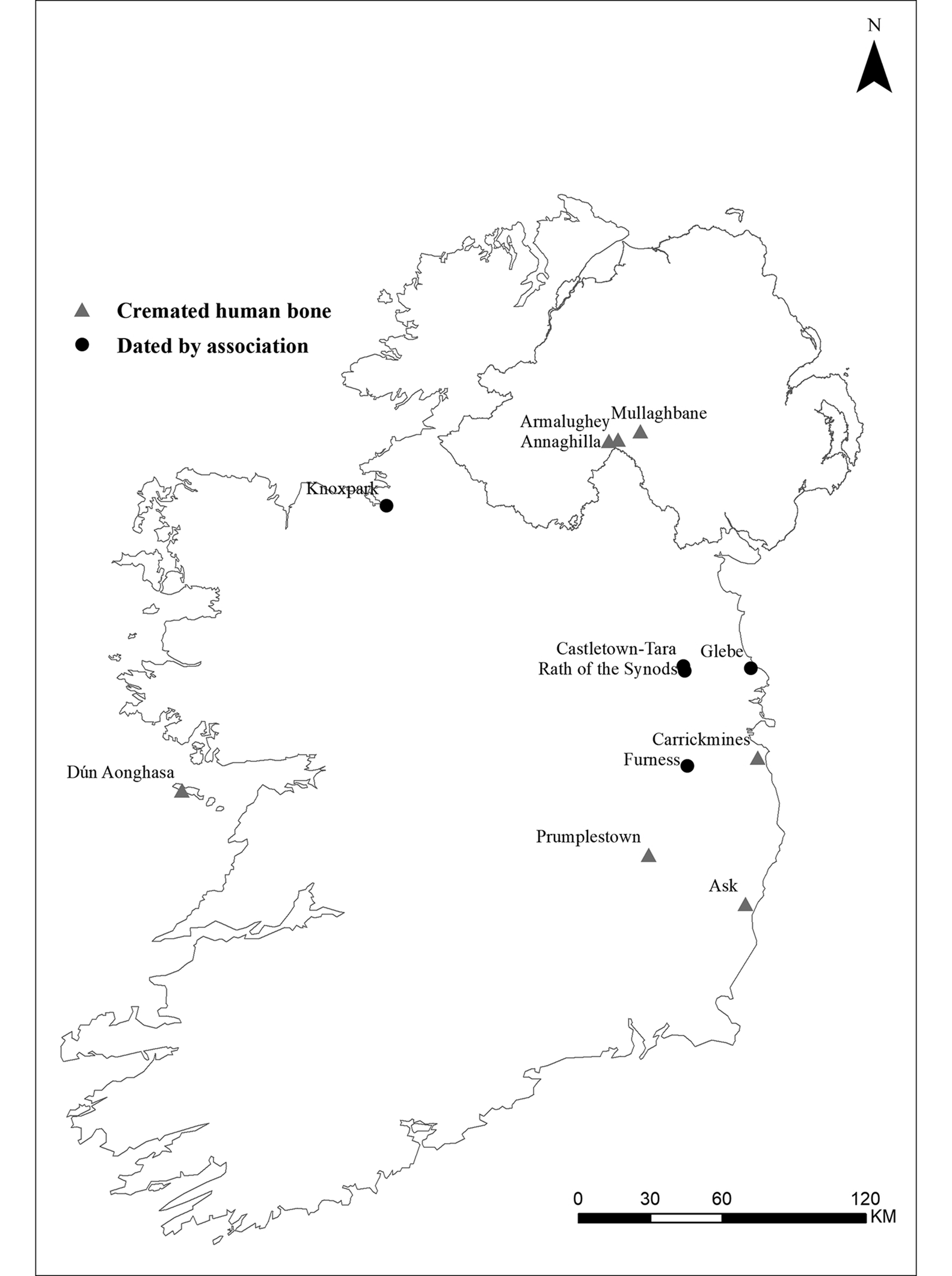
Table S1 in the online supplementary material (OSM) catalogues the radiocarbon dates spanning 200 BC–AD 1200 for directly dated cremated bone, or grain found within cremation material. This includes 27 dates before AD 400 and 27 dates for the period AD 300–1200, with 22 of the latter on cremated human bone from seven sites (Figure 1): Carrickmines (Dublin); Mullaghbane, Annaghilla and Armalughey (Tyrone); Ask (Wexford); Dún Aonghasa (Galway); and Prumpelstown Lower (Kildare). Additionally, cremations from six further sites are probably early medieval, given their direct association with dated material. These comprise five examples of grain in pits containing cremated human bone at Castletown-Tara (Meath); one from Knoxpark (Sligo), where animal bone stratified below cremated bone was dated to AD 559–663 and AD 716–971; charcoal from a cremation at Glebe South (AD 232–531); and charcoal associated with cremated bone within a ditch at Ardsallagh 2 (AD 643–774). Similarly, cremations associated with a ring-cairn at Furness (Kildare) were dated to AD 430–591 (Grogan Reference Grogan1984: 304), while several cremations were stratigraphically contemporaneous with eighth- to tenth-century AD inhumations at the Rath of the Synods, Tara (burials V and W: Grogan Reference Grogan2008: 42–53 & 142–43; Mapping Death n.d). This gives a minimum of 35 probable cremations spanning AD 300–1200 at 13 widely dispersed sites. Of these, two are perhaps unsecure (Tara, Furness), two samples come from charcoal and could therefore suffer from the old wood effect (Ardsallagh, Glebe South), and only one (Armalughey) certainly pre-dates AD 400. Date ranges from Glebe South, Mullaghbane, Prumplestown and Carrickmines span the fifth to sixth centuries.
Map of dated early medieval cremations (map by the authors).
It should be noted that although cremations at many sites are as yet undated, analysis reveals two largely discrete periods of peak visibility: an Iron Age tradition 200–1 BC and an early medieval peak during the seventh to eighth centuries (Figure 2). A degree of continuity, however, may be postulated, as some cremations clearly date to the centuries between both ‘phases’, while others are later (e.g. Mullaghbane, dated to AD 265–535, 709–950 and 1028–1158). No significant breaks seem apparent, although relative differences in visibility might be reflected if changes in depositional contexts occurred over time. Equally, a discontinuity of <25 years would not be clearly visible in radiocarbon data, especially given the relatively small sample size.
Number of radiocarbon dates from cremations in Ireland per century. The error bar represents uncertainty introduced by laboratory error and calibration, calculated through resampling from the posterior probability distribution of radiocarbon dates (McLaughlin Reference McLaughlin2019) (figure by the authors).
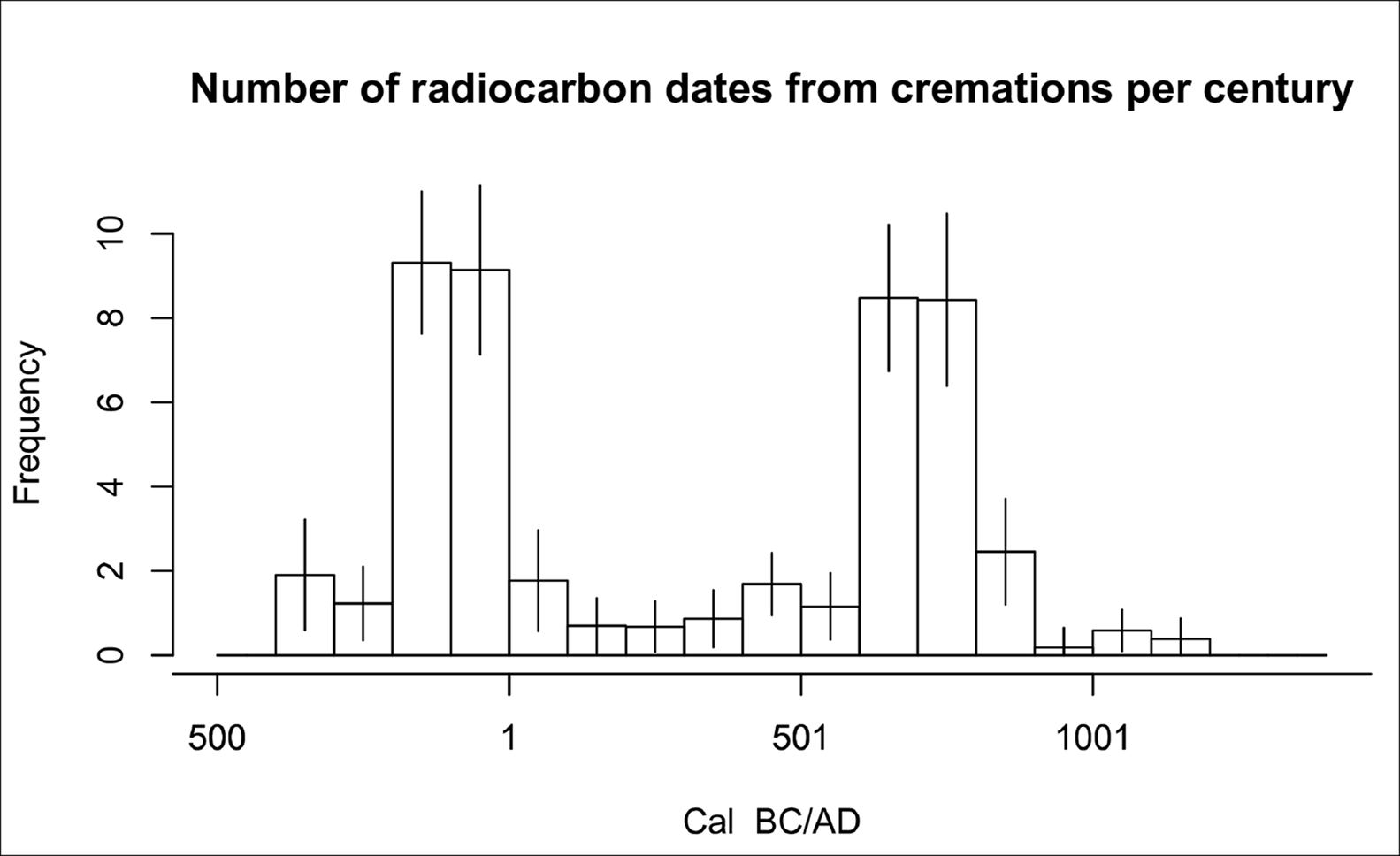
Figure 3 compares the frequency of radiocarbon-dated inhumations and cremations for Ireland. To assess these data, we should consider early medieval cremations (35 from 13 sites) against total dated inhumations (409 from 113 sites). While dated inhumations are clearly more numerous, considering taphonomy and a lack of systematic dating of cremations (see below), this evidence is significant. Even with only 35 probable examples of cremation, the frequency across 13 sites is comparable to the earlier, Late Iron Age cremation peak. Indeed, there are more dated cremations c. AD 400–1200 than for AD 1–400, despite cremation being widely regarded in Ireland as the principal archaeologically detectable mode of burial AD 1–400.
Graph showing the relative frequency of radiocarbon-dated inhumation and cremation burials in Scotland and Ireland (figure by the authors).
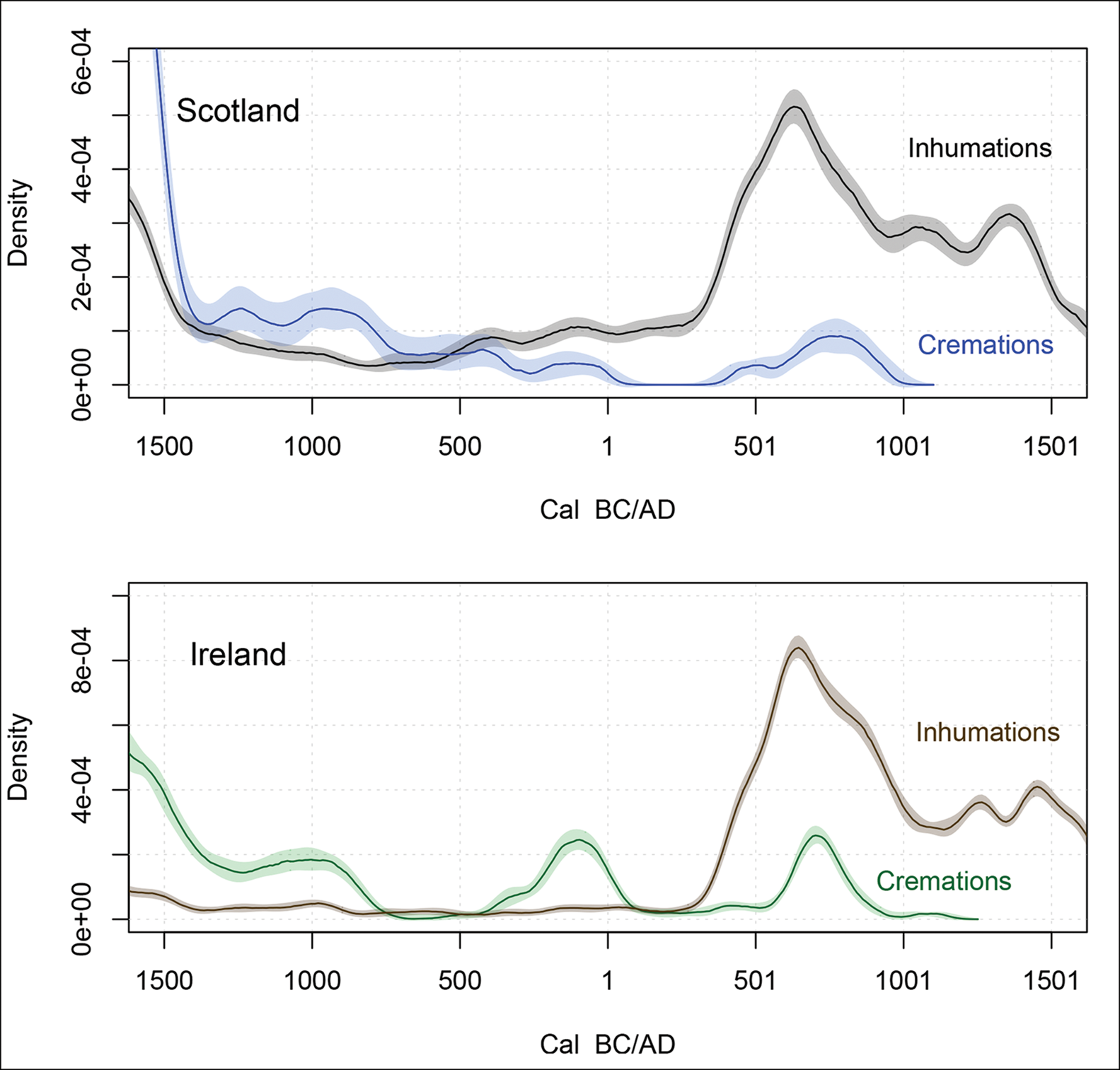
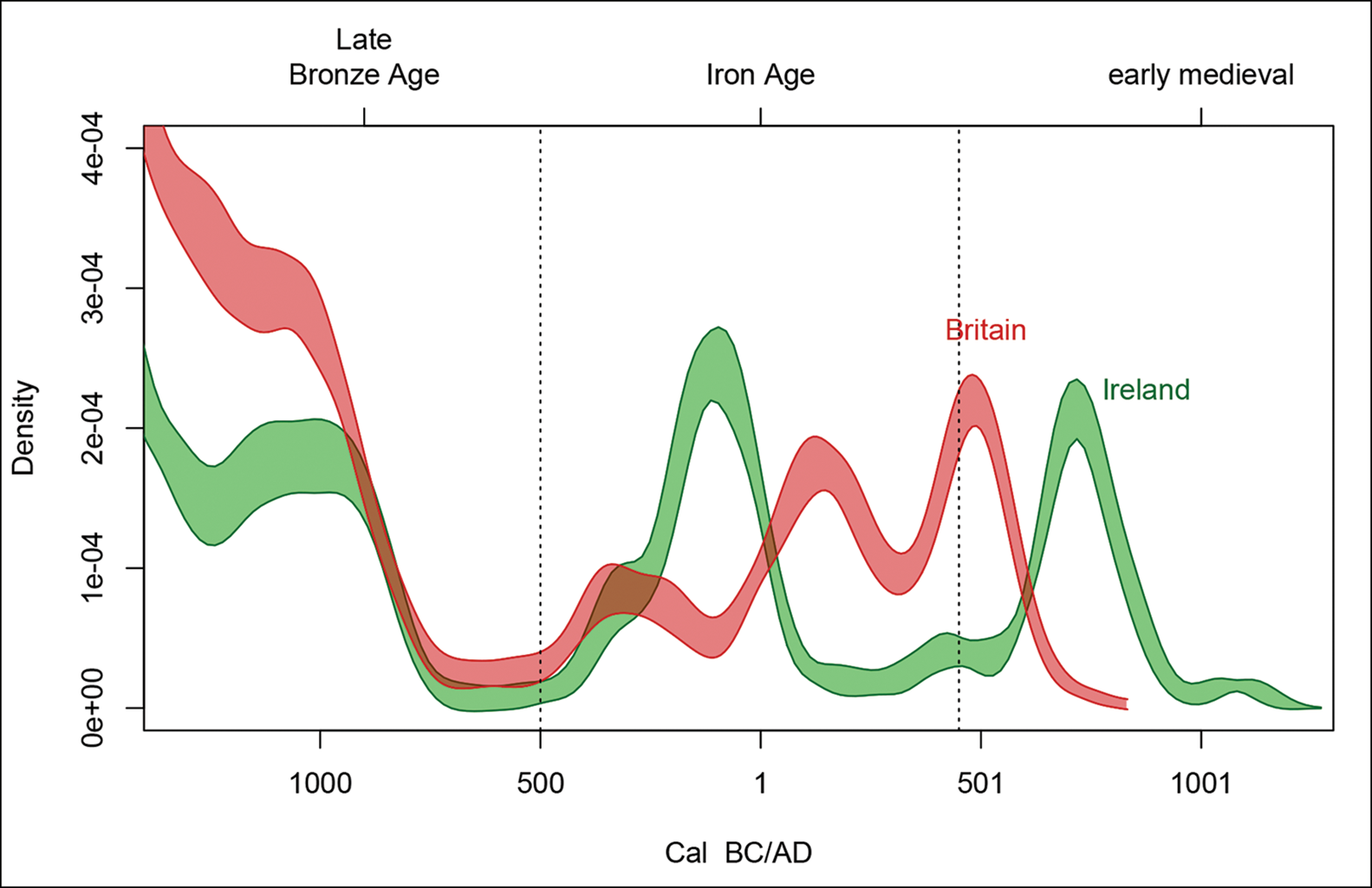
The KDE model presents these data as a continuous time series, and compares the temporal frequency distribution of cremations from Ireland with those from Scotland and Britain more generally (Figures 3–4). The available data suggest a peak for cremation in Ireland AD 688–725 (at 95 per cent certainty), before declining through the eighth to ninth centuries. A minor fifth-century peak is interesting, but not statistically significant. Irish cremation begins to peak when the practice was no longer dominant in early medieval Britain (Figure 4). There are, however, several isolated but important Scottish examples of cremation. These include: Sanaighmhor, Islay (AD 257–536); Stromness, Shetland (AD 390–600); Balnauran of Clava, Inverness (AD 250–900; AD 600–980); Rhiconich, Sutherland (AD 400–640); Forteviot, Perthshire (eighth to ninth centuries); King's Cross, Arran (mid ninth-century coin); Ardnave, Islay (AD 721–980); Baliscate, Mull (AD 725–967); and Cleigh, Lorn (AD 541–771). At least five further sites have cremations that are not directly dated, but where an AD 400–1100 date seems likely: Machrins; Hallow Hill, Fife; Hermisgarth; Ostro Broch, Orkney; and Easterton, Moray (Sheridan Reference Sheridan2005; Maldonado Reference Maldonado2011: 87 & 106–108, Reference Maldonado2013: 11–12, Reference Maldonado, Edwards, Ní Mhaonaigh and Flechner2017: 337; Ó Ríagáin Reference O'Ríagáin2016: 156–60). While many of these examples have problematically long date ranges, a seventh- to ninth-century phase stands out. In general, the KDE analysis reveals (Figure 3) that the cremation traditions in early medieval Scotland are contemporaneous with those in Ireland.
Kernel density estimates for the distribution of radiocarbon dates of cremations from Britain and Ireland, calculated using a Gaussian kernel and bandwidth of 50 years (figure by the authors).
Other potential sites in Ireland
In Ireland, a survey of Mapping Death (n.d) and Excavations.ie (2020) identifies a further 33 sites where cremations have been excavated. Of these, 22 are assumed to be prehistoric, despite the presence of early medieval material. While ten of these are probably Bronze or Iron Age—as suggested by associated finds or indirect radiocarbon dates—only four cases have direct radiocarbon dates to support this assumption. Relatively large and complex sites where cremation has been identified alongside early medieval material, and where a later prehistoric origin may no longer be justified, include the following locations: Bellinstown; Cahircalla-More; Carrigaline Middle; Cush; Cappydonnel Big, Carbury Hill; Ardreigh; Balrigan 1; Corbally 2/3; Cross; Grange 2; Haynestown; Holdenstown 1; Kilree 4; Kiltullagh 2; and Ratoath (Mapping Death n.d; Excavations.ie 2020). At many sites (e.g. Kiltullagh and the Rath of the Synods), cremations associated with early medieval inhumations were assumed to be prehistoric solely because cremation was perceived to be pre-Christian (i.e. pre-AD 400) (McCormick et al. Reference McCormick, Cribbin, Robinson, Shimwell and Murphy1995; Grogan Reference Grogan2008). Both practices, however, were used contemporaneously at seventh- to eighth-century Annaghilla (Dunlop & Barkley Reference Dunlop and Barkley2016: 126–31). This demonstrates a precarious situation in which a priori assumptions that cremation terminated during the fifth century AD are no longer tenable.
The context of cremation has also been debated at many sites. Kelly (Reference Kelly, Cooney, Becker, Coles, Ryan and Sievers2009) identifies Knoxpark in Sligo as a Viking longphort, while Stevens (Reference Stevens2012: 46) implies similarly cultural/ethnic interpretations at Ask. Radiocarbon dating, however, demonstrates that these cremations pre-date the Viking Age (animal bone from below cremated remains at Knoxpark, AD 559–663 & AD 716–971; cremated bone from Ask, AD 650–772 & AD 660–794), and instead they align with the seventh- to ninth-century peak identified above. In Atlantic Scotland, cremated human bone at Ardnave, Baliscate, King's Cross and Cleigh, has also tentatively been proposed as representing Scandinavian-style burials within a colonial context (Ó Ríagáin Reference O'Ríagáin2016). Except for Cleigh, this is plausible. The radiocarbon date ranges, however, agree with Forteviot (eighth to ninth centuries) and elsewhere, as well as the peak now recognisable across Ireland, making such assertions unnecessary.
Discussion
Within established, traditional paradigms, seventh- to eighth-century Irish society was firmly Christianised, with churches widespread during a ‘golden age’ of ecclesiastical art, metalwork, sculpture and illuminated manuscript production. The widespread transformation of burial that began c. AD 400 saw west–east extended inhumation become the dominant rite by c. AD 600, with the foci of inhumation shifting from rural cemeteries to churchyards from the eighth century (O'Brien Reference O'Brien2020: 57). Notwithstanding, whether one regards inhumation as being ‘Christian’ from the fifth century, or only from the seventh to eighth centuries, on the basis of the abovementioned evidence, such models are equivocal. Evidence is lacking for a shift in inhumation burial to churchyards from c. AD 700, while a significant upsurge of cremation as a viable and appropriate burial practice throughout Ireland occurred at this point. This challenges assumptions about changes in inhumation practices embodying the culmination of ‘slow-burn’ Christianising trajectories. One may choose to interpret the data for cremation as evidence of persistent paganism—perhaps even a reaction against Christianisation. Alternatively, cremation could be regarded as being indicative of plague, whereby communities burned the bodies of victims, or cremated the dead to facilitate transportation of a cadaver for burial (e.g. Oestigaard Reference Oestigaard, Tarlow and Nilsson-Stutz2013).
The Black Death probably influenced changing patterns of dated inhumations in the fourteenth century (Figure 3). Yet, for our earlier peak in cremations, persistent paganism or a reaction to disease seem insufficient explanations when considered within wider landscape and social contexts. Cremations do not cluster or correlate with any single period or specifically documented outbreaks of plague. Although a more detailed future analysis of the treatments afforded cremated remains is required, remains were still carefully treated and meaningfully deposited.
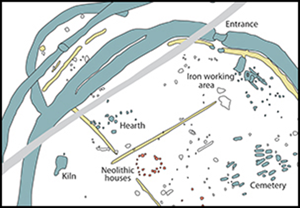
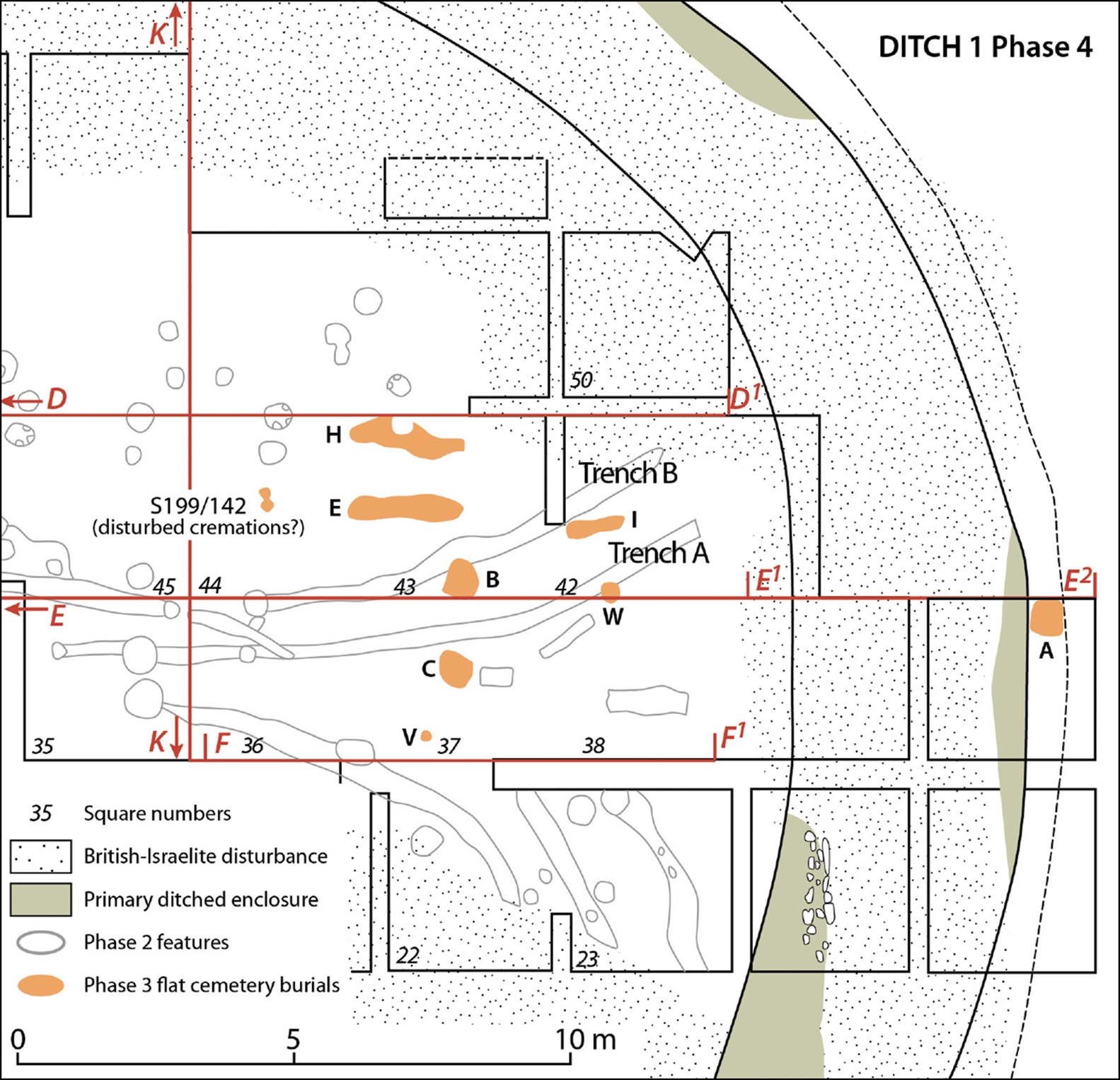
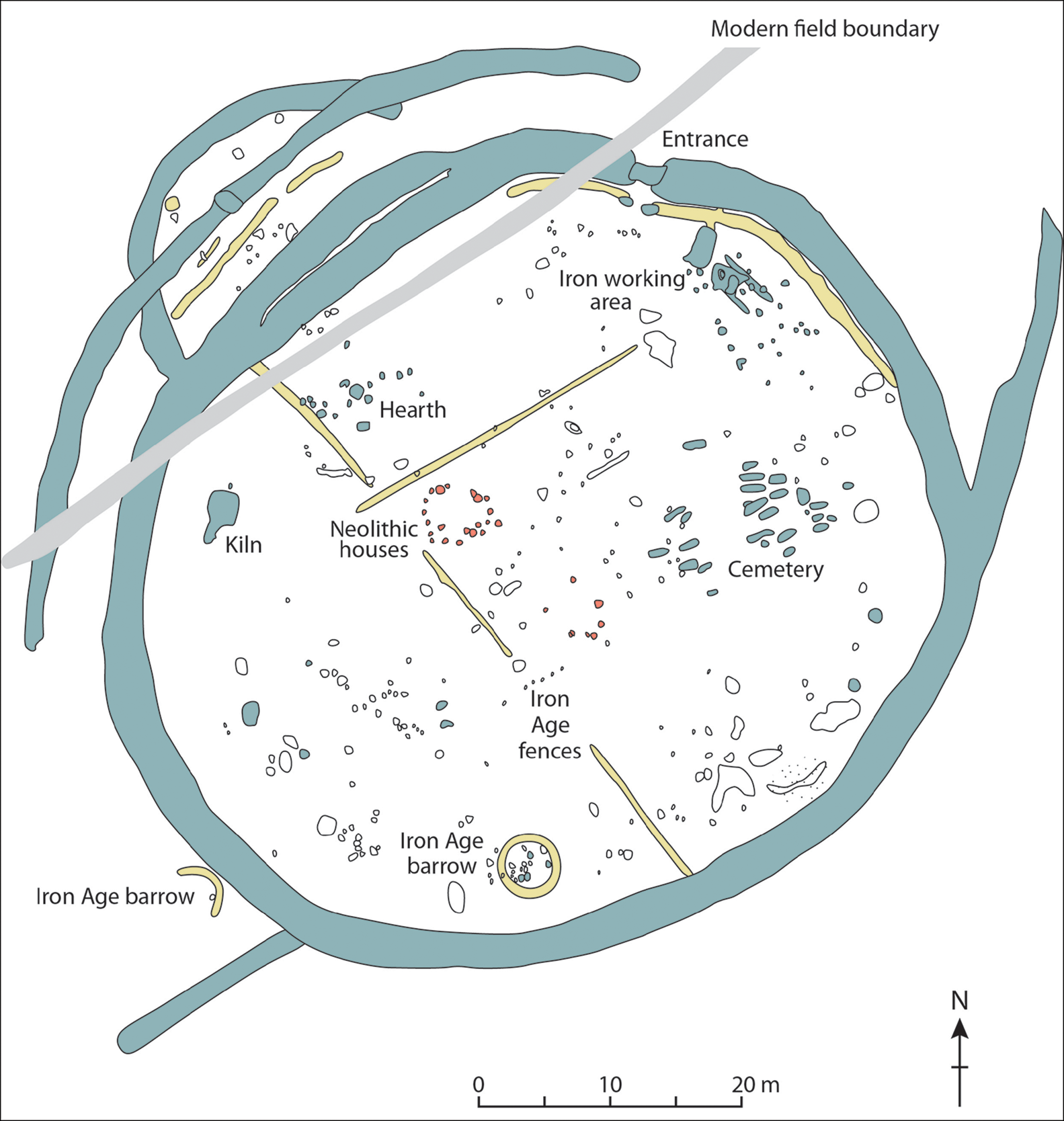
Many seventh- to eighth-century cremations were placed near churches, in a period when Ireland had one of Europe's densest concentrations of churches (Ó Carragáin Reference Ó Carragáin, Graham-Campbell and Ryan2009). Within the major royal centre of Tara, cremations and inhumations at Castletown-Tara and the Rath of the Synods were contemporaneous with renewed activity (Figure 5: V & W; Grogan Reference Grogan2008: 141–48) and the use of the church of Tech Cerpan, which was probably located in the adjacent St Patrick's churchyard. Immediately to the south, a new monumental focus was constructed on the hillcrest with the figure-of-eight-shaped complex of Tech Cormaic and An Forrad during the seventh to ninth centuries AD (see Gleeson Reference Gleeson, Edwards, Ní Mhaonaigh and Flechner2017: 305). As with some high-status inhumations (O'Brien Reference O'Brien, Edwards, Ní Mhaonaigh and Flechner2017: 263–65), cremations were inserted into prehistoric monuments elsewhere, such as at the major Scottish royal centre Forteviot (Maldonado Reference Maldonado2013: 11–12, Reference Maldonado, Edwards, Ní Mhaonaigh and Flechner2017: 337; Ó Ríagáin Reference O'Ríagáin2016). At Annaghilla, Mullaghbane and other sites, cremation occurred alongside inhumation, albeit with notable spatial differences. At Annaghilla, inhumation was confined largely to the complex's south-east corner, while cremated remains were deposited in graves within this cemetery, in an earlier ring-barrow and in postholes and gullies of buildings (Figure 6; Dunlop & Barkley Reference Dunlop and Barkley2016: 126–31). These buildings are unlikely to be domestic structures, as habitation evidence at comparable complexes is equivocal (Ó Carragáin Reference Ó Carragáin, Graham-Campbell and Ryan2009; Gleeson Reference Gleeson, Edwards, Ní Mhaonaigh and Flechner2017). Rather, they may illuminate an emerging class of purpose-built architecture within mortuary contexts (Walsh Reference Walsh2011), perhaps used for cultic, bodily display, transformation or excarnation purposes.
Plan of the Rath of the Synods burials showing the locations of inhumation and cremation burials (after Grogan Reference Grogan2008: fig. 3.5) (figure by the authors).
Plan of the complex at Annaghilla, showing the location of the cemetery and key features (after Dunlop & Barkley Reference Dunlop and Barkley2016: 126) (figure by the authors).
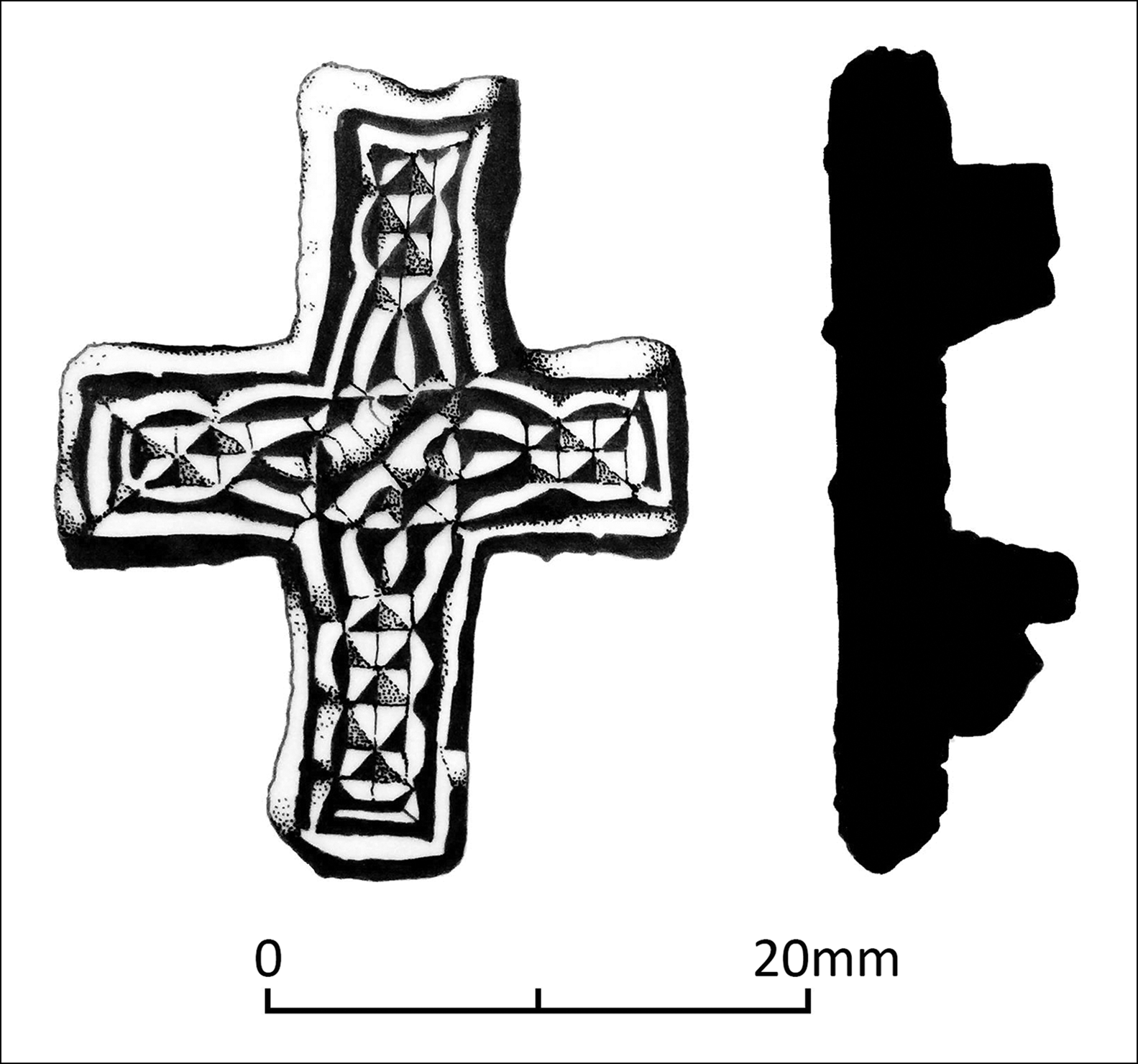
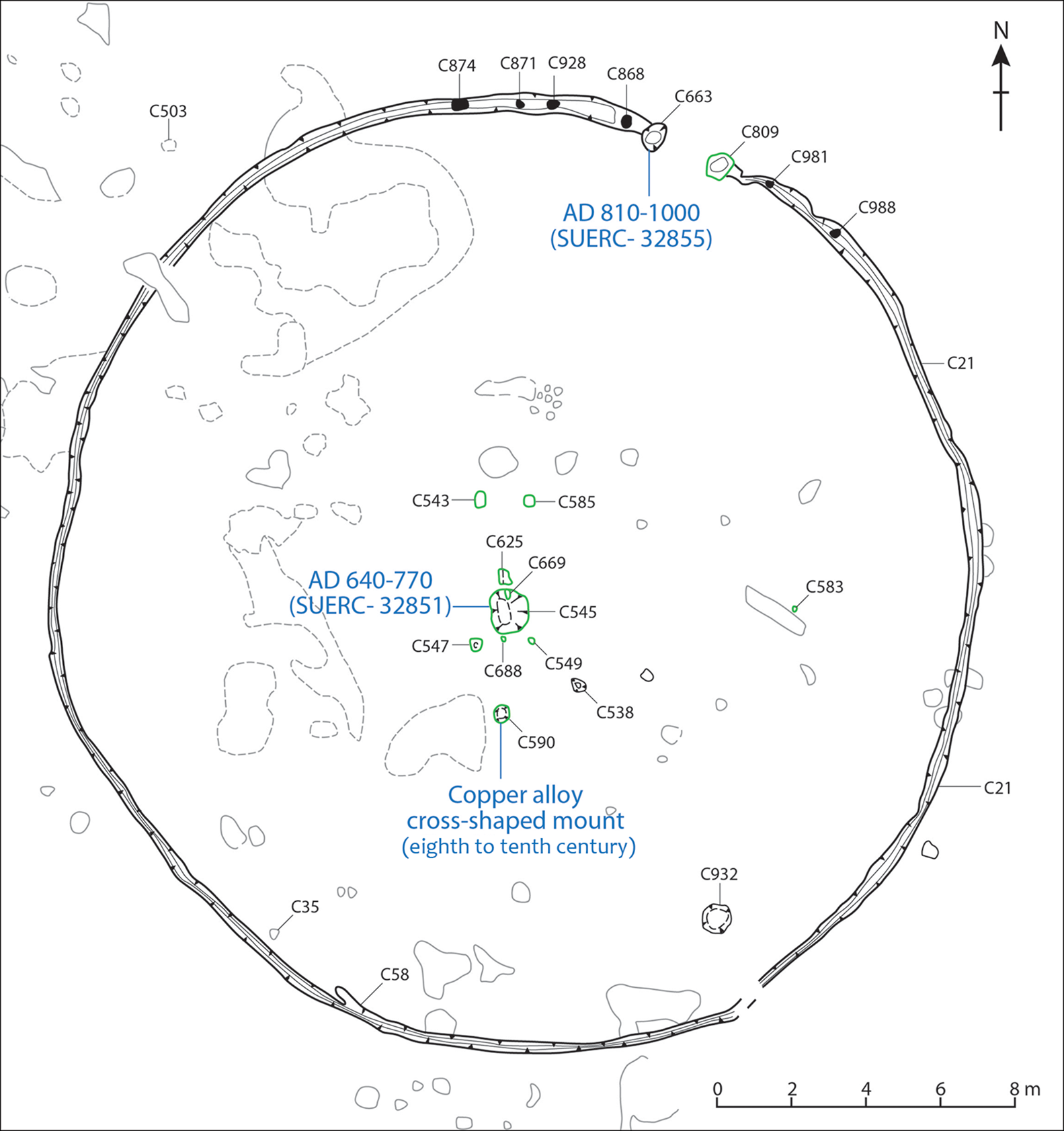
Alongside cremation, these facets of funerary rituals have yet to be explored systematically. During the seventh to ninth centuries, disarticulated remains from different individuals were combined in cave burials at Cloghermore (Kerry) (Connolly et al. Reference Connolly, Coyne and Lynch2005: 165) or deposited in passage tomb chambers at Knowth (Meath) (Eogan Reference Eogan2012: 45–82), suggesting that excarnation was practised. Excarnation in seventh-century Scotland (Cille Pheadeair: Maldonado Reference Maldonado2013: 12) further underlines a greater diversity in burial practices in post-conversion contexts than previously assumed. Moreover, the scale of cremation further challenges narratives of a dominant—even formalised and regulated—west–east extended inhumation rite. Indeed, one of the most striking examples of cremation is from Ask. Here, an early medieval penannular enclosure, which was delimited by a palisade, contained seven pits with cremated remains, including one with a gilded copper-alloy cross-shaped mount (Figures 7–8). Although the highly fragmented cremated remains precluded positive identification as human, this unique find was interpreted as a pagan burial of Viking Age date (Stevens Reference Stevens2012: 46). Two radiocarbon samples (AD 660–794 and AD 650–772; O'Brien Reference O'Brien2020: 31), however, now demonstrate cremation at Ask that pre-dates the Viking Age. While cremation is common in Scandinavia during this period (Price Reference Price, Brink and Price2008), it is rare in Viking Age colonies. In Ireland or Britain, Viking cremation is only certain at Heath Wood (Richards et al. Reference Richards, Beswick, Bond, Jecock, McKinley, Rowland and Worley2004). Of course, we cannot rule out that some cremations were colonial expressions of Scandinavian practices (Kelly Reference Kelly, Cooney, Becker, Coles, Ryan and Sievers2009; Ó Ríagáin Reference O'Ríagáin2016). Yet such ethnically centred attributions seem unnecessary when these examples are situated within established local and regional practices.
Drawing of the cross-shaped mount from a cremation burial at Ask (figure by P. Stevens).
Plan of the Ask cemetery showing cremation burials and the enclosure (after Stevens Reference Stevens2012: illustration 6) (figure by the authors).
The Ask cremations and associated cross-shaped mount suggest caution against dichotomous oppositions between ‘pagan’ and ‘Christian’ burial practices. The iconography and symbolism of the cross suggest an intentional and meaningful expression for communities performing the cremations, which was arguably in no way incongruent with Christian belief. If so, this expression has profound implications for wider European scholarship. Both an implicit and explicit assumption of such scholarship is that cremation was antithetical to Christian belief in the inviolability of the corpse, which is required to facilitate resurrection on the Day of Judgement (e.g. Lucy Reference Lucy2000: 121; Meaney Reference Meaney and Carver2003: 238). Although the development of west–east inhumation practices, or the presence of grave goods, have more recently been separated by scholars from the respective spread of Christian belief or declining paganism, cremation often remains steadfastly regarded as ‘pagan’. Cremation (with remains often placed in cinerary urns, e.g. at Spong Hill), for example, was commonplace in fifth- to sixth-century England, alongside inhumation. Both practices could be furnished, but because they largely differed from previous late Roman practices in terms of accompanying materials, containers or rites, their appearance was commonly regarded as evidence of pagan ‘Germanic’ belief and ethnicity (Williams Reference Williams, Lucy and Reynolds2002; Hills Reference Hills2003; Meaney Reference Meaney and Carver2003: 238).
Despite recent analyses convincingly demonstrating that cremation and inhumation were complementary practices (Williams Reference Williams, Kujit, Quinn and Cooney2014; Nugent Reference Nugent, Cerezo-Román, Wessman and Williams2017), the seventh-century decline in British cremations is often regarded as a barometer for declining paganism and a chronological marker of conversion (Geake Reference Geake1997; Meaney Reference Meaney and Carver2003; Hoggett Reference Hoggett, Semple and Williams2007; for recent chronologies, see Hines & Bayliss Reference Hines and Bayliss2013; Lucy & Hills Reference Lucy and Hills2013). Yet the recognition of cremation within later seventh- or early eighth-century conversion-period contexts, such as St Mary's, Southampton (Stoodley, in Birbeck Reference Birbeck2005: 76), demonstrates the problems with such assumptions. Indeed, within continental scholarship, such culture-historical ethnic and religious assumptions are illustrated by seventh- to eighth-century burials that combine inhumation and cremation (Wamers & Périn Reference Wamers and Périn2013: 179). Under Frankfurt Cathedral, for example, the lavishly furnished eighth-century inhumation of a young female was accompanied by the cremated remains of a child (Wamers & Périn Reference Wamers and Périn2013: 161–81). Despite both burials being covered by a sheet bearing a woven gold cross, the cremation—as at Ask—was interpreted as an expression of persistent pagan belief (Wamers & Périn Reference Wamers and Périn2013: 172–76). Lippok (Reference Lippok2017) encourages critical reflection on these assumptions, identifying a corresponding corpus of cremation burials from contexts and periods in the Low Countries where a Christian ideological milieu seems likely. Lippok (Reference Lippok2017: 37–38) also critically assesses documentary source material that seemingly regulated burial practices, arguing that there is little evidence that cremation was either antithetical to Christian belief or widely prohibited by the Church.
Recognising this has profound implications for archaeologies of religious transformation and commemorative strategies across Europe. Related, however, are issues surrounding standards of recording and the absence of specialist analysis when cremated remains are encountered on excavation sites (McKinley Reference McKinley, Tarlow and Nilsson-Stutz2013). The direct dating of cremated remains from all contexts by either stratigraphic relationships or radiocarbon sampling must be a future priority. Cremation was clearly more common across the Irish Sea region than currently acknowledged. It is almost certainly still under-represented in Ireland and Scotland, and one may wonder whether it has been similarly overlooked because of dominant culture-historical frameworks in Wales, south-western Britain or elsewhere. In Ireland, cremations could be represented by small deposits of cremated bone within contexts not conventionally regarded as funerary (i.e. postholes, gullies, spreads). In some instances, cremated human bone was associated with deposits of burnt animal bone, charcoal or grain (e.g. Castletown and Knoxpark).
The chronological patterning in these examples and the nature of their deposition makes it unlikely that the material derives from accidental burning of remains disturbed from within funerary contexts. Grave goods are known but rare, with their deposition also occurring in pits or spreads, as well as with conventional cremation burials. Equally, intentional deposits of cremated remains within buildings—perhaps embodying mortuary functions—complement these recognised practices. Thus, if we recognise these deposits as meaningful and intentional, this raises issues regarding whether: (i) cremated human bone on early medieval sites has been mistaken for burnt animal bone; (ii) the bone is generally overlooked within burnt and mixed deposits (e.g. ‘midden’ material); or (iii) burnt spreads/soils within settlement contexts could represent funerary pyres. Pyres are extremely rare, but have been identified at Cloghermore Cave (Connolly et al. Reference Connolly, Coyne and Lynch2005), and could perhaps have been placed within ditches (for Iron Age examples, cf. McGarry Reference McGarry2008). Clearly, therefore, acknowledging cremation as a widespread early medieval funerary practice poses conceptual, interpretative and methodological issues that must be addressed in future analysis, recording and post-excavation strategies.
Conclusions
In identifying cremation as a crucial but neglected aspect of early medieval burial practice, we suggest that established narratives of burial in relation to ethnic and religious identities are problematic. These new data have implications for wider European scholarship and assumptions regarding religious transformation and commemorative strategies. Cremation must now be acknowledged as a meaningful element of diverse mortuary technologies that remained viable long after conversion and Christianisation. This is not to say that all cremation burials must be understood as ‘Christian’, and nor should we exclude the possibility that they are, in fact, ‘pagan’. Arguably, such categories are unhelpful. That cremation intensified in periods of plague may be one plausible scenario, albeit perhaps less probable, given its frequency at sites such as Mullaghbane from the third to twelfth centuries AD. Similarly, the contexts of deposition considered above indicate that these interpretations are inconsistent with the data. In some cases, it is highly probable that cremation was being conducted by Christian communities. Indeed, most striking is the evidence for the contemporaneous use of cremation and inhumation at the same sites. The use of these rites together, at the same sites, allowed these communities to implement diverse commemorative strategies through these acts of mortuary theatre. At least for Ireland, previous discussions have been biased towards the analysis and interpretation of extended inhumation between AD 400 and 1100, with evidence for cremation and other diverse mortuary strategies (e.g. excarnation) often dismissed or ignored.
The data presented here open up new avenues for studying ways of death—namely the fluid relationship between belief, commemorative strategies and burial practices during a crucial period of religious transformation and social differentiation. Moreover, they also highlight a fundamental problem, whereby post-excavation strategies have been biased by culture-historical paradigms. This poses significant methodological issues that must be rectified in future analyses.
Acknowledgements
We are grateful to Adrian Maldonado, Ewan Campbell and Russell Ó Riagáin for the Scottish data and discussion.
Funding statement
This research received no specific grant from any funding agency or from commercial and not-for-profit sectors.
Supplementary material
To view supplementary material for this article, please visit https://doi.org/10.15184/aqy.2020.251




 Open access

