


Introduction
Populist citizens – that is citizens who feel that the ‘good people’ should rule rather than the ‘corrupt elite’ (Mudde Reference Mudde2004: 543) – are very critical of the functioning of representative democracy because they perceive a lack of real popular sovereignty (Canovan Reference Canovan1999; Rovira Kaltwasser and Van Hauwaert Reference Rovira Kaltwasser and van Hauwaert2020; Zaslove and Meijers Reference Zaslove and Meijers2023). It is not surprising then that as populist citizens turn away from representative democracy, they turn towards and support innovative forms of democratic decision-making that give power back to the people (Heinisch and Wegscheider Reference Heinisch and Wegscheider2020; Jacobs et al. Reference Jacobs, Akkerman and Zaslove2018; Mohrenberg et al. Reference Mohrenberg, Huber and Freyburg2021; Trüdinger and Bächtiger Reference Trüdinger and Bächtiger2022; Werner and Jacobs Reference Werner and Jacobs2021; Zaslove et al. Reference Zaslove, Geurkink, Jacobs and Akkerman2021).
However, if populist citizens are supportive of democratic innovations in the abstract, do they then also support the outcomes of actual cases of democratic innovations? This matters, as support in the abstract does not necessarily translate to real-life (e.g., Trüdinger and Bächtiger Reference Trüdinger and Bächtiger2022), begging the question whether populist citizens perceive actual instances of citizen participation as legitimate. This sheds more light on how democratic innovations’ claim to improve perceptions of democratic quality among the most disenchanted citizens (see Elstub and Escobar Reference Elstub, Escobar, Elstub and Escobar2019; Smith Reference Smith2009) works out in practice.
To the best of our knowledge, no studies have examined this. To fill this gap, our study sets out to examine the relationship between populist attitudes and acceptance of outcomes of one important subtype of democratic innovations, namely Participatory Budgeting (PB). We focus on this specific subtype as it offers citizens an opportunity to decide directly how to spend a part of the (local) budget (Elstub and Escobar Reference Elstub, Escobar, Elstub and Escobar2019; Sintomer et al. Reference Sintomer, Herzberg and Röcke2008). All the cases covered in our study are cases of binding PBs where the local government had reserved a part of the local budget for the PB. The high level of popular control and policy impact of the PBs examined in this study sets them apart from deliberative mini-publics (Elstub and Escobar Reference Elstub, Escobar, Elstub and Escobar2019; Smith Reference Smith2009), while the degree of direct contact and exchange with authorities is greater as compared to referendums.Footnote 1 This makes them a most likely setting to find an effect, something we will return to in the conclusion when discussing the generalizability of the findings. Our research question is: To what extent and why do the populist attitudes of participants affect the outcome acceptance of Participatory Budgeting?
We do this through a mixed-methods study, analysing participants to three cases of Participatory Budgeting in the Netherlands: one small-, one medium- and one large-sized municipality. To the best of our knowledge we are the first to study populist attitudes among citizens via a mixed-method design. A recent literature review showed that qualitative studies of populist attitudes are rare and no study has employed a mixed-methods approach combining survey and interview data (Marcos-Marne et al. Reference Marcos-Marne, de Zúñiga and Borah2023). In taking this approach, we are able to truly shine a light on how the theorised populist legitimacy framework works out in practice. Our mixed-methods design follows a nested approach (Lieberman Reference Lieberman2005: 437), both methods serving the purpose of evidential integration (examining effects and mechanisms in the same sample) (Kuorikoski and Marchionni Reference Kuorikoski, Marchionni, Kincaid and van Bouwel2022: 268). Specifically, we first quantitatively analyse the extent of outcome acceptance of populist participants to PB. For this we use original survey data gathered at the three PBs (analytical sample N = 113). We then qualitatively explore why populist participants were (dis)inclined to accept the outcome of the PB (34 follow-up interviews with participants to the three PBs).
In our quantitative analysis we find that populist participants are highly willing to accept the outcome of the PB but do not find support for our hypothesis that they differ from non-populist participants. However, our qualitative interview analysis reveals that populists and non-populist participants differ. We find that populist ideology acts as a lens (Mudde and Rovira Kaltwasser Reference Mudde and Rovira Kaltwasser2017) colouring the way populist citizens perceived the process and outcome-related factors. While both populists and non-populists lauded the overall process, populist participants in particular felt heard by their fellow participants and indicated that they got the outcome they wanted. This increased their overall satisfaction. The non-populist participants were more focused on the organisation, and highlighted that the participants were often not entirely representative of the broader population, but they were satisfied with the process, and this trumped the other considerations when it came to accepting the outcome of the PB. Integrating the results of the quantitative and qualitative analyses, our findings thus suggest that there are different pathways to similar levels of outcome acceptance.
In what follows, we first describe what considerations could motivate acceptance of the outcome of a PB, and then why we would expect populist citizens to be more willing to accept the outcome of a PB than non-populist citizens. We describe the three PBs we studied in the Netherlands and how we set up our research design; before providing the results of the quantitative and qualitative analyses respectively.
Theoretical framework
In this section we first discuss the three main explanations for outcome acceptance: process-related, outcome-related and normative considerations (cf. Werner Reference Werner2020b). Our next step is to zoom in on populism as one type of normative consideration. Here, we discuss populists’ (normative) considerations to accept (or refuse) outcomes of PB. The last step in our theoretical framework is to explore how populism can influence process-related and outcome-related considerations. We do this because earlier research has highlighted that different types of considerations can influence each other (e.g., Esaiasson et al. Reference Esaiasson, Persson, Gilljam and Lindholm2019, Werner Reference Werner2020a). Specifically, we theorise how populism can act as a ‘lens’, affecting populist citizens’ perceptions of process-related and outcome-related factors.
Three traditional types of explanations for outcome acceptance of a PB
Recent research has sought to establish why citizen participation in decision-making processes would lead to increased willingness to accept the outcome among participants (Pow et al. Reference Pow, van Dijk and Marien2020; Werner Reference Werner2020b). The existing explanations for higher outcome acceptance among participants to citizen participation initiatives like PB can be divided into process-related considerations, outcome-related considerations, and normative considerations.
-
1. Process-related considerations can motivate outcome acceptance through evaluation of the process by which the outcome came about. More specifically, an individual is more likely to accept an outcome of a process where she feels respected, taken seriously, trusted and cared for by the decision-making authority when that authority provides them with the opportunity to have a say in the decision-making process (Thibaut and Walker Reference Thibaut and Walker1978; Tyler Reference Tyler2006). Thus, if the organisation of a participatory budget explicitly provides participants with a feeling of voice, influence and control, they will feel respected and taken seriously as decision-makers, and feel ownership over the outcome, and this, in turn, fosters outcome acceptance (Lind and Tyler Reference Lind and Tyler1988; Tyler Reference Tyler2006; Van Dijk and Lefevere Reference Van Dijk and Lefevere2023).
-
2. Outcome-related considerations have also long been argued to be an important driver of outcome acceptance: an individual is more willing to accept an outcome that is in line with their outcome preferences (Brummel Reference Brummel2020; Esaiasson et al. Reference Esaiasson, Persson, Gilljam and Lindholm2019; Landwehr and Harms Reference Landwehr and Harms2020; Werner Reference Werner2020a). Put bluntly: an individual who got what they wanted is more likely to accept the outcome – and even to retrospectively perceive the process through which it came about as fair (Esaiasson et al. Reference Esaiasson, Persson, Gilljam and Lindholm2019). This argument posits that decision ‘winners’ are more willing to accept the outcome of a decision-making process than decision ‘losers’ (Werner Reference Werner2020a).
-
3. Lastly, citizens’ normative considerations can also influence outcome acceptance. An individual is more likely to accept the outcome of a decision-making procedure that is in line with their ‘norm-driven general attitude about how decisions ought to be made and what role citizens should play in it’ (Werner Reference Werner2020b: 179). These normative conceptions can be driven by e.g., socialisation, personality, values and ideology (ibid.; see also Renwick Reference Renwick2010: 37–38). While not all ideologies put the conception of how decisions ought to be made front and centre, this is at the heart of the populist ideology, an ideology that centres on giving the power back to the people (see also Mudde Reference Mudde2007: 150–155), and empirically populist attitudes indeed seem to shape citizens’ conceptions of what is (and is not) legitimate democratic decision-making (Heinisch and Wegscheider Reference Heinisch and Wegscheider2020: 32). Other examples of norm-based considerations are, for instance, the role that postmaterialist values or technocratic attitudes play in evaluating decision-making procedures and their outcomes (Bertsou and Caramani Reference Bertsou and Caramani2022: 5; Werner Reference Werner2020b: 180). In sum, according to the explanation based on normative considerations, a citizen is more likely to accept an outcome if it is the result of a decision-making procedure that is in line with that citizen’s norm-driven attitude about how decisions ought to be made.
The role of populism as a normative consideration affecting outcome acceptance
As mentioned in the section above, there may be reasons to expect that populist participants to a PB are more likely to accept the outcome of that PB because of normative considerations if the PB is in line with the populist norm of how decisions ought to be made. This does not mean that populists are automatically more likely to accept PB outcomes, however, and we will also highlight factors that may attenuate this potentially higher outcome acceptance. Below, we first briefly explain how we conceptualise populism, how populism manifests in citizens, and how populist citizens’ normative framework appears to be particularly attuned to democratic decision-making procedures.
Populist citizens adhere to a populist set of ideas. When describing populism in citizens, this paper thus explicitly approaches populism as a political ideology.Footnote 2 Populist ideology is commonly described as consisting of three interrelated sub-dimensions: people-centrism, or the demarcation of a homogeneous and pure people (e.g., Mudde Reference Mudde2004; Müller Reference Müller2014; Taggart Reference Taggart2000); anti-elitism, or the moral opposition against a corrupt political elite (Müller Reference Müller2014); and popular sovereignty, or the belief that the general will of the people is the basis of democratic decision-making (e.g., Canovan Reference Canovan1999, Reference Canovan, Mény and Surel2002; Mény and Surel Reference Mény, Surel, Mény and Surel2002). Citizens adhering to a populist set of ideas are thought to have higher populist attitudes (e.g., Akkerman et al. Reference Akkerman, Mudde and Zaslove2014; Hawkins et al. Reference Hawkins, Riding and Mudde2012; Schulz et al. Reference Schulz, Müller, Schemer, Wirz, Wettstein and Wirth2018). The interrelated subdimensions of populist ideology translate into a particular ‘attitudinal syndrome’ (Wuttke et al. Reference Wuttke, Schimpf and Schoen2020: 356). An individual that has higher populist attitudes considers politics, society, and democratic decision-making in terms of a Manichean struggle between the good people and a corrupt elite that is unable or unwilling to heed the general will of the people (Mudde and Rovira Kaltwasser Reference Mudde and Rovira Kaltwasser2017).
A growing body of literature on populist citizens’ attitudes towards direct and participatory decision-making procedures has found that the populist set of ideas appears to not only determine populist citizens’ process preferences; but also shape their perceptions of democratic decision-making processes and their outcomes. Firstly, research has found that populist citizens are fundamentally dissatisfied with representative democracy (Rovira Kaltwasser and Van Hauwaert Reference Rovira Kaltwasser and van Hauwaert2020). As a result, they have been consistently found to reject mediated representation through parties (Heinisch and Wegscheider Reference Heinisch and Wegscheider2020; Trüdinger and Bächtiger Reference Trüdinger and Bächtiger2022; Zaslove and Meijers Reference Zaslove, Geurkink, Jacobs and Akkerman2021). At the same time, empirical studies have found that the populist turn away from representative democratic decision-making is accompanied by a higher support for alternative forms of democratic decision-making. Higher populist attitudes in citizens have also been shown to be related to higher support for the use of referendums (Abrial et al. Reference Abrial, Alexandre, Bedock, Gonthier and Guerra2022; Jacobs et al. Reference Jacobs, Akkerman and Zaslove2018; Mohrenberg et al. Reference Mohrenberg, Huber and Freyburg2021; Trüdinger and Bächtiger Reference Trüdinger and Bächtiger2022; Zaslove et al. Reference Zaslove, Geurkink, Jacobs and Akkerman2021) and more deliberative forms decision-making (Heinisch and Wegscheider Reference Heinisch and Wegscheider2020; Van Dijk et al. Reference Van Dijk, Legein, Pilet and Marien2020; Zaslove et al. Reference Zaslove, Geurkink, Jacobs and Akkerman2021). This has been explained by the fact that these alternative forms of decision-making are a better fit with the populist worldview, which favours decision-making that gives power to the people and circumvents the elite (e.g. Jacobs et al. Reference Jacobs, Akkerman and Zaslove2018).
From the above we deduce that populism can play a role in driving legitimacy perceptions among populist citizens. We expect that it provides normative reasons to be willing to accept the outcome of a direct decision-making procedure when that procedure fits with populist ideology. PB, particularly the ‘Porto Alegre adapted for Europe’-model (Sintomer et al. Reference Sintomer, Herzberg and Röcke2008: 168), can be defined as a way to ‘allow […] the participation of non-elected citizens in the conception and/or allocation of public finances’ (Sintomer et al. Reference Sintomer, Herzberg and Röcke2008: 168). It is often characterised by a) participation being open to everyone (self-selection); b) the combination of deliberation and, oftentimes, a collective vote; and c) a high degree of power. These characteristics may be especially appealing to citizens with a higher degree of populist attitudes. Indeed, it confers a high degree of voice to the participants, in that this type of PB allows citizens to decide themselves how to allocate (part of the budget). This fairly high degree of delegation of power is also something such citizens prefer in referendums (cf. Zaslove et al. Reference Zaslove, Geurkink, Jacobs and Akkerman2021: 734). Additionally, the deliberative part of the PB may be appealing to populist citizens because it is aligned with people-centrism and allows a populist citizen to make their own voice heard to fellow citizens and allows populist citizens to come in direct contact with politicians to speak to them directly.
On the other hand, it must be noted that having a high degree of voice is not guaranteed. If the politicians and policymakers present at the PB try to subvert the ‘power of the people’, or if they are perceived as trying to manipulate the outcomes away from the will of the people, the outcomes of the PB may not be ‘automatically’ accepted. This may depend on the specific design of the PB, as well as the mere fact that the PB process is still organised by the ‘elites’, and there may be limited room for impact. Moreover, deliberations with fellow participants may reveal ‘the people to be more pluralist than a populist expected beforehand, especially if the populist citizens feel not listened to by their fellow participants and politicians.
All in all though, because PB generally fits well with the populist view of democracy and given the aforementioned empirical studies highlighting a link between populist attitudes and different types of democratic innovations, we tentatively hypothesise that:
Hypothesis: Participants with higher populist attitudes are more likely to accept the outcome of a PB than participants with lower populist attitudes.
Exploring how populism influences process- and outcome-related considerations
After having discussed the relationship between populism as a normative consideration to accept an outcome (or not), in this section we now explore how populism can influence process- and outcome-related considerations to accept an outcome. Specifically, we seek to explore the mechanisms behind that relationship and how that shapes perceptions in practice. It needs to be stressed that given the very limited number of studies examining this topic, this section is more explorative. We argue that that populism in populist citizens can act as a ‘lens’ (i.e., the way populists perceive reality) (Mudde and Rovira Kaltwasser Reference Mudde and Rovira Kaltwasser2017: 97).Footnote 3 The populist ‘lens’ can shape how process and outcome are perceived and has the potential to moderate process- and outcome-related considerations, which in turn can affect outcome acceptance. After all, populist participants’ normative framework might make them more prone to specific considerations of the process or outcome.
What could that look like in practice? Specifically the populist lens concentrates populists on (1) the role of the people (i.e., their fellow participants), (2) the elites’ role of the politicians and policymakers present and (3) the relation between the two (i.e., whether the participants have a genuine say in deciding the outcomes).
First, populists are likely to be focused on the discussions with their fellow participants and evaluate these in terms of whether or not they are ‘the real people’, the silent majority, or simply put: people like them, who do not need to discuss long, but are rather already in agreement because of their ‘singularity’ and them being ‘undifferentiated’ (Taggart Reference Taggart2000: 96). If they feel this is the case, their acceptance may be higher. Alternatively, if they are not taken seriously by their fellow participants or if the differences between the participants are large, it may make them feel the process is being hijacked by ‘special interests’ (Akkerman Reference Akkerman2003: 151) and their acceptance may be lower.
Second, it is likely that the populist lens focuses populist participants on the presence and role of politicians and policymakers during the event. Given their morally inspired disdain of politicians, populist citizens might need much more positive affirmation from politicians than non-populist participants to sway them into feeling being taken seriously as decision-makers. Alternatively, the populist desire to be heard could also make them especially sensitive to the attention of politicians, and in fact more easily inspire the feeling that they are being taken seriously. In the first instance, their willingness to accept the outcome might be lower; in the second instance, their willingness to accept the outcome might be higher.
A third aspect is linked to outcome-related considerations. Here, the populist lens is likely to focus populist participants on the particular outcomes. As Mudde and Rovira Kaltwasser (Reference Mudde and Rovira Kaltwasser2017: 101) highlight, populist citizens feel that politicians do not listen to them, and feel that their own demands are not met. Populists are thus not necessarily altruists. On the contrary, they believe their own wishes are simply the wishes of ‘the people’, and if their demands are met, the people’s demands are met. Alternatively, the focus of outcome-related considerations on the end-result of the decision-making process might not ring with populists’ strong moral convictions about how a decision should be made. In that case, the extent to which the outcome is in line with personal preferences could also matter less for a populist individual than for a non-populist individual. That is to say, if a populist citizen is dissatisfied with the outcome of PB, this might not affect their outcome acceptance because they still believe in the process by which that outcome was achieved.
Thus, although there are no real theoretical or empirical leads that point in one direction, we can at least expect thatFootnote 4 :
Expectation 1: The populist normative framework moderates populist citizens’ process-related considerations.
Expectation 2: The populist normative framework moderates populist citizens’ outcome-related considerations.
Data and methods
Given that we are both interested in the more general effects of populist attitudes on outcome acceptance and the more detailed underlying relationships, our study has both a quantitative and qualitative component. Below we provide an overview of our mixed-methods research design. We begin by discussing the cases we study and then zoom in on the mixed-methods approach itself.
Cases: PB in the Netherlands
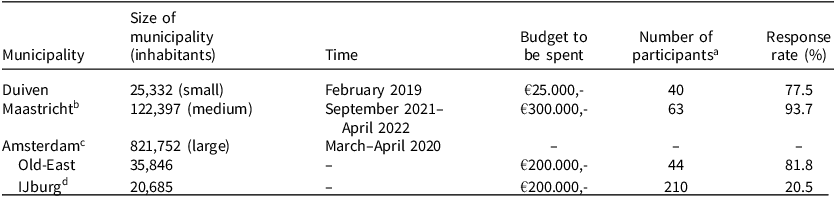
This paper draws on original survey data from PB initiatives in three municipalities in the Netherlands (see Table 1 for an overview). We selected the Netherlands as it is a typical case regarding populist attitudes: Dutch citizens consistently hold populist attitudes similar to other Western democracies (Zaslove et al. Reference Zaslove, Geurkink, Jacobs and Akkerman2021). Furthermore, it has both left- and right-wing populist parties. As such, populism is present in the public sphere across the political spectrum (Akkerman et al. Reference Akkerman, Zaslove and Spruyt2017; Theuwis and Kindt Reference Theuwis and Kindt2024). Within the Netherlands, we selected Duiven, Maastricht, and Amsterdam-East because they provide a different context to test our hypotheses, but applied a similar PB procedure. The selection of the municipalities was based on the degree of urbanisation, as this affects the proximity of citizens to their local authorities. Duiven is a small town with an address density of 1160, Maastricht a medium-sized city (address density: 2520) and Amsterdam-East is the largest and has an address density of 4155 (StatLine – Regionale kerncijfers Nederland, 2022). In the Netherlands, the use of PB has been on the rise at the local level. In line with most of the PB cases at the time, in the three municipalities under study, it was the first time that the local government took the initiative to organise a participatory budget.Footnote 5 This allows us to study participants’ evaluation of PB in a setting where this is a first-time initiative both to the organising authorities and to the people in the respective municipalities. Just like the typical PB in the Netherlands, the municipalities under study all take a similar approach to the design of PB, namely the ‘Porto Alegre adapted for Europe’-model (Sintomer et al. Reference Sintomer, Herzberg and Röcke2008; see online Appendix A). The design of this model is characterised by a) self-selection,Footnote 6 b) a considerable deliberative element, and c) decision-making power. Specifically, all inhabitants of the municipality are invited to come together to decide on how to spend a portion of public money. This is usually done discursively: participants discuss which issues they feel are most important for their municipality in a first meeting. In a second meeting, they decide how much of the budget is allocated to each topic. Next, they can write and submit a project proposal and can vote for the projects they would like to be realised. The projects that receive most votes are funded by the participatory budget. While the exact number of Dutch municipalities is unknown as no official data are compiled, the known Dutch cases all adopt this model of PB. Table 1 provides an overview of the case studies, Tables A1a and b in Appendix A provide additional background information.
Overview of case studies

a Number of participants to the final round, as that is the round we ran our analyses on.
b The PB in Maastricht was interrupted by a Covid lockdown but rather than move online, it was postponed until the lockdown was over. This explains the long period of time over which the PB was held.
c The case in Amsterdam actually consisted of two PB events held in different quarters of the city.
d The PB in Amsterdam IJburg was interrupted by a Covid lockdown and moved online. This resulted in a higher number of participants, but a significantly lower response rate on our survey because this was also distributed online. Additionally, the process was somewhat different because it was online. Both may bias our findings, so to test the potential effect of this we include case dummies (fixed effects). We also include a robustness check in the Appendix with one dummy (IJburg versus the other three cases) (see Appendix E; Table A6). None of these dummies are significant. The qualitative interviews did reveal that the IJburg participants found the deliberations less engaging than participants of the other PBs.
Mixed-methods approach
The mixed-methods approach taken in this paper employs a nested design, whereby the large-N and the small-N analysis provide evidential integration (Kuorikoski and Marchionni Reference Kuorikoski, Marchionni, Kincaid and van Bouwel2022: 271). The quantitative and the qualitative analysis examine distinct claims about the same respondents: the quantitative part examines the effect of populist attitudes on outcome acceptance, whereas the qualitative part examines the underlying mechanisms. Following Lieberman (Reference Lieberman2005: 437), in a first step we start by conducting large-N analysis. In a second step this is then followed by the small-N analysis. The small-N analysis covers participants with a wide degree of variation on our key independent variable, that is, populist attitudes. In a third and final step, the findings of both analyses will be integrated and the original model will be refined. In what follows, we first describe our approach to the quantitative analysis; then we describe our approach to the qualitative analysis.
Survey data and analysis
We draw on original survey data from the PB events in Duiven, Amsterdam and Maastricht between 2019 and 2022. Specifically, we surveyed participants of PBs after they had decided on the allocation of the budget (Maastricht and Amsterdam) or on the projects to be funded (Duiven). Notably, the allocation of the budget, while not the final outcome of the PB, was presented to the participants at the end of their round of discussion as a key outcome of the process, one that was achieved together and communicated as such to the municipality. Thus, all survey data was collected after a key outcome of the process was achieved. Ultimately, our analytical sample consists of 113 respondents.
Our dependent variable, outcome acceptance, is measured by asking respondents: ‘How willing are you to accept the outcome of the participatory budget?’. Respondents were asked to indicate their willingness to accept the outcome on a scale from 0 meaning ‘Not at all willing’ to 10 meaning ‘Very willing’.
Our independent variable, populist attitudes, is measured using the six items developed by Akkerman et al. (Reference Akkerman, Mudde and Zaslove2014). Other scales have also been developed to measure populist attitudes in citizens (e.g., Hawkins et al. Reference Hawkins, Riding and Mudde2012; Schulz et al. Reference Schulz, Müller, Schemer, Wirz, Wettstein and Wirth2018). However, the scale developed by Akkerman et al. (Reference Akkerman, Mudde and Zaslove2014) is particularly suited to the conceptualisation of populist attitudes as an attitudinal syndrome because each of its items tap into at least two of populism’s subdimensions (Castanho Silva et al. Reference Castanho Silva, Jungkunz, Helbing and Littvay2020; Wuttke et al. Reference Wuttke, Schimpf and Schoen2020). This scale thus fits this paper’s conceptualisation of populist ideology as a lens, but it does preclude the analysis of individual effects of populist subdimensions.
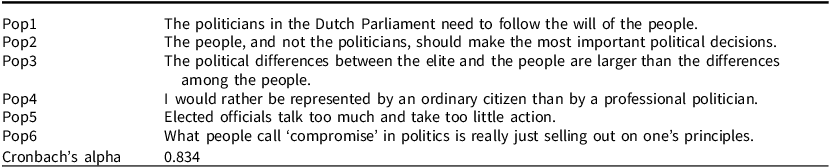
Table 2 lists the six populist attitudes items. For each of these, respondents were asked to indicate their agreement with the statement on a scale from 1 meaning ‘Strongly disagree’ to 5 meaning ‘Strongly agree’. We used principal axis factor analysis to create a factor score of respondents’ populist attitudes (for a similar approach see e.g., Akkerman et al. Reference Akkerman, Mudde and Zaslove2014; Geurkink et al. Reference Geurkink, Zaslove, Sluiter and Jacobs2020; Zaslove et al. Reference Zaslove, Geurkink, Jacobs and Akkerman2021). A Cronbach’s alpha of above 0.8 indicates good scale reliability. A low score on this variable indicates weak populist attitudes, a high score indicates strong populist attitudes. This particular operationalisation of populist attitudes was chosen because the six items all tap into at least two sub-dimensions of populism (Akkerman et al. Reference Akkerman, Mudde and Zaslove2014).Footnote 7
Items measuring populist attitudes

During the data collection, we measured participants’ populist attitudes twice: before the first round of the PB and after the second round of the PB.Footnote 8 This latter survey also includes the item measuring willingness to accept the outcome. In this analysis, we use the populist attitudes items that were measured in the second survey because that yields the highest analytical sample. However, we ran a robustness check with the populist attitudes items measured before the first round and found that this did not change our results, see Appendix F; Table A8.
We control for process- and outcome-related considerations. For process-related considerations, we included ‘satisfaction with event’ for which respondents were asked ‘if you would have to grade this event a score out of 10, what would it be?’ A higher number indicates higher satisfaction with the event.Footnote 9 For outcome-related considerations, we included a dummy for having ‘entered the process with a clear purpose in mind’ or not. For this variable we coded the answers to the open question: ‘what was your main reason for coming to this participatory budget?’ Any answer indicating that participants had clear objectives in mind on which to spend the budget were coded as 1.Footnote 10 Finally, we control for respondents’ gender, age,Footnote 11 education level, satisfaction with democracy and efficacy (see also Zaslove et al. Reference Zaslove, Geurkink, Jacobs and Akkerman2021; Heinisch and Wegscheider Reference Heinisch and Wegscheider2020). A full description of the survey items can be found in Appendix C; Table A3. The analysis itself consists of an OLS regression whereby we include dummies at the case level.Footnote 12
Interview data and analysis
To select populist and non-populist respondents to be interviewed from those that were willing, we used the above described populism items as measured in the post-survey – which provides us with the unique opportunity to find out if and how reasoning about the legitimacy of PB differs for populist and non-populist citizens. In the surveys, respondents were asked to provide contact information if they were willing to be interviewed about their experiences at the PB. We held semi-structured interviews with 34 respondents between 2 to 4 weeks after their participation in the second round of the PB.Footnote 13
The descriptives of the 34 interviewees can be found in Appendix I; Table A13. Notably, 16 interviewees scored 3.5 or higher on the populism scale and were considered populist, and 18 interviewees scored below that threshold and were considered non-populist. We selected this threshold because it is above the neutral score of 3 on a scale from 1 to 5. The threshold is slightly conservative in that it allows for some ‘buffer’.Footnote 14 Admittedly, any threshold is going to be arbitrary to a certain extent and one could consider citizens scoring an average between 3 and 4 borderline cases. Therefore, we carried out a robustness check on these borderline cases (see Appendix I). This extra check suggests that the cut-off of 3.5 is indeed the tipping point where a ‘difference in degree’ becomes a ‘difference in kind’.
On average, the group of non-populists is slightly younger and slightly higher educated, while gender is evenly distributed. The group of populists has more men, is slightly older and slightly lower educated.
We compiled the interview guide for the semi-structured interviews in advance based on our theoretical expectations, including questions on participants’ reasons for participating, their perceptions of fellow participants and the discussion at the table, their perceptions of the presence and role of elected and unelected officials during the event, and their perceptions of the process and outcome. The full interview guide can be found in Appendix J.
The interviews were then analysed abductively. Rather than analysing the interviews purely deductively, i.e., on the basis of theory-derived codes, or purely inductively, on the basis of the interviews themselves, the abductive approach takes theory-derived codes as its starting point while allowing for the discovery of unexpected patterns in the interview texts (e.g., Boyatzis Reference Boyatzis1998). The coding approach was based on thematic analysis as described by Boyatzis (Reference Boyatzis1998). The predefined themes we formulated were: a) expressions of normative considerations, – i.e., people-centrism, anti-elitism, popular sovereignty, and general normative considerations about citizen participation; b) process-related considerations, both positive and negative; and c) outcome-related considerations, both positive and negative. The unit of coding was usually several sentences, sometimes one sentence or a sentence fragment.
After having coded half of the interviews, the validity of the devised coding scheme was tested by establishing intercoder agreement. In three iterations, the coding scheme was adjusted until a Krippendorff alpha of 0.713 was achieved on the second-level codes (e.g., normative – popular sovereignty – positive), indicating sufficient intercoder agreement. Achieving intercoder agreement on the second-level codes allowed us to maintain the nuance of the inductively produced micro-level, or third-level codes. The codebook used to analyse the interviews can be found in Appendix K. The interviews were coded using ATLAS.ti version 22.
Results
Below, we first provide the results of our quantitative analysis and then zoom in on the underlying relationships via our interview analysis. Lastly, we integrate the findings of the two analyses.
Step 1. Quantitative analysis: the effect of populist attitudes on outcome acceptance
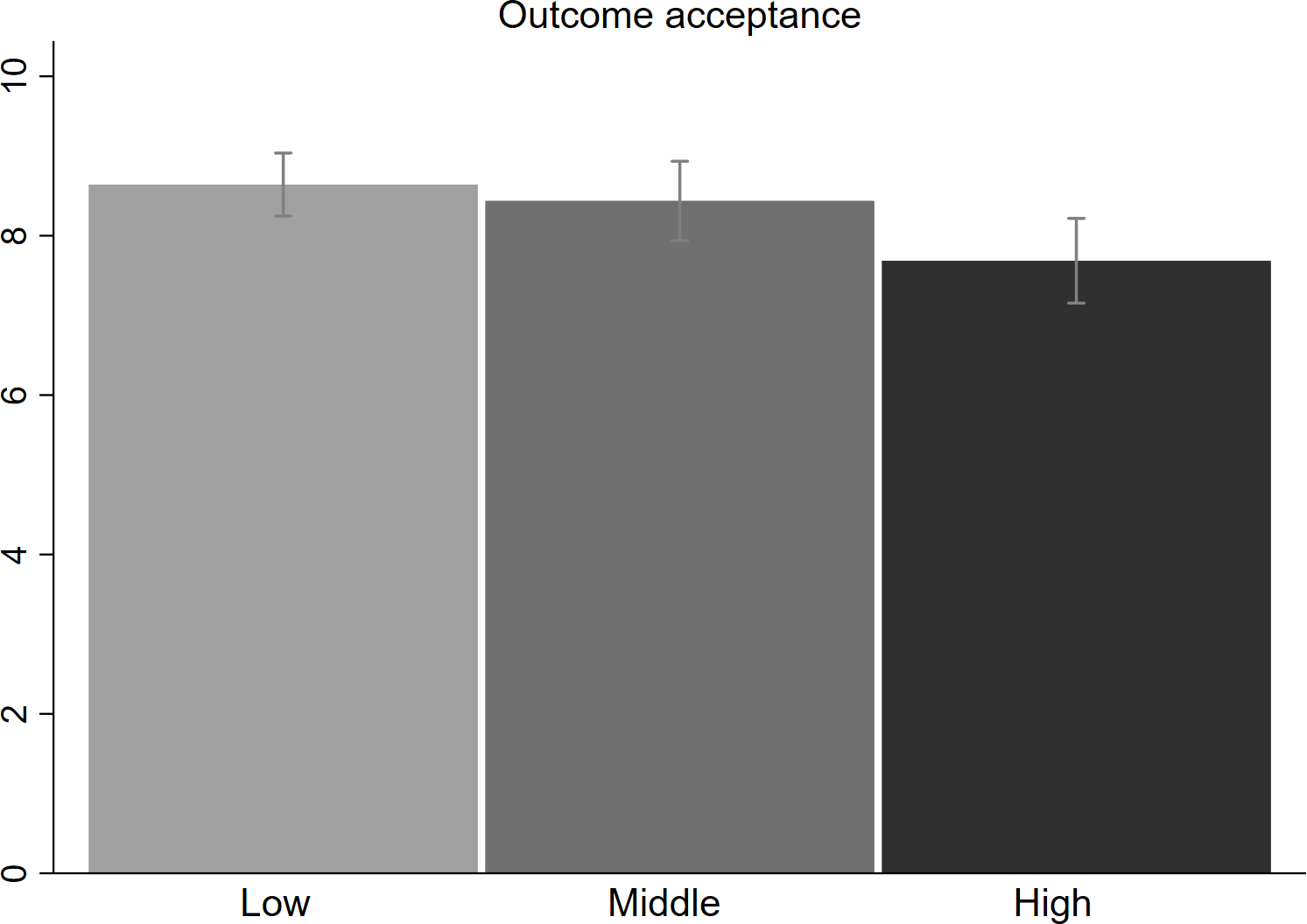
The descriptive statistics of the association between populist attitudes and outcome acceptance in Figure 1 show that outcome acceptance of the PB is generally high, both among populist and non-populist participants. Populist outcome acceptance appears to be only slightly lower than non-populist outcome acceptance.

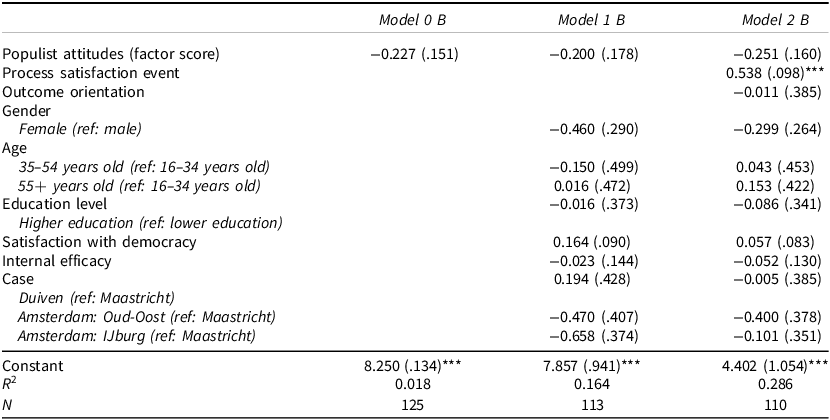
Next, we ran an Ordinary Least Squares (OLS) regression to test whether populist respondents have higher levels of outcome acceptance. We included case-dummies to control for case-specific effects.Footnote 15 Table 3 shows that in each of the three models, the association between populist attitudes and outcome acceptance is not statistically significant. In the third model we do find that satisfaction with the event has a fairly strong and statistically significant effect on outcome acceptance, but the coefficient and standard error for populist attitudes remains similar and the effect is not statistically significant. As such, we do not find support for hypothesis 1 – which hypothesised that respondents with high levels of populist attitudes are more willing to accept the outcome of the PB.
OLS regression of outcome acceptance on populist attitudes

Note: *=<0.05, **=<0.01, ***=<0.001. Unstandardised regression coefficients. Standard errors are between parentheses. Model 0 is the populist attitudes only model. Model 1 adds traditional controls. Model 2 is the final model and includes process-related and outcome-related variables.
Robustness checks
We ran several robustness checks. First, we checked whether our results depend on how we operationalised populist attitudes in the main analysis (Appendix F). We first created an index of populist attitudes by taking respondents’ average score on the populist items. Using the average rather than factor score, we again find that the association between outcome acceptance and populist attitudes is not statistically significant (Appendix F; Table A7). We then created a factor for populist items for five instead of six items – that is, we left out the item asking about respondents’ attitude towards people and not politicians deciding on important issues. This addresses concerns about the tautology of populist attitudes and the dependent variable under study. We again find that the association between outcome acceptance and populist attitudes is not statistically significant (Appendix F; Table A9). We finally ran the analysis using the populist attitudes items measured before round 1. This analysis also does not yield different results (Appendix F; Table A8).
Second, we examined whether the analysis was driven by missing cases. We used multiple imputation to address potential concerns arising from list-wise exclusion of respondents with one or more missing items on the items under study (e.g., van Buuren Reference Van Buuren2018). Again, the pooled results of our multiple imputed datasets (m = 25) indicate that the association between populist attitudes and outcomes is not statistically significant (Appendix G; Table A10).
We must conclude, then, that we find no evidence that populist citizens are more willing to accept the outcome of a PB than non-populist citizens.Footnote 16 However, it could be that the mechanisms behind their outcome acceptance are different. The analysis of interview data below aims to shed light on this. In the jargon of mixed-method research, this means that while our (quantitative) large-N analysis yielded a robust model, we proceed to the model-testing (qualitative) small-N analysis to see whether the mechanisms reflect these findings (Lieberman Reference Lieberman2005: 442). Specifically, if the findings of both types of analysis align, we should see a lot of overlap between populist and non-populist interviewees and a heavy emphasis on process-related considerations.
Step 2. Qualitative analysis: examining how participants perceived the PB cases in practice
This section outlines the main results from the interview analysis. Based on the three overarching themes mentioned above – normative considerations, process-related considerations, and outcome-related considerations – this section seeks to map the experiences of populist and non-populist participants that could have contributed to their willingness to accept the outcome of the PB. It is important to note that the interview analysis is focused on evidence of mechanisms that have either been theorised or become apparent from the interviews to lead to higher outcome acceptance among participants.Footnote 17
The Venn diagrams in Figure 2 summarise the most important experiences expressed by the populist and non-populist interviewees. The more strongly emphasised considerations are listed in a larger font; thus the larger the font, the more ‘important’ the consideration; the pluses indicate positive experiences, i.e., experiences that participants were positive about, the minuses indicate negative experiences. The considerations in the normative theme have neither a plus nor a minus, since that would be a subjective qualification.
Similarities and differences in experiences and perceptions between populist and non-populist participants to a PB.
Note: the font size of the above considerations indicates the relative importance of the considerations. Thus, comments in larger and bold font were most often said; comments in larger font medium often said; and comments in small font least often said. The pluses before comments indicate positive experiences; the minuses indicate negative experiences. There are no pluses or minuses before the normative considerations since they cannot be considered positive or negative (as that would be a subjective qualification).

The diagrams show that the populist and non-populist interviewees had particular experiences, but also shared (process-related) experiences. It is important to note though that the experiences that are described as particular to either populists or non-populists are not necessarily unique to that group. In Tables A14 and A15 in Appendix L we have listed all considerations resulting from the thematic analysis of the interviews. These figures show that many of the considerations that we deem particular to one group have also been mentioned by the other group. However, and importantly, considerations are deemed particular to either group when they are emphasised more strongly by that group – i.e., mentioned more often by more interviewees. This stronger emphasis is indicative of a different experience. The first conclusion to be drawn is thus that there is a difference in how populists and non-populists experienced participation in a PB.
In the following sections we discuss the themes in more detail, focusing first on the experiences they have in common and then on their unique experiences. In each section we start with normative considerations, followed by process-related considerations and finally outcome-related considerations. The discussions of the themes are illustrated with quotes.Footnote 18
The perceptions and experiences that populists and non-populists have in common
As Figure 2 showed, populist and non-populist participants had several considerations in common. These related to normative considerations, and most importantly – and in line with the quantitative analysis – populist and non-populist interviewees shared positive process-related considerations and mentioned overall process satisfaction.
Normative considerations
Firstly, both populist and non-populist participants expressed a belief in popular sovereignty. Non-populists expressed a general belief in more citizen participation and that citizens should determine what happens in their neighbourhood. Populists share this desire for more citizen-participation at the neighbourhood-level. The populists’ expressions of desire for more popular sovereignty were, however, more populist in nature: they more often expressed the feeling that politicians need to listen to the people. While the focus might be slightly different, both groups believe citizens should have a bigger role in (political) decision-making.
Process-related considerations
Secondly, populists and non-populists share a positive evaluation of the presence of politicians at the PB. At all four PBs, politicians – mostly local council members – were present. The level of their involvement differed: in Duiven and the two Amsterdam cases, they were present in the background to witness what was being discussed; in Maastricht, they sat at the table, identified themselves as council member, and listened in or even actively participated in the discussions. Both populists and non-populists largely perceived them as open to the suggestions made at the tables. More broadly, the fact that the PB was organised in the first place was seen as a signal from politics to citizens that politicians want to make a better effort to listen to citizens in the future. These considerations suggest that both populist and non-populist participants noticed the presence of politicians at the event, and collectively translated their presence and attention to a feeling of being taken seriously as a decision-maker. A populist said:
(5) ‘I was happy with [the Elderman’s] intervention because it inspired some trust in the sense of: the municipality wants to think along with us, there is some flexibility, they are not sticking to their rigid decision-making and procedural protocols.’ (202 rnr 4)
In addition, both populist and non-populist participants overall experienced the discussions at their table as open and constructive. As a result of this openness of the discussions, a majority of populist and non-populist participants report that they were able to have their say and felt listened to; and saw that others were also able to have their say and be listened to. We argue that both of these experiences relate to the procedural fairness mechanism described by Thibaut and Walker (Reference Thibaut and Walker1978), through which the perception of being given voice and influence in turn gives people a sense of influence and of control over the decision-making process, which ultimately leads to a higher willingness to accept the outcome.
Interestingly, none of the PBs provided moderators for the discussions at the table. As a result, the interviewees credited the perceived procedural fairness of the PB first and foremost to fellow-participants and their behaviour during the discussion. As such, it is unclear whether the perceived voice translates into feelings of being respected and taken seriously by the decision-making authority. Rather, the experience of having their opinion heard by other participants seems to result in positive views about those fellow participants, particularly among the populist participants. A populist said:
(6) ‘There was respect for one another. We agreed at the beginning of the session to let each other finish their sentences. And, well, I am used to this at work, but that does not always happen when the discussion gets heated. But the discussion did not get heated.’ (301 rnr 109)
A non-populist said:
(7) ‘I usually don’t actively participate in a discussion, but I felt the openness with which the different participants motivated their choices to be very inviting. That is why it felt good to speak of my own ideals and the things I would like to achieve. And that resulted in a very nice chemistry, a very nice result.’ (301 rnr 100)
Populists and non-populists did not have outcome-related considerations in common.
Populist perceptions and experiences
Moving on to the considerations unique to populist participants, the interviews reveal unique normative, process-related and outcome-related considerations.
Normative considerations
Firstly, normatively, the populist interviewees stand apart from the non-populist interviewees in that they more often voiced anti-elitist sentiments. What is interesting to note is that these sentiments are more often of a Manichean nature (Mudde Reference Mudde2004). That is, they are expressions of contempt towards the political elite, and of the belief that the political elite has bad intentions, indicative of the moral divide that populists see between themselves and the elite (ibid.).
(1a) ‘We as humanity have forgotten how to keep all those little egos, or those people who desire power, under our thumb. They do not have to leave, but they do need to know their place, and their place is not at the top, that’s the hard part. And as a society you could make that happen.’ (301 rnr 123)
(1b) ‘And then already I am like, how do you even manage to do this! That is that corruptness again! (…) And then I think, what complete idiots.’ (301 rnr 117)
(1c) ‘And no matter what political party, we’ve heard it again today on the news, it’s all just one big mess over there in The Hague.’ (301 rnr 109)
Process-related considerations
The populist experience of participation in a PB was characterised first and foremost, however, by their overwhelmingly positive evaluation of their fellow participants. Almost all populist interviewees made remarks within this theme. Populist interviewees were very positive about the characteristics of their fellow participants and more uniform in their praise of how their fellow participants behaved during the discussions. They perceived their fellow participants as cooperative and as eager to achieve the best result for the neighbourhood. Moreover, they were happy when fellow participants brought new perspectives to the table, and when fellow participants either already had the same interests as they did or when they came to agree very easily. Whether fellow participants had similar or different interests and perspectives thus seems not to matter for populists’ positive evaluation of their fellow participants.
(2a) ‘We were so in agreement with one another, we were done in a heartbeat.’ (301 rnr 117)
(2b) ‘People at our table engaged in a lively discussion, which was one of the most important things for me, to hear someone else’s ideas and to make my own ideas clear to them.’ (301 rnr 120)
(2c) ‘We all almost immediately agreed with each other, it was really a meeting of the right people at the right time, with the right ideas.’ (301 rnr 3)
(2d) ‘I particularly noticed that people listened carefully to each other and were supportive towards each other.’ (301 rnr 26)
One might have expected populist participants to a PB to have a more ambivalent attitude towards fellow participants, especially those with diverging interests. Indeed, some go so far as to state that a populist would automatically dislike someone they disagree with, and exclude them from the people (Müller Reference Müller2014). However, we argue that this unexpected populist experience can be explained by the following: inherent to populist ideology is a feeling of not being listened to and not being taken seriously.Footnote 19 This feeling is rooted in the belief, on the one hand, that politics should be based on the will of the people; and on the other hand, that the political elite is deliberately unresponsive to that will (Canovan Reference Canovan1999; Müller Reference Müller2014). Although the populist feeling of not being listened to is related first of all to the political elite, it might make populist citizens especially sensitive to instances in which they do experience actively being listened to – even if by other citizens. This could in turn result in the enthusiasm expressed by the populist interviewees about their fellow participants. Any negative remarks about fellow participants were limited to them not being representative, which appears not to have been perceived as problematic.
Outcome-related considerations
Finally, the populist interviewees also more often reported having participated in the PB with a concrete goal in mind, i.e., they already thought of a specific project to finance with the budget. They thus entered the process more often with an intention to benefit. They were also more inclined to evaluate the outcome of the PB based on whether they benefited from it. And they more often report that they did indeed get what they wanted from the outcome. This is indicative of the ‘outcome favourability’-mechanism through which an outcome is more readily accepted when it is in line with one’s preferences (Esaiasson et al. Reference Esaiasson, Persson, Gilljam and Lindholm2019).Footnote 20
Non-populist perceptions and experiences
Lastly, non-populist interviewees also mentioned normative, process-related and outcome-related considerations unique to them.
Normative considerations
Non-populist interviewees were particular in their expression of the belief that citizen participation initiatives, such as a PB, should be as inclusionary and representative of the neighbourhood as possible. We argue that this consideration is indicative of a normative idea of what citizen participation should be. This idea of what citizen participation should be appears to shine through in the process- and outcome-related considerations they have expressed. As illustrated in more detail in the discussion of their process- and outcome-related considerations, they appear to believe that there should be more citizen participation, particularly at the neighbourhood-level. This citizen participation should be bottom-up, thus with as little government involvement as possible, and the outcomes should be towards the greater good.Footnote 21 This normative framework seems to have been decisive in how they experienced certain aspects of the PB.
Process-related considerations
Next to the positive process-related considerations that non-populists shared with populist participants (see Figure 2 and section above), non-populist participants in particular mentioned process-related considerations that were negative in nature. To begin with, non-populists highlighted that the group of participants was not entirely representative: they felt the youth were underrepresented, as well as people with a migration background and lower-educated people. This underrepresentation of certain groups is explicitly attributed to the organisation of the event, which in their view should have exerted itself to reach a larger audience.
On a practical level, non-populist participants experienced the organisation of the event as somewhat messy and clumsy. They also often felt the process was being steered and felt they were limited in their ability to formulate solutions. And even though they were happy with the outcomes, they would have preferred the process to be truly bottom-up with less steering.Footnote 22 Several non-populists explicitly link this steering behaviour to the municipal government.
(3) ‘Yes, I suppose I am happy with the choices we made, but the procedure overall I found tiresome. I think that if you ask local citizens to indicate which themes are important for a neighbourhood, the municipality should not start dictating those themes, you should really leave that to the neighbourhood.’ (202 rnr 17)
Outcome-related considerations
Where the non-populists show themselves as clearly different from the populists is in their evaluation of the outcome of the PB and its overall impact. Where populist participants evaluate the outcome more in terms of whether they got what they wanted, non-populists evaluated it more in terms of whether the neighbourhood got what it needed, which many of them felt was not the case. This is in part because they think the budget is too small to truly have an impact, and in part because the process could only result in ‘shallow’ solutions that do not really address the neighbourhood’s needs.
(4) ‘It was a bit shallow. We could not move towards real solutions and my experience with the people from this neighbourhood is that that is what they really want. Sure, if the purpose is to select 5 themes: fine. But whether that is a meaningful way to spend our time, and whether you should occupy 70 inhabitants with that all afternoon… I wonder.’ (202 rnr 47)
Step 3. Integrating the qualitative and quantitative findings
In this section, we integrate the findings of the two previous steps (i.e., the quantitative and the qualitative analyses). Our quantitative, large-N analysis found that populist attitudes did not have a significant effect on outcome acceptance, whereas most importantly, process satisfaction did have a significant effect. Our qualitative, small-N analysis, however, showed that this is not the complete story.
Indeed, if the findings of both types of analysis aligned, we should have seen a lot of overlap between populist and non-populist interviewees and a heavy emphasis on process-related considerations. The interview analysis did corroborate the latter, but it ‘contradicted’ the former (Rohlfing Reference Rohlfing2008: 1495).
Indeed, while the results of the interview analysis corroborated the importance of process satisfaction, they also suggested that populists and non-populists experienced the PB differently. While both seemed roughly equally accepting of the outcome, they seem to have done so for different reasons. Populist participants were focused on the contact with their fellow participants (cf. the populist people-centrism) and were happy with the outcomes. The non-populist participants were more focused on the nitty-gritty of the procedures and the overall organisation, which they thought was messy (cf. Thibaut and Walker Reference Thibaut and Walker1978). They also highlighted that the participants were often not entirely representative of the broader population of the municipality. In terms of outcomes, the populist interviewees stressed that they were satisfied because they themselves ‘got what they wanted’. The non-populists interviewees, on the other hand, highlighted that the neighbourhood ‘did not get what it needed’. This may seem like a subtle difference, but one that is crucial in the difference between the populist and non-populist participants.Footnote 23
All in all, the non-populist participants highlighted more negative aspects, but they were satisfied with the process, and this apparently trumped the other considerations. This brings us to the last part of our mixed-methods study: the refinement of the original model (Rohlfing Reference Rohlfing2008: 1495). Taken together, our findings suggest different pathways to outcome acceptance. Analyses using Structural Equation Modelling, e.g., using new measurements of how participants view their fellow participants and detailed evaluation of the organisation, could test such pathways quantitatively. As we do not have such data ourselves, this constitutes the ‘endpoint’ of our mixed-methods analysis (cf. Rohlfing Reference Rohlfing2008: 1495). We will return to this point below in the suggestions for future research.
Conclusion
In this study we set out to answer the research question ‘to what extent and why do the populist attitudes of participants affect the outcome acceptance of Participatory Budgeting?’ Our mixed-methods research suggests that the legitimacy perceptions of ‘Porto Alegre adapted to Europe’-style PBs are high among populist and non-populist participants alike, but their reasons are different. On the face of the first, quantitative part of our analysis, populist attitudes among participants do not seem to influence the outcome acceptance of a participatory decision-making process. However, the second, qualitative part of our analysis shows that there is a difference in how populists and non-populists have experienced their participation and that they may have different reasons to be willing to accept the outcome (see Appendix N). In a third step, we integrate both the quantitative and qualitative analyses, and our mixed-methods analysis suggests that there are different pathways to similar levels of outcome acceptance.
Our findings are promising for democratic innovations’ potential to close the perceived gap between democracy’s ideal and democracy’s practice, since the example of the PB has been shown to address a need for more popular sovereignty in both populist and non-populist citizens. However, this study has also shown that democratic innovations’ curative potential is neither absolute nor unconditional. First, our study strongly suggests that that populists’ legitimacy perceptions of democratic innovations is dependent on having experienced real voice. Second, non-populist legitimacy perceptions in this case appeared to depend on normative considerations overriding disappointment with perceived below-par organisation and outcome.
This brings us to the generalizability of our findings. We studied first-time PB initiatives that followed the ‘Porto Allegre in Europe’-model in a country where populism was present across the political spectrum. Our findings are likely to be generalisable to similar settings. Where the exact degree of the effects may be different, the broader patterns and underlying mechanisms we uncovered are likely to travel to similar cases. Moving beyond PBs, we find that having a real voice matters for populists, and this may travel to referendums. Additionally, we found that populists were very sensitive to being listened to by fellow participants, something that is likely to travel to the setting of deliberative mini-publics.
Even though many scholars have suggested that democratic innovations, such as PBs, have the potential to mitigate the contemporary democratic malaise, empirical studies examining whether they actually do so in practice remain almost non-existent in regarding one of the thorniest components of that malaise: populism. Indeed, as Bächtiger and Dryzek (Reference Bächtiger and Dryzek2024: 104) note: ‘research on this topic is extremely sparse’. This is understandable: doing research on populism in actual cases of democratic innovations is not easy and requires the surveying of participants, which can be time-consuming. And yet this also presents the danger that the empirical foundation upon which the findings about the topic rest, is fairly narrow (see also Spada and Ryan Reference Spada and Ryan2017). For instance, our own study used data about the same (Dutch) municipalities as Theuwis and Kindt (Reference Theuwis and Kindt2024). We would thus urge follow-up research to examine cases outside the Netherlands.
Indeed, although the Netherlands is arguably a good (i.e., typical) case, future research should examine actual democratic innovation cases in countries where populism manifests itself differently in the public discourse, e.g., because it is less entrenched in that discourse or is only present at either the left- or right-side of the political spectrum. Similarly, it is useful to replicate our study in cases that have a different PB-design. Indeed, it remains to be seen to what extent our findings hold when the PB is merely advisory, such as in the case of the ‘Consultation on public finances’-model of participatory budgeting, which can be characterised as ‘selective listening’ (cf. Sintomer et al. Reference Sintomer, Herzberg and Röcke2008: 170, 172). Furthermore, we only studied first-time initiatives. This may have potentially affected our findings: first-time initiatives may be messier than subsequent more streamlined PBs. On the other hand, first-time initiatives may have more resources in terms of organisation. It may also affect the overall ‘attitude’ of the politicians and policymakers present. In all four cases, the politicians and civil servants who were there supported the PB as a tool and were open, receptive and listened to the participants. It remains to be seen how such factors affect participants’ outcome acceptance. Bringing this all together, we suggest that studying populism and PBs in France, Scotland, Germany or Spain would, for instance, be worthwhile. Furthermore, another fruitful venue for future research is cross-case comparative research, comparing first-time PBs to recurrent ones and comparing different countries or even European to Latin American cases to check the potential impact of different manifestations of populism (Mudde and Rovira Kaltwasser Reference Mudde and Rovira Kaltwasser2013; Ryan Reference Ryan2021). Finally, our research showed the merit of conducting mixed-methods research, whereby the quantitative and qualitative analyses reinforced each other and revealed insights that no stand-alone quantitative or standalone qualitative study would have revealed. Testing our insights, specifically regarding the different populist and non-populist pathways to outcome acceptance, using new and more refined data via a SEM-analysis is our final suggestion for future research.
Supplementary material
The supplementary material for this article can be found at https://doi.org/10.1017/S175577392610040X.
Data availability statement
The data is available for replication on Harvard Dataverse, https://doi.org/10.7910/DVN/RU0L52.
Acknowledgements
We thank Marie-Isabel Theuwis for her part in the collection of survey and interview data.
Funding
This research is funded by the Dutch Science Organisation (NWO) in the framework of the NWO-VIDI project nr. 195.085.
Competing interests
The authors declare that there is no conflict of interest.
Ethics approval statement
This study was approved by the Ethics Assessment Committee Faculty of Law and Nijmegen School of Management (EACLM). All respondents provided informed consent prior to enrolment in the study.


 Open access

