

In October 1893, the Northern Echo's “Special Correspondent” penned a report detailing the distress experienced in South Yorkshire during a coal strike. Ostensibly a straightforward account of the suffering of the miners and their families, it was also a meditation on the problematic nature of strike-generated hunger. He wrote of strikers’ homes in which signs of poverty abounded: broken window panes stuffed with paper to keep out the cold; rooms emptied of furniture that had been pawned for a few pence; bare food cupboards aplenty. Yet “many well-informed persons” told him that the miners were “the most improvident of men”.
Were the indicators of distress the result of exceptional hardship or of profligate lifestyles? Were they even evidence of genuine suffering? As one gentleman observed, “it was one of the most difficult things in the world to discover whether people were really starving”. The reporter concurred. He assumed that school children with “chubby and rosy” cheeks were in good health until a school teacher corrected him; if it had not been for a soup kitchen the plight of the starving mites would have been serious. He wondered whether aid should be given to strikers who could end the suffering by returning to work. But this question seemed obscenely irrelevant when he came face-to-face with a famished man so weak he was barely able to walk. In that case, immediate relief was the only proper course of action, the journalist decided. He admired the philanthropists who worked to help those in distress, but when the hungry were out of sight, his doubts returned. By the end he was even uncertain about the status of hunger itself. For all the suffering it entailed, it seemed clear that lack of food would soon drive the men back to work; hunger, not charity, might be the means of ending this sorry spectacle of suffering.Footnote 1
The “Special Correspondent” was not alone in worrying about how to respond properly to hunger generated by industrial disputes. The mass suffering that often accompanied lengthy strikes troubled many late Victorians. Those living in strike-affected areas witnessed the distress at first hand. But lots more read about the plight of famished strikers and their families in newspapers that detailed the human cost of stoppages in often sensationalist prose. The press coverage of hungry strikers repays careful study for it casts a revealing light upon the limits of the “humanitarian discovery of hunger”. According to James Vernon, that discovery took place during the nineteenth century and involved a remarkable transformation in attitudes. In the late eighteenth century commentators such as Joseph Townsend and Thomas Malthus could argue that hunger was unavoidable. To the extent that it forced the “morally inadequate” – the workshy and the lazy – into the labour market it could even be acceptable. But Vernon contends that by the end of the nineteenth century, hunger had become a “humanitarian cause-célèbre”, with the hungry increasingly seen as victims of forces beyond their control and therefore objects worthy of compassion. He explains this about-turn as a consequence of events such as the Irish Famine of the 1840s, newspaper coverage of the scandalous conditions in some New Poor Law workhouses, and the Lancashire Cotton Famine of the 1860s. Such episodes, Vernon suggests, gradually freed the hungry from the grip of a condemnatory “Malthusian” discourse which cast them as the immoral authors of their own misfortune.Footnote 2
This chronology of changing attitudes to hunger is highly suggestive. In its broad outlines – if not necessarily in all its detailsFootnote 3 – it captures a significant truth regarding the shift in perceptions of the hungry. It certainly fits well with what we know about the humanitarian discoveries of other suffering groups – such as slaves, condemned criminals, the insane, and so on.Footnote 4 But alongside this bracing narrative of dramatic change over time, Vernon also hints at a more complex chronology, one that recognizes the contingent and partial nature of the humanitarian discovery of the famished. Thus, he remarks that even after the hungry were “discovered” they were still “subject to the unpredictable ebbs and flows of moral sympathy and humanitarian attention”.Footnote 5 Indeed they were, although this underestimates the extent to which many amongst the ranks of the late Victorian famished found themselves – all too predictably – adjudged to be unsuitable recipients of aid.
The rise of a humanitarian sensibility, far from displacing moralistic understandings of hunger in the late nineteenth century, breathed new life into them. Philanthropists everywhere made moral judgements about applicants. For those hungry slum-dwellers on the receiving end of the “scientific charity” practised by the likes of the Charity Organization Society (COS), for example, it might be cold comfort to know they were living in an age in which their plight had become a humanitarian cause célèbre. In the 1880s, one member of the COS could still talk in terms of the “beneficent pains of hunger and want” – beneficent because hunger stimulated the “moral energy” of the poor and encouraged them to strive for better things.Footnote 6 Such sentiments directly echoed those expressed by Joseph Townsend nearly a century earlier.
This paper considers some of the ways in which late Victorians approached a very particular sub-group of the hungry: those in distress as a consequence of industrial disputes. Along the way, the depth of humanitarian sympathy for the famished becomes apparent. Many felt compelled to act. But even the most compassionate often accepted that it was inappropriate to extend one's sympathy indiscriminately. Not all famished bodies were equally deserving of help. A discourse was routinely mobilized that sought to identify the suffering “innocents”. It drew freely on prevailing assumptions about gender roles, in particular the idea that it was responsibility of “manly” working men to protect their “vulnerable”, “helpless” dependants.
Such an approach to strike-generated distress was often justified on the grounds that it was somehow above or beyond politics. Its apolitical credentials were apparently strengthened by the fact that the concept of the “innocents” was as likely to be found in newspapers sympathetic to the cause of labour as it was in those supportive of the interests of capital. Importantly, it enabled philanthropists to argue that they were relieving the distress of hungry “innocents” without taking sides in the strike. However, in truth, this discourse was deeply political and the construction of a striker's dependants as worthy of humanitarian sympathy came at a high price. It denied entirely the agency of working-class women (they were deserving of help only as long as they adhered to the role of passive victims), and it had profound consequences for striking men. If members of their families were the “innocents”, male strikers were, at best, the “non-innocent”, implicitly responsible for the suffering of women and children. At worst, they were simply regarded as downright guilty. In either case, the discourse of the “innocents” worked to render invisible the hunger of the male striker. Humanitarians were seemingly blind to his suffering. Labour leaders had either to turn the idea of the “innocents” to their advantage or subvert the discourse altogether.
Newsworthy Hunger
Recently attention has been drawn to the relationship that obtained between the humanitarian sensibility and sensationalism. Karen Halttunen, for example, has demonstrated how, in the eighteenth and nineteenth centuries, humanitarianism developed within a culture of sensationalism that conceived of pain both as revolting and exciting. At the heart of the “sympathetic revolution” was the idea that sympathetic feelings were produced when one saw, literally or imaginatively, the suffering of others. Early on, there were concerns about this spectatorial sympathy and readers of sentimental fiction and reform literature sometimes found themselves accused of being morally passive, or worse, hypocrites who enjoyed contemplating detailed descriptions of the pain of others.Footnote 7 Kevin Rozario has taken Halttunen's argument a step further and stated that modern humanitarianism was “a creation of a sensationalistic mass culture”. In his study of the American Red Cross Magazine he notes that, in the 1910s, the publication was explicitly entertaining. Other people's suffering was routinely dramatized by the application of literary tropes derived from pulp fiction.Footnote 8
Late Victorian journalists were themselves no strangers to the linkages between suffering and sensationalism. They were fully alive to the dramatic potential of distress occasioned by lengthy strikes that could, after all, render whole communities hungry. Their willingness to turn such suffering into news stories was unhindered by the fact that evidence of hunger was often difficult to come by. As Michelle Perrot has remarked, bourgeois reporters, “whose world ended at the doorsteps of working-class households”, faced real challenges when they tried to uncover the suffering of strikers.Footnote 9 Observers regularly conceded that if hunger was widespread, much of it was concealed from their view. In 1893, a correspondent to the Manchester Guardian thought that “the amount of suffering and actual starvation” occasioned by a strike in the Lancashire cotton district must be “appalling”. However, the full scale of the hardship would probably never be known because of “the proud reserve by which the sufferers have shielded themselves from the public eye”.Footnote 10 Similar comments were made during the five-month-long “Coal War” in South Wales in 1898. One journalist remarked that “the families suffering are very reticent in making their wants known”, whilst another put it more bluntly: the strikers “hide their poverty”.Footnote 11
Such obstacles did not dissuade journalists from trying to convey the drama of a situation that apparently threatened nothing less than mass starvation. Any public signs of distress were seized upon. Thus, the faces of strikers and their families were scoured for signs of hunger's presence.Footnote 12 Schoolteachers were interviewed to see if any of their children had complained of missing breakfast.Footnote 13 And, in the absence of hard facts, hearsay was often pressed into service. During the South Wales miners’ strike of 1898, one of the Glamorgan Gazette's journalists asserted there “was great distress” present in the Maesteg district, although he conceded that he could only cite rumours in support of his claim.Footnote 14
Most commonly, a language was employed by newspaper reporters that was powerful enough to convey the seriousness of the situation facing the strikers and their families, yet remained vague enough to accommodate the lack of evidence. The newspaper coverage of the condition of South Wales coalfield communities in 1898 is typical. Two weeks into the stoppage, the Aberdare Times noted that “distress prevails” in the Aberdare Valley. How many were in distress and to what extent went unremarked.Footnote 15 A week later, another local paper reported that an unspecified number in the Merthyr district had already “felt the hard pinch of poverty, the pangs of hunger, and the sorrow of seeing the little ones crying for food”.Footnote 16 By the end of the first month, the Glamorgan Free Press gloomily observed that the stoppage was “beginning to show its influence upon the homes of the workers, and poverty, grim poverty, is now initiating its reign of terror”.Footnote 17
Another oft-repeated strategy was to write about hunger in terms of a disaster that was always imminent but never quite reached. In 1873, over 1,000 families of South Wales ironworkers were reportedly “in danger of absolute starvation”.Footnote 18 In 1881, some 8,000 striking miners in South Yorkshire were said to be “on the verge of starvation”.Footnote 19 The same phrase was used to characterize the condition of ironworkers and their families in Durham during a miners’ strike in 1892, whilst during the miners’ strike of 1893, Yorkshire colliers were on “the point of starvation”.Footnote 20 And in South Wales, in 1898, whole communities were variously described as being “on the verge”, “on the point”, or “on the borderlands” of starvation.Footnote 21 Such descriptions were certainly not lacking in dramatic energy. However, they quickly lost their ability to shock. If whole communities were on the borders of absolute starvation in the second week of a dispute, where were they on the fourth or the fourteenth week? In the face of such difficulties, alternative means of reporting the human cost of a long-running strike had to be deployed.Footnote 22
Individualizing Hunger
Some of the most effective accounts of strike-generated hunger were those which individualized suffering. As noted above, journalists were presented with some daunting hurdles, given the apparent unwillingness of the working class to share their deprivation with the wider world. But reports appeared in newspapers that purported to bring readers face-to-face with the hungry themselves. During the miners’ strike of 1893, Yorkshire readers learned of a family in Rotherham in which the mother, suffering from typhoid fever, and her five children were discovered living in a house without food or fuel.Footnote 23 In the same year, in Lancashire during the cotton workers’ strike, journalists revealed that in one Burnley household, the absence of wages for eighteen weeks had driven a daughter to lose “her reason” and her father to attempt suicide.Footnote 24
In the 1890s, reports appeared that graphically illustrated the terrible effects hunger was having on working-class families. During the miners’ strike of 1893, the Yorkshire Evening Post carried a number of “pitiful tales” of starvation and privation in the county's coalfield communities. Amongst them was a story in which the severity of the situation was made manifest:
A day or two ago a little lad, famishing with hunger, clutched at a sheep's head which he saw temptingly displayed on a stall in a local meat market, and managed to carry it off without immediate detection. But on the butcher giving information of his loss, the little waif and his booty were traced home by the sturdy police officer. On entering the policeman actually saw the lad and two other youngsters ravenously devouring the flesh from the sheep's head – raw. The police-constable's heart was touched with the scene. He not only refused to take the little chap into custody, but went back to the butcher and told his tale to him, with the result that the tradesman not only discarded all idea of a prosecution, but sent a quantity of choice beef cuttings to the house of famine.Footnote 25
Later, in 1898, South Wales newspapers reported similar incidents. A month into the “Coal War”, the Glamorgan Gazette informed readers of a case in “one of the three Valleys above Bridgend” in which a mother had stolen uncooked liver and taken it home to her children who were seen to devour it raw.Footnote 26 A few days later, readers of the Western Mail learned of a “pathetic incident […] reported from Mountain Ash”. A “little girl, about ten years of age, made a bound at some bloaters exposed for sale, and, taking one, ran up the street eating it ravenously. When overtaken she pleaded for mercy, not having tasted any food for nearly 24 hours.”Footnote 27 The following month, the Aberdare Times carried a story about an incident that took place in Cardiff:
A poor woman was noticed by a butcher a few days ago to seize a piece of liver from his window as she passed. He raised no alarm, but simply followed her and beckoned a policeman who was in sight to walk with him. She at length entered a house, and when the two men got there they were horrified to see several children literally tear the raw liver from their mother's hands and eat it ravenously. The policeman, under such circumstances, asked the tradesman whether he wished him to arrest the woman. “My God, no,” said the butcher, who instead of prosecuting, handed the poor soul a 2 s. piece, and so did the policeman.Footnote 28
The similarity of these stories inevitably raises questions about their veracity. That they reportedly took place in different communities, and even in different strikes separated by five years, strongly suggests that they were fabricated, but by whom is unclear. Did journalists invent such tales, or were they reporting in good faith rumours that had been passed on to them? Perhaps they all referred back to a real event. What is clear is that a number of editors independently chose to include these stories of hungry children devouring raw meat in their newspapers in the 1890s. This is significant and begs a number of questions. What made these tales so attractive that they were recycled in this way? Why did they work so well as hunger texts? And, most importantly of all, how might they have shaped readers’ perceptions of the distress occasioned by a strike?
The decision of editors to include such sensationalized accounts of distress and suffering should not surprise given, firstly, what we know about the “New Journalism” and, secondly, the close connection already described between humanitarianism and sensationalism. These stories appeared to lift the veil of secrecy behind which strikers and their families were thought to be “hiding their poverty”. They were full of human drama and easy-to-follow plots, both staple features of the “New Journalism”. Following Halttunen, we might also say that they gave the well-fed titillating insights into the pain of others’ hunger. They certainly made hunger entertaining by conjuring up a frightening vision of a possible descent into barbarism.Footnote 29 The shocking power of these tales lay, largely, in their denouement – the chilling moment when the children devour raw meat and thereby break a long-established food taboo. Such an image was pregnant with symbolic meaning.Footnote 30 Readers were invited to consider the terrible effects of a strike that was transforming working-class children into wild beasts.
This connection between the consumption of raw meat and the shattering of civilized, human characteristics appeared elsewhere in nineteenth-century texts. In the early 1850s, for example, Chambers’ Edinburgh Journal considered the phenomenon of “wolf children” – youngsters who had become separated from their parents and grown up in forests, quite bereft of human contact. In almost every case, the eating of uncooked food was a key indicator of the children's “lapse from humanity”. A thirteen-year-old boy was found who only ate raw meat; a young girl was discovered who devoured raw fish. Meanwhile, a soldier on duty in India was reported to have encountered a child brought up by wolves. “When any cooked meat was put near him, he rejected it in disgust; but when raw meat was offered, he seized it with avidity, put it upon the ground, under his hands, like a dog, and ate it with evident pleasure.” Such discoveries were deeply concerning, for they asked troubling questions of human nature:
But what, then, is man, whom mere accidental association for a few years can strip of the faculties inherent in his race and convert into a wolf? The lower animals retain their instincts in all circumstances […]. Man alone is the creature of imitation in good or in bad. His faculties and instincts, although containing the germ of everything noble, are not independent and self-existing like those of the brutes.Footnote 31
Individuals could, if circumstances changed for the worse, lose the very characteristics that made them human. And given the widespread acceptance of the theory of urban degeneration, stories of strikers’ children acting in such animalistic ways were especially unsettling.Footnote 32
Another reason why the tales of ravenous children may have been so popular is that they can be seen as examples of the “humanitarian narratives” of suffering bodies that have been described by Thomas Laqueur.Footnote 33 The stories asked readers to identify emotionally with the starving protagonists. They presented scenarios so terrible that a humanitarian response was legitimized. This was reassuring, for strike-induced hunger often disallowed a straightforwardly sympathetic reaction on the part of onlookers. If one accepted the humanitarian argument which held that the hungry poor were victims of forces beyond their control (and, as will be discussed below, not everyone did), strikers – and especially those with dependants – were much more difficult to understand in this way. By refusing to work, strikers lay themselves open to the charge that they were choosing to visit starvation and suffering upon themselves and their families. How should humane citizens respond to such hunger? As one correspondent to the Manchester Guardian put it during the cotton workers’ strike in 1893:
A tale of woe from China or Russia or Greece or India meets with unfailing response from the hearts and pockets of Manchester men, whose generosity has become a proverb to the ends of the earth. Shall we, then, allow our neighbours to perish at our doors without an effort being made to hand them a crust of bread? Surely a scheme could be devised by which, without prejudicing the masters’ interests, the starving women and children could be relieved.Footnote 34
Simply donating money to the strikers was, for many, not an option for it could be seen as prolonging a dispute and “prejudicing the masters’ interests”. But doing nothing whilst the pangs of hunger intensified was equally unpalatable.
Identifying The “Innocents”
The Manchester Guardian's correspondent touched on a problem that extended far beyond the confines of hungry strikers. Notwithstanding the “discovery” of the hungry by humanitarians, numerous agents – including Poor Law officials and charity workers – made countless decisions about which famished bodies deserved help. The “ebbs and flows of moral sympathy” hinted at by James Vernon could be dramatic indeed.Footnote 35
The Poor Law authorities, for instance, were legally bound to step in to save starving individuals from death, but hunger (and much less the prospect of hunger) was certainly no guarantee of help from that quarter. Thus, during the “Crusade against Out-Relief” in the 1870s, there was a sudden redrawing of the line between “deserving” and “undeserving” as Poor Law authorities embarked on a cost-cutting exercise. One in three paupers found themselves denied out-relief (i.e. poor relief paid to paupers who lived outside the workhouse) and in enthusiastic “crusading” unions such as Brixworth the consequences for even the most vulnerable of poor relief claimants – including the impotent elderly and single mothers – could be dire. Elizabeth Hurren has shown that guardians “were not oblivious” to the hardship experienced by the poor, “but they judged it irrelevant to their immediate economic concerns”.Footnote 36 Twenty years later, when hunger had become a “humanitarian cause-célèbre”, Poor Law officials could still argue that a hard line should be taken with many of those in distress. As one official put it in 1895, “Men are apt to think that whenever they are thrown out of work, by cold weather for instance, they are objects of compassion, and that work, or food, should be provided for them, at the cost of their more provident neighbours. This is unreasonable.”Footnote 37
“Compassion” often loomed large in many of the late Victorian debates about how best to deal with the poor. Reformers argued that the Poor Law should be “humanized” and castigated their opponents for being unsympathetic. This was a serious charge indeed in an era in which the humanitarian ethic was in the ascendant. It was often vigorously denied by those who stood by the “principles of 1834”. J.W. Gibson, clerk to the Newcastle guardians, spoke for many when he delivered a paper at the Northern District's annual Poor Law conference in 1894. This was the year in which Poor Law elections were democratized, and his defence of the strict administration of outdoor relief was thus timely. But he went to great lengths to correct guardians who equated strictness with lack of compassion. He railed against the “mistaken sentiment” and “mistaken sympathy” of the advocates of out-relief. Only those who urged “a careful and strict administration of out-relief [had] the real interests of the poor at heart”, for they were motivated by the noblest of goals: to discourage pauperism and encourage self-reliance. It was uncaring, he averred, to succumb to the elderly's pleas for out-relief. No matter how strongly they protested, admitting them to the workhouse was the only proper course of action if the matter was “considered from a really sympathetic and humanitarian point of view”; only in the workhouse would such paupers get the care and attention they needed.Footnote 38 In Gibson's analysis it was not a question of being sympathetic or unsympathetic. Rather it was about ensuring that one's sympathies were acted on in ways that worked in the poor's best interests.Footnote 39 Of course, what those “best interests” were, was always to be decided by people like himself, not the poor.
The idea that humanitarian sympathy, if misdirected, did more harm than good was a theme constantly preached by many members of the Charity Organization Society. Their determination to follow the principles of “scientific” benevolence saw them oppose the opening of soup kitchens during periods of mass distress on the grounds that the distribution of food was indiscriminate and would lead to increased pauperization. “How”, the kindly might ask, “can a basin of good soup do harm to anybody?” An 1887 COS report was clear on the point: a single bowl of soup encouraged the recipient to think “of coming again the next day and relying upon this, instead of his own exertions”.Footnote 40 In 1891, Octavia Hill defended the COS's policy. She understood those “whose hearts go out in pity for starving children and who desire to feed them […]. But one must follow them to their homes to see the results of the wholesale feeding of them which is advocated.” Soup kitchens undermined the independence of the hungry recipients. Parents were deprived of the need to work, drunkenness and neglect increased and pauperism was the end result – “all because of our miserable interference with duties we neither can, nor should, perform”. The provision of free food to the “apparently hungry” was an “evil”.Footnote 41
If soup kitchens for the semi-starved children of the unemployed were controversial, it can easily be imagined how much more problematic many found the idea of feeding hungry strikers. Key COS spokespersons were, again, strident in their criticism of the standard response. Soup kitchens funded by public subscription were insidious in their pauperizing effects. But as L.V. Shairp, a COS “travelling secretary”, remarked in an article in 1914, there was an added difficulty: “philanthropy, which cannot judge whose side is right and which certainly should not take sides, is made a factor in the situation, and may materially affect the issue of the dispute”. Nevertheless, when confronted with newspaper stories of mass distress the “elemental feelings of humanity forbid us to be passive”. How, then, to assuage the humanitarian impulse to alleviate suffering without taking sides in the battle between capital and labour?
Shairp saw no reason to abandon the “scientific” approach. A judicious combination of “method and humanity” was required. This would enable philanthropists to discriminate between the fraudulent and the honest applicant. Visits should be paid to applicants’ homes in order to ascertain the true nature of their circumstances. They could be revealing. Shairp cited the example of one striking miner whose home was found to be in “a terrible state of dirt and destitution – no furniture, children ragged and neglected. Well known to the N.S.P.C.C.” The visitor decided that the “distress” was “chronic” but dismissed it as “not due to strike. Best for children if all went into Workhouse.” It paid to remain vigilant. The immoral, it seemed, were always ready to hoodwink the benevolent by letting them think that their chronic distress and hunger were outcomes of an industrial dispute, not the result of deep-seated character flaws. Shairp also wrote approvingly of how, during the miners’ strike of 1912, the COS administered the Lord Mayor's Distress Fund in Leeds. In that case, relief was refused to miners and their families, in part, because they were mostly in receipt of union strike pay, but also because they were all – men, women and children – “parties to the dispute”.Footnote 42
Significantly, it seems that few late Victorians of a charitable disposition were willing to follow such stringent advice. Even many COS members departed from their organization's official policy regarding the opening of soup kitchens during periods of exceptional distress.Footnote 43 Shairp was certainly horrified at the scale of what he saw as indiscriminate charitable support of strikers and, by the standards of the Charity Organization Society, he may have been correct in his assessment. However, it would be wrong to conclude that the benevolent simply threw caution to the winds when faced with strike-generated hunger. They did not. On the contrary, they deployed a highly moralized discourse that sought to distinguish the “innocent” – and therefore “deserving” – sufferers from those who were, by implication, culpable and “undeserving”.
In deciding who should be labelled amongst the innocents, one group was easy to sympathize with: those workers not on strike themselves but thrown out of work as a result of a dispute. Iron and dock workers were frequently affected when miners struck work, for example. Likewise, workers who were “locked out” rather than on strike were better placed to appear as the injured parties. But the humanitarian embrace was even extended to those most closely connected with the strikers, namely, their wives and children. Shairp himself conceded that a striker's dependants could usefully be categorized as “non-combatants”.Footnote 44
Others agreed. Time and again attention was concentrated on predicament of “innocent” women and children. It was done at the expense of the male striker whose suffering was either ignored or denied. Thus, during the South Wales ironworkers’ strike of 1873, one newspaper correspondent remarked that “Famine is literally stalking through the land. Thousands of men […] are now penniless and their families are starving.” Here hunger had become the sole preserve of the women and children. The men were “penniless”; their families were “starving”. In case readers misunderstood the point, the reporter hammered it home: “It is the wives and innocent children upon whom the burden and distress most heavily falls.”Footnote 45 A reporter for the Western Mail concurred: “It is notorious that the greater part of the suffering is being borne by women and children, who have taken no part in the Strike, and who are almost entirely incapable of in any way influencing the course of events.”Footnote 46The Times, no friend of the striking miners of South Wales in 1898, thought that one of the most distressing features of that dispute was that “innocent women and children” had “been all but starved”.Footnote 47 So powerful was the idea of the “innocents” that even supporters of the miners could find it difficult to talk of the hunger of men in the same breath as that of their dependants. As the Liberal Glamorgan Gazette observed, “What ever may be the merits of the strike, and however just the cause of the workmen and their demands, it is sad to watch the pinched and haggard faces of the women and children who are innocent sufferers.”Footnote 48
This labelling of the strikers’ family members as “innocents” was a recurring theme in the press coverage of late Victorian disputes. Crucially, it appeared both in newspapers hostile to the cause of labour and in those sympathetic to the strikers. Its significance lies, in part, in the way it allowed “humanitarian” bystanders to respond compassionately to strike-created hunger. A striker's wife and children could be identified as worthy objects of concern regardless of the rights and wrongs of the dispute. As we have seen, in all the tales of ravenous children stealing meat from butchers’ stalls, the philanthropic impulse was legitimized, notwithstanding the fact that a crime had been committed by either the children themselves or their mothers. When confronted with the famished “innocents”, there was apparently no option but to suspend temporarily the normal operation of the law. Hence, not only did the wronged butchers refuse to prosecute, but they – and the policemen – were shown giving money to alleviate the suffering.Footnote 49
In part, the concentration on the hungry wives and children of strikers can be seen as another example of the “feminization of famine” that has been observed by scholars of various episodes of mass distress. Margaret Kelleher has noted how images of starving mothers with their children were highly prominent in representations of the Irish Famine of the 1840s, whilst Kathryn Edgerton-Tarpley has remarked upon a similar phenomenon during the famine in Shanghai in the 1870s.Footnote 50 Certainly, the spectacle of a famished female body, no longer able to function as a “primal shelter”, had an especially unsettling effect.Footnote 51 When a Medical Officer of Health in Maesteg wanted to impress upon the public of South Wales the seriousness of the situation in his part of the coalfield during the strike of 1898, it was no coincidence that he chose this theme of the breakdown of the maternal body to make his point. “[T]he distress owing to the strike was very great in his district”, he stated, “and women and children [but not men?] were almost starving for the want of proper nourishment.”Footnote 52 He described the condition of Caerau as “most pitiable”:
There are a large number of women there who are unable to give nourishment to their infants, and I know of many instances of premature labour amongst them. This has all been brought about by a want of proper and good food. The women have denied themselves in order that their young children might be fed with the result that the mother and the infant at her breast have well nigh collapsed.Footnote 53
Likewise, in a series of articles penned for the Labour Leader in 1898, Keir Hardie recounted the tale of an impoverished mother who decided, too late, to turn to the Poor Law for assistance. Upon arrival at her local workhouse, she discovered that her baby had died from starvation in her arms.Footnote 54 The starving female body – with all that it meant for her young offspring – was horrifyingly newsworthy in ways that the hungry body of a striking male simply was not.Footnote 55
There was, however, a notable exception: women strikers. They were often on the wrong side of public sympathy. As is well known, the late Victorian workplace was a site of significant gender conflict. The female worker was seen by many as an unwelcome challenge both to the idea of “separate spheres” and the concept of the male breadwinner wage.Footnote 56 Her wage-earning capacity made her difficult to categorize as a “dependant”, wholly reliant on her husband's income. Popular stereotypes frequently emphasized her de-stabilizing independence. Thus, the “factory girl”, for example, was understood by many middle-class commentators as an unfeminine, uncontrollable “rough” who was found wanting both as a wife and mother. Working-class men could be equally scathing of a figure that always had the potential to challenge their authority as workers and breadwinners. When she went on strike, one might expect that she would be doubly condemned – as a striker and a working woman. Often she was. During a strike of male and female metal workers in West Bromwich in 1913, for example, the grievances of the women workers were simply ignored by the employers and male unionists. The latter took umbrage at the militancy of the women who demanded equality with the men. It was only when the interests of female workers were reconstructed in ways that did not threaten male supremacy that “the men could be re-enlisted to ‘protect’ them”.Footnote 57
Against this context, the matchwomen's strike of 1888 is an especially revealing counter-example. In the eyes of many, these women workers epitomized the stereotype of threatening roughs; they had a reputation for violence, feistiness, and rowdiness. Yet, during their strike they elicited a great deal of sympathy. Why? Louise Raw's recent study provides an illuminating answer. She argues that those “seeking public sympathy for the women's cause” successfully represented them as “helpless waifs”. They were childlike match “girls” (not “women”), “passive victims” who stoically bore their hunger and appalling working conditions “with absolutely no talk of workers’ rights”. Such a construction, Raw concludes, “was in the interests of both the political right and left”. The former used it to heap opprobrium on the socialists who, they suggested, were leading the poor “girls” astray; the latter condemned the exploitative employers for the sorry plight of the workers. As long as striking women were constructed as meek, suffering “innocents” in need of rescue, all was well. Louise Raw suggests that if the matchwomen had been portrayed as they really were – active agents making demands for improved conditions of work – their ability to educe sympathy from a wider public is likely to have been seriously curtailed.Footnote 58
The focusing of attention on the hunger of women and children during strikes could have significant political implications. This, on the face of it, may seem odd. After all, contemporaries often justified the strategy precisely because it seemed to allow them to rise above the messy politics of the industrial dispute. When framing public appeals for relief funds, philanthropists would underline the fact that contributors were not intervening in the strike itself. Thus, when the rector of Merthyr informed readers of the Daily News of a move to open soup kitchens during the ironworkers’ stoppage of 1873, he emphasized that the venture was decidedly not driven by a desire to enter “into this great struggle between master and man”. That struggle was for the men (of both the working and capitalist classes) to sort out between themselves. Rather his call for help was made “on behalf of the women and children, whose daily bread has been stopped by this great strike”.Footnote 59 Likewise, the Tory-supporting Western Mail, when setting up its own relief fund, made it clear that:
Care will be taken to confine the relief to the women and children, so that donations to the Western Mail Relief Kitchen Fund will be understood not to imply any expression of opinion on the part of the givers, on the merits or demerits of the strike. The most determined opponent of the strike and Unionism can with a clear conscience lend his aid […] to mitigate the evils of the contest, in the case of those who have no connection with its origin.Footnote 60
By singling out famished women and children, it was apparently possible to respond compassionately to their hunger without getting embroiled in the conflict between capital and labour. So accepted was this view that even employers involved in a dispute sometimes contributed to the relief of the hungry working-class wives and children.Footnote 61
However, in reality, the concentration upon the plight of the so-called “innocents” carried with it a highly political charge. It necessarily implied the existence of a culpable “other” – the male striker. As the Western Mail noted during the ironworkers’ strike, its relief fund was set up “in accordance with the usual customs of civilised warfare”, ensuring that “the miseries necessarily attendant upon the struggle should be, as far as possible, diverted from those who are responsible for its existence” – the striking men.Footnote 62 In 1890, another Western Mail journalist tellingly asserted that prolonged disputes resulted in “idle men, and starving women and children”.Footnote 63 Such reasoning not only passed over any distress experienced by the male striker, but it also allowed his opponents to blame him for the suffering of his dependants.
Many of the representations of the distress generated by industrial disputes were put together in ways that asked awkward questions of the male striker. How could he, as the breadwinner, expose his helpless dependants to such suffering? The issue was raised most tellingly in a cartoon by J.M. Staniforth, the Western Mail's cartoonist, during the South Wales miners’ strike of 1898 (Figure 1). Set in a kitchen in a collier's house, the cartoon showed a woman, collapsed in a chair, helpless and hopeless, surrounded by her emaciated children. One of the little ones was pictured next to a gnawed bone. The kitchen cupboards were bare. Sitting at the table was a lodger, a hideous grinning skeleton – “Starvation”. Rather than leave the collier out of the picture altogether, Staniforth placed him at the very margins of the scene exiting through an open door. Thus, the cartoonist showed the striker turning his back on his suffering family – abrogating his responsibilities as a husband, a father and a man in the process.Footnote 64
In J.M. Staniforth's cartoon, the hungry “innocents” of a Welsh miners’ strike are presented as worthy objects of compassion, whilst the “guilty” male striker is depicted turning his back on his suffering dependants. J.M. Staniforth, Cartoons of the Welsh Coal Strike: April 1st to September 1st(Cardiff, 1898), p. 21.

The same message was contained in a series of pictures drawn for The Graphic during the South Wales lockout of 1875 (Figure 2). One showed the interior of a miner's dwelling in a valley untouched by the stoppage. “The Collier's Home in Rhondda Valley” was a scene of domestic bliss. The room was well-lit and well-stocked with material goods – including a grandfather clock and a solid Welsh dresser upon which stood assorted ornaments and glassware. In front of a roaring fire sat a respectably dressed collier who dandled his healthy-looking infant upon his knee. At the man's shoulder stood his wife, a contented smile on her face. The next image showed “A Miner's Home in Gas Row, Dowlais” – a district fully involved in the dispute. Dark and full of choking smoke, the room was a picture of crushing penury. Here sat a mother surrounded by seven children including a babe-in-arms. The miserable-looking children were in rags; their irresponsible striking father was, of course, absent.Footnote 65
Another image that develops the idea of the striking male as failed husband and father. Readers of The Graphic were invited to consider a home in which a striking miner has left his famished dependants to their suffering, whilst in an area unaffected by the dispute a working collier is placed at the heart of a scene of domestic bliss. The Graphic, 20 February 1875.

Whilst the practice of relieving starving women and children provided an outlet for humanitarian sympathy, the denial of charitable relief to male workers allowed hunger to retain its disciplinary characteristics. If the spectacle of hungry “innocents” was an obscenity in late Victorian Britain, the prospect of hungry men on strike was acceptable, for, according to this argument, hunger still had a virtuous aspect – it had the potential to bring an industrial dispute to a swift end. Some commentators went further and argued that the only way strikers would learn their lesson was if relief was withheld not only from them, but also from their family members. Thus, when the Western Mail set up its relief fund during the ironworkers’ stoppage of 1873, it announced that anyone in “whole or partial employment” would be refused assistance as would trade unionists and their families.Footnote 66
Here, then, was a further redefinition of who should be placed in the ranks of the “innocents”; hungry wives and children of trade unionists were not deemed innocent enough to be spared the disciplining pain of hunger. The same point was made forcefully in a letter to The Times in 1878. The correspondent decided there were two types of worker: the honest labourers and their dishonest counterparts. The latter were noteworthy by their willingness to take industrial action – “they know very well that they may strike when they please, and may in every conceivable way embarrass their employers”. Such actions should put them – and even their dependants – beyond the reach of charity:
[T]hey ought to be made to feel the consequence of their shameful wickedness, and unreasoning sentimentalists should not instantly set up soup kitchens and blanket funds even for the families of such degraded wretches. But should the innocent suffer for the guilty? Certainly. That is a law which no soup kitchen can permanently affect. It is by the operation of that law alone that guilty persons of a certain class can be reached, and by so much as a charity-blanket can suspend that law it buys a temporary comfort at the expense of solid and enduring prosperity.Footnote 67
Such statements showed that, for all that some of the hungry had become objects worthy of compassion, it was still possible to articulate much older arguments about hunger's disciplinary function in late Victorian Britain.
A War Of Words: The View From The Ranks Of Labour
Representations that concentrated on the suffering of the “innocents” and denied – or ignored – the hunger of male strikers, were prevalent throughout the dominant public sphere in the late Victorian period. Of course, we should not be surprised to find newspapers hostile to the cause of labour employing a discourse that worked to the disadvantage of striking workers. However, as we have seen, the appearance of the “innocents” was not confined to the likes of The Times or the Tory-supporting Western Mail. A raft of Liberal papers – from the Daily News and the Manchester Guardian to the Aberdare Times and the Glamorgan Gazette – all of them often well-disposed to organized labour, regularly referred to the “innocents” when discussing the human cost of a lengthy dispute. In so doing, they too (albeit inadvertently perhaps) unleashed the spectre of the guilty “other” – the male striker, an unmanly specimen who had failed in his role of protector by inviting hunger into his home.
Such gendered representations could have material consequences for they legitimized the withholding of food aid from the famished male. Thus, significant amounts of charitable activity could be directed solely at the dependants of striking men. For example, during the great disputes in the South Wales coalfield in the late nineteenth century, relief funds were established that restricted the distribution of food to the starving “innocents”.Footnote 68 Similarly, at the end of the London dock strike of 1889 it was estimated that some £200,000 had been expended on the relief of the strikers’ wives and children. As the Manchester Guardian observed, this was “a channel into which contributions were directed that would never have been given to the strike fund”.Footnote 69 The attitude of the treasurer of the London Cottage Mission, during that stoppage, was not unusual:
As the poor women and children have not brought this calamity upon themselves, and it is impossible for us to see them starving under our very eyes without making a special effort to mitigate their sufferings, we intend at once commencing breakfasts for these and other meals to be given later on to the before-mentioned women and children.Footnote 70
Meanwhile, Poor Law officials could declare “[o]f course, the wives and children must not be allowed to starve”, at the same time as ruminating on the pros and cons of relieving hungry male strikers.Footnote 71 Hunger, as we have seen, was no guarantee of humanitarian sympathy for striking males.
But, for all the predominance of the discourse of the “innocents”, there were other ways of understanding strike-generated hunger. One strategy open to supporters of the labour movement was to insist that any hunger was in fact the fault of employers. As a South Wales newspaper editor proclaimed in 1898, starvation was “the cruel weapon which coal owners intend to use in order to force the miners into submission”.Footnote 72 Another agreed, arguing that starvation was the “chief weapon by which the workmen are now being fought”.Footnote 73 In a similar vein, the concept of “starvation wages” was often discussed by labour leaders as a means of justifying the decision to withdraw one's labour. A Northumberland miner was reported as saying, during a stoppage in 1877, that it was not right for the masters “to ask miners to work for starvation wages”. He inverted the argument that questioned the manliness of workers who went on strike and brought hunger down on the heads of their dependants: “The man who agreed to work for starvation wages was a coward, and not worthy of the name of Englishman.”Footnote 74 Indeed, working-class understandings of the hunger experienced by male strikers frequently referred to an heroic model of manliness.Footnote 75 Strikers were involved in “wars”, “conflicts”, and “struggles” that demanded courage and strength.Footnote 76
Another option was to emphasize how the “innocents” were actually active agents in the strikes rather than merely helpless victims. When miners in South Yorkshire struck to secure an advance in wages in 1881, The Times noted that a meeting of the colliers’ wives in Wigan urged “the miners to remain out” until the masters conceded.Footnote 77 Likewise, throughout the coal strike of 1893, the Manchester Times reported that miners’ wives travelled to London and made speeches in which they “spoke of the great amount of distress which existed, and of the men's determination not to return to work unless at a living wage”.Footnote 78 At a mass meeting in Hyde Park, women from the distressed districts of Lancashire, Yorkshire, and Derbyshire appeared on platforms with “lettered breast ribbons” which proudly declared they were “miners’ wives”. Their “stories of distress” were “sympathetically cheered” by the crowds.Footnote 79 Their very public support for the strike was one of the most effective means of undercutting an argument that constantly tried to position them and their children as being at the mercy of their selfish, intransigent husbands. They, at any rate, did not blame their menfolk for any hunger they suffered during the stoppage. But, all the while, great care had to be exercised, for if strikers’ wives asserted their agency too stridently, they could be denounced as “unfeminine” and fall foul of conservative commentators and male unionists alike.Footnote 80
Some labour supporters included the suffering of the male striker in their discussions of distress. During the coal strike of 1893, Beatrice Webb told a meeting of women in London that striking miners “had to face starvation”, but they were “willing” to do so in their struggle with the coalowners. Their ability to endure hunger was proof of their manliness.Footnote 81 Likewise, the socialist Labour Leader emphasized the bravery – and the suffering – of colliers on strike in South Wales in 1898. Sensationalist headlines such as “Hungry Children in Wales!” and “Starving Wales. Men Fighting Gallantly … but the Wolf is Showing His Fangs” suggested the paper was not ignorant of the techniques of the “New Journalism”.Footnote 82 However, unlike so much of the newspaper coverage of late Victorian industrial disputes, the starving male striker himself was also accorded attention. One of the Leader's correspondents told readers that he had seen children begging for food and “clean” and “honest” women “asking for coppers at railway stations and thoroughfares”. Crucially, the reporter went on to highlight the suffering of unmarried men at Dowlais who had repeatedly applied to Poor Law authorities for help but with no success. In this depiction of the strike hunger was experienced by women, children, and men.Footnote 83
In Keir Hardie's articles for the paper, hunger was conspicuously democratized. No longer seen as the sole preserve of the starving “innocents”, it was presented as a condition affecting striking men as well as their dependants. Hardie visited houses in Dowlais and “found starvation – literal starvation – in every one”. He noted how hungry children had been sent out to beg for bread and how “careful and thrifty women” were doing their best to make ends meet. But he also recounted his meeting with a widower who was forced to throw himself upon the mercies of the Poor Law and found himself breaking stones for a pittance.Footnote 84 Alongside the story of a mother finding her baby dead on arrival at a workhouse he placed another incident in which a thirty-five-year-old collier died of starvation in the Rhondda.Footnote 85 And Hardie angrily denounced a coalowner's daughter who was, at that moment, raising funds for “poor starving Armenians” whilst miners and their families went hungry:
A starving Welsh collier may not be so picturesque as a starving Armenian, but he is none the less human. It is doubtless very wicked of the Sultan of Turkey to starve Armenians, but it is not one whit more wicked than the conduct of Sultan Lewis and his Cory assistants [i.e. the coalowners] in Wales.Footnote 86
In making his case, Hardie returned to the starving Welsh miner the full humanity denied to him and his striking male counterparts throughout the late Victorian period by those who endlessly referred only to the hunger of the “innocents”.
Hardie's decision to place the suffering of British strikers in an international context was highly unusual. The overwhelming majority of newspaper accounts of strike-generated hunger made no attempt to connect the scenes of distress in the coalfields, cotton districts, and factory towns in Britain with the famines that all too regularly affected other parts of the globe.Footnote 87 This general unwillingness to make links between the suffering of strikers and that of hunger's victims overseas is significant. It was certainly not due to ignorance of foreign famines. Some of the worst disasters occurred in British colonies and were widely reported by the London newspapers. A more plausible explanation might be that contemporaries found the scale of some of those episodes of mass hunger so horrifying as to make them simply incomparable with events closer to home. An estimated 20 million lives were lost to famine in India in the second half of the nineteenth century and as many as 13 million died in China in 1876–1879. Over 650,000 Russians died in 1891–1892.Footnote 88 But, in fact, such appalling figures made Keir Hardie's efforts to put the hunger of a striking miner on a par with that of a starving Armenian all the more noteworthy. For by refusing to distinguish between hunger's victims he was merely following the humanitarian argument to its logical conclusion. If “humanitarians” at home could be moved to philanthropic action by reports of famished bodies overseas, so should they by the suffering of striking men, women, and children in late Victorian Britain. Hunger was wrong, he contended, no matter where it occurred or how many it touched. Perhaps we should expect nothing less from a politician who was to be described as the “Member for Humanity” on his death in 1915.Footnote 89 However, that so few other commentators reached the same conclusion when discussing hungry strikers and their families serves as another reminder of just how conditional the humanitarian response to hunger often was.
The impact of articles like Hardie's in labour-supporting papers such as the Labour Leader was always going to be limited – for they were mostly read by those already sympathetic to the cause of labour. Here the distinction between a dominant liberal public sphere and “rival, subaltern public spheres, with their own newspapers, organizations, and public demonstrations” is illuminating.Footnote 90 Labour leaders and socialists such as Hardie may have portrayed the male striker in positive terms in their own meetings and in the pages of their own newspapers, but they often struggled to get their message across in the newspapers that made up the dominant public sphere. Faced with such difficulties, some working-class leaders decided to work with the prevailing discourse but push it to breaking-point. This high-risk strategy almost guaranteed them wider press coverage – although at a cost.
For example, in 1895, Tom Mann, during a strike of workers in the Northamptonshire boot trade made a speech to boot operatives at Rushden. He began by subverting the discourse of the “innocents” and according the hunger of men the same status as that of their dependants; there were, he said, “starving men, women and children in the principal centres affected by the dispute”. But in an audacious reversal, Mann then invoked fully the idea of the “innocents”. “[I]t ought not to happen that men who realized their parental responsibility should allow their children to starve, and to go on month after month quietly suffering and starving was not the correct way to fight a battle of this kind”. More than that, “It was a crime for men to allow women and children to starve; it was cowardly for men to starve themselves.” Cowardly men, failed fathers who stood by whilst their innocent dependants starved – thus far, it seemed as if Mann was merely repeating the accepted wisdom. However, he then drew some startling conclusions. The way out of the current mess was not by ending the dispute. Mann declared that:
[…] he would encourage his mates to take from the stores the goods required to feed the people they valued. It was not a case of stealing when they were in a state of warfare, and they would be cowards if they neglected to supply those dependent upon them with all that was requisite for their proper development.Footnote 91
Real men had to provide for their families, but that did not mean going back to work; it meant continuing the strike and using whatever means – legal or illegal – were necessary to keep hunger at bay.
An even more disquieting argument that played with the idea of the “innocents” was developed during the South Wales miners’ strike of 1898. Almost three months into the dispute, labour leader David Morgan was interviewed by a local journalist. Morgan was asked whether he was aware of the “terrible destitution in some parts of the coalfield”. He replied that he was and admitted that:
[…] there are extreme poverty and suffering in various districts; and no one has more sympathy with the dear women and children than myself; but rather than lose in the present fight I will go so far as to say that I would rather see women and children die in the conflict than to lose, knowing what a terrible loss it would be.Footnote 92
By 1898, Morgan was an experienced labour leader. Moreover, at fifty-eight years of age, and a Lib-Lab in politics, he was hardly a youthful “hot-head”. He was more militant than some of his Lib-Lab colleagues, but nevertheless, his stated desire to see women and children die of starvation rather than face defeat at the hands of the coalowners cannot be interpreted either as a blunder or as the injudicious ravings of a socialist firebrand.Footnote 93 Instead, it is more profitable to see his statement as a calculated attempt to take the sting out of a discourse that had been repeatedly used against the men throughout the strike.
Countless newspaper reports had blamed the cowardly miners for the suffering of their “innocent” dependants and asked the men to recognize the horrors of where it might all end. One way to quash that argument was to contemplate the worst – and adjudge it a price worth paying.Footnote 94 This had the virtue of throwing attention back onto the heroic nature of the struggle that Morgan's manly miners were engaged in. And it was an opinion that was almost guaranteed to make an impact in the dominant public sphere. On the downside, it involved adopting a highly emotive position that was easily dismissed as irrational, unreasonable and aggressive – some of the very qualities that late Victorian labour leaders had so assiduously sought to exclude from their carefully constructed image of the respectable rank-and-file working man.Footnote 95
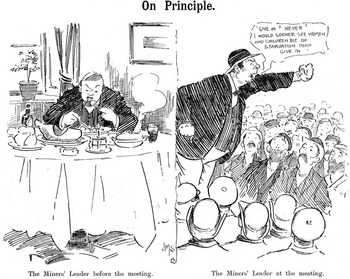
But it is worth noting that for all Habermas's emphasis on the public sphere as a space defined by reasoned discourse, historians are increasingly alive to the role that passion and emotion played in shaping public debates in the eighteenth and nineteenth centuries.Footnote 96 Morgan's intervention can usefully be seen as another example of a public actor consciously choosing to depart from the dictates of calm reason. It was a gamble and whether Morgan thought it had paid off is unknown. Predictably, the Western Mail was quick to seize on his speech. A cartoon appeared in which a rotund Morgan was depicted eating a hearty meal before addressing a crowd of emaciated miners, telling them he would sooner see their dependants starve to death than capitulate (Figure 3).Footnote 97 Here was the labour leader as an irrational, militant hypocrite – not at all the type of political participant worthy of a place in the public sphere.
Welsh miners’ leader David Morgan is depicted as a well-fed hypocrite for having dared try to neutralize the discourse of the “innocents”. He suggested that he would “rather see women and children die in the conflict than to lose”. J.M. Staniforth, Cartoons of the Welsh Coal Strike: April 1st to September 1st(Cardiff, 1898), p. 32.
Conclusion
The apparently reckless words of labour leaders such as Tom Mann and David Morgan only become explicable when one considers the discursive context in which they were made. We have seen how the hungry male striker was a troubling figure for those late Victorians who wanted to respond with compassion to their hunger. By choosing to down tools, the male worker could be held responsible for his suffering and that of his family. As such, the humanitarian response to hunger was often deemed inappropriate. But most right-minded citizens found unthinkable the prospect of allowing women and children to starve with him. The answer to the moral conundrum of what to do lay in the deployment of a discourse which corralled working-class wives and children together under the heading of the “innocents”.
This strategy was often presented as being above politics – after all it allowed a reading public to contribute to relief funds safe in the knowledge that they did so without prolonging a strike or prejudicing the interests of masters or men. In fact, the term “the innocents” necessarily implied the presence of a guilty party. Blame was often laid at the door of the striking male. And the repeated concentration of attention on the hunger of women and children deflected attention from the male striker's distress. Deemed to be without hunger, he was easily lambasted by opponents of the labour movement as a failed father and husband and could be safely ignored by philanthropists.
Such representations had implications that stretched far beyond the pages of the newspapers, for they could result in the withholding of food aid from hungry male strikers. Soup kitchens that dealt exclusively with the relief of the “innocent” women and children constitute a striking example of the real limits of the “humanitarian discovery of hunger”. Not all hungry bodies were equally deserving of compassion, sympathy, and sustenance. This point was not lost on labour leaders and sympathizers of the working class who had to choose their words carefully if they were to have the suffering and the humanity of the male striker recognized. They had to pluck him from the grip of a discourse which – if it acknowledged his hunger at all – could all too easily be used to blame him for his distress. This argument conveniently overlooked the working conditions and “starvation wages” that may have led to his decision to strike in the first place, and acquitted employers of all responsibility for any suffering occasioned by a dispute.
In undertaking this rescue mission, strikers’ advocates had limited means at their disposal. Newspapers devoted to the cause of labour were the most obvious place that alternative understandings of the hunger of the starving striker could be articulated. However, it was much more difficult to take these understandings out into the dominant public sphere. There, the famished male striker continued to be exposed to the icy blasts of the discourse of the “innocents” throughout the late Victorian era.



