




Introduction
The beginning of the Early Iron Age (c. 800–450 BC) in South-east Europe was characterised by a number of significant social changes. In many cases, these developments appear to have been related to the increasing intensity of contact and exchange among the communities located around the head of the Adriatic, and, more widely, with the urbanising societies of the wider Mediterranean world. These changes are marked in eastern Slovenia, as well as across the broader area between the Eastern Alps and Western Pannonia, by the emergence of new centres of population in the form of large hillforts associated with extensive barrow cemeteries and, in some cases, evidence for ironworking (e.g. Teržan Reference Teržan1990; Mason Reference Mason1996; Dular & Tecco Hvala Reference Dular and Tecco Hvala2007; Mason & Mlekuž Reference Mason, Mlekuž and Armit2016; Črešnar & Mele Reference Črešnar and Mele2019; Črešnar et al. Reference Črešnar2020). In the Early Iron Age Dolenjska group of south-eastern Slovenia and northern Croatia, which forms the focus of this article, funerary rites shifted from cremation burials in flat cemeteries to inhumation, usually with multiple graves beneath substantial earthen barrows and often including significant quantities of grave goods. These new hillforts and associated cemeteries attest to the emergence of extended social hierarchies based on the control and exploitation of production and inter-regional trade in commodities such as iron, salt and amber.
It has been suggested that these barrows may have been intended for the burial of family or lineage groups (Dular & Tecco Hvala Reference Dular and Tecco Hvala2007: 123–26 & 237–45; Teržan Reference Teržan, Gabrovec and Teržan2010), although this has been hard to demonstrate using traditional archaeological techniques. As part of the HERA-funded ENTRANS (Encounters and Transformations in Iron Age Europe) project (Armit et al. Reference Armit2014, Reference Armit2016), osteological and isotope analyses have been applied to sites across the region, alongside aDNA analysis facilitated by the COMMIOS (Communities and Connectivities: Iron Age Britons and their Continental Neighbours) project. The present article details the results from one of these sites, the Dolge njive barrow cemetery, and examines the implications for our wider understanding of human mobility and family structure during this dynamic period of South-east European prehistory.
The Dolge njive barrow cemetery
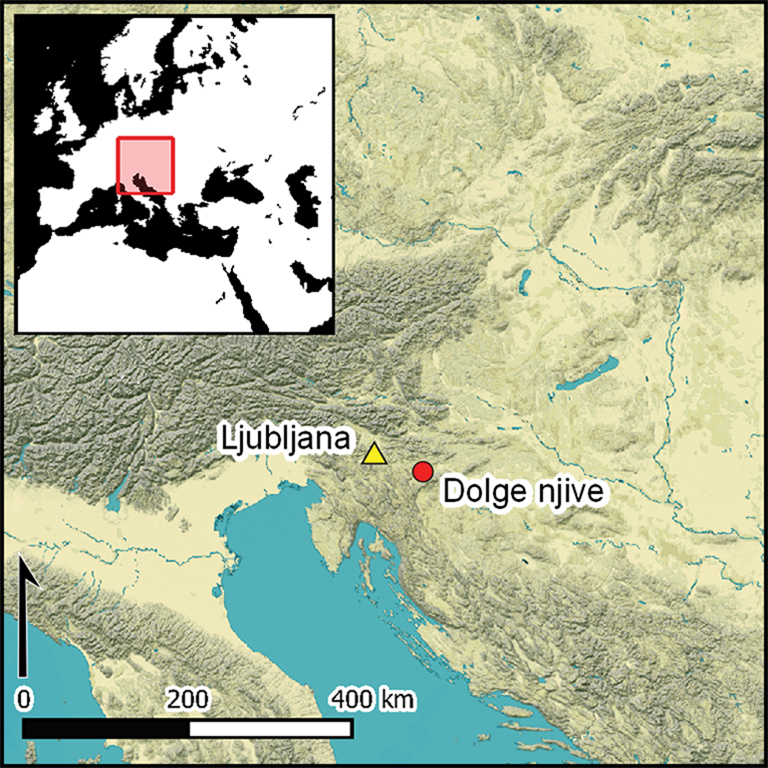
The Early Iron Age Dolenjska group extended across south-eastern Slovenia and part of northern Croatia. The Dolge njive cemetery is one of several distributed around the large (12.68ha) hillfort at Veliki Vinji vrh, collectively constituting one of the largest Dolenjska mortuary complexes, with an estimated total of 145 barrows (Figure 1). Four main barrow groups ascend to the north-western entrance of the hillfort, with a further 45 barrows dispersed, individually or in small groups, across a wider area of more than 25km2. Many of these barrows were excavated in the late nineteenth century with a relatively poor standard of recording and documentation. Modern excavations confirm, however, that skeletal remains in the area are typically very poorly preserved, if at all (Dular & Tecco Hvala Reference Dular and Tecco Hvala2007: 191; Mason & Mlekuž Reference Mason, Mlekuž and Armit2016).
Location of the Dolge njive cemetery (figure by the authors).

The Dolge njive cemetery is located between two deeply incised valleys at the foot of the Vinji vrh massif, to the south-east of the hillfort (Figure 2). In 2002, excavations in advance of motorway construction revealed the poorly preserved remains of three Early Iron Age barrows. Two were constructed on the site of Late Bronze Age cremation platforms, whilst the third was located a short distance to the east and is connected to the others by a Late Bronze Age hollow-way with associated deposits of cremated bone (Mason Reference Mason, Djurić and Prešeren2005; Mason & Mlekuž Reference Mason, Mlekuž and Armit2016). The remains of an Early Iron Age farmstead or small settlement, comprising two cobbled surfaces and two probable domestic structures, were discovered at Pod Vovkom to the south-west of the site (Križ Reference Križ, Djurić and Prešeren2005) (Figure 2). Its location was undoubtedly influenced by the proximity of the river Krka, but it may also have taken advantage of one of the possible routes from the valley to the hillfort.
Map of the complex around the Veliki Vinji vrh hillfort, with the Dolge njive cemetery (red area) and barrows (red dots) indicated (figure by the authors).

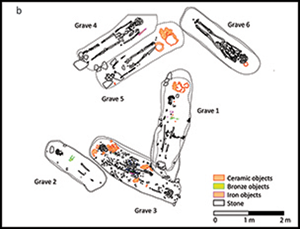
Although two of the Dolge njive barrows (2 and 3) had been largely destroyed by a combination of Roman settlement activity and medieval agriculture, both contained at least one inhumation, each accompanied by spearheads (Figure 3a; Table 1). Barrow 1, on the other hand, was better preserved and contained the remains of six graves (Figure 3b), all of which contained extended, supine inhumations, including one double burial (Burial 3) comprising two individuals buried head to toe (Table 1). Five of the graves were arranged in an approximate circle around the perimeter of the barrow, while the other (Burial 1) lay more centrally. This latter grave, however, cut the edge of Burial 3 (the double grave) and thus cannot be primary. Although central graves in the region tend to be the earliest within each barrow, exceptions are known where they belong to later or even to the latest phases of a barrow's use (e.g. Križ Reference Križ2019: 277 & 293).
a) Layout of the Dolge njive cemetery, indicating the presumed position of the truncated barrows (after Mason & Mlekuž Reference Mason, Mlekuž and Armit2016); b) plan of the excavated graves within Barrow 1 (figure by the authors).

Burials from Dolge njive. Sex: F = female; M = male; U = unidentified; ? indicates uncertainty.

The limited evidence for intercutting within Barrow 1 (Figure 3b), in combination with the slight degree to which the graves intersect, appears to indicate that the later graves were laid out to respect the earlier burials. This suggests either that the earlier graves were marked on the surface and/or that the graves were dug over a relatively short period. All the graves contained grave goods, although the number and composition vary (Table 1); on typological grounds, they date mostly to the Stična (I) phase of the Dolenjska Early Iron Age chronology—that is, Hallstatt C (probably C1). Combining the dates of the grave goods with the stratigraphic and aDNA evidence (see below), we conclude that the bodies in Barrow 1 were probably deposited over a relatively short period during the early/mid seventh century BC.
Osteological analysis
The skeletal remains from the three Dolge njive barrows are characterised by cortical exfoliation and root etching, and are generally heavily fragmented and incomplete (Nicholls Reference Nicholls2017). This is particularly the case for the less dense bones of the axial skeleton (vertebrae, sterna, ribs and ossa coxae) and crania, hampering osteological assessment of age and sex. The dentition exhibits varying degrees of preservation, but survives most frequently as loose teeth, which permit age estimation. All the remains appear to belong to young (approximately 20–35 years old) and middle adults (approximately 36–50 years old). Based on skeletal morphology, we can tentatively assign sex in only five cases (Table 1). We note no pathological alterations, although this is unsurprising, given the poor preservation of the bones.
Ancient DNA analysis
We successfully analysed aDNA from all nine individuals recovered from Dolge njive: seven from Barrow 1, and a single individual each from Barrows 2 and 3. The genomic data obtained for these individuals allows us to determine genetic sex based on the ratio of Y chromosome sequences to combined X and Y chromosome sequences (Table 1), as well as maternal (mitochondrial) and paternal (Y chromosome) lineages (see the online supplementary material (OSM), which also provides information on the population genetics of the group). Regarding the mitochondrial lineages, six of the seven samples from Barrow 1 belong to the H1e5 haplogroup, while the seventh carries the H haplogroup. Individuals from Barrows 2 and 3 carry the H5a6 and H1ba haplogroups, respectively. All males (across all three barrows) carry a R1b Y chromosome haplogroup, which is one of the major Y-chromosome haplogroups in Europe following the Late Neolithic/Bronze Age transition; it became widespread in Europe during the second half of the third millennium BC and is ultimately linked to ancestry from the Eurasian steppe (Allentoft et al. Reference Allentoft2015; Haak et al. Reference Haak2015).
To explore potential genetic relationships among the Dolge njive individuals, we used the software READ (Monroy-Kuhn et al. Reference Monroy-Kuhn, Jakobsson and Günther2018). Within Barrow 1, all seven individuals are close biological relatives (Figure 4). Burial 5 represents the father of the individuals in Burials 1, 3a, 3b and 4: three brothers and a sister. The young adult female from Burial 2 is a second-degree relative of these siblings and their father; this individual is therefore most likely to be the granddaughter of the man from Burial 5 and niece of the four siblings. Since the young adult female from Burial 2 has the same mitochondrial haplogroup as the siblings, it is likely that the mother of this individual was a sister of this group. Burial 6 is a third-degree relative of the siblings (Burials 1, 3a, 3b and 4a), with whom this young adult male shares the same mitochondrial haplogroup. This individual might be their maternal cousin, mother's half-sibling, or great-uncle. The individuals interred in Barrows 2 and 3 are not close biological relatives either of each other or of the family group buried in Barrow 1.
Putative ‘family trees’ based on the aDNA results. In Hypothesis 1, Burial 5 is the father of Burials 1, 3a, 3b and 4, and grandfather of Burial 2. In this scenario, Burial 6 is a maternal cousin of the siblings (Burials 1, 3a, 3b and 4). In Hypothesis 2, Burial 6 is a maternal great-uncle of the siblings, while the other relationships remain unchanged (figure by the authors).

Multi-isotope analysis
We analysed multiple isotopes from the bones and teeth of all the individuals in Barrow 1 in order to examine evidence for diet and mobility (see the OSM). Where possible, we sampled multiple elements from each individual to explore intra-individual isotopic heterogeneity—that is, lifetime variability. In addition to providing information about diet and mobility, the nature of this assemblage gives a rare opportunity to examine variation in isotope ratios within a familial group.
The δ13C and δ15N isotope ratios for the group range from −16.6‰ to −13.6‰ and 7.9‰ to 9.5‰, respectively, indicating a terrestrial-based diet composed of a mixture of C3 and C4 plants with some herbivorous animal protein (Tykot Reference Tykot, Martini, Milazzo and Piacentini2004; Hedges & Reynard Reference Hedges and Reynard2007). The values of different elements from each individual show little variation (see Figure 5), indicating consumption of similar sources of terrestrial protein throughout their lives. The Δ δ13CCARB-COL values consistently exceed 4‰, reflecting a diet high in C4 carbohydrates—probably millet (cf. Lightfoot et al. Reference Lightfoot, Liu and Jones2013) (Table S1). These results are consistent with previous, albeit limited, isotopic analyses of human and archaeobotanical remains of this period in Slovenia (Murray & Schoeninger Reference Murray, Schoeninger, Gibson and Geselowitz1988; Dular & Tecco-Hvala Reference Dular and Tecco Hvala2007; Nicholls et al. Reference Nicholls2020).
a) Carbon isotope ratios from individuals in Barrow 1; b) nitrogen isotope ratios from individuals in Barrow 1; c) carbonate oxygen isotope ratios against strontium isotope ratios obtained from the tooth enamel. Analytical precision based on instrumental error of ±0.2‰ (too small to be visible on the chart) (figure by the authors).

Strontium results are variable, with 87Sr/86Sr ranging from 0.7091 to 0.7102, with concentrations between 59 and 226ppm (Table S3; Figures 5b & 6). The δ18OCARB isotope ratios occupy a relatively narrow range of 21.1‰ to 22.8‰. The 86Sr/87Sr values are consistent with the variable local geology, with no evidence for childhood mobility.
87Sr/86Sr plotted against strontium concentration for individuals in Barrow 1 (figure by the authors).

Strontium concentrations may reflect the trophic level of food consumed by an individual, decreasing in value with increasing trophic level (Evans et al. Reference Evans, Chenery and Fitzpatrick2006). The wide variation in strontium concentrations here suggests that two of the brothers (Burials 3a and 4) consumed more meat and dairy than the other individuals, while their father (Burial 5) exhibits by far the highest Sr concentration, and thus appears to have consumed a diet with a larger proportion of lower-trophic level food (Table S3; Figure 6). This is consistent with the latter's δ15N values, which are the lowest among the group in terms of both dentine and rib collagen. The tooth enamel sampled for this analysis reflects the Sr, O and CCARB isotopic compositions of food consumed during the formation of the tooth crown in early childhood. It appears, therefore, that the father (Burial 5) consumed a different childhood diet and/or lived in a different location compared with his children.
Sex identification from aDNA, osteology and grave goods
There has been much criticism regarding the traditional methodological basis of ascribing sex based on grave goods, particularly in the absence of secure osteological identification (e.g. Arnold Reference Arnold1996). For the Early Iron Age Dolenjska region, however, Teržan (Reference Teržan1985) has proposed that gendered grave goods are a reliable guide to the biological sex of the interred individual. It is therefore appropriate to consider how the sex estimations provided by osteological analysis and aDNA analysis here compare with those suggested by the grave goods.
The regional artefact typology makes it possible to attribute gender to, and therefore to infer biological sex of, six individuals from the three Dolge njive barrows (Table 1). In Barrow 1, Burials 1 and 2 were associated with distinct female attire. The Libna-style belt from Burial 3 is characteristic of typologically male graves (Guštin & Preložnik Reference Guštin and Preložnik2005); since this grave contained two burials (the belt seems to have tied both bodies together), it suggests that at least one male is present. Similarly, the presence of two iron spearheads in Burial 4 suggests that this individual is male. Spearheads also accompanied both individuals identified in the other two (damaged) barrows, suggesting that these individuals are also male. All six attributions based on grave goods (Burials 1, 2, 3a and 4 in Barrow 1, and those in Barrows 2 and 3) are independently confirmed by the aDNA analysis. Given the poor preservation of the skeletal remains, only tentative sex estimations were possible; when compared with the aDNA results, three out of five cases of these tentative attributions prove incorrect (see Table 1).
AMS dating
Six AMS radiocarbon dates were obtained from the skeletal remains: one from each of the graves in Barrow 1 (Table 2; Figure 7). The results form a consistent series in the period c. 800–540 cal BC. The radiocarbon calibration problems associated with the Hallstatt plateau, however, are such that the AMS dates remain highly imprecise and are not readily amenable to further resolution through Bayesian analysis. They are, nonetheless, consistent with the typological dates for the grave goods, which suggest deposition in the first half of or mid seventh century BC.
AMS dates from Barrow 1, plotted using OxCal v4.4 (Bronk Ramsey Reference Bronk Ramsey2017) and IntCal 2020 (Reimer et al. Reference Reimer2020) (figure by the authors).

AMS dates from Barrow 1: all dates on human bone.

Discussion
One of the most promising avenues of enquiry for aDNA research is its potential to reveal patterns of biological relatedness that can inform the analysis of kinship in prehistoric populations (e.g. Sjögren et al. Reference Sjögren2020; Fowler et al. Reference Fowler2022). Perhaps the most striking aspect of the present study is the discovery that all seven individuals buried in Barrow 1 are close biological relatives. The group comprises a father (Burial 5) and this individual's four children (three brothers (Burials 3a, 3b and 4) and a sister (Burial 1)), granddaughter (Burial 2), and a third-degree male relative of the siblings (Burial 6), who is most likely their maternal cousin, great uncle or mother's half-brother. Since no biological relationships appear to exist between individuals buried in different barrows, it seems probable that each barrow accommodated the remains of a distinct familial group, although we should keep in mind that forms of kinship based on factors independent of biological relatedness (e.g. Brück & Frieman Reference Brück and Frieman2021) will always elude detection by DNA analysis. The presence of four full siblings in Barrow 1, and the implied existence of a fifth (mother of Burial 2), together with the absence of definite half-siblings, is also suggestive of a monogamous family structure, though it is possible that any half-siblings were buried elsewhere.
Assessing how this familial structure might articulate with broader kinship patterns requires a dialogue between genetic, ethnographic and archaeological evidence. At first sight, the genetic evidence appears to hint at a possible matrilineal structure in Barrow 1, since all but the father share the same mitochondrial DNA. Burial 2 is related to the rest of the group through the ‘missing’ sister, and Burial 6 is related to the rest of the group through the ‘missing’ mother. Nonetheless, there are several indications that the group composition of Barrow 1 cannot be characterised as one of matrilineal descent. Most significant, perhaps, is the presence of the biological father and his children, who, together, form the ‘core family’ within the barrow. This is not typical of matrilineal systems, where the father is usually buried separately with his natal matriline (cf. Ensor et al. Reference Ensor, Irish and Keegan2017: 742). The two female relatives (the mother of the siblings and the mother of the grandchild (Burial 2)) are the only core members of the family that are absent from the barrow; they are the only multi-generational links that connect this core family to the non-first-degree relatives and would thus be central to any scenario of matriliny. Indeed, it is striking that no individual within Barrow 1 is buried with either their mother or any other maternal ancestor, undermining the hypothesis of a matrilineal basis for selection. Neither does the genetic evidence lend support to the idea of bilateral descent, where spouses are characteristically buried together (Ensor et al. Reference Ensor, Irish and Keegan2017: 741). There is a definite male-centred aspect to the individuals physically present within Barrow 1, since they include a father (Burial 5), four offspring, and a grandchild. Yet the presence of a maternal relative (Burial 6) and a grandchild from a different patrilineage (Burial 2) suggests that this does not represent a straightforwardly patrilineal system. The genetic evidence does not provide clear support for any specific kinship structure drawn from the ethnographic literature, despite the close biological relationships between all occupants of Barrow 1.
When considering these findings, it is important to remember that biological relatedness need not equate to social relatedness, which can be constituted very differently (cf. Brück Reference Brück2021; Brück & Frieman Reference Brück and Frieman2021). In a society where many would have died young, as is evident from the age profile of the individuals from Barrow 1, many children would have been raised in the households of relatives who were not their biological parents. Indeed, relationships of fosterage were apparently institutionalised in certain European Iron Age societies (Karl Reference Karl2005). In this context, it is possible that the granddaughter and possible cousin from Barrow 1 (Burials 2 and 6) were additional dependents of the senior male (Burial 5), acquiring their membership of the patriline through adoption or fosterage. Given their age profile, they may perhaps be dependents who died before marriage, still resident in their ‘father's’ household. Such a ‘messy’ and fluid, but essentially patrilineal, system could explain the absence of the mother from Barrow 1, who may have been returned to her natal group for burial (cf. Ensor et al. Reference Ensor, Irish and Keegan2017); however, this does not explain the absence of the fifth sibling (the mother of the young woman in Burial 2), who, by the same logic, would have been buried with her father in Barrow 1. We must also bear in mind that, while societies may espouse certain idealised kinship structures and social practices, these need not always be rigidly adhered to in practice (e.g. Ilcan Reference Ilcan1994).
The biological relationships between the individuals buried in Barrow 1, combined with the stratigraphic and osteological evidence, suggest a short use-life for the barrow. The father is identified osteologically as a middle adult, approximately 35–50 years at death (although likely to be at the older end of this range), while the others (where age can be estimated) died as young adults. The time that elapsed between the deaths of father and children is thus likely to have been short, perhaps no more than a decade or so. The internal stratigraphy of Barrow 1 demonstrates that the father's grave (Burial 5) was cut by that of one of the sons (Burial 4) and by that of the likely cousin (Burial 6) (Figure 3b). The degree of intercutting is, however, minimal and the layout suggests that the latter two graves were laid out to respect that of the father, whose grave was probably marked above ground. Burial 3, the double grave containing two brothers (presumably buried at the same time), is cut by that of their sister (Burial 1) and closely respects the grave of their niece (Burial 2). The central placement of Burial 1, combined with its stratigraphic position, suggests that it represents a conscious ‘closing’ of the monument.
The results from Dolge njive have implications for the interpretation of the numerous other small barrows found individually, in small groups and within more extensive barrow cemeteries, throughout the region. At Kapiteljska njiva, Novo mesto, for example, most of the 67 barrows contained 10 graves or fewer and are likely to have been used for only a short duration (e.g. Križ Reference Križ2019: 261 & 314–15). It seems likely that the burial groups within these barrows were constituted along similar lines to Barrow 1 at Dolge njive; it remains unclear why such barrows should be so short-lived, rather than containing multiple generations of the same kinship group. One possibility is that this society was highly mobile, with kin groups frequently fissioning and moving away, leading to the establishment of new burial mounds. Other barrows in the region, however, were used for several centuries and contain much larger numbers of burials; for example, as many as 400 at Preloge, near Magdalenska gora (Tecco Hvala et al. Reference Tecco Hvala, Dular and Kocuvan2004: 124; Dular & Tecco Hvala Reference Dular and Tecco Hvala2007: 123–26).
Finally, it is important to note the overall sex bias of the Dolge njive group, where males outnumber females by 7:2 (5:2 in the better-preserved Barrow 1). Although based on a small sample, and thus not statistically significant (P = 0.45 for a two-sided test of equal numbers of males and females considering all burials together), this imbalance may suggest that factors other than kinship—perhaps relating to biological sex, social position or circumstances of death—played a part in determining the composition of the burial population. This, of course, is unsurprising, given that funerary rites are seldom a straightforward reflection of social organisation, but rather the outcome of complex processes of negotiation among the living (e.g. Parker Pearson Reference Parker Pearson1999; Fowler Reference Fowler2013).
Conclusions
The genetic results from Dolge njive confirm the close biological relatedness of individuals buried within the same barrow. They do not, however, provide a definitive guide to understanding the kinship practices of the burial population. While links through the maternal line appear to have been important, the group composition within Barrow 1 suggests neither a matrilineal nor bilateral kinship structure. Evidence for a straightforwardly patrilineal system is also weak, although the composition of the burials may nonetheless be the product of a more flexible patrilineal system, which included the adoption or fosterage of cognatic relatives (including through the female line).
The results from Dolge njive have implications for our wider understanding of Early Iron Age kinship and funerary practices in South-east Europe. The shift from flat cremation cemeteries to inhumation burials of multiple individuals beneath substantial barrows marks a new concern with the grouping and ordering of the dead and with their visibility in the landscape. Whilst the provision of weaponry and other martial accoutrements in a substantial number of male burials across the region presents the deceased as warriors, this dimension of social power is balanced by female grave assemblages comprising objects of considerable intrinsic value and prestige. As at Dolge njive, grave goods were evidently highly gendered, but not necessarily ranked (e.g. Teržan Reference Teržan1985, Reference Teržan, Gabrovec and Teržan2010). The genetic data also suggest the dual importance of male and female descent in determining the composition of the cemetery population. As seen in other contexts, for example, in Early Neolithic Britain (Fowler et al. Reference Fowler2022), aDNA analysis reveals kinship structures that are potentially highly complex and unlikely to be reducible to simple patterns of patrilineal or matrilineal descent. Indeed, such kinship relations, built through both male and female lines, will have provided wider and potentially more robust social networks than those based on purely patrilineal or matrilineal principles alone. Future genetic and isotopic analysis, using a large sample of barrows from some of the more extensive cemeteries in the region, will help us better understand this complex emerging picture of European late prehistory.
Acknowledgements
The authors would like to thank the two referees for their helpful comments on an earlier version of this article.
Funding statement
This research forms part of ENTRANS: a collaborative project involving the Universities of Bradford, Zagreb and Ljubljana, and the Institute for the Protection of Cultural Heritage of Slovenia. ENTRANS (PI: Armit) received funding from the European Union's Seventh Framework Programme for research, technological development and demonstration, under grant agreement no. 291827. The project is financially supported by the Humanities in the European Research Area (HERA) Joint Research Programme (www.heranet.info), which is co-funded by AHRC, AKA, BMBF via PT-DLR, DASTI, ETAG, FCT, FNR, FNRS, FWF, FWO, HAZU, IRC, LMT, MHEST, NWO, NCN, RANNÍS, RCN, VR and the European Community FP7 2007–2013, under the Socio-economic Sciences and Humanities programme. Research for this article also received funding from the European Research Council (ERC), under the European Union's Horizon 2020 research and innovation programme, grant agreement no. 834087 (COMMIOS). The aDNA work was supported by NIH grant GM100233, John Templeton Foundation grant 61220, the Howard Hughes Medical Institute, and the Allen Discovery Center program, a Paul G. Allen Frontiers Group advised programme of the Paul G. Allen Family Foundation. Inigo Olalde was supported by the grant ‘Ayudas para contratos Ramón y Cajal’, funded by MCIN/AEI/10.13039/501100011033 and by ‘ESF Investing in your future’.
Supplementary material
To view supplementary material for this article, please visit https://doi.org/10.15184/aqy.2023.2.


 Open access

