

Introduction
Music-focused digital humanities (DH) projects can often appear as intimidatingly shiny landmarks for how things could be done, if only we had more time, new skills, or project funding to pay for them. Not least because, right now, to admire ‘shiny’ DH projects is potentially to provoke feelings of panic about the skills we feel we should already have but do not have the time or capacity to learn; especially when academics in the UK are widely described as being ‘in crisis’.Footnote 1 Everything is already overwhelming, without adding anything else to the mix. The language around DH is often optimistic and hopeful, which can add to the guilt: not only should you be learning this, but you should want to. Writing in 2015, Laurent Pugin notes, ‘we can see digital musicology projects as an opportunity to widen and bridge research fields. The tools we require are in the process of being invented.’Footnote 2 Since then, the onslaught of machine learning-augmented programs, as well as visual coding and application of programming languages (Python, R, p5.js, JavaScript and D3.js), can leave researchers feeling they would not even know where to start if they did have the capacity. Which is the right one to choose? Just how much programming knowledge is required before the official DH-musicologist badge arrives in the post? This article considers the context of music-led historical DH projects alongside a case study which explores a methodology that attends to broader concerns of academic precarity, technological sustainability and scalability. It reveals exciting new ways of drawing out information about historical music practices that are widely applicable to other kinds of musicology research.
The underlying question of who does, or rather, who can do DH in music studies has been a pressing concern, not least because of wider structural inequalities in academia. Tara McPherson’s influential 2012 article ‘Why Are the Digital Humanities So White? or Thinking the Histories of Race and Computation’ brings sharp attention to ‘the ease with which we partition off considerations of race in our work in the digital humanities and digital media studies’.Footnote 3 As DH commits to challenging its own exclusionary practices, we should ensure we are not embarking on new ones in music-led DH. What does meaningful inclusive practice look like in a field of shiny, and potentially expensive, landmarks?
This article focuses on historical musicology and cultural histories, where even in this subset of the field, the spectacular array of recent DH approaches mean that the landscape is full of shiny projects. Broadly speaking, these fall into two types of projects, albeit with somewhat blurry boundaries: first, digital curation and collection; second, digitally-led storytelling and research dissemination. The first type might incorporate digitized editions of physical archive objects and repositories of born-digital resources such as datasets and visualizations. Such projects may annotate sheet music using digital tools, in particular the use of sound and search functions: for example, the Josquin Research Project aims to make polyphonic scores from 1420–1520 searchable, browsable and contextualized with accompanying analysis.Footnote 4 Other projects may have developed tools: the Music Encoding Project aims to be ‘a community-driven, open-source effort to define a system for encoding musical documents in a machine-readable structure’.Footnote 5 Meta-collections may also be useful repositories of many digital projects, such as ADAM (Archive of Digital Applications in Musicology)Footnote 6 which aims to preserve links to projects which may have been discontinued due to lack of funding. The second kind of project has used digital tools explicitly for analysis and/or dissemination, i.e., digital storytelling. Such projects are many and various; examples include BeethovensWerkstett and the long-established Linked Jazz, the latter of which uses open data technologies to reveal relationships between musicians and their wider community, making important connections between digitized data through social network visualization.Footnote 7 The Musical Passage site powerfully uses digital tools to contextualize a single piece of music, an early record of African diasporic music.Footnote 8
Recently, special journal editions have considered the impact of music-led DH on a particular field of study. Heather Platt’s introduction to the April 2021 edition of Nineteenth-Century Music Review Footnote 9 gives a valuable overview, including of the many different aggregator websites which list digital music projects. Platt notes that digital archives in particular ‘have the potential to democratize scholarship’Footnote 10 since they are often open-access. Such hopes are echoed elsewhere, Duguid et al. noting that ‘digital scholarship offers, at least in theory, an opportunity to further democratize music history, contrasting well-known exemplars with lesser-known, non-canonical voices.’Footnote 11 Platt notes some hesitation when discussing these kinds of multi-purpose websites, questioning ‘the extent to which these websites can adequately address scholars, students and the general public; and in any case, given the declining market share of classical music, who is this general public?’Footnote 12 There have been other more cautious voices about the rush to music DH: Sarah Fuchs, for example, adds a note of caution in reference to her own work with digital network visualisation and subsequent analysis, which she suggests ‘foreclosed – rather than facilitated – intellectual inquiry’.Footnote 13 Fuchs voices hesitations about the value, audience, and critical use of some aspects of musicology and DH.
The speed with which digitised information which may be useful to our field of study appears can provoke excitement for music historians, albeit with some anxiety — even more things that we do not have time to look at! In their introduction to the Music Scholarship Online (MuSO) project, Timothy Duguid, Maristella Feustle, Francesca Giannetti and Elizabeth Grumbach note: ‘The ease and speed of access to digital research inputs and outputs, and the shifts in methodological scope from close to distant reading, though not yet broadly shared in musicological circles, open significant new research prospects.’Footnote 14 Carrying out our own searches into digitised resources such as newspapers, specialist periodicals and listing magazines, can return very large amounts of data about a practitioner’s career or a particular historical practice, without even trying to automate the process. This can present music historians with new concerns around methodology and scale. What would be the right tool to deal with all this data? What is the right approach for analysis and interpretation, and then, how can we disseminate our findings? How long might any of this take? Is the best approach to form a biographical narrative out of the results, or are there additional research questions that could be explored if we were able to extract data differently? What potential might there be for understanding patterns of repertoire or the social production of music?
In addition, there are clear ethical responsibilities with working on digitised archives: in accessing and disseminating previously unexplored information, digital records can reveal sensitive information that need careful interpretation. Holly L. Crossen-White sounds a note of caution, explaining that ‘digital archives are lifting the veil of obscurity on individuals from the past’, adding that researchers should remember that the forgotten individuals they ‘discover’ did not give their consent to participate in digital research.Footnote 15 Searching for a musician’s name might not just reveal concert data, and many other kinds of reporting appears, including, say, reports of crime and court cases, and family events such as divorce with reports of adultery or bankruptcy. There may then be ethical implications beyond the case studies of our research for living descendants, and caution is required in terms of what to digitise and what the implications may be of publishing.
The immediate question is how to sort out all these findings and seek to draw out meaningful conclusions beyond being mildly astonished about how much it is possible to know. If the researcher decides that DH is worthwhile, how should they proceed if coding or structuring a database is not part of their skillset? Collaboration is a key part of DH practice, but when navigating the early stages of new work, or running a very small or specific project, it can be intimidating to know who to collaborate with. What can we do to find out what we have, before jumping to the assumption that we need a shiny project to put it in? What DIY prototyping can we do to access and play with the research material we could extrapolate from historical sources? How do we attend critically to the impulse to repackage the messy reality of historical work and only show it when everything is neat, tidy, and impressive? I want to consider computational methods for thinking about and doing historical musicology and offer an invitation to consider how they might be used for wider projects on a small scale.
This article considers a case study where such a search returns considerable information and proposes a sustainable scalable method for small scale interpretations of historical data through accessible or more precisely, minimal computing approaches. While minimal computing is an established practice in technology of reducing resource requirements and emphasising frugality, in DH is an emerging methodology of inclusive, decolonial, anti-racist and globally aware scholarship. In their recent introduction to the special issue of Digital Humanities Quarterly on the subject, guest editors Roopika Risam and Alex Gil note that the concept calls for: ‘interoperability of digital humanities practices [in order to] promote access and equity in digital knowledge production.’Footnote 16 They explain:
[…] it gestures towards a decision-making process driven by the local contexts in which scholarship is being created. In this way, minimal computing is platform- and software-agnostic, emphasizing instead the importance of making these choices, based on the constraints with which we are working, to facilitate the development of digital humanities scholarship in environments where resources (e.g., financial, infrastructural, and labor) or freedoms (e.g., movement and speech) are scarce.Footnote 17
In addition to the key question of minimal computing, ‘What do we need?’, Risam and Gil offer three further questions: ‘What do we have?’; ‘What must we prioritize?’, and ‘What are we willing to give up?’. This article responds to these four questions, demonstrating how it is possible to establish a clear scalable methodology for analysis and interpretation in small scale music led DH projects, by working with freely available and well-known tools – in this case, Google Sheets.
The choice of how to do a project such as this is a complex one, and usually depends on the technical skills and the confidence of the user. Google Sheets (an equivalent program to Microsoft Excel with additional unique functionality) offers, in its most basic iteration, a column sortable (or filterable) list, with the possibility of creating interlinking tables of data that can function as a relatable database. It is free to use, and easy to export data into a range of formats to ensure later interoperability. Even filtering the list by city of performance counts as DH since sorting data is a computational method. At the more complex end of working with Sheets, an inbuilt query language called Google Visualisation Query API Language, which is a version of SQL (structured query language), allows the user to ask complex queries of the collected data (e.g., ‘Tell me how many times trios were played at this venue during this year’). Google Sheets is not open-source, and there are limitations with proprietary software along with implications around data privacy, ownership, and long-term accessibility. Other open-source database tools are available, but they have a far steeper learning curve and can be intimidating to new users. The choice of Google Sheets was driven by practical considerations and the ability to extract data in a variety of formats (e.g.,. csv and. xls). Since this project was conducted, Microsoft Excel is incorporating Python to permit similar data querying and visualization, and further work might consider the efficacy of each approach.
Case study: exploring the history of three musical migrants
When musical migrants from Nazi-occupied Europe found ways to perform in Britain, their engagements, like those of other musicians at the time, were widely advertised and critiqued in the multitude of local and national newspapers of the period. Líza Fuchsová, Maria Lidka and Paul Hamburger were three musicians who arrived in Britain during the late 1930s and permanently settled in the UK, either pursuing further study or continuing their professional careers. Fuchsová (1913–77) was a Czech concert pianist who became an advocate for Czech musical culture in Britain as well as an important piano soloist and duet partner; Hamburger (1920–2004) was a piano accompanist and teacher who left Vienna for London and became a professor at the Guildhall School of Music & Drama; and Lidka (1914–2013) (born Marianne Liedtke), was a violinist, orchestra leader and later professor at the Royal College of Music who followed her teacher, Max Rostal, to London. Descriptions of their careers are either poorly understood, in the case of Fuchsová, or largely focus on the period in which they were established musicians in later life (Hamburger and Lidka). The working practices of their early career period and early experiences of exile have not been explored, nor has the building of their professional networks. As a historian who tends to focus on the works of minimised figures, Lidka and Fuchsová’s careers were immediately of interest to me, and Hamburger’s own prolific duet partnerships and later career teaching provided enough rationale to use them as case studies.
The recent digitization and machine-reading of paper or microfilm editions through optical character recognition (OCR) technology makes it possible to carry out full-text searches about each musician’s professional activities, potentially revealing large quantities of data. Individual results might look like this concert listing in the Hampstead News, 26 September 1946:
REIZENSTEIN (Pianoforte), MARIA LIDKA (Violin), in a programme of Mozart. Beethoven, Schubert, and Reizenstein’s Sonata in G sharp (1945). Wednesday, 9th Oct. at 8 p.m., in St. Peter’s Church Hall, Belsize Square. The Guild of St. Cecilia.Footnote 18
This typical advertisement provides some details of repertoire and the musicians performing – [Franz] Reizenstein and Lidka – along with location and date details. It demonstrates that Reizenstein, also a musical migrant, was able to perform his own composition in concert in London, and points to his professional relationship with Lidka.
The quantity of individual local newspapers and the breadth of digitization that the British Newspaper Archive (BNA) has carried out means that in any one particular year, multiple titles can represent any one city or region, providing multiple angles on any one concert. Searching for coverage of a concert in Birmingham newspapers during 1945 could use four daily city titles, with an additional eighteen newspapers for the West Midlands. Concert coverage may not be region-specific; for example, chamber concerts in London are frequently written about by regional newspapers’ ‘London Letter’ columns. To illustrate the scale, within the BNA ‘Paul Hamburger’ produces 1395 results from 1900 to 1999 (quotation marks around the search term produce exact or very ‘near hits’ in OCR-ed text), while there are 569 results for ‘Líza Fuchsová’ and 317 for ‘Maria Lidka’. (These figures may go up as the BNA project continues to digitize more pages of newspapers.) Searching for Hamburger in a random month, say April 1952, produces results in a range of national newspapers: the Marylebone Mercury, Hampstead News, Western Mail (Bristol and the Southwest), Hastings and St Leonards Observer and The Stage, with additional details of his radio broadcasts in the Birmingham Daily Gazette, Derry Journal and the Paisley Daily Express. In addition to these resources, historical editions of the Radio Times have been fully digitized as the BBC Programme Index (formerly Genome) as well as the Proms Archive. Since all three musicians regularly played for radio broadcasts, the BBC Programme Index yields considerable results, with over 300 returns for Fuchsová, 150 for Lidka and over 1700 for Paul Hamburger, who was a resident BBC pianist later in his career. Other digital repositories such as ConcertProgrammes.org.uk, ProQuest, and the Internet Archive also make primary material available to search, if not always to view.
What do we need?
The key minimal computing question of ‘What do we need?’ here forces attention to the research question and rationale for embarking on this project. The aim of this project, then, is to understand the previously poorly documented early periods of migrant musicians’ careers. To address what I need to do to achieve this, it is necessary to think about what exactly I want to find out; in this case, where did they work, who did they work with, what music did they play? I need a flexible data structure to incorporate additional information I might find along the way, and a way of documenting decisions. This is something of a Catch-22: to design the structure I need to begin to capture it, but it cannot be captured without a structure. This is an iterative process of redesigning and developing at work, one that also needs to cope with my decision-making about what is outside of the scope of the project. A suitable analogy might be that you need to take your reusable bags to the grocery store to do your shopping, but you do not really know what kinds of foods the store sells or, beyond the very broadest of categories, what you actually intend to buy, so it is probably best if your shopping bag is extendable and you have a few spares.
Making decisions about what is relevant to this research project, based on what information appears to exist at the same time as searching for it, is a dynamic, if sometimes challenging, process. This means understanding the different entities that are present in the source data and deciding what you want to keep, and understanding the relationships between them. Filtering and analysing the data requires a structure that can receive the unstructured information as it is extracted out of the search material. To continue the shopping bag analogy slightly further: it is as if you needed to add extra pockets or compartments to your bag while you are going around the store, except the store has no aisles and you could find any food item at any place within it. You might see a curved yellow fruit in pile one, but by pile fifteen think ‘Oh! Bananas! I do want them, so I will add a banana pocket to my bag. Then I will circle back to re-find the ones I walked past in the first place.’ This whole enterprise may no longer sound very appealing, and for some projects automated processes could assist in this stage. However, the BNA is not open to machine queries as some digitized newspaper collections are set up to permit, i.e., it does not have an API (Application Programming Interface).Footnote 19 So as a result, I need a structure to put this information into that supports manual searching through newspapers to extract data, and which could help to establish the three chosen musicians’ careers and to understand their working practices after arrival in the UK.
The project should store where concerts occurred (both geographically and in terms of specific venues), and record additional information about what repertoire they were playing and who they played with. I also need to be able to order, search and potentially filter the information, first for checking and accuracy and later for analysis. This research should accommodate results beyond London, to encourage exploring the geographical extent of performance. The project must be completed within a short time-frame, building a meaningful set of performance data for analysis of it during six months of fractional employment. The underlying structure then needs to support decision-making about what does not count: for example, in tracking broadcasts on BBC Radio, I only captured live broadcasts rather than recordings, records being played, or repeat broadcasts. I also need to store decision points about how I am shaping the structure through the research process, to define rules and working guidelines for extracting data from newspapers.
In addition to the practicalities, the project should respond to the wider academic framing of mobility studies, which has reframed approaches to migration particularly during this specific period. Musicians and composers who experienced forced migration have frequently been positioned inside a trauma-led narrative which has limited the perceived agency migrants were sometimes able to enact in positioning their own career. Erik Levi and Florian Scheding note that there are musicians for whom ‘displacement [can be read as] taking on an active role as a largely positive impetus for creativity and music-making’.Footnote 20 Beth Snyder’s positioning of ‘the constellation of mobility’ that ‘migrant musicians were forced to navigate’Footnote 21 is helpful, since she draws our attention to the likely patterns of collaborative practice that work focused on this period has started to uncover. Elsewhere, Scheding argues displacement should be considered ‘in its social, cultural and historical context rather than as a biographical subtext of the artist in exile; to investigate patterns in the whole; and to discuss, in an interdisciplinary manner, the consequences an influences of displacement on both contemporaneous and contemporary art and thought.’Footnote 22 There is a tension with the need to establish an individual musician’s biography, especially in the case of marginalized musicians whose activities have been under-researched, to actually understand their practice. Establishing individual stories within the wider social practice of music-making is important then, especially as it reveals the normal expectations of mobility and movement for professional musicians (while holding the context of this exceptional moment of movement).
What do we have?
For each of the three case studies, there are varying amounts of biographical context for each musician, and the knowledge that the three musicians performed with one another in various iterations. In academic literature, Paul Hamburger is the best represented biographically, perhaps given his later important role within the BBC as a Chief Producer, Artists. Hamburger has a short entry in Grove Dictionary of Music and Musicians that does not feature any specific information about his early career in the UK: ‘He made his début in Vienna in 1936 playing Beethoven’s First Piano Concerto. In 1949 he took part in the Proms première of Malcolm Arnold’s Piano Concerto for four hands (with Helen Pyke).’Footnote 23 Hamburger also has a Wikipedia page, which largely reiterates his Grove entry and his brief Oxford Dictionary of Music entry.Footnote 24 Much of the scholarly presence around Hamburger, however, is his own work in Tempo and the Musical Times.
In terms of the two women, Jutta Raab Hansen’s extensive work on musical migrants has addressed the experiences in Britain of both Maria Lidka and Líza Fuchsová. Raab Hansen’s 1996 book provides an in-depth case study of Lidka’s career that was based on interviews with the violinist.Footnote 25 She lays out the elements of Lidka’s experience, that she notes may have been made easier by her young age at the point of arrival, and her ability to navigate between a Czech public name and a German identity. She quotes Lidka’s recollection that ‘The public was never hostile at all during the war, not even if they knew you were from Germany; on the contrary – like everyone else – they were so helpful and interested in the fate of the emigrants.’Footnote 26 Lidka has no profile in Grove but is on Wikipedia, which uses her obituaries as a source, and which explains the basic biographical facts of her career including her involvement with the Czech Trio group during the war. Her son also has written a remarkable history of his family which contextualizes Lidka’s experiences as a migrant.Footnote 27 Fuchsová has a minimal entry in The Concise Oxford Dictionary of Music and only appears in Grove in Paul Hamburger’s entry. Again, Jutta Raab Hansen’s work has pointed to a migrant woman’s contribution, in positioning Fuchsová as an important part of a group of other Czech musicians active in Britain during World War II:
She mainly performed Czech music and was one of the rare interpreters of Smetana. During the war she gave recitals which included Czech music in different places in Great Britain, managed by the concert agency Ibbs & Tillett. Later she performed with Austrian refugee Paul Hamburger as a piano duo and as a member of the Dumka Trio. The career of this very successful pianist lasted until her death. The Times reviews show how busy she was in Britain.Footnote 28
Raab Hansen’s work in asserting the presence of migrant musicians in the UK during and after World War II establishes the importance of the two women, and although she does lay out in some detail Lidka’s work with the Czech Trio and Fuchsová’s touring life, the detail of this period still requires further clarification.
Reflectively assessing our own technical abilities and previous research might reveal knowledge of software or tools that can be used in this low-tech approach to DH projects, in this case Google Sheets. We may already be aware of resources that might have productive possibilities that are worth the investment of our limited time. I had made extensive use of BNA in previous research and suspected there would be coverage of the migrant musicians’ professional lives within it, not least because they have somewhat unusual names, which is helpful in reducing the risk of false hits. In addition, I was reasonably confident with Google Sheets, so I set up a basic sheet with column headers that corresponded to the kinds of information returned. At this point, I was still very committed to the ‘big shiny project’ way of thinking, so assumed that this data collection was being done with the goal of doing something ‘properly’ afterwards.
I explored what kinds of news coverage about concerts might be available, taking Lidka as a test case, using both her original and adopted name as search terms. This was an iterative cycle of searching and refining the spreadsheet to create a robust data architecture. This test process revealed many different types of data, some of which is clearly fixed, and some of which requires more work to pin down. The date of the concert, performance, or broadcast is generally a fixed clear category in advertisements, sometimes harder to access in reports of recent concerts in music journals. The venues are generally fixed for the above reasons, and it quickly became apparent that multiple venues were repeat visits, alongside a wide geographical spread of touring practice. Extant venues could be immediately turned into precise geospatial data, demolished or vague names could be researched to find at least an approximate location.
‘People and named groups performing’ are blurrier categories: not everyone playing might be named in an advert or review. There may be many spellings or iterations of one person’s name (Lidka occasionally performed as Marianne at some of the concerts led by Austrian exile organizations). There may be two people with the same name. Groups may change their name or have subtly different versions of the same name (the Amadeus Quartet or the Amadeus String Quartet). This is also true for spellings of performers’ names, especially if that name presents any kind of ‘foreignness’ to British sensibilities at the time: German names, Slavic alphabets, or Latin adaptations such as Czech all face frequent and inventive mangling. Repertoire information is particularly liable to variation because of the wide bank of sources being used. Lidka’s performance data (in its final, current iteration) uses fifty-six separate newspapers, regional newspapers, concert listing tools and migrant focused periodicals. Initially I kept programme information in a single cell, ‘Program_as_written’. This quickly revealed that repertoire is particularly hard to capture from a wide variety of sources. Adverts may only say ‘Music by Elisabeth Lutyens’, rather than name specific pieces. The first trial search on Maria Lidka revealed a spectacular number of ways that the same piece of repertoire could be referenced (e.g., Smetana’s Trio in G Minor was a staple of the Czech Trio’s repertoire, so was played often and is referred to in every possible variation of this title, but its full catalogue name is ‘Piano Trio in G minor, Op. 15, JB 1:64’).
Computing-led approaches require consistent information to carry out analysis: this can occasionally create a tension between a historian’s desire to preserve and the need to clean data to allow analysis. Using the above Smetana example, there needs to be a single name for that piece to quickly count exactly how many times it was played. This is easy to do by hand without such changes if the focus was ‘What did Maria Lidka play during concerts in 1946 and how was it referred to?’, but here the focus is on a much longer period and on multiple musicians. There is a negotiation here, ultimately guided by the principle of what the research question is, and just as crucially, is not. The guiding principle of ‘What do we need?’ is a powerful question here, alongside a computing-led approach of documenting decision making in a change log. The finished dataset can be accompanied by supporting notes that explain these decisions to users. At this point, I created a secondary sheet, LidkaRepertoire, which stored extended details about the pieces such as composer, date of composition, and created a primary key for each piece of repertoire (Smetana’s Piano Trio in G becomes SME_15). I removed the ‘Program_as_written’ column after going through a process of data transformation (moving the information out into single cell in individual columns using the key system). With a more stable data architecture I carried out data capture for Fuchsová and Hamburger’s performances during the same period.
In terms of how music historians might use DH tools, this is somewhat of a decision point – what do we need? It may be enough to build a simple dataset and use it as standalone ways of accessing data to analyse findings. If this is done in any spreadsheet tool, individual columns can be filtered or sorted, to enable searching by place, for example. As AI-informed tools make their way into spreadsheet software, this might be done increasingly automatically; for example, Google Sheets has an ‘Explore’ button, which would allow you to make a chart for, say, the ten most performed in city, without writing any codes, look ups or functions. (Type ‘Explore’ in the textbox that following ‘Help’, ‘Search the Menus’ produces). Such AI-led functionality will only grow, making working and querying well-formatted data easier for academics.
If the project needs a way of thinking about data beyond a single dataset, a prototype database structure is also possible within a spreadsheet program. This is governed by the researcher’s confidence, available time, and the underlying data being a suitable investment for that time. It is important to note that this is no shiny solution, but rather a way of investigating links and pulling out queries about the collected data. The HLF datasets shifted towards an early prototype of a relational database, albeit one achieved through spreadsheet functionality, to maintain data integrity as the scale increased (so I will refer to it as the HLF Database going forward). This maintained accurate and consistent references to the venues, repertoire and musicians playing alongside the three case studies. To clarify the difference, a dataset is a single set of data, a relational database is a series of data sets that reference each other. A database pulls together information from across multiple tables, this can be done in a variety of technical ways and programs.
Google Sheets can be used to create a working database, without having to learn an entirely new coding language, that can provide accurate outputs for analysis if it is correctly structured. To take the example of our troublesome Smetana trio: every time ‘SME_15’ is recorded, a look-up can be created to pull the full title across from the Repertoire sheet, automatically filling in the correct title: Piano Trio in G minor, Op. 15, JB 1:64.Footnote 29 This is not strictly necessary for a dataset (all that actually needs to be done is making sure that piece is always referred to in exactly the same way if you plan on counting how many times it appears). For a database, however, it makes possible a single underlying Repertoire dataset that will supply connected tables with the full names of pieces and ensures the accuracy of the information. In this case, I worked within Google Sheets to create a functional version of a way to bring this data together and to query it (or ask questions about it). Since Lidka, Hamburger and Fuchsová frequently play together, I decided to create a single VenueDataset that would do exactly this. I also decided to expand the initial period of focus (1940-45) to the end of 1954 as it became clear that post-war careers may look very different. The three sheets, ‘HamburgerData’, ‘LidkaData’ and ‘FuchsovaData’ quickly had accurate and consistent venue and repertoire information pulled from ‘VenueDataset’ and ‘Repertoire’. Since I had more skills in filtering the data in new ways, I created a ‘Combined’ sheet, that pooled performance data into one single dataset or sheet, the current structure of the project.
Database structures permit asking more complicated questions about the data. Databases are usually built within command-line environments that require a coded front end for non-technical users to consult (the shiny project). Google Sheets offers a way to bridge this by mimicking the query language of SQL (Excel also does this through Power Query, though that is beyond the scope of this article). Google Visualisation API Query Language might sound intimidating, but the queries are often slightly more advanced versions of functions that tell the program where to look and what you want to find out. So, it is possible to create a query which says, ‘look at the VenueDataset, and pull a list of only the venues that are in Liverpool’.Footnote 30 Such a query could be extended to look at the to return the dates of performances at venues or the names of performers in Liverpool.Footnote 31 There are many online guides to using both SQL and Google’s version, and free and low-cost training packages are available. However, it is also possible to imitate such a query in a dataset using the inbuilt Filter tools, which will allow you to select only entries with Liverpool in the data, or even sorting the results by the city column A–Z. Any way that gets the correct information out is perfectly fine.
What are we willing to give up?
This revealing question forces the difficult question of whether we need the shiny project, or whether the DIY version is enough for the specific purposes of this project. I am not suggesting that large-scale DH projects are not valuable, but it is worth thinking about what the low-tech model approach might offer up first – whether the researcher chooses to work with datasets or move towards databases. Some of the ‘giving up’ might be in accepting the limitations in what we are doing and being clear in them in sharing our results. For example, in the HLF Database, in terms of repertoire, music may be represented in a programme list for a broadcast that one of the three musicians was simply there for rather than actively playing. Since it is not always obvious who played what, the repertoire cannot be used as creating a definitive list of everything one musician played during this period. This is variable; as someone mostly involved in solo, duet, or trio work, Fuchsová’s concerts are likely to be somewhat more accurate in terms of what she played than Lidka or Hamburger, who both played in a broader variety of broadcasts and concerts.
There are practical constraints and limitations with working in Google Sheets in addition to the limitations outlined earlier. It is best suited to small team collaboration or individual work and small- to medium-=scale projects. The ‘database’ that is the final product of my research is effectively a series of hidden queries across four different tabs, Composers, Repertoire, Venue and Musician; when a different person is selected the query automatically runs each time with the new search term.Footnote 32 To allow widespread access, instructions have been created suggesting the user makes a copy of the document to work with (else the live document would show multiple people trying to change the search term, should two people be using it at the same time). More problematically, unless cells are protected, functions can be overtyped or changed, extra columns can be inserted, and as a result queries can break. However, it is possible to revert to an earlier version to rectify inadvertent changes, and to implement user controls to manage who can change functions within the sheet. Once the sheet is operating as intended, it can be protected to allow multiple users access to the data itself without being able to ‘break’ any of the lookups.
By changing my thinking about what was required, I was able to construct a database that uses and combines individual sheets that allows a user to look at the information and conduct meaningful analysis. In this very small-scale project the raw data, the lists of repertoire and venue are likely to be the most useful items to users and they can freely be downloaded. The ‘front end’ of the database looks and functions like a website might, allowing someone who is not familiar with these kinds of queries to be able to easily access and manage the material. The ‘back end’ of the data is exportable, which means that though it has been produced with Google Sheets, it can be extracted in data formats which are open and interoperable across other programs (e.g. csv files).
What new information is produced through this process?
The HLF database records fifteen years of data, with over 470 concerts and broadcasts at over 160 venues, with 1304 performances of 738 pieces of music by 229 composers (of these, one covers unknown composers, and one anonymous). The real figure of performed pieces is likely to be higher, since there are 132 listed performances of unknown repertoire, and we do not know how many ‘unknown’ programmed items any one concert had. Hamburger, Lidka and Fuchsová played with over 250 individual musicians or groups – this figure is quite small, perhaps because Fuchsová frequently played solo concerts. Firstly, we will consider the threads for each of the three migrant musicians.
Maria Lidka toured extensively across the country as part of the Czech Trio, frequently playing the same repertoire: Suk’s String Quartet No. 2, Op. 31, Dvořák‘s Piano Trio in E Minor, Op. 90, No. 4 and Smetana’s Trio in G minor for Violin, Cello, and Piano, Op. 15. Her concertizing was explicitly part of a propaganda movement to assert the existence and influence of Czech music on the part of the Czech government-in-exile. She often played with her teacher, Max Rostal, alongside other concerts with other migrants including Norbert Brainin and Walter Goehr. She had a long association with Goehr’s work at Morley College. Towards the end of the war and afterwards, her repertoire expanded to include more contemporary pieces, including works by Hindemith, Poulenc, Frank Reizenstein and Mátyás Seiber. The geographical extent of her performances across the UK as well as the variety of type of performance venue she played in, from a Girl Scouts’ Hut to Wigmore Hall, art galleries and secondary schools, points to the role of musical migrants in disseminating music into cultural life, both during and after the war.
Hamburger, who experienced internment during 1940, began performing professionally in the UK in the summer of 1941. One of his earliest concerts with Polish violinist Frederyk Herman featured Elgar’s Violin Sonata in E minor, Op. 82. Hamburger’s repertoire was very broad as an accompanist, and perhaps the most striking feature of his concert history is the relationships he formed with musicians over multiple concerts, including Maria Lidka. Like Lidka, he played across civic and educational venues. After the war, he performed a huge range of contemporary music, and broadcast extensively on both the Third Programme and the Home Service. From a Porthcawl primary school to the Royal Albert Hall, his concert life reflects the working practices of a young musician developing extensive creative networks. The data also reveals a deeper understanding of Fuchsová’s performances. Her work also reflect an educational focus and a wider sense of disseminating so-called Czech repertoire, which was seen as new in British concert life; one account of her work in Scotland remarked, ‘The programme was very representative of Czech music in its brilliance, gaiety, and close kinship with the folk music of the land. Little, if any of it, probably, had figured in an Edinburgh concert programme before.’Footnote 33 Many of Fuchsová’s concerts featured music written by Smetana, Dvořák, Janáček and Vítězslav Novák. She frequently played in what we might now call accessible venues (for example, the Mechanics Institute in Bradford) and schools across the country.
Patterns emerge when observing and carrying out analysis into this data, beyond the front-end to the HLF which shows basic output information, I have also run more specific queries to explore questions. As the purpose of this paper has been to explore the value of doing this work rather than to focus purely on the results, indicative examples have been presented to gesture towards the kinds of queries that can be run and visualized across two specific areas: venues and repertoire. Firstly, the venues that Hamburger, Lidka and Fuchsová were performing in can be easily mapped by exporting the relevant data out of the database – as can the performances, which show the sheer extent of their performance practice. This has been done through importing the dataset into the free tool Google Maps as a CSV file (viewable here), and can be imported into other open-source tools.
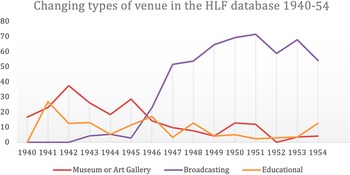
In addition to geospatial visualization, categorizing venues allows their use to be queried, showing the variety of places that the three musicians performed in (see Figure 1). These figures are perhaps surprising, since they demonstrate the importance of museums and art galleries as musical venues. To understand how the war might have affected this, another query (turned into a chart in Figure 2) shows the percentage of performances for each year in the dataset from 1940 to 1954 in museums, educational settings and in broadcastings. This demonstrates that museums seem to have played a more vital part in Hamburger, Lidka and Fuchsová’s careers during wartime, and that broadcasting became the major venue for all three musicians afterwards. One further breakdown, Figure 3, explores which BBC radio channels the musicians played on. The sudden leap reflects the Third Programme’s establishment in 1946, but also reminds us of the continuing engagement of live musicians across the BBC’s other radio programming.
Types of Venue in HLF Database, using discrete numbers of performances in venue types.

Changing types of venue – tracking three types of venue as an overall percentage of performances given per year, clearly showing that Lidka, Fuchsová and Hamburger become established broadcasters after the war.

Which BBC radio stations were Lidka, Fuchsová and Hamburger broadcasting on?

Repertoire
The database can be used to carry out further analysis of composers’ repertoire within concert performances. Such a query reveals the dominance of a small number of composers within the repertoire (albeit not necessarily the traditional canon), see Table 1. Only 13 composers, or just under 6% of the total (including both ‘unknown’ and ‘anonymous’) have their music played 20 times or more, 12 composers are played between 10 and 19 times, and the remaining 204 composers are played 9 times or fewer. The dominant presence of Dvořák and Smetana reflects the emphasis for both Fuchsová and Lidka as Czech musicians (although in Lidka’s case, this was an adopted role).
Most played composers in the HLF Database (removing ‘unknown’ concert repertoire)
| Composer | Pieces of repertoire | Total performances | Percentage of all performances |
|---|---|---|---|
| Dvořák | 52 | 100 | 7.7% |
| Beethoven | 42 | 92 | 7.1% |
| Smetana | 24 | 83 | 6.4% |
| Mozart | 42 | 74 | 5.7% |
| Schubert | 36 | 64 | 4.9% |
| Chopin | 18 | 45 | 3.5% |
| Anonymous | 21 | 33 | 2.5% |
| Brahms | 14 | 25 | 1.9% |
| Debussy | 14 | 23 | 1.8% |
| Haydn | 13 | 20 | 1.5% |
| Martinů | 9 | 20 | 1.5% |
| Suk | 8 | 20 | 1.5% |
This pattern is amplified at repertoire level; of 738 total pieces, 510 pieces are only ever played once, with a further 169 pieces being played between 2 and 5 times; only 20 are played more than six times in 15 years’ worth of data. Some caution is needed here because these 20 pieces include several unnamed works that falsely appear as a single item (e.g., ‘unspecified Chopin Nocturnes’ or ‘unnamed Mozart piano work’). However, it is possible to state that there is a broad selection of repertoire being played. The large number of composers with small amounts of repertoire played reveal composers in their early careers, including a range of British modern composers. These include Alan Rawsthorne (1905–71), Ernest Moeran (1894–1950), Ivy Herbert (1893–1993); Eva Ruth Spalding (1883–1969), Pamela Harrison (1915–90); Timothy Moore (1922–2003), and Constant Lambert (1905–51). There is a very small presence of women composers in the database: 9 composers, or just under 4% of the total selection.
Conclusions
This article has intended to demonstrate the value of employing computing-led thinking in carrying out small-scale explorations of music history. It establishes the kinds of findings that emerge from building both datasets and a database that can be explored by users who are likely to be engaged in exploring working musical practices during the period. It has illustrated the ways in which musical migrants were able to navigate the political uses of national repertoire, as well as writing themselves into the future of post-war musical culture by supporting new composers. In my own work, perhaps the most valuable aspect of this process has been allowing an iterative process to take place, to build and grow confidence in working with data and in using digital tools to interpret and consider historical data. This work can be accessed in multiple ways: through this traditional article output, through a database which can be explored in Google Sheets, and through the datasets which have been separately released. Chasing after the perfect way can often preclude noticing that we already have some of the tools to carry out the research processes we want to and gaining new skills in the process.
This approach to a DIY methodology could support the work of unfunded projects, on a variety of scales, to build not only prototypes but working methods for analysing historical music data. After working with digital tools over the last four years of my research, I am aware of the irony of establishing a clearer methodology through minimal computing while employed as a Research Assistant on a large-scale, AHRC-funded project at a conservatoire. In joining Music, Migration and Mobility at the very end of a three-year project, I have been able to have the time and space to not only continue my approach to research but also to, in effect, frame it as a methodology. My own experiences with DH-led music research have previously taken place within a post-92 university environment before the closure of the music department I was working within. The crisis of arts-based and music HE in the UK has accelerated precarity for individual researchers; one consequence of this is the difficulty in accessing the large-scale funding that many projects demand. All this might also suggest the need to consider our discipline’s expectations of what ‘finished’ looks like, as we work to weather the storm. We might also imagine an extension of this methodology to considering how we could share the knowledge we have with one another as researchers and supporting collaboration and skills sharing to build confidence. DH can reveal new information to help us understand music and working practices, and to better understand how we tell stories about it.
Data access statement
The article refers to this database throughout: Google Sheets Link. The underpinning datasets are openly available on RCM Research Online at https://doi.org/10.24379/RCM.00002376.



 Open access

