



Obesity disproportionately impacts residents of low-income neighbourhoods( Reference Chang 1 , Reference Coogan, Cozier and Krishnan 2 ). Many low-income urban neighbourhoods have limited access to grocery stores that carry fresh fruits and vegetables, resulting in poor access to healthy foods( Reference Powell, Slater and Mirtcheva 3 , Reference Larsen, Story and Nelson 4 ) and contributing to the high obesity rates( Reference Inagami, Cohen and Finch 5 , Reference Zick, Smith and Fan 6 ).
Low-income, urban residents often rely on corner stores for food purchases( Reference D’Angelo, Suratkar and Song 7 , Reference Dennisuk, Coutinho and Suratkar 8 ). Corner stores tend to offer few healthier food options like fresh produce, and when offered, are typically more expensive( Reference Cavanaugh, Mallya and Brensinger 9 ). Low-income residents have reported interest in purchasing fresh fruits and vegetables from corner stores( Reference O’Malley, Gustat and Rice 10 ). Another study found that the more variety of fresh produce available in these stores, the more likely a customer was to purchase fruits or vegetables( Reference Martin, Havens and Boyle 11 ). However, storeowners report challenges stocking produce due to wholesalers’ high prices, improper storage and perceived customer disinterest( Reference O’Malley, Gustat and Rice 10 ).
Urban agriculture is the growing and distribution of crops and livestock within an urban environment, including farming in vacant lots and parks( 12 ). Urban farms typically market their products to local consumers( 12 ), often with a mission to increase access to fresh produce in the surrounding neighbourhoods. Weekly farm stands in low-income communities have been linked with increased consumption of fruits and vegetables( Reference Evans, Jennings and Smiley 13 ). However, another study noted barriers to low-income residents accessing urban farms’ produce, including lack of a convenient time and location for purchases, distrust of outsiders and inadequate produce choices( Reference Hu, Acosta and McDaniel 14 ).
We speculated that collaboration between urban farms and corner stores, where farmers and storeowners work together to achieve a shared goal of increasing local, low-income consumers’ access to fresh produce, might address prior challenges. Farms could enhance their distribution of fruits and vegetables to a convenient location. We suspected that farmers might be willing to assist storeowners with in-store produce management, given their commitment to their products and the community. However, we could find no studies that evaluated an urban farm–corner store collaborative model. Our objective was to pair two urban farms with two corner stores in Baltimore, MD, USA to distribute fresh produce. We hypothesized that the distribution of fresh produce from urban farms to corner stores would be feasible, in demand and acceptable to farmers and storeowners.
Methods
Study design
As a case study, we conducted a 9-week, pre–post, non-randomized intervention study that paired two urban farms with two neighbouring corner stores in Baltimore, MD, USA to distribute and sell fresh produce. We recruited a convenience sample of two urban farms. Each farm identified a store in its community with the assistance of local neighbourhood or business associations. While we noted differences between the urban farms and corner stores, this variability might allow us to examine the collaborative model in different settings. Study staff approached all parties independently to discuss the intervention concept, obtain agreement to participate and receive feedback on the initial intervention design. The Johns Hopkins School of Public Health Institution Review Board exempted this project as not human subjects research.
Intervention design
Each week, farmers and storeowners agreed upon the selection and quantity of fresh produce items to be delivered. Storeowners provided space to display the produce. Each farm delivered produce to its corner store once weekly for 9 weeks starting August 2012. Stores priced items similarly to approximate farm stand prices. To offset the financial risk for both parties, the study covered all produce costs for the first 5 weeks, thus ensuring the farmers received compensation and stores sold the produce for 100 % profit. The study decreased its financial support during weeks 6–9 to determine whether this intervention might be fiscally sustainable (pair #1, 50 % of costs covered; pair #2, 75 % of costs covered) and the storeowners paid the remainder.
Each store had an exterior sign stating that it carried fresh produce from the farm and point-of-purchase promotional materials that included shelf labels and recipe cards. Each farm held a produce tasting event at its store during the study period. The local neighbourhood and business associations promoted the programme at meetings and in newsletters to local residents.
Data collection and outcome measures
In July and August 2012, we conducted two environmental assessments of each store to determine the produce varieties carried at baseline. Baseline sales data were unavailable, as storeowners did not keep sales records.
During the intervention, we visited each store twice weekly to collect data. We tracked the variety (e.g. apples, carrots), quantity and costs of produce delivered. We tracked each item’s sale price, number of items remaining and number of items discarded due to spoilage to estimate sales. We categorized items into five broader groups: fruits (e.g. apples, peaches), greens (e.g. kale, spinach), root vegetables (e.g. potatoes, beets), squash (e.g. cucumbers, aubergine) and aromatic vegetables (e.g. peppers, tomatoes; see online supplementary material, Supplementary Table 1).
We conducted in-depth interviews after 6 weeks with farmers (n2) and storeowners (n2) to discuss their experiences with the intervention. Interviews were audio recorded and transcribed verbatim. We evaluated the transcripts using an editing style analysis technique( Reference Crabtree and Miller 15 ) to identify meaningful passages of text regarding satisfaction with the intervention and intent to continue the collaboration.
Statistical analysis
We calculated the percentage of weeks with a produce delivery during the intervention and conducted a pre–post analysis of the mean number of produce varieties carried in each store using unpaired t tests. Increased variety of fresh produce has been previously linked to increased customer purchases fruits and vegetables( Reference Martin, Havens and Boyle 11 ). To assess demand, we report the weekly and overall produce sales by produce groups for each store.
Results
We established two urban farm–corner store pairs. These farms, stores and neighbourhoods differed in key characteristics (Table 1). Pair #1 included a 0·25 acre (0·1 ha) urban farm with a well-established store that served local residents. This farm was located 0·3 km from the store. The local neighbourhood association was very active in supporting this programme, which included promotion in newsletters and at meetings and community events. Pair #2 included a 2 acre (0·8 ha) urban farm with a newer store that served commuters. This farm was located 1·9 km from the store in a park bordering the neighbourhood. This store was located on a main street with many nearby stores and a supermarket. The local business association featured this programme in its newsletter, but did not engage in further promotion activities.
Characteristics of urban farms, corner stores and communities participating in the urban farm–corner store intervention in Baltimore, MD, USA in 2012

SNAP, Supplemental Nutrition Assistance Program, WIC, Special Supplemental Nutrition Program for Women, Infants, and Children.
Produce distribution
Produce was delivered all nine intervention weeks at both stores. In pair #1, a total of 722 items were delivered during the 9-week period with 53 % fruits, 4 % greens, 5 % root vegetables, 23 % squash and 14 % aromatic vegetables. In pair #2, a total of 278 items were delivered with 30 % fruits, 3 % greens, 0 % root vegetables, 32 % squash and 35 % aromatic vegetables.
Pair #1’s store carried a mean of 1·5 total varieties (sd 0·7) at baseline, which increased to a mean of 12·8 (sd 1·4) during the intervention. The farm provided all produce at this store during the study period. Pair #2’s store carried a mean of 8·0 total varieties (sd 4·2) at baseline, which increased to a mean of 10·2 (sd 3·4) during the intervention. The farm provided most produce items at this store (mean 6·9 varieties (sd 3·3)) during the study period. Figure 1 shows the changes in total produce varieties carried before and during the study period. Only pair #1 produced a significant increase in the mean number of produce varieties carried (mean change 11·3 (sd 1·0), P<0·01).
The mean change in total produce varieties carried before ( , baseline) and during (
 , intervention) the urban farm–corner store intervention in Baltimore, MD, USA in 2012. Baseline means were calculated from data collected by study staff during two visits prior to starting the intervention. Means during the intervention were calculated based on distribution data collected twice weekly by study staff at each store. Mean change estimates (pair #1, 11·3 (sd 1·0), P<0·01; pair #2, 2·2 (sd 2·7), P=0·44) and P values were calculated using unpaired t tests. Pair #1 resulted in a significant increase in mean total produce varieties (**), while pair #2 led to a non-significant increase in varieties

Produce sales
Pair #1 sold 86 % of all items delivered (622 items), while pair #2 sold 63 % of all items delivered (176 items). Table 2 shows the overall sales by produce group for each pair. In pair #1, the store made a profit of $US 446·40 and the net income to the farm was $US 473·94. In pair #2, the store made a profit of $US 177·00 and the net income to the farm was $US 330·40.
ProportionFootnote * of delivered items sold by produce group during the study period; urban farm–corner store intervention in Baltimore, MD, USA, 2012
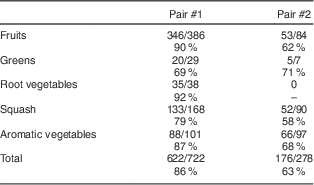
* Calculated from overall sales estimates obtained from data collected twice weekly by study staff.
In pair #1, sixty-six items were discarded due to spoilage (9 % of total delivered). In pair #2, ninety-two items were discarded due to spoilage (33 % of total delivered).
Acceptability
In pair #1, both the farmer and storeowner were satisfied with the intervention. Both the farmer and storeowner planned to continue the collaboration at the end of the 9-week study period. We capitalized on this opportunity to observe pair #1 beyond the study period (details available in the online supplementary material).
In pair #2, both the farmer and storeowner were satisfied with the distribution process; however, both had concerns regarding customer demand and sales. The storeowner perceived that his customers would not purchase produce with imperfections and expressed frustration about spoilage. The storeowner opted to stop the collaboration at the end of the 9-week study period.
Discussion
In this case study, urban farm–corner store collaborations distributed fresh produce to corner stores in low-income urban neighbourhoods. We offered a variety of produce attractive to customers and employed suggested strategies such as tastings and recipe cards for those items less familiar to patrons( Reference Hu, Acosta and McDaniel 14 ). To our knowledge, the present study is the first one to evaluate urban farm–corner store collaborations.
Prior urban agriculture studies have examined community gardens’ social impacts and health benefits. Community gardens can foster social capital, trust and sense of community( Reference Shinew, Glover and Parry 16 , Reference Teig, Amulya and Bardwell 17 ). Community gardens or urban farms have led to improved food access through farmers’ markets and produce donations to the neighbourhood( Reference Corrigan 18 , Reference Larsen and Gilliland 19 ), as well as increased fruit and vegetable intake among both adult and youth gardeners( Reference Alaimo, Packnett and Miles 20 , Reference Ober Allen, Alaimo and Elam 21 ). While farm stands can be located within the community( Reference Evans, Jennings and Smiley 13 ), they often operate for a few hours once weekly. Low-income residents have noted that purchasing produce from urban farms is inconvenient( Reference Hu, Acosta and McDaniel 14 ). The urban farm–corner store collaboration addresses this barrier as the corner store offers a neighbourhood location open 7 d/week where residents could buy produce. Collaborations between urban farms and corner stores could result in improved fruit and vegetable intake among community members, beyond those who garden, although we were unable to examine this in our study. In addition, this model could extend the reach of Farm to School programmes, which provide locally grown produce in schools( 22 ), by expanding the programme to locations, like corner stores, where children frequent after school and on weekends.
Prior corner store interventions have focused on increasing the availability of healthier foods including produce and used point-of-purchase promotions in small stores( Reference Gittelsohn, Rowan and Gadhoke 23 ). Overall, these interventions led to increased stocking of healthy items and improved sales of healthy foods( Reference Gittelsohn, Rowan and Gadhoke 23 ). The present case study employed similar in-store tactics, yet expands upon this literature by proposing and testing a unique model of urban farm–corner store collaborations. We found that the collaborative model significantly increased stocking of produce items in one store.
The contrasting success and failure between pair #1 and pair #2 may provide some insights on factors influencing the viability of the urban farm–corner store collaborative model. We suspect that community factors were critical to pair #1’s success. This store served customers who either lived or worked in the area and neighbourhood volunteers staffed this farm. The neighbourhood association also invested substantial time and resources in promoting the programme. Ultimately, pair #1 utilized more of a community-supported approach as compared with pair #2, which had less community backing. Pair #1’s tactic likely built upon neighbourhood social capital that gardens or farms may inspire( Reference Shinew, Glover and Parry 16 , Reference Teig, Amulya and Bardwell 17 ). Pair #1’s store was relatively isolated from other food retailers. Prior studies have found that limited access to grocery stores can lead to poor access to healthy foods( Reference Powell, Slater and Mirtcheva 3 , Reference Larsen, Story and Nelson 4 ); therefore, this collaboration may have been better positioned to meet a community need. In contrast, pair #2’s store faced competition from other food retailers including a nearby supermarket that carried fresh fruits and vegetables. Pair #1 primarily used a refrigerated display, which was key to limiting spoilage to 9 %( Reference Dannefer, Williams and Baronberg 24 ) in stores without air conditioning during high summer temperatures.
Our study has several limitations. Our case study evaluated a non-randomized intervention in a single city; however, this work represents the first step in designing and testing the urban farm–corner store collaborative model. We did not ascertain customers’ satisfaction with intervention components or evaluate the intervention’s effect on consumers’ purchases, eating behaviours or health outcomes. We believe that our storeowners represent the typical Baltimore corner storeowner. However, our farmers may have been more motivated than the average, given the substantial time they dedicated to this project. Future studies should recruit a variety of storeowners and farmers to understand the level of engagement necessary from both parties that translates into success. While we compared change in produce varieties stocked in response to the intervention, we lacked pre-intervention produce sales data to compare sales pre–post. The strength of our study is that we used a mixed-methods approach, which enriched our quantitative distribution and sales data with qualitative explanations( Reference Borkan 25 ).
Overall, urban farm–corner store collaborations are a promising strategy for areas with limited food retailer density and adequate community support. Researchers could consider these collaborations as a stand-alone intervention or as an adjunct to previously successful corner store interventions( Reference Ober Allen, Alaimo and Elam 21 ). Additional studies are needed to rigorously test this model in a randomized controlled trial to determine its efficacy on produce sales, consumers’ behaviours and health outcomes.
Acknowledgements
Financial support: The Eunice Kennedy Shriver National Institute of Child Health & Human Development (NICHD) and the Office of Behavioral and Social Sciences Research (OBSSR) supported this project (grant number U54HD070725). The content is solely the responsibility of the authors and does not necessarily represent the official views of the NICHD or OBSSR. This project was also awarded the grand prize in the 2012 Urbanite magazine’s Healthy Food Challenge. Conflict of interest: K.A.G., C.W., E.A.S. and J.G. declare no conflicts of interest. E.L. and Z.C. are employees of the urban farms who participated in the collaborations described in this manuscript. Authorship: E.L. and Z.C. provided feedback on intervention design and implementation. Data were collected by K.A.G. and C.W., and all analyses were completed by K.A.G. All authors contributed to and approved the final manuscript contents. Ethics of human subject participation: The Johns Hopkins School of Public Health Institution Review Board exempted this project as not human subjects research.
Supplementary Material
To view supplementary material for this article, please visit http://dx.doi.org/10.1017/S1368980015000051



