




Introduction
Only three Leprocaulon species have been recorded so far in Europe. Leprocaulon calcicola Earl.-Benn. et al. was recently described from walls in SE England (Orange et al. Reference Orange, Earland-Bennett, Hitch and Powell2017). Leprocaulon nicholsiae Lendemer & E. Tripp was reported as new to Europe from volcanic rock and oak bark in the Czech Republic (Vondrák et al. Reference Vondrák, Svoboda, Malíček, Palice, Kocourková, Knudsen, Mayrhofer, Thüs, Schultz and Košnar2022). Finally, Leprocaulon quisquiliare (Leers) M. Choisy (= L. microscopicum (Vill.) Gams ex D. Hawksw.) is the only genus member reported from many European countries and has been known from Europe for almost 250 years since its description as Lichen quisquiliaris (Leers Reference Leers1775). All European species are sterile and their reproduction is vegetative by means of granules.
In 2022, during fieldwork aimed at collecting sterile crustose epiphytic lichens in open habitats within the main river valleys of the western Po Plain (Northern Italy; G. Gheza et al., unpublished data), the first author collected a leprose lichen resembling Lepraria incana (L.) Ach., but containing usnic acid and zeorin. Since leprose species with usnic acid are still poorly known and molecular analysis is recommended to study specimens with such features (Orange et al. Reference Orange, Earland-Bennett, Hitch and Powell2017), our material was sequenced and assigned to the genus Leprocaulon. Subsequently, the first author collected numerous vouchers from other localities in the Po Plain of Lombardia and Piemonte and in centuries-old chestnut orchards in the Prealps of Lombardia. Rich material and new sequences resulted in the recognition of a new lichen species that is formally described here.
In the last decade, lichens have come to be regarded as complex systems including various micro-organisms (Hawksworth & Grube Reference Hawksworth and Grube2020). The mycobiont and the photobiont are still considered to represent two key partners within this symbiotic system (Sanders Reference Sanders2024). Therefore, we also decided to explore the identity of the photosynthetic partner. This decision was prompted by the poor knowledge of Leprocaulon photobionts. Although Honegger (Reference Honegger2004) described the interaction of L. quisquiliare and Symbiochloris symbiontica (Trebouxiophyceae), subsequent publications reported photobionts of the genus Leprocaulon as unknown (Miadlikowska et al. Reference Miadlikowska, Kauff, Högnabba, Oliver, Molnár, Fraker, Gaya, Hafellner, Hofstetter and Gueidan2014) or as an unspecified green coccoid alga (Lendemer & Hodkinson Reference Lendemer and Hodkinson2013; Orange et al. Reference Orange, Earland-Bennett, Hitch and Powell2017; Lendemer Reference Lendemer2020). Only Voytsekhovich & Beck (Reference Voytsekhovich and Beck2015) reported a single observation of Asterochloris irregularis (Trebouxiophyceae).
Materials and Methods
Sampling, morphology and chemistry
All the collected specimens are deposited in PRA, GZU and the personal herbarium of G. Gheza. Microscopic descriptions are based on hand-cut sections mounted in water for the granule size and 10% KOH (K) for observations of the soredia surface and thickness of hyphae. Observations were also made in polarised light (POL). Measurements are given as follows: (min–) x̄ ±SD (–max) μm (n = number of measurements). Spot tests on the thallus were carried out with the reagents K, C (sodium hypochlorite) and P (paraphenylenediamine crystals in ethanol). Lichen secondary metabolites were identified using thin-layer chromatography (TLC) in solvents A, Bʹ and C (Orange et al. Reference Orange, James and White2010). The images were captured using an Olympus SZX 12 stereomicroscope with an Olympus DP 70 (resolution 12.5 Mpx) cooled colour digital camera and the software QuickPHOTO MICRO 3.0 (Promicra), using an extended depth of field module Deep Focus.
Lichen vegetation relevés were carried out to characterize the epiphytic community in which the species grows in the study area. Presence-absence of epiphytic lichen species was recorded within a 50 × 10 cm plot placed at a height of 1 m from the ground on the boles of randomly selected trees colonized by the species during fieldwork to collect specimens for its description. The relevés were carried out on Quercus spp. (Q. cerris, Q. petraea, Q. robur, Q. rubra), Castanea sativa and Robinia pseudoacacia trees, with their circumference at breast height noted in most cases. Overall exposure, and the minimum and maximum height of colonization by the species were recorded on the whole trunk of the trees on which the relevés were carried out. Nomenclature of lichens follows Nimis & Martellos (Reference Nimis and Martellos2024).
DNA extraction, PCR amplification and sequencing
An ISOLATE II DNA Plant Kit (Bioline) was used for DNA extractions. The fungal nuclear internal transcribed spacer (ITS, ITS1-5.8S-ITS2 rDNA; henceforth ITS) and mitochondrial SSU (mtSSU) were amplified with the following primers: ITS1F and ITS4 (Table 1), and mrSSU1 and mrSSU3R (Zoller et al. Reference Zoller, Scheidegger and Sperisen1999). PCR reactions of ITS and mtSSU were prepared for a 20 μl final volume, containing 14 μl double-distilled water, 4 μl MyTaq polymerase reaction buffer, 0.2 μl MyTaq DNA polymerase, 0.4 μl of each of the 25 mM primers, and 1 μl of the sample. Amplifications of both loci consisted of an initial 1 min denaturation at 95 °C, followed by 35 cycles of 30 s at 95 °C, 30 s at the gradient from 56 to 50 °C, 30 s at 72 °C and a final extension of 7 min at 72 °C. The PCR products were visualized on a 0.8% agarose gel and cleaned with ExoSAP-IT™ PCR Product Cleanup Reagent (ThermoFisher Scientific), according to the manufacturer's protocols.
Primers used in this study.

The algal ITS, algal 18S rDNA and chloroplast rbcL were amplified using the primers listed in Table 1. We designed a novel algal-specific primer located in the 5.8S rDNA region to amplify algal 18S rDNA from total lichen DNA. The PCR conditions of ITS were as follows: an initial denaturation at 94 °C for 5 min followed by 35 cycles of denaturing at 94 °C for 25 s, annealing at 50 °C for 30 s, and elongation at 72 °C for 1 min, with a final extension step at 72 °C for 7 min. The PCR conditions of 18S were: an initial denaturation at 94 °C for 5 min followed by 35 cycles of denaturing at 94 °C for 1 min, annealing at 58 °C for 1 min, and elongation at 72 °C for 2 min, with a final extension step at 72 °C for 10 min. The PCR conditions of chloroplast rbcL were: an initial denaturation at 95 °C for 2 min followed by 35 cycles of denaturing at 95 °C for 1 min, annealing at 50 °C for 1 min, and elongation at 72 °C for 1 min, with a final extension step at 72 °C for 7 min. Every PCR run included negative controls, without a DNA template. PCR products were purified using the NucleoMag® NGS Clean-up and Size Select kit (Macherey-Nagel, Duren, Germany) and sequenced using the primers listed in Table 1.
In total, 17 new ITS, three 18S and four rbcL sequences were generated (Table 2). The amplification of mtSSU was completely unsuccessful, most probably due to inappropriate primers.
GenBank Accession numbers and voucher information for sequenced specimens of Leprocaulon. Sequences newly generated in this study are given in bold.

Sequence alignment and phylogenetic analysis
We prepared a mycobiont ITS alignment based on the sequence selection used by Lendemer (Reference Lendemer2020), with emphasis on a balanced representation of individual species. The final alignment included nine newly obtained sequences together with 25 reference sequences retrieved from GenBank of ten formally described species and one unidentified Leprocaulon lineage.
We analyzed newly obtained 18S rDNA and chloroplast rbcL sequences of photobionts together with sequences of representatives of the class Trebouxiophyceae and an outgroup (Chlamydomonas bilatus and Chloromonas rosae). Sequences for alignment were selected based on the studies of Nicoletti et al. (Reference Nicoletti, Procházková, Nedbalová, Mócsai, Altmann, Holzinger and Remias2021) and Barcytė et al. (Reference Barcytė, Hodač and Eliáš2024), with an emphasis on representing all major groups. Since the topology of Trebouxiophyceae phylogenies based on 18S rDNA and chloroplast genes is partly incongruent (Lemieux et al. Reference Lemieux, Otis and Turmel2014), we analyzed the datasets separately. The 18S and rbcL alignments contained three and four newly obtained sequences and 65 and 59 representative sequences retrieved from GenBank, respectively. Subsequently, we analyzed eight newly generated ITS sequences together with all 74 ITS sequences of Symbiochloris currently deposited in GenBank (including undetermined ones and sequences previously assigned to Dictyochloropsis; Škaloud et al. Reference Škaloud, Friedl, Hallmann, Beck and Dal2016).
We carried out alignments for each locus using MAFFT v. 7 (Katoh et al. Reference Katoh, Rozewicki and Yamada2019) with the G-INS-i method. Ambiguous positions were excluded from the analysis using Gblocks v. 0.91b (Castresana Reference Castresana2000), with a less stringent selection, on the Phylogeny.fr server (Dereeper et al. Reference Dereeper, Guignon, Blanc, Audic, Buffet, Chevenet, Dufayard, Guindon, Lefort and Lescot2008). After deleting identical sequences, the final fungal ITS alignment contained 494 positions and 27 sequences; there were 351 positions and 38 sequences for the algal ITS alignment, 1624 positions and 68 sequences for the algal 18S alignment, and 678 positions and 63 sequences for the chloroplast rbcL alignment. All alignments are publicly available on Mendeley Data (http://dx.doi.org/10.17632/rp848tdkb6.1).
Phylogenetic trees were inferred with Bayesian Inference (BI) using MrBayes v. 3.2.7a (Ronquist & Huelsenbeck Reference Ronquist and Huelsenbeck2003; Ronquist et al. Reference Ronquist, Teslenko, van der Mark, Ayres, Darling, Höhna, Larget, Liu, Suchard and Huelsenbeck2012), maximum likelihood (ML) analysis using GARLI v. 2.01 (Zwickl Reference Zwickl2011), and maximum parsimony (MP) analysis using PAUP v. 4.0b10 (Swofford Reference Swofford2003). BI and ML analyses were carried out on a partitioned dataset to differentiate among ITS1, 5.8 S and ITS2 rDNA for the mycobiont dataset, and according to particular codon positions for the rbcL photobiont dataset. Substitution models (see Supplementary Material Table S1, available online) were selected using the Bayesian information criterion (BIC) in MEGA v. 7 (Kumar et al. Reference Kumar, Stecher and Tamura2016). Two parallel MCMC runs, with four chains, were carried out for 10 million generations. Trees and parameters were sampled every 100 generations. Finally, the burn-in values were determined using the ‘sump’ command. ML analysis was carried out using default settings, five search replicates, and the automatic termination set at 5 million generations. The MP analysis was performed using heuristic searches with 1000 random sequence addition replicates and random addition of sequences (the number was limited to 104 per replicate). ML and MP bootstrap support values were obtained from 100 and 1000 bootstrap replicates, respectively. Only one search replicate was applied for ML bootstrapping.
Results
The new species Leprocaulon inexpectatum is uniform in its morphology, chemistry and ecology. An experienced lichenologist can recognize it relatively easily, even in the field, due to its bluish colour, ±discrete granules and frequent association with rough subacidic bark. The uniformity was also observed in the ITS region since all six sequenced specimens shared the same genotype. Based on the Bayesian reconstruction of the phylogeny (Fig. 1), the new species of mycobiont is well delimited and closely related to the American saxicolous species L. beechingii Lendemer.
Phylogenetic hypothesis (midpoint-rooted tree) of Leprocaulon resulting from Bayesian analysis of ITS rDNA. Values at the nodes indicate the statistical support of Bayesian posterior probability (left), maximum-likelihood bootstrap (middle) and maximum parsimony bootstrap (right). Fully supported branches (1.0/100/100) are marked with an asterisk. Scale bar shows the estimated number of substitutions per site. Newly obtained sequences are marked in bold. In colour online.

Our phylogenetic reconstructions based on 18S rDNA (Fig. 2) and rbcL (see Supplementary Material Fig. S1, available online) clearly show the position of the Leprocaulon photobionts within the genus Symbiochloris. Analogically to the phylogenetic hypothesis based on ITS rDNA sequences (Fig. 3), they revealed all the samples from this study formed a monophyletic lineage sister to the species Symbiochloris symbiontica. This lineage splits into two sublineages: one consists of photobionts of Leprocaulon inexpectatum (originating from Italy) and the second consists of photobionts of L. quisquiliare (from the Canary Islands).
Phylogenetic hypothesis of class Trebouxiophyceae resulting from Bayesian analysis of 18S rDNA. Sequences of Chlamydomonas bilatus and Chloromonas rosae were selected as an outgroup. Values at the nodes indicate the statistical support of Bayesian posterior probability (left), maximum-likelihood bootstrap (middle) and maximum parsimony bootstrap (right). Fully supported branches (1.0/100/100) are marked with an asterisk. Scale bar shows the estimated number of substitutions per site. Newly obtained sequences are marked in bold. The nomenclature of clades S8 and S11 follows Škaloud et al. (Reference Škaloud, Friedl, Hallmann, Beck and Dal2016). Kalinella is abbreviated as K. In colour online.

Phylogenetic hypothesis (midpoint-rooted tree) of Symbiochloris resulting from Bayesian analysis of ITS rDNA. The Symbiochloris reticulata clade (34 sequences) was collapsed for clarity of presentation. Values at the nodes indicate the statistical support of Bayesian posterior probability (left), maximum-likelihood bootstrap (middle) and maximum parsimony bootstrap (right). Fully supported branches (1.0/100/100) are marked with an asterisk. Scale bar shows the estimated number of substitutions per site. Newly obtained sequences are marked in bold. The nomenclature of clades S3 and S6-8 follows Škaloud et al. (Reference Škaloud, Friedl, Hallmann, Beck and Dal2016).

Taxonomy
Leprocaulon inexpectatum Gheza, Malíček, Vančurová & H. Mayrhofer sp. nov.
MycoBank No.: MB 856053
Similar to Leprocaulon calcicola but differing in the finer granules of 45–70 μm diam., the corticolous habitat and ITS DNA sequences, which are different in c. 80 positions at various places of the region.
Type: Italy, Lombardia, Milano, Magenta, Pontevecchio, Boschi della Fagiana, 45°26ʹ07″N, 8°49ʹ05″E, 110 m a.s.l., trunk of an old Quercus petraea tree at the edge of a small clearing along the trail, 12 May 2022, G. Gheza (PRA—holotype (PRA-21828); GZU, hb. Gheza—isotypes). GenBank Accession no. PQ456129.
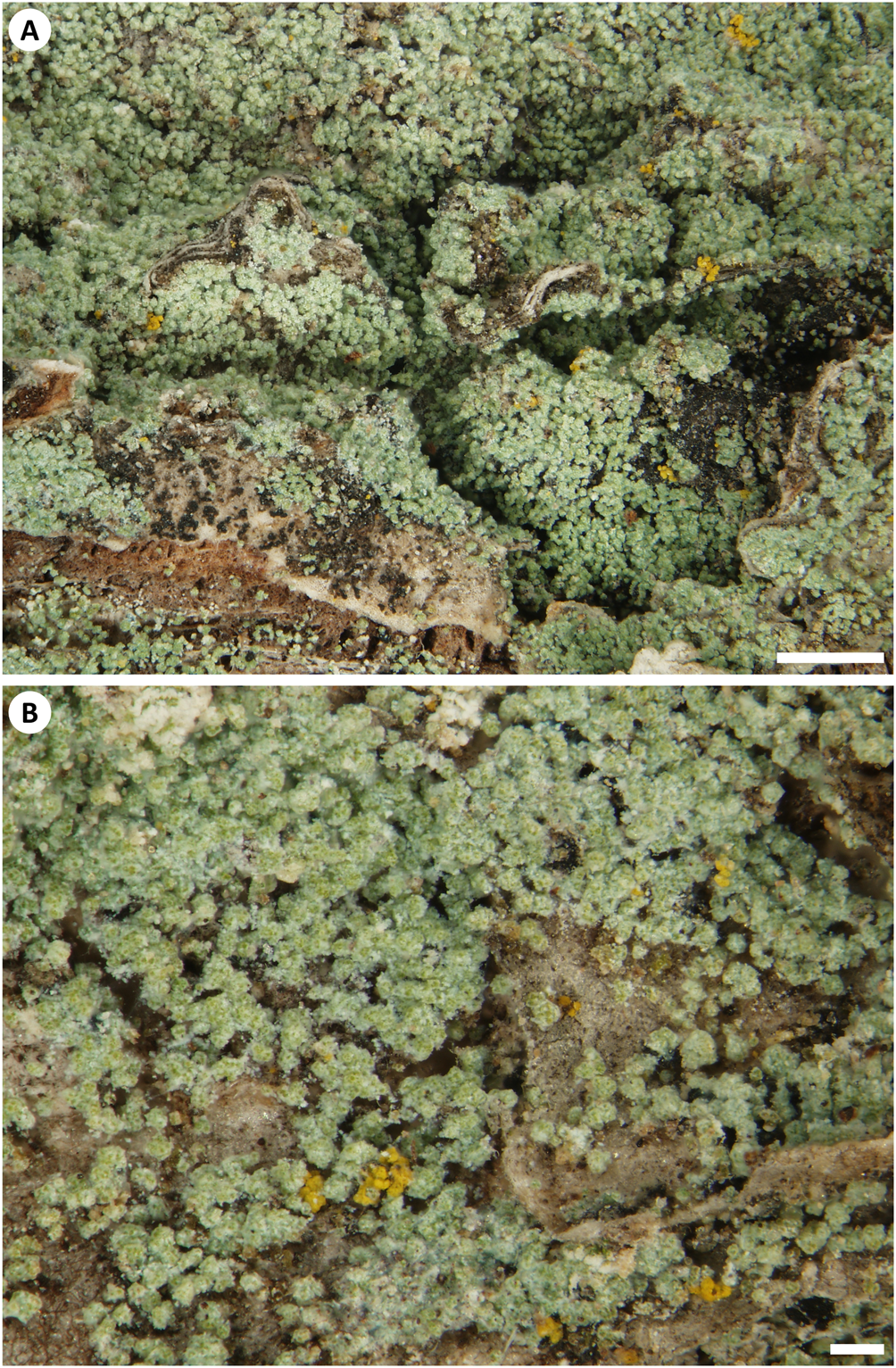
Habitus of Leprocaulon inexpectatum (holotype, PRA). Scales: A = 1 mm; B = 0.2 mm. In colour online.
Typical habitat of Leprocaulon inexpectatum in the Ticino River valley (phorophyte of the holotype; April 2024). In colour online.

Thallus crustose-granulose, discontinuous, not stratified, blue-grey to bluish green, rarely greyish teal, composed of aggregated granules that can merge and form a thin granulose crust (0.2–0.3 mm thick); prothallus and hypothallus absent. Granules subglobose to irregular, ±discrete, soredia-like, fine, (37.5–)45.51–56.88–68.25(–100.0) μm (n = 100), ecorticate, in a mount delimited by a colourless and more or less compact fungal sheath without projecting hyphae, POL−; hyphae hyaline, (2.5–)3.0–3.5(–4.0) μm thick, septate, branched; photobiont Symbiochloris, cells coccoid, globose, (12.5–)11.88–13.00–14.12(–17.5) μm (n = 100).
Ascomata and conidiomata unknown.
Chemistry
Usnic acid and zeorin (n = 19). K−, C−, KC+ yellow, P−, UV−.
Etymology
The specific epithet inexpectatum means unexpected, in order to highlight the unlikelihood of discovering an undescribed species within a human-impacted area such as the Po Plain, and also of its subsequent discovery in chestnut orchards of a south-alpine valley, after having presumed it to be a species of floodplain areas.
Ecology and distribution
Leprocaulon inexpectatum has been recorded on the subacidic rugose bark of oaks (mainly Q. robur, but also Q. cerris, Q. petraea and the alien Q. rubra), chestnut (Castanea sativa) and black locust (Robinia pseudoacacia), rarely also overgrowing mat-forming corticolous mosses (i.e. Hypnum cupressiforme). It prefers trunks of rather old oaks and chestnuts, but when colonizing black locust it also occurs on young trees; this could be due to bark texture, since young oak and chestnut trees have a smoother bark that becomes rugose with age, whereas black locust bark is already rugose in young trees. It can form wide patches on tree boles, where it grows always on the southern side (Table 3), from the basal part up to a few metres from the ground (observed even up to 10 m in a small number of cases; Table 4). In the river valleys it was found associated mainly with Candelariella efflorescens aggr. and Lecanora compallens Herk & Aptroot in more exposed situations, and with Cladonia fimbriata (L.) Fr., Lepraria finkii (B. de Lesd.) R.C. Harris and Lepraria elobata Tønsberg in more sheltered positions (Table 5); in chestnut orchards it was often associated with Chrysothrix candelaris (L.) J.R. Laundon. The colonized trees were located mainly along the edges of broadleaved-dominated woodlands, but also within open woodlands and centuries-old orchards, and in tree rows along small streams; it was also found in mature monospecific groves of the invasive alien black locust, but only close to the Ticino River.
Percent frequency of the exposure on trunks occupied by Leprocaulon inexpectatum, based on the 35 trees on which relevés were carried out.

Minimum and maximum recorded height of Leprocaulon inexpectatum on trunks, based on the 35 trees on which relevés were carried out.

Epiphytic lichens associated with Leprocaulon inexpectatum on Quercus spp., Robinia pseudoacacia and Castanea sativa. Percent frequency of each lichen species per group of relevés is reported. The total mean tree circumference refers only to Quercus spp. and Robinia. The circumference of Castanea trees could not be measured, but a rough estimate of all five centuries-old Castanea trees on which relevés were carried out exceeded a 2 m circumference. Lichen nomenclature follows Nimis & Martellos (Reference Nimis and Martellos2024).

Leprocaulon inexpectatum is currently known from the western Po Plain, the central Prealps and Alps, and the northern Apennines (north-western Italy). To date, 20 collections from nine sites are recorded within the Ticino River valley or in its close surroundings (Lombardia and Piemonte regions), with one collection from one site within the Sesia River valley (Piemonte region), 10 collections from seven sites in the Val Camonica (Lombardia region) and one collection from one site in the Apennine of Pistoia (Toscana region). It is generally very scarce, usually occurring on a small number of trees in each site; the only exception is the area of Boschi della Fagiana (Ticino River valley, Lombardia), where it is somewhat more widespread and was observed on c. 50 trees in an area of c. 30 hectares which hosts a mosaic of well-preserved broadleaved woodlands, grasslands and black locust groves.
Although found also in partially degraded situations and not showing a forest ecology, L. inexpectatum was collected mainly in lowland sites located within mostly forested areas that still host interesting epiphytic species regarded as indicators of ecological continuity in alluvial forests (e.g. Diarthonis spadicea (Leight.) Frisch et al., Opegrapha vermicellifera (Kunze) J.R. Laundon, Pseudoschismatomma rufescens (Pers.) Ertz & Tehler; Gheza et al. Reference Gheza, Nascimbene, Barcella, Bracco and Assini2022). This suggests that L. inexpectatum could also be regarded as an original element of floodplain ecosystems, which persisted only in well-preserved areas within the current lichenologically depleted condition of the Po Plain. Out of more than 200 sites explored across the last ten years by the first author in the river valleys of the western Po Plain, L. inexpectatum was found to date only in 22, indicating that it could be considered a rare species. The findings in centuries-old chestnut orchards of the Val Camonica, made only after the species had already been characterized from the Po Plain, highlight the likelihood of a broader distribution. Despite their anthropogenic origin, chestnut orchards are recognized as very important habitats for epiphytic lichens, hosting rich assemblages and rare species (Dietrich & Bürgi-Meyer Reference Dietrich and Bürgi-Meyer2011; Matteucci et al. Reference Matteucci, Benesperi, Giordani, Piervittori and Isocrono2012, Reference Matteucci, Isocrono, Favero-Longo and Moretti2021; Mayrhofer et al. Reference Mayrhofer, Drescher, Stešević and Bilovitz2013). Although it was not possible to investigate further chestnut orchards in the area, L. inexpectatum was found in seven of the eight explored, which suggests it could also be quite typical in this habitat.
Remarks
The new species is very similar to several other crustose Leprocaulon species containing usnic acid and zeorin, such as L. calcicola, L. knudsenii Lendemer & Hodkinson and L. nicholsiae. All are primarily saxicolous and genetically different. Leprocaulon calcicola differs also in the coarser granules, 60–120 μm diam. (Orange et al. Reference Orange, Earland-Bennett, Hitch and Powell2017). Leprocaulon knudsenii and L. nicholsiae both form a yellow-green thallus (Lendemer & Hodkinson Reference Lendemer and Hodkinson2013; Tripp & Lendemer Reference Tripp and Lendemer2019), in contrast to the predominantly bluish thallus of L. inexpectatum. Leprocaulon knudsenii has so far been reported only from North America and differs in the slightly smaller granules which remain distinct, not forming compound units (Lendemer & Hodkinson Reference Lendemer and Hodkinson2013). Leprocaulon nicholsiae has recently been reported also from Central Europe as an epiphyte on the bark of Quercus (Vondrák et al. Reference Vondrák, Svoboda, Malíček, Palice, Kocourková, Knudsen, Mayrhofer, Thüs, Schultz and Košnar2022); its thallus differs not only in colour, but also in its poorly delimited granules merging into a ±continuous crust (see Malíček et al. Reference Malíček, Palice, Bouda, Knudsen, Šoun, Vondrák and Novotný2024). The closely related L. beechingii, so far known only from North America, differs in having a greenish yellow placodioid thallus with distinctly crisped margins (Lendemer Reference Lendemer2020).
In the field, L. inexpectatum can be easily misidentified as Lepraria incana, which frequently grows on the bark of Quercus spp. and whose thallus is often bluish grey. However, L. incana forms a continuous thallus composed of soredia, different from the discrete granules in L. inexpectatum. Nevertheless, UV reaction or TLC are recommended for confident identification. The recently described Chrysothrix fagicola Malíček & Vondrák is another very similar lichen containing usnic acid and zeorin, differing mainly in the finer yellowish soredia, 25–50 μm diam., which do not usually form a dense continuous crust but are at least locally distinctly sparse (Vondrák et al. Reference Vondrák, Svoboda, Košnar, Malíček, Šoun, Frolov, Svensson, Novotný and Palice2023).
Usnic acid and zeorin are produced by several mostly sterile sorediate epiphytic Lecanora species. Lecanora compallens forms ±delimited soralia and a distinct whitish grey thallus (van Herk & Aptroot Reference van Herk and Aptroot1999). Lecanora stanislai Guzow-Krzemińska et al. differs in the finer soredia up to 35 μm diam. (or consoredia up to 50 μm), and the very thin and mostly endosubstratal non-sorediate parts of the thallus (Guzow-Krzemińska et al. Reference Guzow-Krzemińska, Łubek, Malíček, Tønsberg, Oset and Kukwa2017). Lecanora leuckertiana Zedda (= Lepraria leuckertiana (Zedda) L. Saag) is characterized by a thick leprose sublobate thallus very similar to that of Lepraria vouauxii (Hue) R. C. Harris (Zedda Reference Zedda2000). Based on our observation of its holotype in B, this species could theoretically belong to the genus Leprocaulon, since it corresponds to L. beechingii. However, DNA data for L. leuckertiana are lacking.
The same secondary metabolites are also produced by Megalospora pachycarpa (Duby) H. Olivier, a rare oceanic species of montane forests in Europe. This species differs from L. inexpectatum by the thick continuous yellowish thallus, which becomes bluish only in herbarium specimens (Schreiner & Hafellner Reference Schreiner and Hafellner1992).
Additional specimens examined
Italy: Lombardia: Varese, Lonate Pozzolo, near the heathland of Via Gaggio, 45°35ʹ29″N, 8°43′02″E, 200 m, on trunks of Robinia pseudoacacia in an open oak/black locust/black cherry woodland, 21 ii 2023, G. Gheza (hb. Gheza, GZU); ibid., 45°35′33″N, 8°43′06″E, on trunks of Quercus petraea and Robinia pseudoacacia in an open oak/black locust/black cherry woodland, 27 iii 2024, G. Gheza (hb. Gheza, PRA); Milano, Magenta, Pontevecchio, Boschi della Fagiana, 45°25′55″N, 8°49′38″E, 110 m, on trunks of Quercus cerris in an open oak woodland, 4 iii 2024, G. Gheza (hb. Gheza, PRA); ibid., 45°25′58″N, 8°49′36″E, on trunks of Quercus sp. in an open oak woodland, 4 iii 2024, G. Gheza (hb. Gheza, PRA); ibid., 45°25′53″N, 8°49′36″E, on trunks of Quercus robur at the edge of an open oak woodland, 4 iii 2024, G. Gheza (hb. Gheza, PRA); ibid., 45°25′47″N, 8°49′31″E, on trunk of an isolated Quercus robur tree within a grassland, 4 iii 2024, G. Gheza (hb. Gheza, PRA); ibid., 45°26′00″N, 8°49′16″E, on trunks of Quercus robur in an open oak woodland, 4 iii 2024, G. Gheza (hb. Gheza, PRA); ibid., 45°26′05″N, 8°49′12″E, on trunks of Robinia pseudoacacia in a black locust grove, 4 iii 2024, G. Gheza (hb. Gheza, PRA); ibid., 45°26′05″N, 8°49′04″E, on trunks of Robinia pseudoacacia in a black locust grove, 4 iv 2024, leg. G. Gheza (hb. Gheza); ibid., 45°26′10″N, 8°49′10″E, 4 iii 2024, G. Gheza (hb. Gheza, PRA); ibid., 45°26′11″N, 8°49′05″E, G. Gheza (hb. Gheza, PRA); Pavia, Cassolnovo, Bosco Mandelli, 45°23′27″N, 8°50′09″E, 100 m, on a trunk of Robinia pseudoacacia in a clearing within an oak/black locust woodland, 28 xii 2022, G. Gheza (hb. Gheza, GZU); Pavia, Borgo San Siro, Bosco del Castagnolo near Cascina Torricella, 45°15′21″N, 8°57′38″E, 70 m, on trunks of Quercus robur at the edge of an oak woodland, 18 iii 2024, G. Gheza (hb. Gheza, PRA); Pavia, Garlasco, Bosco del Vignolo near Cascina Arneri, 45°13′19″N, 8°57′30″E, 70 m, on trunks of Quercus robur in an oak row along a stream at the edge of a black alder woodland, 7 iv 2024, G. Gheza (hb. Gheza); Pavia, Gropello Cairoli, Bosco di San Massimo near Cascina San Massimo di Sopra, 45°11′46″N, 8°58′22″E, 70 m, on trunks of Quercus robur in an oak row along a stream near the edge of a black alder woodland, 17 ii 2024, G. Gheza (hb. Gheza, PRA); Brescia, Edolo, picnic area along Via Gennaro Sora, 46°10′11″N, 10°19′03″E, 871 m, on the trunk of a centuries-old Castanea sativa tree at the edge of a broadleaved woodland, 4 v 2024, G. Gheza (hb. Gheza); ibid., above Mù, 46°11′01″N, 10°20′33″E, 810 m, on trunk of a Castanea sativa tree in a managed centuries-old chestnut orchard fragment, 27 iv 2024, G. Gheza (hb. Gheza); Brescia, Sonico, Villincampo, 46°09′26″N, 10°21′23″E, 710 m, on trunks of Castanea sativa in a wide, managed centuries-old chestnut orchard, 27 iv 2024, G. Gheza (hb. Gheza); Brescia, Berzo Demo, Palazzina, 46°05′26″N, 10°19′46″E, 690 m, on trunks of Castanea sativa in an abandoned centuries-old chestnut orchard, 4 v 2024, G. Gheza (hb. Gheza); Brescia, Paspardo, Deria, 46°02′36″N, 10°21′40″E, 650 m, on trunks of Castanea sativa in an abandoned centuries-old chestnut orchard, 1 v 2024, G. Gheza (hb. Gheza); Brescia, Capo di Ponte, Pescarzo, località Convài, 46°02′28″N, 10°20′17″E, 620 m, on trunks of Castanea sativa in a managed centuries-old chestnut orchard, 4 v 2024, G. Gheza (hb. Gheza); Brescia, Cimbergo, below SP88 in the Riserva delle Incisioni Rupestri of Ceto-Cimbergo-Paspardo, 46°01′14″N, 10°21′24″E, 660 m, on trunks of Castanea sativa in an abandoned chestnut orchard, 4 v 2024, G. Gheza (hb. Gheza). Piemonte: Novara, Agrate Conturbia, Parco Faunistico ‘La Torbiera’, 45°40′33″N, 8°35′13″E, 340 m, on trunks of Quercus sp. in an open broadleaved oak/hornbeam/black alder woodland near a small lake, 6 iv 2024, G. Gheza (hb. Gheza); Novara, Pombia, between Via Baraggia and Via del Molino near Cascina Montelame, 45°38′45″N, 8°39′49″E, 180 m, on trunks of Quercus robur in an oak/chestnut/pine woodland, 27 iii 2024, G. Gheza (hb. Gheza, PRA); ibid., between Cascina Casone and the Ticino River, 45°38′10″N, 8°40′34″E, 170 m, on trunks of Robinia pseudoacacia (associated with Normandina pulchella) in an oak/elm/poplar woodland, 21 xi 2022 and 27 iii 2024, G. Gheza (hb. Gheza, GZU, PRA); Novara, Cameri, Bosco Vedro, 45°31′37″N, 8°42′15″E, 130 m, on trunks of Quercus robur at the edge of an oak woodland, 31 v 2024, G. Gheza (hb. Gheza); Novara, Trecate, San Martino, between Colonia Elioterapica and Trattoria La Chiocciola, 45°26′27″N, 8°48′02″E, 110 m, on trunks of Quercus rubra in an oak/hornbeam/elm woodland, 4 iii 2024, G. Gheza (hb. Gheza, PRA); ibid., 45°26′22″N, 8°48′23″E, on trunks of Quercus robur at the edge of an oak woodland, 20 v 2024, G. Gheza (hb. Gheza); Vercelli, Greggio, between the quarry and the Sesia River, 45°26′53″N, 8°22′54″E, 160 m, on the trunk of a Quercus robur tree at the edge of an oak/black locust woodland, 23 xii 2022, G. Gheza (hb. Gheza, GZU, PRA). Toscana: Pistoia, Marliana, Sasso del Diavolo, 43°57′37″N, 10°47′36″E, 710 m, on the trunk of a Quercus cerris tree in an open oak/chestnut woodland, 26 v 2024, G. Gheza (hb. Gheza).
Key to sterile crustose sorediate/granular lichen species with usnic acid and zeorin in Europe
Lichen species with these characters are extremely difficult to identify. We provide this key knowing that it will not allow the reliable identification of many specimens. We strongly recommend a more detailed study using original publications, type material and DNA, with consideration of the possible occurrence of non-European or undescribed species. Several taxa included in this key produce additional lichen metabolites but, in at least part of the collections, only usnic acid and zeorin are detected.
1 Primarily saxicolous species……… 2
Primarily epiphytic (or epixylic) species ……… 8
2(1) Areolate or squamulose thallus well developed, soralia delimited at least when young ………3
Thallus completely without areoles or squamules, soredia/granules covering the whole thallus ………6
3(2) Soredia at margins of areoles, thallus grey to pale yellow ………Lecanora handelii J. Steiner
Soredia laminal, thallus usually yellowish ………4
4(3) Areoles convex, boreal/arctic or high-mountain species ……… Lecanora chloroleprosa (Vain.) H. Magn.
Areoles flat, in various elevations ……… 5
5(4) Areoles often crenulate, discrete, without prothallus; on various rock expositions ……… Lecanora soralifera (Suza) Räsänen
Margins not crenulate, poorly delimited, thallus usually delimited by a distinct prothallus; on vertical to overhanging rocks ………Lecanora orosthea (Ach.) Ach.
6(2) Thallus thinly sorediate, composed of fine soredia, often with prothallus ……… Lecanora flavoleprosa Tønsberg /orosthea
See also the Lithocalla genus, incl. L. ecorticata (J.R. Laundon) Orange (= Lecanora ecorticata J. R. Laundon), which, however, does not produce zeorin (Orange Reference Orange2020)
Thallus thick, leprose, composed of poorly delimited granules, without prothallus……… 7
7(6) On strongly calcareous rocks ………Leprocaulon calcicola
On non-calcareous or weakly calcareous rocks ………Leprocaulon nicholsiae
8(1) Thallus parts without soredia and/or prothallus distinct ………9
Thallus leprose, composed of soredia/granules ………14
9(8) Thallus generally very thick, soralia soon becoming confluent, forming a ±continuous sorediate crust; on old trees in humid woodlands ……… Megalospora pachycarpa
Thallus thinner; variable ecology ………10
10(9) Thallus well developed, soralia more or less delimited ………11
Most of the thallus covered by confluent soredia ………13
11(10) Non-sorediate parts of the thallus ±areolate, yellowish, prothallus well developed; rarely epiphytic ………Lecanora orosthea
See also L. flavoleprosa, which occurs on acidic bark or wood in boreal-montane regions (Tønsberg Reference Tønsberg1992) and on bryophytes and plant debris in arctic-alpine communities (Czarnota et al. Reference Czarnota, Flakus and Printzen2009). See also Lecanora strobilina (Spreng.) Kieff., the thallus of which is sometimes formed by granules (Cannon et al. Reference Cannon, Malíček, Ivanovich, Printzen, Aptroot, Coppins, Sanderson, Simkin and Yahr2022).
Non-sorediate parts of the thallus continuous, greyish or bluish, prothallus present or absent ………12
12(11) Non-sorediate parts of the thallus greyish, continuous and ±smooth; on trunks of mature trees …Lecanora compallens
Young thalli or lignicolous ecotypes of Lecanora expallens Ach. can be very similar to L. compallens. They usually contain xanthones but thalli from shaded habitats or poorly developed specimens are morphologically indistinguishable from L. compallens.
Non-sorediate parts of the thallus ±verruculose-rimose, often with bluish tinge; pioneer species on leaves, needles, small twigs and branches ……… Fellhanera bouteillei (Desm.) Vězda
More or less identical characters are also shared by Chrysothrix caesia (Flot.) Ertz & Tehler and poorly known taxa (or morphotypes) from the Lecanora symmicta group. All of them are usually fertile. On the other hand, Fellhanera bouteillei often produces whitish pycnidia with pyriform conidia.
13(10) Thallus yellow-green to grey-green, sometimes with a distinct bluish tinge; usually on smooth bark of trees in forests, uncommon ………Lecanora stanislai
Thallus more or less yellowish, only very shaded forms almost without yellow tinge; in various habitats, very common ……… ………Lecanora expallens
14(8) Thallus cottony, sublobate, with yellowish tinge ………Lecanora leuckertiana (see also Leprocaulon nicholsiae)
Thallus of ±distinct granules, without lobes, often with a bluish tinge ………15
15(14) Thallus of ±sparse yellow-white to white-grey soredia, generally inconspicuous growing among thalli of other lichens; on smooth bark of beech in forests ……… Chrysothrix fagicola
Similar thallus characters can be formed in Chrysothrix caesia, a rare lichen in Europe, which differs in the ±areolate to continuously sorediate thallus (Vondrák et al. Reference Vondrák, Svoboda, Košnar, Malíček, Šoun, Frolov, Svensson, Novotný and Palice2023).
Thallus continuously granular, distinctly bluish, often covering large areas of trunks; on subacidic rugose bark ……… ………Leprocaulon inexpectatum
Acknowledgements
We thank Jiří Machač for the magnified images of the new species; Dr Harrie Sipman for providing the holotype of Lecanora leuckertiana from B; Dr Valentina Parco (Parco Lombardo della Valle del Ticino), Dr Edoardo Villa (Ente di Gestione delle Aree Protette del Ticino e Lago Maggiore) and Dr Anna Maria Bonettini (Parco dell'Adamello) for authorizations to collect specimens within the protected areas; Dr Cecilia Bellotti, Dr Enzo Bona and Dr Luca di Nuzzo for assistance in part of the fieldwork. GG acknowledges the support of the LIFE18 NAT/IT/000803 ‘DRYLANDS’ project to the field inspection in which Leprocaulon inexpectatum was observed the first time. HM thanks Peter Kosnik for his help with TLC, and Martin Grube for his ongoing support and motivation. JM and LV have been supported by the long-term research development project RVO 67985939.
Author ORCIDs
Gabriele Gheza, 0009-0009-7524-8522; Jiří Malíček, 0000-0002-3119-8967; Lucie Vančurová, 0000-0002-1370-1020; Juri Nascimbene, 0000-0002-9174-654X; Helmut Mayrhofer, 0000-0002-9433-3847.
Competing Interests
The authors declare none.
Supplementary Material
The Supplementary Material for this article can be found at https://doi.org/10.1017/S002428292400046X.


 Open access

