

The domestication and subsequent cultural roles of dogs have been highly debated in the archaeological and genomic literature, especially over the last decade (Drake et al. Reference Drake, Coquerelle and Colombeau2015; Frantz et al. Reference Frantz, Mullin, Pionnier-Capitan, Lebrasseur, Ollivier, Perri, Linderholm, Mattiangeli, Teasdale, Dimopoulos, Tresset, Duffraisse, McCormick, Bartosiewicz, Gál, Nyerges, Sablin, Bréhard, Mashkour, Bălăşescu, Gillet, Hughes, Chassaing, Hitte, Vigne, Dobney, Hänni, Bradley and Larson2016; Freedman et al. Reference Freedman, Gronau, Schweizer, Vecchyo, Han, Silva, Galaverni, Fan, Marx, Lorente-Galdos, Beale, Ramirez, Hormozdiari, Alkan, Vilà, Squire, Geffen, Kusak, Boyko, Parker, Lee, Tadigotla, Siepel, Bustamante, Harkins, Nelson, Ostrander, Marques-Bonet, Wayne and Novembre2014; Germonpré et al. Reference Germonpré, Sablin, Stevens, Hedges, Hofreiter, Stiller and Després2009; Germonpré et al. Reference Germonpré, Sablin, Després, Hofreiter, Lázničková-Galetová, Stevens and Stiller2013; Larson et al. Reference Larson, Karlsson, Perri, Webster, Ho, Peters, Stahl, Piper, Lingaas, Fredholm, Comstock, Modiano, Schelling, Agoulnik, Leegwater, Dobney, Vigne, Vilà, Andersson and Lindblad-Toh2012; Morey and Jeger Reference Morey and Jeger2015, Reference Morey and Jeger2017; Perri Reference Perri2016a; Perri et al. Reference Perri, Smith and Bosch2015; Shipman Reference Shipman2015; Thalmann et al. Reference Thalmann, Shapiro, Cui, Schuenemann, Sawyer, Greenfield, Germonpré, Sablin, López-Giráldez, Domingo-Roura, Napierala, Uerpmann, Loponte, Acosta, Giemsch, Schmitz, Worthington, Buikstra, Druzhkova, Graphodatsky, Ovodov, Wahlberg, Freedman, Schweizer, Koepfli, Leonard, Meyer, Krause, Pääbo, Green and Wayne2013; vonHoldt et al. Reference vonHoldt, Pollinger, Lohmueller, Han, Parker, Quignon, Degenhardt, Boyko, Earl, Auton, Reynolds, Bryc, Brisbin, Knowles, Mosher, Spady, Elkahloun, Geffen, Pilot, Jedrzejewski, Greco, Randi, Bannasch, Wilton, Shearman, Musiani, Cargill, Jones, Qian, Huang, Ding, Zhang, Bustamante, Ostrander, Novembre and Wayne2010). Advances in zooarchaeological, morphometric, and genomic methods have led to a burst of research in the field but have also engendered disagreement regarding the interpretation of data from investigations into their origins. These debates extend to the earliest appearance of domesticated dogs in the Americas and the circumstances leading to their presence in the region, which are unresolved.
Though it is now widely accepted that all dogs were domesticated from an ancient wolf ancestor (Freedman et al. Reference Freedman, Gronau, Schweizer, Vecchyo, Han, Silva, Galaverni, Fan, Marx, Lorente-Galdos, Beale, Ramirez, Hormozdiari, Alkan, Vilà, Squire, Geffen, Kusak, Boyko, Parker, Lee, Tadigotla, Siepel, Bustamante, Harkins, Nelson, Ostrander, Marques-Bonet, Wayne and Novembre2014; Vilà et al. Reference Vilà, Savolainen, Maldonado, Amorim, Rice, Honeycutt, Crandall, Lundeberg and Wayne1997), findings diverge on the timing, location, and number of domestication sites. The tentative identification of a number of proposed Paleolithic dogs dating from before the Last Glacial Maximum (Germonpré et al. Reference Germonpré, Sablin, Stevens, Hedges, Hofreiter, Stiller and Després2009; Germonpré et al. Reference Germonpré, Lázničková-Galetová and Sablin2012; Germonpré, Sablin et al. Reference Germonpré, Sablin, Lázničková-Galetová, Després, Stevens, Stiller and Hofreiter2015, Germonpré, Lázničková-Galetová et al. Reference Germonpré, Lázničková-Galetová, Losey, Räikkönen and Sablin2015; Germonpré et al. Reference Germonpré, Fedorov, Danilov, Galeta, Jimenez, Sablin and Losey2017; Ovodov et al. Reference Ovodov, Crockford, Kuzmin, Higham, Hodgins and van der Plicht2011; Sablin and Khlopachev Reference Sablin and Khlopachev2002), some up to 40,000 years ago (Camarós et al. Reference Camarós, Münzel, Cueto, Rivals and Conard2016), has led to debate regarding the origins of the human–dog relationship (Boudadi-Maligne and Escarguel Reference Boudadi-Maligne and Escarguel2014; Crockford and Kuzmin Reference Crockford and Kuzmin2012; Drake et al. Reference Drake, Coquerelle and Colombeau2015; Morey and Jeger Reference Morey and Jeger2015; Perri Reference Perri2016a).
Despite the suggestion of domesticated dogs much earlier in the Paleolithic, a date of around 16,000 cal BP is generally accepted as the timing of domestication based on secure archaeological and genomic evidence (Axelsson et al. Reference Axelsson, Ratnakumar, Arendt, Maqbool, Webster, Perloski, Liberg, Arnemo, Hedhammar and Lindblad-Toh2013; Frantz et al. Reference Frantz, Mullin, Pionnier-Capitan, Lebrasseur, Ollivier, Perri, Linderholm, Mattiangeli, Teasdale, Dimopoulos, Tresset, Duffraisse, McCormick, Bartosiewicz, Gál, Nyerges, Sablin, Bréhard, Mashkour, Bălăşescu, Gillet, Hughes, Chassaing, Hitte, Vigne, Dobney, Hänni, Bradley and Larson2016; Freedman et al. Reference Freedman, Gronau, Schweizer, Vecchyo, Han, Silva, Galaverni, Fan, Marx, Lorente-Galdos, Beale, Ramirez, Hormozdiari, Alkan, Vilà, Squire, Geffen, Kusak, Boyko, Parker, Lee, Tadigotla, Siepel, Bustamante, Harkins, Nelson, Ostrander, Marques-Bonet, Wayne and Novembre2014; Morey and Jeger Reference Morey and Jeger2015; Perri Reference Perri2016a). Individual domestication locations have been proposed in the Middle East (vonHoldt et al. Reference vonHoldt, Pollinger, Lohmueller, Han, Parker, Quignon, Degenhardt, Boyko, Earl, Auton, Reynolds, Bryc, Brisbin, Knowles, Mosher, Spady, Elkahloun, Geffen, Pilot, Jedrzejewski, Greco, Randi, Bannasch, Wilton, Shearman, Musiani, Cargill, Jones, Qian, Huang, Ding, Zhang, Bustamante, Ostrander, Novembre and Wayne2010), Europe (Thalmann et al. Reference Thalmann, Shapiro, Cui, Schuenemann, Sawyer, Greenfield, Germonpré, Sablin, López-Giráldez, Domingo-Roura, Napierala, Uerpmann, Loponte, Acosta, Giemsch, Schmitz, Worthington, Buikstra, Druzhkova, Graphodatsky, Ovodov, Wahlberg, Freedman, Schweizer, Koepfli, Leonard, Meyer, Krause, Pääbo, Green and Wayne2013), Central Asia (Shannon et al. Reference Shannon, Boyko, Castelhano, Corey, Hayward, McLean, White, Said, Anita, Bondjengo, Calero, Galov, Hedimbi, Imam, Khalap, Lally, Masta, Oliveira, Pérez, Randall, Tam, Trujillo-Cornejo, Valeriano, Sutter, Todhunter, Bustamante and Boyko2015), and East Asia (Wang et al. Reference Wang, Zhai, Yang, Wang, Zhong, Liu, Fan, Yin, Zhu, Poyarkov, Irwin, Hytönen, Lohi, Wu, Savolainen and Zhang2016), while Frantz and colleagues (Reference Frantz, Mullin, Pionnier-Capitan, Lebrasseur, Ollivier, Perri, Linderholm, Mattiangeli, Teasdale, Dimopoulos, Tresset, Duffraisse, McCormick, Bartosiewicz, Gál, Nyerges, Sablin, Bréhard, Mashkour, Bălăşescu, Gillet, Hughes, Chassaing, Hitte, Vigne, Dobney, Hänni, Bradley and Larson2016) suggested a dual origin in East Asia and Europe. The possibility of an independent domestication of dogs in the Americas has been raised by some (Koop et al. Reference Koop, Burbidge, Byun, Rink and Crockford2000; Witt et al. Reference Witt, Judd, Kitchen, Grier, Kohler, Ortman, Kemp and Malhi2015) but rejected by others (Leonard et al. Reference Leonard, Wayne, Wheeler, Valadez, Guillén and Vilà2002; vonHoldt et al. Reference vonHoldt, Pollinger, Lohmueller, Han, Parker, Quignon, Degenhardt, Boyko, Earl, Auton, Reynolds, Bryc, Brisbin, Knowles, Mosher, Spady, Elkahloun, Geffen, Pilot, Jedrzejewski, Greco, Randi, Bannasch, Wilton, Shearman, Musiani, Cargill, Jones, Qian, Huang, Ding, Zhang, Bustamante, Ostrander, Novembre and Wayne2010).
The presence of early dogs in the pre-contact Americas is often assumed to be the result of companion animals arriving from across the Bering Land Bridge with migrating Pleistocene human populations (Fiedel Reference Fiedel2005; Schwartz Reference Schwartz1998; van Asch et al. Reference van Asch, Zhang, Oskarsson, Klütsch, Amorim and Savolainen2013). Migrating groups may have used dogs to transport goods and people, work as hunting aids, serve as bed-warmers, warn people of potential danger, ward off predators, and act as sources of food and fur. A recent analysis of dog remains from eastern Siberia suggests that dogs may have been important for hunting and particularly sled transport in the region up to 15,000 years ago (Pitulko and Kasparov Reference Pitulko and Kasparov2017), similar to their present functions in some Arctic regions today (Brown et al. Reference Brown, Darwent and Sacks2013).
The earliest human migration into North America south of the ice sheet is proposed via a coastal route between about 25,000 and 15,000 cal BP (Braje et al. Reference Braje, Dillehay, Erlandson, Klein and Rick2017; Llamas et al. Reference Llamas, Fehren-Schmitz, Valverde, Soubrier, Mallick, Rohland, Nordenfelt, Valdiosera, Richards, Rohrlach, Barreto Romero, Espinoza, Cagigao, Jiménez, Makowski, Leboreiro Reyna, Lory, Ballivián Torrez, Rivera, Burger, Ceruti, Reinhard, Wells, Politis, Santoro, Standen, Smith, Reich, Ho, Cooper and Haak2016; Skoglund and Reich Reference Skoglund and Reich2016) or via a land route through the Ice-Free Corridor by about 15,000 (Munyikwa et al. Reference Munyikwa, Rittenour and Feathers2017; Potter et al. Reference Potter, Reuther, Holliday, Holmes, Miller and Schmuck2017). Results of ancient DNA testing suggest ancestral Native American populations split from Siberian populations by 20,000 years ago before moving into eastern Beringia and the Americas (Moreno-Mayar et al. Reference Moreno-Mayar, Potter, Vinner, Steinrücken, Rasmussen, Terhorst, Kamm, Albrechtsen, Malaspinas, Sikora, Reuther, Irish, Malhi, Orlando, Song, Nielsen, Meltzer and Willerslev2018). The earliest archaeological evidence of human presence in the Americas occurs in both North and South America around 14,500 cal BP (Dillehay et al. Reference Dillehay, Ocampo, Saavedra, Sawakuchi, Vega, Pino, Collins, Cummings, Arregui, Villagran, Hartmann, Mella, González and Dix2015; Halligan et al. Reference Halligan, Waters, Perrotti, Owens, Feinberg, Bourne, Fenerty, Winsborough, Carlson, Fisher, Stafford and Dunbar2016).
There are a number of large canid remains dating to the late Upper Pleistocene from across Beringia and southern Siberia, many of which are suggested to be Paleolithic dogs (see Germonpré et al. Reference Germonpré, Fedorov, Danilov, Galeta, Jimenez, Sablin and Losey2017 for a review of the Western Beringian and Siberian specimens). These include canids from Ulakhan Sular (ca. 17,200 BP), Diuktai Cave (ca. 17,300-14,100 BP), Afontova Gora-1 (ca. 16,900 BP), Verkholenskaia Gora (ca. 14,900 BP), Berelekh (ca. 14,100 BP), Little John (ca. 14,000 BP; Easton et al. Reference Easton, Mackay, Young, Schnurr, Yesner, Goebel and Buvit2011), McDonald Creek (ca. 14,000–12,600 BP; Mueller et al. Reference Mueller, Goebel, Esdale and Graf2015), Nikita Lake (ca. 13,800 BP), Ushki-I (ca. 12,800 BP), and Ust'Kiakhta (ca. 12,300 BP). At present, the taxonomy and interpretation of many of these specimens is contested or inconclusive. Others have yet to be further evaluated.
Although the arrival of domesticated dogs with an initial human migration has been the most reasonable explanation for their presence in the Americas, evidence for Paleoindian dogs has proven elusive. Previously, Jaguar Cave (Idaho) was thought to hold the earliest domestic dog remains in the Americas at over 10,000 years old (Lawrence Reference Lawrence1967). However, when dated directly, the remains proved to be only 3,000–4,000 years old (Gowlett et al. Reference Gowlett, Hedges, Law and Perry1987). Similarly, Beebe (Reference Beebe1980) reported early dog remains dating to around 20,000 years ago from Old Crow Basin (Yukon Territory), but later dating demonstrated that this dog is of late Holocene age (Harington Reference Harington2003). While there are suggestions of domesticated dogs over 10,000 years old from a few North American sites (Grayson et al. Reference Grayson, Parmalee, Lyman and Mead1988; Haag Reference Haag and Aikens1970; Jenkins et al. Reference Jenkins, Davis, Stafford, Campos, Connolly, Cummings, Hofreiter, Hockett, McDonough, Luthe, O'Grady, Swisher, White, Yates, Yohe, Yost, Willerslev, Graf, Ketron and Waters2013; Lyman Reference Lyman2013; Saunders and Daeschler Reference Saunders and Daeschler1994; Stanford Reference Stanford1978; Walker and Frison Reference Walker and Frison1982), these canid remains have not benefited from recent chronological or morphological evaluations.
Fiedel (Reference Fiedel2005) suggested that the lack of dog remains during the Paleoindian period is not an indication that dogs were absent but is rather the result of their ephemeral nature. While this is a distinct possibility, the earliest appearance of domestic dogs at Early Archaic sites in the midcontinent (Morey and Wiant Reference Morey and Wiant1992; Walker et al. Reference Walker, Morey and Relethford2005) raises questions regarding their origins and routes into the Americas. At Hinds Cave (Texas), Tito and colleagues (Reference Tito, Belknap, Sobolik, Ingraham, Cleeland and Lewis2011) reported finding a small bone fragment within a human coprolite, which they determined as the earliest evidence for dogs in the Americas. Genomic analysis was performed, and the specimen was dated to around 9,200 cal BP. Other early examples of domesticated dogs include specimens from Modoc Rock Shelter in Illinois (ca. 8,400 cal BP; Ahler Reference Ahler1993), Dust Cave in Alabama (ca. 8,400 cal BP; Walker et al. Reference Walker, Morey and Relethford2005), Rodgers Shelter in Missouri (ca. 8,800 cal BP; McMillan Reference McMillan1970), and Koster in Illinois (ca. 9,500 cal BP; Brown and Vierra Reference Brown and Vierra1983; redated in this study). Together, these specimens constitute the corpus of the earliest confirmed archaeological dog record in the Americas.
The arrival of dogs in the Americas has important cultural and ecological implications. Dogs were the first invasive species (along with humans) and domesticates in the Americas, potentially affecting populations of small mammals through predation, other species of Canis through hybridization, and other carnivores through competition or disease transmission (Doherty et al. Reference Doherty, Dickman, Glen, Newsome, Nimmo, Ritchie, Vanak and Wirsing2017). They may have also contributed to important adaptations in hunting and mobility during the peopling of the Americas and into the Pleistocene-Holocene transition.
Here, we present the identification, zooarchaeological analysis, stable isotope analysis, and direct radiocarbon dating of a new isolated dog burial from Stilwell II, an Early Archaic site in the lower Illinois River valley. We also present new direct radiocarbon dates and stable isotope results for dogs from the nearby Koster site and three additional Archaic dogs from the region. These dates confirm that the Stilwell II and Koster dogs represent the earliest directly dated evidence for domesticated dogs in the Americas and the oldest intentional individually buried dogs known worldwide. Similar dog burials only appear in hunter-gatherer contexts approximately 1,000 years later (Perri Reference Perri2014; Perri Reference Perri2016b). Importantly, we contribute to an emerging analytical framework for understanding the behavior and life history of these canids. Our analyses (zooarchaeology, paleopathology, morphology, and stable isotopes) lend insight into what these dogs looked like, how they lived, and their roles within Early Archaic communities.
Site Backgrounds
The Koster Site
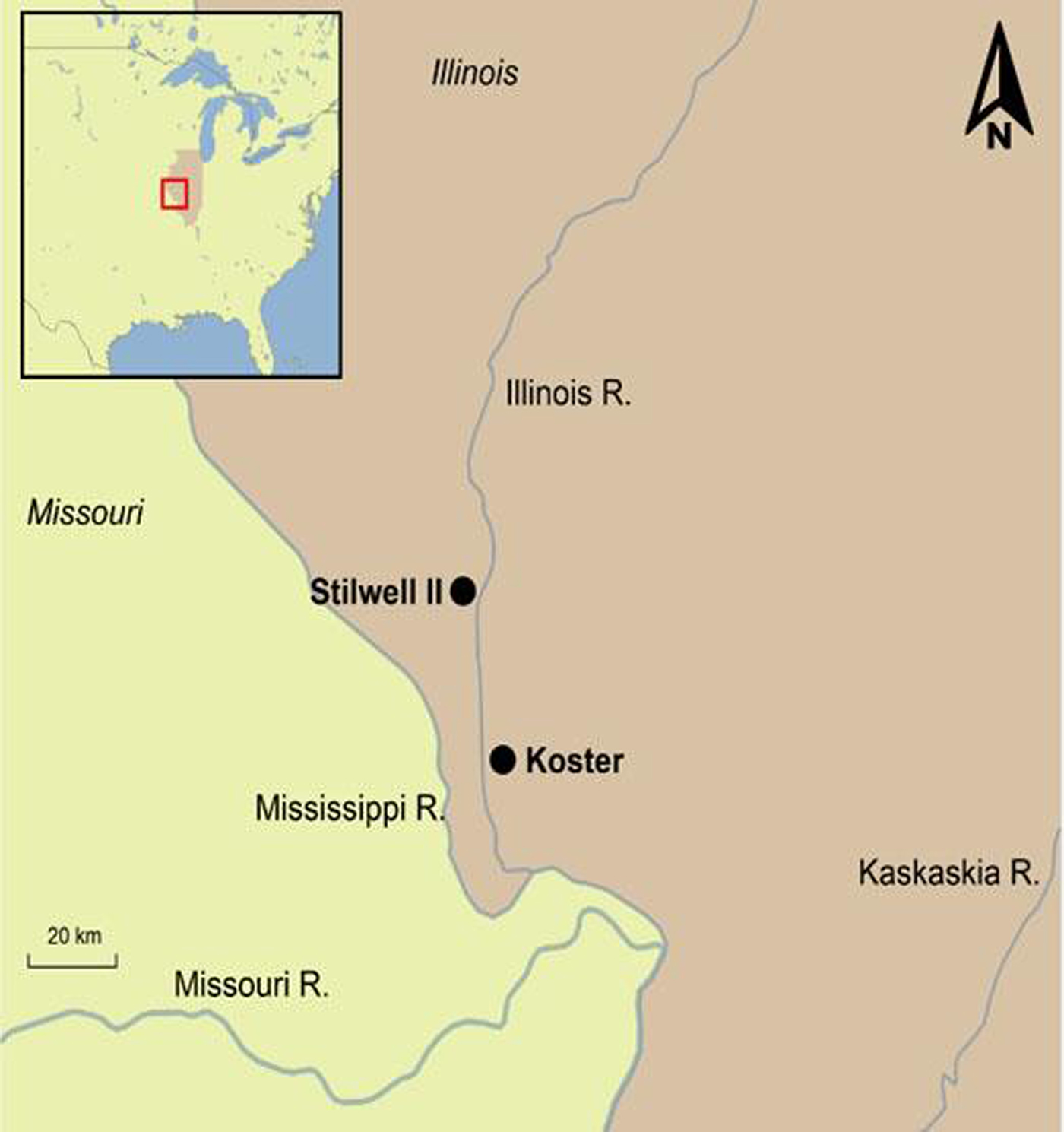
The Koster site (11GE4) is in a minor tributary valley of the lower Illinois River in Greene County, Illinois (Figure 1). The site is multicomponent and highly stratified with cultural deposits spanning the Early Archaic to Mississippian, providing a nearly continuous record of Holocene human occupation (Brown and Vierra Reference Brown and Vierra1983). The site was excavated continuously over a ten-year period and is one of the most studied sites in the lower Illinois River valley (e.g., Butzer Reference Butzer1978; Hajic Reference Hajic1990; Komar and Buikstra Reference Komar and Buikstra2003).
Location of the Koster and Stilwell II sites.
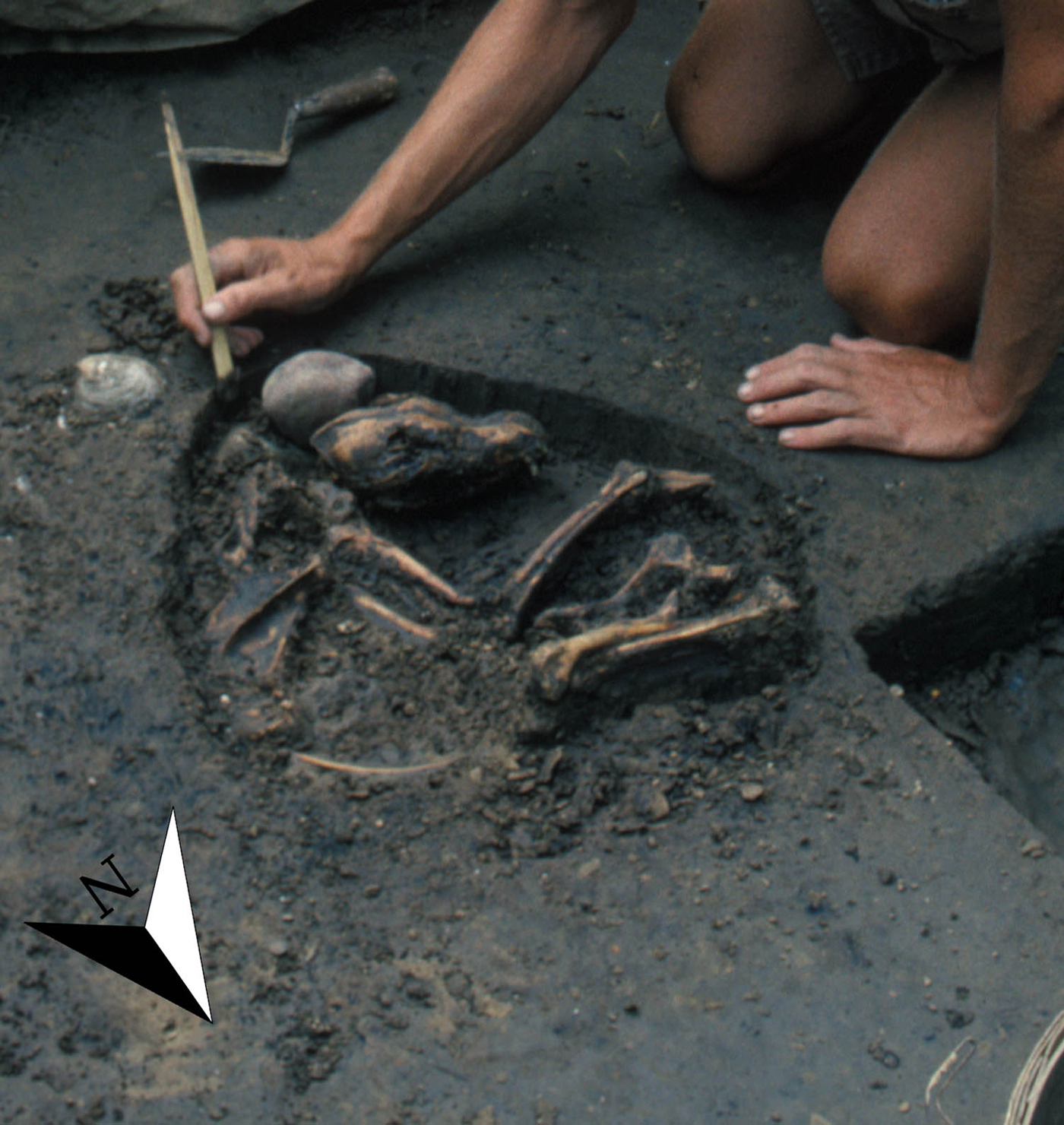
Three isolated dog burials (cf. Perri Reference Perri, Rowley-Conwy, Serjeantson and Halstead2017) in shallow, well-demarcated pits were identified from Horizon 11, one of the Early Archaic phases at Koster (Figure 2). There was also a fourth burial, likely associated with a later period (Hill Reference Hill1972; Morey and Wiant Reference Morey and Wiant1992), and a fifth burial is reported (Neusius Reference Neusius and Fagan1996), the remains of which are not currently present in the Illinois State Museum collection. The skeletons of the three dogs from Horizon 11 were complete and articulated, and they lacked evidence of butchering or skinning (Morey and Wiant Reference Morey and Wiant1992). Given their presence in Horizon 11 and association with a nearby charcoal date (Brown and Vierra Reference Brown and Vierra1983), the dogs were attributed to the terminal Early Archaic. Though this date is commonly reported as 8,500 years ago (e.g., Morey and Wiant Reference Morey and Wiant1992:225), the calibrated age based on the associated charcoal 14C dates is about 9,500 cal BP. These specimens are often cited as the earliest domesticated dogs and occurrences of intentional dog burials in the Americas (Fiedel Reference Fiedel2005; Lapham Reference Lapham2010; Morey Reference Morey2010; Morey and Wiant Reference Morey and Wiant1992; Walker et al. Reference Walker, Morey and Relethford2005).
Excavation of the Koster F2256 dog burial (photograph by Del Baston, courtesy of the Center for American Archeology).
The Stilwell II Site
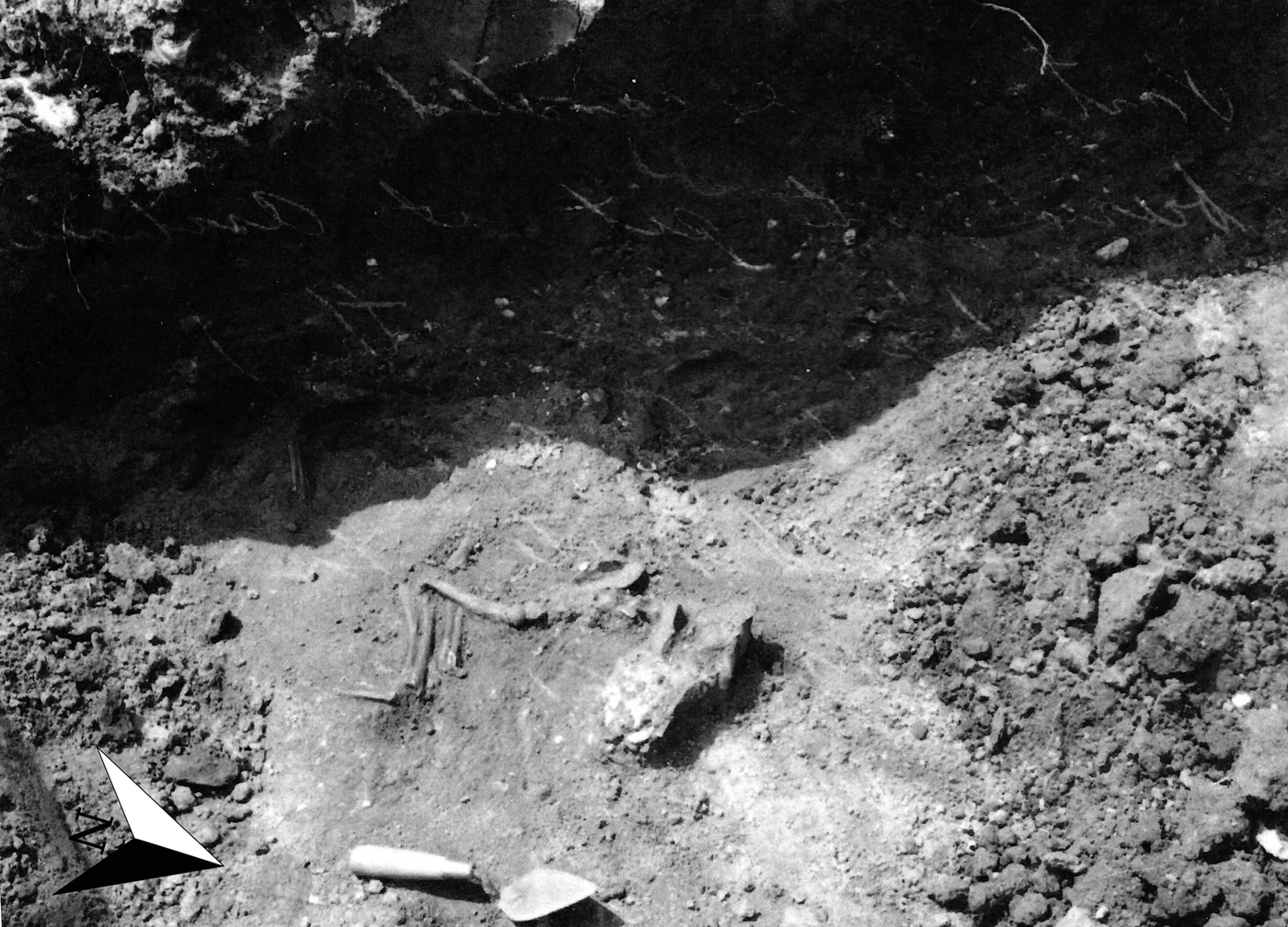
The Stilwell II site (11PK1044) was discovered in 1960 when road-grading operations cut through an alluvial fan in Pike County, Illinois, about 35 km from the Koster site. Gregory Perino collected lithic artifacts and faunal remains from what he described as two living areas indicated by a dark layer of soil 15.2 cm thick and 6.1 m long that was exposed at the base of a 4.3 m cutbank (Perino Reference Perino1970:119). He subsequently recovered a dog burial in the northern area of the site and a human burial in the southern area. The dog burial (Figure 3), which was complete and articulated (Perino Reference Perino1970, Reference Perino1977), was curated at the Illinois State Museum. The faunal remains collected by Perino and others from later excavations done by the Illinois State Archaeological Survey include white-tailed deer, turkey, turtle, small birds, vole, squirrel, fish, and mussel. After the two rescue excavations in 1960 and 1962, Perino published very little about the site and left no field notes or maps. The Illinois State Archaeological Survey began reexcavating the site in 2015, and that is ongoing (see Supplemental text).
The Stilwell II dog burial in situ (courtesy of the Illinois State Museum).
Materials and Methods
Zooarchaeology, Morphology, and Paleopathology
The Koster and Stilwell II dogs were analyzed in the zooarchaeology laboratory at the Illinois State Museum's Research and Collections Center, where they are curated. All skeletal specimens were examined to note the condition of epiphyseal closure, presence of cut marks, damage by carnivore or rodent gnawing, and exposure to fire. Analysis of shoulder height relies on the regression equations of Harcourt (Reference Harcourt1974), and body-mass estimates use the methods presented by Losey and colleagues (Reference Losey, Osipov, Sivakumaran, Nomokonova, Kovychev and Diatchina2014, Reference Losey, McLachlin, Nomokonova, Latham and Harrington2016). Researchers have previously published comprehensive measurement data, burial information, and paleopathology for the Koster dogs (Lawler et al. Reference Lawler, Widga, Rubin, Reetz, Evans, Tangredi, Thomas, Martin, Hildebolt, Smith, Leib, Sackman, Avery and Smith2016; Morey Reference Morey1992, Reference Morey2006; Morey and Wiant Reference Morey and Wiant1992), which is not repeated here. Recent analysis of ancient DNA from one Koster specimen confirms a link to Eurasian domesticated dogs, likely originating in Siberia (Ní Leathlobhair et al. Reference Ní Leathlobhair, Perri, Irving-Pease, Witt, Linderholm, Haile, Lebrasseur, Ameen, Blick, Boyko, Brace, Cortes, Crockford, Devault, Dimopoulos, Eldridge, Enk, Gori, Gopalakrishnan, Grimes, Guiry, Hansen, Hulme-Beaman, Johnson, Kitchen, Kasparov, Kwon, Nikolskiy, Lope, Manin, Martin, Meyer, Myers, Omura, Rouillard, Pavlova, Sciulli, Sinding, Strakova, Ivanova, Widga, Willerslev, Pitulko, Barnes, Gilbert, Dobney, Malhi, Murchison, Larson and Frantz2018; Thalmann et al. Reference Thalmann, Shapiro, Cui, Schuenemann, Sawyer, Greenfield, Germonpré, Sablin, López-Giráldez, Domingo-Roura, Napierala, Uerpmann, Loponte, Acosta, Giemsch, Schmitz, Worthington, Buikstra, Druzhkova, Graphodatsky, Ovodov, Wahlberg, Freedman, Schweizer, Koepfli, Leonard, Meyer, Krause, Pääbo, Green and Wayne2013). Recovery of ancient DNA from the Stilwell II dog has failed thus far.
Though little documentation exists for the site, Perino (Reference Perino1970:119) is clear that the remains of the Stilwell II dog were found in a shallow, intentional burial in what he described as the floor of a living area. The only in situ photograph of the dog shows an articulated skeleton as an isolated burial (Figure 3) with a northwest-southeast orientation (head facing west). The front legs appear to be tucked partly under the body.
Following Von den Driesch (Reference Von den Driesch1976), we provide all possible skeletal measurements for the Stilwell II dog and have retaken all possible measurements from the two Koster dogs (F2256 and F2357) dated in this study (Supplemental Table 1). These measurements were compared to a sample of seven Archaic dogs from Iowa and Illinois (Supplemental Table 3). Modern wild canids (C. latrans, C. lupus) curated in the Illinois State Museum, the University of Kansas Biodiversity Institute, and the East Tennessee Museum of Natural History were also included in osteometric analyses to illustrate the morphological differences between domesticated and wild taxa. Three-dimensional models of the Koster F2256 and Stilwell II mandibles are available for download (see Data Availability Statement).
Observations of the appendicular skeleton include overt and incipient pathology. We define incipient pathological changes as very mild or very early changes not easily visualized by standard radiographic methods and not clarified substantially by standard computed tomography. Each bone was examined directly, supported by magnification as necessary. Microcomputed tomography has been conducted with some of the specimens as parts of other studies (Lawler et al., Reference Lawler, Widga, Rubin, Reetz, Evans, Tangredi, Thomas, Martin, Hildebolt, Smith, Leib, Sackman, Avery and Smith2016). All specimens were photographed. Observations were recorded by location within bone, resulting in multiple scores for given joint components (Supplemental Table 2).
Radiocarbon Dating and Stable Isotopes
Small rib fragments (1–2 cm in length) from the Koster and Stilwell II dogs were submitted to the University of Arizona AMS lab (Tucson, Arizona) or Rafter Radiocarbon lab (Lower Hutt, New Zealand) for radiocarbon dating (Table 2). In both cases, collagen was extracted using a modified Longin technique of acid demineralization followed by removal of organic contaminants using a weak basic solution (Longin Reference Longin1971). Samples were combusted and further purified in a dedicated gas line and converted to graphite targets. These targets were analyzed using the accelerator at the Department of Physics, University of Arizona (USA) and the National Isotope Centre, GNS Science (New Zealand), respectively. All 14C results are calibrated as 2-sigma age ranges with the Intcal13 dataset (Reimers et al. Reference Reimer, Bard, Bayliss, Beck, Blackwell, Ramsey, Buck, Cheng, Edwards, Friedrich, Grootes, Guilderson, Haflidason, Hajdas, Hatté, Heaton, Hoffmann, Hogg, Hughen, Kaiser, Kromer, Manning, Niu, Reimer, Richards, Scott, Southon, Staff, Turney and van der Plicht2013) using Calib 7.1 html (Stuiver et al. Reference Stuiver, Reimer and Reimer2017).
Bone-collagen stable isotope samples followed the same laboratory preparation methods as those prepared for 14C but were analyzed on a continuous-flow gas-ratio mass spectrometer coupled to an elemental analyzer. At the University of Arizona lab, standardization is based on acetanilide for elemental concentration, NBS-22 and USGS-24 for δ13C, and IAEA-N-1 and IAEA-N-2 for δ15N. Precision is better than ± 0.1 for δ13C and ± 0.2 for δ15N. At the Rafter lab, standardization is based on leucine (-22.7‰ for δ13C, 2.2‰ for δ15N), and caffeine (-37.9‰ for δ13C, -7.4‰ for δ15N). Precision for these measurements is ± 0.3‰ for δ15N and ± 0.2‰ for δ13C. All δ13C results are reported relative to VPDB, and all δ15N results are reported relative to N-Air. A third Koster dog (222D) from Horizon 11 was also included in the isotopic analyses.
These data are compared to additional Early and Middle Archaic dog samples from Modoc Rockshelter in Illinois and Rodgers Shelter in Missouri, as well as published archaeological dog and human stable isotope data from the lower Illinois River valley and American Bottom (Carbaugh et al. Reference Carbaugh, Headley and Fort2018; Fort et al. Reference Fort, Hedman, Ambrose, McElrath and Evans2016; Hargrave et al. Reference Hargrave, Hedman and Wolf2006; Hedman et al. Reference Hedman, Hargrave and Ambrose2002). A dataset consisting of midwestern wolves (Fox-Dobbs et al. Reference Fox-Dobbs, Bump, Peterson, Fox and Koch2007), midwestern deer (Cormie and Schwarcz Reference Cormie and Schwarcz1994), and freshwater fish from lower Illinois River valley archaeological assemblages dating to before the local use of maize (Brugam et al. Reference Brugam, Little, Kohn, Brunkow, Vogel and Martin2017) is also included to illustrate general dietary trends in archaeological dog samples. The modern deer dataset is divided into two groups representing animals with very little C4 contribution to the diet (C3 deer) and those with >10% C4 contribution to the diet (C4 deer).
Results
Zooarchaeology, Morphology, and Paleopathology
On the Stilwell II specimens, faint root etching was noted on several of the long bones, whereas only two occurrences of rodent gnawing were observed. No cut marks from dispatch wounds (e.g., on the atlas vertebra) or dismemberment (e.g., cuts near articular ends) were present on the skeleton. The dog was an adult of undetermined age, and the absence of a baculum from the otherwise well-represented posterior bones suggests the animal was a female.
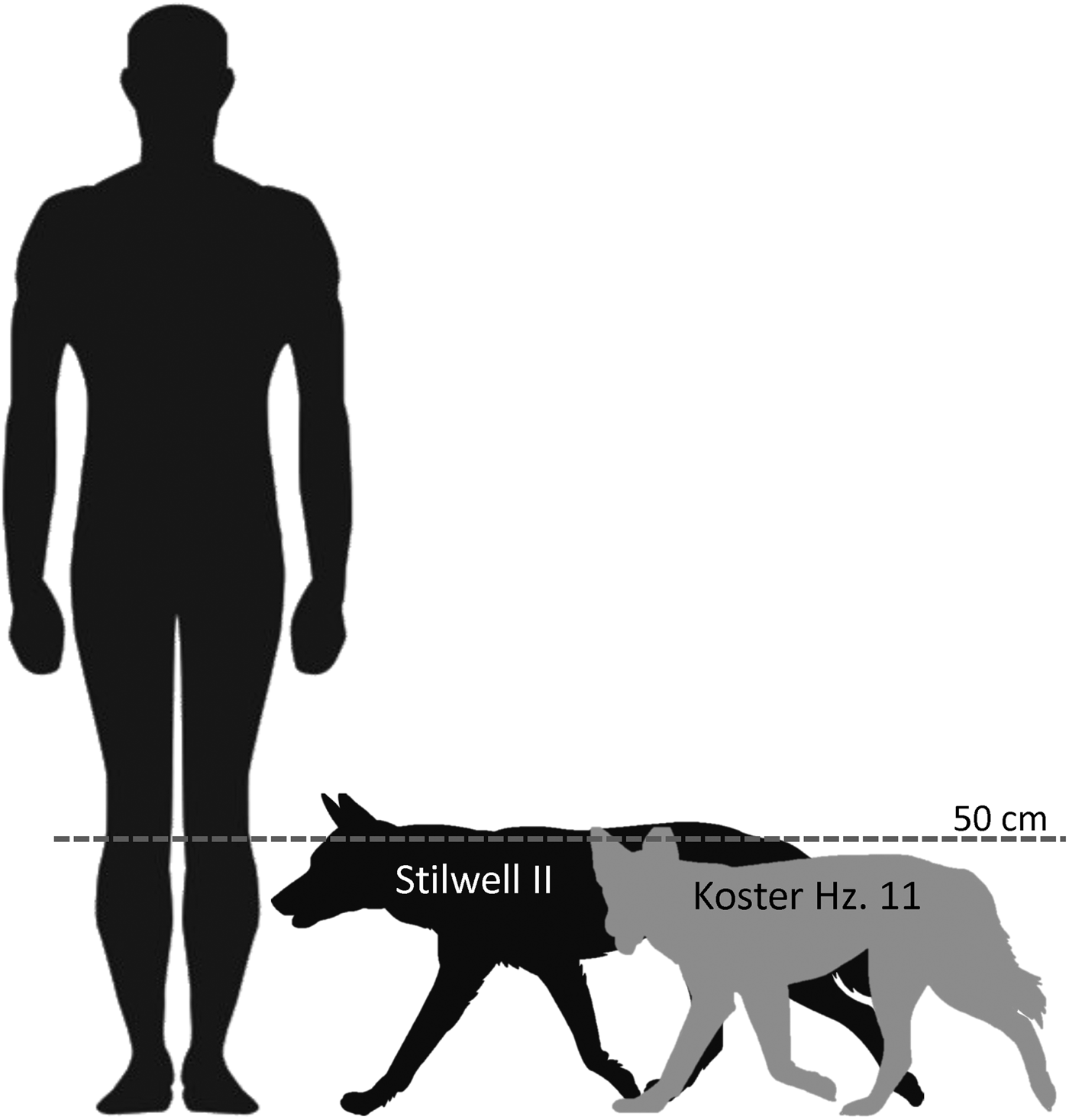
Since it is a relatively complete skeleton, the Stilwell II dog has the potential to provide anatomical insights into the size and morphology of early North American dogs. It had an estimated shoulder height between 504 and 517 mm, based on radial (RDgl) and tibial (TAgl) length (Table 1; Harcourt Reference Harcourt1974). Losey and colleagues recently suggested improved methods for body-mass estimation based on measurements of craniodental (Reference Losey, Osipov, Sivakumaran, Nomokonova, Kovychev and Diatchina2014) and limb elements (Reference Losey, McLachlin, Nomokonova, Latham and Harrington2016). Application of these regression equations to the Stilwell II dog resulted in widely varying estimates (17–32 kg). Following Losey and colleagues (Reference Losey, McLachlin, Nomokonova, Latham and Harrington2016), we prefer body-mass estimates that are based on elements relating directly to locomotion, such as limb elements. Estimates of body mass based on the humerus (distal breadth; HMbd) and radius (proximal breadth; RDbp) are both 17.1 kg (Table 1), similar in mass and build to a small, modern English setter. Dogs from the nearby Koster site are slightly shorter (with shoulder heights between 439 and 463 mm) and more lightly built (12–14 kg; Figure 4).
Relative size of the Stilwell II and Koster dogs.
Shoulder Height and Body Mass Estimates of the Koster and Stilwell II Dogs.

a Data from Harcourt (Reference Harcourt1974) in mm.
b Data from Losey et al. (Reference Losey, Osipov, Sivakumaran, Nomokonova, Kovychev and Diatchina2014) in kg.
cData from Losey et al. (Reference Losey, McLachlin, Nomokonova, Latham and Harrington2016) in kg.
VDDm18 and VDDm19 from mandibular measurements in Von den Driesch (Reference Von den Driesch1976). VDDm18 is the vertical height of the ramus and VDDm19 is the vertical height of the mandibular body behind the M1.
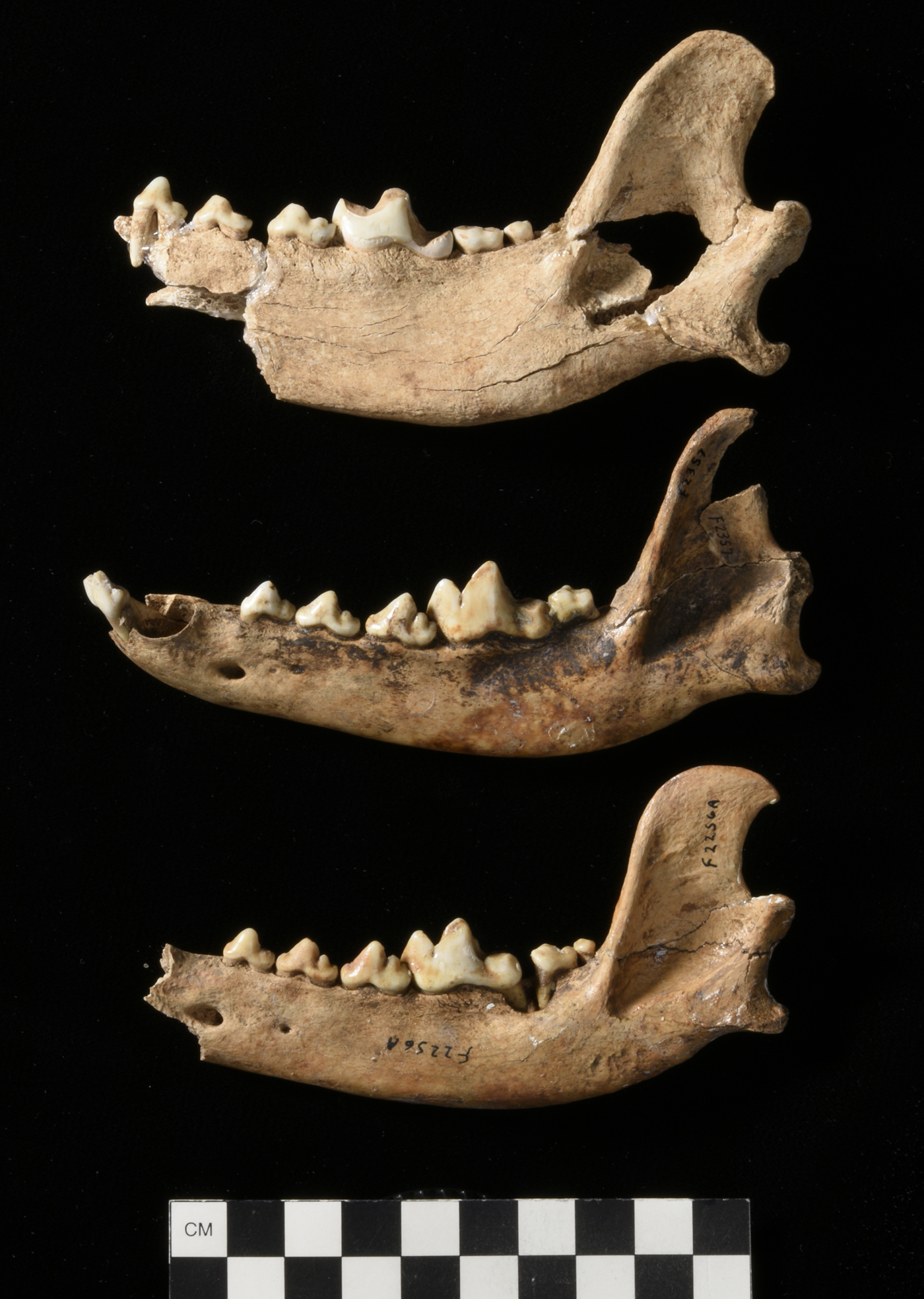
Mandibular morphology varies significantly between the Stilwell II and Koster dogs (Figure 5). The Stilwell II dog mandible is robust with relatively small carnassial molars and a deep mandibular body. Dog mandibles from the Koster site, however, are more gracile, with large carnassial molars and shallow bodies, relative to their size.
Comparison of left mandibles from (top to bottom) the Stilwell II, Koster F2357, and Koster F2256 dogs.
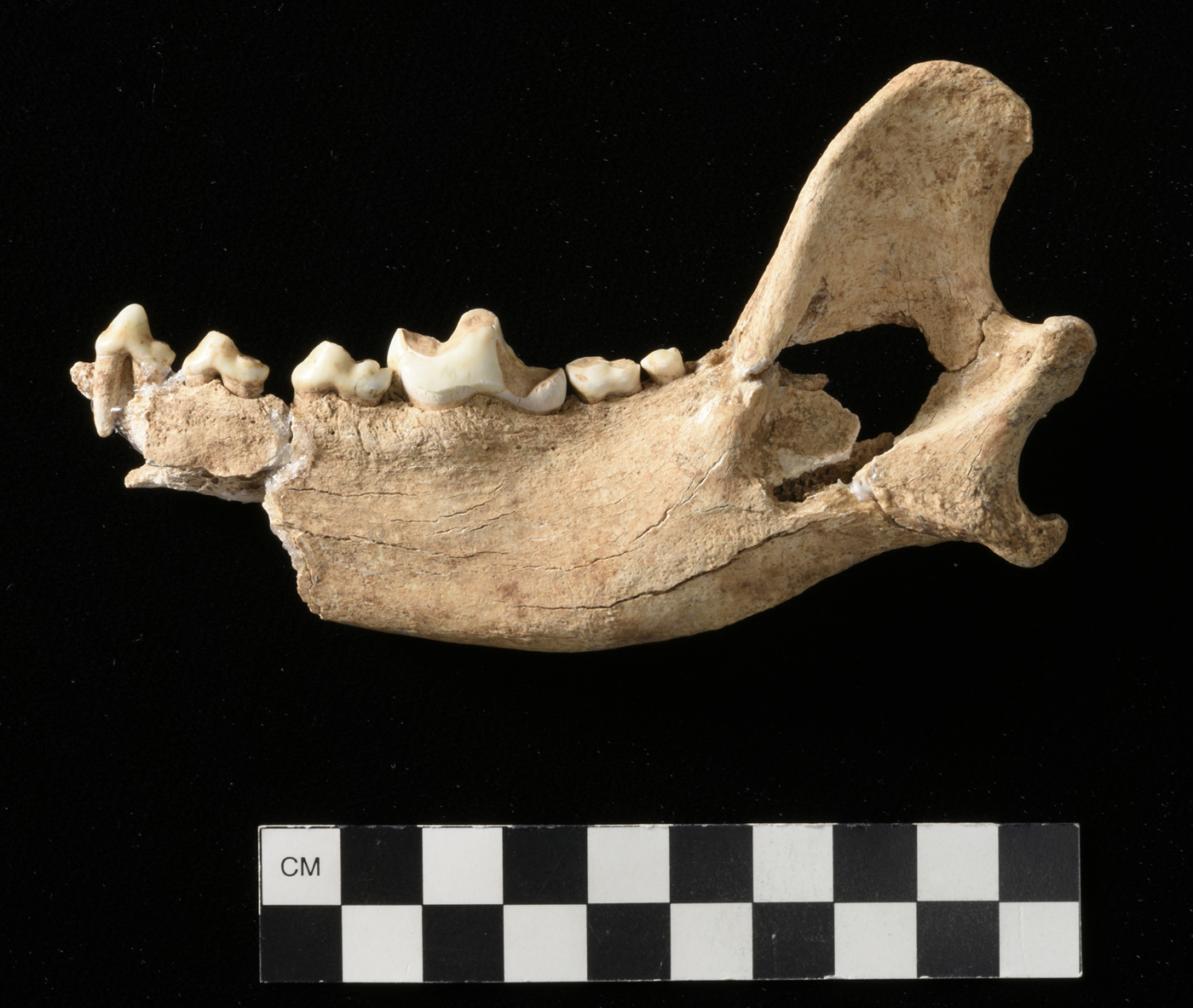
Observations of the Stilwell II dog's axial skeleton included multifocal periodontal-periosteal disease and severe tooth wear. The first and second molars exhibit extreme wear (Figure 6), and the right lower canine is worn nearly blunt. Damage of this type depends partly on genetic susceptibility (e.g., modern small-breed dogs), and on diet and habits such as chewing on bones. The dog could have experienced several complications of chronic oral cavity disease. The rough enlargement of perialveolar mandibular bone below the mandibular arcades signals gingival and periodontal disease. DeBowes and colleagues (Reference DeBowes, Mosier, Logan, Harvey, Lowry and Richardson1996) showed that multiple organ pathology can be related to oral cavity diseases such as gingivitis and periodontitis. Significant associations were found between periodontitis and diseases of the kidney glomerular and interstitial tissue; myocardium, especially papillary muscle; and hepatic parenchyma. The likely explanation is recurring bacteremia originating in the oral tissue (DeBowes et al. Reference DeBowes, Mosier, Logan, Harvey, Lowry and Richardson1996). Without regular dental care, modern domestic dogs commonly develop a similar oral pathology, and from the perspective of modern veterinary medicine, the Stilwell II dog would have been very uncomfortable.
The left mandible of the Stilwell II dog showing advanced tooth wear.
Deviations of spinous processes were observed on seven vertebrae. Prevailing opinion has been that domestic dog vertebral spinous process deviations were caused by carrying packs or pulling travois (Darwent and Gilliland Reference Darwent and Gilliland2001; Walker et al. Reference Walker, Morey and Relethford2005; Warren Reference Warren and Crockford2000). However, it has been shown recently that thorough differential diagnosis of these features yields multiple possible pathological causes or pseudopathologies (Lawler et al. Reference Lawler, Widga, Rubin, Reetz, Evans, Tangredi, Thomas, Martin, Hildebolt, Smith, Leib, Sackman, Avery and Smith2016). Furthermore, the anatomical locations of affected vertebrae are protected by the caudodorsal neck ligament, tendon, and muscle mass (Miller et al. Reference Miller, Evans and Christensen1979) or lie below the protective transverse plane of the wings of the ilia. Thus, these vertebrae are not susceptible to injury related to carrying packs or pulling travois (Lawler et al. Reference Lawler, Widga, Rubin, Reetz, Evans, Tangredi, Thomas, Martin, Hildebolt, Smith, Leib, Sackman, Avery and Smith2016; Supplemental Table 2). A recent study of arctic foxes supports the notion that vertebral asymmetry can be a part of normal morphological variation in at least Canidae (Mustonen et al. Reference Mustonen, Lawler, Ahola, Koistinen, Jalkanen, Mononen, Lamidi and Nieminen2017).
The limbs yielded observations of normal, incipient, and overt pathological changes. The metapodials and phalanges yielded observations of incipient pathology (Supplemental Table 2). The summed changes are consistent with an active lifestyle and do not differ qualitatively from those seen in modern adult dogs (Lawler and Evans Reference Lawler and Evans2016; Lawler et al. Reference Lawler, Widga and Smith2017; Mustonen et al. Reference Mustonen, Lawler, Ahola, Koistinen, Jalkanen, Mononen, Lamidi and Nieminen2017).
Radiocarbon Dating and Stable Isotopes
The Stilwell II and Koster specimens previously had not been directly radiocarbon dated. Because they were discovered within Horizon 11, three dogs from Koster were associated with five Horizon 11 radiocarbon (14C) assays yielding dates between 8,480 ± 110 BP (ISGS-236) and 8,130 ± 90 BP (ISGS-1065; Brown and Vierra Reference Brown and Vierra1983:187), but often cited as 8,500 years ago (e.g., Morey and Wiant Reference Morey and Wiant1992). A fourth undated Koster dog likely comes from a later Archaic occupation. Here, we present three new direct 14C dates from the Stilwell II dog and two Koster Horizon 11 dogs (F2256 and F2357; Table 2). Lyophilized samples from all three dogs had white, fluffy appearances, and carbon to nitrogen ratios (C:N) were within the range of modern mammalian collagen (Tuross et al., Reference Tuross, Fogel and Hare1988), suggesting well-preserved collagen.
Bone Collagen Radiocarbon Dates and Stable Isotope Values.
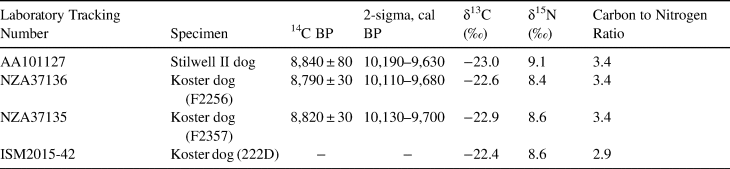
Koster dog F2256 dates to 8,790 ± 30 BP (10,110–9,680 cal BP), Koster dog F2357 dates to 8,820 ± 30 BP (10,130–9,700 cal BP), and the Stilwell II dog dates to 8,840 ± 80 BP (10,190–9,630 cal BP). The chronological differences between the Stilwell II and Koster individuals are not statistically significant at the scale of 14C dating. These new dates range several hundred years earlier than previously associated dates for the Koster dogs and add another lower Illinois River valley dog to the record of early precontact dogs.
The stable isotope values for the Stilwell II dog and three Koster Horizon 11 dogs are presented in Table 2. These data are tightly clustered in isotope space, with an average δ13Ccoll value of -22.7‰ (σ=0.3) and an average δ15Ncoll value of 8.7‰ (σ=0.3).
Discussion
Morphological Variation in Early North American Dogs
Most morphological work on North American dogs has focused on cranial shape (Morey Reference Morey1992, Reference Morey2010; Morey and Wiant Reference Morey and Wiant1992; Olsen Reference Olsen1985; Walker et al. Reference Walker, Morey and Relethford2005); however, measurements on mandibles (Bozell Reference Bozell1988; Walker and Frison Reference Walker and Frison1982) and limb elements (Morey and Aaris-Sørensen Reference Morey and Aaris-Sørensen2002) have also been examined. Relative to wild canids, North American dogs generally exhibit shortened muzzles with accompanying changes to dental and mandibular elements. Smaller body size and the size of certain elements (i.e., carnassial molars) have been attributed to domestication (Morey Reference Morey2010), though recent work has reevaluated the usefulness of many so-called domestication markers (Ameen et al. Reference Ameen, Hulme-Beaman, Evin, Germonpré, Britton, Cucchi, Larson and Dobney2017; Drake et al. Reference Drake, Coquerelle, Kosintsev, Bachura, Sablin, Gusev, Fleming and Losey2017; Janssens et al. Reference Janssens, Spanoghe, Miller and Van Dongen2016). Unfortunately, in the zooarchaeological record, crania are fragile and often poorly preserved. Although relatively complete crania are present at the Koster site, the Stilwell II dog is represented only by cranial fragments despite field documentation indicating that a complete skull was found.
To better understand morphological variability among early midwestern dogs, we use a limited set of mandibular measurements from a larger sample of Archaic midwestern domesticated dogs and modern wild Canis spp. (Supplemental Table 3). In this dataset, Archaic midwestern dogs generally have deeper mandibular bodies (i.e., greater height of the mandible behind the carnassial M1; Von den Driesch Reference Von den Driesch1976:60) relative to the length of the carnassial molar (Von den Driesch Reference Von den Driesch1976:60; Figure 7). The Stilwell II, Simonsen and one of the Modoc specimens have dog-sized carnassial molars but relatively deep, wolf-like mandibles. Three Koster and two Modoc dogs also have deep mandibles relative to carnassial size, although they are much smaller specimens. Coyote-dog hybrids (coy-dogs) generally plot near the archaeological dogs in this morphospace, suggesting that hybrid individuals may be difficult to distinguish through morphology alone. It is also possible that some early archaeological dog samples are from hybrid individuals, as suggested by recent analysis of ancient DNA from one Koster dog (Ní Leathlobhair et al. Reference Ní Leathlobhair, Perri, Irving-Pease, Witt, Linderholm, Haile, Lebrasseur, Ameen, Blick, Boyko, Brace, Cortes, Crockford, Devault, Dimopoulos, Eldridge, Enk, Gori, Gopalakrishnan, Grimes, Guiry, Hansen, Hulme-Beaman, Johnson, Kitchen, Kasparov, Kwon, Nikolskiy, Lope, Manin, Martin, Meyer, Myers, Omura, Rouillard, Pavlova, Sciulli, Sinding, Strakova, Ivanova, Widga, Willerslev, Pitulko, Barnes, Gilbert, Dobney, Malhi, Murchison, Larson and Frantz2018).
Relationship between carnassial length (Von den Driesch Reference Von den Driesch1976, measurement 13L) and mandibular body height (Von den Driesch Reference Von den Driesch1976, measurement 19) among different Canis groups. CS = Cherokee Sewer, Iowa; MD = Modoc Rock Shelter, Illinois; KS = Koster, Illinois (KS1 and 2 included in this study); SM = Simonsen, Iowa; SW = Stilwell II, Illinois. The dotted line connects the left and right mandibles of the same individual. See Supplemental Table 3.
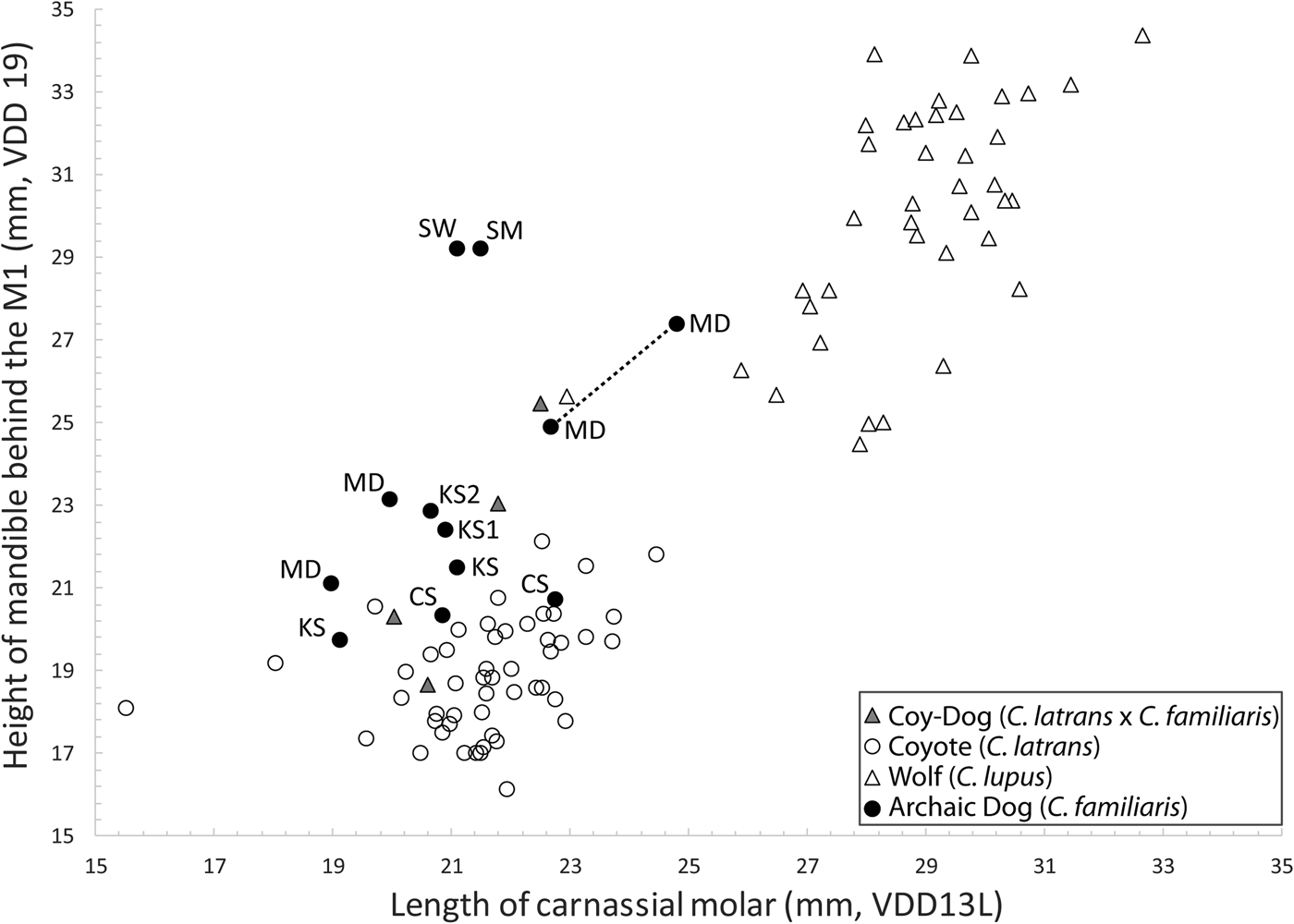
Even this limited sampling of Archaic dogs allows some comparative insight into early dog morphology among contemporaneous specimens as well as those from several different periods represented at the same site. For example, the three dogs from Modoc Rock Shelter show a significant variation in mandibular height and length of carnassial molars (Figure 7). The largest dog dates to 8,560–8,200 cal BP (Supplemental Table 3) but exhibits intra-individual variation between the left and right mandible (shown via dotted line, Figure 7). Another dog from the site dates to 5,710–5,330 cal BP and has much smaller molars and a more gracile mandible. A third undated (likely Archaic) dog falls between these two. Similarly, from the Koster site, the two contemporaneous dogs and a third undated but likely contemporaneous dog all cluster. A fourth dog, likely from a later period (Hill Reference Hill1972; Morey and Wiant Reference Morey and Wiant1992), is smaller than those three in both measurements (Figure 7).
Though only a small sample, the distinct differences between the mandibles of the robust Stilwell II dog and the more gracile Koster dogs (Figure 5), from individuals geographically and temporally indistinguishable, suggest variation in the earliest American dogs. This is perhaps unsurprising, given the morphological variation seen at sites from similar periods in eastern Siberia (Pitulko and Kasparov Reference Pitulko and Kasparov2017) and recent analysis of ancient DNA that shows at least two distinct ancient American dog haplogroups splitting between 16,400 and 12,900 years ago (Ní Leathlobhair et al. Reference Ní Leathlobhair, Perri, Irving-Pease, Witt, Linderholm, Haile, Lebrasseur, Ameen, Blick, Boyko, Brace, Cortes, Crockford, Devault, Dimopoulos, Eldridge, Enk, Gori, Gopalakrishnan, Grimes, Guiry, Hansen, Hulme-Beaman, Johnson, Kitchen, Kasparov, Kwon, Nikolskiy, Lope, Manin, Martin, Meyer, Myers, Omura, Rouillard, Pavlova, Sciulli, Sinding, Strakova, Ivanova, Widga, Willerslev, Pitulko, Barnes, Gilbert, Dobney, Malhi, Murchison, Larson and Frantz2018). The probable female sex of the larger Stilwell II dog suggests the morphological differences are not the result of sexual dimorphism, especially given that the similarly gracile Koster dogs include a female (F2256) and a male (F2357; Morey and Wiant Reference Morey and Wiant1992). Similar morphological variation is seen in the two contemporaneous Middle Archaic dogs from Iowa (Figure 7): one is more robust, like the Stilwell II dog, and the other is more gracile, like the Koster dogs. Though this variation may be the result of morphologically distinct American dog lineages, it may also arise from local admixture with wild canids, such as coyotes and wolves, leading to rapid variation within a more homogenous initial dog population.
Hybridization of Early North American Dogs
Genomic work on wild canid populations has demonstrated that all North American Canis spp. could interbreed, often to a significant degree (Monzón et al. Reference Monzón, Kays and Dykhuizen2014; Wayne and Jenks Reference Wayne and Jenks1991). Although we analyze these taxa as distinct groups, it is likely that some of these specimens show admixture of different species, even in groups made up of modern museum specimens of “known” taxonomic affinity. For example, a recent analysis of ancient DNA from one of the Koster dogs we dated (F2256) revealed that although the specimen clusters with all other precontact North American dog material analyzed (spanning about 9,000 years), it also showed evidence for potential admixture with a midwestern coyote (Ní Leathlobhair et al. Reference Ní Leathlobhair, Perri, Irving-Pease, Witt, Linderholm, Haile, Lebrasseur, Ameen, Blick, Boyko, Brace, Cortes, Crockford, Devault, Dimopoulos, Eldridge, Enk, Gori, Gopalakrishnan, Grimes, Guiry, Hansen, Hulme-Beaman, Johnson, Kitchen, Kasparov, Kwon, Nikolskiy, Lope, Manin, Martin, Meyer, Myers, Omura, Rouillard, Pavlova, Sciulli, Sinding, Strakova, Ivanova, Widga, Willerslev, Pitulko, Barnes, Gilbert, Dobney, Malhi, Murchison, Larson and Frantz2018). This may account for the morphological variation seen between the Koster dogs and the Stilwell II dog, which were concurrent in space and time.
For these reasons, we consider the present study as merely illustrative of general morphological trends in archaeological Canis. Combined genomic and morphological approaches have the potential to answer many questions about North American dog populations. However, these techniques are just being applied rigorously to questions of early dogs in the Americas.
Environment and Diet
The landscape in the lower Illinois River valley roughly 10,000 cal BP was a mesic, fire-sensitive woodland (Baker et al. Reference Baker, Maher, Chumbley and Van Zant1992, Nelson et al., Reference Nelson, Hu, Grimm, Curry and Slate2006). Although C4 plants were present in small numbers at that time (<22% C4), they began to dominate upland floras after about 9,000 cal BP with the spread of the tallgrass prairie (Nelson et al. Reference Nelson, Hu, Grimm, Curry and Slate2006). Within this environment, early Holocene human dietary protein was predominantly acquired from terrestrial and riverine sources (Styles and McMillan Reference Styles, McMillan, Emerson, McElrath and Fortier2009) and δ13C values would have ranged from −22‰ to −38‰ (average = −26.5‰; Tieszen Reference Tieszen1991; Tieszen and Fagre Reference Tieszen, Fagre, Lambert and Grupe1993).
The δ15N of bone collagen (δ15Ncoll) in the Midwest is influenced strongly by trophic-level fractionation, with a difference of about 3‰ between predators and their prey (Hedman et al. Reference Hedman, Hargrave and Ambrose2002; Schoeninger and DeNiro Reference Schoeninger and DeNiro1984). Although landscape aridity can also affect the δ15N of primary consumers (Heaton et al. Reference Heaton, Vogel, von La Chevallerie and Collett1986), the mesic environment of the lower Illinois River valley approximately 10,000 years ago suggests that aridity would have contributed little to local δ15Ncoll values. However, seasonality may influence δ15Ncoll values through the recycling of body tissues due to periodic nutritional stress (Polischuk et al. Reference Polischuk, Hobson and Ramsay2001).
Most isotopic studies of human diets in the valley have focused on the dietary transition from hunting and gathering to growing maize (Buikstra et al. Reference Buikstra, Rose, Milner and Green1994; Emerson et al., Reference Emerson, Hedman and Simon2005; Hedman et al. Reference Hedman, Hargrave and Ambrose2002) and have attempted to track the dietary effect of maize, a C4 grass, on populations that previously depended on a diet dominated by C3 sources. However, the δ15N of human diets has recently received more attention (Froehle et al. Reference Froehle, Kellner and Schoeninger2012; Hedman et al. Reference Hedman, Hargrave and Ambrose2002). Schober (Reference Schober1998, cited in Hedman et al. Reference Hedman, Hargrave and Ambrose2002) noted that δ15Ncoll of midwestern communities with a maize-dominated diet (δ15Ncoll = +9.5‰) were not significantly different from coeval groups that did not rely heavily on domesticates (δ15Ncoll = +8.9‰).
The Koster and Stilwell II dog isotope values reflect unsurprising results for early Holocene pre-maize diets in the region. Low δ13C values suggest terrestrial C3 resources, while high δ15N values may signal consumption of freshwater resources (Brugam et al. Reference Brugam, Little, Kohn, Brunkow, Vogel and Martin2017), human feces (Katzenberg Reference Katzenberg1989), and/or higher overall δ15N values in local prey. Early Archaic dog δ15N values are significantly greater than the single Early Archaic human value in the region (Kaskaskia Mine, Randolph County, Illinois; Hargrave et al., Reference Hargrave, Hedman and Wolf2006), but are more consistent with Middle and Late Archaic human and dog paleodiets (Figure 8). Since these values generally fall outside the range of modern wolves with a C3 terrestrial diet and are within the range of pre-maize freshwater fish from the Illinois River, it is likely that freshwater fish were a significant part of the Early Archaic dog's diet.
Early Archaic dog δ13Ccoll and δ15Ncoll values, compared to the ranges of modern wolves (Fox-Dobbs et al. Reference Fox-Dobbs, Bump, Peterson, Fox and Koch2007), modern deer (Cormie and Schwarcz Reference Cormie and Schwarcz1994), and archaeological fish from the Midwest (Brugam et al. Reference Brugam, Little, Kohn, Brunkow, Vogel and Martin2017). Stable isotope values from Early Archaic (Kaskaskia Mine, N = 1; Hargrave et al. Reference Hargrave, Hedman and Wolf2006), Middle Archaic (Broglio site, n = 16; Carbaugh et al. Reference Carbaugh, Headley and Fort2018), and Late Archaic (Tree Row site, n = 8; Fort et al. 2015) humans, two Late Archaic dogs from the Tree Row site (Fort et al. 2015), and post-maize human diets (N = 64; Hedman et al. Reference Hedman, Hargrave and Ambrose2002) are also included for comparison. All illustrated samples are from the Illinois River valley or the American Bottom. See Supplemental Table 4.
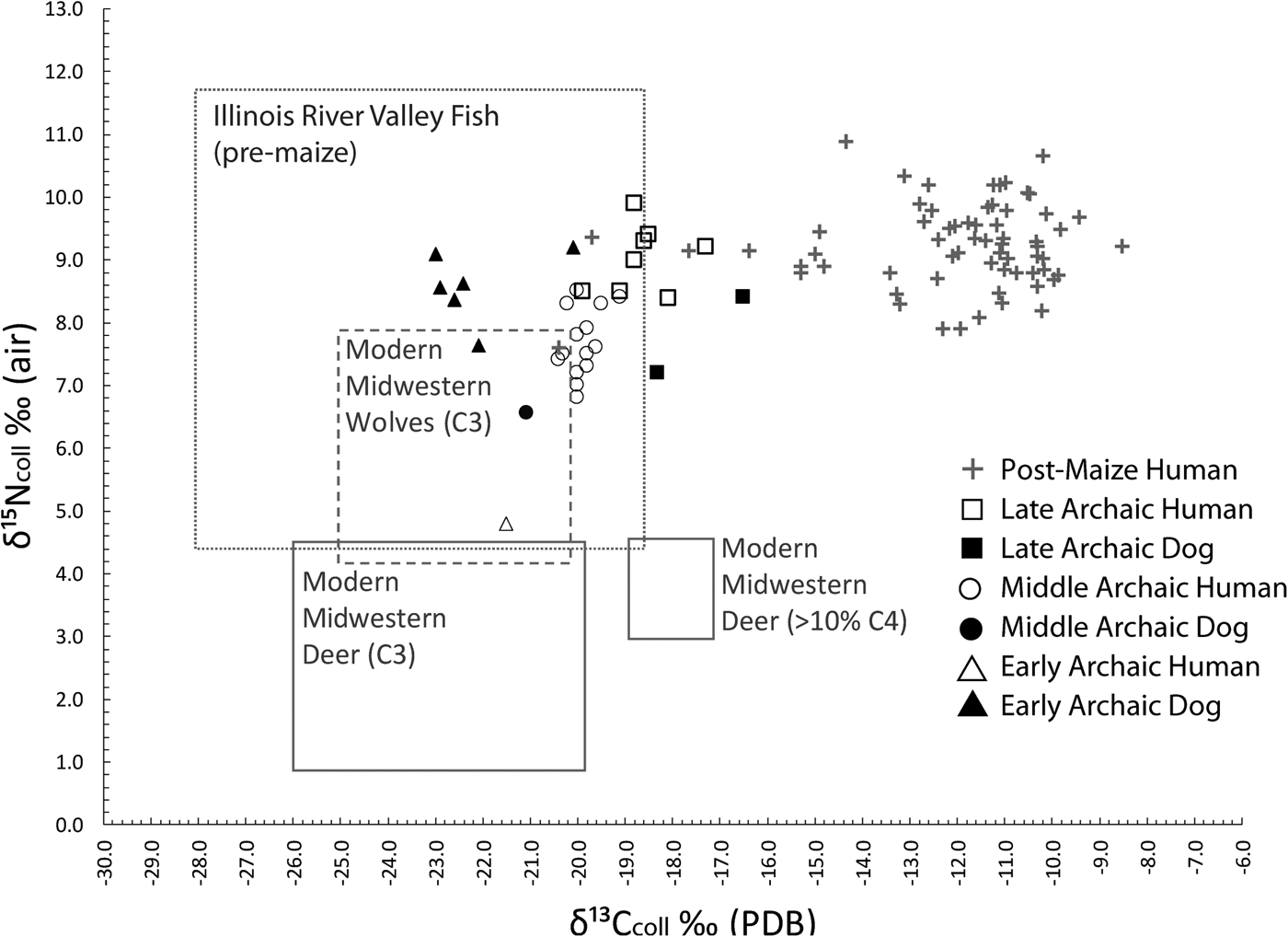
On a larger scale, the variability in both human and dog δ15N values throughout the Holocene is relatively elevated compared to terrestrial herbivores and carnivores, suggesting riverine resources were common in diets throughout the region. The primary axis of change throughout the Holocene in both humans and dogs is in δ13C values. We interpret this as a general landscape transition to C4 tallgrass prairie after the Early Archaic (also see Nelson et al. Reference Nelson, Hu, Grimm, Curry and Slate2006), followed by increasing amounts of maize in human and dog diets during the Woodland and Mississippian periods (Hedman et al. Reference Hedman, Hargrave and Ambrose2002). Future establishment of a local early Holocene isotopic baseline for the Illinois valley is needed before we can further understand the role of dogs within the local food web.
Conclusions
The approximately 10,000-year-old Stilwell II and Koster dogs introduces a gap greater than 4,500 years between these earliest dog remains and the proposed initial migration into the Americas. This is consistent with genomic analyses proposing North American dog populations originated around 10,000 cal BP (Witt et al. Reference Witt, Judd, Kitchen, Grier, Kohler, Ortman, Kemp and Malhi2015), though others suggest an earlier split from Eurasian dogs (Ní Leathlobhair et al. Reference Ní Leathlobhair, Perri, Irving-Pease, Witt, Linderholm, Haile, Lebrasseur, Ameen, Blick, Boyko, Brace, Cortes, Crockford, Devault, Dimopoulos, Eldridge, Enk, Gori, Gopalakrishnan, Grimes, Guiry, Hansen, Hulme-Beaman, Johnson, Kitchen, Kasparov, Kwon, Nikolskiy, Lope, Manin, Martin, Meyer, Myers, Omura, Rouillard, Pavlova, Sciulli, Sinding, Strakova, Ivanova, Widga, Willerslev, Pitulko, Barnes, Gilbert, Dobney, Malhi, Murchison, Larson and Frantz2018; Thalmann et al. Reference Thalmann, Shapiro, Cui, Schuenemann, Sawyer, Greenfield, Germonpré, Sablin, López-Giráldez, Domingo-Roura, Napierala, Uerpmann, Loponte, Acosta, Giemsch, Schmitz, Worthington, Buikstra, Druzhkova, Graphodatsky, Ovodov, Wahlberg, Freedman, Schweizer, Koepfli, Leonard, Meyer, Krause, Pääbo, Green and Wayne2013). Recent DNA analysis suggests precontact American dogs, including those from Koster, shared a common ancestor with eastern Siberian dogs around 15,600 years ago and saw an internal population split roughly 1,000 years later (Ní Leathlobhair et al. Reference Ní Leathlobhair, Perri, Irving-Pease, Witt, Linderholm, Haile, Lebrasseur, Ameen, Blick, Boyko, Brace, Cortes, Crockford, Devault, Dimopoulos, Eldridge, Enk, Gori, Gopalakrishnan, Grimes, Guiry, Hansen, Hulme-Beaman, Johnson, Kitchen, Kasparov, Kwon, Nikolskiy, Lope, Manin, Martin, Meyer, Myers, Omura, Rouillard, Pavlova, Sciulli, Sinding, Strakova, Ivanova, Widga, Willerslev, Pitulko, Barnes, Gilbert, Dobney, Malhi, Murchison, Larson and Frantz2018), though it is not clear on which side of Beringia that split occurred. It is possible that the arrival of the first human populations into the Americas predated their access to Eurasian domesticated dogs, and thus they arrived without them. In this scenario, dogs may have arrived with later genetically indistinguishable migrating Siberian groups (as part of ongoing “migratory dribbles”; Meltzer Reference Meltzer2009:200) before the flooding of the Bering Land Bridge 11,000 years ago (Jakobsson et al. Reference Jakobsson, Pearce, Cronin, Backman, Anderson, Barrientos, Björk, Coxall, de Boer, Mayer, Mörth, Nilsson, Rattray, Stranne, Semiletov and O'Regan2017) but were not part of the very first pulse of migration into the Americas.
The earliest New World domesticated dogs appearing in the midcontinent around 10,000 years ago presents a conundrum both temporally and spatially, but the current absence of Paleoindian dogs in the American West may be the result of several factors. Evidence of earlier dogs in western North America may be unrecognized, despite the number of Clovis, Western Stemmed Tradition, and earlier sites (Erlandson et al. Reference Erlandson, Rick, Braje, Casperson, Culleton, Fulfrost, Garcia, Guthrie, Jew, Kennett, Moss, Reeder, Skinner, Watts and Willis2011; Smallwood and Jennings Reference Smallwood and Jennings2014; Stanford and Stenger Reference Stanford and Stenger2014). Some regions still have few early sites, and the ephemeral nature of some sites (e.g., procurement or satellite camps) may constrain the discovery of dog remains (Erlandson et al. Reference Erlandson, Rick, Braje, Casperson, Culleton, Fulfrost, Garcia, Guthrie, Jew, Kennett, Moss, Reeder, Skinner, Watts and Willis2011; Fiedel Reference Fiedel2005). If early dog remains are being encountered, they may not be identified as dogs, particularly given the often limited and poorly preserved nature of early skeletal material and the difficulty in distinguishing early dogs from wolves (Perri Reference Perri2016a) and coyotes. The few specimens that have been tentatively proposed as Paleoindian dogs (e.g., Grayson et al. Reference Grayson, Parmalee, Lyman and Mead1988; Haag Reference Haag and Aikens1970; Walker and Frison Reference Walker and Frison1982) have not been reevaluated, leaving their taxonomy unclear. These potential dogs are only slightly older than the Stilwell II and Koster specimens, leaving any dogs associated with the earliest human migration in the Americas undiscovered. Finally, it is possible that domesticated dogs entering the Americas with human groups facilitated rapid movement into the midcontinent, leaving little trace in western North America.
While an in situ domestication of North American wolves has been raised as a possibility (Koop et al. Reference Koop, Burbidge, Byun, Rink and Crockford2000; Witt et al. Reference Witt, Judd, Kitchen, Grier, Kohler, Ortman, Kemp and Malhi2015), this has been rejected by several genetic analyses (Freedman et al. Reference Freedman, Gronau, Schweizer, Vecchyo, Han, Silva, Galaverni, Fan, Marx, Lorente-Galdos, Beale, Ramirez, Hormozdiari, Alkan, Vilà, Squire, Geffen, Kusak, Boyko, Parker, Lee, Tadigotla, Siepel, Bustamante, Harkins, Nelson, Ostrander, Marques-Bonet, Wayne and Novembre2014; Leonard et al. Reference Leonard, Wayne, Wheeler, Valadez, Guillén and Vilà2002; Ní Leathlobhair et al. Reference Ní Leathlobhair, Perri, Irving-Pease, Witt, Linderholm, Haile, Lebrasseur, Ameen, Blick, Boyko, Brace, Cortes, Crockford, Devault, Dimopoulos, Eldridge, Enk, Gori, Gopalakrishnan, Grimes, Guiry, Hansen, Hulme-Beaman, Johnson, Kitchen, Kasparov, Kwon, Nikolskiy, Lope, Manin, Martin, Meyer, Myers, Omura, Rouillard, Pavlova, Sciulli, Sinding, Strakova, Ivanova, Widga, Willerslev, Pitulko, Barnes, Gilbert, Dobney, Malhi, Murchison, Larson and Frantz2018; Vilà et al. Reference Vilà, Savolainen, Maldonado, Amorim, Rice, Honeycutt, Crandall, Lundeberg and Wayne1997; VonHoldt et al. Reference vonHoldt, Pollinger, Lohmueller, Han, Parker, Quignon, Degenhardt, Boyko, Earl, Auton, Reynolds, Bryc, Brisbin, Knowles, Mosher, Spady, Elkahloun, Geffen, Pilot, Jedrzejewski, Greco, Randi, Bannasch, Wilton, Shearman, Musiani, Cargill, Jones, Qian, Huang, Ding, Zhang, Bustamante, Ostrander, Novembre and Wayne2010). Some North American archaeological dog specimens show genetic similarities with North American wolves (Koop et al. Reference Koop, Burbidge, Byun, Rink and Crockford2000; Witt et al. Reference Witt, Judd, Kitchen, Grier, Kohler, Ortman, Kemp and Malhi2015); however, this is likely the result of admixture rather than North American wolf domestication. Additional work on ancient American canids, particularly the inclusion of more ancient North American wolf and coyote reference specimens, will further clarify this issue.
Identification of earlier Paleoindian dogs, if they exist, will require distinguishing them from wild canid taxa. This has proven a difficult task, as seen from debates regarding proposed early dogs in the Paleolithic record of Eurasia (Boudadi-Maligne and Escarguel Reference Boudadi-Maligne and Escarguel2014; Crockford and Kuzmin Reference Crockford and Kuzmin2012; Drake et al. Reference Drake, Coquerelle and Colombeau2015; Germonpré, Sablin et al. Reference Germonpré, Sablin, Lázničková-Galetová, Després, Stevens, Stiller and Hofreiter2015; Ovodov et al. Reference Ovodov, Crockford, Kuzmin, Higham, Hodgins and van der Plicht2011; Perri Reference Perri2016a). Differentiation between wild and domestic canids has been based primarily on morphological traits, often requiring well-preserved craniodental material. The validity of these traits for distinguishing domestication is also questionable, given the morphological plasticity of Canis (Ameen et al. Reference Ameen, Hulme-Beaman, Evin, Germonpré, Britton, Cucchi, Larson and Dobney2017; Drake et al. Reference Drake, Coquerelle, Kosintsev, Bachura, Sablin, Gusev, Fleming and Losey2017; Janssens et al. Reference Janssens, Spanoghe, Miller and Van Dongen2016; Morey and Jeger Reference Morey and Jeger2015). Substantial introgression between newly arriving Eurasian dogs and North American wolves and coyotes likely contributed significantly to American dog ancestry as well, as suggested at Koster (Ní Leathlobhair et al. Reference Ní Leathlobhair, Perri, Irving-Pease, Witt, Linderholm, Haile, Lebrasseur, Ameen, Blick, Boyko, Brace, Cortes, Crockford, Devault, Dimopoulos, Eldridge, Enk, Gori, Gopalakrishnan, Grimes, Guiry, Hansen, Hulme-Beaman, Johnson, Kitchen, Kasparov, Kwon, Nikolskiy, Lope, Manin, Martin, Meyer, Myers, Omura, Rouillard, Pavlova, Sciulli, Sinding, Strakova, Ivanova, Widga, Willerslev, Pitulko, Barnes, Gilbert, Dobney, Malhi, Murchison, Larson and Frantz2018). This potentially extensive introgression, particularly in the case of early coy-dogs, may contribute to the misidentification of these specimens in the archaeological record. Though some past research has emphasized apparent introgression between ancient dogs and coyotes or wolves (Valadez et al. Reference Valadez, Rodríguez, Manzanilla, Tejeda, Snyder and Moore2006; Walker and Frison Reference Walker and Frison1982), the issue of early hybridization warrants more attention in future studies.
Analysis of ancient DNA is increasingly being used to identify domesticated dogs (Druzhkova et al. Reference Druzhkova, Thalmann, Trifonov, Leonard, Vorobieva, Ovodov, Graphodatsky and Wayne2013; Frantz et al. Reference Frantz, Mullin, Pionnier-Capitan, Lebrasseur, Ollivier, Perri, Linderholm, Mattiangeli, Teasdale, Dimopoulos, Tresset, Duffraisse, McCormick, Bartosiewicz, Gál, Nyerges, Sablin, Bréhard, Mashkour, Bălăşescu, Gillet, Hughes, Chassaing, Hitte, Vigne, Dobney, Hänni, Bradley and Larson2016; Larson et al. Reference Larson, Karlsson, Perri, Webster, Ho, Peters, Stahl, Piper, Lingaas, Fredholm, Comstock, Modiano, Schelling, Agoulnik, Leegwater, Dobney, Vigne, Vilà, Andersson and Lindblad-Toh2012), but such analyses require adequately preserved skeletal material, and results are subject to interpretation (Ding et al. Reference Ding, Oskarsson, Ardalan, Angleby, Dahlgren, Tepeli, Kirkness, Savolainen and Zhang2012; Savolainen et al. Reference Savolainen, Zhang, Luo, Lundeberg and Leitner2002; Skoglund et al. Reference Skoglund, Ersmark, Palkopoulou and Dalén2015; Thalmann et al. Reference Thalmann, Shapiro, Cui, Schuenemann, Sawyer, Greenfield, Germonpré, Sablin, López-Giráldez, Domingo-Roura, Napierala, Uerpmann, Loponte, Acosta, Giemsch, Schmitz, Worthington, Buikstra, Druzhkova, Graphodatsky, Ovodov, Wahlberg, Freedman, Schweizer, Koepfli, Leonard, Meyer, Krause, Pääbo, Green and Wayne2013). Increasingly, techniques that do not rely on ancient DNA preservation or the preservation of pristine specimens such as complete crania are allowing researchers to document individual life histories of canids, improving chances of identifying individuals in close contact with humans. These techniques include investigating paleopathology and trauma to clarify, for example, pack loading and mistreatment (Lawler et al. Reference Lawler, Widga, Rubin, Reetz, Evans, Tangredi, Thomas, Martin, Hildebolt, Smith, Leib, Sackman, Avery and Smith2016; Losey et al. Reference Losey, Osipov, Sivakumaran, Nomokonova, Kovychev and Diatchina2014), and geometric morphometrics (GM) to detect biomechanical differences among canids (Drake et al. Reference Drake, Coquerelle and Colombeau2015; Drake et al. Reference Drake, Coquerelle, Kosintsev, Bachura, Sablin, Gusev, Fleming and Losey2017; Evin et al. Reference Evin, Souter, Hulme-Beaman, Ameen, Allen, Viacava, Larson, Cucchi and Dobney2016). Dietary analysis of stable isotopes may also help to identify early canids in close contact with humans (Ewersen et al. Reference Ewersen, Ziegler, Ramminger and Schmölcke2018). Ultimately, a combination of these methods will best promote the identification of the earliest domesticated dogs (and other domesticated species).
The Stilwell II and Koster dogs were contemporaneous medium-sized adults with very active lifestyles and surprisingly varied morphologies for their proximity in space and time. Their stable isotope values reflect a C3-dominated Early Archaic landscape and substantial freshwater fish consumption. Early American dogs likely played key cultural and ecological roles in the movement and adaptation of migrating human populations, and their intentional burial suggests they were important to human domesticity in the Americas by 10,000 years ago. Similar burials in other temperate hunter-gatherer contexts have been associated with the dog's importance in hunting techniques as people adapted to changing environments and prey during the Pleistocene-Holocene transition, and with the dog's subsequent elevation in social status (Perri Reference Perri2014, Reference Perri2016b). The intentional burial of the Koster and Stilwell II dogs may reflect a similar importance of hunting dogs in the deciduous forest environment of the midcontinent.
The dating of the Stilwell II dog to around 10,000 years ago, coinciding with similar dates for the Koster dogs, adds a further early specimen to the precontact dog record and identifies the lower Illinois River valley as an important site of early North American domestic dog activity. These new dates potentially extend the presence of North American dogs into the Paleoindian period. They also confirm the Stilwell II and Koster specimens as the earliest securely identified skeletal remains of dogs in the Americas and the earliest examples of intentional individual dog burials in the worldwide archaeological record.Footnote 1 Future evaluation of faunal remains from Clovis, Western Stemmed, and earlier sites may further identify domesticated dogs in the earlier Paleoindian record, supporting their arrival with the first human migrations into the Americas. Alternatively, the timing and location of these earliest dogs may suggest a later arrival with subsequent early human migrations.
Acknowledgements
We thank the Illinois State Museum for access to the faunal collections; the Center for American Archeology for use of the Koster excavation photograph; and Doug Carr and Claire Martin for additional material photographs. We also thank Bonnie Styles, Dee Ann Watt, Mike Wiant, Beckie Dyer, Mike Kolb, Jim Theler, Kris Hedman, and Tom Emerson for their assistance as well as Ken Ames, Torben Rick, Ted Goebel, and the anonymous reviewers for their helpful comments on the manuscript. ISAS would particularly like to acknowledge Bob Perino for the generous donation of his father's material from the Stilwell II site. Funding was provided by the Illinois State Museum Society, the ETSU Center of Excellence in Paleontology, the Rosemary Cramp Travel Fund, and the R. Bruce McMillan Museum Research Internship (A.R.P).
Data Availability Statement
Morphosource provides 3-D mandible models of the Koster F2256 dog (http://www.morphosource.org/Detail/SpecimenDetail/Show/specimen_id/10494) and the Stilwell II dog (http://www.morphosource.org/Detail/SpecimenDetail/Show/specimen_id/10495).
Supplemental Materials
For supplementary material accompanying this paper, visit https://doi.org/10.1017/aaq.2018.74
Supplemental Text. The Stilwell II Site.
Supplemental Table 1. Measurements of the Stilwell II and Koster Dogs.
Supplemental Table 2. Skeletal Pathology Observations of the Stilwell II Dog.
Supplemental Table 3. Supplemental Table 3. Comparative Measurements on “Length of Carnassial M1” (VDD13L) and “Height of Mandible Behind M1” (VDD19).
Supplemental Table 4. Stable Isotope Results of Archaeological Dog, Archaeological Human, Archaeological Fish, Modern Deer, and Modern Wolf.



