

Introduction
“In too many instances, our system is set up in such a way that only wealthy people can serve in these offices… It certainly helps us to be able to have people serving in office who understand the expense, the challenges and the logistics around child care …”
— Raphael Warnock, Democratic Senator from GeorgiaFootnote 1“I know for sure that it would not have been a close race if not for the availability of those childcare funds.”
— Candace Valenzuela, Democratic Nominee for Texas 24 in 2020Footnote 2Following a 2018 Federal Election Commission (FEC) ruling in response to a request from Liuba Grechen Shirley, the use of campaign funds for childcare is becoming more common in the US. In addition to candidates for federal offices, campaign funds for childcare have been adopted in 39 states (Vote Mama Foundation ndA). The widespread adoption and use of this policy mark a turning point for representation in American politics, as it alleviates some of the additional challenges parents, especially mothers, face when running for office.
As the use of campaign funds to cover childcare expenses has become more common, a messaging battle has emerged. Advocacy groups and parents running for office have extolled the benefits of allowing candidates to use campaign funds for childcare. Supporters employ multiple positive frames around the policy, focusing on the unique challenges mothers and fathers face in running for public office, the diversifying effect of this policy on the field of candidates, and the removal of an unnecessary regulation on privately raised campaign funds. Moreover, this has not been a strictly partisan issue, with both Democrats and Republicans advocating for the policy. For example, while the opening quotes were from Democrats, in Oklahoma, Republican State Senator Jessica Garvin introduced a bill that would allow candidates for elected office in Oklahoma to use campaign funds to pay for childcare expenses. Later, Garvin requested that the Oklahoma Ethics Commission consider the matter. Garvin framed the issue in terms of childcare responsibilities being a barrier to public office for parents: “I firmly believe that there’s no reason that someone should have childcare as a barrier to enter the workforce or enter into public service. … You shouldn’t have to pick between being a parent and having a successful career.”Footnote 3
On the other side of the messaging battle, critics of the policy and electoral opponents of candidates using campaign funds for childcare have framed this use of campaign funds as unnecessary, wasteful, and an indication of absentee parenting. Once again, these critiques have come from politicians in both parties. Shirley’s Democratic primary opponent, DuWayne Gregory, argued that voters, who often make less than politicians, also have to pay for childcare and do so without political donations: “Child care is a very real concern for lots and lots of families,” said Doug Forand, Gregory’s spokesperson. “But all those other families find a way to pay for child care and they certainly don’t do it with political donations.”Footnote 4 Similarly, when Louisiana state legislative candidate and mother Morgan Lamandre requested permission to use campaign funds for childcare, her request was rejected, with one oversight board member and former state legislator Charles Emile “Peppi” Bruneau Jr. stating, “Life is full of choices, and that’s one of them, … Nobody forces you to run for public office. But you have a child, and that is your primary responsibility, to provide for that child.”Footnote 5
We aim to clarify how voters respond to different frames around candidates using campaign funds for childcare. As the use of campaign funds for childcare becomes more common, the framing battle displayed above will be a critical determinant of the policy’s utility in American politics. If parents feel their use of campaign funds for childcare is viewed positively by voters, they will be further incentivized to run for office and make use of the policy. Conversely, if parents feel the use of campaign funds for childcare is a political liability that opens them up to attacks, they will be disincentivized from using the policy, and potentially from running for office altogether. As such, clarifying public opinion on the use of campaign funds for childcare, including how the public responds to common framing of the policy, sheds light on the policy’s capability of enhancing political representation.
We use a national survey experiment to explore how the public responds to both positive and negative framing around a hypothetical woman candidate using campaign funds for childcare. Respondents read a fictitious news excerpt about a woman candidate running for a seat in the US House who is using campaign funds for childcare. We randomly assign respondents to read one of four frames around the policy. Two frames feature quotes from the candidate and present the use of campaign funds for childcare as a positive development. One positive frame focuses on the diversifying effect of the policy on representation in Congress. The other focuses on how the government should not unnecessarily regulate parents’ ability to use privately raised campaign funds on childcare. In the two negative frames, the candidate is attacked by an electoral opponent for using campaign funds for childcare. The first attack narrative casts childcare as an improper and wasteful use of campaign funds. The second attack questions the candidate’s parenting style. Finally, we include a fifth control condition that does not mention the use of campaign funds for childcare.
After reading the treatment vignette, respondents answered a questionnaire about the candidate in the story and the policy of campaign funds for childcare. Regarding candidate support, we find treatment effects are conditioned by partisanship. For Democratic respondents, the positive framing treatments increase candidate support, and the candidate attack treatments do not decrease candidate support. For Republican respondents, the positive framing treatments do not increase candidate support, while the candidate attack treatments decrease candidate support. Regarding support for the policy of permitting the use of campaign funds for childcare, results were universally positive. Reading about a mother using campaign funds for childcare increases support for the policy, even when the candidate is attacked for it.
This paper contributes to existing research on the politics of parenthood by evaluating the public opinion effects of candidates using campaign funds for childcare. In addition to alleviating the cost burden of childcare parents face while campaigning, we find potential electoral upside in candidates using campaign funds for childcare. We also report potential downside risk, though the negative effects are limited in magnitude and conditional on partisanship. Thus, our findings extend a growing literature on the powerful but complicated force of parenthood as an issue in campaigns and elections (Greenlee Reference Greenlee2014; Thomas and Bittner Reference Thomas, Bittner, Thomas and Bittner2017; Teele, Kalla, and Rosenbluth Reference Teele, Kalla and Rosenbluth2018; Burge, Hodges, and Rinaldi Reference Burge, Hodges and Rinaldi2020; Sweet-Cushman and Bauer Reference Sweet-Cushman and Bauer2024). For practitioners and reform advocates, our findings suggest that the policy of campaign funds for childcare offers a viable tool with limited political risk, especially for Democrats, and that efforts to frame the policy as a bipartisan solution should continue.
The Use of Campaign Funds for Childcare
Liuba Grechen Shirley became the first woman in American politics to be granted permission to use campaign funds for childcare in 2018 after petitioning the FEC. At the time, Shirley had two young kids, had left her job to campaign full time, and was challenging Republican Incumbent Peter King to represent New York’s 2nd Congressional District (Vote Mama Foundation Reference Foundation2024). While King was reelected, since 2018, Vote Mama Foundation (Reference Foundation2024), which was founded by Shirley with the goal of seeing all 50 states permit the use of campaign funds for childcare, finds that more than 60 federal candidates have used campaign funds for childcare and 39 states have adopted similar policies.Footnote 6
As evident by the quotes highlighted above, many politicians believe the FEC’s ruling to allow the use of campaign funds for childcare has been a positive development. However, given this is a relatively new phenomenon in American politics, there is minimal peer-reviewed research on the topic, but interest is growing. Vote Mama Foundation (Reference Foundation2024) finds that the increased use of campaign funds for childcare has been driven largely by groups who have been historically underrepresented in American politics, including Black women.Footnote 7 In one of the first peer-reviewed evaluations of this policy, McLaughlin and Rhinehart (Reference McLaughlin and Rhinehart2022) find Democrats are more supportive than Republicans or Independents of the use of campaign funds for childcare. Additionally, voters, especially women, are more supportive of campaign funds for childcare when the policy is framed around mothers than when it is framed around fathers. However, despite these early opinion trends, the use of campaign funds for childcare has been bipartisan and not limited to mothers.
Women in US Elections
While there is limited existing research on the use of campaign funds for childcare specifically, we believe this new but growing area of research is closely connected to the broader literature on women in politics, which strongly suggests that allowing candidates to use campaign funds for childcare might have a positive influence on descriptive representation in government. Women, particularly mothers, would likely be among the greatest beneficiaries of these policies. From a theoretical perspective, Deason, Greenlee, and Langner (Reference Deason, Greenlee and Langner2015) predict that the politicization of motherhood places additional barriers on women in electoral politics by increasing conflict between women’s roles as leaders and mothers, emphasizing feminine traits, roles, and stereotypes, and expecting women candidates to place their family roles front and center. The existing literature suggests these concerns hold merit. In the modern political environment, evidence that women face outright hostility when running for elected office is often conditional, but this does not mean women do not face additional barriers when running for office. Both voters and public officials prefer candidates who are married with children. Experimental evidence shows women candidates who are unmarried without kids receive lower ratings than women candidates with kids as well as the control group of women candidates whose marital and parental status was not disclosed. This is especially true among respondents with conservative gender views (Bell and Kaufmann Reference Bell and Kaufmann2015). Teele, Kalla, and Rosenbluth (Reference Teele, Kalla and Rosenbluth2018) argue that such preferences place a double bind on women, since the women who are most likely to possess political ambition are less likely than other women to be married or have kids. While they agree voters prefer candidates who have children to candidates who do not have children, Saha and Weeks (Reference Saha and Weeks2022) find little evidence that the number of children a candidate has influences voters’ perceptions of that candidate’s political ambitions.
This is not to say voters always perceive mothers to be better candidates. In one experiment of undergraduates, women with children, especially young children, were perceived as having less time to devote to a political career than non-parents or fathers (Stalsburg Reference Stalsburg2010). This perception of mothers not having enough time to invest in political careers stems from traditional gender norms expecting women to be disproportionately responsible for home and childcare. The extent to which these extra responsibilities hinder the development or expression of political ambition appears complex. On the one hand, Fox and Lawless (Reference Fox and Lawless2014) find family dynamics, including marital status, number of children, and household responsibilities, do not significantly contribute to the gender gap in political ambition, nor do they explain biases in candidate recruitment or gender differences in self-perceived qualifications for holding elected office. They argue these surprising null findings may be due to the “double burden” professional women face, becoming normalized in American society. However, Bernhard, Shames, and Teele (Reference Bernhard, Shames and Teele2021) find that women who are the primary breadwinners for their families are less likely to act on their political ambitions.
These latter findings align with broader sociological research on maternal employment trends, which finds that as women have more children and as childcare costs increase, mothers are less likely to be employed (Landivar et al. Reference Landivar, Scarborough, Collins and Ruppanner2022). Specifically, mothers with school-age children spend less time working and more time on childcare in states with higher preschool costs and shorter school days (Ruppanner, Moller, and Sayer Reference Ruppanner, Moller and Sayer2019). Furthermore, the relationship between childcare costs and maternal employment appears conditional on educational attainment and local gender norms. Among mothers with lower levels of education, high childcare costs are associated with lower levels of employment; however, among college-educated mothers, this relationship is restricted to states where gender norms expecting women to be the primary caregivers for children exist. In more gender egalitarian states, the employment status of college-educated mothers is less influenced by childcare costs (Ruppanner et al. Reference Ruppanner, Collins, Landivar and Scarborough2021). This conditional relationship between childcare costs, education, and maternal employment provides greater context for Fox and Lawless’s null findings concerning the effect of child and homecare responsibilities on political ambition. Since their sample was composed of individuals in the fields most likely to precede a political career, less than 10 percent of their sample lacked a college degree, while 69% held a graduate degree (Fox and Lawless Reference Fox and Lawless2014, 403).
The impact of state characteristics on maternal employment is also evident when considering migration. Mothers who move to a new state are less likely than other women to be employed in the year following their move. This trend is somewhat mitigated when mothers move to their home state or their spouse’s home state and when they move to a state with lower childcare costs (Landivar, Ruppanner, and Scarborough Reference Landivar, Ruppanner and Scarborough2021). Finally, these trends have been exacerbated by the COVID-19 pandemic. Parents were more likely than non-parents to report having lost their job and having their financial situation worsened by COVID (Elder and Greene Reference Elder and Greene2021). Parents, particularly mothers, have been required to dedicate more time to childcare (Zamarro and Prados Reference Zamarro and Prados2021), with mothers being disproportionately forced out of the labor market in 2020 (Collins et al. Reference Collins, Ruppanner, Landivar and Scarborough2021; Carlson et al. Reference Carlson, Fielding-Singh, Petts and Williams2022). Even among families in the top quintile of wealth and income, traditional economic gender roles are common, while access to paid family leave remains rare (Keister, Thebaud, and Yavorsky Reference Keister, Thébaud and Yavorsky2022).
Collectively, the existing literature suggests even if childcare responsibilities do not directly cause women to have less political ambition, the inequitable gender distribution of these responsibilities has a negative effect on women acting on these ambitions. This is significant because a gender gap in political ambition, such that women are less likely than similarly qualified men to express an interest in running for elected office, is already a well-documented cause of the underrepresentation of women at most levels of US government. Early work in this area identifies a gender gap in political ambition among individuals in fields most likely to precede a political career, law, education, political activism, and business. The political ambition gender gap among this group has remained stable over the last 20 years (Fox and Lawless Reference Fox and Lawless2023). The gender gap in political ambition appears to develop at an early age and has been found among college and high school students (Lawless and Fox Reference Lawless and Fox2015; Shames Reference Shames2017), and even younger children (Bos et al. Reference Bos, Holman, Greenlee, Oxley and Lay2020; Reference Bos, Greenlee, Holman, Oxley and Lay2022).
Many explanations have been offered to explain the gender gap in political ambition. Women are less commonly recruited to run for office (Niven Reference Niven1998; Crowder-Meyer Reference Crowder-Meyer2013; Butler and Preece Reference Butler and Preece2016) and are less likely to respond positively when recruited (Preece and Stoddard Reference Preece and Stoddard2015a). Beyond recruitment, real and perceived biases against women held by elites or voters contribute to the gender gap in political ambition. For example, hostile and benevolent sexism influenced views of Clinton and Trump in 2016 (Cassese and Holman Reference Cassese and Holman2019), and views of Clinton also conditioned the extent to which Clinton served as a role model to potential future candidates (Bonneau and Kanthak Reference Bonneau and Kanthak2020). Women candidates, especially when running for high office, can also face greater media scrutiny (Cassese et al. Reference Cassese, Conroy, Mehta and Nestor2022). While there is continued debate as to whether women are disadvantaged when it comes to fundraising due to mixed evidence (Hogan Reference Hogan2007; Sanbonmatsu and Rogers Reference Sanbonmatsu and Rogers2020), Republican women appear disadvantaged due to having fewer supportive institutions, like EMILY’s List (Thomsen and Swers Reference Thomsen and Swers2017). More broadly, the competitive and often negative nature of campaigning for elected office negatively affects the political ambitions of many women, such that they are election-averse (Kanthak and Woon Reference Kanthak and Woon2015; Preece and Stoddard Reference Preece and Stoddard2015b). Even the framing of the explanations as to why women are underrepresented in American politics can influence levels of political ambition (Brooks and Hayes Reference Brooks and Hayes2019; Holman and Schneider Reference Holman and Schneider2018). While all these explanations are important, the existence of an ambition gender gap among school-age children strongly suggests differences between how young boys and girls are socialized into politics play an important role (Bos et al. Reference Bos, Greenlee, Holman, Oxley and Lay2022). Finally, it is worth noting that the existing literature more commonly considers the political ambitions of White women, but intersectional differences do exist (Scott et al. Reference Scott, Brown, Frasure and Pinderhughes2021).
Theoretical Expectations
The goal of this paper is to contribute to the small but growing literature on the use of campaign funds for childcare. We argue the existing literature on women in US elections, as reviewed in the previous section, strongly suggests the policy of allowing candidates to use campaign funds for childcare expenses has significant potential to reduce the existing gender gap in political representation. If women, who are disproportionately responsible for childcare and homecare and who are more likely than men to be driven out of the labor market due to childcare responsibilities, are able to use campaign funds to pay for childcare while campaigning, we believe women will be more likely to run for office. However, this argument rests on two important assumptions. First, it assumes voters will support candidates, particularly mothers, who use campaign funds for childcare. Parents are unlikely to use campaign funds for childcare, even if it is technically permissible, if they believe voters will punish them for the practice. Second, this argument assumes robust public support for the recent policy changes permitting campaign funds for childcare. While the public is generally supportive of this policy in theory (McLaughlin and Rhinehart Reference McLaughlin and Rhinehart2022), no studies to date have explored public opinion on the policy in practice. If the public reacts to news coverage on campaign funds for childcare with disapproval, the reform is unlikely to have a meaningful and durable impact on American politics.
In sum, the mass public’s reaction to candidates using campaign funds for childcare will determine whether the policy is able to close the gender representation gap in American politics. In this paper, we use a survey experiment that features language from real-world coverage of campaign funds being used for childcare to shed light on this concern. We explore how the public responds to both positive and negative framing around candidates using campaign funds for childcare.
Our first set of predictions pertains to how this use of campaign funds is framed. Framing is important to testing the assumptions outlined above because most voters do not have detailed knowledge about campaign finance regulations. They are most likely to hear about the practice of candidates using campaign funds for childcare during a campaign, either through media coverage or campaign rhetoric. Since most voters will be hearing about this policy secondhand, their opinions of the candidates using campaign funds for childcare, as well as the policy itself, have the potential to be largely shaped by political elites and the media. Therefore, it is not enough to simply ask voters how they feel about the policy of allowing candidates to use campaign funds for childcare. To truly test our assumptions, we must consider how this policy is framed because this is likely how voters will learn about the policy.
We consider two positive frames: the permissible use of campaign funds for childcare will lead to greater diversity among the candidates running for elected office, and the advent of this practice effectively removed an unnecessary regulation. We predict there will be a partisan difference in support for these frames due to the goals and beliefs of the Democratic and Republican parties. Grossmann and Hopkins (Reference Grossmann and Hopkins2015) argue that the core organizing feature of the Republican Party is its commitment to a pure conservative ideology. In comparison, the Democratic Party is composed of different social groups interested in specific policy outcomes. This distinction relates to each party’s political culture and how they recruit candidates (Freeman Reference Freeman1986). Since the Democratic Party is built around social groups and, historically, they have recruited and nominated more diverse candidates than the Republican Party (Fraga and Hassell Reference Fraga and Hans2021; Geras Reference Geras2021), we predict Democrats will be more supportive of the diversification frame.
In comparison, since the Republican Party is built around its conservative ideology, we predict Republicans will be more supportive of the deregulation frame. Since the 1940s, the Republican Party has opposed economic regulations in favor of free enterprise (Janda Reference Janda2022). Although many have considered whether what it means to be a conservative might have changed in the modern Trump-led Republican Party (Amira Reference Amira2022; Barber and Pope Reference Barber and Pope2019), deregulation remains a strong value of the Republican Party. Along most dimensions, Trump’s use of executive actions in the first year of his first term followed the trends of his predecessors, but Trump placed a greater emphasis on deregulation, going so far as to issue an executive order in his first term requiring the removal of two regulations for every new regulation issued by a federal agency (Potter et al. Reference Potter, Rudalevige, Thrower and Warber2022).Footnote 8
H1a: Democrats will be more supportive of the argument that allowing the use of campaign funds for childcare will lead to greater diversity.
H1b: Republicans will be more supportive of the argument that allowing the use of campaign funds for childcare will remove an unnecessary regulation.
Our next prediction pertains to public support for candidates who are attacked for using their campaign funds on childcare. We predict support for candidates making use of this policy will not be diminished by political attacks, and we base this prediction on three theoretical insights. First, people are intuitively supportive of the policy in question. McLaughlin and Rhinehart (Reference McLaughlin and Rhinehart2022) find more support than opposition to the use of privately raised campaign funds for childcare. While the public is not overwhelmingly supportive of the policy — the modal category was “neither agree nor disagree” — there is little public opposition. Thus, attacks on candidates for this practice do not tap into a widespread belief that childcare is an inappropriate use of campaign funds.
Second, we argue public opinion on this issue stems more from the broad concept of parenthood than the specific concept of campaign spending policy. As a new and relatively under-the-radar policy development, campaign funds for childcare is unlikely to elicit strong or long-held opinions from a public that tends to remain in the dark on detailed policy developments (Achen and Bartels Reference Achen and Bartels2016). However, the policy relates to a powerful, broad, and long-term concept in American politics — parenthood. Parenthood, and particularly motherhood, represents a critical political identity (Greenlee Reference Greenlee2014; Burge, Hodges, and Rinaldi Reference Burge, Hodges and Rinaldi2020; Sweet-Cushman and Bauer Reference Sweet-Cushman and Bauer2024), and the American public desires more parents in public office (Teele, Kalla, and Rosenbluth Reference Teele, Kalla and Rosenbluth2018).Footnote 9 We argue the public will interpret coverage of this policy, even in the form of attacks, as a parenthood issue. News about candidates using campaign funds for childcare, regardless of the positive or attack tone, directs more attention to their status as parents running for office than to specific commentary on their use of campaign funds. The public tends to agree with increasing parents’ representation in politics, so attacks on parents using campaign funds for childcare are unlikely to meaningfully decrease candidate support.
Finally, we believe political attacks will not weaken this support due to voters disliking and not being persuaded by negative political advertisements. While there is little evidence negative political advertisements are persuasive, they do have the potential to decrease trust in government and political efficacy (Lau and Rovner Reference Lau and Rovner2009; Lau, Sigelman, and Rovner Reference Lau, Sigelman and Rovner2007). Moreover, evidence suggests that if anyone is hurt electorally by negative advertisements, it might be the attacking candidate (Lau and Rovner Reference Lau and Rovner2009; Lau, Sigelman, and Rovner Reference Lau, Sigelman and Rovner2007). Therefore, we predict:
H2: Political attacks do not lessen support for women candidates who use campaign funds for childcare.
For similar reasons as to why attacks on mothers using campaign funds for childcare are unlikely to lessen candidate support, we argue that news coverage on the use of campaign funds for childcare is likely to increase support for the policy. Americans are unlikely to possess either the knowledge or ideological consistency to hold strong opinions on a relatively new and under-the-radar policy initiative like campaign funds for childcare (Converse Reference Converse and Apter1964, Zaller Reference Zaller1992, Achen and Bartels Reference Achen and Bartels2016). However, we expect stories on this policy to trigger a powerful political identity — parenthood — and generate increased support for the policy. In other words, the combination of intuitive approval of the policy (McLaughlin and Rhinehart Reference McLaughlin and Rhinehart2022), demand for more parents in public office (Teele, Kalla, and Rosenbluth Reference Teele, Kalla and Rosenbluth2018), and centrality of parenthood and motherhood in American politics (Greenlee Reference Greenlee2014; Burge, Hodges, and Rinaldi Reference Burge, Hodges and Rinaldi2020; Sweet-Cushman and Bauer Reference Sweet-Cushman and Bauer2024) suggests strong latent support for the policy of campaign funds for childcare. News about this policy, even in the form of attacks, likely brings this support to the forefront and increases public opinion on the policy of allowing campaign funds for childcare.
Finally, many political organizations exist with the purpose of advancing the number of women in elected office, and these organizations likely play an important role in helping to shape the narrative surrounding policies like the one under observation in this paper. The most obvious example of such an organization is the Vote Mama Foundation, which conducts research and advocacy aimed at reducing the barriers that prevent mothers from running for and serving in office. Vote Mama’s website and social media accounts advocate for the policy of campaign funds for childcare and support politicians using campaign funds for childcare (Vote Mama Foundation ndB). The presence of an active and vocal organization like the Vote Mama Foundation gives mothers political cover to use campaign funds for childcare and likely shapes public opinion of this policy even if they are attacked for doing so. Overall, past research makes clear that interest groups advocating for women’s advancement in politics can be influential in important ways, like recruiting, financing, and supporting candidates, and shaping public opinion (Pimlott Reference Pimlott2010; Thomsen and Swers Reference Thomsen and Swers2017; Kreiter and Osborn Reference Kreitzer and Osborn2019; Geras Reference Geras2021), and we believe this may be an important causal mechanism in our final hypothesis.
H3: Reading about women candidates using campaign funds for childcare increases support for the policy, even when the candidate is attacked for it.
Experimental Design
Using an online survey experiment, we explore how the American public responds to news about candidates for Congress using their campaign funds for childcare.Footnote 10 Roughly 2,000 respondents were recruited through the Lucid Theorem sampling platform for this experiment.Footnote 11 After answering a range of demographic questions, respondents were introduced through a news excerpt to a fictitious candidate running for a seat in the US House. The candidate’s name — Emily Adams — remained constant across treatment conditions. We matched the candidate’s party to respondents’ partisan preference.
The news story explains that the candidate “is joining a growing list of congressional candidates who use campaign funds to cover childcare expenses while campaigning.” To give respondents more context, the story details the recent history of candidates using campaign funds for childcare: “In 2018, the Federal Elections Commission ruled candidates for federal office can use campaign funds to pay for childcare expenses incurred while campaigning. More than 50 federal candidates, Democrats and Republicans, have taken advantage of this ruling and used campaign funds for childcare.” We randomize the framing around the candidate’s use of campaign funds for childcare via candidate quotes.
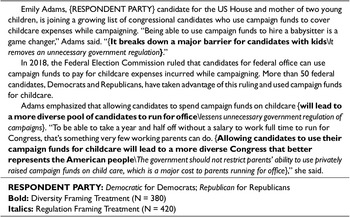
Two frames feature quotes from the candidate herself and present the use of campaign funds for childcare as a positive development. One condition emphasizes the diversifying effect of allowing candidates to use campaign funds for childcare: “To be able to take a year and half off without a salary to work full time to run for Congress, that’s something very few working parents can do. Allowing candidates to use their campaign funds for childcare will lead to a more diverse Congress that better represents the American people.” The second condition includes the same opening sentence but uses anti-regulation framing for the policy: “To be able to take a year and half off without a salary to work full time to run for Congress, that’s something very few working parents can do. The government should not restrict parents’ ability to use privately raised campaign funds on child care, which is a major cost to parents running for office.” Overall, the two positive frames for candidates using campaign funds for childcare highlight different aspects of the policy. The diversity frame emphasizes a potential consequence of the policy — a more diverse Congress — whereas the anti-regulation frame emphasizes candidate autonomy over private campaign funds. Table 1 displays the two positive treatment conditions.Footnote 12
Experimental Vignette Language for Positive Frame Treatments

Table 1. Long description
The table contains a single large cell containing a narrative text block followed by a legend.
Narrative Text:
Emily Adams, {RESPONDENT PARTY} candidate for the U S House and mother of two young children, is joining a growing list of congressional candidates who use campaign funds to cover childcare expenses while campaigning. Adams states that using campaign funds for a babysitter is a game changer. The text then offers two framed options: ‘It breaks down a major barrier for candidates with kids’ or ‘It removes an unnecessary government regulation’.
The text continues by noting that in 2018, the Federal Election Commission ruled that candidates can use funds for childcare, a ruling used by over 50 Democrats and Republicans.
Adams emphasizes that this policy will either ‘lead to a more diverse pool of candidates to run for office’ or ‘lessens unnecessary government regulation of campaigns’. She concludes that the policy will either ‘lead to a more diverse Congress that better represents the American people’ or that ‘The government should not restrict parents’ ability to use privately raised campaign funds on child care’.
Legend at the bottom:
1. RESPONDENT PARTY: Democratic for Democrats; Republican for Republicans.
2. Bold text indicates the Diversity Framing Treatment with a sample size N = 380.
3. Italics indicate the Regulation Framing Treatment with a sample size N = 420.
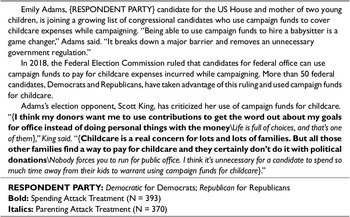
We also develop two negative frames, where the candidate is attacked by a fictional electoral opponent for using campaign funds for childcare. The first attack frame characterizes childcare as an improper use of campaign funds: “‘I think my donors want me to use contributions to get the word out about my goals for office instead of doing personal things with the money,’ King said. ‘Childcare is a real concern for lots and lots of families. But all those other families find a way to pay for childcare and they certainly don’t do it with political donations.’” The second attack frame focuses on the candidate’s parenting ability: “‘Life is full of choices, and that’s one of them,’ King said. ‘Nobody forces you to run for public office. I think it’s unnecessary for a candidate to spend so much time away from their kids to warrant using campaign funds for childcare.’” We developed the four framing conditions based on actual news stories and press releases about candidates using campaign funds for childcare, ensuring the experimental vignette language is ecologically valid. Table 2 displays the attack treatment conditions. Finally, we include a control condition, wherein the news story announces an upcoming town hall event that the candidate is hosting.
Experimental Vignette Language for Attack Frame Treatments

Table 2. Long description
The table contains a narrative about Emily Adams, a candidate for the U S House, who uses campaign funds for childcare. The text is divided into three sections.
1. Introduction: Describes Adams as a mother of two using funds for childcare following a 2018 F E C ruling, noting that over 50 candidates from both parties have done the same.
2. Spending Attack Treatment: Scott King criticizes the use of funds, stating donors want contributions used to get the word out about goals rather than for personal things. He notes that while childcare is a concern, other families find ways to pay for it without political donations.
3. Parenting Attack Treatment: Scott King states that life is full of choices and nobody forces a person to run for office. He claims it is unnecessary for a candidate to spend so much time away from their children to warrant using campaign funds for childcare.
A legend at the bottom specifies that Respondent Party is toggled between Democratic and Republican, bold text indicates the Spending Attack Treatment (N equals 393), and italicized text indicates the Parenting Attack Treatment (N equals 370).
After reading the experimental vignette, respondents were asked to evaluate the candidate. This evaluation includes a feeling thermometer (0–100), a question on how likely the respondent would be to vote for the hypothetical candidate (seven-point Likert scale), and a question on how likely they would be to donate to the hypothetical candidate’s campaign (seven-point Likert scale). Additionally, respondents were asked to rate their level of support for the policy of allowing candidates to use campaign funds for childcare (seven-point Likert scale).
Our reasoning for holding gender constant in the experiment is due to sample size constraints and our conception of campaign funds for childcare as a policy to mitigate the gender representation gap. Men have always been permitted to run for office and do so at greater rates than women. Conversely, women give the costs associated with running for office greater consideration than men (Fulton et al. Reference Fulton, Maestas, Maisel and Stone2006). Since managing childcare may be one of these costs, mitigating the cost of childcare would likely differentially increase the political participation of mothers. Furthermore, since political gender socialization contributes to the gender gap in political ambition (Bos et al. Reference Bos, Greenlee, Holman, Oxley and Lay2022), any change that chips away at these long-held views and practices would likely increase the number of women running for office. We believe the policy under consideration falls into this category. Therefore, rather than randomize gender, we prioritize exploring how the public responds to mothers using campaign funds for childcare.
Results
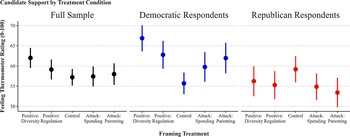
Hypotheses 1 and 2 make predictions on how different policy frames impact public evaluation of mothers using campaign funds for childcare. We expect the diversity frame leads to especially positive evaluations among Democratic respondents (H1A); the anti-regulation frame leads to especially positive evaluations among Republican respondents (H1B); and the attack frames fail to meaningfully decrease candidate evaluations (H2). Figure 1 offers an initial look at these framing effects by plotting mean feeling thermometer ratings for the fictional women candidate across the five treatment conditions. The diversity frame appears to generally increase average support for the candidate relative to the control condition. The mean thermometer rating for the diversity treatment condition (62.02) is substantially greater than the mean thermometer rating in the control condition (57.21) and reaches statistical significance (p-value < 0.01). Conversely, the regulation frame (59.13) and the two attack frames (spending: 57.43; parenting: 57.99) do not substantially impact average feeling thermometer ratings relative to the control condition.Footnote 13 These initial results indicate a possible upside and little downside for parents using campaign funds for childcare.
Feeling thermometer ratings by treatment condition.

Figure 1. Long description
The three panels share a common Y-axis labeled Feeling Thermometer Rating 0-100, ranging from 50 to 70. The X-axis for all panels lists five Framing Treatments: Positive: Diversity, Positive: Regulation, Control, Attack: Spending, and Attack: Parenting.
* Left Panel (Full Sample, black dots): Ratings start at approximately 62 for Positive: Diversity and decrease to around 57 for Control, remaining relatively flat for the attack conditions.
* Middle Panel (Democratic Respondents, blue dots): Ratings are highest for Positive: Diversity at approximately 67 and Positive: Regulation at 63. The rating drops significantly to 56 for Control before rising again to 60 for Attack: Spending and 62 for Attack: Parenting.
* Right Panel (Republican Respondents, red dots): Ratings are lower overall compared to Democrats. The highest rating is for the Control condition at approximately 59. Positive treatments range between 55 and 56, while Attack: Parenting shows the lowest support at approximately 53.
Each data point includes vertical error bars representing confidence intervals.
Subsetting the data by respondent partisanship yields additional insights into the effect of the treatment conditions on candidate support, as Democrats and Republicans appear to differ in reaction to the treatments. Figure 1 also plots mean feeling thermometer ratings for the fictional candidate across the five treatment conditions for Republicans and Democrats in the sample. Both of the positive frames increase support for the candidate among Democrats. The diversity frame leads to an 11.19 increase in mean feeling thermometer ratings relative to the control (p-value < 0.01), and the regulation condition leads to a 7.09 increase in mean feeling thermometer ratings (p-value < 0.01).Footnote 14 Even the attack frames seemingly increase support for the candidate among Democratic respondents. The 4.07 mean feeling thermometer rating difference between the spending attack and the control condition does not quite reach statistical significance (p-value = 0.08), but the parenting attack leads to a statistically significant 6.26 increase in mean feeling thermometer ratings of the candidate relative to the control condition (p-value < 0.01). As such, we report that candidates with Democratic-leaning constituencies stand to benefit from using campaign funds for childcare, even if they are attacked for the practice by electoral opponents.
A different trend emerges among Republican respondents. There is no distinguishable difference between either the diversity or the regulation frame and the control condition, suggesting there is no benefit or punishment generated from a positive frame around the candidate using campaign funds for childcare. The spending attack treatment leads to a 4.35 decrease in mean feeling thermometer rating, though this difference narrowly misses statistical significance (p-value = 0.07), while the parenting attack leads to a statistically significant 5.79 decrease in mean feeling thermometer rating (p-value = 0.02). It appears attacks on candidates for using campaign funds for childcare can potentially harm candidates with Republican leaning constituencies.
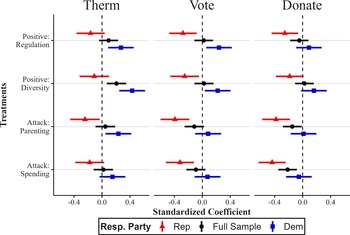
We further flesh out the treatment effects on candidate support by rescaling the three measures of candidate support — feeling thermometer, voting likelihood, and donation likelihood — to range from zero to one and estimating treatment effects for both the full sample and partisan subsets. We use OLS for these estimations, and Figure 2 plots the regression coefficients for each dependent variable and partisan subset.Footnote 15 Findings vary across the dependent variables, but the general story remains the same across these analyses. For Democrats, the positive framing treatments generally result in more positive candidate evaluations relative to the control condition, and the candidate attack treatments do not lead to a decrease in candidate support. Conversely, the treatment effects for every frame are negative for Republican respondents.Footnote 16 These partisan differences tend to balance out and result in neither positive nor negative effects of the treatment conditions on overall candidate support. Among the full sample, the only statistically significant effect for increasing candidate support is the diversity frame on feeling thermometer ratings, and the only statistically significant effects for decreasing candidate support are the attack treatments on donation likelihood.
Treatment effect coefficients plots.

Figure 2. Long description
A multi-panel coefficient plot with three vertical columns titled Therm, Vote, and Donate. The y-axis lists four Treatments: Positive: Regulation, Positive: Diversity, Attack: Parenting, and Attack: Spending. The x-axis represents the Standardized Coefficient ranging from -0.4 to 0.4, with a dashed vertical line at 0.0 indicating no effect.
Each treatment row contains three data points with horizontal error bars representing confidence intervals:
- Red triangle: Rep (Republicans)
- Black circle: Full Sample
- Blue square: Dem (Democrats)
Across all three panels (Therm, Vote, Donate):
- Positive: Regulation and Positive: Diversity treatments show a consistent pattern where Dem (blue) has a positive coefficient (right of zero), Rep (red) has a negative coefficient (left of zero), and the Full Sample (black) is near zero.
- Attack: Parenting and Attack: Spending treatments show a negative shift for all groups, with Rep (red) showing the strongest negative coefficients (approximately -0.3 to -0.4), followed by the Full Sample, while Dem (blue) remains closest to the zero line but generally stays on the negative side or slightly positive in the Donate panel for Parenting.
A legend at the bottom identifies the symbols as Resp. Party: Red triangle for Rep, Black circle for Full Sample, and Blue square for Dem.
We find little evidence for Hypotheses 1A or 1B — that Democrats will prefer the diversity frame (1A) and Republicans will prefer the deregulation frame (1B). After subsetting the data by respondent partisanship, we employ three differences of means tests, one for each candidate support measure, on each partisan subset to gauge whether the diversity frame and regulation frame lead to different levels of candidate support. Essentially, we test whether the diversity frame and the deregulation frame led to different levels of candidate support among Democratic respondents, and then we repeat these tests for Republican respondents. In line with the effects displayed in Figure 2, we do not observe any distinguishable differences between the two positive frames across all six tests.Footnote 17 Thus, we report no support for our first set of hypotheses. The two positive frames around a candidate using campaign funds for childcare do not meaningfully differ in their effect on candidate support for either Democrats or Republicans in our sample.
Our second hypothesis stipulates that attacks do not lessen support for candidates who use campaign funds for childcare. Figures 1 and 2 make it clear that Democrats impose no penalty on candidates who are attacked for their use of campaign funds for childcare. The candidate actually received higher feeling thermometer ratings from Democrats when attacked with the parenting critique than the control condition (p-value < 0.01). However, Republicans generally impose a penalty on the candidate being attacked for using campaign funds for childcare across our candidate support measures. For the donation likelihood measure of candidate support, the Republican penalty is strong enough to result in a statistically significant negative effect in the full sample for both attack frames (p-value < 0.05). Therefore, we observe limited and conditional support for our second hypothesis.
This partisan difference comports with existing research on the relationship between political parties and gender representation in Congress. The share of Democratic women in Congress has steadily grown in recent decades, while the share of Republican women in Congress has lagged behind. Particularly in recent years, Republican women face a tougher electoral environment than Democratic women (Thomsen Reference Thomsen2019). Ideological fit offers one explanation for this trend; in a period of asymmetric polarization, Republican women, who historically have been more ideological moderate than Republican men, do not fit in the current ideological landscape (Thomsen Reference Thomsen2015; Reference Thomsen2020). Additionally, Democratic donors are more supportive of women candidates than Republican donors (Thomsen and Swers Reference Thomsen and Swers2017). Our findings display another difference between the two parties on gender and elections: Democrats tend to be more positive than Republicans in their evaluation of mothers using campaign funds for childcare.
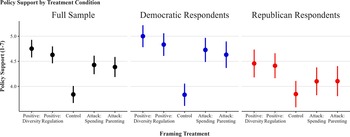
In addition to candidate support, we are interested in how the experimental frames influence support for the policy itself. Our third hypothesis predicts that reading about candidates using campaign funds for childcare increases support for the policy, even when the candidate is attacked for it. Figure 3 plots our measure of policy support (1–7) across the five treatment conditions. Both the positive frames and the attack frames seemingly increase respondent support for allowing candidates to use campaign funds for childcare. The diversity and regulation frames lead to a 0.91-point and 0.79-point increase in mean support for the policy, respectively. The spending and parenting attacks lead to smaller mean increases in policy support — 0.59 and 0.55 points, respectively — but all four treatment effects reach statistical significance (p-value < 0.01).Footnote 18 Therefore, we report robust support for our third hypothesis.
Policy support by treatment condition.

Figure 3. Long description
The figure consists of three side-by-side panels. The Y-axis is labeled Policy Support 1-7 with increments of 0.5. The X-axis is labeled Framing Treatment and includes five categories: Positive: Diversity, Positive: Regulation, Control, Attack: Spending, and Attack: Parenting. Each data point is represented by a dot with vertical error bars.
Panel 1: Full Sample (black dots). Support is highest for Positive: Diversity at approximately 4.75 and Positive: Regulation at 4.6. Support drops significantly for the Control at 3.8. Attack: Spending and Attack: Parenting show moderate support at 4.4 and 4.35 respectively.
Panel 2: Democratic Respondents (blue dots). Support is highest for Positive: Diversity at 5.0 and Positive: Regulation at 4.8. The Control is the lowest at 3.8. Attack: Spending is at 4.7 and Attack: Parenting is at 4.6.
Panel 3: Republican Respondents (red dots). Support is highest for Positive: Diversity at 4.45 and Positive: Regulation at 4.4. The Control is the lowest at 3.85. Attack: Spending and Attack: Parenting both show support at approximately 4.1.
When subsetting the policy support analysis by respondent partisanship, we again observe a difference in how Democrats and Republicans react to the experimental treatments. Figure 3 also plots mean policy support across the five treatment conditions for both Democratic and Republican respondents. For Democratic respondents, all four treatment frames lead to an increase in policy support relative to the control condition (p-value < 0.01). For Republican respondents, the two positive treatments lead to increased support for the policy (p-value < 0.01), while the two attacks neither increased nor decreased support for the policy.Footnote 19
Conclusion
Overall, we find that frames surrounding the use of campaign funds for childcare influence public opinion in meaningful ways. When considering candidate support, Democrats increased their support for a candidate using campaign funds for childcare when told this practice could help to increase diversity in government and when this policy was presented as deregulation. Additionally, Democrats did not decrease their support for this hypothetical candidate when the candidate was attacked for using campaign funds for childcare. Republican candidates did not benefit from using campaign funds for childcare and received less support when attacked for this practice. When considering support for the policy of permitting candidates to use campaign funds for childcare, the results were universally positive. Reading about candidates using campaign funds for childcare increases support for the policy, even when the candidate is attacked for it. Collectively, these findings lend evidence to our claim that the policy of allowing mothers to use campaign funds to pay for childcare while campaigning has the potential to reduce the gender gap in political representation.
These findings carry both practical and scholarly implications. For practitioners, our results suggest that campaign funds for childcare offer a viable tool for parents considering a run for office. The limited downside risk and meaningful upside potential we uncover should allay some candidates’ concerns about the public’s reaction to their use of campaign funds for childcare, particularly for candidates in heavily Democratic districts. For advocates of the campaign funds for childcare reform, such as Vote Mama Foundation, our results suggest a continuation of their strategy to paint the reform as a bipartisan solution to a bipartisan problem. While there is underlying bipartisan support for the policy idea, additional work is needed to convince Republicans voters of the policy in practice. We find no evidence that diversity or anti-regulation framing works particularly well for persuading Republicans, but robust support for the general policy suggests framing appeals around the issue of parenthood.
This study contributes to a growing literature on the politics of parenthood. Existing studies show that, at a high level, parenthood represents a critical identity and positive political force in politics (Greenlee Reference Greenlee2014; Burge, Hodges, and Rinaldi Reference Burge, Hodges and Rinaldi2020; Sweet-Cushman and Bauer Reference Sweet-Cushman and Bauer2024). However, at the practical level, these dynamics can lead to harmful expectations on women running for office (Bell and Kaufmann Reference Bell and Kaufmann2015; Thomas and Bittner Reference Thomas, Bittner, Thomas and Bittner2017; Teele, Kalla, and Rosenbluth Reference Teele, Kalla and Rosenbluth2018). Our findings on broad support for the policy of campaign funds for childcare, but conditional support for candidates who use the policy, reveal another venue through which parenthood plays a meaningful and complicated role in campaigns and elections. Further, the partisan difference we uncover advances existing research on why the share of Republican women in Congress has lagged behind that of Democratic women (Thomsen and Swers Reference Thomsen and Swers2017; Thomsen Reference Thomsen2019; Reference Thomsen2020). We offer an additional explanation for this dynamic — Democrats tend to be more positive than Republicans in their evaluation of mothers using campaign funds for childcare.
More broadly, this study sheds light on an emerging movement in American politics to make it more possible for parents to hold office. We only consider one reform, but our findings plausibly relate to additional policy questions. For example, Republican Congresswoman Anna Paulina Luna recently led what became a widely reported effort to allow new mothers, and later new parents, to proxy vote in the House of Representatives. While her legislative efforts failed under a staunchly opposed Republican Majority led by Speaker Johnson, she was ultimately successful in reaching a compromise with leadership to revive a past procedural rule of vote pairing — allowing a representative to find a colleague voting in the opposite position on an issue and agree to have their votes canceled out. Representative Luna argues, “If we truly want a pro-family Congress, these are the changes that need to happen” (Askarinam Reference Askarinam2025). The coverage of how this compromise played out speaks to the importance of our research in contributing to the growing body of research on addressing the barriers parents, particularly mothers, face in politics.
The policy of allowing candidates to use campaign funds for childcare is becoming common in the US, and one of our core contributions is being the first exploration, at least to our knowledge, of public opinion on candidates who make use of this policy. The goal of our experimental design is to provide an initial look at public opinion on the use of campaign funds for childcare, but the limitations of this design provide multiple pathways for further research. First, we explore general frames around the policy rather than specific words, thereby allowing for a wider scope of exploration but limiting our ability to identify precise causal mechanisms. One avenue for future experimental research is using more nuanced variation to clarify how the public responds to candidates using campaign funds for childcare. For instance, our design holds constant the gender of the fictional candidate. This stems from the motivations behind this research; parenthood creates a more severe barrier to running for public office for women as compared to men, and campaign funds for childcare have the potential to lessen unequal gender representation. We also hold race constant in this experiment due to sample size constraints. Further research should explore how gender and race impact public response to the use of campaign funds for childcare.
Second, questions remain on the extent to which our findings generalize to various electoral environments. Our design focuses on a fictional candidate from the respondent’s party in a primary election, without details on the candidate’s experience or policy goals. We argue this is an important starting point, as primary elections often feature lesser-known candidates and involve a within-party battle for donor support. In fact, the first congressional candidate to use campaign funds for childcare was attacked for the practice in a Democratic primary election (Kurtzleben Reference Kurtzleben2018). Our experiment is well suited for exploring this type of electoral environment, where candidates are relatively unknown and campaigns are focused more on personal distinctions rather than polarized partisan battles. However, future research should explore how various narratives around the use of campaign funds for childcare play out in a general election environment, where the use of campaign funds may play more of a backseat to partisanship and national policy debates. Further research might also explore how our findings generalize to other countries. Parenthood is a universal issue, suggesting our findings might generalize across borders. However, the policy of campaign funds for childcare might receive less public support in countries with more general programs for supporting parents and children than those found in the US. Alternatively, countries that recognize childcare as a societal issue might be more supportive of providing childcare solutions for potential politicians.
Relatedly, there is the potential that voters do not know much about the policy under examination and are unaware of which candidates are using this policy in a real election. We believe our findings provide insights for real-world elections for a few reasons. As evident in the quotes and anecdotes referenced throughout the paper, the use of campaign funds for childcare expenses has received substantial media attention in campaigns. To the extent voters are finding out about this policy via individual campaign developments and reporting rather than extensive knowledge of campaign finance rules, we argue our experimental design offers a valid portrayal of how Americans learn about the policy of campaign funds for childcare. Additionally, as more candidates make use of this policy, it is more likely to become a widely discussed issue. Just as legislators must consider the potential reaction among constituents should a vote on legislation gain salience (Arnold Reference Arnold1990), candidates must consider voters’ reaction to their use of campaign funds should it become a flashpoint issue in the campaign. Research can further explore these questions by tracking news on campaign funds for childcare and conducting candidate-level research on the decision calculus to run for office and use campaign funds for childcare.
Finally, we propose candidate ambition as a mechanism for how campaign funds for childcare can eventually bridge the gender representation gap in American politics. Alleviating the burden of childcare during campaigns should allow more parents, and particularly mothers, to see a viable pathway to running for office. The largely positive public response we uncover to the use of campaign funds for childcare shows that the policy will likely continue expanding in legality and usage across American politics, opening the door for meaningful shrinkage of the gender ambition gap. However, further research is needed to directly evaluate whether, and how, the policy impacts the ambition of potential candidates for office.
Supplementary material
The supplementary material for this article can be found at http://doi.org/10.1017/S1743923X25100482.
Acknowledgments
This research was made possible by a Carrie Chapman Catt Prize for Research on Women and Politics from the Carrie Chapman Catt Center for Women and Politics at Iowa State University. We thank Rachel Blum, Michael Crespin, Charles Finocchiaro, Nathan Barron, and the anonymous reviewers for their helpful suggestions.


 Open access

