




Introduction
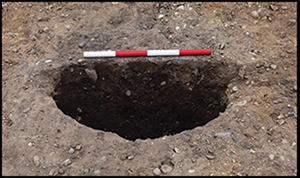
Middle to Late Bronze Age (c. 1500–850 BC) settlement activity was excavated by Oxford Archaeology at St Faith's Road, Old Catton, to the north of Norwich, in 2019. Comparable to contemporaneous sites across eastern England, the remains included a Middle Bronze Age ditched enclosure. This was subsequently used as a discrete occupation area in the Late Bronze Age, which comprised post-built structures and groups of pits (Figure 1). An oval structure in the southern half of the settlement (Structure 5), measuring 5.7 × 3.2m, was formed of seven postholes and a small, sub-circular pit (715). This pit measured 0.72m wide and 0.38m deep (Figure 1: Section 1), and contained a single, charcoal-rich fill of dark grey silty sand (716) that yielded six sherds (67g) of Late Bronze Age pottery (of the Post Deverel-Rimbury (PDR) Plainware tradition), burnt flint (195g) and burnt stone (177g). Due to the midden-like appearance of the fill, the entire volume of the deposit (115 litres) was processed by tank flotation for charred plant remains. Analysis revealed a diverse assemblage of species, comprising flax (Linum usitatissimum), 12 species of common weeds, and cereal remains identified as emmer wheat (Triticum dicoccum), barley (Hordeum vulgare) and, most significantly, broomcorn millet (Panicum miliaceum). Identification of the millet (Figure 2) was based on morphology, the grains of which are described as typically having a “pointed distal end and relatively blunt proximal end” with a “short and wide” embryo (Nesbitt & Summers Reference Nesbitt and Summers1988: 85). Approximately 200 millet grains were present within the pit, each measuring between 1–2mm in size, which is so small that, theoretically, they could have been intrusive. Full details of the charred plant assemblage are available in the unpublished excavation report (Kwiatkowska Reference Kwiatkowska2021), which is freely available to download from Oxford Archaeology's online library at: https://library.oxfordarchaeology.com/6164.
Site plan, showing Middle–Late Bronze Age features and the location of pit 715 within Structure 5 (figure by D. Brown, Oxford Archaeology).

Charred broomcorn millet (Panicum miliaceum) grains from pit 715 (photograph courtesy of C. Kneale, University of Cambridge).

Radiocarbon dates
Due to the unusual nature of these charred plant remains, emmer and flax seeds were sent for radiocarbon analysis and returned dates of 2751±25 BP (SUERC-93503: 980–820 cal BC at 95.4% confidence) and 2721±25 BP (BRAMS-4061: 920–810 cal BC at 95.4% confidence), respectively (Table 1). Historically, the small size of broomcorn millet grains has been problematic for radiocarbon dating, although recent advances have allowed much smaller samples to be reliably dated. After initial attempts to radiocarbon date the broomcorn millet were unsuccessful, a sample was sent to Poznań Radiocarbon Laboratory, which returned a date of 2705±30 BP (Poz-132326: 910–800 cal BC at 95.4% confidence), corroborating those for the flax and emmer. Combined, the results provide a set of tightly dated radiocarbon determinations (Figure 3) that complement the date of the Late Bronze Age pottery, and, significantly, presents a much earlier date for the presence of broomcorn millet in Britain.
Probability distributions for radiocarbon dates at 95% probability. Dates calibrated using OxCal v4.4.4 (Bronk Ramsey Reference Bronk Ramsey2009, Reference Bronk Ramsey2021) and the IntCal20 atmospheric calibration curve (Reimer et al. Reference Reimer2020) (figure by D. Brown, Oxford Archaeology).

Radiocarbon dates from pit 715. Dates calibrated using OxCal v4.4.4 (Bronk Ramsey Reference Bronk Ramsey2009) and the IntCal20 atmospheric calibration curve (Reimer et al. Reference Reimer2020), with date ranges rounded outwards to decadal endpoints.

The spread and use of broomcorn millet
Broomcorn millet is a fast-growing, drought-tolerant cereal crop that can be cultivated on poor soils and at a range of altitudes. It was first domesticated in China in the early to mid-sixth millennium BC, spreading westwards into Central Asia by the mid to late third millennium BC. It is currently thought to have arrived in Europe by the mid second millennium BC (Motuzaite-Matuzeviciute et al. Reference Motuzaite-Matuzeviciute2013; Miller et al. Reference Miller, Spengler and Frachetti2016; Filipović et al. Reference Filipović2018, Reference Filipović2020). Research into the introduction and spread of broomcorn millet in prehistoric Europe has advanced significantly in the last two decades. Against the backdrop of a growing archaeobotanical dataset, new radiocarbon dating programmes (Motuzaite-Matuzeviciute et al. Reference Motuzaite-Matuzeviciute2013; Miller et al. Reference Miller, Spengler and Frachetti2016; Kučera et al. Reference Kučera2019; Filipović et al. Reference Filipović2018, Reference Filipović2020), together with isotopic and biomolecular studies (Heron et al. Reference Heron2016), have recast our understanding of the chronology, spread and importance of millet in the cropping regimes and diets of prehistoric European communities. The weight of evidence no longer supports an early introduction in the Neolithic, but instead points to its adoption and widespread dissemination throughout mainland Europe from the mid second millennium BC (Stika & Heiss Reference Stika, Heiss, Fokkens and Harding2013), before spreading north-west to reach northern Germany and northern France by the mid twelfth century BC (Carozza et al. Reference Carozza, Marcigny and Talon2017: 310; Filipović et al. Reference Filipović2020: 5).
Discussion
Despite the strong evidence that broomcorn millet was an important, rapidly adopted cereal crop on sites across the Channel by the Late Bronze Age, it has not previously been recorded within prehistoric contexts in Britain and occurs only rarely in archaeobotanical assemblages from Romano-British military sites or urban centres, where grains have been interpreted as food imports (Van der Veen Reference Van Der Veen, Millett, Revell and Moore2016: 821). The Old Catton finds are therefore significant in backdating the appearance of broomcorn millet in Britain and provide conclusive evidence of its presence in the Late Bronze Age that is broadly contemporaneous with its widespread adoption in mainland northern Europe. Questions remain, however, as to the mechanisms by which the cereals arrived and whether they were ever cultivated on Norfolk's soils at this time. Given cross-Channel trade in bronze metalwork, and wider evidence for cultural contact and exchange between communities on either side of the Channel (Cunliffe Reference Cunliffe2013: 276–82), as well as large-scale population movement (Patterson et al. Reference Patterson2022), it is not inconceivable that ‘exotic’ or ‘novel’ agricultural products, such as broomcorn millet, arrived via these networks or with migrant peoples. This is difficult to validate, however, when there is a lack of other imported items at Old Catton and while evidence from local contemporaneous settlement, which is admittedly limited, suggests a similar picture. One possibility is that broomcorn millet arrived as an experimental crop; colder temperatures and wetter conditions between the late second and early first millennium BC would have resulted in a shorter growing season (Roberts Reference Roberts, Fokkens and Harding2013: 542), which may have led to quick-growing crops, such as flax and millet, being trialled. Unfortunately, the restricted range of associated plant remains at Old Catton cannot provide further evidence about local cultivation or soils, although the scarcity of chaff suggests that the cereals had been processed.
What is most striking is that, despite the intrinsic virtues of millet—a resilient, fast-growing, nutrient-rich and drought-tolerant crop (Filipović et al. Reference Filipović2020: 2)—it was not adopted into mainstream cropping regimes in prehistoric Britain. Its presence at Old Catton suggests that access to the cereal was not a determining factor in this choice, and rather that its cultivation was avoided or perhaps openly resisted. More importantly, it hints at deeper cultural differences in the foodways and diets of communities in Britain during prehistory, marking the island as one of the geographical limits to broomcorn millet ‘globalisation’ in the Old World (Jones et al. Reference Jones2011).
Acknowledgements
The authors would like to thank RPS Consulting for commissioning the project. Thanks are also extended to the excavation team, project specialists and support staff for their contributions. The project was monitored by John Percival of Norfolk County Council Historic Environment Service.
Funding statement
Excavation was funded by Taylor Wimpey East Anglia.


 Open access

