



1. Introduction
In this article, we address locality conditions on negative concord in Russian. Russian ni-pronouns, which demonstrate negative concord, are licensed in semantically negative clauses and require a clausemate preverbal clitic particle ne ‘not’ which introduces sentential negation (Brown Reference Brown1999, Paducheva Reference Paducheva2011). The clausemate constraint on ni-pronoun licensing is lifted in infinitival complements (Gerasimova Reference Gerasimova, Lyutikova, Zimmerling and Konoshenko2015, Kornakova et al. Reference Kornakova, Ekaterina and Grashchenkov2016), where ni-pronouns can be licensed from the matrix clause.Footnote 1
Existing theories of negative concord differ as to the exact mechanisms underlying licensing of negative elements, and therefore imply differing locality constraints, as well as options to overcome them. In this article we consider three approaches. First, the binding approach (Progovac Reference Progovac1994), which identifies the relation between the negative pronoun and sentential negation with the relation of the anaphor and its binder. Next, the operator-movement approach (Haegeman Reference Haegeman1995, Haegeman and Zanuttini Reference Haegeman and Zanuttini1991), which subsumes the relation between the negative pronoun and sentential negation under the more general spec-head relation between an operator and a head providing it with its scope position. And lastly, the agreement approach (Zeijlstra Reference Zeijlstra2004), which equates the relation between the negative pronoun and sentential negation with (reverse) agreement. While making similar predictions for clausemate licensing, these approaches differ in explaining long-distance licensing: namely, taking different positions as to the dependence of long-distance licensing of an element on its raising to the more local vicinity of the licensor. In this article, we investigate long-distance licensing of ni-pronouns in subject- and object-control infinitives, which have been claimed in the previous literature to be structurally different, and confront theoretical predictions with empirical generalizations. The latter come from the experimental study of acceptability judgments. Exploring various linear positions available for ni-pronouns in matrix and embedded clauses, we show that the licensing of ni-pronouns by matrix negation cannot be explained within the models involving clause-level locality by assuming overt or covert movement of ni-pronouns to the matrix clause, and that the licensing domain of sentential negation should be extended to include infinitival complements.
The article is organized as follows. In section 2 we lay the groundwork for the current study: we first present generalizations of the distribution of ni-pronouns and show that they exhibit strict negative concord; then, we discuss infinitival complements involving subject and object control and their transparency / opacity to syntactic processes. Section 3 contains an overview of the three approaches to negative concord, including a summary of the predictions for Russian. In section 4, the experimental study is described. Section 5 presents the discussion of the results and their implications for the theory of licensing.
2. Setting the scene
In this section we discuss the distribution of Russian ni-pronouns and present their licensing conditions. Then we turn to Russian infinitival complements and address the differences in the syntactic structure of subject and object control infinitives.
2.1. Ni-pronouns
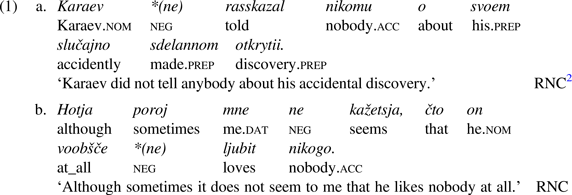
Russian possesses a series of “negative” ni-pronouns (nikto ‘nobody’, ničto ‘nothing’, nigde ‘nowhere’, etc.), which are licensed by the clausemate sentential negation expressed by the preverbal clitic particle ne ‘not’. This is demonstrated in examples (1a–b). Example (1a) shows that omission of the negative particle yields ungrammaticality; while this omission is similarly ungrammatical in the finite complement clause in (1b), despite the presence of the negative particle in the matrix clause.
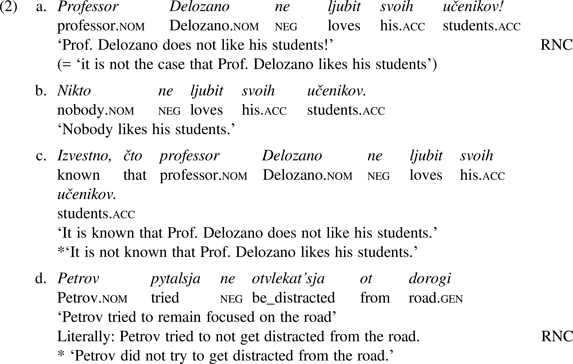
While ni-pronouns require the negative particle, the negative particle is able to negate the clause it appears in on its own, as in (2a).Footnote 3 The scope of sentential negation indicated by the preverbal negative particle includes the subject (2b), but cannot be extended to the superordinate clause (2c). This last is true for infinitival clauses as well: (2d) cannot be interpreted as involving the negative operator in the matrix clause.
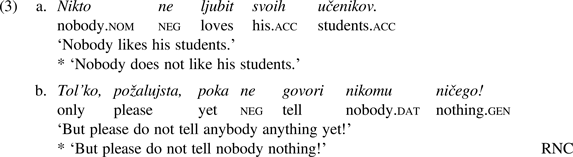
Importantly, clauses containing ni-pronouns are never interpreted as involving double negation, neither for single (3a) nor for multiple (3b) ni-pronouns.
Ni-pronouns can generally appear in one of two positions in the clause: the position where the corresponding non-negative argument / adjunct belongs (base position, as in (1)), or the position in front of the (preverbal) negative particle, as in (4). These positions are difficult to tell apart for subject ni-pronouns (2b), since subjects normally precede the verb.
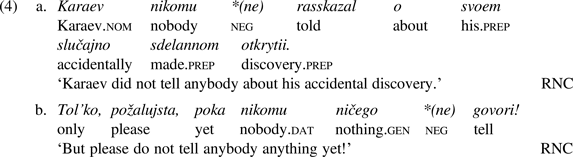
We see in (4) that movement of ni-pronouns to the left of the verb and of negation affect neither the negative particle requirement nor the single negation interpretation. In other words, whatever the position of the ni-pronoun in the clause (which can be altered, for instance by scrambling), these generalizations still hold.
Russian ni-pronouns are the only items that appear solely under negation and participate in negative concord, that is, they demonstrate all the properties of n-words (Laka Reference Laka1990), which appear in negative concord structures and can also be used as fragment answers with negative meaning. We conclude that Russian belongs to the class of strict negative concord languages, in which negative concord requires the presence of the negative marker (Giannakidou Reference Giannakidou1998, Reference Giannakidou, Déprez and Espinal2020). In what follows, we will dub phrasal elements undergoing negative concord ‘negative concord items’ (NCIs), following Giannakidou's (Reference Giannakidou, Déprez and Espinal2020) notation.
The two other classes of polarity-sensitive items in Russian, non-specific indefinite -nibud' pronouns (NSI) and negatively polarized -libo pronouns (NPP), show different distribution with respect to ni-pronouns (Paducheva Reference Paducheva1985, Reference Paducheva2015; Haspelmath Reference Haspelmath1997). -nibud' NSIs are licensed by non-veridical operators; importantly, -nibud' pronouns are not licensed by clausemate sentential negation and have to be replaced by ni-pronouns in negative concord contexts. Unlike -nibud' NSIs, the licensing conditions for -libo pronouns do not include positive contexts and irrealis non-specific contexts; however, these pronouns are allowed in the scope of sentential negation, both clausemate and long-distance. The difference between -libo and ni-pronouns is that -libo NPPs, just as -nibud' NSIs and unlike ni-pronouns, are found in conditionals, interrogatives and under universal quantification.
2.2. Infinitival complements
Russian possesses a number of infinitival constructions which differ as to their distribution and internal structure. Among clausal complements, we identify subject- and object-control infinitives.Footnote 4
Subject- and object-control infinitives differ as to a number of properties. The first property is case marking of floating quantifiers, which has been investigated in depth by Babby (Reference Babby, Bošković, Franks and Snyder1998).
Floating quantifiers – a group of adjectival elements including sam ‘oneself’, ves’ ‘all’ and odin ‘alone’ – agree with their controller in gender and number and copy its case. In finite clauses, floating quantifiers controlled by the nominative subject thus is assigned the nominative case (5a). Subject-control infinitives exhibit the same pattern (5b). Crucially, in object-control infinitives, floating quantifiers referring to the infinitive's subject are assigned the dative, regardless of availability of a dative antecedent to agree with (5c).Footnote 5 Dative floating quantifiers are also attested in infinitival complements of nouns, in purpose infinitives headed by the complementizer čtoby ‘to, in order to’, and in infinitival clauses with arbitrary PRO.Footnote 6
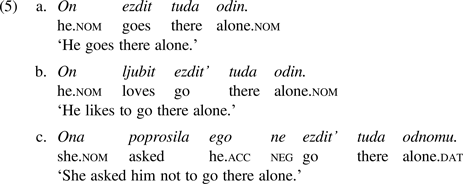
There are several accounts of the pattern (Greenberg and Franks Reference Greenberg and Franks1991, Babby Reference Babby, Bošković, Franks and Snyder1998, Testelets Reference Testelets and Zybatow2001), which differ with respect to the following assumptions: (i) whether dative floating quantifiers copy the default dative case of PRO (Babby Reference Babby, Bošković, Franks and Snyder1998, Testelets Reference Testelets and Zybatow2001) or receive it independently of PRO (Greenberg and Franks Reference Greenberg and Franks1991); (ii) whether the antecedent of the nominative floating quantifier is the matrix subject (Babby Reference Babby, Bošković, Franks and Snyder1998) or the nominative PRO, which copies the matrix subject's case under control (Testelets Reference Testelets and Zybatow2001). Most important, all of the accounts rely on the structural distinctions between subject- and object-control infinitives. Babby (Reference Babby, Bošković, Franks and Snyder1998) argues that subject-control infinitives lack PRO and clausal functional structure; the implied infinitive's subject is identified with the matrix subject via predication.Footnote 7 Object-control infinitives, on the other hand, are full-fledged CPs and contain PRO, which is invariably dative in Russian. Testelets (Reference Testelets and Zybatow2001) opts for a less radical account, where both subject- and object-control infinitives host PRO, but its case properties are different. In subject-control configurations, the case feature on PRO can be identifiedFootnote 8 with the case feature of its controller DP in the matrix clause. When the case feature of the matrix subject gets valued as nominative, this value is simultaneously assigned to PRO. Object-control configurations, on the other hand, are opaque, both for the feature identification and for the subsequent valuation, and the case feature of PRO can only receive the default value. Since syntactic opacity can be due to either domination or c-command intervention, we conclude that object-control infinitives are structurally or featurally more complex than subject-control infinitives.
The second property distinguishing subject- and object-control infinitives concerns adjectival components of the infinitival predicate (Lyutikova Reference Lyutikova2010). In finite clauses, the adjectival predicate can appear in short or long form (6a). Much debate continues to this day surrounding both the derivational and interpretational discrepancies of the two variants, and the source of the instrumental case marking of the long form (see Chvany Reference Chvany1975; Nichols Reference Nichols1981; Babby Reference Babby, Flier and Brecht1985; Franks Reference Franks1995; Bailyn Reference Bailyn and Zhang2001; Reference Bailyn2012; Madariaga Reference Madariaga, Salmons and Dubenion-Smith2007; Pereltsvaig Reference Pereltsvaig2007; Matushansky Reference Matushansky, Marušič and Žaucer2008, Reference Matushansky, Gerhild Zybatow, Dudchuk, Minor and Pshehotskaya2010; Grashchenkov Reference Grashchenkov2018). Analytical passive constructions employ passive participles, which appear in the short form and can be interpreted as either dynamic or stative; the long form supports only the stative interpretation of the passive construction, or signals conversion of the passive participle into an adjective (6b).
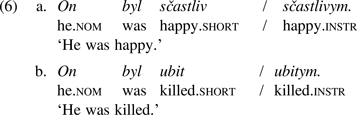
In infinitival clauses, adjectival and passive predicates take different forms in subject- and object-control configurations. In subject-control infinitives, there is a choice between short form and instrumental long form, exactly as in finite clauses (7a–b). In object-control infinitives, the short form is ruled out, and the only option is the instrumental long form (8a–b).
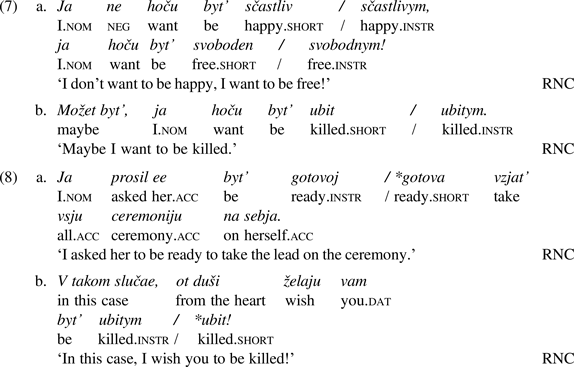
Again, it is evident that availability of the short form depends crucially on the presence of the nominative subject (which is unsurprising, considering that the Modern Russian short form goes back to the Old Russian nominative short form). Therefore, the explanations invoked to account for the nominative case marking of floating quantifiers in subject-control infinitives can be effectively used for predicting short-form distribution. Below we present our analysis of the structural asymmetry between subject- and object-control infinitives, and show how this analysis explains both phenomena.
We propose that subject- and object-control infinitives differ as to the amount of clausal structure projected by them. In line with previous formal analyses (Greenberg and Franks Reference Greenberg and Franks1991, Franks Reference Franks1995, Babby Reference Babby, Bošković, Franks and Snyder1998, Testelets Reference Testelets and Zybatow2001, Landau Reference Landau2004), we assume that object-control infinitives are full-fledged CPs, which contain a subject PRO controlled out of the matrix clause. This hypothesis is not only a natural default assumption regarding the syntactic category of a clause-like constituent (Stowell Reference Stowell1982, Chomsky Reference Chomsky1986), but is also corroborated by a number of syntactic properties that object-control infinitives share with infinitival clauses with overt C / Spec,CP. These include purpose clauses introduced by the complementizer čtoby (9a) and non-finite indirect wh-questions (9b).
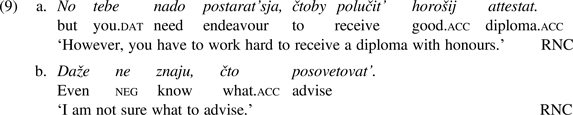
Crucially, all the diagnostics distinguishing between subject- and object-control infinitives produce identical results with infinitival clauses in (9) and object-control infinitives. Thus, floating quantifiers in such clauses are dative (10), and adjectival predicates cannot employ the short form (11).
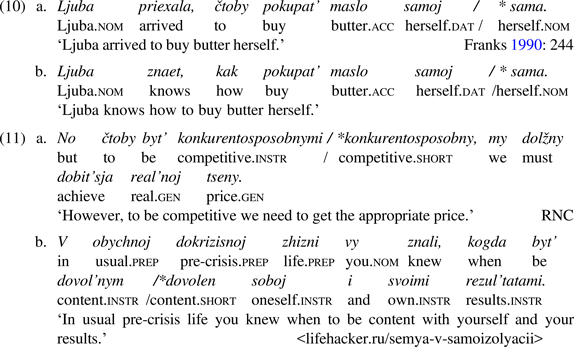
We therefore conclude that object-control infinitives are CPs headed by an empty complementizer which selects for a non-finite TP. A further necessary component of the analysis is the source of the dative case assigned to PRO. Two options are worth discussing: first, that PRO is case-marked by a specific T, defective with respect to tense or ϕ-agreement (Greenberg and Franks Reference Greenberg and Franks1991, Chomsky and Lasnik Reference Chomsky and Lasnik1993, Landau Reference Landau2004), and second, that PRO is case-marked by a specific C, much like the overt infinitival subject is case-marked by the prepositional complementizer for in English (Vergnaud 2007 [Reference Vergnaud, Freidin, Otero and Zubizarreta1977], Chomsky Reference Chomsky1981). Though both accounts can be adapted to account for the Russian data, we argue for the second. The ability to assign case should be considered a property of a lexical item; accordingly, the corresponding case should be available in any configuration where this lexical item appears. The question is, then, whether object control C or non-finite T appears in other configurations and if so, whether they demonstrate their case-assigning properties in those configurations. Object control C can be identified as a specific lexical item independently of its case-assigning properties: it selects for a non-finite TP and introduces the obligatory de se reading (Landau Reference Landau2015). This combination of characteristics is unique for object-control configurations. On the contrary, T in object-control infinitives cannot be reasonably distinguished from T in subject-control infinitives. Therefore, if PRO received dative from T in object-control configurations, we would expect dative be equally available for PRO in subject-control configurations. Yet, subject-control infinitives disallow dative floating quantifiers, see (12).

In light of those considerations, we assume that the object control C assigns dative case to PRO. This hypothesis explains why dative is only attested in subjects of object-control infinitives, but not in subject-control infinitives or other non-finite verbal constituents (gerunds or participles). Thus, our analysis of object-control infinitives is similar to that of Babby (Reference Babby, Bošković, Franks and Snyder1998), Testelets (Reference Testelets and Zybatow2001) or Landau (Reference Landau2004).
As for subject-control infinitives, we propose that they involve a kind of size restructuring in the sense of Wurmbrand (Reference Wurmbrand, Veselovská and Janebová2014). Specifically, we claim that subject-control infinitives are truncated structures lacking the A-bar domain over TP. Accordingly, they are similar to object-control infinitives in that they project the A-domain of the clause, including TP which hosts PRO in its specifier, as well as other functional projections under TP. However, they differ from object-control infinitives in that they do not project a CP layer, meaning A-dependencies may cross the infinitive's boundary.
We believe that size restructuring is a viable (and superior) alternative to Babby's VP analysis of subject-control infinitives for several reasons. Firstly, subject-control infinitives, much like object-control infinitives, exhibit properties associated with the presence of verbal and clausal projections above VP: they support aspectual oppositions relevant to the outer aspect, allow their own agent-oriented adverbial modification and can host their own interpretable sentential negation (13). Negation is especially indicative of the rich functional structure in subject-control infinitives if the presence of NegP implies the presence of TP (Zanuttini Reference Zanuttini1991). Consequently, subject-control infinitives cannot involve Voice restructuring, whichever analysis one chooses – bare VP (Babby Reference Babby, Bošković, Franks and Snyder1998, Wurmbrand Reference Wurmbrand2001), restructuring v (Wurmbrand Reference Wurmbrand, Veselovská and Janebová2014) or restructuring Voice (Wurmbrand and Shimamura Reference Wurmbrand, Shimamura, D'Alessandro, Franco and Gallego2017). Furthermore, if sentential negation implies TP, as Zanuttini (Reference Zanuttini1991) claims, Russian subject-control infinitives are not only bigger than a VoiceP – they are as big as TPs.

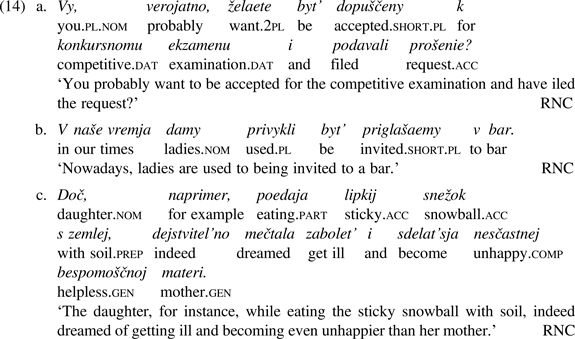
Secondly, subject-control infinitives should involve PRO, which implies, in its turn, a specific syntactic position – Spec,TP – for it to be licensed (Sigurðsson Reference Sigurðsson1991, Reference Sigurðsson2008; Marantz Reference Marantz, Westphal G., Ao B. and Chae1991; Chomsky and Lasnik Reference Chomsky and Lasnik1993; Roger Reference Roger2001, a.m.o.). Russian subject-control infinitives differ radically from constructions involving Voice restructuring (and lacking PRO), as is the case in German, in that the infinitive's subject can correspond to the internal argument of passive or unaccusative infinitives (14).
Finally, if Wurmbrand (Reference Wurmbrand, Veselovská and Janebová2014) is right that the possibility of the “future” temporal interpretation of the infinitive distinct from that of the matrix verbal form is a hallmark of a TP projection within the infinitival phrase, then Russian subject-control infinitives are at least TPs (15).

We conclude that size-restructuring analysis of Russian subject-control infinitives as involving TP and controlled PRO is justified. Now we can use this structural asymmetry between subject and object-control infinitives to explain their different behaviour with respect to licensing nominative floating quantifiers and the short form of adjectives and participles.
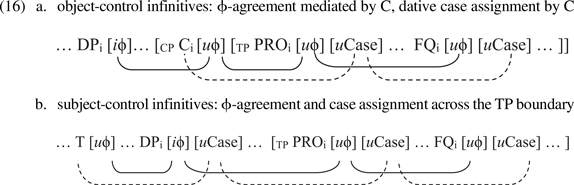
Let us start with the case properties of floating quantifiers. We build on the general idea that floating quantifiers are copying the case of their controller DP and, consequently, inform us of the case properties of PRO (Sigurðsson Reference Sigurðsson1991, Babby Reference Babby, Bošković, Franks and Snyder1998). In object-control infinitives, which are CPs, PRO is uniformly dativeFootnote 9; accordingly, floating quantifiers show up in dative, too.
In subject-control infinitives, there is no CP boundary and no source for the second dative (which, we assume, is assigned by the infinitival C in object-control infinitives). Accordingly, the case feature of PRO, as well as its ϕ-features, gets identified with the features of the controller DP in the matrix clause. When the case feature of the controller DP gets valued as nominative, the case feature of PRO is thereby valued, too. Thus, the absence of the CP-shell in subject-control infinitives entails, on the one hand, that PRO cannot be assigned case within its infinitival phrase and, on the other hand, that the clause boundary is transparent for A-dependencies, including ϕ-agreement and case assignment.
Now let us turn to the distribution of the short form of adjectives and passive participles in infinitives.
We follow Geist (Reference Geist2010) and Grashchenkov (Reference Grashchenkov2018) in assuming that short forms of adjectives project their subject and license it thematically; that is to say, passive participles project the subject as their internal argument, in the thematic position. Importantly, case is marked only on long forms of adjectives and participles in Modern Russian; short forms bear gender and number features, but not a case feature. Accordingly, they need not be case-licensed. Short forms combine with the auxiliary to build a legitimate predicate; the subject DP/PRO raises to Spec,TP and its case feature can be valued as nominative by the finite T. This is represented schematically in (17).

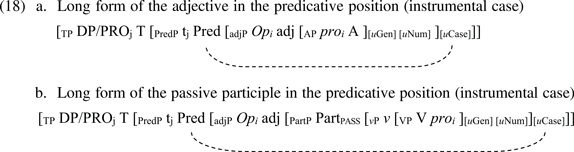
Long form adjectives/passive participles in predicative position have a more articulated structure. We adopt the hypothesis argued for in Bailyn (Reference Bailyn and Zhang2001, Reference Bailyn2012), Madariaga (Reference Madariaga, Salmons and Dubenion-Smith2007), Matushansky (Reference Matushansky, Marušič and Žaucer2008, Reference Matushansky, Gerhild Zybatow, Dudchuk, Minor and Pshehotskaya2010), Grashchenkov (Reference Grashchenkov2018), which identifies instrumental case assignment in adjectival predicates with the functional head Pred (which take an adjectival/participial phrase as their complement) and introduces the subject DP as the external argument. We assume Graschchenkov's (Reference Grashchenkov2018) approach to long forms of adjectives (and participles) as involving an additional functional layer, adjP, which introduces the unvalued uninterpretable case feature into the adjectival/participial constituent. The adjP is construed semantically as a predicate over individuals, due to the adjP layer which triggers λ-abstraction over an individual variable corresponding to the internal argument of the adjective/passive participle. Importantly, this operation converts the participle into a stative predicate, which excludes its dynamic interpretation available in the short form. Our assumptions about the structure of instrumental long forms in predicative position are represented schematically in (18).
The last thing to be taken into account is that short forms are heavily restricted in their distribution. There are just two licit configurations for short forms: the predicate of the finite clause, or the complement of the adj head creating the long forms. We tentatively suggest that short forms have to discharge their uFin(ite) feature, which can be checked against the finite T head or discharged by the adj head.Footnote 10
Now we are in the position to discuss distribution of long and short forms of adjectives/passive participles in control infinitives.
Long forms marked with instrumental case are available in both subject- and object-control infinitives, since they are licensed locally, within the predicate's internal structure. Short forms, however, require an accessible finite T to be licensed. Subject-control infinitives lack the CP layer and, accordingly, the finite T in the main clause is accessible to the elements of the infinitival clause. In object-control infinitives, however, short forms cannot be licensed: within the infinitival clause, finite T / nominative subject are not available, and the functional structure of the main clause is inaccessible due to the CP boundary, that is opaque for A-domain agreement processes.
Hence, the distribution of both nominative floating quantifiers and short form adjectives / passive participles supports the generalization drawn above: object-control infinitives are more opaque than subject-control infinitives, and this difference can be captured by the assumption that the former involve a more complex structure than the latter. Specifically, they differ as to the presence of the A-bar domain of clausal functional structure, instantiated by the CP layer (and, possibly, other functional projections associated with this domain).
It is reasonable to expect that this difference might impact the availability of long-distance licensing of ni-pronouns. However, we need first to investigate options accounting long-distance licensing in existing theoretical models. It is worth noting that the theories of negative concord (NC) only draw a distinction between the two degrees of locality – monoclausal configurations, and finite embedding. Therefore, investigating intermediate levels instantiated by non-finite complement clauses of various sizes is an important challenge. In the next section, we present our overview of the three syntactic approaches to negative concord, special attention being paid to locality issues.
3. Theoretical approaches to negative concord
There are three main approaches to negative concord that we consider in this paper: the binding approach (Progovac Reference Progovac1994), the operator movement approach (Haegeman and Zanuttini Reference Haegeman and Zanuttini1991, Haegeman Reference Haegeman1995) and the agreement approach (Zeijlstra Reference Zeijlstra2004). We first consider the details of each analysis and then suggest what predictions the three approaches make about negative concord and ni-pronouns licensing in Russian.
3.1. Binding approach
The binding approach (Progovac Reference Progovac1994) considers the relation between the licensor and licensee to be similar to the relation between the binder and the anaphor. Negative concord items (NCIs) like Russian ni-pronouns are regarded as negatively-polarized items (NPIs). The approach captures successfully many of their properties, including clause-level locality of licensing, obligatory c-command by the licensor, conditions on the potential licensor (negative I, truth-conditional operator in C), the one-way conditionality of the licensing relation (the licensee needs the licensor, the licensor is independent of the presence of the licensee), the mutual independence of several licensing relations with the same licensor, as well as obviation from a local antecedent exhibited by positive polarity items (PPIs) and non-local NPIs (PPIs and non-local NPIs take a wide scope with respect to the local licensor).
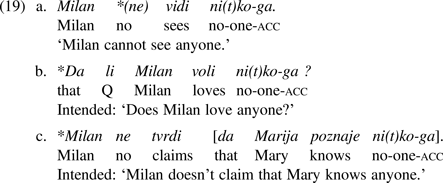
The local domain for licensing is always as large as a minimal IP containing the NPI.Footnote 11 Consequently, the theory predicts that NPIs are licensed by the clausemate negation. This is indeed so for ni-pronouns in Serbo-Croatian: they need a local negator as a licensor (19a) and cannot be licensed by either truth-conditional operator in C (19b) or a superordinate negator (19c).
There is an option in Progovac's system to analyze long-distance licensing of NPIs normally licensed in the local (clausemate) domain, like English anyone (20a–c).
(20)
a. Mary didn't insult anyone.
b. Did Mary insult anyone?
c. I do not say that Mary insulted anyone.
The idea is that long-distance licensing results from the (LF) raising of NPIs that need to be licensed. This raising may proceed through adjunction to IP, movement to Spec,CP, or both. Accordingly, the raised NPI can enter the local licensing configuration with the truth-conditional operator in C, with the superordinate negation, or with any of them, as English anyone does.
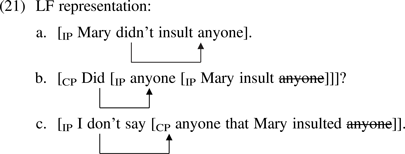
To sum up, long-distance licensing under a binding approach is crucially dependent on the ability of an NPI to raise to the higher licensing domain. This ability might be restricted by general constraints on movement (i.e., island conditions) or by properties of specific NPIs. Thus, small clause (SC) ni-pronouns do not raise at all, and this is why they can only be licensed by the clausemate negation.
3.2. Operator-movement approach
The operator-movement approach (Haegeman and Zanuttini Reference Haegeman and Zanuttini1991, Haegeman Reference Haegeman1995) assumes that NCIs like Russian ni-pronouns or West Flemish nie-pronouns are negative quantifiers (NEG-phrases), not NPIs. As such, they represent a special case of affective operators, the class that includes wh-phrases as well. The relation between NEG-phrases and negation follows from the generalized Affective criterion (Klima Reference Klima, Fodor and Katz1964), which determines well-formedness conditions for affective elements. For negation, the criterion takes the form of (22).
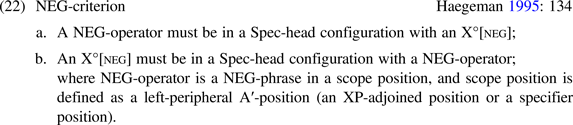
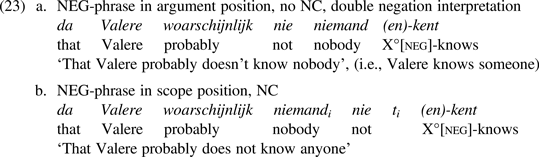
It should be noted that negative quantifiers are not NPIs, hence in principle do not need licensing. Negative quantifiers only become NEG-operators (and subject to the NEG-criterion) in a left-peripheral A′-position, but lack operational force in situ, in the argument position, see example (23a–b) from West Flemish.
However, in languages like Russian where ni-pronouns are licit only in negative contexts,Footnote 12 the functional definition of the NEG-operator might be overridden by the intrinsic definition – Russian ni-pronouns are intrinsically NEG-operators, and this is why they need to assume the specifier position of X°[neg]. In this way, the relation between negation and ni-pronouns becomes a licensing relation.Footnote 13
The NEG-criterion states that clauses involving NC are not so different from simple negative clauses like Mary didn't come. In both cases the clause contains a Neg head (or whatever functional head whose specifier counts as an A′-position) equipped with the feature [neg]; in the specifier of this head, at least one NEG-operator is located. In simple negative clauses, the NEG-criterion is satisfied by a base-generated operator (overt, like French pas, or non-overt). In negative clauses exhibiting NC, negative quantifiers undergo overt or covert (LF) movement to this position, and multiple negative specifiers undergo NEG-absorption so as to be interpretable as one single specifier.
The NEG-criterion applies at LF, but in languages with overt NEG-operator movement, for instance West Flemish, it might be satisfied at earlier stages of the derivation. This conjecture makes a reasonable parallel to the overt or covert movement of wh-operators, which should take their scope position at LF at the latest stage, but which in many languages undergo obligatory or optional movement before spellout. Similarly, covert movement of NEG-operators obeys constraints on movement, for example island constraints or a that-trace filter. For instance, in the French example (24a), the object negative pronoun in the embedded clause can raise to the matrix X°[neg] at LF, whereas in (24b), raising of the subject negative pronoun produces a that-trace effect, which results in ungrammaticality (Haegeman Reference Haegeman1995: 80). The effect is thus parallel to the contrast in (24c–d), where extraction of the wh-object is licit, whereas extraction of the wh-subject produces violation of the that-trace filter.

Another example of the parallelism of the (covert) NEG-operator movement and wh-movement is provided in (25). It shows that in Italian, both licensing of negative pronouns and extraction of wh-phrases is restricted by the adjunct island.
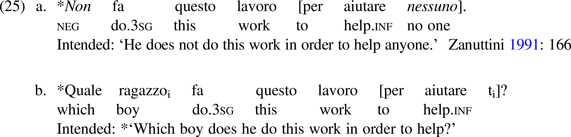
As (24a) clearly shows, NEG-operator movement is not restricted by the clausemate condition. Apparently, locality constraints on NEG-movement might be computed as regular A′-movement constraints, where subjacency restrictions are adjusted to the two parameters distinguishing NEG-movement from wh-movement: (i) the target position is Spec,NegP, not Spec,CP (hence the number of bounding nodes to cross differs); and (ii) the type of available intermediate positions (it is not clear whether the intermediate Spec,CP, or the intermediate Spec,NegP, should serve as a landing site for successive cyclic movement).
It is important to note that the island conditions produce more restrictions for the operator-movement approach than for the binding approach: for instance, the former bans NCIs in adjunct clauses when the licensor is in the matrix clause, whereas the latter tolerates them.Footnote 15 This is because the binding approach only requires that the NPI enters the same domain as the licensor, which can be achieved through movement within the adjunct clause. On the other hand, the operator-movement approach requires that the NEG-operator moves to the specifier of the licensor, which can only be achieved through movement out of the adjunct clause.
3.3. Agreement approach
The agreement approach (Zeijlstra Reference Zeijlstra2004), couched in the framework of minimalism, argues that negative concord is an agreement phenomenon. NCIs in NC configurations are semantically non-negative indefinites, and as such do not introduce semantic negation. Interpretable negation is forced syntactically, through the assumption that NCIs are equipped with a [uNEG] feature. This means that for the derivation to converge there has to be a constituent with a [iNEG] feature to “defuse” the [uNEG] feature through agreement/checking. In this way, the licensing relation between semantic negation and NCIs is shaped in the form of one-way agreement: elements bearing [uNEG] need an element bearing [iNEG], but not vice versa.
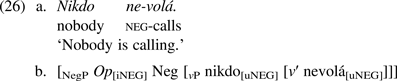
The difference between strict NC languages (e.g., Czech or Russian) and non-strict NC languages (e.g., Italian) concerns the interpretation of the negative marker. In strict NC languages, the negative marker bears [uNEG] as well, and requires a covert negative operator Op in Spec,NegP bearing [iNEG]. Therefore, in strict NC languages, the position of NegP is not associated with the position of the negative marker, and can be assumed to be situated high enough to outscope the negative marker and all the NCIs; see example (26) from Czech.
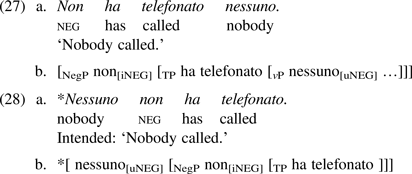
In non-strict NC languages, the negative marker itself carries [iNEG]. Accordingly, NCIs cannot move to the left of the negative marker, because of the LF constraint on variables which have to be c-commanded by their binder.Footnote 16 Therefore, only the NCIs to the right of the negative marker can enter NC; see examples (27)–(28) from Italian.
It is worth noting that the agreement approach to NC requires very specific assumptions about the possible shapes of the Agree operation. First of all, since the number of NCIs is not limited, multiple Agree should be an option. Secondly, the c-command relation between interpretable and uninterpretable occurrences of the feature is reversed. Standard Agree, as proposed in Chomsky (Reference Chomsky, Martin, Michaels, Uriagereka and Keyser2000), is driven by an unvalued uninterpretable feature on the Probe, and the search for its valued interpretable counterpart (Goal) is performed in the Probe's c-command domain. The relation between the Probe and the Goal thus can be dubbed a “downward search, upward valuation”. The agreement approach to NC requires direction reversal, namely, “upward search, downward valuation”, which has been argued for on independent grounds in Wurmbrand (Reference Wurmbrand and Choi2012a, Reference Wurmbrandb, Reference Wurmbrand, Halpert, Kotek and Urk2017) and in Zeijlstra (Reference Zeijlstra2012). Thirdly, agreement in [NEG] feature should never be accompanied by movement, since movement would produce an illicit LF configuration extracting existential quantifiers out of the scope of the negative operator.
The locality issues are not addressed in Zeijlstra (Reference Zeijlstra2004); however, they are mentioned in passing in Zeijlstra (Reference Zeijlstra2012) arguing that negative concord may not apply across the finite CP boundary, as example (29) from Italian shows.

The reason for this, Zeijlstra suggests, is that the C head responsible for the locality violation carries no [uNEG] feature. Reverse Multiple Agree, in general, is said to apply across phase boundaries only if the phase edge itself also participates in the Agree relation. Accordingly, in (29) where C is not equipped with [uNEG], the agreement relation between [iNEG] on non and [uNEG] on nessuno cannot be established. Remarkably, in cases like this, Agree could be enabled if NCI enters the local domain of [iNEG] as the result of another syntactic movement operation. A similar scenario is observed with the binding of anaphors. For example, himself is not locally bound in (30a)–(31a), which results in ungrammaticality, whereas wh-movement of the DP containing the anaphor, or A-movement of the antecedent, results in configurations that satisfy Condition A in (30b) and (31b) respectively.
(30)
a. *Maryi thinks Bill likes best these pictures of herselfi.
b. Maryi wonders [which pictures of herself]i Bill likes best ti.
(31)
a. *It seems to himselfi that Billi is liked ti by Mary.
b. Billi seems to himselfi to be liked ti by Mary.
In this way, the agreement approach becomes similar to the binding approach in that it assumes clause-level locality of the licensing relation which can be overridden by movement.
3.4. Predictions for Russian NC
In this section, we sum up the predictions of the three approaches regarding the locality of licensing ni-pronouns in Russian. We are especially interested in licensing ni-pronouns in infinitival complements by the matrix negation, as in (32a) for subject control, and (32b) for object control.
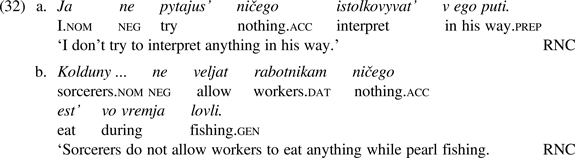
The first thing we need to ensure is that ni-pronouns are indeed licensed out of the matrix clause. As a matter of fact, local NPIs can seem to be long-distance-licensed due to the Neg(ative) raising (see example (33)) – a derivational or interpretational reconstruction of semantic negation in the embedded clause (Horn Reference Horn and Cole1978, Reference Horn and Bright1992; Collins and Postal Reference Collins and Postal2012).
(33) I don't think he'll come.
(i) (unlikely) surface scope of negation: ‘It is not the case that I think that he'll come.’
(ii) (likely) reconstructed/narrow scope of negation: ‘I think that it is not that case that he'll come.’
An argument for a syntactic account of Neg-raising is that NPIs requiring a local licensor are licit in clauses embedded under Neg-raising predicates with a Neg-raising predicate like believe, as in (34a) and non-licit, as in (34b), with a non-Neg-raising predicate like claim,
(34)
a. Calvin did not believe that Mona would move in until June.
b. *Calvin did not claim that Mona would move in until June.
Going back to the Russian examples in (32), we observe that (32b) is preferably interpreted as involving Neg-raising, but (32a) is not. Therefore, the long-distance licensing of ni-pronouns can in principle result from Neg-raising, but, importantly, is also attested in non-Neg-raising configurations.
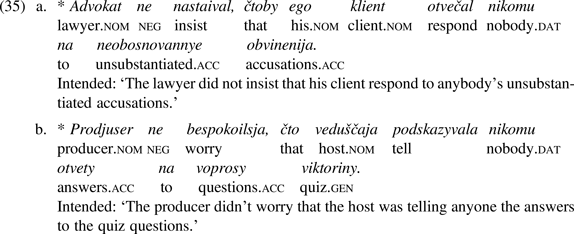
The next thing to observe is that Russian ni-pronouns allow long-distance licensing only in non-finite complement clauses. Examples (35a–b) with non-Neg-raising matrix predicates are judged unacceptable by native speakers.Footnote 17
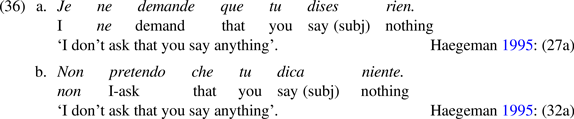
This is expected, if we consider Russian ni-pronouns to be universal NCIs (or universal n-words). Along with other diagnostics for universal n-words, Giannakidou and Zeijlstra (Reference Giannakidou, Zeijlstra, Evaerert and van Riemsdijk2017) mention that the long-distance licensing of such elements is allowed only through a transparent domain: an infinitival clause (as in Russian example (32)), or a subjunctive clause (as in French (36a), repeated from example (24), or Italian (36b)).
In view of the above, we only consider long-distance ni-licensing in infinitival complements of non-Neg-raising subject and object-control verbs.
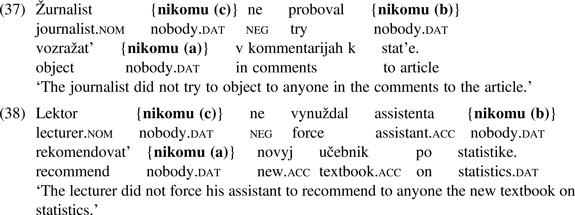
We start with identifying three linear positions available for ni-pronouns in these configurations. As was shown in section 2.1, ni-pronouns in simple clauses appear in two positions: in the base position, where the corresponding non-negative argument / adjunct belong, and in the position in front of the preverbal negative particle ne ‘not’. In infinitival complementation constructions, one additional position seems to be available for ni-pronouns: preceding the infinitive. The three options are shown in (37)–(38): the base position (a), the position in front of the infinitive (b) and the position in front of the matrix verb and negation (c).
Now let us move on to the possible accounts of (37)–(38).
Under the binding approach, ni-pronouns are subject to principle A and should be licensed by the local negative T or by the superordinate negative T; in the latter case, they should be able to raise overtly or covertly to the local vicinity of the superordinate T. In section 2.2 we proposed an analysis of subject- and object-control infinitives and suggested that the two types project different amounts of clausal structure, but both include TP. Accordingly, the T head of the infinitival clause is the nearest eventual antecedent of the ni-pronouns located within this clause. Since it is not negative in the examples under discussion, the ni-pronouns cannot be licensed locally. The question is, then, whether Russian ni-pronouns in their base position can be licensed through covert raising. If Russian ni-pronouns are unlike SC ni-pronouns in that they can raise covertly and in this way get licensed by the superordinate negation, the theory predicts that this raising proceeds through Spec,CP in object-control infinitives; whereas in subject-control infinitives, which lack the CP layer, they can be suggested to adjoin to TP. If so, ni-pronouns in their base position should be licensed not only in whatever infinitival clause, but also in whatever finite clause. However, this prediction contradicts the data, as we see in (35).
The derived position of ni-pronouns before the matrix verb (position (c)) clearly cannot correspond to the position the long-distance-licensed NPI should raise to overtly. Consequently, the movement of ni-pronouns to the derived position (c) is motivated independently of ni-licensing. However, it can have impact on ni-licensing by raising the pronoun to the local domain of the matrix licensor.Footnote 18 Therefore, the binding approach predicts the positive impact of the overt raising of ni-pronouns into the matrix clause. As for the intermediate position, it can in principle be associated with Spec,CP (or whatever edge position of the infinitival clause), which would allow the ni-pronoun to be licensed. On the other hand, it can equally be analogous to the position of the ni-pronoun in the finite clause, and in this case, it is lower than the subject. As a result, we cannot make specific predictions on the possibility of ni-licensing in this position.
The predictions of the binding approach for ni-licensing in Russian control infinitives under our assumptions about the structure of subject- and object-control infinitives are represented in Table 1.
Predictions of grammaticality under the binding approach

The operator-movement approach provides a straightforward explanation for the three positions available for ni-pronouns. The position before the matrix verb is the specifier position of NegP, the target position of the negative operator movement. The position before the infinitive can be identified with the embedded NegP (or Pol(arity)P, Laka Reference Laka1990), an intermediate landing site for negative operator movement. Both subject- and object-control infinitives allow extraction of operators (e.g. wh-movement, see (Lyutikova Reference Lyutikova, Kiseleva, Plungian, Rakhilina and Tatevosov2009, Reference Lyutikova2010)), hence we expect that ni-pronouns will be licit in both subject- and object-control infinitives. The differences in grammaticality can only be attributed to the restrictions on the level of representation at which the NEG-criterion should be satisfied. It is clear that the negative operator's position before the matrix verb allows the application of the NEG-criterion already at the spellout. The acceptability of the two other positions depends on whether checking of the NEG-criterion can be postponed until LF. If Russian ni-pronouns have to move overtly, as nie-phrases do in West Flemish, then the theory predicts the degraded grammaticality of (a) and (b) positions for both types of infinitives. Otherwise, all the three positions are expected to be equally licit.Footnote 19 The predictions of the operator-movement approach are summed up in Table 2.
Predictions of grammaticality under the operator-movement approach

Finally, the agreement approach makes predictions very similar to those of the binding approach. We suggested in section 2.2. that the differences between subject-control and object-control infinitives arise from the fact that the former have reduced functional structure lacking a CP layer. As subject-control infinitives do not contain a phase boundary, the Agree operation can apply. In object-control infinitives, this is only possible if the phase head C carries a [uNEG] feature and participates in Multiple Agree.
Let us consider derived positions (b) and (c) of ni-pronouns. As mentioned in section 3.3, NEG agreement is never accompanied by movement: firstly, because the movement would extract the bound variable out of the scope of the binder, and secondly, because the movement would disable the Reverse Agree (“upward search, downward valuation”). Consequently, the derived positions of ni-pronouns have nothing to do with the Agree operation licensing them. However, eventual movement of ni-pronouns to the matrix clause motivated by some other reason creates a local configuration for Agree to apply. Recall also that the negative operator carrying [iNEG] that ni-pronouns agree with is located high enough in the clause (higher than the subject position). Therefore, ni-pronouns in front of the matrix verb are in the same phase with the negative operator and c-commanded by it, a prerequisite for NEG agreement.
The predictions of the agreement approach under various assumptions are represented in Tables 3 and 4.Footnote 20
Predictions of grammaticality under the agreement approach if infinitival C lacks [uNEG]

Predictions of grammaticality under the agreement approach if infinitival C carries [uNEG]

In the next section, we test, experimentally, the theoretical predictions discussed above.
4. Experiment
To formalize the test of theoretical predictions about locality of ni-pronouns licensing, we ran an acceptability judgments study. The experiment tested the acceptability of ni-pronouns occupying different positions in a clause with an embedded infinitive.
4.1. Materials
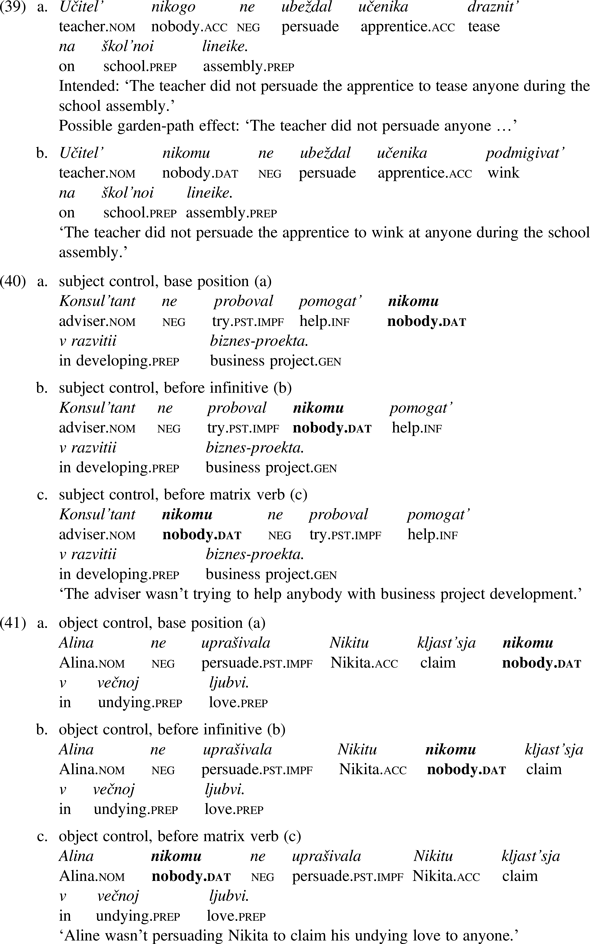
We constructed a 2 × 3 factorial design that crossed the factors Infinitive type and Ni-pronoun position. We used seven non-Neg-raising subject-control verbs (načinat' ‘begin’, probovat' ‘try’, toropit'sya ‘hurry’, riskovat' ‘risk’, starat'sya ‘endeavor’, pytat'sya ‘seek’, perestavat' ‘cease’) and six non-Neg-raising object-control verbs governing acc (ugovarivat' ‘reason’, uprašivat' ‘blandish’, prosit' ‘ask’, zastavlyat' ‘force’, ubeždat' ‘persuade’, vynuždat' ‘compel’). For infinitives, we used verbs that govern dat, which means that in case of object control, matrix verb and infinitive assign different cases. This was done to avoid the garden-path effect in case of object control: otherwise when a ni-pronoun is before the matrix verb, it could be parsed as an argument of this matrix verb (see example (39)). Both target and filler sentences were constructed using the following basic structure leaving out ni-pronouns: subject + negative particle + matrix verb in past form + (object) + infinitive + continuation (i.e., direct object or prepositional phrase). We used imperfective forms of both matrix verb and infinitive. The length of continuation was balanced for all target sentences and fillers. The stimuli set is exemplified in (40)–(41).
We created four tokens for each condition, for a total of 24 target sentences. The target items were distributed across three lists using a Latin Square design and interspersed with 24 filler items that span the range of acceptability. Grammatical fillers included sentences that contained -libo pronouns, instead of ni-pronouns and matrix or embedded negation (42a–b). Ungrammatical fillers included sentences with ni-pronouns and no negative particle so that the pronoun was not licensed (42c–d). We created two pseudorandom orders per list, which results in six lists in total. The survey also included four practice items, two grammatical and two ungrammatical, which were used to check the respondent's competence in completing a rating task. The task was to give acceptability judgments on a 7-point Likert scale. Respondents were instructed that the task has no correct answers and has nothing to do with what is advocated in prescriptive grammars or the plausibility of the described event.
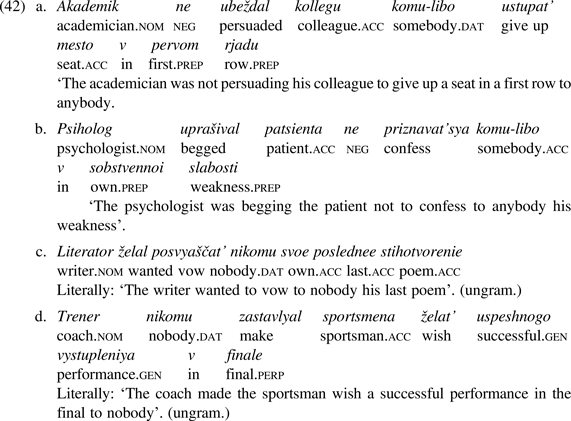
The experiment was implemented via the web-based software Ibex Farm (Drummond Reference Drummond2011). Four grammatical filler sentences were followed by a yes/no comprehension question; the position of these sentences was pseudo-randomized so that one question appeared for every twelve sentences along the list. Sentences were presented one at a time, together with a scale, for at most ten seconds, with a one-second interval between items. In the middle of the experiment, we suggested to respondents that they take a short break. The time a respondent spent on reading a sentence and giving it a rating was recorded.
4.2. Participants
One hundred and fifty-three participants were recruited online via the Yandex.Toloka crowdsourcing platform and social media postings, resulting in 25 participants on average for each list. All participants provided their informed written consent to take part in the study. We treated respondents as outliers when they provided inaccurate ratings for training sentences (e.g., we gave a rating of 6/7 for an ungrammatical sentence or 1/2 for a grammatical one) or when they were 50% or less accurate in answering comprehension questions. Twenty-five participants (16%) were excluded from the data analysis on these grounds. For each participant we also examined whether the ratings provided for filler items were significantly different from the mean ratings; however, no participants were eliminated on this basis. The analysis was performed on the data from 128 respondents (78 females; mean age 34, min 15, max 73, SD 14).
4.3. Results
The results of each participant were z-score transformed to eliminate potential scale bias. Figure 1 and Table 5 report the mean ratings of all six conditions. ANOVA revealed significant main effect for both Infinitive type (df = 1, F = 737.46, p << 0.05) and Ni-pronoun position (df = 2, F = 44.84, p << 0.05) and interaction between these two factors (df = 2, F = 113.44, p << 0.05). Post-hoc pairwise comparisons demonstrate that in subject-control infinitives, the base position is significantly less acceptable than the two other positions. In object-control infinitives, the position before the matrix verb is the least acceptable; the base position is more acceptable, and the position before the infinitive the most acceptable.
Acceptability ratings (z-score transformed) for ni-pronouns in clauses with embedded infinitives. All significant differences marked with * between the relevant boxes.

Mean (raw and z-score transformed) acceptability ratings for the 3 × 2 factorial design

The analysis further shows that sentences with subject-control infinitives generally receive higher scores than sentences with object-control infinitives (Figure 2). This difference is maintained throughout the three positions. Mean ratings for the least acceptable condition (object control, before matrix verb (c)) do not differ from ratings produced for univocally ungrammatical fillers, in which ni-pronouns are not licensed at all.
Interaction plot of acceptability ratings (z-score transformed) for target and filler items. Error bars indicate standard error.

The most acceptable position for ni-pronouns within object-control infinitives is before infinitives. This position received significantly lower scores than the least acceptable position for subject control, which was the base position (Tukey's post-hoc test, p << 0.05) (mean ratings 3.20 and 3.72, mean z-scores 0.284 and 0.404 respectively).
We also analyzed how much time respondents spent on reading a sentence and producing a judgment (henceforward rating time). There was no effect found for Infinitive type (df = 1, F = 0.238, p = 0.626; mean times 5487 and 5449 ms, mean z-score transformed times 0.157 and 0.140, respectively). However, an ANOVA revealed a significant main effect for Ni-pronoun position (df = 2, F = 67.224, p << 0.05) and interaction between the factors (df = 2, F = 12.249, p << 0.05).
In the case of subject control, sentences with ni-pronouns before a matrix verb were judged more quickly than sentences with ni-pronouns in base position (Figure 3). That is, sentences with the least acceptable position are judged more slowly than sentences with more acceptable ones. In the case of object control, sentences with ni-pronouns before a matrix verb were judged significantly faster than sentences with ni-pronouns in the two other positions; that is to say, the less-acceptable sentences were judged more quickly than acceptable ones. The filler data shows that respondents were faster at providing judgments for ungrammatical sentences than for grammatical ones (Figure 4). The pattern observed in filler data is found only within the object-control stimuli.
Rating times (z-score transformed) for ni-pronouns in clauses with embedded infinitives. All significant differences marked with * between the relevant boxes.

Interaction plot of rating times (z-score transformed) for target and filler items. Error bars indicate standard error.

5. Discussion
In this section, we evaluate the results of the experimental study and propose our account of long-distance licensing in infinitival complements.
5.1. Predictions and results
The results of the experimental study do not seem to definitively support any of the predictions outlined in section 3.4.
First, long-distance licensing is generally more felicitous in subject-control infinitives than in object-control ones. This result is in compliance with the overall picture provided by previous studies of infinitival clauses (section 2.2), and strongly supports the idea that subject-control infinitives are more transparent than their object-control counterparts. Moreover, it seems to argue in favour of clause-based locality approaches (i.e, a binding or agreement approach), since they are able to capture the distinction between monoclausal and biclausal configurations. However, the clause boundary, even in object-control infinitives, appears to be not as opaque for ni-licensing as it is for case-assignment: nominative floating quantifiers and short-form adjectives or participles are completely illicit in object-control infinitives, while ni-licensing (in some positions) is much more acceptable than the baseline formed by ungrammatical fillers (and ni-licensing across the board of the finite clause).
Second, the movement of the ni-pronoun to the matrix clause has an unexpectedly deteriorating effect in object-control infinitives, that is, exactly in the environment where we expected the movement to enable local licensing and therefore to ameliorate the scores. This means that licensing ni-pronouns in object-control infinitives is not clause-bound, and no movement of ni-pronouns to the higher licensing domain is required for them to be licensed. It should be noted that the lower acceptability rates for the derived position of ni-pronouns in front of the matrix verb in object-control infinitives cannot be attributed to additional costs of processing the filler-gap dependency created by movement: the rating time for this position is not increased but rather decreased, as compared to the rating time for the base position.
As for the operator-movement approach, it is evident that it can capture neither the differences in acceptability scores between subject- and object-control infinitives nor the opposite impact on the acceptability of movement of ni-pronouns to the matrix clause in subject- and object-control infinitives.
To sum up, none of the approaches are able to derive the picture provided by the experimental scores. In what follows, we attempt at outlining an account which would be compatible with the data.
There are at least three factors that have an impact on the acceptability of long-distance licensing of ni-pronouns in control infinitives: (i) locality of licensing; (ii) preverbal/postverbal position of the pronoun and (iii) movement to the matrix clause.
The local domain for licensing ni-pronouns is as large as a minimal finite clause. The experimental data show that licensing ni-pronouns from the matrix clause is licit not only in subject-control infinitives, but also in object-control infinitives. At the same time, the scores for each of the positions are lower in object-control than in subject-control infinitives, and the highest score for the object-control configuration (before the infinitive, (b)) is significantly lower than the lowest score for the subject-control configuration (base position, (a)). Preliminary comparison with local licensing (provided by fillers involving clause-mate negation) and with long-distance licensing in finite embedded clauses (provided by the pilot experimental study) yields the following hierarchy:

The hierarchy in (43) is compatible with several syntactic phenomena of Russian, which distinguish between infinitival and finite embedding. The illustrative example is provided by anaphor binding (Rappaport Reference Rappaport1986). Example (44) demonstrates that the locality domain of reflexive binding in Russian is larger than the reflexive's governing category (here: the minimal noun phrase or clause containing an accessible subject) and corresponds to the minimal finite clause containing the reflexive.

A comparison of ni-licensing with other locality-sensitive phenomena allows us to identify the ambiguous status of control infinitives: sometimes they pattern with simple clauses, sometimes with finite embedded clauses, and sometimes the subject-control infinitives differ from the object-control infinitives. The relevant generalizations are summarized in Table 6.
Locality of ni-licensing in comparison to other phenomena

The generalizations represented in Table 6 suggest that long-distance ni-licensing is no exception. Rather, it supports the independently-attested variation in locality among different syntactic phenomena. At the same time, if locality type is indicative of the nature of the phenomenon (see relativized minimality, Rizzi Reference Rizzi1990), our data clearly refute the hypothesis underlying the operator-movement approach: ni-licensing and wh-movement differ dramatically with respect to locality.
The second factor affecting acceptability in our experiment is the position of the ni-pronoun with respect to the verb. The experimental results show that for both subject- and object-control infinitives, ni-pronouns before infinitive are significantly more acceptable than ni-pronouns in base position. We suggest that the observed discrepancy in acceptability is independent from ni-licensing conditions and represents the general contrast between pronominal and nominal phrase positioning in Russian.
(45) position of the object pronoun
preverbal > postverbal
According to Kholodilova (Reference Kholodilova2013), pronouns in Russian are generally located closer to the beginning of the sentence due to a set of features: higher degree of accessibility, lighter weight of constituent (in terms of Hawkins’ (Reference Hawkins1990) Performance Theory of Order and Constituency), clitization, etc. As for ni-pronouns, Bivon (Reference Bivon1971) argues that they tend to precede the verbal head. Kholodilova (Reference Kholodilova2013) provides evidence for this observation from the Russian National Corpus (RNC) and from texts found in the Yandex web search engine.
In particular, to study the position preferences for ni-pronouns as compared with noun phrases in sentences with negation, Kholodilova (Reference Kholodilova2013) searched for a pronoun nikto ‘nobody’, and for a nominal NPI ni duši ‘not a soul’, which contains a negative particle and a noun, has the same meaning and equal number of syllables in oblique case forms. The corpus study reveals a clear preference for preposition of negative pronouns with respect to the verb (Table 7).
The frequency of OV vs. VO orders in sentences like: “I … neg knew / know / saw / see …” (data from Yandex search engine) (Kholodilova Reference Kholodilova2013: Table 38)

However, the data from matrix predication might not be directly used as evidence for nonfinite clauses. As argued by Isačenko (Reference Isačenko1966) and Svedstedt (Reference Svedstedt1976), in Russian, nonfinite clausal arguments usually follow the verb, so one would expect ni-pronouns to be used in base position. However, this tendency is not supported by the corpus data. Kholodilova (Reference Kholodilova2013) demonstrates that the proportion of preposing vs. postposing of pronominal arguments in nonfinite clauses correlates with the hierarchy of finiteness proposed for Russian verb forms in (Sai Reference Sai, Bondarko, Voeikova, Rakhilina and Sosnovtseva2013), with infinitives being most closely related to indicatives. As shown in Table 8, pronominal arguments are significantly more often used before the infinitive.
The frequency of preposition and postposition of pronominal and nominal arguments in Russian infinitive clauses (Kholodilova Reference Kholodilova2013: Tables 45-46)

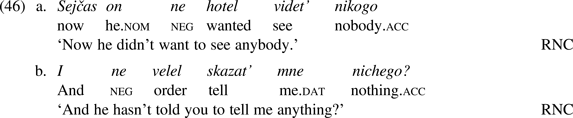
Despite the tendency of ni-pronouns to precede infinitives, they are not prohibited from being located in base position; such instances are found in the corpus and considered grammatical by speakers (46).
Finally, the third factor affecting acceptability is the movement of ni-pronoun to the matrix clause. We observe that this movement is allowed in subject-control infinitives but penalized in object-control infinitives, resulting in ungrammaticality of the outcome.
(47) movement of ni-pronouns to the matrix clause:
subject-control infinitives >> object-control infinitives
The source of this constraint is far from straightforward. On the one hand, the prohibition on ni-pronoun movement to the matrix clause can be related to the structural complexity of object-control infinitives discussed in section 2.2. On the other hand, since ni-pronouns in the experiment are argumental noun phrases, it may be the case that the nominal argument of the matrix verb (i.e., the controller) serves as an intervenor and blocks the movement. It is evident that the explanation of the constraint requires identification of the type of movement involved. However, it is also clear that this movement is independent of ni-licensing.
The next point to discuss is the difference in reaction times. In section 4 we saw that the stimuli with ni-pronouns preceding the matrix verb were rated the most quickly, in spite of the fact that these stimuli were the most acceptable in subject-control infinitives and the least acceptable in object-control infinitives. We suggest that the reason behind this pattern lies in the target sentence structure. The fastest rating times are found within sentences with ni-pronouns before matrix verbs. This position is the nearest one to the beginning of the sentence. When there is subject control, the faster rating times may result from the shorter linear distance between the ni-pronoun and the negator respondents are faster at recognizing licensing here as compared to other positions where the ni-pronoun is further from the negator. What we are observing in the case of object control may be the faster reaction to unacceptability, where as a result, less time is spent on reading the rest of the sentence. To test these suggestions one would need to use more responsive online methods, for example, self-paced reading. For now, we leave this issue for future research.
To sum up, the experimental data show that:
— ni-pronouns are long-distance-licensed in both subject- and object-control infinitives;
— long-distance licensing in object-control infinitives is less acceptable than in subject-control infinitives;
— ni-pronouns are licensed in situ (in base position); movement is not required for long-distance licensing;
— derived positions of ni-pronouns are independent of ni-licensing.
5.2. Analysis
Given the results of the experimental study summarized above, we propose an analysis consisting of two components: first, an account of the long-distance licensing of ni-pronouns able to address lower acceptability of long-distance licensing in object-control infinitives, and second, an account of the derived positions of ni-pronouns able to address the difference in acceptability between the local movement (within the control infinitive) and non-local movement (across the clause boundary), which becomes relevant in object-control infinitives.
We begin with the long-distance licensing of ni-pronouns, using the general idea behind the agreement approach to NC with a slight adjustment of the analysis of the preverbal negative particle and the locality restrictions on NC.
We assume that NC is an instance of syntactic agreement. NCIs bear valued uninterpretable polarity feature [u neg] and need to agree with an interpretable variant of this feature [i neg] on the polarity operator of the clause. The reason why privative uninterpretable features must enter into the Agree relation is the Radical Interpretability Principle, which requires all syntactic elements to be semantically interpretable somewhere in the syntactic structure built in the derivation (Brody Reference Brody and Haegeman1997: 143, Pesetsky and Torrego Reference Pesetsky, Torrego, Karimi, Samiian and Wilkins2007: 274). Since NCIs should be in the scope of the polarity operator, the interaction between them proceeds as Reverse Agree. We use the idea of Multiple Agree (Nevins Reference Nevins2007, Haegeman and Lohndal Reference Haegeman and Lohndal2010) shaped in the form of feature sharing (Pesetsky and Torrego Reference Pesetsky, Torrego and Kenstowicz2001, Reference Pesetsky, Torrego, Guéron and Lecarme2004, 2007), which allows multiple NCIs to be licensed by one negative operator. In this way, the presence of an NCI forces the presence of the accessible negative operator. Otherwise, the uninterpretable [u neg] feature of the NCI would remain unchecked, and the derivation would crash.
In Zeijlstra's (Reference Zeijlstra2004) theory, the preverbal particle is considered as yet another NCI bearing the [u neg] feature, licensed by the multiple reverse Agree with the negative operator. However, this assumption is only tenable if NC is clause-bound. In Russian, ni-pronouns allow long-distance licensing by the matrix negative operator, but the preverbal particle ne can only be licensed by the clausemate negative operator. To illustrate, consider example (2d), repeated here as (48).

In (48), the negative particle ne is in the embedded infinitival clause. As we have seen, ni-pronouns in subject-control infinitives can be licensed by matrix negation. Therefore, if the preverbal particle is analyzed in the same way as ni-pronouns, as an NCI requiring agreement with an accessible negative operator, then we expect that the negative particle on the verb can be construed with the matrix negation, too:
(49) [NegP Op [i NEG] Neg …V [TP ni-pronoun[u NEG] … ne-[u NEG]… ni-pronoun[u NEG] ]]
This amounts to the expectation that the negative particle in the infinitival clause can correspond to the interpretable negation of the matrix clause, which is not borne out: example (48) cannot be interpreted as involving matrix semantic negation.
The generalization we have to capture in the analysis is that ni-pronouns and the negative particle ne differ in two parameters: first, ne requires a clausemate negative operator, whereas ni-pronouns allow long-distance licensing; second, ne is obligatory in the presence of the negative operator, whereas ni-pronouns are not.
There are various ways in which these properties of ne can be implemented in the analysis. The one-to-one correspondence between ne and the negative operator can be captured by introducing a complementary formal feature F, with an inverted interpretability or valuation pattern, much like [wh] and [p]eripheral features on wh-elements and C (Chomsky Reference Chomsky, Martin, Michaels, Uriagereka and Keyser2000). Clausemate condition on agreement for F should be additionally stipulated.
Another way to capture the properties of ne is to assume that ne is a head of NegP, which hosts the negative operator in its specifier (50). In this case, the preverbal position of ne results from the post-syntactic lowering (Embick and Noyer Reference Embick and Noyer2001).
(50) [NegP Op [ ne-Neg° [TP … ni-pronoun … V … ni-pronoun …]
Both approaches require stipulations; moreover, they are sensitive to further assumptions about clause structure and feature organization. In view of this, we refrain from choosing a specific option and leave the complete syntactic analysis of negation in Russian for future studies.
Even so, this preliminary sketch allows us to tackle the difference between subject- and object-control infinitives with respect to NCI licensing.
In subject-control configurations, the embedded clause is represented by a truncated structure equivalent to the non-finite TP. We propose that the TP boundary is transparent for feature sharing.Footnote 21 Consequently, the [u neg] feature of the ni-pronoun can be associated with the [i neg] feature of the polarity operator in the matrix clause.

In object-control infinitives, on the other hand, the CP layer is opaque for feature sharing, and the long-distance licensing of ni-pronouns in the infinitival clause from the matrix clause is banned. The only option to identify the [u neg] feature of the ni-pronoun with the [i neg] feature of the negative operator is by introducing the [u neg] feature in embedded C. This proposal is not unusual, since negative complementizers are found in many languages, including the negative counterparts of various positive complementizers in Celtic languages (McCloskey Reference McCloskey, Borsley and Roberts1996, McQuillan Reference McQuillan, Kehayov and Boye2016), the Latin ne (Allen and Greenough Reference Allen and Greenough2013), and the Basque enik (Laka Reference Laka1990). Crucially, only object-control C (selecting for non-finite TP and assigning dative to PRO) can have a [u neg] feature. Accordingly, ni-licensing across CP boundaries of other complementizers is effectively excluded.
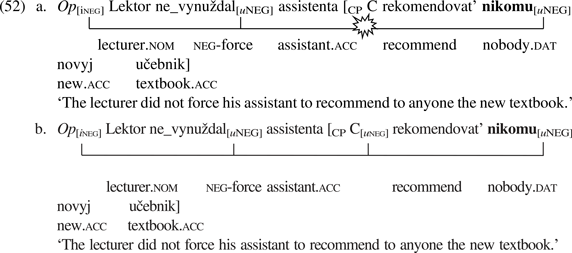
The contrast in the acceptability of ni-licensing in subject- and object-control infinitives can be accounted for if we assume that providing the complementizer with a [u neg] feature comes with processing costs. It creates an additional strain for the computational component, resulting in reduced acceptability scores. This is why ni-pronouns can be licensed in both subject- and object-control infinitives, but this process has a costly path in object-control infinitives.
Now we turn to the second issue: the analysis of the derived positions of ni-pronouns. We propose that the position where preverbal pronouns are found can be associated with Wurmbrand's (Reference Wurmbrand, Veselovská and Janebová2014) ΣP-hosting climbing argumental clitics and short-scrambled constituents. Wurmbrand argues that languages differ as to the A vs A-bar status of its specifier. In Russian, unlike in the languages Wurmbrand discusses, ΣP is below TP rather than above TP, which explains the standard position of the scrambled pronominal object between the subject and the verb (S Opron V), as well as its presence in truncated subject-control infinitives.
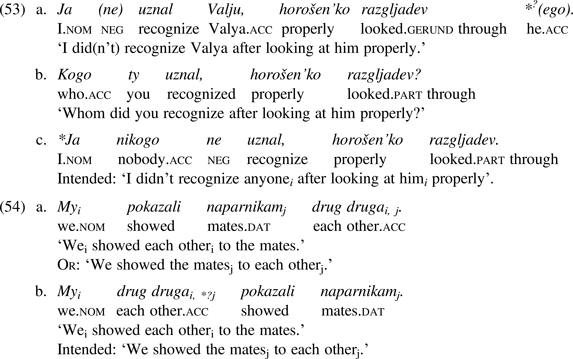
As its position below TP suggests, ΣP belongs to the A-domain of the clause, and movement to ΣP counts as A-movement.Footnote 22 This hypothesis is supported by further empirical evidence. The movement of pronouns into a preverbal position does not trigger standard effects of A-bar movement, such as licensing of parasitic gaps (53). As argued in Ivlieva (Reference Ivlieva2007), parasitic gaps in Russian can be licensed in adjunct clauses by both overt (wh-movement, topicalization) or covert (contrastive focus in situ) A-bar movement. Example (53c) shows that the movement of ni-pronouns to the preverbal position is unlike wh-movement in that it does not license the parasitic gap in the adjunct clause.Footnote 23 Furthermore, short movement of pronouns does not reconstruct for binding purposes; see (54). This body of evidence supports the A-movement analysis of the pronouns’ dislocation to ΣP.
The hypothesis that movement of pronouns to ΣP is an instance of A-movement provides a straightforward explanation of the different acceptability judgements in subject- and object-control infinitives. The position before the infinitive corresponds to the embedded ΣP, available in both subject- and object-control infinitives. Since movement to the local ΣP is preferred for pronouns, in both types of infinitives it yields a statistically significant increase in acceptability scores (see Fig. 1). At the same time, the acceptability judgements when ni-pronouns are moved to the matrix ΣP differ dramatically between two types of control infinitives. In subject-control infinitives, the position before the matrix verb is rated as high as the position before the infinitive (the difference between the two derived positions is not statistically significant; see Fig.1). This is unsurprising, since the non-finite TP does not constrain A-movement. However, in object-control infinitives, movement to the matrix ΣP would cross the CP boundary, opaque for A-movement. Accordingly, stimuli with object-control infinitives where the ni-pronoun appears before the matrix verb receive the lowest scores comparable with those of the ungrammatical filler sentences.
6. Conclusion
In this article, we addressed locality conditions on negative concord in Russian. In particular, we called into question the clausemate condition on licensing ni-pronouns and investigated long-distance ni-licensing in both subject- and object-control infinitives. We identified the availability of ni-pronouns licensed by negation out of the matrix clause and asked whether the grammaticality of the examples in question was due to the overt or covert raising of ni-pronouns to the matrix clause, into the local vicinity of negation.
Using experimental data, we proposed an account of long-distance licensing in infinitival complements. First, we introduced the [u neg] feature, responsible for negative concord. We proposed that the licensing of NCIs is mediated by an Agree relation established between these elements and the negative operator that bears the interpretable feature ([i neg]). Negative pronouns are equipped with the uninterpretable feature [u neg]. This feature is associated with the [i neg] feature of the negative operator in the form of feature sharing. Based on the analysis of Russian infinitival clauses that postulates different functional structures for subject-control and object-control infinitives, we suggest that subject-control infinitives lack a CP layer, and that the TP boundary is transparent for feature sharing. Consequently, ni-pronouns can be licensed by the matrix clause operator in subject-control infinitives. On the other hand, in object-control infinitives, ni-pronouns can be associated with the polarity operator only if the C head is equipped with the [u neg] feature. However, we suggest that the C head that bears the polarity feature comes with an additional processing cost, which results in decreased acceptability scores.
Second, we modeled the difference in acceptability of the derived positions of ni-pronouns by postulating that there is an embedded ΣP projection in the structure, which corresponds to the linear position before the predicate. Although the movement to the embedded ΣP is available in both types of infinitives, movement to the matrix ΣP is unacceptable in object-control infinitives. We suggest that movement of pronouns to ΣP is an instance of A-movement, banned due to the CP boundary in object-control infinitives.
Existing theories of negative concord rely heavily on the movement of NCIs: either as a direct licensing condition (operator-movement approach) or as a prerequisite for entering a local configuration with the licensor (binding approach, agreement approach). Crucially, our data show that ni-pronoun movement to the matrix clause has no impact on acceptability in subject-control infinitives and, unexpectedly, yields ungrammaticality in object-control infinitives. We conclude that although ni-licensing and movement both obey locality constraints, they still differ as to the type of locality required. Consequently, if negative concord is indeed concord, that is, feature unification among probe(s) and goal(s) subsumed under a general mechanism of agreement, then it appears to be less local than movement.
This conclusion is in line with recent research on locality constraints on movement and agreement. The standard Agree (Chomsky Reference Chomsky, Martin, Michaels, Uriagereka and Keyser2000) considers movement as parasitic on agreement: a constituent can only be attracted by a head if it contains a feature that this head agrees with. Therefore, movement is expected to be as local as agreement is. However, a growing body of evidence supports a different approach, namely, that movement and agreement have different properties with respect to locality constraints. Bošković (Reference Bošković2007), for example, claims that the locality of Move is radically different from the locality of Agree, Agree being free from several mechanisms such as phases and the Activation Condition, which constrain Move. Similarly, Arano (Reference Arano2017) reports on differences in the experiencer blocking effect between Move and Agree, while Zeijlstra (Reference Zeijlstra2012) argues that Move in general may be more local than (multiple reverse) Agree. The present article therefore contributes to this research, providing additional evidence for the independence of agreement and movement.



