





Introduction
Weeds are the primary pest of Mississippi rice, and their control costs an estimated US$7.5 to $15 million annually (Buehring and Bond Reference Buehring and Bond2008). Weeds compete with rice for sunlight, water, nutrients, and additional growth requirements (Smith 1988). Factors such as weed species composition, weed density, duration of weed-rice interference, rice cultivar, seeding density, water management, and nutrient availability influence the degree of rice yield loss from weed interference (Odero and VanWeelden Reference Odero and VanWeelden2018). Weed infestations interfere with harvest operations, and weed seed contamination of rice grain lowers rice quality and may reduce the economic value of the crop. Barnyardgrass is the most troublesome weed in Mississippi rice production (Van Wychen Reference Van Wychen2020). Barnyardgrass is highly competitive with rice due to its adaptation to flooded environments, prolific seed production, and rapid growth (Marambe and Amarasinghe Reference Marambe and Amarasinghe2002).
Herbicides are the most widely used weed management strategy in U.S. crop production (Hill Reference Hill1982; McWhorter and Shaw Reference McWhorter and Shaw1982). Glyphosate usage rapidly increased following the introduction and widespread adoption of glyphosate-resistant (GR) canola (Brassica napus L.), corn (Zea mays L.), cotton (Gossypium hirsutum L.), and soybean [Glycine max (L.) Merr.] (Shaner Reference Shaner2000). Failure to incorporate multiple herbicide modes of action (MOAs), as well as additional poor stewardship practices, has resulted in the development of GR weeds (Powles Reference Powles2008). To combat GR weeds, paraquat plus residual herbicides are recommended for preemergence (PRE) application in GR cropping systems (Anonymous 2016; Bond et al. Reference Bond, Bararpour, Bowman, Dodds, Irby, Larson, Pieralisi, Reynolds and Zurweller2022).
Paraquat is a fast-acting, nonselective herbicide that rapidly kills a variety of annual and perennial grass and broadleaf weed species upon contact but has no soil residual activity to control or suppresses these weeds (Bromilow Reference Bromilow2004; Dodge Reference Dodge1971; Haley Reference Haley1979). Paraquat acts by intercepting electrons between the bound ferredoxin acceptors and nicotinamide adenine dinucleotide phosphate (NADP+) and then reducing oxygen to superoxide (O2–) (Calderbank Reference Calderbank1968). Hydroxyl radicals are generated that readily oxidize lipid membranes. In full sunlight, exposed vegetation becomes chlorotic within hours and necrotic within 1 to 3 d (Fuerst and Vaughn Reference Fuerst and Vaughn1990).
Paraquat is used as a herbicide, desiccant, defoliant, and plant growth regulator (Anonymous 2016). Paraquat can be applied preplant, PRE, or post-directed to corn, cotton, peanut (Arachis hypogaea L.), soybean, grain sorghum [Sorghum bicolor (L.)], and other vegetable and fruit crops for nonselective weed control. However, in rice crops paraquat is limited to preplant or PRE applications (Anonymous 2016; Bond et al. Reference Bond, Bararpour, Bowman, Dodds, Irby, Larson, Pieralisi, Reynolds and Zurweller2022).
In Mississippi when preplant and/or PRE herbicides are applied to corn, cotton, and soybean, rice is often in the early seedling growth stages. Paraquat-based herbicide treatments are commonly applied preplant and/or PRE to these crops; therefore, off-target movement onto adjacent rice fields may occur. Off-target movement is defined as the physical movement of a pesticide through the air at the time of application, or soon thereafter, to any site other than that intended for application (Henry et al. Reference Henry, Shaw, Reddy, Bruce and Tamhankar2004; US EPA 2019) and can result in crop damage, including visible injury, delayed maturity, and yield losses to sensitive crops in adjacent fields (Boutin et al. Reference Boutin, Strandberg, Carpenter, Mathiassen and Thomas2014).
The magnitude of damage from an off-target herbicide movement event in rice depends upon the herbicide MOA, the herbicide rate, and the growth stage of the rice at the time of the event (Bond et al Reference Bond, Griffin, Ellis, Linscombe and Williams2006; Ellis et al. Reference Ellis, Griffin, Linscombe and Webster2003; Kurtz and Street Reference Kurtz and Street2003; Lawrence et al. Reference Lawrence, Bond, Golden, Allen, Reynold and Bararpour2020b; McCoy et al. Reference McCoy, Golden, Bond, Dodds, Bararpour and Gore2020). Previous research evaluating early season rice response to off-target movement of paraquat at 84 g ai ha−1 reported injury was ≥41% regardless of application timing with ≥50% injury following exposure at panicle differentiation (PD) (Lawrence et al. Reference Lawrence, Bond, Golden, Allen, Reynold and Bararpour2020b). Delays in rice maturity were >6 d regardless of growth stage at that time of exposure with delays in maturity up to 2 wk following PD treatments. Rough rice yields were reduced to 8% of the nontreated following rice exposure to paraquat at PD (Lawrence et al. Reference Lawrence, Bond, Golden, Allen, Reynold and Bararpour2020b). Paraquat at 28 g ha−1 injured rice by 5% to 25% when it was applied at the 50% heading stage (McCoy et al. Reference McCoy, Golden, Bond, Dodds, Bararpour and Gore2020). In addition, McCoy et al. (Reference McCoy, Golden, Bond, Dodds, Bararpour and Gore2020) reported yield losses of 2,080, 2,480, and 2,020 kg ha−1 from paraquat when the herbicide was applied at 50% heading, 50% heading plus 7 d, and 50% heading plus 14 d, respectively.
After an off-target herbicide movement event has occurred, weed management is still necessary. However, no published studies on rice injury or weed control with labeled herbicides applied following exposure to sublethal concentrations of paraquat is available. Therefore, we conducted research to evaluate rice injury and barnyardgrass control with labeled rates of herbicides following exposure to a sublethal concentration of paraquat.
Materials and Methods
Rice Response Study
Field research was conducted under weed-free conditions from 2019 to 2021 at the Mississippi State University Delta Research and Extension Center in Stoneville, MS, to evaluate rice response to labeled herbicides after exposure to a sublethal concentration of paraquat. Global positioning system coordinates, soil series, soil description, soil pH, and soil organic matter content for this study are presented in Table 1. The experimental site included a rice-fallow rotation in which rice was seeded every other year. Glyphosate (Roundup PowerMax (4.5 L, 1,120 g ae ha−1; Bayer CropScience, St. Louis, MO), paraquat (Gramoxone 2.0 SL, 560 g ha−1; Syngenta Crop Protection, Greensboro, NC), and/or 2,4-D (2,4-D Amine 3.8 SL, 1,120 g ae ha−1; Agri Star, Ankeny, IA) were applied in late March to early April each year to control emerged vegetation prior to seeding.
Geographic location, soil classification, and agronomic information for the rice response study.a

a The rice response study was conducted at the Mississippi State University Delta Research and Extension Center in Stoneville, MS, from 2019 to 2021.
Rice cultivar ‘CL153’ (HorizonAg, Memphis, TN) was drill-seeded at 356 seeds m−2 on May 28, 2019, May 12 and 20, 2020, and June 17, 2021, to a depth of 2 cm using a Great Plains 1520 small-plot grain drill (Great Plains Manufacturing, Inc., Salina, KS). Plots were 1.6 by 4.6 m and consisted of nine rows of rice bordered on either end by a 1.5-m fallow alley that contained no rice. Nitrogen fertilizer was applied at 168 kg ha−1 as urea (46-0-0) immediately before flood establishment (Norman et al. Reference Norman, Slaton, Roberts and Hardke2013). Plots were flooded to an approximate depth of 6 to 10 cm when rice reached the one- to two-tiller stage. Rice was managed throughout the growing season to be free of weeds, insects, and diseases using local guidelines to optimize yield (Buehring Reference Buehring2008).
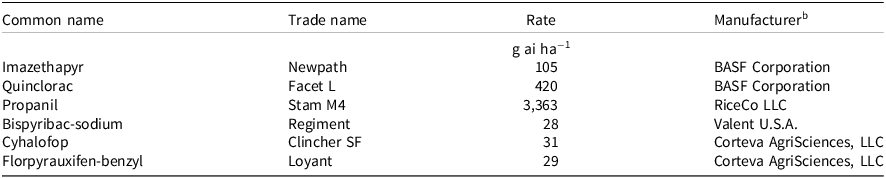
Treatments were arranged as a two-factor factorial within a randomized complete block design and four replications. Factor A was labeled herbicide treatment and consisted of no herbicide treatment and the herbicide products listed in Table 2 applied to rice in the three- to four-leaf (MPOST) growth stage. Factor B was paraquat (Gramoxone SL; Syngenta Crop Protection, Greensboro, NC) exposure and consisted of paraquat applied at 0 and 84 g ha−1 to rice at the spiking to one-leaf (VEPOST) stage (Lawrence et al. Reference Lawrence, Bond, Golden, Allen, Reynold and Bararpour2020a,Reference Lawrence, Bond, Golden, Allen, Reynold and Bararpourb; Reference Lawrence, Bond, Golden, Allen, Reynold and Bararpour2021). Simulated off-target movement tested with constant carrier volume was used reduced herbicide rates to simulate low concentration exposure (Davis et al. Reference Davis, Scott, Norsworthy and Gbur2011; Ellis et al. Reference Ellis, Griffin and Jones2002; Lawrence et al. Reference Lawrence, Bond, Golden, Allen, Reynold and Bararpour2020b; McCoy et al. Reference McCoy, Golden, Bond, Dodds, Bararpour and Gore2020). Paraquat treatments included a nonionic surfactant (NIS) (Activator 90; Loveland Products, Greeley, CO) at 0.5% v/v. Imazethapyr and quinclorac treatments included petroleum oil surfactant (Herbimax, 83% petroleum oil; Loveland Products) at 1.67% v/v. Bispyribac-sodium treatments included surfactant-deposition aid (Phase II [80% arbamides, alcohol ethoxylates, methylated esters of fatty acids, and organosilicone surfactant], Loveland Products) at 1% v/v. Cyhalofop treatments included methylated seed oil surfactant (MSO concentrate with Leci-Tech, 100% MSO; Loveland Products) at 1.67% v/v. Florpyrauxifen-benzyl treatments included MSO at 0.42% v/v. All treatments were applied using a CO2-pressurized backpack sprayer equipped with flat-fan nozzles (Airmix 11002; Greenleaf Technologies, Covington, LA) set to deliver 140 L ha−1 at 206 kPa using water as a carrier. Simulated off-target movement was evaluated with a constant carrier volume to reduce herbicide concentrations and mimic low-concentration exposure (Davis et al. Reference Davis, Scott, Norsworthy and Gbur2011; Ellis et al. Reference Ellis, Griffin and Jones2002).
Herbicide names, application rates, and manufacturer information for the rice response and barnyardgrass control studies. a
a The rice response and barnyardgrass control studies were conducted at the Mississippi State University Delta Research and Extension Center in Stoneville, MS, from 2019 to 2021.
b Manufacturer locations: BASF, Research Triangle Park, NC; RiceCo, Menphis, TN; Valent, Walnut Creek, CA; Corteva, Indianapolis, IN.
Visible estimates of aboveground rice injury were recorded before herbicides were applied at MPOST and 3, 7, 14, 21, 28, and 42 d after labeled herbicide treatment (DAT) on a scale of 0% to 100%, where 0 indicated no visible effect of herbicide and 100 indicated complete plant death. Rice plant height was recorded 21 DAT and at maturity by measuring from the soil surface to the upper-most extended leaf and calculating the mean height of five randomly selected plants in each plot. The number of days to 50% heading was recorded to indicate rice maturity by calculating the time from seedling emergence until 50% of rice plants in an individual plot had visible panicles. Days to canopy closure were calculated using the Canopeo software app (Oklahoma State University, Stillwater, OK) to measure green leaf area as a percentage between rows. Images were collected at weekly intervals from the day of the first application until all plots reached 100% green leaf area. Canopeo is based on color ratios of red to green (R/G) and blue to green (B/G) and an excess green index (2G-R-B). Green normalized difference vegetative index (NDVI) was assessed as an indication of plant health using a hand-held crop sensor (GreenSeeker; Trimble Navigation Limited, Sunnyvale, CA) at 28 DAT. Plots were drained approximately 2 wk before harvest maturity. Rice was harvested with a small-plot combine (Zürn Harvesting GmbH, Schöntal-Westernhausen, Germany) at a moisture content of approximately 20% on October 24, 2019, September 15 and 30, 2020, and October 20, 2021. Final rough rice grain yield was adjusted to 12% moisture content.
Subsamples of rough rice were collected at harvest to determine whole and total milled rice yield. Grain characterization was performed using the WinSEEDLE image analysis system (Regent Instruments, Régent Guay, QC, Canada), and grain length, width, and chalking were recorded. Whole and total milled rice yields were determined from cleaned 100-g subsamples of rough rice using the procedure outlined by Adair et al. (Reference Adair, Bollich, Bowman, Jodon, Johnston, Webb and Atkins1972). Rice was mechanically hulled and milled in a Grainman No. 2 miller (Grain Machinery Manufacturing, Miami, FL) for 30 s and size-separated with a No. 12 4.76-mm screen. Whole and total milled rice yields are presented as a mass fraction of the original 100-g sample of rough rice.
Arcsine transformations of the square roots of rice injury were performed to improve homogeneity of variances. The transformation did not improve homogeneity of variance based on visual inspection of plotted residuals; therefore, nontransformed data were used in analyses. Nontransformed data were subjected to ANOVA using the GLIMMIX procedure with SAS software (version 9.4; SAS Institute Inc., Cary, NC). Site-year and replication (nested within site-year) were random effect parameters (Blouin et al. Reference Blouin, Webster and Bond2011). Type III statistics were used to test the fixed effects of labeled herbicide treatment and paraquat exposure for rice injury; height; days to 50% heading; canopy closure; NDVI; yield (rough, total, and whole milled rice); and grain length, width, and chalking. Means and standard deviations were determined using the MEANS procedure with SAS software. Estimates of least square means were used for mean separation (α = 0.05).
Barnyardgrass Control Study
Field research similar to that described for the rice response study was conducted in the presence of barnyardgrass from 2020 (33.4422°N, 90.9050°W) to 2021 (33.4414°N, 90.9051°W) at the Mississippi State University Delta Research and Extension Center in Stoneville, MS. However, this study evaluated barnyardgrass control with labeled rates of herbicides applied after exposure to a sublethal paraquat concentration. Rice was drill-seeded on May 20, 2020, and May 25, 2021. Soil was a Sharkey clay (very-fine, smectitic, thermic Chromic Eqiaquerts), pH 8.2, and an organic matter content of 2.1%. Site maintenance and plot size were the same as for the rice response study.
The experimental design and treatment structure for the barnyardgrass control study was the same as that for the rice response study. Visible estimates of aboveground rice injury and rice plant height were recorded as previously described. Visible estimates of barnyardgrass control were recorded 7, 14, and 28 DAT using the previously described scale. Rice was harvested with a small-plot combine on October 1, 2020, and October 5, 2021, and final rough rice grain yield was adjusted to 12% moisture content. Data analyses were performed similar to those for the rice response study.
Results and Discussion
Rice Response Study
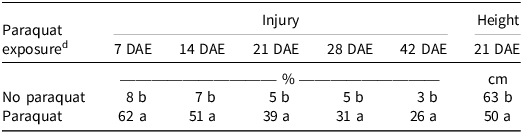
Rice injury prior to labeled herbicide treatments (paraquat alone) ranged from 30% to 50% (data not presented). Rice injury at 7, 14, 21, 28, and 42 DAT and rice height at 21 DAT were influenced by a main effect of paraquat exposure (P = 0.0001). Pooled across labeled herbicide treatments, rice injury following paraquat exposure ranged from 26% to 62% at 7 to 42 DAT (Table 3). Injury in plots with no paraquat exposure was ≤8% at each evaluation. Symptoms of paraquat injury included water-soaked lesions, yellowing of leaves, necrosis, and stunted plant growth. Rice height at 21 DAT was reduced 21% following paraquat exposure (Table 3).
Influence of paraquat exposure on rice injury 7, 14, 21, 28, and 42 d after exposure and rice plant height 21 d after treatment in the rice response study. a,b,c
a Abbreviations: DAE, days after exposure; DAT, days after treatment.
b The rice response study was conducted in Stoneville, MS, from 2019 to 2021.
c Data were pooled from seven labeled herbicide treatments and four experiments. Means followed by the same letter for each parameter are not different at P ≤ 0.05.
d Paraquat at 0 and 84 g ai ha−1 was applied to rice at the spiking to one-leaf stage.
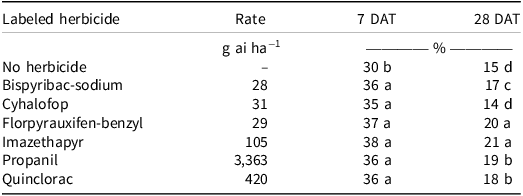
A significant effect of labeled herbicide treatment was detected for rice injury at 7 DAT (P = 0.0001) and 28 DAT (P = 0.0036) (Table 4). Pooled across paraquat exposure, rice injury was ≥35% and ≥14% with all labeled herbicides at 7 and 28 DAT, respectively (Table 4). Injury was greatest at 28 DAT with florpyrauxifen-benzyl and imazethapyr. The main effects of paraquat exposure (P = 0.2070 to 0.3944) and labeled herbicide treatment (P = 0.4120 to 0.6272) and the interactions (P = 0.4490 to 0.6752) of these variables were not significant for days to 50% heading; days to canopy closure; green NDVI; mature rice height; and grain length, width, and chalking (data not presented).
Influence of labeled herbicide treatment on rice injury 7 and 28 d after treatment in the rice response study. a,b,c
a Abbreviation: DAT, days after treatment.
b The rice response study was conducted in Stoneville, MS, from 2019 to 2021.
c Data were pooled from two paraquat exposure treatments and four experiments. Means followed by the same letter for each evaluation are not different at P ≤ 0.05.
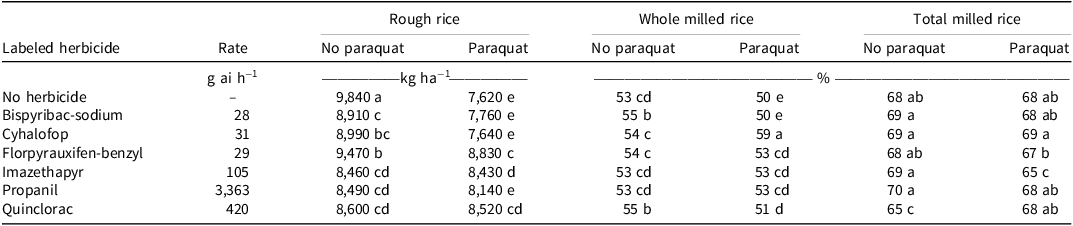
An interaction of labeled herbicide treatment and paraquat exposure was detected for rough, total, and whole milled rice yields. Rough rice yield was reduced by 22% following paraquat exposure in the absence of a labeled herbicide treatment (Table 5). With no prior exposure to paraquat, rough rice yield with labeled herbicide treatments was ≥8,460 kg ha−1 with the greatest yield of 9,840 kg ha−1 from plots with no labeled herbicide. Following paraquat exposure, rough rice yields following florpyrauxifen-benzyl, quinclorac, and imazethapyr were similar (≥8,430 kg ha−1). Rough rice yield for the other labeled herbicide treatments were also similar (≥8,140 kg ha−1).
Interaction of labeled herbicide treatment and paraquat exposure on rice yield in the rice response study. a,b,c
a The rice response study was conducted in Stoneville, MS, from 2019 to 2021.
b Data were pooled over four experiments. Means followed by the same letter for each parameter are not different at P ≤ 0.05.
c Paraquat at 0 and 84 g ai ha−1 was applied to rice at the spiking to one-leaf stage.
Total milled rice yield was similar (≥68%) following all labeled herbicide treatments (including no labeled herbicide) with no prior paraquat exposure, except following quinclorac, when total milled rice was only 65% (Table 5). Among plots treated with paraquat, total milled rice yield following an application of cyhalofop was 2% greater than that following florpyrauxifen-benzyl. Plots treated with imazethapyr exhibited lower total milled rice yield than other labeled herbicide treatments. Bispyribac-sodium and quinclorac produced the greatest whole milled rice yield (55%) compared with other labeled herbicide treatments in the absence of paraquat exposure. Following paraquat exposure, the whole milled yield following cyhalofop was 59% and greatest among other labeled herbicide treatments. Plots treated with bispyribac-sodium and those with no labeled herbicide exhibited the lowest whole-milled rice yields. Reductions in total and whole-milled rice yields were ≥35% in plots exposed to paraquat regardless of labeled herbicide treatment.
Previous research reported rice injury following paraquat exposure at 84 g ha–1 applied to rice at the two- to three-leaf (EPOST) growth stage (Lawrence et al. Reference Lawrence, Bond, Golden, Allen, Reynold and Bararpour2020a). Lawrence et al. (Reference Lawrence, Bond, Golden, Allen, Reynold and Bararpour2020b) reported >42% injury with paraquat 3 d after exposure, with the greatest injury of 56% at 28 d after exposure. That report also noted that rice did not recover from early season paraquat exposure at 10% of the recommended use rate even after adding starter nitrogen or altering nitrogen fertilizer. In contrast, the current study demonstrates that rice injury after applications of labeled rates of herbicides following paraquat exposure was 65% at 7 DAT; however, some recovery from this injury occurred as rice matured, as evidenced by ≤26% injury 42 DAT. Lawrence et al. (Reference Lawrence, Bond, Golden, Allen, Reynold and Bararpour2020b) further suggested that paraquat exposure along with additional herbicide MOAs can induce rough rice yield losses. In the current study, rough rice yields following the labeled herbicides evaluated after paraquat exposure were equal to or greater than those in plots that were exposed to paraquat alone. These data indicate that labeled herbicide treatments have little to no impact on rough rice yield following paraquat exposure. Therefore, the labeled herbicide treatments evaluated in this study may be safely used for weed management following rice exposure to paraquat.
Barnyardgrass Control Study
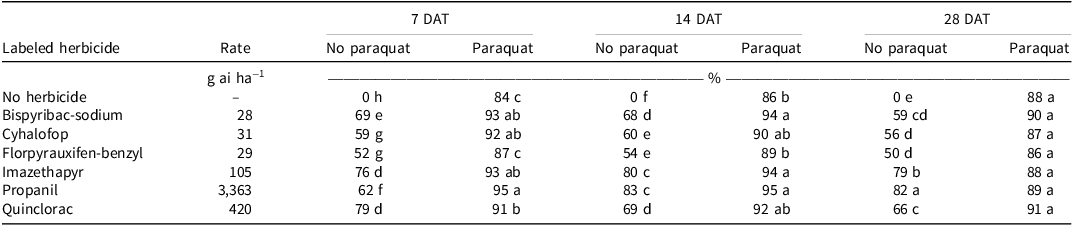
Interactions of labeled herbicide treatments and paraquat exposure were detected for barnyardgrass control at 7 DAT (P = 0.0010), 14 DAT (P = 0.0010), and 28 DAT (P = 0.0010). Some labeled herbicides begin to demonstrate control more rapidly than others. Therefore, barnyardgrass control at 7 DAT with labeled rates of herbicides in the absence of paraquat exposure was greater with quinclorac and imazethapyr than other herbicide treatments (Table 6). Barnyardgrass control at 14 and 28 DAT was ≥79% with imazethapyr and propanil alone and greater than other labeled herbicide treatments. In contrast, Miller and Norsworthy (Reference Miller and Norsworthy2018a) documented that barnyardgrass control was 97% with florpyrauxifen-benzyl 14 d after application and greater than with cyhalofop and quinclorac. Masson et al. (Reference Masson, Webster and Williams2001) reported >90% barnyardgrass control with imazethapyr 28 d after application. Following paraquat exposure, barnyardgrass control in the current study was similar with all labeled herbicide treatments at 14 and 28 DAT except with florpyrauxifen-benzyl and no labeled herbicide (paraquat alone) at 7 DAT. Across all evaluations, barnyardgrass control was at least 12% greater following paraquat exposure and labeled herbicide treatments compared with no paraquat exposure except for propanil at the 28 DAT evaluation (Table 6).
Barnyardgrass control 7, 14, and 28 d after treatment with labeled herbicide treatments in the barnyardgrass control study. a – d
a Abbreviation: DAT, days after treatment.
b The barnyard control study was conducted in Stoneville, MS, in 2020 and 2021.
c Data were pooled over two experiments. Means followed by the same letter for each parameter are not different at P≤ 0.05.
d Paraquat at 0 and 84 g ai ha−1 was applied to rice at the spiking to one-leaf stage.
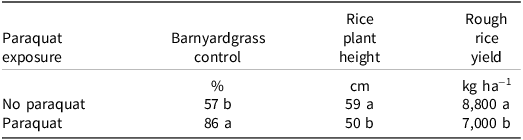
Barnyardgrass control at 42 DAT (P = 0.0001), rice height at 21 DAT (P = 0.0001), and rough rice yield (P = 0.0010) were influenced by the main effect of paraquat exposure. Pooled across labeled herbicide treatments, barnyardgrass control 42 DAT was 29% greater following paraquat exposure than without paraquat exposure (Table 7). Rice plant height and rough rice yield were reduced by 15% and 20%, respectively, following paraquat exposure.
Influence of paraquat exposure on barnyardgrass control 42 d after exposure, rice height 21 d after treatment, and rough rice yield in the barnyardgrass control study. a,b,c
a The barnyard control study was conducted near Stoneville, MS, in 2020 and 2021.
b Data were pooled over seven herbicide treatments and two experiments. Means followed by the same letter for each parameter are not different at P ≤ 0.05.
c Paraquat at 0 and 84 g ai ha−1 was applied to rice at the spiking to one-leaf stage.
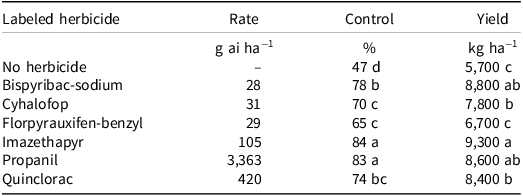
The main effect of labeled herbicide treatment was significant for barnyardgrass control at 42 DAT (P = 0.0010). Pooled across paraquat exposure treatments, imazethapyr and propanil provided the greatest control (≥83%) compared with other labeled herbicide treatments (Table 8). Barnyardgrass control was <78% with bispyribac-sodium, quinclorac, cyhalofop, and florpyrauxifen-benzyl.
Main effect of labeled herbicide treatment on barnyardgrass control 42 d after treatment and rough rice yield in the barnyardgrass control study. a,b
a The barnyard control study was conducted near Stoneville, MS, in 2020 and 2021.
b Data were pooled over two experiments. Means followed by the same letter for each parameter are not different at P ≤ 0.05.
A main effect of labeled herbicide treatment was also detected for rough rice yield (P = 0.0010). Pooled across paraquat exposure treatments, rough rice yield was greater following imazethapyr than all other labeled herbicide treatments and lower with florpyrauxifen-benzyl and no labeled herbicide (paraquat alone) (Table 8). Rough rice yields following bispyribac-sodium, propanil, cyhalofop, and quinclorac were similar.
Compared with other labeled herbicide treatments in this study, florpyrauxifen-benzyl provided the least barnyardgrass control at 7 DAT following exposure to paraquat. Florpyrauxifen-benzyl is a synthetic auxin from the arylpicolinates herbicide family (Epp et al. Reference Epp, Alexander, Balko, Buysse, Brewster, Bryan, Daeuble, Fields, Gast, Green, Irvine, Lo, Lowe, Renga, Richburg, Ruiz, Satchivi, Schmitzer, Siddall, Webster, Weimer, Whiteker and Yerkes2016; Miller and Norsworthy Reference Miller and Norsworthy2018b). Auxinic herbicides are typically more effective on broadleaf weeds and rarely display activity on grass species (Grossmann Reference Grossmann2010); however, florpyrauxifen-benzyl has activity on some grass weed species (Epp et al. Reference Epp, Alexander, Balko, Buysse, Brewster, Bryan, Daeuble, Fields, Gast, Green, Irvine, Lo, Lowe, Renga, Richburg, Ruiz, Satchivi, Schmitzer, Siddall, Webster, Weimer, Whiteker and Yerkes2016). Previous research indicated that for florpyrauxifen-benzyl to display its full herbicidal benefits, soil moisture should be near or above field capacity close to the time of application (Miller and Norsworthy Reference Miller and Norsworthy2018b). Likewise, Calhoun et al. (Reference Calhoun, Barber, Norsworthy, Doherty and Hill2016) suggested that the ideal application timing to effectively control common rice weeds, including barnyardgrass, is to apply florpyrauxifen-benzyl within 5 d of flooding. In this study, labeled rates of herbicides were applied to rice at the three- to four-leaf growth stage (MPOST) on June 17, 2020, and June 23, 2021. A flood was not established until June 25, 2020, and July 6, 2021, respectively. As a result, the decrease in activity from florpyrauxifen-benzyl on barnyardgrass control may be attributed to the lack of soil moisture at the time of application. Barnyardgrass is highly competitive with rice due to its adaptation to flooded environments, prolific seed production, and rapid growth (Marambe and Amarasinghe Reference Marambe and Amarasinghe2002). Therefore, interference from barnyardgrass resulted in reduced rough rice yields following florpyrauxifen-benzyl.
Practical Implications
The objectives of the current studies were to evaluate rice injury and barnyardgrass control with labeled herbicides after exposure to a sublethal concentration of paraquat. This research demonstrates that barnyardgrass control following paraquat exposure was ≥87% 7 d after application of the labeled herbicides evaluated with >89% control 14 and 21 DAT. Labeled herbicide choice should be based on weed spectrum; however, to optimize barnyardgrass control and rice yield with florpyrauxifen-benzyl, soil moisture should be near or above field capacity close to the time of application (Calhoun et al. Reference Calhoun, Barber, Norsworthy, Doherty and Hill2016; Miller and Norsworthy Reference Miller and Norsworthy2018b). Although earlier studies documented that additional herbicide MOAs applied with paraquat can affect rice injury and rough rice yield losses following exposure (Lawrence et al. Reference Lawrence, Bond, Golden, Allen, Reynold and Bararpour2020a), the current research demonstrates that labeled herbicides applied following exposure to a sublethal concentration of paraquat resulted in <36% injury and provided as much as 95% control of barnyardgrass, depending on the herbicide treatment. Therefore, the choice of labeled herbicide should be based on the spectrum of weeds present at time of application.
Acknowledgments
This publication is a contribution of the Mississippi Agricultural and Forestry Experiment Station. This study is based on a larger study that is supported by Hatch project 153300, and which is funded by the U.S. Department of Agriculture–National Institute of Food and Agriculture. We thank the Mississippi Rice Promotion Board for partially funding this research. No competing interests have been declared. We thank personnel at the Mississippi State University Delta Research and Extension Center for their assistance.


 Open access

