


Background
As life expectancy and longevity around the world have increased, so too has interest in how older adults engage with their communities to maintain good health and well-being. Encompassing both of these topics is the study of volunteering among older adults, which has been shown to enhance physical, mental, and social benefits to this population, based on decades of extensive research (Burr et al., Reference Burr, Mutchler, Han, Ferraro and Carr2021). Older adults have consistently been shown to dedicate the greatest number of volunteer hours when compared to younger age groups in Canada (Statistics Canada, 2021). Much of the research in this area has focused on a range of predictors (e.g. education, good health, high income), motivations (e.g. altruism, generativity), and outcomes (e.g. improved physical, mental, and social well-being; longevity) of volunteering among older adults (Morrow-Howell et al., Reference Morrow-Howell, Gonzales, Matz-Costa and Greenfield2015). Beyond these areas of inquiry, new research is attending to the diversity of social contexts surrounding volunteering among older adults, including studies on diverse cultural groups (e.g. immigrants and Indigenous peoples) (Cao, Reference Cao2022; O’Dea et al., Reference O’Dea, Wister and Canham2023), and volunteering during the COVID-19 pandemic (Colibaba et al., Reference Colibaba, Skinner and Russell2021). Using three waves of data drawn from the Canadian Longitudinal Study on Aging (CLSA), this study examines the nexus of these two areas: the impact of the COVID-19 pandemic on volunteering, and volunteering among diverse cultural groups of older adults. We aim to improve the understanding of the current social context surrounding volunteering in Canada by determining changes in the associations between human, social, and cultural capital variables and volunteering among older adults, and examining the potential relationship between ethnic minority status and volunteering, using CLSA data collected prior to and during the pandemic.
Literature review
The early stages of the pandemic had a devastating impact on volunteering. Following directions of physical distancing and sheltering in place, many volunteer organizations could no longer offer their programs in person and were forced to pivot to virtual engagement and other low-tech approaches such as phone or cease activities entirely (Wister & Kadowaki, Reference Wister and Kadowaki2021). Today, almost four years after the worst of the pandemic, various volunteer sectors are still experiencing shortages (Statistics Canada, 2022).
Research in this area is beginning to reveal the specific impact that the COVID-19 pandemic had on older adult volunteers, but it is still limited. So far, mixed results have been found, with some studies describing reductions or cessations in volunteer activity (United Way of British Columbia, 2020), while others suggest stability and resiliency of older volunteers during this time period (Colibaba et al., Reference Colibaba, Skinner and Russell2021; Sin et al., Reference Sin, Klaiber, Wen and DeLongis2021). However, nearly all of the studies published during the early stages of the pandemic agree that due to increased safety concerns, as well as physical/social distancing requirements, volunteering, along with other social activities among older adults, was impacted in some way (Colibaba et al., Reference Colibaba, Skinner and Russell2021; Sin et al., Reference Sin, Klaiber, Wen and DeLongis2021).
Another neglected area of research with respect to social context and volunteering among older adults is that which focuses on ethnocultural diversity. This is a significant gap, particularly in Canada, where the population of older adults is not only growing but rapidly diversifying as well (Hou & Ngo, Reference Hou and Ngo2021). The scant research that has been conducted on older volunteers who belong to diverse ethnic and racial backgrounds suggests that these populations hold similar pathways to and outcomes of volunteering compared to general populations of older adults (Chang, Reference Chang2022). Some of the research in this area also suggests that belonging to a diverse racial, ethnic, cultural, or religious group may have an impact on motivation to volunteer and the types of volunteering activities that are chosen (Khvorostianov & Remennick, Reference Khvorostianov and Remennick2017; O’Dea et al., Reference O’Dea, Wister and Canham2023). There is also research that suggests that minority groups of all ages were subject to unique challenges during the COVID-19 pandemic, in some cases faring worse than the general population. Studies from the United Kingdom and the United States report higher mortality rates from COVID-19 among minority groups (Tai et al., Reference Tai, Shah, Doubeni, Sia and Wieland2021; Morales & Ali, Reference Morales and Ali2021). This research proposes that biomedical (e.g. the prevalence of underlying health conditions) and socioeconomic (e.g. more crowded living conditions, precarious working conditions, poor access to health care) factors placed these groups at higher risk for worse COVID-19 outcomes. Furthermore, the Centre for Disease Control and Prevention found reductions in life expectancy at age 65 to be greatest among Black and Latinx populations (Miller, Reference Miller2021). In a qualitative study by Mahmood et al. (Reference Mahmood, Acharya, Kumar and Paudyal2021), community leaders of ethnic and cultural groups observed disruptions to cultural and religious gatherings, resistance to mental health support, language barriers, impeding adherence to government guidelines, and increases in hate crimes occurring among their members. To our knowledge, this study is the first to explore changes in the relationship between ethnic minority status and volunteering before and after the pandemic.
The overarching goal of this study is to contribute greater insight into these social contexts surrounding older adults who volunteered in Canada during COVID-19. To accomplish this goal, we compared predictors of volunteering (human, social, and cultural capital) among older adults before and during the COVID-19 pandemic. Specifically, by exploring cultural capital and variables representing ethnic minority status, we examined the relationship between cultural generativity and volunteering among older adults before and during the COVID-19 pandemic.
Theoretical framework
One theoretical framework and one theoretical concept helped to guide this research. The first is the integrated theory of volunteer work (Wilson & Musick, Reference Wilson and Musick1997). In this framework, volunteering is described as ‘productive work that requires human capital, collective behaviour that requires social capital, and ethically guided work that requires cultural capital’ (p. 695). According to this framework, human capital resources include education, income, and health status, while social capital refers to the quality and quantity of one’s social relationships, including voluntary organization membership, religious service attendance, informal social interaction, marital status, and degree of social support. Both human capital and social capital are significantly associated with the likelihood that older adults will have knowledge about and access to volunteer opportunities, will be asked to volunteer, and will engage in volunteer positions (Musick & Wilson, Reference Musick and Wilson2007). Further, these two forms of capital are often interconnected, as individuals with greater levels of both education and income, and who are in good health, are more likely to have wider social networks, which offer more opportunities to volunteer (Choi & Chou, Reference Choi and Chou2010). Finally, cultural capital typically refers to attributes that predispose individuals to participate in volunteer work, including religiosity and generative concern (Musick & Wilson, Reference Musick and Wilson2007; Wilson & Musick, Reference Wilson and Musick1997). Cultural capital has also been linked to identification with cultural heritage, identity, and knowledge of family cultural background, through the creation of cultural value (Beel & Wallace, Reference Beel and Wallace2020). According to the integrated theory, for individuals with a greater number of capital resources, volunteering is a more accessible activity than for those with fewer resources, since giving up their time for ‘free’ will present greater challenges and losses (Musick & Wilson, Reference Musick and Wilson2007). Therefore, it is assumed that those with greater capital resources will be more likely to volunteer (Wilson & Musick, Reference Wilson and Musick1997). This theoretical perspective is supported by research on the predictors of volunteering among older adults, including research on the role of health status (Cramm & Nieboer, Reference Cramm and Nieboer2015), education, income (Musick & Wilson, Reference Musick and Wilson2007), social network size (Wilson & Son, Reference Wilson and Son2018), religiosity (Jongenelis et al., Reference Jongenelis, Dana, Warburton, Jackson, Newton, Talati and Pettigrew2020), and generative concern (Gruenewald et al., Reference Gruenewald, Liao and Seeman2012). Using the integrated framework, Choi and Chou (Reference Choi and Chou2010) examined the relationship between human, social, and cultural capital and volunteering status among older adults using longitudinal data from the Survey of Midlife Development in the United States (MIDUS). Findings confirmed the importance of all three forms of capital on volunteering among participants, with level of education, social network size, and religious identification as the most consistent predictors of volunteering from baseline to follow-up nine years later (Choi & Chou, Reference Choi and Chou2010). With all of the aforementioned research having been conducted prior to the COVID-19 pandemic, a key interest of the proposed study is how the pandemic may have impacted the association between these capital resources and volunteering among older adults.
The second theoretical concept that will be used to guide this study is cultural generativity (Kotre, Reference Kotre1984). Cultural generativity refers to the desire of an individual, most often an older adult, who has developed a sense of belonging to a culture (this could be a religious, cultural, or ethnic group, or any group of individuals with shared values and beliefs) and wishes to invest that culture into ‘forms of life and work that will outlive the self’ (Kotre, Reference Kotre1984). Experiencing a sense of belonging to a cultural group can bring upon a sense of cultural generativity for older adults, creating a sense of duty to pass down traditions, teachings, and customs to the next generation and, in doing so, creating a cultural legacy for oneself (Kotre, Reference Kotre1984). Cultural generativity is a distinct type of generativity, a concept proposed by psychologist Erik Erikson in his theory of human development that is now understood to be a key motivational factor for older adults to volunteer (Gruenewald et al., Reference Gruenewald, Liao and Seeman2012) as well as a guiding theoretical concept in the study of volunteering among older adults (Villar et al., Reference Villar, Serrat and Pratt2021). Culture may include more than one’s ethnicity, heritage, and ancestry. Indeed, Kotre describes how cultures may be ‘religious, artistic, ideological, scientific, commonsensical, social, ethnic, as diverse as the communities that build them’ (Kotre, Reference Kotre1984, p. 14). Research suggests that cultural generativity may be a key motivational factor for older culturally diverse adults who volunteer (O’Dea et al., Reference O’Dea, Wister and Canham2023). Using this perspective, one of the goals of this study is to explore the potential relationship between cultural capital, represented by variables including participation in religious activities, ancestral ethnic background, and country of birth, and volunteering in Canada prior to and during the COVID-19 pandemic.
Based on the existing literature, the integrated theory of volunteer work, and the concept of cultural generativity, we propose to test the following hypotheses:
Hypothesis 1: The likelihood of volunteering among older adults will be negatively impacted by the COVID-19 pandemic.
Hypothesis 2: Factors representing human, social, and cultural capital will be positively associated with volunteering among older adults prior to the COVID-19 pandemic.
Hypothesis 3: Associations between human, social, and cultural capital and volunteering among older adults will be impacted by the COVID-19 pandemic.
Methods
Data and sample
This study utilized data from the CLSA. The CLSA is a national-level population-based cohort study with a baseline sample of 51,338 Canadians aged 45–85 years, beginning in 2011. Participants were recruited for the CLSA using the following methods: (1) recruitment from a subset of participants in Statistics Canada’s Canadian Community Health Survey-Healthy Aging (CCHS-HA); (2) recruitment from the registries of provincial health care systems; and (3) recruitment using random digit dialling (RDD) of landline telephones. The CLSA excludes individuals who are unable to speak French or English, who are cognitively impaired at the time of recruitment, residents of the Canadian territories and some remote regions, persons on federal First Nations reserves and other provincial First Nations settlements, full-time members of the Canadian Armed Forces, and institutionalized persons (including long-term care) (Raina et al., Reference Raina, Wolfson, Kirkland, Griffith, Oremus, Patterson, Tuokko, Hogan, Wister, Payette, Brazil and Shannon2009).
Prior to the COVID-19 pandemic, two waves of data had been collected, including Baseline (51,338 participants, 2011–2015) and Follow-up 1 (FUP1) (44,817 participants, 2015–2018). Participants in the CLSA are comprised of two cohorts: the comprehensive cohort and the tracking cohort. Participants in the comprehensive cohort were randomly selected from the population within 25–50 kilometres (based on population density) of CLSA data collection sites across Canada. Participants in the comprehensive cohort are interviewed in their homes and then via assessments at CLSA data collection sites. Participants in the tracking cohort were randomly selected from the ten provinces across Canada and are interviewed using a computer-assisted telephone interview (CATI) system. The CLSA launched the COVID-19 studies in April 2020, soon after the start of the pandemic. The COVID-19 studies aimed to explore the impact of the pandemic on older adults in Canada and covered topics including COVID-19 symptoms and status, risk factors, health care use, health behaviours, and psychosocial and economic consequences of the pandemic. All participants completed an initial 30-minute COVID-19 Baseline Survey over the telephone or online depending on their preference. Participants who completed the Web-based interview received four consecutive weekly 10-minute questionnaires, and those who completed the telephone-based interviews received two consecutive biweekly 10-minute questionnaires. This was then followed by three 10-minute monthly questionnaires and a final 30-minute exit questionnaire. A total of 28,559 eligible CLSA participants participated in the COVID-19 Baseline Survey (April–May 2020), which included 67.2 per cent of CLSA participants from FUP1, excluding deceased participants or those who required a proxy information provider or decision maker.
This study included 24,306 participants (aged 55 years and older) who participated in the CLSA Baseline, FUP1, and COVID-19 Baseline. This research design allows for the examination of changes in associations related to the pandemic. CLSA Baseline data were used for several non-varying covariates, whereas the FUP1 and COVID-19 Baseline data were used to model changes in associations related to volunteering before and during the pandemic.
Ethics approval and consent to participate
This current project received ethics approval at two levels. Consent to participate was obtained for all participants under the CLSA harmonized multi-university ethics process approved by the Hamilton Integrated Research Ethics Board (HiREB), Hamilton Health Sciences/McMaster University. Written informed consent was obtained from all CLSA participants prior to enrolment. Individuals who were not deemed to be cognitively functional were excluded from the CLSA. Simon Fraser University (SFU) was a participating institution in the CLSA data collection (SFU ORS #2010s0281), and the McMaster Research Services Ethics Committee reviewed all consent material prior to data collection.
Measurements
Dependent variable
The dependent variable for this study is participation in volunteer work. During FUP1, participants were asked how often they have participated in volunteer or charity work in the last year. Response options include the following: ‘at least once a day’, ‘at least once a week’, ‘at least once a month’, ‘at least once a year’, or ‘never’. During the Baseline COVID-19 Survey, participants were asked, ‘How many days per week do you currently spend volunteering outside of your home?’ Response choices include 0–7 days per week. To be able to compare the participation in volunteer work at FUP1 and COVID-19 Baseline using a comparable measure across time, we dichotomized the measurement to two levels: volunteers at least once a week (1) and volunteers less than once a week/never (0).
Independent variables
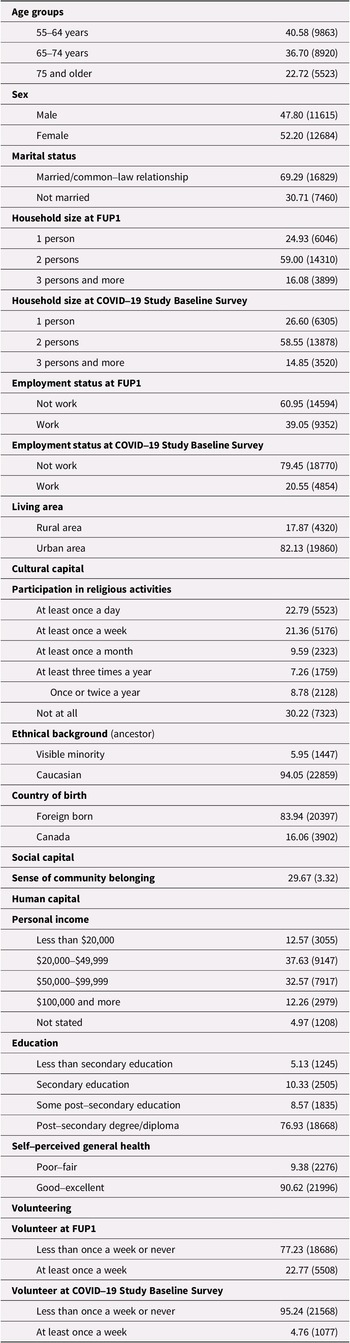
The independent variables in this study were placed into three categories: human, social, and cultural capital (Cramm & Nieboer, Reference Cramm and Nieboer2015; Musick & Wilson, Reference Musick and Wilson2007). Human capital variables of interest included personal income (FUP1), level of education (CLSA Baseline), and self-perceived general health (FUP1) (Overgaard et al., Reference Overgaard, Petrovski and Hermansen2018). Personal income was originally measured at five levels and re-grouped into four categories: ‘less than $20,000’, ‘$20,000–$49,999’, ‘$50,000–$99,999’, and ‘$100,000 and more (including $100,000–$149,999 and $150,000 and more)’. Level of education was grouped into four levels, including ‘less than secondary education’, ‘secondary education’, ‘some post-secondary education’, and ‘post-secondary degree/diploma’. Self-perceived general health was originally measured at five levels and re-grouped into ‘poor to fair’ and ‘good to excellent’. The social capital variable of interest included perception of one’s local area (FUP1) defined as ‘anywhere within a 20-minute walk or kilometer from your home’. This variable was measured with nine items on a 4-option Likert scale. Examples are ‘I really feel part of this area’, ‘Most people in this area are friendly’, and ‘There are lots of people in this area who would help you’. Four items were reverse-coded. Each of the nine items represents different elements related to social capital and cohesion (Alvarez et al., Reference Alvarez, Kawachi and Romani2017). Finally, cultural capital variables included participation in religious activities (FUP1), ancestral ethnic background (CLSA Baseline), and country of birth (CLSA Baseline). Participation in religious activities was measured at six levels, ‘at least once a day’, ‘at least once a week’, ‘at least once a month’, ‘at least three times a year’, ‘once or twice a year’, or ‘not at all’. Ethnic minority status was grouped into two categories: ‘Visible minority’ or ‘Caucasian’. Country of birth was also collapsed into two categories: ‘foreign born’ and ‘Canada’. Although there is an underrepresentation of the diversity of ethnocultural groups in the CLSA, there were enough cases to estimate associations with the measures of ethnic minority status (see Table 1).
Variables and data sources

Covariates
Additional variables were included in the data analysis based on previous studies on volunteering among older adults to control for confounding effects and to identify additional factors associated with volunteering among older adults in Canada. These variables included age, sex, marital status, household size, employment status, and living area (urban vs. rural). Age (FUP1) was measured using three categories: ‘55–64 years’, ‘65–74 years’, and ‘75 years and older’. Sex (CLSA Baseline) was categorized as ‘Male’ and ‘Female’. Marital status (FUP1) was dichotomized into ‘not married (single, widowed or separated)’ and ‘married or in common-law relationship’. Household size and employment status were measured at both FUP1 and during the Baseline COVID-19 Survey. Household size was measured by three categories: ‘1 person’, ‘2 persons’, or ‘3 persons or more’. Employment status was measured as ‘working’ or ‘non-working’ (retired and those not in workforce for other reasons). Finally, rural/urban status was dichotomized into ‘rural area’ and ‘urban area’. All data were collected in three phases: Baseline, FUP1, and COVID-19 Baseline (see Table 1 for detailed information). Sex, education, country of birth, and ancestral ethnic background were extracted from the CLSA Baseline since these factors tend to be stable over long term.
Data analytic procedure
Statistical Package for the Social Sciences (SPSS) version 26 was used for all data analyses. A generalized linear mixed model (GLMM) was chosen to evaluate the differences in volunteering between two time points (FUP1 and COVID-19 Baseline). GLMM is particularly useful when utilizing repeated measures in longitudinal data (West, Reference West2009), in this case, the changes in volunteering from FUP1 to COVID-19 Baseline. GLMM adjusts models for the random effects of repeated measurements on the same participants and can estimate both within-subject variability and between-subject variability. GLMM is also suitable for examining dichotomous outcome variables, as used in this study. Four hierarchical models were built for the GLMM analysis (West, Reference West2009). In Model 1, we included sociodemographic variables. In Model 2, social capital variables were added, and in Model 3, human capital variables were added. Finally, in Model 4, cultural capital variables were added. We employed this modelling strategy to reflect the sequential ordering of blocks of variables on the outcome. During the modelling, interaction terms between all studied variables and survey waves were included in the models to explore the change in association between the dependent and independent variables and covariates. A random intercept was included to model the variation in the dependent variable outcomes. The Akaike information criterion (AIC) was used to compare the model fit; usually, a lower score means a better model fit. GLMM uses the restricted maximum-likelihood estimation to deal with missing data for the dependent variables, and listwise deletion was used for independent variables with missing cases. The only exception is for the variable measuring personal income, which had about 5 per cent missing data. For this variable, missing data were replaced by ‘not stated’.
Results
Among the 24,306 study participants, the majority were female (52%), born in Canada (84%), Caucasian (94%), 55–64 years of age (41%), and were married or living with a common-law partner (69%). Most participants had received a post-secondary degree or diploma (77%), had annual personal income between $20,000 and $49,999 (38%), lived in an urban geographical area (82%), perceived their general health to be good to excellent (91%), and participated in religious activities either at least once a day (22%) or at least once a week (21%). At both FUP1 and COVID-19 Baseline, 59 per cent of participants resided in two-person households. At FUP1, 61 per cent of participants were not working compared to 79 per cent at COVID-19 Baseline. At FUP1, 23 per cent of participants volunteered at least once a week compared to 5 per cent at COVID-19 Baseline. Therefore, our results can be said to support hypothesis 1 that the likelihood of volunteering among older adults would be negatively impacted by the COVID-19 pandemic. Table 2 presents the background characteristics of participants.
Participant background information (n = 24,306)

Table 3 presents the GLMM results, which represent the relationships between measures of human, social, and cultural capital and volunteering between two time points and thus changes in the predictors of volunteering between FUP1 and COVID-19 Baseline. Statistically significant associations for the final model, with all variables included, are described as follows. We present associations at FUP1 followed by interactions with the survey wave to test for changes in the association during the pandemic.
GLMM for volunteering at FUP1 and COVID-19 Study Baseline Survey

Model 1: Covariates
At FUP1, the covariates found to be statistically significant predictors of volunteering at least once a week included older age, female gender, unemployment, and having a larger household size. Participants aged 55–64 years were less likely to volunteer at least once per week (versus less than once per week) compared to those aged 75 years and older (odds ratio (OR) = 0.75, p < .001, 95% confidence interval (CI): [0.68, 0.83]). At FUP1, male participants were less likely to volunteer at least once per week compared to female participants (OR = 0.85, p < .001, 95% CI: [0.79, 0.91]). At FUP1, participants who were working were less likely to volunteer at least once per week compared to participants who were not working (OR = 0.68, p < .001, 95% CI: [0.63, 0.74]). At FUP1, participants occupying two-person households were more likely to volunteer at least once per week compared to participants occupying one-person households (OR = 1.22, p < .01, 95% CI: [1.06, 1.41]). Participants residing in three-person households were also more likely to volunteer at least once per week when compared to participants occupying one-person households (OR = 1.11, p < .05, 95% CI: [1.01,1.22]). For other covariates, including marital status, household size, and living area, no statistically significant relationship was found between being married/being in a common-law relationship or living area (urban vs. rural) and volunteering at least once a week at FUP1.
When comparing findings from FUP1 and COVID-19 Baseline, statistically significant interaction effects between variables including age, gender, and employment status and survey wave were found. From FUP1 to COVID-19 Baseline, participants aged 55–64 were more likely to volunteer at least once per week than those aged 75 years and older (OR = 1.51, p < .001, 95% CI: [1.23, 1.84]); male participants were more likely to volunteer at least once per week than female participants (OR =.31, p < .001, 95% CI: [1.14, 1.51]); and participants who were working were more likely to volunteer at least once per week compared to participants who were not working (OR = 1.39, p < .001, 95% CI: [1.19, 1.62]). No statistically significant interaction effects were found for marital status, household size, or living area and survey wave.
Model 2: Human capital
At FUP1, the human capital variables found to be statistically significant in predicting volunteering at least once a week included personal income level, education, and self-perceived general health. At FUP1, participants with a personal income of $20,000–$49,999 were more likely to volunteer at least once per week compared to participants with an income of less than $20,000 (OR = 1.14, p < .05, 95% CI: [1.02, 1.26]). No statistically significant relationships were found for participants at other income levels ($50,000–$99,999, $100,000 or more) compared to less than $20,000. At CLSA Baseline, participants with higher levels of education, including secondary education (OR = 1.20, p < .05, 1.01, 1.44]), some post-secondary education (OR = 1.47, p < .001, 95% CI: [1.21, 1.77]), and a post-secondary degree/diploma (OR = 1.59, p < .001, 95% CI: [1.36, 1.86), were more likely to volunteer at least once per week compared to participants with less than secondary education. At FUPI, participants with higher self-perceived general health (good to excellent) were more likely to volunteer at least once per week compared to participants with lower self-perceived general health (poor to fair) (OR = 1.47, p < .001, 95% CI: [1.31, 1.66]). No statistically significant interaction effect was found to exist between personal income, education level, or general-perceived general health and survey wave, indicating no change in these associations among older adults before and during the pandemic.
Model 3: Social capital
At FUP1, participants with a higher sense of social cohesion were more likely to volunteer at least once per week (OR = 1.04, p < .001, 95% CI: [1.03, 1.05]). We found a statistically significant interaction effect between sense of social cohesion during the survey wave. From FUP1 to COVID-19 Baseline, participants with a higher sense of social cohesion were less likely to volunteer at least once per week (OR = 0.97, p < .01, 95% CI: [0.95, 0.99]).
Model 4: Cultural capital
At FUP1, participants who participated in religious activities at least once per day were more likely to volunteer compared to participants who did not participate in any religious activities (OR = 2.19, p < .001, 95% CI: [2.01, 2.40]). Similar statistically significant relationships were found between participants who participated in religious activities at least once per week (OR = 1.99, p < 0.001, 95% CI: [1.82, 2.18), at least once per month (OR = 1.41, p < .001, 95% CI: [1.25, 1.59]), and at least three times a year (OR = 1.15, p < .05, 1.01, 1.33) compared to participants who did not participate in any religious activities. At FUP1, no statistically significant relationship was found between participants who participated in religious activities once or twice a year and volunteering at least once per week (OR = 1.05, p >.1, 95% CI: [0.91, 1.20]). We found a statistically significant interaction effect between participation in religious activities and survey wave. From FUP1 to COVID-19 Baseline, participants who participated in religious activities at least once a day were less likely to volunteer at least once a week compared to participants who did not participate in any religious activities (OR = 0.71, p < .001, 95% CI: [0.59, 0.85]). Similarly, participants who participated in religious activities at least once per week were also less likely to volunteer at least once per week compared to participants who did not participate in any religious activities (OR = 0.74, p < .01, 95% CI: [0.62, 0.89]). At COVID-19 Baseline, no statistically significant interaction effect was found for participants who participated in religious activities at least once a month, at least three times a year, or once or twice a year and volunteering at least once per week. At the CLSA Baseline, no statistically significant relationship was found for either ancestral ethnic background or country of birth and volunteering at least once per week. No statistically significant interaction effect was found between either of these variables and survey wave.
Discussion
This study adds to the limited knowledge of older adult volunteers in Canada during the COVID-19 pandemic by examining how volunteer participation in general, as well as associations between human, social, and cultural capital and volunteering, changed during the pandemic using three waves of data from the CLSA. Our first hypothesis, which was that the likelihood of volunteering among older adults would be negatively impacted by the COVID-19 pandemic, was supported. In fact, there was an 18 per cent (23%–5%) decrease in volunteering once per week among participants from FUP1 to COVID-19 Baseline. The decrease in the number of participants who volunteered at least once a week can likely be attributed to the shift in the reality of daily life during the initial stages of the COVID-19 pandemic in Canada. During this time, older adults were affected by public health measures, including physical/social distancing, closure of non-essential businesses, stay-at-home orders, lockdowns, mask mandates, travel restrictions, and restrictions on visitors to their homes. As a result, the types of organizations frequented by older adult volunteers (e.g. hospitals, religious institutions, non-profit organizations) were required to decrease or cease their volunteer opportunities (Statistics Canada, 2022). These changes likely impacted both the desire and ability of older adults to engage in volunteer activities. Indeed, research has determined that, when compared to younger age groups, older adults were more likely to adhere to public health safety measures during this time (Cabot & Bushnik, Reference Cabot and Bushnik2022).
Older adults may have also potentially been affected by the prevailing public discourse surrounding older age during COVID-19, much of which was negative and ageist in nature. A recent report from Employment and Social Development Canada (2022) describes findings from a content analysis of Canadian public documents (including opinion editorials, academic articles, and government communications) related to COVID-19 and older adults, published from April to December 2020. Results found that older adults were homogenously framed as ‘victims’ in 50–88 per cent of all communications reviewed and that the aging process was described as a ‘loss’ the majority of the time. Few publications focused on older adults’ abilities or potential contributions to society, and almost none gave voice to the experiences of older adults themselves. Additional studies on this topic produced similar findings, with print and digital media being found to frame older adults as vulnerable and in need of protection (Skoss et al., Reference Skoss, Batten, Cain and Stanley2022). Previous research (Levy, Reference Levy2022) has been conducted on the relationship between internalized ageism and poor physical, mental, and cognitive health outcomes among older adults. Furthermore, preliminary research conducted on the effect of perceived age discrimination during the pandemic on well-being among older adults suggests similar patterns (Donizzetti & Capone, Reference Donizzetti and Capone2023). Such discourse may have affected older adults’ willingness and confidence to volunteer during this period. Further research is needed that explores the relationship between internalized ageism and patterns of social participation, such as volunteering, among older adults.
The integrated theory on volunteer work proposes that volunteering is an activity that requires its participants to possess human, social, and cultural capital resources. We found partial support for this theory, as well as for our second hypothesis, which anticipated that factors representing human, social, and cultural capital would be positively associated with volunteering among older adults prior to the COVID-19 pandemic at FUP1. Several factors, including education level, income, health status, social cohesion, and religious participation, were found to be associated with a higher likelihood of volunteering at CLSA Baseline and FUP1. Our third hypothesis, which was that associations between human, social, and cultural capital and volunteering among older adults would be impacted by the COVID-19 pandemic, was partially supported, with changes in association found for some variables between the two time points. For variables within the category of human capital, including education level, income, and perceived health status, no change in associations was found, indicating no pandemic effects. When examining the association between volunteering and sense of social cohesion (social capital) at FUP1 prior to the pandemic, it was found that participants with greater levels of social cohesion were more likely to volunteer. At the COVID-19 Baseline, however, those with greater levels of social cohesion were associated with a decreased likelihood of volunteering. It is likely that these changes in association are also linked to the significant impact the pandemic had on daily life and the inability of many older adults to engage in their normal volunteer activities during this time.
Similar changes in association were found when examining the relationship between cultural capital variables and volunteering. Previous research on cultural generativity and volunteering among ethnic minority groups suggests that older adults with a sense of belonging to a culture (whether it be religious, ethnic, etc.) may experience an increased sense of motivation to engage in activities that allow them to pass their culture down to the next generation, such as volunteering (Bower et al., Reference Bower, Lewis, Bermúdez and Singh2021; O’Dea et al., Reference O’Dea, Wister and Canham2023). To examine this relationship, associations between cultural capital variables (religious participation, ancestral ethnic background, and country of birth) and volunteering were tested. No significant associations were found between volunteering and the variables of ancestral ethnic background or country of birth and volunteering among participants before or during the pandemic. A statistically significant association between religious participation and volunteering was found for participants prior to the pandemic, but not during. These findings indicate a lack of cultural generativity being expressed through volunteering for this study sample during the pandemic and also contradict decades of research that connects religious identity and participation with volunteer activity (Johnston, Reference Johnston2013). It might have been assumed that those who regularly engage in religious activities are more inclined to support those in need during a crisis, which is aligned with numerous religious traditions. However, this was not found among CLSA participants during the COVID-19 pandemic. Qualitative research that explores individuals’ experiences, including older adults who belong to diverse cultural groups, during this time is needed to understand these shifting patterns more fully.
We also found significant interaction effects between several covariates and survey waves, including age, gender, and employment status. The association between these covariates and volunteering was found to have changed between FUP1 and COVID-19 Baseline. While volunteering at FUP1 was more likely among individuals who were older (i.e. aged 75 and above), female, and unemployed, the opposite was observed at the COVID-19 Baseline, when it was found that being younger (i.e. age 55–64), male, and employed was associated with a greater likelihood of volunteering. While our data did not provide information on the exact reasons for the observed changes, we know that the COVID-19 pandemic challenged all aspects of daily life, including activities like volunteering. Individuals of all ages were faced with numerous physical, social, and psychological challenges during this time, including COVID-19 infection, being distanced from their loved ones, concerns about others and oneself, and uncertainty about the future, among other challenges. Amidst these profound changes, it is likely that the typical associations between various capital resources and volunteering among older adults were disrupted from their typical patterns.
When considering the observed changes in covariate associations (i.e. age, gender, and employment status), other realities of home life and domestic responsibilities during the early stages of the pandemic should also be considered. For example, ‘younger’ older adults (i.e. age 55–64) may have felt less vulnerable during this time than ‘older’ older adults (i.e. aged 75+) which could have impacted their desire to volunteer. When considering gender, it is possible that older women may have been more likely to have been called upon by their families to engage in spousal/family caregiving and grandparenting during this time (Fan & Moen, Reference Fan and Moen2023), making them less available to engage in volunteer work compared to older men. Finally, in adjusting to new work-from-home policies and other changes to their work lives (e.g. less time spent commuting, increased flexibility), employed older adults may have found more time to dedicate to volunteer activities.
Limitations present in this study include both the operational definition of volunteering and the crude measures of the ethnicity/cultural background of CLSA participants. At both FUP1 and COVID-19 Baseline, only volunteer or charity work that took place in-person was counted as volunteer work. This is especially significant at the COVID-19 Baseline, at which time it is likely that several volunteer operations were only online. Thus, if participants were engaged in online volunteer opportunities at this time, it was not counted as volunteer work, resulting in an underestimation of volunteer activity. Additionally, the volunteering measure is crude, without specificity on number of hours volunteered or types of volunteering. Further, determining the relationship between cultural generativity and volunteering was limited to the available data, which include crude definitions of ethnic minority status (ethnic ancestral background and country of birth). The CLSA also does not measure participants’ sense of belonging to their ethnocultural community, providing only broad estimates by measuring ancestral ethnic background and country of birth. Further, the representation of older adults belonging to diverse cultural groups in this study was very small, with only 5.95 per cent of participants reporting having an ethnic background other than Caucasian. Future research should address these deficiencies. The results are also limited to the Canadian context such that confirmatory studies are required in other countries.
Conclusion
Findings from this study revealed the significant impact that the COVID-19 pandemic had on older adults’ volunteering activities, while also revealing new associations between human, social, and cultural capital and volunteering. Our study findings suggest numerous implications for volunteer research as well as for those who work with older adult volunteers. Older adult volunteers in Canada are known to dedicate more hours than any other age group to their volunteer roles (Statistics Canada, 2021) and tend to remain committed to their volunteer roles for extended periods of time, as long as they continue to benefit from them (O’Dea et al., Reference O’Dea, Wister and Canham2023). Such a disruption in one’s volunteer trajectory could, therefore, have lasting effects and will likely influence older adults’ decisions around volunteering in the future. These findings should be considered by those attempting to establish, maintain, or reignite volunteering opportunities for older adults, including policy makers, leaders of community organizations that rely on older adult volunteers, and coordinators of volunteer programs. It is clear from this research that unexpected health crises can have a significant impact on the social engagement of older adults. It is important that volunteer organizations learn from the COVID-19 experience and attempt to create safe spaces for older adults to engage in volunteering, even amidst potential future health crises.
In utilizing a nationally representative sample of older adults in Canada, this study has tremendous advantages in terms of statistical power. However, the quantitative nature of the data, and the limitation of underrepresentation of specific ethnic groups, means that we do not know the full extent of older adults’ volunteer experiences or reasons for continuing or discontinuing volunteering during the pandemic. While this study helps to confirm what occurred with respect to patterns of volunteering among older adults in Canada during the outset of the pandemic, future qualitative research could help to explain why these changes occurred. This could be achieved by asking older adults more in-depth questions related to their access to volunteer opportunities during the early stages of the pandemic, to understand why some were able to continue volunteering while others were not. Other findings from this study, including the changes in association found from FUP1 to COVID-10 Baseline for certain capital variables and covariates (e.g. employment status, religious participation, sex, age) could also be explored further using a qualitative methodology. To help policy makers, community organization leaders, and volunteer coordinators plan for the future, qualitative research could also be utilized to explore what older adults need to feel safe in their volunteer roles, as well as how the pandemic may have affected older adults’ motivation to volunteer. Finally, future researchers interested in explicating the intersections of the impact of the COVID-19 pandemic on volunteering, and volunteering among diverse cultural groups of older adults should also consider using additional waves of CLSA data as they become available.
Data availability
Data are available from the Canadian Longitudinal Study on Aging (https://www.clsa-elcv.ca/) for researchers who meet the criteria for access to de-identified CLSA data.
Authors’ contribution
E.O. is the main writer of the manuscript; A.W. is the secondary writer; L.L. involved in statistical analyses, methods, and result drafting; and all other authors made substantial contributions to the conceptualization, design and editing of the manuscript, and interpretation of the data. All authors have read and approved the final version of the manuscript and have agreed to be accountable for all parts.
Financial support
Funding for support of the CLSA COVID-19 questionnaire-based study is provided by the Juravinski Research Institute, Faculty of Health Sciences, McMaster University, the Provost Fund from McMaster University, the McMaster Institute for Research on Aging, the Public Health Agency of Canada/Canadian Institutes of Health Research grant reference CMO 174125, and the Government of Nova Scotia. This research was made possible using the data/biospecimens collected by the Canadian Longitudinal Study on Aging. Funding for the CLSA is provided by the Government of Canada through the CIHR under grant reference LSA 94473 and the Canada Foundation for Innovation, as well as the following provinces, Newfoundland, Nova Scotia, Quebec, Ontario, Manitoba, Alberta, and British Columbia. This research has been conducted using the CLSA Baseline Comprehensive Dataset version 6.0, Baseline Tracking Dataset version 3.7, Follow-up 1 Comprehensive Dataset version 3.0, Follow-up 1 Tracking Dataset version 2.2, and COVID-19 Questionnaire Study Dataset version 1.0 under Application ID 2104016. The CLSA is led by Drs. Parminder Raina, Christina Wolfson, and Susan Kirkland. Parminder Raina holds the Raymond and Margaret Labarge Chair in Optimal Aging and Knowledge Application for Optimal Aging, is the Director of the McMaster Institute for Research on Aging and the Labarge Centre for Mobility in Aging, and holds a Tier 1 Canada Research Chair in Geroscience. Lauren Griffith was supported by the McLaughlin Foundation Professorship in Population and Public Health. Mélanie Levasseur is a Fonds de la recherche en santé du Québec Senior Researcher (#298996; 2021–2025).
Competing interest
The authors declare that there are no conflicts of interest.
Disclaimer
The opinions expressed in this manuscript are the author’s own and do not reflect the views of the Canadian Longitudinal Study on Aging.