


Introduction
Surveys are essential to detect significant threats to wildlife or substantial declines in abundance (Treves et al., Reference Treves, Plumptre, Hunter and Ziwa2009). However, estimating numbers of large carnivores is difficult because they occur at low density, are usually cryptic and are often nocturnal. In areas where aerial surveys are feasible it is sometimes possible to estimate prey biomass density, which is often correlated with large carnivore density (Treves et al., Reference Treves, Plumptre, Hunter and Ziwa2009), to give the carrying capacity for large carnivores, assuming no anthropogenic factors are involved (Kiffner et al., Reference Kiffner, Meyer, Michael and Waltert2009). Lions Panthera leo and some of their prey are undercounted by aerial surveys but the medium-to-large ungulates of open country that constitute the major prey of lions are usually estimated with reasonable accuracy (Schaller, Reference Schaller1972; Hunter, Reference Hunter and Penzhorn1998; Hayward & Kerley, Reference Hayward and Kerley2005), making prey counts an attractive option. Developing consistent and reliable methods for estimating population density is pivotal for many studies in animal ecology as well as for efficient population assessment and allocation of conservation effort (Dacier et al., Reference Dacier, Gabriela de Luna, Fernandez-Duque and Di Fiore2011).
Survey methods developed to estimate the population density of African lions include roar counts, individual identification, and mark–recapture methods (Ogutu & Dublin, Reference Ogutu and Dublin1998; IUCN, 2007). These methods are usually time-consuming and therefore expensive to undertake; as a result they are usually applied to only one protected area or a study site within a protected area.
Mills (Reference Mills1985) counted spotted hyaenas Crocuta crocuta (henceforth referred to as hyaenas) by broadcasting animal vocalizations to call in the target species. This technique generates reliable estimates for both hyaenas and lions provided it is accurately calibrated (Ogutu & Dublin, Reference Ogutu and Dublin1998). The calibration procedure involves a systematic assessment of factors that influence variability in carnivore response to the broadcast call and the reliability of density estimates obtained compared with independent estimates of known accuracy. Response is defined as the intentional movement of animals previously engaged in some activity, such as resting, to within the observer's field of view, solely as a result of exposure to broadcast calls. Methods have been developed to analyse these lure counts, using a response curve to a broadcast call or attractant to calculate the density of a species (Buckland et al., Reference Buckland, Summers, Borchers and Thomas2006). These methods change the way call-up data are analysed by calculating the decline in response of an animal with distance from the call-up station. Previous studies have taken the maximum distance at which an animal responds as the call-up distance but have presented data showing that not all animals tested near this maximum distance responded (Ogutu & Dublin, Reference Ogutu and Dublin1998; Ferreira & Funston, Reference Ferreira and Funston2010). Mills et al. (Reference Mills, Juritz and Zucchini2001) tried to compensate for this decline in response with distance by calculating the percentage response of animals within the maximum distance but this percentage can change depending on the arbitrary selection of the maximum distance. Whitman et al. (Reference Whitman, Durant, Maddox, Laake, Packer and Whitman2006) tried to model how response changes with distance from the station. The lure count analysis fits a curve through the data of responding animals with distance from the call station and there is no need to define a maximum response distance as a result. It uses point transect sampling methods, in which the probability of detection is estimated as a function of distance from trials on animals at known locations. An effective radius of response is calculated, which estimates the distance at which the number of animals beyond the radius that respond is equal to the number closer to the lure that do not respond.
We describe the use of this lure count analysis on call-up data to estimate numbers of lions and spotted hyaenas in Uganda. We use the term ‘lure count’ to refer to the specific analysis method described by Buckland et al. (Reference Buckland, Summers, Borchers and Thomas2006).
Study area
We estimated the density and distribution of lions and hyaenas in Uganda's three major savannah national parks: Kidepo Valley National Park, Murchison Falls Conservation Area and the Queen Elizabeth Protected Area, which comprises the Queen Elizabeth National Park and the adjoining wildlife reserves of Kigezi and Kyambura (Fig. 1). All of these conservation areas are managed by the Uganda Wildlife Authority. Lions also occur in Toro-Semliki Wildlife Reserve and occasionally in Lake Mburo National Park and Kabwoya Wildlife Reserve but numbers are very small.
Uganda, showing the location of the three conservation areas surveyed in this study.

The earliest sources of information on Uganda's lions are Din (Reference Din1978) and Van Orsdol (Reference Van Orsdol1981), who estimated 400 lions in the Queen Elizabeth Protected Area. In subsequent studies Driciru et al. estimated 185 and 206 individuals in the same area (Driciru Reference Driciru1999, Reference Driciru2005; Driciru, Siefert & Mapesa, Reference Driciru, Siefert and Mapesa2005). The Uganda Large Predator Program (2000–2002) at Makerere University estimated 206 individuals, and Bauer & Van Der Merwe (Reference Bauer and Van Der Merwe2004) estimated 200 individuals. These estimates were made by extrapolating densities from study sites to the rest of the Protected Area. Driciru et al. (1996), estimated that the total number of lions in Uganda was 345–745. Such a wide range indicates the uncertainty of the species’ status in the country in the 1990s.
Historically spotted hyaenas were widespread in Uganda (Mills & Hofer, Reference Mills and Hofer1998) but now they rarely occur outside protected areas. They are known to occur in Queen Elizabeth, Murchison Falls, Lake Mburo, Kidepo Valley, Mgahinga Gorilla and Mt Elgon National Parks and in Kigezi, Kyambura, Bugungu, and Karuma wildlife reserves. According to the IUCN Action Plan for Hyaenas, Uganda is data deficient, implying that although the species is known to occur in the country, there is no information on its distribution and conservation status (Mills & Hofer, Reference Mills and Hofer1998). Prior to our survey there was no published estimate of the hyaena population in Uganda.
Methods
Lure count analysis method of call-up counts
We used a lure count analysis method (Buckland et al., Reference Buckland, Summers, Borchers and Thomas2006) to estimate lion and hyaena numbers in the Queen Elizabeth Protected Area, Kidepo Valley National Park and Murchison Falls Conservation Area from call-up counts. The surveys were made between 29 November and 6 December 2008 in Queen Elizabeth, between 24 March and 1 April 2009 in Kidepo Valley, and between 6 September and 26 November 2009 in Murchison Falls. The locations of the call stations were determined by a randomly placed grid of points 5 km apart on a map of the three study areas, using ArcGIS v. 9.2 (ESRI, Redlands, USA). We visited the points between 09.00 and 16.00 to locate areas within 50 m of the call station with good accessibility and visibility for the subsequent night count. When selecting the call stations we omitted areas where hyaenas and lions do not occur, such as ranger settlements, rivers, dense tropical high forests and woodland (where rangers have not encountered lion or hyaena signs), lakes, and wetlands (percentage unsampled: Queen Elizabeth Protected Area, 42.3%; Kidepo Valley National Park, 10.9%; Murchison Falls Conservation Area, 20.6%). Estimated densities were then extrapolated to the area of park where lions and hyaenas could occur, to estimate population sizes. During 19.00–01.00 we drove to the selected areas. On the roof rack, c. 2.5 m above the ground, we mounted an FX3 Snow Crow Pro call box attached to two 50-W SP108 deluxe cone speakers connected in series, powered by the car battery. A buffalo calf distress call was played repeatedly at maximum volume for 30 minutes at each call station in each of the study areas. After the first 15 minutes the speakers were rotated through 90° to obtain a circular calling radius without any broadcast interruptions. On five occasions elephants approached within 50 m; we stopped the playback and continued after they had left, to complete the 30 minutes of broadcast.
Observers sat quietly on the roof of the field car to observe the animals that responded to the call. With the car lights turned off, we scanned the area with a 350,000 candela spotlight with a red light filter attached. All animals that came to the call station were recorded, with their time of arrival. Carnivore sex and age classes were noted and we guarded against double counting individuals at each call station by tracking them carefully with the light until they left.
Response curves of lions and hyaenas
Call-up surveys require calibration experiments to determine the effective response distance and the variation of the response with distance from the call station (Buckland et al., Reference Buckland, Summers, Borchers and Thomas2006). To calibrate the responses we conducted an experiment on known individual lions in the Queen Elizabeth Protected Area to establish the probability of response to the buffalo calf distress call at different distances from the speakers. Lion groups or individuals were located and a vehicle was parked some distance away to avoid influencing the lions’ movements. The buffalo distress call was broadcast from a second car, 0.5–5 km away (calculated using a geographical positioning system). The selected individuals were observed and their response to the call and arrival at the vehicle with the call box system within 30 minutes was recorded. We used the binary data on whether or not lions responded to the playback and arrived at the vehicle, to fit a logistic regression, with initial distance from the speaker as a covariate, giving an estimated response curve. We found that individual lions were less likely to respond if exposed to subsequent calls in additional trials; therefore we added the number of repeats as a covariate in the logistic regression model for the response curve. The effective area surveyed around the speaker was estimated from the fitted response curve (Buckland et al., Reference Buckland, Summers, Borchers and Thomas2006). To calculate a similar response curve for hyaenas we used call response data from Kruger National Park (Mills, Juritz & Zucchini, Reference Mills, Juritz and Zucchini2001). The response of hyaenas may vary between sites because of differences in vegetation and call-up equipment but it was not possible to calibrate the responses of hyaenas in Uganda because they were too wary of vehicles.
Results
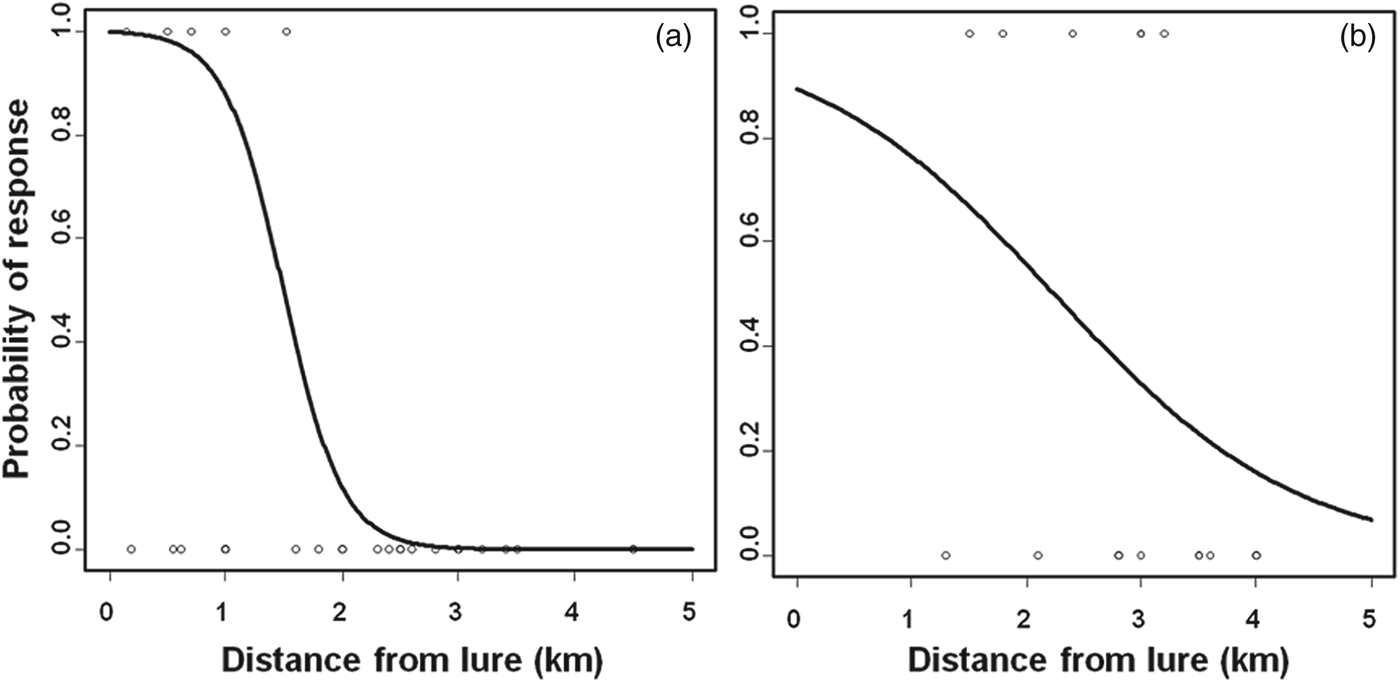
A total area of 6,674 km2 was surveyed, with 35 playback points in the Queen Elizabeth Protected Area, 24 in Kidepo Valley National Park and 72 in Murchison Falls Conservation Area (Table 1). Hyaenas and lions responded differently to playbacks of the buffalo call (Fig. 2). The probabilities of detection of a lion and a hyaena within 5 km were 0.10 and 0.30, respectively. The effective radius of response was calculated as 1.56 km for lions and 2.75 km for hyaenas, which is much lower than the maximum response distances (3.0 and 3.2 km, respectively). This was used to calculate the area sampled and the percentage sampling effort for the conservation area (Table 1).
The probability of response for lions (a), generated from data collected in this study, and for spotted hyaenas (b), from Mills (Reference Mills, Juritz and Zucchini2001), plotted against distance (km) from the call-up station. The curve represents animals that have not been involved in previous trials; probability of response is lower for animals that have been involved in previous trials.
Total area of each of Uganda's three main strongholds for lions and hyaenas (Fig. 1), area of suitable habitat where call-up stations were established, and the percentage of this area sampled by the call-ups, based on the effective radius of the response. The effective radii of response are smaller than those used in previous counts where the maximum distance was used; therefore the percentage sampling effort is lower but more accurate.

The buffalo calf distress call attracted both small and large carnivores to the call stations. Side-striped jackals Canis adustus, black-backed jackals Canis mesomelas, white-tailed mongooses Ichnuemia albicauda and large spotted genets Genetta tigrina responded in Kidepo Valley National Park and Murchison Falls Conservation Area. A total of 66 lions, 176 hyaenas and seven leopards were recorded at call stations. The Queen Elizabeth Protected Area had the largest single group response from lions (10, at a Ugandan kob Kobus kob thomasi lek in the northern sector; Fig. 3) and hyaenas (14, in the southern sector).
The locations of call-up points and sites where lions responded in the Queen Elizabeth Protected Area.

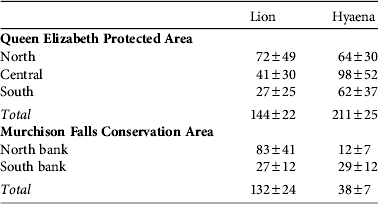
Using lure count analysis the Queen Elizabeth Protected Area was estimated to have a total of 144 ± SE 22 lions. The number of hyaenas was estimated to be 211 ± SE 25. The Protected Area was divided into three sectors for analysis (Fig. 3; Table 2): northern (north of the Kazinga channel that runs between Lakes George and Edward), central (south of the Kazinga channel but north of Maramagambo forest) and southern (Ishasha sector). We have studied the lions in the southern sector since 2005 and recognize all of the individuals. The estimated abundance from the lure counts (27) was close to the known population at the time (29), providing some support for the use of this method to census lions. Standard errors of estimates are high because of small sample sizes.
Estimated number (± SE) of lions Panthera leo and hyaenas Crocuta crocuta in the three sectors of the Queen Elizabeth Protected Area, and overall, and north and south of the Nile in the Murchison Falls Conservation Area, and overall.
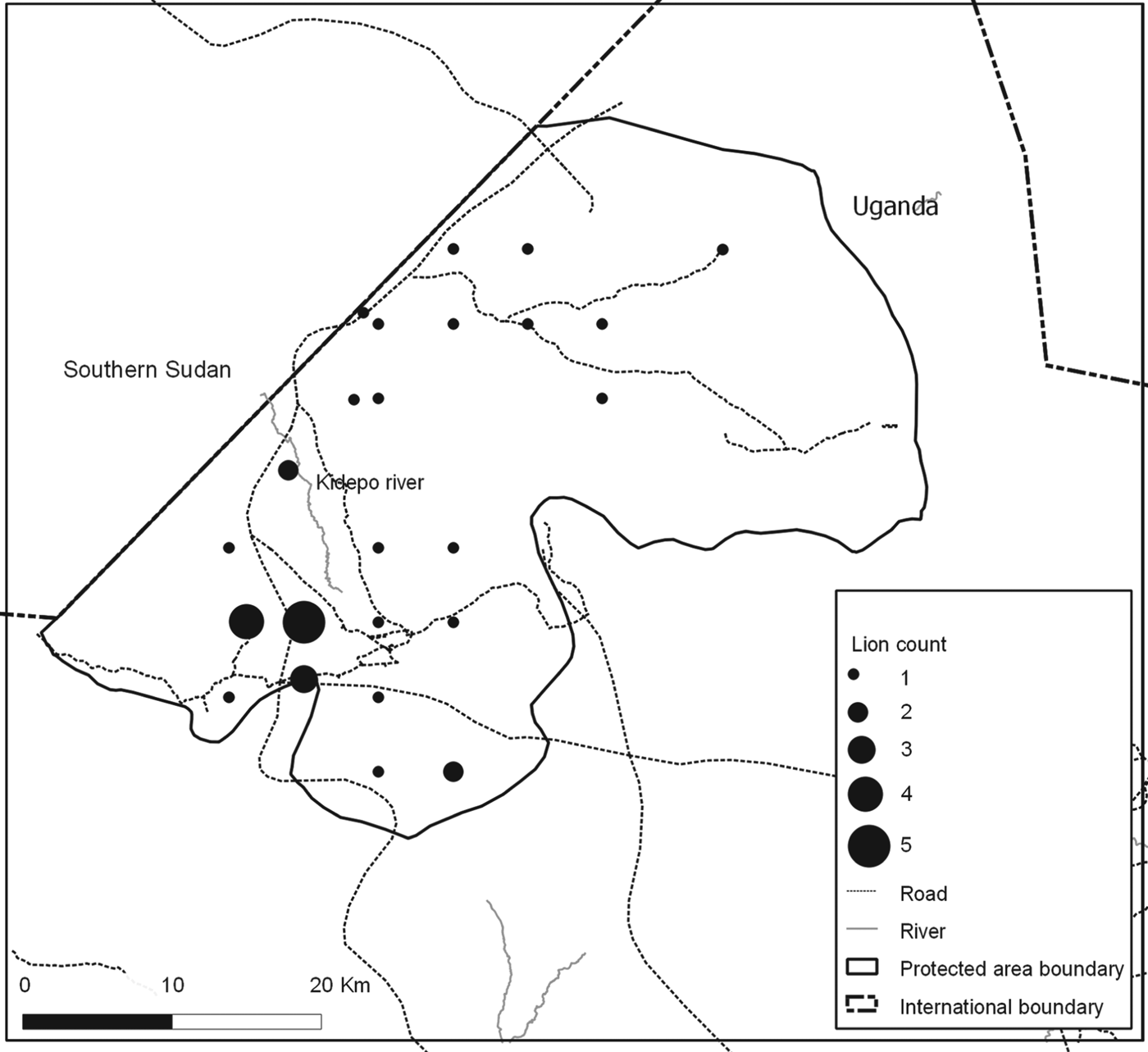
Some areas in the east of Kidepo Valley National Park were omitted for reasons of security and poor accessibility but it is thought that few carnivores occur here because most of the prey species have been hunted by Karamojong warriors (Uganda Wildlife Authority, unpubl. aerial survey data). The largest group of lions (four individuals) in the Park (Fig. 4) was recorded in Narus valley, which constitutes the western half of the Park, and the largest hyaena group (eight individuals) was recorded in the same valley, near the Park headquarters. The estimated numbers of lions and hyaenas in the Park were 132 ± SE 77 and 75 ± SE 33, respectively.
The locations of call-up points and sites where lions responded in the Kidepo Valley National Park.
In Murchison Falls Conservation Area the largest lion group recorded at a call station (four individuals) was at Pakuba Airstrip, in the north-west of the Park (Fig. 5). For analysis the Conservation Area was divided into the northern and southern banks of the Nile and estimates made for each bank (Table 2). Using the lure count analysis we estimated that there were 132 ± SE 24 and 38 ± SE 7 lions and hyaenas, respectively. The number of hyaenas is low given that this is the largest park in Uganda.
The locations of call-up points and sites where lions responded in the Murchison Falls Conservation Area.

The three areas we surveyed contain most of Uganda's lions and hyaenas. There are very few lions (2–8) in the Toro-Semliki Wildlife Reserve and there have been sightings of up to five lions in Lake Mburo National Park after an absence of sightings for several years. Hyaenas are known to occur in Lake Mburo National Park, Mt Elgon National Park and Mgahinga Gorilla National Park but numbers are unknown and likely to be few (Uganda Wildlife Authority, unpubl. data). The wildlife reserves in the east of the country (Pian Upe, Matheniko and Bokora) may contain a small number of hyaenas but they have probably been hunted by Karamojong pastoralists and no sightings have been made by rangers in recent years. Therefore, our estimate of 408 lions and 324 hyaenas could probably be revised to a national population estimate by including a maximum of 10 lions at other sites and possibly 40 hyaenas, giving a total of c. 420 lions and 360 hyaenas in Uganda.
Discussion
In 2006 the Uganda Wildlife Authority (UWA), the Wildlife Conservation Society (WCS) and the Institut Congolais pour la Conservation de la Nature conducted aerial surveys of large mammals, including lion prey species, in the Queen Elizabeth Protected Area and Parc National des Virunga in neighbouring Democratic Republic of the Congo. Prey species included buffalo Syncerus caffer, bushpig Potamochoerus larvatus, bushbuck Tragelaphus scriptus, Ugandan kob Kobus kob thomasi, warthog Phacochoerus africanus, waterbuck Kobus ellipsiprymnus, reedbuck Redunca redunca and topi Damaliscus lunatus. Treves et al. (Reference Treves, Plumptre, Hunter and Ziwa2009) used these surveys to estimate the number of lions from prey densities. They estimated 140 lions in the Protected Area, which is close to our own estimate. These calculations indicate that the estimated population of lions is probably close to the carrying capacity of the Protected Area, based on prey availability.
In Murchison Falls Conservation Area and Kidepo Valley National Park aerial surveys of large mammals were conducted in 2010 by UWA and WCS. Prey species included giraffe Giraffa camelopardalis rothschildi, Ugandan kob, warthog, waterbuck, buffalo and hartebeest Alcelaphus buselaphus. Kidepo Valley National Park also contained bush duiker Sylvicapra grimmia, eland Taurotragus oryx, reedbuck, and zebra Equus quagga. Based on these prey estimates the number of lions in the Murchison Falls Conservation Area is estimated to be 171, compared with 132 ± SE 24 predicted by the lure count analysis. However, lions have been monitored on the northern bank of the Nile since 2010 and at least 79 individual lions are recognized, which is relatively close to the 83 estimated from prey abundance in that area. In total 40 lions responded to the call-ups in Kidepo Valley National Park. There is a large standard error around the estimate of 132 ± 77 for this population because lions only responded at five call-up points (Fig. 4). Based on rangers’ knowledge of the lions in the Park we believe we may be overestimating the number of lions here. We recommend a more intensive survey of the Narus valley, with more call-up points, to generate a better estimate of the populations of lions and hyaenas in this Park.
Studies of the lion in Uganda have been neither consistent nor exhaustive. The Queen Elizabeth Protected Area has been surveyed most frequently (Din, Reference Din1978; van Orsdol, Reference Van Orsdol1981; Driciru, Reference Driciru1999). Although previous researchers have used a different survey method we believe that the results we obtained using the call-up method are at approximately the correct level. The trends in the estimates show that lion numbers have been decreasing in the Queen Elizabeth Protected Area and Murchison Falls National Park but increasing in Kidepo Valley National Park (Table 3).
Estimates from researchers and park rangers of lion numbers in Uganda's conservation areas from 1997 to 2010. The numbers for 2000–2002 and 2004 are based on educated guesses; all other numbers are based on survey data.

Lion numbers declined by nearly 3% per year during 1999–2009 in the Queen Elizabeth Protected Area, if previous estimates are comparable with our numbers.
There are no published data on hyaena population status in Uganda and it is therefore difficult to assess the trend in hyaena numbers. However, we know that hyaenas have been killed by poisoning in retaliation for killing livestock. The carcasses of cattle that have been killed by predators are laced with Carbofuran or a similar insecticide and this kills whatever species feeds on the carcass, including hyaenas, lions and vultures (Okot & Plumptre, Reference Okot and Plumptre2011). It is probable that hyaenas are also declining as a result of poisoning. The use of calibration data from Kruger National Park may have affected the population estimates as a result of variations in vegetation, call-up equipment and temperature, all of which may lead to different responses by hyaenas. Developing a calibration curve for this species in Uganda should be a priority for future research.
Our survey results have been used by the Uganda Wildlife Authority to help develop a conservation action plan for Uganda's large carnivores (UWA, 2010). The plan aims to tackle some of the main threats to carnivores, particularly human–wildlife conflict over livestock losses, road kills in protected areas, and killing of carnivores for trade in body parts. It also supports initiatives to improve prey numbers. The lure count analysis method from call-up counts described here will be used to monitor the numbers of lions and hyaenas to assess whether the decline in numbers has been halted or reversed.
Acknowledgements
We are grateful to Panthera and the United States Agency for International Development for the training and donation provided to make this research possible. We also thank the Uganda Wildlife Authority for granting us permission to conduct our study in National Parks, with the assistance of armed rangers, and Mustafa Nsubuga for assistance with field data collection.
Biographical sketches
Edward Okot Omoya has been studying and conserving the lion population of Queen Elizabeth Protected Area, focusing on the population dynamics of the tree-climbing lions of Ishasha and working with the Basongora pastoralists to tackle human–wildlife conflict. Tutilo Mudumba has been studying and conserving the lion population in Murchison Falls National Park. His research focuses on the impacts of oil exploration on large carnivores and their prey. Stephen Buckland’s research interests include modelling population dynamics, wildlife resource management, wildlife population assessment, distance sampling and biodiversity monitoring. Paul Mulondo is studying the effects of oil exploration on large mammals and birds in the Murchison Falls National Park. Andrew Plumptre has been undertaking applied conservation research in east Africa since 1988. His research interests include survey methods in tropical forests, conservation planning and conservation of great apes.



