




Introduction
In the Koźle Basin in southern Poland (Figure 1), many features of the contemporary landscape attest to past military activities. Indeed, the Basin is one of the most radically transformed landscapes in Europe as a result of aerial bombardment during the 1940s. At that time the Koźle Basin was part of Germany. In the final phase of the Second World War, the U.S. Air Forces used a variety of ordnance to destroy fuel plants in the area: 500lb (227kg) and 250lb (113kg) demolition bombs, 500lb and 250lb general-purpose bombs, and 250lb and 70lb (32kg) incendiary bombs (Craven & Cate Reference Craven and Cate1983; Asch et al. Reference Asch, Graff and Ramey1991; Ehlers Reference Ehlers2009).
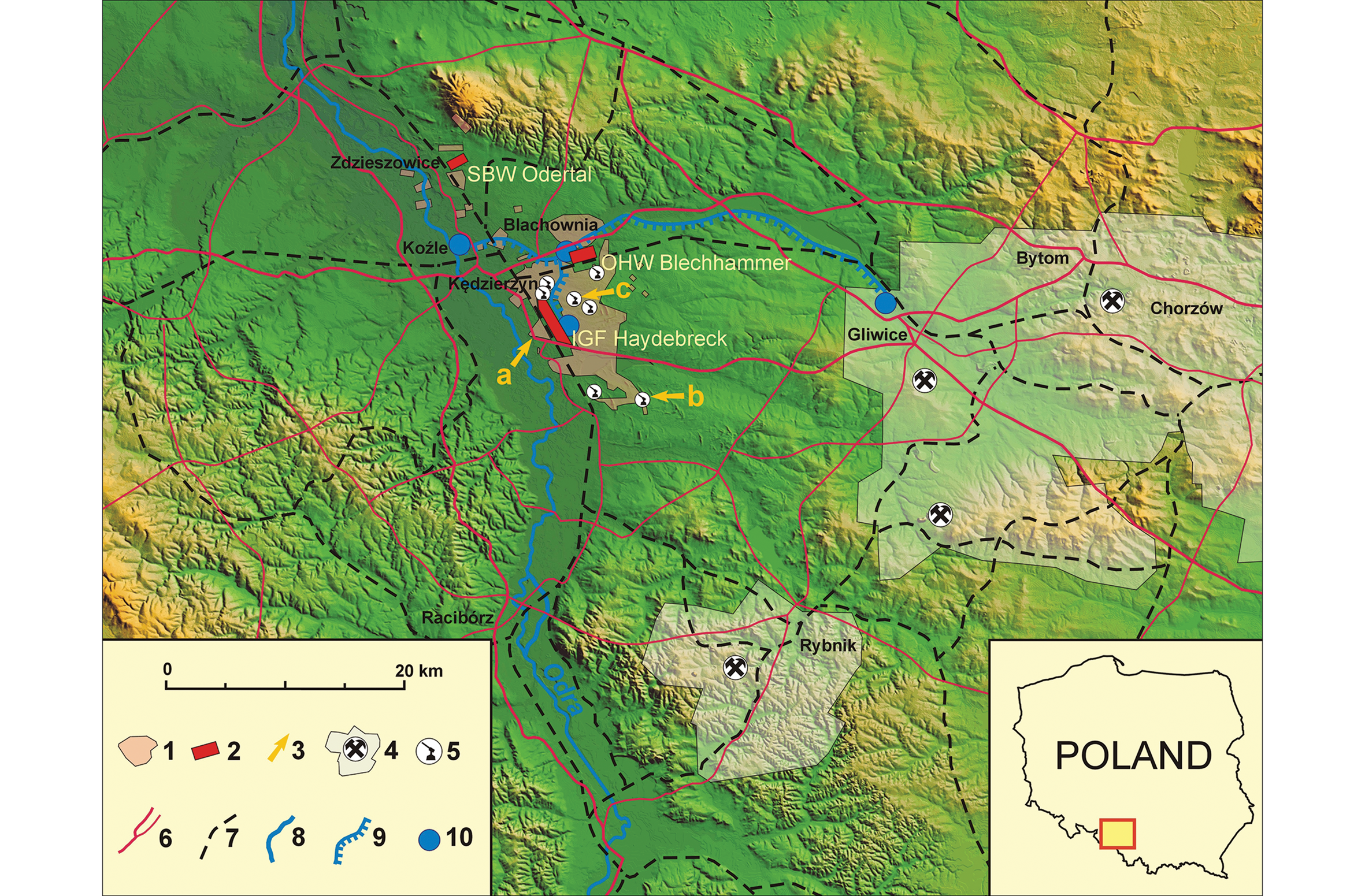
Site map of the Koźle Basin: 1) area with bomb craters; 2) former synthetic fuel plant; 3a) study area; 3b) flak battery near Dziergowice; 3c) former foresters' lodge in Dąbrowa; 4) coal-mining area; 5) flak battery; 6) roads; 7) railway line; 8) river; 9) canal; 10) port (figure by Jan Maciej Waga, digital elevation model prepared by Jerzy Nita).
Most archaeological research on areas similarly transformed by artillery shells or bombs dropped from aircraft concentrates on northern France, Belgium and the Netherlands, and includes descriptions of craters from both the First and Second World Wars (e.g. Passmore et al. Reference Passmore, Harrison and Capps-Tunwell2014, Reference Passmore, Capps-Tunwell, Harrison, Moreira, Derderian and Bissonnette2018; Capps-Tunwell et al. Reference Capps-Tunwell, Passmore and Harrison2016, Reference Capps-Tunwell, Passmore and Harrison2018; de Matos-Machado et al. Reference de Matos-Machado, Toumazet, Bergès, Amat, Arnaud-Fassetta, Bétard, Bilodeau, Hupy and Jacquemot2019; van der Schriek Reference van der Schriek, Sutherland, Shiels, Hughes and Sutherland2019; Passmore & Capps-Tunwell Reference Passmore and Capps-Tunwell2020). In Poland there has been relatively little research on such landscapes (see Kobiałka Reference Kobiałka2017, Reference Kobiałka2018). Over the past decade or so, researchers have paid particular attention to the role of lidar image analysis and other detection methods in studying former battlefields—especially those that are now covered by dense vegetation (e.g. Hesse Reference Hesse2010; Passmore et al. Reference Passmore, Harrison and Capps-Tunwell2014; van der Schriek & Beex Reference van der Schriek and Beex2017; Brenner et al. Reference Brenner, Zambanini and Sablatnig2018; Gheyle et al. Reference Gheyle, Stichelbaut, Saey, Note, van den Berghe, van Eetvelde, van Meirvenne and Bourgeois2018; Clermont et al. Reference Clermont, Kruse, Rottensteiner and Heipke2019; Kruse et al. Reference Kruse, Rottensteiner and Heipke2019; de Matos-Machado et al. Reference de Matos-Machado, Toumazet, Bergès, Amat, Arnaud-Fassetta, Bétard, Bilodeau, Hupy and Jacquemot2019; Note et al. Reference Note, Saey, Gheyle, Stichelbaut, van den Berghe, Bourgeois, van Eetvelde and van Meirvenne2019; Passmore & Capps-Tunwell Reference Passmore and Capps-Tunwell2020).
The aim of this article is to present research on craters that highlights the massive aerial bombing of local industrial plants in the Koźle Basin in 1944, along with the craters’ morphological and morphometric characteristics. We present the first investigation of an intensively bombed Polish landscape, which offers an important contribution to the field of conflict archaeology. The results will, among other outcomes, inform appropriate decisions concerning the protection of these craters as both a cultural and natural heritage landscape.
Methods and materials
We have mapped the distribution of individual craters within the study area through the analysis of a shaded relief map generated from extant lidar data (resolution 4pts/m2, lit from the 315° azimuth; map based on data from www.polska.e-mapa.net). The diameter of each crater has been documented using a distance and surface area measurement application. We sought to establish the dimensions of the craters before they were transformed by human or animal activity (e.g. by animals accessing the water within or by boar wallows).
Crater diameters depend not only on the mass of bombs dropped and the type of fuses used, but also on the geological and hydrological conditions of the ground. Our analysis of the size and shape of craters was therefore focused on areas within each similar geo-environmental feature. These comprise Pleistocene and Holocene terraces formed from mineral river sediments, aeolian sand fields, and peaty wetlands and oxbow lakes. Using remote sensing and field observations, detailed measurements of craters located in these areas were collected and the state of each crater's preservation determined. Field measurements were taken using a GPSMAP 62st receiver and Nikon Forestry Pro laser rangefinder with an optical viewfinder and a level staff. Bathymetric measurements of water bodies in the craters were also taken using a scaled telescopic arm with measuring tape and weight, with readings taken using binoculars. A manual geological probe was used to identify geological conditions on the walls of deeper craters in existing excavations (e.g. drainage ditches, sandpits, footings) and also in safe zones clear of unexploded bombs. We also made use of geological, hydrographic, soil and sozological (i.e. environmental conditions) maps and data from the Geological Database of the Polish Geological Institute.
In addition, we analysed archival mission reports and publications from the Air Force Historical Research Agency website (https://www.afhra.af.mil), the National Archives (https://www.archives.gov) and The Fifteenth Air Force (https://15thaf.org), as well as scientific literature on the Allied air offensive against the Third Reich and other sources that document warfare in Silesia and its material remains.
Study area
The study area lies to the south of Kędzierzyn Koźle in Poland (3a on Figure 1), within the Koźle Basin that forms part of the Silesian Lowland. In the Koźle Basin sandy levels associated with the deglaciation of the Odra ice-sheet, as well as a system of six sandy river terraces, are present. On the right bank of the Odra River, large alluvial fans correspond to the location of the most extensive Vistulian (Weichselian) terrace. Almost the entire area of the Koźle Basin is covered by Quaternary sediments. Fifty per cent of the Basin is covered with a layer of aeolian sands, the thickness of which ranges from several dozen centimetres to 2m, and numerous dunes are present. The extensive presence of sand in the Koźle Basin has resulted in the development of podzolic and rusty (Brunic Arenosol) soils (www.polska.e-mapa.net), which are covered with forests. In many places, water is present either on the surface of sandy, silty terraces or as a shallow water table, and drains via ditches to the rivers.
Air masses often stagnate in the Koźle Basin, but as it is open to the north-west, it can be ventilated rapidly depending on the direction of wind. During the Second World War, these topoclimatic conditions were used most effectively by the Germans for deploying anti-aircraft smoke screens (Konieczny Reference Konieczny1998; Mahoney Reference Mahoney2013). The defensive characteristics of the area (which is, importantly, covered by woods that further concealed German activity) were enhanced by the fact that it was sheltered by hills, which surrounded it in a horseshoe shape (Figure 1). By the 1930s the Koźle Basin already benefitted from an efficient transport infrastructure, comprising a large railway junction, a river port, the regulated Odra River, the Gliwice Canal and a network of good-quality roads. Raw materials in the form of coal and water resources were also available nearby (Figure 1).
The German chemicals and fuel industry in the 1930s and 1940s
The German war plans of the 1930s placed an emphasis on mechanised units, which increased the demand for fuels, oils and lubricants. As a result, the construction of hydrocarbon-production plants commenced at several sites. Due to the convenient location (both environmental and economic) of the Koźle Basin, a decision was made to construct the Third Reich's largest fuel production plants near Heydebreck (now Kędzierzyn) (Ehlers Reference Ehlers2009; Figure 1). The Schaffgotsch Benzin Werke GmbH Odertal plant (SBW on Figure 1) had already been commissioned in 1939. The construction of the Oberschlesische Hydrierwerke AG Blechhammer and IG Farbenindustrie AG Werke Heydebreck plants commenced in late 1939, and fuel production at both these plants started in early 1944. The target output was 350 000 tonnes of fuel per year for Blechhammer and 300 000 tonnes for Heydebreck. The plant in Odertal (now Zdzieszowice) could produce up to 80 000 tonnes of fuel per year. Due to technical difficulties and the impact of bombing by the 15th United States Air Force (USAF), however, these planned levels of output were never achieved (Konieczny Reference Konieczny1998; Haduch Reference Haduchn.d.).
Allied combat operations and the German defence of chemical and fuel plants
In January 1943, the Western Allies planned attacks by Royal Air Force (RAF) Bomber Command and the 8th USAF against German oil refineries and synthetic petrol plants. In September 1943, after the Foggia region of southern Italy had been occupied by the Allies (Holland Reference Holland2018), the 15th USAF began to assemble in this area. From 20 February 1944, as part of the ‘Big Week Offensive’, the 8th and 15th USAF, together with the RAF, launched frequent attacks on selected ground targets and proceeded to exhaust the combat capabilities of the German forces (Holland Reference Holland2018). At the beginning of May 1944, the Americans and the British launched highly effective attacks against five synthetic fuel plants in central Germany, with further heavy bombardment following on 28 and 30 May (Konieczny Reference Konieczny1998).
The Germans reinforced the defence of the Koźle plants by, among other precautions, installing anti-aircraft artillery, laying smoke screens and constructing air-raid shelters. Due to the high ceiling from which the US B-17 and B-24 bombers dropped their loads (6700–8900m), however, only high-powered anti-aircraft batteries were able to shoot down enemy aircraft (Fifteenth Air Force 1944; Craven & Cate Reference Craven and Cate1983; Levine Reference Levine1992).
On 8 June 1944, a directive was issued to the 8th and 15th USAF to prioritise attacks against fuel industry facilities. The plants at Blechhammer, Heydebreck and Odertal in the Koźle Basin were allocated to the 15th USAF (Craven & Cate Reference Craven and Cate1983). By September 1944, despite large losses, the Western Allies managed to reduce fuel production at German refineries to just eight per cent of the April level (Konieczny Reference Konieczny1998). On 7 July 1944, large-scale bombardment of fuel factories in the Heydebreck area began; of the 18 raids, 15 directly targeted the Blechhammer and Heydebreck factories (Asch et al. Reference Asch, Graff and Ramey1991; Carter & Mueller Reference Carter and Mueller1991; Mahoney Reference Mahoney2013). After the first attack, the Germans stationed their anti-aircraft batteries close to the industrial plants. Earthworks representing seven such batteries survive today (Figure 1).
Results
Bombing effects recorded in the contemporary landscape
According to wartime documents (Konieczny Reference Konieczny1998), a total of 26 683 500lb demolition bombs and 3236 250lb general-purpose bombs were dropped on Blechhammer and Heydebreck, and 6808 500lb demolition bombs and 2410 250lb general-purpose bombs were dropped on Odertal (Table 1). This gives a total of 39 137 bombs. These were mostly delay-action bombs (nose fuse: delay 0.1s; and tail fuse: delay 0.01/0.025s; Fifteenth Air Force 1944), intended for the destruction of buildings, reinforced concrete and metal structures, as well as land-cratering.
Intensity of 15th USAF air raids on fuel plants near Kędzierzyn-Koźle (based on the data presented by Konieczny (Reference Konieczny1998)). B = demolition bombs (with Royal Demolition Explosive), B500 = 500lb; B250 = 250lb; Z = incendiary bombs, Z500 = 500lb, Z70– = 70lb; O = general-purpose bombs (GP), O500 = 500lb, O250 = 250lb.

* Estimated number and tonnage of bombs per aircraft during raids in the period described.
** Number and tonnage of bombs as estimated by the German Armaments Inspectorate.
*** Estimated number of bombs after deducting the tonnage of demolition and general-purpose bombs.
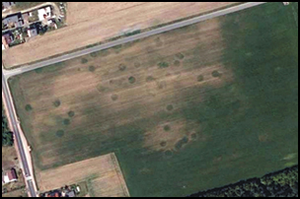
Due to the effective smoke screens deployed over the Heydebreck and Blechhammer plants, the high drop heights and intense anti-aircraft fire, many of the bombs failed to hit their targets (fuel-production plants, transport junctions and communication lines), instead exploding in forests, fields and sometimes villages. After the war, effects of the bombings were removed in industrial and settlement areas, as well as from communication routes; craters in fields were also backfilled (Figure 2: P1). The situation in wooded areas, however, was different. The many forests and marshy wastelands around Kędzierzyn-Koźle have preserved Poland's largest complex of open craters associated with intense Second World War bombing. These are predominantly large craters left by 500lb demolition bombs, and whose current diameters range from 10–15m. They are often more than 2m deep. Smaller, 5–10m-diameter craters were left by 250lb bombs (the size ranges of these two forms, however, may partially overlap). The craters are visible in lidar-based digital elevation models (DEMs) (Figures 3–4). We identified 5238 well-preserved large bomb craters and 151 smaller ones in the vicinity of the former synthetic fuel plants at Kędzierzyn and Blachownia, and 484 large craters and 147 smaller ones near Zdzieszowice. There are also many features that are less well defined in the DEMs.
Bombardment areas (orthophotomaps: polska.e-mapa.net): P1) arable field; P2) new forest stand; P3) new forest stand (left), moor (centre), second-growth forest (right); P4) second-growth forest and meadow (prepared by Jan Maciej Waga).

Study area: 1) bomb craters; 2) detailed study area; 3) area shown in the orthophotomap; 4) P1, arable field; P2–4, properly managed forest land; 5) area of detailed studies; 6) bombing directions; 7) main railway line (figure prepared by Jan Maciej Waga, digital elevation model available from polska.e-mapa.net).

Detailed study area: A: a–d) areas of detailed studies; a1–c1) location of the studied craters; their morphological profiles are below; c2) dune fragment with a triple crater; e) marsh; f) surface of the Vistulian terrace; g) dune; B) chart of the diameters of craters in the studied area (figure prepared by Jan Maciej Waga, digital elevation model available from polska.e-mapa.net).

We carried out detailed analysis of a zone with large clusters of craters near the western perimeter of the former IG Farbenindustrie AG Werke Heydebreck plant (Figure 3). Here, the density of clustered craters ranges from approximately 12–28 per hectare. The site selected for the study is representative of the area of Kędzierzyn and Blachownia in terms of its soil and water conditions. It is situated within the Vistulian terrace, which comprises sands interbedded with silt, with organic deposits accumulated in depressions. Three individual study areas were delineated within the detailed study zone: marshy area ‘a’, area ‘b’ with groundwater present at shallow depths, and area ‘c’ with groundwater present at greater depths; the latter are covered by aeolian sands (Figure 4). The first groundwater level in these three areas, which is present at depths ranging from 0–3m, is subject to seasonal fluctuations. These areas are drained by drainage ditches. Area ‘d’ is located near the heavily bombed freight railway station, immediately adjacent to the edge of the plant, and therefore includes the largest cluster of craters. Some of these have been transformed into rectangular pits into which sappers deposited unexploded ordnance found close to the plant after the air raids, while some were backfilled after the war (Figure 4).
The craters with the largest diameters—usually over 12m—are present in area ‘a’. The largest has a diameter of 15m (a1 on Figure 4) and is situated in the central part of a hollow ‘valley’, in which organic deposits reach a thickness of 1m. Within this ‘valley’, the craters have turned into small pools of water up to 1m deep (Figure 5A). Lidar scanning has identified small peaks in the centres of many craters within the marsh (area ‘a’) and its immediate vicinity. In area ‘b’, crater diameters range from 10–12m (Figure 4), and the degree to which they have been filled with deposits and water is much lower than in area ‘a’. These craters are also deeper and the ridges around them are more pronounced (Figures 5B–C). The smallest changes—both primary (occurring just after the explosion) and secondary (taking place in the following years)—were observed in area ‘c’, within craters situated at higher levels where groundwater can be found at greater depths. Here, the craters have diameters of around 5–10m (left by 250lb bombs) and 10–12m (left by 500lb bombs), and are of considerable depth. There is one spot where as many as three bombs hit, but there are numerous twin craters where two bombs fell (see Figure 4: c2).
Craters: A) within the marsh; B) in the upper part of terrace; C) in the lower part of terrace; D) on the dune (photographs A, C & D by Jan Maciej Waga, B by Maria Fajer).

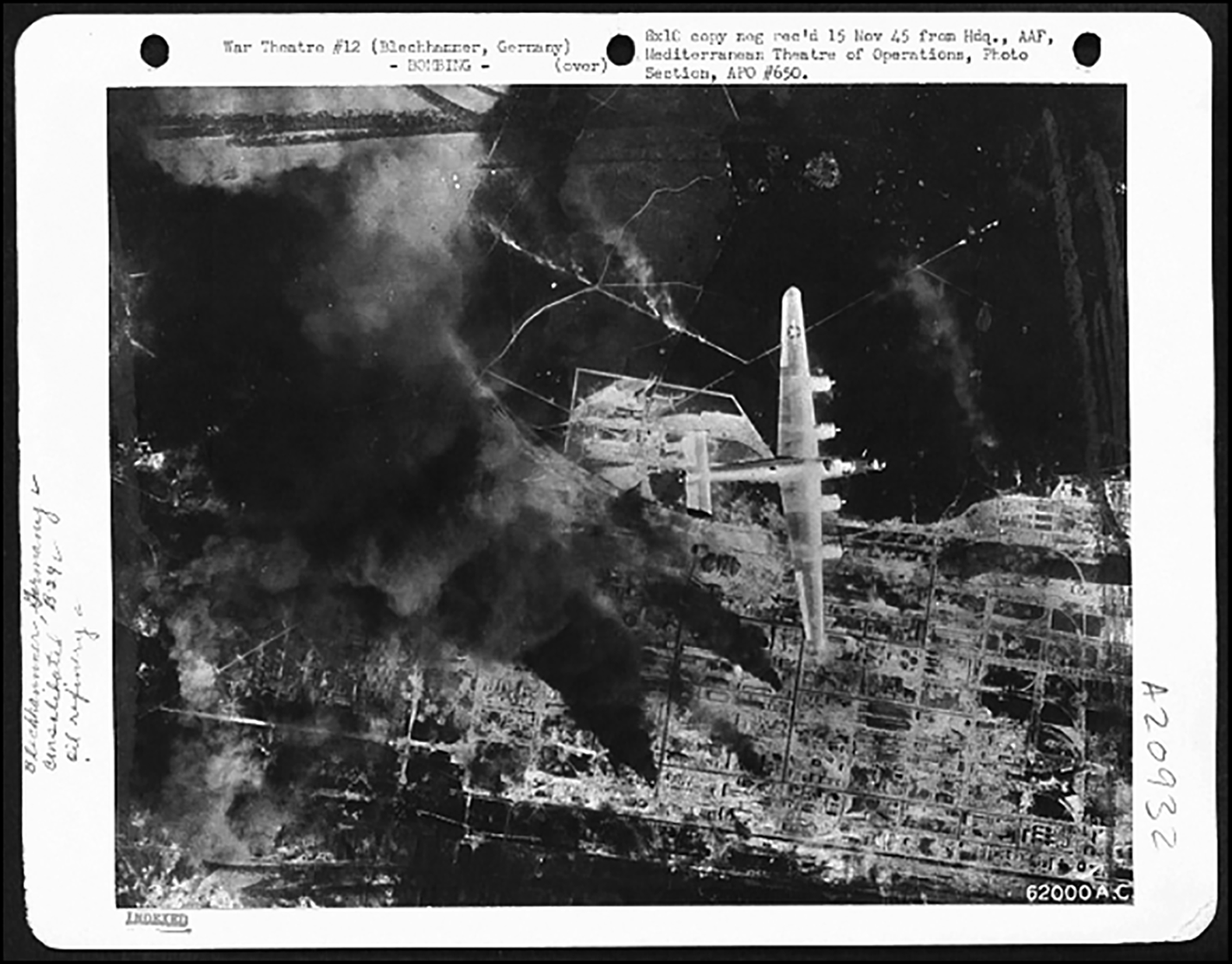
The arrangement of some craters may indicate the approximate azimuths of the air raids carried out against IG Farbenindustrie Werke Heydebreck (Figure 3). These were 39°, 53°, 75°, 78°, 82°, 88°, 147° and 149°. Some of these directions are confirmed by the aerial photographs taken during the operations in question (Figure 6), as well as daily reports from the missions of the Fifteenth Air Force (https://15thaf.org/). To the south-west of the IG Farben plant was located a flak (FlugabwehrKanone) anti-aircraft battery (Figure 7). Nine craters were found approximately 270m to the north-west of the battery and 16 craters 1km to the south. In the south, the craters’ sizes and numbers suggest the use of 250lb bombs. Here, the bombs fell on a dune and on marshy depressions, leaving craters with various diameters. Given that flak batteries were not included as targets in similar large-scale air raids, the significance of the spatial relationship between these three sets of craters is unclear.
B-24 bomber over the IG Farben plant, with part of the detailed study area visible below (source: National Archives and Records Administration, https://catalog.archives.gov/id/193769549).
Flak battery near Dziergowice: 1) location; 2) bombardment area; 3) bombardment direction (figure prepared by Jan Maciej Waga, digital elevation model available from polska.e-mapa.net).

Discussion
Of the numerous craters preserved around the Kędzierzyn area, large 500lb bomb craters dominate, with fewer craters left by 250lb bombs. We found a bimodal distribution of crater diameters (Figure 4A), reflecting the use of bombs of two weight categories. In the diameter range 9–11m, the impacts of explosions overlap (Figure 4B). Passmore et al. (Reference Passmore, Capps-Tunwell, Harrison, Moreira, Derderian and Bissonnette2018) present charts that show correlations between crater sizes, bomb weights, fuse types and soil types. The sizes of the craters found in the Koźle Basin fit well into Passmore et al.'s (Reference Passmore, Capps-Tunwell, Harrison, Moreira, Derderian and Bissonnette2018) parameters. In heavily waterlogged and marshy areas, however, crater diameters exceed those shown on the charts, as the wet soil on which the bombs fell lacked cohesion. There are also central peaks present within these bomb craters. Such landforms were described elsewhere (e.g. Trusheim Reference Trusheim1940) at the outset of the Second World War. Central peak structures that are similar in shape, although much larger, can also be observed in meteorite impact craters on Earth and other celestial bodies, and are considered to be the result of a complex process that occurs as rock layers of the substrate react to the impact (Baker et al. Reference Baker, Head, Collins and Potter2016). Laboratory tests have established that the formation of central peak structures requires a considerable impact force directed at a steep angle (70–90°) relative to the ground surface. It has also been found that such landforms are larger and better developed when fine-grained material is involved (Katsuragi Reference Katsuragi2016).
The craters in the vicinity of Kędzierzyn were created by explosions, and two main stages can be distinguished in their formation process. The first stage involves the bomb entering the ground and detonating, with a limited quantity of soil being thrown into the air and the remaining soil being displaced sideways and downwards, where it was compressed. In water-rich soil conditions, immediately after the shockwave has faded, liquefied floating earth moves into the vacated space within the crater, driven by the sudden drop in pressure at the explosion site and the forces of cohesion and gravity. Soil particles converge concentrically in the centre of the crater, forming a convexity. This process can be compared to the behaviour of the hydrocode model presented by Pierazzo and Collins (Reference Pierazzo, Collins, Dypvik, Burchell and Claeys2004), or the actual fluidised medium in Gault and Greeley's experiment (Reference Gault and Greeley1978). The central peak comprises slightly heavier material, while a mineral-organic suspension with a lower specific gravity accumulates around it. Those soil particles that are thrown almost vertically upwards fall on the crater's surface, while the rest are scattered around the bomb impact site. The second phase involves slower processes, in which material from crater edges and slopes slumps onto its base, which had already been covered with sediments. The resulting landform, although deep, resembles a plate rather than a crater on the surface. Such forms are present, inter alia, in area ‘a’.
Where a bomb penetrates a thicker layer of dry earth and the base of the crater reaches below the groundwater table, an outflow of floating earth from the lower layers surrounding the crater could occur. A higher ridge than in the case described above then forms at the edge of the crater. These forms resemble shallow pans, and can often include central peaks. Such landforms can be found in area ‘b’. Dynamic secondary processes take place on the slopes of explosion craters situated in waterlogged areas and in those areas where groundwater can be found at shallow depths. These include mudflows, rill erosion, scouring and subsequent bioturbations, such as animal trampling of the crater edges and perforation of their slopes by rooting and burrowing. Craters located in areas with a deeper water table are smaller in diameter, and filled to a lesser extent with sediment, as material from their slopes is transported more slowly towards the base. Their ‘poorer’ habitat (i.e. less biodiversity) generates less biomass. Landforms of this type can be found in area ‘c’.
The bomb craters in the vicinity of Kędzierzyn-Koźle are relics that document important historical events, and that constitute a link between the area and the battlefields of Europe and beyond. In Western Europe, bomb craters are often protected in multiple ways (cf. Passmore & Harrison Reference Passmore and Harrison2008; Capps-Tunwell et al. Reference Capps-Tunwell, Passmore and Harrison2016; de Matos-Machado et al. Reference de Matos-Machado, Toumazet, Bergès, Amat, Arnaud-Fassetta, Bétard, Bilodeau, Hupy and Jacquemot2019), but this is not the case in Poland. It has taken only a short time for the bomb craters of the Koźle Basin to become new elements of a considerably transformed forest and wetland ecosystem (cf. Hupy & Schaetzl Reference Hupy and Schaetzl2006; Hupy & Koehler Reference Hupy and Koehler2012; Vad et al. Reference Vad2017). They now represent places where many amphibian, reptile, insect, bird and ungulate species reside, seek shelter or breed. The craters also provide habitats for numerous plant species. The many water bodies and marshes that formed in the bomb craters contribute to the diversification and enrichment of local ecosystems, where sandy soils dominate. Here, we have a record of environmental changes that have occurred over the past 75 years. This situation favours a model of complementary protection, recognising both the cultural and natural values of these craters, which are relatively well preserved in the local forested areas (cf. Passmore & Capps-Tunwell Reference Passmore and Capps-Tunwell2020).
Bomb craters still hide dangerous reminders of the Second World War (Clermont et al. Reference Clermont, Kruse, Rottensteiner and Heipke2019; Kruse et al. Reference Kruse, Rottensteiner and Heipke2019), and any hasty attempt to develop these areas without proper hazard neutralisation may prove costly. Moreover, the morphology of forest and open areas should not be altered without strong justification. Since the 1970s, cultivation methods that degrade both the landscape and forest soils have been used in the state-owned forests of Upper Silesia. Humus layers are bulldozed together with rootstocks and pushed into long heaps, although there are less invasive ways of preparing landscapes for the planting of trees. Apart from the degradation of the natural environment, traces of older human activities, such as charcoal-making sites, settlements and military installations are also being destroyed (Figure 8). Such pursuit of short-term goals often eclipses respect for historical value (Zalewska Reference Zalewska2018).
The area around the former foresters' lodge in Dąbrowa (the landscape is transformed as a result of improper forest management): a) site of the former camp for Belgian and French prisoners of war; b) anti-aircraft battery earthworks; c) well-preserved bomb craters; d) partly backfilled craters; e) heaps of soil and rootstocks (figure prepared by Jan Maciej Waga, digital elevation model available from polska.e-mapa.net).

Conclusions
The crater-strewn landscape that was formed in 1944 during heavy bombing around Kędzierzyn-Koźle is a phenomenon of European significance. These remnants of the conflict attest to the tremendous effort expended by both sides during the war, and reflect the enormous costs of warfare. Post-war practice has shown that areas with bomb craters can be effectively utilised in forested areas (Figure 2) by introducing new crops in a manner that does not compromise these landforms. Both dry craters and those containing water are important ecological niches. This is particularly significant in the case of species that have been displaced from the vast, adjacent areas now dedicated to agriculture. The opposite practice, however, is evidenced in forests near the former foresters' lodge in Dąbrowa—just 2km to the east of our detailed study area (Figure 8). There, the landscape has been heavily remodelled by bulldozing of the upper layers of soil and partial levelling of existing craters. The difference in the appearance of the preserved and transformed landforms is clear. In historical education regarding Second World War battles, the images of vast battlefields with surfaces marred by explosions are the most evocative for the general public (Ryan Reference Ryan2007). In order to preserve the memory of those events, selected sets (at least) of such forms should be studied, described and protected. In the case of Kędzierzyn-Koźle, such remnants of war should be safeguarded in a manner that recognises the complementary significance of both their cultural/historical and natural/ecological values.
Acknowledgements
We would like to thank the two anonymous reviewers for their useful suggestions that greatly improved the manuscript.
Funding statement
Open-access funding was provided by the Institute of Earth Sciences, University of Silesia in Katowice.


 Open access

