





Introduction
The planet is facing an unprecedented, multifaceted environmental crisis that threatens both ecosystems and human life in all its forms. Among the most critical environmental issues are climate change, air and water pollution, deforestation, biodiversity loss and poor waste management. Climate change, driven primarily by human activity, is perhaps the most urgent challenge (Romanello et al., Reference Romanello, Di Napoli, Drummond, Green, Kennard, Lampard, Scamman, Arnell, Ayeb-Karlsson, Berrang Ford, Belesova, Bowen, Cai, Callaghan, Campbell-Lendrum, Chambers, van Daalen, Dalin, Dasandi and Costello2022). According to the Intergovernmental Panel on Climate Change (IPCC), global temperatures have risen by approximately 1.1°C since the pre-industrial period (1850–1900) to the present, and it is projected that they could increase by up to 1.5°C between 2030 and 2052 (IPCC, 2021). Additionally, air pollution affects biodiversity by altering soil, water and ecosystem composition, causing adverse effects on flora and fauna (Schnell & Prather, Reference Schnell and Prather2017). Ocean pollution and poor solid waste management are interrelated problems that require urgent attention. It is estimated that over 8 million tons of plastic enter the oceans every year (Lebreton et al., Reference Lebreton, Slat, Ferrari, Sainte-Rose, Aitken, Marthouse, Hajbane, Cunsolo, Schwarz, Levivier, Noble, Debeljak, Maral, Schoeneich-Argent, Brambini and Reisser2018). A recent study published in The Lancet warns that without decisive climate action, catastrophic warming will have severe impacts on public health and biodiversity, exacerbating inequality and increasing the risks of conflicts and mass human displacement (Watts et al., Reference Watts, Adger and Agnolucci2015).
In response to these environmental crises, the United Nations’ Sustainable Development Goals (SDGs) provide a comprehensive framework to address these challenges. SDGs 13 (Climate Action), 14 (Life Below Water) and 15 (Life on Land) are specifically designed to tackle climate change, ocean degradation and biodiversity loss, respectively, and highlight the need for urgent and coordinated global measures (United Nations General Assembly, 2015). However, for these actions to be effective, they must be accompanied by a fundamental shift in education, policies and human behaviour (Kopnina, Reference Kopnina2020). Given the magnitude and complexity of these challenges, the essential role of education in transforming values and behaviours toward sustainability has been widely recognised. Education can not only provide the necessary knowledge about environmental issues but also foster critical awareness and a sense of responsibility in students, who will be the future leaders and citizens tasked with addressing these problems (Rieckmann, Mindt & Gardiner Reference Rieckmann, Mindt and Gardiner2017; UNESCO, 2017). The combination of education with concrete and effective actions is key to successfully tackling these global environmental challenges and reversing the trajectory towards a healthier and more equitable planet for all (World Health Organization, 2018).
Education, a fundamental pillar
As previously argued, education has the potential to play a fundamental role in addressing the global environmental crisis, as it not only imparts knowledge about the planet’s challenges but also has the capacity to foster a critical and proactive mindset in students (Merma-Molina, Gavilán-Martín, Baena-Morales & Urrea-Solano, Reference Merma-Molina, Gavilán-Martín, Baena-Morales and Urrea-Solano2022). However, this potential remains contingent upon significant reforms to current educational systems, particularly in the face of increasing social and ecological crises. It is not enough to raise awareness among young people solely through data and statistics; pedagogical strategies are needed that integrate concrete and experiential actions to reinforce sustainability principles (Baena-Morales & Ferriz-Valero, Reference Baena-Morales and Ferriz-Valero2023). According to a recent study (van Valkengoed et al., Reference van Valkengoed, Abrahamse and Steg2022), educational interventions must go beyond theoretical learning to include practical activities that engage students in solving real-world environmental problems. This approach not only enhances their understanding of environmental challenges but also strengthens their sense of responsibility and empowerment by allowing them to witness the positive impact of their actions.
A study by Kalsoom and Khanam (Reference Kalsoom and Khanam2017) emphasises the need to design educational programmes that not only convey knowledge about sustainability but also motivate students to participate in community initiatives such as clean-up projects, recycling and energy conservation. This experiential learning approach is key to fostering a deep sense of connection with the environment and a lasting commitment to environmental action. Furthermore, recent research has shown that participatory methodologies, such as service-learning projects, can have a significant impact on students’ environmental awareness (García-Rico et al., Reference García-Rico, Martínez-Muñoz, Santos-Pastor and Chiva- Bartoll2021). These projects connect students with local environmental issues and allow them to directly experience the consequences of unsustainable practices, contributing to their resolution. This approach not only increases their knowledge of environmental problems but also improves their ability to think critically and develop innovative solutions (Cheng, Reference Cheng2019).
The action-based learning model has been identified as a powerful tool for fostering environmental competencies in students, as it involves them in identifying problems and implementing solutions. According to a study by Rieckmann (Reference Rieckmann2018), key competencies for sustainability — such as systems thinking, anticipation, strategic competence and integrated problem-solving — can only be effectively developed when students actively engage in practices that allow them to apply these concepts to real-life situations. This approach, validated in various educational settings, highlights the need for a paradigm shift in sustainability education, where students are not merely passive recipients of information but active agents in building a more sustainable future (Rieckmann et al., Reference Rieckmann, Mindt and Gardiner2017). True learning occurs when students not only understand the data and figures but also realise the power of their own ability to influence social and environmental change (Amerstorfer & Freiin von Münster-Kistner, Reference Amerstorfer and Freiin von Münster-Kistner2021). In this context, physical literacy becomes increasingly relevant. The concept of physical literacy has evolved over the past decades beyond the simple mastery of motor skills and knowledge of physical activity (Fröberg & Lundvall, Reference Fröberg and Lundvall2024). The definition that has gained the most visibility describes physically literate individuals as those who move “with poise, economy and confidence in a wide variety of physically challenging situations” (Whitehead, Reference Whitehead2001, p. (131)). A more updated version from Whitehead defines physical literacy as a “disposition to capitalise on our human-embodied capability wherein the individual has the motivation, confidence, physical competence, knowledge and understanding to value and take responsibility for maintaining purposeful physical pursuits and activities throughout the life course” (Whitehead, Reference Whitehead2013, p. 29). Physical literacy encompasses a holistic approach that integrates physical, cognitive and affective development, highlighting the importance of maintaining the motivation, confidence, physical competence, knowledge and understanding necessary to engage in physical activities throughout life (Carl et al., Reference Carl, Barratt, Wanner, Töpfer, Cairney and Pfeifer2022).
In this broader vision of physical literacy, the connections with the competencies for sustainability can be observed, and within this context the relevance of ecological awareness has recently been argued and discussed (Carl et al., Reference Carl, Abu-Omar, Bernard, Lohmann, White and Peters2024). As part of this, the concept of “eco-physical literacy” emerges, proposing that the development of physical skills and environmental awareness should be interconnected. “Eco-physical literacy” aims to cultivate individuals who are not only physically competent but also aware of the importance of sustainability and environmental stewardship. This concept highlights the need to integrate sustainable practices into physical education (PE) to foster pro-environmental attitudes from an early age. PE programs that include environmental education can significantly influence the development of sustainable values and create a more conscious and responsible citizenry (Baena-Morales & González-Villora, Reference Baena-Morales and González-Víllora2022). Activities such as ecological walks, circuits in natural parks, and, more specifically, plogging, are presented as effective pedagogical tools that combine physical literacy with sustainability education (Lee & Choi, Reference Lee and Choi2023).
Plogging, an activity that combines running with picking up litter, is a concrete example of how eco-physical literacy can be promoted. Plogging not only improves students’ physical fitness (running, bending, squatting and lifting) but also allows them to interact directly with their natural environment, encouraging reflection on the impact of their actions on the environment (Baena- Morales, Martínez-Mirambell & Urrea-Solano Reference Baena-Morales, Martínez-Mirambell and Urrea-Solano2024). In fact, this practice has been associated with multiple benefits at a holistic level, including personal, social and environmental (Martinez-Mirambell, Baena-Morales, et al., Reference Martinez-Mirambell, Baena-Morales, García-Taibo and Ferriz-Valero2023). That is to say, the nature of this recreational activity has much in common with the concept of physical literacy presented considering its holistic approach: physical, cognitive and affective. “For instance, plogging provides opportunities for individuals to gain confidence in their physical abilities since it is a discipline adapted to all levels, which also has the capacity to enhance inclusivity”. Completing a plogging session successfully may encourage further participation in physical activities, in addition to maintaining motivation with the challenge of collecting as much trash as possible. Moreover, plogging provides opportunities for people to gain confidence in their physical abilities, as it is a discipline adapted to all levels, which could also enhance inclusion. Participating in this activity fosters a deeper connection with nature, which may enhance students’ sense of responsibility and commitment to sustainability (Baena-Morales, Reference Baena-Morales2021). Students who engage in outdoor physical activities, such as plogging, may develop a greater awareness of the importance of sustainability and exhibit higher environmental self-efficacy (Martínez-Mirambell, Boned-Gómez, et al., Reference Martínez-Mirambell, Boned-Gómez, Urrea-Solano and Baena-Morales2023), that is, a strengthened belief in their ability to contribute to environmental protection through their daily actions (Thomaes et al., Reference Thomaes, Grapsas, van de Wetering, Spitzer and Poorthuis2023). This type of experiential learning allows students to see how simple decisions, such as keeping green spaces clean during physical activities, could have a positive long-term impact.
The PE curriculum should align with the physical literacy concept, including contents such as plogging, to provide an interdisciplinary educational approach that prepares young people to lead healthy and sustainable lives. This approach may not only promote physical well-being but also fosters active engagement in environmental protection. In doing so, it helps cultivate a generation better equipped to face future environmental challenges, understanding the intrinsic connection between their personal well-being and the health of the planet (Carmody, Reference Carmody2012). Despite the physical, mental and environmental benefits of plogging, as well as its growing use in educational settings, there is a notable lack of studies evaluating the perceptions of Physical Education Teacher Education (PETE) students regarding its pedagogical application. Moreover, research has primarily focused on the effects of plogging on students and the promotion of sustainable behaviours (Martinez-Mirambell, Baena-Morales, et al., Reference Martinez-Mirambell, Baena-Morales, García-Taibo and Ferriz-Valero2023), without exploring how future teachers view it as an educational resource. Understanding these perceptions is crucial, as PETE students will be the ones implementing these activities in school and thereby determining their long-term effectiveness.
Therefore, the present study aims to address this research gap by analysing PETE students’ perceptions of the usefulness and feasibility of plogging within the school context. Through a qualitative approach, the study seeks to identify the benefits and challenges that future teachers associate with plogging, as well as the pedagogical strategies they consider most appropriate for integrating it into the school curriculum. This analysis intends to provide a solid foundation for developing more integrated teacher education programmes that combine PE with environmental education, thereby promoting more sustainable educational practices and fostering responsible, active citizens committed to protecting the environment (Pérez-Pueyo, Hortigüela Alcalá, Casado Berrocal, Heras Bernardino & Herrán Álvarez Reference Pérez-Pueyo, Hortigüela Alcalá, Casado Berrocal, Heras Bernardino and Herrán Álvarez2022).
Method
Participants
Eighty PETE students from various universities in Spain participated in the study. The participants were selected through purposive sampling, which is suitable for qualitative studies aiming for a deep understanding of a specific phenomenon (Jones & Gratton, Reference Jones and Gratton2014). The inclusion criteria for the sample selection were: (1) enrolment in the final year of PETE programs across several universities and (2) prior experience with plogging educational practices during their training. This prior experience involved participation in introductory plogging activities as part of their PE training, ensuring a baseline understanding of the concept. This plogging practice’ refers specifically to the intervention conducted during the study and described later in the text. It is distinct from the prior plogging experience mentioned in the inclusion criteria, which served as preliminary exposure to the concept. The intervention consisted of a series of six dynamic sessions designed to promote environmental awareness and physical activity within the framework of the SDGs. Each session was carefully structured to align with specific targets, such as 13.3 (focused on education and awareness about climate change), 12.5 (reducing waste generation through prevention, reduction, recycling and reuse), and 15.1 (protecting and restoring terrestrial ecosystems). The activities included interactive discussions to understand the impact of pollution and the importance of recycling, supported by data, videos, and images. Additionally, practical plogging exercises were conducted, combining physical activity with litter collection to demonstrate how individual actions can tangibly contribute to achieving these environmental targets.. Students participated in collaborative challenges aimed at preventing potential risks associated with the practice of plogging. These activities included team-based obstacle courses, relay races, and problem-solving tasks, emphasising teamwork and safety during litter collection. Participants practiced running techniques and engaged in fitness circuits that enhanced physical fitness while incorporating demonstrations of proper body mechanics for bending, lifting and carrying litter safely during plogging activities.. Collaboration, as well as collective environmental awareness and action, was emphasised and reinforced through discussion.
The sample consisted of 42 women (52.5%) and 38 men (47.5%), with ages ranging from 21 to 30 years (mean age = 24.6 years).
Procedure
The study was conducted between March and May 2024. Initially, educational institutions from three universities were contacted to obtain the necessary permissions and secure the participation of final-year students enrolled in PETE programs. An informational session was conducted at each university by trained researchers from the respective institutions. During these sessions, participants were briefed on the purpose of the study, its specific research objectives and the importance of exploring their perceptions regarding the implementation of plogging in the school curriculum. All participants provided informed consent before taking part in the study, ensuring anonymity and confidentiality in handling the data.The procedure was divided into several phases:
-
Introductory Session: The concept of plogging, its origin, evolution and its relevance in the educational context were presented. The research objectives were explained, with an emphasis on how the participants’ perceptions and opinions could contribute to the development of more sustainable pedagogical approaches.
-
Data Collection: Semi-structured interviews were individually conducted to explore participants’ perceptions. Each interview lasted between 30 and 45 minutes and was conducted either in person or virtually, depending on participants’ availability. The interviews were audio-recorded with prior consent and later transcribed for analysis. Open-ended questions focused on the utility, feasibility, opportunities and challenges of implementing plogging in educational settings.
-
Validation and Triangulation Process: To ensure the validity of the interview content, a three-pronged triangulation strategy was employed. First, preliminary results were reviewed by a group of experts in PE and sustainability who were not part of the study. These experts provided an external perspective by assessing the coherence, relevance and thematic alignment of the findings with the study objectives and broader research context. Their feedback helped refine the interpretation of the data and ensure a robust analytical process. Second, methodological triangulation was implemented by comparing themes from interview transcripts with insights from relevant literature to ensure consistency and alignment with existing frameworks, including the Sustainable Development Goals (Goal 4 and Goals 13–15), which emphasise sustainability education, climate action and ecological preservation Third, member-checking was conducted by inviting some participants to review the transcripts of their interviews and the preliminary thematic analysis to verify accuracy and interpretation.
Instrument design
A semi-structured interview guide was specifically designed for this study, based on the previously defined research objectives. This guide was developed in collaboration with experts in PE, pedagogy and environmental education to ensure that the questions were relevant, clear and aligned with the study’s goals.
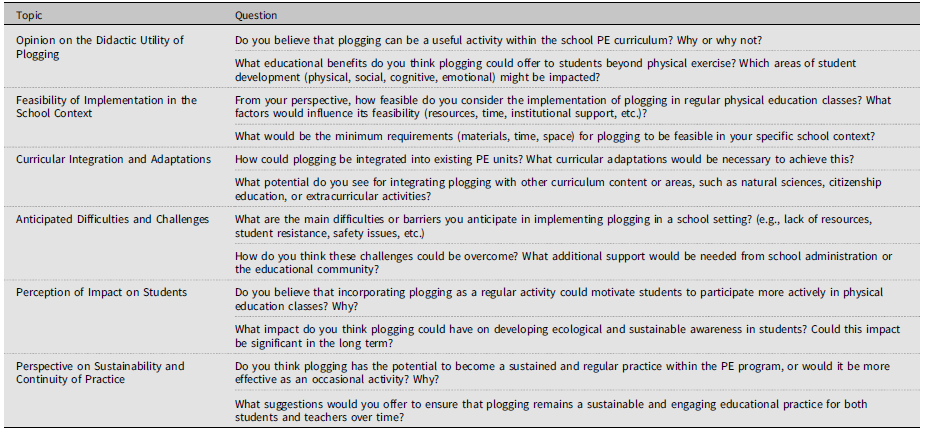
The questions covered four main areas of interest (see Table 1):
Details of topics covered in the interview with corresponding questions
-
Didactic Utility of Plogging: Perceptions of the potential of plogging as an educational tool in PE classes, the benefits it could offer for the students’ holistic development and the reinforcement of pro-environmental values.
-
Feasibility of Implementation: Perceived feasibility of implementing plogging in the school context, considering facilitating factors and possible logistical barriers or challenges.
-
Curricular Integration Opportunities: How plogging could be integrated with other areas of the curriculum, and what curricular adaptations would be necessary.
-
Sustainability and Continuity of the Practice: Sustainability of plogging as a regular activity within the PE program and recommendations for its long-term application.
Data analysis
The qualitative data analysis was conducted using a thematic analysis approach, which allows for the identification, analysis and reporting of patterns (themes) within qualitative data. The analysis process followed the six recommended steps outlined by Clarke and Braun (Reference Clarke and Braun2017): (1) familiarisation with the data, (2) generation of initial codes, (3) searching for themes, (4) reviewing themes, (5) defining and naming themes and (6) producing the final report.
Although initial themes were outlined to inform the development of interview questions, the analysis followed Braun and Clarke’s inductive thematic analysis approach. The data analysis involved searching for and reviewing subthemes and emergent patterns that were not strictly confined to the predefined themes. This iterative process allowed for the identification of new insights that enriched and, in some cases, redefined the initial categories, ensuring alignment with the participants’ narratives and the study’s objectives
-
Coding: The interview transcripts were imported into NVivo 12 qualitative analysis software to facilitate data coding and organisation. The process followed a structured inductive approach: first, the transcripts were thoroughly reviewed to ensure familiarity with the content and to identify preliminary patterns. Codes were generated inductively, emerging directly from the data and were assigned to meaningful segments relevant to the study’s objectives, such as the utility, feasibility, opportunities and challenges of implementing plogging in education. Codes were assessed for their relevance, frequency and contribution to a deeper understanding of participants’ perceptions. To ensure reliability, two researchers independently coded a subset of transcripts, compared their results and resolved discrepancies through consensus, subsequently developing a coding manual to guide the remaining analysis. Finally, similar codes were grouped into overarching themes through an iterative process that allowed for the continuous refinement of the findings.
-
Identification of Themes and Subthemes: After generating codes from the key aspects of participants’ perceptions of plogging, these were aligned with the themes and subthemes corresponding to the interview questions. These themes included: Didactic Utility of Plogging, Feasibility of Implementation, Curricular Integration Opportunities and Sustainability and Continuity of Practice.
-
Absolute Frequency and Percentages: The absolute frequency and percentage of occurrence of each code within the data were calculated to quantify the prevalence of certain themes among the participants. This approach highlighted the most common perceptions, and the most relevant challenges identified by the teacher education students.
-
Representative Quotes: Representative quotes (translated from Spanish to English) from the transcripts were selected to illustrate the main findings and provide concrete examples of participants’ thoughts and reflections. These quotes were chosen to reflect both the majority opinions and divergent views, ensuring a balanced representation of the data.
The resulting qualitative analysis provided an in-depth understanding of the perceptions of teacher education students regarding the application of plogging in educational contexts, revealing both enthusiasm and concerns about this innovative practice. These findings can contribute to future teacher training and the design of educational programmes that integrate sustainable practices into school PE.
Results and discussion
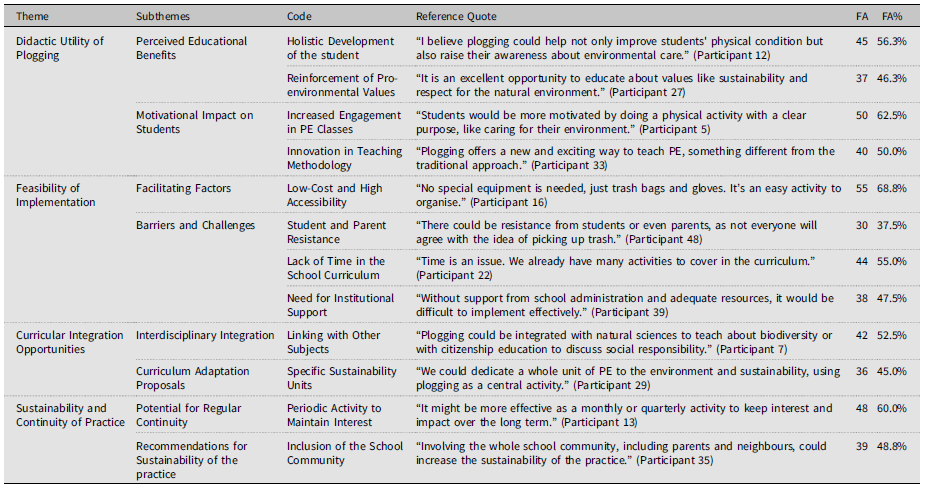
The following presents the results and discussion for each of the topics and subtopics addressed in the interview, including the codes and absolute frequencies, as well as the relative percentages of occurrence concerning their prevalence among the participants (see Table 2).
Interview themes and subthemes with generated codes, absolute frequencies, percentages, and reference quotes
Topic 1. Didactic utility of plogging
Subtopic: Perceived educational benefits
Among the participants, 56.3% identified that plogging can significantly contribute to the holistic development of students, encompassing not only physical improvement but also fostering environmental awareness and social commitment. This perception aligns with existing literature that highlights the multifunctionality of plogging as a pedagogical tool, combining physical activity with environmental education to promote a more holistic learning experience (Baena- Morales et al., Reference Baena-Morales, Martínez-Mirambell and Urrea-Solano2024). A recurrent narrative was that plogging can address multiple dimensions of student development: physical, social, cognitive and emotional. This finding, related to the holistic aspect of plogging, reinforces its potential to promote physical literacy. For instance, one participant commented, “Plogging is not just about running or walking; it requires flexibility, agility and, above all, awareness. Students not only stay fit but also learn about their role in caring for their environment” (Participant 18). This statement underscores how plogging integrates physical activity with a reflective component, allowing students to practically experience the concept of sustainability. Plogging involves performing functional movements such as bending, stretching, and lifting light weights while picking up trash, which, according to Raghavan, Panicker, and Emmatty (Reference Raghavan, Panicker and Emmatty2020), contributes to the development of strength, flexibility and endurance. These activities also enhance coordination and balance, especially among younger students, promoting comprehensive physical literacy. Participants also highlighted how it can help reduce the risk of cardiovascular diseases, consistent with previous studies emphasising the benefits of plogging in terms of caloric expenditure and muscle strengthening (Arundati & Daihani, Reference Arundati and Daihani2019). From a social and emotional perspective, several participants emphasised plogging’s ability to foster group cohesion and teamwork. One participant described their experience, stating, “When students work together to clean a park or a beach, they are developing communication and collaboration skills” (Participant 31). This comment illustrates how plogging can serve as a means to develop critical socio-emotional skills such as empathy and cooperation (Baena-Morales, Reference Baena-Morales2021).
Regarding the reinforcement of pro-environmental values, 46.3% of participants highlighted that plogging may be effective. Unlike more theoretical traditional lessons, plogging offers a direct, immersive experience with the issue of pollution. One participant noted, “When students see the amount of trash in their own environment, it changes their perspective” (Participant 22). This supports the idea that experiential learning, such as that offered by plogging, can be much more effective in raising awareness and educating students about the importance of environmental care (Pérez-Pueyo et al., Reference Pérez-Pueyo, Hortigüela Alcalá, Casado Berrocal, Heras Bernardino and Herrán Álvarez2022). Literature supports this idea; for example, Lee and Choi (Reference Lee and Choi2023) have demonstrated that outdoor learning activities can have a profound impact on the formation of pro-environmental attitudes. This statement aligns with the idea that physical literacy may foster pro-environmental behaviours over a lifetime.
Subtopic: Motivational impact on students
The participants believed that plogging could significantly increase student engagement in PE classes (62.5%), especially among those who usually show less interest in traditional physical activities. As one participant noted: “Plogging is not just about running for the sake of running; it’s about doing something that matters, something that has a positive impact on the community” (Participant 5). This comment reflects how plogging can offer a motivational narrative that engages students by providing them with a sense of accomplishment and responsibility that goes beyond mere physical activity (Baena-Morales et al., Reference Baena-Morales, Vásquez-Echeverría, Gavilán-Martín and González-Villora2024).
From a pedagogical perspective, plogging also allows teachers to diversify their teaching methodologies. Half of the respondents (50%) mentioned that this innovative practice can break the routine of traditional PE classes by introducing experiential learning elements that actively involve students in their learning process. One participant commented: “PE doesn’t always have to be just competitive sports. Activities like plogging allow for new, more inclusive and engaging ways of learning for all students, not just the more athletic ones” (Participant 33). This statement supports studies such as those by Mandrillon et al. (Reference Mandrillon, Gottsmann and Desplanques2024), which suggest that integrating sustainable activities and outdoor practices can enhance student motivation and performance by making learning more relevant and meaningful.
Topic 2. Feasibility of implementing plogging
Subtopic: Facilitating factors
The participants had diverse perceptions regarding the feasibility of implementing plogging as a regular activity in school contexts. While a significant majority (68.8%) viewed plogging as a low-cost, highly accessible activity that could be easily integrated into the PE curriculum, several potential challenges affecting its implementation were also noted. A large number of participants identified the accessibility and low cost of plogging as factors facilitating its implementation in schools. As one participant expressed, “The good thing about plogging is that you do not need much more than trash bags and gloves” (Participant 16). This comment highlights one of plogging’s main strengths: its simplicity and flexibility as a physical activity. As noted by Raghavan et al. (Reference Raghavan, Panicker and Emmatty2020), plogging does not require specialised equipment, making it a viable option for schools with limited budgets. Furthermore, this activity can be easily adapted to different environments, from urban areas to rural zones, increasing its applicability across various school contexts. Another facilitating aspect mentioned by participants is the ease of organising plogging. One participant commented, “Unlike other activities that may require a lot of preparation and coordination time, plogging can be organised quickly and effectively” (Participant 8). Thus, the organisational simplicity of plogging is an advantage compared to other physical activities that may require more planning and resources.
Subtopic: Barriers and challenges
A 37.5% of the participants anticipated potential resistance from students and parents. One participant explained, “Not all students would be willing to pick up trash, and some parents might not see this as part of what PE should be” (Participant 48). This type of resistance may be related to stigmas or misunderstandings about the purpose and benefits of plogging. Morrissy-Swan (Reference Morrissy-Swan2018) suggests that despite the popularity of plogging on social media, its implementation in more formal settings such as schools may require a cultural and mindset shift.
Another significant barrier mentioned by 55% of the participants was the lack of time within the school curriculum. One participant commented, “The curriculum is already quite saturated with mandatory content and activities. Including something additional, like plogging, would require reorganising time and priorities, which is not always easy” (Participant 22). This comment reflects one of the practical limitations teachers face when trying to incorporate new pedagogical practices into a structured educational system. Previous studies have noted that curriculum rigidity and lack of flexibility are common barriers to adopting educational innovations (Baena-Morales, Reference Baena-Morales2021; Colio, Aranda, Hooli, González-Fernández & Ruiz-Montero Reference Colio, Aranda, Hooli, González-Fernández and Ruiz-Montero2023).
The need for institutional support was also identified as a challenge by 47.5% of the participants. One participant stated, “We need the support of school administration, which includes resources, time, and, above all, a commitment to integrating sustainable activities like plogging into the curriculum” (Participant 39). This point highlights that, although plogging is a low-cost activity, its effective implementation depends on the backing of school administration and adequate planning. Without this support, the activity might be seen as a standalone initiative that fails to sustain itself in the long term.
Topic 3: Possibilities for curricular integration of plogging
Subtopic: Interdisciplinary integration
Half of the participants (52.5%) suggested that plogging could be linked with other subjects, such as natural sciences, civic education and extracurricular activities, to address topics related to sustainability, biodiversity and social responsibility. Many participants viewed plogging not just as a physical activity but as an interdisciplinary tool that can facilitate the teaching of various concepts related to the environment, health and global citizenship. One participant explained: “Plogging doesn’t have to be confined to PE; it can be easily integrated into other subjects, such as natural sciences, to teach about the impact of waste on local ecosystems” (Participant 7). This comment reflects an understanding of how plogging can serve as an effective starting point for teaching ecological concepts, linking physical learning with academic learning. The literature supports this perspective, suggesting that activities like plogging can enrich students’ learning by connecting different disciplines in a practical and meaningful way. For example, Colio et al. (Reference Colio, Aranda, Hooli, González-Fernández and Ruiz-Montero2023) highlight that plogging can be used to discuss topics related to education for sustainable development in various educational contexts, ranging from waste management to human rights and environmental ethics. Thus, to ensure that plogging contributes to the holistic development of students, it is essential to adopt an interdisciplinary approach that integrates subjects such as natural sciences and Citizenship Education, promoting learning projects that connect waste collection with environmental impact. Additionally, several participants suggested that plogging could contribute to teaching civic education. One participant noted: “We could use plogging to promote community service and civic responsibility. It could be part of service-learning projects where students not only practise sports but also contribute positively to their community” (Participant 14). This idea reinforces Torsdottir et al.’s (Reference Torsdottir, Olsson and Sinnes2024) proposal about using action-based learning as a means to develop key competencies in education for sustainability, such as critical thinking and strategic competence. This statement highlights the connection between physical literacy and sustainability, emphasising the shared competencies related to taking action and social responsibility
Subtopic: Curricular adaptation proposals
Slightly less than half (45%) of the participants proposed the creation of specific thematic units on sustainability that include plogging as a central activity, highlighting the versatility of plogging in significantly enriching the school curriculum. One participant remarked: “It would be interesting to have a whole unit in PE dedicated to the environment and sustainability, using plogging as the central focus. We could cover everything from the importance of exercise to waste management and recycling” (Participant 29). This statement underscores the flexibility of plogging to be integrated into the school curriculum and its ability to address multiple educational objectives.
Baena-Morales, Vásquez-Echeverría, et al. (Reference Baena-Morales, Vásquez-Echeverría, Gavilán-Martín and González-Villora2024), suggest that the creation of thematic units can be an effective strategy for promoting environmental education in a structured manner, providing students with a deeper understanding of current environmental challenges and how they can actively participate in mitigating them. Thus, plogging becomes not only a physical activity but also a comprehensive educational experience that addresses both physical well-being and environmental and social learning.
Topic 4: Sustainability and continuity of the plogging practice
Subtopic: Potential for regular continuity
Although the participants viewed plogging as a valuable educational practice, they also recognise that its sustainability and continuity over time depend on adequate planning, institutional support and community involvement. Sixty percent of the participants suggested that the effectiveness of plogging could be maximised if it is conducted periodically, such as on a monthly or quarterly basis, rather than being a one-off or sporadic activity. Most participants agreed that plogging should be implemented regularly to maintain students’ interest and engagement in the long term. One participant noted: “Plogging should not be a one-time event. It should be a regular activity, perhaps every month or every quarter, so that students really internalise the importance of environmental care and see it as part of their routine” (Participant 13). This statement underscores the importance of repetition and consistency in teaching sustainable values and forming habits. Previous studies have shown that repeated engagement in pro-environmental activities can have a lasting effect on the adoption of sustainable behaviours (Martinez-Mirambell, Baena-Morales, et al., Reference Martinez-Mirambell, Baena-Morales, García-Taibo and Ferriz-Valero2023). Additionally, the idea of integrating plogging as a regular activity aligns with the proposal to maintain interest and impact over the long term, which has been discussed in the literature on environmental education and PE. According to Rieckmann (Reference Rieckmann2018), the continuity of sustainable practices is crucial for developing meaningful learning and competencies related to sustainability.
Subtopic: Recommendations for the sustainability of the practice
Almost half of the participants (48.8%) recommended including the entire school community, parents and neighbours, to increase the sustainability of the practice. These perspectives underscore the need for a holistic and collaborative approach to ensure the continuity of plogging in educational contexts. One participant explained: “For plogging to be sustainable, we need to involve the entire community, not just the students. If parents, teachers and neighbours participate, it becomes a community initiative that goes beyond the classroom” (Participant 35). This perspective aligns with the community-focused approach to plogging observed in movements such as #YoSoyPlogger in South America and events organised by Mountain Cleaners in India, which demonstrate how community involvement can strengthen the impact of the activity and foster a culture of sustainability.
Additionally, some participants proposed specific strategies to enhance the sustainability of the practice, such as organising school plogging events in collaboration with local environmental protection organisations. One participant suggested: “We could organise plogging days in collaboration with local NGOs, which would also help students connect with broader networks of environmental activism and see the impact of their actions” (Participant 28). These initiatives provide additional resources, logistical support and enrich the educational experience.
Divergent perspectives
While most participants highlighted the educational and motivational benefits of plogging, several divergent perspectives emerged, pointing out potential barriers to its implementation. For instance, some participants noted that there could be resistance from students and parents due to the nature of the activity. As one participant stated: “There could be resistance from students or even parents, as not everyone will agree with the idea of picking up trash” (Participant 48). Additionally, concerns were raised about the lack of time in the school curriculum, which could pose a challenge to integrating this practice. One participant explained: “Time is an issue. We already have many activities to cover in the curriculum” (Participant 22).
Another important aspect was the need for institutional support, such as backing from school administrations and adequate resources, to ensure effective implementation: “Without support from school administration and adequate resources, it would be difficult to implement effectively” (Participant 39). Finally, some participants questioned the sustainability of the practice if carried out too frequently, suggesting that periodic activities, such as monthly or quarterly sessions, might be more effective in maintaining long-term interest and impact: “It might be more effective as a monthly or quarterly activity to keep interest and impact over the long term” (Participant 13). These divergent perspectives highlight potential challenges and the complexity of integrating innovative pedagogical approaches like plogging into educational settings, emphasising the need to address these barriers to maximise its effectiveness and acceptance.
Implications for environmental education and physical literacy
The identified themes highlight the potential of plogging to integrate environmental education with physical literacy in a meaningful way. For instance, the subtheme of “Holistic Development of the Student” suggests that plogging not only improves physical fitness but also fosters pro-environmental awareness, aligning with the goals of environmental education to cultivate responsible citizenship. This dual impact positions plogging as a valuable tool for achieving both educational and health objectives. The “Barriers and Challenges” theme, such as resistance from students and parents or the lack of time in the curriculum, reflects broader systemic challenges in embedding sustainability-focused activities within traditional educational frameworks. Addressing these barriers requires a collaborative approach involving school administrations, teachers and policymakers to allocate resources and prioritise interdisciplinary learning.
From the perspective of physical literacy, the subtheme of “Motivational Impact on Students” underscores how plogging can increase engagement in PE by providing a sense of purpose. This aligns with the core principles of physical literacy, which emphasise the development of motivation, confidence and competence in physical activity through meaningful experiences. Finally, the sustainability of the practice relies on fostering a sense of community and continuity. Incorporating plogging as a periodic activity, as suggested by participants, could maintain its long-term impact while preventing burnout or disengagement. These findings emphasise the need for innovative, adaptable strategies to ensure that plogging becomes an integral and sustainable part of educational programmes, bridging the gap between physical literacy and environmental stewardship.
Limitations and future directions of the study
This study has several limitations that should be considered. Firstly, the sample consisted solely of 80 PETE students from various educational institutions in Spain, which limits the generalisability of the results to other geographical and cultural contexts. Different regions may exhibit significant variations in their educational approaches and attitudes towards sustainability, influencing the feasibility and perception of plogging. Additionally, the study focused exclusively on the perspective of PETE students, omitting other key stakeholders such as students, parents, practicing teachers and school administrators. This restriction limits the comprehensive understanding of how the broader school community might support or perceive the implementation of plogging. The qualitative interpretation of the data also introduces a degree of subjectivity, despite efforts to ensure validity through data triangulation and expert review. Lastly, the study did not include an empirical assessment of the actual implementation of plogging in schools, limiting the ability to make conclusive statements about its impact on learning outcomes or changes in students’ environmental behaviour. These limitations highlight the need for further research to explore these aspects in greater detail.
Future research directions should include expanding and diversifying the sample to include a broader range of participants and incorporating perspectives from students, parents, practicing teachers and school administrators. Additionally, future studies could complement qualitative findings with quantitative or mixed-methods research to empirically measure the impacts of plogging on physical literacy, environmental awareness and sustainable behaviour. Future research could also develop and evaluate specific teacher training programmes that provide the necessary skills and resources for effective plogging implementation. Exploring innovative strategies to ensure the sustainability of the practice, such as community collaboration or integration into broader school events, would also be valuable.
Conclusion
The findings reveal that PETE students perceive plogging as an innovative and valuable practice that can significantly contribute to the holistic development of students, promoting both physical literacy and environmental awareness. In line with the plogging experience lived by the participants, this practice should be based on experiential learning, incorporating reflective processes and group work. Most participants highlighted that plogging not only improves students’ physical condition through a combination of functional and cardiovascular exercises but also reinforces pro-environmental values through experiential learning, connecting students with their natural environment and fostering a sense of social responsibility. However, the results also indicate that the feasibility of plogging in the school context depends on contextual factors such as institutional support, curriculum flexibility and community involvement. While recognising plogging’s potential to integrate with other curriculum areas, such as natural sciences and citizenship education, PETE students pointed out the need for adequate planning, specific teacher training and the development of school policies to facilitate its implementation and continuity. Challenges related to resistance from some students and parents, curriculum saturation and the need to maintain student interest over time were also identified. These findings underscore the importance of adopting a collaborative and inclusive approach that involves all members of the educational community to ensure that plogging becomes a sustainable and effective practice. A gradual and flexible incorporation of plogging, along with an interdisciplinary approach, can greatly facilitate its integration into the educational curriculum. Moreover, informational campaigns and talks for parents and students, emphasising the environmental and physical health benefits of plogging, can help garner community support. In addition, inviting experts or local sustainability leaders can further highlight its importance. Furthermore, collaboration with local governments or environmental associations can provide crucial support; while offering online resources for teachers will ensure they are well-trained to implement plogging effectively in the classroom. In conclusion, this study provides a knowledge base that can guide future research and the development of educational programmes integrating plogging and other sustainable practices, thereby contributing to the formation of moreactive, aware and committed citizens.
Acknowledgements
None.
Financial support
No direct funding was received for the project.
Ethical standards
The study was conducted in accordance with the Declaration of Helsinki, and approved by the Committee of University of Alicante (UA-2022-03-17).
Author biographies
Carlos Martínez-Mirambell is a doctoral student and a member of the PEAK research group. A reference researcher in the study of plogging, his work focuses on using this innovative practice as an educational tool, combining physical activity with environmental awareness to promote sustainability and healthy habits in educational contexts.
Dr. Olalla García-Taibo is currently an Assistant Professor at the Universitat de les Illes Balears, within the Department of Pedagogy and Specific Didactics. She earned an International Doctorate in Physical Activity and Sports Sciences from the University of A Coruña, completing two research stays at international research centers, with cum laude honors and an Extraordinary Doctorate Award. As a collaborator of the PEAK research group, she has published 27 articles in indexed journals, 17 book chapters in SPI Q1 publishers, and one book. Her research focuses on the didactics of Physical Education, pedagogical models, and the Sustainable Development Goals (SDGs), addressing environmental, social, and economic perspectives.
Dr. Andreas Fröberg, Associate Professor, has a PhD in Sport Science and is currently employed as a senior lecturer at the Department of Food and Nutrition, and Sport Science, Gothenburg University. Andreas is assistant (deputy) head of department and responsible for research and doctoral studies at the Department of Food and Nutrition, and Sport Science. Fröberg’s current research focus on how changes of perspectives around learning goals, processes, teaching, and content can bring in possible educative aspects of sustainability to be integrated in Physical education and health.
Dr. Salvador Baena-Morales, Associate Professor at the University of Alicante and Director of the PEAK Research Group, is the most cited researcher internationally in Physical Education and its connection to the Sustainable Development Goals (SDGs), according to Web of Science. He has published extensively, with over 1,500 citations, and has made significant contributions to advancing sustainability in education. He serves as Special Issue editor for the European Journal of Education and associate editor for BMC Public Health, contributing to the dissemination of high-quality research. As a mentor, he has guided numerous theses and fostered interdisciplinary approaches among emerging researchers.


 Open access

