





Introduction
Middle childhood represents a critical developmental window in which children face both elevated risk for emerging psychopathology and rapid growth in stress regulation and coping capacities (Ettekal et al., Reference Ettekal, Li, Chaudhary, Luo and Brooker2023; Skinner & Saxton, Reference Skinner and Saxton2019). During this period, children undergo substantial psychosocial transformations. They begin to experience more intense emotional states (Coe-Odess et al., Reference Coe-Odess, Narr, Allen, LoBue, Pérez-Edgar and Buss2019; Griffith et al., Reference Griffith, Clark, Haraden, Young and Hankin2021), demonstrate heightened sensitivity to social evaluation (Rodrigues et al., Reference Rodrigues, Sokolovic, Madigan, Luo, Silva, Misra and Jenkins2021), and increasingly engage in complex peer interactions where challenges such as rejection, exclusion, and relational aggression become more frequent (Lecce & Devine, Reference Lecce, Devine, Ferguson and Bradford2021). Yet, this same period also offers unique opportunities for strengthening stress management abilities. Middle childhood is a key stage during which children’s ability to manage stress becomes increasingly differentiated and integrated across multiple systems.
According to the dual-process model of coping (Cicchetti & Bendezú, Reference Cicchetti, Bendezú, Skinner and Zimmer-Gembeck2023; Compas et al., Reference Compas, Connor, Saltzman, Thomsen, Wadsworth, Lewis and Ramsay1999), stress responses consist of two interrelated processes: voluntary, intentional coping behaviors (e.g., active coping, support-seeking) and involuntary, automatic physiological responses (e.g., vagal regulation indexed by respiratory sinus arrhythmia). Middle childhood offers a unique window for examining how these two regulatory systems begin to interact. As children become more capable of intentionally regulating their stress responses, their physiological regulation systems (e.g., parasympathetic flexibility) also mature and become more responsive to environmental demands (Harteveld et al., Reference Harteveld, Nederend, Ten Harkel, Schutte, De Rooij, Vrijkotte, Oldenhof, Popma, Jansen, Suurland, Swaab, De Geus, Prätzlich, Ackermann, Baker, Batchelor, Baumann, Bernhard, Clanton and Stadler2021). Investigating the links between coping behaviors and physiological processes in middle childhood is thus critical for understanding integrated regulation, as well as identifying potential mechanisms through which differential coping strategies become biologically embedded and confer risk or resilience for psychopathology.
Children’s voluntary coping behaviors
Coping behaviors refer to mental and behavioral activities to overcome difficulties, especially in stressful contexts, and are typically classified into active coping, social support coping, and disengaged coping (Richardson et al., Reference Richardson, Magson, Fardouly, Oar, Forbes, Johnco and Rapee2020; Solberg et al., Reference Solberg, Gridley and Peters2022). Active coping refers to direct efforts to resolve stress or lessen its effect by setting goals and completing them step by step (Theodoratou et al., Reference Theodoratou, Farmakopoulou, Kougioumtzis, Kaltsouda, Siouti, Sofologi, Gkintoni and Tsitsas2023). Children who use active coping persistently focus on and voluntarily engage with a stressor instead of avoiding it, which means that they may devote themselves to coping with the stress it causes (de la Fuente et al., Reference de la Fuente, Zapata, Martínez-Vicente, Sander, Putwain and Peña-Ayala2015, Reference de la Fuente, Amate, González-Torres, Artuch, García-Torrecillas and Fadda2020). Research has shown that children who are more likely to adopt active coping behaviors experience fewer social and emotional problems (Erath & Pettit, Reference Erath and Pettit2021) and demonstrate a reduced likelihood of suicidal tendencies (Liang et al., Reference Liang, Kõlves, Lew, De Leo, Yuan, Talib and Jia2020).
Social support coping is characterized by proactively asking others for help. Children can seek both instrumental/informational support (proactively asking for information or help about what to do) and emotional support (trying to obtain comfort or empathy) from their parents (Cohen & Wills, Reference Cohen and Wills1985; Wawrzynski et al., Reference Wawrzynski, Schaefer, Schvaneveldt and Alderfer2021). Seeking support from others, either emotional or instrumental support, has been shown to be associated with high levels of regulation capabilities and low levels of emotional symptoms and suicidal ideation (Benatov et al., Reference Benatov, Klomek, Shira, Apter, Carli, Wasserman, Hoven, Sarchiapone, Balazs, Bobes, Brunner, Corcoran, Cosman, Haring, Kahn, Keeley, Kereszteny, Podlogar, Postuvan and Wasserman2020; Erath & Pettit, Reference Erath and Pettit2021; Newman, Reference Newman2024).
Disengaged coping refers to escaping from stressful situations by avoiding cognitive and emotional responses to stressors and maintaining a distance from the stressor (Anderson et al., Reference Anderson, Siciliano, Gruhn, Bettis, Reising, Watson, Dunbar and Compas2024; Compas et al., Reference Compas, Jaser, Bettis, Watson, Gruhn, Dunbar and Thigpen2017). Typical disengaged coping methods include ignoring problems, engaging in alternative activities such as using the internet, and isolating oneself from others (Benatov et al., Reference Benatov, Klomek, Shira, Apter, Carli, Wasserman, Hoven, Sarchiapone, Balazs, Bobes, Brunner, Corcoran, Cosman, Haring, Kahn, Keeley, Kereszteny, Podlogar, Postuvan and Wasserman2020; Kraaij & Garnefski, Reference Kraaij and Garnefski2019; Melodia et al., Reference Melodia, Canale and Griffiths2020). Children who tend to use disengaged coping strategies may avoid confronting stressors directly, which may indicate a lack of efficient skills to successfully cope with stress (Troop-Gordon et al., Reference Troop-Gordon, Sugimura and Rudolph2017). Empirically, the frequent use of disengaged coping strategies under stress may lead to an increased risk of interpersonal difficulties, depressive symptoms, and suicidal ideation and behaviors (Benatov et al., Reference Benatov, Klomek, Shira, Apter, Carli, Wasserman, Hoven, Sarchiapone, Balazs, Bobes, Brunner, Corcoran, Cosman, Haring, Kahn, Keeley, Kereszteny, Podlogar, Postuvan and Wasserman2020; Liang et al., Reference Liang, Kõlves, Lew, De Leo, Yuan, Talib and Jia2020; Richardson et al., Reference Richardson, Magson, Fardouly, Oar, Forbes, Johnco and Rapee2020).
Children’s involuntary physiological regulation processes
Previous studies have thoroughly examined the significant role of coping behaviors in shaping children’s regulatory capabilities (Kraaij & Garnefski, Reference Kraaij and Garnefski2019; Rudolph et al., Reference Rudolph, Li, Li and Cai2023). According to the dual-process model (Cicchetti & Bendezú, Reference Cicchetti, Bendezú, Skinner and Zimmer-Gembeck2023; Compas et al., Reference Compas, Connor, Saltzman, Thomsen, Wadsworth, Lewis and Ramsay1999), stress regulation involves two interrelated systems, namely intentional behavioral coping strategies and involuntary autonomic processes, each contributing uniquely to adaptation during stressful situations. The Polyvagal Theory (Porges, Reference Porges2007) elaborates this view by specifying the parasympathetic nervous system (PNS) as a core neurophysiological mechanism through which physiological regulation becomes linked to social engagement and coping behaviors. From this perspective, coping responses are not only behavioral strategies but are interconnected with PNS-based physiological processes that support engagement or withdrawal when facing stress.
Respiratory sinus arrhythmia (RSA), which plays a pivotal role in overseeing an individual’s homeostatic functions, is a common indicator of PNS activity (Porges, Reference Porges2007). RSA is measured by heart rate variation during the respiratory cycle and reflects the physiological regulation of the vagus nerve in cardiac activity (Beauchaine, Reference Beauchaine2015). At rest, the vagus nerve acts as a “brake” to decrease the heart rate, corresponding with greater beat-to-beat variability and increased RSA levels (Porges, Reference Porges2007). When confronting stress, the vagal brake is removed, which allows for heart rate acceleration to prepare for engaging in and coping with the stressors (Porges, Reference Porges2007).
Baseline-to-task RSA reactivity
Researchers have typically used baseline-to-task RSA changes to quantify the reactivity of the vagal nerve statistically (Gentzler et al., Reference Gentzler, Santucci, Kovacs and Fox2009). To calculate baseline-to-task RSA reactivity, average RSA scores across the task and the resting phase (usually lasting for minutes) are first obtained on the basis of several epochs (Helm et al., Reference Helm, Miller, Kahle, Troxel and Hastings2018). The average RSA level across the stress task is subsequently subtracted from the RSA level across the resting phase, with larger scores suggesting greater baseline-to-task RSA reactivity, further reflecting a greater extent of vagal withdrawal (Gentzler et al., Reference Gentzler, Santucci, Kovacs and Fox2009; Helm et al., Reference Helm, Miller, Kahle, Troxel and Hastings2018).
The literature suggests that a moderate extent of RSA reactivity in the face of stress may indicate a physiologically adaptive response pattern for typically developing children, which may help the body adapt to stress (Abaied et al., Reference Abaied, Stanger, Wagner, Sanders, Dyer and Padilla-Walker2018). For example, individuals whose parents were more likely to provide suggestions involving engagement coping exhibited greater baseline-to-task RSA reactivity when dealing with an interpersonal stressor (Abaied et al., Reference Abaied, Stanger, Wagner, Sanders, Dyer and Padilla-Walker2018). Researchers have also reported that greater baseline-to-task RSA reactivity in response to social-evaluative or emotional stressors is associated with greater emotion regulation capability among school-age children (Gentzler et al., Reference Gentzler, Santucci, Kovacs and Fox2009; Quiñones-Camacho & Davis, Reference Quiñones-Camacho and Davis2019). However, other studies revealed that a greater baseline-to-task decrease in heart rate variability was related to more frequent use of maladaptive coping behaviors and more emotional problems (Hastings et al., Reference Hastings, Klimes-Dougan, Kendziora, Brand and Zahn-Waxler2014; Machado et al., Reference Machado, Pereira, Souza, Xavier, Aguiar, de Oliveira and Mocaiber2021). One potential explanation for the inconsistent findings between baseline-to-task RSA reactivity and child coping ability might be the between-task and static assessment of RSA, which cannot capture nuances in RSA during stressful tasks (Xu et al., Reference Xu, Wang, Morrow, Xu, Gao, Hu, Suveg and Han2024).
RSA inertia
An emerging body of research has proposed indicators that capture dynamic and within-task RSA reactivity (Gao et al., Reference Gao, Speck, Ostlund, Neff, Shakiba, Vlisides-Henry, Kaliush, Molina, Thomas, Raby, Crowell and Conradt2022; Li & Lunkenheimer, Reference Li and Lunkenheimer2025; Lunkenheimer et al., Reference Lunkenheimer, Busuito, Brown and Skowron2018). RSA inertia, the tendency of temporary RSA levels to carry over from one epoch to the next, provides a unique perspective to quantify epoch-to-epoch RSA reactivity during a task (Xu et al., Reference Xu, Wang, Morrow, Xu, Gao, Hu, Suveg and Han2024). High RSA inertia means that the present RSA level is heavily influenced by the RSA level at the last epoch, indicating high resistance to change (Xu et al., Reference Xu, Wang, Morrow, Xu, Gao, Hu, Suveg and Han2024). An emerging body of research has shown that heightened RSA inertia during a stressful task indicates high inflexibility in physiological regulation, which could be a biomarker for child coping (Gao et al., Reference Gao, Speck, Ostlund, Neff, Shakiba, Vlisides-Henry, Kaliush, Molina, Thomas, Raby, Crowell and Conradt2022; Xu et al., Reference Xu, Wang, Morrow, Wang, Gao, Liu, Hu, Suveg and Han2025). For example, children with greater RSA inertia during a public speaking task were more likely to experience heightened in-task negative emotions and exhibited greater externalizing problems nine months later (Xu et al., Reference Xu, Wang, Morrow, Xu, Gao, Hu, Suveg and Han2024, Reference Xu, Wang, Morrow, Wang, Gao, Liu, Hu, Suveg and Han2025). Another study revealed that greater newborn arousal was associated with greater RSA inertia during still-face episodes at 7 months of age, revealing difficulty returning to homeostasis after perturbation (Gao et al., Reference Gao, Speck, Ostlund, Neff, Shakiba, Vlisides-Henry, Kaliush, Molina, Thomas, Raby, Crowell and Conradt2022).
Parent-to-child RSA synchrony
As the primary agents of children’s socialization, parents continue to play a pivotal role in shaping children’s regulatory capacities during middle childhood (Morris et al., Reference Morris, Criss, Silk and Houltberg2017). Although children in this developmental stage begin to acquire more autonomous emotion regulation skills, their physiological and behavioral responses to stress remain heavily influenced by parental input, especially in emotionally salient contexts (Newman, Reference Newman2024; Suveg et al., Reference Suveg, Braunstein West, Davis, Caughy, Smith and Oshri2019). Middle childhood represents a transitional period in which self-regulatory systems are becoming more sophisticated but are still malleable (Harteveld et al., Reference Harteveld, Nederend, Ten Harkel, Schutte, De Rooij, Vrijkotte, Oldenhof, Popma, Jansen, Suurland, Swaab, De Geus, Prätzlich, Ackermann, Baker, Batchelor, Baumann, Bernhard, Clanton and Stadler2021; Pener-Tessler et al., Reference Pener-Tessler, Markovitch and Knafo-Noam2022). This developmental plasticity offers a critical window during which external influences, particularly from parents, can shape children’s emerging coping and regulatory capacities. Therefore, beyond children’s internal regulatory processes (i.e., baseline-to-task RSA reactivity and RSA inertia), parent-to-child RSA synchrony (within-dyad prediction from RSA in parents at a specific epoch to concurrent RSA in children) reflects interpersonal co-regulation (Lunkenheimer et al., Reference Lunkenheimer, Busuito, Brown and Skowron2018). During parent–child interactions, parents provide social references and learning opportunities for their children (Davis et al., Reference Davis, West, Bilms, Morelen and Suveg2018). Through the physiological coordination of parasympathetic processes, children may learn to regulate their emotions and behaviors via external modifications by their parents (Helm et al., Reference Helm, Miller, Kahle, Troxel and Hastings2018). Parent-to-child RSA synchrony may also play an important role in mitigating stress during stressful conditions among low-risk or resilient families with typically developing children, reflecting children’s ability to successfully cope with stress (Gray et al., Reference Gray, Lipschutz and Scheeringa2018; Ravindran et al., Reference Ravindran, Zhang, Green, Gatzke-Kopp, Cole and Ram2021).
Several studies have demonstrated the relevance of parent-to-child RSA synchrony for mitigating children’s stress (Gray et al., Reference Gray, Lipschutz and Scheeringa2018; Ravindran et al., Reference Ravindran, Zhang, Green, Gatzke-Kopp, Cole and Ram2021). During a traumatic experience recall task, children with trauma exposure but without Post-Traumatic Stress Disorder (PTSD) had higher parent-to-child RSA synchrony as compared with children who met the criteria for PTSD (Gray et al., Reference Gray, Lipschutz and Scheeringa2018). During a dyadic fear-eliciting film-watching task for community samples, parent-to-child RSA synchrony peaked when the film clip’s negative emotional content increased, suggesting a dyadic response to emerging challenges (Ravindran et al., Reference Ravindran, Zhang, Green, Gatzke-Kopp, Cole and Ram2021). Other research has indicated positive parent–child RSA synchrony in families with typically developing children during stressful tasks such as conflict discussion (Woody et al., Reference Woody, Feurer, Sosoo, Hastings and Gibb2016) and challenging problem-solving interactions (Lunkenheimer et al., Reference Lunkenheimer, Busuito, Brown, Panlilio and Skowron2019). Nonetheless, more direct evidence is needed to examine the relation between children’s situational coping behaviors and parent–child RSA synchrony.
Taken together, baseline-to-task RSA reactivity, RSA inertia, and parent-to-child RSA synchrony capture distinct but complementary aspects of children’s parasympathetic self-regulation and co-regulation during stress. By integrating these measures, the current study aims to assess both intrapersonal and interpersonal components of involuntary physiological regulation. This approach is well aligned with dual-process models of regulation (Cicchetti & Bendezú, Reference Cicchetti, Bendezú, Skinner and Zimmer-Gembeck2023; Compas et al., Reference Compas, Connor, Saltzman, Thomsen, Wadsworth, Lewis and Ramsay1999) and Polyvagal Theory (Porges, Reference Porges2007) and is particularly suited to middle childhood, a developmental stage marked by increasing self-regulation alongside continued reliance on parental support.
Investigating child coping and physiological regulation in a parent–child dyadic stressful context
To elicit various child coping behaviors and capture physiologically regulatory processes, we adopted a peer rejection discussion task, during which children were first rejected by their peers and then discussed this event with their parents. This study focused on children in middle childhood, a developmental stage marked by increasing exposure to complex peer interactions and heightened sensitivity to social cues (Lecce & Devine, Reference Lecce, Devine, Ferguson and Bradford2021). As children enter primary school, they begin to spend more time with peers, and their social environment becomes more multifaceted, increasing the likelihood of experiencing exclusion or rejection (Mitic et al., Reference Mitic, Woodcock, Amering, Krammer, Stiehl, Zehetmayer and Schrank2021). Importantly, peer relationships during this period are not only more frequent but also more salient: they become highly valued by school-age children and are an important source of children’s self-esteem (Xu et al., Reference Xu, Wang, Liu, Hale, Weng, Ahemaitijiang, Hu, Suveg and Han2022). Therefore, being rejected by peers is a common and threatening experience for children at this important developmental period, and if children do not cope with this negative peer experience appropriately, they may be at increased risk for subsequent emotional and behavioral problems such as depressive symptoms and delinquent behaviors (Nergaard, Reference Nergaard2020; Rudolph et al., Reference Rudolph, Li, Li and Cai2023).
The present study
By applying a dyadic stress-coping task together with behavioral coding and physiological assessment, the present study aimed to investigate how children’s coping behaviors and physiological regulation jointly operate during parent–child stress-coping interactions. Specifically, we examined the unique associations between three typical coping behaviors (i.e., active coping, seeking social support, and disengaged coping) and three physiological regulatory processes (i.e., baseline-to-task RSA reactivity, RSA inertia, and parent-to-child RSA synchrony) among Chinese parent–child dyads. Clarifying how these behavioral and physiological regulatory processes co-occur in moments of stress is theoretically important because current developmental models have yet to explain whether different regulatory systems tend to be recruited in complementary ways, whether they typically align with one another, or whether certain configurations may signal shifts in regulatory organization across development. Although the temporal resolution of these RSA indices differs, we included all three within the same analytic model to allow for a comprehensive examination of both static (between-task indicator of physiological process) and dynamic (within-task indicator of physiological process) aspects of physiological regulation, thereby enabling a more integrated understanding of children’s regulatory functioning in stressful parent–child contexts.
In the face of threatening events, considering the adaptive function of low RSA inertia and high parent-to-child RSA synchrony for families of low-risk typical-development children under stressful contexts (Ravindran et al., Reference Ravindran, Zhang, Green, Gatzke-Kopp, Cole and Ram2021; Xu et al., Reference Xu, Wang, Morrow, Xu, Gao, Hu, Suveg and Han2024), we hypothesized that children who were more likely to use active coping and seek support from their parents during the dyadic stress-coping task would have lower RSA inertia and greater RSA synchrony with their parents. In contrast, we hypothesized that children who exhibited greater disengaged coping during the dyadic stress-coping task would have greater RSA inertia and lower parent-to-child RSA synchrony. In addition, given prior findings of inconsistent associations between children’s regulatory behaviors and baseline-to-task RSA reactivity (Byrd et al., Reference Byrd, Vine, Beeney, Scott, Jennings and Stepp2022; Quiñones-Camacho & Davis, Reference Quiñones-Camacho and Davis2019), we formulated exploratory hypotheses regarding the relations between three coping behaviors and the magnitude of children’s baseline-to-task RSA reactivity from the resting phase to the dyadic stress-coping task.
Methods
Participants
Children in the elementary school stage (preferably grades 1 to 3) and residing in Beijing were included in the study. Families were excluded if either the parent or child had a serious mental disorder, were unable to read the questionnaire, or could not understand the experimental tasks. In addition, families with children diagnosed with autism spectrum disorder or selective mutism were also excluded. The final participants included 88 school-age children, 51 boys and 37 girls, M age = 8.07 years, SD = 1.16, and their primary caregivers, 27 fathers and 61 mothers, M age = 39.07 years, SD = 3.53, recruited via online fliers. Children’s ages ranged from 6 to 11 years old, with the majority, 89.8%, between 7 and 9 years. Parental educational level ranged from high school to graduate school, with a bachelor’s degree being the most commonly reported level (48.9%). Most parents were of Han ethnicity, accounting for 96.6%. The annual income of the families ranged from below 60,000 RMB (9.1%) to above 300,000 RMB (56.8%). Seventy-six families (86.4%) reported that their annual income exceeded the average income of the city (180,000 RMB, approximately $27,400 per family income annually; Beijing Municipal Bureau Statistics, 2022), revealing that the sample had a middle-to-high socioeconomic status. The majority of parents were legally married, 95.5%, while the remaining parents were divorced, 3.4%, or widowed, 1.1%.
Procedures
The parents and children were informed of the procedures of the study and signed informed consent forms. The research assistants placed three electrocardiogram (ECG) electrodes on both the parent and child after they adapted to the environment. The electrodes were arranged using the lead II configuration (i.e., two under the lower ribs and one below the right collarbone; Biopac Systems, Inc.). During the resting baseline phase, the parent–child dyads were instructed to sit separately at opposite sides of the table. A white desk divider was placed between them to prevent interactions, and they remained in this position for 6 minutes. The child subsequently performed an online peer rejection task. This task was adapted into an online form from the traditional peer rejection paradigm (Stroud et al., Reference Stroud, Foster, Papandonatos, Handwerger, Granger, Kivlighan and Niaura2009). At the beginning of the task, the children were invited to enter an online chatroom. Two peers (one boy and one girl, both aged seven) and a host were already present in the chatroom. The children were told that they would complete the task with the two other children. These children were participating in the same task in nearby labs. The children were also instructed to follow the host’s instructions. However, the two peers and the host did not actually exist, and their chatroom accounts were manipulated by research assistants. During the task, the research assistant sent prerecorded audio instructions and provided feedback to the children in the chatroom at appropriate moments. This was done to make the children believe that the two peers and the host were real people and that the conversations were happening in real time.
First, the host asked the three children (i.e., the participating child and two virtual peers) to record a brief self-introduction video to get to know each other. After the participating child uploaded their video in the chatroom, the research assistant sent the prerecorded virtual peers’ self-introduction videos sequentially. The host then invited the three children to play a two-player game and asked them to choose their partner. Only when two children chose each other simultaneously did they start the game. Regardless of which partner the participating child chose, the two virtual children would choose each other and leave the participating child out, who waited for the game to end. Two minutes later, the host announced that the first round of the game was over and that the second round would start so that the participating child would have a chance to play. The participating child chose a partner again, and the two virtual peers chose each other once more, leaving the participating child alone for another two minutes. Finally, the host announced that the game was over and that there would not be another round. Across the peer rejection task, the parent–child dyads sat face-to-face and were separated by a divider. The parents watched the entire process through a screen that was connected covertly to the experimental laptop. However, the research assistant told the children before the task that their parents were working on another task, i.e., the children did not know that their parents were watching their online interactions in the chatroom.
After the peer rejection task, the research assistants told the child that their parents knew what had happened in the chatroom and invited the parent–child dyad to have a 5-minute conversation regarding the just-finished peer rejection task to share their feelings and thoughts. This peer rejection discussion task was designed to be a dyadic stress-coping task. After the discussion, the research assistants debriefed both the parents and the children and explained that the peer rejection process was manipulated by the research assistant and showed them the fake peers’ debriefing videos. In the debriefing videos, two child actors explained that they were acting and that the rejection had been orchestrated by the experimenter. Then, the virtual children expressed a genuine desire to engage in play with the child. Concurrently, the experimenter clarified the experimental purpose (i.e., observing the child’s reactions following rejection) and commended the child for exhibiting exemplary behavior. We ensured that the children’s emotional responses were adequately addressed through comforting. At the end of the assessment, the parent and child received some compensation and gifts. The peer rejection discussion task was video recorded. All the procedures of the study were approved by the Institutional Review Board (IRB) of the Beijing Normal University (Number: 202107140039).
Measures
Coping behaviors via observational coding
Four trained observers, who were blinded to the hypotheses, watched the parent–child discussion videos and coded the children’s coping strategies separately on a 2-point scale (0 = no signs of using a certain coping behavior; 1 = signs of a certain coping behavior) every 15 seconds on the basis of interactions, resulting in 20 periods for each child. We chose a 15-second interval to capture the dynamic and shifting nature of children’s coping behaviors while avoiding excessive fragmentation. This time window provides sufficient resolution to detect meaningful changes in behavior while allowing strategies that unfold over a few seconds to be observed coherently. This approach also aligns with prior studies on child coping and emotion regulation using similar interval-based coding (Berry et al., Reference Berry, Palmer, Distefano and Masten2019; Kahle et al., Reference Kahle, Miller, Helm and Hastings2018; Schoppmann et al., Reference Schoppmann, Schneider and Seehagen2022). Four coders independently assigned scores; if there were inconsistencies in the observation scores, the coders reviewed the videos together to determine a final score. Interrater reliability (i.e., the consistency across the three coders’ initial independent ratings) was evaluated using intraclass correlations (ICCs) for all dyads. The ICC was 0.78 for active coping, 0.83 for disengaged coping, and 0.71 for social support coping. We then averaged the scores across the 20 periods to obtain each child’s score for each type of coping behavior.
Coping strategies were coded via a codebook adapted from the Brief Coping Orientation to Problems Experienced (Brief-COPE; Carver et al., Reference Carver, Scheier and Weintraub1989). According to the Brief-COPE, active coping involves taking direct action, putting in more effort, and approaching a coping behavior in a systematic manner. In our adapted codebook, active coping was coded when the child focused their efforts on addressing the situation they faced or took steps to improve it. Seeking social support encompasses instrumental support and emotional support. Seeking instrumental support includes asking parents with similar experiences for guidance, seeking advice on how to address a specific situation, and consulting someone who is capable of taking concrete actions to resolve an issue. Seeking emotional support involves discussing personal feelings with parents and expressing feelings to gain sympathy and understanding. In the realm of our research, instances were coded when children sought assistance from their parents, either through the receipt of practical help and advice or through comfort and understanding. For example, a child could ask, “What did you think about my behaviors just now?” to solicit feedback and support. Disengaged coping refers to a reduction in one’s efforts to confront a stressor, often manifesting as the abandonment of goals obstructed by the stressor. Disengaged coping is observed when a child ceases efforts to manage a situation or abandons attempts to cope, exemplified by behaviors such as playing with a device while disregarding communication or interaction with a parent.
RSA data acquisition and preprocessing
We used Biopac MP150 systems (Biopac Systems, Inc., Goleta, CA, USA) at 1,000 Hz to collect ECG data, which were then imported into Mindware HRV 3.1.1 software (Mindware Technologies, Ltd., Gahanna, OH, USA). The software could automatically identify R peaks. Afterward, missing or incorrectly identified R peaks were manually corrected by research assistants. The RSA values were calculated every 30 seconds per epoch by power spectral analysis, with a range of 0.24–1.04 Hz for children and 0.12–0.40 Hz for parents (Suveg et al., Reference Suveg, Braunstein West, Davis, Caughy, Smith and Oshri2019; West et al., Reference West, Oshri, Mitaro, Caughy and Suveg2020). Epochs requiring more than one-third of the signal editing were excluded from subsequent analysis.
Physiological regulation processes
Baseline-to-Task RSA Reactivity. RSA values across all the epochs were averaged for the resting phase (6 minutes, 12 epochs) and the peer rejection discussion task (5 minutes, 10 epochs). Then, baseline-to-task RSA reactivity was calculated by subtracting the average RSA level across the peer rejection discussion task from that of the resting phase. In this case, a positive score indicated that RSA decreased from the resting to the discussion task, whereas a negative score indicated that RSA increased.
RSA Inertia and Parent-to-Child RSA Synchrony. RSA inertia and parent-to-child RSA synchrony were calculated from a two-level multilevel model, with repeated assessments of RSA being nested within dyads. We first examined whether the RSA levels of the children and their parents across the peer rejection discussion task had linear or quadratic trends. The results revealed that neither the children’s nor their parents’ RSA values showed linear or quadratic trends, ps > .434. The multilevel model (Model 1) was defined as follows:
 $$\eqalign{{\rm{Level }}\,1:{\rm{ Child\,RSA}} = \, & {b_0} + {b_1}*\left( {{\rm{Prior\hbox{-}epoch\,child\,RSA}}} \right) \cr & + {b_2}*\left( {{\rm{Parent\,RSA}}} \right) + e;}$$
 $${\rm{Level}}\,{\rm{2}}:{b_0} = {\gamma _{00}} + {\gamma _{01}}\left( {{\rm{Average}}\,{\rm{parent}}\,{\rm{RSA}}} \right) + {u_0}$$
 $$b_{1} = \gamma _{10} + u_{1}$$
 $$b_{2} = \gamma _{20} + u_{2}$$
All the predictors were person-mean centered at Level 1 to reflect only within-dyad variation. The average parent RSA was also entered as a covariate of child RSA at Level 2 to control for between-dyad associations. Child RSA inertia was defined as the first-order autoregressive parameter from prior-epoch RSA to concurrent-epoch RSA (γ 10), allowing it to vary across children from different families at Level 2 (u 1). A larger autoregressive coefficient indicated greater RSA inertia. Parent-to-child RSA synchrony was defined as the within-person prediction from concurrent parent RSA to child RSA (γ 20), controlling for the autoregressive effect of child RSA. The parent-to-child RSA synchrony parameter was also allowed to vary across dyads (u 2). A larger prediction coefficient indicated greater parent-to-child RSA synchrony. We used the “SAVEDATA” command of Mplus to obtain the RSA inertia and parent-to-child RSA synchrony values of each dyad for subsequent descriptive analyses.
Statistical analyses
Descriptive statistics and bivariate correlations among key variables were analyzed using SPSS 25.0. The primary multilevel analyses of the present study were conducted via Mplus 8.3 (Muthén & Muthén, Reference Muthén and Muthén2017). Child RSA inertia and parent-to-child RSA synchrony were estimated at Level 1 and were allowed to vary across dyads at Level 2 as latent variables. Baseline-to-task RSA reactivity was calculated in SPSS and then included as an observed outcome in Level 2 of the multilevel model. Similarly, the three indicators of child coping strategies (i.e., active coping, seeking social support, disengagement) were entered as observed predictors into Level 2. Full information maximum likelihood estimation (FIML) was used to handle missing values so that the parameters could be estimated on the basis of all available data (Schlomer et al., Reference Schlomer, Bauman and Card2010; Young & Johnson, Reference Young and Johnson2013).
Results
Table 1 shows the descriptive statistics and bivariate correlations among the study variables.
Descriptive Statistics and Intercorrelations among Variables
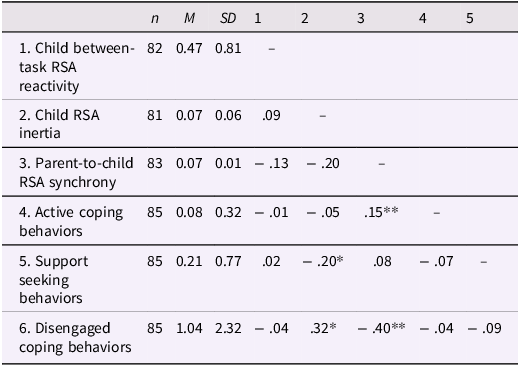
Table 1 Long description
The table presents descriptive statistics and bivariate correlations among six study variables. It consists of six rows and six columns. The columns are labeled as follows: n, M, SD, 1, 2, 3, 4, and 5. The rows are labeled with the study variables: Child between-task RSA reactivity, Child RSA inertia, Parent-to-child RSA synchrony, Active coping behaviors, Support seeking behaviors, and Disengaged coping behaviors. Each row provides the sample size (n), mean (M), standard deviation (SD), and correlation coefficients with other variables. Notable correlations include a significant positive correlation between Active coping behaviors and Support seeking behaviors (0.15), and significant negative correlations between Disengaged coping behaviors and both Child RSA inertia (-0.32) and Active coping behaviors (-0.40).
Note. Child RSA inertia and parent-to-child RSA synchrony were obtained via the “SAVEDATA” command in Mplus.
*p < .05, **p < .01.
A paired t-test revealed that the average RSA level across the task decreased from the resting phase, M = 6.10, SD = 0.95, to the peer-rejection discussion task, M = 5.63, SD = 1.08, with a mean difference of ΔM = 0.47, indicating significant baseline-to-task RSA reactivity, t (81) = 5.20, p < .001. In the multilevel model (Model 1), overall, children’s RSA levels at one specific epoch did not predict the RSA level at the next epoch (i.e., RSA inertia), B = 0.07, SE = 0.04, p = .109. Within dyads, the children’s RSA levels at a certain epoch could be marginally predicted by their parents’ concurrent RSA levels after controlling for the autoregressive effect, B = 0.07, SE = 0.04, p = .086.
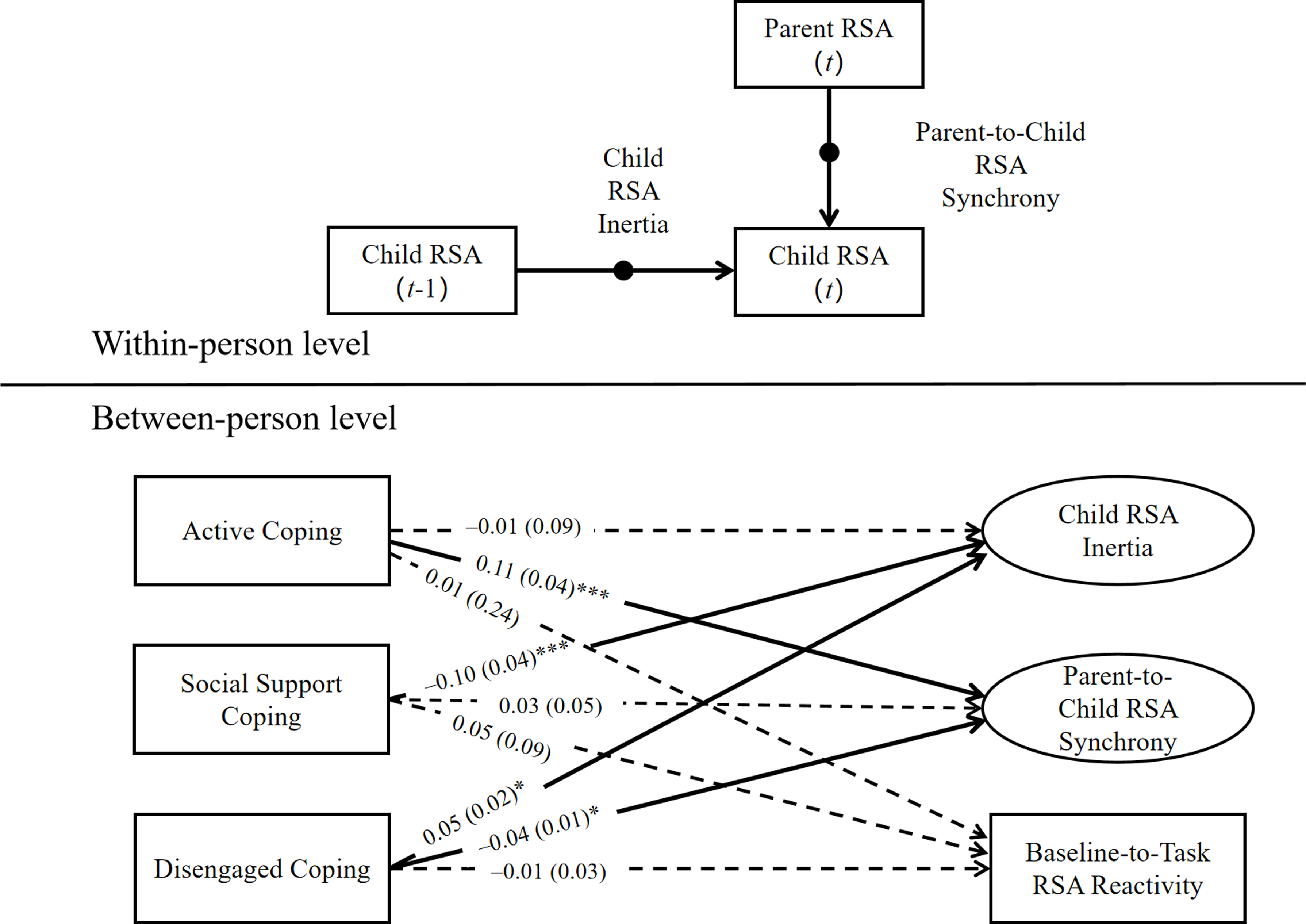
Figure 1 presents the primary results (Model 2, N = 81). Specifically, children who showed more frequent active coping behaviors had greater parent-to-child RSA synchrony, B = 0.11, SE = 0.04, p = .014, and children who showed more frequent social support-seeking behaviors had lower RSA inertia, B = –0.10, SE = 0.04, p = .017. In addition, children who exhibited more disengaged coping behaviors had both higher RSA inertia, B = 0.04, SE = 0.02, p = .002, and lower parent-to-child RSA synchrony, B = –0.04, SE = 0.01, p < .001. However, the nonsignificant associations between active coping and RSA inertia in children, B = –0.01, SE = 0.09, p = .947, and between social support seeking in children and parent-to-child RSA synchrony, B = 0.03, SE = 0.05, p = .571, were unexpected. None of the coping behaviors were associated with baseline-to-task RSA reactivity: B = 0.01, SE = 0.24, p = .955 for active coping; B = 0.05, SE = 0.09, p = .555 for social support coping; B = –0.01, SE = 0.03, p = .675 for disengaged coping.
Results of the model examining the relations between coping behaviors and physiological processes. Note. The bold black lines indicate significant paths, and the dotted lines indicate nonsignificant paths. All the numbers represent unstandardized coefficients, with the standard errors in parentheses.*p < .05, ***p < .001.
Sensitivity analyses
To test the robustness of our findings, we conducted a series of sensitivity analyses (see all the results of sensitivity analyses in the supplementary file). First, given prior evidence suggesting differences in parent–child behavioral and physiological dynamics by parental gender (Girod et al., Reference Girod, Li and Lunkenheimer2025; Li & Lunkenheimer, Reference Li and Lunkenheimer2025), we examined whether the associations between coping behaviors and physiological processes varied between mother–child and father–child dyads. However, the multi-group model could not be successfully identified. We therefore ran separate models by parent gender. These results, reported in the supplemental materials, revealed some differences in association patterns, but due to the limited sample size and lack of formal significance tests, they should be interpreted with caution. Second, we re-estimated the primary model while controlling for linear and quadratic trends in children’s RSA over time. The results remained stable, supporting the robustness of the findings. Third, we additionally controlled for children’s negative affect reactivity to peer rejection, children’s negative affect during the dyadic stress-coping task, and observed parent emotional availability during the stress-coping task to account for potential confounding effects. The results remained generally consistent, suggesting that the observed associations were not driven by these confounding factors.
Discussion
The dual-process model of coping emphasizes the importance of considering both voluntary coping behaviors and involuntary physiological coping processes in response to stress (Compas et al., Reference Compas, Connor, Saltzman, Thomsen, Wadsworth, Lewis and Ramsay1999; Gyurak et al., Reference Gyurak, Gross and Etkin2011). The Polyvagal Theory further specifies why physiological regulation is relevant by positioning respiratory sinus arrhythmia as a core parasympathetic mechanism supporting engagement or withdrawal under stress, thereby providing a mechanistic interpretation of the involuntary branch of the dual-process framework (Porges, Reference Porges2007). Guided by these theoretical models and recent advancements in the assessment of psychophysiology (Li & Lunkenheimer, Reference Li and Lunkenheimer2025; Xu et al., Reference Xu, Wang, Morrow, Xu, Gao, Hu, Suveg and Han2024), this study investigated the association between different coping behaviors and both intrapersonal (child baseline-to-task RSA reactivity, child RSA inertia) and interpersonal (parent-to-child RSA synchrony) physiological regulation processes in a dyadic stress-coping context. As hypothesized, children who were more likely to use active coping behaviors had greater parent-to-child RSA synchrony, and children who were more likely to seek support from their parents had lower RSA inertia. Additionally, children who exhibited more disengaged coping behaviors presented both higher RSA inertia and lower parent-to-child RSA synchrony. Consistent with our hypotheses, none of the coping behaviors were associated with child baseline-to-task RSA reactivity from the resting phase to the dyadic stress-coping task.
Coping behaviors and baseline-to-task RSA reactivity
On average, children’s RSA decreased from the resting phase to the peer-rejection discussion task, illustrating successful elicitation of children’s stress responses during the dyadic stress-coping task. The baseline-to-task RSA reactivity was not associated with any coping behavior, which was in line with our hypothesis. Although previous studies have not concentrated on the associations between specific coping behaviors and baseline-to-task RSA reactivity, mixed results have been reported on the relations between baseline-to-task RSA reactivity and child emotion regulation ability and psychopathology (Beauchaine et al., Reference Beauchaine, Bell, Knapton, McDonough-Caplan, Shader and Zisner2019; Hastings et al., Reference Hastings, Klimes-Dougan, Kendziora, Brand and Zahn-Waxler2014; Quiñones-Camacho & Davis, Reference Quiñones-Camacho and Davis2019). The average magnitude of baseline-to-task RSA reactivity, therefore, may not be precise enough to reflect child physiological regulation.
Coping behaviors and RSA inertia
To overcome the traditional approach of quantifying baseline-to-task RSA reactivity, the present study included RSA inertia in children during the stress task as an indicator of child involuntary self-regulation. RSA inertia refers to the tendency of temporary RSA levels to carry over from one epoch to the next (Xu et al., Reference Xu, Wang, Morrow, Xu, Gao, Hu, Suveg and Han2024). In this study, we found that children who were more likely to adopt disengaged coping behaviors presented greater RSA inertia during the dyadic stress-coping task, whereas children who were more likely to seek emotional or instrumental support from their parents during the stress task had lower RSA inertia. High RSA inertia reflects low physiological flexibility, indicating reduced parasympathetic adjustment to ongoing demands and a more rigid, less dynamically modulated physiological response during the task (Xu et al., Reference Xu, Wang, Morrow, Wang, Gao, Liu, Hu, Suveg and Han2025). Therefore, the observed associations suggest that greater use of disengaged coping and less use of active coping may be linked to lower physiological flexibility, which could reflect less adaptive regulatory functioning in interpersonal stress contexts. Previous studies on RSA inertia have investigated its association with mainly child adjustment outcomes (e.g., emotion regulation capability, externalizing problems; Xu et al., Reference Xu, Wang, Morrow, Xu, Gao, Hu, Suveg and Han2024, Reference Xu, Wang, Morrow, Wang, Gao, Liu, Hu, Suveg and Han2025) or parental characteristics (e.g., parental emotion dysregulation, parent-experienced life stress; Gao et al., Reference Gao, Vlisides-Henry, Kaliush, Thomas, Butner, Raby, Conradt and Crowell2023; Li & Lunkenheimer, Reference Li and Lunkenheimer2025). Our findings extended current research on RSA inertia by examining the unique associations between specific child coping behaviors and RSA inertia, which provides nuanced support for the adaptive functioning of RSA inertia.
Coping behaviors and parent-to-child RSA synchrony
This study further examined the link between task-related coping behaviors and parent-to-child RSA synchrony. The results revealed that children who applied more active coping behaviors during the dyadic-stress coping task presented greater parent-to-child RSA synchrony and that children who displayed more disengaged coping behaviors presented lower parent-to-child RSA synchrony. Previous research has focused mainly on the relation between child trait-like characteristics (e.g., child internalizing problems; Suveg et al., Reference Suveg, Braunstein West, Davis, Caughy, Smith and Oshri2019) or contextual factors (e.g., socioeconomic disadvantage; Miller et al., Reference Miller, Armstrong-Carter, Balter and Lorah2023) and parent–child RSA synchrony. For example, during a stress task (children were asked to verbally respond to a challenging arithmetic problem while their parents passively viewed their performance), children with heightened internalizing problems have lower parent-to-child RSA synchrony (Suveg et al., Reference Suveg, Braunstein West, Davis, Caughy, Smith and Oshri2019). Another study showed that mother–daughter dyads with a history of major depressive disorder had lower positive RSA synchrony or higher negative RSA synchrony than dyads without a history of depression did (Amole et al., Reference Amole, Cyranowski, Wright and Swartz2017). A meta-analysis of 12 studies indicated that high-risk samples, characterized by histories of maltreatment, socioeconomic disadvantage, or clinical difficulties, generally exhibited lower mother–child RSA synchrony compared to low-risk samples (Miller et al., Reference Miller, Armstrong-Carter, Balter and Lorah2023). However, this meta-analysis did not find that mother–child RSA synchrony differed by task context. The present findings build upon the synchrony literature by suggesting that child task-related active and disengaged coping behaviors within a specific dyadic-stress context are uniquely associated with parent-to-child RSA synchrony.
Notably, support-seeking behaviors during the dyadic stress-coping task were not associated with parent-to-child RSA synchrony, and active coping behaviors were not associated with child RSA inertia, which was inconsistent with our hypotheses. To obtain a more holistic view of the relation between coping behaviors and physiological regulation processes, this study reveals that behaviorally intrapersonal regulation (i.e., active coping) is associated with physiologically interpersonal regulation (i.e., parent-to-child RSA synchrony) but not with the physiologically intrapersonal regulation process (i.e., child RSA inertia). In contrast, behaviorally interpersonal regulation (i.e., seeking support from parents) was associated with physiological intrapersonal regulation (child RSA inertia) but not physiologically interpersonal regulation (parent-to-child RSA synchrony).
Rather than reflecting a contradiction between behavioral and physiological regulation, these cross-domain associations may indicate dynamic coordination across regulatory systems. Results suggest that children may flexibly draw on multiple regulatory resources, and these systems need not operate in parallel; instead, one system may compensate when another is less engaged. For example, children who cope independently through active strategies may still benefit from physiological co-regulation with parents (reflected in parent-to-child RSA synchrony), even without overt behavioral support seeking. Conversely, children who behaviorally seek support from parents may rely more on internal physiological flexibility (as indexed by RSA inertia) and less on dyadic physiological coordination in that moment, suggesting that support seeking may represent the strategic recruitment of external resources when autonomic co-regulation is not strongly engaged.
Prior research has shown that both coping behaviors and physiological regulation processes are linked to children’s emotion regulation and psychological adjustment (Gray et al., Reference Gray, Lipschutz and Scheeringa2018; Suveg et al., Reference Suveg, Braunstein West, Davis, Caughy, Smith and Oshri2019; Xu et al., Reference Xu, Wang, Morrow, Xu, Gao, Hu, Suveg and Han2024). By examining both behavioral and physiological coping indicators simultaneously, the present study offers a nuanced view of how these systems are coupled during stress. Developmentally, the observed cross-domain patterns may reflect an ongoing transition in middle childhood from externally scaffolded regulation toward increasing behavioral self-regulation, supported by available physiological and interpersonal resources. Future research should further examine the coordination and temporal dynamics of these systems to better understand the directionality and co-regulation mechanisms underlying stress coping.
Strengths, limitations, and future directions
This study contributes to research on coping behaviors and physiological regulation processes in at least four ways. First, our findings provide solid evidence revealing the associations between intentional and involuntary stress-coping processes, two core components of the dual-process model of coping. The results also demonstrate that explicit coping behaviors are systematically associated with RSA-based indices of physiological regulation. Second, beyond the traditional approach of calculating baseline-to-task RSA reactivity, this study quantified both intrapersonal and interpersonal physiological processes of within-task RSA reactivity from a dynamic perspective. The dynamic physiological processes of intrapersonal and interpersonal regulation contribute to a novel perspective for understanding the biological mechanisms of coping behaviors. Third, our study provides support and contributes to the literature by demonstrating the adaptive function of low RSA inertia and positive parent-to-child RSA synchrony under a new dyadic-stress coping condition among a low-risk community sample, during which parents needed to comfort their children after they were excluded by peers. Fourth, the use of observational coding allowed us to capture proximal and in-task behavioral correlates of RSA inertia and parent-to-child RSA synchrony, which supplies current evidence that mainly concentrates on trait-like correlates of physiological processes.
Some limitations should be considered in the interpretation of our findings. First, as enlightened by prior research (e.g., Gao et al., Reference Gao, Speck, Ostlund, Neff, Shakiba, Vlisides-Henry, Kaliush, Molina, Thomas, Raby, Crowell and Conradt2022; Lunkenheimer et al., Reference Lunkenheimer, Busuito, Brown, Panlilio and Skowron2019), we operationalized RSA inertia only as a lag-1 autocorrelation based on 30-second epochs, which yields a range of values including positive, negative, and near-zero estimates. Specifically, a near-zero autocorrelation could indicate either high flexibility or, alternatively, physiological unpredictability (e.g., random fluctuations between parasympathetic withdrawal and augmentation), which cannot be disentangled using lag-1 inertia alone. The ambiguity in interpreting these values highlights the need for caution when drawing conclusions about regulatory capacity based on a single dynamic index. In addition, we did not consider higher-order lags or autocorrelation within smaller or longer time scales. Future research may benefit from using multiple time scales (e.g., 1 second, 5 seconds, etc.) as well as continuous modeling approaches to more accurately characterize RSA dynamics and their associations with child developmental outcomes. It is also important to incorporate complementary analytic approaches such as nonlinear dynamic modeling or entropy-based measures (e.g., Rohila & Sharma, Reference Rohila and Sharma2019; Zhang et al., Reference Zhang, Gatzke-Kopp, Cole and Ram2022). These tools may better differentiate between physiological flexibility and unpredictability and clarify how distinct RSA dynamic patterns relate to children’s behavioral regulation and broader developmental functioning.
Second, although the study examined concurrent associations with coping behaviors modeled as predictors of physiological outcomes, this approach does not allow for strong causal inferences. In particular, it remains conceptually and empirically unclear whether children’s physiological regulation serves as an antecedent to coping or whether these physiological processes are themselves shaped by children’s behavioral coping strategies during stress. Clarifying this directionality is important because it would illuminate whether physiological attunement provides a scaffold that enables effective coping behaviors or whether coping behaviors mobilize physiological regulatory resources in moments of stress. To address these bidirectional possibilities, future research should employ longitudinal or fine-grained temporal designs. For example, repeated-measures or time-lagged models in naturalistic or experimental settings could help disentangle causal ordering over time. Alternatively, fine-grained behavioral coding synchronized with physiological signals during dyadic interactions may help capture the temporal sequencing of behavioral and physiological responses. Such designs would allow for stronger inferences about the causal interplay between intrapersonal and interpersonal physiological regulation and children’s coping processes.
Third, although our findings highlight distinct associations between children’s coping behaviors and physiological regulatory processes within this lab-based dyadic stress context, it is important to acknowledge that the functional value of coping behaviors is highly dependent on situational demands. A strategy that appears effective in one context may serve a very different purpose in another (e.g., behavioral disengagement may be protective in situations involving intense threat, hostility, or potential harm). Therefore, the present results should not be interpreted as reflecting universally “good” or “poor” forms of coping, but rather patterns that emerged in this specific interpersonal stress paradigm. Future research should examine whether the cross-domain associations observed here generalize or reorganize across diverse stress contexts (e.g., uncontrollable vs. controllable, interpersonal vs. performance-based, peer vs. parent interactions). Such an approach could clarify how different regulatory systems are flexibly recruited across situations and may help identify when and for whom particular configurations of behavioral and physiological responses support effective functioning.
Fourth, we concentrated on physiological processes measured by RSA, an indicator of the PNS. Other physiological systems, such as the sympathetic nervous system and the hypothalamic–pituitary–adrenal axis, also play important roles under stress (Adam et al., Reference Adam, Collier Villaume, Thomas, Doane, Grant, Crockett, Carlo and Schulenberg2023; Brownlow et al., Reference Brownlow, Cheavens, Vasey, Thayer and Hill2024). Recently, an increasing number of studies on neurological self-regulation and interpersonal regulation processes have been conducted, providing a novel perspective for understanding the development of child coping processes (Camacho et al., Reference Camacho, Williams, Ding and Perlman2021; Ratliff et al., Reference Ratliff, Kerr, Cosgrove, Simmons and Morris2022). Future studies should capture multimodal intra- and interpersonal regulation processes during parent–child interactions to elucidate the link between voluntary and involuntary coping processes.
Fifth, the relatively small sample size, particularly the limited number of fathers, and the broad child age range prevented us from formally testing parent gender or developmental differences. In addition, the sample consisted primarily of Chinese families from middle-to-high socioeconomic backgrounds, which may limit the generalizability of the findings. Future research with larger and more diverse samples is needed to examine how the links between coping behaviors and physiological regulation may vary across parent gender, developmental stages, and sociocultural contexts.
Conclusion
In addition to calculating baseline-to-task RSA reactivity, RSA inertia and parent-to-child RSA synchrony were quantified in this study to capture the dynamic physiological processes of intrapersonal and interpersonal regulation. The results revealed that in a dyadic stress-coping task, different child coping behaviors, namely active coping, support seeking, and disengaged coping, were uniquely associated with child RSA inertia and parent-to-child RSA synchrony at the physiological level. This study also revealed a mismatch between children’s behavioral and physiological coping processes during stressful conditions. Interventions aimed at teaching children’s adaptive behaviors to cope with stress could have profound implications for child development because they may also enhance children’s physiological coping capabilities, which is beneficial for child development outcomes in the long term.
Supplementary material
The supplementary material for this article can be found at https://doi.org/10.1017/S0954579426101217.
Data availability statement
All the data are available upon reasonable requests.
Acknowledgements
We thank the teachers, administrators, and families who made this research possible.
Funding statement
The preparation of this article was supported by the National Key R&D Program of China (2024YFC2707800), the National Natural Science Foundation of China (32130045), and the National Social Science Fund of China (23ASH014).
Competing interests
The authors declare that they have no conflicts of interest.
Pre-registration statement
The analyses presented here were not pre-registered.
Availability of code
All the codes are available upon reasonable requests.
Availability of methods/material
All the materials are available upon reasonable requests.
AI statement
AI tools (specifically ChatGPT 4) were used solely for language polishing (e.g., grammar correction, clarity improvement of sentences), formatting of references, or structuring of manuscript sections. The AI-generated content was fully reviewed, edited, and validated by the authors to ensure accuracy, consistency with the study’s original intent, and adherence to academic integrity. No AI tool was involved in core academic work, including study design, data analysis, interpretation of results, or drawing conclusions.


 Open access

