





1. Introduction
Time is elusive. Nobody has ever seen tomorrow or touched yesterday; philosophers have been squabbling for more than a century over the nature of now. And yet time is a foundational part of human experience. Countless everyday activities – from farming and fermenting, to keeping records and conducting rituals – depend on our ability to track and compare durations, to remember and relate sequences, to reconstruct the past and plan for the future. Augustine of Hippo noted this double aspect of time already around 400 ce: “Who can even form a conception of it to be put in words? Yet what do we mention more often or familiarly in our conversation than time?” (Saint Augustine, Reference Augustine2008, p. 267 [c. 400 ce]). Faced with this tension, humans around the world have converged on a solution: we make sense of time by construing it in terms of space, a more tangible dimension of experience (e.g., Bender & Beller, Reference Bender and Beller2014; Boroditsky, Reference Boroditsky2000; Casasanto & Boroditsky, Reference Casasanto and Boroditsky2008; Clark, Reference Clark and Moore1973; Lakoff & Johnson, Reference Lakoff and Johnson1980; Moore, Reference Moore2014; Núñez & Sweetser, Reference Núñez and Sweetser2006; Traugott, Reference Traugott and Greenberg1978; Whorf, Reference Whorf and Carroll1956). To express the passing of time, we use concepts of movement; to compare different durations, we invoke length or size; to construe sequences of events – or to distinguish past from future – we repurpose ideas about location (Núñez & Cooperrider, Reference Núñez and Cooperrider2013). In this way, we are able to form conceptions of time and put those conceptions into words.
Most of the spatial construals of time studied to date have involved body-based spatial contrasts. Notions of bodily ‘front’ and ‘back’, for instance, are widely used to characterize the position of events in a sequence – what is often called sequence time (e.g., Núñez & Cooperrider, Reference Núñez and Cooperrider2013). The construal is apparently based on the imagined scenario of entities in a line all moving in the same direction, like people walking on a path (e.g., Moore, Reference Moore2014). An entity in front of another arrives before it (related to the use of ‘before’ to mean ‘in front of’); an entity behind another arrives after it (related to the use of ‘aft’ to mean ‘toward the back’).
Also widespread is the use of the front–back contrast to distinguish past, present, and future – what is often called deictic time (e.g., Núñez & Cooperrider, Reference Núñez and Cooperrider2013). In the most common construal, evident in English, the future is what lies ‘ahead’ of us, something we ‘look forward to’; the past is what we leave ‘behind’ and ‘think back on’. Such a future-in-front construal is found beyond English and European languages – in Mandarin, Japanese, and Wolof, for example (Alverson, Reference Alverson1994; Gu et al., Reference Gu, Zheng and Swerts2019; Moore, Reference Moore2014) – and appears to be rooted in the experience of forward motion: when we walk, things ahead of us in space are also further into the future; things behind us are also in the past. Commonplace and intuitive as this mapping may be, it is not used everywhere. The Aymara of the Andes construe the past as ‘in front’ of them and the future as ‘behind’, a ‘reversed’ mapping likely based on the idea that the past is visible and known – much like what is physically in front of us – whereas the future is not yet visible and remains unknown – much like what is at our backs (Núñez & Sweetser, Reference Núñez and Sweetser2006).
Body-based construals of time are especially explicit when they pop up in language, but they also show up in psycholinguistic experiments (e.g., Bergen & Lau, Reference Bergen and Lau2012; Rinaldi et al., Reference Rinaldi, Locati, Parolin, Bernardi and Girelli2016; Walker et al., Reference Walker, Bergen and Núñez2017) and in the gestures people spontaneously produce when they speak (e.g., Cooperrider & Núñez, Reference Cooperrider and Núñez2009; Núñez & Sweetser, Reference Núñez and Sweetser2006). These more implicit sources of evidence reveal that people use more than just the front–back bodily axis to conceptualize time. Speakers of English and European languages also construe time in terms of their left–right axis (e.g., Santiago et al., Reference Santiago, Lupiáñez, Pérez and Funes2007), with earlier events toward their left and later events toward their right. In fact, studies find that, when people in these groups gesture about time, they use their left–right axis more than their front–back axis (Casasanto & Jasmin, Reference Casasanto and Jasmin2012; Valenzuela et al., Reference Valenzuela, Cánovas, Olza and Carrión2020; Walker & Cooperrider, Reference Walker and Cooperrider2016). This later-is-rightward construal appears to be based on experience with graphical representations such as calendars, timelines, and text generally, an interpretation supported by findings from other graphical traditions (e.g., Fuhrman & Boroditsky, Reference Fuhrman and Boroditsky2010; Starr & Srinivasan, Reference Starr and Srinivasan2021). Taken together, such observations reveal a widespread tendency for humans to construe time in terms of their own bodily axes, whether front–back, left–right, or up–down. Such construals emerge overtly in language as well as in more implicit behaviors, and are rooted in basic experiences of walking, seeing, and interacting with graphical representations.
Widespread as these patterns are, they are not universal. Work in the past decade has now documented communities that construe time according to environment-based rather than body-based contrasts (Boroditsky & Gaby, Reference Boroditsky and Gaby2010; Gaby, Reference Gaby2012; Núñez et al., Reference Núñez, Cooperrider, Doan and Wassmann2012). In our own prior work, we showed that the Yupno people of Papua New Guinea tend to construe the past as downhill and the future as uphill (Núñez et al., Reference Núñez, Cooperrider, Doan and Wassmann2012). More recently, additional reports have surfaced from the same region of Papua New Guinea, suggesting the future-uphill construal might be an areal feature (Pennington, Reference Pennington2016; Sarvasy, Reference Sarvasy2014; Taylor, Reference Taylor2015). A similar future-uphill pattern has also been documented in Tzeltal (Brown, Reference Brown2012), and there are further hints of it elsewhere (Forker, Reference Forker2020). Together these observations suggest that environment-based construals of time, while only glancingly described to date, are a recurring feature of the human conceptual landscape.
The use of environment-based construals of time in the Yupno and other groups is no accident: it appears to build on a preference for environment-based construals of space. Over the last three decades, abundant evidence has accumulated that – contra the long-held assumptions of Western philosophers and cognitive scientists (see Levinson & Brown, Reference Levinson and Brown1994) – not all cultures prefer to parse the world in terms of ‘front’ and ‘back’, ‘left’ and ‘right’. In many communities, people instead talk about motion, location, and orientation primarily in terms of contrasts like ‘east’ and ‘west’ (e.g., Haun et al., Reference Haun, Rapold, Janzen and Levinson2011; Haviland, Reference Haviland1998), ‘uphill’ and ‘downhill’ (e.g., Bickel, Reference Bickel, Nuyts and Pederson1997; Brown & Levinson, Reference Brown and Levinson1993), ‘toward the mountain’ and ‘toward the sea’ (e.g., Wassmann & Dasen, Reference Wassmann and Dasen1998); or in terms of wind (e.g., Hoffmann, Reference Hoffmann2019) or tide (e.g., Bowern, Reference Bowern2012). In such groups environment-based concepts are often favored for everyday spatial reference, even on small (so-called ‘table-top’) scales (e.g., Levinson & Wilkins, Reference Levinson and Wilkins2006; Pederson et al., Reference Pederson, Danziger, Wilkins, Levinson, Kita and Senft1998); reflected in gesture (e.g., Le Guen, Reference Le Guen2011); mastered by children at young ages (De León, Reference De León1994); used in settings where they might seem inappropriate, such as indoors (Cooperrider, Slotta, & Núñez, Reference Cooperrider, Slotta and Núñez2017); evoked in dreams (Evans, Reference Evans2010); reflected in the orientation of houses and settlements (e.g., Núñez & Cornejo, Reference Núñez and Cornejo2012); and folded into cultural practices like sleep and burial (Wassmann & Dasen, Reference Wassmann and Dasen1998). Of special interest for present purposes, such contrasts are also used to construe elusive dimensions of human experience – dimensions like time.
Environment-based construals of time are of potential interest to a broad swath of fields – from linguistic anthropology to developmental psychology to cognitive neuroscience. And yet, despite this potential for broad interest, details about such systems remain sketchy and scattershot. The broad goal of the present paper is to remedy this. To this end, we present the fullest portrait yet of one environment-based system for conceptualizing time: the topographic system used in the Yupno valley of Papua New Guinea. In our initial report on this system (Núñez et al., Reference Núñez, Cooperrider, Doan and Wassmann2012), our primary aim was to show that Yupno speakers really do conceive of time in terms of environmental rather than bodily contrasts – to show, in short, that such a system exists. We thus left a number of questions unresolved, including about the logic of the system, its linguistic realization, individual variation in its use, and its cultural entanglements and experiential motivations. In the present report, drawing on additional fieldwork – including further interviews and linguistic elicitation – we revisit these questions. We also make an effort to further contextualize this distinctive way of understanding time. The Yupno system – like all human conceptual systems – is best understood within the broader ecology in which its rooted, including the natural and built environment, linguistic resources and discourse regularities, and a suite of relevant cultural practices. We begin with a brief introduction to the Yupno valley and Yupno communities.
2. The Yupno valley of Papua New Guinea
The New Guinea region is a major world hotspot of linguistic diversity (Gorenflo et al., Reference Gorenflo, Romaine, Mittermeier and Walker-Painemilla2012), harboring an estimated 1300 living languages (Palmer, Reference Palmer2017). The Upper Yupno valley is part of the Finisterre Range; it straddles the border of Madang and Morobe provinces and is home to some 8000 speakers of Yupno, spread across approximately 25 villages (Slotta, Reference Slotta2015). Most people in the region are subsistence horticulturalists. Yupno (also spelled Yopno) is a Papuan language, grouped in the Nuclear Trans New Guinea family. Our joint research has been based in the village of Gua, which neighbors the administrative center of Teptep, and lies at an elevation between 2000 and 2200 meters above sea level (Figure 1).
The region of the Upper Yupno valley where the present research was conducted. Interviews were carried out in three villages – Gua, Nombo, and Weskokop – each with a different topographic profile. In Gua, where much of our work has been based, there are two salient uphill–downhill axes: first, a relatively steep upslope–downslope axis, stretching from the Daldal river to the ridge above Gua; second, a relatively gentle upvalley–downvalley axis stretching from Teptep down to the Yupno river. From Gua, Nombo is a 60–90 min walk (~1.7 km as the crow flies) and Weskokop is a 20–30 min walk (~1.3 km). Elevations are shown in meters above sea level; the camera faces approximately southeast (imagery: Google Earth).
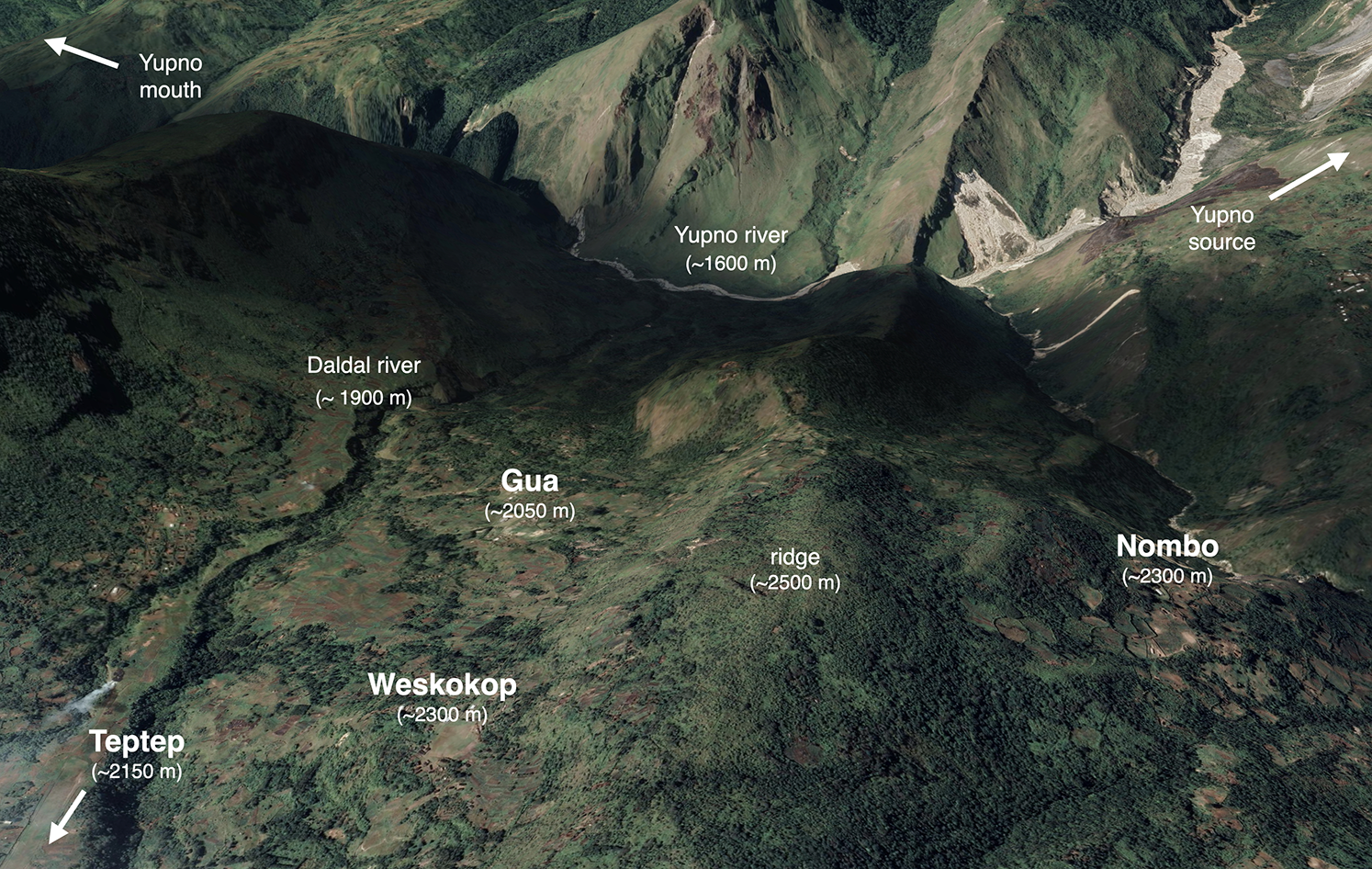
The Yupno valley is formed by the Yupno river, which flows from its high-altitude source down to the Bismarck Sea. Off this main valley are a number of ‘side valleys’ formed by smaller rivers that drain into the Yupno. Gua village sits in one such side valley, defined by the Daldal river (as well as the Jetjet river, which parallels it). These side valleys often have a common geophysical structure: a gentle slope defined by the flow of the smaller river into the Yupno, which we describe as the upvalley–downvalley axis; and steeper slopes on either side of the smaller river, from the nearby ridges down toward the side valley floor and river, which we describe as the upslope–downslope axes.
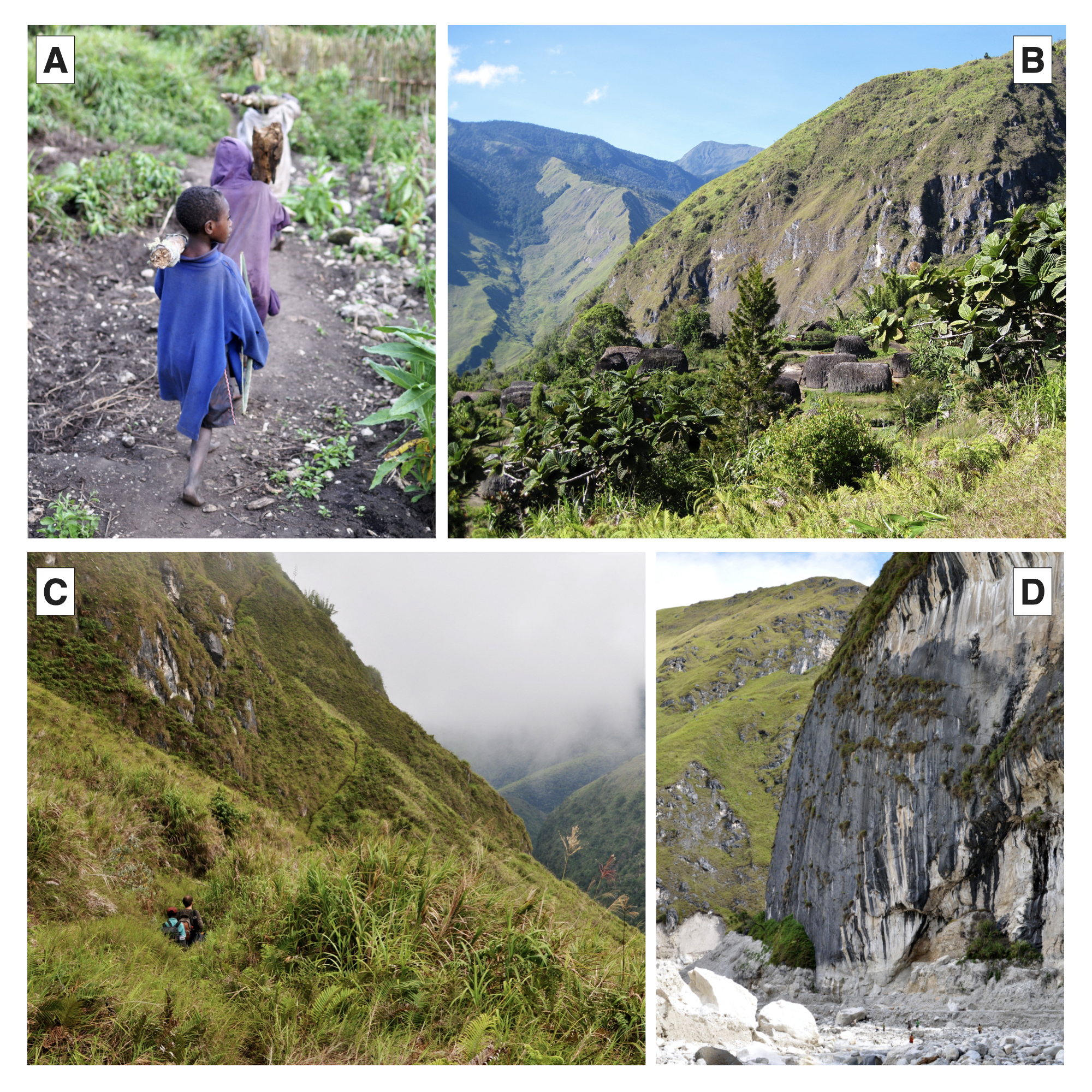
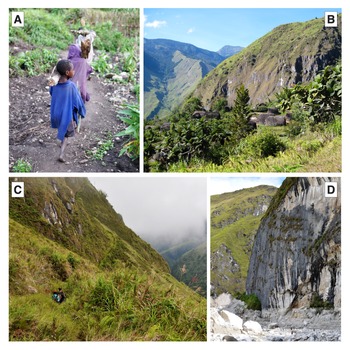
The Yupno valley is rugged and remains relatively remote. No roads come into the area, so one must enter by foot – a difficult journey of a couple days from the nearest cities, Madang and Lae – or by small plane – a prohibitively expensive proposition for most. As a result of this relative isolation, flows of people and goods into and out of the valley are limited. There is no steady influx of print media, for instance, and while the world of contemporary global culture does seep in, it usually feels distant. Within the valley, there are no vehicles (animal-drawn, motorized, mechanical, or otherwise) or graded surfaces; people travel exclusively by foot to tend gardens, gather firewood, and visit neighbors over a network of footpaths (Figure 2). At the time of the present research, infrastructure was quite limited, with water available at communal taps but no electricity, phone service, or internet. Wood fires burn throughout the day and night, providing heat, light, and fuel for cooking.
The lived topography of the Yupno valley. (A) A group of boys carry firewood back to the village. (B) A cluster of houses in Gua. The village includes dwellings spread over an elevation of roughly 200 meters (from 2000–2200 meters above sea level); walking to a nearby house thus often involves going up or down a slope. (C) Men on a path winding up and over a ridge toward the village of Nian. (D) The gorge of the Yupno river at its nearest point of access from Gua.
Despite this remoteness, the Yupno have undergone substantial cultural exchange with other parts of Papua New Guinea and the wider world. Missionization in the region began around 1930 and intensified in the 1950s (Wassmann, Reference Wassmann1994); today most residents of the valley are at least nominally Christian. The first airfield in the region was opened in 1971 (Wassmann, Reference Wassmann1994), and Tok Pisin – the English-based creole used throughout Papua New Guinea and one of the country’s official languages – has been a fixture of schooling for roughly half a century. Today, most adults under the age of 60 years old have at least some fluency in Tok Pisin (Slotta, Reference Slotta2015), though Yupno remains the ‘mother tongue’ learned from birth and the language most used in informal conversation. Many villages in the region, including Gua, have their own schoolhouses, which provide instruction through the middle grades. To pursue further education, students must leave the valley – at considerable expense – to attend a regional high school in a city. Some adults who did not attend high school nonetheless have a basic level of literacy, which is used primarily in church contexts.
A notable aspect of the valley is the architecture. Most buildings are single-room homes made from traditional building materials (Cooperrider, Slotta, & Núñez, Reference Cooperrider, Slotta and Núñez2017). These structures – hereafter ‘traditional houses’ – follow a basic template, with an oval floorplan, a door at one end leading up a few steps to a raised bamboo floor, and a long fireplace at the center that runs the length of the house; there are few if any windows. The houses can be quite large – sometimes 15 meters from end to end (Wassmann, Reference Wassmann1994) – and so can accommodate a sizable group. Everyday life thus unfolds principally in two settings: the rugged terrain of the out-of-doors and the dark, firelit interiors of traditional houses. As we will see, both these settings – natural and built – figure prominently in the Yupno cognitive ecology of time and space. For further ethnographic details, see Wassmann (Reference Wassmann2016), Keck (Reference Keck2005), Slotta (Reference Slotta2012, Reference Slotta2015), and Kocher Schmid (Reference Kocher Schmid1991).
3. Topographic spatial concepts in Yupno language and culture
The Yupno rely heavily on ‘topographic concepts’ when talking about where houses and objects are located, how things are oriented, and where people are going (for examples, see Cooperrider, Slotta, & Núñez, Reference Cooperrider, Slotta and Núñez2017; Slotta, Reference Slotta2014; Wassmann, Reference Wassmann1993, Reference Wassmann1994). Such concepts are used on scales large and small, even when the setting is veridically flat, and even when – to an outside observer – terrain seems beside the point. A similar reliance on topographic distinctions is reported elsewhere in New Guinea’s interior (e.g., Fedden & Boroditsky, Reference Fedden and Boroditsky2012; Von Heeschen, Reference Von Heeschen, Weissenborn and Klein1982), as well as in the broader Pacific region (e.g., François, Reference François2004; Senft, Reference Senft1997) and across the world’s mountainous regions (Urban, Reference Urban2020), including in the Himalayas (e.g., Post, Reference Post2019), the Caucasus (e.g., Forker, Reference Forker2019), and Mesoamerica (e.g., Soto, Reference Soto2011). Our notion of ‘topographic’ bears unpacking.Footnote 1 The relevant linguistic terms do not make explicit reference to slope or terrain, such as with a morpheme meaning ‘hill’ (as in English ‘uphill’); and, in fact, they are also used to refer to purely vertical relationships. More general terms like ‘up’ and ‘down’ may thus seem more appropriate, and we do gloss the terms this way in some contexts. However, elicitation with Yupno speakers suggests the terms are prototypically associated with terrain, with the tilts and contours of the ‘horizontal’ plane.Footnote 2 They are linked, in other words, to the plane of canonical human activity – a plane which, for Yupno speakers, is very often tilted (for similar claims, see Brown & Levinson, Reference Brown and Levinson1993).
As noted, topographic systems are widely distributed around the globe, but, importantly, not all are the same. A critical division among such systems is seen in the difference between the Yupno system and the Tzeltal system, which is perhaps the best described system in the literature (Brown, Reference Brown2012; Brown & Levinson, Reference Brown and Levinson1993). In Yupno, topographic terms are used according to local slopes; in Tzeltal, by contrast, they may be used in this way but also often function as fully abstracted vectors like ‘east’ and ‘west’ (Brown & Levinson, Reference Brown and Levinson1993). There is no similar ‘cardinal-like’ use of ‘uphill’ and ‘downhill’ in Yupno, a fact with implications for how people talk and gesture about space and time.
The key claim about the Yupno – and about other groups that lean on topography – is that topographic concepts are not just present but privileged. Several strands of evidence support this idea. A first is the sheer quantity and variety of words that are inflected for topography, including many that belong to basic, ‘closed-class’ parts of the lexicon. The Yupno demonstratives, for instance, are optionally but pervasively inflected for uphill–downhill relationships. There is a single proximal form (like English ‘this’), but for the medial and distal demonstratives there are neutral (‘that’), up (‘that-up-there’), and down (‘that-down-there’) variants (Cooperrider, Slotta, & Núñez, Reference Cooperrider, Slotta and Núñez2017, Table 1). The basic motion verbs ‘come’ and ‘go’ are similarly inflected (Cooperrider, Slotta, & Núñez, Reference Cooperrider, Slotta and Núñez2017, Table 2); they also combine with other verbs (e.g., ‘send’, ‘walk’, ‘put’) such that a large portion of Yupno verbs ultimately become inflected for ups and downs. Finally, there is a rich class of spatial modifiers (similar to prepositions or adverbs in English) that convey different kinds of topographic relationships. These include, for instance, a contrasting pair of adverbs that refers to elongated objects oriented parallel to the slope of the hill (doŋdoŋ) or perpendicular to it (baratda), as well as monolexemic terms glossable as ‘next-to-on-above-side’ (awɨŋban) or ‘next-to-on-below-side’ (abɨŋban) derived from the basic motion verbs.
A second strand of evidence lies in speakers’ preferred ways of talking: topographic terms are not just abundant in Yupno, they are widely used over alternatives. Neutral forms are available – as noted – but speakers prefer to specify ups and downs when possible, and sometimes reject neutral formulations. We also find that speakers prefer to specify location and motion using topographic contrasts rather than other spatial contrasts (e.g., based on bodily axes or ad hoc landmarks), even on very small spatial scales (Cooperrider, Slotta, & Núñez, Reference Cooperrider, Slotta and Núñez2017; Wassmann, Reference Wassmann1994). In a recent study using a referential communication task – the ‘Pig & Corn’, a variant of the classic ‘Man & Tree’ (e.g., Pederson et al., Reference Pederson, Danziger, Wilkins, Levinson, Kita and Senft1998) – Yupno speakers used topographic contrasts on 75% of trials when outdoors (accounting for 47% of all strategies used) (Cooperrider, Slotta, & Núñez, Reference Cooperrider, Slotta and Núñez2017). Meanwhile spatial contrasts like ‘left’ and ‘right’ – which are heavily used by English speakers in similar tasks (Li & Gleitman, Reference Li and Gleitman2002) – were vanishingly rare, despite the fact the arrays used were often laterally asymmetric (Cooperrider, Slotta, & Núñez, Reference Cooperrider, Slotta and Núñez2017, p. 785).
A third strand of evidence is that topographic terms are frequently used beyond their semantic ‘home turf’. For one, they are pervasively used on flat surfaces outdoors. This is done according to the slopes adjacent to the flat area; walking in the direction of a downhill slope, for instance, would be considered ‘going downhill’, In the Pig & Corn studies just mentioned, we showed that topographic contrasts are also widely used inside traditional houses (on 78% of trials and accounting for 35% of all strategies; Cooperrider, Slotta, & Núñez, Reference Cooperrider, Slotta and Núñez2017). Such terms are used indoors by projecting a ‘conceptual topography’ onto the house, with a longer uphill–downhill axis extending from the door (construed as ‘downhill’) to the opposite end of the house (‘uphill’) and two shorter uphill–downhill axes extending on either side of the house from the fireplace (‘downhill’) to the sidewall (‘uphill’). This topography – which is reminiscent of the two-axis topography surrounding Gua (Figure 1) – is stable regardless of whether a house faces uphill or downhill relative to the surrounding terrain. It also shows up in how speakers gesture about time indoors: they generally locate the past toward the door and the future away from it (Núñez et al., Reference Núñez, Cooperrider, Doan and Wassmann2012).Footnote 3 To date we have only studied the phenomenon of ‘conceptual topography’ in the case of houses, but Yupno speakers apparently also do something similar in urban environments such as the city of Madang, treating the major road – which is more or less flat – as though it defines an uphill–downhill axis (Wassmann, Reference Wassmann1994, pp. 660–661).
Still other strands of evidence support the privileged nature of topographic contrasts for the Yupno. They are mastered by children early in life – including being appropriately used indoors – and are incorporated into cultural practices such as conventional sleeping position (Cooperrider, Slotta, & Núñez, Reference Cooperrider, Slotta and Núñez2017). Finally, they are also recruited for making sense of abstract dimensions of experience – notably, time, to which we now turn.
4. Time in Yupno language and culture
All languages have a more or less rich stock of linguistic resources for talking about different aspects of time and temporal experience. Here we consider these resources in Yupno, with particular focus on those devoted to expressing concepts of duration, sequence time, and deictic time – the three major classes of temporal concepts that are construed spatially around the world (Núñez & Cooperrider, Reference Núñez and Cooperrider2013). Our work to date has zoomed in on the Yupno construal of deictic time – past, present, and future – so we will treat this class of concepts in the most depth, particularly when analyzing gestural examples.
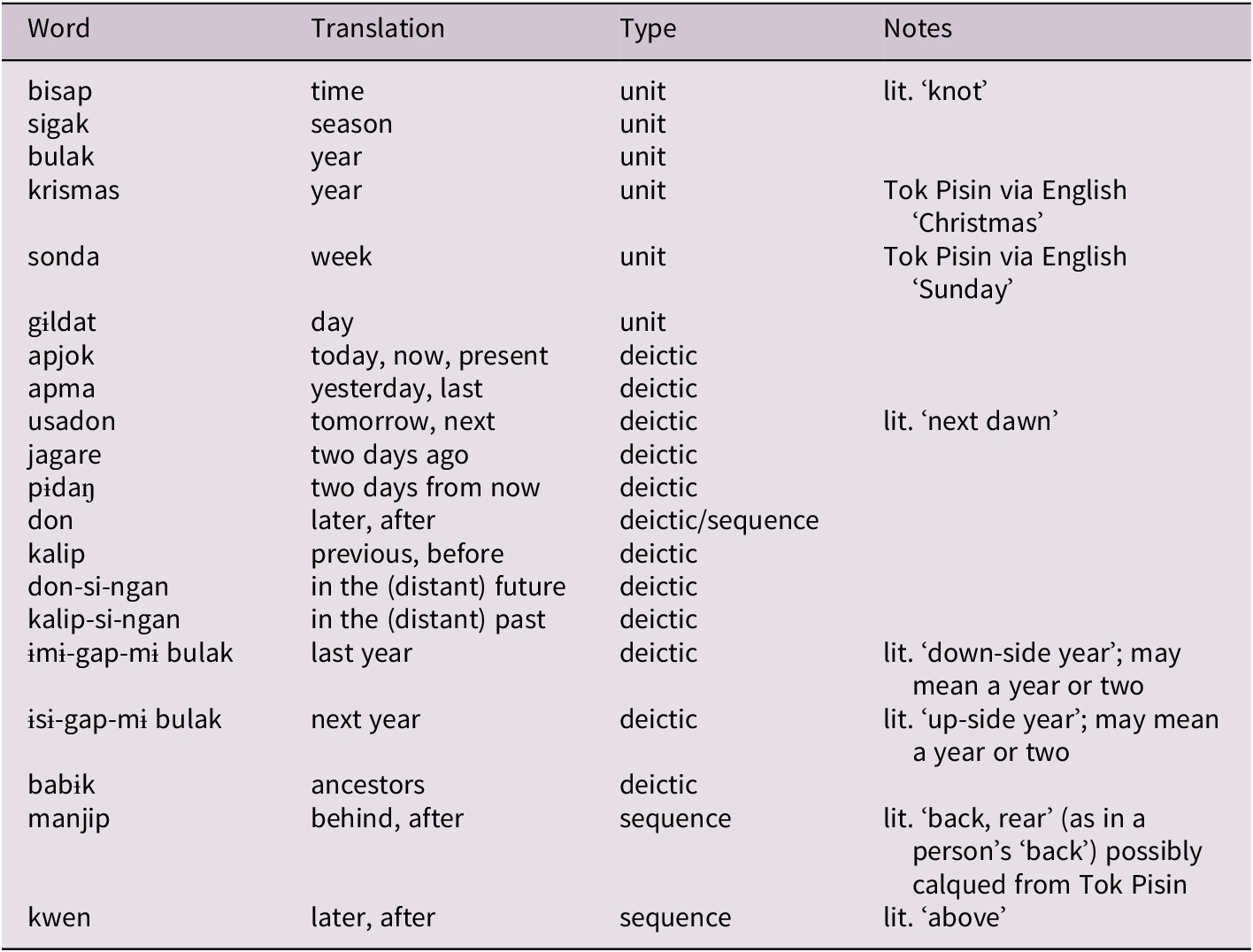
The most generic temporal word in Yupno is bisap, a term meaning period or event, not unlike English ‘time’. The word also means ‘knot’; its reference to time may stem from earlier practices of tying knots to track events like new moons (Wassmann, Reference Wassmann2016, p. 238). There are commonly used words for ‘day’, ‘week’, ‘year’, and ‘season’ (see Table 1). All are native Yupno terms except that for ‘week’ (sonda), which is Tok Pisin and rooted ultimately in English ‘Sunday’. The Tok Pisin term for ‘year’, krismas (from English ‘Christmas’) is also commonly used. Both these Tok Pisin terms are metonymic in that a particular part of the week or year stands for the whole. The Yupno valley does not run on ‘clock time’; hours, minutes, and seconds are scarcely mentioned, if at all. Terms for days of the week and months are taken from Tok Pisin but are not commonly used; years are labeled according to the Western calendar but are not particularly culturally salient.
Key temporal lexicon in Yupno
In comparing the magnitude of durations, Yupno speakers most often use words for ‘long/tall’ (jɨbagɨ) and ‘short/small’ (pɨsɨpmɨ). Long-duration terms are frequently emphasized with an intensifier (-si); short-duration terms are emphasized with the diminutive (-jok), which occurs as a morphological suffix and has several allomorphs (Cooperrider & Núñez, Reference Cooperrider and Núñez2012). The diminutive is also used to mark the precision of temporal intervals, a pattern that is common across languages (Jurafsky, Reference Jurafsky1996).
The topographic system enters into the expression of durations when describing the continuation of a process (what linguists refer to as the ‘durative’). Specifically, as a process unfolds it is said to ‘go up’ (there is no contrasting sense in which a process can ‘go down’) (see Slotta, Reference Slotta2014, pp. 44–45, ex. 94–98).
Yupno speakers express sequential relations in several ways. Sequence time – sometimes known as ‘tenseless time’ (McTaggart, Reference McTaggart1908) – concerns earlier and later relations between events; it differs from deictic time in that it does not necessarily specify a now and thus does not concern past, present, or future. It is the type of concept at play, for instance, when describing different steps in a ceremony, seasons in a year, stages in the lifespan, or the acceleration of a falling object in physics, none of which are obligatorily anchored to now. Interestingly, Yupno furnishes linguistic resources for describing the ‘after’ relation but apparently not for describing the ‘before’ relation (note that many languages have terms for neither relation; e.g., Bohnemeyer, Reference Bohnemeyer, Klein and Li2009). This apparent ‘before-less-ness’ is evident in two conceptual models Yupno speakers commonly employ when describing sequences. A first is the one found worldwide and already discussed: the events-in-a-queue construal, based on a line-up of entities moving in the same direction. The entities correspond to temporal landmarks, such that later landmarks are said to be manjip (literally ‘behind’) earlier ones. However, Yupno speakers do not spontaneously use a contrasting spatial term for ‘in front of’ to mean ‘before’. (It seems possible to extract such a usage during meta-linguistic discussion, but it does not occur in actual usage, nor is it readily volunteered.) In the other major conceptual model, later events are said to be kwen (‘above’) earlier ones (see Slotta, Reference Slotta2014, p. 29, ex. 44). Here, again, Yupno speakers do not spontaneously use the contrasting term mokgwan (‘below’) to mean ‘earlier’. The imagistic origins of this second model may be related to the notion of a piling – with things added later on top of others – or perhaps growth (discussed later). One use of this second model shows up in how speakers link events together in discourse: one speaks of ‘going up’ from the first to the second event. Whether this conceptual model is the same one that motivates the idea that unfolding processes ‘go up’ as they progress is unclear. Lastly, sequences in Yupno are commonly described using lists. These are often initiated with the Yupno term mibɨl-tok (‘first’) (mibɨl means ‘base’, ‘root’, or ‘cause’), or with the Tok Pisin expression namba wan (rooted in English ‘number one’).
In contrast to sequence time, deictic time involves construing events relative to now, and thus separating out past, present, and future. Yupno words that are inherently deictic include apjok (‘today, now’), apma (‘yesterday’), usadon (‘tomorrow’, lit. ‘next dawn’), as well as less frequent terms for ‘day before yesterday’ (jagare) and ‘day after tomorrow’ (pɨdaŋ) (see Table 1). Apma and usadon can also be appended to other temporal units to indicate ‘last’ or ‘next’, as in apma sonda (‘last week’) or usadon krismas (‘next year’). A frequently used word is don (‘later, after’), often intensified as don-si. Overtly topographic words are somewhat rare in deictic time expressions, but they do occur. Particularly common is a pair of opposing deictic words: ɨsɨ-gap-mɨ (dem.up-side-poss) and ɨmɨ-gap-mɨ (dem.down-side-poss), which combine with time units like bulak to yield, for instance, ɨsɨ-gap-mɨ bulak (‘a few years from now’) and ɨmɨ-gap-mɨ bulak (‘a few years ago’). Also used are the demonstratives asudon (dem.up-loc) and amodon (dem.down-loc) to mean ‘at that time (in the future)’ and ‘at that time (in the past)’.
5. Time in Yupno gesture
The linguistic resources just described provide an initial sense of the spatial construals of time used in Yupno. But how speakers actually think about time on the fly shows up more vividly in their gestures. Gesture is universally produced in all cultures (Kendon, Reference Kendon2004; Kita, Reference Kita2009); provides spatial information that goes beyond what is in speech (Alibali, Reference Alibali2005; Cienki & Müller, Reference Cienki and Müller2008; Núñez & Sweetser, Reference Núñez and Sweetser2006); and requires no special equipment to study (beyond a video camera). By examining spontaneous gestures, we can thus get a naturalistic view of how the topographic understanding of time stirs to life in the minds and hands of Yupno speakers – and a more granular view than we could using other sources of evidence.
The examples discussed here are taken from interviews conducted in July 2013. These interviews followed the semi-structured procedure described in Núñez et al. (Reference Núñez, Cooperrider, Doan and Wassmann2012): we first prepared a list of temporal expressions we thought would yield interesting temporal reasoning, with an emphasis on deictic time; we then recorded a native speaker of Yupno saying these phrases; and then finally played them during interviews and invited participants to explain them (in Yupno, though many also used some Tok Pisin). Gesture was not mentioned to participants.Footnote 4 Interviews were conducted in two segments, with the participant facing in different directions in each segment – e.g., first facing downhill then facing uphill – to confirm they were gesturing according to the topography and not according to their own bodily axes. We conducted 10 interviews with a total of 14 adults (11 men). The preponderance of men is due to the fact that women are more likely to be engaged in garden work during the day, and also less inclined to talk to a group of male foreigners. In contrast to the interviews reported in Núñez et al. (Reference Núñez, Cooperrider, Doan and Wassmann2012), which were all recorded in the central market in Gua, our 2013 interviews were filmed at three villages: Gua (three interviews); Nombo (four interviews), and Weskokop (three interviews) (see Figure 1). These additional villages were selected to help us better understand the nature of the uphill–downhill concepts being used, specifically whether speakers were construing time according to local slopes or according to the macrolevel inclination of the valley, which follows the downward flow of the Yupno river to the sea. In two cases, we conducted interviews with the same speaker in two different villages to better understand how their construals of time might change, or not, across settings.
Example 1. WI in Gua
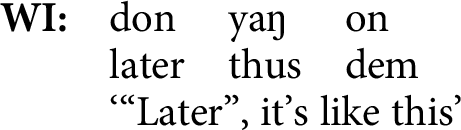
A first sequence of interest is taken from an interview in Gua. A group of men – two in frame and several others off-camera – sit facing upvalley, toward the neighboring village of Teptep (Figure 1). The man at right, WI, has been asked to explain the term don, meaning ‘later’ or ‘future’. The sequence begins with WI drawing a distinction between ‘now’ – which he locates with a quick downthrust of his right hand in front of him – and ‘later’ – which he locates upvalley, ahead of him and high above. The angle of his upward gesture is so steep, in fact, that it leaves the camera frame; it is notably exaggerated relative to the actual topography, which inclines gently into the distance (Figure 3). In all transcribed examples, temporal gestures are marked by underlining, and those gestures depicted in the associated figure are numbered with superscripts; these numbers correspond to the figure panel in which they appear.

Five temporal gestures from Example 1. The speaker locates the present where he is sitting (panel 1), the future upvalley and above (panels 2, 5), and the distant past downvalley (panel 3, 4). In all figures, panel numbers correspond to the words numbered with superscript in the transcript; the panel shows the speaker’s gesture while producing the numbered word.
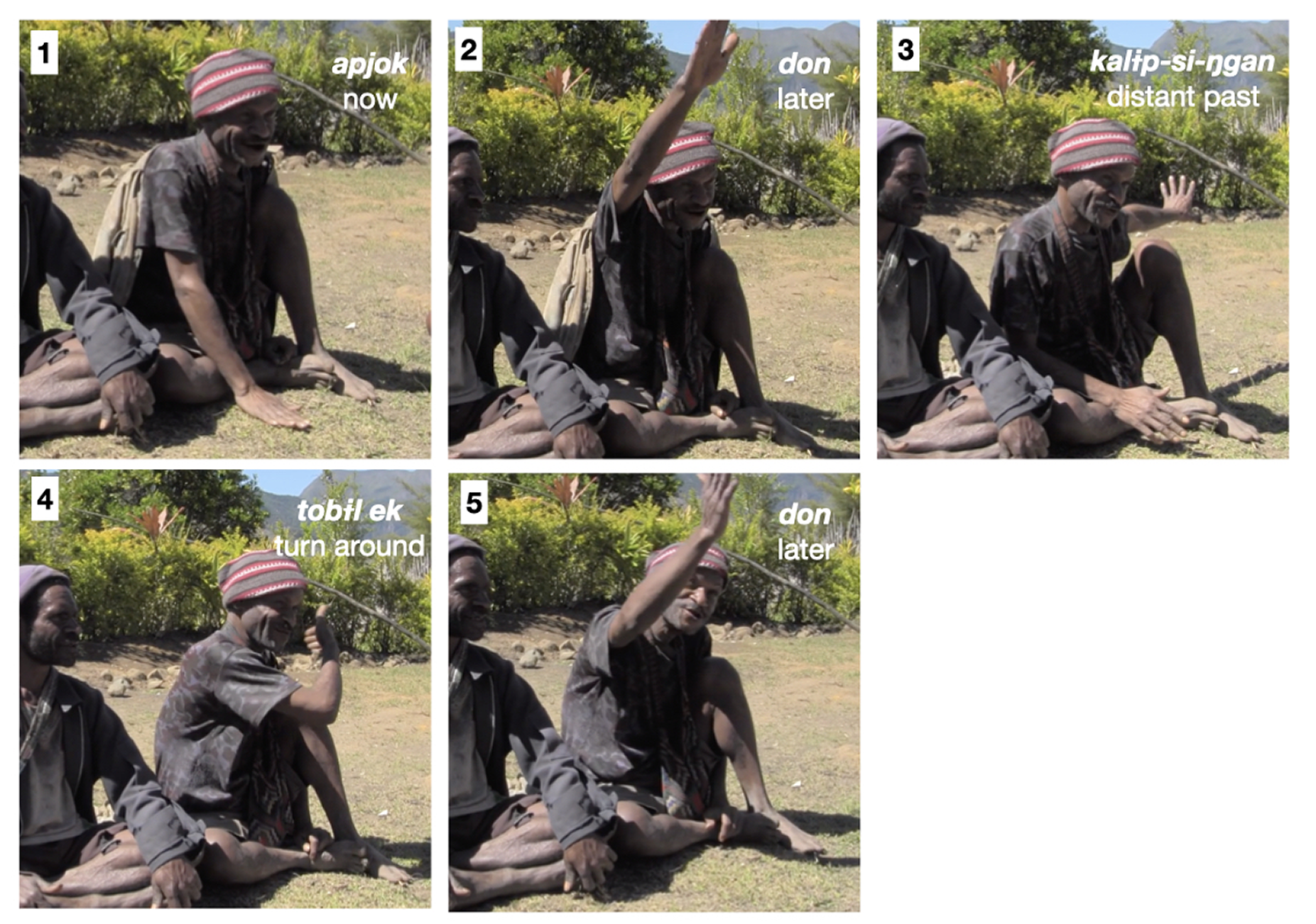
WI then repeats the contrast between ‘now’ and ‘later’, also repeating the associated gestures. His ‘now’ gesture takes on a different character in its second version: rather than a loosely formed ‘chop’, he thumps his full hand, palm open, down onto the ground (Figure 3.1); his ‘later’ gesture is nearly identical to the first (Figure 3.2).


WI then elaborates his spatial model of time by adding in the past. He does this with his left hand, placing the ancestors downvalley, behind him and to the left, toward the gorge of the Yupno river (Figure 3.3).


One of us, JS, asks about the phrasing of ‘we will go into the past’, implicitly questioning whether this would be a reasonable thing to say. WI repeats the phrasing, twisting around slightly and thrusting his right hand repeatedly over his left shoulder (Figure 3.4), in the direction of the recently located ancestors.


After a brief bout of commentary from the others, WI declares the suggestion impossible. The sequence ends with him reiterating that ‘later is where we will go’; his gesture and gaze together emphasize the steep uphill trajectory of this future-ward journey (Figure 3.5).


The sequence illustrates several key features of topographic construals of time in Yupno. It shows the assignment of the three deictic time categories to different spatial positions – the present where the man is sitting, the past downvalley, and future upvalley and above. It also shows that Yupno time-related gestures often contain spatial information that goes beyond what is contained in speech. Aside from the general idea that the future is somewhere we are ‘going’ and the past somewhere we could ‘turn’ toward, there is nothing in speech that explicitly locates the future or past with respect to the terrain. This happens entirely in WI’s gestures. Indeed, even if he had been using the topographically inflected forms of the verb ‘to go’ when describing ‘going’ into the future or past, his gestures would still lend specificity to the idea: ‘going up’, again, can mean anything from a specific direction along the horizontal to purely vertical, but WI’s gestures show he is construing the future as somewhere in between. Finally, the example hints at an interesting degree of variability in Yupno time construals. Here, WI is imagining the future as upvalley, along the gentle slope up toward Teptep, and the past as downvalley, along the gentle slope down toward the Yupno river. This construal differs subtly from the prevailing construal suggested by the data in Núñez et al. (Reference Núñez, Cooperrider, Doan and Wassmann2012), in which the past is associated with the mouth of the Yupno river and the future with its source (p. 30, Figure 2B). Both patterns are broadly consistent with a future-uphill construal, but WI’s gestures provide a first hint, confirmed throughout our 2013 interviews, that Yupno speakers vary in which sense of uphill and downhill they adopt.
Example 2. KA in Gua
The next example involves the same group of men as Example 1 but facing the opposite direction, downvalley toward the gorge of the Yupno river. The speaker is the man on right, KA. He is explaining a sequence of three terms: jagare (‘day before yesterday’), apma (‘yesterday’), and apjok (‘today, now’). The first time he runs through the sequence, he produces three gestures at different positions in front of his body: furthest away with ‘day before yesterday’, a bit closer in with ‘yesterday’, and finally almost in his lap with ‘now’ (Figure 4.1–3). Again, the locations of temporal gestures in the transcript are marked by underlining.


Six temporal gestures from Example 2. The speaker, facing downvalley, twice produces a series of gestures (panels 1–3; panels 4–6) to accompany a three-term sequence: ‘two days ago’ (panels 1, 4), ‘yesterday’ (panels 2, 5), and ‘today’ (panels 3, 6).
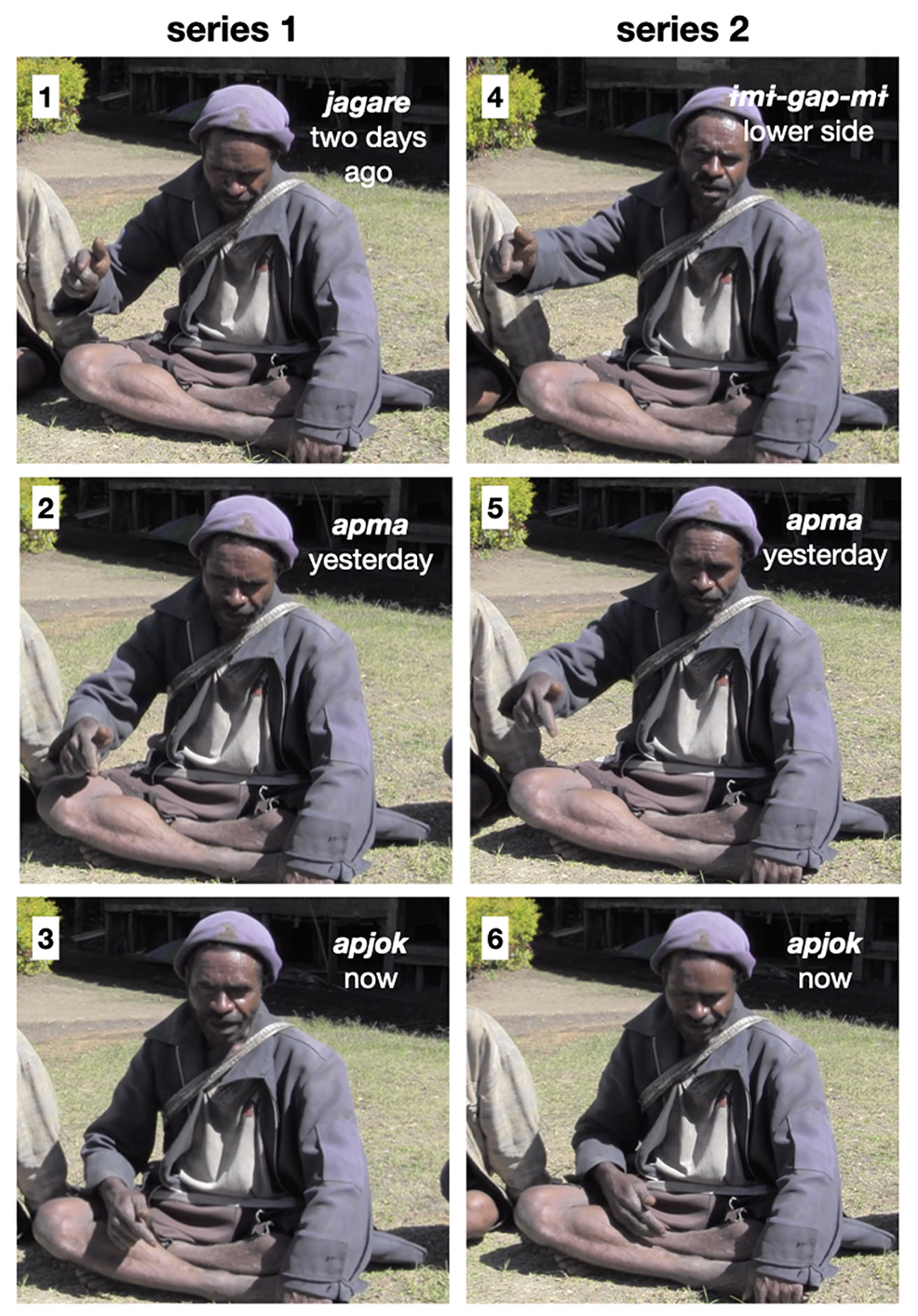
All three are produced with his right hand in a loosely formed index-finger-extended handshape. He repeats the sequence, but this time uses overt spatial language, ɨmɨ-gap-mɨ (‘down side’), to replace the term jagare (Figure 4.4–6):

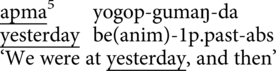
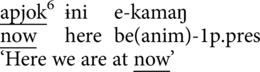
Like Example 1, this sequence shows a speaker gesturally assigning three different temporal landmarks to three different spatial positions. Here, however, the construal is of three different degrees of deictic remoteness – construed as different distances from the speaker’s sitting position – rather than three different deictic time categories. As in Example 1, KA’s construal unfolds along the upvalley–downvalley axis. This provides further evidence that Yupno speakers do not uniformly construe time with the past toward the mouth of the Yupno river and the future towards its source. Rather, the future-uphill construal appears to be more flexible, with speakers keying on whichever slopes are most salient in the speech situation; this is likely determined by the particular landform one is sitting on and how one is oriented, among other factors. Finally, Example 2 also shows how qualitatively similar gestures may be accompanied by overt spatial language (Figure 4.4) or not (Figure 4.1).
Example 3. WI in Nombo
The next example features the same speaker as Example 1, WI, but in a different village: Nombo. Nombo is located 60–90 min by foot from Gua; getting there requires ascending a prominent ridge – roughly 450 meters higher than Gua – and then descending on the other side (see Figure 1). We traveled to Nombo because its geophysical setting would shed further light on whether Yupno speakers key on the macrolevel inclination of the valley or rather on more local slopes when construing time. In Nombo, if one were to place the past in the direction of the mouth of the Yupno river, one would thus be gesturing uphill with respect to a prominent local slope; if one were to place the future in the direction of the river’s source, one would be gesturing toward a steep, nearby downhill.
In this sequence, WI is contrasting some of the same concepts as in Example 1. He begins by explaining the term kalip-si-ŋgan (‘distant past’):
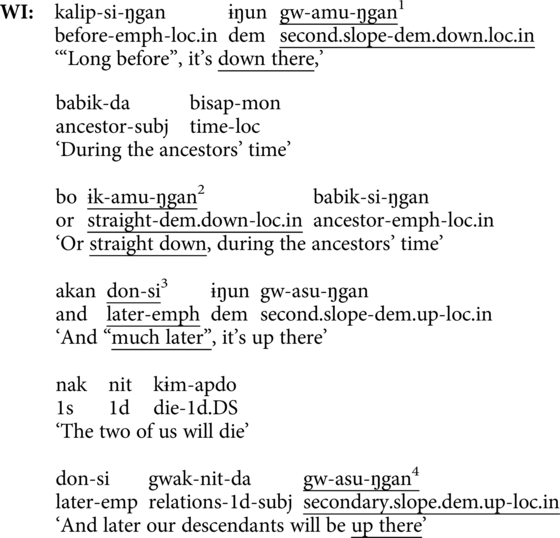
He gestures twice to locate the distant past and ancestors far downvalley (Figure 5.1–2), toward the gorge of the Yupno river and then twice to locate the distant future far upvalley, away from the gorge (Figure 5.3–4).
Four temporal gestures from Example 3. The speaker uses explicit spatial language, locating the distant past downvalley (panels 1, 2) and the future upvalley in the distance (panels 3, 4).
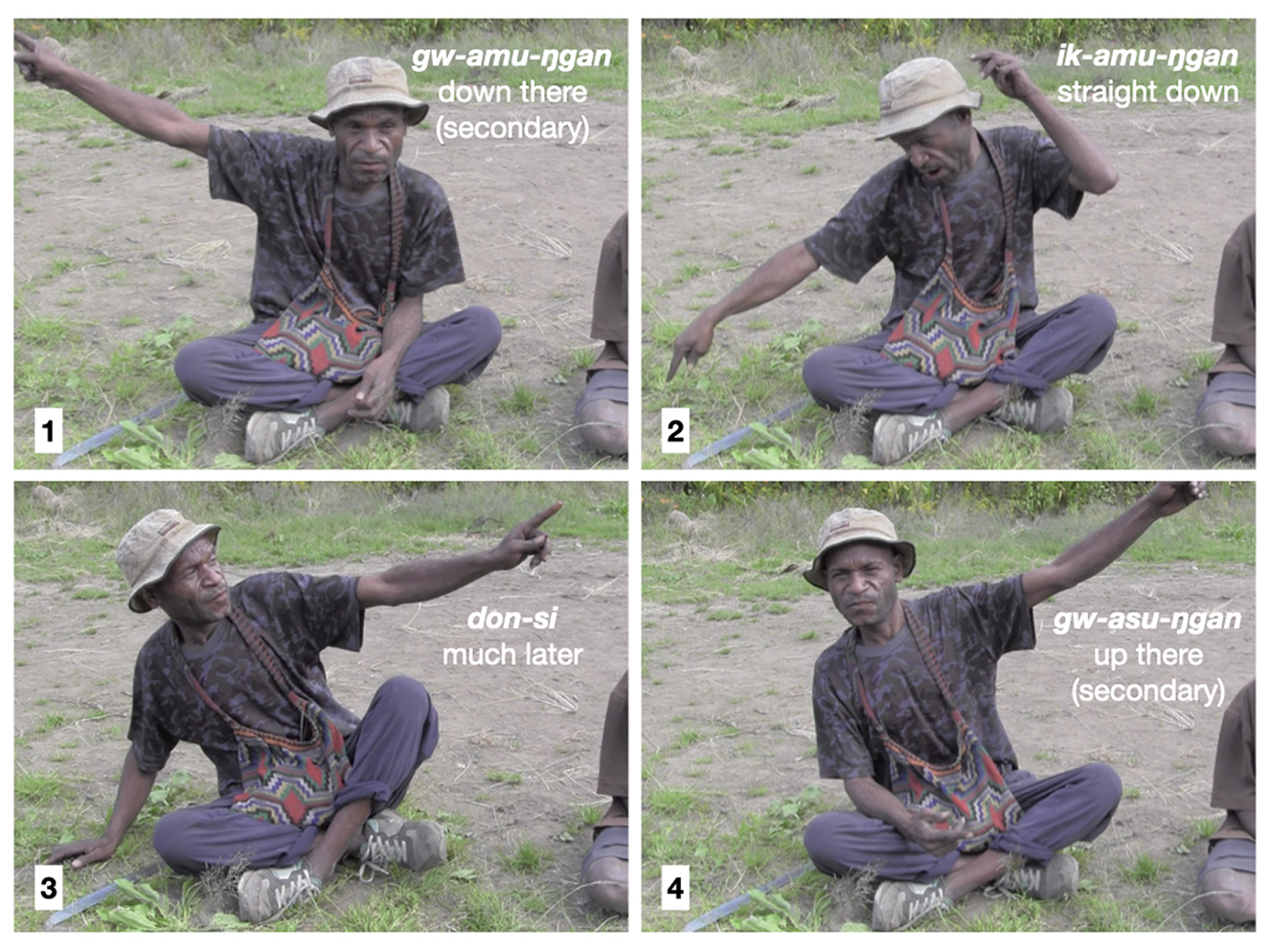
WI’s gestures are, as in Example 1, markedly effortful – for instance, involving full extension of his arm – and, in two cases, involve looking toward where he is gesturing (Figure 5.2 and 5.3). This time his use of topographic terms is explicit. Each of his gestures is accompanied by a topographically marked demonstrative: in three cases he uses the low-frequency topographic demonstratives that refer to the secondary (or gentler) slope, most often the upvalley–downvalley axis. These involve the addition of gw- to the more basic demonstrative set (Cooperrider, Slotta, & Núñez, Reference Cooperrider, Slotta and Núñez2017, p. 796). In Nombo, as he did in Gua, he’s gesturing along an axis extending toward and away from the gorge of the Yupno river – rather than toward the mouth and source of the river.
Example 4. AR and ER in Weskokop
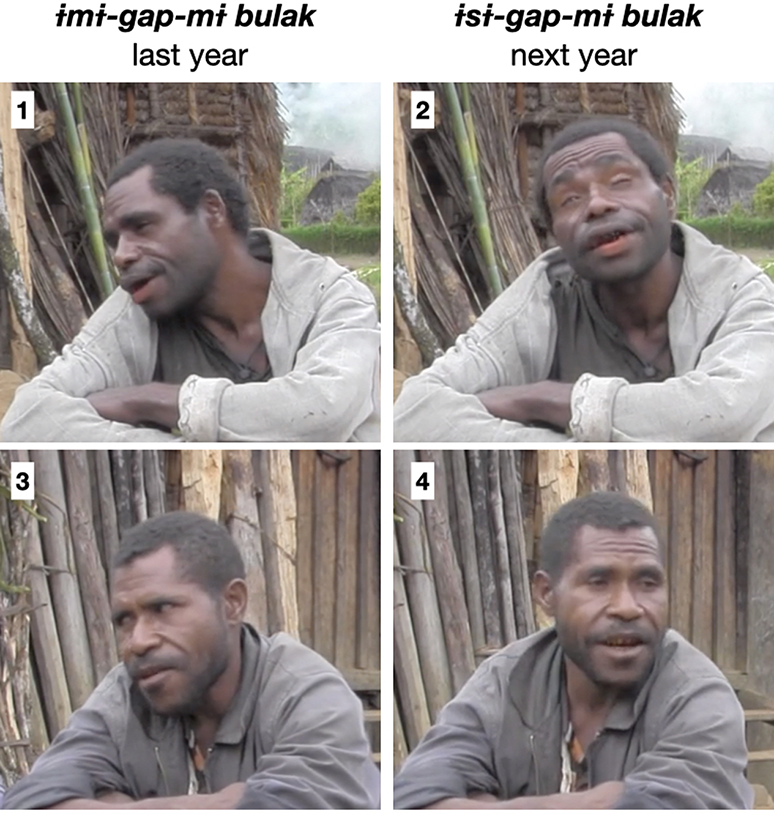
The next example also involves gestures co-produced with overt spatial language. The sequence comes from an interview with two men, AR and ER, in Weskokop, a village that neighbors Gua to the northwest. The village is 20–30 min by foot from Gua and lies approximately 250 meters higher in elevation. We traveled to Weskokop to get, again, a richer sense of how the construal of time changes around the valley. Of interest in this sequence is the fact that, in contrast to the previous examples, the key gestures are produced with the head and face. Non-manual gestures are common in Yupno communication (Cooperrider et al., Reference Cooperrider, Slotta and Núñez2018), but were excluded from our prior work on time because they convey less precise spatial information (Núñez et al., Reference Núñez, Cooperrider, Doan and Wassmann2012). The current sequence is repetitive, with both men making several head gestures upslope (toward their left) when using the phrase ɨsɨ-gap-mɨ bulak (‘future year’) and downslope (toward their right) when using the contrasting term, ɨmɨ-gap-mɨ bulak (‘past year’) (Figure 6). These phrases are similar to the English phrases ‘next year’ and ‘last year’ but do not make specific reference to the immediately previous or coming year. The future gestures of ER are of particular interest: they involve a stylized ‘looking up’ in the direction of the slope rather than a mere toss of the head (Figure 6.2). Interestingly, here the axis at play is not the upvalley–downvalley axis, as used in the previous three examples, but the steeper upslope–downslope axis. The sequence thus provides further evidence that the choice of slope to anchor one’s time references is determined locally and is not uniform across settings or speakers.
Four temporal gestures from Example 4. Both men repeatedly anchored references to the past with downslope head gestures (panels 1, 3) and to the future with upslope head gestures (panels 2, 4). The upslope gestures of the man in panel 2 involve a stylized ‘looking up’.
Example 5. KO in Weskokop
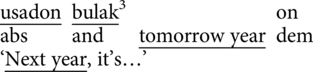
The next example also comes from Weskokop. The man on the right, KO, is contrasting terms spanning all three deictic categories. He arranges them in three contrasting locations, putting ‘last year’ downslope (behind him), ‘this year’ at his feet, and ‘next year’ upslope and above (to his right) (Figure 7, sequence 1). The speaker interleaves his explanation with Tok Pisin, marked below in italics:




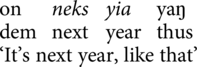
A speaker produces five temporal gestures across two separate sequences. In both sequences he locates ‘now’ where he is sitting. However, whereas in the first sequence he locates the past downslope (panel 1) and the future upslope (panel 3), in the second he locates the past upslope (panel 4). The speaker thus did not maintain a consistent future-uphill construal of time.
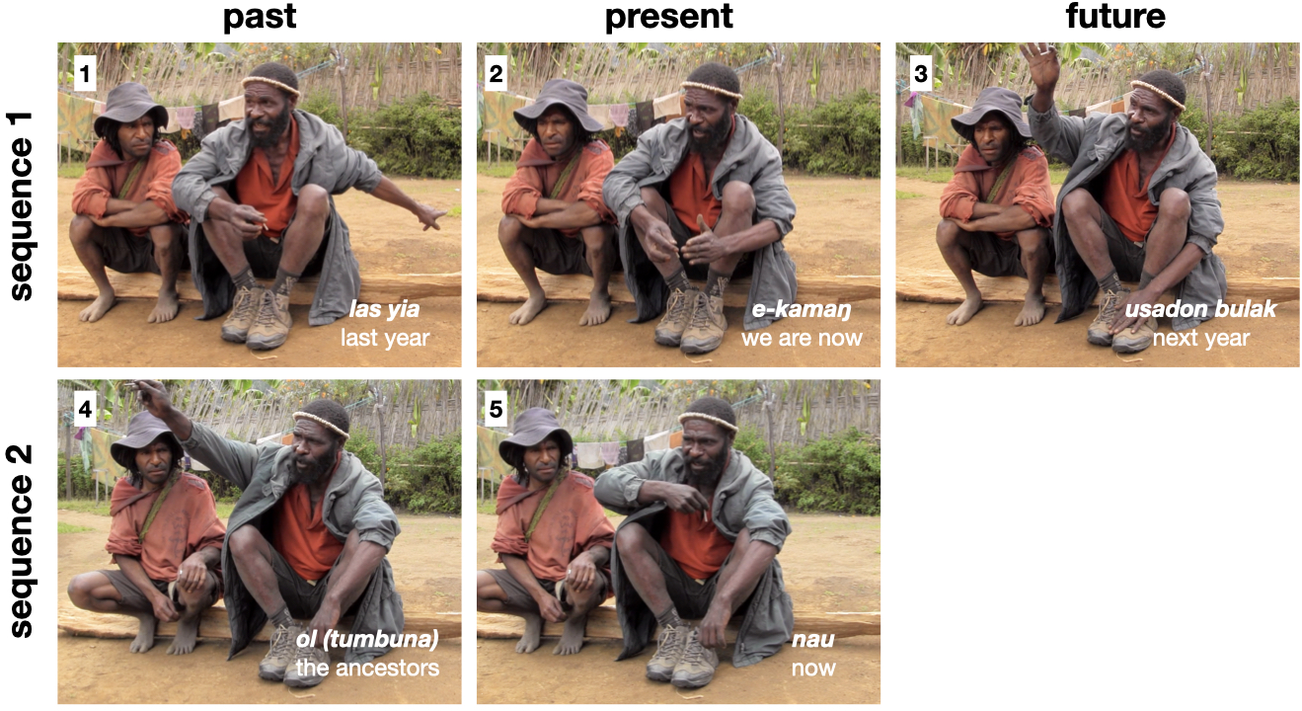
The example shows the systematic use of space to contrast landmarks in the three different time categories. KO seems to be keying on the same upslope–downslope axis as the men in Example 4. The example also shows again the same interesting asymmetry, seen in Examples 1 and 4, with the future located steeply above and the past located roughly along the horizontal.
Example 6. KO in Uskokop
The systematic use of space in Example 5, however, proved to be the exception for KO. More often he gestured according to a reduced model of time in which past and future contrast with now, but not with each other. This might be considered a future-is-elsewhere construal of time. Interestingly, such a generic mapping is found in the semantics of deictic terms in the world’s languages (e.g., in Urdu; Tillman et al., Reference Tillman, Marghetis, Barner and Srinivasan2017) and has previously been attested in temporal gestures (Le Guen & Balam, Reference Le Guen and Balam2012). The non-contrastive nature of KO’s past and future gestures is evident in a second sequence in the same interview, beginning about three and a half minutes later (Figure 7, sequence 2). Here again he interleaves Yupno and Tok Pisin (in italics). Since the interview is the same, numbering continues from Example 5:


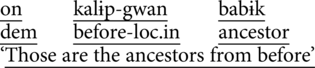
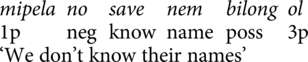

When locating the ‘ancestors’, KO places them far in front of him and to his right – that is, in the same location upslope where, in Example 5, he had placed ‘next year’. This is all the more remarkable for the fact that he is using the Tok Pisin term for ‘down below’ while producing this gesture. Such an inconsistency might be easier to dismiss were the gesture a one-off or casually produced; but, in fact, the gesture is repeated several times and is clearly articulated. At one point, he represents the trajectory from the ancestors (Figure 7.4) to ‘now’ (Figure 7.5), tracing an arc with his right hand from its full extension to his right and above into his lap. His gaze follows his hand as it moves, underscoring the gesture’s communicative relevance (e.g., Cooperrider, Reference Cooperrider2017). In a later interview in Gua, KO showed a similar inconsistency in gestures for past and future, but always preserved the basic mapping between distance from himself and ‘distance’ in time.
KO is not the only Yupno speaker whose construal of time differs from the prevailing topographic model. As mentioned in our earlier report (Núñez et al., Reference Núñez, Cooperrider, Doan and Wassmann2012, p. 29), we previously interviewed a man who consistently gestured according to a body-based model of time. This was evident across several interviews conducted at different locations in Gua, indoors and out: in all cases, he located the future behind him and the past in front of him, the past-in-front construal found in Aymara. These ‘non-conforming’ construals of time may be due to any number of factors, such as where one was raised in the valley, where one has traveled, and which other spatializations of time one has been exposed to. But, generally, there may also be good reasons – discussed below – why idiosyncratic temporal construals of this sort may be more common in the Yupno context than they appear to be among, for instance, Euro-American undergraduates.
A few key generalizations emerge from these examples. First and most basically, they illustrate that the Yupno topographic construal of time – in which present is collocated with the speaker, the past is downhill from the speaker, and the future is uphill – is commonly expressed in gestures. Such gestures are not merely oriented along the horizontal in the direction of nearby slopes. Rather, future gestures are often pitched sharply upwards, and thus seem to embody slopes in their very form. (Interestingly, past gestures do not often embody an opposite downward slope; but see Figure 5.2). Second, the examples illustrate that time gestures are sometimes joined with overtly topographic language but often not; this suggests the system is cognitively vital and not merely yoked to certain linguistic expressions. Third, the examples support a key update to our understanding of the Yupno construal of time: the particular uphill–downhill involved is not necessarily based on the source-to-sea axis of the Yupno river. Rather, it appears to be more locally anchored and situationally selected. Depending on where one is, the most salient uphill and downhill for the purposes of time construal may be upvalley–downvalley or upslope–downslope. Fourth and finally, there is an intriguing degree of individual variability in how Yupno speakers construe time. This is seen, first, in the fact that speakers have latitude to construe past and future according to different senses of uphill and downhill. It also seen in the fact that some speakers – such as KO in Example 5 and 6 and the ‘outlier’ participant described in Núñez et al. (Reference Núñez, Cooperrider, Doan and Wassmann2012) – depart from the future-uphill mapping altogether, while still showing a basic impulse to spatialize time.
6. Discussion
Our main aim here has been to fill out the picture of Yupno time concepts and, in the process, offer the most complete portrait to date of an environment-based way of thinking about time. In this section, we step back from the goal of describing the Yupno system and move to a trickier task: explaining it. We first consider how the system is rooted in – and sustained by – a particular cognitive ecology; we then consider why the system has the structure that it does, with the past construed as downhill and future as uphill.
6.1. The cognitive ecology of the Yupno valley
The Yupno time system can only be understood in terms of the broader cognitive ecology in which it is embedded – that is, the suite of environmental, cultural, and social elements that shape and scaffold how Yupno people think, act, and communicate (e.g., Hutchins, Reference Hutchins2010; Marghetis et al., Reference Marghetis, McComsey and Cooperrider2020; Núñez & Cornejo, Reference Núñez and Cornejo2012). Much research over the last century, following Whorf (Reference Whorf and Carroll1956), has privileged language as a ‘prime mover’ in shaping concepts of space and time across cultures. But more recent work has begun to tease out a broader set of relevant factors – from the geophysical environment (e.g., Palmer et al., Reference Palmer, Lum, Schlossberg and Gaby2017) and subsistence strategies (e.g., Shapero, Reference Shapero2016), to graphical practices (e.g., Danziger, Reference Danziger2011) and architecture (e.g., Núñez & Cornejo, Reference Núñez and Cornejo2012). Here we discuss those elements of the cognitive ecology of the Yupno valley that seem especially important in nurturing and reinforcing the topographic construals of time we have described.
A first element is, of course, the topography itself. Slopes are visually and experientially salient in everyday life. Yupno people spend a good portion of any day in transit – to gardens, schools, friends’ homes – which means they spend a good portion of any day walking up or down footpaths, some quite steep (Figure 2). Another key element – building on the first – is the centrality of topography in the Yupno language. Topography is enshrined in grammar, baked into the contrastive options a speaker must navigate when using a demonstrative or verb, for example. It is also part of discourse norms that quietly urge the use of topographic contrasts over other available options. Put together, these grammatical facts and discourse norms probably account for why Yupno speakers continue to use the topographic system when indoors. But the ‘conceptual topography’ of the house is itself contingent on another aspect of the Yupno ecology: architectural uniformity. More variable housing styles would make such a shared system impractical. Together these three elements – salient topography, linguistic centrality, and architectural uniformity – reinforce each other to keep the topographic system activated in the Yupno mind throughout daily life. A fourth element may also contribute to the vitality of the topographic system: gestural practices, which can reinforce and perpetuate cultural models (e.g., Le Guen, Reference Le Guen2011). As we have seen, Yupno speakers create rich and vivid representations of ups and downs with their hands, sometimes doing so when there is no hint of topography in their speech. Thus topographic notions – even when they are not verbalized – are present and sometimes foregrounded in Yupno communication.
In most other groups where time construals have been studied, graphical practices form a key part of the cognitive ecology. Wherever they are found, calendars, timelines, and (implicitly) text itself play a remarkably powerful role in ‘regimenting’ spatial construals of time and other abstract concepts (Cooperrider, Marghetis, & Núñez, Reference Cooperrider, Marghetis and Núñez2017). These practices entail a canonical position by which the observer views the representation; in this way they encourage body-based ways of thinking about time as proceeding from the observer’s left to right, right to left, or top to bottom, depending on the script or graphical convention. Yet such practices are a relatively limited, uneven presence in the Yupno valley. Western calendars are occasionally found – and are used to track church events, for example – but are recently introduced and hardly ubiquitous. Nor are there older Yupno practices for representing time as space – at least none that play a prominent role in everyday life at the time of this research. (As mentioned, there was once a practice of tying knots to track events; and, in the village of Nokopo, there was a practice of projecting key times of year onto a salient mountain ridge [Kocher Schmid, Reference Kocher Schmid1991, pp. 42–44]. We have never encountered either practice in our research.) The scarcity of such practices in the Yupno valley may be critical to allowing a non-body-based way of thinking about time to flourish. This scarcity may also go some way in explaining the degree of individual variability we have observed – variability which, impressionistically, seems greater than we have encountered in studies with American undergraduates (Cooperrider & Núñez, Reference Cooperrider and Núñez2009; Walker & Cooperrider, Reference Walker and Cooperrider2016). Many of the Yupno adults we interviewed have some exposure to schooling, and some degree of literacy, but they are hardly immersed in a world of printed and digital text. They are thus only exposed to the topographic construal of time through linguistic expressions – which are relatively infrequent, not to mention often ambiguous – and each other’s gestures – which are fleeting and sometimes inconsistent. As a result, Yupno speakers have relative freedom to construct their own versions of the future-uphill mapping – or, indeed, to construct other spatial mappings entirely.
Viewing the Yupno topographic system in an ecological light, as involving a set of mutually reinforcing elements, also underscores its fragility. A change in any of the elements just discussed could have cascading effects, potentially undermining the stability of the entire conceptual system. If more of the Yupno valley were flat and graded, for example, topography would become less experientially salient. If new building styles were introduced, conventions for talking about indoor space topographically may be simplified or abandoned. If more Yupno people were to learn to read and write through exposure to formal schooling, body-based ways of thinking about time would likely enter the ecology and compete with environment-based ones. If more people were leave the Yupno valley to settle in urban areas – with radically different terrain and building styles – it’s not clear how much of the topographic system, if any, would survive the move (see, e.g., Schlossberg, Reference Schlossberg2018). None of these are negative developments on their own, of course. Nor are they idle hypotheticals; several of these changes are underway.
6.2. Why is the future uphill?
Even as we have filled in the picture of the Yupno topographic system, certain key details remain fuzzy or puzzling. Probably the most vexing open question, the one we get asked more than any other, is: Why is the future uphill? Why wouldn’t tomorrow be ‘down below’ rather than ‘up above’? In the case of every other temporal construal described to date, there is a widely accepted explanation for its experiential motivation (Núñez & Cooperrider, Reference Núñez and Cooperrider2013). Yet in the case of the future-uphill construal found in the Yupno valley and elsewhere, no obvious explanation presents itself. Here we consider several candidates.
Explanation 1: entrance schema. In our initial report about the Yupno topographic system, we offered the following explanation for the future-uphill pattern:
The Yupno believe that their ancestors traveled up from an island offshore to settle in the Yupno valley. This may motivate an association between the ancestral past and the macro-scale downhill direction. More generally, the pattern may be motivated by an entrance schema. When inside the valley – or inside a traditional house – the entering action (from below) becomes metonymic for past times, and future as higher up is derived by contrast. (Núñez et al., Reference Núñez and Cornejo2012, p. 34)
This explanation is initially compelling in that it draws on a documented aspect of Yupno cosmology. It also accounts for the time gestures we observed indoors, in which participants generally construed the past as toward the door (‘downhill,’ according to the house’s conceptual topography) and the future as away from the door (‘uphill’) (Núñez et al., Reference Núñez, Cooperrider, Doan and Wassmann2012). Our enthusiasm for this explanation has since dimmed, however, for a few reasons. The first is that, as mentioned, other communities have now been documented that use the same mapping, and no communities, to our knowledge, have yet been shown to use the opposite, future-downhill mapping. There are three other cases of future-uphill construals reported in the same region of Papua New Guinea (Pennington, Reference Pennington2016; Sarvasy, Reference Sarvasy2014; Taylor, Reference Taylor2015), as well as two off the coast (New Britain: Meng, Reference Meng2018; Solomon Islands: Keesing, Reference Keesing1979); the same mapping is also found much further afield, in Tzeltal (Brown, Reference Brown2012) and in languages of the Caucasus (Forker, Reference Forker2020). Thus, any explanation of the Yupno pattern in terms of local cosmology and architectural practices might be an ‘undergeneralization’ (Haspelmath, Reference Haspelmath1997) – that is, an explanation that is not general enough to accommodate the data. A second reason for doubt is that the ancestral origins explanation privileges a particular sense of downhill: the macroscale inclination of the valley, from the source of the Yupno river down toward the sea. But, as our examples here show, the Yupno time construal is much more flexible and adapted to local slopes. A last consideration is that it’s not clear that an explanation of the future-uphill pattern needs to also account for time gestures indoors. It may be that the construal of time indoors simply piggybacks on the construal of space indoors. Again, when inside, one construes the area toward the door as downhill and away from the door as uphill (perhaps due to the mapping between house structure and valley structure; see Cooperrider, Slotta, & Núñez, Reference Cooperrider, Slotta and Núñez2017, pp. 791–793); past and future may then be construed according to this conceptual topography, with the past toward the door and the future away from it.
Explanation 2: growth. Another possible explanation of the Yupno system is based on biological growth. Living things – whether human beings or bamboo stalks – tend to grow upward, so that there is, for at least some of the lifespan, a general trajectory of movement through time and movement upward. Part of the appeal of this explanation, beyond its intuitive plausibility, is that the use of growth as general model of time is well documented in the ethnographic literature (Wiseman, Reference Wiseman2019). The Yupno are subsistence horticulturalists and so there is little question that such a model would be culturally appropriate; bamboo in particular could be a compelling source due to its importance as a building material and its rapid, readily detectable growth. Growth also offers a general conceptual source, thus skirting the problem of undergeneralization; indeed, it has been suggested as the source of similar time mappings elsewhere (Forker, Reference Forker2020, p. 14). However, there is at least one key weakness to the proposal: if the source for the Yupno time system were growth, the gestures we observed would likely look different. People almost invariably anchor their gestures about past and future to the actual terrain, not to some abstracted vertical axis. Many gestures are steeply pitched upward (e.g., Figure 3), but purely upward future gestures are extremely rare and purely downward past gestures are entirely absent. Moreover, the downward gestures we do observe are associated with ‘now’, and it’s not clear how these make sense within a growth model. It’s certainly possible that the Yupno use growth as a source for construing sequence time, such as when thinking about different life stages. Indeed, growth furnishes a natural conceptual source for thinking about sequence time but not a good one for thinking about deictic time. This is because it does not inherently involve an ego that is internal to the space itself, just an observer looking at a process from the outside (see Núñez & Cooperrider, Reference Núñez and Cooperrider2013).Footnote 5
Explanation 3: looking downhill versus uphill. A third possibility concerns an intriguing parallel between the experience of viewing terrain and the experience of ‘viewing’ time. When on sloped terrain, one can see more of the landscape when facing downhill than when facing uphill. (This is likely part of the reason for the general tendency to orient houses facing downhill.) Consider the case of a person walking up a mountain and occasionally stopping to view the terrain in all directions. When facing downhill, such an observer could often see a broad swath of terrain and possibly the specific path one approached by; and the higher up the observer went, the more they would be able to see when looking down. But, when facing uphill, it can be hard to see very much above and the path ahead may be obscured. These patterns are reminiscent of the human experience of time. It’s easier to ‘see’ what is in your past – as discussed in the Aymara case (Núñez & Sweetser, Reference Núñez and Sweetser2006) – and the longer you go on, the more there is to see; the future, meanwhile can only be glimpsed vaguely if at all. This explanation has a number of virtues: it makes sense within the Yupno context; it fits the types of gestures we observed; and it provides a general explanation, one that would reasonably apply to any community engaged in daily travel over hilly terrain. However, admittedly this account does not have the intuitive simplicity of others, as it relies on an interaction of vision and topography.
Explanation 4: canonical travel. The experience of foot travel also motivates a fourth candidate explanation. This account is rooted in a common experience one has when navigating rugged terrain: it can feel like one spent the whole day walking uphill. A frequent pattern in the Yupno valley, for instance, is as follows: one leaves home early in the morning, spends much of the day elsewhere – walking between gardens and houses – and then returns home as evening sets in. On a day like this, in terms of pure elevation gain and loss, one will go uphill exactly as much as one went downhill. But because walking uphill is generally more effortful, one will have spent more time walking up than walking down. And, because of the extra exertion involved, walking uphill may also be more salient in memory. Put together, these facts may mean that walking uphill looms larger in memory and may thus become the ‘canonical’ form of human travel. (Interestingly, uphill travel is described as the canonical form of travel in Tzeltal, though no rationale is offered [Brown & Levinson, Reference Brown and Levinson1992, p. 597]). If canonical walking is indeed walking uphill for the Yupno, their construal of time might be considered a topographically inflected version of the future-in-front construal that is so widespread. Advantages of this account are that is relevant to the Yupno context but general enough to accommodate other cases; that it provides an intuitive model of deictic time, one that situates the ego within the array of events; and that it fits the gestures we observed. However, this account depends on a number of unknowns – in particular, whether walking uphill really is the canonical form of walking in Yupno. More fundamentally, the very notion of ‘canonical’ forms of experience and how they shape construals requires further theoretical elaboration.
Each of the four explanations fulfills certain desiderata. The ‘looking downhill’ and ‘canonical travel’ explanations are general, compatible with gestures we observed, and relevant to the Yupno case. Of the two, the ‘canonical travel’ explanation seems the more intuitive, due to its affinity with the cross-culturally widespread future-in-front construal. Meanwhile, the ‘entrance schema’ explanation is the only one that simultaneously explains the outdoor and indoor time gestures we observed. It remains unclear whether this is truly an advantage, however, as the Yupno construal of time indoors may simply piggyback on the construal of space indoors. There are yet further explanations that have been suggested to us that might also be considered (see also Forker, Reference Forker2020); and the three of us do not necessarily agree on which of the above explanations is most compelling. But by outlining and comparing the best explanations, we hope to spur future empirical work on future-uphill mappings, as well as further theoretical discussion of the experiential motivations for spatial construals of time more generally.
7. Conclusion
For more than half a century, linguists, anthropologists, philosophers, and psychologists have grappled with the puzzle of how humans make sense of time. Such research has documented widespread patterns, while also unearthing unexpected diversity (Núñez & Cooperrider, Reference Núñez and Cooperrider2013). Diversity in human concepts is of inherent humanistic interest, as part of the rich tapestry of practices, lifeways, and forms of sense-making our species has developed in different ecologies around the globe. It also has immeasurable scientific value. Often it is only by puzzling over the forces that generate apparent outliers that we come to understand more general patterns (e.g., Chrisomalis, Reference Chrisomalis2020). We see environment-based understandings of time in just this light. Such systems may seem like marginal peculiarities, but, in fact, they stand to illuminate the major forces shaping human language, culture, and conceptualization.
Unfortunately, the window to conduct such work appears to be closing (e.g., Cooperrider, Reference Cooperrider2019; Evans, Reference Evans2010). The Yupno time system – given its dependence on a fragile ecology of practices and conditions – is undoubtedly precarious. And it’s likely that any similar systems remaining in other parts of the world are also in jeopardy. The study of environment-based construals of time – and environment-based systems for making sense of the world, more generally – is thus not just humanistically and scientifically valuable. It’s also, we would argue, urgent.



 Open access

