


1. Introduction
There is a peculiar disconnect between formal semantics and diachronic semantics. Formal semantics, like other areas of theoretical linguistics, is primarily concerned with ‘hidden’ aspects of grammatical representations: everyday discourse doesn't immediately reveal constraints on scope relations, or anaphora, or other core semantic topics, so our theoretical understanding is advanced through the painstaking elaboration of a model of meaning that is constructed on the basis of systematic, controlled manipulation of crucial test sentences, judgements of acceptability, and intuitions about valid and invalid inferences. Direct negative evidence is crucial, and freely available: we know when a given utterance is infelicitous in context, or when a sentence S cannot assert a proposition P.
As an example, the antecedents of nonrestrictive relatives cannot be nonreferential quantifiers, as shown in (1a). This has been taken (for instance by Sells Reference Sells1985) to indicate that the wh-phrase in a nonrestrictive relative is a discourse anaphor, as discourse anaphors require accessible antecedents.Footnote 1 On the other hand, some person in (1b) makes a perfectly good antecedent for a discourse anaphor such as a nonrestrictive relative: although classically considered to be a quantifier, some introduces a discourse referent which can serve as antecedent (Kamp Reference Kamp, Groenendijk, Janssen and Stokhof1981, Heim Reference Heim1982). None of this is obvious, and carefully constructed contrasts like those in (1) are central to our understanding of these topics.
(1)
a. *no person, [who left]
b. some person, [who left]
Diachronic semantics, for the most part, has been different: as a discipline, it has no choice but to rely on observation of naturalistic data. The various kinds of introspective judgement available to synchronic formal semanticists are unavailable to diachronic semanticists, and negative evidence has to be inferred from absence of positive evidence. This means that the weapon of choice for classical diachronic semantics is the collocation, and diachronic semantics is typically practiced as a form of distributional semantics. If a word is characterized by the company it keeps, then changes in word meaning are characterized by changes in the company a word keeps. For instance, the grammaticalization literature (e.g., Traugott and Dasher Reference Traugott and Dasher2002) contains several examples like (2), which demonstrate the development of going to, from a verb of directed motion into an expression of futurity.

In (2b), marry Bill is not a place you can go to; and in (2c) interest rates are not the kind of things that can go. From collocational changes like these, we can infer a change in denotation: the meaning of go is no longer restricted to literal motion.
A consequence of this is that formal semantics and diachronic semantics often simply talk past each other. The different methods available favour different approaches to what is surely a single underlying phenomenon. Fortunately, though, the two approaches are usefully complementary. The virtues of a formal approach extend beyond precision and objectivity, the usual benefits attributed to it. Approaching semantic change through the lens of synchronic formal theories can tell us where to look.
Take the explanation just given for the contrast in (1): insights like this from formal semantics allow us to make precise statements about possible distributions, which in turn allow us to draw nonobvious distributional predictions. These predictions can be leveraged to provide insight into distributional changes in the historical record.
In this article, we develop an in-depth example of this kind of formal, hypothesis-led investigation of semantic change, concerning the emergence of headed relative clauses with which in Middle English. Which appears in two types of relative in Present-Day English (PDE): nonrestrictive relatives like (3a), and restrictive relatives like (3b).
(3)
a. the University of Edinburgh, [which is in Scotland]
b. The jewellery [which he chose] was always vulgar.
There are also some cases of which in free relatives, such as (4a). However, bare which cannot appear in free relatives (see (4b)), and in most cases, both -ever and an NP complement are required in free which-relatives. Bare what, however, can appear in free relatives, as in (4c).
(4)
a. I ate [whichever dish he cooked].
b. *I ate [which he cooked].
c. I ate [what he cooked].
Free relatives can often be straightforwardly distinguished from headed relatives, because they do not have an external head or overt antecedent. The distributional differences between nonrestrictive and restrictive headed relatives are more subtle. There are some clear syntactic distinctions (for instance, only nonrestrictive relatives can modify clauses), but examples like (5) are structurally ambiguous between restrictive and nonrestrictive analyses. A restrictive analysis of which I enjoyed restricts the set of books to a subset of books which I enjoyed, while a nonrestrictive analysis adds a parenthetical remark that I enjoyed the relevant member of the set of books. Either way, (5) could be talking about the same book.
(5) a book(,) [which I enjoyed]
In PDE, the most robust cue to the restrictive/nonrestrictive distinction is arguably prosodic: comma intonation in (5) indicates a nonrestrictive relative, and its absence indicates a restrictive relative. This correlates with a semantic (and perhaps a syntactic) distinction, but there are many cases, like (5), in which the semantic distinction is neutralized.
In Old English and Early Middle English, which was only used in free relatives. Headed which-relatives are first robustly attested in the mid-14th century. In Truswell and Gisborne (Reference Truswell, Gisborne, Csipak and Zeijlstra2015), we proposed that this spread of which-relatives followed a pathway from free relative in apposition, to nonrestrictive relative, to restrictive relative, a gradual and incremental increase in syntactic and semantic integration into the host clause. This built on a long-established literature (see Curme Reference Curme1912, Johnsen Reference Johnsen1913) demonstrating a semantic overlap between free relatives and nonrestrictive relatives, in that both constructions crucially involve definiteness.Footnote 2 More precisely, free relatives just are definite descriptions (Jacobson Reference Jacobson, Bach, Jelinek, Kratzer and Partee1995), while the wh-phrase in a nonrestrictive relative is a (definite) discourse anaphor (Sells Reference Sells1985). In contrast, the wh-phrase in a restrictive relative is just a λ-abstractor over a variable in the corresponding gap position. In Truswell and Gisborne (Reference Truswell, Gisborne, Csipak and Zeijlstra2015) we described contexts in which this semantic similarity could in principle facilitate reanalysis of free relatives as nonrestrictive relatives.
The problem with this hypothesized pathway, and the starting point for this article, is that it just doesn't work. To demonstrate this, we adapt ideas from Sells (Reference Sells1985) to recast the denotational differences between restrictive and nonrestrictive relatives in distributional terms. The crucial test is that the wh-phrase in a nonrestrictive relative is a discourse anaphor, and discourse anaphors can take certain types of referential DP as antecedents (for instance, indefinites), but not nonreferential DPs (for instance, universals).Footnote 3 If we find a which-relative modifying a nonreferential DP, we know it's restrictive.
Using this test, we uncover a split in the behaviour of headed which-relatives, depending on whether determiner which takes an NP complement. Restrictive and nonrestrictive ‘bare’ which-relatives (with no NP complement) emerge simultaneously, as far as we can see in the textual record. As for which-relatives with an NP complement, like (6), they are always nonrestrictive. That is to say, they always modify referential antecedents, so there is no distributional evidence that they are restrictive, and there is enough data to make this absence statistically highly significant. In neither subcase is there a gradual progression from free to nonrestrictive to restrictive.

We don't know why any of this should be the case.Footnote 5 Our narrower aims in this article are to demonstrate that it is robust across several centuries of the history of English, and to examine the emergence of this system in Early Middle English. In doing this, we show that it is possible to give distributional historical evidence supporting precise, formally statable semantic claims.
The article is structured as follows. Section 2 gives a brief review of the diachrony of English which-relatives, and wh-relatives more broadly. Section 3 introduces the synchronic semantic analysis, and outlines the diachronic hypotheses it implies. Finally, Section 4 revisits the diachrony of which-relatives in the light of these hypotheses.
2. The Diachrony of wh-Relatives
The diachrony of which-relatives can be viewed as a special case of the diachrony of wh-relatives. In Old English, the major strategies for forming both headed and free relatives involved not wh-phrases, but instead the complementizer þe and the se series of demonstrative phrases, as in (7) (see Allen Reference Allen1977, Reference Allen1980 for a comprehensive description).

The only wh-relatives were free relatives. We refer the reader to Truswell and Gisborne (Reference Truswell, Gisborne, Csipak and Zeijlstra2015) for a full account of Old English free wh-relatives; for the purposes of this article, the main points are: (1) free wh-relatives could occur either clause-initially or clause-finally (modulo other elements in the left and right peripheries of the clause); and (2) a clause initial wh-relative obligatorily occurred with swa on either side of the wh-phrase (as in (8a)), while this braced swa … swa was optional in clause-final position (as in (8b–c)).
A reviewer asks whether the clause-initial free wh-relatives should instead be classed as correlatives. Indeed they are often treated as such in the descriptive literature. However, Gisborne and Truswell (Reference Gisborne and Truswell2017a) give several arguments that they are instead what are sometimes called hanging free relatives. The simplest argument is that there are no instances of multiple wh-phrases in this construction at any point in the history of English, which is surprising if these are genuine correlatives but expected if they are free relatives.Footnote 6

In Truswell and Gisborne (Reference Truswell, Gisborne, Csipak and Zeijlstra2015), we claimed that swa … swa was semantically equivalent to PDE -ever, and adopted an analysis of free relatives with swa hw… swa as modal definite descriptions, based directly on the analysis for PDE developed in Jacobson (Reference Jacobson, Bach, Jelinek, Kratzer and Partee1995), Dayal (Reference Dayal and Lawson1997), von Fintel (Reference von Fintel, Jackson and Matthews2000). In this article, little hinges on the accuracy of that claim. The more important (and less controversial) claim is that bare free wh-relatives are straightforward definite descriptions.
Early Middle English saw a breakdown of the Old English free hw-relative system. There was a gradual erosion of the swa … swa marker: the initial swa quickly disappeared, and the final swa was most often realized as se or sum (later so). This was later reinforced by -ever, giving the what(so)ever forms that survive today.

At the same time, the positional conditioning of swa … swa became weaker. Specifically, bare free wh-relatives began to be found in the left periphery, in some cases apparently with the kinds of interpretations previously associated with swa … swa. For instance, (10) is a translation of the same bible passage as Old English (8a), but only the earlier translation has swa … swa.Footnote 7

Concurrently, wh-phrases began to appear in headed relatives. Romaine (Reference Romaine1982) showed that the first headed wh-relatives were confined to the bottom of the Keenan and Comrie (Reference Keenan and Comrie1977) noun phrase Accessibility Hierarchy, for instance in adjuncts and obliques rather than direct arguments. A fuller account would make reference to the fact that Early Middle English headed wh-relatives typically relativize PPs or adverbials rather than DPs, but these very early headed wh-relatives are complex to analyse, and data is scarce. For instance, there are several apparently semantically equivalent forms for a PP-gap relative, with through what, through which, and wherethrough all attested in different texts at roughly the same time.

Although such examples clearly form part of the story concerning the rise of headed wh-relatives, we put them aside in this article and concentrate on DP-gap relatives. Gisborne and Truswell (Reference Gisborne, Truswell, Mathieu and Truswell2017b) demonstrate that DP-gap headed relatives spread from wh-lexeme to wh-lexeme: which-relatives emerge in the mid-14th century (initially with both animate and inanimate antecedents), followed by whom-relatives and then who-relatives in the 15th century.Footnote 8

Early headed which-relatives do not have the same syntax as they do today. They can occur with the, and more importantly for this article, they can also take NP complements.

The example in (13b) is representative of the Middle English norm, where the NP inside the relative clause is identical to an external NP within the same sentence (typically, but not always, the antecedent). From the late 15th century, it became more common for the internal and external NPs to be different. We cannot go into the syntactic implications of this here (see Truswell Reference Truswell2016 for discussion), but the semantic status of these NP complements will be a major focus in Section 4.
So far, we have described the reasonably well-known spread of wh-forms from free to headed relatives, with which having a special status as the first wh-form to spread in this way. However, the picture is incomplete in that ‘headed relative’ is a cover term for two constructions, namely restrictive and nonrestrictive relatives. These are uncontroversially semantically distinct, and since at least Jackendoff (Reference Jackendoff1977) have often been taken to be syntactically distinct, too. This raises immediate questions about the diachrony of wh-relatives, the most basic of which is whether both restrictive and nonrestrictive relatives emerged at once or in series. Section 3 will sharpen this question, before we return to corpus data in Section 4.
3. Semantics of Relative Clauses
We adopt standard models of the semantics of restrictive and nonrestrictive relatives. Specifically, we assume with Heim and Kratzer (Reference Heim and Kratzer1998) and many others that a restrictive relative denotes a 1-place predicate. The restrictive relative composes with its NP sister by conjoining the predicates that each denote. The relative restricts the extension of the NP, in that $\vert {\lcub {x\;\colon \;P\lpar x \rpar \wedge Q\lpar x \rpar } \rcub \vert \le \vert \lcub {x\;\colon \;P\lpar x \rpar } \rcub } \vert $. Compositionally, the restrictive relative is transparent: adding a restrictive relative does not affect the type of NP, so the constituent derived can combine with any determiner or other material that NP can normally combine with.
(14)
a. ⟦book⟧ $ \,= \lambda x.{\rm boo}{\rm k}^{\prime}\lpar x \rpar $
b. ⟦which Sally wrote⟧= λx.write′(s, x)
c. ⟦book which Sally wrote⟧
$\,= \lambda x.{\rm boo}{\rm k}^{\prime}\lpar x \rpar \wedge {\rm writ}{\rm e}^{\prime}\lpar {s\comma \;x} \rpar $d. ⟦the book which Sally wrote⟧
$ \,= \iota x.{\rm boo}{\rm k}^{\prime}\lpar x \rpar \wedge {\rm writ}{\rm e}^{\prime}\lpar {s\comma \;x} \rpar $


For nonrestrictive relatives, we adopt the analysis of Sells (Reference Sells1985). According to Sells, a nonrestrictive relative is propositional, with the wh-phrase interpreted as an E-type anaphor (that is, an anaphor functioning semantically like a definite description, as in Evans Reference Evans1980). Sells’ analysis is supported by the fact that wh-phrases in nonrestrictive relatives are maximizing, like other E-type anaphors (Evans Reference Evans1980). In (15a) but not (15b), the state necessarily buys all the sheep that each farmer owns.
(15)
a. Each farmer owns some sheep, [which the state buys in the Spring].
b. Each farmer owns some sheep [that the state buys in the Spring].
Within the framework of Discourse Representation Theory, Sells (p. 26) proposes the following representation of (15a). The essential points of this representation for our purposes are firstly that some sheep introduces the plural discourse referent Y, along with the information that Y is a group of sheep; secondly that which introduces a second discourse referent Z, and finally that the condition Z = Y expresses the anaphoric relation between which and some sheep. This representation of anaphora also captures the maximizing effect of nonrestrictive which, as the referent Z is identical to the group of sheep which some sheep picks out (Z = Y), and cannot pick out some subset of that group.
(16)

Sells’ analysis implies a first distributional test. The antecedent of a nonrestrictive relative, like any other E-type anaphor, must be referential, in a sense that includes those indefinites that introduce discourse referents (Kamp Reference Kamp, Groenendijk, Janssen and Stokhof1981, Heim Reference Heim1982). There is no such requirement for restrictive relatives. The contrasts in (17) show how these facts can give a distributional diagnostic of restrictiveness.
(17)
a. The/some/few/no sheep [that the state buys] are happy.
b. The/some/#few/#no sheep, [which the state buys], are happy.
Therefore, searching for patterns of the form Q NP … RC,Footnote 9 where Q is a quantifier such as few or no and RC is a which-relative modifying Q NP, can inform our understanding of the diachrony of which relatives: following Sells, we assume that the relatives in such strings simply cannot be nonrestrictive, because which, as an E-type anaphor, wouldn't have the antecedent that it needs.
In Section 4, we will investigate the interactions between this straightforward test and a second distributional property, namely the presence of an overt NP complement of D. In tracking these two distributional properties, we uncover several details of the diachrony of which-relatives. In particular we will see that such which NP-relatives force a nonrestrictive interpretation.
4. Back to which-Relatives
This section gives a corpus-based account of the diachrony of English relatives with which and what. The major developments that we will document are the following. In Early Middle English, which and what simultaneously develop different patterns of use in two distinct dimensions. Which specializes for headed relatives and what for free relatives, and at the same time, which comes to allow NP complements. This Early Middle English grammar is a transitional one: after this period, which occurs only in headed relatives and what only in free relatives, but either can take an NP complement.
When headed which-relatives emerge, both restrictive and nonrestrictive readings are simultaneously available. However, there is an interaction with the presence of an NP complement: in the absence of an NP complement, either reading is available, but which NP-relatives are always nonrestrictive.
4.1 Materials
We rely exclusively on data from parsed corpora in our analysis, because parsed corpora are the only tools available for this kind of fine-grained quantitative diachronic investigation. The corpora used in this article are as follows: YCOE (York–Toronto–Helsinki Parsed Corpus of Old English Prose, Taylor et al. Reference Taylor, Warner, Pintzuk and Beths2003), PPCME2 (Penn–Helsinki Parsed Corpus of Middle English, 2nd edition, Kroch and Taylor Reference Kroch and Taylor2000), PPCEME (Penn–Helsinki Parsed Corpus of Early Modern English, Kroch et al. Reference Kroch, Santorini and Delfs2004), PCMEP (Parsed Corpus of Middle English Poetry, Zimmermann Reference Zimmermann2015), and PLAEME (Parsed Linguistic Atlas of Early Middle English, Truswell et al. Reference Truswell, Alcorn, Donaldson, Wallenberg, Alcorn, Kopaczyk, Los and Molineaux2019). Of these, YCOE, PPCME2, and PPCEME are the major parsed corpora for the relevant periods of English. However, as will become apparent, a period of particular interest in the history of wh-relatives is the late 13th and early 14th centuries, the ‘M2’ period in PPCME2. This is the most poorly represented period in the above corpora, in part because of the scarcity of surviving written English from this period. Accordingly, we supplement the above resources with two smaller corpora, PCMEP and PLAEME. PLAEME, in particular, is designed to fill this gap in the textual record, being composed entirely of texts from 1250–1325. PCMEP and PLAEME are composed almost entirely of verse texts, while the three major corpora are almost entirely prose. We have made no attempt to control for this in what follows, because we do not see a clear reason why metre would affect the choice between monosyllabic that, which, and what.
As noted in footnote 4, for each corpus example in the article we give one of the above acronyms, as well as the ID of the relevant sentence token. This information, together with the documentation for the relevant corpora, can be used to locate the examples precisely. For instance, ‘cmayenbi’ in (13b) identifies that example as coming from the Ayenbite of Inwyt, ‘m2’ gives the period, and ‘100.1965’ locates the example within the text.
4.2 Broad diachrony of wh-relatives
Figure 1 shows the change in global frequency of wh-relatives over time, as a proportion of all relative clauses (whether headed or free).Footnote 10 Although wh-relatives are present throughout the history of English, they are very much a minority strategy in Old English: as mentioned above, they are confined to free relatives in Old English (which are much less frequent than headed relatives: only c.8% of relatives in the corpora are free relatives), and indeed they are a relatively infrequent form of free relative.
Frequency of wh-relatives over time, as a proportion of all relative clauses (top), and close-up of which- and what-relatives in Early Middle English (bottom).

The top half of Figure 1 reveals that the spread of wh-relatives from this point occurs in three main bursts. A sharp increase in the frequency of ‘other’ wh-relatives (to c.10% of all relatives) occurs c.1150–1250, followed by an increase in which-relatives to c.30% of all relatives c.1250–1500, and a second increase in ‘other’ wh-relatives (also to c.30% of all relatives) c.1450–1550. Although our figure collapses all ‘other’ wh-relatives, the first of these increases is driven by use of wh-PPs in headed relatives, and the last by the use of whom and then who in headed NP-gap relatives.
The bottom half of Figure 1 reveals that which- and what-relatives occurred with a frequency barely above zero throughout Early Middle English. The first point of interest in our story is the period c.1250–1350, during which the frequency of which-relatives began to move upwards, while that of what-relatives flatlined at just above zero.
4.3 Which and what
The increase of frequency of which-relatives reflects the emergence of headed which-relatives (recall that headed relatives are by far the more common type of relative). Figure 2 shows the proportion of which- and what-relatives which are headed. The beginning of the increase in frequency of which-relatives in Figure 1 corresponds closely to the point at which which-relatives become categorically associated with headed relatives, while what-relatives become categorically associated with free relatives.
Proportion of which- and what-relatives which are headed, as opposed to free.

At around the same time that which and what were specializing for headed and free relatives, respectively, a strong tendency was developing for which to take NP complements. This is shown in Figure 3. We distinguish three broad stages in Figure 3. Stages 1 and 3 are not of immediate interest: stage 1 is Old English (lasting until the mid-12th century), when no free which- or what-relative took an NP complement. Stage 3 begins in the mid-14th century and represents a stable system still largely visible in PDE. In stage 3, the primary distinction is that which is used almost exclusively in headed relatives, and what in free relatives, and choice of which or what is not directly conditioned by whether they take an NP complement.
Proportion of free which- and what-relatives that had an NP complement.

Our interest is rather in the short-lived stage 2 (c.1150–1350), during which free which-relatives could take an NP-complement, and free what-relatives only rarely did.Footnote 11 In other words, examples like (18a–c) were found throughout Early Middle English, but examples like (18d) are a hallmark of later Middle English.

Figure 4 shows that the first headed which-relatives, like the last free which-relatives, optionally took an NP complement. Moreover, there is no evidence of a difference in the frequency of NP complement between headed and free which-relatives, although the sparsity of data c.1300 (visible in Figure 4 as very wide confidence intervals) limits our ability to interpret this absence of evidence.Footnote 13 We take this to indicate that headed which-relatives emerged directly from free which-relatives. More specifically, we assume that clause-final free which-relatives are the diachronic source of headed which-relatives (because clause-initial free relatives are not a likely candidate for reanalysis as postnominal headed relatives — see Truswell and Gisborne Reference Truswell, Gisborne, Csipak and Zeijlstra2015). We will now investigate restrictiveness of headed which-relatives with and without NP complements against this background.
Proportion of free and headed which-relatives that had an NP complement. Loess smoothers are plotted for free relatives until 1350, and for headed relatives from 1250, because of absence of data at other times.
4.4 Nonreferential antecedents
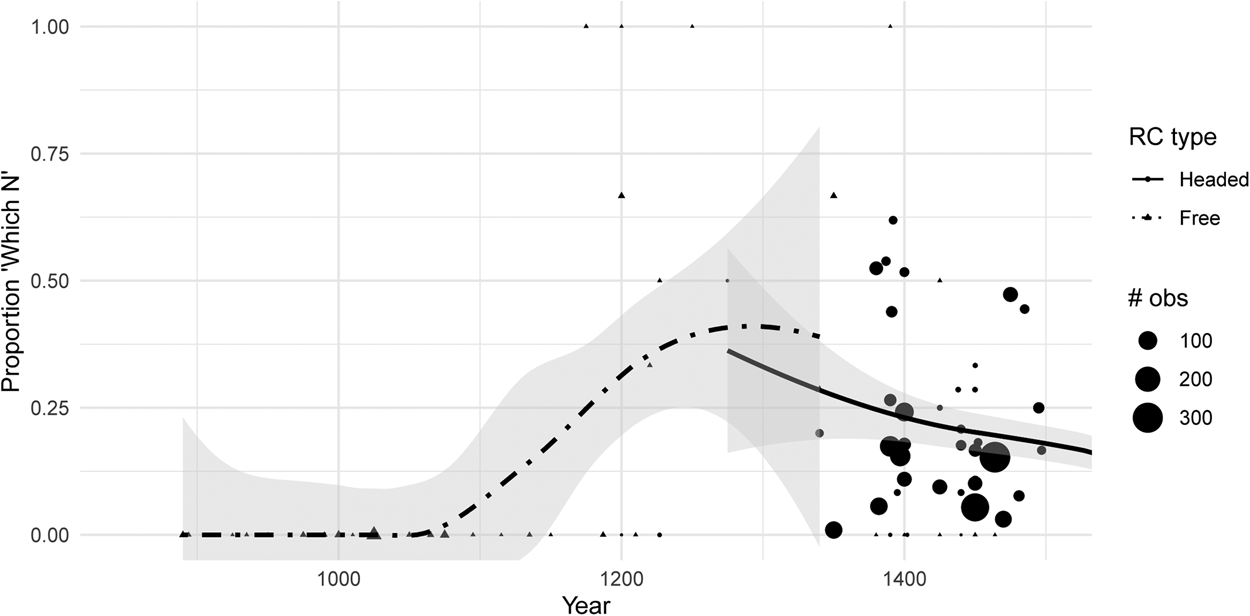
As soon as headed which-relatives appear in the textual record, examples with nonreferential antecedents are found. This means that there is no period during which the only headed relatives were nonrestrictive.Footnote 14 Figure 5 shows this in two different ways: the left-hand plot shows how many which-relatives had a nonreferential antecedent, while the right-hand plot shows how many of the relatives modifying nonreferential antecedents were which-relatives.Footnote 15 In each case, we see an upward trend across the period covered, but in each case, the regression line starts above zero.Footnote 16
Proportion of which-relatives and other relatives that have a nonreferential antecedent.

Text-by-text inspection of results confirm that even in the mid–late 14th century, every major text has a nonzero proportion of nonreferential antecedents for its headed which-relatives. Example (19) illustrates this for a selection of mid–late 14th-century texts, immediately after the emergence of headed which-relatives.

This falsifies the simplest form of the hypothesis that headed which-relatives inherit the semantic properties of free which-relatives: as noted in the introduction, there is a literature, beginning with Curme (Reference Curme1912), in which free which-relatives are taken to be closer to nonrestrictive relatives than to restrictive relatives, but at no point in the history of English did which only occur in free and nonrestrictive relatives, so the historical sequence of events has not been directly conditioned by this semantic overlap.Footnote 17 However, in the following section we consider of the role of NP complements, which reveals a robustly nonrestrictive type of which-relative.
4.5 Headed which-relatives with and without NP
Without exception, no headed which-relatives with an overt NP complement take a nonreferential antecedent with no, few, little, each, or every. This absence is statistically highly unlikely to be a matter of chance. We can construct a simple estimate of the expected number of which NP-relatives with a nonreferential antecedent as follows: among all the corpus texts written since the Ayenbite of Inwyt in 1340, there are 223 examples of which-relatives with nonreferential antecedents. In the same texts, the frequency of NP complements of which in headed relatives is  $1620 \div 18\comma \;318\approx 0.09$. We therefore expect $223 \times 1620 \div 18\comma \;318\approx 20$ which NP-relatives with nonreferential antecedents, as opposed to an observed value of 0. A binomial test (0 successes in 223 trials, with a hypothesized probability of success of $1620 \div 18\comma \;318$) returns p < 10−8.
A more subtle estimate of the expected value, suggested by Igor Yanovich (p.c.), takes into account the fact that the use of which with nonreferential antecedents increases over this period, while the use of NP complements of which declines over the same period. To control for this, we repeated the same binomial test described above for each individual text (that is, if a text has n which-relatives with nonreferential antecedents, and if the proportion of all which-relatives in the text with an overt NP restrictor is p, we used binomial tests to obtain for each text the probability that 0 of the n which-relatives with nonreferential antecedents had an overt NP restrictor). We then took the product of these text-by-text probabilities, to obtain the probability of 0 observations across the whole dataset. According to this estimate, that probability p = 0.002.
For a final estimate, with somewhat different weaknesses from the previous one, we used loess smoothers with R's default parameter settings to estimate the frequency of these two variables year-by-year (see the dashed and dotted lines in Figure 6), and then, for each text, estimated the expected number of which NP-relatives with nonreferential antecedents on the basis of these two values for the year of the text's composition (the thick black line in Figure 6). Summing these text-by-text estimates gives us a prediction of 22 such examples, almost unchanged from our first simple estimate. Although we do not have a precise p-value for 0 observations using this method, we used the 95% confidence interval on the product of the two loess smoothers (the solid grey line at the bottom of Figure 6) to derive a criterial value of 10 observations for p < 0.05. Accordingly, 0 observations is again very low probability.
Expected frequency of which NP-relatives with nonreferential antecedents over time (thick black line), plus lower bound of 95% confidence interval (solid grey line), calculated as the product of loess smoothers tracking the frequency of which among all relative clauses modifying nonreferential DPs (dashed line), and the frequency of NP complements of which in headed relatives (dotted line). The y-axis has a logarithmic scale, except that the point marked ‘0’ represents all values ≤0.001.

We can then be reasonably sure that the absence of which NP-relatives with nonreferential antecedents is real, and surprising. This refines the picture from Section 4.4: although bare headed which-relatives are never categorically nonrestrictive, headed which-relatives with NP complements are always nonrestrictive, throughout their c.600-year existence.Footnote 18
Given our confidence in this result, we can sharpen the notion of referential antecedent relevant to nonrestrictive which NP-relatives. In many respects, these relatives pattern just like Present-Day English nonrestrictive which-relatives (with no NP complement). For a start, classic donkey-anaphora configurations like (20) can be found, parallel to Sells’ example (15a).

This extends to modal and other subordination phenomena in the sense of Roberts (Reference Roberts1987), where Sells’ (21) is structurally quite similar to Early Modern English (22).

Also broadly similar to Present-Day English, a quantified noun phrase does not license introduction of a plural discourse referent corresponding to the domain of quantification. That is, examples like (23) are infelicitous in Present-Day English and absent from the historical record.
(23) #Every book was on the shelf, [which were arranged in alphabetical order].
However, unlike Present-Day English, the antecedent of a which NP-relative need not be a single accessible discourse referent. Examples like (24) are found, in which the antecedent of which Townes is the sum of the Town of Rowcastell and the Town of Langton. That is, the antecedent of a which NP-relative can correspond to the sum of multiple accessible discourse referents.

Corresponding configurations in Present-Day English are ungrammatical.
(25) #Coldstream is in Scotland and Cornhill is in England, [which are on opposite sides of the Tweed].
We do not currently have a synchronic or diachronic account of this difference, but we suspect that the overt NP complement facilitates retrieval of this antecedent.Footnote 19 A similar effect is found with Present-Day English demonstratives: they in (26a) is most naturally interpreted as referring to Philip, Roger, and their men, while (26b) shows that a demonstrative that explicitly mentions towns can refer to the presumably less topical Rowcastle and Langton.
(26)
a. Philip and his 300 men burned Rowcastle. Roger and his 300 men burned Langton. They are two miles beyond Jedworth.
b. Philip and his 300 men burned Rowcastle. Roger and his 300 men burned Langton. These towns are two miles beyond Jedworth.
Finally, we note one example which apparently contradicts several of the above generalizations. Example (27) appears to make liberal use of coercion of the sort that is infelicitous in (25). The wh-phrase the which holes surely refers to the plurality of holes indirectly implied by the participle holed, even though the participle is in the scope of two universal quantifiers.

It is hard to interpret this single example. A corresponding structure (like (28)) would clearly be impossible in Present-Day English.Footnote 20
(28) #Every vertebra is holed on every side, which [ = the holes] are …
This may mean that our conclusion about absence of coerced group antecedents in Middle and Early Modern English is inaccurate, but it may equally indicate that (27) is an outlier.
5. Discussion and Conclusion
Our main empirical result can be summarized as follows. Which NP-relatives are always nonrestrictive. Bare headed which-relatives can always be restrictive or nonrestrictive, although they come to be found more in restrictive relatives over time. Having clear, formally grounded criteria for identifying restrictive relatives has allowed us to find unambiguously restrictive which-relatives, even among the earliest headed which-relatives, and thereby falsify our (2015) claim that the early headed which-relatives are nonrestrictive.
There are two remaining questions, which we discuss briefly here as an invitation to further research. The first is why we don't find a period during which all headed which-relatives, even bare ones, are nonrestrictive. After all, the logic of reanalysis would lead us to expect such a stage. As noted above, there are clearly identifiable contexts for reanalysis of free relatives as nonrestrictive relatives, and also for reanalysis of nonrestrictive relatives as restrictive, but no context that we can see which would allow direct reanalysis of free relatives as restrictive. The natural diachronic pathway would then appear to be from free, to nonrestrictive, to restrictive relatives. We don't have an answer for this, but hope that it is related to other differences in bare and nonbare interrogative–indefinites, such as those discussed by Šimík (Reference Šimík2018) and Belyaev and Haug (Reference Belyaev and Haug2018).
The second question is why which NP-relatives are so stably nonrestrictive, when so many other aspects of the grammar of English relativization are in flux. The question can be sharpened by considering the approach to E-type anaphora in Elbourne (Reference Elbourne2001). Elbourne assumes with Postal (Reference Postal and Dinneen1966) that pronouns are just intransitive determiners, so the differs from she or it in transitivity and inflectional marking. On Elbourne's analysis, E-type pronouns require a covert copy of the antecedent NP as a complement of the pronoun. That is, (29a) has an LF representation like (29b), where strikethrough represents elided material.

Because nonrestrictive relativizers are a species of E-type anaphor, we should expect the same to hold of them. Moreover, anaphora has been analysed as an extreme form of deaccenting. We might then expect the distinction between nonrestrictive bare which and nonrestrictive which NP to reduce to the distinction between ellipsis and deaccenting.
In this way, Elbourne's analysis of E-type anaphora grows naturally into an account of why which NP relatives can be interpreted nonrestrictively. Something more needs to be said about why they must be interpreted like this.
We offer the following conjecture. The absence of restrictive which NP-relatives reflects the distribution of repetition, or redundancy, in discourse. Languages exhibit redundancy in abundance, as is well known, but at the same time, redundancy frequently leads to degradation or illformedness. An example of well-formed redundancy is verbal agreement, where the verb redundantly recapitulates information also encoded in its arguments. An example of ill-formed redundancy is (30), in which the property λx.bike′(x) is predicated of the individual in question twice.
(30) #a bike [which (really) is (indeed) a bike]
In PDE, nonrestrictive relatives are more tolerant than restrictive relatives of such redundancy: although (31), out of context, is somewhat weird, it is clearly more acceptable than (30).
(31) this bike, [which (really) is (indeed) a bike]
Perhaps this reflects the fact that nonrestrictive relatives, unlike restrictive relatives, express an independent proposition. It is quite normal for a content noun to be repeated across independent sentences, for instance.
(32) Yesterday I bought a bike. This bike has twelve gears.
So our conjecture is that the problem with a restrictive relative like (33) is related to the problem with a restrictive relative like (30), in that both reflect a prohibition on certain types of redundancy within restrictive relatives.
(33) a bike [which bike has ten gears]
However, despite the stability of the association of which NP with nonrestrictive interpretations in English, Cinque (Reference Cinque2011) surveys what he calls doubly headed relatives, with NP heads internal and external to the relative, in a range of languages. His data appears to contain both restrictive and nonrestrictive examples, although it is not clear whether he uses the same criteria we have used in his article. Cinque's survey would then appear to suggest that the association of which NP with nonrestrictiveness, however stable in the history of English, is still a parochial fact about English, and an explanation in the general terms just given may then not be appropriate. Alternatively, it may turn out that Cinque's operationalization of the notion of ‘nonrestrictive’ differs from ours. We are still some way, then, from a complete understanding of the basis of contrast between which NP and bare which in English, and its typological context.
CORPORA
PPCEME: Penn–Helsinki Parsed Corpus of Early Modern English.
PPCME2: Penn–Helsinki Parsed Corpus of Middle English, 2nd edition.
PCMEP: Parsed Corpus of Middle English Poetry.
PLAEME: Parsed Linguistic Atlas of Early Middle English.
YCOE: York–Toronto–Helsinki Parsed Corpus of Old English Prose.
SUPPLEMENTARY MATERIALS
To view supplementary material for this article, please visit http://doi.org/10.1017/cnj.2020.11.



